Brazilian-Portuguese version of the Defense Style
Questionnaire (DSQ-40) for defense mechanisms
measure: a preliminary study
Versão em português do
Defense Style Questionaire
(DSQ-40) para avaliação dos mecanismos de defesa:
um estudo preliminar
Carolina Blaya,
aLetícia Kipper,
aElizeth Heldt,
aLuciano Isolan,
aLúcia Helena Ceitlin,
aMichael Bond
band Gisele Gus Manfro
aAbstract
Abstract
Abstract
Abstract
Abstract
The aim of this study is to describe the translation and adaptation process of the Defense Style Questionnaire (DSQ-40) into Brazilian-Portuguese version. The instrument has also contended validation evaluation.
Methods::::: The first version of the scale was presented to five individuals with different schooling for language adaptation. Afterwards the instrument was presented to three experts that evaluated its content validation. The final version was back-translated and accepted by the original author.
Results: Vocabulary adjustments were needed in 9 items and language adaptation in 4 items in order to render the final DSQ-40 Brazilian-Portuguese version. The mean of experts’ correlation to each defense was 89%, being 100% to mature, neurotic and immature factors.
Conclusion: The adaptation of DSQ-40 by different individuals and the group of experts enabled the necessary adjustment to the Brazilian socio-cultural reality.
K KK K
Keywordseywordseywordseywordseywords: Defense mechanisms; Translating; Questionnaires.
Resumo
Resumo
Resumo
Resumo
Resumo
O objetivo desse estudo é o de descrever o processo de tradução e adaptação do Defense Style Questionnaire (DSQ-40) versão em português e avaliar a validade de conteúdo dessa versão do instrumento.
Métodos MétodosMétodos Métodos
Métodos: A primeira versão da escala foi apresentada para cinco indivíduos, com graus diferentes de escolaridade, que efetuaram pequenos ajustes de linguagem. Posteriormente, a escala foi apresentada para três “experts”, que avaliaram a validade de conteúdo do instrumento. A versão final foi retraduzida e apresentada para o autor do instrumento original que aceitou essa versão do DSQ-40.
Resultados ResultadosResultados Resultados
Resultados: Houve necessidade de pequenos ajustes no vocabulário em nove questões e modificações na linguagem em quatro questões, resultando na versão final do instrumento. A média de correlação dos “experts” com cada defesa foi de 89%, e dos fatores maduros, imaturos e neuróticos foi de 100%.
Conclusões ConclusõesConclusões Conclusões
Conclusões: A adaptação do DSQ-40 por diferentes indivíduos com diferentes graus de escolaridade e pelo grupo de experts possibilitou o ajuste à realidade sociocultural brasileira.
Descritores DescritoresDescritores Descritores
Descritores: Mecanismos de defesa; Tradução/processo; Questionários.
aClinical Hospital of Porto Alegre (HCPA)
bSir Mortimer B. Davis-Jewish General Hospital and McGill University, Montreal
Introduction IntroductionIntroduction IntroductionIntroduction
Ego defense mechanisms, a psychoanalytical concept, have been defined as an indicative of how individuals deal with conflict. The defensive style is considered to be an important dimension of the individual’s structure of personality1 and has turned into
the first psychoanalytical concept recognized by the DSM-IV as axes for future studies.2
Bond et al developed the DSQ as a self-report questionnaire with 67 items to assess conscious derivatives of defense mechanisms.3
The aim of this instrument is to identify the characteristic style of how people – conscious or unconscious – deal with conflict based on the idea that people can accurately comment on their behavior. Andrews et al reorganized the instrument into forty questions related to the twenty defenses described in the DSM-III-R.4 Four
defenses are related to the mature factor (sublimation, humor,
anticipation and suppression); four are related to the neurotic factor (undoing, pseudo-altruism, idealization and reaction formation), and twelve are related to the immature factor (projection, passive-aggression, acting-out, isolation, devaluation, “autistic fantasy”, denial, displacement, dissociation, splitting, rationalization and somatization). The DSQ-40 can provide scores for the 20 individual defenses, and scores for the three factors (mature, neurotic, and immature). The individual defense scores are calculated by the average of the two items for each given defense mechanism, and the factor scores are calculated by the average scores of the defenses that belong to each factor. Each item is evaluated on a scale from 1 to 9, where “1” indicates “completely disagree” and “9” indicates “fully agree”.
Validation studies of the DSQ-40 describe the correlation of mature defenses to physical and mental health, ego development,
Rev Bras Psiquiatr. 2004;26(4):255-8
255
Brazilian Portuguese version of the DSQ-40 / Blaya C et al Rev Bras Psiquiatr. 2004;26(4):255-8
256
marital and professional satisfaction and happiness.5 It has also
been compared to an instrument that evaluates defense mechanisms via clinical interview.5 Only the three factors have
been validated by these studies.
The instrument has been translated and validated into Finnish, French and Japanese with similar results to the original questionnaire6-8 and has been used in other cultures, with
simi-lar results, but in non-validated versions.1
The aim of this study is to translate and adapt the DSQ-40 into a Brazilian-Portuguese version and to evaluate its content validity with three different experts restricted to the mature, immature and neurotic factors. The viability of this instrument in Brazil will probably enhance studies on psychoanalytical psychotherapies.
Methods Methods Methods Methods Methods
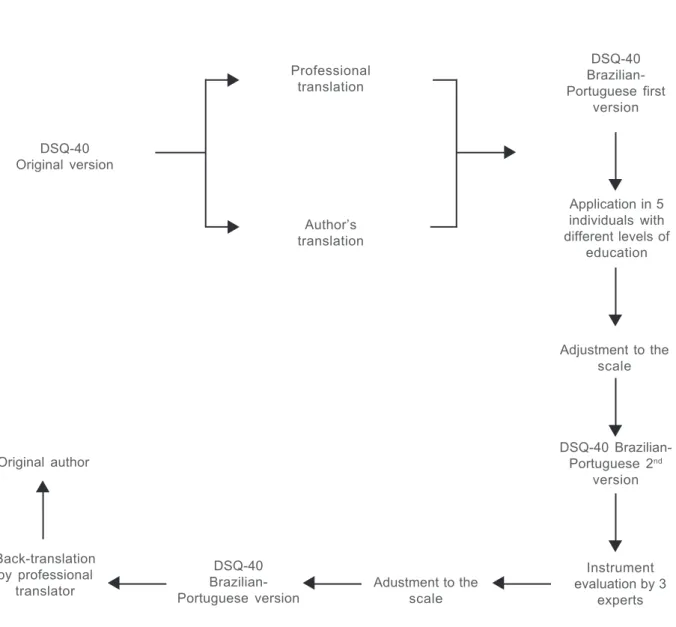
With the permission of the author, the scale was translated into Brazilian-Portuguese. A bilingual psychiatrist, and a professional translator simultaneously performed the translation of the DSQ-40. The two Brazilian versions of the instrument were compared resulting in a preliminary version. This version was applied to 5 individuals of different socio-cultural levels in order to verify the understanding of each question from different cultural and socioeconomic strata. The sample was intentionally selected by convenience method, based on educational background. Subjects had different schooling levels, ranging from elementary school up to college. Subjects evaluated the questions of the instrument in individual interviews, discussing the understanding of each item with the interviewer. The study was previously approved by the Committee for Research Ethics of the Clinical Hospital of Porto Alegre and all individuals gave their informed consent before participating in the research.
Three experts performed the content validity. The experts were outstanding psychiatrists – with psychoanalytical training, more than twenty years of clinical psychotherapy practice – and availability to participate in the study. The experts were asked to correlate the items to each defense. When available, definitions of the DSM-IV were used as a guide. After the experts’ suggestion, the final version of the DSQ-40 was elaborated. The final version was then back-translated by a professional translator whose English is her native language and who had had no previous contact with the instrument. The back-translated version was then sent to the original author who has not pointed out any differences between the original and the Brazilian-Portuguese back-translated version (Figure 1).
Results Results Results Results Results
The final version of the DSQ-40 in Brazilian Portuguese is available upon request. Vocabulary adjustments were needed in 9 items and language adaptation in 4 items. Vocabulary adaptations were also needed in items 2, 3, 9, 15, 20, 22, 28, 35. Language adjustments were needed in items 1, 10, 24, 39. The mean of experts’ correct allocation of items to defenses was 89%, and to mature, neurotic and immature factors it was 100%. Two items were incorrectly allocated by the three experts (items 10 and 31), but all experts recognized the correct answer afterwards.
Discussion Discussion Discussion Discussion Discussion
Translation and adaptation of an instrument into another culture demands a careful methodology,9 mainly when dealing with
psychometric measures. Psychiatric disorders, and their clinical manifestations, as well as people’s perception of their defense mechanisms may be influenced by different cultures and social contexts.9
Any translation process is subject to innumerous distortions that may invalidate the instrument. Several authors9-10 strongly
recommend that when a scale is used in a different language from the original, it must undergo an accurate translation, cul-tural adaptation and validation. The approval of the back-translation version of the DSQ-40 from Brazilian-Portuguese into English by the author of the original scale supports the accuracy of the methodology employed.
The content validity of our version is similar to that of other studies.6,11 All experts misinterpreted the items related to
devaluation and displacement, which can be explained by the DSM-IV12 definition of these defenses. Displacement and
devaluation are concepts that are often juxtaposed. On the other hand, literature validated only the three factors of the DSQ and not each specific defense mechanism. Brazilian experts, in accordance with other studies, also adequately characterized all the items into the mature, immature and neurotic factors.
Many different studies, in Brazil, used a version of the DSQ-40 that had not been validated yet,13-15 but their results agreed the
available data.1
Cultural adaptation of a translated instrument enables individuals to judge their behavior more adequately and therefore recognize their defense style. Even though the use of the DSQ in Brazil can enhance research into psychodynamic aspects of the patients, studies of validation of this instrument are still necessary.
The limitations of this study must be acknowledged since it is a preliminary step of a validation process. In order to compare the results achieved in Brazil though the use of the Brazilian-Portuguese scale, careful validation studies must be undertaken to show its reliability.
Acknowlegments Acknowlegments Acknowlegments Acknowlegments Acknowlegments
The authors express their esteem to Dr. José Blaya Perez Filho, Dr. Cláudio Eizirik and Dr. Sidney Schestatsky for their collaboration.
F FF
FFinanciamento:inanciamento:inanciamento:inanciamento:inanciamento: FIPE do HCPA, número do processo 03-117 e CAPES
Received in 02.12.2004 Accepted in 04.07.2004
Refer ReferRefer Refer Referencesencesencesencesences
1. Blaya C, Kipper L, Perez Filho JB, Manfro GG. Mecanismos de defesa: uso do Defense Style Questionnaire. Rev Bras Psicoter. 2003;5(1):67-80. 2. Skodol AE, Perry JC. Should an axis for defense mechanisms be included in DSM-IV? Compr Psychiatry. 1993;34(2):108-19. Review. 3. Bond M, Gardner ST, Christian J, Sigal JJ. Empirical study of self-rated defense styles. Arch Gen Psychiatry. 1983;40(3):333-8.
4. Andrews G, Singh M, Bond M. The Defense Style Questionnaire. J Nerv Ment Dis. 1993;181(4):246-56.
5. Bond M, Perry C, Gautier M, Goldenberg M, Oppenheimer J, Simand J. Validating the self-report of defense styles. J Personal Disord. 1989;3(2):1-12. 6. Bonsack C, Despland JN, Spagnoli J. The French version of the Defense Style Questionnaire. Psychother Psychosom. 1998;67(1):24-30. 7. Sammallahti P, Aalberg V, Pentinsaari JP. Does defense style vary with severity of mental disorder? An empirical assessment. Acta Psychiatr Scand. 1994;90(4):290-4.
8. Nishimura R. Study of the measurement of defense style using Bond’s Defense Style Questionnaire. Psychiatry Clin Neurosci. 1998; 52(4):419-24. 9. Meyer E, Carvalhal A, Pechansky F. Adaptation for Brazilian Portuguese of a scale to measure willingness to wear condoms. Rev Bras Psiquiatr. 2003;25(4):224-7.
10. Fleck MPM, Leal OF, Louzada S, Xavier M, Chachamovich E, Vieira G, et al. Desenvolvimento da versão em português do instrumento de avaliação de qualidade de vida da OMS (WHOQOL-100). Rev Bras Psiquiatr. 1999;21(1):19-28.
Rev Bras Psiquiatr. 2004;26(4):255-8
257
Brazilian Portuguese version of the DSQ-40 / Blaya C et al
F FF F
Figure 1 - Methodology steps in the translationigure 1 - Methodology steps in the translationigure 1 - Methodology steps in the translationigure 1 - Methodology steps in the translation, transcultural adaptation and content validity of Brazilian-Pigure 1 - Methodology steps in the translation, transcultural adaptation and content validity of Brazilian-P, transcultural adaptation and content validity of Brazilian-Por, transcultural adaptation and content validity of Brazilian-P, transcultural adaptation and content validity of Brazilian-Porororortuguese version oftuguese version oftuguese version oftuguese version oftuguese version of Defensive Style Questionnaire (DSQ-40)
Defensive Style Questionnaire (DSQ-40)Defensive Style Questionnaire (DSQ-40) Defensive Style Questionnaire (DSQ-40) Defensive Style Questionnaire (DSQ-40)
Professional translation
DSQ-40 Original version
DSQ-40 Brazilian-Portuguese first
version
Author’s translation
Original author
Application in 5 individuals with different levels of
education
DSQ-40
Brazilian-Portuguese 2nd
version
Instrument evaluation by 3
experts Adjustment to the
scale
DSQ-40 Brazilian-Portuguese version Back-translation
by professional
translator Adustment to the
scale
12. Diagnostic and statistical manual of mental disorders: dsm-iv. 4 ed. Washington: American Psychiatric Association; 1994.
13. Blaya C, Teruchkin B, Isolan LR, Mezzomo K, Zanardo AP, Hirakata VN, et al. Avaliação dos mecanismos de defesa em pacientes com fobia social: um estudo de caso-controle. Rev Psiquiatr Rio Gd do Sul. 2002;24(3):305-10.
14. Kipper L, Blaya C, Teruchkin B, Heldt E, Isolan L, Mezzomo K, et al. Brazilian patients with panic disorder: the use of defense mechanisms and their association with severity. J Nerv Ment Dis. 2004;192(1):58-64. 15. Heldt E, Manfro GG, Kipper L, Blaya C, Maltz S, Isolan L, et al. Treating medication-resistant panic disorder: predictors and outcome of cognitive-behavior therapy in a Brazilian public hospital. Psychother Psychosom. 2003;72(1):43-8.
Brazilian Portuguese version of the DSQ-40 / Blaya C et al Rev Bras Psiquiatr. 2004;26(4):255-8
258
APPENDIX APPENDIX APPENDIX APPENDIX APPENDIX
DSQ-40 portuguese version DSQ-40 portuguese version DSQ-40 portuguese version DSQ-40 portuguese version DSQ-40 portuguese version
1. I get satisfaction from helping others and if this were taken away from me I would get depressed .
2. I am able to keep a problem out of my mind until I have time to deal with it.
3. I work out my anxiety thourgh doing something constructive and creative like painting and woodwork.
4. I am able to find good reasons for everything I do. 5. I am able to laugh at myself pretty easily.
6. People tend to mistreat me.
7. If someone mugged me and stole my money, I’d rather he be helped than punished.
8. People say I tend to ignore the unpleasant facts as if they didn’t exist .
9. I ignore danger as if I were Superman.
10. I pride myself on my ability to cut people down to size. 11. I often act impulsively when something is bothering me. 12. I get physically ill when things aren’t going well for me. 13. I am a very inhibited person.
14. I get more satisfaction from my fantasies than from my real life. 15. I have special talents that allow me to go thought life without problems.
16. There are always good reasons when things don’t work out for me. 17. I work more things out in my daydreams than in my real life. 18. I fear nothing.
19. Sometimes I think I am an Angel and other times I think I am a devil.
20. I get openly aggressive when I feel hurt.
21. I always feel that someone I know is like a guardian Angel. 22. As far as I am concerned, people are either good or bad. 23. If my boss bugged me, I might make a mistake in my work or work more slowly so as to get back at him.
24. There is someone I know who can do anything and who is absolutely fair and just.
25. I can keep the lid on my feelings if they letting them out would interfere with what I am doing.
26. I am usually able to see the funny side of an otherwise painful predicament.
27. I get a headache when I have to do something I don’t like. 28. I often find myself being very nice to people who by all rights I should be angry at.
29. I am sure I get a raw deal from life.
30. When I have to face a difficult situation I try to imagine what it will be like and plan ways to cope with it.
31. Doctors never really understand what’s wrong with me. 32. After I fight for my rights, I tend to apologize for my assertiveness. 33. When I am depressed or anxious, eating makes me feel better. 34. I am often told that I don’t show my feelings.
35. If I can predict that I am going to be sad ahead of time, I can cope better.
36. No matter how much I complain, I never get a satisfactory response.
37. Often I find that I don’t feel anything when the situation would seem to warrant strong emotions.
38. Sticking to the task at hand keeps me from feeling depressed or anxious.
39. If I were in a crisis, I would seek out another person who had the same problem.