Official Journal of the Brazilian Psychiatric Association Volume 34 • Number 3 • October/2012
Psychiatry
Revista Brasileira de Psiquiatria
Abstract
Introduction: This cross-sectional study assessed the prevalence of psychiatric disorders among drivers , as well as the association between recent alcohol and drug use and psychiatric diagnoses using telephone interviews. Methods:Drivers (n = 1,134) included in a roadside survey from 25 Brazilian state capitals were given a breathalyzer test, and their saliva was tested for psychoactive drugs. A telephone interview was conducted to perform psychiatric disorder evaluations using the MINI. This association was analyzed with a Poisson regression model. Results: The prevalence of any psychiatric disorder was 40.5% among drivers with recent alcohol or drug use, compared with 12.9% among the other drivers. Alcohol/drug-positive drivers reported a higher prevalence of depression (19.4%), mania (6.5%), hypomania (5.4%), post-traumatic stress disorder (8.6%), antisocial personality (7.8%), and substance/alcohol abuse or dependence (48.1%) compared with other drivers (3.5, 2.5, 2.1, 0.5, 1.3 and 18.3% [p < 0.001], respectively). Drivers with recent alcohol or drug use were 2.5 times more likely to have a psychiatric diagnosis (CI: 1.8-3.6, p < 0.001).Discussion:This is the irst study in a low-/middle-income country to evaluate psychiatric
disorders in drivers with recent alcohol or drug using telephone interviews. Psychiatric disorders were found to be associated with drug and alcohol use. This type of epidemiological information for curtailing related driving problems, as these psychiatric conditions are diagnosable. Final Remarks: The results of this study can aid in the design of interventions, treatment programs and focused psychiatric evaluations, both in Brazil and abroad.
Psychiatric disorders among individuals who drive after the
recent use of alcohol and drugs
Sibele Faller,
1J. Matthew Webster,
2Carl G. Leukefeld,
2Daniela Benzano Bumaguin,
1Paulina do Carmo Arruda Vieira Duarte,
3Raquel De Boni,
1Flavio Pechansky
11 Center for Drug and Alcohol Research, Universidade Federal do Rio Grande do Sul, Brazil 2 Center on Drug and Alcohol Research, University of Kentucky (UK), Lexington, KY, USA 3 Secretaria Nacional de Políticas sobre Drogas (Brazilian Secretariat for Drug Policies), Brazil
Received on October 7, 2011; accepted on February 29, 2012
DESCRIPTORS Drivers; Alcohol; Drugs;
Psychiatric Disorders; Telephone.
ORIGINAL ARTICLE
Corresponding author: Sibele Faller. Room 2350/2201-F, Ramiro Barcelos St. 90035-903 Porto Alegre, RS, Brazil. E-mail: [email protected] 1516-4446 - ©2012 Elsevier Editora Ltda. All rights reserved.
Transtornos psiquiátricos entre indivíduos que dirigem sob uso recente de álcool e drogas
Resumo
Introdução: Este estudo transversal avaliou a prevalência de transtornos psiquiátricos e a associação entre dirigir alcoolizado e transtornos psiquiátricos entre motoristas por meio de entrevistas telefônicas. Método:Motoristas (n = 1.134) selecionados a partir de um estudo realizado nas rodovias de 25 capitais brasileiras foram etilometrizados e tiveram sua saliva testada para substâncias psicoativas. Uma entrevista por telefone foi realizada para obter dados sobre transtornos psiquiátricos através do MINI. A associação entre transtornos psiquiátricos e dirigir com uso recente de substâncias foi analisada com um modelo de regressão de Poisson. Resultados: A prevalência de transtornos psiquiátricos foi de 40,5% entre os motoristas que beberam/usaram drogas, em comparação com 12,9% nos demais motoristas. Motoristas que dirigiram com uso recente de substâncias relataram uma maior prevalência de depressão (19,4%), mania (6,5%), hipomania (5,4%), transtorno de estresse pós-traumático (8,6%), personalidade antissocial (7,8%), e abuso ou dependência de álcool/drogas (48,1%) quando comparados com os outros motoristas (3,5%, 2,5%, 2,1%, 0,5%, 1,3% e 18,3%, p < 0,001), respectivamente). Motoristas com uso recente de substâncias apresentaram 2,5 mais chance de ter qualquer diagnóstico psiquiátrico (IC: 1,8-3,6, p < 0,001). Discussão:Este é o primeiro estudo em países de baixa e média renda cujo objetivo é avaliar transtornos psiquiátricos em motoristas com uso recente de substâncias por meio de entrevistas telefônicas. Transtornos psiquiátricos foram associados com o comportamento de dirigir com uso recente de substâncias. Este tipo de informação epidemiológica é fundamental para estratégias de planejamento que visam enfrentar problemas relacionados com o beber e dirigir, uma vez que estas condições psiquiátricas são diagnosticáveis .
Observações Finais:Os resultados deste estudo podem auxiliar no desenvolvimento de intervenções, programas de tratamento e avaliação psiquiátrica, tanto no Brasil quanto no exterior.
DESCRITORES: Motoristas; Álcool; Drogas; Transtornos psiquiátricos; Telefone.
Introduction
According to the World Health Organization, low-and
middle-income countries (LAMICs) have higher road trafic fatality
rates (21.5 and 19.5 per 100,000 people, respectively) than high-income countries 10.3/100,000 people, making vehicle crashes a serious concern for public health.1 Although 90%
of trafic deaths occur in developing countries, data on risk factors are limited, making it dificult to conduct systematic
studies on the characteristics of the drivers who cause these fatal crashes. Because the use of alcohol is associated with
41% of all trafic accidents, understanding the degree to which individuals drive under the inluence (DUI) of alcohol
or other drugs, as well as whether they have comorbid psy-chiatric problems,2,3 would provide valuable information for policy planning and prevention efforts.
The Brazilian government is struggling to develop ad-equate policies against DUI based on reliable data. There have been few studies suggesting that the prevalence of drinking and driving among Brazilian drivers is markedly high. Pechansky et al.,4 based on an analysis of data from
the irst National Survey on Household Consumption Patterns
of Alcohol4 found that approximately 34% of drivers reported drinking and driving in the past year. This percentage is more than twice (13.2%) the percentage of adults who reported alcohol-impaired driving in the U.S.A,5 and 85 (0.4%) times higher than rate in Norway.6 Brazil has limited information on how many individuals drive after drinking alcohol or
us-ing drugs, and there are no published indus-ings related to psychiatric disorders and their relationships to trafic and
driving in the country, which may be due to geographical
and inancial dificulties. The lack of data on this issue is an important void, as driving under the inluence of alcohol
or drugs has been associated with a high prevalence of psy-chiatric conditions in the U.S., and it is reported in several studies to be a factor associated with an increased risk of crash.3,7-14 Therefore, “What is the rate of psychiatric dis-orders among impaired drivers?” is an important research question, particularly in Brazil because the country is pass-ing through a period of interest in the relationship between
alcohol and trafic accidents. The government has shown its
intention to reorganize public policies to this need, such as by the recent the implementation of the new “dry law” and increased investment in research in the area.
In 2001, an important study of 1,105 DUI offenders7 revealed that, among those drivers with a lifetime alcohol-use disorder, 50% of women and 33% of men were diag-nosed with at least one psychiatric condition, often major depressive disorder and/or PTSD, as well as drug abuse or dependence. In contrast to the prevalence found from the National Comorbidity Survey (NCS) impaired drivers exhibit a higher-than-expected prevalence of psychiatric disorders. For example, 61% (women) and 70% (men) of respondents demonstrated lifetime alcohol dependence, which is more than twice the respective NCS sample prevalence. The
pos-sibility that vehicle crashes and drug use are inluenced by
psychiatric disorders is supported by the literature, but most studies are conducted with samples of DUI offenders admitted to court-mandated treatment programs, and comparisons with road surveys are often made with different samples of drivers.8,9,12,13,15-18 Therefore, the determination of the
association between trafic accidents and psychiatric diag
-noses or identiication of risk factors for these morbidities
can determine interventions and post-treatment planning for driving offenders to reduce relapse, consumption and
The purpose of this study was to assess the prevalence of psychiatric disorders among drivers who drove under the
inluence of alcohol and other substances and the association
between impaired driving and psychiatric problems among drivers in Brazil utilizing telephone interviews with a contem-porary bioethics approach using rolling consent.19 Speciically, drivers who tested positive for substances were compared to those who did not with regard to mood disorders, PTSD and antisocial personality disorder (ASPD) – selected according to the prevalence in studies with similar samples. Consistent with the international literature, our hypothesis was that psychi-atric problems would be more prevalent among drivers who tested positive for substances via a breathalyzer or saliva test.
Methods
Participants
Volunteers who participated in this study were recruited during data collection for a larger study about the preva-lence of positive breath for alcohol and other psychoactive substances in professional and private drivers in Brazil.20,21 This was a cross-sectional study with a sample selected in blocks in each capital, proportional to the number of drivers
in the speciic state and stratiied by type of vehicle – auto -mobiles, motorcycles, buses and trucks with random
selec-tion in proporselec-tion to the leet size of each state. Private and
professional drivers who were driving on federal highways which intersect the metropolitan areas of 23 Brazilian state capitals were evaluated.
The sample size had to be calculated considering the limited budget available from the funding agency, and the prevalence of the use of amphetamines (6%, with a 2% margin
of error, and a conidence level of 95%) that we supposed
to be smaller than the use of alcohol. For that, 542 drivers should be included in each stratum, which would allow for an estimate of alcohol use of 30%, with a margin of error smaller than 1.5%. A minimum number of drivers per state (blocks) was determined. The states with estimated n < 100 or those whose n was very close to 100 were consolidated, with a total of 21 states (n = 100 x 21 = 2,100 cases). According to the previous calculation, a total of 1,288 (3,388-2,100) subjects would be divided among the other states with an estimated n > 100. The total of drivers of the states with n > 100 when added up resulted in 38,322,119 drivers, and the proportions for each state were recalculated based on
this igure. Finally, the number of drivers to be approached in
each state was estimated for this total of subjects that were a surplus in each state, maintaining an intermediate tercile (n = 138), and one single state was responsible for the last third of the sample (São Paulo, n = 550). The vehicles were selected proportionally to the number of vehicles in each stratum, according to random number lists generated prior to the data collection.
Data were collected on Fridays and Saturdays from 12 p.m. to 12 a.m. due to economic reasons and logistical details, including security issues. The main objective of the larger study was to estimate risk factors for driving with recent substances use and the prevalence of alcohol and other drugs among Brazilian drivers. During the roadside
survey, the presence of alcohol was veriied by a breatha -lyzer Alco-Sensor IV (Intoximeters, Inc), and the presence of
drugs – amphetamine, cocaine, marijuana (tetrahydrocannabi-nol – THC) and benzodiazepines – was ascertained via a saliva test (Quantisal, Inc). These procedures are less intrusive than other methods and consistent with recommendations found in the literature.22,23 For the screening method, the
ELISA assay was applied. Conirmatory analyses in oral luid
were performed by Liquid Chromatography Tandem Mass Spectrometry (LC-MS). At the end of the roadside survey interview, each participant was asked to provide his/her name and a telephone number for further contact. Attempts were made to contact all those who accepted to be called. Out of the 2,957 drivers interviewed in the main study, 2,580 (87.25%) agreed to have further contact. After a maximum of 5 attempts, 1,134 individuals had completed the tele-phone interview and 199 (7.71%) refused to participate at the time of telephone contact. Of the individuals who were not interviewed and did not formally refuse to participate, 300 (11.62%) were scheduled for further contact but did not respond to subsequent calls, and 947 (36.7%) were not found. This resulted in a response rate of 43.95 %. Approximately 8% (n = 94) of the sample tested positive for alcohol or drugs.
Measures
Demographics – gender, age, type of vehicle, employment and educational level - were obtained through a series of questions
developed speciically for the study and were based on ques -tionnaires of the Brazilian Institute of Geography and Statistics
(Instituto Brasileiro de Geograia e Estatísticas - IBGE).
Psychiatric disorders – current depressive episode, hy-pomanic/manic episode (grouped for Poisson Regression analysis), PTSD, substance abuse/dependence and ASPD - were measured by the Mini International Neuropsychiatric Interview (MINI), instrument adapted for the Brazilian context.24 The primary author was trained on the use of the Brazilian version of the MINI by one of the key investigators in the country.
Procedures
Telephone interviews were conducted by eight trained interviewers at a call center (through the structure of “VivaVoz”, a hotline for information and referrals about drug abuse). Interviewers were instructed to introduce themselves as investigators from the Universidade Federal
do Rio Grande do Sul in order to avoid adverse inluence
in the decision to participate. After being informed of the nature of the survey, drivers who consented had their assessment criteria checked. Two postgraduate level professionals were in charge of real time supervision during interviews. During data collection, monitoring of telephone interviews was conducted by the study coor-dinator (SF) – with consent from volunteers and through meetings to review logistical problems and assess quality control. Subjects were located and contacted with the minimum information needed to conduct the phone call
– only the irst name and telephone number were placed
Ethical Issues
Informed consent was obtained in stages with a rolling consent approach. This iterative process prevents the data from being completely discarded if the participant decides to leave the study and does not keep the individual feeling obligated to answer questions until the end of the interview, minimizing the chance of encountering embarrassment. The respondent was asked to consent at every change of section (1- initial consent; 2- between demographics and psychiatric section; and 3- between psychiatric and drug abuse section), so he/she could choose to continue or terminate the inter-view, therefore validating the information obtained before termination. The study was approved by the Institutional Review Board of Hospital das Clínicas of Porto Alegre.
Statistical analyses
Categorical variables were compared using a series of chi-square tests. In order to identify the association between
psychiatric disorders and driving under the inluence of
alcohol or drugs (dependent variable), a Poisson regres-sion model with robust variance estimator was conducted,
whereby prevalence ratios (PR) and conidence intervals (CI)
of 95% were estimated. The analysis was adjusted for gender,
age, income, educational level, and any substance abuse or
dependence – selected according to information found in
the literature.25-29 Due to the inding of co-linearity between
income and educational level, this last variable was removed from the model. Data were analyzed using SPSS v.18. (SPSS Inc., Chicago, IL, USA).
Results
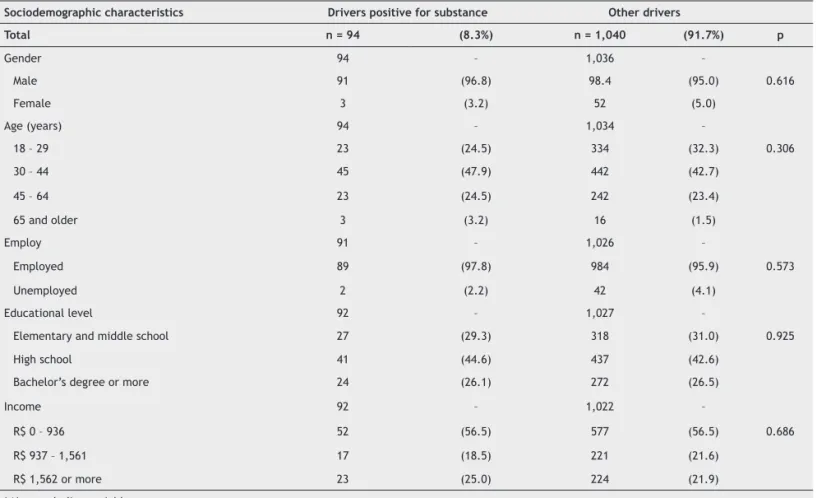
The sample was comprised primarily of men (95%) with a median of 36 years of age (P25: 28.0; P75:44.5). Participants and non-participants were compared regarding demographics using data collected via the main study. No statistical dif-ferences in demographic information were found between drivers who were positive versus those who were negative regarding alcohol/drug use. The total sample was analyzed according to the type of driver participation to determine whether those denying permission differed from those provid-ing permission in their “use of substances on the road status”. Comparing drivers who participated in the main study and did not agree to have further contact (6.9%); who answered the interview (8.3%); were not found (9.8%); and refused to participate (7.0%), the results demonstrated no statistically
signiicant difference (p = 0.20). The comparisons between
drivers with recent use of alcohol and other drugs and the other participants are shown in Table 1.
Drivers who tested positive for alcohol or drug use had a higher prevalence of psychiatric diagnoses when compared to the other drivers without alcohol and other drugs using bivariate analysis. The prevalence of any type of psychiatric
Table 1 Compared prevalence of sociodemographic characteristics between drivers who tested positive for substance use and other drivers in Brazil
Sociodemographic characteristics Drivers positive for substance Other drivers
Total n = 94 (8.3%) n = 1,040 (91.7%) p
Gender 94 – 1,036 –
Male 91 (96.8) 98.4 (95.0) 0.616
Female 3 (3.2) 52 (5.0)
Age (years) 94 – 1,034 –
18 – 29 23 (24.5) 334 (32.3) 0.306
30 – 44 45 (47.9) 442 (42.7)
45 – 64 23 (24.5) 242 (23.4)
65 and older 3 (3.2) 16 (1.5)
Employ 91 – 1,026 –
Employed 89 (97.8) 984 (95.9) 0.573
Unemployed 2 (2.2) 42 (4.1)
Educational level 92 – 1,027 –
Elementary and middle school 27 (29.3) 318 (31.0) 0.925 High school 41 (44.6) 437 (42.6)
Bachelor’s degree or more 24 (26.1) 272 (26.5)
Income 92 – 1,022 –
R$ 0 – 936 52 (56.5) 577 (56.5) 0.686 R$ 937 – 1,561 17 (18.5) 221 (21.6)
Table 2 Association of selected psychiatric disorders and use of substances among Brazilian drivers analyzed by Poisson regression
Psychiatric disorder Crude PR (95% CI)§ Adjusted PR (95% CI)§ p
Mood Disorders* 3.0 (2.1 – 4.3) 2.5 (1.7 – 3.7) < 0.001
PTSD† 15.9 (5.2 – 48.9) 4.5 (1.5 – 13.3) 0.006
ASPD‡ 6.0 (2.5 – 4.7) 3.1 (1.0 – 9.5) 0.039
Any Disorder 3.1 (2.3 – 4.3) 2.5 (1.8 – 3.6) < 0.001
* Depression, mania and hypomania.
† Posttraumatic stress disorder, not adjusted for gender due to the lack of women presenting this disorder in the study. ‡ Antisocial personality disorder, not adjusted for gender due to the lack of women presenting this disorder in the study. § Conidence Interval.
disorder was 40.5% among drivers who tested positive and 12.9% among the other drivers (p < 0.001). Drivers who were
tested positive reported a signiicantly higher prevalence of
psychiatric diagnoses of depression (19.4%), mania (6.5%), hypomania (5.4%), post-traumatic stress disorder (8.6%), an-tisocial personality (7.8%), and substance or alcohol abuse or dependence (48.1%) when compared to other drivers (3.5%, 2.5%, 2.1%, 0.5%, 1.3% and 18.3%, respectively). The results from the Poisson regression analysis are shown in Table 2.
According to the results of the Poisson regression
analy-sis, there was a statistically signiicant association between psychiatric disorders and driving under the inluence of
psychoactive substances. Even after variable adjustment, participants who tested positive for substances were 2.5 times more likely to have psychiatric symptoms.
Discussion
Psychiatric disorders and drivers with recent use
of alcohol and other drugs
Results show that psychiatric disorders were clearly associated with the practice of drunk/drugged driving in this sample of Brazilian drivers. Participants who tested positive for sub-stances were more likely to have mood disorder, PTSD, ASPD or any disorder. The prevalence of psychiatric problems among Brazilian drivers testing positive for alcohol or drugs was high compared to Australia (15.5%), Germany (31.1%), Netherlands (23.2%) and U.S. (26.2%) general population,30 although the sampling time chosen – a transition law period in Brazil – makes
it dificult to compare the present results with the prevalence of alcohol and drug indings in other countries. It is docu
-mented in the literature that drivers under the inluence of
alcohol and drugs present a greater prevalence of psychiatric disorders including alcohol and other substance abuse.7-9,18 In this study, like in the other studies published in international literature, mood disorders, PTSD, substance abuse and de-pendence were very prevalent psychiatric disorders in the sample of drivers who test positive for substances, indicating
the need for greater attention to these speciic disorders.9,31
What seems to be signiicant in relation to these results is the
important difference between the two types of drivers, even
when compared with the indings of other studies previously
conducted in the U.S.7 If drivers could be properly assessed and receive treatment for potential psychiatric problems,
the prevalence of driving under the inluence of alcohol and
drugs could eventually decrease. This, however, poses a tricky solution, since a screening of these symptoms and conditions
should be made at the preliminary stages of trafic education
and licensing for young drivers. Nevertheless, psychiatric test-ing to get a license or to have a suspended license reinstated
seems dificult to administer. Since most of these conditions
can be properly ascertained by a focused set of questions, this would imply much further training from examiners than what is typically provided in many LAMIC countries. Consequently, it seems that the mandatory substance use treatment for all DUI offenders would be more feasible. Some important changes in the environment, such as restriction on times for alcohol sales and banishment of alcohol in certain places like gas stations and bars on the roads, may be useful to address drivers’ be-havior regarding alcohol consumption. These policies must be aligned with adequate enforcement, which is currently limited in Brazil – a situation that can be overcome with additional resources and public support. The secondary focus of attention would be the referral for medical and eventually psychiatric
treatment of those cases properly identiied after a car crash or trafic violation before allowing them to return to driving.
Although data collection began soon after a new law passed in 2008 prohibiting the consumption of any level of alcohol or other substance by drivers in the country,32 the prevalence of drivers who tested positive for a substance (8%) seems to be high when compared to surveys conducted in Australia (3.7% positive for at least one illicit substance) and Norway (4.5% positive for alcohol or drugs) and similar when compared to Canada (8% for alcohol).6,33,34 According to the new Brazilian
law, drivers who drink may have to pay a ine, have their
license suspended for 12 months or even be arrested, an im-portant penalty, depending on the concentration of alcohol per liter of blood. So, considering the Brazilian socio-political context and surveys performed in other countries, we can say
that the prevalence of drivers who drove under the inluence
of any substance is relatively high and certainly helps maintain the frequency of vehicle crashes in Brazilian roads.
Implications
To the best of our knowledge, this is the irst study of
national scope in Brazil and in LAMIC that aims at evaluating psychiatric disorders of substance positive drivers who drove with recent use of alcohol and drugs measured by breatha-lyzer and saliva test, comparing this result with other driv-ers from the same sample. Also, we believe it was possible to set a landmark on the use of a contemporary bioethics approach through rolling or scaled consent applied through telephone surveys in Brazil. Another great strength of this
study was the identiication of the drivers with recent use of
alcohol and drugs using objective tests rather than self-report measures of the use of psychoactive substances. Having the objective measures strongly attests to the participants’ driving behavior.
In this sense, we believe some aspects were essential to ensure the study's quality. Among them the fact that data were collected in a structured call center, allowing better organization of calls and staff; real time monitoring of data collection, that in turn allowed quick problem solution during interviews, being a determinant factor to increase the quality of the information obtained. Interviewers were acquainted both with the technicalities of the call center as well as with diagnostics procedures.
Limitations
Our indings must be viewed in the context of the study’s
limitations. First, the sample may not have national rep-resentativeness due to the restriction of the days and time of data collection. This was due to limitations and issues involving security, as data collection on highways after midnight was discouraged by police authorities. Second, the time allotted for calls to the drivers who consented to participate was set at a maximum of two weeks after consent, so that all regions could be covered in the same way. Third, MINI is an instrument with a considerable sen-sitivity (at least 0.77 for the modules used – 0.94 for Major Depressive Episode), a fact that may have overestimated some results (24). Fourth, we have obtained a response rate lower than those presented in face-to-face studies. As shown in an editorial piece published by Addiction, 30% is the average response rate in surveys conducted about alcohol in the U.S. general population, which, in this case, may contribute to underestimation of the prevalence of impaired driving and psychiatric problems. However, re-sponse rates for other telephone surveys, ranging from 40 to 80%, were not different from the ones produced in this study.35-39 On the other hand, the results show homogeneity among groups in the comparison between respondents and non-respondents regarding demographics and substances recent use measured on the roads. This suggests that this similarity is likely to remain in other aspects, which makes drivers comparable despite the differences in sample size for each group.
Further investigation of this matter would perhaps include other psychiatric diagnoses not ascertained in this study, such as generalized anxiety disorder, obsessive-compulsive
disorder, attention deicit hyperactivity disorder, among oth -ers, since many have already shown they can be associated with drunk/drugged driving. Future studies in Brazil could compare drivers with multiple charges of DUI and those with
no record of recurrence, considering speciic penalties and
restrictions for each group. Since a recent study has shown that alcohol alone accounted for 47% of the total costs of
trafic crashes in the city of Porto Alegre, Brazil, for the
year 2009,40 another investigation of importance could be the estimation of the impact that evaluations and treat-ment of psychiatric disorders – and consequent reduction of crashes – would have on the economy of the country, aiming
to evaluate the cost-beneit analysis of the investment on
public policies directed for the issue. Although costs would
be higher at irst impression, it is believed that not only
could such problems be avoided or at least minimized, but also costs in the end would diminish.
Final Remarks
The type of epidemiological information presented in this paper highlights the fact that driving after recent use of alcohol and other drugs is an important public health prob-lem throughout the world, including in LAMIC, being vital to the planning of broader strategies aimed at reaching such psychiatric disorders and problems related to alcohol and other drugs. This information can be used not only for
traf-ic education purposes, such as advertising campaigns and
training courses for suspended drivers but also to design interventions, treatment programs and psychiatric evalua-tions, both in Brazil and abroad.
Acknowledgements
The authors would like to acknowledge the staff of VivaVoz, mainly Helena Maria Tannhauser Barros, Maristela Ferigolo, Taís de Campos Moreira, Bárbara Diniz, Cássio Machado, Solange Paim, Glaucus Maidana, Ricardo Schneider and Guilherme Foletto.
Disclosures
Sibele Faller
Employment: Center for Drug and Alcohol Research of the Hospital das
Clínicas de Porto Alegre, Universidade Federal do Rio Grande do Sul,
Brazil.
J. Matthew Webster
Employment: Center on Drug and Alcohol Research, University of
Kentucky (UK), Lexington, KY, USA. Carl G. Leukefeld
Employment: Center on Drug and Alcohol Research, University of
Kentucky (UK), Lexington, KY, USA. Daniela Benzano Bumaguin
Employment: Center for Drug and Alcohol Research of the Hospital das
Clínicas de Porto Alegre, Universidade Federal do Rio Grande do Sul,
Brazil.
Paulina do Carmo Arruda Vieira Duarte
Employment: Secretaria Nacional de Políticas sobre Drogas (Brazilian
Secretariat for Drug Policies), Brazil. Raquel De Boni
Employment: Center for Drug and Alcohol Research of the Hospital das
Clínicas de Porto Alegre, Universidade Federal do Rio Grande do Sul,
Brazil.
Flavio Pechansky
Employment: Center for Drug and Alcohol Research of the Hospital das
Clínicas de Porto Alegre, Universidade Federal do Rio Grande do Sul,
Brazil.
Funding for this study was provided by the National Secretariat for Drug
Policies (SENAD) under grant #07-069.
* Modest
** Signiicant
*** Signiicant. Amounts given to the author’s institution or to a colleague for
References
1. WHO. Global Status Report on Road Safety. Geneva, 2009. 2. Trafic NH, Administration S. Report No.: DOT HS 810 809. In:
Administration NHTS, editor. Washington, DC2006.
3. Freeman J, Maxwell JC, Davey J. Unraveling the complexity of driving while intoxicated: a study into the prevalence of psychiatric and substance abuse comorbidity. Accid Anal Prev. 2011;43(1):34-9.
4. Pechansky F, De Boni R, Diemen L, Bumaguin D, Pinsky I, Zaleski M, et al. Highly reported prevalence of drinking and driving in
Brazil: data from the irst representative household study. Rev
Bras Psiquiatr. 2009;31(2):125-30.
5. SAMHSA SAaMHSACfBHSaQ-. National Survey on Drug Use and Health Report: State Estimates of Drunk and Drugged Driving. Rockville: 2010.
6. Gjerde H, Normann PT, Pettersen BS, Assum T, Aldrin M, Johansen U, Lena Kristoffersen L, Øiestad EL, Christophersen AS, Mørland J. Prevalence of alcohol and drugs among Norwegian motor vehicle drivers: a roadside survey. Accid Anal Prev. 2008;40(5):1765-72.
7. Lapham S, Smith E, C’de Baca J, Chang I, Skipper B, Baum G, Hunt WC. Prevalence of psychiatric disorders among persons convicted of driving while impaired. Arch Gen Psychiatry. 2001;58(10):943-9.
8. Lapham S, C’de Baca J, McMillan G, Lapidus J. Psychiatric disorders in a sample of repeat impaired-driving offenders. J Stud Alcohol. 2006;67(5):707-13.
9. McMillan G, Timken D, Lapidus J, C’de Baca J, Lapham S, McNeal M. Underdiagnosis of comorbid mental illness in repeat DUI offenders mandated to treatment. J Subst Abuse Treat. 2008;34(3):320-5.
10. Sutton L. Assessment of alcohol dependence and other psychiatric disorders: implications for rehabilitation programs of the DUI offender. Blutalkohol. 1994;31(1):33-9.
11. McMillen D, Pang M, Wells-Parker E, Anderson B. Behavior and personality traits among DUI arrestees, nonarrested impaired drivers, and nonimpaired drivers. Int J Addict. 1991;26(2):227-35.
12. Albanese MJ, Nelson SE, Peller AJ, Shaffer HJ. Bipolar disorder as a risk factor for repeat DUI behavior. J Affect Disord. 2010;121(3):253-7.
13. Peller AJ, Najavits LM, Nelson SE, LaBrie RA, Shaffer HJ. PTSD among a treatment sample of repeat DUI offenders. J Trauma Stress. 2010;23(4):468-73.
14. Vaughn MG, Deine RS, Delisi M, Perron BE, Beaver KM, Fu Q,
Howard MO. Sociodemographic, behavioral, and substance use correlates of reckless driving in the United States: Findings from a national Sample. J Psychiatr Res. 2010.
15. C’de Baca J, Lapham S, Skipper B, Hunt W. Psychiatric disorders of convicted DWI offenders: a comparison among Hispanics, American Indians and non-Hispanic whites. J Stud Alcohol. 2004;65(4):419-27.
16. LaPlante DA, Nelson SE, Odegaard SS, LaBrie RA, Shaffer HJ. Substance and psychiatric disorders among men and
women repeat driving under the inluence offenders who
accept a treatment-sentencing option. J Stud Alcohol Drugs. 2008;69(2):209-17.
17. Palmer R, Ball S, Rounsaville B, O’Malley S. Concurrent and predictive validity of drug use and psychiatric diagnosis among first-time DWI offenders. Alcohol Clin Exp Res. 2007;31(4):619-24.
18. Shaffer HJ, Nelson SE, LaPlante DA, LaBrie RA, Albanese M, Caro G. The epidemiology of psychiatric disorders among repeat DUI offenders accepting a treatment-sentencing option. J Consult Clin Psychol. 2007;75(5):795-804.
19. Dutton R. Food and Drug Administration public hearing of the conduct of emergency clinical research: testimony of Dr. Dutton. Acad Emerg Med. 2007;14(4):e33-6.
20. Pechansky F, De Boni R, Duarte P, Cubas FP, Benzano D, Von Diemen L, Leukefeld C. Consumo de drogas entre motoristas
privados e proissionais do Brasil. In: Pechansky F, De Boni R,
Duarte P (org). Uso de bebidas alcoólicas e outras drogas nas rodovias brasileiras e outros estudos. SENAD: Brasília-DF; 2010. 21. Pechansky F, De Boni R, Limberger R, Leukefeld CG, Bozzetti
M, Hilgert J, et al. Drunk and drugged driving in Brazilian
highways. International Council on Alcohol, Drugs and Trafic
Safety (ICADTS): Oslo-Norway; 2010.
22. Pil K, Verstraete A. Current developments in drug testing in oral
luid. Ther Drug Monit. 2008;30(2):196-202.
23. Walsh J, Verstraete A, Huestis M, Mørland J. Guidelines for research on drugged driving. Addiction. 2008;103(8):1258-68. 24. Amorim P. Mini International Neuropsychiatric Interview (MINI):
validation of a short structured diagnostic psychiatric interview. Rev Bras Psiquiatr2000. p. 106-15.
25. Hingson R, Winter M. Epidemiology and consequences of drinking and driving. Alcohol Res Health. 2003;27(1):63-78.
26. Kypri K, Stephenson S. Drink-driving and perceptions of legally
permissible alcohol use. Trafic Inj Prev. 2005;6(3):219-24.
27. Labouvie E, Pinsky I. Substance use and driving: the coexistence of risky and safe behaviors. Addiction. 2001;96(3):473-84. 28. NHTSA. NHTSAs-. National survey on drinking and driving
behavior. Washington, DC1998.
29. Stevenson M, Palamara P, Rooke M, Richardson K, Baker M, Baumwol J. Drink and drug driving: what’s the skipper up to? Aust N Z J Public Health. 2001;25(6):511-3.
30. Baumeister H, Härter M. Prevalence of mental disorders based on general population surveys. Soc Psychiatry Psychiatr Epidemiol. 2007;42(7):537-46.
31. Oslin D, O’Brien C, Katz I. The disabling nature of comorbid depression among older DUI recipients. Am J Addict. 1999;8(2):128-35.
32. Andreuccetti G, Carvalho HB, Cherpitel CJ, Kahn T, Ponce JeC, Leyton V. The right choice on the right moment. Addiction. 2010;105(8):1498-9.
33. Davey J, Freeman J. Screening for drugs in oral luid: drug
driving and illicit drug use in a sample of Queensland motorists.
Trafic Inj Prev. 2009;10(3):231-6.
34. Beirness DJ, Beasley EE. A roadside survey of alcohol and
drug use among drivers in British Columbia. Trafic Inj Prev.
2010;11(3):215-21.
35. Iredell H, Shaw T, Howat P, James R, Granich J. Introductory postcards: do they increase response rate in a telephone survey of older persons? Health Educ Res. 2004;19(2):159-64. 36. Feveile H, Olsen O, Hogh A. A randomized trial of mailed
questionnaires versus telephone interviews: response patterns in a survey. BMC Med Res Methodol. 2007;7:27.
37. Hocking J, Lim M, Read T, Hellard M. Postal surveys of physicians gave superior response rates over telephone interviews in a randomized trial. J Clin Epidemiol. 2006;59(5):521-4.
38. Patten S, Adair C, Williams J, Brant R, Wang J, Casebeer A, Beauséjour P. Assessment of mental health and illness by telephone survey: experience with an Alberta mental health survey. Chronic Dis Can. 2006;27(3):99-109.
39. Caetano R. Non-response in alcohol and drug surveys: a research topic in need of further attention. Addiction. 2001;96(11):1541-5. 40. Porto Junior SS, Sousa TRV, Correa E, Stampe MZ. Impacto