RE
VIE
W
1 Núcleo de Pesquisa em Desigualdades em Saúde, Programa de Pós-Graduação em Saúde Coletiva, Universidade Estadual de Feira de Santana. Av. Transnordestina s/n, Novo Horizonte. 44036-900 Feira de Santana BA Brasil. [email protected]
Race/skin color and mental health disorders in Brazil:
a systematic review of the literature
Abstract Mental health disorders contribute a significant burden to society. This systematic lite-rature review aims to summarize the current sta-te of the lista-terature on race/skin color and mental health disorders in Brazil. Methods: PubMed and Lilacs were searched using descriptors for mental health disorders (depression, anxiety, Common Mental Disorders, psychiatric morbidity, etc.) and race to find studies conducted in Brazil. Studies of non-population groups, that did not analyze race/skin color, or for which the mental disorder was not the object of study were excluded. After evaluation of quality, 14 articles were selected for inclusion. There was an overall higher prevalen-ce of mental health disorders in non-Whites. Of the six multivariate analyses that found statisti-cally significant results, five indicated a greater prevalence or odds of mental health disorder in non-Whites compared to Whites (measure of as-sociation between 1.18-1.85). This review identi-fied the trend in the literature regarding the asso-ciation between race and mental health disorders. However, important difficulties complicate the comparability of the studies, principally in func-tion of the differences in the mental health disor-ders studied, the method of categorizing race/skin color, and the screening tools used in the studies analyzed.
Key words Race, Skin color, Mental health
Smole
n JR,
A
Introduction
Mental health is one of the largest contributors to the burden of disability worldwide; in the Glob-al Disease Burden Study 2010, mentGlob-al and sub-stance abuse disorders accounted for the highest proportion (22.9%) of years lived with disabil-ity (YLD). Depressive disorders are particularly important to study: within the category of men-tal and substance abuse disorders, the affective mental health disorders such as depression and anxiety disorders account for the largest portion
of YLD globally1. This pattern of morbidity
bur-den also exists in Brazil. Schramm et al.2 showed
that neuropsychiatric disorders accounted for the highest proportion of YLD, both in Brazil as a whole (34%) and in the Northeast (32.9%). Despite the costly impact on population health, mental health is less studied than physical health. Few studies have examined the association be-tween race/skin color and mental health in Bra-zil, or even included race as a unit of analysis.
Relatively little research has been performed in Brazil on health inequalities according to race/ skin color, principally because researchers do not include a question about race/skin color on
sur-vey instruments. Chor and Lima3 attribute this
to three potential hypotheses: acceptance of the “myth of racial democracy”; difficulties in classi-fying race/ethnicity; and the opposition between class and race. Although Brazil never had a legal or formal policy of racial segregation, this does not mean race has no influence on Brazilian
soci-ety–there are clear inequalities present4,5.
Race/skin color can influence the opportuni-ties that a person receives in life–educational, fi-nancial, and social–which affects socioeconomic
status6,7. A current theoretical framework to
ex-plain the path that connects race to mental health is that exposure to stress is the causal
mecha-nism8. According to Williams et al.9, race may
in-fluence exposure to stress through two possible pathways: stress linked to social structure, social status, and social roles – i.e. the stress caused by the fact that race is a determinant of socioeco-nomic position; and stress linked to experiences of racism and discrimination.
Many of the studies on the association be-tween race and mental health were performed
in the United States9-14. Considering the
differ-ence in social, cultural, and historical contexts between the United States and Brazil, the results of studies performed in the US may not be rep-resentative of the association between race and mental health in Brazil. Therefore the objective
of this study is to systematically review the liter-ature on race and mental health in Brazil to un-derstand this association in the Brazilian context.
Methodology
Search process
Two reference databases were used to cap-ture all the published research on this theme – PubMed was searched to find the internation-ally published research, and Lilacs was searched to find the research published in Brazil. Search strings were created separately for each database. Keywords were chosen according to the theme of the review, with the aim of using general terms to cast the widest net.
The controlled vocabulary thesauruses for each database were consulted to find the con-trolled vocabulary corresponding with the key-words–the MeSH (Medical Subject Headings) system for PubMed, and the DeCS (Descriptores en Ciências de la Salud) system for LILACS. Free terms were also used so as not to miss articles that have not yet been indexed.
Search strings
aúd
e C
ole
tiv
a,
22(12):4021-4030,
2017
Inclusion/exclusion criteria
Only cross-sectional studies on the preva-lence of the aforementioned mental health disor-ders were included in this systematic review, and only studies for which the mental health disorder was an object of study. Studies that did not in-clude a race or skin color variable were exin-cluded. Population studies, or studies of specific popula-tions groups were included in the study; however, studies of non–population groups (for example, people with a specific medical condition other than the mental health disorders of interest) were excluded. All included studies reported at least the prevalence of the mental health condition by race. Other studies also include race in the multi-variate analysis. Considering that racial categori-zation as well as the association between race and health outcomes may be culturally determined, this review was limited to the Brazilian context– only studies performed in Brazil were included.
After the initial search, all abstracts were read to determine relevance, according to the afore-mentioned inclusion and exclusion criteria. Since race, when not the object of study, was not nec-essarily mentioned in the title or abstract, articles were not eliminated if they did not mention race as a variable in the abstract stage.
The search in PubMed resulted in 70 articles, and the search in Lilacs resulted in 192 (Figure 1). Of the 262 total articles identified by the search strings, 209 abstracts were rejected for not fitting the inclusion/exclusion criteria. Since the StArt software screens out most duplicated articles, only 5 articles were identified as duplicates. The full-texts of the 48 articles deemed possibly rel-evant were read in their entirety to determine if they reported the mental health outcome by race in at least the bivariate analysis. Of those 48 ar-ticles, 17 articles met the stated criteria. The ref-erence lists of each of these 17 articles were then combed, and three more relevant articles were identified, downloaded, and judged to fit the cri-teria to be included in the study.
Evaluation of quality
The Joanna Briggs Institute Prevalence Crit-ical Appraisal Tool (JBI-PCT) was used to assess the quality of cross–sectional studies, which con-sists of 10 questions on various elements of study quality, including the sample and sample selec-tion, appropriate statistical analysis and control
for confounding15.
Results
Of 20 studies that met the inclusion criteria, six were judged not to not meet the minimum qual-ity criteria as laid out in the JBI-PCT, primarily due to lack of randomization in the sampling strategy or due to insufficient sample size. Thus, 14 articles were identified for final inclusion (Fig-ure 1).
Setting and subjects
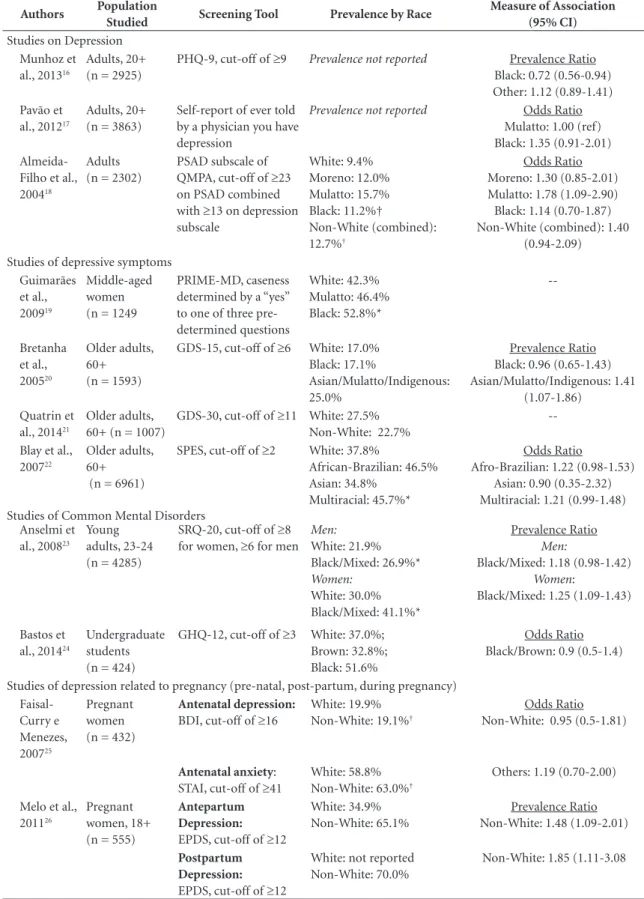
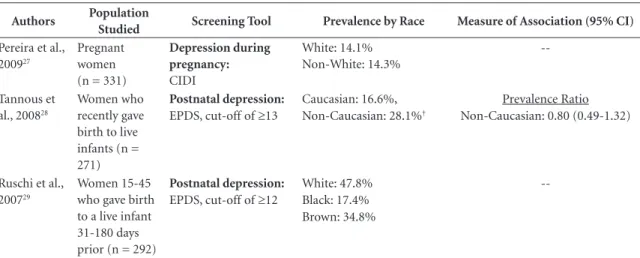
As seen in Table 1, three of the fourteen
in-cluded studies were of the general population16-18,
one with middle–aged women19, three were
specifically of older adults20-22, two with young
Figure 1. Process of identifying articles for inclusion in the systematic review.
Articles identified through search in PubMed and
Lilacs (n = 262)
PubMed (n = 192)
Full-text articles evaluated (n = 48)
Lilacs (n = 70)
Abstracts excluded (n = 209 )
Duplicates removed (n = 5)
Articles excluded (n = 31)
Articles evaluated for quality (n = 17)
Articles that did not meet minimum quality
criteria (n = 6)
Articles included (n = 11) + articles identified from
reference lists (n = 3)
Smole
n JR,
A
adults23,24, and five were of pregnant women or
women who recently gave birth25-29.
Mental health disorders studied
All the included studies examined affective mental health disorders. Three of the fourteen
studies examined depression16-18, three examined
psychiatric morbidity (referred to as depressive
symptoms, or depression morbidity)19-22, two
studied Common Mental Disorders23,24, and five
studies examined ante- or post-natal depression,
or depression during pregnancy25-29. Although
anxiety was included in the search terms, only one study included any measure specific to anx-iety; this study examined both antenatal
depres-sion and antenatal anxiety25.
Although several studies examined the same mental health outcome, there was little concor-dance in the tool used to assess that outcome. Only two screening tools appeared more than once – the Edinburgh Postnatal Depression Scale (EDPS), and the Geriatric Depression Scale. However, of the three studies that used the EDPS,
two used a cut–off of 1226,29, and the other used a
cut-off of 1328. The two studies that used the GDS
used different versions of the scale, as one used
the 30–item version21, and the other used the
15-item version20. All studies used instruments that
were validated for use in Brazilian Portuguese. As seen in Table 1, for the bivariate analyses twelve studies reported prevalence by race, and one reported a prevalence ratio but not
preva-lence18-29. Only ten articles included race in the
multivariate analysis16-18,20,22,23-26,28; although in
one study the absence of race/skin color in the multivariate model was due to the use of step–
wise regression27.
Prevalence
Of the studies on depression in the general population, only one reported prevalence of de-pression by race, and this study found a higher prevalence in the non-White categories (Moreno: 12.0%, Mulatto: 15.7%, and Black: 11.2%) than
among Whites (9.4%)18. One study on Common
Mental Disorders (CMD) found a higher preva-lence among Black Brazilians (51.6%) than White Brazilians (37.0%), but a lower prevalence among Brown Brazilians (32.8%), though these
differ-ences were not significant24. One of the studies on
CMD found a significantly higher prevalence of CMD among Black/Mixed Brazilians than White
Brazilians, and this was true in men and women23.
Depression symptoms were seen to be signifi-cantly higher among Black middle–aged women
(52.8%) than among White women (42.3%)19.
Among older adults, a significantly higher prev-alence of depressive symptoms/depression mor-bidity was seen in non-Whites as compared to
Whites20,22. The difference among non-Whites
varied however in one study Afro-Brazilians (46.5%) and multiracial Brazilians (45.7%) had
a higher prevalence than Whites (37.8%)22, while
in another Blacks had nearly the exact same prev-alence as Whites (17.0% vs. 17.1%, respectively) and the highest prevalence was found among the
category of Asian/Mulatto/Indigenous (25.0%)20.
Another study found a lower prevalence among non-Whites (22.7%) than among Whites (27.5%), however the difference was not
signifi-cant21. For antepartum and post–partum
depres-sion, no statistically significant differences were
found by race25-29.
Multivariate analyses
The multivariate analyses show differing re-sults, as can be seen in Table 1. Prevalence ratios of depression in one study show that Black Bra-zilians are actually significantly less likely like to have depression than Whites (OR = 0.72; 95% CI:
0.56–0.94), and this difference was significant16.
However, another study of depression in the gen-eral population shows that Moreno (OR = 1.30; 95% CI: 0.85-2.01), Mulatto (OR = 1.78; 95% CI: 1.09-2.90) and Black Brazilians (OR = 1.14; 95% CI: 0.70-1.87) Black Brazilians all have greater odds of depression compared to White Brazilians, though this result was only significant for the
Mulatto group18. In a study that adjusted for
dis-crimination, no significant difference was found in odds of CMD between Black/Brown and White Brazilian university students (OR = 0.9; 95% CI:
0.5–1.4)24. Yet, another study, one that did not
adjust for discrimination, found that Black or Mixed Brazilian women have a 25% higher prev-alence of CMD as White women (OR = 1.25; 95% CI: 1.09–1.43); a similar pattern was seen among men, yet this finding was of only marginal
signifi-cance (OR = 1.18; 95% CI: 0.98–1.42)23.
Among older adults, multiracial Brazilians showed significantly higher prevalence of depres-sion morbidity (PR = 1.41; 95% CI: 1.07–1.86), and marginally significant higher odds (OR = 1.21; 95% CI: 0.99–1.48) than Whites. Afro–Bra-zilian older adults also had marginally significant higher odds of depression morbidity (OR = 1.22;
aúd e C ole tiv a, 22(12):4021-4030, 2017
Table 1. Included studies.
Authors Population
Studied Screening Tool Prevalence by Race
Measure of Association (95% CI) Studies on Depression
Munhoz et al., 2013
16
Adults, 20+ (n = 2925)
PHQ-9, cut-off of ≥9 Prevalence not reported Prevalence Ratio
Black: 0.72 (0.56-0.94) Other: 1.12 (0.89-1.41) Pavão et
al., 201217
Adults, 20+ (n = 3863)
Self-report of ever told by a physician you have depression
Prevalence not reported Odds Ratio
Mulatto: 1.00 (ref) Black: 1.35 (0.91-2.01)
Almeida-Filho et al., 200418
Adults (n = 2302)
PSAD subscale of QMPA, cut-off of ≥23 on PSAD combined with ≥13 on depression subscale White: 9.4% Moreno: 12.0% Mulatto: 15.7% Black: 11.2%† Non-White (combined): 12.7%† Odds Ratio Moreno: 1.30 (0.85-2.01) Mulatto: 1.78 (1.09-2.90) Black: 1.14 (0.70-1.87) Non-White (combined): 1.40
(0.94-2.09) Studies of depressive symptoms
Guimarães et al., 200919
Middle-aged women (n = 1249
PRIME-MD, caseness determined by a “yes” to one of three pre-determined questions White: 42.3% Mulatto: 46.4% Black: 52.8%* --Bretanha et al., 200520 Older adults, 60+ (n = 1593)
GDS-15, cut-off of ≥6 White: 17.0% Black: 17.1%
Asian/Mulatto/Indigenous: 25.0%
Prevalence Ratio Black: 0.96 (0.65-1.43) Asian/Mulatto/Indigenous: 1.41
(1.07-1.86) Quatrin et
al., 201421
Older adults, 60+ (n = 1007)
GDS-30, cut-off of ≥11 White: 27.5% Non-White: 22.7%
--Blay et al., 200722
Older adults, 60+ (n = 6961)
SPES, cut-off of ≥2 White: 37.8%
African-Brazilian: 46.5% Asian: 34.8%
Multiracial: 45.7%*
Odds Ratio
Afro-Brazilian: 1.22 (0.98-1.53) Asian: 0.90 (0.35-2.32) Multiracial: 1.21 (0.99-1.48) Studies of Common Mental Disorders
Anselmi et al., 200823
Young adults, 23-24 (n = 4285)
SRQ-20, cut-off of ≥8 for women, ≥6 for men
Men: White: 21.9% Black/Mixed: 26.9%* Women: White: 30.0% Black/Mixed: 41.1%* Prevalence Ratio Men:
Black/Mixed: 1.18 (0.98-1.42)
Women:
Black/Mixed: 1.25 (1.09-1.43)
Bastos et al., 201424
Undergraduate students (n = 424)
GHQ-12, cut-off of ≥3 White: 37.0%; Brown: 32.8%; Black: 51.6%
Odds Ratio Black/Brown: 0.9 (0.5-1.4)
Studies of depression related to pregnancy (pre-natal, post-partum, during pregnancy) Faisal-Curry e Menezes, 200725 Pregnant women (n = 432)
Antenatal depression: BDI, cut-off of ≥16
White: 19.9% Non-White: 19.1%†
Odds Ratio Non-White: 0.95 (0.5-1.81)
Antenatal anxiety: STAI, cut-off of ≥41
White: 58.8% Non-White: 63.0%†
Others: 1.19 (0.70-2.00)
Melo et al., 201126
Pregnant women, 18+ (n = 555)
Antepartum Depression: EPDS, cut-off of ≥12
White: 34.9% Non-White: 65.1%
Prevalence Ratio Non-White: 1.48 (1.09-2.01)
Postpartum Depression: EPDS, cut-off of ≥12
White: not reported Non-White: 70.0%
Non-White: 1.85 (1.11-3.08
Smole
n JR,
A
One study of antepartum depression found a statistically significant difference by race: non– Whites had a 48% higher prevalence of antepar-tum depression than Whites (OR = 1.48; 95%
CI: 1.09–2.01)26. Postpartum depression was
also found to be significantly different by race– non–Whites had a prevalence 85% higher than
in Whites (OR = 1.85; 95% CI: 1.11–3.08)26. Only
one study assessed anxiety, specifically antenatal
anxiety, but did not find any significant results25.
As seen in Table 2, nearly of all the significant associations found in these articles were in the positive direction for the non–White race/skin color group. The studies were most commonly carried out in the states of Rio de Janeiro and Rio Grande do Sul, and in most studies 50% or more of the sample population was White.
Discussion
The existing cross–sectional studies on men-tal health outcomes and race identified in this review suggest that the prevalence of mental health disorders is higher among Afro–Brazilians than Whites. There was not universal consen-sus among these studies, yet of the multivariate analyses that found statistically significant asso-ciations, nearly all were in the positive direction between non–Whites and mental health disor-ders; all of the analyses included socioeconom-ic variables such as educational level and family income. This begs future exploration, especially considering that nearly half of the existing
litera-ture was based on studies that did not have a di-verse study sample. For example, of the 14 studies to include race as a variable of analysis, six had samples that were over three quarters White. Ac-cording to the 2010 Census, Brazil’s population is
47.7% White, and 50.7% Black/Brown30;
howev-er, in the South/Southeast of Brazil, where these six studies were carried out, there is a higher concentration of White Brazilians. Of the studies with a more mixed sample, and therefore greater statistical power to assess race, all significant as-sociations were in the positive direction.
Race does not have a biological relationship with health, therefore there is no biological ba-sis for an association between race and mental
health31,32. The imperative to study this
relation-ship stems from a need to identify the populations with the highest burden of poor mental health who are therefore most in need of treatment, and additionally to better explore and understand (in order to eventually prevent) what societal and contextual factors may be contributing to this association. Since the relationship between race and mental health is not biological, it is not immutable. If the contributing or causal factors could be identified, they could be prevented and therefore reduce or eliminate the inequality. The idea that racial disparities in health are caused by biology and genetics has been discredited, and other theories have taken its place to explain the association between race and health outcomes. A stress theory has been posited, and supported by several studies that found that stress accounts for much of the difference in depressive
symp-Authors Population
Studied Screening Tool Prevalence by Race Measure of Association (95% CI)
Pereira et al., 200927
Pregnant women (n = 331)
Depression during pregnancy: CIDI
White: 14.1% Non-White: 14.3%
--Tannous et al., 200828
Women who recently gave birth to live infants (n = 271)
Postnatal depression: EPDS, cut-off of ≥13
Caucasian: 16.6%, Non-Caucasian: 28.1%†
Prevalence Ratio Non-Caucasian: 0.80 (0.49-1.32)
Ruschi et al., 200729
Women 15-45 who gave birth to a live infant 31-180 days prior (n = 292)
Postnatal depression: EPDS, cut-off of ≥12
White: 47.8% Black: 17.4% Brown: 34.8%
--If not designated otherwise, Whites are considered the reference group. *p < 0.05. † p-value not reported.
aúd
e C
ole
tiv
a,
22(12):4021-4030,
2017
toms by race8, and that race-related
discrimina-tion adversely affects health9,33. A more recent
meta-analysis found that perceived discrimina-tion is directly related to poorer mental health status, and experimental studies showed experi-ences of discrimination may produce a negative psychological stress response and a heightened
physiological stress response34. There is a
tenden-cy that articles on mental health either focus on discrimination or on race, as if race can be the factor of interest or discrimination can–but not
both. Yet this misses an important point, that the experience of discrimination may lead equally to poor outcomes among all it affects, yet Black and Mixed Brazilians still suffer a higher burden of its sequelae since they are more likely to have expe-riences of discrimination. One study found that Black Brazilians have over 50% higher odds of having experienced discrimination than Whites, even after controlling for income, education,
so-cial status, and health problems35. Studies that
explore the association between discrimination
Table 2. Setting, distribution of race in study sample and direction of association in multivariate analysis.
Authors Study Setting Racial Distribution of
Study Sample
Direction of multivariate Associationa
Munhoz et al., 201316 Rio Grande do Sul 80.1% White
12.1% Black 7.8% Other
Black: - * Others: +
Pavão et al., 201217 Representation from all
regions of Brazil
77.2% Mulatto 22.8% Black
Mulatto: (ref) Black: + Almeida-Filho et al.,
200418
Bahia 14.9% White
45.9% Moreno 15.9% Mulatto 20.7% Black
Moreno: + Mulatto + * Black +
Guimarães et al., 200919 Rio de Janeiro 43.3% White
40.1% Mulatto 16.6% Black
--Bretanha et al., 200520 Rio Grande do Sul 78.6% White
8.7% Black 12.7% Asian/ Mulatto/Indigenous
Black: -Asian/Mulatto/ Indigenous: + *
Quatrin, et al., 201421 Rio Grande do Sul 95.7% White
4.3% Non-White
--Blay et al., 200722 Rio Grande do Sul 84.2% White
6.8% Afro-Brazilian 8.6% Multiracial
Afro-Brazilian: + * Multiracial: + *
Anselmi et al., 200823 Rio Grande do Sul 78.1% White
21.9% Black/Mixed
Black/Mixed: + *
Bastos et al., 201424 Rio de Janeiro 51.4% White
32.8% Brown 15.2% Black
Black/Brown:
-Faisal-Curry e Menezes, 200725
São Paulo 83.0% White
17.0% Non-White
Non-White (Depression): - Non-White (Anxiety): +
Melo et al., 201126 Pernambuco; São
Paulo
45.5% White 54.5% Non-White
Non-White: + *
Pereira et al., 200927 Rio de Janeiro 45.0% White
55.0% Non-White
--Tannous et al., 200828 Porto Alegre 64.6% White
35.4% Non-White
Non-White: -
Ruschi et al., 200729 Espírito Santo 49.0% White
16.8% Black 34.2% Brown
Smole
n JR,
A
and mental health are important and necessary, yet they should also report results by race and the association by race to show which population groups bear the risk associated with experiences of discrimination.
This systematic review suggests a positive association between race and mental health dis-orders, and points out the need for further re-search into this association, as well as into the prevalence/mental health burden of Black and Mixed Brazilians. In the initial search results, 262 articles were identified. Many of these articles reported on race––but only when describing the demographics of the sample population. Those that included race as a variable of analysis often did not report the prevalence of mental health disorder by race, or conduct a multivariate anal-ysis that included race. Efforts should be made to stimulate the inclusion of race as an analytic variable in studies of mental health in Brazil.
Eight of the 14 studies in this systematic re-view were carried out in the South or Southeast of Brazil, a pattern also seen in mental health
re-search in Brazil as a whole36. Geographic
diver-sity is important in understanding if there are regional differences in the relationship between race and mental health, yet is also important from a statistical standpoint–there is less racial diversity in the South and Southeast of Brazil, therefore more challenging to recruit a sample with a sufficient number of Black participants to assess the relationship with race. Nearly half of the studies had a sample in which 75% or more of the participants were White. While it is still possible to assess the relationship between race and mental health in such samples, the results will be less reliable due to the small numbers of other racial groups in the analysis.
The lack of standardization of racial catego-ries used in these studies is problematic when at-tempting to compare results across studies. Some
studies used a binary categorization of White compared to Non–White, while others
includ-ed separate categories for Mulatto or Moreno, or
Multiracial. This reflects the complexity of per-ceptions of skin color and race in Brazil, but com-plicates interpretation. Because of the difference in racial categorization, estimating prevalence of mental health disorders by race/skin color group was not possible. Future research should use the five standardized race categories used in the
Bra-zilian Census: Black, White, Parda, Asian, and
In-digenous. To capture all those with Afro–Brazil-ian heritage, researchers commonly group Black and Parda together as Negra. This way the litera-ture on race/skin color and mental health would be more comparable and better able to estimate prevalence of mental health disorders according to standardized race/skin color categories. Ob-taining these prevalence estimates is an important step in identifying health disparities, allocating resources, and designing interventions.
This identified the general trend in the pub-lished literature in the association between race/ skin color and mental health outcomes, however there are important difficulties complicating the direct comparability between these studies. This is primarily due to the different mental health outcomes studied, the different populations studied, and the different screening tools and cut–off points used. However, so few studies on mental health have been conducted in Brazil that assess race that it becomes necessary to look at what little, varied literature exists to stimulate in-terest in conducting new studies.
aúd
e C
ole
tiv
a,
22(12):4021-4030,
2017
Collaborations
JR Smolen and EM Araújo designed the study and search string. JR Smolen carried out the search of the literature. Both EM Araújo and JR Smolen interpreted the results. JR Smolen draft-ed the article, and EM Araújo assistdraft-ed with the introduction and discussion, as well as a critical review of the draft and methodology. EM Araújo approved the final draft of the paper. JR Smolen and EM Araújo designed the study and search string. JR Smolen carried out the search of the literature. Both EM Araújo and JR Smolen inter-preted the results. JR Smolen drafted the article, and EM Araújo assisted with the introduction and discussion, as well as a critical review of the draft and methodology. EM Araújo approved the final draft of the paper.
References
1. Whiteford HA, Degenhardt L, Rehm JR, Ferrari AJ, Erskine HE, Charlson FJ, Norman RE, Flaxman AD, Johns N, Burstein R, Murray CJ, Vos T. Global burden of disease attributable to mental and substance use disorders: findings from the Global Burden of Disease Study 2010. Lancet 2013; 382(9904):1575-1586. 2. Schramm, JMA, Oliveira AF, Leite IC, Valente JG,
Ga-delha AMJ, Portela MC, Campos, MR. Transição epide-miológica e o estudo de carga de doença no Brasil. Cien Saude Colet 2004; 9(4):897-908.
3. Chor D, Lima CR. Epidemiologic aspects of racial in-equalities in health in Brazil. Cad Saude Publica 2005; 21(5):586-594.
4. Heringer R. Desigualdades sociais no Brasil: Síntese de indicadores e desafios no campo das políticas públicas.
Cad Saude Publica, 2002; 18(Supl.):57-65.
5. Lopes F. Para além da barreira dos números: desi-gualdades raciais e saúde. Cad Saude Publica 2005; 21(5):1595-1601.
6. Solar O, Irwin AA. Conceptual framework for action on the social determinants of health. Social Determi-nants of Health Discussion Paper 2 (Policy and Practice).
Geneva: World Health Organization. 2010.
7. Warner DF, Brown TH. Understanding how race/eth-nicity and gender define age-trajectories of disabili-ty: an intersectionality approach. Soc Sci Med 2011; 72(8):1236-1248.
8. Turner RJ, Avison WR. Status variations in stress ex-posure: Implications for the interpretation of research on race, socioeconomic status and gender. J Health Soc Behav 2003; 44(4):488-505.
9. Williams DR, Yu Y, Jackson JS, Anderson NB. Racial differences in physical and mental health: socioeco-nomic status, stress and discrimination. J Health Psy-chol 1997; 2(3):335-351.
10. Breslau J, Kendler KS, Su M, Gaxiola-Aguilar S, Kessler RC. Lifetime risk and persistence of psychiatric disor-ders across ethnic groups in the United States. Psychol Med 2005; 35(3):317-327.
11. Warheit GJ, Holzer CE, Arey SA. Race and mental ill-ness: an epidemiologic update. J Health Soc Behav 1975; 16(3):243-256.
12. Kessler RC, McGonagle KA, Zhao S, Nelson CB, Hughes M, Eshleman S, Wittchen HU, Kendler KS. Lifetime and 12-month prevalence of DSM-III-R Psy-chiatric Disorders in the United States. Arch Gen Psych
1994; 51(1):8-19.
13. Riolo SA, Nguyen TA, Greden JF, King CA. Prevalence of depression by race/ethnicity: Findings from the Na-tional Health and Nutrition Examination Survey III.
Am J Public Health 2005; 95(6):998-1000.
14. Harris KM, Edlund MJ, Larson S. Racial and ethnic differences in the mental health problems and use of mental health care. Med Care 2005; 43(8):775-784. 15. Munn Z, Moola A, Riitano D, Lisy K. The development
of a critical appraisal tool for use in systematic reviews addressing questions of prevalence. Int J Health Policy Manag 2014; 3(3):123-128.
Smole
n JR,
A
17. Pavão ALB, Ploubidis GB, Werneck G, Campos MR. Discrimination and health in Brazil: Evidence from a population-based survey. Ethn & Disease 2012; 22. 18. Almeida-Filho N, Lessa I, Magalhães L, Araújo MJ,
Aquino E, James SA, Kawachi I. Social inequality and depressive disorders in Bahia, Brazil: interactions of gender, ethnicity, and social class. Soc Sci Med 2004; 59(7):1339-1353.
19. Guimarães JMN, Lopes CS, Baima J, Sichieri R. De-pression symptoms and hypothyroidism in a popula-tion-based study of middle-aged Brazilian women. J Affect Disord 2009; 117(1-2):120-123.
20. Bretanha AF, Facchini LA, Nunes BP, Munhoz TN, Tomasi E, Thumé E. Depressive symptoms in elderly living in areas covered by Primary Health Care Units in the urban area of Bagé, RS. Rev Bras Epidemiol 2005; 18(1):1-12.
21. Quatrin LB, Galli R, Moriguchi EH, Gastal FL, Pat-tussi MP. Collective efficacy and depressive symp-toms in Brazilian elderly. Arch Gerontol Geriatr 2014; 59(3):624-629.
22. Blay SL, Andreoli SB, Fillenbaum GG, Gastal FL. De-pression morbidity in later life: prevalence and cor-relates in a developing country. Am J Geriatr Psychiary
2007; 15(9):790-799.
23. Anselmi L, Barros FC, Minten GC, Gigante DP, Horta BL, Victora CG.Prevalence and early determinants of common mental disorders in the 1982 birth cohort, Pelotas, Southern Brazil. Rev Saude Publica 2008; 42(Supl. 2):25-32.
24. Bastos JL, Barros AJD, Paradies Y, Faerstein E. Age, class and race discrimination: heir interactions and associ-ations with mental health among Brazilian university students. Cad Saude Publica 2014; 30(1):175-186. 25. Faisal-Cury A, Menezes PR. Prevalence of anxiety and
depression during pregnancy in a private setting sam-ple. Arch Womens Ment Health 2007; 10:25-32. 26. Melo EF, Cecatti JG, Pacagnella RC, Leite DBF, Vulcani
DE, Yakuch MY. The prevalence of perinatal depression and its associated factors in two different settings in Brazil. J Affect Disord 2011; 136(3):1204-1208. 27. Pereira PK, Lovisi GM, Pilowsky DL, Lima LA, Legay
LF. Depression during pregnancy: prevalence and risk factors among women attending a public health clin-ic in Rio de Janeiro, Brazil. Cad Saude Publica 2009; 25(12):2725-2736.
28. Tannous L, Gigante LP, Fuchs SC, Busnello EDA. Post-natal depression in Southern Brazil: prevalence and its demographic and socioeconomic determinants. BMC Psych 2008; 8:1.
29. Ruschi GEC, Sun SY, Mattar R, Filho AC, Zandonade E, Lima VJ. Aspectos epidemiológicos da depressão pós -parto em amostra brasileira. Rev Psiquiatr RS 2007; 29(3):274-280.
30. Instituto Brasileiro de Geografia e Estatística (IBGE).
Censo Demográfico 2010.Rio de Janeiro: IBGE. [aces-sado 2014 jul 27]. Disponível em: ftp://ftp.ibge.gov. br/Censos/Censo_Demografico_2010/Caracteristi- cas_Gerais_Religiao_Deficiencia/caracteristicas_reli-giao_deficiencia.pdf
31. Cooper R, David R. The biological concept of race and its application to public health and epidemiology. J Health Politics 1986; 11(1):97-116.
32. Goodman AH. Why genes don’t count (for racial differ-ences in health). Am J Public Health 2000: 90(11):1699-1702.
33. Goto JB, Couto PF, Bastos JL GOTO. Revisão sistemá-tica dos estudos epidemiológicos sobre discriminação interpessoal e saúde mental. Cad Saude Publica 2013; 29(3):445-459.
34. Pascoe EA, Richman LS. Perceived discrimination and health: a meta-analyitic review. Psychol Bull 2009; 125(4):531-554.
35. Macinko J, Mullachery P, Proietti FA, Lima-Costa MF. Who experiences discrimination in Brazil? Evidence from a large metropolitan region. Int J Equity Health
2012; 11(80).
36. Medeiros EN, Ferreira M, Vianna RP. Estudos epide-miológicos na area de saúde mental realizados no Bra-sil. Online Braz J Nurs 2006; 5(1).
Article submitted 03/04/2016 Approved 06/09/2016