Revista Gaúcha
de Enfermagem
DOI: http://dx.doi.org/10.1590/1983-1447.2014.03.44643
Knowledge of nursing professionals of a surgical
center regarding malignant hyperthermia
Conhecimento dos profi ssionais de enfermagem de
centro cirúrgico sobre hipertermia maligna
Conocimiento de los profesionales de enfermería de
un centro quirúrgico sobre hipertermia maligna
a M.Sc. in Adult Health Nursing from the School of
Nursing, University of São Paulo. Clinical Nurse in the operating room of the Sírio-Libanês [Syrian-Lebanese] Hospital, Sao Paulo (SP), Brazil.
b M.Sc. in Adult Health Nursing from the School of
Nursing, University of São Paulo. Coordinating Nurse in the operating room of the Sírio-Libanês [Syrian-Lebanese] Hospital, Sao Paulo (SP), Brazil.
Cristina Silva Sousaa Ana Lucia Mirancos Cunhab
ABSTRACT
The objective of this study was to assess the knowledge of the nursing professionals in a surgical center about malignant hyperther-mia. This is a descriptive exploratory study on malignant hyperthermia conducted with mid- and high-level nursing professionals in the surgical center of an institution located in the city of São Paulo, where the research was conducted between August and September 2013. Analysis of the data was descriptive and the average of the correct answers was compared using Student’s t-test. Among the 96 participants, the two items in which at least 70% of the team showed knowledge were: the defi nition of malignant hyperthermia and the professionals involved in the health care provided. With respect to all test items, 70% of nurses answered 50% correctly. The same percentage of mid-level professionals answered only 20% correctly. There was no statistically signifi cant diff erence between the professional categories. This study revealed insuffi cient knowledge on the part of the nursing team about malignant hyperthermia. Descriptors: Malignant hyperthermia. Perioperative nursing. Evidence-based nursing.
RESUMO
Este estudo tem por objetivo avaliar o conhecimento dos profi ssionais de enfermagem de um centro cirúrgico sobre a hipertermia maligna. Trata-se de um estudo descritivo exploratório com profi ssionais de enfermagem de nível médio e superior do centro cirúr-gico da instituição sede da pesquisa, situada na cidade de São Paulo, sobre a hipertermia maligna entre agosto-setembro de 2013. A análise de dados foi descritiva e a média de acertos foi comparada por teste estatístico t Student. Dos 96 participantes, os dois itens nos quais pelo menos 70% da equipe demonstra ter conhecimento são a defi nição de hipertermia maligna (HM) e os profi ssionais envolvidos no atendimento. Em relação a todos os itens do teste, setenta por cento dos enfermeiros obtiveram acertos em 50% dos itens do teste, a mesma porcentagem de profi ssionais de nível médio acertou apenas 20%, não houve diferença estatística signifi cante (p = 0,09) entre as categorias profi ssionais. Este estudo evidenciou insufi ciente conhecimento da equipe de enfermagem sobre a hipertermia maligna.
Descritores: Hipertermia maligna. Enfermagem perioperatória. Enfermagem baseada em evidências.
RESUMEN
Este estudio tuvo por objetivo evaluar el conocimiento de los profesionales de enfermería de un centro quirúrgico sobre la hipertermia maligna. Este es un estudio descriptivo exploratorio sobre la hipertermia maligna realizado con profesionales de enfermería de nivel medio y superior del centro quirúrgico de una institución ubicada en la ciudad de São Paulo donde se realizó la investigación entre agosto y septiembre de 2013. El análisis de los datos fue descriptivo y el promedio de respuestas correctas fue comparado usando la prueba t de Student. Entre los 96 participantes, los dos ítems en los que al menos el 70% del equipo demostró conocimiento fueron la defi nición de hipertermia maligna y los profesionales involucrados en la atención al paciente. Con respecto a todos los ítems de la prueba, el 70% de los enfermeros respondió correctamente el 50%. El mismo porcentaje de profesionales de nivel medio solo respondió correctamente el 20%. No hubo ninguna diferencia estadística signifi cativa entre las categorías profesionales. Este estudio mostró insufi ciente conocimiento del equipo de enfermería sobre la hipertermia maligna.
INTRODUCTION
Malignant hyperthermia (MH) is a potentially fatal mus-culoskeletal disorder; it occurs in genetically predisposed patients and those immediately exposed to halogenated agents and succinylcholine, triggering an increase in intra-cellular free calcium concentration in the cytoplasm of ske-letal muscle cells. This is clinically translated as hypermeta-bolism and rhabdomyolysis, which, untreated, progress to death, thereby warranting the adjective malignant.(1-2)
The occurrence of this syndrome during surgery is an emergency situation and it requires precise treatment with immediate assistance. The paucity of literature on the sub-ject, either nationally or internationally, has raised ques-tions about the level of knowledge of our nursing staff on the subject, and thus we propose to answer the research question: Do you think we are prepared to attend a patient with a crisis of MH?
The incidence of MH varies between countries and states, presumably because of genetic diff erences in the population. A Japanese study conducted in the period 2006-2008 shows a prevalence of 13.7 cases per million.(3) In New York, a study describes 73 cases diagnosed from 2001-2005.(4) In Brazil, there are no current data on the in-cidence; however, it is estimated that general anesthesia is performed approximately fi ve million times annually, and therefore this number is consistent with the annual inci-dence of 500 to 1,000 cases of MH in São Paulo alone.(5)
Clinical signs that may indicate the onset of MH are: unexplained tachyarrhythmias, which may occur in 96% of cases; tachypnea in 85% of patients; and acidosis in 80% of patients in response to increased gluconeogenesis. An event will also produce abnormal amounts of lactic acid, carbon dioxide (CO2), and heat, as well as sustained contraction of muscle groups, which leads to greater use of available adenosine triphosphate (ATP) and oxygen. Mus-cle stiff ness is generally an early sign of MH and is present in approximately 80% of patients, particularly when admi-nistered muscle relaxants. The masseter muscle is one of the muscle groups most frequently involved.(6-7)
The nursing staff should be aware that there is a direct correlation between the severity of an episode of MH and the availability of treatment. Thus, any delay in the early re-cognition and prompt treatment of a patient with MH may result in sudden death by cardiac arrest, brain damage, multiple organ failure, or disseminated intravascular coa-gulation (DIC).(2,6,8)
Considering the importance for patient safety and the participation and contribution of nurses who work in the surgical center during care for patients in crisis, the aim of
this study is to assess the knowledge of malignant hyper-thermia among the nursing professionals in a surgical center.
METHOD
This is a quantitative study on MH with a descriptive design in which a systematic search was conducted on the knowledge of the nurses and nursing technicians working in the research institution’s headquarters, located in the city of São Paulo. The project was approved by the Research Ethics Committee of the institution where it was conduc-ted (Process No. 354.937/2013). All participants signed an Informed Consent Form (ICF) before the start of data col-lection, respecting the ethical principles of research with human beings and research ethics with humans, based on Resolution 466/12 of the National Health Council.
The inclusion criterion applied was nursing professio-nals with expertise in the surgical center of the research institution’s headquarters. The exclusion criteria applied were for professionals with assistant training in nursing, and professionals who were on vacation or sick leave du-ring the research’s period of data collection.
The group of nursing professionals who worked directly with care in the surgical center in the research institution was composed of 23 nurses and 110 nursing technicians. Based on a sample size calculation with an alpha error of 0.05% for 127 professionals, 96 professionals were included in the sample of this research.
The surgical center of the hospital researched consists of 19 operating rooms and 20 beds for post-anesthesia re-covery. It is a large, private, philanthropic hospital based in the municipality of São Paulo. On average, 1,500 surgeries are performed per month.
Data collection was conducted in the months of August and September 2013, using an instrument constructed by the researcher, based on the practices recommended by the Association PeriOperative Registered Nursing (AORN). This nonprofi t association represents the interests of more than 160,000 perioperative nurses, providing nursing education, standards, and practices, and a monthly publication on pe-rioperative nursing. Following the study, it was validated by three specialist nurses in the surgical center by means of group discussion and subjected to Cronbach’s alpha reliability analysis. The instrument developed comprises a theoretical evaluation with 10 questions, and fi ve possible answers for each question; only one of these alternatives was correct.
the defi nition of the pathology, diagnosis, and treatment, side eff ects of medication, existence of a protocol to attend the crisis, resources for recording the occurrence, and pro-fessionals who work during the MH crisis.
One point was assigned for each correct answer. The total score on the knowledge test corresponded to the sum of all the correct answers. To consider knowledge on the subject, it was decided to present the test results in score bands at or above 70%.
The instrument was distributed to professionals who agreed to participate and who had signed the Informed Consent Form. They answered individually, during working hours, and returned the instrument to the researcher im-mediately upon completion; despite identifi cation used in the instrument, the results were kept anonymous.
The data collected were entered into a Microsoft Excel for Mac®2011 spreadsheet using the technique of double entry for analysis using the Statistical Package for Social Science, version 20.0 (SPSS). The analysis considered the scores of the two groups of professionals, i.e., the nursing technicians and the nurses, and not isolated scores for each subject. The variables related to sociodemographic charac-teristics (age, gender, and length of professional training)
and knowledge test answers were summarized and pre-sented descriptively using frequency distribution, absolute values, means, and standard deviations. For evaluation of the knowledge test, Student’s t-test was applied to two in-dependent samples. The level of signifi cance was p<0.05.
RESULTS
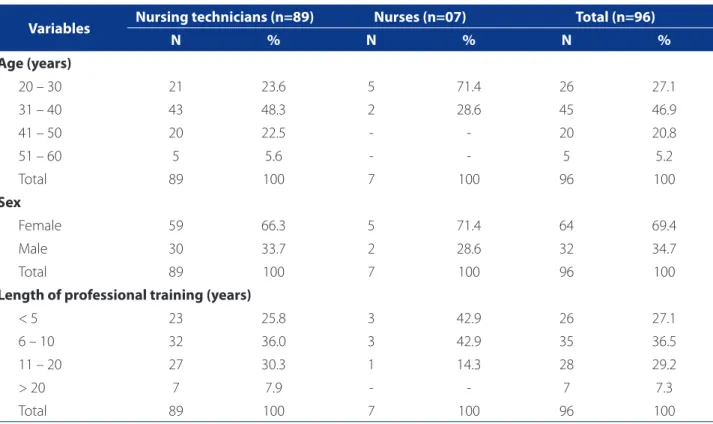
A total of 96 members of the nursing staff from the sur-gical center participated in the survey, which corresponds to 67.13% of the active staff in the unit, 89 nursing tech-nicians and seven nurses. The data obtained resulted in a mean age of 36 ± 8.15 years; for the nursing technicians the average age is 36.4 ± 8.4 years and for the nurses the average age is 31 ± 4 years. As regards gender, the majority observed in both groups were female. Nursing technicians had more professional training, with a mean of 10.7 ± 3 ye-ars, with nurses having a mean of 7.1 ± 7.3 years. The dis-tribution of participants according to socio-demographic characteristics is presented in Table 1.
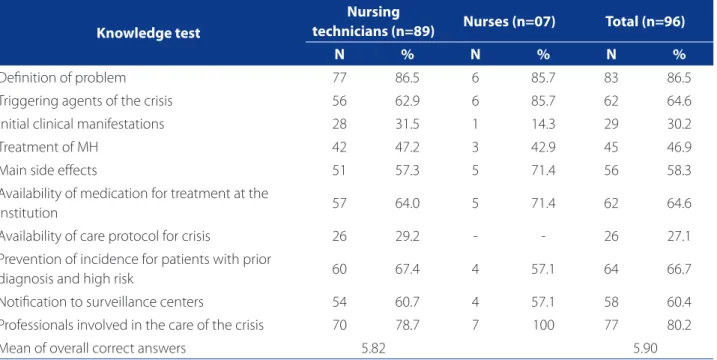
Considering the overall results of the test, the nursing technicians obtained a mean of 5.82 ± 1.78 points reached and the nurses 6.29 ± 0.95. The Student t-test showed no
Variables Nursing technicians (n=89) Nurses (n=07) Total (n=96)
N % N % N %
Age (years)
20 – 30 21 23.6 5 71.4 26 27.1
31 – 40 43 48.3 2 28.6 45 46.9
41 – 50 20 22.5 - - 20 20.8
51 – 60 5 5.6 - - 5 5.2
Total 89 100 7 100 96 100
Sex
Female 59 66.3 5 71.4 64 69.4
Male 30 33.7 2 28.6 32 34.7
Total 89 100 7 100 96 100
Length of professional training (years)
< 5 23 25.8 3 42.9 26 27.1
6 – 10 32 36.0 3 42.9 35 36.5
11 – 20 27 30.3 1 14.3 28 29.2
> 20 7 7.9 - - 7 7.3
Total 89 100 7 100 96 100
Table 1 – Socio-demographic characteristics of the participants according to professional category. São Paulo, SP, 2013.
signifi cant diff erence (p=0.09). Using Cronbach’s alpha, the reliability was 0.33.
The results obtained by the professionals in the know-ledge test, per item, are shown in Table 2.
DISCUSSION
This is an unprecedented study aimed at responding to our concerns about the knowledge of our nursing team regarding MH. A patient with a crisis of MH requires diag-nosis, treatment, and immediate assistance to enable the reversal of the clinical situation and avoid sudden death.
Cronbach’s alpha values of 0.33 refer to low levels but do not aff ect the outcome of the study, because a sample of people with similar backgrounds and experience can result in an unreliable questionnaire. In an evaluation ins-trument, when the sample population indicates a single true item value of 5 (assuming a range of absolute values ranging from 1 to 5), there is no variance of the item and, hence, the calculated reliability value will be zero.
The results of this study showed an insuffi cient know-ledge of MH on the part of the nursing staff . The two items in which at least 70% of the staff demonstrated some kno-wledge are in the defi nition of MH and the professionals involved in the care. In relation to all test items, 70% of the nurses got 50% of the test items right; the same percenta-ge of mid-level professionals got just 20% right.
A North American study of nursing students raised the issue of the lack of knowledge about treatment and mana-gement of MH among undergraduates; however, the study did not categorize the data about this knowledge.(9)
In a study on the knowledge of Brazilian anesthesiolo-gists faced with MH with 10 respondents, the researchers found 80% of correct answers on the diagnosis and 70% on the treatment. On the other hand, only 20% of these respondents knew the side eff ects of dantrolene and 40% of the responses on the pharmacology of dantrolene were incorrect.(10)
In this study, the nurses got at least 80% of the answers correct on defi nition, triggering agents, and professionals involved. In the category of diagnosis and treatment, howe-ver, the knowledge of these professionals was only 14.3% and 42.9% respectively. The nursing technicians had better rates in these categories, at 31.5% and 47.2%. However, po-pulation samples are unequal, and did not allow a furthe-ring of knowledge in the comparison between categories, which was probably related to the educational focus of the professional. Generally, physicians further their knowledge in diagnosis and treatment, and nursing in care.
The absence of or minimal knowledge of MH may re-sult in failures in the handling of a crisis or the treatment implemented. No studies on the nurses’ knowledge of MH were found in either the national or international literature, so we were unable to do comparisons with our fi ndings.
Knowledge test
Nursing
technicians (n=89) Nurses (n=07) Total (n=96)
N % N % N %
Defi nition of problem 77 86.5 6 85.7 83 86.5
Triggering agents of the crisis 56 62.9 6 85.7 62 64.6
Initial clinical manifestations 28 31.5 1 14.3 29 30.2
Treatment of MH 42 47.2 3 42.9 45 46.9
Main side eff ects 51 57.3 5 71.4 56 58.3
Availability of medication for treatment at the
institution 57 64.0 5 71.4 62 64.6
Availability of care protocol for crisis 26 29.2 - - 26 27.1
Prevention of incidence for patients with prior
diagnosis and high risk 60 67.4 4 57.1 64 66.7
Notifi cation to surveillance centers 54 60.7 4 57.1 58 60.4
Professionals involved in the care of the crisis 70 78.7 7 100 77 80.2
Mean of overall correct answers 5.82 5.90
Table 2 – Level of knowledge according to the number of correct answers per professional category. São Paulo, SP, 2013.
In Brazil, a telephone support service for crises in MH is available from the Federal University of São Paulo (UNI-FESP). A prospective study of this service conducted in 2009 resulted in 22 calls; 15 of these were requests for ge-neral information about MH. The service concluded that the number of calls is still low and it is necessary to increase the knowledge about MH in Brazil.(5)
The results of this study showing that health profes-sionals had little knowledge of the subject of MH are in agreement with those presented in other studies(5, 9,-10), em-phasizing the need for training and expanding the know-ledge of health professionals to enable them to recognize patients who may present a crisis of MH during the perio-perative period.
The SS-20 Resolution of February 22, 2006 from the Sta-te of São Paulo defi nes MH as a disease of immediaSta-te pulsory notifi cation, requiring the attending nurse to com-plete a File for Compulsory Notifi cation of Adverse Events and forward it to the Pharmacovigilance Center of their state.(11) Regarding the reporting of cases of hyperthermia, only 57.1% of nurses were aware of their responsibility to notify the monitoring centers, which contributes to the un-derreporting of existing cases.
Since 2007, with well-trained staff , early diagnosis, and quickly instigated treatment, the mortality rate from MH is around 5%. Data from 1970 refer to a mortality rate of 80%. (7) It is recommended that all hospitals have care protocols
for this event.(12) Nevertheless, the rate of correct answers on the existence of a care protocol was only 27.1% from both groups of professionals studied.
Studies on the training and qualifi cation of nursing pro-fessionals are described in the international literature.(7,9,13,14) Professional training is directly linked to giving the patient the best chance of success in recovering from the crisis by me-ans of a coordinated multidisciplinary team such as a rapid response team (RRT).(7) The creation of rapid response teams within healthcare institutions has increased in parallel with the increased interest in improving the quality of care.(15)
A rapid response team in the operating room acts as a multidisciplinary team aimed at attending the emergency situation. Triggered by a beeper from an operating room professional, a nurse, an anesthesiologist, professionals from the satellite pharmacy, the blood bank, and the co-ordinators in the surgical center are informed of the emer-gency situation. It is up to the nurse and the anesthesiolo-gist to help the team in the operating room to deal with a crisis situation.
The AORN recommends that the nursing staff and other professionals in the operating room who may be involved in responding to an MH crisis receive training and perform
activities of validation and competence, applicable to their duties, on the necessary actions to eff ectively manage an event of the disease.(8) The American Association of Nurse Anesthetists (AANA) also recommends that certifi ed anes-thetist nurses maintain their competence through conti-nuing education in the treatment of HM.(16)
The competence of nurses in surgical centers still pre-sents many challenges. Since 2000, actions have been fo-cused on patient safety; thus, safety protocols and proce-dures were put into practice in the surgery center and the nurses’ skills have increased.(17)
Despite the reduction in the mortality rate in cases of MH, the limited knowledge of the nursing staff on the sub-ject can aff ect the quality of care of the surgical patient fa-cing an MH crisis. Training of these professionals on the sub-ject is recommended, as well as training in the care protocol.
CONCLUSION
The results of this research demonstrate insuffi cient knowledge of nurses on the topic of MH. There is a need for training and education on the care of MH for nurses, due to the low rate of correct answers in the test. Although it is not possible to compare the results with other studies in the nursing fi eld, the low rate of assertiveness on the cli-nical manifestations may prevent recognition of a crisis in MH by professionals in this category.
As a limitation of this study, we can cite the presenta-tion of results from a local populapresenta-tion that cannot be ge-neralized. The scarcity of research conducted not only in Brazil but globally impedes a comparison of the results of this study with a similar population. This fact complicates the discussion and makes it diffi cult to draw a conclusion about the overall level of knowledge of nurses in Brazil on the subject of MH.
Among the implications for professional practice, de-termining the level of knowledge of the nursing staff iden-tifi es the areas that need improvement and proposes in-terventions that result in better care practices. It would be interesting for universities and technical courses to include learning about crisis situations of MH in their curricula and how to conduct a case in order to better train professionals and prepare them to further their knowledge and develop new research.
REFERENCES
1. Correia AC, Silva PC, Silva BA. Malignant hyperthermia: clinical and molecular aspects. Rev Bras Anestesiol. 2012;62(6):820-37.
2. Poore SO, Sillah NM, Mahajan AY, Gutowski KA. Patient safety in the ope-rating room: II. intraoperative and postoperative. Plast Reconstr Surg. 2012;130(5):1048-58.
3. Sumitani M, Uchida K, Yasunaga H, Horiguchi H, Kusakabe Y, Matsuda S, et al. Prevalence of malignant hyperthermia and relationship with anesthetics in Ja-pan: data from the diagnosis procedure combination database. Anesthesiology. 2011;114(1):84-90.
4. Brady JE, Sun LS, Rosenberg H, Li G. Prevalence of malignant hyperther-mia due to anesthesia in New York State, 2001–2005. Anesth Analg. 2009;109(4):1162-6.
5. Silva HCA, Almeida CS, Brandao JCM, Silva CAN, Lorenzo MEP, Ferreira CBND, et al. Malignant hyperthermia in Brazil: analysis of hotline activity in 2009. Rev Bras Anestesiol. 2013;63(1):13-9.
6. Escobar DJ. Hipertermia maligna. Rev Med Clin Condes. 2011;22(3):310-5. 7. Dirksen SJH, Van Wicklin SA, Mashman DL, Neiderer P, Merritt DR. Developing
eff ective drills in preparation for a malignant hyperthermia crisis. AORN J. 2013;97(3):329-53.
8. Association of PeriOperative Registered Nurses. Malignant hyperthermia gui-deline. In: Association of PeriOperative Registered Nurses, editor. Perioperative standards and recommended practices. Denver, CO: AORN; 2012. p. 621-41.
9. Cain CL, Riess ML, Gettrust L, Novalija J. Malignant hyperthermia crisis: optimi-zing patient outcomes through simulation and interdisciplinary collaboration. AORN J. 2014;99(2):301-8; quiz 9-11.
10. Macedo M, Buss M. Analysis of the level of information about malignant hyper-thermia among anesthesiologists of a public hospital of the Distrito Federal. Cenarium Pharmacêutico. 2011;4(4):1-20.
11. Secretaria de Saúde do Estado de São Paulo. Resolução SS Nº 20, de 22 de feve-reiro de 2006: atualiza a lista de doenças de notifi cação compulsória no estado de São Paulo. Diário Ofi cial do Estado de São Paulo (SP) 2006 fev 23. Disponivel em: ftp://ftp.cve.saude.sp.gov.br/doc_tec/nive/dncsp_220206.pdf
12. Sousa CS, Diniz TRZ, Cunha ALSM. Malignant hyperthermia: proposing a care protocol for surgical centers. J Nurs UFPE online. 2013;7(11):6714-8. 13. Mullen L, Byrd D. Using simulation training to improve perioperative patient
safety. AORN J. 2013;97(4):419-27.
14. Arriaga AF, Bader AM, Wong JM, Lipsitz SR, Berry WR, Ziewacz JE, et al. Simula-tion-based trial of surgical-crisis checklists. N Engl J Med. 2013;368(3):246-53. 15. Veiga VC, Carvalho JC, Amaya LEC, Gentile JKA, Rojas SSO. Performance of the
rapid response team in the educational process for cardiopulmonary arrest care. Rev Soc Bras Clín Méd. 2013;11(3):258-62.
16. American Association of Nurse Anesthetists. Position statement number 2.5: malignant hyperthermia crisis preparedness and treatment [Internet]. Park Rid-ge (IL); c2009 [cited 2013 Nov 30]. Disponível em: http://www.asdahq.org/ LinkClick.aspx?fi leticket=1zt9j64Dq1M%3D&tabid=90
17. Sousa CS, Gonçalves MC, Lima AM, Turrini RNT. Advances in the role of surgical center nurses. J Nurs UFPE on line. 2013;7(nesp):915-23.
Author’s address:
Cristina Silva Sousa
Rua Professora Carolina Ribeiro, 20, ap. 54, Vila Mariana 041160-020, São Paulo, SP
E-mail: [email protected]