INTRODUCTION
Article/Artigo
Level of behavior and knowledge concerning human papillomavirus
among university students of a nursing college
Nível do comportamento e conhecimento sobre o papilomavírus humano entre universitários
do curso de enfermagem
Camila Aparecida Cirilo
1, Adriana Sierra Assêncio Almeida Barbosa
2and Érika Zambrano
3ABSTACT
Introduction: Human pappilomavirus is one of the most common sexually transmited diseases, and persistent HPV infection is considered the most important cause of cervical cancer. It is detected in more than 98% of this type of cancer. his study aimed to determine the level of knowledge concerning human papillomavirus among nursing college students of a private educational institution located in the City of Bauru, SP, and correlate their knowledge according to the course year. Methods: A descriptive study with a quantitative approach, performed with a questionnaire that permited the quantiication of data and opinions, thus guaranteeing the precision of the results without distortions in analysis or interpretation. he survey was applied to randomly selected 1st, 2nd, 3rd, and 4th-year nursing college students. Twenty students from each level were selected during August 2009, totaling 80 students of both genders. Results: Observation revealed that 4th-year students had greater knowledge than 1st-year students, relecting the greater period of study, the lack of knowledge of 1st-year students was due to the low level of information acquired before entering college. Conclusions: he need for complementary studies which determine the proile and knowledge of a larger number of teenagers in relation to HPV was established. he need for educational programs that can overcome this lack of information is undeniable, especially those aimed at making adolescents less susceptible to HPV and other STDs.
Key-words: Nursing students. HPV. Prevention and diagnosis.
RESUMO
Introdução: O papilomavírus humano é uma das doenças sexualmente transmissível mais comum e a infecção persistente pelo HPV é considerada como a mais importante causa de câncer de colo de útero e chega a ser encontrado em mais de 98% deste tipo de câncer. O objetivo deste estudo foi determinar o nível de conhecimento sobre o HPV e correlacionar o ano em que está matriculado com os dados obtidos, entre estudantes do curso de enfermagem de uma instituição educacional privada localizada na Cidade de Bauru, SP. Métodos: Estudo descritivo com abordagem quantitativa, realizado através de questionário que permitiu quantiicar dado e opiniões garantindo a precisão dos resultados sem distorções de análise e interpretações, a pesquisa foi aplicada nos estudantes do 1º. 2º, 3º e 4º ano do curso de Enfermagem sendo selecionados de forma aleatória 20 alunos de cada ano, totalizando 80 estudantes de ambos os sexos, no mês de agosto de 2009. Resultados: Observou-se que os alunos do 4º ano apresentaram um conhecimento superior aos alunos do 1º ano, tendo em vista o maior tempo de estudo, a falta de conhecimento dos alunos do 1º ano, deve-se ao baixo nível de informação adquirida antes de entra na faculdade.Conclusões: Faz-se necessária realização de estudos adicionais que demonstrem qual peril e conhecimento de um maior número de adolescentes com relação ao HPV. É indiscutível a necessidade de campanhas educativas que possam suprimir a falta de informação, tornando os jovens menos susceptíveis à infecção pelo HPV e outras DST.
Palavras-chaves: Estudantes de enfermagem. HPV. Prevenção e diagnóstico.
1. Vaccination Clinic Biolab Laboratory, Bauru, SP, Brazil. 2. Technical Biology Team, Lauro de Souza Lima Institute, Bauru, SP, Brazil.3. Bauru Anhanguera Educational School, Bauru, SP, Brazil.
Address to: Drª Camila Aparecida Cirilo. Vacination Clinic Biolab Laboratory. Rua Gustavo Maciel Dias 1640, 17015-321 Bauru, SP, Brasil.
Phone: 55 14 3214-3432 e-mail: [email protected] Received in 01/04/2010 Accepted in 28/04/2010
Human papillomavirus (HPV) belongs to the family Papovaviridae and is formed by double-stranded, nonenveloped, circular DNA, with approximately 7,200 to 8,000 base pairs1. It can lead
to a variety of benign, premalignant and malignant lesions in the mucosa and cutaneous tissues1.Genital
HPV infection is one of the most frequent sexually transmited diseases2,3. In a high prevalence context,
infectivity and diagnosis are made by examining the clinical, subclinical and asymptomatic lesions; the dissemination of HPV is universal among the sexually active population, where men are an important means for the proliferation of the virus1-4.
It is estimated that 15 to 40% of the world’s population is contaminated w ith HPV5,6;
furthermore, more than 500,000 new cases occur worldwide every year. Among these, 70% occur in developing countries and 90% are associated with spinocellular cancer of the anal canal7,8.
Persistent HPV infection is considered the most important cause of cancer of the uterine cervix and its participation in development of other genital neoplasias has been suggested, including the vulva, penis, anus and oral cavity. It is believed that HPV is involved in 10 to 15% of all human neoplasias1,9-13.
Considering the dimensions of the problem, it is necessary to eiciently contain the outbreak of HPV infection and its sequelae and immunization ofers one such opportunity5,13-19. Nowadays, the
available vaccines against HPV prevent the types of HVP responsible for 90% of the warts, 70% of the high-grade carcinomas and precancerous lesions and 35 to 50% of the low-grade vulvar lesions3,5,19.
RESULTS METHODS
3%
11%
86%
Never heard about
Know
Have previously heard about but don't what it is
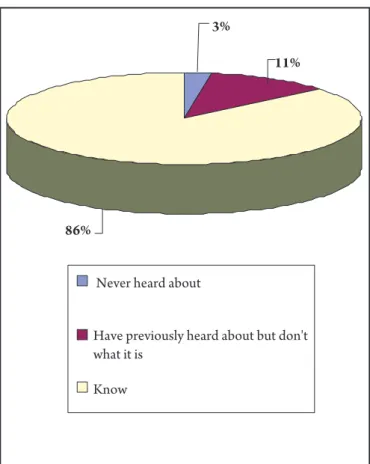
FIgURE 1 - general distribution of knowledge regarding human papilloma virus among the Nursing College students.
HPV is one of the hopes for the future and the vaccination program proposed by the Brazilian government, when it is available, shall be clear, precise and with an educational message not only for those who remain uninformed, but also for health professionals3,5,18.
HPV remains an infection that is rarely discussed within society. A recent study demonstrated the low level of knowledge and wide spread misconceptions regarding STDs, especially HPV. It also revealed that the level of knowledge is still far below that required20.
Given these facts, we considered it important to evaluate the level of knowledge concerning HPV among nursing students of a private educational institution, located in the City of Bauru, SP, Brazil, and correlate the data obtained through the survey with the year in which the students were enrolled.
his is a descriptive study with a quantitative approach, which was conducted in a private educational institution in the City of Bauru, State of Sao Paulo, Brazil. his institution ofers a nursing course, where the survey was conducted. he survey was applied to randomly selected 1st, 2nd, 3rd, and 4th-year students, 20 students from each year,
of both genders, during August 2009. Criteria for exclusion included those under 18 years-old, those who did not agree to participate in the survey, those who were not enrolled in the institution and those who did not ill out the entire survey.
Statistical analysis
he data was analyzed descriptively. he percentual data analysis technique was used and the results were presented as the mean± SD. he graphs were structured using the Microsot Excel program and the tables were structured using the Microsot Word program.
Ethical
he research project was submited to and approved by the Anhanguera College Research Ethics Commitee. All the participants of the survey signed a term of free, informed consent regarding their participation in the research.
he participants of this research were basically composed of female students, who represented 90% (72 students) of the total, with men consisting of 10% (8 students). he students’ mean age was 27.8 years-old.
With the intention of evaluating the level of knowledge of the students concerning HPV, some questions were asked regarding the deinition, consequences, prevention, susceptibility, symptoms and diagnosis of HPV.
Figure 1 presents the students knowledge concerning HPV, where 86% of the interviewees stated knowledge concerning HPV, while 11% had previously heard about HPV and only 3% have never heard about HPV.
he percentage of students with knowledge of HPV was analyzed according to enrollment year: among 2nd and 3rd-year students,
100% of the interviewees stated knowledge of HPV; among 4th-year
students, 90% of the interviewees stated such knowledge; and among 1st-year students, it was 55%.
Analysis of the results for the question regarding the route of HPV contamination showed that 90% the students answered that it occurred through sexual intercourse, 6% answered through blood transfusion, 2% answered others and 2% did not have an opinion. Moreover, analysis revealed that sexual intercourse was the response of 100% of the 2nd, 3rd, and 4th-year students, while only 78% of
1st-year students responded correctly.
The question regarding situations which could increase the chances of contagious disease revealed that 34% answered sexual intercourse without a condom, 33% answered having multiple sex partners and 10% answered having sexual intercourse at a too young an age. his question permited more than one answer. Analysis veriied that, in relation to the susceptibility of contracting HPV, 37% of 2nd- and 4th-year students considered having multiple sex
partners the predominant risk factor, while 33% of 3rd-year students
considered early sexual initiation and the lack of using a condom and 34% of 1st-year students considered the lack of using a condom
as the predominant risks.
In relation to the question regarding predominance of a sex, 60% of the students considered that both sexes are targeted in the same proportion, 36% stated that only or mainly women are capable of acquiring HPV, 2% answered that only or mainly men are capable of acquiring HPV and 2% had no opinion.
In relation to knowledge regarding the frequency of HPV symptoms, 72% stated that HPV infection is oten symptomatic, while 14% stated that it is always symptomatic, 9% stated that it is never symptomatic and 5% had no opinion. Further analysis revealed that 55% of 1st-year students, 85% of 2nd-year and 75% of
3rd- and 4th-year students stated that the HPV infection is sometimes
1% 10%
86% 3%
Doesn't have any efect Col uter cancer No opinion
Nasopharyngeal lesion
FIgURE 2 - general distribution of knowledge concenring the long term efects of human papilloma virus among the Nursing College students.
56% 36%
5% 3%
Usage of preservatives
Vaccination
Others
None
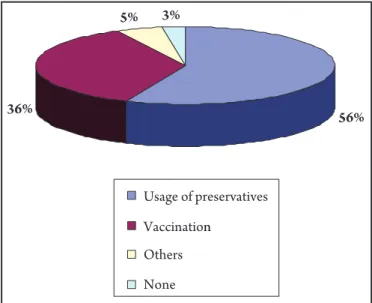
FIgURE 3 - general distribution of knowledge concering preventive methods for human papilloma virus among the Nursing College students.
3 3
0 0
14
4
10
7 3
13
10
13
0 5 10 15
1 yearst 2 yearnd 3 yearrd 4 yearth
Number of students
Never heard about
Have already heard but don't what is it
Yes and I know the dyagnosis
FIgURE 4 - Distribution of knowledge concering the diagnosis of human papilloma virus among the Nursing College students, according to enrollment year.
Figure 2 presents student knowledge concerning the long term efects of HPV, where 86% believe that HPV can cause cervical cancer. One interesting piece of information was that 10% of the students stated that HPV does not have any long term efect.
In relation to the year of enrollment, 80% of 1st-year students,
77% of 2nd-year, 90% of 3rd-year and 95% of 4th-year students believe
that HPV can cause cervical cancer.
Figure 3 presents the students´ level of knowledge regarding prevention, where 56% stated that the usage of condoms can prevent HPV, another 36% of the interviewees believe that vaccination is the main preventive agent, while 5% of the interviewees believed in other prevention methods, such as the Papanicolaou exam coupled with avoiding more than one sex partner.
he distribution per enrollment year revealed that 68% of 1st-year
students, 56% of 2nd-year, 48% of 3rd-year and 61% of 4th-year students
mentioned condoms as a preventive agent. Another 24% of 1st-year
students, 41% of 2nd year, 41% of 3rd-year and 36% of 4th-year students
mentioned vaccination as the main preventive agent.
In relation to HPV diagnosis, 48% of the interviewees stated knowledge of the diagnosis, 44% had previously heard about it, but could not determine diagnosis, while 8% had never heard about it. Among those who stated they had some knowledge of HPV diagnosis, 56% cited the Papanicolaou exam as the main form of diagnosis.
Figure 4 shows that 11% of 1st-year students, 65% of 2nd-year,
52% of 3rd-year and 65% of 4th-year students claimed to know the
diagnosis. hose who had previously heard of, but could not describe it included 73% of 1st-year students, 20% of 2nd-year, 48% of 3rd-year
and 35% of 4th-year students.
he question regarding predisposition for cervical cancer due to HPV revealed that 92% of the students knew that HPV can cause cervical cancer, while only 8% did not know; 85% of 1st-year students,
95% of 2nd-year, 100% of 3rd-year and 90% of 4th-year answered that
the HPV can cause cancer of the uterine cervix.
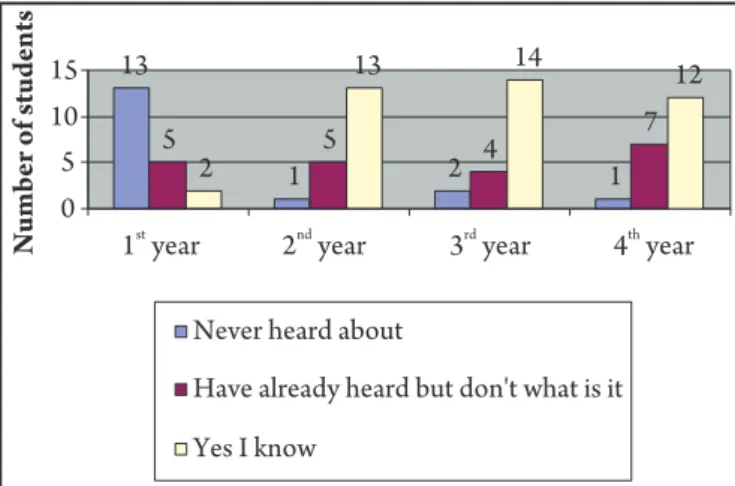
In relation to the vaccination as a form of HPV prevention, 51% stated they knew of the existence of the vaccine, another 27% of the interviewees stated that they had previously heard about it, but they did not know which vaccine was the correct one, while 22% had never heard about a vaccine. Figure 5 reveals that 10% of 1st-year students, 69% of 2nd-year, 70% of 3rd-year and 60% of
4th-year students stated that they already knew about the vaccine
as a preventive agent.
13
1 2 1
5 5 4 7
2
13 14 12
0 5 10 15
Never heard about
Have already heard but don't what is it
Yes I know Number of students 1 yearst
2 yearnd
3 yearrd
4 yearth
FIgURE 5 - Distribution of knowledge concerning the vaccine as a preventing agent against infection by human papilloma virus (HPV) among the Nursing College students, according to enrollment year.
DISCUSSION
he majority of participants in this study (90%) were women, against 10% of men. This can be explained by the fact that the participants were all from a nursing college, a course in which women are predominant, according to Weterich et al21.
his fact is related to the prejudicial image of this profession, prejudice which historically deines Nursing as being a women’s profession. According to the authors, the interest among men for this profession apparently shows that conceptions concerning Nursing are going through a series of transformations, leaving behind the idea of a predominantly female profession, although they are still the majority in this area.
he ages of the interviewees ranged from 18 to 51 years-old, with a mean of 27.8 years-old. Since they are students from a private institution and atend the night course, the average age results difer from the data of Peres et al22, who highlighted that the majority of
university students in Brazil who enroll in higher education are, on average, 20 years-old.
In relation to the level of knowledge of the students concerning HPV, a good overall average of 86% of the students was obtained; however, only 55% of the students in their irst year of college stated that they were aware of HPV, 35% said they had heard about it, but did not know what it was, while 10% had never heard about it. he same results were observed concerning the level of knowledge of the contagious characteristics of HPV. 100% of the students enrolled in the college in the 2nd, 3rd and 4th years knew that this disease is acquired
through sexual intercourse, against 78% of 1st-year students, leading
to the conclusion that part of the students have some knowledge regarding HPV, that this knowledge was probably acquired through other means before college life and that their knowledge tends to increase during the nursing course. Similar data was also veriied by Conti et al 20.
he answers to the question concerning the situations which increase the risk of contracting HPV and which permited more than one answer, showed a high level of knowledge among the students, since only some of the 1st-year students responded with no opinion,
while the other students indicated more than one situation which increases the risk, a fact also considered by Sousa et al23.
Among the interviewees, 60% believed that both sexes are targeted by HPV in the same proportion. Sousa et al23 and
Conti et al20 reported similar data in their research.
In relation to the symptoms, Conti et al20 showed that the majority
of the students did not know much about the subject. In this study, 72% stated that the HPV infection is sometimes symptomatic and 85% believe that the HPV can cause cancer of the uterine cervix.
According to Conti et al20, in their study the students were not
aware of the real function of the preventive exam and further reported that it is fundamental that health institutions alert the population concerning the importance of the preventive exam, because the exam permits a reduction of up to 70% in mortality due to cervical cancer among the risk population. In this study, 57% stated that the use of condoms can prevent HPV, 37% of the interviewees believed that vaccination is the main preventive agent, while 4% believed in other preventive methods, for example, the Papanicolaou exam and not having multiple sex partners.
Thus, although the current prophylactic vaccines protect noninfected women, those infected prior to vaccination still require diagnosis and treatment for preneoplastic lesions. Even if it were extremely eicient and involved a great coverage rate, a large scale vaccination program against HPV would take years to show noticeable epidemiological efects. It is important to highlight that vaccination does not eliminate the necessity for routine examinations for cervical cancer3,5,18.
In relation to diagnosis, 48% of the interviewees stated that they knew the diagnosis, 44% had previously heard about it but did not know what it was, while 8% had never heard about it. his data corroborates indings from other studies20-23.
Regarding the onset of their sex lives and the number of partners, the majority of the students, 92%, had already initiated their sex lives and 65% had already had an average 1 to 3 sex partners. his group can be classiied as a sexual active population, which justiies the interest in studies on the level of knowledge concerning HPV among nursing students20-23.
he present study was performed on students of the nursing college and revealed a lack of information and misconceptions among 1st-year students regarding HPV. he level of information among
these students was less than desirable. his fact is due to the low level of information acquired prior to their enrollment in college and that in their irst year they still have not studied STDs or HPV.
In this very complex context, nurses are valuable members of the health staf who have a fundamental role in the educational process for the health of the population; however, for them to participate in the educational process, it is crucial that sex has been widely discussed using all means of communication, in order to enhance the level of knowledge of these professionals.
he goals proposed for this study were fulilled, since, in general, analysis of the knowledge of HPV among the students was adequate; moreover, the 4th-year students showed a greater level of knowledge in
relation to the 1st-year students due to the longer period of study.
ACKNOWLEDGMENTS
CONFLICT OF INTEREST
he authors declare that there is no conlict of interest.
REFERENCES
he authors would like to thank to Bauru Anhanguera Educational School, Bauru, Sao Paulo State, Brazil.
1. Xavier SD, B Filho I, Carvalho JM, Framil VMS, Castro TMPPG. Freqüência de aparecimento de Papilomavírus Humano (HPV) na mucosa oral de homens com HPV anagenital conirmado por biologia molecular. Arq Int Otorrinolaringol 2007; 11:36-44.
2. Nonnenmacher B, Breitenbach V, Villa LL, Prolla JC, Bozzeti MC. Identiicação do papilomavírus humano por biologia molecular em mulheres assintomáticas. Rev Saude Publica 2002; 36:95-100.
3. Derchain SFM, Sarian LOZ. Vacinas proiláticas para o HPV. Rev Bras Ginecol Obstet 2007; 29:281-284.
4. Teixeira JC, Santos CC, Derchain SFM, Zeferino LC. Lesões induzidas por papilomavírus humano em parceiros de mulheres com neoplasia intra-epitelial do trato genital inferior. Rev Bras Ginecol Obstet 1999; 21:431-437. 5. Nadal LRM, Nadal SR. Indicações da vacina contra o Papilomavírus Humano.
Rev Bras Coloproct 2008; 28:124-126.
6. Rama CH, Roteli-Martins CM, Derchain SFM, Oliveira EZ, Aldrigho JM, Mariani CN. Detecção sorológica de anti HPV 16 e 18 e sua associação com achados do Papanicolaou em adolescentes e mulheres jovens. Rev Assoc Med Bras 2006; 52:43-47.
7. Nadal SR, Manzione CR. Uso do colposcópio para avaliar a região perianal e o canal anal-padronização técnica da nomenclatura e indicações. Rev Bras Coloproct 2004; 24:379-381.
8. Queiroz DT, Pessoa SMF, Sousa A. Infecção pelo Papilomavírus (HPV): incertezas e desaios. Acta Paul Enferm 2005; 18:190-196.
9. Rama CH, Roteli-Martins CM, Derchain SFM, Longato-Filho A, Gontijo RC, Sarian LOZ, et al. Prevalence of genital HPV infection among women screened for cervical cancer. Rev Saude Publica 2008; 42:123-130.
10. Teixeira JC, Derchain SFM, Teixeira LC, Santos CC, Panetta K, Zeferino LC. Male Sexual Partner Evaluation and Relapse Risk in Women Treated for Genital Human Papillomavirus (HPV) Lesions. Rev Bras Ginecol Obstet 2002; 24:315-320.
11. Murta EFC, Souza MAH, Adad SJ, Araújo Júnior E. Infecção pelo Papilomavírus Humano em Adolescentes: relação com o método anticoncepcional, gravidez, fumo e achados citológicos. Rev Bras Ginecol Obstet 2001; 23:217-221. 12. Magi JC, Brito SEM, Grecco ETO, Pereira SMM, Galdino JS. Prevalência de
papilomavirus humano (HPV) anal, genital e oral, em ambulatório geral de coloproctologia. Rev Bras Coloproct 2006; 26:233-238.
13. Pinto AP, Túlio S, Cruz OR. Co-fatores do HPV na oncogênese cervical. Rev Assoc Med Bras 2002; 48:73-78.
14. Cerqueira DM, Moraes DS, Milanezi N, Camara GNL, Amaral FA, Oyama CNR, et al. Caracterização molecular do Papilomavírus Humano em mulheres infectadas com o vírus da imunodeiciência humana do tipo 1 no Distrito Federal e Entorno. Com Ciencias Saude 2007; 18:267-278.
15. Uchimura NS, Ribalta JCL, Focchi J, Baracat EC, Uchimura T. Inluência do uso de anticoncepcionais hormonais orais sobre o número de células de Langerhans em mulheres com captura hídrica negativa para Papilomavírus humano. Rev Bras Ginecol Obstet 2005; 27:726-730.
16. Magi JC, Rodrigues MRS, Guerra GMLS, Costa MC, Costa ACL, Villa LL, et al. Resultados do exame anátomo-patológico e “Polymerase Chain Reaction (PCR)” na forma clínica e subclínica da infecção anal pelo Papilomavírus Humano (HPV) - Estudo em quatro grupos de pacientes. Rev Bras Coloproct 2006; 26:406-413.
17. Roteli-Martins CM, Longatto Filho A, Hammes LS, Derchain SFM, Naud P, Matos JC, et al. Associação entre a idade ao início da atividade sexual e subseqüente infecção por Papilomavírus Humano: resultados de um programa de rastreamento brasileiro. Rev Bras Ginecol Obstet 2007; 29:580-587. 18. Nadal SR, Manzione CR. Vacinas contra o Papilomavirus Humano. Rev Bras
Coloproct 2006; 26:337-340.
19. Noronha V, Mello W, Villa L, Brito A, Macêdo R, Bisi F. Papilomavírus humano associado a lesões de cérvice uterina. Rev Soc Bras Med Trop 1999; 32:235-240.
20. Conti FS, Bortolin S, Kulkamp IC. Educação e Promoção à Saúde: Comportamento e conhecimento de Adolescentes de Colégio Público e Particular em Relação ao Papilomavírus Humano. DST - J Bras Doenças Sex Transm 2006; 18:30-35.
21. Weterich NC, Melo MAC. Peril sociodemográico do aluno do curso de graduação em enfermagem. Rev Latino-Am Enf 2007; 15:404-410.
22. Peres RS, Santos MA, Coelho HMB. Peril da clientela de um programa de pronto-atendimento psicológico a estudantes universitários. Psicol em Estudo 2004; 9:47-54.