Original Article
Copyright © 2015 Revista Latino-Americana de Enfermagem
This is an Open Access article distributed under the terms of the Creative Commons Attribution Non-Commercial License (CC BY-NC).
This license lets others distribute, remix, tweak, and build upon your work non-commercially, and although their new works must also acknowledge you and be non-commercial, they don’t have to license their derivative works on the same terms.
Corresponding Author: Fabiana Alves da Silva
Universidade Federal de Pernambuco. Hospital das Clínicas Comissão de Controle de Infecção Hospitalar
Av. Prof. Moraes Rego, 1235 Cidade Universitária
CEP: 50670-901, Recife, PE, Brasil E-mail: [email protected]
1 Specialist, RN Midwife, Hospital Universitário de Santa Maria, Santa Maria, RS, Brazil. 2 PhD, Physician, Hospital das Clínicas, Universidade Federal de Pernambuco, Recife, PE, Brazil.
3 PhD, Adjunct Professor, Departamento de Enfermagem, Universidade Federal de Pernambuco, Recife, PE, Brazil.
Validation of the content of the prevention protocol for early sepsis
caused by Streptococcus agalactiae in newborns
Fabiana Alves da Silva
1Cláudia Fernanda de Lacerda Vidal
2Ednaldo Cavalcante de Araújo
3Objective: to validate the content of the prevention protocol for early sepsis caused by
Streptococcus agalactiae in newborns. Method: a transversal, descriptive and methodological
study, with a quantitative approach. The sample was composed of 15 judges, 8 obstetricians and
7 pediatricians. The validation occurred through the assessment of the content of the protocol
by the judges that received the instrument for data collection – checklist – which contained
7 items that represent the requisites to be met by the protocol. The validation of the content
was achieved by applying the Content Validity Index. Result: in the judging process, all the
items that represented requirements considered by the protocol obtained concordance within the
established level (Content Validity Index > 0.75). Of 7 items, 6 have obtained full concordance
(Content Validity Index 1.0) and the feasibility item obtained a Content Validity Index of 0.93.
The global assessment of the instruments obtained a Content Validity Index of 0.99. Conclusion:
the validation of content that was done was an efficient tool for the adjustment of the protocol,
according to the judgment of experienced professionals, which demonstrates the importance of
conducting a previous validation of the instruments. It is expected that this study will serve as an
incentive for the adoption of universal tracking by other institutions through validated protocols.
Descriptors: Validation Studies; Streptococcus Agalactiae; Sepsis; Infant, Newborn.
Rev. Latino-Am. Enfermagem 2015 July-Aug.;23(4):635-41
DOI: 10.1590/0104-1169.0179.2598
Introduction
The neonatal infection by the B group β-hemolytic
Streptococcus (EGB), or Streptococcus agalactiae, is
considered an important problem of public health, being
the main cause of early neonatal sepsis, the generalized infection that occurs on the irst 48 hours of life, having a direct relationship with the gestational or intra-partum period, according to the deinition by the Brazilian Ministry of Health. The sepsis represents one of the most
important causes of neonatal morbidity and mortality,
and its incidence varies from one to eight cases for every
thousand born alive. In Brazil, the rate of mortality is
around 25%. International databases demonstrate that
around 30 million of newborns are diagnosed with sepsis
and from one to two million of them die.
Among other complications due to the infection by
the Streptococcus agalactiae in newborns some of them
need to be emphasized: meningitis, pneumonia, septic
abortion, chorioamnionitis, endometritis, increase in mortality and morbidity, neurological deicit, long-term hospital coninement and neonatal decease. Vertical transmission is the most common and its determining
factor is the exposure of the newborn to the EGB that
are present in the vagina, which is colonized in the
intra-partum period5. Among the newborns of mothers
that possess the EGB, the colonization occurs in 50%
of the cases. Considering the prevalence of the national
maternal colonization in 20%, there will be incidence
of two cases for every thousand born, provided the
absence of prophylactic interventions.
With the understanding of the relevance of this
issue in the context of public health, in the late 1990’s, a
process of implementation of prophylactic interventions
started, intending to control the EGB infection in
newborns, which were improved through time. In
1996, the Center for Diseases Control and Prevention (CDC) published in the USA the irst national consensus directives about perinatal prevention of infections
caused by Streptococcus agalactiae. Two prophylactic
strategies for the intra-partum period were established. The irst was based on the risk factors and the second in the results of the tracking on the genitorectal secretion
cultures, collected between the 35th and the 37th week of
pregnancy, for the EGB research.
In August 2002, based on the new evidences of
a retrospective study, these directives were updated,
being now recommended the universal tracking through
genitorectal culture between the 35th and the 37th week
of gestation as the only strategy for the orientation of the
intra-partum chemoprophylaxis of the early infection by
the EGB. This approach consists in doing a microbiological
examination, with the goal of limiting, in terms of candidacy
to the intra-partum prophylaxis, just the patients colonized
by the EGB, regardless of the risk factors. This study
demonstrated that the effectiveness of the late antenatal
tracking, through the EGB culture, was 50% superior to
the alternate approach based on the risk factors.
In 2010, the 3rd review of the directives based on
the updated evidences of perinatal prevention for the
EGB was published. The CDC 2010 version highlights the
indications for universal “screening” on the 3rd trimester
of the gestation, standardizing the laboratory methods
about the collection and transportation of samples for
the detection of the GBS, taking into consideration
the changes in the arrangement and of the indication
of the antimicrobials recommended for the
intra-partum prophylaxis and by supplying updates for the
recommendations for newborns at risk to have an early
infection.
The change of conduct in the USA, through the
implementation of the orientations established by the
CDC, suggests a decline in the incidence of the early
disease caused by the EGB in the country, provided that,
among newborns with up to 6 days of life, the incidence
of the B group streptococcus disease was reduced from 0.47 of a thousand successful births, between 1999 and 2001, to 0.34 of a thousand successful births, between 2003 and 2005, which corresponds to a reduction of
27% after the implementation of the CDC 2002 guide.
Other data evinced that in the USA there was a reduction
equivalent to 1.2% in the annual rate of hospitalization
among the pre-term newborns, between 1988 and
2006, and that can be a consequence of the results of
the implementation of the preventive measures.
The Hospital das Clínicas of the Federal University
of Pernambuco (HC/UFPE) did not have the protocol for
the prevention of the neonatal infection by the EGB. This
way, the genitorectal culture is not done frequently, which
makes it impossible to know the state of the maternal
colonization. Given that, the prevention of the perinatal
infection by EGB is done through the administration
of the intra-partum antibiotic in pregnant women that
present risk factors on neonatal transmission, such
as the long period necessary for the rupture of the
amniotic membrane and the premature labor. However, this approach presents a limited eficiency and such indiscriminate use of antibiotics, in all pregnant women
with risk factors, may contribute for the emergence of
Given the available evidences about the relevance
of the infection within public health policies, the
consequences for the concept and the precision of
the intra-partum prophylaxis based on the universal
tracking, it was developed a protocol for the
prevention of the neonatal sepsis by the EGB, based
on the recommendations of the CDC 2010 guide, to be
implemented in the pre-natal, obstetrics and neonatal
units of the HC/UFPE.
Taken into consideration the importance of the
adequacy of the protocol regarding the semantic and
content aspects, the validation of the content by judges
emerge as a tool to meet this requirement, because it
allows professionals that are experienced in this area to provide signiicant collaborations to the protocol.
Provided what was mentioned previously, this study
had the goal of validating the content of the prevention
protocol of the early sepsis caused by the Streptococcus
agalactiae in newborns.
Method
This is a transversal, descriptive and methodological
study with a quantitative approach, conducted at the
HC/UFPE, an institution specialized in the care of
high-risk pregnancies, between May and August 2013.
The population was made of obstetricians and
pediatricians from the Obstetrics Center at the HC/UFPE,
with a minimum experience of four years in pediatrics
or obstetrics. The sample, by willfulness, included 10
obstetricians and 10 pediatricians. These were included due to a 4 year minimum experience in neonatology at the HC/ UFPE. The adopted criteria for exclusion were the following:
failure to deliver the questionnaire within the established deadline or the inadequate illing of the questionnaires.
The validation by the judges occurred through
the evaluation of the content of the protocol for the
prevention of neonatal sepsis caused by EGB, based
on the CDC 2010 guide. Through this, the contact
was established in order to invite pediatricians and
obstetricians to participate in the research. For all those
that accepted participating, the protocol that was made
to meet the requirements of the study was delivered, as
well as a letter containing the objectives of the study, the justiication of the process of the assessment protocol and the instrument for the data collection, a checklist
containing seven items that represent the requisites to
be met by the protocol.
The evaluation of the instrument occurred from the classiication of every item in terms of being adequate,
partially adequate or inadequate. The ones considered
adequate were those that completely met the
established requirement; partially adequate were those
that required some changes; and inadequate were those
that expressed a complete non-compliance in relation to
the established criteria.
The judges were instructed to give the material back after the analysis and to give their inal opinion personally to the researchers, within the 30 day deadline. For the
cases in which were considered to have inadequacies,
the reasons were explained, the suggestions described
and the contents rewritten, improved and submitted
to a new assessment. To the judges were also granted
explanations, when they were requested, related to the
practices established in the protocol.
The variables that were analyzed were: vocabulary, relevance, clinical-scientiic aspects, clarity, feasibility, organization and scope. After the
assessment of the protocol, the validation of the
content was done, with the application of the Content
Validity Index (CVI) that measures the proportion or
percentage of the judges that express agreement in
relation to the instrument’s items.
The specialized literature presents different
possibilities for the calculation of the CVI, as well as for
the establishment of its minimum level of concordance.
It is possible to calculate the score of this Index by
adding up the items that were deemed relevant. In
the case of this study, it was considered an adequate
judgment by all judges. The CVI calculation for the
instrument, as a whole, was done through the addition
of all the CVIs, calculated separately, divided by the
number of items of the instruments. It was considered
the minimum concordance index for the CVI the number
0.75, by consensus, both for the assessment of every
item and the instrument general assessment.
The data collected were electronically processed,
with the aid of the Excel 20 program. For the analysis
the manual calculation of the CVI was applied, as it
was previously described and percentages for the
characterization of the sample were utilized.
All the judges were informed about the goals of
the research, being included only the participants that
signed the Informed Consent Form. The ethical aspects were observed, with respect to the Resolution 466/2012 of the Brazilian National Health Council (CNS). The data
collection started after the approval of the project by
the Research Ethics Committee of the Center of Health
Results
Initially, the sample included 20 judges. However,
there were 5 exclusions: 2 for refusal in participating in all phases, 1 for inadequate illing of the form, 1 for not returning the material and 1 that abandoned. This way,
the sample was made up by 15 judges, 8 obstetricians
and 7 pediatricians. Table 1 shows the characterization
of the judges.
Table 1 – Data related to the identiication of the judges, according to gender, experience and titration. Recife, PE,
Brazil, 2013.
Variables n %
Gender
Feminine 9 60.0
Masculine 6 40.0
Titration
Specialization 8 53.3
Master’s Degree 5 33.3
PhD 2 13.3
Experience
6 to 10 years 1 6.5
>10 years 14 93.5
Total 15 100.0
It can be observed in Table 1 that among the
participants there was the prevalence of the feminine
gender (9 = 60%). The experience years varied from 10 to 38 years, and 14 (93.5%) of the judges had an experience time greater than 10 years. Regarding the titration, 5
(33.3%) had a Master’s degree and 2 (13.3%) had a PhD.
As it was demonstrated in Table 2, in the process
of judging the requisites related to the protocol of
prevention of the neonatal sepsis caused by EGB, after the irst assessment which was done by the judges no item was deemed as inadequate. However, only the
item relevance had total approval (CVI 1.0) and the
others required changes. It was observed that the items
vocabulary, clarity and feasibility had a CVI below the
established level (CVI < 0.75).
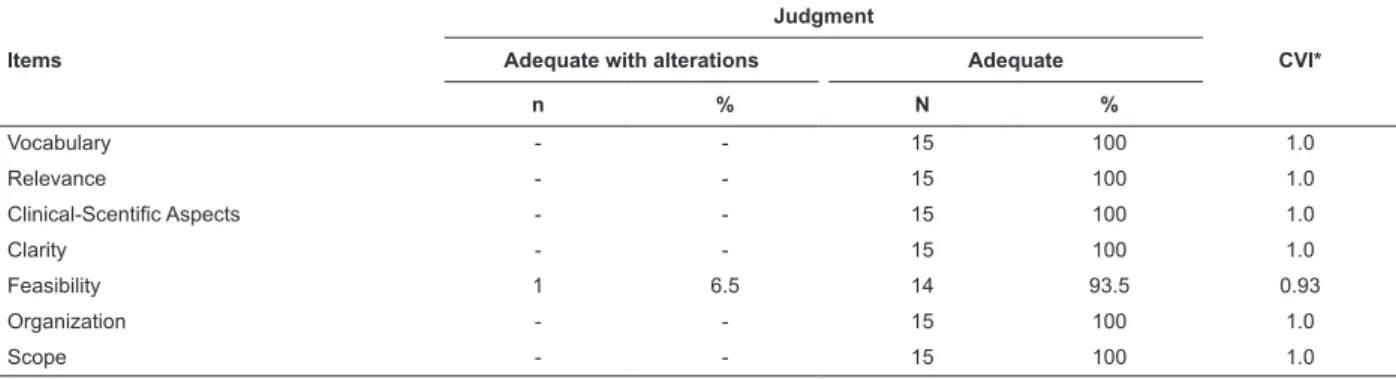
When the protocol was submitted for a new
analysis after its correction, considering the suggestions
of the judges, all the items obtained concordance
within the established level (CVI > 0.75). Of the 7
items, 6 obtained full concordance (CVI = 1.0) and
the item Feasibility obtained a CVI of 0.93. The global
assessment of the instruments had a CVI of 0.99,
demonstrating concordance within the established
level (Table 3).
Table 2 – First step of judgment made by the judges about the items of the protocol of prevention of the early
infection by the Streptococcus agalactiae in a newborn. Recife, PE, Brazil, 2013.
Items
Judgment
CVI*
Adequate with alterations Adequate
N % N %
Vocabulary 4 26.5 11 73.5 0.73
Relevance - - 15 100 1.0
Clínical-Scientific Aspects 2 13.5 13 86.5 0.86
Clarity 5 33.5 10 66.5 0.66
Feasibility 5 33.5 10 66.5 0.66
Organization 2 13.5 13 86.5 0.86
Scope 1 6.5 14 93.5 0.93
* Content Validity Index (CVI)
Table 3 – Second step of the judgment of the items of the protocol of prevention of the early infection by Streptococcus
agalactiae in newborns. Recife, PE, Brazil, 2013.
Items
Judgment
CVI*
Adequate with alterations Adequate
n % N %
Vocabulary - - 15 100 1.0
Relevance - - 15 100 1.0
Clinical-Scentific Aspects - - 15 100 1.0
Clarity - - 15 100 1.0
Feasibility 1 6.5 14 93.5 0.93
Organization - - 15 100 1.0
Scope - - 15 100 1.0
The most important questionings highlighted by
the judges considered to be necessary for adjustments were related to the structure of the lowcharts, the adequacy of the vocabulary, the lack of description of the
evidence levels, repeated information, the need for the
elaboration of sentences more clearly and the inclusion
of the diagram in the description of the prenatal conduct. For other questionings, clariications were provided by personal contact established with the judge.
Discussion
Considering the titration of the judges and the
minimum experience time of 10 years in almost all
cases, adding that the HC/UFPE is a hospital-school
in which the activities are together with the learning,
research and extension inseparably, it is possible to
state that it is an experienced group and it is inserted
in a context that provides the opportunity for constant
updating, suggesting that the judges possess the desirable qualiication for the judgment of the protocol.
The obstetrics nurses are qualiied to provide care for low-risk pregnancies during the prenatal
period, for normal childbirth without dystocia and in
the puerperium, in health facilities or at home. In case
there is any complication during pregnancy that may
characterize a high-risk pregnancy, these professionals
should refer the pregnant woman to the doctor, so that
he or she can continue to provide assistance. Keeping
in mind that HC/UFPE is an institution specialized in the
care of high-risk pregnancies, in which the care to these
patients in the Prenatal and at the Obstetrics Center is
given by the doctor – the sample did not include nurses.
The low-risk prenatal is done by the professionals
that belong to the Program for the Family’s Health
(PSF), which is present in 92% of Brazilian cities. Given
that, the doctors and nurses that act within the PSF
need to pay attention to the importance of doing the
microbiological exam for the detection of the B group
β-hemolitic Streptococcus. The challenge consists in, up to the present moment, the limited availability in the
labs entailed to the Brazilian Sistema Único de Saúde (Uniied Health System) for the prenatal routine, which suggests the need for stimulating the professionals to the introduction of the classiication of the Streptococcus agalactiae between the 35th and the 37th weeks in the assessment of the pregnant women, in their respective
local health facility.
Regarding the judgment process, it can be
observed that the item Relevance obtained consensual
total approval, which highlights the importance of doing
the swab in the pregnant women for the research of
the B group β-hemolitic Streptococcus, as a way to
orientate the prophylaxis and the treatment directed to
the reduction of the prevalence of the neonatal infection
by the group B Streptococcus are limited, provided
that the recommendation for the universal tracking for
the EGB research in all pregnant women between the
35th and the 37th weeks is not present in the manuals
written by the Ministry of Health, which is restricted to
special situations, such as: premature rupture of the
membrane, premature labor and pregnant women that
are HIV-positive.
The justiication is based on a systematic review, that assessed the use of the intra-partum prophylactic
antibiotic and the maternal and neonatal outcomes,
making clear that, although there is a decrease in the
occurrence of the infection caused by the EGB (RR 0.17, CI 95%, 0.04 to 0.74), there is a possibility that the results were inluenced by the authors, due to a methodological law of the studies. The authors add that currently there are no satisfactory evidences to state
that the intra-partum antibiotic prophylaxis is related
to the reduction of the neonatal mortality due to this
disease.
As the recognition of these controversies, related to
the viability and the impact of the orientations published
by the CDC, has a result in the lack of standardization
of the preventive strategies in many countries and the uncertainty about the eficiency of these practices, recently a systematic review with meta-analysis,
through an electronic query at the Cochrane Library, that
had the goal of determining the best tracking strategy
for the EGB in pregnant women. The results of this
study demonstrated that the adoption of the universal
tracking and of the antibiotic prophylaxis resulted in
an important reduction in the incidence of the neonatal
sepsis, making clear that the adoption of the universal
tracking for pregnant women, added to the antibiotic prophylaxis, are eficient measures.
As the importance of this theme is considered in
the context of Public Health, the City Department of
Health of São Paulo published a technical note based on
the CDC 2002 guide, for the tracking and prophylaxis
of the EGB among the pregnant women registered in
the Mãe Paulistana Program. Statistical data referring
to the acquired infections in the perinatal period in the
city of São Paulo demonstrate that there was a reduction
from 57.8%, in 2000, to 55.1% in 2008, and that can be
regarding the care to the neonatal infection caused by
the EGB.
It is of great importance that the tracking for the
research of the EGB in all pregnant women between
the 35th and the 37th weeks is included in the Ministry
of Health’s manuals, given that the indiscriminate use
of antibiotics may entail an increase in the resistant
strains. Furthermore, it is known that policies based on
prevention result in a cost-effectiveness relation that is
superior to the healing model.
At the HC/UFPE, the prophylaxis is based in the
administration of crystalline penicillin in pregnant women
that present risk factors. However, the impossibility
of identifying the state of the maternal colonization
can be interpreted as a risk for the transmission of
the infection. This fact was demonstrated in the study
conducted in pregnant women that have undergone
intra-partum prophylaxis for the prevention of the
maternal transmission of the EGB infection, based on
risk factors in a maternity hospital in Minas Gerais,
Brazil. The results revealed that 71.2% of the patients
that received intra-partum prophylaxis according to
their risk factors were not colonized by the EGB. On the
other hand, 33.3% of the patients that did not receive
the intra-partum prophylaxis were colonized. While the irst piece of information may indicate that the clinical judgment led to the unnecessary use of antibiotics in
around 7 out of 10 pregnant women, the second one indicates that the clinical judgment has laws, provided that the colonized patients, that do not present risk factors, will not beneit from the prophylaxis.
The penicillin remains as the antibiotic of choice
for the intra-partum prophylaxis, given that the EGB
presents a considerable sensibility. On the other hand,
a study done in a maternity hospital in Ceará, Brazil, demonstrated a high resistance in 4 out of 9 cases of pregnant women colonized by the Streptococcus agalactiae. This inding may be justiied by the identiication of molecular forms of these bacteria that present mutations in the gene of the protein of penicillin
bonding, resulting in the reduction of the susceptibility
to this medicine. Given that, the promotion of the
rational use of the antibiotics becomes important, which
was made possible through the development of the
protocols. In the present study the protocol that was
developed limited the chemo-prophylaxis, provided
that in the pregnant women with a positive result for
the culture this should only be indicated for the women
colonized by the EGB or in the presence of asymptomatic
bacteriuria, intra-partum fever, or a history of newborns
stricken by the infection by the Streptococcus agalactiae
in previous births.
It is worth highlighting that this study presented a
limitation, provided that the validity of the content is a
subjective process, being necessary a future validation
through additional clinical application. This fact remits to
the need for the conduction of future researches, with
the intent of verifying the results of the application of
the protocol in the neonatology and obstetrics sectors
of the HC/UFPE.
Conclusion
The validation of the content done in this study
was an effective tool to assess the adequacy of the
protocol, in agreement with the judgment emitted by
professionals with a wide experience in their area.
According to the results that were obtained, after
pondering the suggestions proposed by the judges, the
content of the protocol for the prevention of the early
neonatal sepsis by the Streptococcus agalactiae can be
considered satisfactory and adequate, demonstrating
the importance of doing a previous validation of the instruments. This irst step represents an important phase in the validation process; however, the need for
the production of studies should be highlighted, with the
intention of submitting them to clinical applications.
Bearing in mind the serious consequences of the
early perinatal streptococcal disease, in opposition to
the methods of tracking of the B-group Streptococcus in
the prenatal period, it is expected that this study works
as an incentive to the adoption of the universal tracking
by other institutions, both in the public and private
healthcare systems, through validated protocols, based on the scientiic knowledge that comes from researches based on the prevalence, prophylaxis and therapeutics
of this relevant perinatal pathology.
References
1. Ministério da Saúde (BR). Atenção à saúde do
recém-nascido: guia para os profissionais de saúde. Brasília:
Ministério da Saúde; 2011.
2. Castelano DS Filho, Tibiriça SHS, Diniz CG. Doença
Perinatal associada aos estreptococos do Grupo B:
aspectos clínico-microbiológicos e prevenção. HU Rev. 2008 abr/jun;34(2):127-34.
3. Stoll B, Hansen PS. Early Onset Neonatal Sepsis: The
Burden of Group B Streptococcal and E. coli Disease
4. Springman AC, Latcher DW. Selection, recombination, and virulence gene diversity among group B streptococcal genotypes. J Bacteriol. 2009 Jul;19(1):5419–27. 5. Zaidi AKM, Thaver D, Ali SA, Khan TA. Pathogens
Associated With Sepsis in Newborns and Young Infants
in Developing Countries. Pediatr Infect Dis J. 2009 Jan;
28(19):10-8.
6. Montes L, Souza JB, Fortunato FR Lopes ICR. Doença
Perinatal Associada ao Streptococcus Agalactiae
Aspectos Microbiológicos, Diagnóstico e Prevenção. News Lab. 2012; 109:132-43.
7. Prevention of perinatal group B streptococcal disease:
a public health perspective. MMWR 1996; Recomm Rep 45(RR-7):1-24.
8. Schrag S, Zell E, Lynfield R, Aaron R. A
population-based comparison of strategies to prevent early-onset
group B streptococcal disease in neonates. N Engl J Med. 2002;347(4):233.
9. Verani J, Mc gee L, Schrag S. Prevention of perinatal
group B streptococcal disease - revised guidelines from
CDC. MMWR 2010;59(RR-10):1-36.
10. Phares CR, Lynfield R, Farley MM, Mohle-Boetani
J, Harrison LH, Petit S, et al. Epidemiology of invasive
group B Streptococcal diseasein the United States,
1999-2005. J Am Med Assoc. 2008;299(17):2056-65.
11. Lukacs SL, Schrag SJ. Clinical Sepsis in Neonates
and Young Infants, United States, 1988-2006.
2012;160(6):960-5.
12. Tibúrcio MP, Melo GSM, Balduíno LSC, Costa IKF,
Dias TYAF, Torres GV. Validação de instrumento para
avaliação da habilidade de mensuração da pressão arterial. Rev Bras Enferm. 2014; jul-ago;67(4):581-7. 13. Gusmão JL, Pierin AMG. Instrumento de Avaliação da
Qualidade de Vida para Hipertensos de Bulpitt e Fletcher. Rev Esc Enferm USP. 2009; 43(Esp):1034-43.
14. Conselho Nacional de Saúde (BR). Resolução 466 [Internet]. [acesso 10 jul 2013]. Disponível em: http:// conselho.saude.gov.br/resolucoes/2012/Reso466.pdf 15. Ministério da Saúde (BR). Gestação de alto risco:
manual técnico. 5ed. Brasília: Ministério da Saúde;
2012.
16. Ministério da Saúde (BR). Secretaria de atenção à
saúde. Atenção Básica. Saúde da Família. Histórico de
cobertura da Saúde da Família [Internet]. Brasília; 2008. [acesso 12 mar 2008]. Disponível em: http://dtr2004. saude.gov.br/dab/abnumeros.php.
17. Castellano-Filho DS, Silva VL, Nascimento TC, Vieira
MT, Diniz CG. Detection of group b streptococcus in
Brazilian pregnant women and antimicrobial susceptibility
patterns. Braz J Microbiol. 2010;41:1047-55.
18. Ministério da Saúde (BR). Secretaria de Atenção à
Saúde. Atenção ao pré-natal de baixo risco. Brasília:
Ministério da Saúde; 2011.
19. Ohlsson A, Shah VS. Intrapartum antibiotics for
known maternal Group B streptococcal colonization.
Cochrane Data base Syst. Rev. 2009 jul; 8:(3).
20. Taminato M, Fram D, Torloni MR, Belasco AGS,
Saconato H, Barbosa DA. Screening for group B
Streptococcus in pregnant women: a systematic review
and meta-analysis. Rev. Latino-Am. Enfermagem. 2011;19(6):1470-8.
21. Prefeitura do Município de São Paulo. Secretaria
Municipal da Saúde. Áreas Técnicas da Saúde da Mulher
e da Criança e Assistência Laboratorial. Prevenção
da infecção neonatal pelo Streptococcus agalactiae
(Estreptococo Grupo B ou GBS). [acesso 13 out 2012].
Disponível em: www.prefeitura.sp.gov.br.
22. Nakamura PAM, Schuab RBB, Neves FPG, Pereira
CFA, de Paula GR, Barros RR. Antimicrobial resistance
profiles and genetic characterisation of macrolide
resistant isolates of Streptococcus agalactiae. Mem Inst
Oswaldo Cruz. 2011;106(2):119-22.
23. Linhares JJ, Cavalcante PG Neto. Prevalência de
colonização por Streptococcus agalactiae em gestantes
atendidas em maternidade do Ceará, no Brasil,
correlacionando com os resultados perinatais. Rev Bras Ginecol Obstet. 2011; 33(12):395-400.
24. Kimura K, Suzuki S, Wachino J, Kurokawa H, Yamane K, Shibata N, et al. First molecular characterization of
group B streptococci with reduced penicillin susceptibility.
Antimicrobial Agents Chemother. 2008;52(8):2890-7.
Received: June 4th 2014