Use of a noninvasive ventilation device following
tracheotomy: an alternative to facilitate ICU
discharge?
Utilização de equipamentos de ventilação não invasiva na
traqueostomia: uma alternativa para alta da UTI?
INTRODUCTION
Respiratory system injury progressing to acute respiratory failure (ARF) is common in intensive care units (ICU). In many such cases, the use of mechani-cal ventilation (MV) is indispensable. Recent technologimechani-cal and organizational advances in intensive care have allowed more patients to survive acute injury. However, these advances have also increased the number of chronic critical
pa-tients who become dependent on MV and other modalities of intensive care.(1)
Approximately 10% of the patients dependent on MV for prolonged periods of time undergo tracheotomies, considered an alternative to facilitate
ventilator weaning.(2) Tracheotomies reduce anatomical dead space, airway
resistance, and respiratory efort. hese procedures also allow better access to
the airway for removing secretions.(2,3) Following the tracheotomy procedure,
Soraia Genebra Ibrahim1, Joyce Michele Silva1,
Luis Guilherme Alegretti Borges1, Augusto Savi1,
Luiz Alberto Forgiarini Junior2, Cassiano Teixeira1,3
1. Hospital Moinhos de Vento - Porto Alegre (RS), Brazil.
2. Centro Universitário Metodista - IPA - Porto Alegre (RS), Brazil.
3. Universidade Federal de Ciências da Saúde de Porto Alegre – UFCSPA - Porto Alegre (RS), Brazil.
ABSTRACT
Objective: We aimed to assess the use of noninvasive ventilation devices in pa-tients with prolonged weaning following tracheotomy.
Methods: We performed a retros-pective observational study using data collected from the clinical records of tracheotomized patients diagnosed with prolonged weaning. he participants were hospitalized in the adult intensive care unit of Moinhos de Vento Hospital, Porto Alegre (RS) between December 2007 and December 2008.
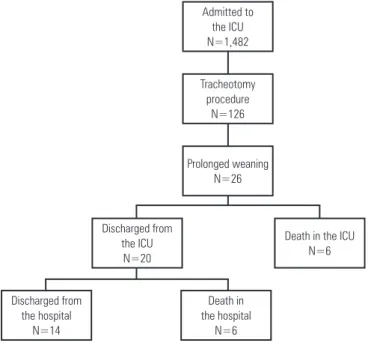
Results: In the data collection period, 1,482 patients were admitted to the intensive care unit. In total, 126 patients underwent tracheotomies, and 26 of these patients met the inclusion criteria for participating in the study. he average age of the patients in our sample was 73 ± 12 years. In our sample, 57.7% of the participants were female, and 80.8% were admitted as a result of acute hypoxemic
respiratory failure. After the tracheotomy, the patients remained under mechanical ventilation for an average of 29.8 days. After the initiation of the experimental protocol, the tracheotomized patients remained under ventilation for an average of 53.5 days on a portable noninvasive device connected to the tracheotomy. here were three possible outcomes for the patients. hey were discharged, were weaned from the noninvasive ventilation, or died in the intensive care unit or hospital ward. In total, 76.9% (20/26) of the patients were discharged from the intensive care unit, and 53.8% (14/26) of the patients were discharged from the hospital.
Conclusion: he use of noninvasive portable ventilators connected to the tra-cheotomy may represent an alternative for discontinuing ventilationand discharging tracheotomized patients with prolonged ventilatory weaning from intensive care unit.
Keywords: Tracheotomy; Ventilator weaning; Respiration, artiicial
This study was conducted at the intensive care unit, Hospital Moinhos de Vento - Porto Alegre (RS), Brazil.
Conflicts of interest: None.
Submitted on August 20, 2011 Accepted on March 30, 2012
Corresponding author:
Cassiano Teixeira Rua Riveira, 355/403
patients are more comfortable and mobile. hey are also more efective at communicating and staying out of bed. he patients often have better nutrition and are more safely discharged from the ICU.(3,4)
Recently, patients undergoing MV weaning have been classiied into three subgroups according to the patient’s diiculties and prognosis following MV
withdrawal.(5) Within this classiication scheme, the
prolonged weaning diagnosis is assigned to patients who have failed three or more spontaneous breathing trials,
or weaning attempts for more than seven days.(5) hese
patients require alternative treatments to become weaned from the ventilator and discharged from the ICU, and they are chronically dependent on intensive care. his dependence is associated with worse prognosis and higher rates of complications and mortality. In addition, these patients mean a signiicant inancial burden to the healthcare system.(1,5)
Recently, pressure support ventilation (PSV) has been used with noninvasive ventilation equipment [PSV combined with positive end-expiratory pressure (PEEP)] in caring for tracheotomized patients with chronic ARF.(5) Similar to MV, these portable noninvasive ventilation (NIV) devices may also reduce respiratory rate, increase tidal volume (Vt), improve gas exchange, and thus reduce respiratory efort.(5,6) NIVs are being increasingly applied to manage patients chronically dependent on MV such that they can be safely discharged from the ICU sooner.
he purpose of the present study was to examine the prognosis of tracheotomized patients with prolonged weaning and patients who were characterized as being unweanable. he patients were subjected to pressure support ventilation through a NIV device, and their ICU discharge rates were recorded.
METHODS
A retrospective observational design was adopted for the present study. We collected data from the clinical re-cords of tracheotomized patients (1) diagnosed with pro-longed weaning (≥ three failures at spontaneous breathing trials or failed MV weaning attempts for seven days or more) and (2) patients with advanced neuromuscular di-seases who were considered by the routine ICU physicians to be unweanable. All of the participants were patients in the adult ICU of Moinhos de Vento Hospital, Porto Ale-gre (RS) between December 2007 and December 2008. he present study was approved by the Research Ethics Committee of the institution waiving the need of obtai-ning a signed informed consent.
Protocol for using the NIV device in tracheotomi-zed patients
Routine criteria for starting pressure support venti-lation and use of speciic NIV device included: (1) age ≥ 18 years old and either being diagnosed with prolon-ged weaning or advanced neuromuscular disease. In the latter case, the clinical history was required to indicate that the patient would be indeinitely dependent on ventilator support.
he patients meeting the inclusion criteria were spontaneously ventilated using a NIV device (VPAP II,
Resmed®, San Diego, USA) connected to a tracheotomy
cannula. All of the patients used a tracheotomy cannula (size 8 or larger) with a cuf and an inner-cannula. hese patients were assisted by the ICU physiotherapists, who supervised an institutionally standardized rehabilitation program for these patients. his program consisted of exercises for the lower and upper limbs that could be performed in a bed or an armchair. he patients were also taught techniques for bronchial cleansing and pulmonary expansion.
Data collection
We collected data on the demographics (gender and age) of the patients. Their underlying diseases and the causes of their respiratory failure were also recorded. Additionally, were noted the length of their invasive ventilation support, as well as the length of their NIV support following tracheotomy. Finally, the outcome of the patients at the ICU and the hospital were recorded.
Statistical analysis
Descriptive statistical analyses were performed. Total values, group percentages, and means ± standard devia-tion (SD) of the parameters of interest were calculated.
RESULTS
Table 1 – Characteristics and prognoses of the patients
Patient Gender Age Diagnosis MV duration after tracheotomy
NIV duration after tracheotomy
ICU outcome Hospital outcome
1 F 56 ALS 5 24 Death
2 M 37 Vascular disease 5 12 Death -
3 F 78 COPD 50 14 Death -
4 F 89 PO 13 89 Death -
5 M 56 Parkinson 6 56 Death -
6 F 63 Multiple myeloma 12 68 Death -
7 M 76 ALS 5 41 Discharge Discharge
8 M 68 PO 40 25 Discharge Discharge
9 F 85 Multiple myeloma 56 240 Discharge Death
10 M 85 COPD 25 41 Discharge Discharge
11 F 81 COPD 45 38 Discharge Discharge
12 F 86 COPD 5 180 Discharge Death
13 F 80 CAP 13 187 Discharge Death
14 F 89 Porphyria 90 27 Discharge Discharge
15 F 87 CKF 85 34 Discharge Death
16 F 64 Stroke 74 38 Discharge Death
17 F 84 ALS 5 13 Discharge Death
18 F 77 Stroke 15 57 Discharge Discharge
19 F 85 Alzheimer 25 34 Discharge Discharge
20 M 65 Muscular dystrophy 18 24 Discharge Discharge
21 F 66 COPD 34 19 Discharge Discharge
22 M 78 COPD 38 49 Discharge Discharge
23 M 73 Stroke 36 29 Discharge Discharge
24 M 62 ALS 21 22 Discharge Discharge
25 M 70 PO 38 19 Discharge Discharge
26 M 69 COPD 18 12 Discharge Discharge
MV - mechanical ventilation; NIV - noninvasive ventilation; ICU - intensive care unit; F - female; ALS - amyotrophic lateral sclerosis; M - male; COPD - chronic obstructive pulmonary disease; PO - postoperative following major surgery; CAP - severe community-acquired pneumonia; CKF - chronic kidney failure.
before they were discharged, the NIV was discontinued, or died in the ICU or hospital.
Of the patients undergoing the NIV protocol, 76.9% (20/26) were discharged from the ICU, and 53.8% (14/26) were discharged from the hospital.
DISCUSSION
he most important inding in this study was that the use of NIV devices in tracheotomized patients allowed that 76.9% of the patients were discharged from the ICU, and 53.8% were discharged from the hospital. his was seen in a special population of patients who are dependent on ventilator support. he usage of these devices has not yet been extensively documented in the literature.
Chronic critically ill patients, a current epidemics, relect both the improvement in patient care, consequently reducing mortality rates and the increased number of patients dependent on intensive
care.(1,7) Patients with chronic critical illnesses who
have been dependent on ventilator support for ≥ 21 days are associated with greater morbidity, hospital expenses, and mortality rates, both inside and outside
of the hospital.(1,7-10) In addition to their dependence
Admitted to the ICU N=1,482
Tracheotomy procedure
N=126
Prolonged weaning N=26
Discharged from the ICU
N=20
Discharged from the hospital
N=14
Death in the ICU N=6
Death in the hospital N=6
on MV, patients with chronic critical diseases are more susceptible to severe weakness attributable to myopathy, neuropathy, or bodily changes;(5) infection;(7,9) coma or
delirium;(10) and nutritional deicits. hese patients are
also vulnerable to pain, thirst, dyspnea, depression, and anxiety, as well as the inability to communicate during tracheal intubation.(11)
In these patients, weaning is often associated with the inability to spontaneously breathe during attempted extubation. hese patients frequently
require tracheotomies.(1,7) Many of these patients can
be transferred to respiratory care units, intermediate care units, and home care services. However, because of the disorganization of the Brazilian healthcare system,
these types of units are often unavailable.(1) herefore,
alternatives are needed to ensure that the ICU beds are occupied by patients who truly require intensive care.
Nava and Hill(12) suggested that patients with chronic,
severe, and irreversible diseases should not be subjected to invasive ventilatory support when they develop ARF. In these situations, using NIV devices and other similar equipment may be indicated to treat the ARF symptoms. hese devices may help make better use of the available ICU beds and increase patient survival.(12)
Noninvasive ventilation can give continuous positive airway pressure (CPAP) or pressure support (characterized by applying two disparate airway pressures). Pressure support seems to be a better alternative for ICU patients with the exception of patients with cardiogenic
pulmonary edema.(13)
NIV can be used as a weaning strategy, especially when applied for the prophylactic treatment of special populations. his technique may reduce the duration
of MV,(13) accelerate ventilator weaning,(12,13) reduce
the risk of MV-related pneumonia,(14,15) and decrease
patient mortality.(12-14) However, few reports about the
use of diferent ventilator modes and NIV devices in tracheotomized patients that are dependent on invasive ventilatory support have been published. Patel and
Petrini(16) studied patients undergoing MV weaning. hey
compared the positive pressure exerted by conventional
ventilators in the CPAP mode (5 cm H2O) to that
exerted by a bilevel positive airway pressure (BiPAP) ST/D device. hey examined the BiPAP settings of 5 and
10 cm H20 for the expiratory positive airway pressure
(EPAP) and inspiratory positive airway pressure (IPAP), respectively. he authors showed that both methods were equally eicient and safe even in tracheotomized
patients.(16) Hill also asserted that patients could be
maintained using ventilators with PSV and PEEP
applied noninvasively or through a tracheotomy.(17) hus,
we analyzed the outcome of patients with tracheotomies using this mode of ventilation. hese patients were diagnosed with prolonged weaning. We assessed their discharge rates from the ICU and hospital.
hough the average time for discontinuing MV depends on the severity and nature of the patient’s disease or injury, patients with prolonged weaning are usually kept on MV for 16 to 37 days.(5,6,18,19) In our study, the patients required an average of 83 days of ventilator support between the tracheotomy and their discharge from the hospital. he patients were discharged from the hospital as a result of NIV use (3/26), ventilator weaning (11/26), or death (12/26). Our patients underwent tracheotomies to accelerate MV weaning. However, they remained under MV with PSV for an average of 29.8 days before pressure support using a NIV device was
indicated. Previously, Scheinhorn et al.(20) showed that
tracheotomies reduced the average time to discontinuing ventilator support from 29 to 17 days. he weaning protocols for critical, MV-dependent, tracheotomized patients commonly involve changing the ventilator
mode to the PSV setting (10 to 15 cm H2O). Next,
the patient is subjected to spontaneous breathing trials
through a T-tube in the tracheotomy.(8,21,22) he average
stay in the ICU of the patients with prolonged weaning ventilated using pressure support on a NIV device was 53 days. he patients were subsequently transferred to a hospital ward.
Patients who remain dependent on ventilation are vulnerable to death. Successful weaning, however, does not guarantee long-term survival. Most patients with severe chronic diseases have comorbid disorders, residual organic dysfunction, and other concurrent complications. he mortality rate of these patients varies
between 20 and 49%.(22,23) here results are consistent
with the indings in our study: 23.1% of the patients in our sample died in the ICU, and 46.1% of the patients died during their hospitalization.
Our study has two strengths. here have been few studies published on our reported topic. Furthermore, we are investigating chronic critical care patients who are dependent on MV, which is a population that is rapidly increasing in number. However, our sample size is restricted. In addition, the data that we collected is retrospectively derived from incomplete medical records.
Any mechanical ventilator developed for invasive or noninvasive ventilation may be used in practice, unless
distal oriice designed to minimize CO2 re-inhalation during inspiration. We applied this speciic NIV device to our chronic critical patients because of these characteristics. We hoped to facilitate the transfer of these patients to the wards under this type of support because the hospital at which the study was conducted did not have an intermediate care unit. Further, we aimed to encourage the patient’s relatives to participate in the patient’s care.
Similarly, Nava and Hill(12) observed that one of the main advantages of using NIV is that patients who are not at risk of death may be safely managed outside of the ICU. For this advantage to be practical, the healthcare teams in the hospital wards must be adequately trained. he hospital at which this study was conducted successfully implemented this idea. he participants were put on ventilators equipped with alarms and previously adjusted parameters. Physiotherapeutic care was provided every day (three sessions per day). In addition, there was a fast response team that was ready to assist the patients in less than two minutes in case of emergency.
he results of the present study suggest that the ventilation strategy that we implemented facilitates weaning and ICU discharge in chronic critical patients and for patients requiring skilled assistance. Nevertheless, we will need to examine a larger patient sample over a longitudinal period to assess the signiicant predictors of ICU discharge.
CONCLUSION
NIV devices may be used to facilitate ventilation wi-thdrawal and ICU discharge in tracheotomized patients with prolonged ventilator weaning.
RESUMO
Objetivo: Avaliar a utilização de equipamentos para realiza-ção de ventilarealiza-ção não invasiva em pacientes crônicos traqueos-tomizados com desmame prolongado.
Métodos: Estudo observacional retrospectivo, por meio de levantamento de dados de prontuários, em pacientes tra-queostomizados com diagnóstico de desmame prolongado, os quais estiveram internados na unidade de terapia inten-siva para adultos do Hospital Moinhos de Vento, em Porto Alegre (RS), no período de dezembro de 2007 a dezembro de 2008.
Resultados: Durante o período pré-estabelecido para a coleta dos dados, 1.482 pacientes estiveram internados na unidade de terapia intensiva. Destes, 126 pacientes foram traqueostomizados e 26 preencheram os critérios de inclusão no estudo. A média idade dos pacientes foi de 73 ± 12 anos, 57,7% eram do gênero feminino e 80,8% dos casos interna-ram por insuiciência respiratória aguda hipoxêmica. Após a realização de traqueostomia, os pacientes permaneceram, em média, 29,8 dias ainda em ventilação mecânica e, após o início do protocolo nos traqueostomizados, 53,5 dias em ventilação com ventilador portátil de ventilação não invasiva na traquestomia até a alta, desmame da ventilação não in-vasiva ou óbito durante a internação na unidade de terapia intensiva ou no hospital. De todos os pacientes protocolados, 76,9% (20/26) receberam alta da unidade de terapia intensi-va e 53,8% (14/26) alta hospitalar.
Conclusão: A utilização de ventiladores portáteis utiliza-dos para a realização de ventilação não invasiva conectautiliza-dos a traqueostomia pode ser uma alternativa para a desconti-nuação da ventilação e alta da unidade de terapia intensiva em pacientes traqueostomizados com desmame ventilatório prolongado.
Descritores: Traqueostomia; Desmame do respirador; Respiração artiicial
REFERENCES
1. Nelson JE, Cox CE, Hope AA, Carson SS. Chronic critical illness. Am J Respir Crit Care Med. 2010;182(4):446-54.
2. Cox CE, Carson SS, Holmes GM, Howard A, Carey TS. Increase in tracheostomy for prolonged mechanical ventilation in North Carolina, 1993-2002. Crit Care Med. 2004;32(11):2219-26.
3. Goldwasser R. Desmame e interrupção da ventilação mecânica. J Bras Pneumol. 2007;33(Supl 2):S128-36.
4. Pierson DJ. Tracheostomy and weaning. Respir Care. 2005;50(4):526-33. 5. Boles JM, Bion J, Connors A, Herridge M, Marsh B, Melot C, et al.
Weaning from mechanical ventilation. Eur Respir J. 2007;29(5):1033-56. 6. Wagner DP. Economics of prolonged mechanical ventilation. Am Rev
Respir Dis. 1989;140(2 Pt 2):S14-8.
7. MacIntyre NR, Epstein SK, Carson S, Scheinhorn D, Christopher K, Muldoon S; National Association for Medical Direction of Respiratory Care. Management of patients requiring prolonged mechanical ventilation:
report of a NAMDRC consensus conference. Chest. 2005;128(6):3937-54. 8. Clini EM, Crisafulli E, Antoni FD, Beneventi C, Trianni L, Costi S, et al.
Functional recovery following physical training in tracheotomized and chronically ventilated patients. Respir Care. 2011;56(3):306-13.
9. Engoren M, Arslanian-Engoren C. Hospital and long-term outcome of trauma patients with tracheostomy for respiratory failure. Am Surg. 2005;71(2):123-7.
10. Kahn JM, Carson SS, Angus DC, Linde-Zwirble WT, Iwashyna TJ. Development and validation of an algorithm for identifying prolonged mechanical ventilation in administrative data. Health Serv Outcomes Res Methodol. 2009;9(2):117-32.
11. Burns KE, Adhikari NK, Keenan SP, Meade M. Use of non-invasive ventilation to wean critically ill adults off invasive ventilation: meta-analysis and systematic review. BMJ. 2009;338:b1574.
12. Nava S, Hill N. Non-invasive ventilation in acute respiratory failure. Lancet. 2009;374(9685):250-9. Review.
Chest. 2007;132(2):711-20.
14. Kalb TH, Lorin S. Infection in the chronically critically ill: unique risk profile in a newly defined population. Crit Care Clin. 2002;18(3):529-52. 15. Trevisan CE, Vieira SR; Research Group in Mechanical Ventilation Weaning.
Noninvasive mechanical ventilation may be useful in treating patients who fail weaning from invasive mechanical ventilation: a randomized clinical trial. Crit Care. 2008;12(2):R51.
16. Patel RG, Petrini MF. Respiratory muscle performance, pulmonary mechanics, and gas exchange between the BiPAP S/T-D system and the Servo Ventilator 900C with bilevel positive airway pressure ventilation following gradual pressure support weaning. Chest. 1998;114(5):1390-6. 17. Hill NS. Noninvasive positive-pressure ventilation. In: Tobin MJ. Principles
and practice of mechanical ventilation. 2nd ed. New York: MacGraw-Hill; 2006. p. 433-72.
18. Hollander JM, Mechanick JI. Nutrition support and the chronic critical illness syndrome. Nutr Clin Pract. 2006;21(6):587-604.
19. Van den Berghe G, de Zegher F, Veldhuis JD, Wouters P, Awouters M, Verbruggen W, et al. The somatotropic axis in critical illness: effect of continuous growth hormone (GH)-releasing hormone and GH-releasing peptide-2 infusion. J Clin Endocrinol Metab. 1997;82(2):590-9.
20. Scheinhorn DJ, Chao DC, Stearn-Hassenpflug M, Wallace WA. Outcomes in post-ICU mechanical ventilation: a therapist-implemented weaning protocol. Chest. 2001;119(1):236-42.
21. Schönhofer B, Euteneuer S, Nava S, Suchi S, Köhler D. Survival of mechanically ventilated patients admitted to a specialised weaning centre. Intensive Care Med. 2002;28(7):908-16.