REVIEW ARTICLE
Mental health problems among medical students in Brazil:
a systematic review and meta-analysis
Joa˜o P. Pacheco,
1Henrique T. Giacomin,
1Wilson W. Tam,
2Ta´ssia B. Ribeiro,
1Claudia Arab,
3Italla M. Bezerra,
1Gustavo C. Pinasco
11Faculdade de Medicina, Escola Superior de Cieˆncias da Santa Casa de Miserico´rdia de Vito´ria (EMESCAM), Vito´ria, ES, Brazil.2Alice Lee
Centre for Nursing Studies, Yong Loo Lin School of Medicine, National University of Singapore, Singapore.3Departamento de Cardiologia, Escola Paulista de Medicina, Universidade Federal de Sa˜o Paulo (UNIFESP), Sa˜o Paulo, SP, Brazil.
Objective:
To provide a comprehensive picture of mental health problems (MHPs) in Brazilian medical
students by documenting their prevalence and association with co-factors.
Methods:
We systematically searched the MEDLINE/PubMed, SciELO, LILACS, and PsycINFO
databases for cross-sectional studies on the prevalence of MHPs among medical students in Brazil
published before September 29, 2016. We pooled prevalences using a random-effects meta-analysis,
and summarized factors associated with MHP.
Results:
We included 59 studies in the analysis. For meta-analyses, we identified the summary
prevalence of different MHPs, including depression (25 studies, prevalence 30.6%), common mental
disorders (13 studies, prevalence 31.5%), burnout (three studies, prevalence 13.1%), problematic
alcohol use (three studies, prevalence 32.9%), stress (six studies, prevalence 49.9%), low sleep
quality (four studies, prevalence 51.5%), excessive daytime sleepiness (four studies, prevalence
46.1%), and anxiety (six studies, prevalence 32.9%). Signs of lack of motivation, emotional support,
and academic overload correlated with MHPs.
Conclusion:
Several MHPs are highly prevalent among future physicians in Brazil. Evidence-based
interventions and psychosocial support are needed to promote mental health among Brazilian medical
students.
Keywords:
Mental health; depression; medical students; mental disorders
Introduction
Mental health problems (MHPs) and mental distress can
significantly impair quality of life
1and empathy.
2Further-more, higher mental well-being is positively associated
with empathy
3and negatively associated with suicidal
ideation, unprofessional behaviors, and burnout.
4From
this perspective, MHPs may have a serious impact on
a student’s life, affecting capacity to organize highly
dem-anding study hours, socialize, and perform academically.
Among students of the health professions, this could affect
patient care, since empathy and professionalism might be
impaired.
The literature reports that medical students display
poorer psychosocial wellbeing when compared to peers
of the same age
5and exhibit higher prevalence of
depres-sion and burnout than the general population,
6presumably
due to the intense workload expected. In particular, a
number of potentially stressful factors have been reported
among Brazilian medical undergraduates. These include a
highly stressful environment, competitiveness, excessive
workload, sleep deprivation, peer pressure, and many
other personal, curricular, institutional, and affective
factors.
1,7,8Additionally, undergraduate medical
educa-tion in Brazil is facing new challenges, such as conciliating
a Unified Health System (SUS)-centered national
curri-culum guideline with the psychosocial needs of students
8within the framework of a 6-year curriculum divided into
three cycles: a basic (preclinical) cycle, a
clinical-theo-retical cycle, and the more practical ‘‘internship’’ cycle.
Research into factors associated with MHPs is
impor-tant for the development of interventions, especially at this
paradigm-changing stage of curriculum planning. Factors
known to be associated with MHPs in medical students
include female gender,
9,10maladaptive personalities,
9financial difficulties,
10pre-existing mental health
pro-blems,
11and exposure to an older, fragmented, and
more theoretical curricular structure.
12In a study of 62,728 medical students, the overall
prevalence of depression was reported to be 28.0%.
13Existing systematic reviews and meta-analyses on this
issue have been generated for medical students from
Asia,
14,15North America,
9English-speaking countries
outside North America,
16and more globally.
13,17To our
knowledge, only one review
18relates to Brazilian medical
students, but was limited to a range of depressive and
anxiety disorders and did not include statistical analysis or
provide a detailed description of methodology to enable
future replication.
Correspondence: Joa˜o Pedro Gonc¸alves Pacheco, Rua Fortunato
Ramos, 493/304, Praia do Canto, CEP 29055-290, Vito´ria, ES, Brazil. E-mail: [email protected]
Submitted Jan 10 2017, accepted Mar 25 2017, Epub Aug 31 2017.
Associac¸a˜o Brasileira de Psiquiatria
This study aims to provide a comprehensive insight into
Brazilian medical student mental health, by addressing
the following questions relating to medical students in
Brazil: 1) what is the prevalence of MHPs and 2) which
co-factors are associated with MHPs. We hypothesized
that the most investigated MHPs would be depression,
anxiety, and burnout; that clinically significant depression
would affect a significant proportion of medical students;
and that female students would be generally more
affec-ted by mental health issues, given this trend in the general
public.
Methods
We registered the protocol of this review in the
Inter-national Prospective Register of Systematic Reviews
(PROSPERO; record no. CRD42016048236).
19Searches
On September 29, 2016, one reviewer (JPP) searched
MEDLINE (via PubMed) from 1966 to 2016, SciELO from
1909 to 2016, LILACS from 1980 to 2016, and PsycINFO
from 1927 to 2016. The review team developed a common
search strategy, including terms related to Brazil, medical
students, mental health, mental disorder, and other related
terms. The complete search strategy is available from the
registered protocol.
19We did not apply limitations to the
search. In addition, we manually screened the references
of the included papers for potential inclusion in the review.
Inclusion criteria
We only included cross-sectional studies that
evalua-ted the prevalence of MHPs amongst medical students
in Brazil. We included studies if: 1) they were
cross-sectional; 2) they assessed medical students enrolled in
Brazilian medical schools; 3) they reported prevalence of
one or more MHPs. For this review, we defined an MHP
as any diagnosable mental disorder or symptom of mental
disorder (e.g., depression, burnout, suicidal ideation).
Exclusion criteria
We excluded studies if: 1) they included medical student
participants with non-medical students in the same group,
but provided no subgroup analysis; 2) MHPs were not
the main focus of the questionnaire/diagnostic instrument
(e.g., the focus was quality of life); 3) they used instruments
not validated for the Portuguese language and for Brazilian
populations (linguistic and cultural validation was required);
or 4) the full study was not available.
Outcomes
The primary outcomes for this review were the prevalence
of depression and common mental disorders (CMD). The
secondary outcomes were the prevalence of other MHPs
and factors associated with MHPs.
Study selection and data extraction
Two review team members (JPP and HTG) independently
screened titles and abstracts, assessed studies for
eligi-bility, and performed data extraction. Any discrepancies in
study selection were resolved through discussion with a
third reviewer (GCP). We used the Preferred Reporting Items
for Systematic Reviews and Meta-Analyses
20(PRISMA)
flow chart to illustrate the study selection process (Figure 1).
The data extracted from each study included: study
char-acteristics (e.g., location, sample size), participant
charac-teristics (e.g., mean age, gender), and results for the
prevalence of MHPs and factors associated with MHPs.
Detailed information on data extraction is provided in the
protocol.
19We requested missing data (such as exact
number of participants, mean age, and gender) from study
authors as necessary.
Risk of bias assessment
Two authors (JPP and HTG) assessed reporting of ethical
approval and appraised the studies using the risk-of-bias
tool developed by Hoy et al.
21We used this tool because
it addresses external and internal validity and has high
inter-rater agreement.
21We omitted the last item of the
tool (‘‘Summary item on the overall risk of study bias’’)
because of its subjectivity. We resolved disagreements by
discussion. We used ratings to generate a quality index
for the quality-effects
22(QE) meta-analysis.
Data synthesis and statistical analysis
We used the Meta-analysis of Observational Studies in
Epidemiology (MOOSE) statement
23to guide the
report-ing of this review.
When studies provided appropriate data, we pooled the
results using a random-effects (RE) model, thus reporting
the aggregate prevalence, corresponding p-value, and 95%
confidence interval (95%CI). We used double arcsine
trans-formation and normalized prevalence data after pooling and
back-transformation.
24We presented the results in forest
plots. We also performed a sensitivity analysis to examine
whether use of a QE model
22produced a substantial
dif-ference in the results. We investigated the QE model
because it accounts for study quality and leads to a distinctly
conservative confidence interval when heterogeneity
exists.
22When two or more studies reporting the same
mental health problem were based on the same
data-base, we selected only one for the quantitative
synth-esis, favoring the study that was first published. We
selected this criterion because additional studies have
focused on particular subgroups, which could augment
their contribution to the meta-analysis results.
cycles of 2 years each); 3) country region where the
school is located; 4) cutoff scores (when we noted
varia-tion between studies); 5) symptom severity; and 6)
risk-of-bias score. For the meta-regression, we considered:
1) proportion of male students; 2) age; and 3) risk-of-bias
score. We divided studies into low (
X
0.9) and high
(
o
0.9) risk of bias. We assessed evidence of publication
bias by Egger’s regression method,
27when at least 10
studies were available.
25We performed meta-analyses
using MetaXL version 5.3 (EpiGear International, Sunrise
Beach, Queensland, Australia), and carried out
meta-regression and Egger’s meta-regression method using the
‘‘metafor’’ function in R software version 3.2.0 (R
Founda-tion for Statistical Computing, Vienna, Austria).
Results
We included 59 studies
28-86in the qualitative analysis,
and 57
28-37,39-52,54-86studies involving a total of 18,015
medical students in the quantitative analysis (Table 1). All
Table 1
Selected characteristics of the 59 studies of mental health problems amongst medical students in Brazil included in
qualitative analysis of a 2016 systematic review and meta-analysis
Study (date) Region of Brazil Students (n) Mean age (years) Male (%) Mental health problem assessed/Instrument
Abra˜o (2008)28 SE 400 NR 44 Depression/BDI
Aguiar (2009)29 NE 199 22 54.5 Stress/LSSI
Alberton (2013)30 S 391 NR 48.8 Disordered eating patterns/EAT
Alexandrino-Silva (2009)31 SE 338 22.4 31 Depression/BDI; suicidal ideation/BSI; hopelessness/BHS
Almeida (2007)32 NE 223 22 50.2 Common mental disorders/SRQ-20
Almeida (2016)33 NE 376 22.1 41.1 Burnout syndrome/MBI-HSS
Amaral (2008)34 CW 287 21.3 45.7 Depression/BDI
Amorim (2008)78 SE 285 21.1 47 Potentially hazardous alcohol intake/AUDIT
Amorim (2012)35 NE 203 NR NR Potentially hazardous alcohol intake/AUDIT
Baldassin (2006)36 SE 472 21.9 40.5 Trait anxiety/STAI-T
Baldassin (2008)37 SE 481 21.9 40.5 Depression/BDI
Baldassin (2013)38
* SE 481 NR 40.5 Depression/BDI
Baldisserotto (2005)79 S 378 22.6 59 Common mental disorders/SRQ-20
Baltieri (2015)39 SE 100 21.4 100 Depression/BDI
Bassols (2008)80 S 78 22 56.4 Stress/LSSI
Bassols (2014)40 S 232 23.1 50.4 Depression/BDI; anxiety/BAI
Bassols (2015)41 S 232 23.1 50.4 Stress/LSSI
Brunch (2009)81 S 233 NR NR Depression/BDI; trait anxiety/STAI-T
Cardoso (2009)42 CW 234 23.7 65.8 Low sleep quality/PSQI
Castaldelli-Maia (2012)43 SE 732 NR 36.6 Depression/BDI
Costa (2010)44 NE 473 22.6 49.7 Common mental disorders/SRQ-20
Costa (2012)45 NE 84 24.2 51.2 Depression/BDI
Costa (2012)46 NE 369 22.4 50.4 Burnout syndrome/MBI-HSS
Costa (2014)47 NE 93 NR NR Common mental disorders/SRQ-20
Cunha (2009)48 SE 295 21.2 41.9 Common mental disorders/SRQ-20
Danda (2005)49 NE 410 21.7 53.1 Excessive daytime sleepiness/ESS
Di Pietro (2009)50 SE 164 NR NR Concern with body shape/BSQ
Facundes (2005)51 NE 141 NR NR Common mental disorders/SRQ-20
Fiorotti (2010)52 SE 229 NR 50.2 Common mental disorders/SRQ-20
Furtado (2003)82 SE 178 22.2 41 Stress/LSSI
Gavioli (2009)53
* SE 455 NR 38.8 Common mental disorders/SRQ-20
Guimara˜es (2005)83 SE 413 22.5 43.6 Stress/LSSI
Hidalgo (2002)54 S 342 NR 58.2 Common mental disorders/SRQ-20;
excessive daytime sleepiness/ESS
Hirata (2007)55 NE 161 22.1 47.8 Depression/BDI
Leao (2011)56 SE 156 24.6 56 Depression/BDI; anxiety/BAI
Lima (2006)57 SE 455 NR 38.8 Common mental disorders/SRQ-20
Loayza (2001)58 S 302 20.5 60.9 Common mental disorders/SRQ-20
Macedo (2009)59 SE 290 21.6 41 Depression/BDI
Moro (2005)60 S 140 NR NR Depression/BDI
Nicoli (2011)61 SE 110 NR 40.2 Compulsive eating/BES
Pagnin (2014)62 SE 127 21.4 45 Depression/BDI; Anxiety/BAI; excessive daytime
sleepiness/ESS; low sleep quality/PSQI
Pagnin (2015)63 SE 193 21.4 46.1 Low sleep quality/MSQ; depression/BDI
Paro (2010)64 SE 385 22.3 38.7 Depression/BDI
Paula (2014)65 NE 652 22.7 41.1 Depression/BDI-II
Porcu (2001)84 S 126 NR 55.6 Depression/BDI
Rique (2014)66 NE 221 22.3 55.7 Low sleep quality/PSQI; excessive daytime
sleepiness/ESS
Rocha (2013)67 NE 354 NR 50.5 Common mental disorders/SRQ-20
Santos (2011)68 NE 234 NR NR Burnout syndrome/MBI-HSS
Serra (2015)69 SE 657 22.7 38.8 Depression/BDI; anxiety/BAI
Silva (2014)70 SE 434 22 41.9 Common mental disorders/SRQ-20
Silveira (2014)71 S 152 25.2 36.2 Potentially hazardous alcohol intake/AUDIT
Souza (2010)85 S 359 21.3 43.4 Depression/BDI; anxiety/STAI
Souza (2005)72 NE 562 21.5 57 Stress/GHQ
Tabalipa (2015)73 S 262 23 43.9 Depression/BDI; anxiety/BAI
Tempski (2015)74 All 1,350 22.8 47.1 Depression/BDI; anxiety/STAI
Torres (2016)75 SE 471 22.5 41.6 Obsessive-compulsive disorder/OCI-R;
Depression/BDI
Vallilo (2011)86 SE 400 22.6 44 Depression/BDI
Vasconcelos (2015)76 NE 234 22 34.2 Anxiety and depression/HADS
Volcan (2003)77 S 165 NR 58.8 Common mental disorders/SRQ-20
AUDIT = Alcohol Use Disorders Identification Test; BAI = Beck Anxiety Inventory; BDI = Beck Depression Inventory; BDI-II = Beck Depression Inventory, version II; BES = Binge Eating Scale; BHS = Beck Hopelessness Scale; BSI = Beck Scale for Suicidal Ideation; BSQ = Body Shape Questionnaire; CW = Center-West; EAT = Eating Attitudes Test-26; ESS = Epworth Sleepiness Scale; GHQ = General Health Questionnaire; HADS = Hospital Anxiety and Depression Scale; LSSI = Lipp’s Stress Symptoms Inventory; MBI-HSS = Maslach Burnout Inventory-Human Service Survey; MSQ = Mini-Sleep Questionnaire; NE = Northeast; NR = not reported; OCI-R = Obsessive-Compulsive Inventory-Revised; PSQI = Pittsburgh Sleep Quality Assessment; S = South; SE = Southeast; SRQ-20 = 20-item Self-Report Questionnaire; STAI = State-Trait Anxiety Inventory; STAI-T = Trait Anxiety Inventory.
forest plots are available on request from the authors. We
conducted subgroup analyses for depression and CMD
(Tables 2 and 3).
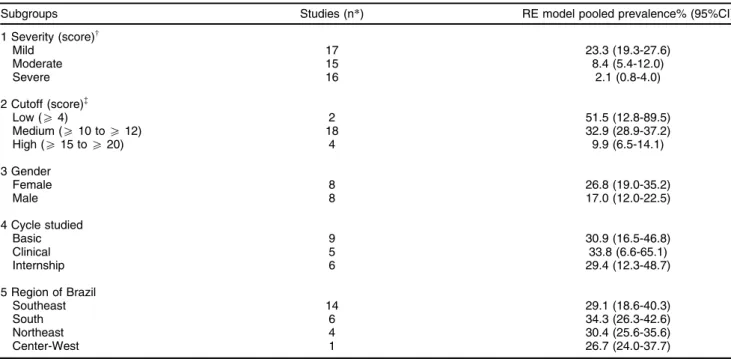
Prevalence of mental health problems
Depression
In an analysis of 25 studies, the summary prevalence
of depression among medical students in Brazil was
30.6% (95%CI 24.0-37.7, p
p
0.01, I
2= 97.96%). Table 2
reports stratified prevalences of depression.
The prevalences of depression were significantly
dif-ferent when using medium (32.9%, 95%CI 28.9-37.2) vs.
higher (9.9%, 95%CI 6.5-14.1) cutoff scores. When
stra-tified by symptom severity, aggregate prevalence was
23.3% (95%CI 19.3-27.6) for students with mild
symp-toms, 8.4% (95%CI 5.4-12.0) for moderate sympsymp-toms,
and 2.1% (95%CI 0.8-4.0) for severe symptoms. For
meta-regression, only the risk-of-bias score was significant (beta
= 0.7937, p = 0.0092).
Common mental disorders
CMDs can be translated as an indicator of a
non-psychotic mental disorder,
87evaluated by the 20-item
Self-Report Questionnaire (SRQ-20). The questionnaire
assesses 20 somatic, mood and anxious symptoms. It is
not a diagnostic instrument, but a community screening
tool, and cutoff scores may vary according to the cultural
context in which it is administered.
The prevalence of CMDs among medical students in
Brazil was 31.5% (95%CI 26.1-37.1, p
p
0.01, I
2=
92.67%), based on 13 studies. Simple meta-regression
showed that both risk-of-bias score (beta = 0.4986, p =
0.0029) and percentage of male students (beta = -0.0100,
p
o
0.01) were significant, but only the percentage of male
students was significant when both variables were included
in the regression.
We detected minimal variation in cutoff scores for
CMD, and severity of symptoms is not reported for CMD.
Thus, subgroup analyses were not conducted by these
characteristics. When prevalences were stratified by
region, students from the South region of the country
Table 2
Subgroup analyses of prevalence of depression among medical students in Brazil
Subgroups Studies (n*) RE model pooled prevalence% (95%CI)
1 Severity (score)w
Mild 17 23.3 (19.3-27.6)
Moderate 15 8.4 (5.4-12.0)
Severe 16 2.1 (0.8-4.0)
2 Cutoff (score)=
Low (X4) 2 51.5 (12.8-89.5)
Medium (X10 toX12) 18 32.9 (28.9-37.2)
High (X15 toX20) 4 9.9 (6.5-14.1)
3 Gender
Female 8 26.8 (19.0-35.2)
Male 8 17.0 (12.0-22.5)
4 Cycle studied
Basic 9 30.9 (16.5-46.8)
Clinical 5 33.8 (6.6-65.1)
Internship 6 29.4 (12.3-48.7)
5 Region of Brazil
Southeast 14 29.1 (18.6-40.3)
South 6 34.3 (26.3-42.6)
Northeast 4 30.4 (25.6-35.6)
Center-West 1 26.7 (24.0-37.7)
95%CI = 95% confidence interval; RE = random-effects.
*n indicates number of studies.
wThe scores juxtapose between studies using the Beck Depression Inventory (BDI-I or II), e.g., mild severity has been considered by authors
asX4 top9 orX15 top20 points in different studies; the total possible score is 63.
=Cutoff scores were divided by the review team into low (
X4), medium (X10 toX12), and high (X15 toX-20) out of a possible 63 points
for the 24 studies that used the BDI-I or II.
Table 3
Subgroups analyses of prevalence of common
mental disorders among medical students in Brazil
Subgroups Studies (n*)
RE model pooled prevalence% (95%CI)
Gender
Female 7 37.1 (30.0-44.4)
Male 7 31.9 (23.8-40.4)
Cycle studied
Basic 6 37.4 (31.1-43.8)
Clinical 6 42.8 (35.3-50.3)
Internship 6 34.6 (24.5-45.2)
Region of Brazil
Southeast 4 38.1 (29.5-47.1)
South 4 21.1 (18.9-23.6)
Northeast 5 31.5 (26.1-37.1)
95%CI = 95% confidence interval; RE, random-effects.
showed a significantly lower prevalence (21.1%, 95%CI
18.9-23.6) compared to those from the Southeast
(38.1%, 95%CI 29.5-47.15) and Northeast (31.5%, 95%
CI 26.1-37.1) regions (Table 3).
Other mental health problems
Analysis of three studies yielded a summary prevalence
of burnout of 13.1% (95%CI 10.2-16.4) among medical
students in Brazil. One study reported the prevalence
of current suicidal ideation and hopelessness through
standardized and validated tools. The prevalences were,
respectively, 13.4% and 95.5%.
Four studies reported prevalences of trait anxiety
(89.6%, 95%CI 43.3-100.00), two of state anxiety
(62.1%, 95%CI 0.00-100.00), six of anxiety in a general
sense (32.9%, 95%CI 22.0-44.9), six of stress (49.9%,
95%CI 57.8-53.0), and one of obsessive-compulsive
disorder (3.8%). Pooled data from three studies yielded
an aggregate prevalence of problematic alcohol use of
32.9% (95%CI 29.3-36.6). The aggregate prevalence of
low sleep quality was 51.5% (95%CI 21.2-81.2, pooled
data from four studies), while that of excessive daytime
sleepiness was 46.1% (95%CI 37.7-54.5, pooled data
from four studies).
The prevalence of compulsive eating and disordered
eating patterns was 10.9% and 10.0% respectively (data
from one study). Disordered eating patterns were more
prevalent among females (17.0%) than males (2.6%).
One study investigated concern over body shape, but
only reported prevalences for females (21.1%) and males
(9.5%) independently.
Factors associated with mental health problems
To balance the effect of multiple comparisons (see
para-graph on limitations, Discussion section) and for ease of
interpretation, we assessed factors that showed
signifi-cant correlations in more than one study or those
sig-nificant after multivariate analyses (Table 4). Female
gender was significantly associated with depression,
anxiety, and stress, while male gender was more
asso-ciated with burnout. Thoughts of dropping out, later stages
of the course, little involvement in leisure activities, lack of
emotional support, and academic overload were correlated
with MHP.
Assessment of publication bias, quality of studies, and
sensitivity analysis
We found no significant evidence of publication bias in the
25 studies that investigated depression (p = 0.0658) or
in the 13 studies that investigated CMD (p = 0.6542). We
did not conduct such analyses for the other conditions
because too few studies were available.
Risk-of-bias tool scores ranged from 5 to 10 out of a
possible 10 points (table available on request from the
authors). As noted above, risk-of-bias score was the only
significant factor in the meta-regression analysis for
dep-ression, while for CMD it was significant on simple
meta-regression. Studies with low risk of bias tended to report
higher prevalences of depression (37.4%, 95%CI
27.4-47.7) and CMD (37.7%, 95%CI 31.0-44.6), than those
with high risk of bias (30.6% [95%CI 24.0-37.7] and
Table 4
Factors associated with mental health problems among medical students in Brazil, according to studies included in a
2016 systematic review and meta-analysis
Mental health problem Positive association(n), pp0.05
Depression Female gender(8)*; desire to switch courses(2)*; later stages of the course(2)*; internship cycle(2)*; clinical cycle(3); dissatisfaction with the course(2); tobacco smoking(2); average (compared to good) academic performance*; difficulties in relationships*, emotional tension*; evening-type preference*; feeling pressured by parents*; having concerns over the future*; not having a parent who was a physician*; not participating in social activities*, parents were physicians*; poor or reasonable physical health*, thoughts of dropping out*; religion other than Catholic*, sedentary life style*; sporadic or rare involvement in leisure activities*; uncertainty about professional future.*
Common mental disorders
Not receiving sufficient emotional support(5)*; difficulty making friends(4)*; thoughts of dropping out(2)*; feelings of rejection(2)
*; academic overload(2)
*; few leisure activities(3); financial problems(3); not satisfied with professional choice(2); clinical cycle(2); feeling rejected by peers/friends(2); history of psychological treatment(2); sleep pattern disorder*; sedentary life style*; not working*; not having a car*; lack of confidence in acquisition of skills*; feelings of discomfort in relation to the activities of medical school*; unmatched expectations about the course*; prior diagnosis of mental disorder*; emotional tension and feelings of unhappiness*; long-lasting difficulty asking questions during classes due to shyness*; arousal during the night*; insomnia*; daytime sleepiness*; less than 7 hours of sleep per night*; poor self-evaluation of academic performance*; difficulty initiating sleep*; difficulty maintaining sleep*; falling asleep later*; waking up earlier*; low social interaction.*
Burnout Lack of confidence in acquisition of skills(2)
*; thoughts of dropping out(2)
*; male gender(2); having failed examinations*; feeling uncomfortable in academic activities*; not seeing coursework as a source of pleasure.*
Anxiety Female gender(3)*; parents were not physicians*; feeling pressured by parents.*
Stress Female gender(5); first year of the course*; lower family income*; dissatisfaction with the course*; using escape/ avoidance as coping strategy.*
Low quality sleep Cynicism*; emotional exhaustion.*
Excessive daytime sleepiness
Emotional exhaustion*; decreased academic efficacy*; cynicism.*
Obsessive-compulsive disorder
Depressive symptoms*; first year of the course*; adaptation difficulties.*
n = number of studies in which the association was found (minimum = 1).
31.5% [95%CI 26.1-37.1] respectively). However, the
difference was not significant. Sensitivity analysis showed
no significant difference between results for the QE model,
when compared to the RE model.
Discussion
Our findings support those from other parts of the
world,
9,13-17emphasizing how prevalent depression and
other mental disorders are among medical students.
Among the included studies, more had been published
from 2010-2016 than during the entire preceding decade.
This draws attention to the fact that, although these issues
have long been reported, they continue to be common in
the lives of medical students, possibly contributing to the
high prevalence of MHPs among physicians.
88,89We report that a high proportion of Brazilian medical
students are suffering from various MHPs. These include
psychological stress, anxiety, depression, sleep pattern
disorders, burnout, eating disorders, and potentially
hazardous alcohol use.
The most prevalent mental health problem that fitted
the meta-analysis was trait anxiety (89.6%), indicating
that most medical students have a considerably
perma-nent tendency to experience anxiety, stress, and
wor-ries.
90Yates et al.
11observed, in a retrospective survey,
that medical students with a mental health problem were
more inclined to have a pertinent pre-admission mental
health history. Moreover, Puthran et al.
13have found a
tendency of depression prevalence to decline in later
years of the medical course. These findings suggest that
the high levels of mental disorders among medical
students may not be predominantly due to a toxic learning
environment, as some authors have argued,
7,91but rather
to the contribution of the characteristics of individuals
selected through a highly competitive entrance exam.
Other hypotheses are that final-year students might be
receiving more treatment or feeling more fulfillment from
their professional choice as they become more in charge
of patient care. In the worst-case scenario, those more
severely depressed students have already dropped out.
This does not mean that students with MHPs should not
receive appropriate support within their higher-education
institutions. It is precisely because these high prevalences
are observed that we believe an open, non-stigmatized
communication should exist between students and the
institution, especially during the early years of training.
Our analysis showed that depressive symptoms,
when stratified by severity, are predominantly mild – an
evaluation that was not done in previous reviews.
13,17Assessment of symptom severity in depression is based
on the number of symptoms, functional impairment, and
suffering imposed by symptoms.
92Following this
con-struct, which is also used by depression scales,
92,93mild depression imposes just the number of symptoms
required for diagnosis or a few more, and produces only
mild social/occupational impairment.
94It is different from
minor or minimal or subthreshold depression,
95and
benefits from evidence-based treatment (e.g.,
cognitive-behavioral therapy or interpersonal therapy, alone or in
combination with antidepressants
96). The extent to which
mild depression symptoms affect the lives of medical
students should be investigated in future longitudinal
stu-dies. However, our finding is not completely unexpected.
Because depression can be a debilitating disorder, only
students that were performing academic activities at the
times of data collection were appraised, making students
that dropped out or were absent due to a mental disorder
not visible to the study (see paragraph on limitations
below).
Many MHPs and their correlations intersect,
suggest-ing that they might be coexistent in high-risk groups of
students. Female students tended to have higher
pre-valences of depression and CMD. Additionally, female
gender was associated with mood and anxiety disorders,
while male gender was associated with burnout. Similar
gender differences are also observed in the general
population and in medical students from other parts of
the world.
9,97,98Modifiable stressors also need to be
addressed to improve well-being. As a recent systematic
review
99revealed, there is no satisfactory evidence that
learning environment interventions could contribute to
improved mental well-being in medical students;
addi-tional high-quality research is needed in this area. We
observed that signs of lack of motivation (e.g., thoughts of
dropping out, dissatisfaction with the course, decreased
academic efficacy) and lack of emotional support were
associated with MHP, as in medical students from other
countries.
9The use of portfolios,
100self-assessments,
101and continued mentorship
102in undergraduate medical
education could improve students’ engagement and
ref-lection about the course, alleviating sources of distress
and helping students perceive their coursework as a
gratifying activity. A drop in academic performance can be
an indicative of a mental disorder. This is a key marker,
because academic records are usually easily available
to tutors. Future studies could consider the efficacy of
using this kind of information to identify students that are
potentially in decline.
suggesting that this is a gap in the literature. Finally, the
tools used do not aim at diagnosis. This could result in
larger prevalences, since sensitivity is commonly
prefer-red when using screening tools.
On the basis of this review, the pooled prevalences of
depression, anxiety, CMD, and problematic alcohol use
among medical students in Brazil ranged from 30.6 to
32.9%. Approximately half of the students were
experien-cing low sleep quality, and 46.1% experienced excessive
daytime sleepiness. Burnout affected approximately 13%
of students. These findings suggest that future physicians
are at great risk of depression, anxiety, alcohol-related,
sleep, and eating disorders. Our findings are in line with
studies reporting MHPs among medical students in other
countries, which suggests the existence of a global
problem. Signs of lack of motivation, insecurity, poor
academic performance, financial problems, and lack of
emotional support were all associated with MHPs, and
constitute modifiable stressors that could be targets for
novel interventions. As Brazilian medical students are
at high risk of MHPs, it is imperative that psychosocial
support be provided within higher-education institutions
and that students be monitored for frequency and severity
of these problems. Evidence-based interventions are
needed to promote well-being and mental health.
Acknowledgements
The authors thank Dr. Christopher N. Connolly for his
careful work in revising the manuscript and Dr. Christiane
B. Lourenc
¸
o and Ms. Elis C. Francischetto for their support
in the development of the research protocol. The authors
also thank Dr. George Stoica and Dr. Suhail A. Doi for their
helpful advice.
Disclosure
The authors report no conflicts of interest.
References
1 Lins L, Carvalho FM, Menezes MS, Porto-Silva L, Damasceno H. Health-related quality of life of students from a private medical school in Brazil. Int J Med Educ. 2015;6:149-54.
2 Neumann M, Edelha¨user F, Tauschel D, Fischer MR, Wirtz M, Woopen C, et al. Empathy decline and its reasons: a systematic review of studies with medical students and residents. Acad Med. 2011;86:996-1009.
3 Shanafelt TD, West C, Zhao X, Novotny P, Kolars J, Habermann T, et al. Relationship between increased personal well-being and enhanced empathy among internal medicine residents. J Gen Intern Med. 2005;20:559-64.
4 Dyrbye LN, Harper W, Moutier C, Durning SJ, Power DV, Massie FS, et al. A multi-institutional study exploring the impact of positive mental health on medical students’ professionalism in an era of high burnout. Acad Med. 2012;87:1024-31.
5 Pagnin D, de Queiroz V. Comparison of quality of life between medical students and young general populations. Educ Health (Abingdon). 2015;28:209-12.
6 Dyrbye LN, West CP, Satele D, Boone S, Tan L, Sloan J, et al. Burnout among U.S. medical students, residents, and early career physicians relative to the general U.S. population. Acad Med. 2014;89:443-51.
7 Tempski P, Bellodi PL, Paro HB, Enns SC, Martins MA, Schraiber LB. What do medical students think about their quality of life? A qualitative study. BMC Med Educ. 2012;12:106-106.
8 Figueiredo AMd, Ribeiro GM, Reggiani ALM, Pinheiro BdA, Leo-poldo GO, Duarte JAH, et al. Percepc¸o˜es dos estudantes de
med-icina da ufop sobre sua qualidade de vida. Rev Bras Educ Med. 2014;38:435-43.
9 Dyrbye LN, Thomas MR, Shanafelt TD. Systematic review of depression, anxiety, and other indicators of psychological distress among U.S. and Canadian medical students. Acad Med. 2006; 81:354-73.
10 Meyer C, Guimara˜es ACdA, Machado Z, Parcias SR. Qualidade de vida e estresse ocupacional em estudantes de medicina. Rev Bras Educ Med. 2012;36:489-98.
11 Yates J, James D, Aston I. Pre-existing mental health problems in medical students: a retrospective survey. Med Teach. 2008;30: 319-21.
12 Zuardi AW, Prota Fdel G, Del-Ben CM. Reduction of the anxiety of medical students after curricular reform. Rev Bras Psiquiatr. 2008; 30:136-8.
13 Puthran R, Zhang MW, Tam WW, Ho RC. Prevalence of depression amongst medical students: a meta-analysis. Med Educ. 2016;50: 456-68.
14 Cuttilan AN, Sayampanathan AA, Ho RC. Mental health issues amongst medical students in Asia: a systematic review [2000-2015]. Ann Transl Med. 2016;4:72-72.
15 Lei XY, Xiao LM, Liu YN, Li YM. Prevalence of depression among chinese university students: a meta-analysis. PLoS One. 2016;11: e0153454.
16 Hope V, Henderson M. Medical student depression, anxiety and distress outside North America: a systematic review. Med Educ. 2014;48:963-79.
17 Rotenstein LS, Ramos MA, Torre M, Segal JB, Peluso MJ, Guille C, et al. Prevalence of depression, depressive symptoms, and suicidal ideation among medical students: a systematic review and meta-analysis. JAMA. 2016;316:2214-36.
18 Baldassin S. Ansiedade e depressa˜o no estudante de medicina: revisa˜o de estudos brasileiros. Cadernos ABEM. 2010;6:19-26. 19 Pacheco JPG, Ribeiro TB, Francischetto EC, Arab C, Lourenc¸o CB,
Bezerra IMP, et al. Prevalence of depression and other mental health problems amongst medical students in Brazil: systematic review and meta-analysis [Internet]. Heslington: University of York. 2016 [cited 2017 Apr 15]. crd.york.ac.uk/PROSPERO/display_record. asp?ID=CRD42016048236.
20 Moher D, Liberati A, Tetzlaff J, Altman DG; PRISMA Group. Pre-ferred reporting items for systematic reviews and meta-analyses: the PRISMA statement. Ann Intern Med.2009;151:264-9; W64. 21 Hoy D, Brooks P, Woolf A, Blyth F, March L, Bain C, et al. Assessing
risk of bias in prevalence studies: modification of an existing tool and evidence of interrater agreement. J Clin Epidemiol. 2012;65:934-9. 22 Doi SA, Barendregt JJ, Khan S, Thalib L, Williams GM. Advances in the meta-analysis of heterogeneous clinical trials II: the quality effects model. Contemp Clin Trials. 2015;45:123-9.
23 Stroup DF, Berlin JA, Morton SC, Olkin I, Williamson GD, Rennie D, et al. Meta-analysis of observational studies in epidemiology: a proposal for reporting. Meta-analysis Of Observational Studies in Epidemiology (MOOSE) group. JAMA. 2000;283:2008-12. 24 Barendregt JJ, Doi SA, Lee YY, Norman RE, Vos T. Meta-analysis
of prevalence. J Epidemiol Community Health. 2013;67:974-8. 25 Higgins J, Green S, editors. Cochrane handbook for systematic
reviews of interventions. Version 5.1.0 [updated March 2011]. 2011. handbook.cochrane.org.
26 Higgins JP, Thompson SG, Deeks JJ, Altman DG. Measuring inconsistency in meta-analyses. BMJ. 2003;327:557-60.
27 Egger M, Davey Smith G, Schneider M, Minder C. Bias in meta-analysis detected by a simple, graphical test. BMJ. 1997;315:629-34. 28 Abra˜o CB, Coelho EP, Passos LBdS. Prevaleˆncia de sintomas depressivos entre estudantes de medicina da Universidade Federal de Uberlaˆndia. Rev Bras Educ Med. 2008;32:315-23.
29 Aguiar SM, Vieira APGF, Fernandes Vieira KM, Aguiar SM, No´brega JO. Prevaleˆncia de sintomas de estresse nos estudantes de medicina. J Bras Psiquiatr. 2009;58:34-8.
30 Alberton VC, Dal-Bo´ MJ, Piovezan AP, Silva RMd. Abnormal eating behaviors among medical students at a university in southern Santa Catarina, Brazil. Rev Bras Educ Med. 2013;37:15-20.
enrolled in healthcare training programs: a cross-sectional study. Rev Bras Psiquiatr. 2009;31:338-44.
32 Almeida AdM, Godinho TM, Bitencourt AGV, Teles MS, Silva AS, Fonseca DC, et al. Common mental disorders among medical stu-dents. J Bras Psiquiatr. 2007;56:245-51.
33 Almeida GdC, Souza HRd, Almeida PCd, Almeida BdC, Almeida GH. The prevalence of burnout syndrome in medical students. Arch Clin Psychiatry (Sa˜o Paulo). 2016;43:6-10.
34 Amaral GFd, Gomide LMdP, Batista MdP, Pı´ccolo PdP, Teles TBG, Oliveira PMd, et al. Sintomas depressivos em acadeˆmicos de medicina da Universidade Federal de Goia´s: um estudo de pre-valeˆncia. Rev Psiquiatr Rio Gd Sul. 2008;30:124-30.
35 Amorim TC, Amorim MES, Guedes LAC, Ramalho SL, Rivera GA. Evaluation of alcohol addiction among Brazilian Northeast medical students through the alcohol use disorders identification test and the relation with body mass index and smoking. Rev Soc Bras Clin Med. 2012;10:398-401.
36 Baldassin SP, Martins LC, Andrade AGd. Trac¸os de ansiedade
entre estudantes de medicina. Arq Med ABC. 2006;31:27-31. 37 Baldassin S, Alves TC, de Andrade AG, Nogueira Martins LA. The
characteristics of depressive symptoms in medical students during medical education and training: a cross-sectional study. BMC Med Educ. 2008;8:60.
38 Baldassin S, Silva N, de Toledo Ferraz Alves TC, Castaldelli-Maia JM, Bhugra D, Nogueira-Martins MC, et al. Depression in medical students: cluster symptoms and management. J Affect Disord. 2013;150:110-4.
39 Baltieri DA, Aguiar AS, de Oliveira VH, de Souza Gatti AL, de Souza Aranha e Silva RA. Validation of the pornography consumption inventory in a sample of male Brazilian university students. J Sex Marital Ther. 2015;41:649-60.
40 Bassols AM, Okabayashi LS, Silva AB, Carneiro BB, Feijo F, Gui-maraes GC, et al. First- and last-year medical students: is there a difference in the prevalence and intensity of anxiety and depressive symptoms? Rev Bras Psiquiatr. 2014;36:233-40.
41 Bassols AMS, Carneiro BB, Guimara˜es GC, Okabayashi LMS, Carvalho FG, da Silva AB, et al. Stress and coping in a sample of medical students in Brazil. Arch Clin Psychiatry (Sa˜o Paulo). 2015;42:1-5.
42 Cardoso HC, Bueno FCdC, Mata JCd, Alves APR, Jochims I, Vaz Filho IHR, et al. Avaliac¸a˜o da qualidade do sono em estudantes de
Medicina. Rev Bras Educ Med. 2009;33:349-55.
43 Castaldelli-Maia JM, Martins SS, Bhugra D, Machado MP, Andrade AG, Alexandrino-Silva C, et al. Does ragging play a role in medical student depression - cause or effect? J Affect Disord. 2012;139: 291-7.
44 Costa EF, Andrade TM, Silvany Neto AM, Melo EV, Rosa AC, Alencar MA, et al. Common mental disorders among medical stu-dents at Universidade Federal de Sergipe: a cross-sectional study. Rev Bras Psiquiatr. 2010;32:11-9.
45 Costa EF, Santana YS, Santos AT, Martins LA, Melo EV, Andrade TM. [Depressive symptoms among medical intern students in a Brazilian public university]. Rev Assoc Med Bras (1992). 2012;58: 53-9.
46 Costa EF, Santos SA, Santos AT, Melo EV, Andrade TM. Burnout Syndrome and associated factors among medical students: a cross-sectional study. Clinics (Sao Paulo). 2012;67:573-80.
47 Costa EF, Rocha MM, Santos AT, Melo EV, Martins LA, Andrade TM. Common mental disorders and associated factors among final-year healthcare students. Rev Assoc Med Bras (1992). 2014;60: 525-30.
48 Cunha MAB, Neves AAdF, Moreira ME, Hehn FJ, Lopes TP, Ribeiro CCF, et al. Transtornos psiquia´tricos menores e procura por cui-dados em estudantes de Medicina. Rev Bras Educ Med. 2009;33: 321-8.
49 Danda GJdN, Bastos O, de Souza KFR, Azenha M, Ferreira GR. Padra˜o do ciclo sono-vigı´lia e sonoleˆncia excessiva diurna em estudantes de medicina. J Bras Psiquiatr. 2005;54:102-6. 50 Di Pietro M, Silveira DX. Internal validity, dimensionality and
per-formance of the Body Shape Questionnaire in a group of Brazilian college students. Rev Bras Psiquiatr. 2009;31:21-4.
51 Facundes VL, Ludermir AB. Common mental disorders among health care students. Rev Bras Psiquiatr. 2005;27:194-200.
52 Fiorotti KP, Rossoni RR, Borges LH, Miranda AE. Transtornos mentais comuns entre os estudantes do curso de medicina: prevaleˆncia e fatores associados. J Bras Psiquiatr. 2010;59: 17-23.
53 Gavioli MdA, Silva AG, Gonc¸alves RJ, Santos ME, Shi KL, Lima
MCP. Formando grupos no internato: crite´rios de escolha, satis-fac¸a˜o e sofrimento psı´quico. Rev Bras Educ Med. 2009;33:4-9.
54 Hidalgo MP, Caumo W. Sleep disturbances associated with minor psychiatric disorders in medical students. Neurol Sci. 2002;23: 35-9.
55 Hirata FC, Lima MC, de Bruin VM, Nobrega PR, Wenceslau GP, de Bruin PF. Depression in medical school: the influence of morning-ness-eveningness. Chronobiol Int. 2007;24:939-46.
56 Leao PB, Martins LA, Menezes PR, Bellodi PL. Well-being and help-seeking: an exploratory study among final-year medical students. Rev Assoc Med Bras (1992). 2011;57:379-86.
57 Lima MC, Domingues Mde S, Cerqueira AT. [Prevalence and risk factors of common mental disorders among medical students]. Rev Saude Publica. 2006;40:1035-41.
58 Loayza H MP, Ponte TS, Carvalho CG, Pedrotti MR, Nunes PV, Souza CM, et al. Association between mental health screening by self-report questionnaire and insomnia in medical students. Arq Neuropsiquiatr. 2001;59:180-5.
59 Macedo PNAG, Nardotto LL, Dieckmann LHJ, Ferreira YD, Macedo BAG, dos Santos MAP, et al. Factors associated with depressive symptoms in a sample of Brazilian medical students. Rev Bras Educ Med. 2009;33:595-604.
60 Moro A, Valle JBd, Lima LPd. Sintomas depressivos nos estudantes de medicina da Universidade da Regia˜o de Joinville (SC). Rev Bras Educ Med. 2005;29:97-102.
61 Nicoli MG, Junior RD. Binge eating disorder and body image per-ception among university students. Eat Behav. 2011;12:284-8. 62 Pagnin D, de Queiroz V, Carvalho YT, Dutra AS, Amaral MB,
Queiroz TT. The relation between burnout and sleep disorders in medical students. Acad Psychiatry. 2014;38:438-44.
63 Pagnin D, de Queiroz V. Influence of burnout and sleep difficul-ties on the quality of life among medical students. Springerplus. 2015;4:676.
64 Paro HB, Morales NM, Silva CH, Rezende CH, Pinto RM, Morales RR, et al. Health-related quality of life of medical students. Med Educ. 2010;44:227-35.
65 de Paula JdA, Borges AMFS, Bezerra LRA, Parente HV, de Paula RCdA, Wajnsztejn R, et al. Prevaleˆncia e fatores associados a` depressa˜o em estudantes de medicina. Rev Bras Crescimento Desenvolv Hum. 2014;24:274-81.
66 Rique GL, Fernandes Filho GM, Ferreira AD, de Sousa-Munoz RL. Relationship between chronotype and quality of sleep in medical students at the Federal University of Paraiba, Brazil. Sleep Sci. 2014;7:96-102.
67 Rocha ES, Sassi AP. Transtornos mentais menores entre estu-dantes de medicina. Rev Bras Educ Med. 2013;37:210-6. 68 de Abreu Santos AT, Grosseman S, de Oliva Costa EF, de Andrade
TM. Burnout syndrome among internship medical students. Med Educ. 2011;45:1146.
69 Serra RD, Mattos e Dinato SL, Caseiro MM. Prevalence of depressive and anxiety symptoms in medical students in the city of Santos. J Bras Psiquiatr. 2015;64:213-20.
70 Silva AG, Cerqueira AT, Lima MC. Social support and common mental disorder among medical students. Rev Bras Epidemiol. 2014;17:229-42.
71 Silveira Rda R, Lejderman B, Ferreira PE, Rocha GM. Patterns of non-medical use of methylphenidate among 5th and 6th year stu-dents in a medical school in southern Brazil. Trends in Psychiatry Psychother. 2014;36:101-6.
72 Souza FGdMe, Menezes MdGC. Estresse nos estudantes de medicina da Universidade Federal do Ceara´. Rev Bras Educ Med. 2005;29:91-6.
73 Tabalipa FdO, Souza MFd, Pfu¨tzenreuter G, Lima VC, Traebert E, Traebert J. Prevalence of anxiety and depression among medical students. Rev Bras Educ Med. 2015;39:388-94.
75 Torres AR, Cruz BL, Vicentini HC, Lima MC, Ramos-Cerqueira AT. Obsessive-compulsive symptoms in medical students: prevalence, severity, and correlates. Acad Psychiatry. 2016;40:46-54. 76 Vasconcelos TCd, Dias BRT, Andrade LR, Melo GF, Barbosa L,
Souza E. Prevaleˆncia de sintomas de ansiedade e depressa˜o em estudantes de medicina. Rev Bras Educ Med. 2015;39: 135-42.
77 Volcan SM, Sousa PL, Mari Jde J, Horta BL. [Relationship between spiritual well-being and minor psychiatric disorders: a cross-sec-tional study]. Rev Saude Publica. 2003;37:440-5.
78 Amorim AVC, Kikko EO, Abrantes MM, Andrade VLAˆ . A´lcool e alcoolismo: estudo de prevaleˆncia entre discentes do curso de Medicina da UNIFENAS em Belo Horizonte - Minas Gerais. Rev Med Minas Gerais. 2008;18:16-23.
79 Baldisserotto CM, Filho ES, Nedel F, Sakae TM. Problemas psi-quia´tricos menores e indicadores do uso problema´tico de a´lcool entre os estudantes de medicina da Universidade do Sul de Santa Catarina - UNISUL. ACM Arq Catarin Med. 2005;34:73-9. 80 Bassols AM, Rodrigues GS, Seeger GM, Eizirik CL, Sordi AO,
Reche M. A prevaleˆncia de estresse em uma amostra de estu-dantes do curso de medicina da Universidade Federal do Rio Grande do Sul. Rev HCPA. 2008;28:153-7.
81 Bruch TP, Jornada LK, Carneiro EA. Presenc¸a de sintomas
psi-quia´tricos em estudantes de medicina de Universidade do sul do Brasil. ACM Arq Catarin Med. 2009;38:61-5.
82 Furtado ES, Falcone EMO, Clark C. Avaliac¸a˜o do estresse e das
habilidades sociais na experieˆncia acadeˆmica de estudantes de medicina de uma universidade do Rio de Janeiro. Interacao Psicol. 2003;7:43-51.
83 Guimara˜es KBS. Estresse e a formac¸a˜o me´dica: implicac¸o˜es na
sau´de mental dos estudantes [thesis]. Sa˜o Paulo: UNESP de Assis; 2005.
84 Porcu M, Fritzen CV, Helber C. Sintomas depressivos nos estu-dantes de medicina da Universidade Estadual de Maringa´ [Internet]. [cited 2017 Apr 26]. www2.unifesp.br/dpsiq/polbr/ppm/original5_01.htm. 85 Souza L. Prevaleˆncia de sintomas depressivos, ansiosos e estresse em acadeˆmicos de medicina [dissertation]. Sa˜o Paulo: Universidade de Sa˜o Paulo; 2010.
86 Vallilo NG, Danzi R Jr, Hu¨bner CvK, Novo NF, Gobbo R. Prevalence of depressive symptoms in medical students. Rev Soc Bras Clin Med. 2011;9:36-41.
87 Gonc¸alves DM, Stein AT, Kapczinski F. [Performance of the
self-reporting questionnaire as a psychiatric screening questionnaire: a comparative study with structured clinical interview for DSM-IV-TR]. Cad Saude Publica. 2008;24:380-90.
88 Mata DA, Ramos MA, Bansal N, Khan R, Guille C, Di Angelantonio E, et al. Prevalence of depression and depressive symptoms among resident physicians: a systematic review and meta-analysis. JAMA. 2015;314:2373-83.
89 Ishak WW, Lederer S, Mandili C, Nikravesh R, Seligman L, Vasa M, et al. Burnout during residency training: a literature review. J Grad Med Educ. 2009;1:236-42.
90 Marteau TM, Bekker H. The development of a six-item short-form of the state scale of the Spielberger state-trait anxiety inventory (STAI). Br J Clin Psychol. 1992;31:301-6.
91 Wolf TM. Stress, coping and health: enhancing well-being during medical school. Med Educ.1994;28:8-17; discussion 55-7. 92 Lux V, Aggen SH, Kendler KS. The DSM-IV definition of severity of
major depression: inter-relationship and validity. Psychol Med. 2010;40:1691-701.
93 Smarr KL, Keefer AL. Measures of depression and depressive symptoms: Beck Depression Inventory-II (BDI-II), Center for Epi-demiologic Studies Depression Scale (CES-D), Geriatric Depres-sion Scale (GDS), Hospital Anxiety and DepresDepres-sion Scale (HADS), and Patient Health Questionnaire-9 (PHQ-9). Arthritis Care Res (Hoboken). 2011;63:S454-66.
94 American Psychiatric Association. Diagnostic and Statistical Manual of Mental Disorders, Fourth Edition (DSM-IV). Arlington: American Psychiatric Publishing; 1994.
95 Ayuso-Mateos JL, Nuevo R, Verdes E, Naidoo N, Chatterji S. From depressive symptoms to depressive disorders: the relevance of thresholds. Br J Psychiatry. 2010;196:365-71.
96 Parikh SV, Segal ZV, Grigoriadis S, Ravindran AV, Kennedy SH, Lam RW, et al. Canadian Network for Mood and Anxiety Treatments (CANMAT) clinical guidelines for the management of major depres-sive disorder in adults. II. Psychotherapy alone or in combination with antidepressant medication. J Affect Disord. 2009;117:S15-25. 97 Andrade LH, Wang YP, Andreoni S, Silveira CM, Alexandrino-Silva
C, Siu ER, et al. Mental disorders in megacities: findings from the Sa˜o Paulo megacity mental health survey, Brazil. PLoS One. 2012;7:e31879.
98 Kessler RC, Berglund P, Demler O, Jin R, Koretz D, Merikangas KR, et al. The epidemiology of major depressive disorder: results from the National Comorbidity Survey Replication (NCS-R). JAMA. 2003; 289:3095-105.
99 Wasson LT, Cusmano A, Meli L, Louh I, Falzon L, Hampsey M, et al. Association between learning environment interventions and medi-cal student well-being: a systematic review. JAMA. 2016;316:2237-52. 100 Buckley S, Coleman J, Davison I, Khan KS, Zamora J, Malick S, et al. The educational effects of portfolios on undergraduate student learning: a Best Evidence Medical Education (BEME) systematic review. BEME Guide No. 11. Med Teach. 2009;31:282-98. 101 Sharma R, Jain A, Gupta N, Garg S, Batta M, Dhir SK. Impact of
self-assessment by students on their learning. Int J Appl Basic Med Res. 2016;6:226-9.