165
Article
Father and Mother as a Couple: Conceptual Aspects and Construct Validation
1Cilio Ziviani2
Terezinha Féres-Carneiro Andrea Seixas Magalhães
Pontifícia Universidade Católica do Rio de Janeiro, Rio de Janeiro-RJ, Brazil
Abstract: Based on the theory of the indissoluble link, this study aims to validate the scale Father and Mother as a Couple scale (FMC), addressed to marital relations between parents as perceived by their sons and daughters, referring to various components of this construct. The PMC, consisting of eleven pairs of items, and distinguishing father and mother in the same variable, is part of a broader instrument, the Questionnaire on Parents as a Couple (QPC), comprising 60 items overall. The non-probability sample consists of 1,612 youth, 678 men and 934 women, between 18 and 29 years. The analyses presented empirical evidence favoring
the validation of this scale as consisting of a single dimension which has, however, been considered as comprising the fi rst principal
component interpreted as explicit, and the second one as implicit, both in the father and mother subscales with Cronbach’s alphas, respectively, .85 and .86. The Möbius strip is proposed for modeling the explicit-implicit dimensionality.
Keywords: parents, family, test validity, psychometrics
Pai e Mãe na Conjugalidade: Aspectos Conceituais e Validação de Construto
Resumo: Com base na teoria do laço indissolúvel, este estudo teve como objetivo a validação da escala Pai e Mãe naConjugalidade (PMC), a partir da percepção dos fi lhos sobre o pai e a mãe, referente a diversos componentes desse construto.
A PMC, composta por onze pares de itens, distinguindo pai e mãe na mesma variável, é parte integrante de um instrumento mais amplo, o Questionário sobre a Conjugalidade dos Pais (QCP), constituído de 60 itens. A amostra não-probabilística foi composta por 1.612 jovens, 678 homens e 934 mulheres, entre 18 e 29 anos. As análises apresentaram evidência empírica de validação da referida escala, como constituída de uma única dimensão que apresenta, todavia, um primeiro componente interpretado como explícito e um segundo como implícito, nas subescalas pai e mãe com alfas de Cronbach, respectivamente,
de 0,85 e 0,86. A fi ta de Möbius é proposta para modelação da dimensionalidade explícito-implícita.
Palavras-chave: pais, família, validade do teste, psicometria
Padre y Madre en la Conyugalidad: Aspectos Conceptuales y Validación de Constructo
Resumen: Basado en la teoría del lazo indisoluble, este trabajo tiene como objetivo la validación de la escala Padre, Madre en la Conyugalidad (PMC), desde la percepción de los hijos sobre el padre y la madre, referente a diversos componentes de esa construcción. La PMC compuesta por once pares de artículos, distinguiendo padre y madre en la misma variable, es parte integrante de un instrumento más amplio, el CCP – Cuestionario sobre la Conyugalidad de los Padres (CCP), constituido de 60 artículos. La muestra no probabilística es compuesta por 1.612 jóvenes, 678 hombres y 934 mujeres, entre 18 y 29 años. Los análisis presentan evidencia empírica en el sentido de validación de la referida escala, como constituida de una única dimensión que presenta, sin embargo, un primer componente interpretado como explícito y un segundo como implícito, en las subescalas padre y madre con alfas de Cronbach, respectivamente, de 0,85 y 0,86. La cinta de Möbius es propuesta para modelación de la dimensionalidad explícito-implícita.Palabras clave: padres, familia, validación de test, psicometria
1 Acknowledgements: The authors acknowledge Prof. Orestes Diniz Neto, from the Psychology Department at Universidade Federal de Minas Gerais, and Prof. Virgílio Gomes do Nascimento from the Graduate Program in Psychology at Sociedade Educacional Fluminense, for their cooperation in data collection, accomplished in Belo Horizonte and Baixada Fluminense, respectively. Acknowledgements also to the designer Isabel Elia Ziviani for her graphical work involving fi gures and tables. Support: National Council for Scientifi c and Technological Development (CNPq) and Rio de Janeiro Research Foundation (FAPERJ).
2 Corresponding author:
Cilio Ziviani. Departamento de Psicologia. Pontifícia Universidade Católica do Rio de Janeiro. Rua Marquês de São Vicente, 225, Rio de Janeiro - RJ. CEP 22.453-900. E-mail: [email protected]
This study is part of a research on the place of marriage in the life project of young adults who have not married yet, departing from their experience of their parents as a couple. We specifi cally discuss a scale of 11 item pairs in a larger
60-item questionnaire that assesses different aspects identi-fi ed as relevant in the experience of this marital relation-ship. The previous identifi cation of these indicators was based on clinical experience with couples and families, on the pertinent literature and on the theoretical premises we will now express.
At birth, subjects all have their own predestined place which, since conception, is marked by the parents’ look, by their ideals and by the family myths that are involved in, and structure, the psyche. Hence, the genealogical order in-scribes the subject in humanity and provides references and elements for the construction of identity. To that effect, it is necessary that the subjects appropriate their history, their mark, and actively occupy their place (Magalhães & Féres-Carneiro, 2007).
and change it, imprinting their authorship, integrating what was transmitted to them, in an original and creative move-ment. At the level of parental care and sociocultural ac-knowledgement, the difference refl ects itself at the symbolic level, through the encounter between the father’s subjectiv-ity and the mother’s subjectivsubjectiv-ity. This encounter of subjec-tivities defi nes the intersubjective relation between father and mother, and between them and the children. It is in this psychic work context that one should attempt to understand the construction-deconstruction of the psychic links of af-fi liation and of the unconscious alliances (Benghozi, 2010; Kaës, 2009).
It is important to theoretically distinguish between the marital and the parental intersubjective links. In the marital intersubjective link, separation may be admitted, considering the frequent separation of couples nowadays. If the couple is not only marital but also parental, however, in this condition of father and mother, the link is indissoluble. Like in the three indissolubility conditions of the link between parents, chil-dren and siblings, the dissolution of marital relations does not imply the dissolution of parental ones. Therefore, the in-dissolubility of the parental couple adds up to the theoretical postulate about the indissolubility of the intersubjective link. Thus, we propose the family theory of the indissoluble link between the members of the parental couple, based on the notion of indissolubility of the bond between parents, chil-dren and siblings (Benghozi & Féres-Carneiro, 2001; Kaës, 1993/2003a, 1993/2003b).
Marital relations imply the interweaving of two “I’s”, two subjectivities, to constitute a shared identity, as appoint-ed by the ideal of a marital project markappoint-ed by the myth of continuity across generations. Constituted based on parental models, the destiny of the marital relationship is to develop into the parental relationship, thus continuing the genera-tional transmission. Hence, marital and parental relations are interwoven in its origin and destiny (Magalhães, 2009).
The couple is based on the logic that one plus one makes three: its dynamics encloses, at the same time, two individu-als and one couple. The couple contains two subjects, two individual identities that, in the love relation, live with a con-jugality or marital identity. But how can you be two if you are one? How can you be one if you are two? This double inquiry (Féres-Carneiro, 1998) fi nds a theoretical answer in the logic of the couple proposed by Caillé (1991), in which one plus one makes three, as each couple creates its unique model, the absolute of the couple.
Thus, the defi nition of couple comprises the two part-ners and its unique model, its absolute. In addition, conjugal-ity imposes that the model should be a self-referential whole, in which one level forwards to the other without external in-terference (Caillé, 1991). According to the author, as a result of this self-referring recursiveness, the absolute of the couple is something that turns to itself. Therefore, we propose the Möbius strip (Möbius, 1886) to represent the marital char-acteristic of self-reference from the logical viewpoint, as
formulated by Priest (2010). The author proposes dialethe-ism as a common solution for all self-reference paradoxes, that is, as the view in which true contradictions exist (diale-theia) (Priest, 2006, 2008).
Based on this theoretical framework for the marital dyad, we present a methodology involving statistics on differences between partners in that dyad. To begin with, we follow Tukey (1969) when he characterizes data analysis as a “handmaid-en”, at the service of psychological theory and the researcher, in his detective work, in empirical investigation. This inves-tigative position is emphasized by Abelson (1995), arguing that the skill to produce credible statistical narratives does not differ from what is demanded from a good detective as, in re-search, the investigator must solve an interesting case, similar to the “whodunit” of a traditional murder mystery, except that it is a “howcummit” – how come the data fall in a particular pattern. Referring to Abelson (1995), asserting that the data analyst is an advocate and uses statistics in order to argue for a causal theory, Judd & Kenny (2010) conclude that successful data analysis requires a causal theory, in which the correlation plays a fundamental role.
Likewise, the researcher of the role of family psychic transmission in the subjectivation process of the parental couple’s descendants is sometimes similar to a detective, in the attempt to articulate theoretical clues with clinical data, and at other times takes the stand of an archeologist, recon-structing the ancestral history of subjectivity. This investi-gative attitude encourages us to search, in the transmitted legacy, the elements for a family metapsychology (Magal-hães & Féres-Carneiro, 2005). But how can one identify the “whodunit”, how can one focus on the individual who usually gets lost in the successive aggregations statistics promote? Let us start with an incursion into Philosophy, the demonstration of the possibility of never loosing sight of the individual, taken as a fi gure, contrasted with the sta-tistical background.
When discussing principles of Justice, Aristotle (1984) proposes that there is an intermediate for the unequal. This intermediate is the equal – where there is a more and a less, there is also what is equal. Based on this discussion of the unequal, we conceive the mean as the division in equal parts, and propose to reformulate its concept for the sake of the statistical analyses exemplifi ed in this work. The advantage of this conceptual re-elaboration is the understanding of the arithmetic mean as that abstract quantity, corresponding to the division of the whole, to be distributed into exactly equal parts. Hence, subjects are entitled to their equal share, in re-lation to which their position will be larger (positive sign) or smaller (negative sign). Since the sum of the differences is necessarily zero, the subject’s score is quantitatively identi-cal to the sum of all the remaining others – as these, as a whole, possess the same numerical value. At the same time, however, it is qualitatively different, given the opposite sign.
sign imposes (Ziviani, 1998a). In this context, as a quantity, numbers gain qualifi cation, following the Hegelian defi nition of measure as a qualifi ed quantity (Hegel, 1812/1966), based on the conception of the mean as an aufgehoben (“sublated”) equalitarian share. The difference between each subject’s position, in the distribution it participates in, and the equali-tarian share (s)he is entitled, to allows us to identify his/her contribution to the fi nal statistical result. Consequently, each subject’s individuality is preserved and identifi able, all the time, in the correlations the statistical models are based on.
This highlight is particularly relevant for data analysis of nonindependent observations (Judd & Kenny, 2010), with regard to which, in this case, there is the individual level of the subject son or daughter in distinguishing between the father’s perception and the mother’s perception (level 1, in the multilevel analysis); and the supra-individual level, which this subject’s perception turns to, i.e., the level of his/ her father and mother as a couple (level 2). The challenge is to analyze these two levels at the same time. In this analy-sis, the fi rst statistical consideration is to center the variables around zero – if this is done, only the differences that qualify each subject’s result as positive (above zero) or negative (below zero) remain, as a consequence of the subtraction of the arithmetic mean from each score or, as we propose here, from the equal share each subject is entitled to in the divi-sion of the whole into equal parts. That makes the arithmetic mean mathematically equal to zero – but a zero that, far from being a ‘nothing’ – Nichts according to Hegel (1812/1966) – becomes the fundamental reference point that generates ‘pure’ individual differences.
The basic methodological issue is the nonindependence of observations, as two judgments come from the same sub-ject, in the same variable. That alone would be a suffi cient reason for using a repeated measures analysis. The subject’s judgment, however, is about father and mother. As such, the repeated measures design is, in addition, a logically neces-sary methodological consequence, deriving from the theoret-ical premise of the indissoluble link in the parental couple. In other words, independently from the possible dissolubility of the marital link, based on the always preserved individuality of the partners, father and mother are correlated. The correla-tion is the empirical expression of the conjunccorrela-tion between them. In short, as a paralogism, “independent partner” does not exist in this study in conceptual terms. Let us look at how this conceptualization is translated into practice.
When examining 16 studies about why marriages change and deteriorate, Kenny (1998) found the presence of couple effects in some of them, defi ned as the extent to which members of a couple agree or are similar to each other, effects which can be measured by simply correlating their responses. In addition, Kenny continues, an “agreement correlation itself represents the amount of variance that is shared between husband and wife, and so makes no sense to square the correlation because it is already a variance measure” (p. 412). This conclusion made us conceptually
consider the correlation coeffi cient itself as the unit of analy-sis of the nonindependence between couple members.
Based on these considerations, in this study, father and mother are analyzed as a couple and, at the same time, pre-served as individuals. Thus, this is about the response to the initial inquiry about how to be one in the couple if you are two and, at the same time, how to be two if you are one. This study is justifi ed by the lack of instruments to assess dyadic variables, that is, scores coming from one and another part-ner (Kenny, Kashy, & Cook, 2006), analyzed simultaneously at the individual (father distinguished from mother and vice-versa), and dyadic levels (marital couple).
Hence, based on the family theory of the indissoluble link between the members of the parental couple and between parents, children and siblings, the aim in this study is the vali-dation of the FMC scale – Father and Mother as a Couple, based on how adult children perceive their father and mother, considering different components of this construct.
Method
Participants
The non-probabilistic sample consists of 1,612 young people between 18 and 29 years old (M = 22.23, SD = 3.25), both men (42%, N = 678) and women (58%, N = 934), 1,424 (88%) of whom declared they were single. Participants were recruited in the city of Rio de Janeiro (27%, N = 437), at the so-called Baixada Fluminense or surroundings (62%, N = 993), and in Belo Horizonte (11%, N = 182). The majority was enrolled in higher education (65%, N = 1,049). More than half (59%, N = 949) declared they belonged to the mid-dle class, upper midmid-dle class or higher, with married parents (61%, N = 976). A minority reported living outside the par-ents’ home (20%, N = 328).
Instrument
Procedure
Data collection. The questionnaire, including the BEF, was answered individually. The answers were coded, the consistency of the data contents was systematically verifi ed, and the missing data were examined with the help of the specifi c module in IBM SPSS (2010). Among the missing responses, nothing was found that could be considered as systematic variance. Item by item missing data in the scales remained far below one percent. This proportion increases when analyzing, like in this study, in the correlations, only people who did not omit any item– including the remaining 1,612 – 1,479 = 133 people implies adopting some kind of estimate for the missing data. This becomes unnecessary as, in the analysis performed, the pattern found points towards missing at random, i.e., non-systematic omissions.
Data Analysis. Initially, we repeat the data analysis strategy used by Ziviani, Féres-Carneiro and Magalhães (2011) for the items of the Questionnaire on Parents as a Couple (QPC) focused on “my parents”. Principal compo-nents analysis, showing that the circumplex variance struc-ture, with cross-loading of items in the fi rst two components, observed in that study, was replicated here. In this case, how-ever, two sources of nonindependence of observations are present. The fi rst comes from the theory of the indissoluble link, as the observations refer to the father and to the mother. The second derives from the fact that the the two observa-tions were presented by the same subject, thus prescribing repeated measures analysis. This double condition of non-independence made us elect the correlation coeffi cient itself as a measure of variance, as referred by Kenny (1998) in the context of research involving marital dyads. That explains the strategy of decomposing this coeffi cient, so as to unveil its qualitative nature and its logical foundation. To compare means-father with means-mother, the t-test for paired sam-ples could also be used, regardless of the repeated measures analysis of variance, in which the main independent vari-able is the subject him/herself. In fact, however, this would not add anything substantial as, in accordance with Field (2009), when exemplifying the conversion of the t-test to a correlation, “all statistical procedures are basically the same, they’re just more or less elaborate versions of the correlation coeffi cient!” (p. 343).
Ethical Considerations
The research project complied with all ethical guide-lines and received approval from the Research Ethics Com-mittee at the Psychology Department of the university where the study took place, under number 05/2004. All participants signed the Informed Consent Term, declaring their agree-ment with the future use of the data in teaching, research and scientifi c publications. Subjects were offered the opportu-nity to access their own individual results. If interested, they wrote down their name, electronic address, and telephone.
Results and Discussion
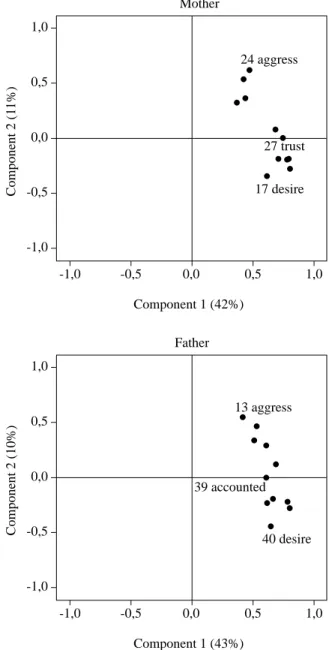
Figure 1 illustrates how the nonindependence of obser-vations is considered. The scale related to the father is treated independently from the scale related to the mother, exactly to permit the analysis of the interdependence between one scale and the other.
Fig ure 1. Principal component analysis results from the 11 items Father and 11 items Mother: item loadings in the components.
Mother
24 aggress
27 trust
17 desire
Component 1 (42%)
Component 2 (1
1%)
-1,0 -1,0 -0,5 0,0 0,5 1,0
-0,5 0,0 0,5 1,0
Father
13 aggress
39 accounted
40 desire
Component 1 (43%)
Component 2 (10%)
-1,0 -1,0 -0,5 0,0 0,5 1,0
-0,5 0,0 0,5 1,0
Table 1
Qualitative Constitution of Covariance (Part A) and Correlation (Part B) between Item 53 Happiness: My Father Demon-strated Being a Happy Person and Item 9 Happiness: My Mother DemonDemon-strated Being a Happy Person
A. Mean (equality) 3,80 (Fa) and 3,85 (Mo)
B. Standard-deviation 1,11 (Fa) e 1,10 (Mo)
C. Sum of products by qualitative category
Differences from equality Standardized differences
N Total marital relations
Father Mother Fa × Mo Father Mother Fa × Mo Fa × Mo Products
-1,80 x -2,85 = 5,145 -1,62 x -2,59 = 4,199 8 33,59
-2,80 x -1,85 = 5,193 -2,52 x -1,68 = 4,238 12 50,86
-0,80 x -2,85 = 2,293 -0,72 x -2,59 = 1,871 14 26,20
-2,80 x -2,85 = 7,997 -2,52 x -2,59 = 6,527 16 104,43
604,39 357
-2,80 x -0,85 = 2,389 -2,52 x -0,77 = 1,950 17 33,15
-0,80 x -1,85 = 1,489 -0,72 x -1,68 = 1,215 42 51,04
-1,80 x -0,85 = 1,537 -1,62 x -0,77 = 1,254 43 53,94
-1,80 x -1,85 = 3,341 -1,62 x -1,68 = 2,727 63 171,79
-0,80 x -0,85 = 0,685 -0,72 x -0,77 = 0,559 142 79,38
-2,80 x 1,15 = -3,219 -2,52 x 1,04 = -2,628 3 -7,88
-1,80 x 1,15 = -2,071 -1,62 x 1,04 = -1,690 5 -8,45
-2,80 x 0,15 = -0,415 -2,52 x 0,13 = -0,339 6 -2,03
-58,22 164
-1,80 x 0,15 = -0,267 -1,62 x 0,13 = -0,218 30 -6,54
-0,80 x 1,15 = -0,923 -0,72 x 1,04 = -0,753 33 -24,86
-0,80 x 0,15 = -0,119 -0,72 x 0,13 = -0,097 87 -8,45
0,20 x -2,85 = -0,559 0,18 x -2,59 = -0,456 3 -1,37
1,20 x -2,85 = -3,411 1,07 x -2,59 = -2,784 7 -19,49
1,20 x -1,85 = -2,215 1,07 x -1,68 = -1,808 10 -18,08
-68,72 138
0,20 x -1,85 = -0,363 0,18 x -1,68 = -0,296 16 -4,74
1,20 x -0,85 = -1,019 1,07 x -0,77 = -0,832 16 -13,31
0,20 x -0,85 = -0,167 0,18 x -0,77 = -0,136 86 -11,73
1,20 x 0,15 = 0,177 1,07 x 0,13 = 0,145 93 13,44
0,20 x 1,15 = 0,225 0,18 x 1,04 = 0,184 112 20,58
445,76 820
0,20 x 0,15 = 0,029 0,18 x 0,13 = 0,024 253 6,00
1,20 x 1,15 = 1,373 1,07 x 1,04 = 1,121 362 405,74
Total 1479 923,21 923,21 1479
923,21 units distributed in 1,479 parts are equal to 0,624 for each couple.
(Pearson Correlation)
negative differences positive differences
Note. The four different qualitative confi gurations are marked by the contrasts between the two shades of grey. In part A, the differences between the Likert scores 1, 2, 3, 4 and 5 and the respective means Father (Fa) and Mother (Mo) defi ne the coeffi cients line by line in both columns Father and Mother. In part B, these coeffi cients are divided by the respective standard deviations (Father, Mother). Columns in part C successively group the products in function of the number N of respondents in each qualitative category.
variance for the Father subscale, and 42% and 11% for the Mother subscale, respectively.
Table 1 presents, step-by-step, the results of the quali-tative constitution of Pearson’s product-moment correlation between the item “My father demonstrated being a happy person” and the item “My mother demonstrated being a happy person”, as examples of the adopted analytic proce-dure. The 1,479 subjects attributed 5,526 units of happiness to the father. Likewise, 5,703 units of happiness were attrib-uted to the mother. The division of these total values into
Column N in Table 1 presents the number of marital couples in each qualitative combination of positive and neg-ative differences. The obtained sum of the Father × Mother product, in the respective categories, after multiplying by the number of couples, differs from zero and can be distributed in equal parts among the 1,479 couples. This equalitarian marital share derives from the parents as a couple’s marital covariance. “Couple” because the father’s individuality, in the multiplication with the mother’s individuality, results in the product “Couple”. The operational defi nition of the mari-tal relation between father and mother is actualized through this product.
In Table 1, the set Standardized differences re-ex-presses the differences in units of standard deviation (“z” scores). After taking into account the number of parental couples in each qualitative condition, the sum of products Father × Mother result in 923.21. This corresponds to the amount of units of marital happiness to be distributed in equal parts among the 1,479 couples. The equally distrib-uted share corresponds to 0.624 for all couples. Four quali-tatively distinct categories exist though – 357 couples with negative father and negative mother, 164 with negative
father and positive mother, 138 with positive father and negative mother, and 820 with positive father and positive mother, resulting in the sub-totals + 604.39, –58.22, –68.72 and + 445.76, respectively.
In Figure 2, one can see that the qualitative categories obtained in Table 1 reveal a syntax: they organized them-selves into the logical gate of equivalence. In the matrix at the left side of Figure 2, the letter T means true and the let-ter F means false in Wittgenstein’s proposal, presented in paragraph 5.101 of the Tractatus (Wittgenstein, 1922/2010). Making p correspond to Father and q to Mother, one can para-phrase “if father, then mother; and if mother, then father” (p. 56 and p. 125, respectively, in the bilingual English-German edition). In our example, the qualitative situation “if happy father, then happy mother” is rendered true (T, true), and the same is the case for “if unhappy father, then unhappy moth-er”. The other two possibilities, in the syntactic condition of logical equivalence, are rendered false for “if unhappy fa-ther, then happy mother” and “if happy fafa-ther, then unhappy mother”. Or vice-versa. Both signalize the marital relation-ship negatively; the parents are conjoined, but negatively.
The empirical counterpart of the healthy marital relation-ship points towards the condition of happy father and happy mother. There are 820 couples (55%) in this condition. In the op-posite condition, in which both father and mother are perceived as unhappy, there are 357 couples (only 24%). As observed at the right side of Figure 2, however, these were the couples that most contributed positively to the correlation: 65%, in compari-son to their opposites (48%), and to couples whose children per-ceive them as contradictory (–6% and –7%).
In Table 2, results are presented according to the concep-tion highlighted in the introducconcep-tion, based on the theoretical
framework of Caillé (1991), Carneiro (1998), Féres-Carneiro and Diniz-Neto (2010) and Kaës (1993/2003a, 1993/2003b, 2009), about the simultaneous contact between individuality (father in the row, mother in the column – or vice-versa) and the marital relation (actualized through the correlation, in bold, on the main diagonal). Thus, the matrix in Table 2 has double contents. On the left and horizontally, it presents the correlation coeffi cients between the items of the Father subscale and, on the right and vertically, the cor-relation coeffi cients between the items on the Mother sub-scale. The main diagonal shows the intra-item correlations, Figure 2. Qualitative synthesis of confi guration observed in the correlation data presented in Table 1 between the items 53 hap-piness: My father demonstrated being a happy person and item 9 haphap-piness: My mother demonstrated being a happy person. The syntax corresponds to the logical door of equivalence, in line with Wittgenstein’s proposals. Coeffi cients on each line are reproduced from Table 1. The percentages represent that part of the whole corresponding to each of the four qualitative catego-ries that compose the correlation under analysis.
F F : V - - +
- +
-+ -
-+ + +
604,39
-58,22
-68,72
445,76
Logical
equivalence
F V :
:
:
:
:
:
: F
V F F
V V V
Tractatus, § 5.101 (Wittgenstein, 2010/1922, pp. 56 and 125)(*)
-6%
-7%
48%
100%
7))7ST,QZRUGV,ISWKHQTDQGLITWKHQS>SŁT@
65%
between father and mother, in the same variable. The ar-rangement of these correlations, calculated through IBM SPSS 19 (2010), using N–1 = 1,478 subjects, constitutes the fi nal design suggested for the psychometric scaling of the marital relation between father and mother – both scales are
considered simultaneously, with a view to modeling refl ec-tion and self-reference in the marital couple. The means, with the respective standard deviations, in the margins of Table 2, are considered as a technical reference of the distribution, in equal parts, of the subjects’ sum of scores.
Table 2
Correlations between items on the Father Subscale and items on the Mother Subscale
Items
26 di
ffi
cul
t
41 s
poke
ba
dl
y
52 i
ns
ec
ure
47 c
onve
ni
enc
e
24 a
ggre
ss
56 s
ol
itude
27 t
rus
t
04 a
cc
ount
ed
33 s
at
is
fa
ct
ion
17 de
si
re
09 ha
ppi
ne
ss
α
= ,86 M
ea
n
±
S
D
03 difficult ,242 ,29 ,33 ,22 ,34 ,26 ,35 ,22 ,23 ,15 ,25
M
ot
he
r
4,31 ,99
06 spoke badly ,37 ,337 ,28 ,23 ,21 ,29 ,25 ,15 ,24 ,20 ,26 3,48 1,28
08 insecure ,38 ,31 ,367 ,41 ,23 ,53 ,55 ,19 ,45 ,26 ,47 3,74 1,34
11 convenience ,28 ,33 ,36 ,619 ,26 ,54 ,43 ,21 ,56 ,44 ,51 4,02 1,26
13 aggress ,30 ,24 ,28 ,20 ,437 ,21 ,27 ,18 ,23 ,14 ,26 4,74 ,73
19 solitude ,25 ,28 ,38 ,41 ,15 ,497 ,51 ,17 ,62 ,40 ,62 3,57 1,25
18 trust ,34 ,30 ,47 ,39 ,34 ,38 ,500 ,22 ,57 ,39 ,54 3,87 1,25
39 accounted ,31 ,26 ,33 ,36 ,27 ,25 ,40 ,254 ,23 ,16 ,28 4,21 1,07
48 satisfaction ,31 ,32 ,41 ,55 ,28 ,47 ,53 ,49 ,709 ,53 ,66 3,59 1,25
40 desire ,25 ,23 ,24 ,42 ,15 ,39 ,38 ,40 ,63 ,611 ,48 3,45 1,26
53 happiness ,36 ,35 ,40 ,50 ,27 ,53 ,48 ,45 ,69 ,55 ,625 3,85 1,10
α = ,86 Father
N = 1.479
Mean 3,83 3,73 4,15 4,05 4,74 ,401 4,24 3,89 3,74 3,68 3,80
± SD 1,24 1,30 1,16 1,29 ,71 1,08 1,05 ,122 1,21 1,20 1,11
Note. Correlations between Father and Mother, in the same variable, are printed in bold, on the principal diagonal (inter-father, intra-item correlations). Correlations between the items responded about the Father are displayed in the lower left part (inter-item, intra-father correlations). Correlations between the items responded about the Mother are displayed in the upper right part (inter-item, intra-mother correlations). The permit the estimation of co-variances, the means, standard deviations and Cronbach’s alpha coeffi cient of the Father items are shown on the two bottom lines of the table; the same statistics for the Mother items are displayed in the two columns on the right.
Let us now imagine that Table 1 presents the constitu-tion of the correlaconstitu-tion r = 0.337, observed in Table 2. This refers to item 06 spoke badly (‘My father spoke badly about my mother’s family’) correlated with item 41 spoke badly (‘My mother spoke badly about my father’s family’). This number ‘0.337’ results from the division, in equal parts, of the sum of each couple of parents’ contributions to the total parental marital relation. Hence, this sum will necessarily equal the multiplication of each part of 0.337 by the 1,479 participating subjects, i.e., 0.337 × 1,479 = 498.42. Now, this number is practically half of ‘923.21’, whose division into equal parts is the correlation between items 53 happiness and 09 happiness. This means that the negative contributions are proportionally much larger. In practical terms, for every positive contribution that adds, increasing the fi nal correla-tion, a negative contribution will exist that subtracts, making the fi nal correlation tend towards zero. This non-detachment from the original families in the two contradictory conditions could be examined in the light of the theoretical consider-ations about the fundamental contradiction of the marital link presented in the introduction. The detachment from the
original parental links is a pre-condition for the creation of a new structure deriving from the transformation of each partner’s parental models, as discussed in Benghozi (2010), Féres-Carneiro (1998), Kaës (2009) and Magalhães (2009).
In Figure 3 are the loadings of components C1 and C2 for the father and mother subscales. At the left side, it is observed that the loadings between the items and the fi rst component (C1), classifi ed top-down, range between.822 (48 satisfaction, ‘My father demonstrated satisfaction with marriage’) and.442 (13 aggress, ‘My father physically aggressed my mother’) for the father subscale, and between.807 (33 satisfaction, ‘My mother demonstrated satisfaction with marriage’) and.372 (04 accounted, ‘My mother accounted for what she said or did’) for the mother subscale. Consequently, all eleven items are correlated with the fi rst dimension, or fi rst principal compo-nent, C1, of the Father and Mother as a Couple (FMC) scale.
(‘My father physically aggressed my mother’), with load-ing.552 (and simultaneous loading of.442 in C1) and item 40 desire (‘My father demonstrated desire for my mother’), with loading –.438 (and loading.670 in C1). In the mother subscale, item 24 aggress (‘My mother physically aggressed my father’), with loading.621 (and simultaneous loading of.423 in C1) and item 17 desire (‘My mother demonstrated desire for my father’), with loading –.347 (and loading.613 in C1). Thus, the highest loadings in the second component, at the same time as also high loadings in the fi rst component, are for items related to affection, whether positive (desire) or
negatively (aggress). In addition, a difference between father and mother is found for the item that occupies a central posi-tion in the top-down hierarchy of correlaposi-tions in the second component, C2. In the father subscale, the item that serves as a “hinge” for the mutual refl ection, among the items above and below, is the indicator related to accountability, item 39 accounted (‘My father accounted for what he said or did’), with loading.001. In the mother subscale, on the other hand, it is the indicator related to trust, item 27 trust (‘My mother seemed to trust my father’) that occupied the central posi-tion, with loading.008.
Also, the four highest loadings in component C2 are from items with equally high loadings in the fi rst component, C1. The same can be observed for the two items with the highest negative loading: both 17 desire (My mother demon-strated desire for my father) and 33 satisfaction (My mother demonstrated satisfaction with marriage) show high loadings in the fi rst component −.61 and.81 respectively. This cross-loading suggests the inquiry: how to consider theoretically relevant items that are correlated with two orthogonal and independent dimensions at the same time?
In this study, we only consider one route to answer this question, which refers to its representation, in the
confi guration Guttman (1954/1955) originally called cir-cumplex – i.e., the replacement of the vertical order of factor loadings by the circular form, in which the notion of hierar-chy loses meaning. We also propose the Möbius strip (Mö-bius, 1886) as a functional analogue to model this type of circumplex, especially regarding the proposal of the adjective explicit to name the role of the items in the fi rst component, or factor, representing the “marital relationship” construct, and the adjective implicit to designate the role played by the same items in the second component of the same construct.
Thus, the logical characteristic of the Möbius strip becomes even more important, i.e., for modeling the Figure 3. Principal component analysis, C1 and C2. Cross-loading of items between components C1 and C2. Ordering of items on the Möbius strip. C1 is the explicit component and C2 the implicit component. Loadings in the components >.30 are printed in bold.
48 satisfaction
Father
Mother
Möbius
Strip
Father
Mother
,82 -,27
C1 C2
,44 ,55
C1 C2
13 aggress
53 happiness ,80 -,21 ,56 ,47 03 difficult
18 trust ,71 ,12 ,53 ,34 06 spoke badly
11 convenience ,68 -,19 ,63 ,30 08 insecure
40 desire ,67 -,44 ,71 ,12 18 trust
19 solitude ,64 -,23 ,63 ,00 39 accounted
39 accounted ,63 ,00 ,68 -,19 11 convenience
08 insecure ,63 ,30 ,80 -,21 53 happiness
03 difficult ,56 ,47 ,64 -,23 19 solitude
06 spoke badly ,53 ,34 ,82 -,27 48 satisfaction
13 aggress ,44 ,55 ,67 -,44 40 desire
33 satisfaction ,81 -,28 ,42 ,62 24 aggress
09 happiness ,80 -,18 ,37 ,54 04 accounted
56 solitude ,78 -,19 ,47 ,36 26 difficult
27 trust ,76 ,01 ,44 ,32 41 spoke badly
47 convenience ,71 -,19 ,69 ,08 52 insecure
52 insecure ,69 ,08 ,76 ,01 27 trust
17 desire ,61 -,35 ,80 -,18 09 happiness
26 difficult ,47 ,36 ,71 -,19 47 convenience
41 spoke badly ,44 ,32 ,78 -,19 56 solitude
24 aggress ,42 ,62 ,81 -,28 33 satisfaction
self-reference model Caillé (1991) postulated concerning the couple. With regard to this comes the logical demonstration, defended by Priest (2010), that “the inside is the outside, and the outside is the inside; truth is falsity, and falsity truth” (p. 43). In Figure 3, the reference to the Möbius strip is located at the crossing between components C1 and C2 and, at the same time, between the Father and Mother subscales, with the infl ection point that was empirically determined through the principal components analysis Each scale is divided into two halves, with item 39 accounted (My father accounted for what he said or did), representing this infl ection point for the Father subscale, and item 27 trust (My mother seemed to trust my father) for the Mother subscale, with loadings 0.001 and 0.008, respectively. In the component scores, the responses to these items practically disappear, as they are multiplied by weights that very closely border on zero.
couple. Let us now imagine items placed in the circumplex, i.e., circular form, with the Father and Mother items displayed side by side along the Möbius strip. When we cut along this strip with the scissors, following the line that separates Father and Mother items, the marital couple will be separated, but not the parental couple, as the strip would be separated in two if it were not a Möbius strip (as both ends were jointed after be-ing twisted 180 degrees, on one of the surfaces, before bebe-ing glued to the other).
Finally, it should be asked whether the scale is reliable, and valid, to evaluate father and mother as a couple. The magnitude of the internal consistency coeffi cient Cronbach’s alpha, as shown in Table 2, is suffi ciently high (.86 for father and.85 for mother, with 11 paired items) to conclude that the set is reliable. We use the word “set” because, in view of the theory of the indissoluble intersubjective link, we do not consider an eventual scale that would add up father and mother scores as valid. The sum would not distinguish between the inter-item father and inter-item mother corre-lations, from the correlation between father and mother in the same item, considered as self-referent, presented item by item on the diagonal of the matrix in Table 2. The difference between father and mother scores would not make this dis-tinction either and, in addition, this would entail additional problems related to the subtraction of the correlations (Furr, 2011). Besides, both procedures would hamper our goal of never losing out of sight the qualitative aspect, connected with the individual subject, no matter the statistics involved. Therefore, the scales should be kept separately and the rela-tions between one another should be expressed, in the future, in multilevel models – especially concerning Cronbach’s al-pha (1951), which is inappropriate in the case of nested two-level observations like in the present study (Nezlek, 2011). That will permit the systematic investigation of the essence of the marital relation as it is empirically defi ned here: the subjective nonindpendence between individuals who are in-dissolubly interlinked in a shared destiny.
From a strictly psychometric viewpoint, we consider that the analysis example present empirical evidence for the validation of the Father and Mother as a Couple scale as uni-dimensional. This dimension, however, becomes two-faced: Component C1 measures the explicit marital relation, while component C2, orthogonal to the fi rst, measures the implicit marital relation. These components present themselves inde-pendently, since the correlation between them is mathemati-cally zero, as a consequence of the principal components analysis used. Conversely, we underline that exploratory factor analysis would not produce factor loadings with both characteristics in any way, as referred by Ziviani, Féres-Car-neiro and Magalhães (2011).
When comparing defi nitions of validity for psychologi-cal tests with the more contemporaneous view, according to Primi, Muniz and Nunes (2009), a reorganization and reno-vation can be identifi ed in conceptual terms. Summarizing the defi nition of validity that emphasizes the interpretative Figure 4. Möbius strip, twisted confi guration in which the
in-side is the outin-side, and the outin-side is the inin-side; truth is falsity, and falsity truth (Priest, 2010, p. 42-43). In this study, besides representing the marital characteristic of self-reference from the perspective of dialetheism in logic (Priest, 2006, 2008), according to which true contradictions exist, the Möbius strip is also proposed to model the explicit-implicit dimensionality of the PMC scale. Copyright: Zentilia/Shutterstock
meaning and use of the test, they conclude that “this defi nition associates validity with a scientifi c investigation that verifi es the meanings attributed to the test scores as well as the cur-rent or potential consequences of the interpretative use of the scores” (p. 247). Hence, we consider that the psychometric evidence presented attends to expectations with regard to the validation of the meanings attributed to the scores.
We started with the Aritstotelian conception of the mean, followed by the possibility of the Hegelian measure in psy-chology (Ziviani, 1998b), and the representation of something as being and not being at the same time (Ziviani, 1998a), con-ceptualized by Priest (2006) as dialetheia in contemporary logic, as the philosophical foundations for the method pre-sented here. Of particular concern are the opposites taken as contradictories which, as “they are unique”, are not mixed up with contraries, so that one can move “up to logical equiva-lence” (Priest, 2008, p. 78). We believe that this method, phil-osophically supported as described above, not only allows the researcher to investigate Abelson’s howcummit (1995) – why data take a certain form, but also permits the identifi cation of whodunit – the quality of each subject’s participation, going beyond the simple magnitude of this role in the statistics used.
Final Considerations
We kept in mind the question by Sireci (2009): “If the use of this test for the purpose I am using it for were chal-lenged in court, do I have suffi cient evidence to persuade the judge or jury and win the case?” (p. 31) when trying to di-rect our epistemological efforts towards the validation of the Father and Mother as a Couple scale. We consider that the use of the methodological procedure described here permits answering “yes” – the subject will always be individually identifi ed as a fi gure, amidst the other participants in the cor-relations, in the statistical background adopted.
The main contribution of this study is to highlight the variance structure of the “father and mother as a couple” construct, made possible by the adequacy of the items, which allowed the large majority of subjects to identify each of the referred situations in their parents’ marriage. Each subject psychologically answered by confi rming, or denying, the situation the item referred to, consistent with his/her affi rma-tion or denial of the other situarma-tions described in the other items. This is possible based on the theoretical-methodolog-ical proposal of the indissoluble link, corroborated by the clinical practice involving couples and families.
Even if the method prescribed in the theory of the indissol-uble link permitted unveiling the basic structure of this covari-ance, the main limitation in the present study is that the analysis was not extended to the full range of available resources, from the t-test to multilevel analysis, including the use of the so-called Exploratory Structural Equation Modeling (Asparouhov & Muthén, 2009; Marsh et al., 2010), which makes it possible to expressly incorporate the cross-loading of items into the model.
References
Abelson, R. P. (1995). Statistics as principled argument. Hillsdale: Lawrence Erlbaum.
Asparouhov, T., & Muthén, B. (2009). Exploratory structural equation modeling. Structural Equation Modeling, 16(3), 397-438. Retrieved from http://www.statmodel.com/ download/SEM-Asparouhov2009.pdf
Aristotle. (1984). Nicomachean ethics. In J. Barnes (Ed.), The complete works of Aristotle: The revised Oxford translation (W. D. Ross, Trans., Vol. 2, pp. 1729-1867). Princeton, NJ: Princeton University Press.
Benghozi, P. (2010). Malhagem, fi liação e afi liação. São Paulo: Vetor.
Benghozi, P., & Féres-Carneiro, T. (2001). Laço frátrio e continente frátrio como sustentação do laço genealógico. In T. Féres-Carneiro (Org.), Casamento e família: Do social à clínica (pp. 112-118). Paulo de Frontin, RJ: Nau. Caillé, P. (1991). Un et un font trois: Le couple révélé à lui
même. Paris, France: ESF.
Cronbach, L. J. (1951). Coeffi cient alpha and the internal structure of tests. Psychometrika, 16, 297-334. doi:10.1007/BF02310555
Féres-Carneiro, T. (1998). Casamento contemporâneo: O difícil convívio da individualidade com a conjugalidade. Psicologia: Refl exão e Crítica, 11(2), 379-394. doi: 10.1590/S0102-79721998000200014
Féres-Carneiro, T., & Diniz-Neto, O. (2010). Construção e dissolução da conjugalidade: Padrões relacionais. Paidéia, 20(46), 269-278. doi: 10.1590/S0103-863X2010000200014 Féres-Carneiro, T., Ziviani, C., & Magalhães, A. S. (2007).
Questionário sobre a conjugalidade dos pais como instrumento de avaliação. In T. Féres-Carneiro (Org.), Família e casal: Saúde, trabalho e modos de vinculação (pp. 251-267). São Paulo: Casa do Psicólogo.
Field, A. (2009). Discovering statistics using SPSS (3rd ed.). London: Sage.
Furr, R. M. (2011). Scale construction and psychometrics for social and personality psychology. London: Sage. Guttman, L. (1955). A new approach to factor analysis: The
radex. In P. F. Lazarsfeld (Ed.), Mathematical thinking in the social sciences (2nd ed., pp. 258-348). Glencoe, IL: The Free. (Original published in 1954)
Hegel, G. W. F. (1966). Wissenschaft der logik [Science of logic] (Vol. 1, Part 1). Göttingen, Germany: Vandenhoeck & Ruprecht. (Original published in 1812)
Judd, C. M., & Kenny, D. A. (2010). Data analysis in social psychology: Recent and recurring issues. In S. T. Fiske, D. T. Gilbert, & G. Lindzey (Eds.), Handbook of social psychology (5th ed., Vol. 1, pp. 115-139). Hoboken, NJ: Wiley.
Kaës, R. (2003b). Introduction au concept de transmission psychique dans la pensée de Freud. In R. Kaës (Ed.), Transmission de la vie psychique entre générations (2ème ed., pp. 17-58). Paris: Dunod. (Original publicado em 1993)
Kaës, R. (2009). Les alliances inconscientes. Paris: Dunod. Kenny, D. A. (1998). Couples, gender, and time: Comments
on method. In T. N. Bradbury (Ed.), The developmental course of marital dysfunction (pp. 410-422). New York: Cambridge University Press.
Kenny, D. A., Kashy, D. A., & Cook, W. L. (2006). Dyadic data analysis. New York: Guilford.
Magalhães, A. S. (2009). Conjugalidade e parentalidade na clínica com famílias. In T. Féres-Carneiro (Org.), Casal e família: Permanências e rupturas (pp. 205-217). São Paulo: Casa do Psicólogo.
Magalhães, A. S., & Féres-Carneiro, T. (2005). Conquistando a herança: Sobre o papel da transmissão psíquica familiar no processo de subjetivação. In T. Féres-Carneiro (Org.), Família e casal: Efeitos da contemporaneidade (pp. 24-32). Rio de Janeiro: Editora PUC-Rio.
Magalhães, A. S., & Féres-Carneiro, T. (2007). Transmissão psíquica geracional: Um estudo de caso. In T. Féres-Carneiro (Org.), Família e casal: Saúde, trabalho e modos de vinculação (pp. 341-364). São Paulo: Casa do Psicólogo. Marsh, H. W., Lüdtke, O., Muthén, B., Asparouhov, T.,
Morin, A. J. S., Trautwein, U., & Nagengast, B. (2010). A new look at the big fi ve factor structure through exploratory structural equation modeling. Psychological Assessment, 22(3), 471-491. doi:10.1037/a0019227 Möbius, A. F. (1886). Zur theorie der polyëder und der
elementarverwandtschaft. In F. Klein (Ed.), Gesammelte werke [The collected works] (Vol. 2, pp. 519-559). Leipzig, Germany: S. Hirzel.
Nezlek, J. B. (2011). Multilevel modeling for social and personality psychology. Thousand Oaks, CA: Sage. Priest, G. (2010). Logic: A brief insight. New York: Sterling
Publishing Co.
Priest, G. (2006). In contradiction: A study of the transconsistent (2nd ed., Kindle electronic edition version). New York: Oxford University Press.
Priest, G. (2008). Doubt truth to be a liar (Kindle electronic edition version). New York: Oxford University Press. Primi, R., Muniz, M., & Nunes, C. H. S. S. (2009). Defi nições
contemporâneas de validade de testes psicológicos. In C. S. Hutz (Org.), Avanços e polêmicas em avaliação psicológica (pp. 243-265). São Paulo: Casa do Psicólogo. Sireci, S. G. (2009). Packing and unpacking sources of
validity evidence: History repeats itself again. In R. W. Lissitz (Ed.), The concept of validity: Revisions, new directions, and applications (pp. 19-37). Charlotte, NC: Information Age.
Tukey, J. W. (1969). Analyzing data: Sanctifi cation or detective work? American Psychologist, 24(2), 83-91. doi:10.1037/h0027108
Wittgenstein, L. (2010). Tractatus logico-philosophicus (C. K. Ogden, Trans.) [eBook]. London: Kegan Paul, Trench & Trubner. (Original published in 1922). Retrieved from http://www.gutenberg.org/fi les/5740/5740-pdf.pdf Ziviani, C. (1998a). Sintaxe da qualidade e subordinação
da quantidade na medida em psicologia. Cadernos de Psicologia (SBP), 4(1), 139-152.
Ziviani, C. (1998b). Hegel e a medida em psicologia. Revista Ciências Humanas, (21), 257-304.
Ziviani, C., Féres-Carneiro, T., & Magalhães, A. S. (2009). A conjugalidade dos pais percebida pelos fi lhos: Questionário de avaliação. In T. Féres-Carneiro (Org.), Casal e família: Permanências e rupturas (pp. 157-168). São Paulo: Casa do Psicólogo.
Ziviani, C., Féres-Carneiro, T., & Magalhães, A. S. (2011). Sons and daughters’ perception of parents as a couple: Distinguishing characteristics of a measurement model. Psicologia: Refl exão e Crítica, 24(1), 28-39. doi:10.1590/ S0102-79722011000100005
Cilio Ziviani is a Visiting Professor at Pontifícia Universi-dade Católica do Rio de Janeiro
Terezinha Féres-Carneiro is a Full Professor at Pontifícia Universidade Católica do Rio de Janeiro
Andrea Seixas Magalhães is an Assistant Professor at Pon-tifícia Universidade Católica do Rio de Janeiro
Received: Jul. 1st, 2011
1st revision: Nov. 23rd, 2011
2nd revision: Jan. 17th, 2012
Accepted: May 17th, 2012
How to cite this article: