Effects of body mass index on the outcomes of percutaneous
nephrolithotomy
_______________________________________________
Cemal Selcuk Isoglu
1,Tufan Suelozgen
1, Hayal Boyacioglu
2, Gokhan Koc
11 Department of Urology, Tepecik Education and Research Hospital, Izmir, Turkey; 2 Department of
Statistics, Ege University Faculty of Science, Izmir, Turkey
ABSTRACT
ARTICLE
INFO
______________________________________________________________ ______________________
Objective: To examine the the effect of body mass index (BMI) on PNL results and complications with a large number of patients.
Materials and Methods: A total of 958 patients were included in the study, who un-derwent percutaneous nephrolithotomy in our clinic between 2008 and 2015. Patients were divided into 2 groups according to their body mass index. Patients with a BMI < 30 kg/m2 were classified as group 1 (n:676) and patients with a BMI ≥ 30 kg/m2 were classified as group 2 (n:282). Achieving stone-free status or having residual stones of
≤ 4 mm were considered as operational success.
Results: The mean age was 47.9 years for group 1 and 48.9 years for group 2 patients. At postoperative first month CT analysis, residual stone was not observed in 466 pa-tients (69%) of group 1 and 20 (72%) papa-tients of group 2. There was no significant difference between the groups in terms of stone-free status (p=0.348). There was no significant difference between two groups complications. Also, there was no difference between the groups for requiring additional intervention (p=0.924). No other complica-tions were observed in the patients.
Conclusions: BMI does not affect the outcomes of percutaneous nephrolithotomy as well as complication rate.
Keywords:
Body Mass Index; Nephrostomy, Percutaneous; Calculi
Int Braz J Urol. 2017; 43: 698-703
_____________________
Submitted for publication: December 26, 2016
_____________________
Accepted after revision: February 19, 2017
_____________________
Published as Ahead of Print: April 10, 2017
INTRODUCTION
Obesity is a widespread health problem with an increasing frequency all over the World, due to inadequate diet and decreased physical ac-tivity (1). It is well known that urinary tract sto-ne disease is more common in obese patients (2). Percutaneous nephrolithotomy (PNL) is accepted as the gold standard treatment method for renal stones greater than 2 cm with high stone-free and reasonable complication rates (3). However, the results of PNL in obese patients are controver-sial. There are studies in the literature, indicating that obesity negatively influences the outcome of
the operation as well as studies stating that it has no effect (4, 5). In this study, we investigated the effect of body mass index (BMI) on PNL results and complications.
MATERIALS AND METHODS
intraoperati-ve, and postoperative data and having no exclu-sion criteria were included in the study. Patients were divided into two groups with respect to the body mass index. Those with a BMI < 30 kg/m2
were classified as non-obese (Group 1), whereas those with a BMI ≥ 30 kg/m2 were classified as
obese (Group 2).
All patients were examined by non-con-trast whole abdomen CT before the operation. In imaging studies, only the stones found in one calyx or only in the pelvis were named as sim-ple stones while pelvic stones filling one calyx or more as well as staghorn stones were named as complicated stones (6).
The period, starting from the time of con-trast agent administration to the patient at the prone position, up to the time of nephrostomy catheter insertion was recorded as the operation time. Duration of fluoroscopic imaging throu-ghout the operation, the number of accesses, and the presence of intraoperative complications were also recorded. At the end of the operation, a 14 Fr re-entry Malecot catheter was placed in all pa-tients and removed on postoperative day 1-3 and the patients without any complications were then discharged from the hospital. Furthermore, pos-toperative complications and additional interven-tions were noted for each patient. Complicainterven-tions were also classified according to Modified Clavien system.
All patients were reevaluated with non--contrast CT taken routinely at postoperative 1 month. The presence of residual fragments of ≤ 4 mm or no stone was considered as therapeutic success (7).
SURGICAL PROCEDURE
Complete blood count, biochemical tests, coagulation tests and urine culture were perfor-med in all patients preoperatively. Appropriate antibiotic treatment was given to the patients with positive urinary cultures and they were operated when they had sterile urine cultures. The patient was placed in the prone position after an open--ended 6-Fr ureter catheter was inserted through the urethra via cystoscopy while in the lithotomy position. The procedure was performed under
ge-neral anesthesia. Following the injection of an opaque agent from the ureter catheter, an access needle was introduced into the renal collecting system via the appropriate calyx under fluoros-copic guidance. After placement of the guiding catheter, the Amplatz dilator set was used in order to create the tract, first with a 6 Fr dilator follo-wed by a 28-30 Fr dilator, using the single step method. The same technique was used for the pa-tients with complex stones, where a second access was required. The stones were broken by using a 24 Fr nephroscope and an ultrasonic lithotripter. A 14 Fr malecot re-entry catheter was routinely inserted after the operation was terminated.
STATISTICAL ANALYSIS
The chi-square test was used to assess the categorical variables among the groups. The Mann-Whitney U test was used in order to com-pare the differences between the two independent groups. P value <0.05 was considered significant.
IBM SPSS version 15.00 was used for analysis.
RESULTS
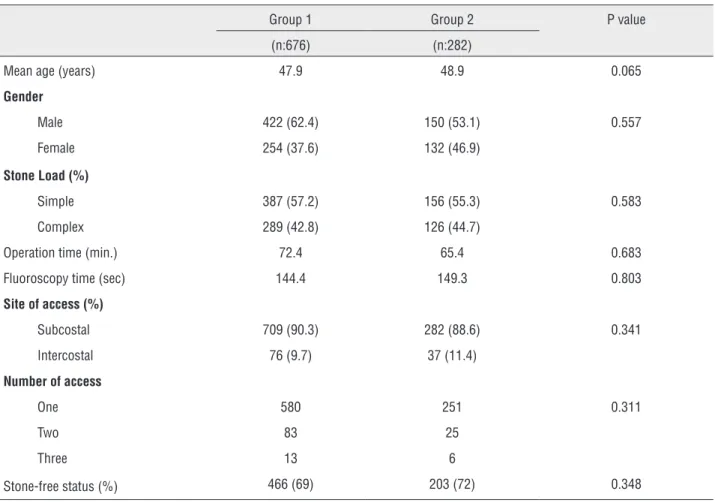
There were 676 patients in Group 1 and 282 patients in Group 2. Of the patients, 422 were male (62.4%) and 254 were female (37.6%) in group 1, while 150 were male (53.1%) and 132 were female (46.9%) in group 2. The groups were similar in terms of gender (p=0.557).
The mean age of the patients was 47.9±14.7 years in group 1 and 48.9±13.3 years in group 2. There was no statistically significant difference in terms of age between the two groups although the patients in the obese group were slightly older than others (p=0.065).
Among Group 1 patients, 387 (57.2%) had simple stones while 289 (42.8%) had complex sto-nes. In group 2, 156 (55.3%) had simple stones and 126 (44.7%) had complex stones. There was no statistically significant difference between two groups in terms of complexity and simplicity of the stones (p=0.583).
duration of operation was not statistically signi-ficantly different between the two groups althou-gh it was relatively longer for group 1 patients (p=0.683).
The mean duration of fluoroscopy was 149.3±6.06 seconds in Group 1 patients and 144.4±9.74 seconds in group 2 patients, displaying no statistically significant difference between the two groups (p=0.803).
In the non-obese group, 580 patients had one, 83 had two, and 13 had three accesses. In the obese group however, 251 patients had one, 25 had two, and 6 had three accesses.Two groups were similar in terms of the number of accesses (p=0.311).
A total of 785 accesses were performed in 676 patients in Group 1. Of these, 709 (90.3%) were subcostal and 76 (9.7%) were intercostal ac-cess, through 11-12 intercostal space. In Group 2,
totally 319 accesses were performed, of which 282 (88.4%) were subcostal and 37 (11.6%) were inter-costal. There was no significant difference betwe-en the two groups in terms of the site of access (p=0.341) (Table-1).
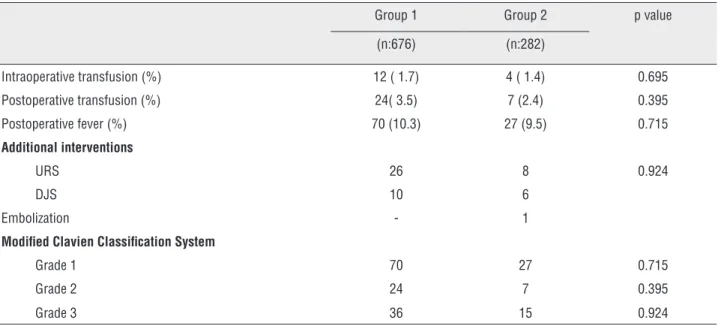
Due to intraoperative hemorrhage resul-ting in hypotension, blood transfusion was given to 12 patients (1.7%) in group 1 and 4 patients (1.4%) in group 2. No significant difference was detected between the two groups, in terms of in-traoperative blood transfusion (p=0.695). Except for hemorrhage, no other intraoperative compli-cation was observed in the patients.
Blood transfusion was required due to postoperative hemoglobine loss and hemodyna-mic instability such as hypotension in 24 (3.5%) patients in group 1 and 7 patients (2.4%) in group 2. Postoperative transfusion was grade 2 accor-ding to the Modified Clavien Classification
Sys-Table 1 - Significant preoperative and intraoperative data of the patients.
Group 1 Group 2 P value
(n:676) (n:282)
Mean age (years) 47.9 48.9 0.065
Gender
Male 422 (62.4) 150 (53.1) 0.557
Female 254 (37.6) 132 (46.9)
Stone Load (%)
Simple 387 (57.2) 156 (55.3) 0.583
Complex 289 (42.8) 126 (44.7)
Operation time (min.) 72.4 65.4 0.683
Fluoroscopy time (sec) 144.4 149.3 0.803
Site of access (%)
Subcostal 709 (90.3) 282 (88.6) 0.341
Intercostal 76 (9.7) 37 (11.4)
Number of access
One 580 251 0.311
Two 83 25
Three 13 6
tem and showed no difference between the groups (p=0.395). No patient needed more than 2 units of transfusion.
Fever (>38ºC) was determined before dis-charge in 27 patients of the obese group and 70 patients of the non-obese group, and they were appropriately treated before being discharged from the hospital. No significant difference was detected in terms of postoperative fever between the groups (p=0.715). None of the patients deve-loped sepsis or died from operation-related plications. Fever was considered as grade 1 com-plication group according to the Modified Clavien Classification System.
When the groups were evaluated in terms of operation success, postoperative residual stone fragments were observed in 210 patients (31%) of group 1 and in 79 patients (28%) of group 2. There was no significant difference in operative perfor-mance between the groups (p=0.348).
The groups were also evaluated for addi-tional interventions. Thirty-six patients of the non-obese group required additional interventions after their discharge from the hospital. Double-J stents (DJS) were inserted in twenty-six patients due to wound site discharge or severe colic pain. Ureteroscopy (URS) was performed in twenty-six patients for treatment of the ipsilateral ureteral
stones determined by non-contrast abdominal CT. In group 2 however, a total of 15 patients requi-red additional interventions. Eight patients were inserted DJS because of the wound site dischar-ge. Six patients underwent URS due to ureteral stone. Due to postoperative persistent hematuria in one patient, selective angiography was applied and upon determination of arteriovenous fistula, eventually superselective embolisation was per-formed. No additional treatment was required af-ter embolisation. The requirement for additional intervention was considered as Clavien grade 3 and there was no significant difference between two groups (p=0.924) (Table-2).
DISCUSSION
Obesity has become a major problem for both developed and developing countries as a result of reduced physical activity and increased calorie intake. Particularly high income countries display higher rates of increase in obesity in the last three decades (1). The incidence of health problems such as metabolic syndrome, cardiovascular disease, malignancy, and renal calculus also increased in the community with the increase in obesity (8).
Today, PNL is a widely used method in re-nal stone treatment in both obese and non-obese
Table 2 - Intraoperative and postoperative complications of the groups.
Group 1 Group 2 p value
(n:676) (n:282)
Intraoperative transfusion (%) 12 ( 1.7) 4 ( 1.4) 0.695
Postoperative transfusion (%) 24( 3.5) 7 (2.4) 0.395
Postoperative fever (%) 70 (10.3) 27 (9.5) 0.715
Additional interventions
URS 26 8 0.924
DJS 10 6
Embolization - 1
Modified Clavien Classification System
Grade 1 70 27 0.715
Grade 2 24 7 0.395
patients. However, anestesia-related problems can be seen in obese patients. Respiratory com-plications may occur, for example a decrease in total lung capacity, as a result of the prone po-sition during operation. Again, entubation di-fficulties may also occur in obese patients (9). In some centers, PNL is performed in the su-pine position in order to minimize such com-plications (10). In our clinic however, PNL in the supine position is not performed due to the lack of experience, yet complications related to anesthesia have not been observed.
In obese patients, it may not be possible to reach the renal collecting system with Amplatz sheet or it may be difficult to reach the stone be-cause of the thick subcutaneous fat tissue. Curtis et al. reported that they made an incision in the skin and adipose tissue and retracted the tissue and so gained extra distance (11). In our study, standard Amplatz dilatators were used in both groups and access was obtained in all patients.
Carson et al. compared 44 obese and 226 non-obese patients and found no significant di-fference between the groups in terms of opera-tion time, stone-free status and complicaopera-tion rates (12). In their study conducted with 236 patients (57 obese, 279 non-obese), Pearle et al. found no significant difference between the groups in ter-ms of operative success and complication rates whereas longer operation time and higher rates of blood transfusion in the obese group (13). El-Ass-my et al. indicated the mean stone size as 2.5±0.85 cm and reported no correlation between BMI and operative success (14). Alyami et al. examined pa-tients having renal stones smaller than 3 cm and determined no correlation between BMI and ope-rative success (5).
Croes study group published the first prospective study including 3709 patients (15). Patients with PNL were sorted according to their BMI. In contrast to many publications, they indi-cated a decrease in the rate of stone-free status whereas an increase in the duration of the opera-tion in parallel with the increased BMI. In a series of 530 patients, Fearber et al. determined signifi-cantly higher complication rates in obese patients than in patients with normal BMI (16). Meanwhile, Pearle et al. reported that the need for blood
trans-fusion was higher in the group with obese patients (13). Koo et al. examined a series of 181 patients in 4 groups and determined no difference between them in terms of operation time and blood loss (4).
In our study with 958 patients (282 obe-se and 676 non-obeobe-se), no significant difference was determined between two groups in terms of operation time, duration of fluoroscopy, operatio-nal success, need for additiooperatio-nal intervention and complication rates. Even when the complications were grouped according to Clavien classification, both groups showed no significant difference. In the obese group, arteriovenous fistula developed in one patient and it was successfully treated with selective embolization. None of the patients died due to complications.
As for the limitations of the study, we can mention its retrospective design and inability to group the Clavien 3 classification into 3A and 3B because of the missing information about if the patients with Double J stent were given anesthesia or not.
CONCLUSIONS
According to the results of our study,
PNL is an effective method with high success
rates, therefore it can be applied safely in
obe-se patients as well as in non-obeobe-se patients.
CONFLICT OF INTEREST
None declared.
REFERENCES
1. Calvert RC, Burgess NA. Urolithiasis and obesity: metabolic and technical considerations. Curr Opin Urol. 2005;15:113-7.
2. Semins MJ, Shore AD, Makary MA, Magnuson T, Johns R, Matlaga BR. The association of increasing body mass index and kidney stone disease. J Urol. 2010;183:571-5.
3. Türk C, Knoll T, Petrik A, Sarica V, Skolarikos A, Straub M, et al. Guidelines on Urolithiasis. European Association of Urology 2015. p. 16-24.
5. Alyami FA, Skinner TA, Norman RW. Impact of body mass index on clinical outcomes associated with percutaneous nephrolithotomy. Can Urol Assoc J. 2013;7:E197-201. 6. Tefekli A, Ali Karadag M, Tepeler K, Sari E, Berberoglu Y, Baykal
M, et al. Classification of percutaneous nephrolithotomy complications using the modified clavien grading system: looking for a standard. Eur Urol. 2008;53:184-90.
7. Altunrende F, Tefekli A, Stein RJ, Autorino R, Yuruk E, Laydner H, et al. Clinically insignificant residual fragments after percutaneous nephrolithotomy: medium-term follow-up. J Endourol. 2011;25:941-5.
8. WHO Global Infobase. Data for Saving Lives. January 2011. Available at. <http://www.who.int/gho/en/>
9. Juvin P, Lavaut E, Dupont H, Lefevre P, Demetriou M, Dumoulin JL, et al. Difficult tracheal intubation is more common in obese than in lean patients. Anesth Analg. 2003;97:595-600.
10. Mazzucchi E, Vicentini FC, Marchini GS, Danilovic A, Brito AH, Srougi M. Percutaneous nephrolithotomy in obese patients: comparison between the prone and total supine position. J Endourol. 2012;26:1437-42.
11. Curtis R, Thorpe AC, Marsh R. Modification of the technique of percutaneous nephrolithotomy in the morbidly obese patient. Br J Urol. 1997;79:138-40.
12. Carson CC 3rd, Danneberger JE, Weinerth JL. Percutaneous lithotripsy in morbid obesity. J Urol. 1988;139:243-5.
13. Pearle MS, Nakada SY, Womack JS, Kryger JV. Outcomes of contemporary percutaneous nephrostolithotomy in morbidly obese patients. J Urol. 1998;160:669-73.
14. El-Assmy AM, Shokeir AA, El-Nahas AR, Shoma AM, Eraky I, El-Kenawy MR, et al. Outcome of percutaneous nephrolithotomy: effect of body mass index. Eur Urol. 2007;52:199-204.
15. Fuller A, Razvi H, Denstedt JD, Nott L, Pearle M, Cauda F, et al. The CROES percutaneous nephrolithotomy global study: the influence of body mass index on outcome. J Urol. 2012;188:138-44.
16. Faerber GJ, Goh M. Percutaneous nephrolithotripsy in the morbidly obese patient. Tech Urol. 1997;3:89-95.
_______________________ Correspondence address: Cemal Selcuk Isoglu, MD Urology specialist Department of Urology Tepecik Education and Research Hospital, Izmir, Turkey