CAPACITY BUILDING INITIATIVES IN PRESERVATION
TECHNIQUES: A CASE STUDY OF NIGERIAN UNIVERSITIES
Miracle Eka Njeze
National Open University of Nigeria Center for Resource Learning Nigeria
Iwu Juliana James
Covenant University Nigeria
ABSTRACT
The librarians are often encouraged to maintain and keep their collections accessible through digitization as their stock in trade is their collection. This study examined capacity building initiatives in preservation techniques in selected libraries and assessed the level of training received by different library staff. Four university libraries were randomly selected and a descriptive survey method using a self-developed questionnaire. The respondents comprised librarians and non-librarians. A total of one hundred and twenty copies of questionnaires were distributed, but a hundred and twelve was retrieved and used for the analysis. The study revealed that there were no professionals to manage the preservation section of the university library and as such, most institutions make do with Para-professionals like binders,
technicians and library officers etc. Analysis from the respondent’s show that
Universities in Nigeria are not exposed to capacity building in preservation. Finally, regular trainings are vital for the development of all staff and for any university to stand out amongst others; there must be provision for usual capacity building of both faculty and staff.
Keywords: Capacity Building; Professional/Librarian; Para-Professional/Non-Librarians; Preservation; Academic Library.
1 INTRODUCTION
Accessibility of resources is very important in meeting user’s needs and also
satisfying the objectives of the University. It is not enough to buy very expensive
books if there are no measures put in place to reduce the rate of deterioration. Most
the circulation for general borrowing and making large photocopies. However if the
rate of traffic is not checked by ensuring that books that are deteriorating are
withdrawn from the library collection and taken to the bindery for repairs, the library
will later be filled up with books that are worn out and physically damaged.
Capacity building is very important because it gives staff the knowledge to
decide which resources to digitize and not to digitize, while obsolete resources are
weeded, in terms of content, date of publication, and date of acquisition.
Smith (2000) observed that in many parts of the world, a preservation
concern is accorded low priority in most academic libraries and staffing for
preservation is reduced. It is extremely rare to find universities with preservation
departments. According to Wikipedia (2012) one of the biggest challenges in the field
of preservation today is educating librarians and other staff, in the best ways to
handle materials as well as the conditions in which particular materials will decay the
least. This challenge is exacerbated by the fact that preservation is a peripheral
element of most library science curricula and preservation techniques like care of
library collections, conservation, digitization, digital preservation and disaster
preparedness plan etc.
Ajidahun (2007) opined that professional librarians in University libraries
today whose knowledge of library automation has been rendered outdated as a result
of inadequate training pose a great challenge in their coping with modern library
practices. This is absolutely true because Altobellis (2011) noted that lack of
information in preservation techniques, grants, and workshops etc. limits the extent to
which many universities particularly care for their collections.
2 STATEMENT OF PROBLEM
It is a popular saying that prevention is better and even cheaper than cure.
This is true even in the library setting; replacing library materials when possible, is
expensive. Preservation makes good economic sense. Considering the huge risk
librarians stand to face in the case of any loss/disaster in the library, this study
by receiving the necessary training in order to prevent the occurrence of loss or
damage of any kind.
The specific objectives are: a) Investigate if the libraries have a functional
preservation department; b) Investigate the category of staff responsible for
preservation of library materials; c) Find out if librarians attend international
workshops/conferences on preservation; d) Investigate the frequency of capacity
building in preservation; e) Investigate the capacity building initiative available for
library staff; f) Investigate the current preservation technique used in the library.
In carrying out this study, the researcher intends to put forward the following
questions, which will guide her in conducting the study. These include:
a) Does the library have a functional preservation department?
b) What category of staff is responsible for preservation?
c) Do librarians attend international workshops/conferences on
preservation?
d) How often does the library conduct capacity building on preservation?
e) What capacity building initiative is available for library staff.
f) Which preservation technique is used in the library.
3 LITERATURE REVIEW
Building capacity involves development of your mind, by reading, writing and
acquiring other skills. Chandan (2000) opined that capacity building is as a short term
process which uses systematic and organized procedure to enhance the knowledge
and skills of personnel. Ajidahu (2007) and Zhang (2004) noted that training is
needed for managerial and non-managerial staff of any profession though they are
very essential for non-managerial staff who constitute large portion of the total
employee in an academic library. Yesufu (2000) and Chandan (2000) say training of
staff enhances productivity, because education and training is regarded as the most
important direct means of upgrading the human intellect for productive employment,
According to Donata (2011) capacity building enhances job performance and
management efficiency. The advantage of capacity according to Anunobi (2012) and
Stoner (2002) is that it reduces cost of production, enables staff make prompt
decisions, boosting of one’s morale, reduces supervision, rapid growth in staff status
and organizational stability.
Goldsmith (2007) observed that training for both staff and users is an
important part of the library mission, thus librarians must conduct training sessions for
all category of library staff to promote preservation awareness through lectures and
documentary videos. A good library must have a disaster plan which must be
updated with current telephone numbers of agencies to contact for directions within
the library and other emergency information for rapid response in other to salvage a
good number of library resources.
Page (1999) is of the opinion that emergency response plan needs ‘exercise’
similar to fire or evacuation drills in which everyone practices leaving the building,
without panic. These drills teach staff what to do, where to exit, and how to proceed
in an orderly manner. Exercise of this nature must teach preparedness, build
confidence, among the staff. Simpson, (2011) observed that one of the biggest
assumptions or oversights people make is to overlook how important it is to be
personally prepared for an emergency. The first 72 (seventy-two) hours is the most
crucial, and self-preparedness can make a lot of difference when disasters strike
hence the need for having a functional and workable preservation department. It also
is expedient to initiate a robust training package for the library.
On the other hand Oketunji (2001) observed that library schools are
inadequate in meeting the challenges of modern information technologies owing to
lack of financial resources to procure the necessary equipment needed for the
training of students. Emphasis still remains on printed materials rather than on
information sources in electronic form which is the new trend in information
technology. This shouldn’t be because we are in digital age where information must
be accessed irrespective of the location of the users.
Nizier (2006) is of the opinion that training helps to develop theoretical and
sharing in the sense that the staff will have a better understanding of what has been
taught, because he has experienced it practically, and is in the position to share such
knowledge with his colleague.
According to Drewes (2006) one successful step for many universities is to
make preservation a part of every staff job description. From readers services, to
technical services there must be proper care in handling and treating library
materials; this creates a sense of ownership of the collection and gives the
responsibility that staff must feel to care for the university collection as if it were their
own.
Feather (1990) observed that technical training is largely in the hands of the
binding industry, but as a profession we need to take a greater interest, in conducting
training for librarians through workshops, conferences and seminars. The advantage
of external training is that staff may concentrate better when removed from the
regular workplace, and training from an outside "expert" may make more of an
impression than internal training. In-house training, like seminar presentations, taken
in turns by librarians as part of capacity development for staff will assist them to read
wide and be updated with current happenings in the society.
Wilson (2000) observed that in eliminating ignorance through proactive
education, staff needs to learn how to recognize items that are in need of
conservation, by educating users in careful and appropriate handling procedures,
and ability to monitor and examine current practices.
Muhammad (2006) opined that staff training is very important, and as such
librarians must specialize as preservation professional or conservators to enable
them become experts in that area. When library materials are newly acquired, staff
and students prefer the current edition because of new information carried out
through developments, and research hence the high demand for them.
Morrow (2000) opined that every library seeks to keep the materials that
comprise its collection in useable condition after they are selected, acquired,
processed, and made available for users. This is in fulfillment to Ranganathan’s law
on librarianship. Most libraries make do with support staff (like Library
methods of handling library materials, and are not acquainted with current trends and
techniques in preservation.
According to Doyle (2005) there are different types of librarians that
specialize in preserving library materials these librarians are recognized as
preservation librarian, conservation librarian, reformatting librarian and preservation
consultant. They ensure smooth running of their section and effective management of
resources at their disposal, but in most Nigerian Universities we hardly have
librarians with such specialty.
4 RESEARCH METHODOLOGY
The study used questionnaire, observation and interviews as the instruments
for collecting data. The population of this study covered 120 (one hundred and
twenty) librarians and non-librarians in academic libraries in Ogun State, Nigeria. The
random sampling technique was used to select respondents from each of the
libraries to represent the sample of the study.
This presents the demographic variables used in this study. All the variables
selected and tested as independent and dependent variables were described in the
tables 1-11.
Table 1: Sex distribution.
Sex Frequency Percentage (%)
Male 41 36.6
Female 71 63.4
Total 112 100
The analysis on Table 1 depicts that 63.4% of the respondents are female
while 36.6% are males. This is expected as there are more female librarians
compared to their male counterparts in the library profession. Fisher (1997) asserts
Table 2: Age distribution.
Age Frequency Percentage (%)
20-40 40 35.7
40-60 55 49.1
60 and above 17 15.2
Total 112 100
The Table 2 indicates that the least age bracket falls between 60 (sixty) and
above representing 15.2% of the respondents, while the age bracket between 20
(twenty) and 40 (forty) represents 35.7%, whereas ages between 40 (forty) and 60
(sixty) represents 49.1% of the respondent, this in actual fact constitutes the age
bracket of the active labor force in Nigeria.
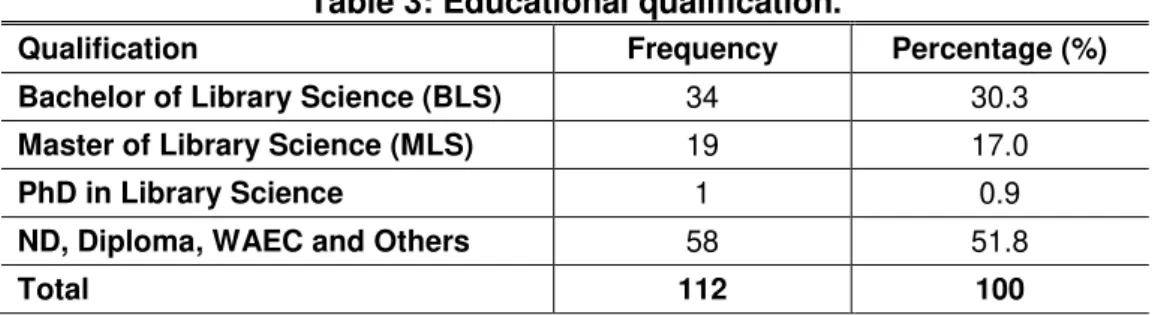
Table 3: Educational qualification.
Qualification Frequency Percentage (%)
Bachelor of Library Science (BLS) 34 30.3
Master of Library Science (MLS) 19 17.0
PhD in Library Science 1 0.9
ND, Diploma, WAEC and Others 58 51.8
Total 112 100
The data above reveals that the highest respondents are non-librarians
(Para-professionals) representing 51.8% (this constitute WAEC/NECO, OND, NCE,
Diploma and B.sc/HND holders), professionals – first degree bachelor of Library
Science (BLS) 30.3%, master in Library Science (MLS) 17.0%, while the least 0.9%
possess doctorate degree.
Table 4: Years of experience.
Years of Experience Frequency Percentage (%)
1-5 78 69.6
6-10 26 23.2
11-15 4 3.6
16 and above 4 3.6
The Table 4 shows that 3.6% of the respondents ranging between 11
(eleven) and 16 (sixteen) years and above have work experience in the field of
research, 23.2% of the respondent representing between 6 (six) and 10 (ten) years,
and 69.6% representing between 1 (one) and 5 (five) years have experience in the
field of study.
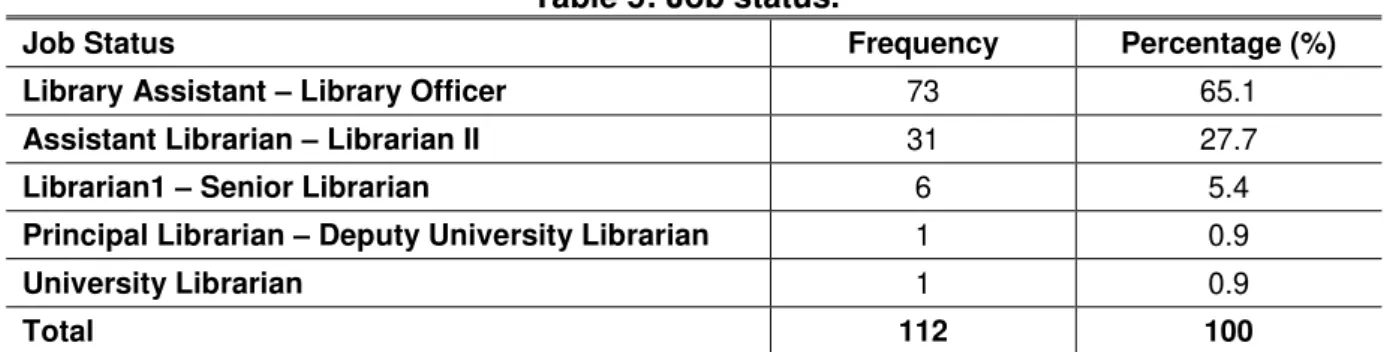
Table 5: Job status.
Job Status Frequency Percentage (%)
Library Assistant – Library Officer 73 65.1
Assistant Librarian – Librarian II 31 27.7
Librarian1 – Senior Librarian 6 5.4
Principal Librarian – Deputy University Librarian 1 0.9
University Librarian 1 0.9
Total 112 100
From the classification of the respondents library assistant and library officer
represents 65.1%, while assistant librarian and librarian II represent 27.7%, librarian I
and senior librarian represent 5.4%, and deputy university librarian and university
librarian represent 0.9% of the respondents.
Table 6: Distribution according to institution.
Universities Frequency
Distributed
Percentage (%) Distributed
Frequency Retrieved
Percentage (%) Retrieved
Babcock University (Bab) 35 29.17 36 32.1
Bells University (Bell) 20 16.66 15 13.4
Covenant University (Cov) 30 25 32 28.6
Redeemers University (Red) 35 29.17 29 25.9
Total 120 100 112 100
The Table 6 shows the total questionnaires completed and returned by the
universities participating in the survey. A total of 120 (one hundred twenty)
questionnaires were distributed to individuals from various universities. These, only
112 (one hundred and twelve) have been completed and returned, representing
Table 7: Presence of preservation department. Does the library have a
preservation department?
Frequency Percentage (%)
No 86 76.8
Yes 26 23.2
Total 112 100
The Table 7 shows that 76.8% of the respondent’s observed that the library
does not have preservation department but they do, it is because it is not functional,
while 23.2% of the respondent agree having preservation department.
Table 8: Category of staff responsible for preservation. What category of staff is
responsible for preservation?
Frequency Percentage (%)
Para professional staff 96 85.7
Professional staff 16 14.3
Total 112 100
The Table 8, clearly shows that 85.7% of the task on preservation and has
been enormous on para-professionals, this is so because librarians/professionals do
not possess enough skills to manage the section effectively, while only 14.3% of the
professional staff are knowledgeable and have skills to match in preservation.
Table 9: Attendance of workshops for library staff on preservation. Does librarians attend international
workshops & conferences on preservation?
Frequency Percentage (%)
Yes 37 33
No 75 67
Total 112 100
The Table 9 indicates that the negative response to workshops and
conferences by librarians is very high about 67% compared to their colleagues in the
developed world that is conversant with modern trends in the profession. On the
other hand only 33% of librarians attend international conference and workshops
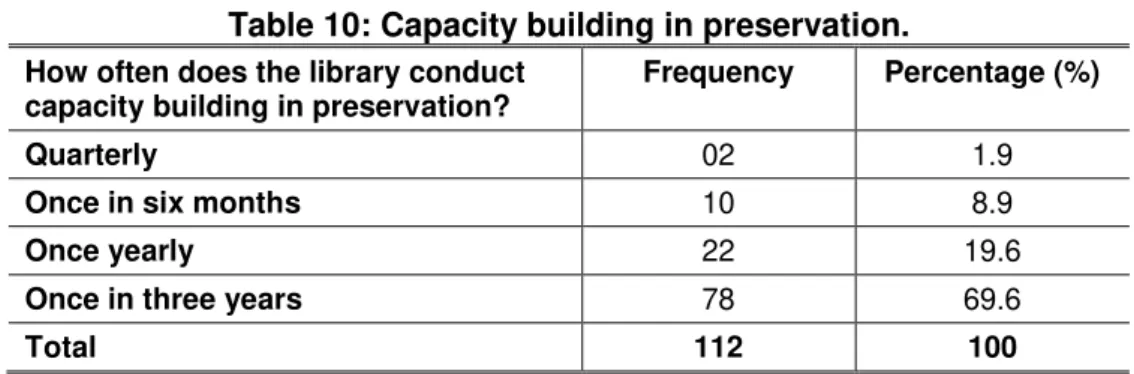
Table 10: Capacity building in preservation. How often does the library conduct
capacity building in preservation?
Frequency Percentage (%)
Quarterly 02 1.9
Once in six months 10 8.9
Once yearly 22 19.6
Once in three years 78 69.6
Total 112 100
The Table 10 shows that capacity building is not being organized for
librarians and non-librarians because within one to three years, only 69.6% and
19.6% of staff have been exposed to training while in the duration of six months only
1.9% and 8.9% were exposed to trainings. This is very low because knowledge is
power, therefore as information providers we must be abreast with current trends in
our profession.
Table 11: Capacity building initiative for library staff. What capacity building initiative
is available to library staff?
Frequency Percentage (%)
Seminars 38 33.93
Conferences 20 17.86
In House 34 30.36
Formal 12 10.71
E-Learning 8 7.14
Total 112 100
The Table 11 highlights that libraries surveyed conduct more seminars
(33.93%) and in-house training (30.36%) for its employees. Capacity building
initiatives related to conferences (17.86%) appear in the background. Finally, it
appears personal development (10.71%) and e-learning (7.14%) demonstrating
initiatives that are little used.
Table 12: Current preservation techniques used in the library. What capacity building initiative
is available to library staff?
Frequency Percentage (%)
Conservation 15 13.4
Digitization 35 31.3
Digital Preservation 28 25
Disaster Preparedness Plan 09 8.0
Total 112 100
The Table 12 shows that all the libraries have exposed their staff to capacity
building in scanning (31.3%), digital preservation (25%), though more trainings needs
to be conducted in attempts to take appropriate care of library materials, because it is
considered that conservation (13.4%) and disaster plan (8%) are very low rates.
5 FINDINGS
The study revealed that majority of the libraries studied do not have
functional preservation department perhaps this is because the direct impact of wear
and tear and its effect on library materials have been underestimated by the
Librarians. Even for those who have, they are run and managed by non-librarians
(Para-professionals). It is imminent to stop and ruminate over certain questions at
this juncture (questions that could lead to further research) is it that the professional
librarian perceive preservation as an unprofessional task which should be left to the
non-librarians, if yes, then there needs to be a study of library schools in Nigeria to
discover whether preservation and conservation of library materials is not taught at
postgraduate level. This is absolutely inappropriate especially in the current climate
of digitization, where professionals are expected to champion the cause.
The low priority accorded preservation in most of the libraries studied may
not be unconnected to the relegation of preservation to the non-librarians after all; if
there are professionals involved it would go a long way to justify the need to establish
functional preservation department which would be headed by a qualified
professional.
It was also discovered that librarians and non-librarians rely more on
insufficient funds from the university to sponsor them, and when they do it is not
enough, it is usually complimented with their personal funds.
6 CONCLUSION AND RECOMMENDATIONS
Following the afore-mentioned observations, there is need for libraries to
have a functional and operational preservation department. More professional
librarians should be encouraged to major in preservation, in other to be to committed
and concerned about preserving the material with which they work and to be further
equipped in supervising the Para professionals for better quality of work and quick
delivery of service to library users.
National and international trainings on preservation techniques must be
made compulsory for all library staff irrespective of their sections in the library.
Capacity building should be done in two phases: the first phase should be for the
newly employed staff, while the second phase for staff that has worked for more than
five years and above. After trainings, it would be expected that the performance of
the non-professionals will improve as they will strive to apply the techniques and
knowledge they have acquired from the trainings. Regular update of library science
curricular must be introduced in our universities, both in undergraduate and
postgraduate levels and the lecturers equipped with the latest trends in information
communication technology (ICT). Staff must be trained on types of disaster,
prevention and conservation strategies.
It is the duty of all library staff, beginning from the University librarian, to
safeguard the welfare of their collections. This training must be supported and
encouraged by all categories of staff. Capacity building is necessary in every
academic university especially for new staff, because it equips them with the relevant
skills in their profession.
In spite of the busy schedule of librarians, time must be created for adequate
and timely trainings on preservation in order to be equipped with modern trends in
REFERENCES
ANUNOBI, C. V. (2012) Human capacity building in Nigerian higher education sector: Imperative for academic libraries contribution towards national development. Nigeria: Nnamdi Azikiwe University Awka, 2012. Available:
<http://works.bepress.com/chinwe_anunobi/11>. Access: Jun. 25, 2007.
AJIDAHUN, C. O. (2007). The training, development and education of library manpower in information technology in university libraries in Nigeria. World Libraries, v.17, n.1, Spring 2007. Available:
<http://www.worlib.org/vol17no1/ajidahun1_v17n1.shtml>. Access: Jun. 25, 2007.
ALTOBELLIS, A. (2011). Massachusetts Connecting to Collections
Statewide Preservation Survey: Final report. Andover (MA): Northeast Document Conservation Center, 2011. 361p. Available:
<http://mblc.state.ma.us/advisory/preservation/c2c.pdf>. Access: Jun. 25, 2007.
COMMUNITY District Library. Material Selection Policy: Gifts, book withdrawal and objections to materials. 2010. Available: <http://www.mycdl.org/cdl/>. Access: Jun. 25, 2007.
CHANDAN, J. Management: Theory and practice. New Delhi: Vikas, 2000.
DONATA, L. Seven effective ways to improve job performance. 2011. Available: <http://productivity-time-management.knoji.com/seven-effective-ways-to-improve-job-performance/>. Access: Jun. 25, 2007.
DOYLE, B. Careers in preservation Librarianship. Houston (TX): LIS Career.com, 2005. Available: <http://www.liscareer.com/doyle_preservation.htm>. Access: Jun. 25, 2007.
DREWES, J. Preservation partners: Engaging staff in preservation efforts. In: WORLD LIBRARY AND INFORMATION CONGRESS, IFLA GENERAL
CONFERENCE AND COUNCIL 72nd, Seol, Korea, 20-24th August. Proceedings… Seol, 2006. Available: <http://archive.ifla.org/IV/ifla72/papers/096-Drewes-en.pdf>. Access: Jun. 25, 2007.
FISHER, W. The question of gender in library management. Library Administration and Management, v.11, n.4, p.231-36, Fall 1997.
GOLDSMITH, B. Preservation and Conservation Division. New York: New York Public Library, 2007. Available:
<http://www.nypl.org/collections/nypl-collections/preservation-division>. Access: Jun. 25, 2007.
LEE, K. et al. The state of the art and practice in digital preservation. Journal of Research of the National Institute of Standards and Technology, v.107, n.1, p.93, 2002. Available: <http://nvl.nist.gov/pub/nistpubs/jrest/107/1/j71/lee.pdf>. Access: Jun. 25, 2007.
MORROW, C. C. Defining the library preservation program: Policies and
organization. In: BANKS, P. N.; PILETTE, R. Preservation: Issues and planning Chicago: American Library Association, 2000.
MUHAMMAD, U. Preservation and conservation of library materials: The situation in the National Library of Nigeria. Nigerbiblios, v.17, n.1/2, p.116-137, Dec. 2006.
NIZIERS, G. Preservation and conservation training in the French National Library. In: In: WORLD LIBRARY AND INFORMATION CONGRESS, IFLA GENERAL CONFERENCE AND COUNCIL 72nd, Seol, Korea, 20-24th August. Proceedings… Seol, 2006. Available: <http://archive.ifla.org/IV/ifla72/papers/096-Niziers-en.pdf>. Access: Jun. 25, 2007.
OLATOKUN, W. M. A survey of preservation and conservation practices and
Techniques in Nigerian university libraries. LIBRES: Library and Information Science Research Electronic Journal, v.18, n.2, Sep. 2008. Available:
<http://libres.curtin.edu.au/libres18n2/Olatokun_FINAL.pdf>. Access: Jun. 25, 2007.
OKETUNJI, I. Education of librarians in an electronically oriented society. In: CATALOGUING, CLASSIFICATION & INDEXING SECTION OF THE NIGERIAN LIBRARY ASSOCIATION SEMINAR. WORKSHOP ON SOFTWARE CHOICE PARAMETERS FOR CATALOGUING IN NIGERIAN LIBRARIES, 22-27 October.
Proceedings… Akure (Ondo), 2001.
PAGE, J. A. When disaster strikes: First steps in disaster preparedness. The Serials Librarian, v.36, n.3-4, p.347-361, 1999.
SMITH, K. Preservation training abroad. CLIR Issues, v.13, Jan./Feb. 2000. Available: <http://www.clir.org/pubs/issues/issues13.html/issues13.html#clir>. Access: Jun. 25, 2007.
SIMPSON, J. When disaster strikes: Helping you prepare for the worst. Calgary Journal Online, 15 Apr. 2011.
STONER, J.; FREEMAN, R.; GILBERT, D. Management. New Delhi: Prentice-Hall, 2002.
WILSON, P.; SOY, S. Defining preservation: Introduction to preservation for libraries and archives. 2000. Available:
WIKIPEDIA. Preservation: Library and Archival Science. 2012. Available:
<http://en.wikipedia.org/wiki/Preservation_(library_and_archival_science)>. Access: Jun 25, 2007.
YESUFU, T. The human factor for national development. Benin City (Nigeria): University of Benin Press and Spectrum Books, 2000.
ZHANG, S. L. Effectiveness of support staff training and development in Kansas and Oklahoma. Amigos Fellowship Final Report. Kansas: Wichita State University Libraries, 2004. Available:
<http://www.amigos.org/files/2004_effectiveness.pdf>. Access: Feb. 5, 2012.
Miracle Eka Njeze
National Open University of Nigeria (NOUN) Center for Resource Learning (Library) 14/16 Ahmadu Bello Way
Victoria Island - Lagos State E-Mail: [email protected] Nigeria
Iwu Juliana James Covenant University Km10 Idiroko Road Ota. Ogun State