Masoud Mahmoodi a * Ali Naderi b
a School of Mechanical Engineering, Sem-nan University, SemSem-nan, Iran.
[email protected] b School of Mechanical Engineering , Semnan University, Semnan, Iran. [email protected]
* Corresponding author
http://dx.doi.org/10.1590/1679-78252154
Received 21.05.2015 In revised form 23.02.2016 Accepted 23.03.2016 Available online 12.04.2016
Abstract
Equal channel angular rolling (ECAR) is a severe plastic defor-mation (SPD) process in order to achieve ultrafine-grained (UFG) structure. In this paper, the mechanical properties of ECAR pro-cess using artificial neural network (ANN) and nonlinear regres-sion have been illustrated. For this purpose, a multilayer percep-tron (MLP) based feed-forward ANN has been used to predict the mechanical properties of ECARed Al5083 sheets. Channel oblique angle, number of passes and the route of feeding are considered as ANN inputs and tensile strength, elongation and hardness are considered as the outputs of ANN. In addition, the relationship between input parameters and mechanical properties were ex-tracted separately using nonlinear regression method. Comparing the outputs of models and experimental results shows that models used in this study can predict and estimate mechanical properties appropriately. Where, the performance of ANN model is better than the correlations to predict mechanical properties. Finally, the developed outputs of neural network model are used to ana-lyze the effects of input parameters on tensile strength, elongation and hardness of ECARed Al5083 sheets.
Keywords
ECAR, Mechanical properties, Ultrafine-grained, Artificial neural network, Nonlinear regression
Applicability of Artificial Neural Network and Nonlinear
Regression to Predict Mechanical Properties of Equal
Channel Angular Rolled Al5083 Sheets
NOMENCLATURE
NOMENCLATURE (continuation)
m experimental data p predicted data W weight function ξ activation function b bias value
R correlation coefficient ρ performance ratio φ channel oblique angle N number of passes
1 INTRODUCTION
In the last decade, SPD was introduced as an effective method in the production of metals with nano structure. Recently UFG materials produced by SPD processes have been considered by many researchers. ECAR process is a SPD method that leads to UFG structure and improved mechanical properties of material. This process is presented for continuous forming of sheets and strips and like ECAP can apply large strain to the material with no change in cross-section of piece (Sedighi et al., 2013).
In this decade, many researchers have investigated the ECAR process and micro-structure of its samples. Kavackaj et al (2012). The effect of the temperature on the accelerated grain refining dur-ing the continuous ECAP operation was discussed by Lee et al (2002). Chen et al. (2007) illustrated the effect of ECAR pass on microstructure and properties of magnesium alloy sheets.
Chung et al. (2006, 2007) analyzed the accumulated deformation and the control of thickness uniformity of Al 6063 alloy in the ECAR process. Cheng et al. (2007, 2008) illustrated ECARed AZ31 magnesium alloy sheet drawability and its improvement at room temperature. The effect of ECAR process on AZ31 magnesium alloy has been studied by Hasani et al. (2011) to achieve a nano-structure. Habibi et al. (2011, 2012) illustrated the effect of ECAR process on strength and electrical conductivity of pure copper. They also applied ECAR and post-annealing to enhance the properties of nano-grained pure copper. Mahmoodi et al. (2012) studied the residual stress distribu-tion through the thickness of ECARed aluminum alloy.
Since experiments require fairly high cost and time, ANN has been attended considerably by researchers in various fields because of its ability in modeling variables with a few experiments. In fact, ANN is a new method for predicting the nonlinear behavior of material properties (Anaraki et al., 2008). The main advantage of ANN compared to conventional methods is its high speed in solv-ing the complicated relationships (Zhangtt et al., 1995). ANN has capability of modelsolv-ing and pre-dicting the behavior of complex processes based on specified data (Derogar et al., 2011).
Chan et al. (2008) developed a comprehensive methodology based on finite element method and ANN to estimate the design parameters and determine the optimal network structure. Qin et al. (2010) used ANN model to evaluate and predict the deformation behavior of ZK60 magnesium alloy during hot compression. ANN modeling to predict the hot deformation behavior of A356 aluminum alloy was performed by Haghdadi et al. (2013). Sheikh et al. (2008) estimated the flow stress behav-ior of AA5083 using ANN with regard to the dynamic strain aging effect.
The tensile strength, elongation and hardness have traditionally been the most widely quoted and applied determinants of mechanical behavior. In this paper, mechanical properties of ECARed Al5083 alloy sheet have been estimated by using artificial neural network. Likewise, nonlinear re-gression has been employed to propose equations for mechanical properties in terms of channel oblique angle and number of passes.
2 ECAR PROCESS
Figure 1 shows a schematic of ECAR process equipment. In this process, the sample passes through the die channel with no change in cross section under a continuous severe shear deformation. Ac-cording to Figure 1, ECAR process takes place in routes A and C. In route A, the strip moves along rolling direction with no rotation, while in route C, the strip is rotated 180 degrees in rolling direc-tion before the process.
Input and output channel thickness is 2 mm and the thickness of strip after rolling reduction is 1.95 mm. The Al 5083 samples with the dimension of 400 * 40 * 2 mm were annealed for one hour at 350 ċ. The experiments were accomplished in channel oblique angles of 110, 120 and 130 degrees for 1 to 3 passes at room temperature (Mahmoodi et al., 2011).
3 DESIGN AND TRAINING ARTIFICIAL NEURAL NETWORK
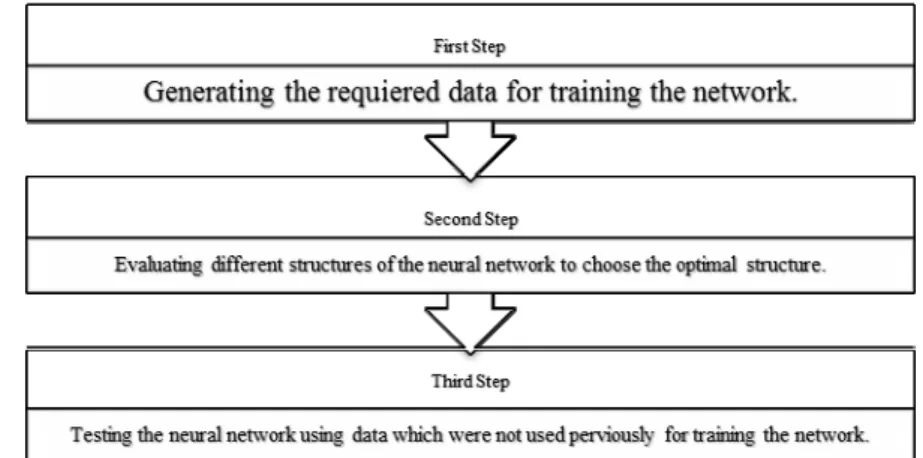
Artificial neural network is a general tool for modeling nonlinear functions, so that it can approxi-mate any complex behavior with any desired level of accuracy. ANN flexibility to estiapproxi-mate nonline-ar functions has made it a valuable tool in data processing. ANN modeling process is given in Fig-ure 2.
Figure 2: ANN modeling process.
ANN is specified by important features such as network architecture, activation function and training algorithm. The network complexity depends on the number of hidden layers and the num-ber of neurons in each layer. The small numnum-ber of hidden layer neurons may cause under fitting. Conversely, a large number of hidden layer neurons may result in over fitting. In most cases, the optimal number of hidden layer neurons can be achieved through trial and error.
Selecting the appropriate input parameters has an important role in ANN method and can af-fect the quality of prediction. In this research, channel oblique angle, routes of feeding and number of passes are considered as the input variables and tensile strength, elongation and hardness of ECARed Al5083 are considered as the output variables.
A neuron is the basic processing element in ANN modeling. In a neuron, each input is multi-plied by the weights, and the results are added to each other and bias. The activation function of neurons in each layer is determined and is used to produce output neurons by calculating sum of input weights and bias (Equation1).
( )
O=xWI +b (1)
Where O, I, b, W and xare output value, input value, bias value, weight function and activation function, respectively.
ANN is trained using data obtained from experiments to estimate the mechanical properties of ECARed Al5083 sample. The aim of training process in ANN is to achieve near zero errors with the proper adjustment of the training parameters, including updating the weights to achieve the desired error. In the present study, Levenberg-Marquardt back-propagation algorithm is used for modeling the mechanical properties of ECARed Al5083 sample. For this purpose, the experimental data set is used in which 70% of data set is used for training, and the remaining data set is used to test and validate the network. The mechanical properties of ECARed Al5083 sheets are predicted using a multilayer perceptron (MLP) feed forward network (Fig. 3). The network has a good ability to es-timate nonlinear relations and is one of the most common models of ANN in engineering applica-tions. Haghdadi (2013).
Inputs Hidden Layer 1 Hidden Layer 2 Output Layer
bias bias
C
Channel Angle
P
Number of Pass
R
Route
A=1 / C=2 110/120/130
1/2/3
Tensile Strength
Elongation %
bias
TS
EL
HV Hardness
Figure 3:MLP feed forward neural network.
One of the most commonly used performance functions in a MLP feed forward network is mean square error (MSE). MSE and correlation coefficient (R) are used to evaluate the performance of ANN. MSE and R-values are obtained from the following equations.
2
1
1 n
i i
i
MSE p m
n =
é ù
=
å
ë - û (2)1
2 2
1 1
( )( )
( ) ( )
n
i i
i
n n
i i
i i
m m p p
R
m m p p
=
= =
-
-=
-
-å
å
å
(3)Where mirepresents experimental data values,
p
irepresents predicted values, andnis the number of samples. mand p are mean values ofm
andp, respectively.MSE has been modified by adding a term, including the mean square network weights (MSW). The modified performance function is:
(1 )
MSEreg = r´MSE + -r MSW (4)
WhereMSEregis the modified performance function and
r
is the performance ratio.4 RESULTS AND DISCUSSION
In this section, the mechanical properties of ECARed Al5083 samples have been investigated by using nonlinear regression and ANN. The performance of these models has been measured and compared to each other. For this purpose, MSE and Correlation coefficient have been used. Finally, the mechanical properties of ECAR process have been analyzed based on adequate model.
4.1 Proposed Empirical Correlation
The mechanical properties of samples were modeled using nonlinear regression equation as well as ANN. For this purpose, experimental data set was used as the pattern. The resulting equations are extracted as a function of channel oblique angle and number of passes. For accurate evaluating model output to get the best correlation, mean square error and correlation coefficient are calculat-ed and comparcalculat-ed (Equations 2 and 3). Finally, equations of 5, 6 and 7 were selectcalculat-ed as correlations with less error for tensile strength, elongation and hardness, respectively.
6 3 2
2 3
Tensile Strength 323 231.9 1.59 10 16.2 0.709 1.41
110 0.106
N N N N
N N
j j j
j
-= + + ´ + +
-- - (5)
6 2 3
3 2
Elongation% 16.5 131 10 0.123 16.5 0.0122 30.9
2.84 0.0683
N N N N
N N
j j j
j
-= + ´ + + +
-- - (6)
7 3 2 2
2 3 2
Hardness 89 44.6 3.25 10 9.72 0.294 7.92 sin(1.8 0.8 2.4 )
0.335 36.7 0.081 11.9 sin(1.8 0.8 2.4 )
N N N N N N
N N N N N
j j
j j
-= + + ´ + + + +
-- - - - + - (7)
Where
j
is the channel oblique angle andNis the number of passes. Mean square error values ofequations of tensile strength, elongation and hardness are 2.1, 0.1283 and 0.37 and their correlation coefficients are 0.9983, 0.9986, and 0.9979, respectively. The results show that the equations can estimate the mechanical properties favorably.
4.2 Results of Ann Modeling
Number of hidden layer
Number of neuron in each hidden layers
MSE R1 R2 R3 R
1 2 4.4186 0.9925 0.99133 0.99048 0.99196
1 3 1.3995 0.99793 0.99831 0.9972 0.99756
1 4 0.7716 0.99829 0.99927 0.99804 0.9984
1 5 0.2538 0.99929 0.99962 0.99915 0.99924
1 6 0.3666 0.99914 0.99944 0.99988 0.99932
1 7 0.6219 0.99831 0.99758 0.99808 0.99813
1 8 0.4514 0.9988 0.9991 0.99906 0.99889
1 9 0.4278 0.99916 0.99956 0.9999 0.99926
2 2 2.8301 0.99446 0.99682 0.99372 0.99483
2 3 0.4068 0.9986 0.99866 0.99877 0.99847
2 4 0.5667 0.99834 0.99879 0.99854 0.99833
2 5 0.4765 0.99934 0.99882 0.9994 0.99886
2 6 0.0972 0.99954 0.99977 0.99938 0.99952
2 7 0.3407 0.99936 0.9992 0.99954 0.99936
2 8 0.6221 0.99829 0.9997 0.99906 0.99858
2 9 0.5048 0.99715 0.99783 0.9994 0.99743
Table 1: Error and trial procedure for finding optimal number of hidden layers and neurons.
In Table 1, R1, R2 and R3 are the correlation coefficients between the model output and train-ing data, model output and validation data and finally model output and test data, respectively.
Likewise, R is the correlation coefficient between the model output and the whole experimental data. MSE and R-values have been calculated and compared in Table 1 for different ANN architec-tures.
Experimental Data
-1.5 -1.0 -0.5 0.0 0.5 1.0 1.5
A
N
N
O
ut
pu
ts
-1.5 -1.0 -0.5 0.0 0.5 1.0 1.5
Tensile Strength Elongation Hardness Fitted Line
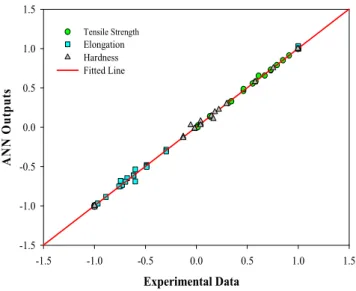
As it can be observed in Table 1, a network with three hidden layers and eight neurons at ei-ther of them shows the best performance. MSE value is 0.0972 for selected network architecture that is a suitable value on scale of output parameters. Figure 4 shows the network regression graph after training. Obviously, R-value is close to one, which confirms the proper performance of the selected network.
4.3 Comparing the Outputs of Models with Experimental Results
As it has been illustrated, artificial neural network and nonlinear regression models can estimate the mechanical properties accurately. Figure 5 shows the comparison between experimental results and models outputs. According to this figure, the experimental results and the models outputs for all three properties are in a very good agreement.
Number of Data
0 5 10 15 20 25
Te ns ile S tr en gt h (M Pa) 300 320 340 360 380 400 Experimental ANN Correlation a
Number of Data
0 5 10 15 20 25
El on ga tion % 2 4 6 8 10 12 14 16 18 Experimental ANN Correlation
Number of Data
0 5 10 15 20 25
H ar ne ss - H V - 1 00 g 75 80 85 90 95 100 105 110 Experimental ANN Correlation b c
Figure 5:Comparison between experimental results and models outputs, a. Tensile strength b. elongation c. hardness
respec-tively. Although, the maximum error values for nonlinear regression model to estimate the tensile strength, elongation and hardness are 3.93, 0.63 and 1.97, respectively.
4.4 The Mechanical Properties Analyzed Using Ann Model
The ANN model has been used for developing the mechanical properties of ECARed Al5083 sam-ples after selecting the best model with proper performance. The tensile strength, elongation and hardness at different channel oblique angles of 110 to 130 ° for annealed and one to three passes samples have been shown separately in Figure 6.
Channel Angle ( degree )
110 115 120 125 130
Te ns ile S tr en gt h ( M Pa ) 300 320 340 360 380 400 Annealed 1 Pass 2 Pass 3 Pass
Channel Angle ( degree )
110 115 120 125 130
El on gat ion % 2 4 6 8 10 12 14 16 18 Annealed 1 Pass 2 Pass 3 Pass
Channel Angle ( degree )
110 115 120 125 130
H
ar
dn
es
s - H
V - 10 0g 75 80 85 90 95 100 105 110 Annealed 2 Pass 3 Pass 2 Pass 1 Pass
Figure 6:The developed data using trained ANN based on experimental data, a. Tensile strength b. elongation c. hardness
According to Figure 6.a, the results of ANN show that the tensile strength increases in route C compared to route A. In agreement with conducted research, volume fraction and the velocity of formation of coaxial grains for route C are more than route A. (Dobatkin et al., 2007).
As shown in Figure 6.b, the material strength increases by decreasing the channel oblique angle of 130° to 110°, but the elongation decreases. An increase in strength and decrease in elongation at the first pass may be due to dislocation multiplication in the structure during deformation in the ECAR process. The dislocations can be formed within the grains and grain boundaries. The higher dislocation density in the material, the higher resistance to movement of dislocations and conse-quently the higher forces required for plastic deformation. This matter explains the increase in strength during plastic deformation.
Experimental - Rute A ANN - Rute A Experimental - Route C ANN - Rute C
c b
Experimental - Rute A ANN - Rute A Experimental - Route C ANN - Rute C
Experimental - Rute A ANN - Rute A Experimental - Route C ANN - Rute C
After the first pass, the tensile strength increases with a much lower rate and elongation reduc-es to a very small extent. It can be due to the sharp decline of work hardening in subsequent passreduc-es. The fine grains produced by high angle boundaries obstruct dislocation movement. Other defor-mation mechanisms are begun by increasing passes, such as grain boundary sliding and rotating grains (Meyers et al., 2006).
The reduction in elongation will not continue with increasing the number of passes. Increasing the cumulative plastic strain and generation of fine grains can be as a result of the dynamic equilib-rium between the generation and the annihilation of dislocations (Lee et al., 2003)
As Figure 6.c shows, a sever increase in hardness of samples occurs in the first pass. The reason is because of the work hardening of sample caused by the sub-grain boundaries formation.
5 CONCLUSIONS
In this paper, two methods of ANN and nonlinear regression modeling were used to estimate the mechanical properties of ECARed Al5083 sample. For this purpose, MLP feed forward network was employed. Furthermore, the relationship between the channel oblique angles and the number of passes as the input parameters and tensile strength, elongation and hardness as the output parame-ters was presented separately using the nonlinear regression model. Performance of ANN and non-linear regression model shows that both models estimate the mechanical properties of ECARed Al5083 samples accurately. However, the ANN model estimates the output parameters with high accuracy. Mean square error and correlation coefficient are 0.0972 and 0.99952 for ANN, respective-ly.
The results of mechanical properties obtained by trained ANN show that tensile strength values increases in route C more than corresponding values at route A. By decreasing the channel oblique angle especially at the first pass, the strength increases and the elongation decreases. The greater number of passes leads to increase in tensile strength, hardness and reduction in elongation.
References
Ambrogio G., Filice L., Guerriero F., Guido R., Umbrello D., (2010). Prediction of incremental sheet forming process performance by using a neural network approach. Int. J. Adv. Manuf. Technol., 54:921–930.
Anaraki M. T., Sanjari M., Akbarzadeh A., (2008). Modeling of high temperature rheological behavior of AZ61 Mg-alloy using inverse method and ANN. Mater. Des., 29:1701–1706.
Chan W. L., Fu M. W. Ã., and Lu J., (2008). An integrated FEM and ANN methodology for metal-formed product design. Engineering Applications of Artificial Intelligence, 21:1170–1181.
Chen Z., Cheng Y., Xia W., (2007). Effect of Equal-Channel Angular Rolling Pass on Microstructure and Properties of Magnesium Alloy Sheets. Material and Manufacturing Processes, 22:51–56.
Cheng Y. Q., Chen Z. H., Xia W. J., (2007). Drawability of AZ31 magnesium alloy sheet produced by equal channel angular rolling at room temperature. Mater. Charact., 58:617–622.
Cheng Y. Q., Chen Z. H., Xia W. J., Zhou T., (2008). Improvement of Drawability at Room Temperature in AZ31 Magnesium Alloy Sheets Processed by Equal Channel Angular Rolling.Journal of Material Engineering and Perfor-mance, 17:15–19.
Chung Y. H., Park J. W. Lee K. H., (2007). Controlling the Thickness Uniformity in Equal Channel Angular Rolling (ECAR). Mater. Sci. Forum, 539–543: 2872–2877.
Derogar A., Djavanroodi F., (2011). Artificial Neural Network Modeling of Forming Limit Diagram. Mater. Manuf. Process., 26:1415–1422.
Djavanroodi F., Omranpour B., Sedighi M., (2013). Artificial Neural Network Modeling of ECAP Process. Mater. Manuf. Process., 28:276–281.
Dobatkin S. V., Szpunar J. a., Zhilyaev A. P., Cho J.-Y., Kuznetsov A. A., (2007). Effect of the route and strain of equal-channel angular pressing on structure and properties of oxygen-free copper. Mater. Sci. Eng. A, 462:132–138. Esmailzadeh M., Aghaie-Khafri M., (2012). Finite element and artificial neural network analysis of ECAP. Comput. Mater. Sci., 63:127–133.
Forcellese A., Gabrielli F., Simoncini M., (2011). Prediction of flow curves and forming limit curves of Mg alloy thin sheets using ANN-based models. Comput. Mater. Sci., 50:3184–3197.
Habibi A., Ketabchi M., Eskandarzadeh M., (2011). Nano-grained pure copper with strength and high-conductivity produced by equal channel angular rolling process. J. Mater. Process. Technol., 211:1085–1090.
Habibi A., Ketabchi M., (2012). Enhanced properties of nano-grained pure copper by equal channel angular rolling and post-annealing. Mater. Des., 34:483–487.
Haghdadi N., Khalesian A. R., Abedi H. R., (2013). Materials and Design Artificial neural network modeling to predict the hot deformation behavior of an A356 aluminum alloy. Mater. Des., 49:386–391.
Hassani F. Z., Ketabchi M., (2011). Nano grained AZ31 alloy achieved by equal channel angular rolling process. Mater. Sci. Eng. A, 528:6426–6431.
Kvačkaj T., Kováčová A., Kvačkaj M., Kočiško R., Lityńska-Dobrzyńska L., Stoyka V., Miháliková M., (2012). TEM studies of structure in OFHC copper processed by equal channel angular rolling. Micron,43:720-724.
Lee J. C., Seok H. K., Suh J.Y., (2002). Microstructural evolutions of the Al strip prepared by cold rolling and con-tinuous equal channel angular pressing. Acta Mater, 50:4005-4019.
Lee J., Suh J., Ahn J., (2003). Work-Softening Behavior of the Ultrafine-Grained Al Alloy Processed by High-Strain-Rate , Dissimilar-Channel Angular Pressing. Metallurgical and Materials Transactions A, 34:625–632.
Mahmoodi. M., (2011). The effect of ECAR parameters on residual stresses and mechanical-microstructural proper-ties of Al sheets. Ph.D. thesis, (in Persian), Iran University of Science and Technology.
Mahmoodi M., Sedighi M., and Tanner D. A., (2012). Investigation of through thickness residual stress distribution in equal channel angular rolled Al 5083 alloy by layer removal technique and X-ray diffraction. J. Mater., 40:516– 520.
Meyers M.A., Mishra A., Benson D.J., (2006). Mechanical properties of nanocrystalline materials. Prog. Mater. Sci., 51:427–556.
Qin Y. J., Pan Q. L., He Y. B., Li W. B., Liu X. Y., Fan X., (2010). Artificial Neural Network Modeling to Evaluate and Predict the Deformation Behavior of ZK60 Magnesium Alloy During Hot Compression. Mater. Manuf. Process., 25,:539–545.
Sedighi M., Mahmoodi M., (2013). Residual Stresses Evaluation in Equal Channel Angular Rolled Al 5083 by IHD Technique: Investigation of Two Calculation Methods. Materials and Manufacturing Processes, 28:85–90.
Sheikh H., Serajzadeh S., (2008). Estimation of flow stress behavior of AA5083 using artificial neural networks with regard to dynamic strain ageing effect. J. Mater. Process. Technol., 196:115–119.
Toros S., Ozturk F., (2011). Flow curve prediction of Al–Mg alloys under warm forming conditions at various strain rates by ANN. Appl. Soft Comput,11:1891–1898.