Production, v. 25, n. 3, p. 713-724, jul./set. 2015 http://dx.doi.org/10.1590/0103-6513.132213
Received 03/15/2013; Accepted 12/07/2013
Framework to manage suppliers for strategic
alliances with a multicriteria method
Patricia Guarnieria*, Adiel Teixeira de Almeidab**
a*Universidade de Brasília, Brasília, DF, Brasil, [email protected] b**Universidade Federal de Pernambuco, Recife, PE, Brasil, [email protected]
Abstract
Processes that identify top suppliers of new products or services and evaluate the performance of the existing suppliers are essential to strategic alliances. The objective of this article is to propose a framework to select partners for strategic alliances in supply chain management using a criteria method. To reach this objective, the multi-criteria modeling procedure was used to detach the steps of a decision process, which comprises the methodology used in this article. To illustrate the use of the model, a numerical application, with characteristics from a small supermarket using the ELECTRE III method, was presented. The main contribution of the model proposed is to improve the process used to select suppliers for strategic alliances by considering multiple criteria called ‘soft factors’. The proposed model suggests a systematic procedure that can reduce uncertainty in the decision process.
Keywords
ELECTRE III. Multi-criteria decision analysis. Strategic alliances. Supplier selection.
1. Introduction
Decisions regarding supplier selection for strategic alliances are considered complex, mainly due to consideration of various qualitative and quantitative criteria, which very often have conflicting relations with each other (Choy et al., 2003; Almeida, 2013). It should be emphasized that the definition of an appropriate set of criteria and the analysis of an interaction between them is essential. In this sense, Figueira et al. (2009) state that fuzzy integral-based methods were introduced in decision aiding to allow such interactions to be taken into account.
Currently, having processes to identify the best suppliers of new products or services or even to evaluate the performance of a former supplier is an essential issue in strategic alliances. However, these tasks are also difficult given that they involve not only quantitative measures, but also qualitative factors, such as stability in the management structure; reliability; financial stability, among others (Bozarth
& Handfield, 2008).
In the last twenty or so years, many articles have tackled these issues in various different situations such
as: selecting suppliers and evaluating their performance in connection with the purchase of components/ materials (Boran et al., 2009); selecting the most appropriate alternative for outsourcing (Almeida, 2007); selecting partners for co-development alliances (Feng et al., 2010) and; selecting suppliers for optimal allocation order, satisfying constraints (Razmi et al., 2009). Despite several studies having explored the problem of selecting suppliers in a multicriteria context, with different methods and approaches, few of them deal specifically with strategic alliances in supply chain management in a multicriteria decision aid context (Feng et al., 2010).
supplier according to its performance in order to maximize the value across the entire supply chain.
2. Literature review
2.1.
Supplier selection problem (SSP)
Evaluating suppliers’ performance and selecting them are considered strategic issues, because these activities contribute to obtaining, keeping and improving a competitive advantage (Wang, 2010). In recent years many authors have proposed different multicriteria approaches and different sets of criteria to carry out these activities. There is no consensus among experts in the area regarding a best method or a best set of criteria (Almeida, 2013).
One of the first and most quoted studies regarding this problem was published in 1966 by Dickson, who proposed 23 criteria by which to select suppliers, the most important criteria were: Quality; Delivery; Performance History; Guarantee Policies; Productive Capacity and Price. Ellram (1990) proposed some criteria called ‘soft factors’, which are focused on strategic alliances between suppliers and buyers in supply chains. The main criteria highlighted were: Feeling of trust, management attitude, outlook for the future, strategic fit, and top management compatibility.
Ho et al. (2010) carried out a literature review on articles published in international journals from 2000 to 2008, the authors found that the most used individual approach was DEA, whereas the most popular integrated approach was AHP – GP, besides the most popular criteria were: quality, delivery,
and price/cost. Viana & Alencar (2012) conducted
a literature review based on 56 articles on supplier selection problem and identified main methodologies used, trends and gaps of the literature in the period between 1998 and 2011.
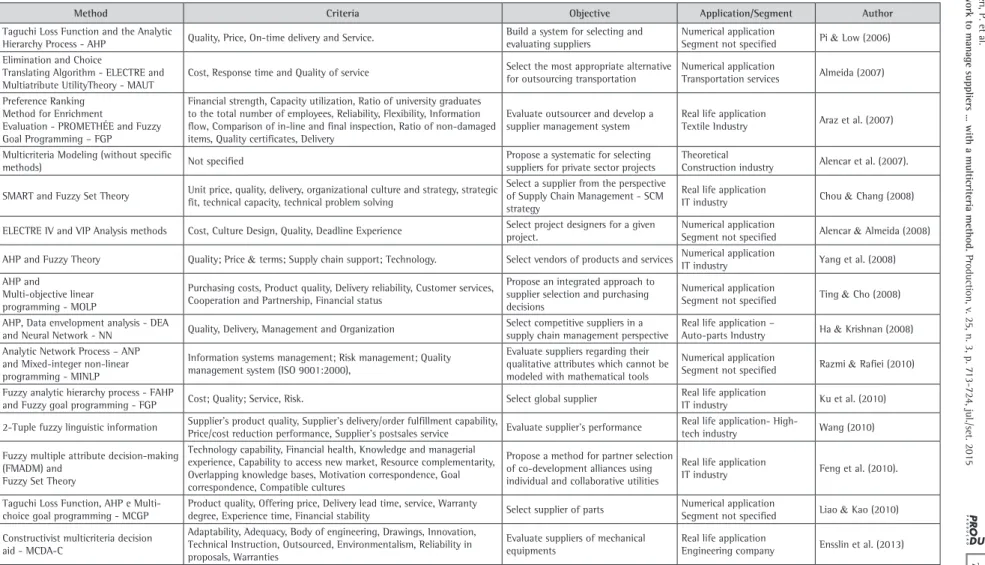
Many other studies have emerged on supplier selection problem, especially from 2006 to the present. For the purposes of this article, a selection of those that bear most directly on the Multicriteria Decision Aid (MCDA) approach proposing some models with a set of criteria is shown in Table 1.
As presented in Table 1, the only article approaching strategic alliances and thus, considering appropriate criteria for this process was from Feng et al. (2010). Other articles presented are focused in selection of suppliers for purchasing of products and services. Since the work from Dickson (1966) until now, most of articles on supplier selection focus on criteria cost, quality, delivery, capacity among others, which are quantitative in nature and, reflects the traditional
arm’s length relationships with suppliers. In the context of this article, the companies will consider another type or relationship with suppliers, cooperative in nature, aimed to strategic alliances, which requires differentiated criteria. The next section has the purpose to differentiate the relationships aimed to strategic alliances and emphasize the need of a proper set of criteria for this situation.
2.2.
Strategic alliances and soft factors
The previous relationships characterized by an ‘arm’s-length’ relation were gradually replaced by ‘durable arm’s-length’ and ‘strategic alliances’, the latter being characterized by a high degree of information exchange (Dyer et al., 1998). Moreover, the complexity increases, because supply chain partnering involves collaborative activities such as sharing information, synchronizing decisions, sharing complementary resources, and aligning incentives
(Cao & Zhang, 2010).
Strategic alliances are driven by efforts to reduce price, increase the dependability of supply, and influence supplier quality and delivery schedules (Ellram, 1995). The main reasons to constitute strategic alliances can be highlighted: growth strategies and entering new markets; obtain new technology and/ or best quality or cheapest cost; reduce financial risk and share costs of research and development;
achieve or ensure competitive advantage (Elmuti &
Kathawala, 2001).
Furthermore, the strategic alliances involve information sharing, risks and rewards sharing, cooperation, similar objectives and customer focus, integration of key-processes, and interfunctional coordination (Mentzer et al., 2001). It is also possible through strategic alliances to focus on core activities
(Kannan & Tan, 2004; Wong et al., 2005). In this
sense, trust emerges as a driver’s performance and is associated with lower costs of trading (Bandeira et al., 2009).
On the other hand, as pointed out by Tjemkes &
Furrer (2010), strategic alliances involve uncertainty, interdependence, and vulnerability. Mentzer et al. (2001) indicated that in order to succeed over time, alliances must adapt their tasks, routines, performance indicators and objectives, avoiding premature termination.
Fr
ame
w
ork to manage suppliers … with a multicriteria method.
Production, v
. 25, n. 3, p. 7
13-724, jul./set. 2015
71
5
Guarnieri, P. et al.
Table 1. Summary of Supplier Selection Articles.
Method Criteria Objective Application/Segment Author
Taguchi Loss Function and the Analytic
Hierarchy Process - AHP Quality, Price, On-time delivery and Service.
Build a system for selecting and evaluating suppliers
Numerical application
Segment not specified Pi & Low (2006) Elimination and Choice
Translating Algorithm - ELECTRE and Multiatribute UtilityTheory - MAUT
Cost, Response time and Quality of service Select the most appropriate alternative for outsourcing transportation
Numerical application
Transportation services Almeida (2007)
Preference Ranking Method for Enrichment
Evaluation - PROMETHÉE and Fuzzy Goal Programming – FGP
Financial strength, Capacity utilization, Ratio of university graduates to the total number of employees, Reliability, Flexibility, Information flow, Comparison of in-line and final inspection, Ratio of non-damaged items, Quality certificates, Delivery
Evaluate outsourcer and develop a supplier management system
Real life application
Textile Industry Araz et al. (2007)
Multicriteria Modeling (without specific
methods) Not specified Propose a systematic for selecting suppliers for private sector projects TheoreticalConstruction industry Alencar et al. (2007).
SMART and Fuzzy Set Theory Unit price, quality, delivery, organizational culture and strategy, strategic fit, technical capacity, technical problem solving
Select a supplier from the perspective of Supply Chain Management - SCM strategy
Real life application
IT industry Chou & Chang (2008)
ELECTRE IV and VIP Analysis methods Cost, Culture Design, Quality, Deadline Experience Select project designers for a given project.
Numerical application
Segment not specified Alencar & Almeida (2008)
AHP and Fuzzy Theory Quality; Price & terms; Supply chain support; Technology. Select vendors of products and services Numerical applicationIT industry Yang et al. (2008)
AHP and
Multi-objective linear programming - MOLP
Purchasing costs, Product quality, Delivery reliability, Customer services, Cooperation and Partnership, Financial status
Propose an integrated approach to supplier selection and purchasing decisions
Numerical application
Segment not specified Ting & Cho (2008)
AHP, Data envelopment analysis - DEA
and Neural Network - NN Quality, Delivery, Management and Organization
Select competitive suppliers in a supply chain management perspective
Real life application –
Auto-parts Industry Ha & Krishnan (2008) Analytic Network Process – ANP
and Mixed-integer non-linear programming - MINLP
Information systems management; Risk management; Quality management system (ISO 9001:2000),
Evaluate suppliers regarding their qualitative attributes which cannot be modeled with mathematical tools
Numerical application
Segment not specified Razmi & Rafiei (2010)
Fuzzy analytic hierarchy process - FAHP
and Fuzzy goal programming - FGP Cost; Quality; Service, Risk. Select global supplier
Real life application
IT industry Ku et al. (2010)
2-Tuple fuzzy linguistic information Supplier’s product quality, Supplier’s delivery/order fulfillment capability, Price/cost reduction performance, Supplier’s postsales service Evaluate supplier’s performance Real life application- High-tech industry Wang (2010)
Fuzzy multiple attribute decision-making (FMADM) and
Fuzzy Set Theory
Technology capability, Financial health, Knowledge and managerial experience, Capability to access new market, Resource complementarity, Overlapping knowledge bases, Motivation correspondence, Goal correspondence, Compatible cultures
Propose a method for partner selection of co-development alliances using individual and collaborative utilities
Real life application
IT industry Feng et al. (2010).
Taguchi Loss Function, AHP e
Multi-choice goal programming - MCGP Product quality, Offering price, Delivery lead time, service, Warranty degree, Experience time, Financial stability Select supplier of parts Numerical applicationSegment not specified Liao & Kao (2010)
Constructivist multicriteria decision aid - MCDA-C
Adaptability, Adequacy, Body of engineering, Drawings, Innovation, Technical Instruction, Outsourced, Environmentalism, Reliability in proposals, Warranties
Evaluate suppliers of mechanical
down a complex decision problem into a hierarchical tree (Almeida, 2013). The Utilité Additive - UTA is based on MAUT, it assumes an additive utility function and generates a set of utility functions (Jacquet-Lagreze
& Siskos, 1982).
PROMETHÉE I supplies a partial ranking, which allows incomparability. On the other hand, PROMETHÉE II supplies complete ranking, which considers all the alternatives are comparable (Brans
& Mareschal, 2005). Over the years, several versions of PROMETHÉE, such as versions III and V, have been proposed. ELECTRE III allows the introduction of pseudo-criteria instead of true-criteria, thus the outranking relation can be interpreted as a fuzzy relation. ELECTRE IV method was developed to address specifically the problem of urban planning
presented in Hugonnard & Roy (1984).
In general, ELECTRE methods comprise two main procedures: i) constructing one or several outranking relation(s), and ii) a procedure for exploiting relations. First of all, the purpose of constructing one or several outranking relation(s) is to compare each pair of actions in a comprehensive way. Then, the exploitation procedure is used in order to draw up recommendations from the results obtained in the first phase (Figueira et al., 2005).
According to Figueira et al. (2005) the use of ELECTRE methods are relevant when decision situations have the following characteristics:
1) The DM wants to include at least three criteria in the model, although it may be done for two criteria, in special situations, and
2) At least one of the following situations must be verified:
a) Actions are evaluated (for at least one criterion) on an ordinal scale or on a weak interval scale; b) A strong heterogeneity related to the nature of
evaluations exists among criteria, which complicates the aggregation of all criteria in a unique and common scale;
c) Non-compensatory aggregation procedures; d) For at least one criterion the following holds true:
small differences of evaluations are not significant in terms of preferences, while the accumulation of several small differences may become significant. This requires the introduction of discrimination thresholds (indifference and preference).
When compared with ELECTRE II, the method ELECTRE III presented two new features: (i) the possibility of working with indifference and preference thresholds, i.e. with the concept of pseudo-criterion, and (ii) the introduction of a fuzzy outranking relation instead of a preference model containing only two
crisp outranking relations (Roy & Vanderpooten,
1997, Figueira et al., 2005).
1990; Bozarth & Handfield, 2008). Indeed these
factors should be considered, nevertheless a new set of supplier selection criteria considering ‘soft factors’ should be also incorporated (Ellram, 1990).
Soft factors are those that are unique due to the partnership character of the buyer-supplier relationship, which cover issues based more on ‘gut feel’ than on any kind of policy statement or quantitative analysis (Ellram, 1990, p. 13). Soft factors can consider metrics as: ability to share information, trust, reliability, ease of communication, goals alignment, among others. The evaluation criteria for evaluate the performance of cooperative relationships, aimed to strategic alliances, should be developed according to the relative importance of the various strategic objectives established by managers, which can be adapted during the lifetime of the alliance (Cravens et al., 2000). Ellram (1990) identified through interviews with managers the following criteria related to strategic alliances: feeling of trust; management attitude for the future; strategic fit; top management compatibility, compatibility across levels and functions of buyer and supplier companies; supplier’s organizational structure and personnel; business references, and customer’s base of suppliers.
Effective relations require a clear understanding of expectations, open communication and information exchange, mutual trust and a common direction for the future (Ellram, 1990). In addition, some criteria can measure the performance of strategic alliances: cost reductions identified by working together in cross-business teams; sales volume from new service capabilities from working together; learning and growth measures considered the extent of teamwork relationships; enhancing cross-functional skills; aligning incentives related to integration (Cravens et al., 2000).
3. Multicriteria ranking methods
Several methods have been developed over the years to deal with ranking problems, and each has its own peculiarities that must be highlighted in order to choose the most appropriate method for each case, which depends on the decision maker’s rationality. The main methods that deal with ranking problems found in the literature are as follows.
Dias & Climaco (2000) proposed the VIP Analysis
algorithm, which considers an additive value
function. Edwards & Barron (1994) presented two
Framework to manage suppliers … with a multicriteria method. Production, v. 25, n. 3, p. 713-724, jul./set. 2015 717 Guarnieri, P. et al.
the problem can be highlighted: i) The consideration of more than two criteria; ii) The need of alternatives to be evaluated in an ordinal scale; iii) The nature of criteria (quantitative and qualitative); iv) The demand for a method with non-compensatory aggregation procedures; v) The need of considering the imprecise judgments of the decision maker.
In order to illustrate the use of the framework, it is presented in this section a numerical application simulating a situation with real characteristics from a supermarket based on the articles of Mainville et al. (2008) and Vieira et al. (2009), which tackled collaborative relationships and alliances in this segment. The steps of the numerical application are: 1) Describing the context of the problem and defining the objectives; 2) Structuring the decision problem; 3) Defining a set of criteria; 4) Defining suitable suppliers; 5) Applying the ELECTRE III method; 6) Conducting the sensitivity analysis.
4.1.
Description of the context of the
problem
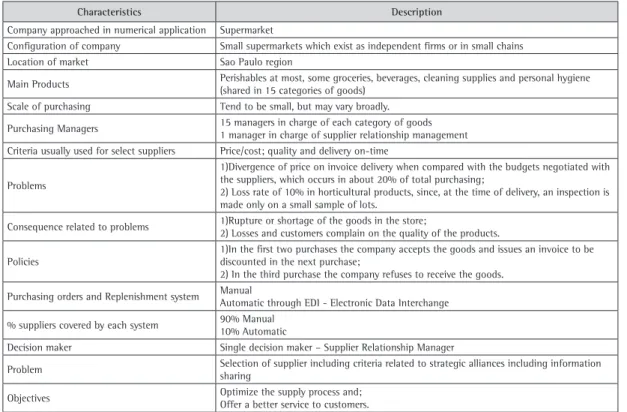
Assume that the company operates in the supermarket sector, and provides its customers with products such as commodities. The main characteristics and description of the problem context is presented in Table 2.
Combinations with methods ELECTRE III/IV has been proposed, some of them can be highlighted:
Freitas & Costa (1998) proposed a combination
of ELECTRE III with tools supported in quality methodologies and with statistical methods. Almeida (2007) developed the association of ELECTRE with MAUT. Alencar et al. (2010) proposed a multicriteria
group decision model using ELECTRE. Wang &
Triantaphyllou (2008) analyzed the rank reversal
problems in ELECTRE II and ELECTRE III. Hora &
Costa (2009) developed an experiment with ELECTRE III/IV and found that the ELECTRE IV shown more stable than ELECTRE III.
4. Framework proposed to manage
suppliers in strategic alliances
This framework is proposed to manage suppliers in strategic alliances, using a multicriteria method (ELECTRE III) to rank suppliers. It is distinguished by inserting in this context, specific criteria related to strategic alliances called soft factors. The use of MCDA approach enables this type of analysis to be made in a structured and systematic way, which facilitates the decision making process.
The ELECTRE III method was chosen for this application, considering the main characteristics of the decision problem. Thus, the following characteristics of
Table 2. Characteristics and description of the problem.
Characteristics Description
Company approached in numerical application Supermarket
Configuration of company Small supermarkets which exist as independent firms or in small chains Location of market Sao Paulo region
Main Products Perishables at most, some groceries, beverages, cleaning supplies and personal hygiene (shared in 15 categories of goods)
Scale of purchasing Tend to be small, but may vary broadly.
Purchasing Managers 15 managers in charge of each category of goods 1 manager in charge of supplier relationship management Criteria usually used for select suppliers Price/cost; quality and delivery on-time
Problems
1)Divergence of price on invoice delivery when compared with the budgets negotiated with the suppliers, which occurs in about 20% of total purchasing;
2) Loss rate of 10% in horticultural products, since, at the time of delivery, an inspection is made only on a small sample of lots.
Consequence related to problems 1)Rupture or shortage of the goods in the store;2) Losses and customers complain on the quality of the products.
Policies 1)In the first two purchases the company accepts the goods and issues an invoice to be discounted in the next purchase; 2) In the third purchase the company refuses to receive the goods.
Purchasing orders and Replenishment system ManualAutomatic through EDI - Electronic Data Interchange
% suppliers covered by each system 90% Manual10% Automatic
Decision maker Single decision maker – Supplier Relationship Manager
Problem Selection of supplier including criteria related to strategic alliances including information sharing
Objectives Optimize the supply process and;Offer a better service to customers.
article, this methodology involved: i) analyzing the context of the problem (Section 4.1); ii) structuring the decision problem and identifying preliminary means-ends objectives and fundamental hierarchy objectives (Section 4.2), and iii) defining the set of criteria to measure the objectives (Section 4.3).
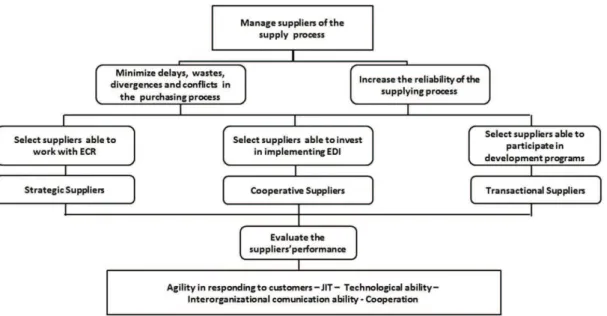
Therefore, the hierarchy of objectives of this decision context is shown in Figure 1.
Hence, as shown in Figure 1, the strategic objective at the top of the hierarchy is dedicated to managing suppliers; the fundamental objectives are: to minimize delays, wastes, divergences and conflicts with suppliers and, to increase the reliability of the supply process; the mean objective is: to select suppliers able to work with EDI technology and the ECR – Efficient Consumer Response system. In order to be aware to what extent suppliers are able to invest and implement EDI and ECR, it is necessary to evaluate the suppliers according to their performance under an appropriate set of criteria, which are related to the objectives set out in this numerical application. The appropriate set of criteria is described in the following section. It should be emphasized that the validation of these objectives and, consequently, the validation of the set of criteria, it was based on literature, considering the proposal of a generic framework that can be adapted by decision makers.
4.3.
The definition of a set of criteria
In the context of the numerical application, this paper proposes the following set of five criteria: Particularly in this case, given that most goods sold
are commodity-type products, the lack of availability of items pushes customers to the competition and whenever this problem persists, this leads the company to losing a portion of the consumer market. This assertion is supported by Araz et al. (2007) who pointed out that purchasing activities are an important part of the overall operation of a company. Therefore, the ability of any company to maintain quality and meet delivery requirements depends directly on the performance of its suppliers.
Moreover, this problem is characterized as a selection of supplier problem - SSP, which is increasingly seen as a strategic issue by companies. Note that the decision problem in this paper has a single DM, who is the supplier relationship manager, and it is clear that the company needs a model to evaluate and select suppliers that includes additional criteria and not just those of price, quality and delivery on-time, in order to optimize the supply process and offer a better service to its customers.
4.2.
Structuring the decision problem and
defining the objectives
The structuring of a problem and its goals in a hierarchy helps to understand the context of the decision and to define the set of objectives and criteria, in addition to providing the basis for using quantitative modeling (Keeney, 1992). The strategy of value focused thinking (VFT) which Keeney (1992) put forward, addresses how values can be used to improve the decision making process. In the present
Framework to manage suppliers … with a multicriteria method. Production, v. 25, n. 3, p. 713-724, jul./set. 2015 719 Guarnieri, P. et al.
price, delivery and quality remain in the suppliers’ base. These suppliers are considered in this step. In order to define their suitability, it is necessary to evaluate their performance in accordance with the set of criteria, defined previously in Section 4.3. Given that most criteria, in this particular paper, are qualitative in nature, scales of assessment of Likert type were constructed.
The scales used in this paper were constructed in five levels and are based on the description of defined criteria, the values of which range from 1 to 5. Keeney (1992) emphasized that the criteria should be measurable, operational, and understandable. In order to meet these properties, the scales were constructed to enable the differentiation of each level with regard to the consequences of the decision problem.
First of all, weights for the criteria were defined. Secondly the suppliers were evaluated based on the criteria. Thus, it was possible to construct a matrix of payoffs. In this matrix it is possible to visualize the performance of each alternative regarding each criterion. To illustrate the application method, this paper assumes there are six suppliers and five criteria, which are codified as follows: C1 - Agility in responding to customers; C2- JIT capability; C3 - Technological capacity; C4 - Interorganizational communication ability, and C5 – Cooperation. The performances of suppliers are shown in Table 3.
In this case, the performance of the alternatives vs. criteria has been uniformly distributed and rounded in order to discretize the decision problem. It is important to point out that due to this being a numerical application, the weights were based on those in the literature and the performance of the suppliers was generated randomly using Excel, which uses a uniform distribution. After the performance of each supplier was generated, based on the defined set of criteria, the method proceeded to ranking the suppliers. However, before proceeding with this step, the preference and indifference thresholds are established.
Agility in responding to customers: Responding quickly buyer’s demands/requests. This criterion may be measured by analyzing the order cycle time in days, the percentage of deliveries within the period specified by the customer, the rate of adherence to the schedule of delivery, among others (Vieira et al., 2009).
JIT capability: The equipment and structure of the supplier company should be used according to the buyer’s needs. Production or delivery is pulled by demand. The stocks of raw materials are minimal and sufficient for a few hours of production. Suppliers must be trained, qualified and connected so as to be able to make deliveries of small lots at the frequency desired. This criterion is measured by the number of JIT tools implemented (Vieira et al., 2009).
Technological capability: Use of appropriate technology to ensure the availability of the product/ service to customers. The existence of computerized systems for data exchange and automatic purchasing orders such as EDI; appropriate technology to ensure the visibility of information such as ERP (Enterprise Resource Planning) and SCM software (Ellram, 1990;
Yang et al., 2008; Vieira et al., 2009; Razmi & Rafiei,
2010; Feng et al., 2010).
Interorganizational communication ability: The practice of maintaining open communication and frequent contact with the buyer on routine matters or about technical and organizational changes in the supplier company. It also covers the credibility of information, conducting periodic meetings, technical visits, personal contacts, e-mail, press, releases, and so on. This criterion can be measured by the percentage of accuracy and credibility of information throughout the period of the relationship period; the means of communicating changes in decisions and policies; the periodicity of holding meetings with teams dedicated to commercial and logistics processes (Ellram, 1990; Vieira et al., 2009).
Cooperation: Organizational links between supplier and buyer. Value of involvement that can motivate the supplier to expend considerable efforts on behalf of the buyer company. This criterion is affected by the nature of the linkage between partners and measures the availability of dedicated teams in the logistics; commercial; production and quality areas; % of savings achieved; % of reduction in waste generation and rework; % of improvements in cycle time of delivery
and/or productivity (Bozarth & Handfield, 2008;
Ting & Cho, 2008; Vieira et al., 2009).
4.4.
Defining suitable suppliers
Assume that the company constantly evaluates its suppliers, as a result of which, only those able to attain minimal requirements in criteria such as
Table 3. Matrix of performance Supplier vs. Criteria.
Alternatives Criteria
C1 C2 C3 C4 C5
Weights 0.20 0.20 0.15 0.20 0.25
Supplier A - SA 5 4 4 5 3
Supplier B - SB 3 2 1 2 2
Supplier C - SC 3 1 3 2 1
Supplier D - SD 5 5 4 4 5
Supplier E - SE 4 2 2 4 3
that the alternatives with the best performances are respectively: SA/SD – SF – SE – SC – SB. The Credibility Matrix is also shown in Table 6 to facilitate the comparison of the data; it presented the same indexes because the veto threshold was not used in this specific situation. After analyzing these results, Table 7 gives the preference relations.
Based on the results presented in Table 7, regarding the preference relations generated after the pairwise comparison of the alternatives, it is seen that:
1) Supplier A is preferred (P) to suppliers B, C, E and F and indifferent (I) to supplier D;
2) Similarly, supplier D is preferred (P) to suppliers B, C, E, F and indifferent (I) to A;
3) Supplier F is preferred (P) to suppliers B, C and E and at least as good as (P-) suppliers A and D; 4) Supplier E is preferred (P) to suppliers B, C and at
least as good as (P-) suppliers A, D and F; 5) Supplier C is preferred (P) to supplier B and at least
as good as (P-) suppliers A, D, E and F;
6) Supplier B is at least as good as (P-) suppliers A, C, D, E, F.
By using the analysis of this matrix, the following preference relations are found in accordance with the DM’s judgments: Strong Preference (P); Weak Preference (P-) and Indifference (I). The relation of Incomparability (R), in this case was not found. Therefore, the alternatives that presented most relations
4.5.
Application of the ELECTRE III method
Based on data presented in Table 1, ELECTRE III-IV software, developed by the Lamsade - Université Paris Dauphine could be used. First of all, in order to carry out the processes of descending and ascending distillation, the two thresholds of indifference and preference deemed alpha and beta were defined. Initially, the thresholds for all criteria were set as
being α=0.15 and β=0.30. Also, it was chosen not
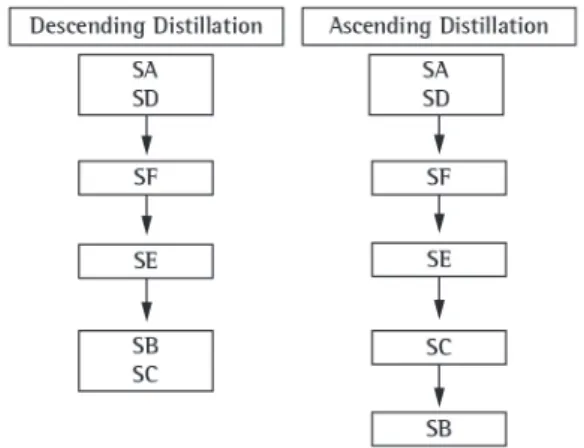
to consider the veto thresholds due to the suppliers having already gone through a prior selection process based on the criteria of price, quality and delivery. After the software was used to make the calculations, the median and final pre-orders were obtained, which enabled the suppliers to be ranked. In some cases, the DM may consider that there is no threshold of indifference and preference (q and p = 0), this is more common when the criteria have a qualitative assessment of the potential action. Any variation of the thresholds can change the ranking order. These results are presented in Figure 2 and Table 4, respectively.
According to the results presented in Figure 2, the distillation processes are convergent except by the alternatives SB and SC, which in the descending distillation were together at the fourth level, whereas in the ascending distillation SC was at the fourth level and in SB at the fifth level. This situation indicates that the model detected a very small difference in the performance of the two suppliers. If divergences between the distillations are found, the DM can examine and analyze these alternatives more closely due to their special sensitivity, regarding non-comparability. Thus, the DM can decide to investigate this situation or review some parameters to gain more confidence in the results found. This is a particular situation found for this kind of DM’s preference structure, in which an incomparability relation among consequences should be considered.
Table 4 shows the ranking results according to the median and final pre-orders.
Also, it can be seen from Table 4, that both pre-orders: the median and final ones generated the same ranking of the alternatives, which prove that the model’s parameters do not need to be revised and that it was able to compare the alternatives. The Concordance and Credibility indexes were also generated and are given in Table 5.
The alternatives were compared pairwise, by analyzing the statement aSb. Thus, the Concordance Matrix shown in Table 5 was obtained. The results can be detailed as per in Table 6.
Therefore, the Concordance Matrix proves the ranking provided by distillation processes (Figure 2) and median and final pre-orders (Table 4) and shows
Figure 2. Distillation processes.
Table 4. Ranking of alternatives.
Rank Median pre-order Final pre-order
1º SA - SD SA - SD
2º SF SF
3º SE SE
4º SC SC
Framework to manage suppliers … with a multicriteria method. Production, v. 25, n. 3, p. 713-724, jul./set. 2015 721 Guarnieri, P. et al.
Initially the thresholds of indifference and preference
were set at α=0.15 and β=0.30. Variations in them
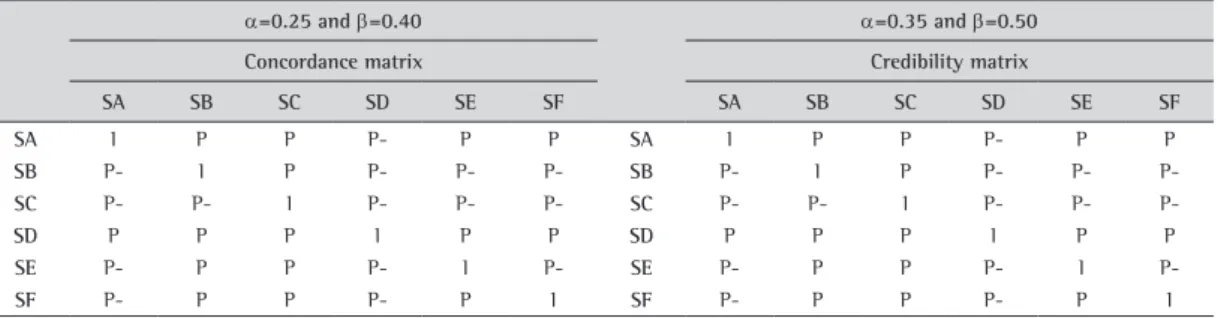
can demonstrate how the values provided by the DM are sensitive, which helps him/her to review some parameter if necessary or whether he/she is secure, before proceeding with the decision. Thus, in order to carry out a sensitivity analysis, the thresholds of indifference and preference for all criteria were re-set
to α=0.25 and β=0.40 and, α=0.35 and β=0.50,
bearing in mind that the measurement scale is qualitative and the same for all criteria. The results can be visualized in Table 8.
Also, note from Table 8, that both pre-orders:
median and final, with respectively α=0.25 and
β=0.40 and, α=0.35 and β=0.50 generated the same
ranking. However, when compared with the values of
the thresholds first set, namely α=0.15 and β=0.30,
there was an inversion between SB and SC, and a ranking with six positions was generated, in which the alternative SD is ranked in first position and
Table 5. Matrices of Concordance and Credibility indexes.
Concordance matrix Credibility matrix
SA SB SC SD SE SF SA SB SC SD SE SF
SA 1.00 1.00 1.00 0.67 1.00 0.86 SA 1.00 1.00 1.00 0.67 1.00 0.86
SB 0.00 1.00 0.81 0.00 0.19 0.00 SB 0.00 1.00 0.81 0.00 0.19 0.00
SC 0.00 0.67 1.00 0.00 0.19 0.19 SC 0.00 0.67 1.00 0.00 0.19 0.19
SD 0.76 1.00 1.00 1.00 1.00 1.00 SD 0.76 1.00 1.00 1.00 1.00 1.00
SE 0.14 1.00 0.81 0.24 1.00 0.24 SE 0.14 1.00 0.81 0.24 1.00 0.24
SF 0.57 1.00 1.00 0.24 0.76 1.00 SF 0.57 1.00 1.00 0.24 0.76 1.00
Table 6. Description of the results with credibility index.
Alternative Relation Alternative Credibility
Index
SA At least almost as good as
SB 100%
SC 100%
SD 67%
SE 100%
SF 86%
SB
Worse than SA 100%
SD 100%
At least almost as good as
SC 81%
SE 100%
SF 86%
SC
Worse than SA 100%
SD 100%
At least almost as good as
SB 67%
SE 19%
SF 19%
SD At least almost as good as
SA 76%
SB 100%
SC 100%
SE 100%
SF 24%
SE At least almost as good as
SA 14%
SB 100%
SC 81%
SD 24%
SF 24%
SF At least almost as good as
SA 57%
SB 100%
SC 100%
SD 24%
SE 76%
of strong preference (A, D) were ranked as the best alternatives i.e. ranked as the first; the alternatives F, E had an intermediary performance and were ranked as second and third respectively; alternatives C and B, had the worst performance appearing in the last position of the ranking.
4.6.
Sensitivity analysis
If necessary, the parameters of the model can be reviewed by means of a sensitivity analysis, for example by varying the parameters alpha and beta.
Table 7. Preference relations Matrix.
Preference relations matrix
SA SB SC SD SE SF
SA I P P I P P
SB P- I P- P- P-
P-SC P- P I P- P-
P-SD I P P I P P
SE P- P P P- I
P-SF P- P P P- P I
Table 8. Ranking of alternatives after varied α=0.25 and β=0.40
and α=0.35 and β=0.50.
Rank
α=0.25 and β=0.40 α=0.35 and β=0.50
Median Pre-order
Final Pre-order
Median Pre-order
Final Pre-order
no interaction with the DM and, due to scale of assessment of alternatives under a set of criteria is not validated by means of a methodological procedure, considering that it is not the main objective of this article. On the other hand, the numerical application does not downgrade the proposal, considering that it provides a more generic view of the segment approached, which can be used as base by managers in order to make decision in this context. Furthermore, it can motivate the researchers of supplier selection; to incorporate to traditional criteria those called soft factors.
For further researches it is suggested to analyze the interaction between criteria chosen for the framework based on study of Figueira et al. (2009). Besides that, studies considering the rank reversal problems could be developed as per demonstrated
by Wang & Triantaphyllou (2008) and Hora & Costa
(2009). Studies with the objective of validate scales of assessment of alternatives under the set of criteria composed by soft factors are also needed. Also, it is suggested more studies related to supermarket segment, including real life applications applying the systematic framework proposed in this article.
Furthermore, it is suggested the development of studies similar to those developed by Vieira et al. (2009), including MCDA methods. Also, studies approaching the differences among small, medium and large supermarkets related to purchasing and supplier selection strategies, similar to Mainville et al. (2008), including multicriteria perspective.
Nevertheless it is important to emphasize that for each case, specific indicators should be chosen that correctly represent the goals to be achieved in the decision making process. There are many contexts of supplier selection problem and also, many types of strategic alliances with suppliers (co-development; co-design; co-production; resources sharing; technology transference; information sharing; knowledge sharing, among others); for this reason it is important to adapt the set of criteria covering the particularities of the problem.
alternative SA in second. As stated, in qualitative judgments, varying alpha and beta can change the rankings. The preference relations were altered as a result of the variation of parameters, according Table 9.
As can be seen from Table 9, the preference
relations with the parameters α=0.25 and β=0.40
and, α=0.35 and β=0.50, are the same. Nevertheless,
comparing these results with the first preference relations in Table 4, the parameters of which were
set at α=0.15 and β=0.30, the alternatives SA, SD, SB
presented some divergences. This fact denotes that these alternatives are very sensitive and demands closer examination by the DM so that he/she becomes more confident in the results. The DM should analyze the reasons for the non-comparability of these alternatives and, if possible, obtain more information about this before deciding if the ranking is appropriate.
5. Concluding remarks
The main contribution of the model proposed is to improve the process for selecting suppliers for strategic alliances by taking multiple criteria called ‘soft factors’ into account and evaluating them using a MCDA approach through a systematic procedure. Based on the results presented previously, it is noted that by applying an MCDA method, DMs had the means by which to structure the problem of evaluating and selecting suppliers as partners in strategic alliances in a formal way. This significantly reduces the subjectivity and risk of the decision making process.
Thus, evaluating and selecting the most appropriate suppliers for alliances, for which there should be suitable and balanced performance indicators, is essential in the present business environment. In addition, by continuously evaluating the performance of its partners, the company can provide them with feedback and propose improvements in deficient processes, with a view to achieving greater adherence to the company’s policies.
The limitations of this study are related to it does not present a real life application, consequently, with
Table 9. Matrices of Preference relations with α=0.25 and β=0.40, and α=0.35 and β=0.50.
α=0.25 and β=0.40 α=0.35 and β=0.50
Concordance matrix Credibility matrix
SA SB SC SD SE SF SA SB SC SD SE SF
SA I P P P- P P SA I P P P- P P
SB P- I P P- P- P- SB P- I P P- P-
P-SC P- P- I P- P- P- SC P- P- I P- P-
P-SD P P P I P P SD P P P I P P
SE P- P P P- I P- SE P- P P P- I
Framework to manage suppliers … with a multicriteria method. Production, v. 25, n. 3, p. 713-724, jul./set. 2015 723 Guarnieri, P. et al.
Dias, L. C., & Clìmaco, J. N. (2000). Additive aggregation with variable interdependent parameters: the VIP analysis software. Journal of the Operational Research Society, 51(9), 1070-1082.
Dickson, G. W. (1966). An analysis of vendor selection systems and decisions. Journal of Purchasing, 2(1), 5-17. Dyer, J., Cho, D., & Chu, W. (1998). Strategic supplier
segmentation: the next ‘best practice’ in supply chain management. California Management Review, 40(2), 57-77. http://dx.doi.org/10.2307/41165933
Edwards, W., & Barron, F. H. (1994). SMARTS and SMARTER: Improved simple methods for multiattribute utility measurements. Organizational Behavior and Human Decision Processes, 60, 306-325. http://dx.doi. org/10.1006/obhd.1994.1087
Ellram, L. M. (1990). The supplier selection decision in strategic alliances. Journal of Purchasing and Materials Management, Fall, 8-14.
Ellram, L. M. (1995). Total cost of ownership: An analysis approach for purchasing. International Journal of Physical Distribution & Logistics Management, 25, 4-23. http://dx.doi.org/10.1108/09600039510099928 Elmuti, D., & Kathawala, Y. (2001). An overview of strategic
alliances. Management Decision, 39(3), 205-217. http:// dx.doi.org/10.1108/EUM0000000005452
Ensslin, L., Ensslin, S. R., Rocha, S., Marafon, A. D., &
Medaglia, T. A. (2013). Modelo multicritério de apoio à decisão construtivista no processo de avaliação de fornecedores. Produção, 23(2), 402-421. http://dx.doi. org/10.1590/S0103-65132012005000065
Feng, B., Fan, Z. P., & Ma, J. (2010). A method for partner selection of codevelopment alliances using individual and collaborative utilities. International Journal of Production Economics, 124, 159-170. http://dx.doi. org/10.1016/j.ijpe.2009.10.019
Figueira, J. R., Greco, S., & Roy, B. (2009). ELECTRE methods with interaction between criteria: An extension of the concordance index. European Journal of Operational Research, 199(2), 478-495. http://dx.doi.org/10.1016/j. ejor.2008.11.025
Figueira, J., Mousseau, V., & Roy, B. (2005). ELECTRE methods. In J. Figueira, S. Greco & M. Ehrgott (Eds.), Multiple Criteria Decision Analysis: State of the Art Surveys (pp. 133-162). London: Springer Verlag. Freitas, A. L. P., & Costa, H. G. (1998). Avaliação e classificação
da qualidade de serviços utilizando uma abordagem multicritério. Gestão e Produção, 5(3), 272-283. http:// dx.doi.org/10.1590/S0104-530X1998000300008 Ha, S. H., & Krishnan, R. (2008). A hybrid approach to supplier
selection for the maintenance of a competitive supply chain. Expert Systems with Applications, 34(2), 1303-1311. http://dx.doi.org/10.1016/j.eswa.2006.12.008 Ho, W, Xu, X., & Dey, P. K. (2010). Multi-criteria decision
making approaches for supplier evaluation and selection: A literature review. European Journal of Operational Research, 202(1), 16-24. http://dx.doi.org/10.1016/j. ejor.2009.05.009
Hora, H. R. M., & Costa, H. G. (2009). O problema da inversao de ordem em métodos multicritério: um experimento com o ELECTRE III/IV. In Anais do XLI Simpósio Brasileiro de Pesquisa Operacional, Porto Seguro.
Hugonnard, J., & Roy, B. (1984). Ranking of suburban line extension projects for the Paris metro system by References
Alencar, L. H., & Almeida, A. T. (2008). Multicriteria decision group model for the selection of suppliers. Pesquisa Operacional, 28, 321-337. http://dx.doi.org/10.1590/ S0101-74382008000200009
Alencar, L. H., Almeida, A. T., & Morais, D. C. A. (2010). Multicriteria group decision model aggregating the preferences of decision-makers based on ELECTRE methods. Pesquisa Operacional, 30, 687-702. http:// dx.doi.org/10.1590/S0101-74382010000300010 Alencar, L. H., Almeida, A. T., & Mota, C. M. M. (2007).
Sistemática proposta para seleção de fornecedores em gestão de projetos. Gestão e Produção, 14(3), 477-487. http://dx.doi.org/10.1590/S0104-530X2007000300005 Almeida, A. T. (2013). Processo de decisão nas organizações:
construindo modelos de decisão multicritério. São Paulo: Atlas.
Almeida, A. T. (2007). Multicriteria decision model for outsourcing contracts selection based on utility function and ELECTRE method. Computers & Operations Research, 34, 3569-3574. http://dx.doi.org/10.1016/j. cor.2006.01.003
Araz, C. Ozfirat, P. M., & Ozkarahan, I. (2007). An integrated multicriteria decision-making methodology for outsourcing management. Computers &
Operations Research, 34(12), 3738-3756. http://dx.doi. org/10.1016/j.cor.2006.01.014
Bandeira, R. A. M., Mello, L. C. B. B., & Maçada, A. C. G. (2009). Relacionamento interorganizacional na cadeia de suprimentos: um estudo de caso na indústria da construção civil. Produção, 19(2), 376-387. http:// dx.doi.org/10.1590/S0103-65132009000200012 Boran, F. E., Genç, S., Kurt, M., & Akay, D. (2009). A
multi-criteria intuitionistic fuzzy group decision making for supplier selection with TOPSIS method. Expert Systems with Applications, 36(8), 11363-11368. http://dx.doi. org/10.1016/j.eswa.2009.03.039
Bozarth, C. C., & Handfield, R. B. (2008). Introduction to operations and supply chain management. New Jersey: Pearson Education Inc.
Brans, J. P., & Mareschal, B. (2005). PROMETHEE Methods. In J. Figueira, S. Greco & M. Ehrgott (Eds.), Multiple Criteria Decision Analysis: State of the Art Surveys (pp. 163-196). London: Springer Verlag.
Cao, M., & Zhang, Q. (2010). Supply chain collaborative advantage: A firm’s perspective. International Journal of Production Economics, 128(1), 358-367. http://dx.doi. org/10.1016/j.ijpe.2010.07.037
Chou, S. Y., & Chang, Y. H. (2008). A decision support system for supplier selection based on a strategy-aligned fuzzy SMART approach. Expert Systems with Applications, 34, 2241-2253. http://dx.doi.org/10.1016/j. eswa.2007.03.001
Choy, K. L., Lee, W. B., & Lo, V. (2003). Design of an intelligent supplier relationship management system: A hybrid case based neural network approach. Expert Systems with Applications, 24, 225-237. http://dx.doi.org/10.1016/ S0957-4174(02)00151-3
Razmi, J., Songhori, M. J., & Khakbaz, M. H. (2009). An integrated fuzzy group decision making/fuzzy linear programming (FGDMLP) framework for supplier evaluation and order allocation. International Journal of Advanced Manufacturing Technology, 43, 590-607. http://dx.doi.org/10.1007/s00170-008-1719-7
Roy, B., & Vanderpooten, D. (1997). The European school of MCDA: Emergence, basic features and current works. Journal of Multi-Criteria Decision Analysis, 5(1), 22-38. http://dx.doi.org/10.1002/(SICI)1099-1360(199603)5:1<22::AID-MCDA93>3.0.CO;2-F Ting, S. C., & Cho, D. I. (2008). An integrated approach for
supplier selection and purchasing decisions. Supply Chain Management: An International Journal, 13(2), 116-127. http://dx.doi.org/10.1108/13598540810860958
Tjemkes, B., & Furrer, O. (2010). The antecedents of response strategies in strategic alliances. Management Decision, 48(7), 1103-1133. http://dx.doi. org/10.1108/00251741011068806
Viana, J. C., & Alencar, L. H. (2012). Metodologias para seleção de fornecedores: uma revisão da literatura. Produção, 22(4), 625-636. http://dx.doi.org/10.1590/ S0103-65132012005000067
Vieira, J, Yoshizahi, H., & Ho, L. (2009). Collaboration intensity in the Brazilian supermarket retail chain. Supply Chain Management: An International Journal, 14(1), 11-21. http://dx.doi.org/10.1108/13598540910927269 Wang, W. P. (2010). A fuzzy linguistic computing
approach to supplier evaluation. Applied Mathematical Modeling, 34(10), 3130-3141. http://dx.doi. org/10.1016/j.apm.2010.02.002
Wang, X., & Triantaphyllou, E. (2008). Ranking irregularities when evaluating alternatives by using some ELECTRE methods. Omega, 36, 45-63. http://dx.doi.org/10.1016/j. omega.2005.12.003
Wong, A., Tjosvold, D., & Zhang, P. (2005). Developing relationships in strategic alliances: Commitment to quality and cooperative interdependence. Industrial Marketing Management, 34(7), 722-731. http://dx.doi. org/10.1016/j.indmarman.2004.12.007
Yang, J. L., Chiu, H. N., Tzeng, G. H., & Yeh, R. H. (2008). Vendor selection by integrated fuzzy MCDM techniques with independent and interdependent relationships. Information Sciences, 178(21), 4166-4183. http://dx.doi. org/10.1016/j.ins.2008.06.003
multicriteria method. Transportation Research, 16, 301-312.
Jacquet-Lagreze, E., & Siskos, J. (1982). Assessing a Set of Additive Utility Functions for Multicriteria Decision Making: The UTA Method. European Journal of Operational Research, 10(2), 151-164. http://dx.doi. org/10.1016/0377-2217(82)90155-2
Kannan, V. R., & Tan, K. C. (2004). Supplier alliances: differences in attitudes to supplier and quality management of adopters and non-adopters. International Journal of Supply Chain Management, 9(4), 279-286. http://dx.doi.org/10.1108/13598540410550028 Keeney, R. L. (1992). Value-focused thinking: a path to
creative decision making. Cambridge: Harvard College. Ku, C. Y., Chang, C. T., & Ho, H. P. (2010). Global
supplier selection using fuzzy analytic hierarchy process and fuzzy goal programming. Qualitative and Quantitative, 44, 623-640. http://dx.doi.org/10.1007/ s11135-009-9223-1
Liao, C. N., & Kao, H. P. (2010). Supplier selection model using Taguchi loss function, Analytical hierarchy process and Multi-choice goal programming. Computers &
Industrial Engineering, 58, 571-577. http://dx.doi. org/10.1016/j.cie.2009.12.004
Mainville, D., Reardon, T., & Farina, E. M. M. Q. (2008). Scale, scope, and specialization effects on retailers procurement strategies: evidence from the fresh produce markets of São Paulo. Revista de Economia e Sociologia Rural, 46(1), 207-227. http://dx.doi.org/10.1590/S0103-20032008000100009
Mentzer, J., Dewitt, W., & Keebler, J. (2001). Defining supply chain management. Journal of Business Logistics, 22(2), 1-25. http://dx.doi. org/10.1002/j.2158-1592.2001.tb00001.x
Pi, W. N., & Low, C. (2006). Supplier evaluation and selection via Taguchi loss functions and an AHP. International Journal Advanced Manufacturing Technology, 27(5-6), 625-630. http://dx.doi.org/10.1007/s00170-004-2227-z