Winners and Losers: social modulation of
behaviour in zebrafish (Danio rerio)
Joana Teixeira Ferreira da Silva
Dissertation Advisor:
Professor Doutor Rui Oliveira
Coordinator of the dissertation seminar:
Professor Doutor Rui Oliveira
Thesis submitted as partial requirement for obtaining the degree of:
Master in Psicobiology
Winners and Losers: social modulation of
behaviour in zebrafish (Danio rerio)
Joana Teixeira Ferreira da Silva
Master Thesis performed under the guidance of Professor Doutor Rui Oliveira,
submitted to the Instituto Superior de Psicologia Aplicada to obtain Master's
degree in the specialty of psychobiology as the order of the DGES, No. 6037 /
2007 published in Gazette of the Republic 2nd series of 23 March, 2007.
With colaboration of:
Instituto Gulbenkian de Ciência (IGC)
AGRADECIMENTOS
Estou profundamente agradecida ao Professor Doutor Rui Oliveira, pela orientação que sempre me dedicou durante este ano, por toda a informação e conhecimento que me transmitiu, e pela possibilidade que me deu de fazer parte não só deste projecto como também desta equipa fantástica, da qual, não tenho dúvidas vou sentir muita falta.
Quero agradecer ao David Gonçalves pela dedicação, paciência e carinho que me dedicou durante a orientação na fase final deste projecto, bem como pela preciosa colaboração na análise estatística. Ao Miguel Simões que mais do que um óptimo c demonstrou uma desmesurada amizade, com uma carinhosa e paciente devoção durante todo o meu trabalho. Ao grupo daUnidade de Investigação em Eco-Etologia do ISPA que sempre foram muito amáveis e prestativos. Ao Paulo Raimundo pela sua indispensável ajuda na manutenção dos peixes. Ao IGC por disponibilizar os seus laboratórios para que este projecto se pudesse concretizar. E por fim aos meus queridos “companheiros de trabalho” os pequenos Zebrafish.
SUMÁRIO
Na natureza os animais lutam para adquirir ou defender recursos vitais tais como alimento, abrigo ou a escolha de parceiros. O comportamento agressivo, intrínseco a um indivíduo e presente em todo o reino animal, é uma resposta ao stress social que pode ser quantificável.
Em confrontos agonísticos entre dois indivíduos, o comportamento pode ser caracterizado por uma série de acções específicas, geralmente dependentes do comportamento do oponente. Vários estudos demonstram que o comportamento agonístico é influenciado por experiências anteriores que se reflectem nos resultados de interacções seguintes. Um vencedor resultante do primeiro encontro tem maior probabilidade de ganhar um segundo encontro, enquanto que um derrotado num primeiro encontro tem uma probabilidade elevada de perder nos encontros seguintes.
O peixe Zebra (Danio rerio) é um modelo extremamente usado em estudos de genética, biologia do desenvolvimento, neurofisiologia e biomedicina. Este animal exibe padrões distintos de comportamento agressivo e estabelece hierarquias de dominância-subordinação. O objectivo deste trabalho consistiu em reconhecer os comportamentos desta espécie social durante encontros agonísticos. Para tal, os comportamentos de dominância–subordinação entre díades de machos foram caracterizados. Foi também avaliada a influência de encontros anteriores no comportamento dos machos em encontros agonísticos posteriores. Os resultados obtidos demonstram que a probabilidade de um derrotado perder um combate é mais elevada do que a probablidade de um vencedor ganhar um encontro posterior. Nós mostramos pela primeira vez que um único encontro social é suficiente para induzir mudanças comportamentais mais duradouras em perdedores e mais transitórias em vencedores desta espécie.
Palavras-chave: Comportamento agressivo; Zebrafish; Efeitos de vencedor e
ABSTRACT
In nature animals fight to acquire or defend vital resources such as food, shelter or access to mates. Aggressive behaviour is a quantifiable response to social stress, which is intrinsic to an individual and prevalent throughout the animal kingdom. In dyadic agonistic encounters, behaviour can be characterized by several specific behavioural patterns, usually dependent on the actions of the opponent. It was already shown that fighting behaviour is influenced by prior experiences, which is reflected in the outcome in later contests. The winner in a first combat is more likely to dominate during a second encounter, whereas a loser in a first contest has more probability to lose again in later contests.
Zebra-fish (Danio rerio) is a model system extensively used in genetic, developmental biology, neurophysiology and biomedicine studies. This fish exhibit distinct patterns of aggressive behaviour and establishes hierarchies of dominance-subordinance. The aim of this study was to identify behaviours of this social species during agonistic encounters. Subsequently we characterized this dominance-subordinance behavioural pattern between pairs of male zebrafish and analysed the influence of prior experiences in later agonistic encounters. Our results showed that the probability of a loser to lose an interaction is higher than the probability of a winner to win a subsequent fight which confirms that both winner and loser effects are present in zebrafish. We showed for the first time that one single social encounter is enough to induce long-lasting behavioural changes in losers and transient changes in winners of zebrafish males.
ÍNDEX
Bibliographic review 1-6
- Agressive Behaviour 1-3
- Winner and Loser Effects 3-5
- Physiological characteristics involved in aggressiveness 5-6
- Animal model system 6
- References 7-10
Article 11-38
- Abstract 11
1 -Introduction 12-14
2 - Materials and Methods 14-17
2.1 - Study animal and maintenance 14
2.2 - Experimental procedures 14
2.2.1 - Motivation to fight 14
2.2.2 - Detection of subordinance/dominance pattern and winner/loser effects 15
2.3- Behavioural analyses 15-16
2.4- Statistical analyses 16-17
3- Results 17-25
3.1 - Motivation to fight. 17
3.2- Time of fight decision 17 3.3- Time to first attack
3.4- Establishment of Dominance-subordinance behavioural pattern in aggressive encounters
18 19 -22
3.5- Detection of Winner / Loser effects 22-25 3.5.1. Influence of previous experience in the outcome of a second encounter 22-24
3.3.1. Influence of prior experiences in behaviours 24-25 4- Discussion 25-28 5- Acknowledgments 28 6- References 28-31
TABLES LIST
Table I: Ethogram that comprises agonistic behaviours recorded for male zebrafish
Table II (a): Observed frequencies of victories and defeats in a second encounter
considering the outcome of these individuals in a first contest.
Table II (b): Statistical analysis using ACTUS 2.
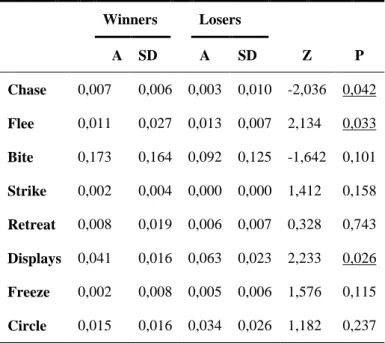
Table III: Descriptive averages of behaviour’s frequency and respective statistical test
value of differences between behaviours displayed by animals, in the second contests, that experience a prior victory or defeat.
Table IV: Descriptive averages of behaviour’s duration and respective statistical test value
of differences between behaviours displayed by animals, in the second contests, that experience a prior victory or defeat.
FIGURES LIST
Bibliographic Review
Figure I: An exemplar of study model: Zebrafish, Danio rerio.
Article
Figure I: Motivation to fight. All subjects were submitted to a mirror test before engage in agonistic
encounters with a conspecific. Latency to mirror’s first attack was recorded and compared with posterior decision fight result (Winners or Losers). P values were calculated based on n=12 Losers and n=11 Winners.
Figure II: comparison of time to fight decision between first encounters (TD WL) and duration to
fight resolution in second interactions (TD WN and TD WL). TD WN it’s mentioned to contests between the winner of the first encounter (W) with a naif male (N); and TD LN is relate to encounters between the loser of the first fight (L) with another naif (N). P values were calculated based in n=11.
Figure III: These results compare time to first attack in first encounters (WL) with the initiative to
start fight in second interactions (WN and LN). WN its mention to posterior contests between winners of the first encounter (W) with a naif male (N); and LN is relate to second encounters between losers in the first fight (L) with another naif (N). P values were calculated based in n=11.
Figure IV: Differences between the frequencies of occurrence of behaviours displayed by winners
and losers that are more present in each phase. Gray bar represent previous phase of all behaviours that are displayed by Winners-Losers; Black bar represent posterior phase of all behaviours that are
displayed by Winners-Losers. The line refers to behaviours that don’t show differences in the frequency of occurrence by winners and losers. Above the line are considered behaviours of dominance; below the line are considered behaviours of subordinance. In addition, the behaviours present above the line are more display in Winners; the behaviours present below the line are more exhibits in Losers. P values were calculated based in n=11.
Figure V: Differences between the duration of behaviours displayed by winners and losers that are
more present in each phase. Gray bar represent previous phase of all behaviours that are displayed by Winners-Losers; Black bar represent posterior phase of all behaviours that are displayed by Winners-Losers. The line refers to behaviours that don’t show differences in the frequency of occurrence by winners and losers. Above the line are considered behaviours of dominance; below the line are considered behaviours of subordinance. In addition, the behaviours present above the line are more display in Winners; the behaviours present below the line are more exhibits in Losers. P values were calculated based in n=11.
Figure VI: Differences between the duration and frequency of circle displayed by winners and
BIBLIOGRAPHIC REVIEW
Aggressive Behaviour
Classic ethological studies have focused on aggression because this is prevalent to animal kingdom (Larson et. al., 2006), common in invertebrate and vertebrate species (Miczek et. al. 2007), even in cooperative animal societies (Johnstone & Dugatkin, 2000). Aggressive behaviour is a quantifiable response to social stress witch is intrinsic to an individual (Earley et. al. 2000), represent a significant proportion of social interactions and frequently occur in a social environment (Huntingford & Turner, 1987). This behaviour is not a simple reflexive response to a stimulus but complex patterns of individual’s conduct (Larson et. al., 2006 and Spence et. al., 2008). As other behavioural category the expression, duration and moment of aggression are diverse between animals, but remain distinct and recognizable entities (Nilsen et. al., 2004).
Despite the fact that aggressive behaviour is large studied in scientific school, is etiology still remain understood. Multiple environmental and biological factors seem to be involved in this behaviour (Larson et. al., 2006) and some mechanisms that facilitate animal’s encounters are favour by selection (Rutte et al., 2006). Success in agonistic encounters depend on individual attributes as age, gender and previous history of the individual, as the context in witch the fight takes place, and both can influence the individual’s response to an agonistic encounter (Blanchard et.al, 2001 and Landau, 1951 a & b). Intrinsic factors are associated with physical and physiological performance, such as age, size and an animal’s fighting ability (resource holding power - RHP). In contrast extrinsic factors include social experience, usually referred as winner, loser and bystander effects (Landau, 1951 a & b; Dugatkin & Earley, 2004 and Parker, 1974).
Comparing Human’s agonistic behaviour with other species these actions are considered a trouble, other than in numerous species, aggression is used in order to compete for resources, such as food, mates, territories and social status, (Larson et. al., 2006 and Hsu et. al., 2006, b) that can result in wounding, exhaustion, and sometimes even death (Blanchard et.al, 2001). In animals the processes leading to victory or defeat appear to be considered to establish a dominance hierarchy (Bégin et. al., 1996 and Giaquinto & Volpato, 1997) and contest experience and its effects on subsequent contests show relevance to establish this pecking order (Hsu et. al., 2006 (b)). In addition to this dominance-subordinate pattern revealed by winners and losers of the contest, the outcome of an interaction includes other significant information as the costs that include time and
energy spent to reach that result and the possibility of being injured (Hsu et. al., 2006 (b); and Hurd, 1997). So, it’s important that during confronts animal’s chose what kind of behaviours is better to employ and when they need to give up the fight (Stuart-Fox, 2006). It is possible that opponents will differ in which behaviour they prefer to execute at some point of the contest (Enquiste et. al., 1990).
Animal contests often involve a series of complex behaviours. Posturing displays, stereotypical displays and aggressive actions are frequently used to appeal to agonistic intent in Vertebrates social conflicts (Miczek et al., 2002) and emerge to be more abundant at the earlier stages of the fight (Ros et. al., 2006). Ritualized sequences of visual, acoustic, and tactile signals are used by males during agonistic encounters. In fishes visual signals have been more documented but some studies make reference to colour changes (Peake & Mcgregor, 2004). These postures used in aggressive interactions, follow a complex temporal and sequential organization that can be similar to females and males, but in some cases some of these behaviours can be different between sexes (Nilsen et al., 2004 and Miczek, et. al. 2007). Males and females of many species engage in agonistic encounters (Briffa & Dallaway, 2007; Draud & Lynch 2002 and Nilsen et al., 2004), nonetheless, it’s more frequent to observe fights between members of the same sex. A lot of studies have reported agonistic encounters between males in many species (Andersson, 1994) and show that specific male characteristics as differences in their searching abilities (Wiklund & Fagerstrom, 1977; Carroll & Salamon, 1995 and Parker, 1974) can influence male competitive success.
During contest is possible to recognize different phases of aggressiveness and energetic costs that generally increased with fight development which are higher during escalation of encounter but diminish at the end of the fight (Ros et. al., 2006). Generally the first actions in a contest are low-cost displays that allow individuals to get some opponent’s size information (Enquist & Jakobsson, 1986). Animal size itself is one of the most important factors in determining outcomes of fights between fishes of many species (Huntingford & Turner, 1987 & Beauregard et. al., 1996). In spite of fights expected to be won by the larger/stronger animal when opponents are similar in fighting ability; this characteristic does not always demonstrate animal’s physical condition (Seebacher & Wilson, 2006 and Enquist, 1983). Sometimes the weaker animal can win the contest (Enquiste et. al., 1990). For that reasons, in matched individuals contests, the animals should estimate other attributes of their competitor. In this type of interaction opponents need obtain more information, and as a consequence they display more frequent aggressive acts to assess each
other (Beaugrand & Goulet, 2000 and Enquiste et. al., 1990), and the contest emerge to be longer and more intense (Enquiste et. al., 1990 & Enquist, 1983). In contrast, encounters between males of very different sizes rarely progress more (Enquist & Jakobsson, 1986).
Information about outcome in past experiences can have an important impact, too, in species where fighting ability it’s not determinant in fight result’s (Jackson, 1991). Prior contests can estimate the benefits or costs for the contestants in engaging in agonistic encounters (Hsu et. al., 2006, b). Therefore, considering these ideas mentioned above, aggressive encounters can provide some potential resource benefits (as shelter, mates, food, etc.) to the animal that win the contest (Huntingford & Turner, 1987), contrarily to costs of outcome fight experienced by losers; and make available to an individual to estimate resource-holding potential of is opponent (Peake & Mcgregor, 2004). These experience effects influence also social behaviour of organisms (Hsu et. al., 2006, b).
Winner and Loser Effects
Winner and loser effects are well known among fishes and a few other animals, including some insects, mammals and birds (Landau, 1951 a & b; Rutte et al., 2006; Hsu et. al., 2006, a; Bégin et. al., 1996; Oliveira et. al., 2009; Hsu & Wolf, 2001 andChase et al., 1994).
In Dugatkin’s (Dugatkin, 1997, 1998) model, Winner and loser effects are usually defined as an increased probability of winning at time T+1 given a victory in a first encounter at time T, and an increased probability of losing at time T+1 given a loss in a first encounter respectively, even though, as in any system, is important to have in consideration that one effect can exist without the other, they are not mutually exclusive. For example, if one animal is more probably to defeat another animal it’s not necessary that this second individual is more likely to be defeat in a next encounter (Dugatkin, 1997).
Despite their ubiquity and prevalence in numerous animal taxa, the mechanisms underlying winner and loser effects are still poorly understood and are unknown whether these effects are adaptive (Rutte et al., 2006). Some investigators think that learning can be behind these outcomes, individuals receive some kind of positive or negative reinforcement in the first combat where they experience a winner or loser condition, which subsequently, appears to be involved in a second contest aggressiveness (Hsu et. al., 2006 (b)). Besides, these effects are important to hierarchy formation and result as an indicator to
self-assessment of an individual’s relative fighting ability (Rutte et al., 2006, Oliveira et. al., 2009 and Jackson, 1991).
Currently, most studies focus in understanding how experience can influence aggression (Hsu et. al., 2006 (b)), and for that, contests outcomes are being several documented as the features that can lead to these results. In experimental works, two general ways of acquire losers and winners are usually employed to evaluate the effects of prior experiences. In “social-cues” theory is previous decide which individual of the pair will become the dominant and which will become the subordinate. The second is the “self-assessment” hypothesis, where two opponents engage each other, and in the outcome of the combat one of theme will be the loser and the other the winner (Rutte et al., 2006 and Beaugrand, & Goulet, 2000). This last theory is more similar with what happens in natural contest (Bégin et. al., 1996) and for that is more regularly used in scientific experiments.
There are models in which animals have different characteristics but in some cases they are randomly select, before the contest they are in the some situation, so winning or losing may reflect individual differences. Therefore, must be considering the possibility of pre-existing differences between those two opponents (Blanchard et. al., 2001). Some intrinsic and individual factors can influence the contest outcome such as size and animal’s fight ability (Landau, 1951 a & b; Dugatkin & Earley, 2004 and Parker, 1974).
It’s probably that fight ability change over time, so, more recent experiences should be better to define the individual’s outcome in an aggressive contest (Hsu, Y. & Wolf, 1999 and Bakker et al. 1989) as winner/loser effects. Rather than the last experience, multiple prior contests can affect aggressive behaviour and the contest outcome (Hsu & Wolf, 2001). On the other hand, the actions of the opponent may mediate the contest result (Chase et al., 1994). So, with prior fighting experiences an animal acquire capacity to percept its own fighting ability and to assess the costs involve in future competitions (Hsu et. al., 2006 (a)). Some studies have demonstrated these ideas mentioned above revealing that a winner in a prior contest is more likely to dominate during a second encounter and a loser in a first combat have more probability to lose again in later contests (Landau, 1951 a & b; Rutte et al., 2006; Hsu et. al., 2006, a; Bégin et. al., 1996; Oliveira et. al., 2009; Hsu & Wolf, 2001 &Chase et al., 1994).
In fact these effects are certainly widespread in animals and they are extremely patent, but winning and losing experiences outcomes may have different extents, mostly related to how much an effect occurs and how long the effect lasts. In many species these effects tend to be asymmetrical with the loser effect more marked than the winner one (Hsu & Wolf,
2001). Eventless, the amount of dominance or subordination received by winners or losers, respectively, could diverge according to different encounters (Beaugrand, & Goulet, 2000) and some individual characteristics such as fighting ability, or hormonal level (Bégin et. al., 1996). In some studies, it was demonstrated that winner effect is less pronounced as loser and the first was usually short then the second (Bégin et. al., 1996; Oliveira et. al., 2009; Hsu & Wolf, 2001; Hsu et. al., 2006, a;Rutte et al., 2006; Bakker et al. 1989and Chase et al., 1994). Some possible explanations for this greater and longer-lasting loser effect are strategically, individuals with prior losing experience often voluntarily retreat from a subsequent contest without physically interacting with their naïve opponents to avoid more costs of time, energy and sometimes even injuries, which they have experience in previous contests (Neat et.al., 1998). In addition, this asymmetry can be explain by individual’s intrinsic factors, since when losers experience long fights they can have some physiological repercussions, and as a result, a loser effect long lasting than the winner one (Neat et.al., 1998).
Physiological characteristics involved in aggressiveness
Multiple environmental and biological factors seem to be involved in aggressive behaviour (Larson et. al., 2006) and some mechanisms that facilitate animal’s encounters are favour by selection (Rutte et al., 2006). There are some behavioural and neuroendocrine mechanisms that may occur at an early stage in vertebrate evolution that could be related to aggressiveness (Øverli et. al., 2004).
Social stress is common in almost all higher animal species that may produce qualitatively effects in animal’s behaviour and physiology patterns. Some studies demonstrate that animal models of social stress involve to conspecifics aggressive encounters (Blanchard et. al., 2001), and the consequences of that agonistic meet can be stressful for the individuals. Is expected that hypothalamic–pituitary–adrenal axis take part in this kind of performances (Huntingford, F. & Turner, A., 1987 and Earley et. al., 2006). In this manner hormone concentrations and neural pathways seems to represent an important role in this behaviour. Hormones levels can influence neural circuit that are related to information obtained in this kind of behaviours. On the other hand, changes in neural circuitry can influence neuroendocrine changes that are relevant to execute a response give by an animal in a contest (Beaugrand, & Goulet, 2000 and Hsu et. al., 2006 (b)). Those ideas mentioned above are supported by studies with cichlid fish that show
elevated levels of hormones in contests between members of their social group (Oliveira et. al., 2009). In this manner, neuroendocrinal factors appear to be involved in the translation of some behavioural responses (Beaugrand, & Goulet, 2000).
In addition, and to strengthen this mention there are physiological changes that mediate the effects of experience on behaviour that should apparently involve the neuroendocrine system. Winner/loser effects can be explained by individual’s intrinsic factors, for example some studies show that losers experience consequences of long fights as a superior respiratory rates during the period of contest, not experienced by winners.
Animal model system
The zebrafish, Danio rerio is one of the most important vertebrate model organisms in genetics, developmental biology, neurophysiology and biomedicine (Amsterdam & Hopkins, 2006; Grunwald & EIsen, 2002 and Rubinstein, 2003). The success of zebrafish as a study model system is related to their attributes that brings advantages comparing to other already established model systems. It’s small and robust; large numbers can be kept easily and cheaply in the laboratory. Development is rapid, have a short generation time (3-4 months) and breed in large numbers Zebrafish. Furthermore, fertilisation is external and optical transparency during early embryogenesis allowing for accessible manipulation (Kimmel et al., 1995and Lawrence, C., 2007).
In spite of this animal is well knowned in different areas of science, in ethology zebrafish have not been a widely studied animal (Gerlai et al., 2000), and for that reason, complex behaviours are recently investigated in this animal. Zebrafish is social specie which in both males and females it’s possible to observe aggressive behaviours. Although, in Larson et al. 2006, it was effectively demonstrated that zebrafish establish dominant– subordinate relationships and winner/loser effect.
REFERENCES
Amsterdam, A. & Hopkins, N., 2006. Mutagenesis strategies in zebrafish for identifying genes involved in development and disease. Trends in Genetics, 22, 9.
Andersson, M. 1994. Sexual Selection. Princeton, New Jersey: Princeton University Press.
Bakker, Th. C.M., Bruijn, E. & Sevenster, P., 1989. Asymmetrical effects of prior winning and losing on dominance in sticklebacks (Gasterosteus aculeatus). Ethology, 82, 224–229.
Beauregard, J., Payette, D. & Goulet, C., 1996 Conflict outcome in male green swordtail fish dyads (Xiphophorus helleri): interaction of body size, prior dominance/subordination experience, and prior residency. Behaviour, 133, 303–319
Beaugrand, J.P. & Goulet, C., 2000. Distinguishing kinds of prior dominance and subordination experiences in males of green swordtail fish (Xiphophorus helleri ). Behavioural Processes, 50, 131–142.
Bégin, J., Beaugrand, J.P. & Zayan, R., 1996. Selecting dominants and subordinates at conflict outcome can confound the effects of prior dominance or subordination experience. Behavioural Processes, 36, 219-226.
Blanchard, R.J., McKittrick, C.R. & Blanchard, D.C., 2001. Animal models of social stress: effects on behavior and brain neurochemical systems. Physiology Behaviour, 73, 261–271.
Briffa, M. & Dallaway, D., 2007. Inter-sexual contests in the hermit crab Pagurus
bernhardus: females fight harder but males win more encounters. Behavioral Ecology and
Sociobiology, 61, 1781-1787.
Carroll, S. P. & Salamon, M. H., 1995. Variation in sexual selection on male body size within and between populations of the soapberry bug. Animal Behaviour, 50, 1463–1474.
Chase, I., Bartolomeo, C. & Dugatkin, L. A., 1994. Aggressive interactions and inter-contest interval: how long do winners keep winning? Anim. Behav., 48, 393–400.
Draud, M. & Lynch, P. A. E., 2002. Asymmetric contests for breeding sites between monogamous pairs of convict cichlids (Archocentrus nigrofasciatum, cichlidae): Pair experience pays. Behaviour, 139, 861-873.
Dugatkin, L.A., 1997. Winner and loser effects and the structure of dominance hierarchies. Behavioral Ecology, (8) 6, 583-587.
Dugatkin, L.A., 1998. A model of coalition formation in animals. Proc. R. Soc. Lond. B, 265, 2121-2125.
Dugatkin, L.A. & Earley, R.L., 2004. Individual recognition, dominance hierarchies and winner and loser effects. Proc. R. Soc. B, 271, 1537–1540.
Earley, R.L., Hsu, Y & Wolf, L.L., 2000. The use of standard agression testing methods to predict combat behaviour and contest outcome in Rivulus marmoratus dyads. Ethology, 106, 743-761.
Earley, R.L., Edwards, J.T., Aseem, O., Felton, K., Blumer, L.S., Karom M. & Grober, M. S., 2006. Social interactions tune aggression and stress responsiveness in a territorial cichlid fish (Archocentrus nigrofasciatus). Physiology & Behavior, 88, 353–363.
Enquist, M., 1983. Evolution of Fighting Behaviour: Decision Rules and Assessment of Relative Strength, J. theor. Biol., 102, 387-410.
Enquist, M., & Jakobsson, S., 1986. Decision making and assessment in the fighting behaviour of Nannacara anomala (Cichlidae, Pisces). Ethology, 72, 143-153.
Enquist, M., Leimar, O., Ljungberg, T., Mallner, Y. & Segerdahl, N., 1990. A test of the sequential assessment game: fighting in the cichlid fish Nannacara anomala. Anim. Behav., 40, 1-14.
Gerlai, R., Lahav, M., Guo, S. & Rosenthal, A., 2000. Drinks like a fish: Zebra fish (Danio rerio) as a behavior genetic model to study alcohol effects. Pharmacol. Biochem. Behav. 67:773–782.
Giaquinto, PC & Volpato, GL., 1997. Chemical communication, aggression, and conspecific recognition in the fish Nile tilapia. Physiological Behavior, 62(6): 1333-8.
Grunwald D.J. & EIsen, J. S., 2002. Headwaters of the zebrafish - emergence of a new model vertebrate. Nature Reviews Genetics, 3, 717–724.
Huntingford, F., Turner, A., 1987. Animal Conflict. Chapman & Hall, London.
Hurd, P. L., 1997. Cooperative signalling between opponents in fish fights. Animal Behaviour, 54, 1309–1315.
Hsu, Y. & Wolf, L.L., 1999. The winner and loser effect: integrating multiple experiences. Animal Behaviour, 57, 903–910.
Hsu, Y. & Wolf, L.L., 2001. The winner and loser effect: what fighting behaviours are influenced? Animal Behaviour, 61, 777–786.
Hsu, Y., Earley, R.L. & Wolf, L.L., 2006, a. Modulation of aggressive behaviour by fighting experience: mechanisms and contest outcomes. Biology Rev., 81, 33-74.
Hsu, Y & Earley, R.L. & Wolf, L.L., 2006, b. Modulating Aggression Through Experience. Fish Cognition and Behaviour, Chapter 6, 96-118.
Jackson, W.M., 1991. Why do winners keep winning? Behav. Ecol. Sociobiol., 28, 271–276.
Johnstone, R.A. and Dugatkin, L.A., 2000. Coalition formation in animals and the nature f winner and loser effects. Proc. R. Soc. Lond., 267, 17-21.
Kimmel, C.B., Ballard, W.W., Kimmel, S.R., Ullmann, B. & Schilling, T.F., 1995. Stages of embryonic development of the zebrafish. Developmental Dynamics, 203, 253– 310.
Landau, H.G., 1951a. On dominance relations and the structure of animal societies. I. Effects of inherent characteristics. Bull. Math. Biophysics, 13, 1–19.
Landau, H.G., 1951b. On dominance relations and the structure of animal societies. II. Some effects of possible social causes. Bull. Math. Biophysics, 13, 245–262
Larson, E.T., O’Malley, D.M. & Richard H.M., 2006. Aggression and vasotocin are associated with dominant–subordinate relationships in Zebrafish. Behavioural Brain Research, 167, 94–102.
Lawrence, C., 2007. The husbandry of zebrafish (Danio rerio): A review. Aquaculture, 269, 1–20.
Miczek, K.A., Fish, E.W., De Bold, J.F., De Almeida, R.M., 2002. Social and neural determinants of aggressive behavior: pharmacotherapeutic targets at serotonin, dopamine and gamma-aminobutyric acid systems. Psychopharmacology (Berl) 163, 434–458.
Miczek, K. A., De Almeida, R.M., Kravitz, E.A., Rissman, E.F., De Boer, S.F. & Raine, A., 2007. Neurobiology of Escalated Aggression and Violence. J Neurosci.; 27(44): 11803–11806.
Neat, F.C., Taylor, A.C. & Huntingford, F.A., 1998. Proximate costs of fighting in male cichlid fish: the role of injuries and energy metabolism. Animal Behaviour, 55, 875– 882.
Nilsen, S.P., Chan, Y.B., Huber, R. & Kravitz, E.A., 2004. Gender-selective patterns of aggressive behavior in Drosophila melanogaster. PNAS, (101) 33, 12342–12347.
Oliveira, R.F., Silva, A. & Canário, A.V.M., 2009. Why do winners keep winning? Androgen mediation of winner but not loser effects in cichlid fish. Proc.R.Soc.B, doi:10.1098.
Øverli, Ø., Korzan, W.J., Larson, E.T., Winberg, S., Lepage, O., Pottinger, T.G., Renner, K.J. & Summers, C.H., 2004. Behavioral and neuroendocrine correlates of displaced aggression in trout. Hormones and Behavior, 45, 324– 329
Parker, G.A. 1974. Assessment strategy and the evolution of fighting behaviour. Journal of Theoretical Biology, 47, 223–243.
Peake, T.M. & Mcgregor, P.K., 2004. Information and aggression in fishes. Learning & Behavior, 32 (1), 114–121.
Ros, A.F.H., Becker, K. & Oliveira, R.F., 2006. Aggressive behaviour and energy metabolism in a cichlid fish, Oreochromis mossambicus. Physiology & Behavior, 89, 164– 170.
Rubinstein, A.L., 2003. Zebrafish: from disease modelling to drug discovery. Current Opinion in Drug Discovery Development 6, 218–223.
Rutte, C., Taborsky, M. & Brinkhof, M.W.G., 2006. What sets the odds of winning and losing? Ecology and Evolution, (21) 1.
Seebacher, F. & Wilson, R. S. 2006 Fighting fit: thermal plasticity of metabolic function and fighting success in the crayfish Cherax destructor. Funct. Ecol., 20, 1045– 1053.
Spence, R., Gerlach, G., Lawrence C. & Smith, C., 2008. The behaviour and ecology of the zebrafish, Danio rerio, Biology. Rev. 83, 13–34.
Stuart-Fox, D., 2006. Testing game theory models: fighting ability and decision rules in chameleon contests. Proc. R. Soc. B, 273, 1555–1561
Wiklund, C. & Fagerstro¨m, T., 1977. Why do males emerge before females? A hypothesis to explain the incidence of protandry in butterflies. Oecologia, 31, 153–158.
Winners and Losers: social modulation of behaviour in
zebrafish (Danio rerio)
J.Ferreira da Silva; J.M.Simões & R.F.Oliveira
1. Unidade de Investigação em Eco-Etologia, Instituto Superior de Psicologia Aplicada, Rua Jardim do Tabaco 34,1149-041 Lisboa, Portugal.
2. Instituto Gulbenkian de Ciência, Rua da Quinta Grande 6, 2780-156 Oeiras, Portugal
ABSTRACT
In nature animals fight to acquire or defend vital resources such as food, shelter or access to mates. Aggressive behaviour is a quantifiable response to social stress, which is intrinsic to an individual and prevalent throughout the animal kingdom. In dyadic agonistic encounters, behaviour can be characterized by several specific behavioural patterns, usually dependent on the actions of the opponent. It was already shown that fighting behaviour is influenced by prior experiences, which is reflected in the outcome in later contests. The winner in a first combat is more likely to dominate during a second encounter, whereas a loser in a first contest has more probability to lose again in later contests.
Zebra-fish (Danio rerio) is a model system extensively used in genetic, developmental biology, neurophysiology and biomedicine studies. This fish exhibit distinct patterns of aggressive behaviour and establishes hierarchies of dominance-subordinance. The aim of this study was to identify behaviours of this social species during agonistic encounters. Subsequently we characterized this dominance-subordinance behavioural pattern between pairs of male zebrafish and analysed the influence of prior experiences in later agonistic encounters. Our results showed that the probability of a loser to lose an interaction is higher than the probability of a winner to win a subsequent fight which confirms that both winner and loser effects are present in zebrafish. We showed for the first time that one single social encounter is enough to induce long-lasting behavioural changes in losers and transient changes in winners of zebrafish males.
1. INTRODUCTION
Aggressive behaviour is a quantifiable response to social stress witch is intrinsic to an individual, prevalent to the animal kingdom (Larson et. al., 2006 and Earley et. al. 2000), represent a significant proportion of social interactions and frequently occur in a social environment (Huntingford & Turner, 1987).
Despite the fact that aggressive behaviour is large studied in scientific school, is etiology still remain understood. Multiple environmental and biological factors seem to be involved in this behaviour (Larson et. al., 2006). In this manner extrinsic and intrinsic factors can be in the source of such conducts.
There are some behavioural and neuroendocrine mechanisms that could be related to aggressiveness (Øverli et. al., 2004). In that manner, hormone concentrations and neural pathways, and consequently the hypothalamic–pituitary–adrenal axis, represent an important role in this kind of performances (Huntingford, F. & Turner, A., 1987 and Earley et. al., 2006).
In numerous species aggression is use in order to compete for resources, such as food, mates, territories and social status, (Larson et. al., 2006 and Hsu et. al., 2006 (b)) that can result in wounding, exhaustion, and sometimes even death (Blanchard et.al, 2001). In animals the processes leading to victory or defeat appear to be involved in establishing a dominance hierarchy (Bégin, et.al., 1996 and Giaquinto & Volpato, 1997). Additionally, the outcome of an interaction includes other significant information of agonistic encounters, as the costs, time and energy spent to reach that result (Hsu et. al., 2006 (b) and Hurd, 1997).
Animal contests often involve a series of complex behaviours, so, it’s important that during confronts animal’s chose what kind of behaviours is better to employ (Stuart-Fox, 2006). Ritualized sequences of visual, acoustic, and tactile signals are used by males during agonistic encounters. In fishes visual signals have been more documented (Peake & Mcgregor, 2004). Generally the first action in a contest are low-cost displays that allow individuals to estimate resource-holding potential (RHP) of is opponent (Enquist & Jakobsson, 1986 and Peake & Mcgregor, 2004). There are models in which animals have different characteristics but in some cases they are randomly selected. In this manner, information about outcome in past experiences can have an important impact in animals where fighting ability it’s not determinant in fight result (Jackson, 1991).
Currently, most studies focus in understanding how experience can influence aggression (Hsu et. al., 2006 (b)). In experimental works, two general ways of acquire losers and winners
are usually employed to evaluate the effects of prior experiences. In “social-cues” theory is previous decide which individual of the pair will become the dominant and which will become the subordinate. The second is the “self-assessment” hypothesis, where two opponents engage each other, and in the outcome of the combat one of theme will be the loser and the other the winner (Rutte et al., 2006 and Beaugrand & Goulet, 2000).
Winner and loser effects are usually defined as the probability of a winner in a prior contest is more likely to dominate during a second encounter and a loser in a first combat have more probability to lose again in later contests (Landau, 1951 a & b; Rutte et al., 2006; Hsu et. al., 2006 (a); Bégin, et. al., 1996; Oliveira,et. al., 2009; Hsu & Wolf, 2001 &Chase et al., 1994)). Winner and loser effects are well known among fishes and a few other animals, including some insects, mammals and birds (Landau, 1951 a & b; Rutte et al., 2006; Hsu et. al., 2006 (a); Bégin, et. al., 1996; Oliveira, et. al., 2009; Hsu & Wolf, 2001 andChase et al., 1994). Some investigators think that learning can be behind these outcomes (Hsu et. al., 2006 (b)).
In fact these effects are certainly widespread in animals but winning and losing experiences outcomes may have different extents with loser effect more pronounced and is usually short then the winner one (Bégin et. al., 1996; Oliveira et. al., 2009; Hsu & Wolf, 2001; Hsu & Wolf, 2001; Hsu et. al., 2006 (a); Rutte et al., 2006; Bakker et al. 1989 and Chase et al., 1994).
Males and females of many species engage in agonistic encounters (Briffa & Dallaway, 2007; Draud & Lynch 2002 and Nilsen et. al., 2004), nonetheless, most studies reporte agonistic encounters between males in many species (Andersson, 1994).
In this study, we focused on intra-sexual aggressive contests between males of zebrafish. The zebrafish (Danio rerio) is one of the most important vertebrate model organisms in genetics, developmental biology, neurophysiology and biomedicine (Amsterdam & Hopkins, 2006; Grunwald & EIsen, 2002 and Rubinstein, 2003), because is attributes brings advantages comparing to other model systems. (Kimmel et al., 1995 and Lawrence, C., 2007). Complex behaviours are recently investigate in this animal and Larson et al. 2006, has effectively demonstrate that zebrafish establish dominant–subordinate relationships and exhibit agonistic behaviour. Therefore, in this experiment we study the behaviour of this social specie during conspecific agonistic encounters. Thus, our first aim is to characterize agonistic behaviours between pairs of male’s zebrafish. Subsequently, we pretend to confirm if males of zebrafish establish a dominance-subordinance behavioural pattern. Then we pretend to study the
influence of prior experiences in later agonistics encounters, to confirm if both winner and loser effects are present in zebrafish.
2. MATERIALS AND METHODS 2.1. Study animal and maintenance
Subjects were from a population bred at the IGC animal house, which derived from wild-type (AB) Zebrafish (Danio rerio) of the Zebrafish International Resource Center (ZIRC). In this study, adult males ranged from 25±5mm (standard length). Prior to the experiment, animals were kept in a 3,5 L (29x14x15) and 8,0 L (30x22x15)social tanks (sex ratio: 1 male: 2 female). Recirculating water was maintained at 28 ◦C with a photoperiod of 14:10 (Light:dark cycle). Fish were fed twice a day: in the morning with live artemia and in the afternoon with commercial food flakes, except for the observation days. Individual recognition was achieved by clipping caudal, dorsal or anal fins.
2.2. Experimental procedures
Pairs of males matched for size were used (n=11 males pairs). In a paired paradigm, aspects of aggression become much more obvious than in a social group (Larson et. al., 2006). Each dyad was placed in a 700ml Polycarbonate tank (18x10x9) visually isolated by a removable PVC opaque divider but perforated to allow chemical contact, for 24h. This lack of social interaction increase aggression and provide more manifested behaviours that facilitate the expression of winner/loser effect (Hsu et. al., 2006, a). The general maintenance conditions (i.e. temperature, photoperiod) in the experimental tanks were the same as in the stock tanks.
2.2.1. Motivation to fight
After 1 day in isolation, a mirror was put only in one side of the experimental aquaria, in such a way that only the focal male of the pair was tested. The behaviour was recorded and latency to attack the mirror was subsequently registered. The mirror test aimed to investigate if all individuals comprise the same intrinsic fighting motivation before an aggressive encounter with an opponent. In that way, the mirror image provides a regular mimic behaviour that highlights aggressiveness to the tested fish that a real opponent can’t offer
(Thompson 1966). The original pair was retested in the same manner, but with the previously non-tested male now being designated as the focal fish.
2.2.2. Detection of winner/loser effects
After 1 day in isolation, PVC opaque divider was removed and that pair was allowed to interact for 30 min (first interaction). Following each interaction, the fights were stopped by replacing the opaque partition. In a second stage, the winner of the first encounter (W) was placed in visual isolation with a naif male (N1) and the loser of the first fight (L) was isolated with another naif male (N2) (interval between the first and second interactions). Following this period, PVC opaque divider was removed and each pair was allowed to interact for 30 min (second interaction). One of these behavioural interactions was videotaped immediately after the isolation period (1h) and the other was recorded after 1h 40min. Tanks were randomized so that they were not always taped in the same order. By analyzing this last interaction the influence of prior experiences in subsequent agonistics encounters can be recognized.
2.3. Behavioural analyses
Video recordings were analyzed using the software Observer Noldus XT. The used method to register the activity of males was the continuous record of the focal animal (Martin and Bateson, 1993). The behaviours considered in this study are described in the following ethogram (table 1). An ethogram is verbal description of distinct patterns of specie behaviours that are observed when organisms engage in some conducts (Nilsen et. al., 2004).
Encounter’s analyses initiate when at least one of the contestants exhibit one of all behaviours considered above. After that moment Frequency, Latency and Duration of behaviours were register. These analyses were made in two different phases: first we analyze all behaviours displayed by the two contestants since moment that we considered the initiate of a fight until the moment that fight was considered to be resolved - Previous Phase. Subsequently, we analyze the last 5 min of the contest – Posterior Phase.
The same criteria are used in both experiments to assess the winner and loser males of each agonistic encounter. There a tendency for behavioural elements to replace each other during a fight, and the most common actions displayed during previous phase are different by that exhibit during posterior phase. As follows, the establishment of a winner/loser pattern can be recognize when is observed a tendency to winners keep displaying behaviours such as
chases and bites repeatedly to the opponent, that doesn’t return attacks, and losers adopted submissive behaviours as retreat, flee and freeze that comprise the Posterior Phase, and can be easily perceived by the observer.
Table I: Ethogram that comprises agonistic behaviours recorded for male zebrafish.
Behaviour Description
Bite subject with the other animal body. In some cases the subject of interaction body suffers a slightly The fish approach the other fish and it must exist contact between the mouth of the focal movement.
Circle
Two fish approach one another with dorsal and anal fins erect; they orient head to tail and slowly circle each other while ascending (Spence & Smith, 2005). This behaviour implies at least one full round of both fishes.
Displays
Is defined as a posture during which the fish erects its dorsal, caudal, pectoral, and anal fins when positioned to an opponent (Gerlai, 2003). No physical contact occurs. This behaviour can happen when the fish are in: T position, parallel position, anti-parallel position and frontal position, and it can be done for one or both subjects at the same time.
Chase Male swims almost rapidly towards another fish, which changes speed or direction (Larson et.
al., 2006 and Spence & Smith, 2005). The behaviour stops when the focal subject finishes chase the other animal, or when the non focal animal admits a freeze posture.
Flee One animal swimming rapidly away from the other over a distance of greater than two body
lengths. This behaviour is almost always in response to a chase from the other individual.
Strike
The focal fish approach, slowly or quickly, the other fish but it doesn’t appear to have contact between the focal’s mouth and the body of other subject. Occurs always a retreat reaction of the non focal subject.
Retreat
The focal fish swimming rapidly away from the other fish. Pursuit does not take place by the non focal fish. This behaviour is almost always in response to a strike or bite from the other individual.
Freeze Fish stays immobile with all fins retracted in the bottom or top of the aquaria, and exhibiting
the caudal region facing downwards.
2.4. Statistical analyses
Motivation to fight was tested using the T-test for independent samples to compare differences between two groups with STATISTICA v. 8.0.Software. To show the influence of prior experiences in subsequent agonistic encounters was used a T-test for dependent samples to test differences in the fight decision and start of the fights time; in a second part was used the software ACTUS 2 to analyse the influence of previous experiences in the outcome of second encounters. Concerning the behaviours analyses, all statistics were also run with the
STATISTICA v. 8.0.Software. A Wilcoxon matched pair’s test was used to compare winners and losers behaviours to demonstrate a dominance-subordinance behavioural pattern in aggressive encounters. To analyse the Winner / Loser effect a Mann-Whitney Test was performed. A significance value of p<0.05 was used for all tests.
3. RESULTS
3.1. Motivation to fight
The mirror test shows that all individuals present a similar motivation to fight before an aggressive encounter with an opponent. Statistically differences between Winners and Losers (t= -0,119634; df=21; p= 0,905910) are not significant (Fig. I), and there are no correlation between fishes’ length and mirror attack latencies (p = -0,33).
Figure I: Motivation to fight. All subjects were submitted to a
mirror test before engage in agonistic encounters with a conspecific. Latency to mirror’s first attack was recorded and compared with posterior decision fight result (Winners or Losers). P values were calculated based on n=12 Losers and n=11 Winners.
3.2. Time of fight decision.
In losers, the time to fight decision in second contests was significantly shorter when compared with the duration to fight decision of the first encounter (TD LN / TD WL (t= 2,216850; df=10; p= 0,050966)); contrarily the time of decision winner’s second fights don’t demonstrate significant values (TD WN e TD WL (t= 0,971693; df=10; p= 0,354120)), as the result revealed in the time of fight resolution between second encounters (TD WN e TD LN (t= 1,759206; df=10; p= 0,109044)) (Fig. II). Losers Winners 0 10 20 30 40 50 60 70 80 L a te n c y ( s )
Figure II: comparison of time to fight decision between first encounters
(TD WL) and duration to fight resolution in second interactions (TD WN and TD WL). TD WN it’s mentioned to contests between the winner of the first encounter (W) with a naif male (N); and TD LN is relate to encounters between the loser of the first fight (L) with another naif (N). P values were calculated based in n=11.
3.3. Time to first attack.
The latency to initiate the first attack in second fight was lower in both losers (LN) (t= 1,141941; df=10; p= 0,280085)); and winners (WN) (t= 0,826794; df=10; p= 0,427641)) when compared with the initiative to start fight in the first contest (WL). In the second contests Losers (LN) started second encounters quickly than Winners (WN) (t= 1,480673; df=10; p= 0,169498)). However, despite with those results it is possible to see an influence of prior experiences in subsequent agonistic encounters; statically they don’t reveal significant values (Fig.III). T im e (s ) T D WL T D WN 50 100 150 200 250 300 350 400 450 500 550 T im e ( s ) T D WL T D WN 50 100 150 200 250 300 350 400 450 500 550 T im e ( s ) TD WL TD LN 50 100 150 200 250 300 350 400 450 500 550 Tim e ( s) T im e (s ) T D WL T D WN 50 100 150 200 250 300 350 400 450 500 550 T im e ( s ) T D WL T D WN 50 100 150 200 250 300 350 400 450 500 550 T im e ( s ) TD WL TD LN 50 100 150 200 250 300 350 400 450 500 550 Tim e ( s)
Figure III: These results compare time to first attack in first encounters (WL) with the initiative to start fight in second interactions (WN and LN). WN its mention to posterior contests between winners of the first encounter (W) with a naif male (N); and LN is relate to second encounters between losers in the first fight (L) with another naif (N). P values were calculated based in n=11.
3.4. Establishment of Dominance-subordinance behavioural pattern in aggressive encounter.
These results are relative to the different phases, Previous Phase and Posterior Phase, described in the behavioural analyzes (methods and maintenance).
In this study we pretend to validate if zebrafish can establish a Dominance-subordinance behavioural pattern, this means that the outcome of the agonistic encounter must reveal winners and losers. For that we compared the behaviours exhibit by winners and losers in both phases, to recognize the differences between the behaviours displayed by winners and losers that are more present in each phase. Thus, if those differences are noticeable and significant, is positively that dominance-subordinance behavioural pattern is established.
Frequency
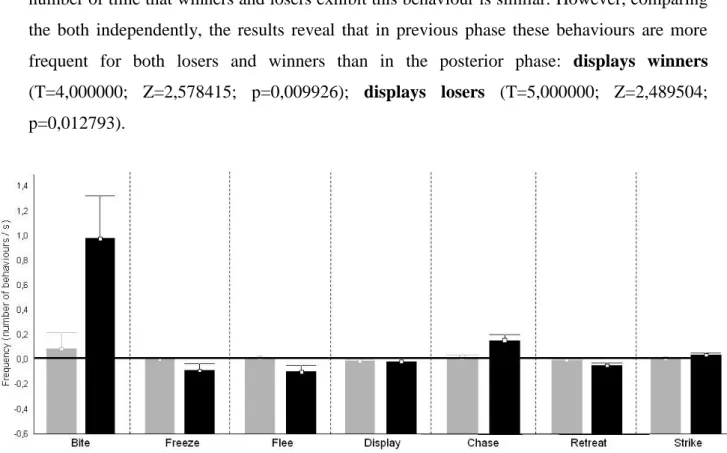
The results show that all behaviours, excluding Displays, reveal significant differences by the frequency of behaviours display by winners and losers when comparing the two different phases: Freeze (T=6,000000; Z=2,191483; p=0,028418); Retreat (T=3,000000;
T1st WL T1st LN -40 -20 0 20 40 60 80 100 120 T1st WL T1st LN -40 -20 0 20 40 60 80 100 120 WL WN LN T im e to f ir s t a tt ac k (s ) T1st WL T1st LN -40 -20 0 20 40 60 80 100 120 T1st WL T1st WN -40 -20 0 20 40 60 80 100 120 T1st WL T1st LN -40 -20 0 20 40 60 80 100 120 T1st WL T1st LN -40 -20 0 20 40 60 80 100 120 WL WN LN T im e to f ir s t a tt ac k (s ) T1st WL T1st LN -40 -20 0 20 40 60 80 100 120 T1st WL T1st WN -40 -20 0 20 40 60 80 100 120
Z=2,310161; p=0,020880); Strike (T=2,000000; Z=2,240448; p=0,025063); Flee and Chase (T=0,00; Z=2,934058; p= 0,003346); Bite (T=9,000000; Z=2,133860; p= 0,032855). In
previous phase behaviour were near zero which means that the number of times of
behaviours exhibit by winners and losers are similar. However, in posterior phase these behaviours present differences; some are more displayed by winners than losers, and the same happens with losers, which prove that a dominance-subordinance behavioural pattern is established (Fig. IV). The frequency of Displays (T=28,00000; Z=0,444554; p=0,656642) didn’t reveal differences between winners and losers in both phases, which means that the number of time that winners and losers exhibit this behaviour is similar. However, comparing the both independently, the results reveal that in previous phase these behaviours are more frequent for both losers and winners than in the posterior phase: displays winners (T=4,000000; Z=2,578415; p=0,009926); displays losers (T=5,000000; Z=2,489504; p=0,012793).
Figure IV: Differences between the frequencies of occurrence of behaviours displayed by
winners and losers that are more present in each phase. Gray bar represent previous phase of all behaviours that are displayed by Winners-Losers; Black bar represent posterior phase of all behaviours that are displayed by Winners-Losers. The line refers to behaviours that don’t show differences in the frequency of occurrence by winners and losers. Above the line are considered behaviours of dominance; below the line are considered behaviours of subordinance. In addition, the behaviours present above the line are more display in Winners; the behaviours present below the line are more exhibits in Losers. P values were calculated based in n=11.
Duration
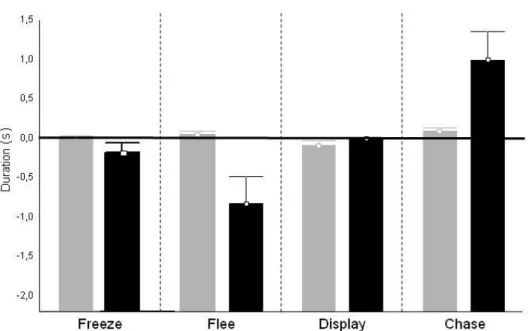
Duration can only be analysing by state events, and so point events are not considered here. The results show that all behaviours, excluding Displays, reveal significant differences in the time spent in all behaviours displayed by winners and losers when comparing the two different phases. Freeze (T= 2,000000; Z=2,599201; p=0,009345);; Flee and Chase (T= 1,000000; Z=2,845147; p= 0,004439). In previous phase behaviours were near zero which means that the time that behaviours are exhibit by winners and losers are similar. However, in
posterior phase these behaviours present differences; the time spent by winners displaying
some behaviours are higher than for losers, and the same for losers, which prove that a Dominance-subordinance behavioural pattern is established (Fig. V). Duration of Displays (T= 11,00000; Z=1,362402; p=0,173072) didn’t reveal differences between winners and losers in both phases, which means that winners and losers spent similar time exhibiting this behaviour. However, comparing the both independently, the results reveal that in previous phase these behaviours are more frequent for both losers and winners than in the posterior phase: displays winners (T= 0,00; Z= 2,934058; p= 0,003346); displays losers (T= 0,00; Z= 2,934058; p= 0,003346).
Figure V: Differences between the duration of behaviours displayed by winners
and losers that are more present in each phase. Gray bar represent previous phase of all behaviours that are displayed by Winners-Losers; Black bar represent posterior phase of all behaviours that are displayed by Winners-Losers. The line refers to behaviours that don’t show differences in the frequency of occurrence by winners and losers. Above the line are considered behaviours of dominance; below the line are considered behaviours of
subordinance. In addition, the behaviours present above the line are more display in Winners; the behaviours present below the line are more exhibits in Losers. P values were calculated based in n=11.
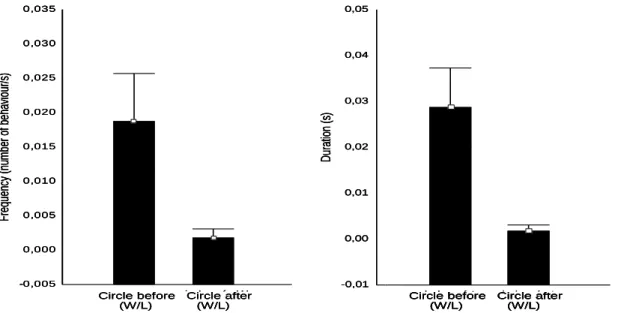
Circle is a mutually exclusive behaviour and so, when animal 1 exhibits circle the animal 2 is doing that also. In that way, statically effectuated in the behaviours mentioned above subtract the values of losers and winners and in this behaviour will always have null results. In that way, we compared, only, the values revealed by both winners and losers (that are the same) in both phases. The results divulged that this behaviour is more present in the previous phase. That Frequency: Circle (t=3,360542; df=10; p=0,007236); duration: Circle (t=2,739521; df=10; p=0,020850).
Figure VII: Differences between the duration and frequency of circle displayed by
winners and losers which are more present in each phase. P values were calculated based in n=11.
3.5. Detection ofWinner / Loser effects.
3.5.1. Influence of previous experience in the outcome of a second encounter.
Statistical analysis was carrying out using ACTUS 2, the second version of ACTUS
(Analysis of Contingency Tables Using Simulation). This is a simulation statistical program
designed by Estabrook for the analysis of contingency tables (Estabrook & Estabrook, 1989) that simulate, count and compare results allowing assessing if the probability of the observed distribution happens perhaps (Almada & Oliveira, 1997). With this program the problems of low expected values that limit the use of the χ2 statistics, in various situations, is surpass
D urat ion (s ) circle pré L circle pós L -0,01 0,00 0,01 0,02 0,03 0,04 0,05 circle pré L circle pós L -0,01 0,00 0,01 0,02 0,03 0,04 0,05
Circle before Circle after
(W/L) (W/L) circle pré L circle pós L -0,01 0,00 0,01 0,02 0,03 0,04 0,05 Freq ue ncy (nu m be rof beh avi ou r/s ) ci rcl e pré W ci rcl e pós W -0,005 0,000 0,005 0,010 0,015 0,020 0,025 0,030 0,035 ci rcl e pré W ci rcl e pós W -0,005 0,000 0,005 0,010 0,015 0,020 0,025 0,030 0,035 ci rcl e pré W ci rcl e pós W -0,005 0,000 0,005 0,010 0,015 0,020 0,025 0,030 0,035
Circle before Circle after
(W/L) (W/L) D urat ion (s ) circle pré L circle pós L -0,01 0,00 0,01 0,02 0,03 0,04 0,05 circle pré L circle pós L -0,01 0,00 0,01 0,02 0,03 0,04 0,05
Circle before Circle after
(W/L) (W/L) circle pré L circle pós L -0,01 0,00 0,01 0,02 0,03 0,04 0,05 D urat ion (s ) circle pré L circle pós L -0,01 0,00 0,01 0,02 0,03 0,04 0,05 circle pré L circle pós L -0,01 0,00 0,01 0,02 0,03 0,04 0,05
Circle before Circle after
(W/L) (W/L)
Circle before Circle after
(W/L) (W/L) circle pré L circle pós L -0,01 0,00 0,01 0,02 0,03 0,04 0,05 Freq ue ncy (nu m be rof beh avi ou r/s ) ci rcl e pré W ci rcl e pós W -0,005 0,000 0,005 0,010 0,015 0,020 0,025 0,030 0,035 ci rcl e pré W ci rcl e pós W -0,005 0,000 0,005 0,010 0,015 0,020 0,025 0,030 0,035 ci rcl e pré W ci rcl e pós W -0,005 0,000 0,005 0,010 0,015 0,020 0,025 0,030 0,035
Circle before Circle after
(W/L) (W/L) Freq ue ncy (nu m be rof beh avi ou r/s ) ci rcl e pré W ci rcl e pós W -0,005 0,000 0,005 0,010 0,015 0,020 0,025 0,030 0,035 ci rcl e pré W ci rcl e pós W -0,005 0,000 0,005 0,010 0,015 0,020 0,025 0,030 0,035 ci rcl e pré W ci rcl e pós W -0,005 0,000 0,005 0,010 0,015 0,020 0,025 0,030 0,035
Circle before Circle after
(Almada & Oliveira, 1997). The value of SAD, the sum over the boxes of the absolute difference between the observed count and the expected, is also providing by this program. ACTUS 2 simulates significance for SAD, using the same approach as for χ2 (Estabrook et. al., 2002). With this program the significance of χ2 of results are estimated by the simulation of thousands of tables, all with the same row and column total of the original table. With these simulations we verify that the calculated values of χ2 for simulated tables are similar or greater than the value of χ2 calculated for the original table. ACTUS 2 give the results in two tables: one for large counts and one for small counts. Each box of the simulated table is compared with the original data table and values smaller than 50 are considered to be one-tailed significant (P<0,05) (Estabrook et. al., 2002).
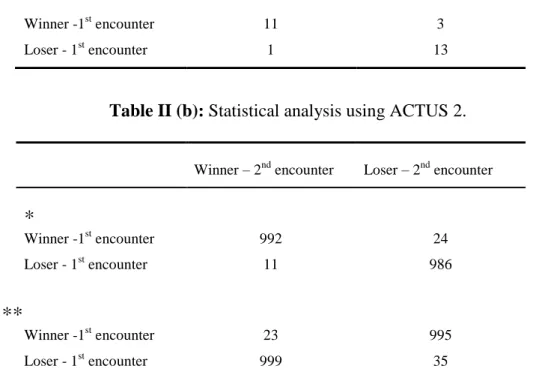
Employing this program to this study, the results reveal that in most cases both winners and losers of the first interaction also won and lose, respectively, in the second interaction. The results illustrate the presence of both winner and loser effects suggesting also that the loser one is more patent (Table II (a) and (b)).
Table II (a): Observed frequencies of victories and defeats in a second encounter considering the outcome of these individuals in a first contest.
Winner – 2nd encounter Loser – 2nd encounter
Winner -1st encounter 11 3
Loser - 1st encounter 1 13
Table II (b): Statistical analysis using ACTUS 2.
Winner – 2nd encounter Loser – 2nd encounter
*
Winner -1st encounter 992 24 Loser - 1st encounter 11 986**
Winner -1st encounter 23 995 Loser - 1st encounter 999 35* Cases in which simulated values did not exceed observed values; ** cases in which observed values did not exceed simulated values, based on 10000 simulated
tables. P values (significant for P<0,05) were calculated based in n=14.
2
=14.583, SAD=20.000.
Table II (b) demonstrates that observed values for both, winners/losers, in first and second encounters, present a significantly superior number to the simulated values and a significantly inferior number to the simulated one. In a similar way, observed values for winners in first encounter but losers in the second one, plus losers in first encounter but winners in the second one, present a significantly inferior number to simulated and a significantly superior number to the simulated one.
3.5.2. Behavioural analyses.
These results are relative to the different phases, Previous Phase and Posterior Phase, described in the behavioural analyzes (methods and maintenance).
In this part of experiment we pretend to evaluate the influence of prior experiences in behaviours displayed in later agonistics encounters, to confirm if both winner and loser effects are present in zebrafish.
For that we compared the behaviours exhibit by winners and losers only in the previous phase, to recognize the differences between behaviours displayed by winners and losers in the second contest given a first experience. In posterior phase the subordinate/dominate pattern is already established, and so, results in this phase don’t give relevant information to compare effects of prior experiences in subsequent agonistic encounters, which are more noticeable in moments immediately after a prior experience.
Frequency
Chase, Flee and Displays show significant values for the frequency of behaviours displayed by winners and losers. However, winners and losers that arose from the first encounter don’t reveal behavioural differences in the second contests (Table III).
Duration
Relative to the time spent in second encounters for winners and losers that arose from the first encounter only chase present significant statistic values. The other behaviours are display in related time between winners and losers, of prior experiences, in second interactions (Table IV).
Table III: Descriptive averages of behaviour’s
frequency and respective statistical test value of differences between behaviours displayed by animals, in the second contests, that experience a prior victory or defeat. Winners Losers A SD A SD Z P Chase 0,007 0,006 0,003 0,010 -2,036 0,042 Flee 0,011 0,027 0,013 0,007 2,134 0,033 Bite 0,173 0,164 0,092 0,125 -1,642 0,101 Strike 0,002 0,004 0,000 0,000 1,412 0,158 Retreat 0,008 0,019 0,006 0,007 0,328 0,743 Displays 0,041 0,016 0,063 0,023 2,233 0,026 Freeze 0,002 0,008 0,005 0,006 1,576 0,115 Circle 0,015 0,016 0,034 0,026 1,182 0,237
Table IV: Descriptive averages of behaviour’s duration and
respective statistical test value of differences between behaviours displayed by animals, in the second contests, that experience a prior victory or defeat.
Winners Losers A SD A SD Z P Flee 0,084 0,196 0,111 0,167 1,116 0,264 Chase 0,035 0,060 0,003 0,008 -2,134 0,033 Freeze 0,002 0,008 0,012 0,027 1,313 0,189 Circle 0,037 0,049 0,082 0,094 1,379 0,168 Displays 0,418 0,342 0,448 0,274 0,295 0,768 4. DISCUSSION
As we expected, our results demonstrates that male’s zebrafish exhibit agonistic behaviour and establish a significant dominant–subordinate pattern. The behaviours used in