1
A Work Project, presented as part of the requirements for the Award of a Master Degree in Economics from the NOVA – School of Business and Economics.
ONE.COST – ASSESSING SOCIAL PROBLEMS COSTS
MARIA PINHEIRO DE MELO VILALTA CANUDAS #871
A Project carried out on the Master in Economics Program, under the supervision of: Associate Professor Carmen Lages,
Assistant Professor Joana Story Associate Professor Maria João Major
Professor António Miguel
2
Abstract
This work project is inserted in the larger project “One.Cost”, developed by the Social Investment Lab, and intends to be the starting point to identify and assess the cost per unit of social problems. A theoretical background to social problem solving and its challenges is provided as well as an analysis of the application of Benefit Analysis and Cost-Effectiveness Analysis in measuring social impact. The focus of this paper is on health sector and exposes the main limitations of including costs in social impact measurement, in this particular area.
3
1. Introduction
Portugal is nowadays exposed to severe social problems in areas as health, education, social protection, employment and professional training. Identifying the more relevant social problems and understanding their root causes and consequences are the starting point to eradicate them and to improve people’s lives.
Organizations and individuals are looking for innovative solutions that stimulate the creation of lasting and significant social transformation and social entrepreneurs have become increasingly important in this field. However, creating social impact and, consequently, solving social issues is an arduous and complex process. The challenges begin with the absence of a common definition for key concepts as social impact or social entrepreneur. The lack of standard and user-friendly methods of social impact measurement is another obstacle faced by the social sector. Although it is recognized the value and need for evaluating the performance across social organizations, the resources required and the complexity of the process complicate and dissuade the establishment of a universal measurement tool. In the context of economically evaluating social impact, it can be observed the application of Benefit Analysis and Cost-Effectiveness Analysis. This economic tools support the decision-making between different social interventions.
This paper is integrated in the One.Cost project, developed by the Social Investment Lab that intends to build a database of social problems costs. In section II and III the existing literature on solving social problems and other related concepts, as social entrepreneurs and social impact, is reviewed. Section IV presents the reasons why social impact measurement is needed and the challenges that it faces. In section V, the paper focus on the Benefit Analysis and Cost-Effectiveness Analysis. Section VI analyses the theoretical framework for assessing social interventions in the health care context. Conclusions and recommendations are presented in section VII.
4
2. Social Problem and Social Entrepreneur
A social problem is a condition affecting negatively and prevalently a group of people (Loseke, 2003) and it is understood and identified by the society as a problem that has to be tackled and subject to public attention (Hilgartner and Bosk, 1988; Loseke, 2011). Poverty, famine, unemployment, environmental pollution and violence are examples of social problems. Those problems imply social costs – the opportunity cost of resources allocated to tackle the social problems and the additional costs imposed on society (Deloitte, 2016). In the social sector, that comprises “organizations driven primarily by a social purpose” (Ebrahim and Rangan, 2014: 118), foundations, non-profit, charitable organizations and social enterprises try to address social problems, by creating some social change.
There are many different processes to create and enhance social change, but this study will focus on innovation. Innovation, in social problem solving, is a completely pioneer and powerful solution that has the potential to continuously increase the change created (Kramer, 2005; Epstein and Yuthas, 2014). In the traditional business context, the agents that, using innovation and going beyond the resources they control, search for change and exploit it as an opportunity are named as “entrepreneurs” (Dees, 1998). Adapting this concept to the social sector, it can be concluded that assuming innovation as the solution for social problems implies that the change-makers are in fact social entrepreneurs (Dees, 1998). Literature presents different definitions for social entrepreneur and social entrepreneurship (Please see Table 1). For the purpose of this study, social entrepreneur is understood as the change-agent (Dees, 1998; Alvord et al. 2004) that contributes to solve social problems through an innovative and sustainable way (Dees, 2012, 1998; Santos, 2012; Austin et al. 2006).
5
Table 1. Definitions of Social Entrepreneur
Term Source Definition
Social
Entrepreneur Dees (1998)
Social entrepreneurs play the role of change agents in the social sector, by: Adopting a mission to create and sustain social value (not just private value) … without being limited by resources currently in hand (p. 4) Social
Entrepreneur
Alvord et al. (2004)
[C]reates innovative solutions to immediate social problems and mobilizes the ideas, capacities, resources, and social arrangements required for sustainable social transformations. (p. 262)
Social Entrepreneurship
Austin et al.(2006)
[S]ocial entrepreneurship as innovative, social value creating activity that can occur within or across the nonprofit, business, or government sectors. (p. 2) Social
Entrepreneurship Santos (2012)
Social entrepreneurship is an innovation process in the economy that can happen in different institutional contexts, is based on value creation (p. 350)
By conceiving and investing in innovative and sustainable solutions (Dees, 1998, 2012), social entrepreneurs accomplish their social mission focused on creating a significant and lasting impact (Stevens et al. 2014; Dees, 1998; Santos, 2012). For example, to tackle the social problem of hunger in Portugal, charitable institutions supply meals to poor people. Despite being a noble action, this is not a sustainable solution. In contrast, the social enterprise Re-Food developed a sustainable and innovative solution by “rescuing” wasted food and providing it to people who needs. Besides addressing the hunger problem, Re-Food also solves the problem of food waste.
3. Social Impact
Any company or organization creates a broad variety of social impacts (Epstein and Yuthas, 2014; Retolaza et al. 2016). In literature there is no standard definition for social impact and, in some cases, the term social value is used for the same meaning (Maas, 2014) (Please see Table 2). In this paper, social impact refers to lasting and significant social change that is caused by an intervention and affects the society.
6
Table 2. Definitions of Social Impact
Term Source Definition
Social Value
Emerson et al. (2000)
Social Value is created when resources, inputs, processes or policies are combined to generate improvements in the lives of individual or society as a whole (p. 137)
Social
Impact Clark et al. (2003)
By impact we mean the portion of the total outcome that happened as a result of the activity of the venture, above and beyond what would have happened anyway (p. 7) Social
Impact Tuan (2008)
The long-term sustainable and sometimes attributable change due to a specific intervention or set of interventions (p. 30 and 31)
Social Impact
Epstein and Yuthas (2014)
societal and environmental changes - positive and negative, intended and unintended - that result from investments (p.15)
Organizations and individuals’ actions seek for creating and maximizing impact – economic or social - in society (Emerson, 2003). The distinction between social and economic goal is a common problem in the social sector field (Emerson, 2003; Santos, 2012). In addition to create an illusory restriction between social and commercial investors (Emerson, 2003), the dichotomy economic-social complicates the correct identification of social enterprises as the change-agent that creates social impact (Santos, 2012). The creation of social impact is associated with the commitment to others-interest and society rather than self-interest and personal profit (Stevens et al. 2014; Dees, 2012) and is presented as an adverse and independent dimension of economic value (Santos, 2012; Emerson, 2003). The main limitation of the dichotomy social-economic is that the economic value created cannot be separated from social impact (Emerson, 2003; Stevens et al. 2014) because they are two sides of the same reality (Epstein and Yuthas, 2014; Emerson, 2003; Austin et al. 2006). A solution for the problem economic-social is the use of a broader concept of value, “defined in terms of the increase in the utility of society’s members” (Santos, 2012:337), as a “blended value” that comprises both social impact and economic value (Emerson, 2003).
Instead of economic-social, it is the dichotomy value creation and value appropriation that allows the definition of a social enterprise (Santos, 2012). Value creation is the increase in the
7
utility and well-being of society as a whole (Kroeger and Weber, 2015; Santos, 2012), while value appropriation is the act of the agent/organization taking some of the value created, for their own interest (Santos, 2012). Although both creation and appropriation can coexist in the same organization (Santos, 2012), the social enterprise is focused on maximizing the value created (Stevens et al. 2014; Santos, 2012) and only uses the value appropriation as a mean to support and improve the value creation operations (Santos, 2012; Dees, 1998). The purpose and strategy driven by a social impact (Dees, 1998) should be explicit in the social enterprise’s mission (Santos, 2012; Epstein and Yuthas, 2014). The mission statement is the starting point for social entrepreneurship activity and clarifies the actions, the “target population” and the desired outcomes (Epstein and Yuthas, 2014). A strong, explicit and concise mission is crucial to the social entrepreneur’s success because it creates discipline, promotes an efficient allocation of resources and prevents degenerative problems inside the organization (Epstein and Yuthas, 2014; Colby et al. 2004).
4. Social Impact Measurement
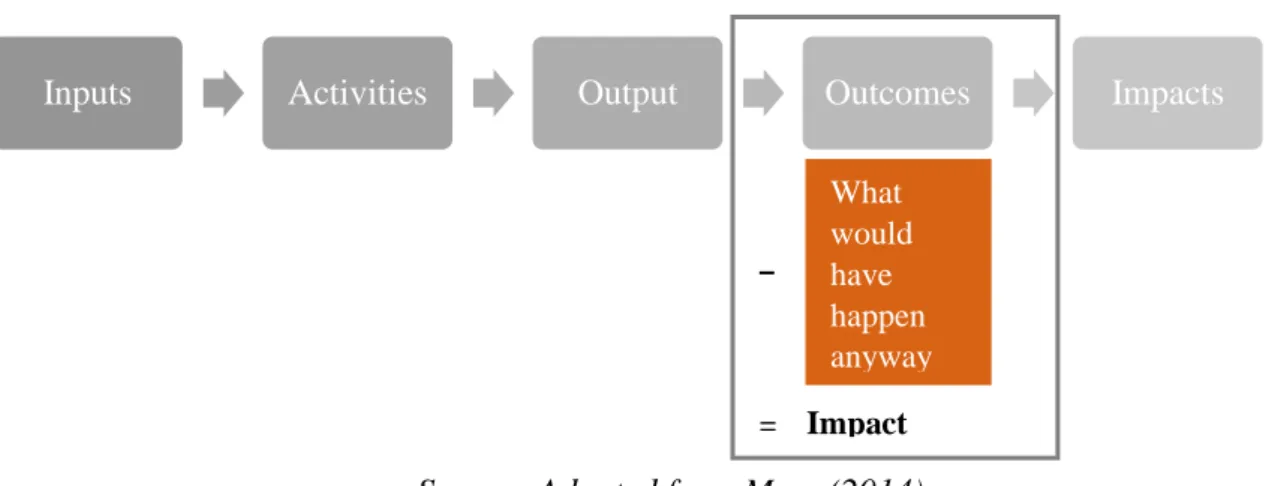
Social impact measurement refers to methods that identify and measure changes in the impact that result from the achievement of the ultimate goal of an intervention, program or policy (Rauscher et al. 2012; Epstein and Yuthas, 2014). As an alternative to impact measurement, some organizations evaluate the success of their activities and projects through output measurement, by assessing the outputs supplied (Epstein and Yuthas, 2014; Ebrahim and Rangan, 2014). While output is the service or good provided – for example number of free meals served to homeless people – impact is the long-term change created by an intervention in society – eradicate hunger and malnutrition (Ebrahim and Rangan, 2014; Rauscher et al. 2012). To understand what should be evaluate – output or impact – in the performance of social sector organizations, literature suggests analysing the logic model of social interventions (Ebrahim and Rangan, 2014; Kaplan, 2001). The logic model delineates and describes the
8
actions and the cause-and-effect logics that transform intended impact into actual change (Colby et al., 2004; Epstein and Yuthas, 2014) (Please see Figure 1).
It could be argued that, since the purpose of organizations is to deliver impact (Emerson, 2003), the success and efficiency of an intervention should be assessed at the end of the logic model – impacts (Ebrahim and Rangan, 2014). However, impacts in terms of social change can mean very long term effects and because of the casual relationship between outcome and impact, outcomes can be “proxies for impact” (Twersky et al., 2010: 14).
Figure 1. Logic Model of a social intervention
Source: Adapted from Mass (2014)
Outcome is the effect of the social intervention in the individuals of the target group, such as improving nutrition and health of homeless people (Rauscher et al. 2012; Ebrahim and Rangan, 2014). Some authors argue that assessing “outcomes” presents some limitations: outcomes are often not directly and uniquely caused by organizations’ actions (Ebrahim and Rangan, 2014) and they are in constant interaction with the social, cultural and economic context (Austin et al. 2006; Kroeger and Weber, 2014). In response to the previous criticism, Rauscher et al. (2012) propose to subtract the deadweight - “outcome that would have been produced even without intervention” – from the outcome being assessed, to obtain a proxy for its impact that can be used in social impact measurement (Rauscher et al. 2012: 6).
Inputs Activities Output Outcomes Impacts
What would have happen anyway = Impact –
9
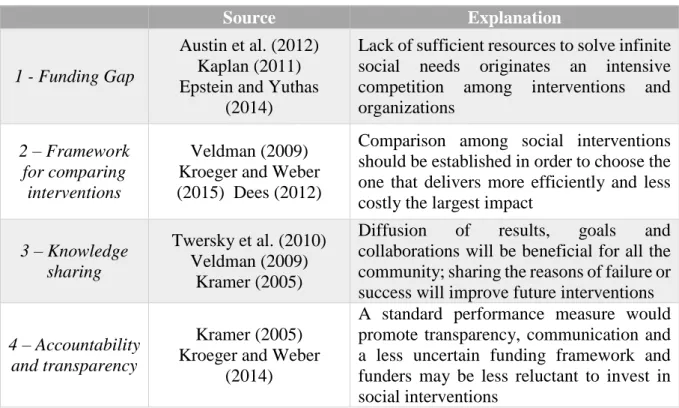
Social impact measurement, as social performance evaluation, is a crucial step in the process of delivering the maximum societal change (Kroeger and Weber, 2015; Kaplan, 2001). A standard and robust measurement methodology will help organizations to overcome some of the difficulties they find in the social field (see Table 3).
Table 3. Reasons to explain why measurement is needed in social sector
Source Explanation
1 - Funding Gap
Austin et al. (2012) Kaplan (2011) Epstein and Yuthas
(2014)
Lack of sufficient resources to solve infinite social needs originates an intensive competition among interventions and organizations
2 – Framework for comparing
interventions
Veldman (2009) Kroeger and Weber (2015) Dees (2012)
Comparison among social interventions should be established in order to choose the one that delivers more efficiently and less costly the largest impact
3 – Knowledge sharing
Twersky et al. (2010) Veldman (2009)
Kramer (2005)
Diffusion of results, goals and collaborations will be beneficial for all the community; sharing the reasons of failure or success will improve future interventions
4 – Accountability and transparency
Kramer (2005) Kroeger and Weber
(2014)
A standard performance measure would promote transparency, communication and a less uncertain funding framework and funders may be less reluctant to invest in social interventions
Social organizations perceive measurement as expensive, ambiguous and difficult to be applied (Epstein and Yuthas, 2014, Veldman, 2011). In order to simplify, traditional financial metrics are, in some cases, adopted. They are useful in the sense that they allow an objective evaluation of managers’ performance and the financial sustainability of a social project (Kramer, 2005), but they do not assess accurately all the dimensions of the success of a non-profit organization, many of which are non-financial dimensions (Kaplan, 2001). Despite the urgent need for a multidimensional measurement system (Kaplan, 2001), the academic work on social performance measurement is still weak (Kroeger and Weber, 2015; Ebrahim and Rangan, 2014) and the current expertise in this subject is mostly extracted from practice (Ebrahim and Rangan,
10
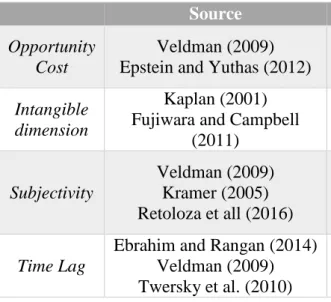
2014). The examples presented in literature are still embryonic (Kramer, 2005) and there are many obstacles that have to be overcome (Please see Table 4).
Table 4. Challenges in social performance measurement
Source Explanation
Opportunity Cost
Veldman (2009) Epstein and Yuthas (2012)
Trade-off between investing resources in evaluating operations or creating and improving social transformations
Intangible dimension
Kaplan (2001) Fujiwara and Campbell
(2011)
Services and goods delivered by organizations are intangible (non-market goods) hence it is difficult to quantify them
Subjectivity
Veldman (2009) Kramer (2005) Retoloza et all (2016)
Quantifying social impacts is a subjective process since it is composed by the perspectives of all the stakeholders involved that have different interests
Time Lag
Ebrahim and Rangan (2014) Veldman (2009) Twersky et al. (2010)
There is a significant time separation between the moment of action/investment and the materialization of the desired impact.
5. Economic Evaluation in Social Impact Measurement
Within the field of social impact measurement, some methods are known as economic evaluation – they evaluate if an intervention or project is economically efficient by identifying, measuring and comparing the cost and consequences of resource allocation against alternative uses (Rauscher et al. 2012). Economic evaluation can be grouped into four different types: cost analysis, cost-effectiveness (CEA), cost-utility and cost-benefit (CBA), depending on the identification and measurement of effects (Please see Appendix 1).In the social field, since there is no standard evaluation approach (Veldman, 2011), philanthropic and non-profit organizations have developed their own measurement frameworks (Kramer, 2005; Tuan, 2008), based on the assumptions of CEA and CBA (Maas, 2014; Veldman, 2011) (Please find examples in Appendix 2).
For the purpose of this study, the analysis will be focused on CEA and CBA since they are the “classical economic approaches” that incorporate the cost in measuring social impact (Tuan,
11
2008). CBA and CEA are related analytic methodologies that support organizations, authorities and other economic agents in their decision-making, by integrating economic-social costs and consequences/benefits (Yates, 2015; Udvarhelyi et al. 1992).
CBA is an economic evaluation that sets a monetary value to all costs and benefits of each social intervention (Cellin and Kee, 2015; Yates, 2015). The distinctive feature of CBA is the integration of outcomes measured in monetary units (Tuan, 2008) so that costs incurred are weighted against the monetized benefits (Cellin and Kee, 2015). For instance, when evaluating the construction of a bridge, a monetary value is placed on benefits – easier communication or reduction in car traffic - and on costs – environmental impact or financial building costs. Interventions are ranked as cost-beneficial (Yates, 2015) and chosen accordingly to their net benefits to society (Tuan, 2008).
CEA is a cost inclusive tool used to compare two or more interventions (Ashdown and Hummel-Rossi, 2002), usually, within the same area of impact (Tuan, 2008). Like CBA, CEA identifies and places a monetary value on costs, but those costs are related only with the key outcome (Cellin and Kee, 2015; Udvarhelyi et al. 1992). Since benefits are not measured in monetary units, intervention’s costs are expressed per unit change in the specific outcome (Tuan, 2008; Rauscher et al. 2012). As an example, if we consider a drug rehabilitation program, some of the costs considered are wages paid to doctors and nurses, monetary cost of treatment drugs and opportunity cost of time. In CEA, those costs are expressed in terms of days without drugs (the key outcome of the intervention).
Despite their shared background, CEA and CBA differ on their information requirements: CBA is more arduous and complex (Tuan, 2008) because its purpose is to compare the monetary value (dollars or euros) of all costs and benefits of each intervention. While CEA just relates implementation’s costs to the key outcome/impact obtained (Cellini and Kee, 2015). The
12
performances of CEA and CBA are demanding processes that include several steps (Cellin and Kee, 2015). Despite the purpose of an objective and quantified final result, the two analysis require subjective and hard decisions, regarding assumptions, estimations and other qualitative elements (Yates, 2015; Edejer et al. 2003). A simplification and summary of the processes of performing CEA and CBA (Cellin and Kee 2015), is presented in Figure 2. The process is common for the first steps, but it diverges from the sixth step – quantification of benefits
Source: Adapted from Cellin and Kee (2015)
1. Setting the framework for the analysis
Before starting the analytical process itself, it is indispensable to decide which analysis better fits the intention of the organization or individual (Cellin and Kee, 2015). First, the user should define and describe the status quo – “the state of the world in the absence of the program or policy (Cellin and Kee, 2015: 495) – that will be used as the baseline scenario to isolate the impact/outcomes of the intervention (Veldman, 2011; Tuan, 2008; Cellin and Kee, 2015). The status quo of a vaccination program could be the regular activity of health centers and hospitals and the medical services supplied before the vaccination program.
Setting the framework for the analysis Establishing the Cohort
Identification and prioritization of costs and benefits Projection of benefits and costs over time
Cost Monetization
Quantification of benefits
Discount costs and benefits to present values Cost-Effectiveness Ratio Sensitive Analysis Recommendations 1 2 3 4 5 6 7 8 9 10
13
Two aspects have to be considered in choosing the more suitable framework: (1) the purpose – what will be measured (Maas, 2014) and how data will be evaluated (Tuan, 2008) – and, (2) the timing of analysis - prospective, ongoing or retrospective (Cellin and Kee, 2015; Maas, 2014). Both analysis can be applied before, after or during the program (Cellini and Kee, 2015; Yates, 2015). CEA estimates the costs per effectiveness unit (Rauscher et al. 2012) and consequently its practice is constrained to one impact domain (Tuan, 2008). CEA is most appropriate when the main outcome is intangible or difficult to be monetized (Cellin and Kee, 2015). The CBA framework should be chosen if the user aims to evaluate the net benefit to society of a single or multiple interventions (Tuan, 2008; Cellin and Kee, 2015) and, particularly, if the focus of analysis is the investors’ social and financial objectives (Maas, 2014). CEA and CBA are applicable to communicate to external stakeholders, for academic purposes and organization knowledge (Maas, 2014; Tuan, 2008)
2. Establishing the cohort
The second step refers to the definition of the relevant stakeholders for the analysis (Cellin and Kee, 2015). Stakeholders are the “individuals and groups that can affect or be affected by the activities and outcomes” (Epstein and Yuthas, 2014: 110). It is important to delineate who assumes the costs and who will benefit from the intervention and specify which stakeholders compose the target (Cox et al. 2008; Deloitte, 2016; Cellin and Kee, 2015). In order to define the cohort, objective criteria can be considered, such as “age, sex, race, geographical location, or health status, size and distribution of the target cohort” (Deloitte, 2016: 15). It is argued that the geographical area criterion could be the basis for setting the scope of CEA and CBA - “The analyst should base her definition of society on the jurisdiction that will bear the brunt of the costs and receive the majority of the benefits” (Cellin and Kee, 2015: 498).
14
3. Identification and prioritization of costs and benefits
After establishing the cohort of the analysis, benefits and costs should be identified and classified (Udvarhelyi et al. 1992; Tuan, 2008; Cellin and Kee, 2015). In what concerns the definition of cost and benefit, some authors argue that, in the context of social impact measurement, cost comprises the financial resources and the negative impacts created by the intervention while benefits are the positive impacts (Cellin and Kee, 2015). In opposition, Yates (2015) and Rausher et al. (2012) define costs as the monetary value of the resources invested in the intervention and benefits as the positive or negative outcomes achieved. Every social program or policy is affected and affects a broad variety of individuals, hence it is difficult to identify and classify each benefit and cost (Cellin and Kee, 2015). The user should try to understand the most relevant benefits and costs. The participation of stakeholders may simplify this process and add value to the social performance evaluation (Cox et al. 2008; Cellin and Kee, 2015; Veldman, 2011; Ashdown and Hummel-Rossi, 2002).
4. Projection of costs and benefits over time
CEA and CBA have to consider the timeline of the project being evaluated and specify the timing of costs and benefits (Cellin and Kee, 2015; Tuan, 2008). In social interventions, it is usual that the desired impact takes many years or decades to be observed (Twersky et al. 2010), complicating the definition of the time frame (Cellin and Kee, 2015; Veldman, 2011). The choice between long and short term will depend on the useful life of each social intervention (Veldman, 2011; Cellin and Kee, 2015) and, in some cases, both perspectives are required (Maas, 2014). Traditionally, CBA and CEA are performed for a time horizon of five to fifty years (Cellin and Kee, 2015). Having a defined timeline, costs and benefits have to be identified for each year of the program (Cellin and Kee, 2015). Since CEA and CBA can be implemented before, during and after de intervention (Yates, 2015), the analysis can be ex ante – costs and outcomes are predicted – or ex post – actual costs and benefits are used (Cellin and Kee, 2015).
15 5. Cost Monetization
The CEA and CBA seek to place a monetary value on each cost and costs are said to be monetized (Cellin and Kee, 2015; Udvarhelyi et al. 1992). Monetization measures “social and environmental indicators and translate[s] those indicators [benefits and costs] into a monetary value comparable with traditional financial data” (Maas, 2014: 11). Monetary unit (dollar or euro) is accept as the standard measure because it facilitates comparison and addition, and is commonly understood by people (Cellin and Kee, 2015).
The previous categorization of costs, depending on their nature, (described in step 4) and the definition of the agents responsible for the costs incurred (described in step 2) are now useful to find the best metrics to be used in the cost monetization process (Cellin and Kee, 2015; Deloitte, 2016). Financial reports and budgets provide data concerning the resources invested: workers’ salaries, capital costs, services, material and other costs. However, those may not be the most accurate and complete sources of information (Cellin and Kee, 2015; Yates, 2015; Ashdown and Hummel-Rossi, 2002). As an example , one of the most valuable resources of social sector organizations is the time devoted by volunteers (Yates, 2015) but this cost is not reflected in financial information (Yates, 2015; Ashdown and Hummel-Rossi, 2002). In order to overcome the obstacles in the process of cost monetization, Cellin and Kee (2015), suggest to analyze separately the costs with respect to the different stakeholders groups.
6. Quantification of benefits
The method followed to quantify benefits is what distinguish CEA and CBA (Robinson, 1993): for CBA, consequences (or effects) are measured in monetary unit (benefits are monetized) while, in CEA, benefits are estimated in natural non-monetary units – units of effectiveness that correspond to the “quantifiable outcome central to the program’s objective” (Cellin and Kee, 2015: 494), for example “life year saved” (Tuan, 2008: 31).
16
In CEA, costs of social interventions are related to a key outcome so the outcome used as reference has to be a reliable measure of program’s success and should be related with its objective (Cellin and Kee, 2015). In addition, since the purpose of CEA is to compare two or more interventions, the user should opt for a natural unit common to different programs (Ashdown and Hummel-Rossi, 2002). For example, if the social intervention is about heart medicines, the absence of cardiac events can be the natural unit chosen but the life expectancy is a better unit, since it is applicable to other health interventions. Benefits are, then, quantified in natural units (Tuan, 2008), but only the outcomes caused by the program should be taken into account (Cellin and Kee, 2015). This is possible by assessing the actual scenario with intervention against the baseline state (defined in step 1) (Veldman, 2011; Tuan, 2008; Cellin and Kee, 2015).
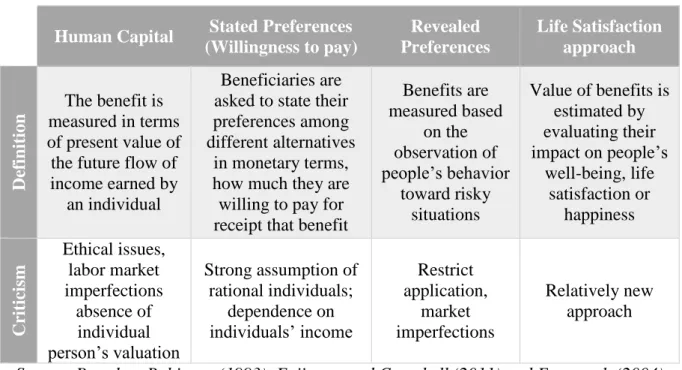
In CBA, the ideal objective is to place a monetary value for every relevant benefit (Cellin and Kee, 2015; Tuan, 2008). Some benefits can be easily monetized following the same methods applied to cost, but others, in particularly nonmarket benefits, are difficult to be converted into monetary units (Yates, 2015; Cellin and Kee, 2015; Cox et al. 2012). Non-market good is “any good or service which is not traded in markets, such as public goods, but also elements of and events in one’s life such as health, employment and marriage” (Fujiwara and Campbell, 2011: 9). The absence of a readily market price reflecting the value for society (Veldman, 2011) is overcome by the estimation of shadow prices – monetary value that is attached to each social intervention’s outcome ((Tuan, 2008; Cellin and Kee, 2015; Veldman, 2011; Tuan, 2008). Four main approaches are suggested by the literature to obtain shadow prices of non-market benefits. A summary can be found that in table 5. Each valuation method for non-market benefits has disadvantages and advantages. Choosing the most appropriate and accurate approach depends on the intervention’s features and domain (Fujiwara and Campbell, 2011).
17
Table 5. Valuation techniques for nonmarket benefits
Human Capital Stated Preferences
(Willingness to pay) Revealed Preferences Life Satisfaction approach De fin ition The benefit is measured in terms of present value of the future flow of income earned by
an individual
Beneficiaries are asked to state their preferences among different alternatives
in monetary terms, how much they are willing to pay for receipt that benefit
Benefits are measured based on the observation of people’s behavior toward risky situations Value of benefits is estimated by evaluating their impact on people’s well-being, life satisfaction or happiness Cr itic ism Ethical issues, labor market imperfections absence of individual person’s valuation Strong assumption of rational individuals; dependence on individuals’ income Restrict application, market imperfections Relatively new approach
Source: Based on Robinson (1993), Fujiwara and Campbell (2011) and Frey et al. (2004) Nevertheless, willingness-to-pay has been the preference on the context of CBA (Yates, 2015) while life satisfaction approach, because of its early development, has been treated as a complement to the traditional preference-based approaches (Fujiwara and Campbell, 2011).
7. Discount costs and benefits to obtain present values
Having costs and benefits quantified, CBA and CEA have to discount all monetary values to their present value (Cellin and Kee, 2015; Tuan, 2008). By investing resources on a specific program, the organization or individual is deciding not to allocate those resources to alternative programs, thus there is an opportunity cost to be considered (Cellin and Kee, 2015). Moreover, people value more benefits today than benefits tomorrow (Veldman, 2011; Yates, 2015). These situations are considered, by adjusting costs and benefits through the social discount rate - “is meant to reflect society’s impatience or preference for consumption today over consumption in the future” (Cellin and Kee, 2015: 518). There is no consensus regarding the social discount rate (Veldman, 2011) and Cellin and Kee (2015) suggest using a real discount rate of 2 to 3%
18
and later testing the hypothesis of higher social discount rates (described in step 9). The mathematical formulas for the calculation of the present values are presented in Appendix 3.
8. Compute a cost-effectiveness ratio for CEA or net present value for CBA
The formulas for computing the outputs of CEA and CBA, adapted from Cellin and Kee (2015) are presented in Appendix 4.
CEA: In this step, it is calculated the cost-effectiveness ratio (Cellin and Kee, 2015; Tuan, 2008) that expresses, for each intervention, the trade-off between costs incurred, in monetary units, and the outcomes achieved (Ashdown and Hummel-Rossi, 2002). Examples of cost-effectiveness ratios are “cost per person cured of malaria, cost per child educated for one additional year, cost per automobile accident avoided” (Tuan, 2008:28).
CBA: There are three outputs from CBA (Tuan, 2008). The key metric is the Net Present Value (NPV) that assesses the net benefits; Benefit-cost ratio and Internal rate of return (IRR) are applied as complement to NPV (Tuan, 2008; Cellin and Kee, 2015). The benefit cost ratio is more appropriate for comparing similar projects while the IRR corresponds to the social discount rate such that the present value of benefits matches the present value of costs (Cellin and Kee, 2015).
9. Sensitive Analysis
After computing the CEA and CBA outputs, sensitivity analysis should be performed with the aim of testing if the results obtained are robust and accurate, by modifying some or all assumptions taken in the process (Udvarhelyi et al. 1992). Both CEA and CBA require lots of data and the user almost never have access to perfect information (Cox et al. 2012). Thus, the user has to judge and decide many aspects, such as the approach for evaluating non-market benefits or the social interest rate to be applied. The sensitivity analysis can be partial (varying
19
only one assumption at a time) or extreme (testing all the assumption under the best or worst case scenario) (Cellin and Kee, 2015).
10. Recommendations
To conclude CEA and CBA, a recommendation should be made based on the computed metrics, described in step 8 (Cellin and Kee, 2015). The estimation of the cost-effectiveness ratio of a single program reveals little information, unless it is compared with other programs (Yates, 2015; Tuan, 2008). Hence, when comparing alternative programs to achieve a desired outcome, the user should implement the more efficient alternative – the program with lower cost-effectiveness ratio (Cellin and Kee, 2015; Edejer et al. 2003). The decision based on CBA is more straightforward: the intervention is realized if the NPV is positive and is rejected for a negative NPV (Cellin and Kee, 2015). However, in none of the cases, recommendations or decisions should be founded solely on the estimations obtained (Yates, 2015; Ashdown and Hummel-Rossi, 2002).
6. Health Care Analysis
Malnutrition, infant mortality, mental health, drug addiction or even excess of unnecessary health care are examples of social problems in the health care system. They affect negatively and largely society. The costs and consequences of these social problems can take the form of lower quality of life, monetary costs (to health system or tax payers), familiar problems or increased poverty, among others. Social entrepreneurs, by developing innovative and lasting solutions, have an important role on solving social problems. Take the example of Medic Mobile, a social enterprise that intends to improve health care in countries in Africa, Latin America and Asia, making medical assistance easier and quicker. The idea is that mobile phones can be used to register, track and communicate patients and diseases efficiently, in remote and poor areas.
20
In health care, similarly to what happens in other social fields, efficacy is no longer a sufficient condition to implement a health care policy or intervention (Udvarhelyi et al. 1992), as the high costs and the increasing demand for health care require economic evaluation (Higgins and Harris, 2012). Indeed, CEA and CBA can facilitate medical and policy decisions by promoting the most efficient health care practices (Udvarhelyi et al. 1992; Yin and Forman, 1995). Being financially responsible for how each Euro is spent (Ashown and Hummel-Rossi, 2002) is increasingly important, specially, for a country as Portugal that is still recovering from a severe economic crisis.
The adoption of CEA or CBA, in the health economic literature, as the best analytic methodology is object of an active debate. Strengths and weakness are presented in Table 6.
Table 6. Strengths and weakness of Cost-Benefit and Cost-Effectiveness Analysis
Cost-Benefit Analysis Cost-Effectiveness Analysis
Strengths
- Comparison across health and non-health sectors
- Addition of different benefits - Objective measurement unit
- Easier comprehension - Easier execution - Starting point
- QALY - important health outcome
Weakness
- Robust Assumptions
- Costly and complex process - Monetization limitations
- Context-specific - Costly process - Ambiguous results
- Subjective measurement unit
Source: Based on Edejer et al. (2003), Cellin and Kee (2015), Robinson (1993) and Yin and Forman (1995)
CEA and CBA, applied to health care systems, weigh rationally costs and benefits caused by new policies, technologies or procedures (Yin and Forman, 1995). The use of CBA in health care evaluations implies the problematic and sometimes unethical task of placing a monetary value on health or human life (Robinson, 1993). While on the one hand a standard and universal unit as Euro or Dollar enables comparisons across health systems and non-health sectors (Robinson, 1993; Yin and Forman, 1995), on the other hand, health outcomes are so complex
21
and subjective that measuring them in terms of a single and decontextualized monetary unit can be very limited (Higgins and Harris, 2012; Robinson, 1993). None of the valuation techniques for nonmarket benefits (previously presented in table 5) can be straightforwardly apply to health outcomes. For example, if people are asked to state how much are they willing to pay for a health care service, as a X-ray exam, their answers will probably diverge. First, they do not have the necessary information or training to value the benefit. Secondly, the value placed will depend on each person: a perfectly healthy individual may set a lower value than the one set by a person that has or had in the past some health condition.
Because of its wider domain of appliance, CBA is assumed as the “ideal analysis”, but the requirement of unrealistic assumptions, as the patient having perfect information about his health conditions, and the subjective and controversial monetization process make CBA to be criticized in favor of CEA. One particular type of CEA that suits the economic health care evaluation is the Cost-Utility Analysis (CUA). In CUA, monetary costs are related to outcomes expressed in terms of utility, being utility “the amount of ‘satisfaction’ yielded from the health care program” (Yin and Forman, 1995: 312). Examples of utility measures are QALYs – quality adjusted life years – and DALYs – disability adjusted life year (Yates, 2015) (Please see Appendix 5 for more details). In some sense, CUA acts as a compromise choice between CEA and CBA: a utility measure as QALY is a non-monetary and easier applicable metric, circumventing the problem of benefit monetization in CBA, and it is also a general accept unit in the health sector, mitigating the problem of comparison prevailing in CEA. The number of CEA (and CUA) has presented a significant growth and QALY has become the “cornerstone” of economic health analysis (Whitehead and Ali, 2010). Assessing health benefits in terms of QALYs takes into consideration not only the number of lives saved or life expectancy, but also the quality of those lives - years gained (Higgins and Harris, 2012; Yin and Forman, 1995). For a diabetic patient, a healthy lifestyle and taking medicines is preferable to the future risk of
22
amputation in even if his life expectancy is the same in both situations, because his quality of life in the remaining years is probably better.
In the context of health care interventions, CEA is the most used economic evaluation, since it offers to policy-makers, doctors, patients and health care providers an effective and useful tool to assess the value of health interventions. In Portuguese literature, there is a significant number of CEA and CUA (see Table 9 for some examples).
Table 7. Strengths and weakness of Cost-Benefit and Cost-Effectiveness Analysis
Authors Clinical Area Effectiveness Unit
Munguambe et al.
(2014) Ischaemic heart disease
Absence of cardiac events, number of prevented interventions, number of cardiac
catheterization prevented Lourenço et al.
(2012)
Venous
thromboembolism QALYs
Matos (2012) Pressure Ulcers (prevention)
Percentage of prevented pressure ulcers and recovery of pre-existent pressure ulcers Araújo et al.
(2007) Lung Cancer Years of life and QALYs
7. Conclusions and main recommendations
The larger project One.Cost aims to centralize information and build a database of the unit costs of social problems affecting Portugal. The contribution of the present Work Project is to define and understand concepts related with the process of assessing social problems and to identify and critically analyze economic methodologies to estimate the costs of social health problems.
Measuring economically the social impact created by interventions, programs and policies is a complex and arduous process. In health care, there are many factors that make social impact measurement difficult and costly. CEA and CBA require many resources (time, money, knowledge) and the excessive application of economic analysis for each and every health care interventions would be inefficient and irrational. Estimating the benefits and the costs of health
23
interventions may implies ethical and equity issues, since the current valuation techniques are controversial and cause, in some cases social inequalities. Moreover, it is required expertise and access to health system databases to better understand the health social problems, the medical procedures involved and accurately estimate their costs and benefits. In the context of health care in Portugal, the main limitation of the application of CEA or CBA is the lack of an organized and accessible information database. The available information on the cost of health care interventions is often dispersed, incomplete and difficult to analyze.
The finding of this papers suggest that for the purpose of the One.Cost project, CEA is the most appropriate economic evaluation and a valuable starting point, since it intends to find answers for questions as How much does it cost per year a cancer patient? Further research projects should attempt to estimate the social cost of a specific social problem in the health area, by applying the cost-effectiveness framework, presented in this paper. Interviewing Portuguese experts and contacting health care institutions and organizations may help to overcome some of the challenges aforementioned.
8. References
Alvord, Sarah H., L. David Brown and Christine W. Letts. 2004. “Social Entrepreneurship and Societal Transformation: An Exploratory Study.” Journal of Applied Behavioral Science 40 (3), 260-83
Araújo, A., B. Parente, R. Sotto-Mayor, E. Teixeira, T. Almodôvar, F. Barata, H. Queiroga, C. Pereira, H. Pereira, F. Negreiro and C. Silva. 2008. “Avaliação económica do erlotinib, docetaxel, pemetrexedo e tratamento de suporte no tratamento de segunda ou terceira linhas de doentes com cancro do pulmão de não pequenas células.” Revista Portuguesa de Pneumologia, 14 (6), 803-827.
Ashdown, Jane and Barbara Hummel-Rossi. 2002. “What is Cost-Effectiveness Analysis?” Journal of Reading Recovery 2 (1), 44-46
24
Austin, James, Howard Stevenson and Jane Wei-Skillern. 2006. “Social and commercial entrepreneurship: same, different or both?” Entrepreneurship: theory and practice 30 (1), 1-22
Cellini, Stephanie Riegg and James Edwin Kee. 2015. “Cost-Effectiveness and Cost-Benefit Analysis.” In Handbook of Practical Program Evaluation, edited by Joseph S. Wholey, Harry P. Hatry and Kathryn E. Newcomer, 493-530. United States of America: Jossey Bass
Clark, Catherine, William Rosenzweig, David Long and Sara Olsen. 2004. Double Bottom Line Project Report: Assessing Social Impact in Double Bottom Line Ventures, Columbia Business School/Haas School of Business/Rockefeller Foundation.
Colby, Susan and Nan Stone and Paul Carttar. 2004. “Zeroing in on Impact: In an era of declining resources, nonprofits need to clarify their intended impact.” Stanford Social Innovation Review 2 (2), 24-33
Cox, Julian, Matt Bowen and Oliver Kempton. 2012. Social Value: Understanding the wider value of public policy interventions. New Economy Working Papers
Dees, J. Gregory. 1998. “The Meaning of Social Entrepreneurship.” Stanford University: Center for Social Innovation, Graduate School of Business, Kauffman Center for Entrepreneurial Leadership, Ewin Marion Kauffman Foundation
Dees, J. Gregory. 2012. “A Tale of Two Cultures: Charity, Problem Solving, and the Future of Social Entrepreneurship.” Journal of Business Ethics 111 (3), 321-334
Deloitte Access Economics. 2016. A practical guide to understanding social costs: Developing the evidence base for informed social impact investment
Ebrahim, Alnoor and V. Kasturi Rangan. 2014. “What Impact? A framework for measuring the scale and scope of social performance.” California Management Review 56 (3), 118-141
25
Emerson, Jed. 2003. “The Blended Value Proposition: Integrating Social and Financial Returns.” California Management Review 45 (4), 35-51
Edejer, T. Tan-Torres, R. Baltussen, T. Adam, R. Hutubessy, A. Acharya, D. B. Evans and C. J. L. Murray. 2003. Making Choices in Health: WHO Guide to Cost-Effectiveness Analysis. Switzerland: World Health Organization
Epstein, Marc J. and Kristis Yuthas. 2014. Measuring and Improving Social Impacts. San Francisco: Berrett-Koehler Publishers
Frey, Bruno, Simon Luechinger and Alois Stutzer. 2004. “Valuing Public Goods: The Life Satisfaction Approach.” CESifo Working Paper 1158
Fujiwara, Daniel and Ross Campbell. 2011. Valuation techniques for social cost-benefit analysis. London: HM Treasury.
Higgins, Alisa M. and Anthony H. Harris. 2012. “Health Economic Methods: Cost-Minimization, Cost-Effectiveness, Cost-Utility, and Cost-Benefit Evaluations.” Critical Care Clinics 28 (1), 11-24
Hilgartner, Stephen and Charles L. Bosk. 1988. “The Rise and Fall of Social Problems: A Public Arenas Model.” American Journal of Sociology 94 (1): 53-78
Kaplan, Robert S. 2001 “Strategic performance measurement and management in nonprofit organization.” Nonprofit Management & Leadership 11 (3), 353-370
Karoly, Lynn A. 2008 Valuing Benefits in Benefit-Cost Studies of Social Programs RAND Kramer, Mark R. 2005 Measuring Innovation: Evaluation in the Field of Social
Entrepreneurship. Skoll Foundation, Boston: Foundation Strategy Group
Kroeger, Arne and Christiana Weber. 2015. “Developing a Conceptual Framework for Comparing Social Value Creation” Academy of Management Review 39(4) 43-70
Loseke, Donileen. R. 2003. Thinking about Social Problems: An Introduction to Constructionist Perspectives (2nd ed.). New York: Aldine de Gruyter
26
Lourenço, Óscar, Francisco Batel-Marques, João Carrasco and Mónica Inês. 2012. “Análise De Custo-Efetividade Do Apixabano Vs. Enoxaparina Na Prevenção Do Tromboembolismo Venoso Após Artroplastia Eletiva Da Anca Ou Joelho.” Revista Portuguesa de Farmacoterapia 4, 248-258
Maas, Karen. 2014. Giving Thoughts Classifying Social Impact Measurement Frameworks. The Conference Board, Inc.
Matos, Isabel Maria Ferreira. 2012. “Custo-Efetividade de Intervenções na Prevenção de Úlceras de Pressão.” Master’s Thesis, Universidade do Minho – Escola de Economia e Gestão.
Munguambe, Vanda, Ernesto Pereira and Nuno Raposo. 2014. “Análise custo-efetividade da intervenção coronária percutânea diferida versus efetuada com base na avaliação da fração de fluxo de reserva coronária.” Revista de Ciências da Saúde da ESSCVP 6, 8-22 Rauscher, Olivia, Christian Schober and Reinhard Millner. 2012 Social Impact Measurement
und Social Return on Investment (SROI) – Analysis: New methods of economic evaluation? Working paper. NPO Competence Center
Retoloza, José Luis, Leire San-José and Maite Ruíz-Roqueñi. 2016 Social Accounting for Sustainability: Monetizing the Social Value, SpringerBriefs in Business
Robinson, Ray. 1993. “Economic Evaluation and Health Care: Cost-benefit analysis.” BMJ 307, 924-926
Santos, Filipe. 2012. “A Positive Theory of Social Entrepreneurship.” Journal of Business Ethics 111 (3), 335-351
Stevens, Robin, Nathalie Moray and Johan Bruneel. 2014.”The Social and Economic Mission of Social Enterprises: Dimensions, Measurement, Validation, and Relation.” Entrepreneurship: Theory and Practice 39 (5), 1051-1082
27
Tuan, Melinda. 2008. Measuring and/or Estimating Social Value Creation: Insights into Eight Integrated Cost Approaches. Bill & Melinda Gates Foundation - Impact Planning and Improvement
Twersky, Fay, Jodi Nelson and Amy Ratcliffe. 2010. A Guide to Actionable Measurement. Bill & Melinda Gates Foundation
Udvarhelyi, I. Steven, Graham A. Colditz, Arti Rai and Arnold M. Epstein. 1992. “Cost-Effectiveness and Cost-Benefit Analyses in the Medical Literature: Are the Methods Being Used Correctly?” Annals of Internal Medicine 116 (3), 238-244
Veldman, Paul. 2011. “Learning social metrics from international development.” Community Development Investment Review, 7 (1), 71-77
Whitehead, Sarah J. and Shehzad Ali. 2010. “Health Outcomes in Economic Evaluation: the QALY and Utilities.” British Medical Bulletin, 1-17
Yates, Brian T. 2015. “Cost-benefit and cost-effectiveness analyses in evaluation research.” In J. D. Wright (Ed.), International Encyclopedia of the Social & Behavioral Sciences (2nd ed.) Vol 5. 55–62. Oxford: Elsevier.
Yin, Dongping and Howard P. Forman. 1995. “Health Care Benefit and Cost-Effectiveness Analysis: An Overview.” Journal of Vascular an Interventional Radiology 6 (3), 311-320