93
R E V I S T A P O R T U G U E S A D E I M U N O A L E R G O L O G I A
ARTIGO ORIGINAL
RESUMO
Introdução: A recomendação habitual no tratamento da alergia alimentar é a evicção completa, até à aquisição de tolerância. É importante perceber em que situações ocorrem falhas na evicção, de forma a orientar o melhor possível o doente com alergia alimentar. Objectivo: Conhecer a frequência e caracterizar as exposições acidentais, num grupo de doentes com alergia alimentar. Material e métodos: A partir dos registos do Serviço de Imunoalergologia do Hospital Dona Estefânia, foram seleccionados doentes com idade ≤ 10 anos com alergia às proteínas do leite de vaca, ovo, peixe, amendoim ou frutos secos. Os pais/prestadores de cuidados responderam a um inquérito telefónico referente ao ali-mento implicado, falhas na dieta e sintomas. Resultados: Contactou -se um grupo de 65 doentes com idade média de 4,3 anos (63% do sexo masculino), totalizando 69 casos de alergia alimentar – cerca de 42 casos de alergia ao leite, 11 casos de alergia ao peixe, 10 de alergia ao ovo, 5 de alergia aos frutos secos e 1 de alergia ao amendoim. Na maioria dos casos a primeira reacção foi desencadeada por ingestão (95,6%) e foi imediata (78,3%), manifestando -se por sintomas mucocutâneos (MC) em 75,4%, gastrintestinais em 33,3% e respiratórios em 23,2%. Ocorreu anafilaxia em 17%. Houve falhas na dieta em 68,1% dos casos, que contabilizaram um total de 68 eventos de exposição acidental, na maioria (87,1%) com sintomas. Destes 68 eventos de exposição acidental, em 69,1% (n=47) o leite foi o alimento implicado, em 14,7% (n=10) foi o ovo, em 13,2% (n=9) o peixe e em 2,9% (n=2) os frutos secos. As manifestações clínicas mais frequentes foram MC (55,9,9%), seguindo -se as do tracto respiratório (25%) e as do tracto gastrointestinal (23,5%). Em 20,5% dos eventos de exposição acidental, ocorreu reacção anafiláctica. A maior parte das ingestões/exposições acidentais ocor-reram em casa (36,8%) e na escola (29,4%). Perante a reacção foi administrada terapêutica em 41,2%, aguardaram reso-lução espontânea 38,2% e recorreram ao serviço de urgência 20,6% dos casos. Conclusões: As falhas na dieta de evicção foram frequentes, a maioria com sintomas. Aconteceram maioritariamente em casa e na escola, o que pode
Exposições acidentais na alergia alimentar
Accidental exposures in food allergy
Filipa Sousa1, João Antunes2, Maria João Paes3, Marta Chambel2, Sara Prates2, Paula Leiria Pinto2
1 Unidade de Imunoalergologia, Hospital Central do Funchal, Madeira
2 Serviço de Imunoalergologia, Centro Hospitalar de Lisboa Central, Hospital Dona Estefânia, Lisboa 3 Serviço de Imunoalergologia, Centro Hospitalar de Lisboa Norte, Hospital de Pulido Valente, Lisboa
R e v P o r t I m u n o a l e r g o l o g i a 2 0 1 1 ; 1 9 ( 2 ) : 9 3 - 1 0 0
Data de recepção / Received in: 06/01/2011 Data de aceitação / Accepted for publication in: 17/06/2011
Imuno (19) 2 - Miolo 2ª PROVA PT.indd 93
94
R E V I S T A P O R T U G U E S A D E I M U N O A L E R G O L O G I A
INTRODUÇÃO
A
prevalência da alergia alimentar tem vindo a au-mentar nos países ocidentais, nomeadamente em idade pediátrica1. Na infância estima -se que seja de cerca de 6-8%2. Os alimentos mais vezes implicados são leite de vaca, ovo, peixe, soja, trigo, marisco, amendoim efrutos secos. Actualmente, a única recomendação segura no tratamento da alergia alimentar é a evicção completa até que seja adquirida tolerância3,4.
As ingestões ou os contactos acidentais são uma fon-te de preocupação constanfon-te para os doenfon-tes e familiares, dado que podem levar a reacções potencialmente fatais, o que acarreta uma pesada carga emocional5,6. Desafios sugerir lacunas no conhecimento dos pais/prestadores de cuidados. A caracterização das exposições acidentais nos doentes com alergia alimentar poderá ajudar a optimizar a transmissão de informação, a estes e aos seus responsáveis, relativamente à prevenção de situações de risco.
Palavras -chave: Alergia, alimentar, contacto, exposição, ingestão, reacção acidental
ABSTRACT
Background: The usual recommendation in food allergy treatment is strict eviction until tolerance is established. It is important
to know how an eviction diet fails in order to improve the information we give to food -allergic patients. Objective: To identify the frequency and to characterise accidental food exposures in a group of food -allergic patients. Material and methods: Children aged ten years or less, allergic to cow’s milk proteins, egg, fish, peanut or nuts were selected from the files of patients followed up at the Al-lergology and Clinical Immunology outpatient clinic of Hospital Dona Estefânia. Parents/caregivers answered a questionnaire regarding the culprit food, symptoms and characterisation of accidental exposures. Results: We selected a group of 65 patients, with a median age of 4.3 years (63% males), corresponding to 69 cases of food allergy – 42 cases of cow’s milk protein allergy, 11 cases of fish al-lergy, 10 cases of egg alal-lergy, five cases of nut allergy and one case of peanut allergy. The first reaction occurred, in most cases, by inges-tion (95.6%) and was immediate (78.3%). Symptoms were mucocutaneous in 75.4%, gastrointestinal in 33.3% and respiratory in 23.2%. Anaphylaxis occurred in 17%. The eviction diet failed in 68.1% cases, which corresponded to 68 accidental exposure occur-rences, most with symptoms (87.1%). Of these 68 accidental exposures, the culprit food was cow’s milk in 69.1% (n = 47), egg in 14.7% (n = 10), fish in 13.2% (n = 9) and nuts in 2.9% (n = 2). Mucocutaneous manifestations were the most frequent (55.9%), followed by respiratory symptoms (25%) and gastrointestinal symptoms (23.5%). Anaphylaxis occurred in 20.5%. Most accidental exposures were at home (36.8%) and at school (29.4%). After the reaction, parents/caregivers administered medication in 41.2% of cases, waited until spontaneous resolution took place in 38.2% and went to Emergency Room Departments in 20.6%. Conclusion: Eviction diet failures were frequent, most of them with symptoms. Most accidental exposures occurred at home and at school. This may indicate gaps in parents’/care givers’ knowledge. The characterisation of accidental exposures in food -allergic patients may help to improve the information transmitted to parents/caregivers to help them identify risk factors and be aware of avoidance measures.
Key -words: Contact, food allergy, exposure, ingestion, accidental reaction.
Imuno (19) 2 - Miolo 2ª PROVA PT.indd 94
95
R E V I S T A P O R T U G U E S A D E I M U N O A L E R G O L O G I A como a leitura dos rótulos ou os cuidados para evitar a
contaminação cruzada surgem diariamente, bem como potenciais limitações das actividades sociais relacionadas com a alimentação, como ida à escola, a restaurantes, visi-ta a amigos e familiares, o que condiciona negativamente a qualidade de vida destes doentes7,8. Adicionalmente, os doentes e seus pais/prestadores de cuidados devem ser instruídos acerca do que fazer no caso de exposição aci-dental3,9. É importante perceber -se em que situações ocor-rem as exposições acidentais, de forma a poder melhor orientar o dia -a -dia do doente com alergia alimentar. O conhecimento da realidade por parte dos profissionais de saúde permite optimizar as orientações dadas em relação à evicção, bem como ao ensino das atitudes perante uma eventual exposição com reacção clínica.
O nosso objectivo foi estudar a frequência de ocor-rência de exposições acidentais (ingestões/contactos/ina-lações) num grupo de doentes com alergia alimentar e caracterizar o contexto em que se deram, o que as con-dicionou e as atitudes perante a reacção. Deste modo, pretendemos vir a aperfeiçoar o aconselhamento que da-mos aos nossos doentes, adequando -o o mais possível à sua realidade.
MATERIAL E MÉTODOS
A partir dos registos dos doentes com alergia alimen-tar seguidos na Consulta de Imunoalergologia do Hospital Dona Estefânia, foi seleccionado, por amostra de conve-niên cia, um grupo de doentes com idade igual ou inferior a 10 anos e com alergia às proteínas do leite de vaca, ao ovo, ao peixe, ao amendoim ou aos frutos secos.
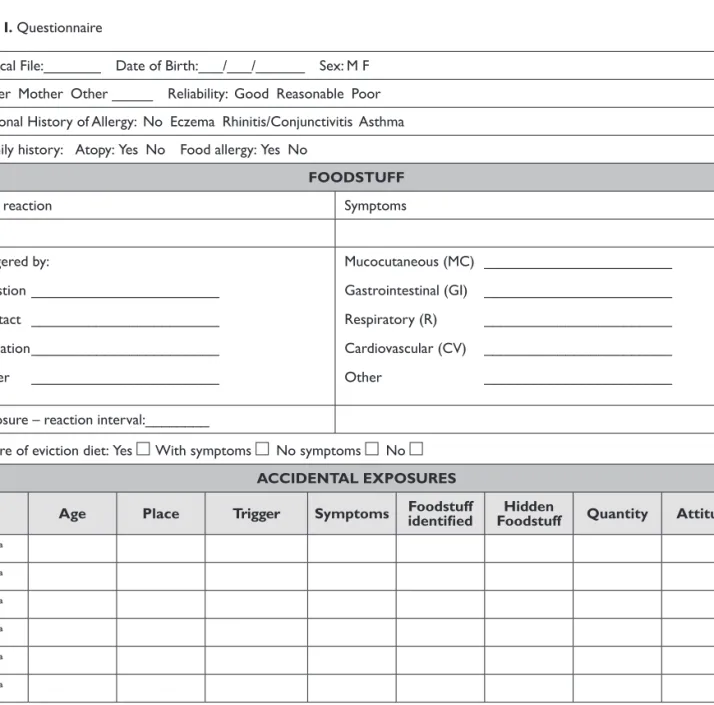
Procedeu -se ao contacto telefónico e à aplicação de um questionário aos prestadores de cuidados. Do questionário (Quadro 1) constavam os dados demográficos, o(s) alimento(s) implicado(s), os antecedentes pessoais e fami-liares de doença alérgica, a caracterização da primeira re-acção (forma como foi desencadeada, clínica, intervalo en-tre a exposição e a reacção), a existência de falhas na dieta,
caracterização das ingestões acidentais tendo em conta o número das mesmas, o local e o modo como ocorreram, a forma de apresentação do alimento (evidente ou oculto) e a atitude dos prestadores de cuidados perante a reacção.
Alguns doentes apresentavam alergia a mais do que um alimento em simultâneo. Para a análise de resultados defi-nimos como “caso” cada alergia alimentar em cada doen-te, pelo que o número de casos é superior ao número de doentes. À excepção dos dados demográficos, que se ba-seiam no número de doentes, toda a restante análise de resultados se baseia no número de casos de alergia alimen-tar ou no número de eventos de exposição acidental.
RESULTADOS
Foram contactados os pais de 65 doentes, 62 dos quais apresentavam alergia a apenas um alimento, dois a dois alimentos, e um doente tinha alergia a três alimentos. Des-te modo, a análise diz respeito a um total de 69 casos de alergia alimentar.
Quanto aos dados demográficos (Quadro 2), salienta--se o predomínio do sexo masculino e o facto de mais de metade dos doentes apresentar antecedentes pessoais e familiares de outra doença alérgica, embora apenas 9,2% tenham antecedentes familiares de alergia alimentar.
Os 69 casos de alergia alimentar apresentavam a se-guinte distribuição: 42 casos de alergia ao leite, 11 casos de alergia ao peixe, 10 de alergia ao ovo, 5 de alergia aos frutos secos e 1 de alergia ao amendoim. A primeira re-acção foi desencadeada por ingestão em 95,6% (66/69) e por contacto em 4,4% (3/69) dos casos. Na maioria dos casos (78,3%), a reacção foi imediata – surgiu em menos de 30 minutos em 60,9% (42/69) e entre 30 minutos a duas horas em 17,4% (12/69). Nos restantes 21,7% (15/69), a reacção manifestou -se após duas ou mais horas. Relati-vamente à forma de manifestação clínica inicial, os sintomas mucocutâneos (MC) foram os predominantes (75,4%; 52/69), seguindo -se os sintomas gastrintestinais (GI) (33,3%; 23/69) e os sintomas respiratórios (R) (23,2%; 16/69). Os EXPOSIÇÕES ACIDENTAIS NA ALERGIA ALIMENTAR / ARTIGO ORIGINAL
Imuno (19) 2 - Miolo 2ª PROVA PT.indd 95
96
R E V I S T A P O R T U G U E S A D E I M U N O A L E R G O L O G I A Quadro 1. Questionário
Processo clínico:_______ Data nascimento:___/___/______ Sexo: M F
Pai Mãe Outro _____ Fiabilidade: Boa Razoável Má
Antecedentes pessoais alergia: Não Eczema Rinite/Conjuntivite Asma Antecedentes familiares: Atopia: Sim Não Alergia alimentar: Sim Não
ALIMENTO
Primeira reacção Sintomas
Idade Desencadeada por: Ingestão _______________________ Contacto _______________________ Inalação _______________________ Outro _______________________ Mucocutâneos (MC) _______________________ Gastrointestinais (GI) _______________________ Respiratórios (R) _______________________ Cardiovasculares (CV) _______________________ Outros _______________________ Intervalo exposição – reacção:________
Falhas na dieta de evicção: Sim Com sintomas Sem sintomas Não EXPOSIÇÕES ACIDENTAIS
Idade Local Desencadeada Sintomas identifi cadoAlimento Alimento oculto Quantidade Atitude
1.ª 2.ª 3.ª 4.ª 5.ª 6.ª
Local: Casa (C), Restaurante (R), Escola (E), Casa familiar/amigo (CF/A), Outro (O) Desencadeada: Ingestão (Ing), Contacto (C), Inalação (Inal), Outro (O)
Sintomas: Mucocutâneos (MC) – prurido, eritema, urticária, angioedema, eczema, síndrome alergia oral; Gastrintestinais (GI) – náuseas,
vómitos, diarreia, cólica, hematoquesia, má progressão ponderal; Respiratórios (R) – rinite, conjuntivite, tosse sibilância, estridor, edema da glote, dispneia; Cardiovasculares (CV) – sudorese, palidez, cianose, taquicardia, palpitações, hipotensão, choque.
Quadro 2. Caracterização da amostra (n=65 doentes)
Idade Idade média: 4,3 anos (mínimo: 9,5 meses; máximo: 10 anos)
Género Masculino: n=41 (63%) / Feminino: n=24 (37%)
Antecedentes pessoais de doença alérgica Sim: n=41 (63%) / Não: n=24 (37%)
Antecedentes familiares de doença alérgica Sim: n=42 (64,6%) / Não: n=23 (35,4%)
Antecedentes familiares de alergia alimentar Sim: n=6 (9,2%) / Não: n=59 (90,8%)
Imuno (19) 2 - Miolo 2ª PROVA PT.indd 96
97
R E V I S T A P O R T U G U E S A D E I M U N O A L E R G O L O G I A sintomas MC consistiram maioritariamente em urticária
e/ou angioedema (36/52 casos), surgindo o eczema atópi-co em apenas 10 casos e eritema cutâneo em 6. Cerca de 17,4% (12/69) dos casos foram de anafilaxia, com mento mucocutâneo e respiratório em 7 casos, envolvi-mento mucocutâneo e gastrintestinal em 3 e envolvimen-to mucocutâneo, respiratório e gastrintestinal em 2. Em nenhum caso ocorreu envolvimento do sistema cardio-vascular.
As falhas na dieta de evicção instituída após o diagnós-tico de alergia alimentar ocorreram em 68,1% dos casos (47/69) e na maioria destes casos surgiram sintomas (87,1%; 41/47). De realçar que em apenas cerca de 1/3 dos casos (31,9%; 22/69) a dieta de evicção foi cumprida sem falhas aparentes. Nos casos de alergia ao leite, ocorreram falhas na dieta de evicção em 73,8% (31/42); nos casos de alergia ao peixe, em 81,9% (9/11); na alergia ao ovo as falhas verificaram -se em 50% (5/10); nos casos de alergia ao amen-doim/frutos secos estas ocorreram em 33,3% (2/5).
Nos 47 casos de alergia alimentar em que houve falhas na dieta foi possível contabilizar um total de 68 eventos de exposição acidental ao alimento implicado. Na origem destes eventos de exposição acidental, o leite foi o alimen-to implicado em 69,1% (47/68), em 14,7% (10/68) foi o ovo, em 13,2% (9/68) o peixe e em 2,9% (2/68) os frutos secos. Estas exposições acidentais (n=68) deram -se maioritaria-mente por ingestão (77,9%; 53/68), menos vezes surgiram por contacto cutâneo (20,6%; 14/68) e raramente por ina-lação (1,5%; 1/68). Entre os casos que tiveram exposições acidentais por ingestão, a maioria sofreu apenas um episó-dio (n=22), em 8 casos ocorreram dois episóepisó-dios e em 5 casos ocorreram três episódios de ingestão acidental.
As manifestações clínicas mais frequentes nos eventos de exposição acidental foram, tal como na reacção inicial, as MC em 55,9% (38/68), seguindo -se as do tracto respi-ratório (25%; 17/68) e as do tracto gastrintestinal (23,5%; 16/68). Na Figura 1 é apresentado o tipo de manifestações clínicas em função de cada um dos alimentos. Em 14 casos (20,5%) ocorreram reacções anafilácticas. Nestes, verificou--se envolvimento mucocutâneo e respiratório em 5 casos;
envolvimento mucocutâneo e gastrintestinal em 4; envol-vimento mucocutâneo, respiratório e gastrintestinal em 3; em 2 casos ocorreu envolvimento respiratório e gastrin-testinal. Em nenhum caso ocorreu envolvimento do siste-ma cardiovascular. Oito dos 14 eventos de exposições acidentais com anafilaxia ocorreram em doentes cuja ma-nifestação inicial foi de anafilaxia.
Nas exposições acidentais procurou -se avaliar se o alimento se encontrava oculto ou se se apresentava de forma visível. No caso do leite e do peixe, o alimento era visualmente identificável em cerca de metade dos casos (leite 51%, peixe 56%). Relativamente ao ovo e aos frutos secos o alimento estava na maioria das vezes oculto (ovo 70%, frutos secos 100%), ou seja, tinha sido utilizado como ingrediente mas a sua presença física não era evidente. A Figura 2 evidencia estes dados.
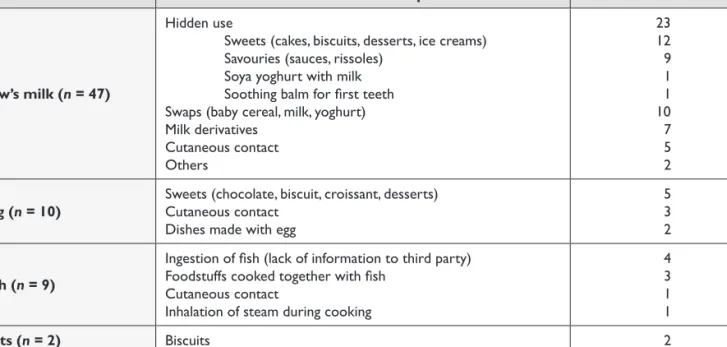
A maior parte das 68 exposições acidentais ocorreram em casa (36,8%; 25/68) ou na escola (29,4%; 20/68). Menos vezes aconteceram em casa de familiar ou amigo (17,6%; 12/68) e mais raramente em restaurantes (7,4%; 5/68) ou outros locais públicos (8,8%; 6/68). Quanto às circunstâncias das ex-posições acidentais, houve alguma variabilidade em função do alimento em causa, conforme se verifica no Quadro 3.
A utilização oculta de leite ou seus derivados, maiorita-riamente na confecção de pratos doces ou salgados, foi a EXPOSIÇÕES ACIDENTAIS NA ALERGIA ALIMENTAR / ARTIGO ORIGINAL
Legenda: MC – mucocutâneas; GI – gastrintestinais; R – respiratórias; A – anafilaxia
Figura 1. Manifestações clínicas nas exposições acidentais
Imuno (19) 2 - Miolo 2ª PROVA PT.indd 97
98
R E V I S T A P O R T U G U E S A D E I M U N O A L E R G O L O G I A causa mais frequente de exposição a este alimento, sendo
responsável por 23 eventos (Quadro 3). Foram também muito frequentes as trocas com alimentos contendo pro-teínas do leite de vaca, como leite, papas e iogurtes, que se apresentam de forma idêntica aos que não contêm proteínas de leite de vaca (por exemplo, embalagens semelhantes) e
o não reconhecimento (ou o esquecimento) de que os de-rivados do leite devem ser igualmente excluídos da dieta destes doentes. Outras situações mais particulares são re-feridas como Outros e incluem: o caso de uma criança cuja chupeta foi lavada no dispositivo de produção de vapor ge-ralmente utilizado para aquecer o leite nas máquinas de café expresso e desencadeou um quadro de urticária peribucal por provável contaminação; o caso de uma criança que de-senvolveu sintomas de urticária por tomar banho numa piscina onde outra criança vomitou após ter ingerido leite.
Nos casos em que o alimento implicado foi o ovo, a sua utilização na confecção de pratos doces ou salgados e o contacto acidental com ovo na cozinha, durante a preparação das refeições, foram os motivos apontados.
Relativamente ao peixe, as situações reportadas mais fre-quentemente foram a ingestão deste alimento devido à falta de transmissão da informação a outras pessoas que ficaram a prestar cuidados às crianças, bem como a ingestão de ali-mentos confeccionados juntamente com peixe. Outras situ-ações mais particulares estão indicadas no Quadro 3. A situa-ção desencadeada por contacto cutâneo ocorreu no Jardim Figura 2. Identificação do alimento implicado
Quadro 3. Circunstâncias em que ocorreu exposição acidental
Alimento Causa da exposição acidental n
Leite (n=47)
Utilização oculta
Doces (bolos, bolachas, sobremesas, gelados) Salgados (molhos, rissóis)
Iogurte de soja com leite Bálsamo primeiros dentes Trocas (papa, leite, iogurte) Derivados do leite Contacto cutâneo Outros 23 12 9 1 1 10 7 5 2
Ovo (n=10) Doces (chocolate, bolacha, croissant, sobremesas)Contacto cutâneo Pratos confeccionados com ovo
5 3 2
Peixe (n=9)
Ingestão de peixe (falta de informação a terceiros) Alimentos cozinhados em conjunto com peixe Contacto cutâneo
Inalação de vapores durante a confecção
4 3 1 1
Frutos secos (n=2) Bolachas 2
Imuno (19) 2 - Miolo 2ª PROVA PT.indd 98
99
R E V I S T A P O R T U G U E S A D E I M U N O A L E R G O L O G I A Zoológico de Lisboa e foi resultante do “beijo” de uma foca
durante a apresentação da alimentação dos leões -marinhos (com peixe). A reacção consistiu numa urticária de contacto.
No caso dos frutos secos, as reacções deram -se por ingestão de bolachas contendo estes alimentos.
A atitude perante a reacção foi administrar terapêuti-ca de emergência em 41,2% (28/68), aguardar resolução espontânea em 38,2% (26/68) e recurso ao serviço de urgência em 20,6% (14/68) dos casos. Quanto à terapêu-tica medicamentosa, a mais utilizada foi o anti -histamínico H1 (25%; 17/68), seguido do corticóide oral (17,6%; 12/68) e menos vezes houve recurso ao broncodilatador de cur-ta acção (13,2%; 9/68). No único caso em que houve re-curso à adrenalina (1,5%; 1/68), a administração foi feita pelos profissionais de saúde, no serviço de urgência.
DISCUSSÃO
Com este estudo pretendeu -se conhecer melhor a frequência e as circunstâncias em que ocorrem as expo-sições acidentais numa população pediátrica com alergia alimentar e os resultados mostram -nos que, nos nossos doentes, as ingestões alimentares acidentais são comuns e acompanham -se muito frequentemente de sintomas de maior ou menor gravidade.
Verificou -se que ocorreram falhas na dieta de evicção em 68,1% dos casos. Na literatura não foram encontrados estudos semelhantes, pelo que foi difícil comparar os nossos dados. No entanto, num estudo canadiano, em que se pre-tendia estudar especificamente o papel da rotulagem dos alimentos, 47,8% dos doentes relatava ter sofrido exposições acidentais10. Tratava -se maioritariamente de doentes alérgi-cos ao amendoim e cerca de metade da amostra foi recru-tada a partir de associações de doentes com alergia alimen-tar, o que poderá justificar a percentagem mais baixa de falhas na dieta. Adicionalmente, o mesmo estudo constata que os doentes alérgicos a amendoim, frutos secos, peixe ou crustáceos apresentam uma percentagem mais baixa de exposições acidentais do que os alérgicos a outros
alimen-tos. Esta diferença poderá ser explicada pelo facto daqueles alimentos causarem frequentemente reacções de maior gravidade, levando a um maior cuidado na sua identificação, tanto por parte da indústria alimentar como do doente10.
Nos doentes estudados, a maior parte das exposições acidentais condicionou reacção clínica (87,2%) e, ao con-trário do que é habitualmente referido,9 deu -se com maior frequência em casa e na escola, ou seja, no contexto do dia -a -dia da criança, e mais raramente em restaurantes ou em casa de familiares ou amigos. Provavelmente, nas situa-ções tipicamente identificadas e ensinadas como sendo de risco, a vigilância é maior, reduzindo efectivamente a ocor-rência de exposições acidentais nesse contexto. O am-biente familiar do dia -a -dia será provavelmente mais pro-pício a momentos de abrandamento da vigilância.
Quanto à forma de exposição, para além das situações classicamente mencionadas na literatura – presença ocul-ta do alimento e falhas na leitura dos rótulos3,9,10 –, iden-tificámos mais algumas que também ocorreram com fre-quência. Salientam -se as trocas com alimentos do mesmo tipo e com embalagens semelhantes (papas, leites, iogurtes), o desconhecimento (ou esquecimento) de que os alimen-tos da mesma família e derivados contêm o alergénio res-ponsável (por ex., derivados do leite) e, finalmente, as falhas na passagem de informação a terceiros (familiares, funcio-nários escolares, amas). Os restantes casos que surgiram de uma forma mais rara são também importantes, pois o seu conhecimento e divulgação podem ajudar a prevenir situações semelhantes noutros doentes.
Os dados obtidos parecem sugerir que o conhecimen-to que está a ser transmitido aos pais/prestadores de cui-dados pode não ser suficiente, havendo a necessidade de veicular mais e melhor informação e educar devidamente os pais/prestadores de cuidados no sentido da evicção do alimento implicado na alergia alimentar.
Pelo menos nalguns casos de crianças com alergia alimen-tar poderá ser importante uma abordagem multidisciplinar, com o apoio de nutricionista/dietista, de forma a optimizar a veiculação da informação aos pais/prestadores de cuidados. Adicionalmente, e à semelhança do que existe para certas EXPOSIÇÕES ACIDENTAIS NA ALERGIA ALIMENTAR / ARTIGO ORIGINAL
Imuno (19) 2 - Miolo 2ª PROVA PT.indd 99
100
R E V I S T A P O R T U G U E S A D E I M U N O A L E R G O L O G I A doenças crónicas, os doentes e pais/prestadores de cuidados
poderiam beneficiar de grupos de apoio em que se partilham experiências de situações concretas11, os quais actualmente ainda não existem em Portugal para a alergia alimentar.
No que respeita à atitude perante a reacção, verificou--se que apenas um quinto teve necessidade de recorrer ao serviço de urgência. Dos restantes, cerca de metade teve resolução espontânea – provavelmente os casos com reacções de menor gravidade – e a outra metade resolveu a situação com recurso a medicação com anti -histamínicos, corticóides e/ou broncodilatadores, o que pode significar que a maioria dos pais/prestadores de cuidados estarão bem orientados para a abordagem da reacção aguda. Há algumas evidências de que, nos doentes com história de reacções mais graves, há um maior cuidado na evicção de exposições acidentais10 que poderá também contribuir para a aparente baixa frequência de reacções graves na amostra estudada.
O recurso quase nulo à adrenalina, apesar de 20,5% das reacções acidentais referidas serem de tipo anafilácti-co, está de acordo com os dados observados noutros estudos que também detectam uma utilização deste fár-maco inferior à que seria desejável em situações de ur-gência12. No entanto, temos que admitir que, entre as crianças que recorreram à urgência hospitalar, possa ter havido mais algumas tratadas com adrenalina sem que os pais tenham tido conhecimento do facto.
CONCLUSÕES
As falhas na dieta de evicção foram frequentes, a maio-ria com sintomas. As exposições acidentais aconteceram maioritariamente no contexto do dia -a -dia da criança, o que pode sugerir lacunas de conhecimento dos pais/pres-tadores de cuidados.
Através da caracterização das exposições acidentais, numa amostra de doentes com alergia alimentar, poder--se -á contribuir para optimizar a transmissão de informa-ção aos doentes e seus responsáveis relativamente à
iden-tificação de situações de risco potencial e aos cuidados a ter na evicção.
Financiamento: Nenhum
Declaração de conflitos de interesse: Nenhum.
Contacto:
Sónia Filipa de Sousa Jardim Fernandes Rua Ilha dos Amores, lote 4.11.02 B, 4.º Esq. 1990 -121 Lisboa
e -mail: [email protected]
REFERÊNCIAS
1. Sicherer SH, Munoz -Furlong A, Sampson HA. Prevalence of peanut and tree nut allergy in United States determined by means of a random digit dial telephone survey: a five year follow -up study. J Allergy Clin Immunol 2003; 112: 1203 -7.
2. Bock SA. Retrospective appraisal of complaints of adverse reactions to foods in children during the first three years of life. Pediatrics 1987; 79: 683 -8.
3. Sicherer SH, Teuber S. Current approach to the diagnosis and man-agement of adverse reactions to foods. J Allergy Clin Immunol 2004; 114: 1146 -50.
4. Mathew I, Jonathan MS: Management of food allergies. Expert opin-ion Pharmacother 2003; 4(7): 1025 -37.
5. Kemp AS, Hu W. Food allergy and anaphylaxis – dealing with uncer-tainty. Med J Aust 2008; 188: 503 -4.
6. Teufel M, Biedermann T, rapps N, et al. Psychological burden of food allergy. World J Gastroenterol 2007; 13: 3456 -65.
7. Sicherer SH, Noone SA, Munoz -Furlong A. The impact of childhood food allergy on quality of life. Ann Allergy Asthma Immunol 2001; 87: 461 -4.
8. Marklund B, Ahlstedt S, Nordström G. Food hypersensitivity and quality of life. Curr Opin Allergy Clin Immunol 2007; 7: 297 -87. 9. Sampson HA. Food allergy. Part 2: Diagnosis and management. J
Allergy Clin Immunol 1999; 103: 981 -9.
10. Sheth SS, Waserman S, Kagan R, Alizadehfar R, Primeau MN, Elliot S,
et al. Role of food labels in accidental exposures in food -allergic
in-dividuals in Canada. Ann Allergy Asthma Immunol 2010; 104: 60 -5. 11. Wendy Hu, Robert Lo, John Zi. Attributes and views of families with
food allergic children recruited from allergy clinics and from a con-sumer organization. Pediatr Allergy Immunol 2008; 19: 264 -9. 12. MM Almeida, A Gaspar, C Santa -Marta, S Piedade, P Leiria -Pinto, G
Pires et al. Anafilaxia – da notificação e reconhecimento à abordagem terapêutica. Rev Port Imunoalergologia 2007; 15 (1): 19 -41.
Imuno (19) 2 - Miolo 2ª PROVA PT.indd 100
93
R E V I S T A P O R T U G U E S A D E I M U N O A L E R G O L O G I A
ORIGINAL ARTICLE
ABSTRACT
Background: The usual recommendation in food allergy treatment is strict eviction until tolerance is established. It is important to know how an eviction diet fails in order to improve the information we give to food -allergic patients. Objective: To identify the frequency and to characterise accidental food exposures in a group of food -allergic patients. Material and methods: Children aged ten years or less, allergic to cow’s milk proteins, egg, fish, peanut or nuts were selected from the files of patients followed up at the Allergology and Clinical Immunology outpatient clinic of Hospital Dona Estefânia. Parents/caregivers answered a questionnaire regarding the culprit food, symptoms and characterisation of accidental exposures. Results: We selected a group of 65 patients, with a median age of 4.3 years (63% males), corresponding to 69 cases of food allergy – 42 cases of cow’s milk protein allergy, 11 cases of fish al-lergy, 10 cases of egg alal-lergy, five cases of nut allergy and one case of peanut allergy. The first reaction occurred, in most cases, by ingestion (95.6%) and was immediate (78.3%). Symptoms were mucocutaneous in 75.4%, gastrointes-tinal in 33.3% and respiratory in 23.2%. Anaphylaxis occurred in 17%. The eviction diet failed in 68.1% cases, which corresponded to 68 accidental exposure occurrences, most with symptoms (87.1%). Of these 68 accidental exposures, the culprit food was cow’s milk in 69.1% (n = 47), egg in 14.7% (n = 10), fish in 13.2% (n = 9) and nuts in 2.9% (n = 2). Mucocutaneous manifestations were the most frequent (55.9%), followed by respiratory symptoms (25%) and gastrointestinal symptoms (23.5%). Anaphylaxis occurred in 20.5%. Most accidental exposures were at home (36.8%) and at school (29.4%). After the reaction, parents/caregivers administered medication in 41.2% of cases, waited until spontaneous resolution took place in 38.2% and went to Emergency Room Departments in 20.6%. Conclusion: Eviction diet failures were frequent, most of them with symptoms. Most accidental exposures occurred at home and at school. This may indicate gaps in parents’/care givers’ knowledge. The characterisation of accidental exposures in
Accidental exposures in food allergy
Exposições acidentais na alergia alimentar
Filipa Sousa1, João Antunes2, Maria João Paes3, Marta Chambel2, Sara Prates2, Paula Leiria Pinto2
1 Allergology and Clinical Immunology Unit, Hospital Central do Funchal, Madeira,
2 Allergology and Clinical Immunology Clinic, Centro Hospitalar de Lisboa Central, Hospital Dona Estefânia, Lisbon 3 Allergology and Clinical Immunology Clinic, Centro Hospitalar de Lisboa Norte, Hospital Pulido Valente, Lisbon
R e v P o r t I m u n o a l e r g o l o g i a 2 0 1 1 ; 1 9 ( 2 ) : 9 3 - 1 0 0
Data de recepção / Received in: 06/01/2011 Data de aceitação / Accepted for publication in: 17/06/2011
Imuno (19) 2 - Miolo 2ª PROVA EN.indd 93
94
R E V I S T A P O R T U G U E S A D E I M U N O A L E R G O L O G I A
INTRODUCTION
T
he prevalence of food allergy has been increasing in western countries, namely in paediatric age individuals1. It is estimated at being around 6 -8% in childhood2. The foodstuffs most frequently involved arecow’s milk, egg, fi sh, soya, wheat, shellfi sh, peanut and nuts. Currently, the only safe recommendation in treating food allergy is complete eviction until tolerance is aquired3,4.
Accidental ingestion and exposure are a constant source of worry for patients and their families, given that they can lead to potentially fatal reactions, which can bring with it a food -allergic patients may help to improve the information transmitted to parents/caregivers to help them identify risk factors and be aware of avoidance measures.
Key -words: contact, food allergy, exposure, ingestion, accidental reaction
RESUMO
Introdução: A recomendação habitual no tratamento da alergia alimentar é a evicção completa, até à aquisição de tolerância. É
importante perceber em que situações ocorrem falhas na evicção, de forma a orientar o melhor possível o doente com alergia alimentar.
Objectivo: Conhecer a frequência e caracterizar as exposições acidentais, num grupo de doentes com alergia alimentar. Material e Métodos: A partir dos registos do Serviço de Imunoalergologia do Hospital Dona Estefânia, foram seleccionados doentes com idade ≤
10 anos, com alergia às proteínas do leite de vaca, ovo, peixe, amendoim ou frutos secos. Os pais/prestadores de cuidados, responderam a um inquérito telefónico, referente ao alimento implicado, falhas na dieta e sintomas. Resultados: Contactou -se um grupo de 65 do-entes com idade média de 4,3 anos (63% do sexo masculino), totalizando 69 casos de alergia alimentar – cerca de 42 casos de alergia ao leite, 11 casos de alergia ao peixe, 10 de alergia ao ovo, 5 de alergia aos frutos secos e 1 de alergia ao amendoim. Na maioria dos casos a 1.ª reacção foi desencadeada por ingestão (95,6%) e foi imediata (78,3%), manifestando -se por sintomas mucocutâneos (MC) em 75,4%, gastrointestinais em 33,3% e respiratórios em 23,2%. Ocorreu anafilaxia em 17%. Houve falhas na dieta em 68,1% dos casos, que contabilizaram um total de 68 eventos de exposição acidental, na maioria (87,1%) com sintomas. Destes 68 eventos de ex-posição acidental, em 69,1% (n=47) o leite foi o alimento implicado, em 14,7% (n=10) foi o ovo, em 13,2% (n=9) o peixe e em 2,9% (n=2) os frutos secos. As manifestações clínicas mais frequentes foram MC (55,9,9%), seguindo -se as do tracto respiratório (25%) e as do tracto gastrointestinal (23,5%). Em 20,5% dos eventos de exposição acidental, ocorreu reacção anafiláctica. A maior parte das inges-tões / exposições acidentais ocorreram em casa (36,8%) e na escola (29,4%). Perante a reacção foi administrada terapêutica em 41,2%, aguardaram resolução espontânea 38,2% e recorreram ao Serviço de Urgência 20,6% dos casos. Conclusões: As falhas na dieta de evicção foram frequentes, a maioria com sintomas. Aconteceram maioritariamente em casa e na escola, o que pode sugerir lacunas no conhecimento dos pais/prestadores de cuidados. A caracterização das exposições acidentais nos doentes com alergia alimentar poderá ajudar a optimizar a transmissão de informação, a estes e aos seus responsáveis, relativamente à prevenção de situações de risco.
Palavras -chave: alergia, alimentar, contacto, exposição, ingestão, reacção acidental
Imuno (19) 2 - Miolo 2ª PROVA EN.indd 94
95
R E V I S T A P O R T U G U E S A D E I M U N O A L E R G O L O G I A heavy emotional burden5,6. Challenges such as reading
food-stuff labels or the care involved in avoiding cross -contamination occur daily, as do the potential limitations to social activities which involve food, such as school, eating out, visiting friends and family. This has a negative impact on these patients’ qual-ity of life7,8. Further, patients and their parents/caregivers have to be instructed about what to do in case of accidental exposure3,9. It is important to understand in which situations accidental exposure can occur, to better guide the daily life of a patient with food allergy. Health professionals’ knowl-edge of patients’ day -to -day reality can improve the informa-tion transmitted to parents/caregivers to help them identify risk factors and be aware of avoidance measures.
Our aim was to study the frequency of accidental ex-posure (ingestion/contact/inhalation) in a group of patients with food allergy and characterise accidental food expo-sure, what led to it and reactions to it, in order to improve the information we give to food -allergic patients and tailor it to their reality.
MATERIAL AND METHODS
Children aged ten years or less, allergic to cow’s milk proteins, egg, fish, peanut or nuts were selected from the files of patients followed up at the Allergology and Clinical Immunology outpatient clinic in Hospital Dona Estefânia. Parents/caregivers were contacted by phone and asked to answer a questionnaire. The questionnaire (Table I) mapped out demographic data, the trigger foodstuff(s), personal and family history of allergic disease, characterisation of the first reaction (how it was triggered, its clinical mani-festations, time lag between exposure and reaction) and failure in the diet, characterisation of accidental ingestions in terms of number, the place and manner in which they
occurred, how the food was presented (obviously or hid-den) and parents’/caregivers’ attitudes to the reaction.
Some patients were allergic to more than one foodstuff simultaneously. In order to analyse the results, we defined as a “case” each food allergy in each patient, meaning the number of cases is higher than the number of patients. Unlike demographic data, which is based on the number of patients, all the remaining analysis of results is based on the number of cases of food allergy or the number of oc-currences of accidental exposure.
RESULTS
We contacted the parents of 65 patients, 62 of which had allergy to only one foodstuff, two to two foodstuffs and one to three. Hence the analysis deals with a total of 69 cases of food allergy.
Of the demographic data (Table II), we highlight the predominance of males and that over half the patients had personal and family histories of another allergic disease, although only 9.2% had family history of food allergy.
The 69 cases of food allergy consisted of 42 cases of cow’s milk allergy, 11 cases of fish allergy, 10 of egg allergy, five of nut allergy and one of peanut allergy. The first reaction was triggered by ingestion in 95.6% (66/69) of cases and by contact in 4.4% (3/69) of cases. In the majority of cases (78.3%), the reaction was immediate, occurring within less than 30 minutes in 60.9% (42/69) and within 30 minutes to two hours in 17.4% (12/69). In the remaining 21.7% (15/69) cases, the reaction manifested after two or more hours. In terms of the initial clinical manifestation, mucocutaneous (MC) symptoms were predominant (75.4%; 52/69), followed by gastrointestinal (GI) (33.3%; 23/69) and respiratory (R) symptoms (23.2%; 16/69). Mucocutaneous symptoms were ACCIDENTAL EXPOSURES IN FOOD ALLERGY / ORIGINAL ARTICLE
Imuno (19) 2 - Miolo 2ª PROVA EN.indd 95
96
R E V I S T A P O R T U G U E S A D E I M U N O A L E R G O L O G I A Table I. Questionnaire
Clinical File:_______ Date of Birth:___/___/______ Sex: M F Father Mother Other _____ Reliability: Good Reasonable Poor Personal History of Allergy: No Eczema Rhinitis/Conjunctivitis Asthma Family history: Atopy: Yes No Food allergy: Yes No
FOODSTUFF
First reaction Symptoms
Age Triggered by: Ingestion _______________________ Contact _______________________ Inhalation _______________________ Other _______________________ Mucocutaneous (MC) _______________________ Gastrointestinal (GI) _______________________ Respiratory (R) _______________________ Cardiovascular (CV) _______________________ Other _______________________ Exposure – reaction interval:________
Failure of eviction diet: Yes With symptoms No symptoms No
ACCIDENTAL EXPOSURES
Age Place Trigger Symptoms Foodstuff identifi ed Foodstuff Hidden Quantity Attitude
1.ª 2.ª 3.ª 4.ª 5.ª 6.ª
Place: Home (H), Restaurant (R), School (S), House of family member/friend (HF/F), Other (O) Triggered by: Ingestion (Ing), Contact (C), Inhalation (Inha), Other (O)
Symptoms: Mucocutaneous (MC) – pruritus, erythema, urticaria, angiooedema, eczema, oral allergy syndrome; Gastrointestinal (GI)
– nauseas, vomiting, diarrhoea, colic, haematochezia, poor ponderal progression; Respiratory (R) – rhinitis, conjunctivitis, cough, wheeze, stridor, oedema of the glottis, dyspnoea; Cardiovascular (CV) – sweating, palidity, cyanosis, tachycardia, palpitations, hypotension, shock.
Table II. Sample characterisation (n = 65 patients)
Age Mean age: 4.3 years (minimum: 9.5 months; maximum: 10 years)
Gender Male: n = 41 (63%) / Female: n = 24 (37%)
Personal history of allergic disease Yes: n = 41 (63%) / No: n = 24 (37%)
Family history of allergic disease Yes: n = 42 (64,6%) / No: n = 23 (35,4%)
Family history of food allergy Yes: n = 6 (9,2%) / No: n = 59 (90,8%)
Imuno (19) 2 - Miolo 2ª PROVA EN.indd 96
97
R E V I S T A P O R T U G U E S A D E I M U N O A L E R G O L O G I A mainly urticaria and/or angio -oedema (36/52 cases),
fol-lowed by atopic eczema in only 10 cases and cutaneous erythema in six. Around 17.4% (12/69) of cases were ana-phylaxis, with mucocutaneous and respiratory involvement in seven cases, mucocutaneous and gastrointestinal in three and mucocutaneous, respiratory and gastrointestinal in two. No case had involvement of the cardiovascular system.
Failures in the eviction diet that had been started when the food allergy was diagnosed occurred in 68.1% of cases (47/69) and in the majority of these cases symptoms oc-curred (87.1%; 41/47). We highlight that in only around one--third of cases (31.9%; 22/69) was the eviction diet maintained with no apparent failures. In the cases of cow’s milk allergy, there were failures in the eviction diet in 73.8% (31/42) cases; in the cases of fish allergy in 81.9% (9/11); in egg al-lergy there were failures in 50% (5/10) cases; in the cases of peanut/nut allergy there were failures in 33.3% (2/5) cases.
In the 47 cases of food allergy in which there were failures in the eviction diet, it was possible to count a total of 68 accidental exposures to the foodstuff in question. In terms of the origin of these accidental exposures, cow’s milk was the trigger foodstuff in 69.1% (47/68), egg in 14.7% (10/68), fish in 13.2% (9/68) and nuts in 2.9% (2/68). These accidental exposures (n = 68) occurred mainly by ingestion (77.9%; 53/68), less by cutaneous contact (20.6%; 14/68) and rarely by inhalation (1.5%; 1/68). The majority of cases in which accidental exposure was by ingestion suffered only 1 episode (n = 22); in eight cases there were 2 episodes and in five cases there were 3 episodes of accidental ingestion.
The most frequent clinical manifestations in accidental exposure occurrences were, just as in the initial reaction, 55.9% (38/68) MC, followed by respiratory tract reactions (25%; 17/68) and gastrointestinal tract reactions (23.5%; 16/68). Figure 1 shows the type of clinical reaction for each foodstuff. In 14 cases (20.5%) there were anaphylactic
re-actions. Of these, there was mucocutaneous and respira-tory involvement in five cases; mucocutaneous and gastro-intestinal in four; mucocutaneous, respiratory and gastrointestinal involvement in three; and gastrointestinal and respiratory involvement in two. No case had involve-ment of the cardiovascular system. Eight of the 14 acci-dental exposure events with anaphylaxis occurred in pa-tients whose initial manifestation was anaphylaxis.
We investigated whether the foodstuff was identified or hidden, in the accidental exposures. In the case of cow’s milk and fish, the foodstuff was visually identifiable in around half of the cases (cow’s milk 51%, fish 56%). Egg and nuts were mostly hidden (egg 70%, nuts 100%), mean-ing they had been used as an mean-ingredient but their physical presence was not evident. Figure 2 shows these data.
The majority of the 68 accidental exposures occurred at home (36.8%; 25/68) or at school (29.4%; 20/68). They occurred less often in the house of a family member or friend (17.6%; 12/68), and rarely in restaurants (7.4%; 5/68) or other public places (8.8%; 6/68). In terms of their cir-cumstances, there was some variability as to the foodstuff in question, as Table III shows.
ACCIDENTAL EXPOSURES IN FOOD ALLERGY / ORIGINAL ARTICLE
Legend: MC – mucocutaneous; GI – gastrointestinal; R – respiratory; A – anaphylaxis
Figure 1. Clinical manifestations in accidental exposure
Imuno (19) 2 - Miolo 2ª PROVA EN.indd 97
98
R E V I S T A P O R T U G U E S A D E I M U N O A L E R G O L O G I A The hidden use of cow’s milk or its derivatives, mainly in
sweets and savouries, was the most frequent cause of ex-posure to this foodstuff, and was responsible for 23 occur-rences (Table III). The swapping with foodstuffs containing cow’s milk proteins, such as milk, baby cereals and yoghurts,
which look identical to those which do not contain cow’s milk proteins (for example, similar packaging) and the non--recognition (or forgetting) that cow’s milk derivatives must also be excluded from these patients’ diets was also frequent. Other more particular situations are labelled Others and include: the case of a child whose dummy was washed in a steam heater usually used to heat the milk in espresso cof-fee machines and which triggered peri -bucal urticaria due to probable contamination; the case of a child who developed urticaria symptoms after being in a swimming pool in which another child had vomited after ingesting milk.
In cases of egg allergy, the reasons given for the acci-dental exposure incidents were the use of egg in sweet or savoury dishes and accidental contact with egg in the kitchen during the preparation of meals.
Concerning fish, the most frequently reported symp-toms were ingestion of fish due to a failure to transmit information to people taking care of the child, in addition Figure 2. Identification of the trigger foodstuff
Table III. Circumstances in which accidental exposure occurred
Foodstuff Cause of accidental exposure n
Cow’s milk (n = 47)
Hidden use
Sweets (cakes, biscuits, desserts, ice creams) Savouries (sauces, rissoles)
Soya yoghurt with milk Soothing balm for fi rst teeth Swaps (baby cereal, milk, yoghurt) Milk derivatives Cutaneous contact Others 23 12 9 1 1 10 7 5 2
Egg (n = 10) Sweets (chocolate, biscuit, croissant, desserts)Cutaneous contact Dishes made with egg
5 3 2
Fish (n = 9)
Ingestion of fi sh (lack of information to third party) Foodstuffs cooked together with fi sh
Cutaneous contact
Inhalation of steam during cooking
4 3 1 1
Nuts (n = 2) Biscuits 2
Imuno (19) 2 - Miolo 2ª PROVA EN.indd 98
99
R E V I S T A P O R T U G U E S A D E I M U N O A L E R G O L O G I A to the ingestion of food cooked together with fish. Table
III shows other more particular cases. The situation trig-gered by cutaneous contact occurred at Lisbon Zoo and was caused by a sea lion giving a “kiss” to a child during the sea lions’ feeding time (the sea lions are fed with fish). The reaction seen in this case was contact urticaria.
Reactions to nuts were triggered by ingestion of bis-cuits containing nuts.
The attitude in response to the reaction was to admin-ister emergency treatment in 41.2% (28/68) of cases, wait for spontaneous resolution in 38.2% (26/68) and Emergen-cy Room (ER) visits in 20.6% (14/68). The most frequently used medicine was H1 -antihistamine (25%; 17/68), followed by oral corticosteroids (17.6%; 12/68), while there was less frequent recourse to short -acting bronchodilator (13.2%; 9/68). There was only one case of adrenaline being adminis-tered (1.5%; 1/68) by healthcare professionals at the ER.
DISCUSSION
This study aimed to identify the frequency of and to char-acterise accidental food exposures in a group of food -allergic paediatric patients. The results show that in our patients, cidental foodstuff ingestion is common and very often ac-companied by symptoms of greater or lesser severity.
There were failures in the eviction diet in 68.1% of cases. We found no similar studies in the literature, meaning it was difficult to compare our data. A Canadian study, how-ever, specifically analysing the role of foodstuff labels, found that 47.8% of patients had experienced accidental expo-sures10. These were mainly patients with peanut allergy and around half the sample was recruited from food -allergy patients’ associations, which could explain the lower per-centage of eviction diet failure. Additionally, the same study
reported that patients allergic to peanut, nuts, fish or shell-fish had a lower percentage of accidental exposure than those allergic to other foodstuffs. This difference can be explained by the fact that those foodstuffs give rise to more severe reactions, leading to greater care being taken in their identification by both the food industry and the patient10.
In our patients, the majority of the accidental exposures led to a clinical reaction (87.2%) and, unlike what is usually reported9, they occurred more frequently at home or at school, that is, as part of the child’s daily routine. They occurred more rarely in restaurants or at friends’ or family members’ houses. It could be that vigilance is greater in situations typi-cally seen and taught as being those containing risk, thus ef-fectively reducing the occurrence of accidental exposure episodes at these places. A day -to -day domestic environment is probably more conducive to relaxing one’s vigilance.
As regards the form of exposure, in addition to the situations usually reported in the literature – the hidden presence of the foodstuff and failures in reading product labels3,9,10 – we identified some others which often occur. We highlight the swapping for foodstuffs of the same type and with similar packaging (baby cereal, milk, yoghurts), the lack of knowledge (or forgetting) that foodstuffs of the same family and derivatives contain the trigger allergen (for example, cow’s milk derivatives) and finally, failures to pass on the information to third parties (family members, members of school staff, nannies). The remaining cases, which illustrate more unusual forms, are also important as knowledge of these and dissemination of that knowledge could help prevent similar situations in other patients.
The data we obtained seem to suggest that the infor-mation transmitted to parents/caregivers might not be sufficient and that there is a need to pass on more and better information and duly educate parents/caregivers to avoid the trigger foodstuff in food -allergy cases.
ACCIDENTAL EXPOSURES IN FOOD ALLERGY / ORIGINAL ARTICLE
Imuno (19) 2 - Miolo 2ª PROVA EN.indd 99
100
R E V I S T A P O R T U G U E S A D E I M U N O A L E R G O L O G I A A multidisciplinary approach is important in at least some
cases of children with food allergy, with support from a nutrition-ist/dietician, to improve the information given to parents/care-givers. In addition, and as is the case in some chronic diseases, patients and parents/caregivers can benefit from support groups with whom to share experiences of concrete situations11. There are as yet no food -allergy support groups in Portugal.
In terms of the attitude taken to the reaction, only a fifth of patients needed to go to the ER. Of the remaining, around half had spontaneous resolution – most likely the cases with less severe reactions – and the other half were resolved with antihistamines, corticosteroids and/or bronchodilators, which could mean that the majority of parents/caregivers are well informed as to how to deal with an acute reaction. There is some evidence that patients with a history of more severe reactions take greater care in avoiding accidental exposures10. This could also contribute to the seemingly low frequency of severe reactions in the sample studied.
The almost nil recourse to adrenaline, despite 20.5% of the accidental reactions reported being anaphylactic, is in line with data seen in other studies, which also found a lower than desirable use of this drug in emergency situa-tions12. That said, we admit that there could have been some use of adrenaline in the children who went to the ER, with their parents being unaware of this fact.
CONCLUSIONS
There were frequent failures in the eviction diets, the majority with symptoms. Accidental exposures occurred mainly as part of a child’s everyday routine, which could indicate gaps in parents’/caregivers’ knowledge.
A mapping of accidental exposures in a sample of patients with food allergy can help to improve the information
trans-mitted to patients and their parents/caregivers to help them identify risk factors and be aware of avoidance measures. Funding: None
Conflict of interest disclosure: None
Contact:
Sónia Filipa de Sousa Jardim Fernandes
Rua Ilha dos Amores, lote 4.11.02 B, 4.º Esq, 1990 -121 Lisboa E -mail: [email protected]
REFERENCES
1. Sicherer SH, Munoz -Furlong A, Sampson HA. Prevalence of peanut and tree nut allergy in United States determined by means of a random digit dial telephone survey: a five year follow -up study. J Allergy Clin Immunol 2003; 112: 1203 -7.
2. Bock SA. Retrospective appraisal of complaints of adverse reactions to foods in children during the first three years of life. Pediatrics 1987; 79: 683 -8.
3. Sicherer SH, Teuber S. Current approach to the diagnosis and man-agement of adverse reactions to foods. J Allergy Clin Immunol 2004; 114: 1146 -50.
4. Mathew I, Jonathan MS: Management of food allergies. Expert opin-ion Pharmacother 2003; 4(7): 1025 -1037.
5. Kemp AS, Hu W. Food allergy and anaphylaxis – dealing with uncer-tainty. Med J Aust 2008; 188: 503 -4.
6. Teufel M, Biedermann T, rapps N, et al. Psychological burden of food allergy. World J Gastroenterol 2007; 13: 3456 -65.
7. Sicherer SH, Noone SA, Munoz -Furlong A. The impact of childhood food allergy on quality of life. Ann Allergy Asthma Immunol 2001; 87: 461 -4.
8. Marklund B, Ahlstedt S, Nordström G. Food hypersensitivity and quality of life. Curr Opin Allergy Clin Immunol 2007; 7: 297 -87. 9. Sampson HA. Food allergy. Part 2: Diagnosis and management. J
Allergy Clin Immunol 1999; 103: 981 -9.
10. Sheth SS, Waserman S, Kagan R, Alizadehfar R, Primeau MN, Elliot S, et al. Role of food labels in accidental exposures in food -allergic in-dividuals in Canada. Ann Allergy Asthma Immunol 2010; 104: 60 -5. 11. Wendy Hu, Robert Lo, John Zi. Attributes and views of families with
food allergic children recruited from allergy clinics and from a con-sumer organization. Pediatr Allergy Immunol 2008; 19: 264 -269. 12. MM Almeida, A Gaspar, C Santa -Marta, S Piedade, P Leiria -Pinto, G
Pires et al. Anafilaxia – da notificação e reconhecimento à abordagem terapêutica. Rev Port Imunoalergologia 2007; 15 (1): 19 -41.
Imuno (19) 2 - Miolo 2ª PROVA EN.indd 100