Vera Alexandra
Félix Graça Silva
Contaminação por escorrências de incêndios:
efeitos da biofiltração
Contamination by wildfires runoff: effects of
biofiltration
Vera Alexandra
Félix Graça Silva
Contaminação por escorrências de incêndios:
efeitos da biofiltração
Contamination by wildfires runoff: effects of
biofiltration
Dissertação apresentada à Universidade de Aveiro para cumprimento dos requisitos necessários à obtenção do grau de Mestre em Biologia Aplicada, ramo Ecologia, Biodiversidade e Gestão de Ecossistemas, realizada sob a orientação científica do Doutor Fernando José Mendes Gonçalves, Professor Associado com Agregação do Departamento de Biologia da Universidade de Aveiro, e co-orientação do Doutor Nelson José Cabaços Abrantes, investigador de pós-doutoramento do CESAM e da Universidade de Aveiro e da Doutora Joana Luísa Lourenço Estevinho Pereira, investigadora de pós-doutoramento do CESAM e da Universidade de Aveiro.
Esta dissertação foi financiada por Fundos FEDER através do Programa
Operacional Fatores de
Competitividade – COMPETE e por Fundos Nacionais através da FCT – Fundação para a Ciência e a Tecnologia no âmbito do projeto
o júri
presidente Doutora Maria Adelaide de Pinho Almeida
Professora Auxiliar do Departamento de Biologia da Universidade de Aveiro
Doutor Jan Jacob Keizer
Investigador Auxiliar do Departamento de Ambiente e do Centro de Estudos do Ambiente e do Mar da Universidade de Aveiro
Doutor Fernando José Mendes Gonçalves (Orientador)
Professor Associado com Agregação do Departamento de Biologia da Universidade de Aveiro
Doutor Nelson José Cabaços Abrantes (Co-orientador)
Estagiário de Pós-Doutoramento do Departamento de Ambiente e do Centro de Estudos do Ambiente e do Mar da Universidade de Aveiro
Doutora Joana Luísa Lourenço Estevinho Pereira (Co-Orientadora)
Estagiário de Pós-Doutoramento do Departamento de Biologia e do Centro de Estudos do Ambiente e do Mar da Universidade de Aveiro
agradecimentos Em primeiro lugar, e não poderia ser de outra forma, o meu sincero agradecimento ao meu orientador, Professor Doutor Fernando Gonçalves, e co-orientadores Doutor Nelson Abrantes e Doutora Joana Pereira, que sempre se mostraram disponíveis para mim. Por todos os meios disponibilizados, por todas as conversas, sugestões, sapiência, apoio, confiança e oportunidades, muito obrigada. Foi uma honra ser guiada por vocês.
Obrigada ao Sargento Orlando Pereira e Sousa, Chefe do Núcleo de Proteção Ambiental da Guarda Nacional Republicana em Oliveira de Azeméis, pelos dados do relatório de investigação do incêndio em Vale de Cambra.
Quero também dar um agradecimento especial à Isabel Campos pela enorme ajuda, excelente exemplo e pela esperança que me deu a nível pessoal e profissional. O meu obrigado à Andreia Carvalho por me ter auxiliado no laboratório. Quero agradecer à Inês Rosa pela boa disposição e pela disponibilidade em responder às minhas questões, que não foram poucas. Quero agradecer ao João Gomes pelo tempo perdido comigo de volta da estatística. E um muito obrigada aos restantes LEADERs com os quais, de uma forma ou de outra, tanto aprendi. Foi um privilégio integrar esta equipa. À minha família que sempre me apoiou e lutou por mim e pelo meu sucesso, muito obrigada. Obrigada pelo amor, esforços e compreensão. Nunca existirão palavras suficientes para vos agradecer.
Um curto mas sentido obrigada ao Nelson Farinha, pelo namorado e companheiro perfeito que é, às minhas grandes amigas e grandes mulheres Cristiana Silva, Rita Brites e Filipa Ribeiro que confiaram cegamente em mim, à bióloga Ana Carvalho que caminhou a meu lado, dando-me força passo a passo. Por fim, mas não menos importantes quero agradecer aquelas que me todos os dias escreviam a meu lado, levando-me a acreditar que conseguiríamos juntas, Cátia Santos e Sónia Pinho.
Foram tantos os que de forma mais ou menos direta contribuíram para a elaboração deste trabalho… Foi com vocês o sonho, os erros, as conquistas, a aprendizagem. Muito obrigada a todos.
palavras-chave Incêndios florestais, extratos aquosos de cinzas, metais e hidrocarbonetos aromáticos policíclicos, ecossistema aquático, efeitos ecotoxicológicos,
Corbicula fluminea, biofiltração.
resumo Todos os anos, vastas áreas da região Mediterrânea são devastadas por incêndios florestais. Estes podem causar sérios impactos nos ecossistemas, existindo um interesse crescente sobre os seus efeitos na qualidade da água e no biota aquático. A partir de extratos aquosos de cinzas, que se assumiu simularem escorrências de uma área ardida, determinaram-se analiticamente vários metais e dezasseis hidrocarbonetos aromáticos policíclicos (HAPs). Paralelamente, foi realizada uma avaliação ecotoxicológica desses extratos aquosos de cinzas com quatro espécies standard, representando diferentes grupos funcionais e níveis tróficos. Os extratos aquosos de cinzas induziram uma redução no crescimento dos produtores primários Pseudokirchneriella subcapitata e Lemna minor, e inibiram a luminescência da bactéria Vibrio fischeri, enquanto não se verificou uma imobilização significativa em ensaios com o cladócero zooplanctónico Daphnia magna. Estes resultados são concordantes com a inconsistência que se verifica existir na literatura relativamente aos efeitos deletérios dos incêndios no ecossistema aquático. Esta avaliação ecotoxicológica permitiu construir uma base de análise comparativa com vista a responder à questão essencial que motivou este estudo: a presença do bivalve invasor Corbicula fluminea nos sistemas afetados poderá apoiar a mitigação dos potenciais efeitos dos incêndios florestais nas comunidades aquáticas? Neste contexto, o potencial biofiltrador desta espécie foi testado ao longo de sete dias, utilizando como modelo experimental os extratos aquosos de cinzas simulando escorrências de incêndios. Ao longo da experiência verificou-se a diminuição de metais (redução acima dos 70% para o Mn e Zn) e PAHs (redução de 50% nos valores de naftaleno na água e a bioconcentração de alguns elementos nos tecidos moles (especialmente Cu e Zn) e conchas das amêijoas (especialmente Mn). Paralelamente foi efetuada a avaliação ecotoxicológica dos extratos aquosos após a biofiltração, utilizando a mesma bateria de organismos acima descrita, e de um modo geral, observou-se uma diminuição da toxicidade dos extratos. Aquando da exposição aos extractos aquosos filtrados observou-se uma menor inibição do crescimento dos produtores primários (estatisticamente significativa na taxa de crescimento e no incremento total da biomassa de L. minor) bem como uma menor inibição da luminescência of V. fischeri (ou mesmo estimulação da luminescência em várias das concentrações testadas) e não se registaram efeitos tóxicos em D. magna. Estes resultados sugerem que os efeitos ecológicos nefastos da presença da espécie invasora C. fluminea podem, em cenários particulares, ser compensados em alguma medida por serviços adicionais que a espécie
keywords Wildfire, aqueous extracts of ashes, metals and polycyclic aromatic hydrocarbons, aquatic ecossystem, ecotoxicological effects, Corbicula fluminea, biofiltration.
abstract Every year, large areas of the Mediterranean region are devastated by wildfires. Wildfires can cause serious impacts on terrestrial ecosystems but there is also a growing concern about their effects on surface water quality and on the aquatic biota. Aqueous extracts of ashes (AEA) were used in this study as an alternative for the runoff from a burnt area. Various metals and sixteen polycyclic aromatic hydrocarbons (PAHs) were analytically determined in the extracts. Their ecotoxicological assessment followed with four standard species representing different functional groups and trophic levels. The aqueous extracts of ashes induced a reduction in the growth of the primary producers
Pseudokirchneriella subcapitata and Lemna minor, and inhibited the
luminescence of the bacteria Vibrio fischeri but did not produce a significant immobilization in the cladoceran zooplankter Daphnia magna. These results reflected the inconsistency found in the literature on the deleterious effects of wildfires on aquatic ecosystems. This assessment comprised the first step of this study, which had, as overarching research question, whether the invasive bivalve Corbicula fluminea could mitigate the potential effects of wildfires on aquatic species. The biofiltration potential of this species was tested by exposing it to aqueous extract of ashes during a 7-day period, and by using the filtered solution in a second battery of ecotoxicological tests. Throughout the experiment there was a reduction of the concentration of the metals (more than 70% for Mn and Zn) and PAHs (a loss of 50% in naphthalene in the aqueous extract and, at the same time, an increase in the concentration of some contaminants in the clam’s soft tissue (especially Cu and Zn) and shells (especially Mn). Generally, lower toxicity was observed after than before filtration by C. fluminea. When exposed to biofiltered AEA, a smaller inhibition on the growth of the primary producers was observed (statistical significant in both growth rate and yield of L. minor) as well as a much lower luminescence inhibition of V. fischeri (or even luminescence stimulation of several tested concentrations) and non toxic effects were reported in D. magna. Thus, the negative ecological effects resulting from the presence of the invasive species
C. fluminea can eventually be somewhat compensated by additional services provided to the ecosystem.
Chapter I
General introduction
Wildfire effects on aquatic ecosystems
Fire is a powerful-acting modifier of the environment that on large scales is assumed as a destructive force, causing prompt and dramatic impacts in the structure and functioning of ecosystems, such as changes in species composition and successional rates, nutrient losses via volatilization, accelerated erosion, leaching or denitrification (Lavorel et al. 2007, Neary et al. 1999, Raison 1979). Nevertheless, in controlled conditions, fires of low severity have been applied as a management tool (e.g., to combat undesirable vegetation) in many ecosystems (Dwire and Kauffman 2003, Jung et al. 2009, Munro et al. 2009, Olivella et al. 2006, Pereira et al. 2011, Úbeda et al. 2009). In fact, it can promote herbaceous flora and increase availability of nutrients for plants (Neary et al. 1999) or generate complex and productive habitats by altering biotic/abiotic characteristics of watersheds (Bisson et al. 2003, Moody and Martin 2001).
Forest fires are frequent in Mediterranean ecosystems (Granged et al. 2011) causing serious environmental and economical impacts (Lavorel et al. 1998). Olivella et al. (2006) estimated an average burnt area of 600 000 – 800 000 ha year-1 which compromises, among others, the local biodiversity (Granged et al. 2011). Portugal alone contributes for, in average, a burnt area of 140 808 ha year-1 in the last decade (AFN 2011). This disturbance is more frequent in summer, at higher temperature, lower air humidity and lower fuel moisture (Millan et al. 1998, Pausas 2004, Pereira et al. 2005, Pereira et al. 2011, Pinol et al. 1998). Furthermore, both the number of fires and the area burned tend to increase with climatic changes (Pinol et al. 1998). To make it even worse, there are anthropogenic causes contributing to this trend including changes in land use, criminal behavior and negligence (Pereira et al. 2005).
In order to fully realize the extension of such perturbation one has to analyze different environmental compartments that can be affected by fires. At the soil compartment, the effects of a wildfire can be distinguished into two groups: (i) as a direct effect of high temperatures, there is an increased mineralization of organic matter (with consequent reduction in structural complexity and increase in pH through the release of soluble cations); (ii) as an indirect effect resulting from the loss of vegetation and litter, a higher vulnerability to erosive processes plus considerable changes in the hydrological regime establishes (Alegre et al. 2010, Raison 1979). The severity of effects of heat and ash inputs in the soil depends, among others, on the fire regime, vegetation, soil characteristics (e.g., type, thermal conductivity) and quantity and quality of organic matter (Certini 2005, Gonzalez-Perez et al. 2004,Moody and Martin 2001, Raison 1979). All the
effects of fire in soil have implications on the hydrological cycle, due e.g. to changes in porosity, infiltration and storage capacity, hydraulic conductivity and retention of water (Neary et al. 1999). Furthermore, after fire, higher water repellence by the soil through the formation of a hydrophobic layer that results in higher runoffs is commonly observed (DeBano 2000, Jung et al. 2009). This leads to huge losses of nutrients, reaching in Portugal every year and on average 268 tonnes of nitrates, 696 of calcium, 931 of magnesium and 332 of potassium (Alegre et al. 2010). These losses, combined with the nutrients transport into neighboring waterways, have a colossal impact in the water quality1. It is consensual that fires result in leaching of considerable amounts of nutrients that enrich surface water bodies standing in the surroundings of the burnt areas (Jung et al. 2009). Furthermore, processes such as the leaching of ash deposited, diffusion of smoke gases, dissolution of ammonium volatilized or nitrification of ammonium into water can also contribute to enhance the levels of phosphorus, nitrogen, ammonium and nitrate, respectively (Certini 2005, Ranalli 2004, Spencer and Hauer 1991, Spencer et al. 2003). These input of nutrients combined with the higher light penetration (due the loss of vegetation) can promote aquatic primary production which ultimately can result in eutrophication of water bodies (Spencer et al. 2003).
Wildfires pose other environmental concerns once they contribute to greenhouse gas and aerosol emissions (Lavorel et al. 2007), as well as to the pool of contaminants affecting the ecosystems, with particular emphasis given to metals and PAHs (Smith et al. 2011).
Metals occur naturally in aquatic system as result of the slow-rate leaching from soil/rock to water or via atmosphere sources (Adriano 2001; Paliulis 2005, Zhou et al. 2008). Wildfires constitute an additional diffuse source of metals to aquatic systems, following increased erosion rates and runoff/overland flow that promote the input of ash and soil in waters (Smith et al. 2011). The soil organic matter mineralization releases metals and ashes produced during combustion (mainly composed of oxides and hydroxides of base cations such as Ca2+ and Mg2+) affect the soil pH, leading to metal changes into an ionic form and increased potential transport into aquatic systems (Ignatavièius et al. 2006,Pereira and Úbeda 2010, Pitman 2006). The extension of these metal inputs depends on temperature reached during fire, soil type and species composition (Pereira and Úbeda 2010).
1
Water quality refers to the physical, chemical, biological and organoleptic properties of water.
Although some metals are essential in small concentrations for normal healthy growth of organisms, at excessive concentrations all metals cause toxic effects like enzyme inhibition, the replacement of essential metals as cofactors and alterations in membrane integrity (Alloway 1995, Gifford et al. 2004). Moreover, such compounds cannot be degraded, being persistent pollutants that biomagnify across the food chain (Gupta and Singh 2011). In fact, the contaminant concentration in an aquatic organism may exceed contaminant level on water – bioconcentration - as a result of chemical uptake through the respiratory surface and/or the skin. The increase of contaminants in organisms may also occur via organism's diet, through the food chain – biomagnification. The combination of chemical bioconcentration and biomagnification is known as bioaccumulation (Gobas and Morrison 2000). The bioaccumulation of metals may ultimately represent risk to human health, particularly when it occurs in species of commercial value (Boening 1999). Given the risk they represent for organisms, thirteen metals (Ag, As, Be, Cd, Cr, Cu, Hg, Ni, Pb, Sb, Se, Tl and Zn) are included on the US Environmental Protection Agency (EPA) list of priority pollutants (Keith and Telliard 1979). At European Union level, some of them (Cd, Hg, Ni and Pb) are included on the Priority Substances Directive (Directive 2008/105/EC 2008).
Apart from human activities that include the industrial production sector (namely the combustion of fossil fuels for heat and power generation and waste incineration), wildfires are recognized as a major diffuse source of polycyclic aromatic compounds (PAHs) (Kim et al. 2003, Manoli and Samara 1999, Vila-Escalé et al. 2007). PAHs are a class of hazardous organic chemicals consisting of a variable number of fused benzene rings in linear/angular/cluster arrangements (Cerniglia 1992). These are ubiquitous environmental contaminants produced via natural or anthropogenic (predominant) incomplete combustion processes (Kim et al. 2003, Olivella et al. 2006, Woodhead et al. 1999). PAHs reach the aquatic environment mainly via atmospheric fallout, municipal/industrial effluents, urban runoff, spillage or disposal of oil /petroleum products (Manoli and Samara 1999, Woodhead et al. 1999).
PAHs are widely studied by their toxic, mutagenic, carcinogenic and teratogenic properties (Baumard et al. 1998, Manoli and Samara 1999, Ravindra et al. 2008). Additionally, such hydrophobic compounds rapidly adsorb onto or associated with particles, and show a high environmental persistence and bioaccumulation potential (Baumard et al. 1998, Cerniglia 1992). For these reasons, sixteen PAHs were incorporated the US EPA list of priority pollutants (ATSDR 1995). They are: Acenaphthene (ACE), Acenaphthylene (ACY), Anthracene (ANT), Benzo(a)anthracene
(BaA), Benzo(a)pyrene (BaP), Benzo(b)fluoranthene (BbF), Benzo(k)fluoranthene (BkF), Benzo(g,h,i)perylene (BGP), Chrysene (CHR), Dibenz(a,h)anthracene (DBA), Fluoranthene (FLT), Fluorene (FLU), Indeno(1,2,3-cd)pyrene (IND), Naphthalene (NAP), Phenanthrene (PHE) and Pyrene (PYR). ANT, BaP, BbF, BkF, BGP, FLT, IND and NAP also incorporated the Priority Substances Directive (Directive 2008/105/EC 2008).
Deleterious effects by wildfires in the terrestrial and the aquatic biota are also often mentioned in parallel to the structural/chemical effects noticed in different environmental compartments of the affected ecosystems (see above). The most obvious effects of fire can be observed in vegetation. Fires of high intensity can change or eliminate a whole plant community (Alegre et al. 2010) and the impacts can result from direct action of heat, by removal of the litter and standing crops and by the alteration on availability of nutrients (Raison 1979). To resist the combustion conditions, plants exhibit several adaptive characteristics (e.g., thick barks that insulate cambial tissues from high temperatures; resistant seed coats that require fire to germinate), crucial in the survival and recolonization process (Alegre et al. 2010, Dwire and Kauffman 2003, Úbeda et al. 2009). After fire, an increase in plant productivity is commonly observed, as promoted by higher soil temperatures, soil pH, nutrients availability and microbial activity (Pereira et al. 2011, Raison 1979). Changes in vegetation cover affect land use (Lavorel et al. 2007) as well as the hydrological cycle through reduced water uptake and evapotranspiration by plants (Burke et al. 2005, Moody and Martin 2001).
In brief, the effects of fire on soil fauna can be immediate as the result of combustion itself, which can lead to escape, injury or death of organisms. The medium/long term effects include changes in habitat and alterations in quantity and quality of food resources available. The severity of such effects is positively influenced by the following factors: frequency, intensity, dimension of area burnt and velocity of propagation of fire (Alegre et al. 2010). The biology of the species present and the season when the fire occurs also play an important role in the severity of the impacts, e.g., specialist species are more intensely affected and spring fires tend to be more severe due the presence of nests, eggs and offspring (Alegre et al. 2010, Mihuc and Minshall 1995).
Prieto-Fernandez et al. (1998) and Certini (2005) refer to an immediate reduction in soil microbial biomass following wildfires and changes in composition of microbial community, dependent on differential taxa sensitiveness to fire, with higher reductions in fungi than in bacteria. Indeed, according to Johnson (1992), wildfires estimulate the presence of N-fixing bacteria, which may contribute to explain this noticed trend. The larger amount of ashes deposited on soil after a fire can also influence this community.
Raison (1979) argues that soil microbial activities are changed by alteration of pH, add of organic microbial substrates, or by improved availability of inorganic nutrients, all provided by the deposition of ashes following wildfires.
In general, terrestrial invertebrates are very resilient to fire and many organisms can survive in situ (Munro et al. 2009). Indeed, Orgeas and Andersen (2001) found short-term positive effects of fire on beetles probably due to the reduction of predation pressure or because fire might enhance habitat structure or food quality. Still, Certini (2005) observed a decrease in soil invertebrate’s biomass, in spite of their mobility, and changes in taxa composition. Antunes et al. (2009) studied the edaphic macro-arthropod community after a forest fire, reporting differences in dominant taxa between the sampling periods: three (autumn) and eight months (spring) after the fire. The authors suggest that the dominant fauna in autumn (ants, scavengers and carrion feeders) may have been favored by the increase of food resources or by the simplification of the habitat following the fire. In spring, the community already showed signs of recovering and the adjacent unburned area should have act as a source of colonizing organisms. Notwithstanding, in both sampling seasons the microbial activity was compromised (as accessed by cellulase activity) in burnt areas. Andersen et al. (2005), in a five-year experimental period, indicated no effects of fire on the abundance of several invertebrate groups.
Regarding the aquatic biota, Charette and Prepas (2003) found higher cianobacterial biomass after a fire in Canadian lakes, and Planas et al. (2000) reported an increase in diatoms biomass with shifts on community composition. Thus, and as mentioned above, the input of nutrients stimulates producer’s growth but in excessive situations can result in eutrophication (DeBano 2000, Ranalli 2004). In a streams monitoring program run in the U.S.A., the periphyton biomass was not found influenced by fire although alterations in the diatom assemblage were registered (Earl and Blinn 2003). Minshall et al. (1995) recorded a post-fire reduction to almost half of the periphyton biomass but, even with a lower Simpson index, the post fire taxa richness was higher.
The results of the studies on the effects of fires on aquatic invertebrate community are not consistent. Minshall et al. (2001) and Minshall (2003) found minor or indiscernible direct effects in lotic invertebrate communities. After forest fires, Mellon et al. (2008) observed higher macroinvertebrate densities and lower diversity with chironomid midges dominating the community. To Earl and Blinn (2003), the post-fire reductions in macroinvertebrate densities can be ranged from minimal to dramatic with Diptera, Ephemeroptera and Trichoptera being the most affected groups. The authors associate the extension of the changes to the duration of the ashes flow and to the characteristics of
the ash material. Rinne (1996) witnessed a drastic reduction in the density of aquatic macroinvertebrates due to the slurry and ashes flow. Munro et al. (2009) studied endemic species of artesian springs, and recorded higher densities in short periods of time after fire. Long-term effects weren’t detected, reinforcing the high resilience of the invertebrate community. Scrimgeour et al. (2001) showed a higher postfire macroinvertebrate biomass in canadian lentic systems as long periods have passed after the disturbance.
Rinne (1996) found drastic reduction in the density of a salmonids population following a wildfire and Spencer et al. (2003) observed a high number of dead fish (mainly Oncorhynchus clarkii lewisi), which may have been related to the high temperatures or to the diffusion of smoke gases and alterations in water chemistry (e.g., high ammonia levels). Pilliod et al. (2003) studies reveled several effects of fire in amphibian populations, e.g.: the combustion can kill individuals of all life stages; the reduction of vegetation may leave them more exposed to predators and to ultraviolet-B radiation; and alterations in water chemistry and thermal stress can result in mortality of the aquatic life stages.
From the considerations above, it is recognizable that wildfires can lead to several and serious economic and environmental impacts, with the extension of these impacts being generally related to their frequency, severity and timing of occurrence (Pettit and Naiman 2007). The literature is not consensual as to the changes operated by wildfires in aquatic ecosystems; while some studies noticed important changes in aquatic communities or severe deleterious effects in different species (e.g., Prieto-Fernandez et al. 1998, Rinne 1996), others could not link the event with impacts in the biota (e.g., Minshall et al. 2001, Minshall 2003). Considering this inconsistency, it is reasonable to hypothesize that some ecosystem conditions may buffer the expected effects of wildfires in the aquatic biota. The present study was framed by this context and the main addressed question is if, in the aquatic ecosystem, wildfire impacts can eventually be smoothed by the invasive bivalve Corbicula fluminea. The answer should provide a new perspective where the nuisance can compensate with some benefit to the ecosystem.
Corbicula fluminea as a nuisance
The Asian clam Corbicula fluminea (Müller 1774), of current widespread distribution, is a filter and pedal feeder freshwater bivalve (Doherty 1990, Karatayev et al. 2003, Oehlmann and Schulte-Oehlmann 2002, Sherman et al. 2009). This hermaphroditic
species often occurs in dense aggregations burrowing in soft sediments (Phelps 1994, Sousa et al. 2008b, Vaughn and Hakenkamp 2001). C. fluminea shows a rapid growth and short life span (4 years). These clams mature quickly, have high fecundity (>68 000 pediveligers adult -1 year-1) and great capacity of dispersion i.e. show the typical characteristics of an r species (Doherty 1990, McMahon 2002, Sousa et al. 2008a, Sousa et al. 2008c).
Asian clams exhibit large range of tolerance to different environmental conditions: they can tolerate significant turbidity (McMahon 2002), salinities beetween 2 and 17, temperatures within 2 - 37 º C (Karatayev et al. 2005) and pH ranging from 5.9 to 8.2 (Araujo et al. 1993). Higher biomasses are generally recorded on sandier sediments, with higher values of organic matter and redox potential (Karatayev et al. 2003, Karatayev et al. 2005, Sousa et al. 2008c). On the other hand, clams are generally restricted to well-oxygenated areas (Rosa et al. 2011a, Sousa et al. 2008a), sensitive to salinity fluctuations (Sousa et al. 2006) and biotic factors like competition or parasitism may also negatively affect their distribution (Sousa et al. 2008c.). Some authors argue that Asian clams are sensitive to organic pollutants (Sousa et al. 2008c), but others evidence that they tolerate and accumulate e.g. organochlorine pesticides (OCPs) (Takabe et al. 2010), polychlorinated biphenyls (PCBs) (Tatem 1986), dioxins, furans, chlorinated pesticides (Colombo et al. 1995), and PAHs (Narbonne et al. 1999, Pruell et al. 1986, Sherman et al. 2009).
Although its native range is restricted to Asia, C. fluminea is now common in European and American freshwater habitats (Sousa et al. 2008b). The rapid spread of this invader has been argued to result from human activities, e.g. transport of specimens as a tourist curiosity, food resource, fish bait or carried in ballast water. These pathways combined with natural dispersion, e.g. passively transported by currents, fishes (digestive tracts), aquatic birds (feet/feathers) or attached to floating vegetation (Darrigran 2002, Diniz et al. 2007, McMahon 1982, McMahon 2002, Sousa et al. 2008a) contribute to the species dispersal ability. The first record of an established C. fluminea population in Portugal and in Europe was in 1980, in the Tejo river (Mouthon 1981). Since then, the species has experienced massive expansion in the country and the current distribution range comprises most of the Portuguese main watersheds (Rosa et al. 2011b). In Europe, the species is currently established in Spain (Araujo et al. 1993), France (Mouthon 1981), United Kingdom (Howlett and Baker 1999), Germany, Belgium, the Netherlands (Karatayev et al. 2005), Switzerland and Romania (DAISIE 2012).
Corbicula fluminea Filter feeding Water transparency (+) Light penetration (+) Infauna (-) Macrophytes (+) Periphyton (+) Pedal feeding Organic matter (-) Infauna (-) Biodeposition Organic matter (+) Infauna (+) Burrowing Sediment porosity (+) Water infiltration (+) Oxygen penetration (+) Infauna (+) Microbes (+) Shell production Flow velocity (-) Hard substrate (+) Habitat complexity (+) Epibenthos (+) Infauna (+,-) This species has considerable negative ecological and economical impacts (Hakenkamp et al. 2001, McMahon 2002, Phelps 1994), however eradication does not seems a viable option. Furthermore, the removal of an established population can lead to unpredictable and dramatic changes in ecosystem (Zavaleta et al. 2001). Biological management (birds, fishes and mammals) has the potential to control clam densities in the wild, but so far there are no studies proving a significant regulation in C. fluminea population abundances (Sherman et al. 2009, Sousa et al. 2008c).
As an ecosystem engineer that establishes at high densities in invaded areas C.fluminea is able to alter ecosystem structure and functioning (Jones et al. 1997, Sousa et al. 2009, Vaughn and Hakenkamp 2001). The general pathways of this role by the invasive bivalve are represented in Figure 1 and further discussed in detail.
Figure 1- Positive (+) and negative (-) effects of Corbicula fluminea biological processes at the level of abiotic variables and biota. Adapted from Sousa et al. 2009.
C. fluminea highly efficient filtering rates result in the removal of phytoplankton, bacteria and particulate organic matter from the water column at a high rate. Thus, light penetration in the watershed is enhanced, which favors macrophyte and periphyton growth (Karatayev et al. 2003, Phelps 1994, Sousa et al. 2009, Vaughn and Hakenkamp 2001). The grown macrophyte beds provide extended shelter for zooplankton and habitat for some fishes (Reeders and Bij de Devaate 1990) whereas reduce the habitat available for clams, a negative feedback potentially capable to regulate its population abundances (Karatayev et al. 2005).
Asian clams suplement filter feeding with pedal feeding when there isn’t enough material available to filter out of the water column. Both modes of feeding support their high metabolism and rapid growth rate (Hakenkamp and Palmer 1999). Pedal feeding reduces the organic content and the abundance of diatoms and benthic bacteria on the sediment (Hakenkamp et al. 2001).
As infaunal organisms, Asian clams might change rates of sedimentation, sediment chemistry, grain size, aggregation, porosity and organic matter content by bioturbation of sediment and biodeposition of (pseudo)feces (Hakenkamp and Palmer 1999, Prokopovich 1969, Vaughn and Hakenkamp 2001). These biological processes improve sediment homogenization and aeration, with positive consequences in the metabolism of the microbial comunity (Vaughn and Hakenkamp 2001). The post-digested material, deposited on the bottom as feces, and the non-ingested material, deposited as pseudofeces, enrich the organic content of sediments and provide an additional food source for other benthic taxa (Karatayev et al. 1997, Karatayev et al. 2005, Vaughn and Hakenkamp 2001, Werner and Rothhaupt 2007). Werner and Rothhaupt (2007) argue that C. fluminea can also use their own biodeposition products further limiting the amount of food available for other organisms. The considerable excretion rate of C. fluminea also has repercussions in compartment’s nutrient concentrations and hence in the biogeochemical cycles (Hakenkamp et al. 2001, Sousa et al. 2008a).
C. fluminea shell production may have several effects in aquatic habitats: e.g., controls local solutes/particles transport, introduces additional complexity to the system by providing a greater area of colonization to epilytic and epizoic organisms and creates new microhabitats (empty shell cavities and interstices between shells) (Gutiérrez et al. 2003, Sousa et al. 2009). The generated microhabitats protect benthic fauna from physical conditions (e.g., waves, currents) and provide refuge (Vaughn and Hakenkamp 2001). For example, Caenis spp. larvae and Hirudinea densities enhanced at such heterogeneous habitats (Werner and Rothhaupt 2007). The shell densities, size and shape affect the previous services (Gutiérrez et al. 2003).
Although clams are a major component of freshwater benthic communities already proven to induce structural and functional changes in the invaded ecosystems, their effects on fauna abundance and diversity have not been extensively studied (Darrigran 2002, Vaughn and Hakenkamp 2001). Nevertheless, is recognized that C. fluminea may be a new food item in infested water bodies with Cantanhêde et al. (2008) reporting this bivalve as an almost exclusive diet for the granulated catfish Pterodoras granulosus. Sousa et al. (2008c) indicates higher abundance and biomass of oligochaetes, freshwater
sponges and amphipods in the presence of Asian clams. Karatayev et al. (2005) corroborates it, reporting an endosymbiotic relationship with the oligochaete Chaetogaster limnaei. On the other hand, Hakenkamp (2001) suggests that C.fluminea induces a smaller abundance of benthic bacteria, diatoms and flagellates and no apparent effect on protists or meiofauna. Indeed, the establishment of the invasive Asian clam induces negative impacts on native bivalve’s abundance and diversity through reducing available habitats, ingesting sperm, glochidia and juveniles, limiting food availability and increasing consumption of oxygen. Furthermore, they can be a host to/vector of parasites and pathogens that might affect the native fauna (Karatayev et al. 1997, McMahon 2002, Sousa et al. 2008a, Vaughn and Hakenkamp 2001). All these impacts are directly correlated with local species composition, Asian clam’s population densities and time since introduction (Karatayev et al. 2003).
Other adverse effects of this invasive species which are directly linked to human activities include the bioconcentration and biomagnification of contaminants across the food chain (Narbonne et al. 1999, Achard et al. 2004) with eventual human health risk; and fouling of water lines within the freshwater-dependent industry and obstruction of irrigation canals with the consequent economic losses (Belanger et al. 1991, Darrigran 2002, McMahon 1982, Rosa et al. 2011b).
Corbicula fluminea: a powerful biofilter?
The Asian clam has been recognized as a well-suited species for biological monitoring of a variety of contaminants provided its high tolerance to lethal effects resulting from exposure, large size, sedentary habit, abundance, ubiquity and multi-year life span (Doherty 1990, Graney et al. 1983, Gupta and Singh 2011 Shoults-Wilson 2008, Oehlmann and Schulte-Oehlmann 2002, Sherman et al. 2009, Takabe et al. 2010). According to Vidal (2002) these criteria make C. fluminea a good candidate as a freshwater sentinel organism for environmental survey programs. For example, this species was already used in the national French program ECODYN as a biomarker for water contamination (Legeay at al. 2005):
C. fluminea concentrates contaminants from both the water column and the sediment (Doherty 1990, Karatayev et al. 2003), providing an integrated measure of the exposure scenario (Smolders et al. 2003). The species is able to concentrate high levels of contaminants in tissues (Narbonne et al. 1999), providing an indication on the bioavailable contaminants that can bioconcentrate and bioamplify across the aquatic food
web (Darrigran 2002, Doherty 1990, Peltier et al. 2008). The contaminants’ accumulation can also occur in shells trough adsorption from surrounding environment onto the organic matrix (passive process) or by isomorphic substitution, within the calcium carbonate matrix, after transported from soft tissues to the mantle (active process) (Conners et al. 1999, Lingard et al. 1992, Sturesson 1976). Conners et al. (1999) studied the pattern of Pb accumulation in C. fluminea and reported much higher values in shells than in the adductor muscle tissue and foot tissue. Besides that, the concentrations of this metal in shells were not affected by the depuration period. The authors concluded that, for this species, shells are the primary storage site for lead. They even alert for the integration of shells in monitoring programs focusing sites affected by this contaminant. Indeed, when compared to tissues, shell analysis has some advantages such as easier identification, collection and preservation and as they are preserved in the fossil record, shells allow a temporal evaluation of metal pollution (Al-Aasm et al. 1998). Shell accumulation is particularly important because it may act as a detoxifying mechanism for organisms (Bertine and Goldberg 1972, Sturesson 1978; Al-Aasm et al. 1998). In fact, Walsh et al. (1995) observed differential bioaccumulation of metals and organopollutants between shells and soft tissues of Austrocochlea constricta with the longest-chain aliphatic hydrocarbons mainly confined to the shells, suggesting that shells might be a safe storage site for pollutants resistant to soft tissue detoxification mechanisms.
Accumulation of contaminants occurs when uptake rates exceeds corresponding elimination rates. Contaminant bioavailability and feeding rates regulate the uptake while elimination depends on biotransformation and excretion (Naimo 1995, Sherman et al. 2009). Bioaccumulation is influenced by chemical, physical and biological factors: site location in the watershed, physico-chemical environment (suspended solids, dissolved oxygen, pH, temperature, turbidity), sediment composition, duration and concentration of exposure, hydrophobicity of the chemicals, log Kow, organism’s age, length and condition (Graney et al. 1983, Shoults-Wilson 2008, Shoults-Wilson et al. 2009, Takabe et al. 2010). The location of the sampling site also affects the depicted accumulation patterns of most contaminants mainly because sites differ chemically. Upstream sites generally have higher content of dissolved organic matter (DOM), which increases the accumulation of some dissolved metals, e.g. Cd, Pb, and Zn, due to complexation phenomena with DOM (Angelo et al. 2007, Roditi et al. 2000, Shoults-Wilson et al. 2009).
Positive relationships are usually defined between contaminants bioaccumulation and log Kow or hydrophobicity of the chemicals (Takabe et al. 2010). The same pattern is generally found regarding water temperature, which links directly to the metabolic rate of
species (Doherty 1990, Vidal et al. 2000), pH (Doherty 1990, Simon and Garnier-Laplace 2004) and duration and concentration of exposure (Conners et al. 1999, Graney et al. 1983, Legeay et al. 2005) which influences the distribution of elements in bivalve organs (Simon and Garnier-Laplace 2004). Moreover, clear water (with reduced turbidity) potentiates the accumulation of lower molecular weight and more water soluble PAHs (Baumard et al. 1999) while water with higher oxygen saturation potentiates the accumulation of metal contaminants like arsenic, whose speciation is affected by the oxygen saturation of the medium (Shoults-Wilson et al. 2009, Sohrin et al. 1997). On the other hand, Tran et al. (2001) showed higher Cd accumulation in water bodies with low oxygen saturation, due an increase in C. fluminea ventilatory activity. Although Nugegoda and Rainbow (1989) have reported an increased bioavailability of Zn at low salinity levels, which affects the atomic form of soluble metals and the processes of osmoregulation, Luoma et al. (1990) did not find a significant correlation between this parameter and the accumulation of Cu, Cd and Cr in C. fluminea. The accumulation of contaminants is also closely related to the characteristics of the sediment that may determine which elements are (more) available to organisms (e.g. finer sediments tend to exhibit the highest concentrations of Fe and Mn adsorbed to particles) (Luoma et al. 1990). Shoults-Wilson et al. (2009) refers higher accumulation of cadmium in C. fluminea in sandy systems than in sediments of high silt/clay fraction.
Particular characteristics of the organisms such as age and size can be responsible for differences in bioaccumulation patterns (Boening 1999). Older individuals may have a greater net capacity to accumulate some contaminants once they were exposed for a life-through longer period and/or because they have less effective elimination mechanisms due to the typically slower metabolic rates (Shoults-Wilson et al. 2009). In general, larger individuals accumulate higher concentrations of trace metals like Cd, Cu, Cr, and Hg as compared to smaller individuals (Angelo et al. 2007, Bilos et al. 1998, Luoma et al. 1990), but the literature is not consistent as to this tendency. According to Shoults-Wilson (2008), larger individuals accumulate higher Cd levels, but the opposite occurs with Cu, Ni, Pb, and Zn. Popham and Dauria (1983) found that larger mussels have lower ability to accumulate Cu and higher ability to accumulate Pb and Zn compared to smaller individuals. Although reporting a positive relationship between C. fluminea size and Cu levels, Bilos et al. (1998) reported an inverse tendency with Zn levels. The authors justified it with different physiological requirements of both essential metals with age. As explained by Angelo et al. (2007) and Shoults-Wilson et al. (2009), the lower accumulation
rates noticed for lead may also result from its allocation to the shell in older individuals or from its dilution in the soft tissue as the organisms grow.
It’s also important to notice that in presence of contaminants, C. fluminea has the ability to slow down the valve closure rhythm as a protective/adaptive strategy, which constrains filtration and consequently accumulation rates (Doherty et al. 1987, Fournier et al. 2005, Graney et al. 1983, Inza et al. 1997, Tatem 1986, Tran et al. 2007). Liao et al. (2005) even suggest that the pollution level of a watershed may be estimated by the frequency and duration of bivalves valve closure. Legeay et al. (2005) tested the interference of Cd contamination, under normoxia and hypoxia conditions, in valve closure of C. fluminea and verified that the adaptive behavior only occurred under normoxia. The authors justification was the constraint imposed by the oxigen supply requirement under contaminated/uncontaminated hypoxia conditions, leading to an increased need to ventilate.
In fact, the filtering rate of this invasive bivalve varies considerably among different tested conditions, being affected by gill morphology, size and concentration of particles, water temperature and by clam’s size (Sylvester et al. 2005, Vaughn and Hakenkamp 2001). The gills have specific characteristics which support the high rate of filtration: acomplex cirri of two ciliary plates with 42 cilia per plate (Silverman et al. 1995). Is known that C. fluminea can filter particles between 1 and 20 µm (Karatayev et al. 2005) but there are inconsistent evidences about the response of filtration rates of this species to varying particle concentrations. Although Vaughn and Hakenkamp (2001) suggest that the filtration rate increases with increasing particles concentration until a threshold is reached, Way et al. (1990) showed higher filtration rates at lower suspended particles concentrations. The latter authors also suggest that, across a range of particle concentrations, C. fluminea can physiologically adjust to achieve an optimal filtering rate and that these depend on clam weight as particle concentrations increase - the filtration rates of smaller individuals are reduced while larger clams show an improvement in their filtration rates.
It is consensual that temperature enhances the metabolic rate of aquatic organisms and consequently the filtration activity. This occurs until a plateau is reached and from that point onwards, the clearance rate drops abruptly (Sylvester et al. 2005). According to Mattice (1979), 24ºC is the optimal filtering temperature for C. fluminea. However, experimental data on bivalves filtering activity are not systematic and some inconsistencies have been noticed. For example, Reeders and Bij de Vaate (1990) reported filtration rates independent of water temperature in Dreissena polymorpha,
suggesting that differences between bivalve species should be considered. At 20ºC, Prokopovich (1969) reported a filtering rate for C. fluminea of 20-150 ml g-1 h-1 while Habel (Way et al. 1990) reported 11 ml clam-1 h-1. At temperatures within the range 18-27 ºC, Mattice (1979) presented values of 200-800 ml clam-1 h-1 and Foe and Knight (Way et al. 1990) indicated a filtering rate range of 3-13 ml clam-1 h-1 at 16-30ºC. These rates were estimated under unrealistic conditions, e.g., individuals were not allowed to burrow in the sediment. Furthermore, these values could not be correlated with size and concentration of natural food resources. It is therefore reasonable to conclude that under natural conditions, Asian clams may exhibit much higher filtering rates (Vaughn and Hakenkamp 2001, Way et al. 1990). Way et al. (1990) recorded filtering rates in the field ranging from 10 to 610 ml h-1, in clams weighing within 50-400 mg (dry weight) and Cohen et al. (1983) calculated a mean value of 24.1 ml g-1 h-1.
No studies could be found in the literature regarding the influence of the size of the organism in filtration rates for C. fluminea. However, Sylvester et al. (2005) compared the filtration rates of Limnoperna fortunei belonging to different size-classes (15 and 23 mm), and concluded that higher rates could be found in smaller organisms that feed more actively. Reeders and Bij de Vaate (1990) also reported this same pattern in D. polymorpha, but attributed it to a degenerative feature of the largest, thus oldest mussels. High filtering rates combined with elevated densities over extensive areas, characteristic of invasive bivalves such as C. fluminea, result in large volumes of water filtered in a few hours (Karatayev et al. 2005). Based on this general scenario, Asian clams are a potential asset to the restoration of eutrophic water bodies (McMahon 2002, Phelps 1994). In fact, a reduction of approximately half of phytoplankton abundance in the Potomac River (USA) in only 3-4 days was evident in the study by Cohen et al. 1984.
The potential as a biofilter was already recognized in the freshwater zebra mussel Dreissena polymorpha (Karatayev et al. 2005), and this invasive bivalve was already incorporated in restoration programs. The grazing pressure of the zebra mussels induces a decline in algal biomass and turbidity, starting a biomanipulation cascade and culminating in an improvement of aquatic ecosystem health (Reeders and Bij de Devaate 1990). Elliott et al. (2008) underlined the potential of D. polymorpha as an on-site industrial biofilter for water treatment. Nevertheless, water quality benefits certainly do not justify the introduction of invasive species, which restricts such a treatment/remediation strategy to already-infested water bodies or to closed systems where the species spread can be prevented. The present study addressed the biofilter potential of the Asian clam C.
fluminea, using a complex mixture as a challenge that simulates post-wildfire runoff and contains essentially metals and PAHs.
Dissertation aims and structure
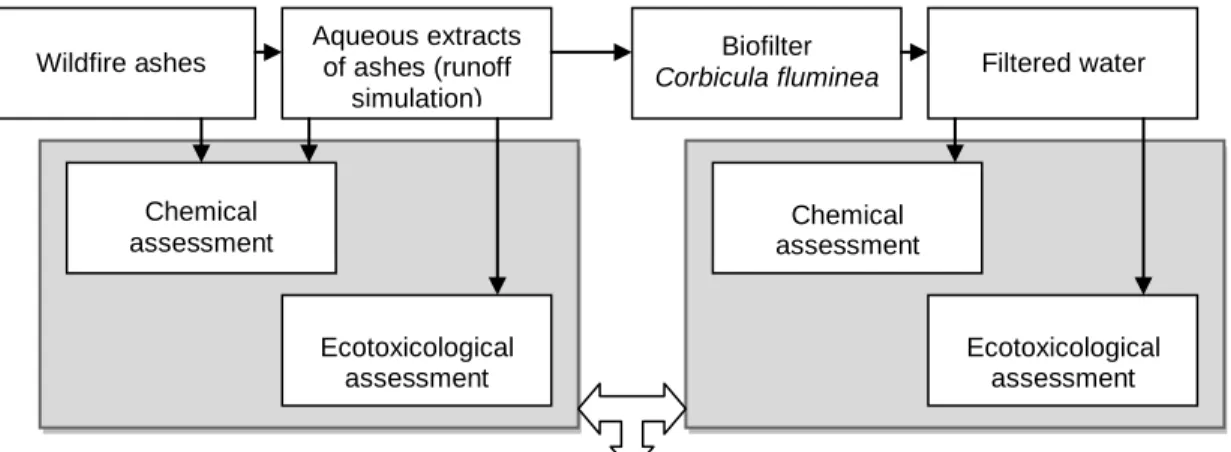
The main purpose of the present dissertation was to evaluate the biofilter potential of Corbicula fluminea Müller 1774, using wildfires runoff as a model challenge. It was a first approach to assess if there could be a benefit from an invasive species in the mitigation of deleterious effects of wildfires on aquatic ecosystems. An integrated assessment of the chemical and biological improvements promoted by the species in the water quality was carried out following a stepwise approach (Figure 2).
Figure 2: Schematic representation of the integrative experimental approach followed in the present study. The contents of the two central chapters of the dissertation are highlighted in grey for better guidance across the document.
The current dissertation document was organized in four chapters. The first contains a comprehensive literature review and provides the state of the art on the environmental effects of wildfires; it also provides an overview on the biology of the Asian clam Corbicula fluminea, whose ability as a biofilter is the main research question defining the scope of this dissertation. Chapter II and Chapter III were written following the structure of scientific papers. The former aimed at clarifying the chemical composition (PAHs and metals) of an aqueous extract of aches from a forest fire and characterizing its ecotoxicological effects using four standard aquatic species. The latter aimed specifically to test the filtration
CHAPTER II CHAPTER III
Filtered water Wildfire ashes Aqueous extracts of ashes (runoff simulation) Biofilter Corbicula fluminea Chemical assessment Ecotoxicological assessment Chemical assessment Ecotoxicological assessment
potential of C. fluminea by assessing the changes in PAH and metal composition as well as in eco-toxicological profile produced by a 7-day treatment with the bivalve. Chapter IV summarizes and integrates the information and main conclusions generated within the former two chapters to provide a general picture on the ability of the Asian clam to assist the mitigation of wildfire effects in aquatic ecosystems.
References
Achard M. 2004. Induction of a multixenobiotic resistance protein (MXR) in the Asiatic clam Corbicula fluminea after heavy metals exposure. Aquatic Toxicology 67: 347-357.
Adriano DC. 2001. Trace metals in terrestrial environments: biogeochemistry, bioavailability, and risks of metals. 2nd edition: Springer Verlag.
Al-Aasm IS, Clarke JD, Fryer BJ. 1998. Stable isotopes and heavy metal distribution in Dreissena polymorpha (Zebra mussels) from western basin of Lake Erie, Canada. Environmental Geology 33: 122-129.
Alegre SP, Bautista S, Bugalho M, Carvalho T, Catry FX, Coelho C, Correa C, Esteves T, Fernandes P, Ferreira AD, Moreira F, Morgado R, Nunes LF, Paiva V, Pinheiro AQ, Pinho J, Rego F, Silva JS, Vallejo R. 2010. Ecologia do fogo e gestão de áreas ardidas: ISA Press.
Alloway CJ. 1995. Heavy Metals in Soils. Springer-Verlag.
Andersen AN, Cook GD, Corbett LK, Douglas MM, Eager RW, Russell-Smith J, Setterfield SA, Williams RJ, Woinarski JCZ. 2005. Fire frequency and biodiversity conservation in Australian tropical savannas: implications from the Kapalga fire experiment. Austral Ecology 30: 155-167.
Angelo RT, Cringan MS, Chamberlain DL, Stahl AJ, Haslouer SG, Goodrich CA. 2007. Residual effects of lead and zinc mining on freshwater mussels in the Spring River Basin (Kansas, Missouri, and Oklahoma, USA). Science of the Total Environment 384: 467-496.
Antunes S, Curado N, Castro BB, Gonçalves F. 2009. Short-term recovery of soil functional parameters and edaphic macro-arthropod community after a forest fire. J Soils Sediments 9: 267-278.
Araujo R, Moreno D, Ramos MA. 1993. The asiatic clam Corbicula fluminea (Muller, 1774) (bivalvia, corbiculidae) in Europe. American Malacological Bulletin 10: 39-49. ATSDR. 1995. Toxicological profile for polycyclic aromatic hydrocarbons (PAHs): Agency
for Toxic Substances and Drug Registry. Washington DC.
Baumard P, Budzinski H, Garrigues P. 1998. Polycyclic aromatic hydrocarbons in sediments and mussels of the western Mediterranean sea. Environmental Toxicology and Chemistry 17: 765-776.
Baumard P, Budzinski H, Garrigues P, Narbonne JF, Burgeot T, Michel X, Bellocq J. 1999b. Polycyclic aromatic hydrocarbon (PAH) burden of mussels (Mytilus sp.) in different marine environments in relation with sediment PAH contamination, and bioavailability. Marine Environmental Research 47: 415-439.
Belanger SE, Cherry DS, Farris JL, Sappington KG, Cairns J. 1991. Sensitivity of the asiatic clam to various biocidal control agents. Journal American Water Works Association 83: 79-87.
Bertine KK, Goldberg ED. 1972. Trace-elements in clams, mussels, and shrimp. Limnology and Oceanography 17: 877-884.
Bilos C, Colombo JC, Presa MJR. 1998. Trace metals in suspended particles, sediments and Asiatic clams (Corbicula fluminea) of the Rio de la Plata Estuary, Argentina. Environmental Pollution 99: 1-11.
Bisson PA, Rieman BE, Luce C, Hessburg PF, Lee DC, Kershner JL, Reeves GH, Gresswell RE. 2003. Fire and aquatic ecosystems of the western USA: current knowledge and key questions. Forest Ecology and Management 178: 213-229. Boening DW. 1999. An evaluation of bivalves as biomonitors of heavy metals pollution in
marine waters. Environmental Monitoring and Assessment 55: 459-470.
Burke JM, Prepas EE, Pinder S. 2005. Runoff and phosphorus export patterns in large forested watersheds on the western Canadian Boreal Plain before and for 4 years after wildfire. Journal of Environmental Engineering and Science 4: 319-325. Cantanhêde G, Hahn NS, Gubiani EA, Fugi R. 2008. Invasive molluscs in the diet of
Pterodoras granulosus (Valenciennes, 1821) (Pisces, Doradidae) in the Upper Parana River floodplain, Brazil. Ecology of Freshwater Fish 17: 47-53.
Cerniglia CE. 1992. Biodegradation of polycyclic aromatic hydrocarbons. Biodegradation 3: 351-368.
Certini G. 2005. Effects of fire on properties of forest soils: a review. Oecologia 143: 1-10. Charette T, Prepas EE. 2003. Wildfire impacts on phytoplankton communities of three
small lakes on the Boreal Plain, Alberta, Canada: a paleolimnological study. Canadian Journal of Fisheries and Aquatic Sciences 60: 584-593.
Cohen RRH, Dresler PV, Phillips EJP, Cory RL. 1984. The effect of the asiatic clam, Corbicula fluminea, on phytoplankton of the Potomac river, Maryland. Limnology and Oceanography 29: 170-180.
Colombo JC, Bilos C, Campanaho M, Presa MJR, Catoggio JA. 1995. Bioaccumulation of polychlorinated-biphenyls and chlorinated pesticides by the Asiatic clam Corbicula fluminea - its use as sentinel organism in the rio de la plata estuary, Argentina. Environmental Science & Technology 29: 914-927.
Conners DE, Westerfield SM, Feyko A, Black C. 1999. Lead accumulation in soft tissues and shells of Asiatic clams(Corbicula fluminea). Paper presented at Proceedings of the 1999 Georgia Water Resources Conference; March 30-31, Institute of Ecology, University of Georgia, Athens, Georgia.
DAISIE - European Invasive Alien Species Gateway. 2012.
http://www.europe-aliens.org/speciesFactsheet.do?speciesId=53281#. Accessed 2012 May 28.
Darrigran G. 2002. Potential impact of filter-feeding invaders on temperate inland freshwater environments. Biological Invasions 4: 145–156.
DeBano LF. 2000. The role of fire and soil heating on water repellency in wildland environments: a review. Journal of Hydrology 231: 195-206.
Diniz MS, Santos HM, Costa PM, Peres I, Costa MH, Capelo JL. 2007. Metallothionein responses in the Asiatic clam (Corbicula fluminea) after exposure to trivalent arsenic. Biomarkers 12: 589-598.
Directive 2008/105/EC of the European Parliament and the Council of 16 December 2008 on environmental quality standards in the field of water policy, amending and subsquently repealing Council Directives 82/176/EEC, 83/513/EEC, 84/156/EEC, 86/280/EEC and amending Directive 2000/60/EC of the European Parliament and the Council. Official Journal of the European Union L 348: 84-97.
Doherty FG. 1990. The asiatic clam, Corbicula spp, as a biological monitor in freshwater environments. Environmental Monitoring and Assessment 15: 143-181.
Doherty FG, Cherry DS, Cairns J. 1987. Valve closure responses of the Asiatic clam Corbicula fluminea exposed to cadmium and zinc. Hydrobiologia 153: 159-167. Dwire KA, Kauffman JB. 2003. Fire and riparian ecosystems in landscapes of the western
USA. Forest Ecology and Management 178: 61-74.
Earl SR, Blinn DW. 2003. Effects of wildfire ash on water chemistry and biota in South-Western USA streams. Freshwater Biology 48: 1015-1030.
Elliott P, Aldridge DC, Moggridge GD. 2008. Zebra mussel filtration and its potential uses in industrial water treatment. Water Research 42: 1664-1674.
Fournier E, Adam C, Massabuau JC, Garnier-Laplace J. 2005. Effect of selenium exposure on the freshwater bivalve Corbicula fluminea. Radioprotection 40: S3-S9. Gifford S, Dunstan RH, O'Connor W, Roberts T, Toia R. 2004. Pearl aquaculture - profitable environmental remediation? Science of the Total Environment 319: 27-37.
Gobas FAPC, Morrison HA. 2000. Bioconcentration and Biomagnitification in the Aquatic Environment in Mackay D, Boethling RS, eds. Handbook of Property Estimation Methods for Chemicals: Environmental Health Sciences, CRC Press.
Gonzalez-Perez JA, Gonzalez-Vila FJ, Almendros G, Knicker H. 2004. The effect of fire on soil organic matter - a review. Environment International 30: 855-870.
Graney RL, Cherry DS, Cairns J. 1983. Heavy-metal indicator potential of the Asiatic clam (Corbicula fluminea) in artificial stream systems. Hydrobiologia 102: 81-88.
Granged AJP, Zavala LM, Jordán A, Bárcenas-Moreno G. 2011. Post-fire evolution of soil properties and vegetation cover in a Mediterranean heathland after experimental burning: A 3-year study. Geoderma 164: 85-94.
Gupta SK, Singh J. 2011. Evaluation of mollusc as sensitive indicatior of heavy metal pollution in aquatic system: a review. tThe IIOAB Journal - Special Issue on Environmental Management for Sustainable Development 2: 48-57.
Gutiérrez JL, Jones CG, Strayer DL, Iribarne OO. 2003. Mollusks as ecosystem engineers: the role of shell production in aquatic habitats. Oikos 101: 79–90. Hakenkamp CC, Palmer MA. 1999. Introduced bivalves in freshwater ecosystems: the
impact of Corbicula on organic matter dynamics in a sandy stream. Oecologia 119: 445-451.
Hakenkamp CC, Ribblett SG, Palmer MA, Swan CM, Reid JW, Goodison MR. 2001. The impact of an introduced bivalve (Corbicula fluminea) on the benthos of a sandy stream. Freshwater Biology 46: 491-501.
Howlett D, Baker R. 1999. Corbicula fluminea (Müller): New to U.K. Journal of Conchology 36(6): 83.
Ignatavièius G, Sakalauskiene G, Oskinis V. 2006. Influence of land fires on increase of heavy metal concentrations in river waters of Lithuania. Journal of Environmental Engineering and Landscape Management XIV(1): 46a-51a.
Inza B, Ribeyre F, MauryBrachet R, Boudou A. 1997. Tissue distribution of inorganic mercury, methylmercury and cadmium in the Asiatic clam (Corbicula fluminea) in relation to the contamination levels of the water column and sediment. Chemosphere 35: 2817-2836.
Johnson DW. 1992. Effects of forest management on soil carbon storage. Water Air and Soil Pollution 64: 83-120.
Jones CG, Lawton JH, Shachak M. 1997. Positive and negative effects of organisms as physical ecosystem engineers. Ecology 78: 1946-1957.
Jung HY, Hogue TS, Rademacher LK, Meixner T. 2009. Impact of wildfire on source water contributions in Devil Creek, CA: evidence from end-member mixing analysis. Hydrological Processes 23: 183-200.
Karatayev AY, Burlakova LE, Padilla DK. 1997. The effects of Dreissena polymorpha (Pallas) invasion on aquatic communities in eastern Europe. Journal of Shellfish Research 16: 187-203.
Karatayev AY, Burlakova LE, Padilla DK. 2005. Contrasting distribution and impacts of two freshwater exotic suspension feeders, Dreissena polymorpha and Corbicula fluminea. Pages 239-262 in Dame RF, Olenin S, eds. Comparative Roles of Suspension-Feeders in Ecosystems 47.
Karatayev AY, Burlakova LE, Kesterson T, Padilla DK. 2003. Dominance of the Asiatic clam, Corbicula fluminea (Muller), in the benthic community of a reservoir. Journal of Shellfish Research 22: 487-493.
Keith L, Telliard W. 1979. ES&T Special Report: Priority pollutants: I- a perspective view. Environmental Science & Technology 13(4): 416-423.
Kim EJ, Oh JE, Chang YS. 2003. Effects of forest fire on the level and distribution of PCDD/Fs and PAHs in soil. Science of the Total Environment 311: 177-189. Lavorel S, Canadell J, Rambal S, Terradas J. 1998. Mediterranean terrestrial ecosystems:
research priorities on global change effects. Global Ecology and Biogeography Letters 7: 157-166.
Lavorel S, Flannigan MD, Lambin EF, Scholes MC. 2007. Vulnerability of land systems to fire: Interactions among humans, climate, the atmosphere, and ecosystems. Mitig Adapt Strat Glob Change 12: 33–53.
Legeay A, Achard-Joris M, Baudrimont M, Massabuau JC, Bourdineaud JP. 2005. Impact of cadmium contamination and oxygenation levels on biochemical responses in the Asiatic clam Corbicula fluminea. Aquatic Toxicology 74: 242-253.
Liao C, Jou L, Chen B. 2005. Risk-based approach to appraise valve closure in the clam in response to waterborne metals. Environmental Pollution 135: 41-52.
Lingard SM, Evans RD, Bourgoin BP. 1992. Method for the estimation of organic-bound and crystal-bound metal concentrations in bivalve shells. Bulletin of Environmental Contamination and Toxicology 48: 179-184
Luoma SN, Dagovitz R, Axtmann E. 1990. Temporally intensive study of trace-metals in sediments and bivalves from a large river-estuarine system - Suisun bay delta in San-francisco bay. Science of the Total Environment 97-8: 685-712.
Manoli E, Samara C. 1999. Polycyclic aromatic hydrocarbons in natural waters: sources, occurrence and analysis. Trac-Trends in Analytical Chemistry 18: 417-428.
Mattice JS. 1979. Interactions of Corbicula sp. with power plants. Pages 119-138 in Briton JC, ed. Proceedings of First International Corbicula Symposium. Texas Christian University Research Foundative Fort Worth
McMahon RF. 1982. The occurrence and spread of the introduced Asiatic freshwater clam, Corbicula fluminea (Muller), in North America: 1924-1982. The Nautilus 96(4).
McMahon RF. 2002. Evolutionary and physiological adaptations of aquatic invasive animals: r selection versus resistance. Canadian Journal of Fisheries and Aquatic Sciences 59: 1235-1244.
Mellon CD, Wipfli MS, Li JL. 2008. Effects of forest fire on headwater stream macroinvertebrate communities in eastern Washington, U.S.A. Freshwater Biology 53: 2331–2343.
Mihuc TB, Minshall GW. 1995. Trophic generalists vs trophic specialists - implications for food-web dynamics in postfire streams. Ecology 76: 2361-2372.
Millan MM, Estrela MJ, Badenas C. 1998. Meteorological processes relevant to forest fire dynamics on the Spanish Mediterranean coast. Journal of Applied Meteorology 37: 83-100.
Minshall GW. 2003. Responses of stream benthic macroinvertebrates to fire. Forest Ecology and Management 178: 155-161.
Minshall GW, Royer TV, Robinson CT. 2001. Response of the Cache Creek macroinvertebrates during the first 10 years following disturbance by the 1988 Yellowstone wildfires. Canadian Journal of Fisheries and Aquatic Sciences 58: 1077-1088.
Minshall GW, Robinson CT, Royer TV, Rushforth SR. 1995. Benthic community structure in 2 adjacent streams in Yellowstone-national-park 5 years after the 1988 wildfires. Great Basin Naturalist 55: 193-200.
Moody JA, Martin DA. 2001. Post-fire, rainfall intensity-peak discharge relations for three mountainous watersheds in the western USA. Hydrological Processes 15: 2981-2993.
Mouthon J. 1981. Sur la présence en France et au Portugal de Corbicula (Bivalvia, Corbiculidae) originaire d’Asie. Basteria 45: 109-116.
Munro NT, Kovac KJ, Niejalke D, Cunningham RB. 2009. The effect of a single burn event on the aquatic invertebrates in artesian springs. Austral Ecology 34: 837-847. Naimo TJ. 1995. A review of the effects of heavy-metals on freshwater mussels.
Ecotoxicology 4: 341-362.
Narbonne JF, Djomo JE, Ribera D, Ferrier V, Garrigues P. 1999. Accumulation kinetics of polycyclic aromatic hydrocarbons adsorbed to sediment by the mollusk Corbicula fluminea. Ecotoxicology and Environmental Safety 42: 1-8.
Neary DG, Klopatek CC, DeBano LF, Ffolliott PF. 1999. Fire effects on belowground sustainability: a review and synthesis. Forest Ecology and Management 122: 51-71.