Ideation at Canon Business Services
- Exploring New Approaches for Service Innovation
Maastricht University | Nova SBE
Name: Fernando Garduño Jänz
ID: i6098617 | 23386
Track: DD IB - Strategy and Innovation
Master Thesis
Supervisor (UM): Prof. Dr. Martin Carree
Supervisor (Nova): Prof. José Moreira
Maastricht, January 2016
Abstract
Digitalisation, globalisation, and evolving customer demands are only a few of the factors that are bound to transform the business process services industry for CBS. By investigating new ways to address these imminent challenges, this thesis explores the feasibility of implementing a formal approach to ideation to complement CBS’ service innovation practice. Two workshops were therefore conducted to put theory into action by generating new service ideas in a multifunctional team. Applying both divergent and convergent ideation techniques revealed that the latter improved an idea’s novelty and creativity as opposed to the expected increase in workability and relevance. Additionally, further analysis sheds light into the potential influence of individual characteristics and group dynamics on creativity. The thesis concludes with a discussion on the organisational implications of the findings and recommendations for future research.
Table of Contents
Acknowledgements 4 1. Introduction 5 1.1 The Case 7 1.2 Research Context 8 1.3 Approach 9 2. Theoretical Background 102.1 The Front-End of Innovation 10
2.2 Creativity 11
2.3 Creativity and Ideation in Groups 12
2.4 Team Diversity 13
2.4.1 Functional Knowledge Diversity for Service Innovation 15
2.5 Ideation Techniques 15
2.5.1 Divergent and Convergent Ideation Processes 17
2.7 Role of the Facilitator 19
2.8 Idea Selection 20 2.9 Idea Buildup 21 3. Research Design 24 3.1 Background 24 3.2 The Workshop 25 3.3 Concept Overview 25 3.4 CBS’ Business Challenge 28 3.5 Participants 29 3.6 Workshop Procedure 30 3.6.1 Facilitation 32
3.7 Sample and Procedure 33
3.7.1 Measurement 34
3.8 Control Variables 34
3.9 Idea Evaluation 36
3.10 Data Analysis 37
Abbreviations
R&D - Research and Development CBS - Canon Business Services NSD - New Service Development
MEPS - Marketing Execution and Production Services CCS - Costumer Communication Services
CX - Customer Experience NSO - National Sales Office SBU - Strategic Business Unit
4.3 Paired Samples T-Test 41
4.4 Quality of the Best Selected Idea 42
4.5 Correlation Analysis 43
5. Discussion 45
6. Conclusion 48
6.1 Managerial Contributions and Recommendations 48
6.2 Limitations and Future Research 50
6.3 Conclusion 51
References 53
Acknowledgements
Now that after my master programme, which gave me the opportunity to study in two amazing cities, Lisbon and Maastricht, is already coming to an end, I’d like to thank the people who have made this incredible journey possible.
First of all, I’d like to thank my supervisor at CBS, Michiel Roersma, for his support and advice along the way and making this thesis possible in the first place. Being able to join CBS as a thesis intern gave me an unparalleled opportunity to put scientific theory into practice as well as to learn from an enthusiastic and welcoming team.
A special thank you also goes to all my colleagues who devoted their time to participate in the workshops, evaluated a broad range of ideas, and gave me advice whenever needed. Next, but not less, I want to thank my supervisor at Maastricht University, Prof. Dr. Carree, for his continuous support and valuable advice from start to end as well as my co-advisor from Nova SBE, Prof. Moreira, for his unique insights into organisational research.
I’d also like to thank my friends who I’ve met in Maastricht and Lisbon for not only their support but also for giving me the necessary motivation whenever needed.
Lastly, I’d like to thank my parents for always believing in me, helping me to realise my dreams, and their never-ending support no matter what. I would have never accomplished what I have if it wasn’t for you.
1. Introduction
Innovation is and always has been a crucial determinant to a company’s success. While today’s business environment is characterised by an increasingly global competition, rapidly changing customer demands, and continuous technological developments, innovation has been identified as a crucial determinant to prevail in this dynamic global economy (Dahlman, 2007; Rubera & Kirca, 2012). As a large body of literature on innovation has proven, innovation no longer only entails technological inventions and large expenditures on research and development (R&D). Innovation can occur in a diverse range of business processes in form of incremental and intangible developments, a notion that has becoming particularly relevant to services, making continuous innovation indispensable for success (Toivonen & Tuominen, 2009).
However, seeing how the world’s most advanced economies are predominantly shaped by services - OECD nations have derived an average of 74.5% of their respective GDPs from service industries in 2014 (Worldbank, 2015) - and also developing countries are experiencing a rapid growth of the tertiary sector, there is a substantial need for further research to shed light into the complexity of services as scholars of innovation have predominantly focused on products rather than the service domain (Bitner & Brown, 2007; Meyer & DeTore, 2001; Ostrom el al., 2010). Especially the front-end actives of new product development and new service development (NSD) show essential differences with regard to the relevance of R&D expenditures and the degree to which these activities are formalised within the organisation. While R&D has been identified as a dominant driver of product development (Brouwer & Kleinknecht, 1996), the front-end activities surrounding NSD are primarily characterised by a less formal development of new concepts and procedures, which,
on an organisational level, is only scarcely addressed in service innovation research (Preissl, 2000). Additionally, the underlying factors supporting creative processes will be explored. Based on Amabile’s (1988) model of organisational innovation, innovation does not only derive from a company’s strategic processes and resource abundance, but largely to the creative input of individual employees. Therefore, in ideation research, which is the overarching process surrounding idea generation and thus represents a major driver of the front-end activities in NSD, creativity is seen as the key to innovation (Shalley & Gilson, 2004). Particularly, as the effectiveness of ideation is enhanced by a group’s diversity, as new ideas are forged by adapting and combining initially distinct knowledge frames, ideation has the potential to substantially complement an organisation’s innovation process by building on the expertise and creativity of its workforce (Santanen, Briggs, & De Vreede, 2004). However, although the benefits of ideation and creativity seem to be apparent, most research neglects the organisational context supporting ideation (Sutton & Hargadon, 1996).
As opposed to laboratory research, which only investigates the effectiveness of ideation on artificial problems that do not require any specialised knowledge, organisations implement ideation to capitalise on their employee’s creativity and expertise to solve complex, specific problems (Kavadias & Sommer, 2009). Additionally, as participants in most ideation research lack interdependent professional relationships, intrinsic task motivation as well as problem-relevant, complementary skills, there is a considerable necessity for organisational ideation research (Sutton & Hargadon, 1996).
This study therefore aims to shed light into the organisational front-end activities preceding the NSD process by investigating the feasibility of ideation at a multinational company - Canon Business Services.
1.1 The Case
Canon Business Services (CBS) is a leading business process outsourcing provider that delivers an extended suite of services, ranging from document outsourcing to more advanced services such as marketing execution, to businesses worldwide. In the highly competitive business process outsourcing industry that calls for constant service innovation in order to meet the demand of a global customer base and to remain competitive, CBS is currently identifying new ways to enhance its service development process. Notably, as the company so far has followed a customer-centric approach in which NSD is primarily triggered by an emerging market need, additionally sourcing service ideas internally by specifically tapping into employees’ creativity and expertise can be the key to further innovation. A formalised ideation approach can assist the company to better utilise employees’ creativity by facilitating cross functional knowledge exchanges in order to generate new service ideas and to solve complex problems. Moreover, while individuals primarily solve problems based on their past knowledge, ideation techniques increase creativity by assisting “individuals to break free from cognitive, habitual, and mental association and pattern of thought” and thus have the potential to effectively complement innovation processes (Lin, Hon, & Ming-Yueh, 2006, p. 2).
This study will therefore address the feasibility of implementing idea generation techniques within CBS by investigating the following research question:
How can CBS implement a durable ideation approach to stimulate creativity and service innovation?
1. Which essential preconditions are relevant for successful organisational ideation?
2. How do divergent and convergent idea generation techniques facilitate the conceptualisation of creative ideas?
3. How does team diversity, in terms of work experience and functional expertise, contribute to ideation?
4. To what extent is idea creativity influenced by individual factors and team dynamics?
1.2 Research Context
The research was conducted during a thesis-internship at Canon-Océ in the Business Services department. Information on the current service development process was gathered via observations, interviews, and internal documents. In order to test the feasibility of a formalised ideation approach in terms of its applicability to the organisation, data were gathered during two workshops at CBS. These workshops were designed specifically to generate new service ideas, based on the most significant findings in creativity and ideation literature. The organisational feasibility of said ideas was subsequently evaluated by a panel of CBS employees for further comparison.
By developing and validating a durable approach to ideation the scope of this study will be (1) to complement CBS’ innovation practice and (2) to investigate the feasibility of ideation within an organisational environment.
1.3 Approach
The thesis is structured as follows: The first part introduced the case background together with the research context of the study. In the second part, the theoretical findings in both the creativity and ideation literature will be discussed while deriving applicable propositions for further analysis. In the third section, the research design will be outlined by thoroughly explaining CBS’s intuition behind this study as well as the conceptualisation of the ideation workshop. The fourth part will cover the data analysis which summarises the findings and relation to the propositions. The fifth part will discuss these findings in a subjective form and outline the managerial implications thereof. In the sixth section, the limitations and suggestions for future research will be explained. In the last section, the thesis will be concluded.
2. Theoretical Background
2.1 The Front-End of Innovation
As the market dynamics have shifted towards an increasing prominence of the service sector, understanding the critical resources, drivers, and capabilities needed to complement service development is of major relevance to companies in the service industry. Nonetheless, there is a considerable deficiency in the service management literature particularly addressing these front-end determinants leading up to the NSD process (Menor, Tatikonda, & Sampson, 2002). The so-called “fuzzy front-end” is comprised of all activities leading up to the formal NSD process, or as Reid & Brentani (2004) put it “[the] time and activity spent on an idea prior to the first official group meeting to discuss it” (p. 171). Initially coined by Smith & Reinersten (1991), the fuzziness of this concept derives from the unstructured, informal activity in which ideas are generally generated prior to be implemented in the formal development process within organisations. Particularly on an organisational research has this fuzziness been demonstrated as the Industrial Research Institute was unable to formulate best practices within the front-end of eight multinational companies due to a lack of definitions and a theoretical construct (Koen et al., 2001). Comparing one company’s front-end processes to those of another proved insurmountable because there was no common language or definition of the key elements of the front-end.
While this process is generally more structured for incremental innovations, as information is gathered in a directed approach, discontinuous innovations tend to emerge from an unstructured search for information (Reid & Brentani, 2004). As front-end idea generation represents the stepping-stone to the overarching NSD process, it is a crucial determinant for
to the ambiguity surrounding idea generation as well as its decisive relevance to organisations, Koen et al. (2001) identified the fuzzy front-end as being “one of the greatest opportunities for improving the overall innovation process” (p. 46).
2.2 Creativity
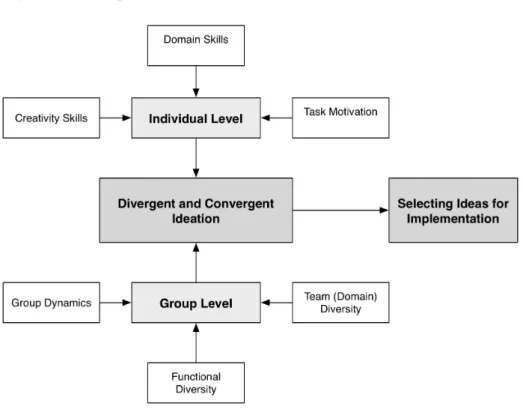
Seeing how creativity is directly related to the idea generation, Amabile (1983) was one of the first scholars to address the social psychology of creativity by stating that anyone has the potential to be creative and that social factors actively influence the degree of creativity. In one of her pioneering studies on organisational innovation, Amabile (1988) proposed that innovation does not only stem from an organisation’s resources and strategies, but to a large extent from the creativity of individual employees. Amabile's (1988) componential model described three components that influence an employee’s creative performance, namely, domain-relevant skills, creativity-relevant skills, and task motivation. Domain-relevant skills refer to the expertise and skill set that are unique to each individual. Creativity-relevant skills involve the extent to which past knowledge can be reframed to stimulate new trains of thought. The last component, task motivation, attributes creative performance to both intrinsic and extrinsic motivation. With her research Amabile (1988) was able to shed light into the determinants of creative abilities by highlighting the relevance of external influences. She proposed that an organisation can have a direct effect on an employee’s creativity by positively influencing these components.
Notably, as an idea originates from an individual’s creative ability, employees have the potential to improve current and develop new business practices with novel ideas, making creativity a key driver of innovation (Shalley & Gilson, 2004). Building on this insight, many
firms actively develop new drivers of creativity to establish a continuous flow of innovative processes.
Based on the cognitive network model, which illustrates the mind as a collection of information, Santanen et al. (2004) explained the fundamental mechanisms preceding creative solutions. Respectively, when presented with a new problem, people ideate solutions based on past memories of similar situations (referred to as frames) by adapting and combining these accordingly. Therefore, solutions that originate from the combination of distant frames of knowledge also tend to be more creative than solutions that are based on related ones (Santanen et al., 2004). These findings are especially for organisations of relevance as the apparent benefits of heterogeneous teams for innovation have gained substantial support within the innovation literature.
2.3 Creativity and Ideation in Groups
The findings on team effectiveness in idea generation processes have been mixed. Although the positive impact of a large knowledge base on creative processes has been proposed by various researchers (Brown & Paulus, 2002; Santanen et al., 2004; Woodman et al., 1993), groups may also inhibit ideation due to the challenges associated with sharing diverse ideas. Janis (1982) who analysed creative group processes from a psychological perspective, found that individuals refrain from sharing ideas that they perceive as being overly different from the general group view due to the apprehension of evaluation. Diehl & Stroebe (1987), however, showed evidence that Osborn’s (1953) brainstorming rules (amongst others, to defer judgement) are an effective measure to mitigate evaluation apprehension when effectively implemented in group idea generation tasks. Also free-riding is another factor that
is commonly described to reduce group effectiveness. Since all ideas are merged as a collective group outcome in ideation, individuals have the ability to free-ride on the contribution of others as opposed to nominal group ideation, which measures performance on an individual level (Diehl & Stroebe, 1987). Free-riding is therefore more likely the larger the group is, as it reduces the identifiability of individual input. Moreover, groups constrain an efficient exchange of ideas as members can only effectively share ideas one at a time (Diehl & Stroebe, 1987). Production blocking is therefore stated to reduce the development of new ideas, since individuals only have limited opportunities to express their ideas. Within organisational research, West (1990) found production blocking to have a negative influence on creative output in larger teams, while teams, with fewer than three members, are prone to a decline of creative variety.
2.4 Team Diversity
Nieto & Santamaria (2007) found that the scope of knowledge diversity within an innovation task force influences the novelty of new product innovations, while Woodman, Sawyer, & Griffing (1993) suggested a positive relation between the breadth of the knowledge scope and the number of ideas generated. Particularly as diverse teams generate input based on varying perspectives to stimulate cognition, these teams also offer a higher potential to reach favourable solutions. Brown & Paulus (2002) further supported these findings by studying the influence of priming individuals with domain related and unrelated ideas prior to ideation. The study claimed that priming unrelated and unique ideas significantly increased productivity in ideation, as opposed to priming domain related ideas, which only contributed marginally to the idea generation process. Likewise, organisational research showed evidence
that a wide scope of knowledge in the collaborative network, facilitating product innovation, has an effect on the extent of product novelty due to larger amount of possible linkages from collaboration (Nieto & Santamaria, 2007). These findings are further supported by Nijstad, Rietzschel, & Stroebe (2006) who proposed that the full potential of team diversity can only be exploited when the diverse range of individual input is jointly implemented.
Although the benefits of team diversity, characterised by a broad knowledge scope, for generating high-quality ideas seem to be apparent, these teams are also prone to intragroup conflicts as well as low levels of integration and group satisfaction, which therefore require profound coordination (Milliken & Martins, 1996). The lack of social integration in heterogeneous groups is caused by a lack of mutual attraction which is more likely to occur in homogeneous groups. Consequently, in order for a group to achieve high levels of performance or “group flow” Sawyer (2008) proposed various factors, such as clarified group goals and open communication, to overcome potential conflicts. Additionally, integration is needed for team members to efficiently build on shared knowledge in order to gain new perspectives and develop radically new solutions (Cronin & Weingart, 2007). Fay, Borril, Amir, Haward, & West (2006), moreover, identified that a shared vision, high frequency of interaction, and trust are prerequisites to fully realise the benefits of diversity for solving complex tasks.
Proposition 1: Heterogeneous groups, which show high levels of knowledge diversity are
2.4.1 Functional Knowledge Diversity for Service Innovation
Although there are various forms of diversity, ranging from surface-level demographic factors up to deep-level diversity that includes preferences, values, and attitudes, this study will predominantly address a third from, functional diversity (Pinjani, 2007). With the assumption that the functional background of team members defines the overall scope of knowledge that can be applied to solve complex problems, it influences performance and allows organisations to tap into a larger pool of expertise (Pelled, Eisenhardt & Xin, 1999). However, Engen & Magnusson (2015) explained that broad knowledge by itself is not sufficient for successful service innovation as the process requires two distinct types thereof: demand-side and supply-side knowledge. Building on Amabile’s (1988) componential model which depicted domain knowledge as being one important factor of creativity and thus idea generation, Engen & Magnusson (2015) proposed that domain knowledge can best complement the service innovation process by incorporating employees with an understanding of customer demand (demand-side knowledge) as well as the ability to discern an idea’s feasibility from the company’s perspective (supply-side knowledge).
Proposition 2: Functional background diversity positively contributes to idea generation and
service innovation.
2.5 Ideation Techniques
With his publication “Applied Imagination” (1953) Osborn became known as the founding father of creative problem solving as well as the inventor of today’s most known ideation technique - brainstorming. Initially developed to foster creative idea generation for ad
campaigns, brainstorming became known as the “mother of idea-generation techniques” as it was the first, formally documented technique to stimulate creativity and to generate a large amount of ideas in a short amount of time. Building on the intuition that brainstorming allows people to draw from a wide pool of ideas to build on and stimulate further idea generation, Osborn (1953) stated that this technique is especially effective to facilitate the problem solving process in teams.
Osborn’s (1953) research was specifically conceptualised to increase the productivity of group ideation. In order to guarantee the best possible outcome in terms of quality and quantity of ideas, Osborn (1953) further proposed four rules to diminish the negative effects of criticism during ideation: (1) participants are instructed to aim for a large quantity of ideas, (2) are encouraged to be as creative as possible, (3) to build on the ideas of others, and (4) to defer all criticism. These rules were proposed to significantly reduce evaluation apprehension in brainstorming groups as well as to improve group performance.
Soon after Osborn’s (1953) publication, Taylor, Berry, & Block (1958) discovered that brainstorming in groups (also referred to as interactive group brainstorming) actually proved to be less effective in terms of productivity (number of ideas generated) than by being applied on an individual level (also referred to as nominal group brainstorming).
Numerous studies followed suit to investigate the effectiveness of group brainstorming (e.g., Diehl & Stroebe, 1987; Isaksen & Gaulin, 2005; Rietzschel et al., 2006), with the general consensus that individual brainstorming is indeed more productive - a phenomenon coined as “the illusion of group effectivity” by Stroebe, Diehl, & Abakoumkin (1992). These studies, however, assessed effectiveness in terms of overall ideas generated, which for organisations is not necessarily of relevance. For an idea to become an innovation it needs to be
successfully implemented (Shalley, Zhou, & Oldham, 2004), therefore organisations require a fewer amount of relevant ideas that can be successfully developed. Furthermore, Lin et al. (2006) identified brainstorming as the most common technique to be used among a sample of technical consultants, which they found to be due to its simplicity of usage and feasibility to solve complex problems that require collaboration and input from different fields of knowledge.
In the subsequent years, following Osborn’s publication, a rapid rise of conceptualised idea-generation techniques emerged. Smith (1998) identified a total of 172 distinct techniques in the creativity literature and classified them among three main categories to complement future research: Strategies (techniques for generating ideas), tactics (methods to support ideation), and enablers (create conditions to facilitate ideation). Particularly for companies that apply creative problem solving techniques in their operations, do strategies, such as brainstorming, only play a part of the whole process. Complementary techniques, for further idea development, selection, and analysis are therefore essential (Isaksen & Gaulin, 2005). Ideation techniques are specifically designed to complement the innovation process by increasing creativity and triggering individuals or teams to address an alternative solution space, as it has been shown that individuals without these techniques tend to exclusively use prior knowledge in an unstructured way to find solutions (Shalley & Gilson, 2004).
2.5.1 Divergent and Convergent Ideation Processes
Ideation techniques can be primarily divided between the extent to which they promote divergent or convergent thinking (Kilgour & Koslow, 2009). However, most ideation techniques focus on the development of original ideas by stimulating divergent thinking as
opposed to convergent thinking, which promotes appropriateness and feasibility by selectively focusing on a restricted number of ideas. With the objective to raise overall creativity, divergent ideation techniques are designed to actively facilitate the combination of distant frames of knowledge (Kilgour & Koslow, 2009). Similar to the findings stated by Santanen et al. (2004), combining otherwise unrelated frames in divergent ideation can therefore help organisations to benefit from unique ideas and solutions. On the other hand, convergent techniques focus on knowledge frames that are within a relevant domain to generate solutions and ideas that are appropriate to the problem at hand (Kilgour & Koslow, 2009).
As both techniques therefore offer a tradeoff between originality and appropriateness, Rietzschel et al. (2006) stated that an initial divergent ideation technique is to be followed by a convergent ideation technique in order generate creative ideas that can be implemented for further development. Kilgour & Koslow’s (2009) extensive investigation on divergent and convergent techniques further concluded that initial domain knowledge of the problem at hand is a necessary prerequisite for interactive groups to achieve both an appropriate and original outcome. However, convergent ideation can generate less appropriate ideas for highly domain specific personnel when presented with a deceiving problem statements due to a limited mental search space, known as mental set fixation (Kilgour & Koslow, 2009). Divergent techniques enable domain experts to move past their domain specific knowledge to generate more original ideas, while convergent techniques increase overall appropriateness. These findings are therefore in line with Rietzschel et al.’s (2006) proposition that both types of techniques are fundamental to innovation.
Proposition 3: The ideation method requires both, divergent and convergent thinking
processes, to develop ideas that are original as well as appropriate.
2.7 Role of the Facilitator
Albeit being predominantly neglected in ideation research, the ideation session’s facilitator can have a significant effect, in terms of productivity and effectiveness, on group performance (Isaksen & Gaulin, 2005). Together with the original conceptualisation of the brainstorming technique, Osborn (1953) elaborately described the role of the facilitator as the person being responsible for guiding the ideation process from start to end. Thus, their role is to enforce the brainstorming rules, encourage active participation, and to maintain focus on the task at hand (Osborn, 1953). Empirical evidence showed that particularly a professional facilitator substantially affects idea quantity, to a degree that outperforms nominal groups, by guiding a group towards achieving task relevant goals and assuring a common understanding of the anticipated outcomes (Isaksen & Gaulin, 2005). This finding is moreover in line with Offner, Kramer, & Winter (1996) who demonstrated that interactive brainstorming groups outperform nominal groups when intergroup collaboration is adequately stimulated by a trained facilitator. In addition, the facilitator’s degree of expertise has a positive effect on the quantity of ideas generated within interactive groups (Oxley, Dzindolet, & Paulus, 1996). Although teams, guided by inexperienced student facilitators, outperformed non-facilitated brainstorming groups, only groups with highly trained facilitators managed to overcome diminishing performance over time, by consistently generating an equal amount of ideas throughout the session. In their research, Oxley et al. (1996) were thus able to demonstrate that under the right conditions, interactive groups are able to generate substantially more
ideas than nominal groups. Although these findings may not fully be applicable to real life organisational settings, as the aforementioned studies derived their conclusions from laboratory set ups and thus generated ideas on comparably simple tasks, there appears to be a strong evidence that an appropriate facilitation plays a crucial role for effective ideation.
Proposition 4: An experienced facilitator is able to positively contribute to a group’s ideation
performance.
2.8 Idea Selection
Applying ideation for innovation purposes requires both idea generation and idea selection (Girotra, Terwiesh, & Ulrich, 2010). Companies need to evaluate numerous ideas and select a few for further development, thus making this process indispensable for innovation. Generating a large set of ideas is thus generally irrelevant to an organisation since the success of innovation depends on the quality of the subsequently implemented ideas (Girotra et al., 2010). Selecting the best ideas, however, proves to be a challenging aspect of ideation as Rietzschel et al. (2006) found that idea selection by both nominal and interactive groups, based on creativity as a measure of quality, hardly differs from selecting a random sample of all ideas. Although the overall number of ideas generated is positively related to the amount of good ideas therein (Diehl & Stroebe, 1987), interactive teams appear to be only slightly superior to nominal groups when selecting the best ideas, which partly compensates for their inherent productive efficiency (Rietzschel et al., 2006). This finding is in line with Girotra et al. (2010) who demonstrated that groups perform poorly when selecting their own ideas, which the authors assumed to be due to the involvement in the initial idea generation process. With regard to selection bias, Paulus, Dzindolet, & Kohn (2012) identified an apparent
tendency of groups to predominantly select ideas based on innovativeness rather than appropriateness.
Both Girotra et al. (2010) as well as Rietzschel et al. (2006) drew their conclusions from experiments using student samples which are not entirely representative of an organisational setting. Primarily, as companies benefit from the competence diversity of interactive groups to solve firm relevant problems (Sawyer, 2008), Kavadias & Sommer (2009) further concluded that brainstorming groups do indeed have an advantage over individuals to solve cross-functional problems, since solutions can be framed around a diverse range of domain specific ideas. Particularly for organisations that are dependent on creative processes to develop innovative solutions, such as design consultancy IDEO, Sutton & Hargadon (1996) proposed that interactive groups provide the means that are indispensable to complement ideation, as organisations are dependent on the skill variety of its employees to evaluate and select appropriate ideas for further development.
It is therefore important to utilise a team’s diversity in the selection process in order to incorporate a range of relevant individual expertise.
Proposition 5: Organisations are dependent on diverse expertise of multifunctional teams to
effectively select the best ideas for further implementation.
2.9 Idea Buildup
Osborn (1953) attributed the effectiveness of brainstorming to the ability to direct a group’s creativity towards one collective outcome. Participants are therefore expected to build on the ideas of others in order to incorporate individual perspectives and take advantage of diverse knowledge domains. This phenomenon is commonly referred to as idea buildup: the
combination and improvement of distinct ideas. Investigated by a number of studies (e.g., Nijstad et al., 2006), diverse knowledge domains are proposed to positively contribute to creative outcomes which makes them favourable to organisations. Interactive brainstorming groups therefore have an advantage over nominal groups in solving cross-functional problems (Kavadias & Sommer, 2009). Girotra et al. (2010) were the first to empirically test the contribution of idea buildup by analysing the extent to which teams build on each other’s ideas as well as its impact on quantity and variety. Contrary to popular believe, building on each other’s ideas was negatively related to quantity along with idea variety, as subsequent ideas were framed around previously generated idea domains, thus limiting the search scope. Although this is the first study thoroughly testing idea buildup, Girotra et al. (2010) focused exclusively on homogeneous groups, consisting of university students enrolled in the same major, which therefore lacked domain specific expertise. Accordingly, these findings are not entirely representable for organisational research as idea quality and applicability are of greater importance to a company that is looking to complement existing capabilities then to experimental groups that lack long-term interaction and problem relatedness (Sutton & Hargadon, 1996). Girotra et al. (2010) did find significant support for a greater likelihood of buildup in teams. Considering that previous findings by Nieto & Sanataria (2007) demonstrated a positive interaction between knowledge diversity and product novelty, idea buildup in organisational teams is likely to contribute to higher quality ideas.
3. Research Design
3.1 Background
Exploiting the creativity of employees by implementing a formalised approach to ideation can help organisations, as it was extensively argued above, to generate a large amount of relevant ideas for future service innovations and to solve complex problems. Particularly the front-end activity of idea generation in NSD, which has been identified as being one of the most decisive stages for successful innovation (Engen & Magnusson, 2015), is also one of the least understood.
For CBS, innovation is a fundamental aspect of its everyday operations. Particularly as digital advancements are changing the dynamics of the global document outsourcing industry (valued at €45 billion ), CBS is looking for new ways to innovate existing service lines and to 1
increase its portfolio by adding new ones.
The global document outsourcing market, which is divided into off-site printing services, value added services, and on-site print and mail services, is experiencing an overall compound annual growth rate (CAGR) of 2.4%. This growth, however, is only one-sided as value added services are expected to grow at 5.8% CAGR, while a global decline in print and mail services is gradually reducing the market size of both off-site printing and value added services.
With the notion to effectively tap into existing expertise and creativity, ideation was identified as a potentially lucrative approach to achieve these goals. Although ideation is already being applied within product and technology development within Canon-Océ, service development so far has been predominantly reliant on market pull activities such as customer
demand. Internalising ideation could thus provide innovative solutions by facilitating a creative knowledge exchange.
3.2 The Workshop
Data was gathered during two ideation workshops which were conducted at CBS’ Venlo office. These workshops aimed to study the feasibility of using a formalised ideation approach in detail by ideating on a company relevant problem statement and additionally, to evaluate the propositions that were formulated based on the literature review. Using an ex post facto research design allowed to leave group interaction largely unbiased in their behaviour by studying the ideation process within its organisational context. Each workshop took approximately 2 hours and followed the same structure which was divided into three parts: Introduction, Divergent Ideation, and Convergent Ideation (Figure 3).
3.3 Concept Overview
CBS is currently investing in growing two of its major service lines - Marketing Execution and Production Services (MEPS) and Customer Communication Services (CCS). Both service lines support communication between companies and their clients. However, following the trends in digitalisation that are changing the service environment faster then ever, CBS is facing uncertainty towards the future market application of both services. In this increasingly digital world, service providers can therefore no longer ignore the challenges and opportunities that will play an imminent role in the service industry, and thus need to address these accordingly (Deloitte, 2013).
The following section provides a detailed description of MEPS and CCS, which represented the main focus of ideation during the workshops, as well as an overview of the preeminent digital trends, as proposed by Deloitte (2013) that are foreseen to have a substantial influence on tomorrow’s customer service.
Customer Communication Services (CCS) facilitate the execution, management, and
optimisation of multichannel communication between companies and their inbound and outbound customers. These channels currently range from paper, email, mobile app, up to SMS to capture data that is then further prepared by means of data management (e.g., archiving and retrieval, analytics, customer segmentation) to assist the customer communication process. A major challenge for CCS is a trend towards digitalisation that sees this service line evolving from simple customer correspondence letters towards end-to-end customer experiences. Additionally, physical print volumes are declining rapidly while new channels (e.g., social media) emerge. Mobile and web platforms are rapidly becoming the norm, which puts pressure on CBS to maintain consistent customer communication across multiple channels.
Marketing Execution Production Services (MEPS) allows companies to outsource
execution and production of marketing campaigns to Canon. These services will include both content adaptation (post production, reformatting, localisation) as well as the publication/ distribution to agreed channels. The global marketing execution market, which is currently valued at €8b, is shifting towards decoupling marketing execution from creative services. A major challenge to address in the future is the increasing complexity in marketing execution
as a result of globalisation and a rise in relevant channels. These factors, moreover, raise the need to efficiently execute marketing campaigns for multiple target groups, via several formats and languages, in order to not only maintain a certain level of excellence, but also, to retain consistent customer experience across all channels.
Deloitte (2013) identifies six trends that will shape customer expectations and service delivery in the years to come:
• Mobile First: The rapid dispersion of smart mobile devices has developed this segment into the most important touch point through which customers interact with a service provider.
• Omni Channel: Over 60% of all customers are currently using multiple channels (e.g., mobile, telephone, email) to interact with a company. As this trend is forecasted to increase in complexity, companies need to provide consistent brand image across all channels. • Social Media: The growing influence of social media in service delivery will be a key
driver to success as it allows companies to interact with an unprecedented number of customers at minimum costs.
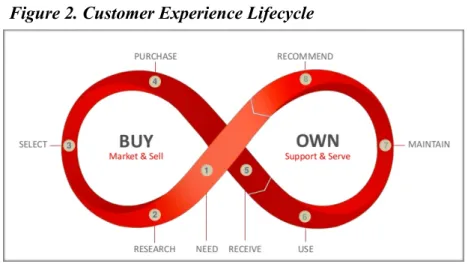
• Customer Experience (CX): Customers are no longer simply buying into what is being offered to them but expect companies to be responsive to their views. Companies should not only focus on individual touch points that a customer encounters when interacting with a service (or product), but need to optimise the overall customer lifecycle - from initial consideration, usage, up to the post-purchase experience (see Figure 1).
• User Adoption: In order to drive user adoption, companies need to personalise their service offerings by taking advantage of an increasing influx of data.
• Analytics: The increasing number of channels, devices, and touch points through which organisations communicate with their customers, offers valuable data that needs to be extensively analysed for continuous service innovation.
As these trends represent some of the major challenges that CBS is going to face during future development, participants of the workshops were explicitly instructed to take these into account when formulating their ideas.
3.4 CBS’ Business Challenge
Digitalisation, globalisation, and evolving customer demands are only a few of the factors that are bound to transform the business process services industry for CBS. The rising complexity of service delivery, which is predominantly due to an increase of new communication channels (e.g., social media, mobile) as well as a growing number of new competitors, calls for innovation in the service development process. These external pressures are particularly relevant for the future development of MEPS and CCS, as the increasing complexity of the industry will pose a major challenge if not addressed accordingly. CBS is therefore exploring further optimisation opportunities by improving customer experience throughout the customer lifecycle.
As depicted in Figure 1, the customer lifecycle can be divided between the process leading up to the initial purchase of the service (steps 1 - 4) as well as the subsequent post-purchase experience (steps 5 - 8). Respectively, since MEPS addresses the marketing activities,
lines jointly target the overall customer lifecycle and thus offer potential for further integration in the future.
Consequently, the ideation workshop addressed the uncertainty surrounding the future development of both services as well as the necessity of customer experience management to maintain a favourable position in the highly competitive business process outsourcing market. Participants were therefore instructed to ideate on the following problem statement:
“What might a Canon service offering in 2020 look like that taps into the trend of Customer Experience management? Please take into consideration the position in both CCS and MEPS
that CBS may have by then, as well as the imminent trends in digitalisation.”
3.5 Participants
All workshop participants were employees from various functions at Canon-Océ and therefore offered a diverse functional background knowledge to complement the ideation process (for related discussion, see Kilgour & Koslow, 2009). Moreover, building on Engen & Magnusson’s (2015) research, service innovation requires an understanding of customer
Source: Adapted from Oracle (2014)
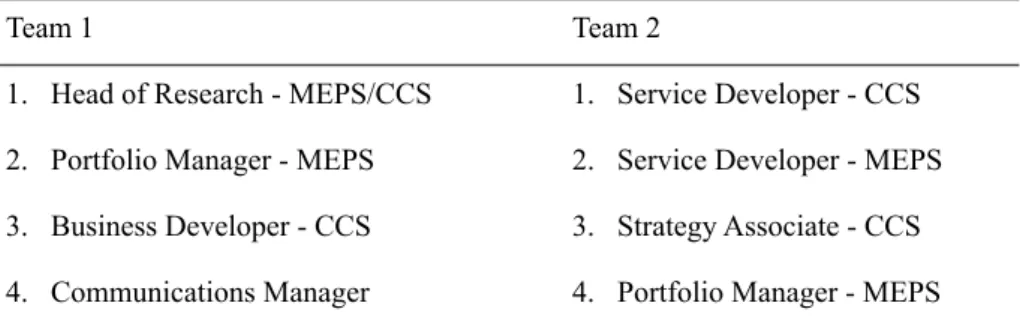
demand (demand-side knowledge) as well as of the feasibility to the firm (supply-side knowledge). Therefore, each team included members of both knowledge backgrounds with 4 persons each. Additionally, both teams included experts of the two services, MEPS and CCS, who are either actively involved in the current development process or have gained relevant expertise in the past (Table 1).
Teams were deliberately kept small as larger teams are prone to individual competition and production blocking (Paulus et al., 2012). Participants were invited personally or via email.
3.6 Workshop Procedure
1. Introduction
Upon introducing the concept and organisational benefits of creative problem solving,
Table 1. Functional Roles of Workshop Participants at Canon-Océ
Team 1 Team 2
1. Head of Research - MEPS/CCS 1. Service Developer - CCS
2. Portfolio Manager - MEPS 2. Service Developer - MEPS
3. Business Developer - CCS 3. Strategy Associate - CCS
4. Communications Manager 4. Portfolio Manager - MEPS
presented by one of the group members. Furthermore, Deloitte’s (2013) digital trends for customer service were thoroughly introduced by highlighting the necessity of customer experience (CX), as depicted above. Although all participants stated to have at least a fundamental understanding of both service lines as well as the principles of CX, this introduction aimed to ensure that all participants had a common understanding of all relevant topics. Before being presented with the problem statement, participants were introduced to the brainstorming rules, developed by Osborn (1953) to improve production efficiency in group ideation: (1) defer all judgement, (2) wild ideas are encouraged, (3) build on the ideas of others, (4) aim for quantity.
2. Divergent Ideation
Once the rules were discussed, the team was presented with the following problem statement:
“What might a Canon service offering in 2020 look like that taps into the trend of Customer Experience management?”.
As this brainstorm aimed to primarily generate a large quantity of diverse and creative ideas, participants were encouraged to freely discuss everything that comes to mind and to write down all ideas, irrespective of assumed feasibility, on Post-It notes.
The team was given 20 minutes for this brainstorming task.
3. Convergent Ideation
The brainstorm was followed by an initial screening and selection of ideas for further improvement. First, a convergent technique called brainmapping (Bard, 2004) was introduced with the instruction to group all related ideas together and to give each cluster an overarching title (e.g., Screens & Projection, Multichannel). Bard (2004) recommended brainmapping as
an effective method to analytically classify ideas following a divergent technique. Each participant was then asked to freely allocate a total of 5 points across all ideas, of which the five ideas with the most votes were then selected for further refinement. This method was chosen to reflect individual priorities and allowed participants to select the most suitable ideas without being influenced by any evaluation criteria.
During the last part of the ideation workshop, participants were asked to actively refine each of the five ideas previously selected. Each idea was discussed for 6 minutes by identifying potential synergies with other ideas and generating new related ones. The team was moreover told to frame their decisions on experience and to take the strategic positioning of the respective service idea into account. Building on the notion that team diversity and functional expertise are relevant for service innovation, this convergent method was applied to enable participants to generate relevant and applicable ideas. This method was adapted from VanGundy’s (1988) “Stimulus Analysis Technique”.
An overview of the workshop’s affiliated theory can be found in Table 2.
3.6.1 Facilitation
Both workshops were facilitated by me. Although, as illustrated in the literature review, a professional, experienced facilitator was demonstrated to considerably contribute to group ideation processes, guiding the workshop myself was more suitable under the exploratory circumstances of this study. As a facilitator I introduced the different concepts, explained the particular ideation techniques, and tried to stimulate an ongoing conversation throughout the session.
3.7 Sample and Procedure
Due to the exploratory nature of the study, which investigated how CBS can potentially address the imminent challenge of digitalisation, participants were selected using a purposive sampling technique. As the applicability of ideation for service innovation was tested by generating ideas for two specific service lines (MEPS and CCS), sample size of participants (N = 8) was limited by (1) the number of suitable participants and (2) scheduling appropriate dates for the workshops. In addition, each workshop was set up to select 5 ideas from the divergent output to apply convergent ideation techniques for further refinement - generating a total of 20 ideas for analysis. Lastly, two semi-structured individual depth interviews were conducted with a service line manager at CBS, responsible for CCS, and with an independent creativity and innovation consultant.
Table 2. Summary of Workshop Related Theory
Participants • Group diversity as a fundamental determinant for generating large quantities of innovative ideas (Nieto & Santamaria, 2007; Nijstad et al., 2006; Santanen et al., 2004).
• Demand-side and supply-side knowledge as a prerequisite for service innovation (Engen & Magnusson, 2015).
Process • Divergent and convergent ideation is needed to generate appropriate and
original ideas (Kilgour & Koslow, 2009; Rietzschel et al., 2006). Introduction • Explanation of Osborn’s (1953) brainstorming rules to improve group
performance.
• Overview of relevant service lines and concepts (MEPS, CCS, CX) to trigger appropriate ideas (Kilgour & Koslow, 2009).
Brainstorming • Divergent ideation technique which is particularly applicable within organisational contexts (Osborn, 1953; Lin et al. 2006)
Brainmapping • Primary convergent technique which allows participants to analytically group ideas (Bard, 2004).
Idea Selection • Utilize individual expertise to incorporate competence diversity (Kavadias & Sommer, 2009; Rietzschel et al., 2006).
3.7.1 Measurement
In order to trace each idea back to its main contributor for further analysis, both workshops were audio recorded and subsequently transcribed. Additionally, all materials (e.g., Post-It notes) were collected to count the number of ideas generated and to digitalise the outcome for further evaluation. Participants were asked to complete a questionnaire which featured questions on demographics, the familiarity of underlying concepts as well as intra-group variables.
3.8 Control Variables
Demographic Variables. Due to the favourability of large knowledge scopes within ideation
(see Nieto & Santamaria, 2007; Nijstad et al., 2006), the questionnaire measured the highest level of education, educational background, employment at Canon-Océ (in years), overall work experience (in years) as well as demographics such as gender and nationality. These variables were recorded based on the proposition that a diverse range of educational backgrounds and work experience will positively influence ideation due to a larger range of knowledge domains.
In order to control for underlying group differences, the questionnaire tested for concept familiarity of CBS’ service lines CCS and MEPS, together with CX, based on a 5-point Likert scale, ranging from “not at all familiar” to “extremely familiar”. Additionally, participants were asked to state their familiarity with ideation techniques as well as the frequency of usage in the workplace on the same scale in order to evaluate whether previous
knowledge thereof could have potentially had a moderating effect on individual creativity scores.
Extraversion. The scale for extraversion was adapted from Francis, Brown, & Philipchalk’s
(1992) EPQR-A questionnaire, which is an abbreviated form of the EPQR-S scale. The scale consists of 6 items (2 being reverse coded), with binary responses (yes = 1, no = 0) and a maximum score of 6. As previous studies have shown that extraversion can have a positive influence on creative team processes (e.g., Bolin & Neuman, 2006), this measure was included to explain potential differences in ideation outcomes.
Innovative Behaviour. In order to measure individual innovatives, the 6 item “Innovative
Behaviour Measure”, developed by Scott & Bruce (1994), was used. Each item was rated on a 5-point scale, ranging from “not at all” to “to an exceptional degree”. The authors defined innovative behaviour as the individual involvement in the overall innovation process, from idea generation to implementation. As previously argued, the successful implementation of ideas is necessary for innovation (Shalley et al., 2004). Therefore, measuring individual innovative behaviour can account for varying levels of idea quality.
Intra-Group Process Components. Based on Laird, Prince, & Spence (2003), intra-group
processes influence team performance. To assess individual perceptions of group processes and workshop facilitation, several items were adapted from four group process scales , as 2
illustrated in Laird et al. (2003).
Goal Clarity (Van der Post and de Coning 1997); Task Specialization (McCorkle et al. 1999); Team Functioning (McCorkle
2
3.9 Idea Evaluation
Ideas were initially evaluated based on four constructs, namely, novelty, workability, specificity, and relevance as proposed by Dean, Hender, Rodgers, & Santanen (2006). The multidimensional measure was specifically developed to assess ideational outcomes in terms of creativity as an aggregated measure of quality (consisting of workability, specificity, and relevance) and novelty. However, as proposed by Dean et al. (2006), specificity, which was defined as the extent to which an idea is expressed in a detailed and elaborate way, should only be measured when it is relevant to the focus of the study. Considering that participants were instructed to primarily focus on idea quantity during the divergent process and thus to simply outline their ideas on a Post-It note, idea specificity was not a representative quality construct for this study. Accordingly, idea creativity was measured by the extent to which ideas were novel (original and paradigm changing), workable (implementable within the company), and relevant (effective and applicable to the given problem statement) (Dean et al., 2006).
Due to the relevance of the ideation workshop to the company and nature of the study, the Consensual Assessment Technique (CAT) was used to evaluate the creativity of the ideas generated. This technique was conceptualised by Amabile (1982) to determine the actual creativity of a certain outcome by drawing form the unique expertise of multiple experts of a certain domain.
Ideas were therefore individually evaluated via a randomised online questionnaire by 6 employees of CBS on Dean et al.’s (2006) idea creativity measures as illustrate above. Each of the evaluators held distinct positions within CBS, ranging from marketing and strategy functions up to research and service innovation (see Appendix). The variety of expertise
allowed to evaluate the ideas from different organisational viewpoints, thus creating quality scores that better reflect organisational practicality.
3.10 Data Analysis
Once all workshop participants (N = 8) completed the questionnaires, data were imported to SPSS 23 and compiled to one dataset. Scale measurements for extraversion, innovative behaviour, and intra-group processes where calculated by summating individual items (reverse coded items where transposed accordingly).
All ideas, generated during the workshops, were transcribed and digitalised for further evaluation. The quantity of individual ideas was derived from the overall number of Post-It notes that participants used to document each idea.
Idea evaluation measures were derived from a randomised questionnaire containing all 20 ideas that were selected for further refinement during both workshops. As these ideas were evaluated by 6 distinct experts, mean values were generated for each quality dimension - novelty, feasibility, and workability.
Audio recordings of both workshops, moreover, allowed to trace all ideas back to the main contributors within the team in order to allocate individual creativity scores. To compound each participant’s individual creativity score, idea ratings for each creativity measure (novelty, relevance, and workability) were distributed amongst the ideator (the person initially mentioning an idea) as well as the successive contributors (the person(s) further developing an idea). Therefore, for an idea with no contributors, the ideator would receive a score equivalent to said idea’s rating. For an idea with one contributor, the ideator would receive 2/3 of the score, while the contributor would receive 1/3 of each creativity measure.
Lastly, for an idea with two contributors, the ideator would receive 1/2 of the score, with both contributors receiving 1/4 of the score, each. Aggregating all scores among the three creativity measures, for each participant, resulted in a proximate measure of individual creative contribution.
4. Data Analysis
4.1 Descriptive Statistics
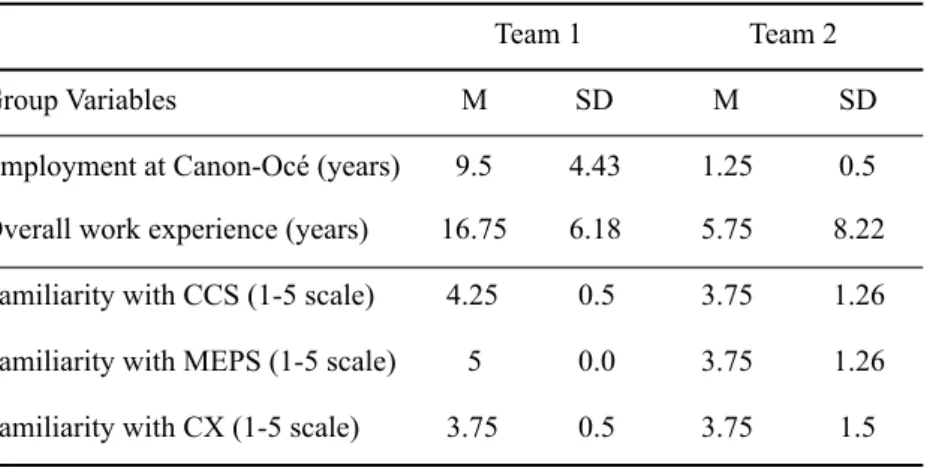
As depicted in Table 3, participants have been working at Canon-Océ for a mean of 5.38 years and have on average 11.25 years of overall work experience. The corresponding standard deviations are particularly high which is partly due to the small sample (N = 8) as well as the team constellations, which included senior and junior staff.
Average scores for concept familiarity were assessed on a 5-point scale for ideation (M = 4.25), MEPS (M = 4.37), CCS (M = 4.00), and CX (M = 3.75). All participants showed to have at least fundamental knowledge of each core concept with low average spread around the mean. Concerning extraversion, all participants reported exceedingly high values (M = 5.38) on a scale ranging from 0 (not at all extraverted) to 6 (extremely extraverted). Moreover, innovative behaviour, consisting of 6 items, scored on average 21.13 out of 30,
while intra-group processes, which accounted for group dynamics, averaged 15.75 out of 20 overall.
Looking at the different team constellations, as illustrated in Table 6, Team 1 differs substantially from Team 2 in terms of mean years of employment at Canon-Océ and overall work experience. For Team 1, years of employment at Canon-Océ range from 4 to 14 years with a mean value of 9.5 years, while Team 2’s participants have been employed by Canon-Océ for an average of 1.25 years, spanning from 1 to 2 years. Moreover, average work experience for Team 1 is 16.75 years, with values fluctuating between 8 to 22 years, while Team 2 has a mean of 5.75 years, ranging from 1 to 18 years.
Based on self-reported ratings, both teams show high levels of familiarity with the relevant concepts (>3.75). However, Team 1 indicates higher mean scores of familiarity with both service lines.
The four participants from Workshop 1 generated a total of 34 ideas, of which 18 and 16 were ideated during the divergent and convergent process, respectively. With 20 and 25 ideas in the divergent and convergent process, respectively, participants in Workshop 2 generated a total of 45 ideas (Table 5).
Table 4. Functional Roles of Team Members at Canon-Océ
Team 1 Team 2
Group Variables M SD M SD
Employment at Canon-Océ (years) 9.5 4.43 1.25 0.5
Overall work experience (years) 16.75 6.18 5.75 8.22
Familiarity with CCS (1-5 scale) 4.25 0.5 3.75 1.26
Familiarity with MEPS (1-5 scale) 5 0.0 3.75 1.26
4.3 Paired Samples T-Test
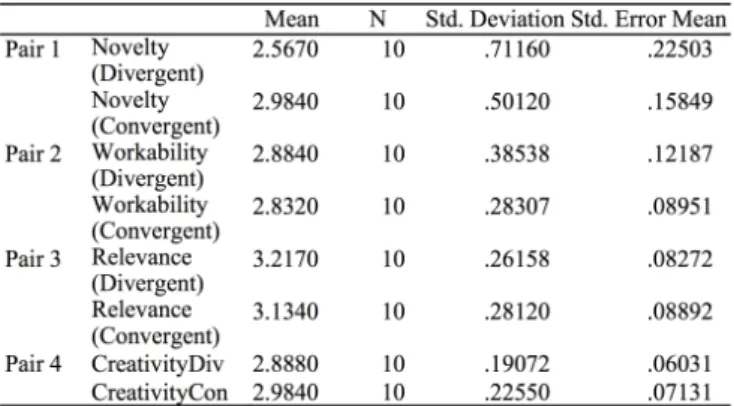
In order to evaluate the effect of the convergent ideation process on idea quality, based on Dean et al.’s (2006) idea creativity measures, a paired samples t-test was conducted using SPSS 23. This method of comparison was chosen as observations were dependent to one another and this test allowed to analyse the difference between the means of the same subject before and after experimental conditions were applied (Cooper & Schindler, 2014). The sample consists of 10 ideas, selected by the teams after both workshops’ divergent processes, which were subsequently further developed into a set of 10 “refined” ideas during the convergent process. Table 6 illustrates the descriptive statistics related to idea creativity scores with respect to being generated either during the divergent or convergent process. Notably, mean values for idea novelty and creativity increased from 2.567 to 2.984 and 2.888 to 2.984, respectively. Both idea quality constructs, workability and relevance, show declining mean values of 2.884 to 2.832 and 3.217 to 3.134, respectively.
Table 7 presents the result of the paired samples t-test. At the 5% level, convergent ideation shows a significant effect (p = 0.026) on idea creativity which illustrates that the effect is not likely due to chance but rather due to the convergent process itself. Extending the 5% significance level to 10%, in order to account for the small sample size, the mean novelty
Table 5. Number of Ideas Generated per Workshop
Number of Ideas -
Workshop 1 Creativity Rating SD Number of Ideas - Workshop 2 Creativity Rating SD
Divergent Process 18 2.84 0.34 20 2.78 0.23
Convergent Process 16 3.06 0.35 25 2.91 0.19
score for the selected ideas is significant with a Sig. (2-Tailed) p-value of 0.055. However, idea workability and relevance show no insignificant difference between the two conditions (p = 0.579 and p = 0.342, respectively).
4.4 Quality of the Best Selected Idea
As previously mentioned, group members were asked to individually select ideas, following the diverging ideation process, for further refinement. Although findings, concerning the effectiveness of idea selection, have been mixed, it was expected that a diverse team within an organisational context will be able to adequately discern the best ideas (proposition 3).
Table 6. Idea Creativity Scores
with their respective creativity ratings. With 5 points, “Screens & Projection” was the most voted idea in workshop 1 (see Appendix). Albeit not being the highest rated idea, with a creativity rating of 3.04 and 3.13, it scores above the mean rating in both the divergent (2.84) and the convergent process (3.06), respectively. In workshop 2, “Connectivity & Multichannel” was the most voted idea, which received the second highest rating after the divergent process (3.00) and the highest rating after the convergent process (3.25).
4.5 Correlation Analysis
Table 8 provides an overview of the correlations between work experience, the familiarity of concepts (ideation, MEPS, CCS, CX), group behaviour (extraversion, innovative behaviour, intra-group processes) as well as the creativity measures which were aggregated on an individual level. Although high levels of concept familiarity, extraversion, and innovative behaviour were expected to positively relate to idea creativity, the small sample size (N = 8) resulted in predominantly insignificant correlations. At the 5% level, concept familiarity of CX and ideation (r = 0.733, p = 0.038) as well as of ideation and MEPS (r = 0.813, p = 0.014) show positive correlations. Moreover, there appears to be a strong relation between innovative behaviour and work experience (r = 0.711, p = 0.048) as well as initial familiarity with MEPS and work experience (r = 0.742, p = 0.035). All idea creativity measures show strong inter variable correlations (r > 0.938) at the 1% level, which can be explained by Dean et al.’s (2006) proposition that feasibility, workability, and specificity should be merged to one overarching quality construct, due to an inherent relatedness.
Since it is not possible to draw further significant results from the given sample size, these results primarily reflect a general overview of the relationships between variables.
e 8. Cor re lat ion M at ri x
5. Discussion
In light of recent developments in the business process outsourcing industry, CBS is currently facing a global increase in competitive pressure as well as a continuous necessity for service innovation in order to meet evolving customer requirements with regard to the emergence of new communication channels. Looking for new opportunities to fuel the service innovation process, CBS, therefore, identified ideation as a potentially lucrative approach to further build on its employees’ expertise and creativity to meet the demand of tomorrow’s customer. Especially the increasing complexity of today’s business challenges calls for team diversity due to its presumable benefits for finding appropriate solutions (Paulus et al., 2012). However, as studies on ideation so far predominantly researched this field within laboratory settings, applying research within a firm relevant context offered an unprecedented opportunity to validate and further develop theory. Consequently, this case study assessed how CBS can implement a formal ideation approach to stimulate creativity and the service innovation process.
Due to the exploratory nature of the study, feasibility of ideation was assessed through the implementation of two workshops at CBS. With four participants in each workshop, thus a sample size of n =8, data are limited and to a large extent not statistically significant. Moreover, both workshops selected and further developed a total of ten ideas each, which were evaluated by an expert panel as proposed by the Consensual Assessment Technique (Amabile, 1982).
In terms of idea creativity, ideas significantly improved at the 5% level with the convergent ideation process, while at the 10% significance level, ideas subsequently reached higher novelty ratings. Evaluating the relationship between individual creativity scores and