A Work Project, presented as part of the requirements for the Award of a Master Degree in Management from the NOVA – School of Business and Economics.
“Renova: How to grow business out of
the tissue category in Portugal”
Communications Plan
Jonas Dominique Weber | 24999
A Project carried out within the Master in Management Program, under the supervision of:
Professor Jorge Velosa
2
Table of contents
1. Marketing objectives ... 1
2. Target audience selection and action objectives ... 1
3. Target Audience Decision Making ... 2
4. Communication objectives ... 2
5. Positioning statement for the campaign ... 4
6. Creative strategy ... 5
7. Integrated marketing communications strategy ... 7
8. Media strategy ... 7
9. Media budget allocation and campaign scheduling ... 8
10. Campaign tracking and evaluation ... 10
References ... 11
1
1. Marketing objectives
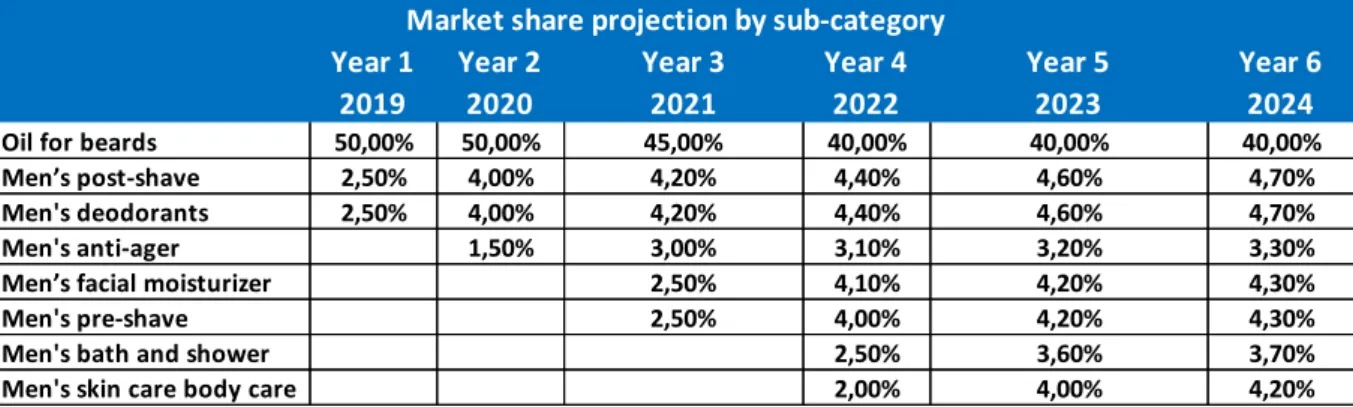
The marketing objectives translate the overall marketing goals into objectives that can be operationalised. They should be clear and concise enough to provide measures of progress to evaluate the success of the marketing plan (Thomas, 2008). Thereby they are determining the overall purpose for advertising or promoting the brand out of the company’s perspective (Rossiter & Percy, 1997). Furthermore, they also need to be specific regarding the timeframe to reach them (Thomas, 2008). The three main marketing objectives for Renova Men are first to launch the product in Portugal, in the hypermarkets and supermarkets distribution channel within the timeframe of two years and reaching sufficient distribution until May 2019, second to create awareness and positive brand attitude, and third to generate sales of the products according to the market share projections (figure 1) and the sales forecast (figure 2).
2. Target audience selection and action objectives
In order to determine the target audience for Renova Men in terms of primary and secondary target audience, the awareness-attitude-behaviour approach is applied (Rossiter & Percy, 1997). Since Renova will be entering a new category with a men’s grooming offering, the primary target audience focus should be on other brand switchers (OBS), thus people that already buy products in the category but not our brand because they are not aware of Renova’s offering. The secondary target audience should be non-category users (NCU) as they offer high-sales potential for an initial category offering to unaware NCU who enter the category. However, the acquisition of NCU requires higher acquisition cost due to the necessary category education (Rossiter & Percy, 1997). Furthermore, influencers such as the men’s partners (e.g. girlfriend) and peers (family and friends), bloggers or lifestyle magazines as well as the trade will also be the secondary target audience. The influencers will need to be convinced to spread the word about the product and the retailers have to be convinced to list the products on their shelves. To further narrow down the target audience the aforementioned approach can be extended by using
2
additional geographic, demographic and psychographic criteria (Rossiter & Percy, 1997). In this regard the primary target audience will be narrowed down to adult men between the age of 25 to 45 years in Portugal, that are concerned about their outer appearance and who are open minded about using men’s grooming products (Euromonitor International, 2016 A), that also value well-being and want to feel good when buying and using men’s grooming products. Having determined the target audience it is necessary to set the action objectives, which outline the “observable, measurable, actual behaviour” (Rossiter & Percy, 1997) that is supposed to be evoked through the campaign among the target audience. The possible action objectives are trial and repeat purchase (Rossiter & Percy, 1997). Since Renova Men will be a newcomer to the market the main action objective will be initially brand trial. Thereby for OBS who already buy products in the category the action objective is initially brand trial followed by repeat purchase and for NCU that are not using the category yet to try the category with the Renova Men brand and repurchasing it after trial. For the trade/ retailers the action objective is also trial through stocking the product, followed by repeat purchase.
3. Target Audience Decision Making
In order to determine specific communication objectives for the target audience it is important to understand the target audience decision process and thereby evaluating when marketing communication influences the choice for the brand. Identifying the different roles of people involved in the decision process helps to devise specific communication objectives to them (Percy & Rosenbaum-Elliott, 2016). The analysis of the decision process can be formalised by using a behavioural sequence model (BSM), which is illustrated in figure 3.
4. Communication objectives
Communication effects refer to long lasting mental associations within the mind of a potential consumer and can be divided into five basic communications effects of category need, brand awareness, brand attitude, brand purchase intention and purchase facilitation (Rossiter & Percy,
3
1997). Thereby the first communications effect is the category need, which refers to a potential buyer’s notion that the product from a category is necessary to fulfil a perceived need (Rossiter & Percy, 1997). Renova Men is placed in the sub-category of mass men’s grooming products within the mass beauty and personal care category. This category is already frequently purchased to some extent by men in Portugal. However, the category is not considered mature yet as many men in Portugal are not aware of all the offerings in the category (Euromonitor International, 2016 A). Therefore the category need is depending on the individual products, hence the target needs to be reminded of the category need for most of the products, whilst for the beard oil it needs to be created. The second communication effect is brand awareness, which describes the ability of the target audience “to recognize or recall the brand and associate it with the need” (Percy, 2008). The brand Renova is well established in the Portuguese market and enjoys a high brand awareness e.g. 87% in 2005 (de Sousa, 2012), which it was able maintain and built upon over the years (Euromonitor International, 2016 B). However, brand awareness for the Renova brand relates to the tissue and hygiene category and not the men’s grooming category. Therefore brand awareness for Renova Men within the men’s grooming category is non-existent and needs to be created as the brand will be a new introduction to the market. The necessity for brand awareness can be further specified into brand recognition and brand recall. Which of the two brand awareness objectives is required depends on when and where the decision for a specific brand is made. If the decision for the brand is made at the point of purchase brand recognition is the required objective. However, if the decision is made prior to the point of purchase the required objective is brand recall (Rossiter & Percy, 1997). As described in the BSM in figure 3 the potential customers of Renova Men predominantly decide for the brand at the point-of-purchase, thus brand recognition is the required main objective. Furthermore, research in the area of customer decision making for buying at grocery retailers revealed that there is a trend towards more in-store and point-of-purchase decisions among
4
consumers (POPAI, 2012). Because Renova Men is a new category entrant, the brand name must also be associated with the men’s grooming category through brand recall and the prospective buyer also needs to locate and recognize the product in the store, thus requiring brand-recall-boosted brand recognition (Rossiter & Bellman, 2005). However, besides being aware of a brand consumers also need to have a favourable brand attitude towards the brand to consider purchasing it (Percy & Rosenbaum-Elliott, 2016). Nevertheless, brand attitude is a relative concept and is dependent on several things such as what the target audience wants from the product, knows about the product and feels about the brand. What an individual knows thereby generally consists out of different beliefs that person has (Percy & Rosenbaum-Elliott, 2016). Since the Renova Men brand does not exist in the market yet, positive brand attitude for the brand needs to be created. The appropriate strategies for the brand attitude objective are derived from the Rossiter-Percy grid (Percy, 2008), which is discussed within the creative strategy part of this report. The fourth communication objective is brand purchase facilitation, which usually refers to promotions and is aimed at moving sales forward immediately (Percy, 2008). Since Renova Men will be the launch of a new brand the emphasis should be on creating a positive brand attitude and the creation of brand purchase intention should be done through “soft-selling” by creating a very favourable brand attitude (Rossiter & Percy, 1997). Lastly, brand purchase facilitation should be omitted as customers can be expected to already know where to buy men’s grooming products within the supermarket.
5. Positioning statement for the campaign
Since Renova Men is entering an existing category with a new product a differentiated positioning is chosen as it will not be centrally positioned as the category defining brand (Percy & Rosenbaum-Elliott, 2016). Therefore the positioning statement can be derived as follows: To
(target market) 25-45 years old Portuguese men, well-being and outer appearance concerned
5
of men’s grooming products (where the product is the hero), that focuses (point of difference) on the men’s well-being by inspiring them to stay true to themselves and by offering a pleasurable experience that appeals to senses (sensorial gratification).
This is underlined (reason to believe) by the liberated masculinity approach, colourful and artistic packaging, the enjoyable and compatible fragrance between the products and its natural ingredients.
Advertising should emphasize the artistic and colourful design of the packaging and
well-being (b-->e+) and must mention the quality and functionality as entry ticket (b) whilst price should be omitted.
6. Creative strategy
The business context in which the campaign will be carried out is that products specifically for men are increasingly present in stores, magazines as well as on social media. Whilst several advertising campaigns are trying to influence the purchase decision and product use in Portugal, “the majority of Portuguese men remains largely unaware of the actual offer in terms of men’s grooming, or do not feel the need to use such products” (Euromonitor International, 2016 A). On the contrary, “the younger generation presents a more open mind about personal care products” (Euromonitor International, 2016 A). The category is still less sophisticated and segmented than for women, which represents an important element for potential future development and growth of the category (Euromonitor International, 2016 A). As being a new category entrant the link between the category and Renova Men needs to be established through creating brand awareness and a positive brand attitude by generating the impression that the brand is designed especially for men and helps them feel good. The utilization of the Rossiter-Percy Grid can help to categorize the different factors influencing the brand attitude in such a way that communication strategies can be derived. Thereby the grid differentiates whether buying the brand is a high or low involvement purchase and whether the purchase motivation
6
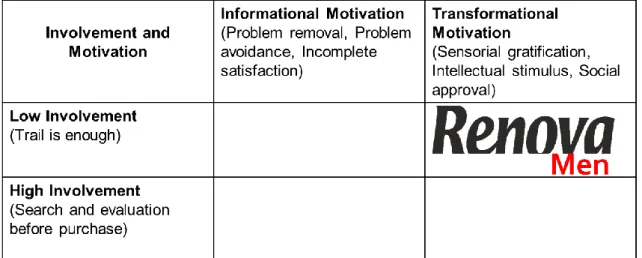
is driven by one of the three negative informational motivations or one of the three positive transformational motivations (Percy & Rosenbaum-Elliott, 2016). The Rossiter-Percy Grid for Renova Men is illustrated in figure 4. The purchase of Renova Men constitutes a low involvement decision for the primary target group of OBS as they are already familiar with the category and buying the product does not pose a great economic risk. Regarding men’s grooming products the purchase motivation can vary between an informational choice and a transformational choice. Since Renova Men will be positioned as a brand that offers well-being with a focus on making men feel good, the purchase motivation is based on the positive transformational motive of sensorial gratification. Therefore brand attitude needs to be created through demonstrating the emotional benefit and emotional authenticity (Percy & Rosenbaum-Elliott, 2016), thus the emotional benefit must be portrayed with emphasis in order to provide the correct emotional response and the provision of information should be minimal (Percy & Rosenbaum-Elliott, 2016). Furthermore, research evidence suggests that emotional campaigns have a higher ability for brand differentiation compared to more rational campaigns based on the functional brand benefits (Binet & Field, 2008). Given the necessity to create brand awareness for the new Renova Men brand, the right brand awareness strategy for achieving brand recognition in particular needs to be applied. Hence, the use of brand unique, good visual content, which is liked by the target audience is highly important (Percy & Rosenbaum-Elliott, 2016). Therefore the “visual presentation of the pack or logo” of how it looks at the point of purchase and “good visual content” (Percy & Rosenbaum-Elliott, 2016) are very important to reach the objectives. In this sense the ad needs to show the artistic packaging to convey the idea of feeling good and getting a nice treat as well as showing the purpose of the product to establish the association with the category need for men’s grooming products (Rossiter & Bellman, 2005), thus facilitating how the product can be found on the shelves. To summarize the key benefit to be conveyed to consumers is “Feel good with Renova Men and stay true to yourself!”
7
highlighting the aspect of feeling good when using the brand and the idea of well-being through being content with themselves.
7. Integrated marketing communications strategy
In order for any campaign to be successful a number of communication objectives must be addressed to support the positioning and must be executed coherently across different media. Thereby marketing communication can be further differed between advertising and promotion (Percy & Rosenbaum-Elliott, 2016). An overview of the different components of the campaign for Renova Men are depicted in figure 5. Thereby the campaign will feature components around the point of purchase, outdoor, online activities, public relations, promotions and direct marketing. The general idea behind the combination of these campaign components is to have a mixture of wide reach through online activities, public relations and outdoor advertising as primary media to potentially reach a wide cross-section of the Portuguese population and more targeted components as secondary media such as direct marketing or point of purchase initiatives. However, the component of promotions featuring aspects such as listing fees, point of sales activities and consumer price-offs will be discussed in the main report within the promotion chapter, whilst in this report the focus is on the advertising components and consumer promotions such as sampling.
8. Media strategy
In order to address the communication objectives outlined for the campaign it is necessary to select media that cater to these objectives. Thereby the media that cater to all the objectives are considered the primary media, whilst media that only cater to certain specific objectives is considered secondary media (Percy & Rosenbaum-Elliott, 2016). In the campaign for Renova Men building brand awareness in the form of brand recognition is the main objective together with creating a positive brand attitude. Taking these objectives and the considerations from the creative strategy into account the ideal media to reach the objectives would be TV and online
8
media (Percy & Rosenbaum-Elliott, 2016). However, using TV ads constitutes high media expenditures and the company Renova has clearly indicated during our meetings that they do not wish to use TV for their advertising, thus this option will not be considered. However, online media is also well suited for showing the product and it is possible to focus on images and other visual content (Percy & Rosenbaum-Elliott, 2016). Therefore part of the primary media for the campaign will be online media. Thereby various social media (detailed in main the report) that are good for showing visual content were selected to generate earned media. In order to drive engagement and buzz around the product there will be a launch event (explained in the main report) and videos and pictures of the event will be disseminated on social networks. The idea is that this combination will create “consequential word of mouth, which occurs when consumers directly exposed to traditional marketing campaigns pass on messages about them or brands they publicize” (Vetvik, Doogan, & Bughin, 2010). Thereby increasing effectiveness as “marketing campaigns that trigger positive word of mouth have comparatively higher campaign reach and influence” (Vetvik, Doogan, & Bughin, 2010). The same logic to generating WOM applies to the proposed Facebook contest that is coupled with a guerrilla marketing promotion using Renova’s toilet paper and outdoor billboards. To further boost the reach of these social media channels, paid media such as Google AdWords, Facebook and Instagram sponsored page and paid Facebook ads will be used (Lay , 2015). As secondary media the campaign will make use of lifestyle bloggers and ads in retailer magazines. Furthermore, the myRenova.com website, Pop-up shops and marketing during events will be used as a display for the products as well as direct marketing and product sampling.
9. Media budget allocation and campaign scheduling
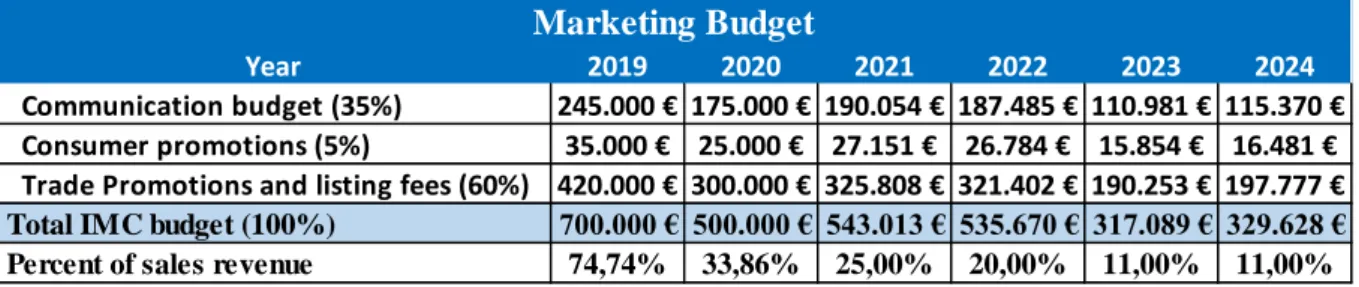
The total marketing budget is outlined in figure 6. During the first 2 years the marketing budget will make up a higher percentage of forecasted sales revenues and in the following years will be reduced stepwise, thus levelling out at 11% after all products are launched. The budget
9
allocation used for communication efforts within the first two years is depicted in figure 7 and figure 8. Thereby in 2019 the highest focus is on the launch event to create a lot of attention and WOM as well as on billboards and direct marketing through pop-up stores. The reasoning is that consumers first need to see the product in real life and need to have a first hands experience. The remaining 2019 budget is allocated to online channels. In 2020 the budget focus is shifted towards online activities with 55,5% of the budget being allocated to online and social media. The remaining budget is mostly allocated to outdoor and direct marketing. However, these channels are combined e.g. Facebook contest and billboards. The idea is that after the launch there are already several people that have bought the brand and are thus more inclined to engage online and act as brand ambassadors compared to 2019 when most people are still completely unfamiliar with the brand. With regard to the campaign scheduling for 2019 (figure 9 & 10) it needs to be mentioned that the launch event for the first products will be in May. During the first two months after launch there will be a very intensive phase of communication with the launch event being accompanied by the social media activities, the TV appearance as well as billboards and direct marketing initiatives. During the rest of the year the focus will be on digital online media and shorter bursts of the remaining media. The schedule for 2020 (figure 11 & 12) is similar to 2019 in that sense that many activities will focus on the time of the launch of the new products in January 2020. Thereby social media will be extensively used in combination with a guerrilla promotion campaign and a consumer contest. The effect of the contest will be extended for a longer time through using the results from the contest on billboards and on social media after the contest has finished. The idea is to reach a lot of people through using online media and focus the activities around the launch to create high attention for the new products. Throughout the rest of the year social media and ads on Facebook will be used. Additionally there will be short bursts of direct marketing events at the summer music festivals and at pop-up stores.
10
10. Campaign tracking and evaluation
Deriving measures to track the campaign helps to assess if the campaign is reaching its objectives. Thereby the least expensive yet also least accurate method is to use the comparison between expenditures on communication and evolution of sales. However, this approach cannot establish in which way the evolution of sales is affected by the communication efforts (Rossiter & Bellman, 2005). A more accurate method to track campaigns is conducting customer tracking surveys (CTS). However, despite the more accurate results of CTS’s they can pose huge additional costs (Rossiter & Bellman, 2005). Therefore other less expensive measures are more suitable for the company. On a more aggregate level the tracking of sales before, during and after the campaign from retail sales records can help to understand how well the product sells at different retailers according to those reports (Rossiter & Bellman, 2005). Furthermore, the pace of market share growth can be an indicator especially in cases of entering a new category, which would apply to Renova Men (Rossiter & Bellman, 2005). Since also various online media such as social media will be used for the campaign it is possible to use the tracking options available through them (Sayre, Visser, & Zwillenberg, 2011). For example it is possible to track the number of likes, comments and shares of posts on social media sites such as Instagram and Facebook or the number of followers of the social media pages. Furthermore, it is possible to track the click-through-rate of Google AdWords as well as the number of additional Renova website visitors and on the social media pages. Additionally the adherence to the Facebook contest and number of trial incidents related to the contest can help to indicate the performance of these initiatives. Lastly a qualitative analysis of the comments on social media posts and of feedback via other channels, e.g. consumer’s reactions and feedback at the pop-up stores and at the direct marketing during events, can be used to gather insights about the campaign and how it is perceived by the consumers.
11
References
Binet, L., & Field, P. (2008). Communications Strategy in the Era of Accountability. Institute of Practitioners in Advertising (IPA dataMINE).
de Sousa, R. S. (2012). Case Study: Renova Toilet Paper Avant-garde marketing in a commoditized category. INSEAD.
Euromonitor International. (2016 A). Men's grooming in Portugal. Euromonitor.
Euromonitor International. (2016 B). Renova - Fábrica de papel do Almonda SA in tissue and hygiene (Portugal). Euromonitor.
Lay , M. (2015). Show me the ROI: The Balancing Act of Organic and Paid Social. Adobe. Percy, L. (2008). Strategic Integrated Marketing Communication: theory and practice.
Oxford: Butterworth-Heinemann / Elsevier.
Percy, L., & Rosenbaum-Elliott, R. (2016). Strategic Advertising Management (Fifth ed.). Oxford University Press.
POPAI. (2012). 2012 Shopper engagement study media topline report. Point Of Purchase Advertising International (the global association for marketing at retail).
Rossiter, & Percy. (1997). Advertising Communications & Promotion Management (Second ed.). Irwin/ McGraw -Hill.
Rossiter, J. R., & Bellman, S. (2005). Marketing Communications: theory and applications. Pearson-Prentice Hall.
Sayre, K., Visser, J., & Zwillenberg, P. (2011). Getting More from Social Media. The Boston Consulting Group.
Thomas, R. K. (2008). Health Services Marketing: A Practitioner’s Guide. Memphis: Springer Science+Business Media, LLC.
Vetvik, O. J., Doogan, J., & Bughin, J. (2010). A new way to measure word-of-mouth marketing. McKinsey Quarterly.
12
Appendix
Figure 1: Market share projection by sub-category ... 13
Figure 2: Sales Forecast ... 13
Figure 3: Behavioural Sequence Model (BSM) ... 14
Figure 4: Rossiter-Percy Grid for Renova Men ... 15
Figure 5: IMC Strategy Overview ... 15
Figure 6: Overall Marketing Budget ... 16
Figure 7: Above the line communications budget 2019 ... 16
Figure 8: Above the line communications budget 2020 ... 17
Figure 9: Above the line campaign schedule January 2019 – June 2019 ... 18
Figure 10: Above the line campaign schedule July 2019 – December 2019 ... 19
Figure 11: Above the line campaign schedule January 2020 – June 2020 ... 20
13 Figure 1: Market share projection by sub-category
Figure 2: Sales Forecast Year 1 2019 Year 2 2020 Year 3 2021 Year 4 2022 Year 5 2023 Year 6 2024
Oil for beards 50,00% 50,00% 45,00% 40,00% 40,00% 40,00%
Men’s post-shave 2,50% 4,00% 4,20% 4,40% 4,60% 4,70%
Men's deodorants 2,50% 4,00% 4,20% 4,40% 4,60% 4,70%
Men's anti-ager 1,50% 3,00% 3,10% 3,20% 3,30%
Men’s facial moisturizer 2,50% 4,10% 4,20% 4,30%
Men's pre-shave 2,50% 4,00% 4,20% 4,30%
Men's bath and shower 2,50% 3,60% 3,70%
Men's skin care body care 2,00% 4,00% 4,20%
Market share projection by sub-category
2019 2020 2021 2022 2023 2024
Oil for beards 469.767 € 477.753 € 437.288 € 395.308 € 402.028 € 408.863 € Men’s post-shave 637.500 € 1.052.000 € 1.134.424 € 1.220.532 € 1.310.463 € 1.361.714 € Men's deodorants 665.000 € 1.100.000 € 1.155.000 € 1.210.000 € 1.265.000 € 1.314.473 € Men's anti-ager 164.666 € 337.566 € 357.538 € 378.299 € 396.753 € Men’s facial moisturizer 186.545 € 314.194 € 330.547 € 344.170 € Men's pre-shave 859.365,00 € 1.398.358,73 € 1.493.237,37 € 1.554.780 €
Men's bath and shower 127.500 € 183.600 € 191.908 €
Men's skin care body care 44.833 € 91.640 € 97.857 €
Sum in retail value RSP 1.772.267 € 2.794.420 € 4.110.188 € 5.068.265 € 5.454.815 € 5.670.518 € estimated market share of total
category based on projected total category market size
0,71% 1,10% 1,59% 1,93% 2,04% 2,08%
excl VAT 23% 1.440.868 € 2.271.886 € 3.341.616 € 4.120.541 € 4.434.809 € 4.610.177 € excl retailer margin 35% 936.564 € 1.476.726 € 2.172.050 € 2.678.351 € 2.882.626 € 2.996.615 €
14 Figure 3: Behavioural Sequence Model (BSM)
What Need arousal Information search
and
evaluation of
alternatives
Choice Usage
Who Men themselves (initiator)
partner such as wife (initiator
and influencer)
Members of peer group such as family, friends or work
colleagues (initiator and
influencer) Men themselves (influencer) Peers (influencers) Men themselves (decider and purchaser)
Partner such as wife or girlfriend of men
(decider and
purchaser)
Men themselves (user)
Where Retailer stores such as
supermarket or hypermarkets
Home
Retailer stores Home Online
Retail store Home Gym Hotel room Bathroom
When During weekly routine
grocery shopping At point-of-purchase while shopping Instant when at point-of-purchase Usually after shower as part of the morning routine
How At home need arises for men
to replenish a product
At store need arises to try out a new brand
Evaluating own preference (brand
recall)
Examining products at store (design, price
etc.)
Asking peers
Compare what is offered at the store
Based on previous purchase
Trial of product Brand remains in
consideration set if
15 Figure 4: Rossiter-Percy Grid for Renova Men
16 Figure 6: Overall Marketing Budget
Figure 7: Above the line communications budget 2019
Year 2019 2020 2021 2022 2023 2024
Communication budget (35%) 245.000 € 175.000 € 190.054 € 187.485 € 110.981 € 115.370 € Consumer promotions (5%) 35.000 € 25.000 € 27.151 € 26.784 € 15.854 € 16.481 € Trade Promotions and listing fees (60%) 420.000 € 300.000 € 325.808 € 321.402 € 190.253 € 197.777 € Total IMC budget (100%) 700.000 € 500.000 € 543.013 € 535.670 € 317.089 € 329.628 € Percent of sales revenue 74,74% 33,86% 25,00% 20,00% 11,00% 11,00%
Marketing Budget
Medium Total % of Total
Online 3.680 € 1,60% Online Online 8.625 € 3,75% Social Media Social Media 3.680 € 1,60% Social Media 10.810 € 4,70% Social Media Social Media 2.300 € 1,00% Social Media Social Media Social Media Social Media 14.375 € 6,25% Social Media Social Media PR 2.875 € 1,25% PR PR 73.600 € 32,00% Outdoor 57.500 € 25,00% Magazines 2.300 € 1,00% Direct Marketing 12.880 € 5,60% Direct Marketing 28.750 € 12,50% Direct Marketing 8.625 € 3,75% 230.000 € 100,00%
Direct Marketing Promotion team Pop-up stores/ Eventmarketing 15.000 € Consumer promotionSampling during events (launch, festivals etc.) 35.000 € 50.000 € 280.000 € 2019
Above the line budget (Communications)
IC total: Integrated communications
Media Total:
Above the line total: Media Description Google AdWords
Renova website
Digital content production e.g. pictures, text, music Renova Men Facebook page
Renova Men Facebook sponsored page Facebook ads
Renova Men Instagram page
Renova Men Instagram sponsored page Pinterest
Flickr
YouTube Channel
Videos production (launch event and product demo) Renova Men Twitter channel
Google+ Bloggers TV presences
Kinect Projection Mapping launch event Billboards
Retailer Magazines
Materials for direct marketing e.g. stands Pop-up stores
17 Figure 8: Above the line communications budget 2020
Medium Media Description Total % of Total
Online 8.000 € 5,0% Online Online 2.000 € 1,3% Social Media Social Media 3.392 € 2,1% Social Media 24.000 € 15,0% Social Media Social Media 3.200 € 2,0% Social Media Social Media Social Media Social Media 5.000 € 3,1% Social Media Social Media POS/ online 40.000 € 25,0% PR 3.200 € 2,0% PR Outdoor 48.000 € 30,0% Magazines 1.600 € 1,0% Direct Marketing 1.600 € 1,0% Direct Marketing 15.000 € 9,4% Direct Marketing 5.000 € 3,1% 160.000 € 100,00%
Direct Marketing Promotion team Pop-up stores/ Eventmarketing 15.000 € Consumer PromotionSampling during Facebook contest and events 20.000 € Consumer PromotionWinner prices for Facebook contest 5.000 €
40.000 € 200.000 € IC total:
2020 Above the line budget
(Communications)
Media Total:
Above the line total: Integrated communications
Google AdWords Renova website
Digital content production e.g. pictures, text, music Renova Men Facebook page
Renova Men Facebook sponsored page Facebook ads
Renova Men Instagram page
Renova Men Instagram sponsored page Pinterest
Flickr
YouTube Channel
Demonstration Videos production
Eventmarketing during summer music festivals Renova Men Twitter channel
Google+
Guerrilla promotions with toilet paper Bloggers
TV presences Billboards Retailer Magazines
Materials for direct marketing e.g. stands Pop-up stores
18 Figure 9: Above the line campaign schedule January 2019 – June 2019
Media Description January February March April May (launch) June
Google AdWords
Renova website Heavy publishing after launch event
Digital content
production e.g. pictures etc. Renova Men
Facebook page Heavy publishing after launch event
Renova Men
Facebook sponsored page attract followers
Facebook ads show products
Renova Men
Instagram page Heavy publishing after launch event
Renova Men
Instagram sponsored page attract followers
Pinterest Flickr YouTube Channel Videos production Renova Men Twitter channel Google+ Bloggers
TV presences after launch event
Kinect Projection
Mapping launch event two weeks
Billboards 4 weeks
Retailer Magazines Materials for direct
marketing e.g. stands preparation for launch
Pop-up stores 2 weeks
Eventmarketing during music festivals
Heavy publishing after launch event
Heavy publishing after launch event set up but not live for public
set up but not live for public
publications and reports after launch set up but not live for public
19 Figure 10: Above the line campaign schedule July 2019 – December 2019
Media Description July August September October November December
Google AdWords
Renova website Digital content
production e.g. pictures etc. Renova Men
Facebook page Renova Men
Facebook sponsored page Facebook ads
Renova Men Instagram page Renova Men
Instagram sponsored page Pinterest Flickr YouTube Channel Videos production Renova Men Twitter channel Google+ Bloggers TV presences Kinect Projection Mapping launch event
Billboards 4 weeks 2 weeks
Retailer Magazines Materials for
direct marketing e.g. stands
Pop-up stores 2 weeks entire month
Eventmarketing during music festivals
publish video from launch event and product demonstration videos continuous presence with regular postings about products and related information continuous presence with regular postings about products and related information
continuous presence with regular postings about products and related information continuous presence with regular postings about products and related information continuous presence with regular postings about products and related information
promotion teams during summer music festivals
continuous presence with regular postings about products and related information
preparation next years launches
20 Figure 11: Above the line campaign schedule January 2020 – June 2020
Media Description
January (launch add.
products)
February March April May June
Google AdWords support launch of the new products
Renova website Renova Men
Facebook page used as platform during contest/ Guerrilla promotion; posting of videos and pictures related to the contest Renova Men Facebook
sponsored page Facebook ads
Renova Men Instagram page posting of videos and pictures related to the contest Renova Men Instagram
sponsored page
Pinterest posting of videos and pictures related to the contest
Flickr posting of videos and pictures related to the contest
YouTube
Channel video posts related to contest
Renova Men
Twitter channel used for sharing the hashtag #feelinggoodwithRenovaMen of the contest
Google+ posting of videos and pictures related to the contest
Guerrilla promotions
with toilet paper 3 months contest related to the new product launch
Bloggers occasional publications after launch
TV presences related to Facebook contest
Billboards 8 weeks with pictures from contest
Retailer Magazines
Pop-up stores Eventmarketing summer music festivals
21 Figure 12: Above the line campaign schedule July 2020 – December 2020
Media Description July August September October November December
Google AdWords
Renova website Renova Men Facebook page Renova Men
Facebook sponsored page Facebook ads
Renova Men
Instagram page continuous presence with regular postings about products and related information Renova Men
Instagram sponsored page Pinterest
Flickr YouTube
Channel product demonstration videos
Renova Men Twitter channel Google+
Guerrilla promotions with toilet paper Bloggers
TV presences
Billboards 2 weeks
Retailer Magazines
Pop-up stores 2 weeks 2 weeks 2 weeks
Eventmarketing
summer music festivals small promotion teams during summer music festivals
continuous presence with regular postings about products and related information
continuous presence with regular postings about products and related information continuous presence with regular postings about products and related information