
EUROPEAN ORGANIZATION FOR NUCLEAR RESEARCH (CERN)
CERN-EP-2017-098 2017/09/20
CMS-EXO-16-030
Search for low mass vector resonances decaying to
quark-antiquark pairs in proton-proton collisions at
√
s
=
13 TeV
The CMS Collaboration
∗Abstract
A search is reported for a narrow vector resonance decaying to quark-antiquark pairs in proton-proton collisions at √s = 13 TeV, collected with the CMS detector at the LHC. The data sample corresponds to an integrated luminosity of 2.7 fb−1. The vector resonance is produced at large transverse momenta, with its decay products merged into a single jet. The resulting signature is a peak over background in the distribution of the invariant mass of the jet. The results are interpreted in the framework of a lepto-phobic vector resonance and no evidence is found for such particles in the mass range of 100–300 GeV. Upper limits at 95% confidence level on the production cross section are presented in a region of mass-coupling phase space previously unexplored at the LHC. The region below 140 GeV has not been explored by any previous experiments.
Published in Physical Review Letters as doi:10.1103/PhysRevLett.119.111802.
c
2017 CERN for the benefit of the CMS Collaboration. CC-BY-3.0 license
∗See Appendix A for the list of collaboration members
1
Over the past half-century, searches for narrow resonances in the dijet invariant mass spectrum have been an important part of the physics program at every collider. Such searches are well motivated within the many classes of theories beyond the current standard model (SM) that predict resonances with significant couplings to quarks [1–11]. The first searches for such par-ticles at the UA1 [12] and UA2 [13, 14] experiments at the CERN SppS have been extended to larger values of resonance masses by the CDF [15–19] and D0 [20–22] experiments at the Fer-milab Tevatron, and by the ATLAS [23–32] and CMS [33–45] experiments at the CERN LHC. In this Letter, we report on a search for vector (Z0) resonances decaying to quark-antiquark pairs (qq) using the data collected in pp collisions at√s = 13 TeV by the CMS detector, corre-sponding to an integrated luminosity of 2.7 fb−1. This search concentrates on the mass region of 100–300 GeV, exploring for the first time masses below 140 GeV [13, 14]. To access this mass regime, we present a new analysis technique exploiting novel jet substructure techniques and associated production with a jet. The search is interpreted in the framework of a leptopho-bic vector resonance and can also be reinterpreted in terms of searches for generic vector-like resonances decaying to quarks. [46].
With the increase in collision energy and beam intensity at hadron colliders, there has been a loss of search sensitivity for lighter resonances with couplings to quarks and gluons. The main experimental difficulties originate from the large increase in the cross section of multijet back-grounds at small resonance masses, and the more restrictive trigger requirements needed to reduce the data recording rate because of limited resources for event processing and storage. To overcome these difficulties, we require events to have a jet with large transverse momen-tum (pT) from initial-state radiation (ISR) produced in association with the resonance. This
ISR constraint provides enough energy in the event to satisfy the trigger. Combinatorial back-grounds are reduced by requiring the resonance be reconstructed within a single jet. The jet is required to have the two-prong structure expected from signal. The dominant background is from SM events comprised of jets produced through quantum chromodynamics (QCD). This multijet background is estimated by inverting the two-prong substructure requirement, which is specifically designed to be uncorrelated with the jet mass. By searching for new particles produced in association with an ISR jet, we are able to search for new resonances in a coupling and mass regime to which previous searches were insensitive.
A detailed description of the CMS detector, together with a definition of the coordinate system and the relevant kinematic variables, can be found in Ref. [47]. The central feature of the CMS apparatus is a superconducting solenoid of 6 m internal diameter, providing a magnetic field of 3.8 T. A silicon pixel and strip tracker, a lead tungstate crystal electromagnetic calorimeter (ECAL), and a brass and scintillator hadron calorimeter (HCAL), each composed of a barrel and two endcap sections, reside within the solenoid. Forward calorimeters extend the pseudo-rapidity (η) [47] coverage provided by the barrel and endcap detectors. Muons are measured in gas-ionization detectors embedded in the steel flux-return yoke outside the solenoid. We employ the CMS particle-flow (PF) algorithm [48, 49] to reconstruct and identify each indi-vidual particle through an optimized combination of information from the various elements of the CMS detector. The energy of a photon is obtained directly from the ECAL measurement, corrected for losses in detector sensitivity due to zero suppression near signal threshold. The energy of an electron is determined from a combination of its momentum at the primary in-teraction vertex determined using the tracker, the energy of the corresponding ECAL cluster, and the energy sum of all bremsstrahlung photons spatially compatible with originating from the electron track. The energy of a muon is obtained from the curvature of the corresponding track. The energy of a charged hadron is obtained from a combination of its momentum
mea-sured in the tracker and the matching of ECAL and HCAL energy depositions, corrected for the response function of the calorimeters to hadronic showers. The energy of a neutral hadron is obtained from the corresponding corrected ECAL and HCAL energies.
The benchmark Z0 signal events are simulated at leading order (LO) using the MAD -GRAPH5 aMC@NLO 2.2.1 generator [50]; PYTHIA 8.205 generator [51, 52] and GEANT4 [53]. The dominant SM backgrounds arise from multijets, W → qq, and Z → qq sources. These backgrounds are simulated at LO using the MADGRAPH5 aMC@NLO 2.2.1 generator and hadronized withPYTHIAusing the CUETP8M1 tune [54]. To events containing W and Z bosons, we apply higher-order QCD and Electroweak (EWK) corrections to improve modeling of the high pTW and Z events, following [55–59]. Owing to the similarity between the signal process
and the SM W and Z topologies, the next-to-leading-order (NLO) QCD corrections and associ-ated uncertainties applied to the W and Z simulations are also applied to the signal simulation. The NLO EWK corrections are not applied since such corrections are different for leptophobic Z0signal production.
To isolate the Z0signal and overcome trigger restrictions, we select a high-pT signal jet, which
typically recoils against another high-pTISR jet. We use a logical “or” of trigger requirements
that selects on the total hadronic transverse energy in the event and, in some cases, additionally select on the mass of the jet after removing remnants of soft radiation, with the jet trimming technique [60]. Jets at the trigger level are reconstructed using the anti-kT algorithm [61, 62]
with a distance parameter of 0.8, and are referred to as AK8 jets.
After the trigger selection, the AK8 jets are reconstructed by clustering particle candidates in the event. To mitigate the effect of additional interactions in the same or adjacent bunch cross-ings (pileup), the pileup per particle identification (PUPPI) algorithm [63] is used, prior to jet clustering, to weight the PF candidates on the likelihood of coming from the primary interac-tion vertex. Other correcinterac-tions are applied to jet energies as a funcinterac-tion of jet η and pT to match
the detector response and to bring data and simulation into agreement. We require at least one AK8 jet to have pT > 500 GeV and to satisfy|η| < 2.5 to be fully efficient with respect to
the trigger requirements. We veto events containing identified and isolated electrons or muons with pT > 10 GeV, and |η| < 2.5 or 2.4, respectively, to reduce backgrounds from SM EWK
processes.
The Lorentz-boosted Z0 →qq system is reconstructed as a single high-pT jet, where the decay
products have merged into one object, assumed to be the jet of highest pT in the event. From
simulation studies, approximately 70% of Z0 signal events satisfy this assumption. The most important variable is the soft drop jet mass (mSD), which employs soft drop grooming [64, 65],
a technique used to remove soft and wide-angle radiation in jets. The variable mSD enhances
the peak at the Z0 mass for signal events and the same act of soft drop grooming reduces the masses from background quark- and gluon-initiated events. For computing mSD, we use a soft
radiation fraction selection greater than z=0.1 and an angular exponent parameter of β=0. Since the Z0 →qq jet has a two-prong structure, we use substructure tools developed to identify jets from hadronically decaying W bosons. We use a variable based on the N-subjettiness ratio
τ2/τ1[66], also referred to as τ21, which is used in other searches to determine a jet’s consistency
with having a two-prong structure [67–69]. However, any chosen cutoff τ21 value sculpts the
jet mass distributions in a way that depends on the pT of the jet, and causes a complex mass
distribution that peaks at high jet mass. This limits its usefulness when searching for resonant peaks over a large range in pT. We therefore employ a transformation of τ21 to τ21DDT, where
DDT stands for designed decorrelated tagger [70]. It is a generic technique to reduce mass correlations of the observable in multijet events. We specifically deploy it here through a linear
3
transformation between τ21and a dimensionless jet mass variable [71], ρDDT =ln[mSD2 /(µ0pT)],
where the scale µ0 = 1 GeV. We determine the optimal transformation from simulation to be τ21DDT =τ21+0.063 ρDDT. Events are selected by requiring τ21DDT <0.38.
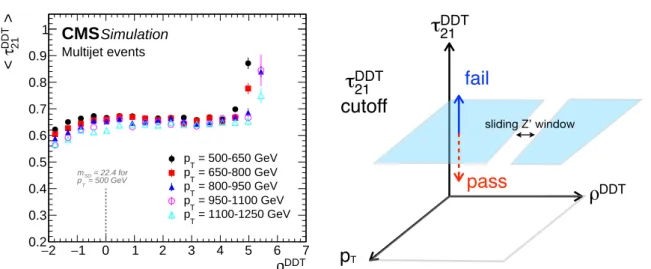
The dominant background comes from multijet events. For each Z0 mass point, we estimate this background using sidebands of kinematic distributions in the data, in order to minimize reliance on the simulation. We use both ρDDT and τ21DDT background-dominated sideband re-gions and take advantage of the lack of correlation between τ21DDT and ρDDT. The method is illustrated in Fig. 1(left), where the mean in the distribution of τ21DDTis plotted as a function of
ρDDTfor different bins in jet pT. Both τ21DDTand pThave little dependence on ρDDTin range from
0 to 4 corresponding to 30 GeV < mSD < 300 GeV. Figure 1(right) illustrates the strategy for
estimating the multijet background. We define the pass-to-fail ratio, Rp/ f, as the ratio of yields in the pass region (τ21DDT < 0.38) to the yields in the fail region (τ21DDT > 0.38). We rescale mul-tijet events from the fail region using Rp/ f parameterized in pT and ρDDTto predict the mulijet
signal region background:
Ppassmultijet(pT, ρDDT) =Rp/ f(pT, ρDDT)Pfailmultijet(pT, ρDDT) (1)
where Ppassmultijetand Pfailmultijetare the passing and failing multijet distributions. We determine Rp/ f
by fitting the ratio of data events in the pass to fail regions over the (ρDDT, pT) space. With this
method, we fit for any residual correlations between τ21DDTand ρDDT, modeling them as polyno-mial functions. Fitting Rp/ f, in place of the normalization, allows the region where the trigger
selection is not fully efficient to be exploited; therefore we begin the Rp/ f fit in this region at
a jet pT >350 GeV. Prior to performing the fit, we subtract the W and Z boson contributions
expected from simulation, at NLO, to estimate only nonresonant contributions such as the mul-tijet background. To avoid a bias induced by a given Z0 signal, we exclude a window from the Rp/ f fit centered about the given Z0mSDof width±10% mZ0, which corresponds approximately
to the jet mass resolution. The missing strip in the Rp/ f shape in Fig. 1 (right) reflects this
win-dow. Fits are therefore performed as a function of Z0 mass to estimate the background. The two-dimensional Rp/ f depends slightly on the chosen mass hypothesis, as different windows
in jet mass are excluded for each Z0mass. Finally, the mass distribution in data is tested for the presence of signal using the multijet prediction along with the simulated W and Z predictions. The uncertainties in the method described above arise from three sources. The first uncertainty arises from residual systematic effects in the method, as determined from a self-consistency check in simulated events. This systematic effect is correlated across all jet mass bins. The second is due to the uncertainty in the Rp/ f shape from the fit parameter uncertainties, also
correlated across all jet mass bins. The third source originates from uncorrelated statistical uncertainties in the size of the fail sample and the statistical uncertainties in the self-consistency test.
Smaller backgrounds from resonant SM processes (W/Z +jets) are estimated from simulation, but with corrections for the mass shapes and efficiencies evaluated from data as discussed be-low. The expectations for all SM background processes (multijets, W/Z +jets) are determined for jet masses from 30 to 330 GeV. Including the region near the W and Z boson masses pro-vides a constraint on the mass distribution of the Z0and its normalization by determining the W/Z +jets contribution in situ.
The systematic effects on shapes and normalizations of the W, Z, and signal distributions are correlated. We constrain the jet mass scale, jet mass resolution, and τ21DDT selection efficiency using a sample of merged W boson jets in semileptonic tt events in data. Using the same τ21DDT selection as in the analysis provides passing and failing regions for merged W boson jets in data
4 DDT ρ 2 − −1 0 1 2 3 4 5 6 7 > DDTτ21 < 0.2 0.3 0.4 0.5 0.6 0.7 0.8 0.9 1 CMSSimulation Multijet events = 500-650 GeV T p = 650-800 GeV T p = 800-950 GeV T p = 950-1100 GeV T p = 1100-1250 GeV T p = 22.4 for SD m = 500 GeV T p
p
Tfail
pass
cutoff
sliding Z’ window DDTρ
2− 1− 0 1 2 3 4 5 6 7>
DDT 21τ
<
0.2 0.3 0.4 0.5 0.6 0.7 0.8 0.9 1CMS
Simulation
Multijet events = 500-650 GeV T p = 650-800 GeV T p = 800-950 GeV T p = 950-1100 GeV T p = 1100-1250 GeV T p = 22.4 for SD m = 500 GeV Tp DDTρ
2− 1− 0 1 2 3 4 5 6 7>
DDT 21τ
<
0.2 0.3 0.4 0.5 0.6 0.7 0.8 0.9 1CMS
Simulation
Multijet events = 500-650 GeV T p = 650-800 GeV T p = 800-950 GeV T p = 950-1100 GeV T p = 1100-1250 GeV T p = 22.4 for SD m = 500 GeV Tp DDTρ
2 − −1 0 1 2 3 4 5 6 7 DDT 21τ
<
0.2 0.3 0.4 0.5 0.6 0.7 0.8 0.9 Multijet events = 500-650 GeV T p = 650-800 GeV T p = 800-950 GeV T p = 950-1100 GeV T p = 1100-1250 GeV T p = 22.4 for SD m = 500 GeV T pFigure 1: The average of τ21DDTversus ρDDTfor different bins in jet pT(left). A schematic of the
method used to estimate the background (right). After a τ21DDTselection is applied, the multijet event distributions in the passing region are predicted from their distributions in the failing region with the use of a pass-to-fail ratio extracted through a 2-dimensional fit in (ρDDT, pT)
space. Events in a sliding window around the desired Z0 mass point are vetoed when deter-mining the pass-to-fail ratio.
and in simulation. A simultaneous fit to the two samples in mSDis performed to extract the
tagging efficiency of a merged W boson jet, its jet mass scale, and the resolution in simulation and in data. Scale factors relating data and simulation are then computed and applied to the simulation. These scale factors and their uncertainties determine the initial distributions for the W, Z, and signal that are further constrained in the final fit in situ using the presence of the W and Z peaks in the jet mass distribution. Finally, additional systematic uncertainties are applied to the W, Z, and Z0 signal yields that are associated with higher-order corrections to the boson pT distributions, jet energy scale [72], the modeling of pileup and the integrated
beam luminosity [73]. A quantitative summary of the systematic effects considered is shown in Table 1.
Table 1: Summary of the systematic uncertainties for signal and background. Uncertainties due to the finite size of the simulated samples are applied only to the Z0 signal. Electroweak uncertainties are applied only to the W/Z boson processes. Dashes (—) indicate the uncertainty does not apply.
Systematic effect Multijet SM W/Z and Z0 Multijet fit parameters 1–4% —
Multijet bin-by-bin statistics 1–20% —
Multijet fit closure 1–12% —
W boson tagging scale factor — 20%
NLO QCD pT corrections — 8–12%
Jet energy/mass resolution — 10%
Simulation sample size — 1-30%
Integated luminosity — 2.7%
Pileup — <1%
Jet energy/mass scale — 1%
To validate the background estimation method and its associated systematic uncertainties, studies are performed on simulated events by injecting a signal and testing for a bias in the
5
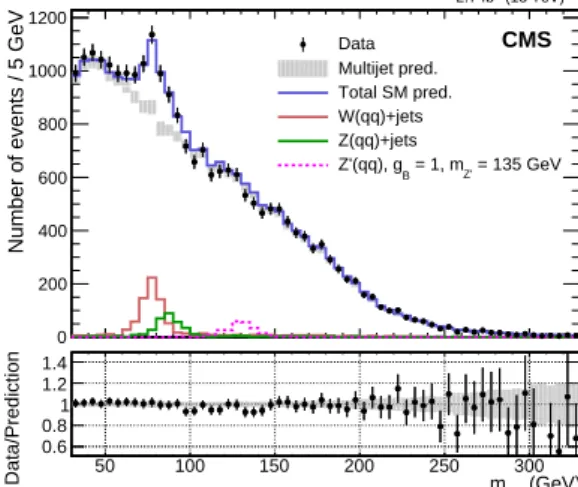
extracted signal cross section. No significant bias is observed. We combine the estimates of var-ious SM background processes, and search for a Z0 resonance in the 100–300 GeV mass range, while the SM backgrounds are estimated in the 30–330 GeV mass range. Figure 2 shows the soft drop jet mass distribution with a background calculated for the Z0search at a mass of 135 GeV. Expected background contributions from the W and Z bosons are clearly visible in the data.
Number of events / 5 GeV
0 200 400 600 800 1000 1200 Data Multijet pred. Total SM pred. W(qq)+jets Z(qq)+jets = 135 GeV Z' = 1, m B Z'(qq), g CMS (13 TeV) -1 2.7 fb (GeV) SD m 50 100 150 200 250 300 Data/Prediction 0.6 0.8 1 1.2 1.4
Figure 2: Soft drop jet mass distribution after final selection. Data are shown as black points. The multijet background, including uncertainties, is shown as gray boxes, while the sum of the SM processes is given by the blue line. Contributions from the SM W/Z boson and a hypothetical Z0 signal at a mass of 135 GeV are also indicated. In the bottom panel, we show the ratio of the data to the background prediction, including uncertainties.
The number of events in data is consistent with the predicted backgrounds from SM processes. Results are obtained from combined signal and background binned likelihood fits to the jet mass distribution, such as the one shown in Fig. 2. The results are interpreted as upper limits on the production cross section for signal in terms of 95% confidence level (CL) upper lim-its computed using the modified frequentist approach (CLs), taking the likelihood as the test
statistic [74, 75] in the asymptotic approximation [76]. Systematic uncertainties are treated as nuisance parameters that are modeled through log-normal priors. The probability of the down-ward fluctuation of the data at a Z0signal mass of 100 GeV is less than 0.15% and corresponds to a local 2.8σ effect. We attribute this to a statistical fluctuation in data. Studies of the background model are performed by injecting simulated signal events and we find negligible biases in the fitted signal strength. An alternative background estimate is also studied by fitting directly the jet mass distribution, results are consistent within 1 σ.
Upper limits on signal cross sections are translated into the coupling of the Z0 boson to quarks (gq) as a function of mZ0. In Fig. 3, we compare our results with previous results from the UA2,
CDF, ATLAS, and CMS experiments. The limits from the UA2 and CDF experiments, and the indirect constraints from the Z → qq width are obtained following the approach described in Ref. [77]. We exclude coupling values of gqfrom 0.071 to 0.260 over the selected Z0 mass range.
In summary, a search by CMS for a vector (Z0) resonance decaying to a qq pair in the mass range from 100-300 GeV has been presented. The results are interpreted in the framework of a leptophobic vector resonance model. No excess above the SM prediction is observed, and 95% confidence level upper limits are set on the coupling of the Z0 to quarks as a function of the Z0 mass. These limits are the most stringent to date for masses less than 300 GeV. For masses below 140 GeV, these are the only available direct limits.
Z' mass (GeV) 80 100 200 300 400 500 q Coupling, g 0.05 0.06 0.1 0.2 0.3 0.4 0.5 0.6 1 CMS (13 TeV) -1 2.7 fb UA2 [13] CDF Run 1 [18] CDF Run 2 [19] [25] -1 ATLAS 8 TeV, 20.3 fb [43] -1 CMS 8 TeV, 18.8 fb Z Width (indirect) [77] Observed Expected 68% Expected 95% Expected 140 GeV
Figure 3: Upper limits on gq as a function of the Z0 mass at 95% CL [78]. Limits from other
relevant searches are shown. An indirect constraint from the width of the SM Z boson is also given.
Acknowledgments
We congratulate our colleagues in the CERN accelerator departments for the excellent perfor-mance of the LHC and thank the technical and administrative staffs at CERN and at other CMS institutes for their contributions to the success of the CMS effort. In addition, we grate-fully acknowledge the computing centers and personnel of the Worldwide LHC Computing Grid for delivering so effectively the computing infrastructure essential to our analyses. Fi-nally, we acknowledge the enduring support for the construction and operation of the LHC and the CMS detector provided by the following funding agencies: BMWFW and FWF (Aus-tria); FNRS and FWO (Belgium); CNPq, CAPES, FAPERJ, and FAPESP (Brazil); MES (Bulgaria); CERN; CAS, MoST, and NSFC (China); COLCIENCIAS (Colombia); MSES and CSF (Croatia); RPF (Cyprus); SENESCYT (Ecuador); MoER, ERC IUT, and ERDF (Estonia); Academy of Fin-land, MEC, and HIP (Finland); CEA and CNRS/IN2P3 (France); BMBF, DFG, and HGF (Ger-many); GSRT (Greece); OTKA and NIH (Hungary); DAE and DST (India); IPM (Iran); SFI (Ireland); INFN (Italy); MSIP and NRF (Republic of Korea); LAS (Lithuania); MOE and UM (Malaysia); BUAP, CINVESTAV, CONACYT, LNS, SEP, and UASLP-FAI (Mexico); MBIE (New Zealand); PAEC (Pakistan); MSHE and NSC (Poland); FCT (Portugal); JINR (Dubna); MON, RosAtom, RAS, RFBR and RAEP (Russia); MESTD (Serbia); SEIDI, CPAN, PCTI and FEDER (Spain); Swiss Funding Agencies (Switzerland); MST (Taipei); ThEPCenter, IPST, STAR, and NSTDA (Thailand); TUBITAK and TAEK (Turkey); NASU and SFFR (Ukraine); STFC (United Kingdom); DOE and NSF (USA).
References
[1] E. Eichten, I. Hinchliffe, K. D. Lane, and C. Quigg, “Supercollider physics”, Rev. Mod. Phys. 56 (1984) 579, doi:10.1103/RevModPhys.56.579.
[2] P. H. Frampton and S. L. Glashow, “Chiral color: An alternative to the standard model”, Phys. Lett. B 190 (1987) 157, doi:10.1016/0370-2693(87)90859-8.
[3] U. Baur, I. Hinchliffe, and D. Zeppenfeld, “Excited quark production at hadron colliders”, Int. J. Mod. Phys. A 2 (1987) 1285, doi:10.1142/S0217751X87000661.
References 7
[4] J. L. Hewett and T. G. Rizzo, “Low-energy phenomenology of superstring inspired E(6) models”, Phys. Rept. 183 (1989) 193, doi:10.1016/0370-1573(89)90071-9. [5] U. Baur, M. Spira, and P. M. Zerwas, “Excited quark and lepton production at hadron
colliders”, Phys. Rev. D 42 (1990) 815, doi:10.1103/PhysRevD.42.815. [6] E. H. Simmons, “Coloron phenomenology”, Phys. Rev. D 55 (1997) 1678,
doi:10.1103/PhysRevD.55.1678, arXiv:hep-ph/9608269.
[7] L. Randall and R. Sundrum, “An alternative to compactification”, Phys. Rev. Lett. 83 (1999) 4690, doi:10.1103/PhysRevLett.83.4690, arXiv:hep-th/9906064. [8] S. Cullen, M. Perelstein, and M. E. Peskin, “TeV strings and collider probes of large extra
dimensions”, Phys. Rev. D 62 (2000) 055012, doi:10.1103/PhysRevD.62.055012, arXiv:hep-ph/0001166.
[9] L. A. Anchordoqui et al., “Dijet signals for low mass strings at the Large Hadron Collider”, Phys. Rev. Lett. 101 (2008) 241803,
doi:10.1103/PhysRevLett.101.241803, arXiv:0808.0497.
[10] T. Han, I. Lewis, and Z. Liu, “Colored resonant signals at the LHC: largest rate and simplest topology”, JHEP 12 (2010) 085, doi:10.1007/JHEP12(2010)085, arXiv:1010.4309.
[11] R. S. Chivukula, A. Farzinnia, E. H. Simmons, and R. Foadi, “Production of massive color-octet vector bosons at next-to-leading order”, Phys. Rev. D 85 (2012) 054005, doi:10.1103/PhysRevD.85.054005, arXiv:1111.7261.
[12] UA1 Collaboration, “Two-jet mass distributions at the CERN proton-antiproton collider”, Phys. Lett. B 209 (1988) 127, doi:10.1016/0370-2693(88)91843-6.
[13] UA2 Collaboration, “A measurement of two jet decays of the W and Z bosons at the CERN ¯pp collider”, Z. Phys. C 49 (1991) 17, doi:10.1007/BF01570793.
[14] UA2 Collaboration, “A search for new intermediate vector mesons and excited quarks decaying to two jets at the CERN ¯pp collider”, Nucl. Phys. B 400 (1993) 3,
doi:10.1016/0550-3213(93)90395-6.
[15] CDF Collaboration, “The two jet invariant mass distribution at√s= 1.8 TeV”, Phys. Rev. D 41 (1990) 1722, doi:10.1103/PhysRevD.41.1722.
[16] CDF Collaboration, “Search for quark compositeness, axigluons and heavy particles using the dijet invariant mass spectrum observed in p ¯p collisions”, Phys. Rev. Lett. 71 (1993) 2542, doi:10.1103/PhysRevLett.71.2542.
[17] CDF Collaboration, “Search for new particles decaying to dijets in p ¯p collisions at√ s =1.8 TeV”, Phys. Rev. Lett. 74 (1995) 3538,
doi:10.1103/PhysRevLett.74.3538, arXiv:hep-ex/9501001.
[18] CDF Collaboration, “Search for new particles decaying to dijets at CDF”, Phys. Rev. D 55 (1997) 5263, doi:10.1103/PhysRevD.55.R5263, arXiv:hep-ex/9702004.
[19] CDF Collaboration, “Search for new particles decaying into dijets in proton-antiproton collisions at√s=1.96 TeV”, Phys. Rev. D 79 (2009) 112002,
[20] D0 Collaboration, “Measurement of dijet angular distributions and search for quark compositeness”, Phys. Rev. Lett. 80 (1998) 666, doi:10.1103/PhysRevLett.80.666, arXiv:hep-ex/9707016.
[21] D0 Collaboration, “The dijet mass spectrum and a search for quark compositeness in ¯pp collisions at√s=1.8 TeV”, Phys. Rev. Lett. 82 (1999) 2457,
doi:10.1103/PhysRevLett.82.2457, arXiv:hep-ex/9807014.
[22] D0 Collaboration, “Search for new particles in the two jet decay channel with the D0 detector”, Phys. Rev. D 69 (2004) 111101, doi:10.1103/PhysRevD.69.111101, arXiv:hep-ex/0308033.
[23] ATLAS Collaboration, “Search for new particles in two-jet final states in 7 TeV proton-proton collisions with the ATLAS detector at the LHC”, Phys. Rev. Lett. 105 (2010) 161801, doi:10.1103/PhysRevLett.105.161801, arXiv:1008.2461. [24] ATLAS Collaboration, “Search for quark contact interactions in dijet angular distributions
in pp collisions at√s=7 TeV measured with the ATLAS detector”, Phys. Lett. B 694 (2011) 327, doi:10.1016/j.physletb.2010.10.021, arXiv:1009.5069.
[25] ATLAS Collaboration, “A search for new physics in dijet mass and angular distributions in pp collisions at√s=7 TeV measured with the ATLAS Detector”, New J. Phys. 13 (2011) 053044, doi:10.1088/1367-2630/13/5/053044, arXiv:1103.3864.
[26] ATLAS Collaboration, “Search for new physics in the dijet mass distribution using 1 fb−1 of pp collision data at√s=7 TeV collected by the ATLAS detector”, Phys. Lett. B 708 (2012) 37, doi:10.1016/j.physletb.2012.01.035, arXiv:1108.6311. [27] ATLAS Collaboration, “ATLAS search for new phenomena in dijet mass and angular
distributions using pp collisions at√s =7 TeV”, JHEP 01 (2013) 029, doi:10.1007/JHEP01(2013)029, arXiv:1210.1718.
[28] ATLAS Collaboration, “Search for new phenomena in the dijet mass distribution using pp collision data at√s=8 TeV with the ATLAS detector”, Phys. Rev. D 91 (2015) 052007, doi:10.1103/PhysRevD.91.052007, arXiv:1407.1376.
[29] ATLAS Collaboration, “Search for new phenomena in dijet angular distributions in proton-proton collisions at√s=8 TeV measured with the ATLAS detector”, Phys. Rev. Lett. 114 (2015) 221802, doi:10.1103/PhysRevLett.114.221802,
arXiv:1504.00357.
[30] ATLAS Collaboration, “Search for new phenomena in dijet mass and angular
distributions from pp collisions at√s=13 TeV with the ATLAS detector”, Phys. Lett. B
754(2016) 302, doi:10.1016/j.physletb.2016.01.032, arXiv:1512.01530. [31] ATLAS Collaboration, “Search for resonances in the mass distribution of jet pairs with
one or two jets identified as b-jets in proton–proton collisions at√s =13 TeV with the ATLAS detector”, Phys. Lett. B 759 (2016) 229,
doi:10.1016/j.physletb.2016.05.064, arXiv:1603.08791.
[32] ATLAS Collaboration, “Search for new phenomena in dijet events using 37 fb−1of pp collision data collected at√s =13 TeV with the ATLAS detector”, (2017).
References 9
[33] CMS Collaboration, “Search for dijet resonances in 7 TeV pp collisions at CMS”, Phys. Rev. Lett. 105 (2010) 211801, doi:10.1103/PhysRevLett.105.211801,
arXiv:1010.0203. [Erratum: doi:10.1103/PhysRevLett.106.029902].
[34] CMS Collaboration, “Search for quark compositeness with the dijet centrality ratio in pp collisions at√s=7 TeV”, Phys. Rev. Lett. 105 (2010) 262001,
doi:10.1103/PhysRevLett.105.262001, arXiv:1010.4439.
[35] CMS Collaboration, “Measurement of dijet angular distributions and search for quark compositeness in pp collisions at√s =7 TeV”, Phys. Rev. Lett. 106 (2011) 201804, doi:10.1103/PhysRevLett.106.201804, arXiv:1102.2020.
[36] CMS Collaboration, “Search for resonances in the dijet mass spectrum from 7 TeV pp collisions at CMS”, Phys. Lett. B 704 (2011) 123,
doi:10.1016/j.physletb.2011.09.015, arXiv:1107.4771.
[37] CMS Collaboration, “Search for quark compositeness in dijet angular distributions from pp collisions at√s =7 TeV”, JHEP 05 (2012) 055, doi:10.1007/JHEP05(2012)055, arXiv:1202.5535.
[38] CMS Collaboration, “Search for narrow resonances and quantum black holes in inclusive and b-tagged dijet mass spectra from pp collisions at√s=7 TeV”, JHEP 01 (2013) 013, doi:10.1007/JHEP01(2013)013, arXiv:1210.2387.
[39] CMS Collaboration, “Search for narrow resonances using the dijet mass spectrum in pp collisions at√s=8 TeV”, Phys. Rev. D 87 (2013) 114015,
doi:10.1103/PhysRevD.87.114015, arXiv:1302.4794.
[40] CMS Collaboration, “Search for quark contact interactions and extra spatial dimensions using dijet angular distributions in proton-proton collisions at√s=8 TeV”, Phys. Lett. B
746(2015) 79, doi:10.1016/j.physletb.2015.04.042, arXiv:1411.2646. [41] CMS Collaboration, “Search for resonances and quantum black holes using dijet mass
spectra in proton-proton collisions at√s=8 TeV”, Phys. Rev. D 91 (2015) 052009, doi:10.1103/PhysRevD.91.052009, arXiv:1501.04198.
[42] CMS Collaboration, “Search for narrow resonances decaying to dijets in proton-proton collisions at√s=13 TeV”, Phys. Rev. Lett. 116 (2016) 071801,
doi:10.1103/PhysRevLett.116.071801, arXiv:1512.01224.
[43] CMS Collaboration, “Search for narrow resonances in dijet final states at√s=8 TeV with the novel CMS technique of data scouting”, Phys. Rev. Lett. 117 (2016) 031802,
doi:10.1103/PhysRevLett.117.031802, arXiv:1604.08907.
[44] CMS Collaboration, “Search for new physics with dijet angular distributions in proton-proton collisions at√s = 13 TeV”, (2017). arXiv:1703.09986.
[45] CMS Collaboration, “Search for dijet resonances in proton-proton collisions at√ s =13 TeV and constraints on dark matter and other models”, Phys. Lett. B (2016) doi:10.1016/j.physletb.2017.02.012, arXiv:1611.03568.
[46] B. A. Dobrescu and F. Yu, “Coupling-mass mapping of dijet peak searches”, Phys. Rev. (2013) 035021, doi:10.1103/PhysRevD.88.035021, arXiv:1306.2629. [Erratum: doi:10.1103/PhysRevD.90.079901].
[47] CMS Collaboration, “The CMS experiment at the CERN LHC”, JINST 3 (2008) S08004, doi:10.1088/1748-0221/3/08/S08004.
[48] CMS Collaboration, “Particle–flow event reconstruction in CMS and performance for jets, taus, and EmissT ”, CMS Physics Analysis Summary CMS-PAS-PFT-09-001, 2009.
[49] CMS Collaboration, “Commissioning of the particle-flow event reconstruction with the first LHC collisions recorded in the CMS detector”, CMS Physics Analysis Summary CMS-PAS-PFT-10-001, 2010.
[50] J. Alwall et al., “The automated computation of tree-level and next-to-leading order differential cross sections, and their matching to parton shower simulations”, JHEP 07 (2014) 079, doi:10.1007/JHEP07(2014)079, arXiv:1405.0301.
[51] T. Sj ¨ostrand, S. Mrenna, and P. Skands, “PYTHIA 6.4 physics and manual”, JHEP 05 (2006) 026, doi:10.1088/1126-6708/2006/05/026, arXiv:hep-ph/0603175. [52] T. Sj ¨ostrand, S. Mrenna, and P. Skands, “A brief introduction to PYTHIA 8.1”, Comput.
Phys. Commun. 178 (2008) 852, doi:10.1016/j.cpc.2008.01.036, arXiv:0710.3820.
[53] GEANT4 Collaboration, “GEANT4—a simulation toolkit”, Nucl. Instrum. Meth. A 506 (2003) 250, doi:10.1016/S0168-9002(03)01368-8.
[54] CMS Collaboration, “Event generator tunes obtained from underlying event and multiparton scattering measurements”, Eur. Phys. J. 76 (2016) 155,
doi:10.1140/epjc/s10052-016-3988-x, arXiv:1512.00815.
[55] CMS Collaboration, “Search for dark matter produced with an energetic jet or a hadronically decaying W or Z boson at√s = 13 TeV”, (2017). arXiv:1703.01651. [56] S. Kallweit et al., “NLO electroweak automation and precise predictions for W+multijet
production at the LHC”, JHEP 04 (2015) 012, doi:10.1007/JHEP04(2015)012, arXiv:1412.5157.
[57] S. Kallweit et al., “NLO QCD+EW predictions for V+jets including off-shell vector-boson decays and multijet merging”, JHEP 04 (2016) 021, doi:10.1007/JHEP04(2016)021, arXiv:1511.08692.
[58] S. Kallweit et al., “NLO QCD+EW automation and precise predictions for V+multijet production”, in Proceedings, 50th Rencontres de Moriond, QCD and high energy interactions, p. 121. 2015. arXiv:1505.05704.
[59] M. Sch ¨onherr et al., “NLO QCD+EW for V+jets”, in Proceedings, 4th Large Hadron Collider Physics Conference (LHCP 2016), p. 058. Lund, Sweden, June, 2016. arXiv:1609.01445. [PoS(LHCP2016)058].
[60] D. Krohn, J. Thaler, and L.-T. Wang, “Jet trimming”, JHEP 02 (2010) 084, doi:10.1007/JHEP02(2010)084, arXiv:0912.1342.
[61] M. Cacciari, G. P. Salam, and G. Soyez, “The anti-ktjet clustering algorithm”, JHEP 04
(2008) 063, doi:10.1088/1126-6708/2008/04/063, arXiv:0802.1189.
[62] M. Cacciari, G. P. Salam, and G. Soyez, “FastJet User Manual”, Eur. Phys. J. C72 (2012) 1896, doi:10.1140/epjc/s10052-012-1896-2, arXiv:1111.6097.
References 11
[63] D. Bertolini, P. Harris, M. Low, and N. Tran, “Pileup per particle identification”, JHEP 10 (2014) 059, doi:10.1007/JHEP10(2014)059, arXiv:1407.6013.
[64] M. Dasgupta, A. Fregoso, S. Marzani, and G. P. Salam, “Towards an understanding of jet substructure”, JHEP 09 (2013) 029, doi:10.1007/JHEP09(2013)029,
arXiv:1307.0007.
[65] A. J. Larkoski, S. Marzani, G. Soyez, and J. Thaler, “Soft drop”, JHEP 05 (2014) 146, doi:10.1007/JHEP05(2014)146, arXiv:1402.2657.
[66] J. Thaler and K. Van Tilburg, “Identifying boosted objects with N-subjettiness”, JHEP 03 (2011) 015, doi:10.1007/JHEP03(2011)015, arXiv:1011.2268.
[67] CMS Collaboration, “Identification techniques for highly boosted W bosons that decay into hadrons”, JHEP 12 (2014) 017, doi:10.1007/JHEP12(2014)017,
arXiv:1410.4227.
[68] CMS Collaboration, “Search for massive resonances decaying into pairs of boosted bosons in semi-leptonic final states at√s=8 TeV”, JHEP 08 (2014) 174,
doi:10.1007/JHEP08(2014)174, arXiv:1405.3447.
[69] CMS Collaboration, “Search for massive resonances in dijet systems containing jets tagged as W or Z boson decays in pp collisions at√s = 8 TeV”, JHEP 08 (2014) 173, doi:10.1007/JHEP08(2014)173, arXiv:1405.1994.
[70] J. Dolen et al., “Thinking outside the ROCs: Designing Decorrelated Taggers (DDT) for jet substructure”, JHEP 05 (2016) 156, doi:10.1007/JHEP05(2016)156,
arXiv:1603.00027.
[71] G. P. Salam, “Towards jetography”, Eur. Phys. J. C 67 (2010) 637, doi:10.1140/epjc/s10052-010-1314-6, arXiv:0906.1833.
[72] CMS Collaboration, “Determination of jet energy calibration and transverse momentum resolution in CMS”, JINST 6 (2011) 11002, doi:10.1088/1748-0221/6/11/P11002, arXiv:1107.4277.
[73] CMS Collaboration, “CMS luminosity measurement for the 2015 data taking period”, CMS Physics Analysis Summary CMS-PAS-LUM-15-001, 2016.
[74] T. Junk, “Confidence level computation for combining searches with small statistics”, Nucl. Instrum. Meth. A 434 (1999) 435, doi:10.1016/S0168-9002(99)00498-2, arXiv:hep-ex/9902006.
[75] A. L. Read, “Presentation of search results: the CLstechnique”, J. Phys. G 28 (2002) 2693,
doi:10.1088/0954-3899/28/10/313.
[76] G. Cowan, K. Cranmer, E. Gross, and O. Vitells, “Asymptotic formulae for likelihood-based tests of new physics”, Eur. Phys. J. C 71 (2011) 1554,
doi:10.1140/epjc/s10052-011-1554-0, arXiv:1007.1727. [Erratum: doi:10.1140/epjc/s10052-013-2501-z].
[77] B. A. Dobrescu and C. Frugiuele, “Hidden GeV-scale interactions of quarks”, Phys. Rev. Lett. 113 (2014) 061801, doi:10.1103/PhysRevLett.113.061801,
[78] G. Busoni et al., “Recommendations on presenting LHC searches for missing transverse energy signals using simplified s-channel models of dark matter”, (2016).
13
A
The CMS Collaboration
Yerevan Physics Institute, Yerevan, Armenia
A.M. Sirunyan, A. Tumasyan
Institut f ¨ur Hochenergiephysik, Wien, Austria
W. Adam, F. Ambrogi, E. Asilar, T. Bergauer, J. Brandstetter, E. Brondolin, M. Dragicevic, J. Er ¨o, M. Flechl, M. Friedl, R. Fr ¨uhwirth1, V.M. Ghete, J. Grossmann, J. Hrubec, M. Jeitler1, A. K ¨onig, N. Krammer, I. Kr¨atschmer, D. Liko, T. Madlener, I. Mikulec, E. Pree, D. Rabady, N. Rad, H. Rohringer, J. Schieck1, R. Sch ¨ofbeck, M. Spanring, D. Spitzbart, J. Strauss, W. Waltenberger, J. Wittmann, C.-E. Wulz1, M. Zarucki
Institute for Nuclear Problems, Minsk, Belarus
V. Chekhovsky, V. Mossolov, J. Suarez Gonzalez
Universiteit Antwerpen, Antwerpen, Belgium
E.A. De Wolf, D. Di Croce, X. Janssen, J. Lauwers, M. Van De Klundert, H. Van Haevermaet, P. Van Mechelen, N. Van Remortel
Vrije Universiteit Brussel, Brussel, Belgium
S. Abu Zeid, F. Blekman, J. D’Hondt, I. De Bruyn, J. De Clercq, K. Deroover, G. Flouris, D. Lontkovskyi, S. Lowette, S. Moortgat, L. Moreels, A. Olbrechts, Q. Python, K. Skovpen, S. Tavernier, W. Van Doninck, P. Van Mulders, I. Van Parijs
Universit´e Libre de Bruxelles, Bruxelles, Belgium
H. Brun, B. Clerbaux, G. De Lentdecker, H. Delannoy, G. Fasanella, L. Favart, R. Goldouzian, A. Grebenyuk, G. Karapostoli, T. Lenzi, J. Luetic, T. Maerschalk, A. Marinov, A. Randle-conde, T. Seva, C. Vander Velde, P. Vanlaer, D. Vannerom, R. Yonamine, F. Zenoni, F. Zhang2
Ghent University, Ghent, Belgium
A. Cimmino, T. Cornelis, D. Dobur, A. Fagot, M. Gul, I. Khvastunov, D. Poyraz, C. Roskas, S. Salva, M. Tytgat, W. Verbeke, N. Zaganidis
Universit´e Catholique de Louvain, Louvain-la-Neuve, Belgium
H. Bakhshiansohi, O. Bondu, S. Brochet, G. Bruno, A. Caudron, S. De Visscher, C. Delaere, M. Delcourt, B. Francois, A. Giammanco, A. Jafari, M. Komm, G. Krintiras, V. Lemaitre, A. Magitteri, A. Mertens, M. Musich, K. Piotrzkowski, L. Quertenmont, M. Vidal Marono, S. Wertz
Universit´e de Mons, Mons, Belgium
N. Beliy
Centro Brasileiro de Pesquisas Fisicas, Rio de Janeiro, Brazil
W.L. Ald´a J ´unior, F.L. Alves, G.A. Alves, L. Brito, M. Correa Martins Junior, C. Hensel, A. Moraes, M.E. Pol, P. Rebello Teles
Universidade do Estado do Rio de Janeiro, Rio de Janeiro, Brazil
E. Belchior Batista Das Chagas, W. Carvalho, J. Chinellato3, A. Cust ´odio, E.M. Da Costa,
G.G. Da Silveira4, D. De Jesus Damiao, S. Fonseca De Souza, L.M. Huertas Guativa, H. Malbouisson, M. Melo De Almeida, C. Mora Herrera, L. Mundim, H. Nogima, A. Santoro, A. Sznajder, E.J. Tonelli Manganote3, F. Torres Da Silva De Araujo, A. Vilela Pereira
Universidade Estadual Paulistaa, Universidade Federal do ABCb, S˜ao Paulo, Brazil
S. Ahujaa, C.A. Bernardesa, T.R. Fernandez Perez Tomeia, E.M. Gregoresb, P.G. Mercadanteb, S.F. Novaesa, Sandra S. Padulaa, D. Romero Abadb, J.C. Ruiz Vargasa
Institute for Nuclear Research and Nuclear Energy of Bulgaria Academy of Sciences
A. Aleksandrov, R. Hadjiiska, P. Iaydjiev, M. Misheva, M. Rodozov, M. Shopova, S. Stoykova, G. Sultanov
University of Sofia, Sofia, Bulgaria
A. Dimitrov, I. Glushkov, L. Litov, B. Pavlov, P. Petkov
Beihang University, Beijing, China
W. Fang5, X. Gao5
Institute of High Energy Physics, Beijing, China
M. Ahmad, J.G. Bian, G.M. Chen, H.S. Chen, M. Chen, Y. Chen, C.H. Jiang, D. Leggat, Z. Liu, F. Romeo, S.M. Shaheen, A. Spiezia, J. Tao, C. Wang, Z. Wang, E. Yazgan, H. Zhang, J. Zhao
State Key Laboratory of Nuclear Physics and Technology, Peking University, Beijing, China
Y. Ban, G. Chen, Q. Li, S. Liu, Y. Mao, S.J. Qian, D. Wang, Z. Xu
Universidad de Los Andes, Bogota, Colombia
C. Avila, A. Cabrera, L.F. Chaparro Sierra, C. Florez, C.F. Gonz´alez Hern´andez, J.D. Ruiz Alvarez
University of Split, Faculty of Electrical Engineering, Mechanical Engineering and Naval Architecture, Split, Croatia
B. Courbon, N. Godinovic, D. Lelas, I. Puljak, P.M. Ribeiro Cipriano, T. Sculac
University of Split, Faculty of Science, Split, Croatia
Z. Antunovic, M. Kovac
Institute Rudjer Boskovic, Zagreb, Croatia
V. Brigljevic, D. Ferencek, K. Kadija, B. Mesic, T. Susa
University of Cyprus, Nicosia, Cyprus
M.W. Ather, A. Attikis, G. Mavromanolakis, J. Mousa, C. Nicolaou, F. Ptochos, P.A. Razis, H. Rykaczewski
Charles University, Prague, Czech Republic
M. Finger6, M. Finger Jr.6
Universidad San Francisco de Quito, Quito, Ecuador
E. Carrera Jarrin
Academy of Scientific Research and Technology of the Arab Republic of Egypt, Egyptian Network of High Energy Physics, Cairo, Egypt
A.A. Abdelalim7,8, Y. Mohammed9, E. Salama10,11
National Institute of Chemical Physics and Biophysics, Tallinn, Estonia
R.K. Dewanjee, M. Kadastik, L. Perrini, M. Raidal, A. Tiko, C. Veelken
Department of Physics, University of Helsinki, Helsinki, Finland
P. Eerola, J. Pekkanen, M. Voutilainen
Helsinki Institute of Physics, Helsinki, Finland
J. H¨ark ¨onen, T. J¨arvinen, V. Karim¨aki, R. Kinnunen, T. Lamp´en, K. Lassila-Perini, S. Lehti, T. Lind´en, P. Luukka, E. Tuominen, J. Tuominiemi, E. Tuovinen
Lappeenranta University of Technology, Lappeenranta, Finland
15
IRFU, CEA, Universit´e Paris-Saclay, Gif-sur-Yvette, France
M. Besancon, F. Couderc, M. Dejardin, D. Denegri, J.L. Faure, F. Ferri, S. Ganjour, S. Ghosh, A. Givernaud, P. Gras, G. Hamel de Monchenault, P. Jarry, I. Kucher, E. Locci, M. Machet, J. Malcles, G. Negro, J. Rander, A. Rosowsky, M. ¨O. Sahin, M. Titov
Laboratoire Leprince-Ringuet, Ecole polytechnique, CNRS/IN2P3, Universit´e Paris-Saclay, Palaiseau, France
A. Abdulsalam, I. Antropov, S. Baffioni, F. Beaudette, P. Busson, L. Cadamuro, C. Charlot, R. Granier de Cassagnac, M. Jo, S. Lisniak, A. Lobanov, J. Martin Blanco, M. Nguyen, C. Ochando, G. Ortona, P. Paganini, P. Pigard, S. Regnard, R. Salerno, J.B. Sauvan, Y. Sirois, A.G. Stahl Leiton, T. Strebler, Y. Yilmaz, A. Zabi, A. Zghiche
Universit´e de Strasbourg, CNRS, IPHC UMR 7178, F-67000 Strasbourg, France
J.-L. Agram12, J. Andrea, D. Bloch, J.-M. Brom, M. Buttignol, E.C. Chabert, N. Chanon, C. Collard, E. Conte12, X. Coubez, J.-C. Fontaine12, D. Gel´e, U. Goerlach, M. Jansov´a, A.-C. Le Bihan, N. Tonon, P. Van Hove
Centre de Calcul de l’Institut National de Physique Nucleaire et de Physique des Particules, CNRS/IN2P3, Villeurbanne, France
S. Gadrat
Universit´e de Lyon, Universit´e Claude Bernard Lyon 1, CNRS-IN2P3, Institut de Physique Nucl´eaire de Lyon, Villeurbanne, France
S. Beauceron, C. Bernet, G. Boudoul, R. Chierici, D. Contardo, P. Depasse, H. El Mamouni, J. Fay, L. Finco, S. Gascon, M. Gouzevitch, G. Grenier, B. Ille, F. Lagarde, I.B. Laktineh, M. Lethuillier, L. Mirabito, A.L. Pequegnot, S. Perries, A. Popov13, V. Sordini, M. Vander Donckt, S. Viret
Georgian Technical University, Tbilisi, Georgia
T. Toriashvili14
Tbilisi State University, Tbilisi, Georgia
D. Lomidze
RWTH Aachen University, I. Physikalisches Institut, Aachen, Germany
C. Autermann, S. Beranek, L. Feld, M.K. Kiesel, K. Klein, M. Lipinski, M. Preuten, C. Schomakers, J. Schulz, T. Verlage
RWTH Aachen University, III. Physikalisches Institut A, Aachen, Germany
A. Albert, M. Brodski, E. Dietz-Laursonn, D. Duchardt, M. Endres, M. Erdmann, S. Erdweg, T. Esch, R. Fischer, A. G ¨uth, M. Hamer, T. Hebbeker, C. Heidemann, K. Hoepfner, S. Knutzen, M. Merschmeyer, A. Meyer, P. Millet, S. Mukherjee, M. Olschewski, K. Padeken, T. Pook, M. Radziej, H. Reithler, M. Rieger, F. Scheuch, D. Teyssier, S. Th ¨uer
RWTH Aachen University, III. Physikalisches Institut B, Aachen, Germany
G. Fl ¨ugge, B. Kargoll, T. Kress, A. K ¨unsken, J. Lingemann, T. M ¨uller, A. Nehrkorn, A. Nowack, C. Pistone, O. Pooth, A. Stahl15
Deutsches Elektronen-Synchrotron, Hamburg, Germany
M. Aldaya Martin, T. Arndt, C. Asawatangtrakuldee, K. Beernaert, O. Behnke, U. Behrens, A. Berm ´udez Mart´ınez, A.A. Bin Anuar, K. Borras16, V. Botta, A. Campbell, P. Connor,
C. Contreras-Campana, F. Costanza, C. Diez Pardos, G. Eckerlin, D. Eckstein, T. Eichhorn, E. Eren, E. Gallo17, J. Garay Garcia, A. Geiser, A. Gizhko, J.M. Grados Luyando, A. Grohsjean, P. Gunnellini, A. Harb, J. Hauk, M. Hempel18, H. Jung, A. Kalogeropoulos, M. Kasemann,
J. Keaveney, C. Kleinwort, I. Korol, D. Kr ¨ucker, W. Lange, A. Lelek, T. Lenz, J. Leonard, K. Lipka, W. Lohmann18, R. Mankel, I.-A. Melzer-Pellmann, A.B. Meyer, G. Mittag, J. Mnich, A. Mussgiller, E. Ntomari, D. Pitzl, R. Placakyte, A. Raspereza, B. Roland, M. Savitskyi, P. Saxena, R. Shevchenko, S. Spannagel, N. Stefaniuk, G.P. Van Onsem, R. Walsh, Y. Wen, K. Wichmann, C. Wissing, O. Zenaiev
University of Hamburg, Hamburg, Germany
S. Bein, V. Blobel, M. Centis Vignali, A.R. Draeger, T. Dreyer, E. Garutti, D. Gonzalez, J. Haller, A. Hinzmann, M. Hoffmann, A. Karavdina, R. Klanner, R. Kogler, N. Kovalchuk, S. Kurz, T. Lapsien, I. Marchesini, D. Marconi, M. Meyer, M. Niedziela, D. Nowatschin, F. Pantaleo15, T. Peiffer, A. Perieanu, C. Scharf, P. Schleper, A. Schmidt, S. Schumann, J. Schwandt, J. Sonneveld, H. Stadie, G. Steinbr ¨uck, F.M. Stober, M. St ¨over, H. Tholen, D. Troendle, E. Usai, L. Vanelderen, A. Vanhoefer, B. Vormwald
Institut f ¨ur Experimentelle Kernphysik, Karlsruhe, Germany
M. Akbiyik, C. Barth, S. Baur, E. Butz, R. Caspart, T. Chwalek, F. Colombo, W. De Boer, A. Dierlamm, B. Freund, R. Friese, M. Giffels, A. Gilbert, D. Haitz, F. Hartmann15, S.M. Heindl, U. Husemann, F. Kassel15, S. Kudella, H. Mildner, M.U. Mozer, Th. M ¨uller, M. Plagge, G. Quast, K. Rabbertz, M. Schr ¨oder, I. Shvetsov, G. Sieber, H.J. Simonis, R. Ulrich, S. Wayand, M. Weber, T. Weiler, S. Williamson, C. W ¨ohrmann, R. Wolf
Institute of Nuclear and Particle Physics (INPP), NCSR Demokritos, Aghia Paraskevi, Greece
G. Anagnostou, G. Daskalakis, T. Geralis, V.A. Giakoumopoulou, A. Kyriakis, D. Loukas, I. Topsis-Giotis
National and Kapodistrian University of Athens, Athens, Greece
S. Kesisoglou, A. Panagiotou, N. Saoulidou
University of Io´annina, Io´annina, Greece
I. Evangelou, C. Foudas, P. Kokkas, N. Manthos, I. Papadopoulos, E. Paradas, J. Strologas, F.A. Triantis
MTA-ELTE Lend ¨ulet CMS Particle and Nuclear Physics Group, E ¨otv ¨os Lor´and University, Budapest, Hungary
M. Csanad, N. Filipovic, G. Pasztor
Wigner Research Centre for Physics, Budapest, Hungary
G. Bencze, C. Hajdu, D. Horvath19, ´A. Hunyadi, F. Sikler, V. Veszpremi, G. Vesztergombi20, A.J. Zsigmond
Institute of Nuclear Research ATOMKI, Debrecen, Hungary
N. Beni, S. Czellar, J. Karancsi21, A. Makovec, J. Molnar, Z. Szillasi Institute of Physics, University of Debrecen, Debrecen, Hungary
M. Bart ´ok20, P. Raics, Z.L. Trocsanyi, B. Ujvari
Indian Institute of Science (IISc), Bangalore, India
S. Choudhury, J.R. Komaragiri
National Institute of Science Education and Research, Bhubaneswar, India
17
Panjab University, Chandigarh, India
S. Bansal, S.B. Beri, V. Bhatnagar, U. Bhawandeep, R. Chawla, N. Dhingra, A.K. Kalsi, A. Kaur, M. Kaur, R. Kumar, P. Kumari, A. Mehta, J.B. Singh, G. Walia
University of Delhi, Delhi, India
Ashok Kumar, Aashaq Shah, A. Bhardwaj, S. Chauhan, B.C. Choudhary, R.B. Garg, S. Keshri, A. Kumar, S. Malhotra, M. Naimuddin, K. Ranjan, R. Sharma, V. Sharma
Saha Institute of Nuclear Physics, HBNI, Kolkata, India
R. Bhardwaj, R. Bhattacharya, S. Bhattacharya, S. Dey, S. Dutt, S. Dutta, S. Ghosh, N. Majumdar, A. Modak, K. Mondal, S. Mukhopadhyay, S. Nandan, A. Purohit, A. Roy, D. Roy, S. Roy Chowdhury, S. Sarkar, M. Sharan, S. Thakur
Indian Institute of Technology Madras, Madras, India
P.K. Behera
Bhabha Atomic Research Centre, Mumbai, India
R. Chudasama, D. Dutta, V. Jha, V. Kumar, A.K. Mohanty15, P.K. Netrakanti, L.M. Pant, P. Shukla, A. Topkar
Tata Institute of Fundamental Research-A, Mumbai, India
T. Aziz, S. Dugad, B. Mahakud, S. Mitra, G.B. Mohanty, B. Parida, N. Sur, B. Sutar
Tata Institute of Fundamental Research-B, Mumbai, India
S. Banerjee, S. Bhattacharya, S. Chatterjee, P. Das, M. Guchait, Sa. Jain, S. Kumar, M. Maity24, G. Majumder, K. Mazumdar, T. Sarkar24, N. Wickramage25
Indian Institute of Science Education and Research (IISER), Pune, India
S. Chauhan, S. Dube, V. Hegde, A. Kapoor, K. Kothekar, S. Pandey, A. Rane, S. Sharma
Institute for Research in Fundamental Sciences (IPM), Tehran, Iran
S. Chenarani26, E. Eskandari Tadavani, S.M. Etesami26, M. Khakzad, M. Mohammadi Najafabadi, M. Naseri, S. Paktinat Mehdiabadi27, F. Rezaei Hosseinabadi, B. Safarzadeh28, M. Zeinali
University College Dublin, Dublin, Ireland
M. Felcini, M. Grunewald
INFN Sezione di Baria, Universit`a di Barib, Politecnico di Baric, Bari, Italy
M. Abbresciaa,b, C. Calabriaa,b, C. Caputoa,b, A. Colaleoa, D. Creanzaa,c, L. Cristellaa,b, N. De Filippisa,c, M. De Palmaa,b, F. Erricoa,b, L. Fiorea, G. Iasellia,c, S. Lezkia,b, G. Maggia,c, M. Maggia, G. Minielloa,b, S. Mya,b, S. Nuzzoa,b, A. Pompilia,b, G. Pugliesea,c, R. Radognaa,b,
A. Ranieria, G. Selvaggia,b, A. Sharmaa, L. Silvestrisa,15, R. Vendittia, P. Verwilligena
INFN Sezione di Bolognaa, Universit`a di Bolognab, Bologna, Italy
G. Abbiendia, C. Battilanaa,b, D. Bonacorsia,b, S. Braibant-Giacomellia,b, L. Brigliadoria,b, R. Campaninia,b, P. Capiluppia,b, A. Castroa,b, F.R. Cavalloa, S.S. Chhibraa, G. Codispotia,b, M. Cuffiania,b, G.M. Dallavallea, F. Fabbria, A. Fanfania,b, D. Fasanellaa,b, P. Giacomellia, L. Guiduccia,b, S. Marcellinia, G. Masettia, F.L. Navarriaa,b, A. Perrottaa, A.M. Rossia,b, T. Rovellia,b, G.P. Sirolia,b, N. Tosia
INFN Sezione di Cataniaa, Universit`a di Cataniab, Catania, Italy
INFN Sezione di Firenzea, Universit`a di Firenzeb, Firenze, Italy
G. Barbaglia, K. Chatterjeea,b, V. Ciullia,b, C. Civininia, R. D’Alessandroa,b, E. Focardia,b, P. Lenzia,b, M. Meschinia, S. Paolettia, L. Russoa,29, G. Sguazzonia, L. Viliania,b,15
INFN Laboratori Nazionali di Frascati, Frascati, Italy
L. Benussi, S. Bianco, F. Fabbri, D. Piccolo, F. Primavera15
INFN Sezione di Genovaa, Universit`a di Genovab, Genova, Italy
V. Calvellia,b, F. Ferroa, E. Robuttia, S. Tosia,b
INFN Sezione di Milano-Bicoccaa, Universit`a di Milano-Bicoccab, Milano, Italy
L. Brianzaa,b, F. Brivioa,b, V. Cirioloa,b, M.E. Dinardoa,b, S. Fiorendia,b, S. Gennaia, A. Ghezzia,b,
P. Govonia,b, M. Malbertia,b, S. Malvezzia, R.A. Manzonia,b, D. Menascea, L. Moronia, M. Paganonia,b, K. Pauwelsa,b, D. Pedrinia, S. Pigazzinia,b,30, S. Ragazzia,b, T. Tabarelli de Fatisa,b
INFN Sezione di Napolia, Universit`a di Napoli ’Federico II’b, Napoli, Italy, Universit`a della
Basilicatac, Potenza, Italy, Universit`a G. Marconid, Roma, Italy
S. Buontempoa, N. Cavalloa,c, S. Di Guidaa,d,15, F. Fabozzia,c, F. Fiengaa,b, A.O.M. Iorioa,b, W.A. Khana, L. Listaa, S. Meolaa,d,15, P. Paoluccia,15, C. Sciaccaa,b, F. Thyssena
INFN Sezione di Padova a, Universit`a di Padova b, Padova, Italy, Universit`a di Trento c,
Trento, Italy
P. Azzia,15, N. Bacchettaa, L. Benatoa,b, D. Biselloa,b, A. Bolettia,b, R. Carlina,b, A. Car-valho Antunes De Oliveiraa,b, P. Checchiaa, P. De Castro Manzanoa, T. Dorigoa, U. Dossellia, F. Gasparinia,b, U. Gasparinia,b, A. Gozzelinoa, S. Lacapraraa, M. Margonia,b, A.T. Meneguzzoa,b, N. Pozzobona,b, P. Ronchesea,b, R. Rossina,b, F. Simonettoa,b, E. Torassaa,
M. Zanettia,b, P. Zottoa,b, G. Zumerlea,b
INFN Sezione di Paviaa, Universit`a di Paviab, Pavia, Italy
A. Braghieria, F. Fallavollitaa,b, A. Magnania,b, P. Montagnaa,b, S.P. Rattia,b, V. Rea, M. Ressegotti, C. Riccardia,b, P. Salvinia, I. Vaia,b, P. Vituloa,b
INFN Sezione di Perugiaa, Universit`a di Perugiab, Perugia, Italy
L. Alunni Solestizia,b, M. Biasinia,b, G.M. Bileia, C. Cecchi, D. Ciangottinia,b, L. Fan `oa,b,
P. Laricciaa,b, R. Leonardia,b, E. Manoni, G. Mantovania,b, V. Mariania,b, M. Menichellia, A. Rossi, A. Sahaa, A. Santocchiaa,b, D. Spigaa
INFN Sezione di Pisaa, Universit`a di Pisab, Scuola Normale Superiore di Pisac, Pisa, Italy
K. Androsova, P. Azzurria,15, G. Bagliesia, J. Bernardinia, T. Boccalia, L. Borrello, R. Castaldia, M.A. Cioccia,b, R. Dell’Orsoa, G. Fedia, L. Gianninia,c, A. Giassia, M.T. Grippoa,29, F. Ligabuea,c, T. Lomtadzea, E. Mancaa,c, G. Mandorlia,c, L. Martinia,b, A. Messineoa,b, F. Pallaa, A. Rizzia,b, A. Savoy-Navarroa,31, P. Spagnoloa, R. Tenchinia, G. Tonellia,b, A. Venturia, P.G. Verdinia
INFN Sezione di Romaa, Sapienza Universit`a di Romab, Rome, Italy
L. Baronea,b, F. Cavallaria, M. Cipriania,b, D. Del Rea,b,15, M. Diemoza, S. Gellia,b, E. Longoa,b, F. Margarolia,b, B. Marzocchia,b, P. Meridiania, G. Organtinia,b, R. Paramattia,b, F. Preiatoa,b, S. Rahatloua,b, C. Rovellia, F. Santanastasioa,b
INFN Sezione di Torino a, Universit`a di Torino b, Torino, Italy, Universit`a del Piemonte
Orientalec, Novara, Italy
N. Amapanea,b, R. Arcidiaconoa,c, S. Argiroa,b, M. Arneodoa,c, N. Bartosika, R. Bellana,b, C. Biinoa, N. Cartigliaa, F. Cennaa,b, M. Costaa,b, R. Covarellia,b, A. Deganoa,b, N. Demariaa, B. Kiania,b, C. Mariottia, S. Masellia, E. Migliorea,b, V. Monacoa,b, E. Monteila,b, M. Montenoa,
19
M.M. Obertinoa,b, L. Pachera,b, N. Pastronea, M. Pelliccionia, G.L. Pinna Angionia,b, F. Raveraa,b, A. Romeroa,b, M. Ruspaa,c, R. Sacchia,b, K. Shchelinaa,b, V. Solaa, A. Solanoa,b, A. Staianoa, P. Traczyka,b
INFN Sezione di Triestea, Universit`a di Triesteb, Trieste, Italy
S. Belfortea, M. Casarsaa, F. Cossuttia, G. Della Riccaa,b, A. Zanettia
Kyungpook National University, Daegu, Korea
D.H. Kim, G.N. Kim, M.S. Kim, J. Lee, S. Lee, S.W. Lee, C.S. Moon, Y.D. Oh, S. Sekmen, D.C. Son, Y.C. Yang
Chonbuk National University, Jeonju, Korea
A. Lee
Chonnam National University, Institute for Universe and Elementary Particles, Kwangju, Korea
H. Kim, D.H. Moon, G. Oh
Hanyang University, Seoul, Korea
J.A. Brochero Cifuentes, J. Goh, T.J. Kim
Korea University, Seoul, Korea
S. Cho, S. Choi, Y. Go, D. Gyun, S. Ha, B. Hong, Y. Jo, Y. Kim, K. Lee, K.S. Lee, S. Lee, J. Lim, S.K. Park, Y. Roh
Seoul National University, Seoul, Korea
J. Almond, J. Kim, J.S. Kim, H. Lee, K. Lee, K. Nam, S.B. Oh, B.C. Radburn-Smith, S.h. Seo, U.K. Yang, H.D. Yoo, G.B. Yu
University of Seoul, Seoul, Korea
M. Choi, H. Kim, J.H. Kim, J.S.H. Lee, I.C. Park, G. Ryu
Sungkyunkwan University, Suwon, Korea
Y. Choi, C. Hwang, J. Lee, I. Yu
Vilnius University, Vilnius, Lithuania
V. Dudenas, A. Juodagalvis, J. Vaitkus
National Centre for Particle Physics, Universiti Malaya, Kuala Lumpur, Malaysia
I. Ahmed, Z.A. Ibrahim, M.A.B. Md Ali32, F. Mohamad Idris33, W.A.T. Wan Abdullah, M.N. Yusli, Z. Zolkapli
Centro de Investigacion y de Estudios Avanzados del IPN, Mexico City, Mexico
H. Castilla-Valdez, E. De La Cruz-Burelo, I. Heredia-De La Cruz34, R. Lopez-Fernandez, J. Mejia Guisao, A. Sanchez-Hernandez
Universidad Iberoamericana, Mexico City, Mexico
S. Carrillo Moreno, C. Oropeza Barrera, F. Vazquez Valencia
Benemerita Universidad Autonoma de Puebla, Puebla, Mexico
I. Pedraza, H.A. Salazar Ibarguen, C. Uribe Estrada
Universidad Aut ´onoma de San Luis Potos´ı, San Luis Potos´ı, Mexico
A. Morelos Pineda
University of Auckland, Auckland, New Zealand
University of Canterbury, Christchurch, New Zealand
P.H. Butler
National Centre for Physics, Quaid-I-Azam University, Islamabad, Pakistan
A. Ahmad, M. Ahmad, Q. Hassan, H.R. Hoorani, A. Saddique, M.A. Shah, M. Shoaib, M. Waqas
National Centre for Nuclear Research, Swierk, Poland
H. Bialkowska, M. Bluj, B. Boimska, T. Frueboes, M. G ´orski, M. Kazana, K. Nawrocki, K. Romanowska-Rybinska, M. Szleper, P. Zalewski
Institute of Experimental Physics, Faculty of Physics, University of Warsaw, Warsaw, Poland
K. Bunkowski, A. Byszuk35, K. Doroba, A. Kalinowski, M. Konecki, J. Krolikowski, M. Misiura,
M. Olszewski, A. Pyskir, M. Walczak
Laborat ´orio de Instrumenta¸c˜ao e F´ısica Experimental de Part´ıculas, Lisboa, Portugal
P. Bargassa, C. Beir˜ao Da Cruz E Silva, B. Calpas, A. Di Francesco, P. Faccioli, M. Gallinaro, J. Hollar, N. Leonardo, L. Lloret Iglesias, M.V. Nemallapudi, J. Seixas, O. Toldaiev, D. Vadruccio, J. Varela
Joint Institute for Nuclear Research, Dubna, Russia
S. Afanasiev, P. Bunin, M. Gavrilenko, I. Golutvin, I. Gorbunov, A. Kamenev, V. Karjavin, A. Lanev, A. Malakhov, V. Matveev36,37, V. Palichik, V. Perelygin, S. Shmatov, S. Shulha, N. Skatchkov, V. Smirnov, N. Voytishin, A. Zarubin
Petersburg Nuclear Physics Institute, Gatchina (St. Petersburg), Russia
Y. Ivanov, V. Kim38, E. Kuznetsova39, P. Levchenko, V. Murzin, V. Oreshkin, I. Smirnov,
V. Sulimov, L. Uvarov, S. Vavilov, A. Vorobyev
Institute for Nuclear Research, Moscow, Russia
Yu. Andreev, A. Dermenev, S. Gninenko, N. Golubev, A. Karneyeu, M. Kirsanov, N. Krasnikov, A. Pashenkov, D. Tlisov, A. Toropin
Institute for Theoretical and Experimental Physics, Moscow, Russia
V. Epshteyn, V. Gavrilov, N. Lychkovskaya, V. Popov, I. Pozdnyakov, G. Safronov, A. Spiridonov, A. Stepennov, M. Toms, E. Vlasov, A. Zhokin
Moscow Institute of Physics and Technology, Moscow, Russia
T. Aushev, A. Bylinkin37
National Research Nuclear University ’Moscow Engineering Physics Institute’ (MEPhI), Moscow, Russia
R. Chistov40, M. Danilov40, P. Parygin, D. Philippov, S. Polikarpov, E. Tarkovskii P.N. Lebedev Physical Institute, Moscow, Russia
V. Andreev, M. Azarkin37, I. Dremin37, M. Kirakosyan37, A. Terkulov
Skobeltsyn Institute of Nuclear Physics, Lomonosov Moscow State University, Moscow, Russia
A. Baskakov, A. Belyaev, E. Boos, V. Bunichev, M. Dubinin41, L. Dudko, A. Ershov, A. Gribushin,
V. Klyukhin, O. Kodolova, I. Lokhtin, I. Miagkov, S. Obraztsov, S. Petrushanko, V. Savrin
Novosibirsk State University (NSU), Novosibirsk, Russia
21
State Research Center of Russian Federation, Institute for High Energy Physics, Protvino, Russia
I. Azhgirey, I. Bayshev, S. Bitioukov, D. Elumakhov, V. Kachanov, A. Kalinin, D. Konstantinov, V. Krychkine, V. Petrov, R. Ryutin, A. Sobol, S. Troshin, N. Tyurin, A. Uzunian, A. Volkov
University of Belgrade, Faculty of Physics and Vinca Institute of Nuclear Sciences, Belgrade, Serbia
P. Adzic43, P. Cirkovic, D. Devetak, M. Dordevic, J. Milosevic, V. Rekovic
Centro de Investigaciones Energ´eticas Medioambientales y Tecnol ´ogicas (CIEMAT), Madrid, Spain
J. Alcaraz Maestre, M. Barrio Luna, M. Cerrada, N. Colino, B. De La Cruz, A. Delgado Peris, A. Escalante Del Valle, C. Fernandez Bedoya, J.P. Fern´andez Ramos, J. Flix, M.C. Fouz, P. Garcia-Abia, O. Gonzalez Lopez, S. Goy Lopez, J.M. Hernandez, M.I. Josa, A. P´erez-Calero Yzquierdo, J. Puerta Pelayo, A. Quintario Olmeda, I. Redondo, L. Romero, M.S. Soares, A. ´Alvarez Fern´andez
Universidad Aut ´onoma de Madrid, Madrid, Spain
J.F. de Troc ´oniz, M. Missiroli, D. Moran
Universidad de Oviedo, Oviedo, Spain
J. Cuevas, C. Erice, J. Fernandez Menendez, I. Gonzalez Caballero, J.R. Gonz´alez Fern´andez, E. Palencia Cortezon, S. Sanchez Cruz, I. Su´arez Andr´es, P. Vischia, J.M. Vizan Garcia
Instituto de F´ısica de Cantabria (IFCA), CSIC-Universidad de Cantabria, Santander, Spain
I.J. Cabrillo, A. Calderon, B. Chazin Quero, E. Curras, M. Fernandez, J. Garcia-Ferrero, G. Gomez, A. Lopez Virto, J. Marco, C. Martinez Rivero, P. Martinez Ruiz del Arbol, F. Matorras, J. Piedra Gomez, T. Rodrigo, A. Ruiz-Jimeno, L. Scodellaro, N. Trevisani, I. Vila, R. Vilar Cortabitarte
CERN, European Organization for Nuclear Research, Geneva, Switzerland
D. Abbaneo, E. Auffray, P. Baillon, A.H. Ball, D. Barney, M. Bianco, P. Bloch, A. Bocci, C. Botta, T. Camporesi, R. Castello, M. Cepeda, G. Cerminara, E. Chapon, Y. Chen, D. d’Enterria, A. Dabrowski, V. Daponte, A. David, M. De Gruttola, A. De Roeck, E. Di Marco44, M. Dobson, B. Dorney, T. du Pree, M. D ¨unser, N. Dupont, A. Elliott-Peisert, P. Everaerts, G. Franzoni, J. Fulcher, W. Funk, D. Gigi, K. Gill, F. Glege, D. Gulhan, S. Gundacker, M. Guthoff, P. Harris, J. Hegeman, V. Innocente, P. Janot, O. Karacheban18, J. Kieseler, H. Kirschenmann, V. Kn ¨unz, A. Kornmayer15, M.J. Kortelainen, C. Lange, P. Lecoq, C. Lourenc¸o, M.T. Lucchini, L. Malgeri, M. Mannelli, A. Martelli, F. Meijers, J.A. Merlin, S. Mersi, E. Meschi, P. Milenovic45, F. Moortgat, M. Mulders, H. Neugebauer, S. Orfanelli, L. Orsini, L. Pape, E. Perez, M. Peruzzi, A. Petrilli, G. Petrucciani, A. Pfeiffer, M. Pierini, A. Racz, T. Reis, G. Rolandi46, M. Rovere, H. Sakulin, C. Sch¨afer, C. Schwick, M. Seidel, M. Selvaggi, A. Sharma, P. Silva, P. Sphicas47, J. Steggemann, M. Stoye, M. Tosi, D. Treille, A. Triossi, A. Tsirou, V. Veckalns48, G.I. Veres20, M. Verweij,
N. Wardle, W.D. Zeuner
Paul Scherrer Institut, Villigen, Switzerland
W. Bertl†, K. Deiters, W. Erdmann, R. Horisberger, Q. Ingram, H.C. Kaestli, D. Kotlinski, U. Langenegger, T. Rohe, S.A. Wiederkehr
Institute for Particle Physics, ETH Zurich, Zurich, Switzerland
F. Bachmair, L. B¨ani, P. Berger, L. Bianchini, B. Casal, G. Dissertori, M. Dittmar, M. Doneg`a, C. Grab, C. Heidegger, D. Hits, J. Hoss, G. Kasieczka, T. Klijnsma, W. Lustermann,
B. Mangano, M. Marionneau, M.T. Meinhard, D. Meister, F. Micheli, P. Musella, F. Nessi-Tedaldi, F. Pandolfi, J. Pata, F. Pauss, G. Perrin, L. Perrozzi, M. Quittnat, M. Sch ¨onenberger, L. Shchutska, A. Starodumov49, V.R. Tavolaro, K. Theofilatos, M.L. Vesterbacka Olsson, R. Wallny, A. Zagozdzinska35, D.H. Zhu
Universit¨at Z ¨urich, Zurich, Switzerland
T.K. Aarrestad, C. Amsler50, L. Caminada, M.F. Canelli, A. De Cosa, S. Donato, C. Galloni, T. Hreus, B. Kilminster, J. Ngadiuba, D. Pinna, G. Rauco, P. Robmann, D. Salerno, C. Seitz, A. Zucchetta
National Central University, Chung-Li, Taiwan
V. Candelise, T.H. Doan, Sh. Jain, R. Khurana, C.M. Kuo, W. Lin, A. Pozdnyakov, S.S. Yu
National Taiwan University (NTU), Taipei, Taiwan
Arun Kumar, P. Chang, Y. Chao, K.F. Chen, P.H. Chen, F. Fiori, W.-S. Hou, Y. Hsiung, Y.F. Liu, R.-S. Lu, M. Mi ˜nano Moya, E. Paganis, A. Psallidas, J.f. Tsai
Chulalongkorn University, Faculty of Science, Department of Physics, Bangkok, Thailand
B. Asavapibhop, K. Kovitanggoon, G. Singh, N. Srimanobhas
ukurova University, Physics Department, Science and Art Faculty, Adana, Turkey
A. Adiguzel51, F. Boran, S. Cerci52, S. Damarseckin, Z.S. Demiroglu, C. Dozen, I. Dumanoglu, S. Girgis, G. Gokbulut, Y. Guler, I. Hos53, E.E. Kangal54, O. Kara, U. Kiminsu, M. Oglakci, G. Onengut55, K. Ozdemir56, D. Sunar Cerci52, B. Tali52, H. Topakli57, S. Turkcapar, I.S. Zorbakir, C. Zorbilmez
Middle East Technical University, Physics Department, Ankara, Turkey
B. Bilin, G. Karapinar58, K. Ocalan59, M. Yalvac, M. Zeyrek
Bogazici University, Istanbul, Turkey
E. G ¨ulmez, M. Kaya60, O. Kaya61, S. Tekten, E.A. Yetkin62
Istanbul Technical University, Istanbul, Turkey
M.N. Agaras, S. Atay, A. Cakir, K. Cankocak
Institute for Scintillation Materials of National Academy of Science of Ukraine, Kharkov, Ukraine
B. Grynyov
National Scientific Center, Kharkov Institute of Physics and Technology, Kharkov, Ukraine
L. Levchuk, P. Sorokin
University of Bristol, Bristol, United Kingdom
R. Aggleton, F. Ball, L. Beck, J.J. Brooke, D. Burns, E. Clement, D. Cussans, O. Davignon, H. Flacher, J. Goldstein, M. Grimes, G.P. Heath, H.F. Heath, J. Jacob, L. Kreczko, C. Lucas, D.M. Newbold63, S. Paramesvaran, A. Poll, T. Sakuma, S. Seif El Nasr-storey, D. Smith, V.J. Smith
Rutherford Appleton Laboratory, Didcot, United Kingdom
K.W. Bell, A. Belyaev64, C. Brew, R.M. Brown, L. Calligaris, D. Cieri, D.J.A. Cockerill,
J.A. Coughlan, K. Harder, S. Harper, E. Olaiya, D. Petyt, C.H. Shepherd-Themistocleous, A. Thea, I.R. Tomalin, T. Williams
Imperial College, London, United Kingdom
R. Bainbridge, S. Breeze, O. Buchmuller, A. Bundock, S. Casasso, M. Citron, D. Colling, L. Corpe, P. Dauncey, G. Davies, A. De Wit, M. Della Negra, R. Di Maria, A. Elwood,
23
D. Futyan, Y. Haddad, G. Hall, G. Iles, T. James, R. Lane, C. Laner, L. Lyons, A.-M. Magnan, S. Malik, L. Mastrolorenzo, T. Matsushita, J. Nash, A. Nikitenko49, V. Palladino, M. Pesaresi, D.M. Raymond, A. Richards, A. Rose, E. Scott, C. Seez, A. Shtipliyski, S. Summers, A. Tapper, K. Uchida, M. Vazquez Acosta65, T. Virdee15, D. Winterbottom, J. Wright, S.C. Zenz
Brunel University, Uxbridge, United Kingdom
J.E. Cole, P.R. Hobson, A. Khan, P. Kyberd, I.D. Reid, P. Symonds, L. Teodorescu, M. Turner
Baylor University, Waco, USA
A. Borzou, K. Call, J. Dittmann, K. Hatakeyama, H. Liu, N. Pastika
Catholic University of America, Washington DC, USA
R. Bartek, A. Dominguez
The University of Alabama, Tuscaloosa, USA
A. Buccilli, S.I. Cooper, C. Henderson, P. Rumerio, C. West
Boston University, Boston, USA
D. Arcaro, A. Avetisyan, T. Bose, D. Gastler, D. Rankin, C. Richardson, J. Rohlf, L. Sulak, D. Zou
Brown University, Providence, USA
G. Benelli, D. Cutts, A. Garabedian, J. Hakala, U. Heintz, J.M. Hogan, K.H.M. Kwok, E. Laird, G. Landsberg, Z. Mao, M. Narain, S. Piperov, S. Sagir, R. Syarif, D. Yu
University of California, Davis, Davis, USA
R. Band, C. Brainerd, D. Burns, M. Calderon De La Barca Sanchez, M. Chertok, J. Conway, R. Conway, P.T. Cox, R. Erbacher, C. Flores, G. Funk, M. Gardner, W. Ko, R. Lander, C. Mclean, M. Mulhearn, D. Pellett, J. Pilot, S. Shalhout, M. Shi, J. Smith, M. Squires, D. Stolp, K. Tos, M. Tripathi, Z. Wang
University of California, Los Angeles, USA
M. Bachtis, C. Bravo, R. Cousins, A. Dasgupta, A. Florent, J. Hauser, M. Ignatenko, N. Mccoll, D. Saltzberg, C. Schnaible, V. Valuev
University of California, Riverside, Riverside, USA
E. Bouvier, K. Burt, R. Clare, J. Ellison, J.W. Gary, S.M.A. Ghiasi Shirazi, G. Hanson, J. Heilman, P. Jandir, E. Kennedy, F. Lacroix, O.R. Long, M. Olmedo Negrete, M.I. Paneva, A. Shrinivas, W. Si, L. Wang, H. Wei, S. Wimpenny, B. R. Yates
University of California, San Diego, La Jolla, USA
J.G. Branson, S. Cittolin, M. Derdzinski, B. Hashemi, A. Holzner, D. Klein, G. Kole, V. Krutelyov, J. Letts, I. Macneill, M. Masciovecchio, D. Olivito, S. Padhi, M. Pieri, M. Sani, V. Sharma, S. Simon, M. Tadel, A. Vartak, S. Wasserbaech66, J. Wood, F. W ¨urthwein, A. Yagil, G. Zevi Della Porta
University of California, Santa Barbara - Department of Physics, Santa Barbara, USA
N. Amin, R. Bhandari, J. Bradmiller-Feld, C. Campagnari, A. Dishaw, V. Dutta, M. Franco Sevilla, C. George, F. Golf, L. Gouskos, J. Gran, R. Heller, J. Incandela, S.D. Mullin, A. Ovcharova, A. Patterson, H. Qu, J. Richman, D. Stuart, I. Suarez, J. Yoo
California Institute of Technology, Pasadena, USA
D. Anderson, J. Bendavid, A. Bornheim, J.M. Lawhorn, H.B. Newman, T. Nguyen, C. Pena, M. Spiropulu, J.R. Vlimant, S. Xie, Z. Zhang, R.Y. Zhu
![Figure 3: Upper limits on g q as a function of the Z 0 mass at 95% CL [78]. Limits from other relevant searches are shown](https://thumb-eu.123doks.com/thumbv2/123dok_br/16068100.1106278/8.892.287.600.173.406/figure-upper-limits-function-limits-relevant-searches-shown.webp)
