Revista Gaúcha
de Enfermagem
a Escola Superior de Enfermagem do Porto (ESEP).
Porto, Portugal
b Centro de Investigação em Tecnologias e Serviços de
Saúde (CINTESIS). Porto, Portugal
c Universidade do Porto (UP), Instituto de Ciências
Biomédicas Abel Salazar. Porto, Portugal
d Universidade Federal de Santa Catarina (UFSC),
Programa de Pós-Graduação em Enfermagem. Florianópolis, Santa Catarina, Brasil
e Centro Hospitalar Universitário de São João (CHUSJ),
Departamento de Enfermagem. Porto, Portugal
How to cite this article: Ribeiro OMPL, Vicente CMFB, Martins MMFPS, Vandresen L, Silva JMAV. Instruments for assessing professional nursing practice environments: an integrative review. Rev Gaúcha Enferm. 2020;41:e20190381. doi: https://doi. org/10.1590/1983-1447.2020.20190381
Instruments for assessing professional nursing
practice environments: An integrative review
Instrumentos para avaliação dos ambientes da prática profissional de enfermagem: revisão integrativa Instrumentos para la evaluación de los entornos de la práctica
profesional de enfermería: revisión integradora Olga Maria Pimenta Lopes Ribeiroa,b
Corália Maria Fortuna de Brito Vicenteb,c
Maria Manuela Ferreira Pereira da Silva Martinsa,b
Lara Vandresend
João Miguel Almeida Ventura da Silvae
ABSTRACT
Objective: To identify the instruments used to evaluate the professional nursing practice environments in the hospital context. Method: An integrative review, whose research process was conducted independently by two researchers in the period from July to August 2019 in the CINHAL, PubMed and SciELO databases.
Results: Based on the inclusion and exclusion criteria, 53 studies published between 2009 and 2019 were considered for analysis. Ten instruments and three thematic areas were identified: instruments for the assessment of the nursing professional practice environments; implications of the use of instruments for the assessment of nursing professional practice environments; limitations of the instruments for the assessment of nursing professional practice environments.
Conclusion: Despite the relevance of the instruments identified, this integrative review provides contributions that support the need to use specific tools to assess the nursing practice environments that include the structure, process and outcome components. Keywords: Work environment. Professional practice. Nursing. Hospitals.
RESUMO
Objetivo: Identificar os instrumentos utilizados para avaliar os ambientes da prática profissional de enfermagem no contexto hospitalar.
Método: Revisão integrativa, cujo processo de pesquisa, foi conduzido de forma independente por dois investigadores, no período de julho e agosto de 2019 nas bases de dados CINHAL, PubMed e SciELO.
Resultados: Com base nos critérios de inclusão e exclusão, consideraram-se para análise 53 estudos, publicados entre 2009 e 2019. Foram identificados dez instrumentos e três áreas temáticas: instrumentos de avaliação dos ambientes da prática profissional de enfermagem; implicações do uso dos instrumentos de avaliação dos ambientes da prática profissional de enfermagem; limitações dos instrumentos de avaliação dos ambientes da prática profissional de enfermagem.
Conclusão: Apesar da relevância dos instrumentos identificados, essa revisão integrativa fornece contribuições que sustentam a necessidade de utilização de ferramentas específicas para avaliação dos ambientes da prática profissional de enfermagem que incluam os componentes estrutura, processo e resultado.
Palavras-chave: Ambiente de trabalho. Prática profissional. Enfermagem. Hospitais.
RESUMEN
Objetivo: Identificar los instrumentos utilizados para evaluar los entornos de la práctica profesional de enfermería en el contexto hospitalario.
Método: Revisión integradora, cuyo proceso de investigación se realizó de manera independiente por dos investigadores en el período de julio a agosto de 2019 en las bases de datos CINHAL, PubMed y SciELO.
Resultados: En función de los criterios de inclusión y exclusión, se consideraron para el análisis 53 estudios publicados entre 2009 y 2019. Se identificaron diez instrumentos y tres áreas temáticas: instrumentos para la evaluación de los entornos de la práctica profesional de enfermería; implicaciones del uso de instrumentos para la evaluación de los entornos de la práctica profesional de enfermería; limitaciones de los instrumentos para la evaluación de los entornos de la práctica profesional de enfermería.
Conclusión: A pesar de la relevancia de los instrumentos identificados, esta revisión integradora ayuda a respaldar la necesidad de utilizar herramientas específicas para evaluar los entornos de la práctica de enfermería que incluyen componentes de estructura, proceso y resultados.
INTRODUCTIONThe work environment and its implications for the patient, the professionals and the institutions have been widely studied. And the truth is that, in recent years, in the scope of the quality of care provided, the contributions of the nursing practice environments are increasingly revealed. When investigating the literature, it is possible to understand that, despite the complexity inherent to the concept of the nursing practice environment, Lake(1) defined it as the set of
characteristics of the work context that facilitate or constrain the professional nursing practice. In 2007, the International Council of Nurses (ICN) chose “Favorable Environments for Practice: Working Conditions = Quality Care” as theme of the International Nurse Day, alerting to a pressing reality since, in environments of quality professional practice, the nurses’ objectives are met and the patients are assisted in meeting their needs and their individual health goals(2).
In this segment, environments favorable to the practice are characterized by: innovative political contexts, centered on recruitment and retention; strategies for continued train-ing and promotion; adequate compensation for the profes-sionals; recognition programs; sufficient material resources; and a safe work environment(2). Although health research has
already focused on the professional practice environments(1,3)
for more than a decade, the appeal launched by the ICN on May 12th, 2007, had a positive impact, culminating in the
es-tablishment of “favorable environments for the practice” as a priority program. Since in some countries there are different levels of training in Nursing, nurses, technicians and nursing assistants have been considered for the assessment of the professional practice environments(4).
What is certain is that, in the last decade, several studies have reinforced that favorable environments for the nursing practice bring advantages for professionals, patients, and institutions(5). In a systematic review of the literature, it was
found that, in relation to the nursing professionals, favor-able environments for the practice contribute to greater professional satisfaction and to a lower level of burnout. With regard to the patients, mortality rates decrease and satisfaction with the care provided increases. And, as far as institutions are concerned, absenteeism and turnover rates decrease(5). The Magnet Hospitals have been mentioned as
an example, since they show a set of characteristics that promote favorable environments for the practice, of which the following are but examples: strong nursing leadership, recognition for the autonomy and responsibility of nurses, as well as a decentralization policy(5).
The problem is that, although in the last decade the pro-motion of favorable environments for the nursing practice
has been a concern, in the contexts the nursing professionals do not always see a positive change. Given the above, it is a priority to implement measures that guarantee profes-sional practice environments that promote quality of care, because the improvement of the work environment in the hospital can be a relatively low-cost strategy to improve care and, consequently, the results for patients and nursing professionals(5–7).
Being aware that to improve the environments of the nursing practice, specifically in the hospital context, it is es-sential to assess them using an integrative literature review, we intend to identify the instruments used to evaluate the environments of the professional nursing practice in the hospital context.
METHODThis integrative review followed the methodological pro-cess based on a research protocol previously prepared by the authors, based on six phases: identification of the theme and definition of the research question; establishment of inclusion and exclusion criteria for the studies; categorization of the studies; evaluation of the included studies; interpretation of the results; and presentation of the knowledge synthesis(8).
In view of the previously described objective, we defined the following research question: “What instruments have been used to assess the environments of the professional nursing practice in the hospital context?”
The research was carried out independently by two re-searchers (double blind modality), between the months of July and August 2019, in the CINHAL, PubMed and SciELO databases. The research strategies applied by database were the following, in the case of CINHAL: ((“Work Environment”) AND (“Professional Practice” OR “Professional Practices”) AND (“Nursing” OR “Nursings” OR “Nurses” OR “Nurse”) AND (“Hos-pitals” OR “Hospital”)); in PubMed: ((“Work Environment”) AND (“Professional Practice” OR “Professional Practices”) AND (“Nursing” OR “Nursings” OR “Nurses” OR “Nurse”) AND (“Hos-pitals” OR “Hospital”)) and in SciELO: ((“Work Environment” OR “Ambiente de Trabalho” OR “Ambiente de Trabajo”) AND (“Professional Practice” OR “Professional Practices” OR “Prática Profissional” OR “Exercício Profissional” OR “Práctica Profesion-al” OR “Ejercicio ProfesionProfesion-al”) AND (“Nursing” OR “Nursings” OR “Nurses” OR “Nurse” OR “Enfermagem” OR enfermeir* OR “enfermeria” OR enfermer*) AND (“Hospitals” OR “Hospital” OR “Hospitais” OR “Centro Hospitalar” OR “Centros Hospitalares” OR “Nosocômio” OR “Nosocômios” OR “Hospitales”)).
The inclusion criteria were defined as follows: studies available in full text, published from January 2009 to June 2019, in the English, Spanish and Portuguese languages, and
that addressed the instruments to assess the environments of the professional nursing practice in the hospital context. Since the objective is to identify these instruments, the as-sessment of the adequacy of the study methodology was not used as an inclusion criterion(8).
It is referred that research studies that presented instru-ments to assess in isolation some of the characteristics of the environments of the professional nursing practice, and not all of its components, were excluded.
The article selection process involved a number of stages. The first consisted of reading the titles, in order to reject those that did not meet the inclusion criteria. In the second stage, by reading the abstracts, the studies that met the inclusion criteria were selected. Finally, in order to select the articles to be included in the review, they were read in full. Although in some of the studies the instrument used was the same, often validated in different cultures, it was decided to include all the research studies, a fact that allowed knowing the most used instruments.
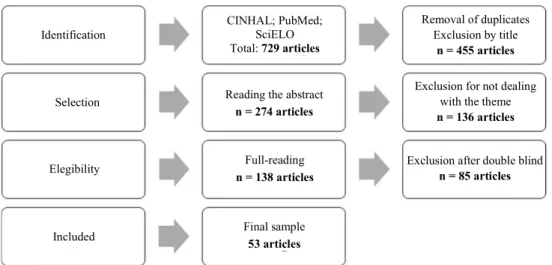
RESULTSInitially, a total of 729 articles were identified. After re-moving duplicate studies and reading the titles, the sample consisted of 274 articles. Of these, 136 studies were excluded by reading the abstracts, and 138 were proposed for full reading. Given the previously defined criteria, after a con-sensus meeting between the two researchers, 53 studies were included in the final sample, as explained in Figure 1.
In Chart 1, we summarize the 53 studies included in this review, referring to the authors, year of publication, and des-ignation of the instrument for assessing the environments of the professional nursing practice.
Regarding the year, we verified that the highest incidence of publication of studies was in 2014, with eight articles, fol-lowed by 2015, 2017 and 2018 with seven articles, 2013 with six articles, 2010 with five articles, 2016 with four articles, 2019 with three articles and, finally, 2009, 2011 and 2012 with two articles each year. With regard to the location of the studies, there was great geographical dispersion: fifteen studies in Brazil, eight studies in the United States of America (USA), six studies in China, five studies in Australia, three studies in Cyprus, three studies in Portugal, two studies in Spain, two studies in the Netherlands, and one study in each one of the following locations: Belgium, England, Turkey, Colombia, Japan, South Korea, and Finland. It is important to mention that two of the selected studies were carried out in more than one country(34,52).
Three thematic areas were identified after analyzing the included studies: instruments for assessing the professional nursing practice environments; implications of the use of instruments for assessing the environments of professional nursing practice, and limitations of the instruments for as-sessing the environments of professional nursing practice.
Instruments for assessing the professional nursing practice environments
The Revised Nursing Work Index (NWI-R), built by Aiken and Patrician in 2000(3), derives from the Nursing Work
In-dex (NWI), which was developed in 1989 to measure nursing professional satisfaction and the perception of quality of care(45). Although the NWI-R is composed of 57 items, 15 of
these items were distributed in three dimensions: autonomy (5 items); control over the practice environment (7 items), and relationship between nurses and physicians (3 items).
Figure 1 – Flowchart of the selection and exclusion process of the studies in the period between 2009 and 2019 Source: Authors Identification Selection Elegibility Included CINHAL; PubMed; SciELO Total: 729 articles Reading the abstract
n = 274 articles Full-reading n = 138 articles Final sample 53 articles Removal of duplicates Exclusion by title n = 455 articles Exclusion for not dealing
with the theme n = 136 articles Exclusion after double blind
Chart 1 – Scientific production according to the databases in the years 2009 to 2019
Author and year Place Instrument
Lee H et al., 2019(9) China Nursing Practice Environment Scale: Chinese Version
Ulrich B et al., 2019(10) USA Healthy Work Environment Scale
Zangaro G and Jones K, 2019(11) USA Practice Environment Scale of the Nursing Work Index
Azevedo Filho F et al., 2018(12) Brazil Practice Environment Scale of the Nursing Work Index
Costa N et al., 2018(13) Brazil Nursing Work Index – Revised: Brazilian Version
Dorigan G and Guirardello E, 2018(14) Brazil Nursing Work Index – Revised
Efstathiou G et al., 2018(15) Cyprus Practice Environment Scale of the Nursing Work Index: Greek Version
Lahuerta-Valls L et al., 2018(16) Spain Practice Environment Scale of the Nursing Work Index
Neves T et al., 2018(17) Portugal Practice Environment Scale of the Nursing Work Index: Portuguese Version
Pires B et al., 2018(18) Brazil Nursing Work Index – Revised: Brazilian Version
Alves D et al., 2017(19) Brazil Nursing Work Index – Revised
De Brouwer B et al., 2017(20) Netherlands Essentials of Magnetism II: Dutch Version
Erickson J et al., 2017(21) USA Professional Practice Work Environment Inventory
Gasparino R and Guiraldello
E, 2017(22) Brazil
Practice Environment Scale of the Nursing Work Index: Brazilian Version
Maurício L et al., 2017(23) Brazil Nursing Work Index – Revised: Brazilian Version
Oliveira E et al., 2017(24) Brazil Nursing Work Index – Revised: Brazilian Version
Oshodi T et al., 2017(25) England Essentials of Magnetism II
Alves D and Guirardello E, 2016(26) Brazil Nursing Work Index – Revised
Boaretto F et al., 2016(27) Brazil Nursing Work Index – Revised
Teng C et al., 2016(28) China Professional Practice Environment: Chinese Version
Topçu I et al., 2016(29) Turkey Practice Environment Scale of the Nursing Work Index: Turkish Version
Gasparino R and Guirardello
E, 2015(30) Brazil Nursing Work Index – Revised: Brazilian Version
Hayes B et al., 2015(31) Australia Brisbane Practice Environment Measure
Leone C et al., 2015(32) Portugal Practice Environment Scale of the Nursing Work Index: Adapted version included in RN4CAST
Papastavrou E et al., 2015(33) Cyprus Revised Professional Practice Environment
Papastavrou E et al., 2015(34)
Cyprus, USA, Finland, Greece, Sweden,
Portugal, Turkey Revised Professional Practice Environment
Author and year Place Instrument
Wang S et al., 2015(36) China Practice Environment Scale of the Nursing Work Index
Alzate L et al., 2014(37) Colombia Practice Environment Scale of the Nursing Work Index: Spanish Version
Choi J and Boyle D, 2014(38) USA Practice Environment Scale of the Nursing Work Index
De Brouwer B et al., 2014(39) Netherlands Essentials of Magnetism II
Farmakas A et al., 2014(40) Cyprus Revised Professional Practice Environment
Ferreira M and Amendoeira
J, 2014(41) Portugal
Practice Environment Scale of the Nursing Work Index: Portuguese Version
Ishihara I et al., 2014(42) Japan Nursing Work Index – Revised: Japanese Version
Kramer M et al., 2014(43) USA Essentials of Magnetism II
Marcelino C et al., 2014(44) Brazil Nursing Work Index – Revised: Brazilian Version
Balsanelli A and Cunha I, 2013(45) Brazil Nursing Work Index – Revised: Brazilian Version
Havens D et al., 2013(46) USA Practice Environment Scale of the Nursing Work Index
Kim C et al., 2013(47) South Korea Korean General Unit – Nursing Work Index
Panunto M and Guirardello
E, 2013(48) Brazil Nursing Work Index – Revised: Brazilian Version
Shang J et al., 2013(49) USA Practice Environment Scale of the Nursing Work Index
Yang J et al., 2013(50) China Practice Environment Scale of the Nursing Work Index
De Pedro-Gómez J et al., 2012(51) Spain Practice Environment Scale of the Nursing Work Index
Hinno S et al., 2012(52) Finland
Netherlands Nursing Work Index – Revised
Aitken L et al., 2011(53) Australia Practice Environment Scale of the Nursing Work Index
Gasparino R et al., 2011(54) Brazil Nursing Work Index – Revised: Brazilian Version
Charalambous A et al., 2010(55) Finland Revised Professional Practice Environment
Cortelyou-Ward K et al., 2010(56) USA Nursing Work Index – Revised
Flint A et al., 2010(57) Australia Brisbane Practice Environment Measure
Halcomb E et al., 2010(58) Australia Professional Practice Environment
Walker K et al., 2010(59) Australia Practice Environment Scale of the Nursing Work Index: Australian Version
Chiang H and Lin S, 2009(60) China Nursing Practice Environment Scale: Chinese Version
Van Bogaert P et al., 2009(61) Belgium Nursing Work Index – Revised
Chart 1 – Cont. Source: Research data, 2019.
The organizational support dimension is composed of 10 items derived from the 15 previously mentioned(23). The
re-sponses, on a Likert type scale, can take 4 options (strongly agree, partially agree, partially disagree and strongly disagree). Values below 2.5 represent favorable environments for the professional nursing practice and, above 2.5, unfavorable environments. In this instrument, the lower the score, the greater the presence of attributes favorable for the profes-sional practice(18,23). At the international level, the NWI-R,
already adapted and validated in several countries, has been applied in several contexts(19,23).
The Practice Environment Scale of the Nursing Work Index (PES-NWI) was built by Lake in 2002(1), based on the
NWI, as well as on the characteristics of the
Magnet Hospi-tals. Consisting of 31 items, it is organized into five
dimen-sions: nurse participation in hospital affairs (9 items); nursing foundations for quality of care (10 items); leadership and support of nurses (5 items); staffing and resource adequacy (4 items), and collegial nurse-physician relations (3 items)
(12). The answers, on a Likert type scale, can take 4 options
(strongly disagree, disagree, agree and strongly agree). In this instrument, scores over 2.5 are favorable for the nursing practice. Given its robustness, the use of PES-NWI has been widely disseminated, including several validation studies for different cultures(15,22,37,41,60). Following a meta-analysis, the
authors(11) concluded that the PES-NWI is a reliable instrument
for assessing the nursing practice environments in the USA, as well as in other countries.
The Nursing Practice Environment Scale (C-NPES) refers to the Chinese version of a tool derived from PES-NWI and the perceptions of nurses in Taiwan hospitals about the nursing practice environments(60). Consisting of 30 items, it
is organized into five dimensions: management and leader-ship (10 items); professional nursing development (6 items); quality in nursing (7 items); staffing and resources adequacy (4 items), and participation in hospital affairs (3 items)(9). In
each item of the C-NPES, the answers vary between 1, which corresponds to “not relevant”, and 4, “very relevant”(60).
The Professional Practice Environment (PPE), validated in 2004 by Erickson et. al., is an instrument with 38 items and eight dimensions: leadership and autonomy in the clinical practice; team’s relationship with the physicians; control over the practice; communication about patients; teamwork; deal-ing with disagreements and conflicts; internal motivation for work, and cultural sensitivity(21,58). The responses, on a Likert
scale, can take 4 options (strongly disagree, disagree, agree and strongly agree)(58). Due to the validation of the instrument
in Australia, the final proposal has 30 items, distributed over the eight dimensions: leadership and autonomy in the clinical
practice (3 items); team’s relationship with the physicians (2 items); control over the practice (4 items); communication about patients (2 items); teamwork (3 items); dealing with disagreements and conflicts (8 items); internal motivation for work (5 items), and cultural sensitivity (3 items)(58).
The Revised Professional Practice Environment (RPPE) appears in 2009, in continuity with the work done by Er-ickson et. al.(21). It is an instrument with 39 items and eight
dimensions: leadership and autonomy in the clinical practice (5 items); team’s relationship with the physicians (2 items); control over the practice (5 items); communication about patients (3 items); teamwork (4 items); dealing with disagree-ments and conflicts (9 items); internal motivation for work (8 items), and cultural sensitivity (3 items)(34,55). The responses,
on a Likert type scale, can take 4 options (strongly disagree, disagree, agree and strongly agree). The higher the score, the more positive the characteristic of the professional practice environment(40).
The Essentials of Magnetism II (EOMII) is a 58-item instru-ment that was developed to assess eight attributes of the nursing practice environments: collaborative relationship between nurse and physician (6 items); control of the nurs-ing practice (8 items); support from the nursnurs-ing manager (10 items); staffing adequacy (6 items); clinically competent pairs (4 items); education support (4 items); patient-centered culture (11 items), and clinical autonomy (9 items)(20). The
responses, on a Likert type scale, can take 4 options (strongly disagree, disagree, agree and strongly agree). It should be noted that, in 2001, the first version of Essentials of Magne-tism (EOM) was developed to measure the components of the work processes identified as essential by the nurses who worked at the Magnet Hospitals(39).
The Professional Practice Work Environment Invento-ry (PPWEI), derived from PPE and RPPE and with 72 items, was designed to measure nine dimensions: autonomy and control over the practice; communication about patients; cultural sensitivity; dealing with disagreements and con-flicts; relationship with physicians, staff and hospital groups; sufficient staff, time and resources for quality patient care; supportive leadership and autonomy; teamwork; and mo-tivation at work(21). Each of the 72 items can be classified,
on a Likert type scale, from 1 to 6 points (strongly disagree, moderately disagree, disagree, agree, moderately agree and strongly agree). In the review proposed by the authors(21),
the PPWEI contains 61 items spread over eight dimensions: support leadership, autonomy and control over the practice (18 items); communication about patients (5 items); cultural sensitivity (7 items); dealing with disagreements and conflicts (7 items); relationship with physicians, staff and hospital
groups (6 items); sufficient staff, time and resources for quality patient care (4 items); teamwork (8 items); and motivation at work (6 items).
The Korean General Unit – Nursing Work Index (KGU-NWI) is an instrument based on the NWI-R, and was built to measure the professional nursing practice environments in inpatient units of South Korean Hospitals(47). It has 26
items, distributed over six dimensions: participation in de-cision-making processes (7 items); nursing process (5 items); adequate nursing team (3 items); education to improve the quality of care (4 items); organizational support and hospital management (4 items), and physician-nurse relationship (3 items)(47).
The Healthy Work Environment (HWE) is a scale based on the standards defined by the American Association of Critical-Care Nurses, consisting of 32 items, distributed over six dimensions: qualified communication; true collaboration; effective decision-making; appropriate staff; meaningful recognition; and authentic leadership(10). The responses, on
a Likert scale, can take 4 options (strongly disagree, disagree, agree and strongly agree)(10).
The Brisbane Practice Environment Measure (B-PEM) is a 26-item, four-dimensional instrument, the initial version of which was developed in 2006 by Flint and Courtney, based on the reality and on work experiences of the nurs-es(57). Although the original model had 33 items and five
thematic constructs, currently, the instrument has 26 items, distributed in four dimensions: doing things (9 items); flexi-bility of management support (5 items); feeling valued/not valued (7 items); and professional development (5 items). According to the authors, it is a robust instrument, relevant to the contemporary nature of the nurses’ experiences, which allows for a periodic and continuous assessment of the work environment. The responses, on a Likert type scale, can take 5 options (never, rarely, sometimes, often and always)(31).
Implication of the use of instruments to assess the environments of the professional nursing practice
The results obtained with the use of the instruments for assessing the environments of the professional nursing prac-tice, in addition to having implications for the pracprac-tice, point out to factors that deserve special attention from the nursing managers(26) in the environment of hospital institutions.
The situational diagnosis is essential for the improvement actions to be implemented, in the sense of a more favorable environment for the professional nursing practice(23). In this
context, through the analysis of the articles, it was verified that the use of instruments whose items are distributed
over several dimensions/subscales allows informing, with more precision, the different levels of management, about the components in which it is necessary and a priority to intervene. The aforementioned favors the modification of the institutional culture in the face of factors that need improve-ment, which can contribute to enhance the satisfaction of the nursing professionals with the work environment and, consequently, improve the quality of care that is provided(23).
Inspired by the American experience, some researchers have focused their study on the attributes of the
Magnet Hos-pitals, of which the following stand out: decentralization
in decision-making, professional recognition, autonomy, responsibility for the quality of care, effective, participative and visible management and leadership, and a strong rela-tionship between nurse and physician(36). The evidence that
these aspects are characteristics of a good environment for the professional nursing practice has determined their inclusion in some of the instruments identified in this review. Because in the same institution it is possible to identify the variations between units(21,38), it becomes possible to plan
improvement strategies which are adequate to the spec-ificities of each context. Effectively, the variations existing in the practice environments in the different units of the same institution are not always consistent with the same improvement strategies.
Following the included studies, it was also verified that, internationally, NWI-R and PES-NWI are the most used instru-ments. In the perspective of the authors, the evaluation of the characteristics of the practice environment, using NWI-R and PES-NWI, provides support for the development of a set of relationships between essential components of the professional nursing practice, whose objective is to create better working conditions(23), allowing, simultaneously,
iden-tifying which environments are favorable or unfavorable for safety and quality of care(17), as well as the satisfaction and
retention of nurses(11).
Limitations of the instruments for assessing the environments of the professional nursing practice
Although different instruments have been identified, even when the same instrument is used, it is not always fully used(45). Although the most used instruments are NWI-R
and PES-NWI, in many studies changes/modifications have been made that generate alternative structures. What has been described results, for example, from the validation processes of the instruments in different cultures, which culminates in final versions with variation in the number of items, as well as their distribution within the respective
dimensions/sub-scales(22). Although with the aforementioned
there is an improvement in the psychometric properties of the instruments and also reflects the cultural and profes-sional differences between the different countries, it is an aspect that hinders a comparative analysis of the results. In fact, as mentioned by some authors, it is difficult to make comparisons with other studies, since the researchers do not always consider all the variables of the instruments(45,48). The
truth is that health cultures and environments have unique characteristics that differ between countries(39), reasons why
one cannot fail to evaluate the psychometric properties of the instruments in cultures other than the original one.
Despite linguistic and cultural differences and discussions about its factorial structure(52,56), NWI-R continues to be one
of the most validated instruments and one of the most used in research on the nursing practice environments in the in-ternational context(52,56). The problem is that NWI-R and all its
derivatives measure structural characteristics of units, but not the work processes or the nursing practices(39). In addition to
NWI-R, PES-NWI, according to some authors(11,41), is another of
the most used instruments to measure the environments of the nursing practice, and its use in several languages and in different cultural contexts has led to several methodological studies(15,22,37,41,60). Following the comparison between the
different versions of the original PES-NWI, it was verified that the factor analysis of the instrument varied between different countries due to differences in the organization of the health systems and in the infrastructures(37). Although in
some situations the number of items and factors remains the same as the original instrument, the organization of the items within the factors/dimensions is different(15). Overall,
this evidence suggests that, although the instrument is very useful in different contexts, its structure may differ signifi-cantly in different health systems(25).
Despite the widespread use of PES-NWI, and the existence of a revised version, there is shortage of publications that address the need for modifications of the instrument(15). As
mentioned by some authors, although it is reliable to measure the environments of the nursing practice, the instrument could benefit from being updated, in order to accurately reflect the current environment of the professional nursing practice, with regard, for example, to using the technology and to providing an increasingly complex care(11). In addition,
according to some authors, the measures most frequently used to assess work environments were developed more than 20 years ago and, in addition to the lack of robust psychometric tests, there is a limited theoretical component that boosted their development(57). Consequently, the validity
of these instruments can be questioned in terms of their
relevance to the current environment of the professional nursing practice(18,57).
In addition, most of the existing instruments measure the structure and the outcome, without evaluating the process. Of the three, the process is the most important and should not be excluded(39). The tools to measure the process are more
difficult and take longer to build than those that measure the structure or the outcome(43). Moreover, they become
more quickly out of date because the work environment in health is constantly changing and growing in complexity(43).
In an attempt to overcome some of the limitations mentioned, other instruments have been developed and improved, such as the case of PPE, RPPE, PPWEI, EOMII, HWE and B-PEM. Given that PPE, RPPE and PPWEI are based on PES-NWI and HWE is based on NWI-R, with the use of these instruments, the structural dimension of the practice envi-ronments continues to be focused on. On the other hand, EOMII allows measuring the process(39) and B-PEM, taking
into account the nurses’ work experiences, is seen by the authors as relevant to assess the current environment of the professional nursing practice(31,57). Regarding the lesser
used instruments, the authors have pointed out the lack of translated versions(34). It is noted that, despite the various
instruments in use, the authors continue to dedicate them-selves to the improvement and development of others(43).
DISCUSSIONThe environment of the professional nursing practice has aroused growing interest because, during the last decade, there was an evident consensus that the identification of opportunities to improve the working conditions in hospitals is essential to maintain adequate professionals and ensure excellence(52). From the perspective of the authors(52), although
the health systems in different countries are influenced by economic changes driven by the recession and substantial pressures on the hospitals, investment in the professional nursing practice environments can make a difference, as it can be an effective way to improve outcomes and quality of care(17,34,49).
According to the authors, the environment of the profes-sional nursing practice is fundamental for the well-being of the professionals, for patient safety, and also for the quality of care(19,26,34,37,40). From the analysis to the studies, it was
clear that unfavorable environments are associated with worse outcomes for patients and professionals(29–30,36,42). On
the other hand, favorable environments for the nursing practice guarantee better results for professionals, patients and institutions(10,27,34). Diverse authors have identified greater
professional satisfaction(14,19,22,24,31,54), higher involvement and
commitment in the professionals(35,46,50), lower levels of
burn-out(9,14,19,22,54), lower intent to leave the work(9–10,19,22,54,56), and
better perception on the quality of care(22,54). In relation to the
patients, greater satisfaction with care and lower mortality rates(22,38–39) were verified. And for the institution, lower rate
of turnover and absenteeism(22,54).
In this context, it appears that a possible answer to the existing concerns with quality of care may be the creation of productive and healthy professional practice environments(20).
The environments characterized as most favorable have been identified in the Magnet Hospitals(38). As the authors
claim(38), hospital-level initiatives to meet the Magnet
desig-nation criteria contribute to improving the nursing practice environment in the units. An aspect highlighted in several studies refers to the impact of management and leadership in the environments of the professional nursing practice and, consequently, in the outcomes of the professionals and of the patients(9,25–26,31,34,38,50–51). Despite the downward
trend in the economy in recent years, there are relatively low-cost interventions that nursing managers can mobilize to improve workforce governance, with consequent gains for the nurses, the profession, the health organizations, and the health system as a whole(32).
The important thing is that, in the context of the contin-uous improvement of the practice environments, focus is given to the components of structure (referring to relatively stable characteristics of the institutions), process (relative to activities developed for the production of goods and services) and outcome (characterized by obtaining desir-able changes of the products or services)(62). The problem
is that most of the studies carried out have concentrated on structure-outcome relationships, ignoring the process dimension(43). And, to understand how the structure affects
the patient and the nursing results, there are tools designed to assess the presence of environmental characteristics that promote an adequate professional practice(54). Following the
review, we found ten of these instruments.
The first attempt to measure the nursing work envi-ronment based on the characteristics of the
Magnet Hos-pitals was accomplished by Kramer and Hafner in 1989(25);
they built a scale composed of 65 items, referred to as the Nursing Work Index. Four additional scales have been de-rived from the NWI(25): In 2000, Aiken and Patrician(3) built
the Revised Nursing Work Index, with 57 items, and Lake(1)
built the Practice Environment Scale of the Nursing Work Index, with 31 items. Also in 2002, Estabrooks et. al. built the Practice Environment Index (PEI), using 49 items from the NWI-R and adding two items to reflect the Canadian
context. Later on, in 2004 and still from NWI-R, Choi et al. built the Perceived Nursing Work Environment (PNWE)(25).
Although we did not find the PEI and PNWE in the review, it is important that both were derived from NWI-R. Given that NWI measures the structural characteristics of hospital units, and not the nursing work processes, other instruments have emerged, such as the EOM, developed in 2004 by Kramer and Schmalenberg(25). After substantial changes
to this tool, in 2008, the authors renamed it as Essentials of Magnetism II. The EOMII is a tool designed to measure healthy and productive work environments and can facil-itate research on the impact of the work environment on the provision of quality care(25).
Following the investigations using the aforementioned instruments, it was clear that, although there are several factors that influence quality of care, the studies developed have been focusing on the attributes that can be evaluated with the two most used instruments: NWI-R and PES-NWI. Although, in the international context these two instru-ments are the most used, there are authors who highlight the relevance of EOMII. Although PES-NWI and EOMII have a common ancestor, the Nursing Work Index, the focus of both instruments differs to some extent. While PES-NWI focuses on structures that facilitate a good environment, EOMII focuses on processes inherent to the work environ-ments(20). So the following question arises: Is it correct to use
the instruments with a focus on different components to assess the environments of the nursing practice?
In a study that aimed to determine the construct validity of the Dutch version of EOMII (D-EOMII), although D-EOMII and PES-NWI focus on the nursing practice environment and have important correlations between them, the use of both is not advised. As the authors refer(20), the important
thing is to select the instrument that best suits the organi-zation and/or the unit. In deciding on the selection of the instruments to be used, their advantages and disadvantages can also be a criterion. For example, in the case described, EOMII encompasses elements that are not present in PES-NWI, giving a more in-depth view on areas for improving the environments of the nursing practice. However, the fact that PES-NWI is shorter can guarantee a more significant adherence(20). The growing evidence of the relationship
be-tween work environments and patient outcomes intensifies the need to prioritize the improvement of the professional nursing practice environments(10). For this, and as the authors
advice, in addition to investing in improving the practice environments, it is essential to measure the progression of this improvement, by regularly using the instruments that best suit the contexts.
CONCLUSIONWith this study it was possible to identify ten of the instru-ments used to assess the environinstru-ments of the professional nursing practice in the hospital context. Even assuming as a limitation the fact that the research was carried out only in three databases, the applicability of the results became evident.
Although using different instruments, in all studies the need to invest in the professional practice environments was highlighted, in order to guarantee adequate working conditions, as well as quality and safety of care, aspects that should be highlighted early on within the scope of teaching. On the other hand, it was evident that, in the area of man-agement, monitoring the environments of the professional nursing practice in the hospital and by units constitutes an opportunity to improve their quality, with significant repercussions on the quality of care provided by the nursing professionals. In view that, to guarantee and evaluate quality of care, the attributes of the structure, process and outcome components must be considered within the scope of the research, the development of instruments that enable the evaluation of the three components becomes relevant, which, consequently, will allow knowing the strengths and weaknesses of the different contexts in the hospital practice.
REFERENCES1. Lake E. Development of the Practice Environment Scale of the Nursing Work Index. Res Nurs Health. 2002;25(3):176-88. doi: https://doi.org/10.1002/ nur.10032
2. Conselho Internacional de Enfermeiros (CH). Ambientes favoráveis à prática: condições de trabalho = cuidados de qualidade: instrumentos de informação e acção. Genebra: Internacional Council of Nurses; 2007 [cited 2019 Aug 23]. Available from: https://www.ordemenfermeiros.pt/arquivo/publicacoes/ Documents/Kit_DIE_2007.pdf
3. Aiken LH, Patrician PA. Measuring organizational traits of hospitals: the Revised Nursing Work Index. Nurs Res. 2000;49(3):146-53. doi: https://doi. org/10.1097/00006199-200005000-00006
4. Gasparino RC, Ferreira TD, Carvalho KM, Rodrigues ES, Tondo JC, Silva VA. Evaluation of the professional practice environment of nursing in health institutions. Acta Paul Enferm. 2019;32(4):449-55. doi: https://doi. org/10.1590/1982-0194201900061
5. Wei H, Sewell KA, Woody G, Rose MA. The state of the science of nurse work environments in the United States: a systematic review. Int J Nurs Sci. 2018;5(3):287-300. doi: https://doi.org/10.1016/j.ijnss.2018.04.010 6. Smith JG. The nurse work environment: current and future challenges. J Appl
Biobehav Res. 2018 [cited 2019 Aug 24];23(1):e12126. doi: https://doi. org/10.1111/jabr.12126
7. Gaalan K, Kunaviktikul W, Akkadechanunt T, Wichaikhum O, Turale S. Factors predicting quality of nursing care among nurses in tertiary care hospitals in Mongolia. Int Nurs Rev. 2019;66(2):176-82. doi: https://doi.org/10.1111/inr.12502 8. Mendes C, Silveira R, Galvão C. Integrative literature review: a research method
to incorporate evidence in health care and nursing. Texto Contexto Enferm. 2008;17(4):758-64. doi: https://doi.org/10.1590/S0104-07072008000400018 9. Lee HF, Chiang HY, Kuo HT. Relationship between authentic leadership and nurses’ intent to leave: the mediating role of work environment and burnout. J Nurs Manag. 2019 Jan;27(1):52-65. doi: https://doi.org/10.1111/jonm.12648 10. Ulrich B, Barden C, Cassidy L, Varn-Davis N. Critical care nurse work environments
2018: findings and implications. Crit Care Nurse. 2019;39(2):67-84. doi: https:// doi.org/10.4037/ccn2019605
11. Zangaro GA, Jones K. Practice environment scale of the nursing work index: a reliability generalization meta-analysis. West J Nurs Res. 2019 Jan;41(11):1658-84. doi: https://doi.org/10.1177/0193945918823779
12. Azevedo Filho FM, Rodrigues MCS, Cimiotti JP. Nursing practice environment in intensive care units. Acta Paul Enferm. 2018 Mar;31(2):217-23. doi: https://doi. org/10.1590/1982-0194201800031
13. Costa NN, Silva AEBDC, Lima JC, Bezerra ALQ, Sagawa MR, Sousa MRG. Pediatric work environment: satisfaction of nursing professionals. J Nurs UFPE online. 2018 Dez;12(12):3327-36. doi: https://doi.org/10.5205/1981-8963- v12i12a234975p3327-3336-2018
14. Dorigan GH, Guirardello EB. Effect of the practice environment of nurses on job outcomes and safety climate. Rev Latino-Am Enfermagem. 2018;26:e3056. doi: https://doi.org/10.1590/1518-8345.2633.3056
15. Efstathiou G, Andreou C, Tsangari H, Dimitriadou M, Papastavrou E. Adaptation and validation of the Cyprus version of the practice environment scale of the nursing work index: a methodological study. BMC Res Notes. 2018 Nov;11(1):791. doi: https://doi.org/10.1186/s13104-018-3896-2
16. Lahuerta-Valls L, Roca-Caparà N, Blanco-Blanco J. [Are nurses working in a pediatric oncology-hematology unit satisfied with their work environment?] Ene Rev Enferm. 2018 [cited 2019 Aug 22];12(1):1-18. Spanish. Available from: http://scielo.isciii.es/pdf/ene/v12n1/1988-348X-ene-12-01-709.pdf 17. Neves TMA, Parreira PMSD, Graveto JMGN, Rodrigues VJL, Marôco Domingos JP.
Practice environment scale of the nursing work index: Portuguese version and psychometric properties. J Nurs Manag. 2018 Oct;26(7):833-41. doi: https:// doi.org/10.1111/jonm.12606
18. Pires BSM, Oliveira LZF, Siqueira CL, Feldman LB, Oliveira RA, Gasparino RC. Nurse work environment: comparison between private and public hospitals. Einstein. 2018 Nov;16(4):eAO4322. doi: https://doi.org/10.31744/ einstein_journal/2018AO4322
19. Alves DFDS, Silva D, Guirardello EB. Nursing practice environment, job outcomes and safety climate: a structural equation modelling analysis. J Nurs Manag. 2017 Jan;25(1):46-55. doi: https://doi.org/10.1111/jonm.12427
20. De Brouwer BJM, Fingal C, Schoonhoven L, Kaljouw MJ, Van Achterberg T. Measuring hospital staff nurses perception on quality of the professional practice environment. J Adv Nurs. 2017 Mar;73(10):2484-94. doi: https://doi.org/10.1111/jan.13291 21. Erickson JI, Duffy ME, Ditomassi M, Jones D. Development and psychometric
evaluation of the professional practice work environment inventory. J Nurs Adm. 2017 May;47(5):259-65. doi: https://doi.org/10.1097/NNA.0000000000000 476
22. Gasparino RC, Guirardello EB. Validation of the practice environment scale to the Brazilian culture. J Nurs Manag. 2017 Jul;25(5):375-83. doi: https://doi. org/10.1111/jonm.12475
23. Maurício LFS, Okuno MFP, Campanharo CRV, Lopes MCBT, Belasco AGS, Batista REA. Professional nursing practice in critical units: assessment of work environment characteristics. Rev Latino-Am Enfermagem. 2017;25:e2854. doi: http://dx.doi.org/10.1590/1518-8345.1424.2854
24. Oliveira EM, Barbosa RL, Andolhe R, Eiras FRC, Padilha KG. Nursing practice environment and work satisfaction in critical units. Rev Bras Enferm. 2017 Jan-Feb;70(1):73-80. doi: https://doi.org/10.1590/0034-7167-2016-0211 25. Oshodi TO, Crockett R, Bruneau B, West E. The nursing work environment and
quality of care: a cross-sectional study using the Essentials of Magnetism II Scale in England. J Clin Nurs. 2017 Sept;26(17-18):2721-34. doi: https://doi. org/10.1111/jocn.13783
26. Alves DFS, Guirardello EB. Nursing work environment, patient safety and quality of care in pediatric hospital. Rev Gaúcha Enferm. 2016 jun;37(2):e58817. doi: https://doi.org/10.1590/1983-1447.2016.02.58817
27. Boaretto F, Haddad MCFL, Rossaneis MA, Gvozd PSCP. The work environment of nurses who perform care activities in a university hospital. Cogitare Enferm. 2016;21(2):01-09. doi: https://doi.org/10.5380/ce.v21i2.44006
28. Teng CI, Chang HY, Lu JFR, Chou CY. Professional practice environment scale-Chinese version: development and psychometric testing. J Nurs Res. 2016 Mar;24(1):21-30. doi: https://doi.org/10.1097/jnr.0000000000000107 29. Topçu I, Türkmen E, Badır A, Göktepe N, Miral M, Albayrak S, et al. Relationship
between nurses’ practice environments and nursing outcomes in Turkey. Int Nurs Rev. 2016 Jun;63(2):242-9. doi: https://doi.org/10.1111/inr.12247
30. Gasparino R, Guirardello EDB. Professional practice environment and burnout among nurses. Rev Rene. 2015 Jan-Feb;16(1):90-6. doi: https://doi. org/10.15253/2175-6783.2015000100012
31. Hayes B, Douglas C, Bonner A. Work environment, job satisfaction, stress and burnout among haemodialysis nurses. J Nurs Manag. 2015 Jul;23(5):588-98. doi: https://doi.org/10.1111/jonm.12184
32. Leone C, Bruyneel L, Anderson JE, Murrells T, Dussault G, Jesus ÉH, et al. Work environment issues and intention-to-leave in Portuguese nurses: a cross-sectional study. Health Policy. 2015 Dec;119(12):1584-92. doi: https://doi. org/10.1016/j.healthpol.2015.09.006
33. Papastavrou E, Andreou P, Middleton N, Merkouris A, Lambrou P, Lemonidou C. Translation and validation of the revised professional practice environment questionnaire in the Greek language. J Nurs Meas. 2015 Dec;23(3):112-27. doi: https://doi.org/10.1891/1061-3749.23.3.E112
34. Papastavrou E, Acaroglu R, Sendir M, Berg A, Efstathiou G, Idvall E, et al. The relationship between individualized care and the practice environment: an international study. Int J Nurs Stud. 2015 Jan;52(1):121-33. doi: https://doi. org/10.1016/j.ijnurstu.2014.05.008
35. Wang S, Liu Y. Impact of professional nursing practice environment and psychological empowerment on nurses’ work engagement: test of structural equation modelling. J Nurs Manag. 2015 Apr;23(3):287-96. doi: https://doi. org/10.1111/jonm.12124
36. Wang S, Liu Y, Wang L. Nurse burnout: personal and environmental factors as predictors. Int J Nurs Pract. 2015 Fev;21(1):78-86. doi: https://doi.org/10.1111/ ijn.12216
37. Alzate LCC, Bayer GLA, Squires A. Validation of a Spanish version of the practice environment scale of the nursing work index in the Colombian context. Hisp Health Care Int. 2014 Mar;12(1):34–42. doi: https://doi.org/ 10.1891/1540-4153.12.1.34
38. Choi J, Boyle DK. Differences in nursing practice environment among US acute care unit types: a descriptive study. Int J Nurs Stud. 2014 Nov;51(11):1441-9. doi: https://doi.org/10.1016/j.ijnurstu.2014.03.001
39. De Brouwer BJM, Kaljouw MJ, Kramer M, Schmalenberg C, Van Achterberg T. Measuring the nursing work environment: translation and psychometric evaluation of the Essentials of Magnetism. Int Nurs Rev. 2014 Mar;61(1):99-108. doi: https://doi.org/10.1111/inr.12073
40. Farmakas A, Papastavrou E, Siskou O, Karayiannis G, Theodorou M. Challenges in mental health nursing: working in institutional or community settings? J Psychiatr Ment Health Nurs. 2014 Feb;21(1):39-45. doi: https://doi. org/10.1111/jpm.12045
41. Ferreira MRSCF, Amendoeira J. Study of adaptation and validation of the practice environment scale of the nursing work índex for the portuguese reality. Rev Esc Enferm USP. 2014 Jun;48(4):690-7. doi: https://doi.org/10.1590/ S0080-623420140000400017
42. Ishihara I, Ishibashi Y, Takahashi K, Nakashima M. Effect of organizational factors and work environments on newly graduated nurses’ intention to leave. Japan J Nurs Sci. 2014 Jul;11(3):200-10. doi: https://doi.org/10.1111/jjns.12021 43. Kramer M, Brewer BB, Halfer D, Hnatiuk CN, MacPhee M, Schmalenberg C. The
evolution and development of an instrument to measure essential professional nursing practices. J Nurs Adm. 2014 Nov;44(11):569-76. doi: https://doi. org/10.1097/NNA.0000000000000128.
44. Marcelino CF, Alves DF dos S, Gasparino RC, Guirardello EB. Validation of the Nursing Work Index-Revised among nursing aides and technicians. Acta Paul Enferm. 2014 Jun;27(4):305-10. doi: https://doi.org/10.1590/1982- 0194201400052
45. Balsanelli AP, Cunha IC. The work environment in public and private intensive care units. Acta Paul Enferm. 2013 Nov;26(6):561-8. doi: https://doi. org/10.1590/S0103-21002013000600009
46. Havens DS, Warshawsky NE, Vasey J. RN work engagement in generational cohorts: the view from rural US hospitals. J Nurs Manag. 2013 Oct;21(7):927-40. doi: https://doi.org/10.1111/jonm.12171
47. Kim CW, Lee SY, Kang JH, Park BH, Park SC, Park HK, et al. Application of revised nursing work index to hospital nurses of South Korea. Asian Nurs Res (Korean Soc Nurs Sci). 2013 Sept;7(3):128-35. doi: https://doi.org/10.1016/j. anr.2013.07.003
48. Panunto MR, Guiraldello EB. Professional nursing practice: environment and emotional exhaustion among intensive care nurses. Rev Latino-Am Enfermagem. 2013;21(3):765-72. doi: https://doi.org/10.1590/S0104- 11692013000300016
49. Shang J, Friese CR, Wu E, Aiken LH. Nursing practice environment and outcomes for oncology nursing. Cancer Nurs. 2013 May-Jun;36(3):206-12. doi: https:// doi.org/10.1097/NCC.0b013e31825e4293
50. Yang J, Liu Y, Huang C, Zhu L. Impact of empowerment on professional practice environments and organizational commitment among nurses: a structural equation approach. Int J Nurs Pract. 2013 Feb;19 (Suppl 1):44-55. doi: https:// doi.org/10.1111/ijn.12016
Associate editor:
Dagmar Elaine Kaiser
Editor-in-chief:
Received: 10.30.2019
Corresponding author:
Olga Maria Pimenta Lopes Ribeiro E-mail: [email protected]
51. De Pedro-Gómez J, Morales-Asencio JM, Bennasar-Veny M, Artigues-Vives G, Perelló-Campaner C, Gómez-Picard P. Determining factors in evidence-based clinical practice among hospital and primary care nursing staff. J Adv Nurs. 2012 Fev;68(2):452-9. doi: https://doi.org/10.1111/j.1365-2648.2011.05733.x 52. Hinno S, Partanen P, Vehviläinen-Julkunen K. The professional nursing practice
environment and nurse-reported job outcomes in two European countries: a survey of nurses in Finland and the Netherlands. Scand J Caring Sci. 2012 Mar;26(1):133-43. doi: https://doi.org/10.1111/j.1471-6712.2011.00920.x 53. Aitken LM, Burmeister E, Clayton S, Dalais C, Gardner G. The impact of Nursing
Rounds on the practice environment and nurse satisfaction in intensive care: pre-test post-test comparative study. Int J Nurs Stud. 2011 Aug;48(8):918-25. doi: https://doi.org/10.1016/j.ijnurstu.2010.10.004
54. Gasparino RC, Guirardello EB, Aiken LH. Validation of the Brazilian version of the Nursing Work Index-Revised(B-NWI-R). J Clin Nurs. 2011 Dec;20(23– 24):3494-501. doi: https://doi.org/10.1111/j.1365-2702.2011.03776.x 55. Charalambous A, Katajisto J, Välimäki M, Leino-Kilpi H, Suhonen R.
Individualised care and the professional practice environment: nurses’ perceptions. Int Nurs Rev. 2010 Dec;57(4):500-7. doi: https://doi.org/10.11 11/j.1466-7657.2010.00831.x
56. Cortelyou-Ward KH, Unruh L, Fottler MD. The effect of work environment on intent to leave the nursing profession: a case study of bedside registered nurses in rural Florida. Health Serv Manage Res. 2010 Nov;23(4):185-92. doi: https:// doi.org/10.1258/hsmr.2010.010008
57. Flint A, Farrugia C, Courtney M, Webster J. Psychometric analysis of the Brisbane Practice Environment Measure (B-PEM). J Nurs Scholarsh. 2010 Mar;42(1):76-82. doi: https://doi.org/10.1111/j.1547-5069.2009.01328.x
58. Halcomb EJ, Davidson PM, Caldwell B, Salamonson Y, Rolley JX. Validation of the Professional Practice Environment Scale in Australian general practice. J Nurs Scholarsh. 2010 Jun;42(2):207-13. doi: https://doi.org/ 10.1111/j.1547-5069.2010.01349.x
59. Walker K, Middleton S, Rolley J, Duff J. Nurses report a healthy culture: results of the Practice Environment Scale (Australia) in an Australian hospital seeking Magnet recognition. Int J Nurs Pract. 2010 Dez;16(6):616-23. doi: https://doi. org/10.1111/j.1440-172X.2010.01890.x
60. Chiang HY, Lin SY. Psychometric testing of the Chinese version of Nursing Practice Environment Scale. J Clin Nurs. 2009 Mar;18(6):919-29. doi: https:// doi.org/10.1111/j.1365-2702.2008.02433.x
61. Van Bogaert P, Clarke S, Vermeyen K, Meulemans H, Van de Heyning P. Practice environments and their associations with nurse-reported outcomes in Belgian hospitals: development and preliminary validation of a Dutch adaptation of the Revised Nursing Work Index. Int J Nurs Stud. 2009 Jan;46(1):54-64. doi: https:// doi.org/10.1016/j.ijnurstu.2008.07.009
62. Donabedien A. An Introduction to quality assurance in health care. New York: Oxford University Press; 2003.