I
REI CRETARIÆ ROMANÆ FAVTORVM
ACTA 42
CONGRESSVS VICESIMVS SEPTIMVS
REI CRETARIÆ ROMANÆ FAVTORVM
SINGIDVNI HABITVS
MMX
BONN
2012
II
ISSN 0484-3401
Published by the Rei Cretariæ Romanæ Favtores, an international learned society
Editorial committee:
Dario Bernal Casasola Tatjana Cvjetićanin
Philip M. Kenrick Simonetta Menchelli
General Editor: Susanne Biegert
Typesetting and layout: ars archäologie redaktion satz, Waldstraße 8 D-65719 Hofheim am Taunus
Printed and bound by: BELTZ Bad Langensalza GmbH, D–99947 Bad Langensalza
Enquiries concerning membership should be addressed to
The Treasurer, Dr. Archer Martin, Via di Porta Labicana 19/B2, I–00185 Roma [email protected]
ISBN 978-3-7749-3797-0
III
InhaltsverzeIchnIs
Vorwort der Redaktion. . . .
The Aegean and the Pontic region Charikleia Diamanti
Byzantine Emperors on stamped Late Roman/Early Byzantine Amphoras. . . . Cristina monDin
La ceramica tardoantica di Tyana (Cappadocia meridionale): tra continuità e discontinuità nell’entroterra anatolico. . . . Platon PetriDis
Pottery and society in the ceramic production centre of late Roman Delphi. . . . Denis Zhuravlev
Syro-Palestinian lamps from Chersonesos and their derivatives of the Roman and Byzantine period. . . .
The Balkans and the Danube region Maja Bausovac & Darja Pirkmajer
Late Roman glazed pottery from Rifnik near Celje. . . . Vesna Bikić & Vujadin ivanišević
Imported pottery in Central Illyricum – a case study: Caričin grad (Iustiniana Prima) . . . . Snežana ČernaČ-ratković
Burnished pottery from Horreum Margi. . . . Dénes GaBler
Terra sigillata from Aquincum-Viziváros (water town). . . . Kristina jelinČić
Ceramica romana tardo antica dal villaggio romano Virovitica Kiškorija Jug (Pannonia Superior) dalle unità stratigrafiche datate mediante 14C
Gordana jeremić
Late Roman and Early Byzantine pottery from Saldum. Reflection of change in social and historical circumstances. . . . Eduard kreković
Roman Pottery in the Migration Period. . . . Słavica krunić
Late Roman and Early Byzantine lamps from Singidunum. . . . Marian mocanu
Late Roman fine pottery with stamped decoration discovered at (L?)ibida (Province of Scythia) . . . . Andrei oPaiţ & Dorel Paraschiv
Rare amphora finds in the city and territory of (L)Ibida (1st–6th centuries AD) . . . .
Ivana ožanić roGuljić
Pottery from the workshop of Sextus Metilius Maximus (Crikvenica-Igralište/Ad Turres,
Northern Dalmatia) . . . . VII 1 7 15 23 33 41 51 57 69 81 89 97 107 113 125
IV
Roberto Perna, Chiara caPPoni, Sofia cinGolani & Valeria tuBalDi
Hadrianopolis e la valle del Drino (Albania) tra l’età tardoantica e quella protobizantina.
Le evidenze ceramiche dagli scavi 2007–2009. . . . Angelina raiČković
Late Roman Pottery from Viminacium-Thermae. The excavation of 2004 . . . . Milica taPaviČki-ilić
Some observations concerning painted pottery in Moesia superior. . . .
Italy and Cisalpine Gaul
Michele Bueno, Marta novello & Valentina mantovani
Progetto Aquileia: Casa delle Bestie Ferite. Commercio e consumo ad Aquileia. Analisi delle anfore tardoantiche alla luce di alcuni contesti. . . . Marco cavalieri, Enrica BolDrini, Charles Bossu, Paola De iDonè & Antonia Fumo
Aspetti della cultura materiale nelle fasi di riutilizzo (V–inizi VII sec. d.C.) della villa romana di Aiano- Torraccia di Chiusi (San Gimignano, Siena/Italy). Note preliminari. . . . Fulvio coletti
La ceramica invetriata di età tardoantica a Roma: nuovi dati da recenti scavi stratigrafici. . . . Daniela cottica & Luana toniolo
La circolazione del vasellame ceramico nella laguna nord di Venezia tra I sec. d.C. e VI sec. d.C.
Osservazioni preliminari. . . . Christiane De micheli schulthess & Fabiana FaBBri
I bicchieri a bulbo dal territorio italiano: contributo per la definizione di una koiné produttiva. . . . Fabiana FaBBri
Ceramica di epoca tardo-imperiale dalla Valdinievole e dalla cittá di Pistoia (Toscana, Italia).
Contributo per la storia economica e commerciale dell’Etruria romana. . . . Archer martin
Composition by functional groups of contexts at Pompeii. . . . Simonetta menchelli & Marinella Pasquinucci
Ceramiche con rivestimento rosso nella Tuscia settentrionale. . . . Luana toniolo
Napoli tardo-antica. Nuovi dati dal centro urbano: il contesto dei Girolomini . . . . Paola ventura
Materiale ceramico da recenti scavi presso la villa di Torre di Pordenone (Provincia di Pordenone,
Friuli Venezia Giulia, Italia) . . . .
Sicily and Lampedusa Valentina caminneci
«Animam in sepulchro condimus»: sepolcreto tardoantico in anfore presso l’Emporion di Agrigento (Sicilia, Italia). . . . Armida De miro & Antonella Polito
Lucerne in sigillata africana, ceramica fine e da fuoco dalla necropoli paleocristiana di Lampedusa (Sicilia) Marek PalacZyk
Spätantike und mittelalterliche Transportamphoren von Ietas (Sizilien). . . . Maria Concetta Parello & Annalisa amico
Ceramica fine e ceramica comune di provenienza africana dal sito in contrada Verdura di Sciacca
(Agrigento, Sicilia/Italia). . . . Maria Serena riZZo & Luca ZamBito
Ceramiche da fuoco di età tardo-antica e della prima età bizantina dal territorio agrigentino: nuovi dati da Cignana e Vito Soldano. . . .
133 147 155 159 169 181 195 205 217 225 229 239 249 259 267 273 281 289
V Africa
Marzia GiulioDori (con collaborazione di Moufida jenen, Sofia cinGolani & Chokri touihri)
Ceramica tardoantica e bizantina dal teatro romano di Althiburos (Tunisia). . . . Mohamed kenawi
Beheira Survey: Roman pottery from the Western Delta of Egypt. Surface pottery analysis – Kilns. . . . Florian schimmer
Amphorae from the Roman fort at Gheriat el-Garbia (Libya). . . . Meike weBer & Sebastian schmiD
Supplying a desert garrison. Pottery from the Roman fort at Gheriat el-Garbia (Libya). . . .
Iberian Peninsula
Macarena Bustamante ÁlvareZ
La terre sigillée hispanique tardive: un état de question à la lumière de nouvelles découvertes. . . . Macarena Bustamante ÁlvareZ & Francisco Javier heras
Nouvelles données stratigraphiques pour la connaissance de la forme Hayes 56 en ARSW-D à
Augusta Emerita (Mérida, Badajoz/Espagne). . . . Adolfo FernÁnDeZ FernÁnDeZ
Datos preliminares sobre las ánforas orientales tardías de dos yacimientos de Vigo (Galicia, Espana), con el ejemplo de un contexto de la primera mitad del s. VII . . . . Ana Patricia maGalhães
Late sigillata from fish-salting workshop 1 in Tróia (Portugal). . . . José Carlos quaresma & Rui morais
Eastern Late Roman fine ware imports in Bracara Augusta (Braga, Portugal). . . . Albert V. riBera i lacomBa & Miquel rosselló mesquiDa
Las ánforas tardoantiguas de Valentia. . . . Inês vaZ Pinto, Ana Patrícia maGalhães & Patrícia Brum
Un depotoir du Ve siecle dans l’officine de salaisons 1 de Tróia (Portugal). . . .
Catarina vieGas
Imports and local production: common ware from urban sites in southern Lusitania (Algarve). . . .
Transalpine Gaul, Germany and Austria Martin auer
Late Roman local production in southwestern Noricum. Municipium Claudium Aguntum – a case study . . . . Loes lecluse
Typological characterisation of kilns in north western Gaul in the Roman period. . . . 299 309 319 327 337 349 355 363 373 385 397 407 419 423
VII Der 27. RCRF-Kongress fand vom 19. bis zum 26. September 2010 im Nationalmuseum in Belgrad statt.
Thema des Kongresses war: „Late Roman and eaRLy Byzantine PotteRy: the end or continuity of Roman production?“. Von den anlässlich des Kongresses präsentierten Postern und Vorträgen wurden folgende nicht publiziert:
m. BeRgamini,
P. Comodi & i. Faga Scoppieto: La produzione di vasi a pareti sottili D. BeRnaL CasasoLa, m. LaRa
medina & J. VaRgas giRón Roman clay fishing weights in Hispania. Recent research on typology and chronology A. BieRnaCki & E. kLenina Red slip ware from Novae (Moesia Secunda): 4th–5th local production and imports
M. CasaLini Circolazione ceramica a Roma tra l eta delle invasione e la riconquista bizantina. Nuovi dati dai contesti delle pendici nord orientali del Palatino
sV. ConRad Pottery of the second half of the 3rd century from Romuliana
T. CVJetićanin Late Roman pottery in Diocese Dacia: overview, problems and phenomena M. daszkiewiCz & H. HameL Roman pottery from Baalbek (Lebanon): provenance studies by laboratory analysis J. daVidoVić Late Roman burnished pottery from Srem
E. doksanaLti The late Roman pottery from “the Late Roman House” in Knidos and the Knidian late Roman pottery
D. doBReVa Late Roman amphorae on the Lower Danube: trade and continuity of the Roman production D. doBReVa & g. FuRLan Progetto Aquileia: Fondi ex Cossar. Commercio e consume ad Aquileia. Analisi delle
anfore tardoantiche alla luce di alcuni contesti
kR. domzaLski Late Roman light-coloured ware: tradition and innovation P. dyCzek Remarks on the so called legionary pottery
a. Jankowiak & F. teiCHneR A household inventory of a Mirobrigensis celticus
G. kaBakCHieVa Spätrömische Keramik in den Provinzen Dacia Ripensis und Moesia Secunda T. kowaL & J. ReCLaw Scientific Investigations – Program EU – Central Europe: The Danube Limes project J. kRaJsek Late Roman pottery from Municipium Claudium Celeia
J. LeidwangeR Economic crisis and non market exchange: fabric diversity in the Late Roman 1 cargo amphoras from the 7th century shipwreck at Yassiada (Turkey)
T. LeLekoVić Pottery from the necropoleis of Mursa (1st–4th centuries)
B. Liesen First century fine ware production at Xanten (Germany) R. PaLma La ceramica dipinta di Schedia (Egitto)
D. PaRasCHiV,
G. nutu & M. iaCoB La ceramique romaine d’Argamum (Moesia Inferior)
S. PetkoVić Late Roman pottery from tower 19 of the the later fortification of Romuliana
P. PuPPo Ceramiche comuni di VI–VII sec. d.C. nella Sicilia occidentale: produzioni regionali ed importazioni dall Africa settentrionale
D. RadiCeVić Early Byzantine pottery from Liška Ćava, near Guča (Western Serbia) D. RatkoVić The territory of Serbia in Roman times
CHR. sCHaueR Pottery of the late Roman and early Byzantine periods in Olympia
VIII
Bei der Korrektur und Durchsicht der Artikel stand mir das editorial committee zur Seite. Ganz besonders danke ich Philip Kenrick für die zuverlässige Unterstützung und Dieter Imhäuser (ars) für die gute und freundschaftliche Zusammenarbeit bei Satz und Layout.
Die Zitierweise wurde den Richtlinien der Römisch-Germanischen Kommission des Deutschen Archäologischen Instituts angeglichen (Ber. RGK 71, 1990, 973–998 und Ber. RGK 73, 1992, 478–540).
Susanne Biegert G. sCHneideR & M. daszkiewiCz In-situ chemical analysis of pottery using a portable X-ray spectrometer
A. staRoVić & R. aRsić Cherniakhovo-type ceramic vessels from NW Serbia and the question of inhabitants of the central Balkans in the late 4th century AD
M. tekoCak Roman pottery in the Aksehir Museum
P. Vamos Some remarks about military pottery in Aquincum M. VuJoVić & E. CvijEtić Mortaria from Komini-Municipium S. (Montenegro)
Y. waksman “Byzantine White Ware I”: from Late Roman to Early Byzantine Pottery in Istanbul/ Constantinople
373
Rei CRetaRiÆ RomanÆ FaVtoRVm aCta 42, 2012
1. Introduction
the excavations carried out in the past 30 years under
Pro-jecto de Salvamento de Bracara Augusta (Project for the Rescue of Bracara Augusta) have enabled us to determine the importations and the economy trends of this Roman city situated in the western periphery of the empire. if studies of early empire imports have been privileged1, little is known
about the Late period when the city was the capital of all
Gallaecia. the only articles about late imported goods were published in LRCW 1, where a brief analysis of the fine ware production was presented in the context of the african and Late eastern amphorae2, and in the course of a former
RCRF congress exclusively dedicated to Late Hispanic terra sigillata3.
in this study about the productions of fine eastern ware, we put forward an interpretation of the available data, espe-cially in relation to the trade of the african ware which, along with the Late Hispanic sigillata, were the major imports in the city in the Late Roman era and in the Suevic-visigothic domain period.
to carry out the issue we are dealing with, we counted on a pioneering study by m. Delgado4 about the late ware from
the middle east found in Portugal, where the Phocaean and Cypriot productions so far found in Braga are referred to.
2. The Eastern productions in Bracara Augusta
as we can see in fig. 4, except for two Cypriots fragments Hayes forms 1/2, the eastern productions are represented by ceramics from the Phocaean region, especially by Hayes form 3, with its distinctive variants.
* Post-doctoral grant (Fundação para a Ciência e a tecnologia).
Resear-cher (CiDeHUS-Un.Évora/UniaRQ-Un.Lisboa).
** Professor at the University of minho 1 Morais 2005a.
2 id. 2005b, 55–67.
3 R. Morais, estudio preliminar de la terra sigillata hispánica tardía de
Bracara augusta. acta RCRF 41, 2010, 437–461. See also Martins/
delgado 1989–90, 11–38. 4 delgado 1988, 35–49.
2.1. Fabrics
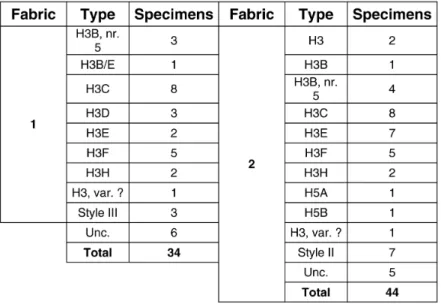
in the Phocaean production collected in Braga we diagnosed two major fabrics (fig. 1). the first one is subdivided in fabric 1a and 1b and is related to the Çandarli ware, as the sample no. 54 (fig. 7,54) from that typology seems to confirm. it is a fabric of better quality although subgroup 1b has a bit more soft fabric. Fabric 2 has got a large set of pieces in subgroup 2a of orange shades. Hayes5 refers to the following
specimens with a relatable fabric to the ones from Bracara
Augusta: Hayes form 2a,2 (“orange ware and slip”), Hayes form 3C,10 (“orange clay and slip”) and Hayes form 5B (“orange clay, rather soft with orange-red slip”). Regarding the fabric 2b from Bracara Augusta, only three fragments were diagnosed belonging to Hayes form 3C,16, and Hayes 3H,37, similar to a Hayes form 3H specimen found at Chãos Salgados (Mirobriga?) in Lusitania6.
Below we present a brief description of these fabrics, making reference to the names and colour codes according to a. Cailleux’s table7:
Fabric 1a
Hard, thick fabric of linear fracture; colour n25/P25 (faint red). Well preserved glossy slip, with fine grooves and slightly porous; R19/R20 colour (red).
Fabric 1b
Hard, thick fabric, of a less linear fracture; colour n25/n27 (faint red/light red-brown). Well preserved glossy slip of P13/ P25 colour (faint red), sometimes slightly porous.
Fabric 2a
Less hard fabric than that of fabric 1, but nonetheless thick, of conchoidal fracture; orange colour, n35/n45 (light red-brown). Fine slip, generally badly preserved in all forms, except for the Hayes Form 3C, where its degree of preserva-tion is relatively good; R20 colour (red)
Fabric 2b
Less hard fabric than that of fabric 1, but nonetheless thick, of conchoidal fracture; cream colour, n25 (faint red). Fine slip of P15/P25 colour (faint red)
5 Hayes 1972, 327, 333; 339.
6 in this last site (QuaresMa 2009), the small number of late Phocaean terra
sigillata comprises fabrics 1a (Hayes 3C and 3e) and 2b (Hayes 3H).
7 a. Cailleux, notice sur le Code des Couleurs des Sols (s.l. s.d.).
EasTErn LaTE roman fInE warE ImporTs In BrAcArA AugustA
(Braga, porTugaL)
374
José Carlos QuaresMa & rui Morais
as we will see, at a typological level these two fabrics do not have different importation timelines. in this respect, only group 2, with its Hayes types 5a and B, is highlighted here. However, these types present a timeline that is still consistent with the one from Hayes 3 variants. it is at the level of the decorative groups that we find some differences although the relative smallness of the collection does not allow us to draw firm conclusions: all the specimens from Hayes style ii belong to fabric 2 (namely to 2a, of orange shade) while style iii is in fabric 1, which is correlated to the Çandarli Ware fabric.
the Cypriot specimens have a fine and orange fabric. the slip that covers both faces is matte, but coarse. it is a later fabric in this type of forms, dated from the mid 6th century8.
8 delgado 1988, 42–43.
2.2. types, decorative styles and stratigraphy (fig. 2) the only fragment of Çandarli ware belongs to Hayes type 4, which usually presents a slight groove on the outside, between the wall and the bottom. according to Hayes9, there
is a typological relation between this Çandarly ware form, from the 3rd century, and the Hayes 1a of Late Phocaean terra
sigillata, dated from the late 4th to the early 5th century, which
he considers to be the direct successor of the Çandarli ware. He even states that some specimens exhibit an intermediate fabric, with a thick slip on the inside and discoloration of the exterior of the rim, as is the case of no. 3 of the Late Roman pottery (Hayes 1B)10, which comes from a group of the end
of the 4th century from the agora in athens. no. 54 (fig. 7,54)
from Bracara Augusta exhibits a rather small diameter, which makes it similar to Hayes type 1a,1 of Phocaean sigillata and comes from a not very reliable layer that corresponds to the fill over the theatre basilica to level it (U.S. 1606), very likely dated from the second half of the 4th century.
the Çandarli Ware trade is quite rare in the Western mediterranean. Still in the eastern part of this sea, Benghazi has a good collection of these imports, with a much wider number of types represented there. the type Hayes 4 at Benghazi is quite similar to the sherd from Bracara and its two specimens come from deposits nos. 73 and 108, dated to second and middle 3rd century11.
in Bracara Augusta the amount of Late Phocaean terra sigillata mostly comprises several Hayes type 3 variants, of which we highlight Hayes types 3B,5 (460−475 aD), 3C (460−475 aD), 3e (end of the century) and 3F (6th century)
although the forms 3B (460−475 aD), 3D (end of the 5th
century), 3H (6th century) and Hayes 5a (500−550 aD) and
5B (500−550 aD12) are also present.
9 Hayes 1972, 321–322; 325–326. 10 ibid. 326.
11 PH. M. KenriCK, excavations at Sidi Khrebish Benghazi (Berenice) 3,1.
the fine pottery (tripoli 1985) 265; 450; 466.
12 atlante i, 232.
fig. 1. Bracara Augusta. types of Late Phocaean terra sigillata (by fabric).
fig. 2. Bracara Augusta. types of Late Phocaean terra
375
eastern late roManfinewareiMPortsin Bracara augusta (Braga, Portugal)
Hayes type 3B, which lip exhibits its highest point on the inside, is only represented by one specimen. most of the specimens are close to Hayes type 3B,5, whose rim, in the words of Hayes13, is very similar to that of Hayes type 3C.
the profile of the rims found in Braga is variable, but they are always high and thick on the outside. they always present a roulette decoration, with a simple band (figs. 7,5.8.10), a double band (figs. 7,6.7) or a more elaborated one (figs. 7,4.9).
the profiles are more variable in Hayes type 3C, with rims of different thickness and a simple or double roulette (figs.
7,12−18). the Hayes type 3e rims are also variable and are
less likely to present a roulette decoration (figs. 7,21−27). this reduced trend towards the roulette becomes evident in the sixth century with the smaller forms, Hayes types 3F and H, whose rims, especially in the latter type, exhibit a great variability (figs. 7,28−37).
as far as the typological distribution of the patinas over the rim is concerned, no difference is to be seen: the light patina occurs in Hayes types 3B,5 (2 specimens), 3D (1 speci-men) 3e (1 specispeci-men) and 3F (3 specimens); the grey patina occurs in Hayes types 3 var.? (1 specimen), 3B (1 specimen), 3B,5 (2 specimens), 3C (6 specimens), 3D (1 specimen), 3e (2 specimens), 3F (4 specimens) and 3H (1 specimen).
figs. 7,1−3 are particular cases related to Hayes type
3, but whose characteristics do not allow us to classify them with certainty; as a consequence they can be called as
unclassifiable14. figs. 7,2−3 can not be related to the small varieties, but the most striking case is fig. 7,1, with roulette on the outside wall by the bottom and to which no parallels were to be found15.
13 Hayes 1972, 331.
14 J. W. Hayes, Late Hellenistic and Roman pottery in the eastern
mediter-ranean – an overview of recent developments. in: m. B. Briese/L. e. Vaag, trade relations in the eastern mediterranean from the Late Hel-lenistic Period to Late antiquity: the ceramic evidence. Halicarnasian Studies 3 (odense 2005) 11–26; fernández fernández 2010, 380. even
at the agora of athens one doesn’t find any parallels: J. W. Hayes, the
athenian agora. Results of excavations conducted by the american School of Classical Studies at athens 32. Roman pottery. Fine-ware imports (Princeton 2008) figs. 38–41.
15 the single parallel is the Hayes type 84 in african terra sigillata C5,
dated to c.420–460 aD (Hayes 1972, 131), which as roulleted wall,
decoration that doesn’t occur on our fig. 7,1.
the second Hayes16 decorative group dates from 440 to
490 aD and is prevalent in Bracara Augusta. a number of motifs occur: the 16 (diamond with volutes), 19 (s-scroll), 59 (canthari), 35 (small animal: hare), 36 (lion), 46 (stylized gallinaceous), 69 and 70 (Greek cross) motifs. the crosses also occur in group 3, just like the hare. this less frequent style dates from 470 to 580 aD17.
as we have already said, the Late Cypriot terra sigillata is represented by only two specimens, figs. 7,55−56, Hayes type 1/2 dated from the first half of the 6th century. Hayes form
2,14 is very close to the specimen from Bracara Augusta, especially to fig. 7,55, which exhibits the same rouletted decoration on the outside, slightly above the bottom.
except for the fragments collected in the archaeological intervention of Rua Gualdim Pais, inside a block situated in the historical centre of the present day city, the eastern pro-ductions so far documented in Bracara Augusta come from disturbed layers of modern or contemporary age.
the fragments collected in Gualdim Pais are, as we have previously mentioned, an exception. they were found in a level (G2, layer 5) dated from the 6th century, over a layer
of destruction of a hypocaust, probably built during the 4th
century18. the Cypriots rim fragments Hayes form 1/2, figs. 16 Hayes 1972, 349.
17 ibid..
18 delgado 1988, 35–49.
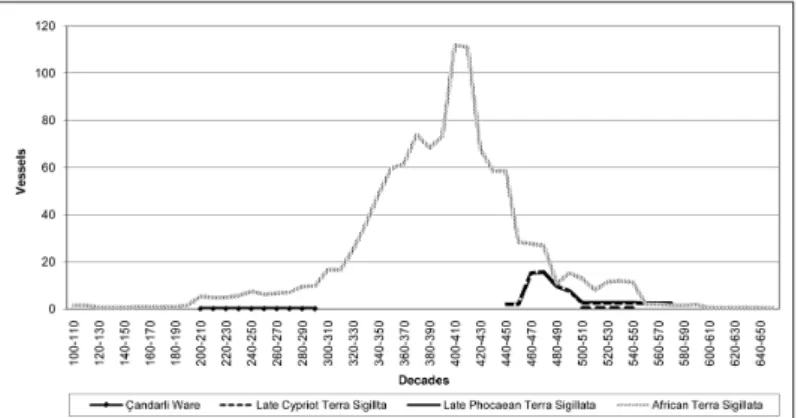
fig. 3. Bracara Augusta. evolution of the late roman terra sigillata and Çandarli Ware.
fig. 4. Bracara Augusta. Late roman imports
376
José Carlos QuaresMa & rui Morais
7,55−56, and two Phocaean fragments, the rim of Hayes
form 3F, fig. 7,32, and an undetermined bottom come from the above mentioned level. together with these fragments, several late glass bowls and late grey pottery vessels of lo-cal fabric, some of which imitate Late Gaulish terra sigillata forms (DSP), namely Rigoir 6b, 22 and 29, were collected.
3. The trade of the Eastern ware in Bracara Augusta
as we can see in fig. 3, in a general quantitative analysis of the late productions, in Bracara Augusta there is a higher percentage of african sigillata (1025 specimens, to which 27 of african a and 1 of african a/D ones are added) com-pared with the sigillata of Phocaean and Cypriot origin (88
specimens). However, if we take the period of highest con-centration of Phocaean ware in the city under consideration, particularly from the third quarter of the 5th century onwards,
and compare that percentage with the imported african ware in the same period, we realize that there is a balance between both productions, especially due to the sharp fall of the african trade. as we have already mentioned, the eastern trade might have started in the third quarter of the 5th century,
with particular emphasis both on Hayes type 3C and Hayes type 3B,5, followed by Hayes 5a, reinforced by Hayes form 3e at the end of the century, when the Phocaean sigillata seems to match the african one for a few years. according to Hayes19, the types 3F and G replace type 3e in the second
19 Hayes 1972, 338.
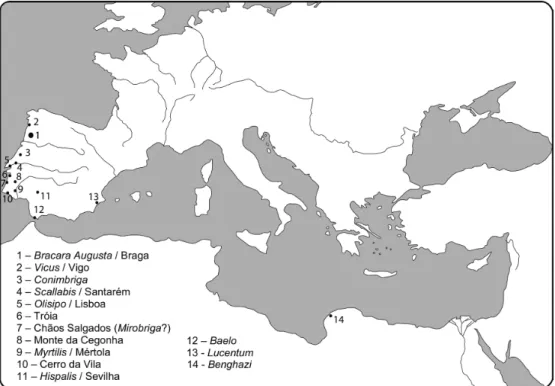
fig. 5. Sites in the Portuguese territory with the main amount and/or wider formal range of Late Phocaean terra sigillata
excluding Bracara Augusta (delgado 1988; a. m. D. diogo/l. trindade, Ânforas e sigillatas tardias (claras, foceenses e cipriotas) provenientes das escavações de 1966/67 do teatro tomano de Lisboa. Rev. Portuguesa arqu. 2/2, 1999, 83–96; C. Viegas, Cerâmica, economia e comércio: a terra sigillata da alcáçova de Santarém. trab. arqu. 26 (Lisboa 2003); QuaresMa
2009 anexo 2).
377
eastern late roManfinewareiMPortsin Bracara augusta (Braga, Portugal)
378
José Carlos QuaresMa & rui Morais
379
eastern late roManfinewareiMPortsin Bracara augusta (Braga, Portugal)
380
José Carlos QuaresMa & rui Morais
quarter of the 6th century in the agora of athens. according
to a. Fernández Fernández20, the Phocaean sigillata replaces
the african in Vigo in the 6th century while the 5th century is
still dominated by african sigillata (marqués de Valledares sector: Phocaean sigillata 36,6% − african sigillata 56,7%; Hospital sector no. 5: Phocaean sigillata 33% − african sigil-lata 53,4%). the large formal variety of the imports of this city allows us to draw other conclusions that are stratigraphically documented: from the second half of the 6th century onwards,
there is a decrease in Hayes 3 and an increase in Hayes 10 which is not even present in Bracara Augusta. this indicates, just like fig. 3 clarifies, a sharp decrease of the eastern imports of this city in the mid 6th century even though such a situation
was already visible since the early 6th century, unlike Vigo.
as we have already mentioned, the typological range of Bracara Augusta is also much narrower than the one of Vigo, where Hayes types 1, 2, 4, 6, 7, 8, 9 and 10 show up, with a clear predominance of Hayes type 3 with 86%. the types 1, 5, 6 and 8 focus their stratigraphic timeline in the late 5th century to the early decades of the 6th century whose
contexts are dominated by the small variants of Hayes 3, in particular of Hayes 3F, just like in Braga.
Hayes type 3 dominates throughout the atlantic façade where the above mentioned case of Vigo, as well as that of
Conimbriga, is very clear. the formal range can be very well differentiated from that of Vigo by the large concentration of Hayes type 3, the rare occurrence of types 2, 5, and 8, and the absence of Hayes 9 and 10, which seems to indicate a major interruption of this trade in the mid 6th century.
Bracara Augusta seems to have an intermediate situa-tion if we compare the Peninsular panorama and Vigo (one should add the data from Baelo, Lucentum, etc, where the Phocaean sigillata is always a minority21). the importance of
the eastern trade in the capital of Gallaecia is quite clear in the supremacy of the wine amphorae from antiochia (11 × LRa 1), asia minor (13 ×LRa 3 and Palestine (4 × LRa 4), in a total of 25 eastern specimens against the 6 tunisian ones22.
the situation documented in Vigo, where the high general amount both of sigillata and amphorae from the east overlaps the african23 one, is interpreted by a. Fernández Fernández.
according to this author24, this predominance is due to the
arrival of large amounts of eastern productions to the port enclave of Vigo to be afterwards redistributed throughout the region up to the consumption centres, as Bracara Augusta and
Lucus. He is also of the opinion that the highlighted presence of these products in Vigo can be elucidated by the fact that there is a direct relation between this port and the coasts of
Asia Minor in the Late Roman period, which explains beyond doubt the presence of those productions in the British isles. the privileged location of this port led to the maintenance of importations of african and eastern ware in the first half of the 7th century, a period when they are no longer present 20 fernández fernández 2010, 376; 380.
21 a. Bourgeois/f. Mayet, Fouilles de Baelo 6. Les sigillées. Collect. Casa
de Velásquez 34 (Paris 1991); P. reynolds, el yacimiento tardorromano
de Lucentum (Benallua-alicante): las ceramicas finas (alicante 1987); QuaresMa 2009, 476.
22 Morais 2005b.
23 fernández fernández 2010, 375–384. 24 ibid.
in the conventual capitals of the northwest (such an absence is certain, at least in relation to the Late Phocaean terra sigil-lata). this situation seems to suggest that the trade system in the mediterranean did not vanish immediately.
the eastern ware so far collected in Bracara Augusta must be understood in the context of the presence of traders from these regions, well documented in the written sources regarding Hispania25, and sometimes responsible for the trade
of african products.
this situation could well explain the presence of Late Roman C ware, in particular of Hayes form 3, which would have arrived in Braga as a subsidiary product, as a comple-mentary cargo to eastern amphorae; their number is five times that of the african ones. However, what this presence seems to reveal is that Bracara Augusta, just like other Peninsular cities which benefitted from long distance trade of Fretum
Gaditanum, enjoyed an active commercial role in a time its economy was believed to be in major retraction. the role of the Peninsula in this eastern Late antique trade must be, nonetheless, problematised taking into account the recent data from Hispalis, whose wine trade dated between aD 475 and 550 comprises an amphorae sample dominated by the east (36,12%), followed by africa with 34,78%, having italy once more a relevant role in this consumption centre with 28,9%26. as we see it, the role of the Peninsula and of the
atlantic façade needs the publishing of other major atlantic sites, such as Myrtilis/mértola, in the South of the Portuguese territory, but also of Olisipo/Lisbon, in the western façade, whose trade in this period is still essentially unpublished.
in fact, in the contexts of the Sommer sector of this city, dated from the final of the 5th/first half of the 6th century, the
eastern amphorae, in a sample of 198 specimens, represent 25% of the importations, twice as much as that of the africans with 12%27. it is important to know which is the typological
range of the eastern sigilatta in Olisipo and what is the final chronology of those fine ware and amphorae, to confirm or rule out an apparently earlier terminus than that of Vigo (in
Conimbriga, 50% of the Phocaean sigillata belongs to Hayes types 3B and C and 30% to Hayes type 3e28).
4. The trade with african ware in Bracara Augusta
a first glimpse at the african trade in Bracara Augusta29
is extremely important to understand the dynamics of the long distance trade of its fine table ware and the complex
25 F. aMores Carredano/e. garCía Vargas./d. gonzález aCuña, Ánforas
tardoantíguas en Hispalis (Sevilla, españa) y el comercio mediterráneo. in: m. Bonifay/J.-Chr. tréglia (eds.), LRCW 2. Late Roman Coarse Wares, Cooking Wares and amphorae in the mediterranean: archaeology and archaeometry 2. BaR internat. Ser. 1662 (oxford 2007) 133–146.
26 e. garCía Vargas, Hispalis como centro de consumo desde época
tardorrepublicana a la antigüedad tardía. el testimonio de las ánforas. an. arqu. Cordobesa 18, 2007, 317–360; QuaresMa 2009 anexo 2. 27 J. PiMenta/C. faBião, Ânforas orientais em Olysipona (Lisboa): a
vita-lidade da rota atlântica em época pós-romana (in printing); QuaresMa
2009 anexo 2.
28 m. delgado/f. Mayet/a. M. alarCão, Fouilles de Conimbriga 4. Les
sigillées (Paris 1975) 285.
29 the amount of african terra sigillata presented in this article is a first
version, which is nonetheless very close to the final count to be published in the near future.
381
eastern late roManfinewareiMPortsin Bracara augusta (Braga, Portugal)
382
José Carlos QuaresMa & rui Morais
chronology of the process in contrast to the eastern (Late Phocaean and Cypriot), the Peninsular (Late Hispanic) and the Late Gaulish trade (DSP). these last productions are only represented in the city with five fragments from the Provence region Rigoir type 1, 3b, 6c, 15 and 34.
the trade with african ware (including 11 fragments of african cooking ware dated from the 2nd to the 4th century aD),
is weak in the early and mid empire period, reaching its peak with the D production from the 5th century onwards. in this
stage Hayes forms 58 and 59, dated from the second half of the 4th to the early 5th century, are common and Hayes forms 61,
67 and 73 go up to the mid/third quarter of the 5th century. at
the end of this century, the numer of Hayes forms 91 a and B and 80/81 is still significant. the numer of types dated to the late 5th century, such as Hayes 99, 97 and 103, is significantly
lower and the decrease is still more pronounced from the mid 6th century onwards, after a stability of 50 years since about aD
500. Hayes type 106 marks the end of this trade, already scarce in the second half of the 6th century. throughout this century
there is a certain variety of production centres of Hayes form 104, mostly produced in the centres of mejerda Valley (D1) and atelier X (as is the case of the C/D production and especially the D2)30. these african importations are accompanied in Bra-cara Augusta by one specimen of african common ware (jug type 6, 5th century or first half of the 6th century), five tunisian
oil-lamps (Barbera series 5 and collateral Barbera aRS) and six amphorae (Keay 35a, 36B and 6231).
5. final remarks
the context of the importations documented in Bracara let us assume that the city wast only a redistribution centre for imported goods but also as a supply centre for its terri-tory, taking into account its pottery tradition since the early empire period32. Since its early days, the city emerges as a
dynamic centre in constant growth, a condition that it will keep up to the end of the empire, under a climate of political, economical and social changes.
although the sources and the archaeological data on the Suevic-visigothic occupation are still scarce, we can say that this occupation did not determine the immediate decline of
30 See Hayes 1972; atlante i; m. Bonifay, Études sur la céramique romaine
tardive d’afrique. BaR internat. Ser. 1301 (oxford 2004).
31 Morais 2005b. 32 id. 2005a.
the city. in spite of the abandonment of some constructions, many others were restored as the occupation levels of these periods demonstrate33. a further proof of that are the
impor-tations and the persistence of the workshops of local pro-duction, documented in the archaeological registers, which reveal that the city resisted to the upheavals resulting from theodoric’s plunder in aD 455, referred to by Hydatius34.
the same can be said about the moment when the Visigoths finally occupy the city and its territory in aD 58535. although
it is difficult to isolate the materials from that period from those from the Suevi dominion, the archaeological register keeps records of the urban reconstruction despite the bad quality of the constructions and restorations.
nevertheless, if we analyse the set of materials in terms of economic and cultural meaning we realize that they present significant differences concerning the evolution of the trade in Bracara:
a. the situation in the 5th century (or even in the late 5th/early
6th century) is characterised by the binding to the regular
mediterranean circuits, as the arrival of all type of food (especially through the amphorae) and of the eastern and the african fine ware demonstrate;
B. the situation in the 6th and 7th centuries is defined by a
gen-eral reduction of the repertoires. after c. 550 aD the fine ware imports, much more narrowed, are always african36.
Up to a point, we can talk about a reduction of the expec-tations related to the supply of the community. this situation can be connected to a more modest way of life and to a pro-gressive trend of the local community to self-sufficiency. in this scenario, the social and economic exchanges seem less regular and take place in the periphery of the community life. as the data collected in Vigo demonstrate, during the 6th
century (specially the second half) many peninsular cities closed themselves although the atlantic routes related to british navigation still went on37.
[email protected] [email protected]
33 a. gasPar, Cerâmicas tardias da antiguidade tardia e alto-medievais
de Braga e Dume. anejos archico español arch. 28, 2003, 455.
34 a. tranoy, Hydace. Chronique (Paris 1974) 74; 174; 179; 214. 35 Martins/delgado 1989–90, 31–38.
36 See fig. 3.
37 fernández fernández 2010; see also P. reynolds, Hispania and the
383
eastern late roManfinewareiMPortsin Bracara augusta (Braga, Portugal)
Bibliography
delgado 1988 m. delgado, Contribuição para o estudo das cerâmicas romanas tardias do médio oriente encontradas
em Portugal. Cad. arqu. 5, 1988, 35−49.
fernández fernández 2010 a. fernández fernández, Resultados preliminares del estudio de la t.S. focense (LRC) aparecida en
Vigo (Galiza, españa). acta RCRF 41, 2010, 375−384. Hayes 1972 J. W. Hayes, Late Roman Pottery (London 1972).
Martins/delgado 1989−90 m. Martins/m. delgado, História e arqueologia de uma cidade em devir: Bracara augusta. Cad. arqu.
6−7, 1989−1990, 11−38.
Morais 2005a R. Morais, autarcia e Comércio em Bracara augusta. Bracara augusta. escav. arqu. 2 (Braga 2005).
Morais 2005b R. Morais, From oppidum to Dives Bracara: the roman trade through the amphorae. in: J. m. Gurt i
esparraguera/J. Buxeda i Garrigos/m. a. Cau ontiveros (eds.), LRCW 1. Late Roman Coarse Wares, Cooking Wares and amphorae in the mediterranean: archaeology and archaeometry 1. BaR internat. Ser. 1340 (oxford 2005) 55−68.
QuaresMa 2009 J. C. QuaresMa, economia antiga a partir de um centro de consumo lusitano. terra sigillata e cerâmica
africana de cozinha em Chãos Salgados (mirobriga?). PhD thesis Fac. Letras Univ. Lisboa (2009). atlante i a. Carandini (a cura di), atlante delle Forme Ceramiche i. Ceramica Fine Romana nel Bacino
384