Coffee Diterpenes: Quantification and
Anti-angiogenic Effects
Marzieh Moeenfard
Dissertation presented to obtain the degree of
Doctor in Chemical and Biological Engineering
by the
University of Porto
Supervision: Doctor Maria Arminda Costa Alves
Co-Supervision: Doctor Nuno Pedro Garcia Fernandes Bento Borges
Doctor José Alejandro Ribeiro dos Santos
Abstract
Coffee is one of the most important agricultural products in the world, from which a popular beverage is prepared for its particular aroma, taste and composition. The lipidic fraction of coffee is extremely complex and serves as carrier for flavors and for fat-soluble vitamins and contributes to texture and mouthfeel in the coffee brew. It is also regarded as an important source of bioactive components, such as diterpenes and diterpene esters that carry relevant nutritional or functional properties. Elevation of blood low density lipoprotein is the consequence of high diterpenes consumption. Nevertheless, degradation of toxic substances, anti-carcinogenic and anti-inflammatory properties of coffee diterpenes have been also documented. Moreover, they are used for authentication purpose in coffee industry.
To contribute to a better understanding of the factors affecting the diterpenes level in coffee, this study aimed to provide information on the influence of species, blending, roasting, and brewing method on diterpenes content in coffee samples, as well as the anti-angiogenic effects of two diterpene esters. Firstly, the analytical methods for quantification of total diterpenes in coffee matrices (beans and brews) including cafestol, kahweol, 16-O-methylcafestol (16-OMC) and dehydrocafestol and diterpenes esters, including cafestol and kahweol linoleate, oleate, palmitate and stearate, were adapted from previous ones and conveniently validated, using high performance liquid chromatography combined with diode array detector (HPLC-DAD).
Total diterpenes were analyzed after saponification of diterpene esters. The optimized conditions were: saponification at 80 °C of 2.5 mL of coffee brew or 200 mg of ground coffee with potassium hydroxide in methanol/water media, followed by two or four sequential extractions using diethyl ether in terms of coffee brew or ground coffee, respectively. The combined ether phase was cleaned with 5 mL of 2 M NaCl solution. The analytical methods proved to be linear (R2 ≥ 0.999) within the range of 0.3 - 300 mg/L and good precision (≤ 8%)
and high recovery (81 – 102%) were achieved.
Kahweol was the most important diterpene in Arabica brews, followed by cafestol, whereas, in Robusta brews, cafestol and OMC were the main diterpenes. Cafestol, kahweol and 16-OMC concentrations in coffee brews ranged between 0.3 – 140.1 mg/L , 0.3 - 190.6 mg/L, and
cafestol and kahweol content also indicated that by varying the preparation parameters, the total diterpenes could be reduced from 58.9 ± 0.7 mg/L (brewed with very fine particles) to 30.8 ± 0.8 mg/L. However, these amounts correspond to low extraction efficiencies of brews, ranging from 1.4% (cafestol) and 1.5% (kahweol) in espresso coffee, to 2.8% (cafestol) and 2.9% (kahweol) when brewing with very fine particles.
With roast, despite the stability of the total lipid amounts, cafestol contents decreased from 40 -71 mg/g coffee oil in green coffee beans to 35 - 52 mg/g coffee oil in roasted ones. Less effect was remarked for kahweol content as reduction from 2 - 68 mg/g coffee oil to 1 - 63 mg/g coffee oil was found from green beans over the roasted coffees. On the other hand, 16-OMC presented relative stability in the roasting process (27.0 ± 0.3 mg/g coffee oil vs. 24.9 ± 0.2 mg/g coffee oil in green and roasted Robusta-Vietnam, respectively). Dehydrocafestol was only identified in roasted samples in the range of 1 – 3 mg/g coffee oil.
Diterpene esters were extracted directly from coffee brew or ground coffee (2.5 mL/200 mg), with ultrasonication (20 min), followed by extraction using diethyl ether. HPLC-DAD combined with spectral deconvolution was successfully applied to deconvolve, from the raw data, the partially overlapped chromatographic peaks of cafestol and kahweol esters, which all together contributed to characterize samples in a single chromatographic run. Within the linearity range of 5 - 400 mg/L, the method proved good intra- and inter-day precision (≤ 5%), accuracy (recovery of 87 - 103%), and limits of detection (0.1 - 1.7 mg/L) and quantification (0.4 - 5.5 mg/L). No significant differences (p ≥ 0.05) were observed among deconvolution and classical approach, when setting the wavelength at 290 nm for quantifying the kahweol esters.
In general, boiled coffee prepared from Arabica bean was the most concentrated brew in terms of total cafestol esters (309 ± 15 mg/L) and total kahweol esters (1016 ± 29 mg/L) content, while, mocha and espresso brews had an intermediate contribution to cafestol esters intake with values of 46 ± 5 mg/L and 5.1 – 73 mg/L, respectively. They also were considered as an intermediate source of kahweol esters (123 ± 2 mg/L of mocha coffee and 46 – 127 mg/L of espresso brews). However, it seemed that individual diterpene esters were not affected by brewing procedure as in terms of kahweol esters, kahweol palmitate (2 – 409 mg/L) was the major compound in all samples, followed by kahweol linoleate (20 – 381 mg/L), oleate (5 – 176 mg/L) and stearate (2 – 50 mg/L). Higher amounts of cafestol palmitate (1.5 – 103 mg/L) and stearate (3 – 62 mg/L) were also observed compared to cafestol linoleate (0.5 – 46.5 mg/L) and cafestol oleate (0.5 – 20 mg/L).
Some changes were also observed in diterpene esters content in roasted beans over the green ones. However, their distribution in green and the respective roasted beans were similar as cafestol palmitate existed in larger proportion in green (201 – 739 mg/100 g dry matter) and
roasted coffees (154 – 670 mg/100 g dry matter). Also, kahweol linoleate presented slightly higher content than kahweol palmitate either in green (542 – 2455 mg/100 g dry matter) or respective roasted coffee samples (612 – 2342 mg/100 g dry matter).
The variability of the diterpene esters content as a function of coffee species in coffee blends was also studied. The distribution of individual diterpene esters in coffee blends was not affected by coffee species. Reducing Arabica content in coffee blends from 80% to 20%, caused a 49 ± 7% decline in the cafestol esters content and a more significant decrease of 76 ± 4% of kahweol esters. The highest effect was observed on kahweol stearate with around 80% decline.
The angiogenic effects were tested with cafestol palmitate and kahweol palmitate. According to our findings, both compounds inhibited angiogenesis steps on human microvascular endothelial cells (HMVECs). Compared to control, HMVECs viability decreased in a dose-dependent manner as concentrations of 75 and 100 μM of each compound were cytotoxic. Cell proliferation was also dramatically reduced by both diterpene esters at concentration of 50 μM. However, cafestol palmitate and kahweol palmitate did not induce apoptosis on HMVECs. Both compounds reduced cell migration, but this effect was only statistically significant after kahweol palmitate incubation. Inhibition of VEGFR-2 expression and its downstream effector Akt, but not Erk, was also observed in cafestol palmitate and kahweol palmitate treated HMVECs. These findings were confirmed using ELISA assay for phosphorylated (active) VEGFR-2. Our findings further indicate that kahweol palmitate exerts more potent anti-angiogenic effects than cafestol palmitate, in most of assays. Globally, the results show that both cafestol palmitate and kahweol palmitate as the main diterpene esters present in Arabica coffee, are able to prevent several steps involved in angiogenesis and can be considered as potent compounds against angiogenesis-dependent disorders.
Resumo
O café é um dos produtos agrícolas mais importantes do mundo, a partir do qual é preparada uma bebida com aroma, sabor e composição muito especial. A fracção lipídica do café é extremamente complexa e serve como meio de suporte de aromas e de vitaminas lipossolúveis, bem como contribui para a textura e paladar da infusão de café. Também é considerada uma importante fonte de compostos bioativos, como diterpenos e ésteres de diterpenos, possuindo propriedades nutricionais e funcionais relevantes. Apesar do aumento da lipoproteína de baixa densidade poder ser uma consequência do elevado consumo de diterpenos, foram também reportadas a sua capacidade de degradar substâncias tóxicas e propriedades anti-carcinogénicas e anti-inflamatórias. Para além disso, os diterpenos são utilizados em contexto industrial para a autenticação de variedades de café.
De modo a compreender melhor os fatores que influenciam os níveis de diterpenos no café, este trabalho visou elucidar a influência das espécies, mistura, método de torrefação e de preparação no teor de diterpenos em amostras de café, bem como os efeitos anti-angiogénicos destes dois ésteres de diterpenos. Em primeiro lugar, foram adaptadas (a partir de metodologias previamente existentes) e convenientemente validadas as metodologias baseadas em cromatografia líquida com detecção por arranjo de díodos (HPLC-DAD) para a quantificação de níveis totais de diterpenos incluindo cafestol, caveol, 16-O-metilcafestol (16-OMC) e dehidrocafestol e níveis de ésteres de diterpenos, incluindo linolato, oleato, palmitato e estearato de cafestol e de caveol em matrizes de café (grãos e infusão).
Os níveis totais de diterpenos foram analisados após a saponificação dos seus respetivos ésteres. As condições otimizadas empregam a saponificação de 2.5 mL de infusão de café ou 200 mg de café moído saponificados com 3.0 g de hidróxido de potássio em solução metanol/água a 80 °C, seguidos por duas ou quatro extracções sucessivas usando éter dietílico, para infusão ou café sólido, respetivamente. As fases orgânicas combinadas foram purificadas usando 5 mL de solução de 2 M NaCl. As metodologias analíticas demonstraram linearidade (R2 ≥ 0.999) na gama
enquanto que em infusões de Robusta, o cafestol e o 16-OMC foram os diterpenos principais. As concentrações em infusões de café de cafestol, caveol e 16-OMC variaram entre 0.3 – 140.1 mg/L , 0.3 - 190.6 mg/L e 2.2 - 45.6 mg/L, respetivamente. O estudo dos efeitos dos parâmetros de preparação de café expresso nos níveis de cafestol e caveol revelaram que é possível reduzir os níveis totais de diterpenos de 58.9 ± 0.7 mg/L (preparação com partículas de café de moagem muito fina) para 30.8 ± 0.8 mg/L. No entanto, estes níveis correspondem a baixos rendimentos de extração na bebida preparada, variando entre 1.4% (cafestol) e 1.5% (caveol) em café expresso e 2.8% (cafestol) e 2.9% (caveol) quando se utiliza na preparação da bebida partículas de moagem muito fina.
Embora a quantidade total de lípidos se mantenha estável, durante a torrefação, os níveis de cafestol diminuíram de 40 - 71 mg/g de óleo de café em grãos verdes para 35 – 52 mg/g de óleo de café em grãos torrados. Foi observado um efeito menos significativo para o caveol, verificando-se uma redução de níveis de 2 -68 mg/g de óleo de café em grãos verdes para níveis de 1 – 63 mg/g de óleo de café em grãos torrados. Por outro lado, o 16-OMC demonstrou ser relativamente estável durante o processo de torrefação (27.0 ± 0.3 mg/g de óleo contra 24.9 ± 0.2 mg/g de óleo de grãos de café Robusta-Vietname verde e torrado, respetivamente). Dehidrocafestol foi unicamente identificado em amostras torradas em gamas de 1 - 3 mg/g de óleo de café.
Os ésteres de diterpenos foram diretamente extraídos de infusão ou grãos de café moídos (2.5 mg/200 mg) aplicando ultrasons (20 min) seguidos de éter dietílico. A combinação de HPLC-DAD com a desconvolução espetral dos dados em bruto permitiram a distinção entre os picos cromatográficos parcialmente sobrepostos de ésteres de cafestol e caveol, permitindo a sua caracterização simultânea numa única análise cromatográfica. Na gama de linearidade de 5 - 400 mg/L, o método demonstrou boa precisão repetibilidade e precisão intermédia (≤ 5%), exatidão (recuperações de 87 - 103%) e limites de deteção (0.1 - 1.7 mg/L) e de quantificação (0.4 - 5.5 mg/L). Não foram observadas diferenças significativas (p ≥ 0.05) entre a abordagem por desconvolução e a abordagem clássica, usando comprimentos de onde de 290 nm.
Em cafés fervidos (decocções) preparados a partir de grãos da espécie Arábica, os teores totais de ésteres de cafestol (309 ± 15 mg/L) e de ésteres de caveol (1016 ± 29 mg/L) foram os mais elevados, enquanto que infusões de café do tipo moca ou expresso, contribuam através da ingestão com níveis intermédios de ésteres de cafestol na ordem dos 46 ± 5 mg/L e 5.1 - 73 mg/L, respetivamente. Também contribuem com níveis intermédios de ingestão de ésteres de caveol (123 ± 2 mg/L no café moca e 46 - 127 mg/L no café expresso). No entanto, aparentemente, a composição de ésteres individuais parece não ter sido afetada, uma vez que o palmitato de caveol (2 – 409 mg/L) foi o composto principal em todas as amostras, seguido do
linolato (20 - 381 mg/L), oleato (5 - 176 mg/L) e estearato de caveol (2 - 50 mg/L). Também foram detetados níveis mais elevados de palmitato (1.5 - 103 mg/L) e de estearato de cafestol (3 - 62 mg/L) quando comparados com os níveis de linolato (0.5 - 46.5 mg/L) e de oleato de cafestol (0.5 - 20 mg/L).
Verificaram-se também algumas variações no teor de ésteres de diterpenos entre grãos torrados e verdes. No entanto, a sua distribuição em grãos verdes e os mesmos torrados foi similar, na medida que o palmitato de cafestol esteve presente em maior proporção em grãos verdes (201 - 739 mg/100 g de matéria seca) e grãos torrados (154 - 670 mg/ 100 g de matéria seca). Também o linolato de caveol esteve presente em níveis ligeiramente superiores que o palmitato de cafestol, tanto em cafés verdes (542 - 2455 mg/100 g de matéria seca) como em cafés torrados (612 - 2342 mg/100 g de matéria seca).
A variação do teor de ésteres de diterpenos em função da espécie em misturas de cafés também foi investigada. A distribuição de ésteres de diterpenos individuais não foi afetada pela espécie da de café. Uma diminuição do 80% para 20% de Arábica em misturas de café, resultou numa redução de 49 ± 7% nos teores de ésteres de cafestol e uma redução mais significativa de 76 ± 4% em ésteres de caveol. Foi verificado um efeito mais pronunciado, para o estearato de caveol, resultando numa deminuição de 80%.
Os efeitos angiogénicos foram testados com palmitato de cafestol e palmitato de caveol. De acordo com a observações verificadas neste estudo, ambos os compostos inibiram etapas de angiogénese em células endoteliais microvasculares humanas (HMVECs). Comparado com o controlo, a viabilidade de (HMVECs) diminui em função da dose, sendo as concentrações de 75 μM e 100 μM de palmitato de cafestol e palmitato de caveol, consideradas citotóxicas. A proliferação de células também foi reduzida significativamente por ambos os ésteres de diterpenos em concentrações de 50 μM. No entanto, o palmitato de cafestol e palmitato de caveol foram incapazes de induzir apoptose em HMVECs. Ambos os compostos reduziram a migração de células, mas este efeito apenas foi estatisticamente significativo após incubação em palmitato de caveol. Foi observada a inibição da expressão de VEGFR-2 e o seu transdutor a jusante Akt, mas não de Erk, foi observado em HMVECs tratados com palmitato de cafestol e palmitato de caveol. Estas observações foram confirmadas por ensaios ELISA para VEGFR-2 fosforilado (ativo). Verifou-se também que o palmitato de caveol expressa um efeito anti-carcinogénico mais potente que o palmitato de cafestol, na maior parte dos ensaios realizados. Na sua generalidade, os resultados obtidos demonstram que o palmitato de cafestol e palmitato de caveol, sendo os ésteres predominantes presentes no café Arábica, são capazes de inibir várias etapas envolvidas na angiogénese e podem ser considerados potencias compostos contra patologias relacionadas com a angiogénese.
Acknowledgments
First of all, I would like to thank the institution which made this work possible, Laboratory for Process Engineering, Environment, Biotechnology and Energy (LEPABE). Similar, profound gratitude goes to Faculties of Engineering, Nutrition and Medicine of the University of Porto.
I must also acknowledge the financial support of FCT, Fundação para a Ciência e a Tecnologia, with my PhD scholarship (SFRH/BD/79318/2011). I would like to acknowledge also FEDER - Fundo Europeu de Desenvolvimento Regional and Programa Operacional Competitividade e Internacionalização - COMPETE2020 for the financial support for the project
UID/EQU/00511/2013-LEPABE. An acknowledgment goes also to project
UID/BIM/04293/2013 for partially financial support. Great acknowledge goes to a coffee company in Porto, Portugal which gently provided several coffee samples, espresso coffee machine and coffee grinder for us.
Foremost, I would like to express my sincere gratitude to my supervisor Professor Arminda Alves for her kindness, patience, motivation, and tremendous academic support. I appreciate all her contributions of time, ideas, and funding to make my PhD experience productive and stimulating. She helped me in all the time of PhD study and writing of this thesis with her guidance, moral support and the freedom I needed to move on.
I would like to express my sincere appreciation and thanks also to my co-supervisors Professor Nuno Borges and Professor Alejandro Santos for all the support, insightful comments and encouragement and for being so dedicated and for the continuous support of my PhD study.
A big thanks goes to Professor Lucia Santos for the support and guidance, useful comments, remarks and engagement through my PhD thesis.
I was also involved in experimental part outside the FEUP, where I met amazing people. My sincere thanks goes to Professor Raquel Soares who provided me an opportunity to join her team, and who gave access to the laboratory and research facilities. Thanks for kindness and for being always supportive.
In my work on studying the health effect of diterpenes, I am particularly indebted to Dr. Alice Cortez who has been a truly dedicated mentor and taught me everything compassionately. I
Biochemistry - Faculty of Medicine. I would like also to thank all my lab mate there, in particular Vera Machado, for being always affable and so helpful.
A special and huge acknowledgement goes to D. Maria de Fátima Faustino for her kindness and being always available to help, affable and contributor. Thank you so much D. Fátima.
I am also especially grateful for great assistance of Sr. Serafim Pereira, D. Maria de Fátima Ferreira and Eng. José Luis Moreira during these years.
A special group from the LEPABE is not mentioned yet. They welcomed me to the E201 in 2011. The members of the E201 have contributed immensely to my personal and professional time at the LEPABE and they deserve my recognition and gratitude. Our group has been a source of friendships as well as good advice and collaborations.
Profound gratitude goes to José Avelino Silva. I am particularly indebted to José Avelino for his constant help in my lab work and for providing me with a lab training. I was always ensure about his backup when problems were appeared. I totally remember my first entrance to Lab E201 and his support during those days and I would never forget his amazing help throughout these years. Thank you so much José Avelino.
I am also hugely appreciative to Guillaume Erny. In my attempted to analyze diterpene esters, he wrote the code to generate the deconvolution models. Without his precious help it would not be possible to finish this research.
A special acknowledgement goes to my lab mates, Mónica Santos, Vera Homem, Leandro Figueiredo, Raquel Sousa, Sara Ramos, Nuno Ratola and Patrícia Correia for being my friends and helping me with the thesis and supported me in many ways and also for fun times, being companions and welcoming. Their friendships makes my life in Portugal as a wonderful experience. You all will be always on my mind. A big thanks goes to Leandro Figueiredo for giving a helping hand in the laboratory whenever I need and for leaving HPLC just for me during the several working days. I wish to thank also Ana Isabel, Daniela and Mariana and I hope you all be successful both in your professional and personal life.
I am also greatly thankful to my friends, Malihe and Hooshiar for their sincere help and kindness during the last year and for lots of fun time. Thank you !
Finally, huge thanks go to my mother and my father for being with me in hard time and for their unbelievable support, love and encouragement in my many, many moments of crisis. Words cannot express how grateful I am to them for all of the sacrifices that they have made on my behalf. Although they were not here, I always felt and got their warm presence next to myself. A huge thanks to my sister, Hamideh, and my brothers, Hossein, Hamid and Ali. Their kind and warm messages during these years away from home was always encouraging me. They are the most important people in my world and I dedicate this thesis to them.
To my father, To my mother
Life is like riding a bicycle.
To keep your balance, you must keep moving.
Contents
List of Figures ... xvii
List of Tables ... xxiii
Abbreviations and Symbols ... xxv
Chapter 1 Introduction ...1
1.1. Motivation and relevance ... 1
1.2. Objectives and Outline ... 3
Chapter 2 Literature Review ...5
2.1. Introduction to coffee technology ... 5
2.1.1. Introduction ... 5
2.1.2. Coffee origins and cultivation... 6
2.1.3. Coffee harvesting and post-processing ... 8
2.1.3.1. Dry and wet methods ... 8
2.1.3.2. Polishing, grading, and sorting ... 10
2.1.3.3. Storage of coffee beans ... 10
2.1.3.4. Roasting ... 10
2.1.3.5. Grinding and blending ... 13
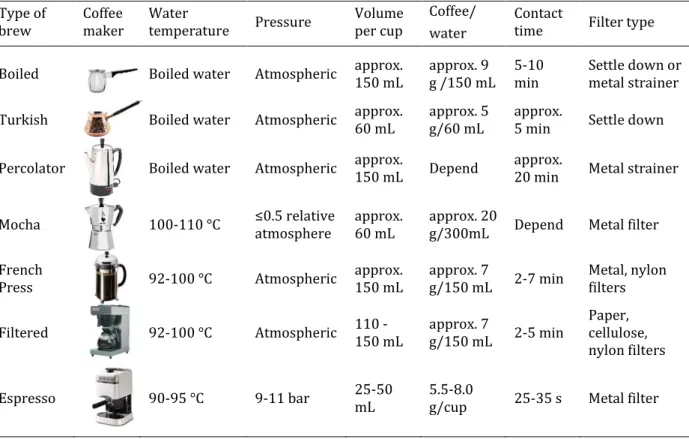
2.1.3.6. Brewing ... 13
2.1.4. Pattern of coffee production and consumption ... 15
2.1.5. Chemical composition of coffee ... 17
2.1.5.1. Non-volatile compounds... 18
2.1.5.2. Volatile compounds ... 21
2.1.6. Conclusions ... 22
2.2. Coffee Diterpenes ... 22
2.2.1. Introduction ... 22
2.2.2. Diterpenes – Content and properties ... 23
2.2.3. Effect of regional and technological parameters on diterpenes content ... 35
2.2.3.2. Roasting... 36
2.2.3.3. Defective beans ... 38
2.2.3.4. Brewing ... 39
2.2.4. Analysis of total diterpenes in coffee matrices ... 45
2.2.4.1. Methods relying on primary extraction of coffee oil ... 45
2.2.4.2. Methods relying on direct saponification ... 48
2.2.4.3. Other analytical techniques ... 56
2.2.5. Analysis of diterpene esters in coffee matrices ... 56
2.3. Potential health effects of coffee diterpenes ... 58
2.3.1. Harmful effects of coffee diterpenes ... 58
2.3.2. Beneficial effects of coffee diterpenes ... 60
2.3.2.1. Anti-angiogenic effects of coffee diterpenes ... 61
2.4. Conclusions ... 63
Chapter 3 Materials and Methods ... 65
3.1. Chemicals, equipment, materials and samples... 65
3.1.1. Chemicals ... 65
3.1.2. Equipment and materials ... 65
3.1.3. Samples ... 66
3.1.3.1. Coffee beans ... 66
3.1.3.2. Coffee brews ... 67
3.1.3.2.1. Traditional coffee brew preparation ... 67
3.1.3.2.2. Commercial coffee brew preparation ... 67
3.1.3.2.3. Espresso coffee (EC) with different preparation parameters ... 68
3.2. Chromatographic conditions ... 70
3.2.1. Preparation of standard solutions for calibration curves ... 70
3.2.2. HPLC-DAD analysis of total diterpenes ... 70
3.2.3. HPLC-DAD analysis of cafestol and kahweol palmitate ... 70
3.2.4. HPLC-DAD analysis of diterpene esters combined with spectral deconvolution (SD) . 71 3.2.5. Methods validation ... 71
3.3. Water content of ground coffee ... 72
3.4. Lipid extraction from ground coffee ... 72
3.5. Method optimization for extraction of total diterpenes ... 73
3.5.1. Coffee brews... 73
3.5.2. Ground coffee ... 74
3.6. Method optimization for extraction of diterpene esters ... 74
3.6.1. Coffee brews... 74
3.6.2. Ground coffee ... 75
3.7. Total diterpenes and diterpene esters concentration in coffee brews... 75
3.7.2. Diterpene esters extraction ... 76
3.8. Total diterpene and diterpene esters content in green, roasted and blends of coffee ... 76
3.8.1. Total diterpenes extraction ... 76
3.8.2. Diterpene esters extraction ... 76
3.9. Anti-angiogenic properties of cafestol and kahweol palmitate ... 77
3.9.1. Cell culture ... 77
3.9.2. MTS toxicity assay ... 77
3.9.3. BrdU proliferation assay ... 78
3.9.4. TUNEL assay ... 79
3.9.5. Migration assay ... 80
3.9.6. Western blotting assay ... 80
3.9.7. ELISA assay ... 81
3.10. Statistical analysis ... 82
Chapter 4 Results and Discussion ... 83
4.1. Introduction ... 83
4.2. Quantification of total diterpenes in coffee brews ... 84
4.2.1. Optimization of total diterpenes extraction from coffee brew ... 84
4.2.1.1. First phase of optimization ... 85
4.2.1.2. Second phase of optimization ... 86
4.2.2. Method validation for analysis of total diterpenes ... 90
4.2.3. Analysis of total diterpenes in various types of coffee brews... 93
4.2.3.1. Traditional coffee brews ... 94
4.2.3.2. Commercial coffee brews ... 96
4.3. Quantification of total diterpenes in ground coffee ...100
4.3.1. Optimization of diterpenes (cafestol and kahweol) extraction from ground coffee ...100
4.3.2. Method validation ...101
4.3.3. Total lipid and diterpenes in ground coffee - Effect of roasting ...102
4.4. Effect of technological parameters on cafestol and kahweol content of espresso coffee 106 4.4.1. Effect of roasted and ground coffee amount ...106
4.4.2. Effect of water quantity (cup size) ...107
4.4.3. Effect of grinding grade...108
4.4.4. Effect of extraction time ...109
4.4.5. Effect of water temperature ...109
4.4.6. Effect of water pressure ...110
4.4.7. Cafestol and kahweol extraction efficiency ...110
4.5. Quantification of diterpene esters in coffee brews using HPLC-DAD/SD ...112
4.5.1. Optimization of diterpene esters extraction from coffee brew ...112
4.5.2. Basic principles of spectral deconvolution ...113
4.5.3. Development of spectral deconvolution ...116
4.5.5. Diterpene esters content in various types of coffee brews ... 121
4.5.6. Comparison of coffee brews according to their fatty acid composition... 126
4.6. Quantification of diterpene esters in ground coffee using HPLC-DAD/SD ... 128
4.6.1. Optimization of diterpene esters extraction from ground coffee ... 128
4.6.2. Method validation ... 130
4.6.3. Diterpene esters content in ground roasted coffee - Effect of roasting and blending 130 4.6.3.1. Effect of roasting ... 130
4.6.3.2. Effect of blending... 132
4.7. Anti-angiogenic properties of cafestol palmitate and kahweol palmitate ... 133
4.7.1. Effect of cafestol and kahweol palmitate on HMVECs viability ... 134
4.7.2. Cafestol and kahweol palmitate inhibit HMVECs proliferation ... 135
4.7.3. Cafestol and kahweol palmitate do not induce apoptosis on HMVECs ... 136
4.7.4. Kahweol palmitate inhibits HMVECs migration ... 137
4.7.5. Cafestol and kahweol palmitate suppress VEGFR-2 signaling pathway ... 138
Chapter 5 Conclusions and Future Work ... 141
5.1. General conclusions ... 141
5.2. Future work ... 146
Annex ... 149
Annex I ... 149
A1.1. Extracting and opening the data ... 149
A1.2. Exploring the data and getting the standard spectra ... 151
A1.3. Deconvolution and analysis of results ... 154
Annex II ... 158
List of Figures
Figure 2.1. Coffee producing countries around the globe. "Reprinted from Comprehensive Natural Products II-Chemistry and Biology, Volume 3 - Development & Modification of Bioactivity, S. Oestreich-Janzen, Chemistry of Coffee, 1085-1117., Copyright (2010), with
permission from Elsevier" ... 6
Figure 2.2. Ripe fruits of Arabica coffee ... 7
Figure 2.3. Anatomy of coffee bean ... 8
Figure 2.4. Procedures involved in production of dried green coffee. “Republished with permission of Taylor and Francis Group LLC Books, from [Coffee: A Perspective on Processing and Products, Ramalakshmi and Raghavan, 2016]; permission conveyed through Copyright Clearance Center, Inc.” ... 9
Figure 2.5. General overview of the Maillard reaction showing flavor compounds as end products. Reprinted from Biotechnology Advances, Vol 24, M.A.J.S. van Boekel, Formation of flavor compounds in the Maillard reaction, 230-233., Copyright (2006), with permission from Elsevier ... 12
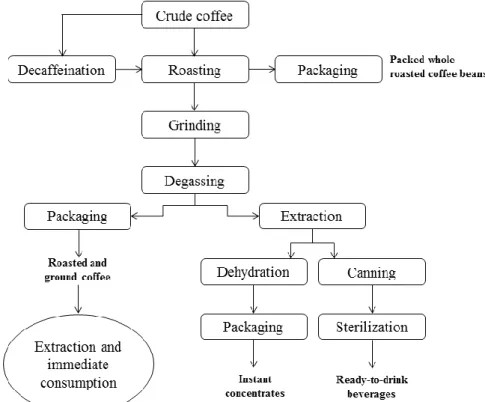
Figure 2.6. Key technological steps to obtain coffee products. “Republished with permission of Taylor and Francis Group LLC Books, from [Packaging and the Shelf Life of Coffee, Nicoli, M. C. et al., 2016]; permission conveyed through Copyright Clearance Center, Inc. ” ... 15
Figure 2.7. Chemical structure of caffeine ... 18
Figure 2.8. Chemical structures of the main CQAs ... 19
Figure 2.9. Basic structures of arabinogalactan and galactomannan ... 19
Figure 2.10. Maillard reaction products derived from lysine identified in coffee melanoidin. Reproduced from Moreira et al. (2006) with permission of The Royal Society of Chemistry ... 21
Figure 2.11. Structural formulae of the most important diterpenes in coffee ... 24
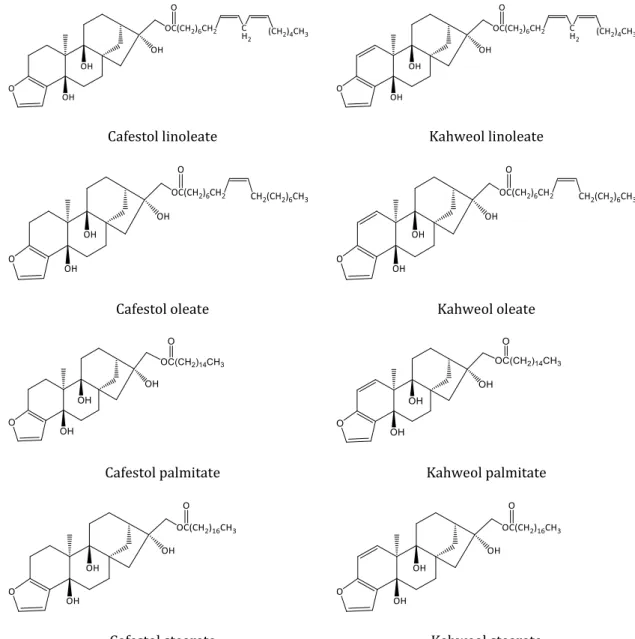
Figure 2.12. Chemical structures of the eight main diterpene esters present in Arabica coffee ... 27
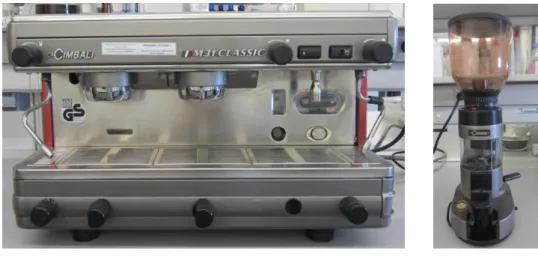
Figure 3.1. The espresso coffee machine and grinder used for brewing EC under different preparation parameters, (gently supplied by a coffee company) ... 69 Figure 3.2. Lipid extraction from ground coffee using Soxhlet apparatus ... 73 Figure 4.1. Effect of the heating system on diterpenes contents of coffee brew (saponification of 5.0 mL of brew by 0.45 g of KOH followed by 4 times extraction using diethyl ether and cleaning the combined ether phase with 15 mL of 2 M NaCl solution; mean ± sd) ... 86 Figure 4.2. Effect of the number of extractions and the amount of 2 M NaCl solution on (A) cafestol and (B) kahweol content of coffee brew (saponification of 5.0 mL of brew using 0.45 g of KOH in water bath was accomplished at 80 °C during 60 min followed by 1, 2, 3 or 4 times extractions with diethyl ether and subsequent cleaning with 0, 5, 10 or 15 mL of 2 M NaCl solution) ... 87 Figure 4.3. Evaluation of saponification efficiency through the presence of cafestol palmitate and kahweol palmitate in saponified and cleaned coffee extract. Saponification of 5.0 mL of coffee brew was done with 0.45 g of KOH in water bath at 80 °C for 60 min followed by two times extraction using diethyl ether and cleaning with 5 mL of salt solution. Analysis was performed using HPLC-DAD at 225 and 290 nm using elution of acetonitrile (100%) at a flow rate of 1.2 mL/min. The chromatogram was recorded at 225 nm to allow the observation of all compounds of interest... 88 Figure 4.4. Effect of temperature, initial sample volume, and the amount of KOH on cafestol and kahweol concentration of (A and C) 5.0 mL and (B and D) 2.5 mL of coffee brew (saponification of different volumes of brew with different amounts of KOH was done in water bath at 80 and 90 °C during 60 min; extraction was performed twice using diethyl ether and the organic phase was cleaned using 5 mL of 2 M NaCl solution) ... 89 Figure 4.5. Spectrum of mixed standards solution of diterpenes (150 mg/L). Analysis was done by HPLC-DAD with acetonitrile/water (55/45, v/v) at 0.8 mL/min to determine cafestol (225 nm), kahweol (290 nm), 16-OMC (225 nm) and 15,16-dehydrocafestol (207 nm), both in coffee beans and brews ... 90 Figure 4.6. Typical chromatogram of total diterpenes in spiked coffee (roasted Robusta coffee - Vietnam) prepared by direct hot saponification. Analysis was done using HPLC-DAD with acetonitrile/water (55/45, v/v) and 0.8 mL/min. The chromatogram was recorded at 225 nm to allow the observation of all compounds of interest... 91 Figure 4.7. (A) Cafestol (B) kahweol and (C) 16-OMC concentration (mg/L) in coffee brews prepared using R&G Arabica or Robusta coffee ... 95 Figure 4.8. Concentration (mg/L) of cafestol, kahweol and 16-OMC in commercial coffee brews. Although 16-OMC was detected in all brews, its concentration was ≤LOQ in most of samples ... 98 Figure 4.9. Concentration of cafestol, kahweol and 16-OMC (mg/cup) in commercial coffee brews. Cup size for each preparation was as follows: capsules and pod (40 mL), espresso bar (25 mL), vending coffee (30 mL), instant espresso (50 mL), other instant coffees (150 mL). Although 16-OMC was detected in all brews, its concentration was ≤LOQ in most of samples ... 99 Figure 4.10. Boxplot of (A) cafestol and (B) kahweol content (mg/100 g dry matter) vs. KOH (g) and sequential extractions using diethyl ether in R&G Arabica coffee. ... 100
Figure 4.11. Total lipid content (% of dry matter basis) of coffee beans as influenced by roasting process ...103 Figure 4.12. Contents of (A) cafestol, (B) Kahweol, (C) 16-OMC and (D) dehydrocafestol as mg/g of lipid, in green and roasted coffee beans ...105 Figure 4.13. (A) Cafestol and (B) kahweol extraction yield (%) in EC as influence by preparation parameters. Yield= [brew diterpene concentration (mg/L) × total brew volume (L)]/ [diterpene content of ground coffee (mg/kg) × total ground coffee (kg)] × 100 ...111 Figure 4.14. Effect of successive extractions (2, 3 and 4 times) and initial sample volume (2.5 or 5.0 mL) on cafestol and kahweol palmitate concentration of coffee brew ...113 Figure 4.15. Separation of diterpene esters in coffee by HPLC-DAD with detection at (A) 225 ± 4 nm and (B) 290 ± 4 nm. The coffee sample (ground coffee, 100% Arabica, cultivated in Brazil) was extracted with diethyl ether and then was separated using a C18 column with a mobile phase composition of acetonitrile/isopropanol (70:30, v/v) at a flow rate of 0.4 mL/min. The peaks corresponding to the diterpene esters are indicated as (1) (kahweol linoleate), (2) (kahweol oleate), (3) (kahweol palmitate), (4) (kahweol stearate), (5) (cafestol linoleate), (6) (cafestol oleate), (7) (cafestol palmitate), and (8) (cafestol stearate). ...117 Figure 4.16. UV-vis absorption spectra of (A) cafestol esters, (B) kahweol esters, (C) background, and (D) main impurities ...118 Figure 4.17. Deconvoluted chromatograms obtained using HPLC-DAD/SD with a standard mixture (75 mg/L) containing all diterpene esters of interest, obtained with a four-spectra model. Blue: absorbance at 290 ± 4 nm; Red: absorbance at 225 ± 4 nm, Green: background absorbance. Different diterpene esters has different absorbance at the same concentration. The chromatogram was recorded at 225 nm to allow the observation of all compounds of interest. [1: kahweol linoleate; 2: kahweol oleate; 3: kahweol palmitate; 4: kahweol stearate; 5: cafestol linoleate; 6: cafestol oleate; 7: cafestol palmitate; and 8: cafestol stearate] ...119 Figure 4.18. Deconvoluted chromatogram obtained using HPLC-DAD/SD for real coffee sample (Boiled coffee-Arabica). Blue = absorbance at 290 ± 4 nm; Red: absorbance at 225 ± 4 nm; Green: background absorbance. [1: kahweol linoleate; 2: kahweol oleate; 3: kahweol palmitate; 4: kahweol stearate; 5: cafestol linoleate; 6: cafestol oleate; 7: cafestol palmitate; and 8: cafestol stearate] ...122 Figure 4.19. Cafestol esters concentration (mg/L ± sd) in various types of coffee brews analyzed by deconvolution approach (HPLC-DAD/SD) [CL: cafestol linoleate; CO: cafestol oleate; CP: cafestol palmitate; CS: cafestol stearate]. In instant and filtered coffee, the values of diterpene esters content are mainly less than LOQ ...124 Figure 4.20. Kahweol esters concentration (mg/L ± sd) in various types of coffee brews analyzed by deconvolution approach (HPLC-DAD/SD [KL: kahweol linoleate; KO: kahweol oleate; KP: kahweol palmitate; KS: kahweol stearate]. In instant and filtered coffee, the values of diterpene esters content are mainly less than LOQ ...125 Figure 4.21. Concentration of kahweol esters in various types of coffee brews obtained from HPLC-DAD and HPLC-DAD/SD at 290 nm. One-way ANOVA indicated that for each coffee
samples there was no significant differences (p ≥ 0.05) between values obtained by classical (HPLC-DAD) or deconvolution (HPLC-DAD/SD) approach ... 126 Figure 4.22. The ratio of diterpene esters esterified with unsaturated fatty acids (DE-UFA) to total diterpene esters (TDE) content as a measure of diterpene esters unsaturation in some coffee brews... 127 Figure 4.23. Effects of ultrasonication and successive extractions using diethyl ether on diterpene esters content of Arabica coffee extract (harvested in Brazil) ... 129 Figure 4.24. Influence of roasting on the content of (A) cafestol and (B) kahweol esters in different coffee beans in mg/100 g dry matter. [CL: cafestol linoleate; CO: cafestol oleate; CP: cafestol palmitate; CS: cafestol stearate; KL: kahweol linoleate; KO: kahweol oleate; KP: kahweol palmitate; KS: kahweol stearate] ... 131 Figure 4.25. Cafestol and kahweol esters content (mg/100g dry matter) in the blends of Arabica-Brazil and Robusta-Vietnam ... 133 Figure 4.26. Effect of CP and KP on confluent HMVECs cultures viability evaluated by MTS assay. HMVECs were seeded in 96-well plates and cultured in the absence or presence of various concentrations of CP and KP (50, 75, and 100 μM) for 24 h and viability of ECs was determined by MTS assay. Incubation of cells upon treatment with CP and KP at concentration of 50 μM led to 82 ± 7% and 57 ± 13% cell viabilities, respectively. Results are expressed as percentage vs. control as 100% viability. Depicted data are means of values ± sd. Assays were repeated three times and performed in duplicates, p < 0.05 vs. control. CP, cafestol palmitate; KP, kahweol palmitate ... 134 Figure 4.27. Study of cell proliferation in HMVECs with the indicated concentration of CP and KP. Studding cell proliferation was performed using BrdU assay at 50 µM of CP and KP for 24 h. Anti-proliferative effect was found for CP or KP at the concentration of 50 µM (p < 0.05 vs. control). There was no significant difference between the CP- and KP-treated groups (p ≥ 0.05) ... 135 Figure 4.28. Study of cell apoptosis in HMVECs with the indicated concentration of CP and KP. (A) Effect of CP and KP on HMVECs apoptosis assessed by TUNEL assay at 50 μM of CP and KP. Fluorescent images (Magnification ×200) of cells treated with CP and KP vs. control after 24 h incubation with treatments at 37 °C under 5% CO2. Blue (DAPI), Dapi-stained nuclei; Green
(FICT), apoptotic cells. (B) HMVECs incubation with CP and KP resulted in increased apoptosis after 24 h but in non-significant manner (p ≥ 0.05 vs. control) ... 136 Figure 4.29. Study of cell migration in HMVECs with the indicated concentration of CP and KP. (A) Effect of CP and KP on HMVECs migration at 50 µM of CP and KP. These compounds inhibited HMVECs migration in injury assay after 24 h incubation at 37°C under 5% CO2, being significant
in KP-treated HMVECs. (B) The inhibitory effect on HMVECs migration was found significant (p < 0.05 vs. control) only when HMVECs were incubated with KP. Graphs are the means ± sd. Values from at least two independent experiments, repeated three times, p < 0.05 vs. control; CP, cafestol palmitate; KP, kahweol palmitate ... 138 Figure 4.30. Effect of CP and KP on VEGFR-2 signaling pathway. (A and B) Effect of incubation of HMVECs with CP and KP at concentrations of 50 μM on total VEGFR-2, Akt, and Erk expression was tested by Western blotting analysis. (A) Representative bands obtained after immunostaining are shown. (B) Quantification carried out through densitometry and the
relative band intensity ratio after normalization with β-actin are shown compared to control as 100%. Total VEGFR-2 expression decreased in CP- and KP-treated cells. A significant reduction for Akt expression was also presented upon treatment with CP and KP (p < 0.05 vs. control). Erk immunostaining was not affected after incubation with compounds analyzed (p ≥ 0.05 vs. control). (C) Phosphorylated VEGFR-2 (pVEGFR-2) in HMVECs after incubation with 50 μM CP and KP was measured by ELISA assay. Comparisons of the relative intensity of activated VEGFR-2 compare to control (as 100%) are shown. Both compounds inhibited the expression of activated VEGFR-2 in treated ECs. p < 0.05 vs. control. CP, cafestol palmitate; KP, kahweol palmitate...140 Figure A1.1. Extracting and opening the data ...150 Figure A1.2. uiimport panel from Matlab ...150 Figure A1.3. Comparison of chromatograms...152 Figure A1.4. Absorbance at line = 4198 (axeX (4198) = 27.99 min) ...153
List of Tables
Table 2.1. Some physical properties of Arabica coffee before and after roasting ... 11 Table 2.2. Comparison of green and roasted coffee composition ... 13 Table 2.3. Overview of coffee brewing methods ... 14 Table 2.4. Total coffee production by selected exporting countries (In thousands 60 kg bags) ... 16 Table 2.5. Export of coffee by selected exporting countries (In thousands 60 kg bags) ... 16 Table 2.6. Chemical composition of green and roasted coffee beans ... 17 Table 2.7. The major lipid classes in coffee oil (Catuaí Vermelho - wt%) ... 23 Table 2.8. Some physical and chemical properties of cafestol and kahweol ... 25 Table 2.9. Distribution (%) of diterpene esters in Arabica coffees ... 26 Table 2.10. Total diterpenes content in coffee beans ... 28 Table 2.11. Total diterpenes content in various types of coffee brews ... 41 Table 2.12. An overview of the determination of diterpenes in coffee matrices ... 49 Table 3.1. General description of ground coffees used for preparation of commercial coffee brews ... 68 Table 4.1. Validation parameters for determination of cafestol, kahweol and 16-OMC in coffee brews by HPLC-DAD ... 92 Table 4.2. Accuracy and intra-day precision of coffee brews spiked at two different concentration levels ... 93 Table 4.3. Content of diterpene per cup and diterpene extraction yield by different brewing methods ... 96 Table 4.4. Validation parameters for determination of cafestol, kahweol, 16-OMC and dehydrocafestol in ground coffee by HPLC-DAD. ...101 Table 4.5. Intra-day precision and recovery of total diterpenes from ground coffee spiked at two different concentration levels...102 Table 4.6. Cafestol and kahweol concentration in different espresso coffees as affected by preparation parameters ...107
Table 4.7. Validation parameters of HPLC-DAD and HPLC-DAD/SD approach for analysis of eight diterpene esters in coffee brews ... 120 Table 4.8. Validation parameters for analysis of eight diterpene esters by HPLC-DAD/SD in roasted and ground coffee ... 130 Table A2.1. Statistics for the calibration curves of KL (Kahweol linoleate), KO (Kahweol oleate), KP (Kahweol palmitate), and KS (Kahweol stearate) obtain using Excel (LINEST function) ... 158
Abbreviations and Symbols
2D Two dimensional 16-OMC 16-O-methylcafestol 16-OMK 16-O-methylkahweol λ Wavelength (nm) ACN Acetonitrile AFB1 Aflatoxin B1Akt (PKB) Protein kinase B
ALAT Alanine aminotransferase
ANOVA Analysis of variance
Anti-BrdU-POD Lyophilizate, stabilized monoclonal antibody from mouse-mouse hybrid cells, clone BMG 6H8, Fab fragments conjugated with peroxidase
AOAC Association of analytical communities
aw Water activity
BCA assay Bicinchoninic acid assay
BrdU labeling solution
5-bromo-2´-deoxyuridine
CAS Chemical abstracts service
CETP Cholesterylester transfer protein
CGAs Chlorogenic acids
CID Compound identifier
C/K Cafestol/kahweol
CL Cafestol linoleate
C NMR Carbon nuclear magnetic resonance
CO Cafestol oleate
CO2 Carbon dioxide
COC Cold on-column
COX-2 Cyclooxygenase-2 protein
CP Cafestol palmitate
CQAs Caffeoylquinic acids
CS Cafestol stearate
CV Coefficient of variation
CYP Cytochrome P450
CYP1A1 Cytochrome P450 family 1 subfamily A, polypeptide 1
CYP1A2 Cytochrome P450 family 1 subfamily A, polypeptide 2
CYP2B1 Cytochrome P450, family 2, subfamily B, polypeptide 1
CYP2B2 Cytochrome P450, family 2, subfamily B, polypeptide 2
CYP2E1 Cytochrome P450, family 2, subfamily E, polypeptide 1
CYP3A9 Cytochrome P450, family 3, subfamily A, polypeptide 9
Da Daltons
DB Dry bean
DE-UFA Diterpene esters esterified with unsaturated fatty acids
diCQA Dicaffeoylquinic acids
DIN Deutsches Institut für Normung
DMBA 7,12-dimethylbenz[a]anthracene
DMF Dimethylformamide
DMSO Dimethyl sulfoxide
DNA Deoxyribonucleic acid
DNAse Deoxyribonuclease
EC Espresso coffees
ECs Endothelial cells
ECL Enhanced chemiluminescence
EGF Endothelial cell growth factor
ELISA Enzyme-linked immunosorbent assay
eNOS Endothelial nitric oxide synthases
EPCs Endothelial progenitor cells
Erk Extracellular signal regulated kinases
eV Electronvolt
FAK Focal adhesion kinase
FBS Fetal bovine serum
FQA Feruloylquinic acids
FTIR Fourier transform Infrared spectroscopy
FTRS Fourier transform Raman spectroscopy
GC-FID Gas chromatography - flame ionization detector
GC-MS Gas chromatography - mass spectroscopy
GPC Gel permeation chromatography
GSLS German society of lipid science
GSH Glutathione
GSH-S-transferase Glutathione -S-transferase
H2SO4 Sulfuric acid
HDL High density lipoprotein
HEPES 4-(2-hydroxyethyl)-1-piperazineethanesulfonic acid
HIF Hypoxia-inducible factor
HMVECs Human microvascular endothelial cells
HPLC-DAD High performance liquid chromatography - Diode array detector
HPLC-DAD/SD High performance liquid chromatography - Diode array detector/Spectral deconvolution
HPLC–MSn High performance liquid chromatography - Multiple mass spectrometry
HPLC-PDA High performance liquid chromatography - Photodiode array detector
HPLC-UV High performance liquid chromatography - Ultraviolet detector
HRP Horseradish peroxidase
HSCCC High-speed countercurrent chromatography
HUVEC Human umbilical vein endothelial
IARC International agency for research on cancer
IC50 Half maximal inhibitory concentration
ICO International coffee organization
JNK Jun amino-terminal kinases
K2CO3 Potassium carbonate
kDa Kilodaltons
KI Potassium iodide
KL Kahweol linoleate
KO Kahweol oleate
KP Kahweol palmitate
KS Kahweol stearate
LC Liquid chromatography
LC-GC Liquid chromatography - Gas chromatography
LDL Low density lipoprotein
L-NNA Nω-nitro-L-arginine
LOD Limit of detection
LOQ Limit of quantification
LOQ sample Sample quantification limit
MAE Microwave assisted extraction
MAPKs Mitogen - activated protein kinases
MCP-1 chemoattractant protein-1
MGMT O6-methylguanine-DNA methyltransferase
MLR Multi linear regression
MMP Mitochondrial membrane potential
mRNA Messenger Ribonucleic acid
MS Mass spectrometer
MSD Mass selective detector
MSTO-211H Human mesothelioma cell lines
MTBE Methyl tert-butyl ether
MTS
3-(4,5-dimethylthiazol-2-yl)-5-(3-carboxymethoxyphenyl)-2-(4-sulfophenyl)-2H-tetrazolium
m/z Mass to charge ratio
NA Not available
NaCl Sodium chloride
Na2S2O5 Sodium metabisulfite
ND Not detected
NGD Norme grassi e derivati, metodo
NMR Nuclear magnetic resonance
NO Nitric oxide
NOS Nitric oxide synthase
p Probability
P38 P38 mitogen-activated protein kinases
PBS phosphate-buffered saline
PBST PBS with tween 20 – 10X
pCoQA p-coumaroylquinic acids
PCA Principal component analysis
PhIP 2-amino-1-methyl-6-phenylimidazo(4,5-b)pyridine
PLGF Placenta growth factor
PLTP Phospholipid transfer protein
RPMI Roswell Park Memorial Institute medium
PS Pulsed split
PTFE Polytetrafluoroethylene membranes
pVEGFR-2 Tyrosine-phosphorylated vascular endothelial growth factor receptor 2
R2 Coefficient of determination
RIPA buffer Radio immunoprecipitation assay
R&G coffee Roasted and ground coffee
RPM Revolutions per minute
SD Spectral deconvolution
sd Standard deviation
SDS-PAGE Sodium dodecyl sulfate polyacrylamide gel electrophoresis
SFE Supercritical fluid extraction
S/N Signal to Noise ratio
SPE Solid phase extraction
STAT3 Signal transducer and activator of transcription 3
SULT1A1 Sulfotransferase 1A1
TAG Triacylglycerol
TBST Tris buffered saline
TDE Total diterpene esters
TLC-FID Thin layer chromatography - flame ionization detector
TUNEL Terminal deoxynucleotidyl transferase-mediated deoxyuridine
triphosphate nick-end labelling
UVB Ultraviolet B (shortwave rays)
vs. Versus
v/v Volume/volume percent
VDAs Vascular disruptive agents
VEGFA Vascular endothelial growth factor A
VEGFs Vascular endothelial growth factors
VEGFR-2 Vascular endothelial growth factor receptor 2
VEGFRs Vascular endothelial growth factor receptors
VLDL Very low density lipoprotein
WCG Waste coffee ground
Chapter 1
Introduction
1.1. Motivation and relevance
Coffee is one of the most important appreciated beverages in the world, being a complex mixture containing thousands of compounds with biological activity. The coffee plant belongs to the family of Rubiaceae which has more than 100 species. Global coffee production comes from
Coffea arabica (Arabica) and Coffea canephora var. robusta (Robusta) with nearly 58%
originating from the former and 42% from the latter (ICO, 2016). In 2015, the worldwide coffee production was 148 million bags of coffee (each bag is equivalent to 60 kg of coffee), from which 62% come from Robusta and the other from Arabica (ICO, 2016). Portugal is one of the highest importers of coffee beans in Europe.
In terms of chemical composition, coffee oil consists predominantly of triglycerides (75 - 80%, wt), although it is a source of other valuable products in terms of human health effects such as sterols (2 - 5.4%, wt) and diterpene esters (7 - 20%, wt) (Novaes et al., 2015). The latter include cafestol, kahweol and 16-O-methylcafestol (16-OMC) that can be thermally degraded during the roasting process to form decomposed derivatives such as dehydrocafestol, dehydrokahweol, cafestal and kahweal (Speer and Kölling-Speer, 2006). The occurrence of cafestol has been reported in all commercial coffee species, while kahweol is mainly present in Arabica coffee, and it is only found as a minor component in Robusta coffee (Kitzberger et al., 2013). Robusta beans contain 16-OMC which is absent in Arabica and is described as a chemical marker of Robusta coffee (Kurzrock and Speer, 2007). The pentacyclic diterpenes exist in coffee oil as monoesters on C17 by saturated or unsaturated fatty acids (Novaes et al., 2015) as 14 and
12 different fatty acid esters have been detected for cafestol and kahweol, respectively. Also, 12 fatty acid esters were identified for 16-OMC. Nevertheless, from a quantitative point of view, C16,
C18, C18:1, C18:2, C20, and C22 esters of fatty acids predominate (Speer and Kölling-Speer, 2006).
Coffee passes through several steps to reach its final destination, which is human consumption. The chemical composition of roasted coffee, including diterpenes and diterpene esters exhibit different extraction rates according to coffee species, genetic variability as well as climatic conditions and post-harvest techniques (Kitzberger et al., 2014). However, they may also be influenced by the choice of brewing technique and conditions (home brewing or industrial extraction) as diterpene extraction greatly varies among the different brewing methods (Silva et al., 2012).
Even potentially small health benefits or risks associated with coffee intake may have important public health implications due to its widespread consumption. Being specific, coffee diterpenes are known for their effects on human health, as cafestol and, to a lesser extent, kahweol have been linked with the increase of serum cholesterol (Urgert and Katan, 1996; Weusten-Van der Wouw et al., 1994). However, it is still discussed if coffee consumption can affect lipid metabolism in order to significantly increase cardiovascular risk. Nevertheless, more recently, wider attention has been dedicated to desirable effects of diterpenes, as available data in the literature points out a number of health benefits such as elevation of liver enzymes, antioxidant activity, anti-carcinogenic properties, as well as protective effects against aflatoxin B1 (Cavin et al., 2002; Cavin et al., 2001; Schilter et al., 1996). Several disorders like cancer are associated with chronic inflammation and oxidative stress conditions, where angiogenesis, the formation of new capillaries from preexistent blood vessels, plays a crucial process. It is therefore highly relevant to elucidate the anti-angiogenic properties of the coffee diterpene esters.
Considering that diterpenes and their related esters have biological importance, evaluating their content in a wide range of coffee sample becomes important. This would allow us to evaluate the distribution of individual diterpenes and diterpene esters in several coffee brews considering coffee as one of the most popular beverages in the world. Although cafestol and kahweol have been studied in classical coffees (filtered coffee, mocha, and espresso automated machines), few works exist regarding the new automated machines involving capsules and pod that have recently gained great market share because they are user-friendly. The effect of extraction parameters during expresso coffee preparation (one of the most consumed worldwide) on diterpenes content of final beverage needs to be studied, as well.
Bibliographic review revealed few reports on diterpene esters profile of coffee samples that are directly available to the consumer, mainly due to an important co-elution during HPLC-DAD analysis. Thus, application of deconvolution for mathematical separation of diterpene esters is also covered in this study. Moreover, data available in the literature indicated the effect of some
technological parameters on total cafestol or kahweol, however, little information is available on the effect of these parameters on diterpene esters content of coffee beans and brews.
Besides that, albeit anti-carcinogenic properties of diterpenes have been studied from a pharmacological point of view, to the best of our knowledge, less attention has been paid to anti-angiogenic properties of diterpene esters. Thus, the ability of cafestol and kahweol palmitate to inhibit angiogenesis response of endothelial cells is also investigated in the present work.
1.2. Objectives and Outline
This work aimed to study the fate of diterpenes and diterpene esters in coffee samples, from green beans to the final beverage as influenced by species, roasting, blending as well as brewing through simple and accurate analytical techniques. The specific objectives were:
Improvement of the existing analytical methods:o Optimization of the extraction procedure for quantification of diterpenes (total or esterified forms) in coffee samples with minimum steps of sample treatment; o Development of an inexpensive and sensitive analytical method for
mathematical separation of cafestol and kahweol esters in absence of a MS detector using spectral deconvolution (SD) in conjunction with HPLC-DAD (HPLC-DAD/SD);
Analysis of the fate of diterpenes during coffee preparation from beans to coffee drink: o Explanation of the fate of diterpenes from the green coffee bean to the final cupof coffee, not only cafestol, kahweol and 16-OMC, but also the related esters and products of transformation after roasting, as the dehydrated form;
o Study of diterpene levels in espresso coffee brews and the parameters that affect the diterpene extraction (water pressure or temperature, extraction time, particle size, etc.); this was undertaken in order to help clarify the exposure of coffee consumers to these compounds and their eventual effects on human health;
o Evaluation of the role played by the technological procedures, as raw blending composition, roasting and brewing procedures, in diterpenes and diterpene esters pathways from beans to brews;
o Investigation the anti-angiogenic properties of the main coffee diterpene esters, namely cafestol and kahweol palmitate, using in vitro experiments.
This thesis is divided into five chapters. After the introduction in chapter one, the second one presents and discusses the current literature. It includes a short introduction to coffee technology and afterwards the state of the art regarding the occurrence of coffee diterpenes in coffee, the analytical approaches described for their identification and quantitative determination and the impact of coffee diterpenes on human health are presented. The material and methods used to achieve the mentioned objectives are given in the third chapter, which has been divided into two sections. The first part presents the conditions of the analysis of diterpenes and eight related esters of coffee, which was performed at LEPABE, Faculty of Engineering of University of Porto. The second part includes the experimental conditions related to the evaluation of the anti-angiogenic properties of cafestol and kahweol palmitate, which was carried out at the Department of Biochemistry - Faculty of Medicine of University of Porto. In chapter four the results are presented and discussed. Chapter five summarizes the main conclusions of this thesis. Some suggestions for the future work are also provided in chapter five. Finally, additional information is given in Annex.
Chapter 2
Literature Review
2.1. Introduction to coffee technology
2.1.1. Introduction
Since the discovery of coffee as a beverage prepared from the extract of roasted coffee beans around the fifteenth century, its popularity has quickly spread around the world. Now coffee is one of the most consumed beverages in the world and considered as one of the most valuable primary products in the world trade which crucial to the economies and politics of many developing countries. For this purpose, outlines of coffee cultivation and the production of coffee ready for use are presented in this chapter. Indeed, the process of bringing the harvested coffee fruits to beverage involves a series of steps. Initially, brief information in coffee history, origin and its cultivation are presented. Subsequently, post-harvest operations up to coffee brews preparation are discussed. Afterwards, the processes to produce coffee beverages are discussed under the topic of grinding and brewing. In this chapter, an attempt has been made to emphasize any variations in processing conditions that would produce a different chemical pattern in the final beverage.
In the last few decades, intensive research on coffee has expanded our knowledge about the chemical, sensory and health-related aspects of coffee along the whole value chain, from the bean to the cup. In addition, coffee species differ not only with respect to the regions where they are cultivated but also in their chemical composition. Thus, the quality of the coffee used for the preparation of a beverage is greatly related to the chemical composition of the roasted beans, which, in turn, is affected by the chemical composition of green beans and by post-harvest
processing conditions. For this purpose, a description of the main chemical composition of coffee is also given briefly in this section.
2.1.2. Coffee origins and cultivation
Over the centuries numerous legends have accumulated about the discovery of coffee (Coffea sp.) which was first cultivated from around the fifth to the eighth century (Vieira, 2008). Until 1600, the cultivation of coffee was restricted to Arabia, and mainly centered in the highlands of Yemen (Oestreich-Janzen, 2010). Nevertheless, since 1723, when Brazil gained coffee seeds, this country turned to the main producer and exporter of coffee (Spiller, 1998). Nowadays, more than 70 developing countries in tropical and subtropical regions namely Brazil, Vietnam, Indonesia and Colombia have the main role in growth and exportation of coffee (ICO, 2016). As illustrated in Figure 2.1 coffee plantations are found in all continents belonging to this geographic belt, even in Australia.
Rubiaceae family is one of the largest botanical families of flowering plants and can be
subdivided into three subfamilies: Rubioideae, Cinchonoideae, and Ixoroideae. This family consists of 43 tribes, 611 genera, and 13143 species (Wermelinger et al., 2011). Coffee plants belong to the Rubiaceae family and are a part of Coffea tribe, subfamily Cinchonoideae, and have around 100 species. Among them, Coffea arabica and Coffea canephora var. robusta are the most traded ones (Wermelinger et al., 2011) which are conveniently referred to as Arabica and Robusta, respectively (Spiller, 1998). Coffee plant grows at 600 - 1800 m above the sea level
Figure 2.1. Coffee producing countries around the globe. "Reprinted from Comprehensive Natural Products II-Chemistry and Biology, Volume 3 - Development & Modification of Bioactivity, S. Oestreich-Janzen, Chemistry of Coffee, 1085-1117., Copyright (2010), with permission from Elsevier".
(Buffo and Cardelli-Freire, 2004). Arabica and Robusta have their own ecology, as flat lands are suitable for growing the Robusta coffee and mountain slopes are proper for Arabica coffee (Spiller, 1998). In Arabica coffee, ripe fruits are red or yellow (Figure 2.2), whereas more color occurs in Robusta plants (Vieira, 2008). Arabica and Robusta are the most important commercially cultivated species, accounting for 58% and 42% of the world’s coffee production, respectively (Mussatto et al., 2011), being Vietnam as one of the leading countries in the production of Robusta coffee since 1990 (Oestreich-Janzen, 2010).
Robusta was the name given by the Belgians, as it proved more robust against diseases and had less ecological requirements in terms of humidity, temperature, and altitude of plantations (Oestreich-Janzen, 2010). The price gap between Arabica and Robusta coffee has significantly widened due to the more pronounced and fine flavor of Arabica (Vieira, 2008). Despite the differences in taste between Robusta and Arabica, Robusta beans soon turned out to be a useful alternative for the vulnerable Arabica coffees, which were more exposed to disease due to their narrow genetic origin (Oestreich-Janzen, 2010). It is possible to transfer the resistant genes from Robusta to Arabica coffee, through breeding researches (Kitzberger et al., 2013). However, in addition to resistance genes, other undesirable genes may also be transferred to Arabica cultivars, which may reduce the quality of coffee brews (Kitzberger et al., 2014).
Regarding other species, C. congensis and C. liberica are cultivated in limited areas in Africa and Vietnam. C. racemosa is appreciated in Mozambique, being deciduous and remarkably resistant to high temperatures and drought. Because C. dewevrei produces poor beverage, it is not commercially cultivated, nevertheless, it is considered important for breeding programs due to its adaptability to poor soils and drought. Likewise, C. eugenioides is not produced commercially, but it is maintained in germ banks as a repository of genes to be transferred to C.
arabica. C. stenophylla is of interest for its resistance to some pests like ‘leaf miner’ (Vieira,
2008).
2.1.3. Coffee harvesting and post-processing
The chemical composition of coffee beans and subsequently the quality and acceptability of the obtained beverage may be influenced by several factors such as genetic variability (Kitzberger et al., 2013), climatic and agronomic conditions (altitude, temperature, hydric demand, types and levels of fertilization and coffee bean maturation) (Joët et al., 2010), postharvest treatment, roasting (Dias et al., 2014; Franca et al., 2005), grinding (Andueza et al., 2003a; Bell et al., 1996) as well as storage conditions (Ramalakshmi and Raghavan, 2003). Attention to cultural practices is essential to overcome the adverse effects of these factors on quality of coffee. Because, even if the raw materials possess the highest quality, faulty processing may result in deterioration in quality of final product (Ramalakshmi and Raghavan, 2003).
Coffee production process includes the removal of outer red skin and pulp from coffee fruits followed by removal of mucilage, parchment covering and eventually the silver skin that covers coffee beans (Spiller, 1998). The anatomy of the coffee bean is presented in Figure 2.3. After harvesting, regardless of the species, green coffee is traditionally produced by either wet or dry processing. Removal of the pericarp of the coffee cherry followed by drying the raw coffee seed to a moisture content of 10 - 12% of the fresh weight are the main objectives of both methods (Joët et al., 2010).
2.1.3.1. Dry and wet methods
In the wet method, when moisture content of coffee beans decline from 65% to 45%, harvest is done followed by mechanical de-pulping (Ramalakshmi and Raghavan, 2003). Afterwards, the mucilaginous residues are degraded during a controlled fermentation step. Mucilage can be eliminated by several methods like natural fermentation, the enzymatic method, treatment with alkali and also attrition (frictional removal) but the most common method is natural fermentation (Ramalakshmi and Raghavan, 2003) by lactobacilli and yeasts activity or with
enzymes which naturally exist in coffee fruits (Spiller, 1998), during 18 - 36 h (Oestreich-Janzen, 2010). After fermentation, the mucilage is washed off and dried to final moisture content of 10% and subsequently hulled. The coffee prepared by this method is called parchment coffee (Ramalakshmi and Raghavan, 2003) or washed coffee (Knopp et al., 2005). Wet-processed coffees are generally characterized by better aroma and thus higher acceptance which is more appreciated by the market (Joët et al., 2010). A major problem associated with this technique is its requirement of a large volume of water (Ramalakshmi and Raghavan, 2003).
In the dry method, the coffee fruits which may include ripe, immature or over-ripped coffee fruits are processed together (Mazzafera, 1999). The coffee fruits are dried under sun until the moisture content of cherries reaches 12% and then they are mechanically hulled (Ramalakshmi and Raghavan, 2003). Depending on the thickness of the layers, temperature and amount of sunshine during the day, drying takes 3 - 9 days (Oestreich-Janzen, 2010) .The coffee obtained by this method is called cherry coffee (Ramalakshmi and Raghavan, 2003) or unwashed coffee (Knopp et al., 2005). Production of green coffee beans using dry method is characterized by more body (Joët et al., 2010) and it costs much less than the wet method. Almost all Robusta coffee and also a high ratio of Brazilian Arabica coffee are treated using this method. The process of green coffee beans production is summarized in detail in Figure 2.4.
Figure 2.4. Procedures involved in production of dried green coffee. “Republished with permission of Taylor and Francis Group LLC Books, from [Coffee: A Perspective on Processing and Products, Ramalakshmi and Raghavan, 2016]; permission conveyed through Copyright Clearance Center, Inc.”