Enrollment Time as a Requirement for Biometric Hand Recognition Systems
João P. Carvalho1,4, Vítor J. Sá1,3, Sérgio Tenreiro de Magalhães1,3, Henrique D. Santos2,3 1 Faculty of Social Sciences, Catholic University of Portugal, Braga, Portugal
2 Department of Information Systems, University of Minho, Guimarães, Portugal 3 ALGORITMI Research Center, University of Minho, Braga/Guimarães, Portugal 4 BSB, Braga, Portugal [email protected] [email protected] [email protected] [email protected] Abstract
Biometric systems are increasingly being used as a means for authentication to provide system security in modern technologies. The performance of a biometric system depends on the accuracy, the processing speed, the template size, and the time necessary for enrollment. While much research has focused on the first three factors, enrollment time has not received as much attention. In this work, we present the findings of our research focused upon studying user’s behavior when enrolling in a biometric system. Specifically, we collected information about the user’s availability for enrollment in respect to the hand recognition systems (e.g., hand geometry, palm geometry or any other requiring positioning the hand on an optical scanner). A sample of 19 participants, chosen randomly apart their age, gender, profession and nationality, were used as test subjects in an experiment to study the patience of users enrolling in a biometric hand recognition system.
Keywords: biometric systems requirements, security systems, hand geometry, biometric enrolment
1. Introduction
Assuring system security is a great concern nowadays, as Information and Communication Technologies (ICT) are commonly used to transport, process, and store personal information and confidential data. The evolution of the system security technologies for authentication has transitioned from something you know (e.g., passwords), to something you have (e.g., security tokens), to something you are (e.g., biometric technologies). In all cases, the reliability, efficiency, accuracy, and cost of the technology are important decision factors that govern their application. Once the realm of science fiction, biometric technologies have become viable authentication solutions to secure mainstream technologies. As a consequence, more systems are adding biometric systems for authentication to replace or augment existing password based authentication methods. Biometric systems make use of an individual’s personal characteristics to uniquely identify the individual as a
means to provide access to a system (Boulgouris, Plataniotis & Micheli-Tzanakou, 2010). Much research has been devoted to studying biometric system reliability and accuracy in order to evaluate their effectiveness as a security technology in environments which require high security (Jain, Ross & Prabhakar, 2004). However, little research has examined user behavior during the time required for enrolling in a biometric system. Historically, time has been an important factor when human forms of identification are searched (Fontana & Marim, 2009). Among the many features used in a biometric system include face recognition, iris identification, retina identification, speech recognition, hand geometry, finger geometry, and palm geometry, among many others (Furtado, 2002). Currently, one of the most popular forms of biometrics used in our daily routine is the use of finger print scanners used on mobile devices such as laptops and tablets. In these devices, fingerprints are used as a primary means of authentication, with passwords being used in the “backstage” in case of system failures. Palm prints and hand geometry offer some interesting attributes which make them suitable as a biometric. For example, a persons palm starts to form on the seventh month of the pregnancy and is a feature that remains unique to the person until the end of life, without suffering any changes (Moreira, 2004, cited in Fontana & Marim, 2009). Thus, the focus of this study is, therefore, hand geometry and for this Biometric System we realize that there is no data about it, revealing an immature system with the need to still under investigation. We may consider that this system combined whit other factors like palm lines revel more efficient the decision algorithms and not about the precision of the representation (Magalhães & Santos, 2003).
Given the users the opportunity to choose the way that can access their personal data, way we should use the Biometric Systems turns into a big question. If once we could capture attention a user for a minute, now that time is much reduced. Not only safety is influencing the choice to the process of adaptation to this technology to users is also important the graphic environment and its efficiency. In this paper, we try to understand to what extent people have patience for the process of enrolment, and argue that this is also one of the requirements of biometric systems, instantiated in this case for hand recognition systems (hand geometry, palm geometry or any other requiring positioning the hand on a optical scanner). This work continues the series of similar studies conducted for fingerprint recognition (Sá, Magalhães & Santos, 2014a) and face recognition (Sá, Magalhães & Santos, 2014b). 2. Previous studies regarding enrolment time as a requirement for biometric recognition systems
As mentioned, this study was made as part of a larger project studying the enrolment time as a requirement for biometric recognition systems. The global aim is to limit the enrolment time in an objective way, by providing some analytical results relative to user’s patience. The first study focused on fingerprint recognition systems (Sá, Magalhães & Santos, 2014a) and concluded that there is a generalized positive predisposition for enrolment that is expressed in some by the predisposition to try for many times. The second study (Sá, Magalhães & Santos, 2014b) focused on face recognition and found that there was an average availability exceeding 20 attempts, and a high standard deviation in both the number of attempts as well as the average of the average times, which showed large
differences between the behaviors of users. However, analyzing the data it appeared that, in general, users with less attempts were the ones who spent more time in each trial. Thus, a generalized positive predisposition for enrolment, which is expressed in some by the predisposition to try for many times and in others by the predisposition to try over a long time, was found.
3. Methodology
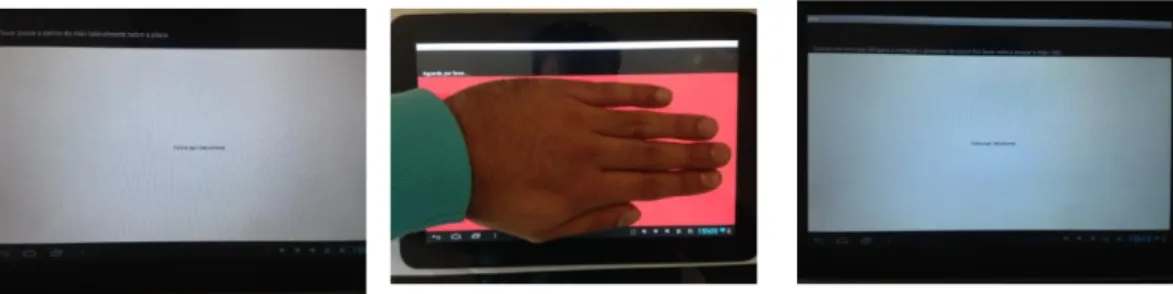
To make this study we had to create an application that we named “palm”, written for use on the Android operating system. “Palm” was specifically designed to test the patience of users when enrolling their hand geometry in a biometric system. The application prompts users to put their hand over the tablet and then asks them to wait for the conclusion of the process. Whenever they take of their hand from the tablet, it prints an error on the screen and asks them to repeat the process from the beginning as shown in Figure1 below. Before starting the test a short questionnaire was done so that the authors could know information such as: name, age, sex, profession, if they ever had been in contact with the palm recognitions system, and if they knew more biometric technologies, this survey also relied on an informed consent so they could participate in the study freely.
During the administration of the questionnaire, it was concluded that none of the participants had been in contact with this technology, and everyone was on an anxious state caused by that ignorance. Except one case that when he asked to one of the authors about how he should put his hand, the correct indications were given but out of the tablet, however when he started the test he placed his hand out of the tablet too, clicking one single time when he realize that the application wasn’t working.
It’s important to refer that before starting the test, it was only explained to participants that they were making a recognition palm test has a security biometric system and only at the end was revealed the purpose of the test. In all experiments, the test only ended when users quit or when they solicited the author’s help. All tests were videotaped, what allowed disambiguation of the stored results and will allow future studies on the user’s behavior.
4. Results
We present in Table 1 the synthesis of the obtained results globally and divided by sex. Table 1: Experimental results
All Male Female
Number of attempts
Average 14,42 16,14 13,41
Minimum 1 4 1
Maximum 46 33 46
Average time in minutes 7,155 5,37 9,45
Maximum time in minutes 43,36 14,43 43,36
Minimum time in minutes 0,0009 0,1 0,0009
The results show that there are users willing to try many times, before giving up and that there are user’s willing to try for a long time before giving up on that attempt to enroll in the system. Curiously, the maximum and the minimum waiting time are from women, as well as the maximum and minimum number of attempts, although it has been chosen a balanced sample with respect to gender. Further studies are necessary to study the effect of intermediate interactions of the system in the overall patience.
5. Conclusion
Despite the small sample size used in this study, the analysis of the results reveals interesting aspects such the fact that people get quite anxious before making it, the surprise effect when are revealed the real purpose of the test as well as the fact that knowing what is, for example, the fingerprint, don’t recognize it as a biometric system. This paper presents the results that were analyzable according to the materials. It also must be pointed out, that the need for further studies in this area as well as a highest sample is important so that the results become even more reliable. Acknowledgements
This work has been supported by FCT – Fundação para a Ciência e Tecnologia within the Project Scope UID/CEC/00319/2013.
References
Boulgouris, N. V., Plataniotis, K. N., & Micheli-Tzanakou, E. (Eds.). (2009). Biometrics: theory,
methods, and applications (Vol. 9). John Wiley & Sons.
Fontana, D. & Marim, L. (2009). Sistema de Autenticação/Identificação Pessoal Biométrica Através da Palma da Mão com o Auxílio de Redes Neurais Artificiais. In Anais do 14O Encontro de
Furtado, V. (2002). Tecnologia e Gestão da Informação na Segurança Pública. Rio de Janeiro, Editora Garamond.
Jain, A. K., Ross, A., & Prabhakar, S. (2004). An introduction to biometric recognition. Circuits and
Systems for Video Technology, IEEE Transactions on, 14(1), 4-20.
Magalhães, S. & Santos, H. (2003). Biometria e autenticação. In Actas da 4ª Conferência da
Associação Portuguesa de Sistemas de Informação. Porto, Portugal.
Sá, V.J., Magalhães, S.T. & Santos, H.D. (2014a). Enrolment Time as a Requirement for Biometric Fingerprint Recognition. International Journal of Electronic Security and Digital Forensics, 6(1), 18‐24.
Sá, V.J., Magalhães, S.T. & Santos, H.D. (2014b). Enrolment Time as a Requirement for Face Recognition Biometric Systems. In Proceedings of 13th European Conference on Cyber