UNIVERSIDADE DA BEIRA INTERIOR
Ciências da Saúde
Bioanalytical method validation of Venlafaxine
and Desvenlafaxine in mouse plasma, brain and
liver using a MEPS/HPLC assay: a path to study
these drugs’ intranasal administration
Experiência Profissionalizante na vertente de Farmácia
Comunitária, Hospitalar e Investigação
Sara Alexandra Meirinho
Relatório para obtenção do Grau de Mestre em
Ciências Farmacêuticas
(Ciclo de estudos Integrado)
Orientador: Professor Doutor Gilberto Alves
Coorientador: Mestre Ana Serralheiro
Agradecimentos
Após 5 anos de muito trabalho, esforço e dedicação, chego ao final desta etapa a sentir-me concretizada! No entanto, não posso deixar de sentir aquela tristeza profunda pelo facto de tudo estar a terminar, e mais ainda pelas saudades que irei sentir de tudo e de todos… Mesmo que meras palavras não consigam expressar todo o meu agradecimento, chega então a hora de dizer “Obrigado!”.
Obrigada mamã por me teres aturado estes 22 anos da minha vida, por seres o meu pilar nos bons e maus momentos, por me teres dado a educação e os ensinamentos que fez de mim a que sou, pelos carinhos e amor, pelos beijos e abraços, pelos ralhetes e chamadas de atenção… Bem, por tudo mesmo!
Obrigado papá por sempre me fazeres rir em momentos que só me apetecia chorar, por me fazeres ver o lado positivo de tudo, por fazeres com que eu adquirisse a tua forma divertida e social de ser, e por todo o apoio e aprendizagens de vida que me proporcionas.
Obrigada a todos os meus amigos que me proporcionaram tantos momentos bons, tantas gargalhadas, tantas conversas tolas, tanto carinho… enfim que que me fizeram tão feliz! No entanto, e como ser amigo não é apenas partilhar bons momentos, obrigada àqueles que me deram um ombro cada vez que necessitei, que me fizeram crescer, que partilharam comigo dificuldades e tristezas, que trabalharam comigo e que me ajudaram quando mais desesperei! Não vou mencionar nomes porque sei que todos percebem que me estou a referir a eles e que são os maiores e melhores amigos que alguém pode ter! Como vou ter saudades vossas…
Obrigado Professor Gilberto, Márcio e Ana por todo o apoio que me deram na realização deste trabalho. Sem vocês nada disto era possível e não estaria neste momento prestes a concluir o curso!
Obrigada a todo o pessoal da farmácia da Alameda e da farmácia hospitalar, não só pelos bons momentos que me proporcionaram como também por todos os conhecimentos transmitidos que irão fazer de mim uma melhor profissional no futuro!
Abstract
The present thesis was elaborated aiming to obtain the master’s degree in pharmaceutical sciences. In here, it is described all the scientific investigation work done to reach the proposed objective, as well as all tasks and learnings that I have taken along my community and hospital pharmacy internships.
Chapter 1 is related with my scientific investigation work entitled “Bioanalytical method validation of Venlafaxine and Desvenlafaxine in mouse plasma, brain and liver using a MEPS/HPLC assay: a path to study these drugs’ intranasal administration”. Since major depressive disorder is one of the most prevalent psychiatric diseases, its therapeutic successful rate must be increased. Nowadays, the majority of all antidepressants used are given orally, being this route a source of therapeutic problems, mainly in what concerns with the time and dosage required to accomplish the desired effects. So, in order to improve it, intranasal administration route has been investigated, once parts of the nasal cavity directly contacts with brain tissue. Over time, and after some research, it was also understood that Venlafaxine is one of the most successful antidepressants until now, having the advantage of being metabolized to an active metabolite called Desvenlafaxine. So, in order to perform some future studies using intranasally administration of both these drugs and understand what advantages it brings, a reliable bioanalytical quantification method for venlafaxine and desvenlafaxine in mouse plasma, brain and liver matrices must be validated, in this case, using a MEPS/HPLC method.
Chapter 2 is related with community pharmacy internship, describing all the performed activities during the 3 month that I have stayed in Pharmacy Alameda. The focus in this chapter is to understand how community pharmacies in general work, taking into account not only drugs dispense and pharmaceutical services but also the best way to manage them. Chapter 3 is about my 2 month of internship in hospital pharmacy services, describing all the duties and tasks performed in each pharmacy section. In here it is also explicit pharmacists’ importance in patients’ pharmaceutical therapies management as well as in controlling all the economic costs related with it.
Keywords
Resumo
A tese aqui exposta foi elaborada com o intuito de obter o grau de Mestre em Ciências Farmacêuticas. Seguidamente é descrito todo o trabalho efetuado no âmbito da investigação científica, de modo a que o objectivo proposto fosse alcançado. Estão também descritas as tarefas elaboradas e aprendizagens obtidas ao longo dos meus estágios em farmácia comunitária e em farmácia hospitalar.
No Capítulo 1 é descrito todo o meu trabalho no âmbito da área de investigação, sendo este intitulado “Validação de um método bioanalítico de Venlafaxina e Desvenlafaxina em plasma, cérebro e fígado de murganho usando MEPS/HPLC: um caminho para o estudo da administração intranasal destes fármacos”. Uma vez que a depressão major é uma das doenças psiquiátricas mais prevalente, a taxa de sucesso do seu tratamento terá obrigatoriamente de ser aumentada. Actualmente, a maioria dos antidepressivos são administrados por via oral, o que é uma fonte de problemas a nível terapêutico, considerando principalmente o tempo e as elevadas doses necessárias para o tratamento da doença. Assim, de modo a melhorar este aspecto, a via intranasal tem vindo a ser estudada, uma vez que existem locais na cavidade nasal que contactam directamente com o tecido cerebral. Ao longo do tempo também se tem percebido que a Venlafaxina é um dos antidepressivos mais eficazes, tendo também a vantagem de ser metabolizada num metabolito activo chamado Desvenlafaxina. Assim, de modo a perceber quais as vantagens da administração por via intranasal da Venlafaxina e da Desvenlafaxina, deve ser antes validado um método bioanalítico usando MEPS/HPLC de modo a que ambos se consigam quantificar em plasma, cérebro e fígado de murganho.
O Capítulo 2 está relacionado com o estágio em farmácia comunitária, no qual são descritas todas as actividades realizadas ao longo dos 3 meses que passei na Farmácia da Alameda. Neste capítulo é focado todo o funcionamento em geral de uma farmácia comunitária, tendo sempre em conta não apenas a dispensa de medicamentos e os serviços farmacêuticos, mas também as melhores formas de gestão efetuadas neste âmbito.
O Capítulo 3 refere-se aos 2 meses de estágio em farmácia hospitalar, descrevendo-se aqui todas as tarefas e responsabilidades de cada secção da farmácia. Aqui é também focada a importância do farmacêutico hospitalar na gestão das terapêuticas dos doentes e dos custos associados a estas.
Palavras-chave
Table of contents
Chapter 1 – Bioanalytical method validation of Venlafaxine and Desvenlafaxine in mouse plasma, brain and liver using a MEPS/HPLC assay: a path to study these
drugs’ intranasal administration 1
1.1 Introduction 1
1.1.1 Venlafaxine Pharmacology: pharmacokinetics and
pharmacodynamics 3
1.1.2 Barriers and other constrains to reach the brain 9
1.1.3 Intranasal drugs administration 10
1.2 Materials and methods 20
1.2.1 Materials and reagents 20
1.2.2 Stock and intermediate solutions, standards and quality Control
(QC) Samples 20
1.2.3 Chromatographic equipment and conditions 21
1.2.4 Blank matrices 21
1.2.5 Sample preparation and MEPS extraction 22
1.2.6 Method validation 22
1.2.7 Preparation of ODV formulation 23
1.2.8 IN administrations 24
1.3 Results and discussion 25
1.3.1 Optimization of sample preparation and chromatographic
conditions 25
1.3.2 Method Validation 26
1.4 Conclusion 35
Chapter 2 – Community Pharmacy 36
2.1 Introduction 36
2. 2.1 Pharmacy structure 36
2. 2.2 Human resources 37
2. 2.3 Drugs and health products 39
2. 2.4 Provision and storage 41
2. 2.4.1 Suppliers criteria selection 41
2. 2.4.2 The order 42
2. 2.4.3 Orders reception and check 43
2. 2.5 Storage 44
2. 2.6 Pharmacy Services 45
2. 2.7 Prescriptions Analysis and Checking 48
2. 2.8 Attending and patients’ care 51
2.3 Conclusion 54
Chapter 3 – Hospital Pharmacy 56
3.1 Introduction 56
3.2 Pharmaceutical Services Organization and Management – Logistic and
Acquisition Section 56
3.2.1 Drugs selection 56
3.2.2 Drugs Acquisition 57
3.2.3 Pharmaceutical Products Reception 58
3.2.4 Storage 58
3.2.5 Distribution 59
3.2.5.1 Traditional distribution 60
3.2.5.2 Stocks replacement levels distribution 60
3.3 Ambulatory Distribution 61
3.3.1 Special controlled drugs distribution 64
3.3.1.1 Hemoderivatives 64
3.4 Individual daily distribution in single dosage (IDDSD) 66
3.5 Pharmacotechnics 69
3.5.1 Sterile injectable cytotoxic and biologic medication preparation 69 3.5.2 Parenteral nutrition and other sterile solutions preparation 71 3.5.3 Non-sterile compound medicines preparation 73
3.5.4 Repacking 74
3.5.5 Purified water preparation 74
3.6 Pharmacovigilance and clinical pharmacy 75
3.7 Medication information 76 3.8 Pharmacokinetics 77 3.9 Clinical trials 77 3.10 Conclusion 78 References 80 Chapter 1 80 Chapter 2 84 Chapter 3 85 Annexes 88
Annex I – Example of part of photossensibility drug induced research work
performed 88
Annex II – Example of part of inhalators devices research work performed 89 Annex III – FGP protocol for 70% saturated alcoholic solution of boric acid 90 Annex IV – Legislated INFARMED mathematical equation for prescribed-drugs
price calculation 91
Annex V – PillBox for Individualized Medication Preparation Service 91
Annex VI – Headache approach Holon Group Protocol 92
List of figures
Figure 1 - Chemical representation of venlafaxine.
Figure 2 - Venlafaxine metabolic pathways and correspondent CYPs that catalyze each step of it. Note that the major pathway catalyzed by CYP2D6 is represented with a bold arrow. Figure 3 - Routes that a drug can follow after intranasal administration, including the ones that lead to the drug receptor targets and the elimination pathways.
Figure 4 - A scheme illustrating the nose-to-brain mechanism of drug delivery. It can be seen both olfactory and trigeminal nerves routes, in which the first ends in the olfactory bulbs and, the second one enters at the level of the pons and the cribriform plate, allowing the drug to be distributed to the posterior and also the anterior regions of the brain.
Figure 5 - Typical chromatograms of extracted mouse plasma samples obtained by the MEPS/HPLC method developed: blank plasma (A); plasma spiked with IS licarbazepine (LIC) and the analytes desvenlafaxine (ODV) and venlafaxine (VEN) at concentrations of the lower limit of quantification (B).
Figure 6 - Typical chromatograms of extracted mouse brain samples obtained by the MEPS/HPLC-FLD method developed: blank brain (A); brain spiked with IS licarbazepine (LIC) and the analytes desvenlafaxine (ODV) and venlafaxine (VEN) at concentrations of the lower limit of quantification (B)
Figure 7 - Typical chromatograms of extracted mouse liver samples obtained by the MEPS/HPLC-FLD method developed: blank liver (A); liver spiked with IS licarbazepine (LIC) and the analytes desvenlafaxine (ODV) and venlafaxine (VEN) at concentrations of the lower limit of quantification (B).
Figure 8 - Typical chromatograms of extracted mouse plasma (A) and brain (B) samples after 30 minutes of the intranasal formulation administration.
Figure 9 - Typical chromatograms of extracted mouse plasma (A) and brain (B) samples after 4 hours of the intranasal formulation administration.
List of tables
Table 1 – Peak serum concentration and time to peak concentration of venlafaxine (VEN) and its major metabolite desvenlafaxine (ODV) studied in humans after oral administration of both extended and immediate release venlafaxine formulations.
Table 2 - Summary of metabolizers’ status effects on venlafaxine (VEN) and desvenlafaxine (ODV) pharmacokinetic parameters in plasma, after administration of venlafaxine extended release (75mg) and desvenlafaxine (100mg) to healthy EM and PM subjects.
Table 3 - Examples of pharmacokinetic-based interactions involving venlafaxine (VEN), with scientific evidence based on pharmacokinetic clinical trials.
Table 4 - Advantages and limitations of intranasal drugs delivery, when compared with conventional routes of administration (oral and intravenous).
Table 5 - A summary of the most important physicochemical properties of venlafaxine (VEN) and desvenlafaxine (ODV) to be considered in an intranasal drug formulation type.
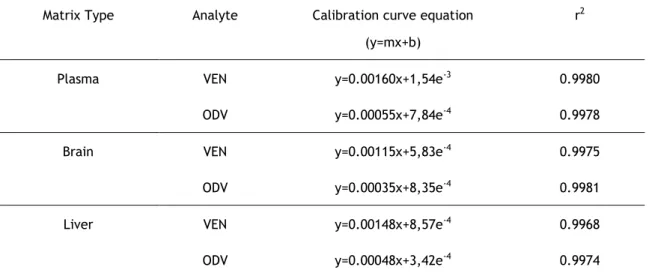
Table 6 - Linearity method demonstration in mouse plasma, brain and liver samples for both desvenlafaxine (ODV) and venlafaxine (VEN). Y represents the analyte/IS peak area ratio, x represents analyte concentrations and r2 represents coefficient of determination.
Table 7 – Inter- and intra-day precision and accuracy for the determination of desvenlafaxine (ODV) and venlafaxine (VEN) in mouse plasma, brain and liver samples (n = 3) at the concentrations of the QCLLOQ, QC1, QC2 and QC3 concentrations of the calibration ranges.
Table 8 - Absolute recovery (%) of desvenlafaxine (ODV) and venlafaxine (VEN) from mouse plasma, brain and liver samples at QC1, QC2 and QC3 concentrations of the calibration ranges
(n = 3).
List of abbreviations
MDD Major depressive disorder
ADME Absorption, distribution, metabolism and excretion AIM Pharmaceutical products’ holders
API Active pharmaceutical ingredient AUC Area under the curve
AUE Exceptional authorization use BBB Blood brain barrier
BCF Blood-cerebrospinal fluid
BMI Body mass index
BP Blood pressure
BZD Benzodiazepines
CARAT Control of allergic rhinitis and asthma test CFT Therapeutic and pharmacy commission CHCB Centro Hospitalar Cova da Beira, E.P.E.
Cmax Peak serum concentration
CNP Product national code
CNPEM Código nacional de prescrição eletrónica de medicamentos
CNS Central nervous system
COPD Chronic obstructive pulmonary disease CSF Cerebrospinal fluid
CV Coefficient of variation
CYP Cytochrome P450
EMs Extensive metabolizers FDS Fast dispensing system
FEV1 Forced expiratory volume in one second
FVC Forced vital capacity GIT Gastrointestinal tract
GOLD Global initiative for chronic obstructive lung disease HL Hospital logistic
HPLC High-performance liquid chromatography ICU Intensive care unit
IDDSD Individual dairy distribution in daily dosage
INFARMED Autoridade Nacional do Medicamento e Produtos de Saúde, I.P.
INM International non-property name IS Internal standard
IV Intravenous
IVA Imposto de venda ao público
JCI Joint Commission International LASA Look-alike-sound-alike
LIC Licarbazepine
LLOQ Lower limit of quantification MAO Monoamine oxidase
MDR Multidrug resistant protein
MNSRM-DEF Non-prescription drugs exclusively dispensed in pharmacies MEPS Microextraction by package sorbent
mMRC Modified medical research counseling dyspnea scale NHMF National hospital medication formulary
OA Operational assistant
ODV Desvenlafaxine/O-desmethylvenlafaxine OTCs Over-the-counter
PA Pharmacy Alameda
PDA Personal digital assistant P-gp P-glycoprotein
PL Portuguese legislation PMs Poor metabolizers PS Pharmaceutical services PVA Prices in reference countries PVP Public selling prices
QC Quality control
QC1 Low quality control
QC2 Medium quality control
QC3 High quality control
r2 Coefficient of determination
RE Receita especial
SAM Medical support system
SGICM Drugs circuit integrated management system SNRIs Serotonin-norepinephrine reuptake inhibitors
SNS Health National System
SSRIs Selective serotonin reuptake inhibitors t1/2 Half-life
TCAs Antidepressants TCA Trichloroacetic acid TD Technical director
TDT Therapeutic and diagnose technician Tmax Time to peak concentration
UCAD Unidade de cuidados agudos e continuados
UMs Ultra-rapid metabolizers
Chapter 1 – Bioanalytical method validation
of Venlafaxine and Desvenlafaxine in mouse
plasma, brain and liver using a MEPS/HPLC
assay: a path to study these drugs’ intranasal
administration
1.1 Introduction
Major depressive disorder (MDD) is one of the most prevalent and debilitating psychiatric disorders. It is mainly characterized by encompassing low mood, low self-esteem and loss of interest and pleasure in normal daily activities [1]. According to Diagnostic and Statistical
Manual of Mental Disorders (DSM-V), American Psychiatric Association (2015), the criteria to consider a major depressive episode are the presence of, at least, five of the following symptoms during a period of two consecutive weeks, in which it is mandatory that one of them is depressive humor during the day, almost all days (children and teenagers can present irritating mood), or loss of pleasure or interest in daily activities, almost all days. The others could be: weight and/or appetite gain/loss, insomnia or hypersomnia, psychomotor agitation or slowness almost all days, fatigue and loss of energy, feelings of excessive guilt and depreciation, decrease of concentration and thought capacity, and finally recurrent dead thoughts, mainly related to suicide and without a preliminary, concrete plan to do it. All this aspects need to occur almost all days during the previous cited period of time, and cannot be associated with some other physiologic disease, substance abuse or a life landmark/traumatic event. They also need to affect the social, occupational or another area of the patient life [2].
MDD affects around 121 million of people worldwide and is responsible of nearly 850.000 deaths every year. Some researches show that 15% of the population from high-income countries, compared to 11% for low/middle-income countries, was likely to get depression over their lifetime, being twice more common in women than in men across all ages groups, with the exception of 18-34 age group, in which the classical female:male odds ratio of MDD is reduced [3,4].
Throughout years, and even more in the last decade, the prescription of antidepressant drugs has increased [5] and the discovery of tricyclic compounds and monoamine oxidase inhibitors,
effective in treatment of MDD, lead to several hypotheses for pathophysiological mechanisms that causes depression, being the monoamine hypothesis the most widely accepted. This one is based on facts that brain monoaminergic (serotonin, norepinephrine and dopamine) neurotransmission is affected. So, these neurotransmitters are the critical targets to all antidepressants and, if they are synergistically targeted, the effect will be even more
in the synapse, even by inhibiting their intraneuronal metabolism, increasing their release by blocking the α2 auto and hetero-receptors and, mainly, through inhibition of their neuronal
reuptake in the presynaptic neurons [6].
Unfortunately, most of the MDD cases are therapeutically refractory or resistant to medication. This is caused by several factors including not only patients personal characteristics but also socioeconomic conditions, demography, educational level, environmental factors (nutrition, work hours, stress), adherence to the long term therapy and so on. Polygenetic variations, physiological and pathophysiological factors (age, gender, pregnancy and concomitant diseases, mostly hepatic and renal ones) are other important aspects to consider [8]. An important point related with antidepressant resistance is the
limitations that drugs faced to reach the brain, especially if they are taken orally or systemically (some of the problems described below do not apply to systemic route of administration, such as first-pass metabolism). The causes are multiple but are mainly related with transport restrains from systemic circulation to central nervous system (CNS). These restrictions are related with some barriers like the blood brain barrier (BBB), blood-cerebrospinal fluid (BCF) barrier and others. Brain capillary vessels and choroid plexus are in their nature, being it the major impediments for molecules to reach the target receptors in brain (biophase) [5,10], especially for charged molecules with a high molecular weight.
However, once they keep away foreign materials from brain, it can be an advantage in case of toxic and harmful particles entrance in the body [11]. Some other important limitations need
to be considered in the variability of clinical antidepressant responses. First-pass metabolism and other metabolic pathways, genetic polymorphisms, plasma protein binding levels that affects both action duration, intensity and drugs BBB passage [11], efflux proteins [e.g.
P-glycoprotein – (P-gp)] present in several important path organs, and drug interactions due to co-medication are the main concerns. This last aspect has been greatly considered in the last years because of the world’s population aging, the increase of other psychiatric, neurologic and somatic diseases that came with MDD, and the daily hazardous exposures that lead to the development of other acute or chronic diseases. Consequently, polypharmacy and the requirement of extended periods for MDD treatment carry an increased risk of drug-drug interactions [e.g. inhibition/induction of P-gp and/or metabolic cytochrome P450 (CYP) isoenzymes] [12-14], which can modify the pharmacokinetics of antidepressant drugs even in a
way that can lead to severe adverse effects and poor tolerability and efficacy. This is more relevant especially in the elderly, an age group where depression levels are increasing and that usually are already under complex polytherapy regimens. So, in this age group, the refractory depression occurrence probability is even higher, leading to the need of adding other antidepressants to improve clinical response [8].
1.1.1
Venlafaxine
Pharmacology:
pharmacokinetic
and
pharmacodynamics
Nowadays, venlafaxine (VEN) is one of the most commonly prescribed antidepressants worldwide, mainly in second line therapy, being used as an alternative drug in the treatment of selective serotonin reuptake inhibitors (SSRIs) resistant depression. That is because it is a good choice for non-remitting patients due to its particular pharmacokinetics profile, which gives it a favorable tolerability when compared to others.
It was first synthesized by Wyeth in 1993 and it was the first one of this antidepressant group that aimed to treat both MDD and anxiety disorders. Chemically, it is a hydroxycycloalkylphenylethylamino (Figure 1) derivative bicyclic antidepressant, belonging to the class of serotonin-norepinephrine reuptake inhibitors (SNRIs)
[8,12,15]. Its mechanism of action is based on a dual action in
serotonin and norepinephrine reuptake inhibition, by blocking receptors in the pre-synaptic neurons and other paths responsible of capturing these neurotransmitters.
Consequently, it will increase the diminished levels in the synaptic cleft and the response of post synaptic neurons to them. What also contributes to the efficacy of VEN is its uninterrupted presence at the site of action over a sustained period of time [1]. It is used as a
racemic mixture of the R-(-)-enantiomer and S-(+)-enantiomer, in which the first one inhibits both serotonin and norepinephrine reuptake, and the second one only inhibits serotonin reuptake [5]. Although the two have similar absorption and distribution properties, the dual
inhibitory effect of R-(-)-enantiomer only became meaningful at higher doses (150mg/day or more), so, generally, VEN is more potent in blocking serotonin uptake than that for norepinephrine [7,8]. Studies in rats have also shown that high doses, but not low ones, induced
a functional desensitization of the terminal 5-HT1B auto-receptors at pre-synaptic neurons
and, additionally enhance tonic activation of post-synaptic 5-HT1A receptors. This
desensitization of the auto-receptors leads to an increase of serotonin in the synaptic cleft as a consequence of the increased reuptake inhibition. So, in short time and with a low VEN dosage, the firing activity of serotonin in post-synaptic neurons was markedly reduced because of the lower degree of desensitization of pre-synaptic auto-receptor, however, at high doses and in a long term treatment, a full recovery of the firing activity of serotonin post-synaptic receptors happened, what proves the adaptive mechanism of these neurons (this was not observed with norepinephrine neurons) [7].
It is important to know that VEN also has some effects in inhibiting dopamine reuptake but does not have this inhibitory property in the monoamine oxidase (MAO) enzymes family, which is responsible for catalyzing the oxidation of monoamines like serotonin,
Figure 2 - Chemical representation of venlafaxine [15].
norepinephrine, dopamine, and other neurotransmitters. VEN also has no significant affinity for α2-adrenergic, muscarinic, cholinergic, H1-histaminergic, benzodiazepine (BZD) and opioid
receptors [13,14]. So, contrary to SSRIs and tricyclic antidepressants (TCAs), VEN has a low
potential to cause anticholinergic and orthostatic hypotensive effects, as well as sedation and weight gain. However, it is particularly important the blood pressure increase caused by VEN, mostly for patients that already suffer of arterial hypertension disease [14].
Another shortcomings mainly related to oral therapy are the slow onset of action, systemic side effects like tachycardia, fatigue, headache, dizziness, sexual dysfunction, dry mouth and the need of frequent oral administrations to maintain an effective therapeutic concentration in blood [1]. This last point forwards us to the pharmacokinetic properties of VEN, which are
the justification for it. It is well absorbed from gastrointestinal tract (GIT) after oral administration (~92%), but its bioavailability is only of 40-45%. This is due to its extensive first-pass metabolism, responsible for its major metabolite in serum O-desmethylvenlafaxine (ODV) synthesis, most commonly known by desvenlafaxine. This one has an equivalent pharmacological activity and potency compared with the parent drug, so the therapeutic consequences of this conversion aren’t meaningful. Besides it, other minor metabolites, with few or no relevant pharmacological activity at all, are formed in parallel, such as
N,O-didesmethylvenlafaxine, N-desmethylvenlafaxine and N,N,O-tridesmethylvenlafaxine (Figure
2) [5,8,12,16]. This biotransformation is catalyzed by the CYP isoenzymes, in which ODV
formation happens due to CYP2D6, especially for VEN R-enantiomer. Consequently, the plasma concentration of this active metabolite is two- to three-times fold higher than VEN. The other isoenzymes responsible for minor metabolites formation, through demethylation of the parent drug and metabolites already formed, are mainly CYP3A4, CYP2C19 and CYP1A2. Then, after these oxidative pathways, they are conjugated in phase II metabolic biotransformation lanes, forming aryl-O-glucuronide metabolites that are then excreted due to an increase in their hydrophilic properties [8,16].
Figure 2 - Venlafaxine metabolic pathways and correspondent CYPs that catalyze each step of it. Note that the major pathway catalyzed by CYP2D6 is represented with a bold arrow [8].
Once in the systemic circulation, both VEN and ODV are widely distributed throughout the body since their binding to plasma proteins is not very significant (27% for VEN and 30% for ODV). This aspect contributes to a larger water volume distribution and, consequently, to their pass through the placenta and to the breast milk. So, in post-partum women, extra careful must be had, especially in what the babies’ health is concerned. Related with excretion pathways, it is described that VEN and its related compounds are primarily excreted in urine (~92.1%) and, in a few degree, in feces. Overall, the terminal elimination half-life of VEN is approximately 5±2h and for ODV is about 11±2h. An advantage of these two molecules is that they exhibit a linear relationship between dose and plasma concentrations, within a daily dose range of 75-450mg [8,17]. In order to determine both VEN and ODV peak serum
concentration (Cmax) and time to peak concentration (Tmax), a study in humans was made using
150mg/day of an extended release formulation of VEN (Effexor XR) and 75mg of an immediate release formulation administrated at each 12 hours of VEN too (Effexor Hydrochloride) [17].
The results are shown in Table 1.
N OH CH3 CH3 O CH3 Venlafaxine (VEN) NH OH CH3 O CH3 N OH CH3 CH3 OH N-Desmethylv enlafaxine (NDV)
O-Desmethylv enlafaxine (ODV)
NH OH CH3 OH N,O-Didesmethylv enlafaxine (DDV) N OH CH3 CH3 O Glu NH2 OH OH N,N,O-Tridesmethylv enlafaxine (TDV) NH OH CH3 O Glu N,O-Didesmethylv enlafaxine-glucuronide O-Desmethylv enlafaxine-glucuronide (56%) (1%) (16%) CYP2D6 CYP2C9, CYP2C19 CYP2D6 CYP2C9, CYP2C19 C YP3 A4 , C YP2 C 1 9 C Y P2 C 9 C YP3 A4 , C YP2 C 1 9 C Y P2 C 9 CYP3A4, CYP2C19 CYP2C9 U D PG T UDPGT
Table 4 - Cmax and Tmax of venlafaxine (VEN) and its major metabolite desvenlafaxine (ODV) studied in humans after oral administration of both extended and immediate release Venlafaxine formulations [17].
Cmax.(ng/mL) Tmax.(h)
VEN ODV VEN ODV
VEN extended release 150mg/day
150ng/mL 260ng/mL 5,5h 9h
VEN immediate release 75mg/12h
225ng/mL 290ng/mL 2h 3h
In this study, it was also realized that if it is used equal doses of either immediate release tablet or an extended release capsule, the exposure of VEN and ODV are similar for both, only with a slightly lower plasma concentration fluctuation for the extended release formulation case. So, it was proved that this one provides a slower rate of absorption but the same extent of absorption, when compared with the immediate release formulation [17].
Applying what was said before about all the antidepressants in general, patients who are treated with VEN also have exhibited large inter-individual variability in their drug outcome. This can possibly be linked with the pharmacokinetics and/or pharmacodynamics influence related with genetic and non-genetic individual factors. The expression of these variations in genotype and phenotype is more evident and studied to metabolic profiles of CYP450 isoenzymes and drug transporters. This leads to a drug disposition and, later, to antidepressant response variability, since the bioavailability/biodisposition at the target receptors will be compromised according with these variations [8,9].
Talking about CYP2D6, the most important isoenzyme for VEN metabolism, there are more than 70 different alleles of its coding gene, and they all occur in variable frequencies in different ethnicities. They have been linked to three classes of phenotypes, based on drug metabolism extend: extensive metabolizers (EMs), the most frequent type in world population, poor metabolizers (PMs) and ultra-rapid metabolizers (UMs). So, as VEN and ODV concentrations are mostly dependent of CYP2D6 metabolizer state and considering ODV/VEN ratio a measurement of this CYP activity in depressed patients, it was suggested that the clinical responses and side effects of VEN are related to CYP2D6 genotype. That is why there are evidences that PMs have an increased risk of developing side effects, being the most common nausea, vomiting and diarrhea, and also present a less favorable clinical response. If we compare VEN and ODV, there are slight differences in reuptake inhibition of norepinephrine and dopamine that explain this higher frequency in side effects, being more recurrent with the parent molecule [8,9,12]. Besides it, studies reveled that CYP2D6 displays a
earlier in neurotransmitters reuptake inhibition, this could lead to clinical consequences and cause the observed differences of occurrence of side effects in PMs and EMs [12].
Also related with these different metabolizer types, the pharmacokinetics of VEN and ODV can present some differences. According to Preskorn et al. (2009) study, after administrating an extended release formulation of VEN, its Cmax and area under the curve (AUC) in plasma
were significantly higher, by approximately 149% and 331%, respectively, in PM’s compared with EM’s. Also VEN half-life (t1/2) was prolonged in PM’s (12.7h) compared with EM’s. Now,
related to ODV pharmacokinetic parameters also determined in this study, after administration of the same previous VEN formulation, Cmax and AUC were significantly lower
by approximately 78% and 73%, respectively, for PMs compared with EMs. But, if it is administrated directly ODV instead of VEN, the mean Cmax and AUC for ODV were statistically
comparable between EMs and PMs [18]. All data are summarized in Table 2.
Table 5 - Summary of the effect of metabolizers’ status on venlafaxine and desvenlafaxine pharmacokinetic parameters in plasma, after administration of venlafaxine extended release (75mg) and desvenlafaxine (100mg) to healthy EM and PM subjects [18].
CYP2D6 status Cmax (ng/mL) Tmax (h) AUC (ng*h/mL) t1/2 (h)
VEN administration (75mg)
VEN pharmacokinetics parameters
EMs 39.6 6.0 591 10.9 PMs 98.6 7.0 2548 12.7 ODV pharmacokinetics parameters EMs 104.3 10.0 3078 13.6 PMs 23.4 16.0 844 14.4 ODV administration (100mg) ODV pharmacokinetics parameters EMs 190.0 8.0 5630 9.51 PMs 249.6 6.0 5992 11.43
Another factor that should be considered related to the efficacy of VEN in treating MDD, is how the co-administration of other drugs interferes with VEN bioavailability and therapeutic
outcomes. Although lots of pharmacokinetic-based drug interactions have been reported in numerous clinical trials, the consequences of it have not been widely explored. However, not all drug interactions have a negative impact on therapeutic results, and some medication may even be intentionally added as a strategy for therapeutic optimization [11].
Considering the co-administration of CYP2D6 inhibitors, there will be an increase of systemic exposure to VEN and a decrease of ODV serum concentrations. That could lead to some side effects increased, like explained before. However, some authors suggested that this interaction does not present substantial implications on therapeutic results due to the demonstrated VEN and ODV equipotency as antidepressant agents and because the total active moiety (VEN plus ODV) concentrations only suffers minimal changes. So, generally, the co-administration of CYP2D6 inhibitors do not require dose adjustments, but there are some CYP2D6 inhibitory drugs like terbinafine that needs extra care if co-administrated with VEN. In this particular case, it was demonstrated that VEN AUC increased 490%, leading to toxic effects. Some other examples of drug interactions involving VEN are represented on Table 3. The inhibition of VEN minor metabolic pathways mediated by CYP3A4, CYP2C9 and CYP2C19 has not been extensively studied. However, these isoenzymes are responsible for synthetize non-active metabolites, so, a reduction of mediated drug clearance could happen which can precipitate the appearance of toxicity [8,12].
Table 6 - Examples of pharmacokinetic-based interactions involving venlafaxine, with scientific evidence based on pharmacokinetic clinical trials.
Drug(s) Interaction
mechanism
Consequences and clinical effects
References
Bupropion CYP2D6 inhibition ↑ [VEN] in plasma
Serotonin and
norepinephrine related adverse effects (anxiety, blood pressure raise)
[19] [20]
Fluoxetine/Norfluoxetine (SSRI’s)
CYP2D6 and CYP2C19 inhibition
Serotoninergic Syndrome [12]
Cimetidine CYP inhibition Unknown [21]
Diphenhydramine CYP2D6 inhibition Unknown [22]
Imipramine CYP2D6 inhibition ↑ [VEN]; ↓ [ODV]; ↔
ODV+VEN
[23]
Ketoconazole CYP2C, CYP3A4, and
P-gp inhibition
Unknown [23] [24]
Propafenone CYP2D6 and P-gp
inhibition
Visual hallucinations and psychomotor agitation
[32]
Haloperidol, Desipramine, Imipramine, Metoprolol and Risperidone
Possible CYP2D6 inhibition
Once these drugs are metabolized by CYP2D6 too, there will be an ↑of their concentrations and ↑of their side effects
[19] [32] [37] [38] [39]
Indinavir P-gp induction Unknown [11]
A special attention is also required toward VEN co-administration with other CYP2D6 substrates, since VEN has a high bonding capacity to this isoenzyme. If these other substrates have a narrow therapeutic window and do not present other alternative metabolic pathway, extra monitoring and careful in polypharmacy therapy management must be considered [12].
1.1.2 Barriers and other constrains to reach the brain
As already said, another issues that need to be considered are the unique characteristics of cerebral natural barriers BBB and BCF, and the transport proteins/channels associated to them. These are the major hurdles to the entrance of many molecules, preventing some drugs and xenobiotic tissue penetration and also their accumulation in cytotoxic levels [25,26]. This
also maintains a constant internal environment that is important for optimal neuronal functioning [5]. However, once VEN has its therapeutic targets at the brain, these limitations
need to be crossed, aiming a maximum number of drug molecules to reach their specific receptors which leads to better therapeutic outcomes [5].
P-gp is one of the most important resistance transporters related to CNS-acting drugs once it influences their brain concentrations. It belongs to the multidrug resistant protein (MDR) family and is a product of gene expression MDR1 or ABCB1 [5-27]. It is an ATP-binding cassette
transmembrane protein responsible for the active efflux of a broad spectrum of structurally unrelated compounds [25,26]. It is present at high concentrations in the luminal membrane of
brain capillaries endothelial cells, more specifically in microvessels present at the interface between blood and CNS. It is also present in the apical surface of the epithelia cells that constitute the choroid plexus. Here, it effluxes compounds into the blood, preventing drugs to gain access to the brain tissue [27]. It has a significant effect in drugs absorption,
distribution, metabolism and excretion (ADME), especially when oral bioavailability and CNS distribution are considered. The reason for it is that P-gp is not only present at BBB but also expressed at the BCF, intestine, lungs, heart and pancreas (25,27]. Changes in expression and
activity of this transporter can dramatically influence the pharmacokinetic profile of drugs that interact with it, resulting in clinical drug-drug interactions [25], due to the induction or
inhibition capacity that some drugs have in P-gp expression and also the bonding strength that have to it. Brain drug levels differences and, consequently, the therapeutic outcomes variations between individuals can be observed also because of P-gp genes polymorphisms. All
these factors are limitations to treat MDD and other psychiatric disorders and, in some cases, it even can contribute to potential toxicity for some drugs [5].
Some studies using P-gp knockout mice have been performed to investigate the in vivo role of this transporter related to the administration of VEN [5-25-26]. It was shown that VEN is a P-gp
substrate, as well as it major metabolite ODV. The affinity to it does not differ between O- and N-desmethylvenlafaxine but, in what concerns to S- and R-VEN enantiomers, the brain S/R concentration ratios were significantly different when knockout and wild-type mice were compared. This suggests that the affinity of the two enantiomers of VEN to P-gp is different
[5]. Some other important point to consider is the P-gp efflux protein expression induction by
VEN in brain and intestinal endothelium cells. A prove of it is the reduction of apical-to-basolateral permeability of a drug efflux probe (rhodamine 123) across in vitro models of BBB and intestine (Caco-2 cells) [5,25,26]. This causes a drug efflux increase leading to some
drug-drug interactions in humans. The impact of this mechanism when is used ODV is smaller [25].
So, it can be considered that both VEN and ODV are P-gp substrates and, contrary to ODV, VEN is also an inducer of it. That is why oral bioavailability and distribution of VEN and ODV can be modified, as well as their therapeutic outcomes (efficacy vs adverse effects). In theory, that is also a reason to have caution when another P-gp substrates are concomitantly used in patients receiving VEN, considering that many of them have narrow therapeutic ranges and that VEN can precipitate changes in rate and extend of their systemic exposure
[12].
To sum up, a lot of problems have been associated with VEN oral and intravenous (IV) administration routes, influencing its bioavailability and, ultimately, the therapeutic outcomes in treating MDD. So, the need to found new strategies (e.g. nasal delivery) to overcome this issue and improve VEN concentrations on its brain targets, as well as decrease the adverse effects associated, has become a priority nowadays once VEN is one of the antidepressants with a better therapeutic profile currently prescribed to treat MDD and anxiety disorders.
1.1.3 Intranasal drugs administration
One of the options that has been explored in recent years, not only for VEN but also to other drugs whose targets are especially localized in the brain (and other organs too), is the intra-nasal (IN) route of administration. Drugs administrated to CNS by this via not only circumvent BBB but also avoid hepatic first-pass metabolism, systemic dilution effect, reduces drug delivery to non-target sites, enables administration of lower doses and, in turn, reduces toxicity [28,29]. It is also a good alternative because it is non-invasive, safe, it does not require
any therapeutic agent modification, it is practical and convenient to administer, accomplishing faster and higher levels of drug absorption and, in the end, it enhances the
therapeutic compliance for some patients, minimizing the requiring dose, especially for those that do not adhere to therapeutic schedules [6,28,30]. Although this method produces less
undesirable consequences while still achieving desirable CNS effects, each drug must be individually examined to evaluate their physical and chemical properties that can affect their presence in nasal mucosa, the sense of smell, specific immunity nasal mechanisms, lymphatic’s and deep cervical lymph nodes that can drain some molecules, impairing drug CNS entrance. For example, in contrast with the IN delivery of hydrophilic compounds that typically result in low or no systemic exposure while targeting the brain, it can be difficult to avoid systemic exposure with small lipophilic molecules intranasally delivered [28]. That is
because this transport route is mainly dependent of the lipophilicity, molecular weight and degree of ionization of the therapeutic molecules [30].
There are many reasons for the nasal route has been considered one of the most reliable administration alternatives nowadays. They are mainly related with the physiological and anatomic characteristics of nasal cavity. Highly relatively vascularized and permeable mucosa’s epithelium, porous endothelial membrane, direct access to this organ, large surface area especially for fast absorption drugs, quick onset of action, lower enzyme levels compared with GIT and liver that avoid the drugs degradation or modification, high total blood flow per volume and direct drug transport to systemic circulation and brain are the main reasons to explore it, especially for drugs that are poorly orally absorbed or have to be given by injection (small molecules and macromolecules) [28,30]. Besides, and especially for
small lipophilic molecules, when IN route is compared to the IV route, similar plasmatic drugs profiles can be observed [28,30]. However, nasal drug absorption is not only dependent of these
characteristics. Small and uncharged particles easily find their way through mucous, whereas large and charged ones find it more difficult. Structural changes can occur in the mucous layer after contacting with the drug formulation, mostly due to environmental factors modifications in there such as pH and temperature. Potential metabolism by enzymes present in the nasal cavity can also arise, which limits drugs residence time in there and, as consequence, their reaching to target receptors [1,31]. An important point reported was that
drug concentration increases in blood and CNS with an increase in their octanol:water partition coefficient, but the permeability and surface area in the formulation deposition site may also affect nasal absorption [10,31]. It also cannot be forgotten the role of mucous
membrane cilia clearance that is capable of clearing the administrated drugs. As a consequence, the available time for absorption is limited, contrasting with the huge membrane area provided by numerous microvilli on the ciliated epithelium, which greatly enhance drug absorption when compared to non-ciliated epithelium [10]. Talking about how
drug distribution in nasal cavity affects the absorption efficiency, it must be considered that nasal particles deposition is related with airflow resistance provided by nasal mucosa. The particles deposition pattern at respiratory tract is also a function of their size, shape, density and hygroscopicity, as well as the pathological conditions in nasal passages. But, it is mainly
the particle size distribution that determines the site of deposition and affects the subsequent biological responses [28].
Pathways involving nerves that connect nasal passages to the brain and spinal cord are also important. Those that involve the vasculature, cerebrospinal fluid (CSF) and lymphatic system have been tested for some molecules passage from nasal cavity to CNS [28].
Nasal cavity, mainly the neuroepithelium in its upper portion, is the only site in human body where the nervous system is in straight contact with the surrounding environment. Drugs uptake from nasal mucosa into the brain occurs by direct passage from olfactory region to the brain. Once the trigeminal nerve innervates all the respiratory epithelium, being this one of the biggest part of the nasal cavity, drugs can also reach brain targets through this nerve. It can also be systemically transported in which part of the drug is absorbed into systemic circulation by diffusion through blood capillaries of the respiratory mucosa while the other part may enter into the blood circulation via olfactory region, particularly at the level of
lamina propria [10]. Subsequently, drugs reach the brain by crossing the BBB and CFS, as it can
be seen in Figure 3. The pathway followed by each molecule is mainly dependent of their characteristics already described. However, these routes have not been widely investigated in human beings due to difficulties in quantitative measures of drugs in CNS and brain [28-30].
Figure 3 - Routes that a drug can follow after intranasal administration, including the ones that lead to the drug receptor targets and the elimination pathways.
Since it has good permeability, the nasal respiratory route is considered one of the most important sections to systemically deliver drugs, being it a much more attractive alternative to conventional routes. It revealed a higher and rapid drug action onset, especially for those which have poor oral absorption, like proteins and peptides [29,30]. Respiratory mucosa region
is the largest part of the nasal cavity and it is where the trigeminal nerve pathway is located, being full of blood capillaries with an abundant bloodstream. So, even though a broad number of drugs can enter into the systemic circulation directly though respiratory region and, subsequently cross BBB to reach CNS, some compounds can gain access to caudal brain via the trigeminal nerve or by lymphatic and perivascular spaces upon lamina propria absorption [10].
Drugs physicochemical properties are factors that must be considered in the evaluation of transport rate and cross capacity from nose-to-brain. From all, three are more relevant for this administration route: the relative molecular weight, lipophilicity and the degree of dissociation. First, most of the small molecular weight (≤400Da) drugs can be freely transported into the brain through nasal mucosa epithelium but, in general, those that have a molecular weight above 1000Da show a poor capability in penetrating the physiological barriers, indicating that the rate of mucosa permeation is highly correlated with molecular size. Second, nasal mucosa is easily penetrated by highly lipophilic drugs with a well-defined linear correlation between the drug’s oil-water distribution coefficient and its absorption rate constant. Finally, it is well known that drug concentration in CNS is inversely correlated with its dissociation degree [10].
Still, in what VEN and ODV are concerned and, particularly considering their low oral bioavailability and the brain location of their target receptors, is the olfactory direct route
Nasal drug administration
Lymphoid uptake Olfactory and
trigeminal pathways Respiratory region
Systemic circulation
Tissues uptake Metabolism/elimination
Nasal lymphatic
nodes
Olfactory region
Brain tissue Cerebrospinal fluidthat mostly matter to investigate in order to overcome all the problems associated with currently used formulations. That is because the olfactory region, next to respiratory region, is the top site from where drugs can be directly delivered into the CNS, in which drug concentrations in olfactory bulbs, after IN delivery, were found to be among the highest in CNS [10,28,30].
Human olfactory mucosa, located in nasal cavity roof, contains olfactory cells (bipolar neurons composed by one pole contacting with the external environment and the other located in lamina propria), entering in olfactory bulbs though the cribriform plate of ethmoid bone. By this way, the IN administrated drugs distribution from the upper part of the nasal cavity is direct to the brain, bypassing the BBB and other barriers [28,30].
Unlike the olfactory nerve, the trigeminal nerve enters the brain through both the pons and the cribriform plate, which allows a drug delivery to both the anterior and posterior brain regions [30].
Generally, substances transportation along the olfactory and trigeminal nerve pathways can happen through both intracellular and extracellular mechanisms. The first one includes the uptake into olfactory sensory neurons within nasal cavity, even by simple diffusion, receptor-mediated endocytosis or adsorptive endocytosis and pinocytosis, being followed by slow axonal transport. These can take several hours/days for the drug to appear in the olfactory bulbs and other brain areas [1,30]. On the other hand, extracellular transport is rapid and likely
accounts for much of the quick delivery and onset of action observed with IN CNS therapeutics [30].
To be more specific, drugs that enter in the nose to get into the brain can follow different mechanisms of transport along the olfactory nerve:
Axonal/intracelular transport: drugs internalization in primary nerves of the olfactory epithelium is done through passive diffusion, receptor-mediated endocytosis or adsorptive endocytosis and pinocytosis, followed by slower axonal transport. This allows the uptake of drug molecules into olfactory receptor neurons. This transportation mechanism takes several hours or days for olfactory bulbs and other brain areas drugs appearance, being the small lipophilic molecules the ones which mainly go through this path to brain [33,34].
Perineural/extracelular transport: polar molecules rapidly move between nasal epithelium cells tight junctions requiring only several minutes (no more than 30 minutes) for a drug reach the olfactory bulbs and other CNS areas after IN administration. However, due to some structural changes related with depolarization and action potential propagation in nerve’s axons, drugs delivery can be blocked or delayed. Besides, the majority of IN administrated drugs rapidly reach brain targets through this pathway, being this one the most promising way for CNS drugs transportation [33,34].
In what trigeminal nerve pathway is concerned, the ophthalmic and maxillary branches of it are equally important for nose to brain drug delivery, once neurons from these branches directly pass through nasal mucosa [1,33,34]. This nerve creates entry points into both caudal
and rostral brain areas following IN administration [28]. Interestingly, a small portion of the
trigeminal nerve also ends in the olfactory bulbs [1,33]. Since both the olfactory and trigeminal
nerves are in contact with the olfactory bulbs, this is what sometimes makes difficult to distinguish what way the intranasally administrated drugs use to reach it and, subsequently, other brain areas. In many cases both could be involved, however more research is needed to prove it [1,33]. Both trigeminal and olfactory delivery pathways are shown next in Figure 4.
Figure 4 - A scheme illustrating the nose-to-brain mechanism of drug delivery. It can be seen both olfactory and trigeminal nerves routes, in which the first terminates in the olfactory bulbs and, the second one enters at the level of the pons and the cribriform plate, allowing the drug to be distributed to the posterior and also the anterior regions of the brain.
To enhance the IN drug absorption, it is important to adjust drug concentration, dose volume and dosage. Nasal absorption of most drugs increases with concentration increasing, especially for those that penetrate through passive diffusion. Within a certain dosage range, the drug absorption and therapeutic effects would rise with an increased dosage. However, the volume of nasal cavity is limited, being the reason for the nasal administration dose is restricted only to 25-200µL, thus constricting to a certain degree the amount of drug transported from nose to brain [30]. So, due to this restriction, it was needed to adapt the
formulation type, in order to promote most efficient drug transportation, even by trying to weak the mucociliary clearance, prolonging drug retention or contact time in the absorption site, or especially by increasing the drug deposition on olfactory mucosa. Additionally, it is important to adjust the pH of nasal formulation to 4.5-6.5, that will result in a better and
efficient drug permeation, as well as local irritation avoidance [31]. All these factors will
decide the extension of CNS drug delivery. For example, mucoadhesives are capable of dilating tight junctions and opening paracellular paths, increasing absorption extension. Also the use of penetration enhancers (e.g. surfactants, bile salts,…), enzymatic inhibitors, pro-drugs and novel pharmaceutical dosage forms can increase permeability across nasal mucosa
[29-31]. It was already used some kind of IN dosage formulations like drops, powders and
aerosols, as well as gelatin, emulsions, ointments, liposomes microspheres, nanoparticles and ion exchange resin preparations. Contrary to conventional formulations (e.g. powders and solutions) that have no mucous membrane adhesion and are easily cleared by the nasal cilia, bio-adhesive polymers, starch microspheres and chitosan preparations have been extensively used to increase the bio-adhesive ability and, consequently, the resident time on the nasal epithelial surface [30]. Micro and nano-dimensional drug delivery vehicles have excellent and
broad prospects in the pharmaceutical field. Such carriers systems showed superior outcomes like a greater therapeutic efficacy with a reduced dosing frequency [30].
Now that the most important points about IN administration have been talked about, the main advantages and limitations related to this administration route are summed up in Table 4.
Table 4 - Advantages and limitations of intranasal drugs delivery, when compared with conventional routes of administration (oral and intravenous).
Advantages Limitations
Drugs direct transport to systemic circulation
[10,30,31]
High molecular weight compounds are difficult to deliver for brain [30]
Direct transport to CNS and brain tissues, circumventing the BBB and other barriers to reach the brain receptors [10-28]
Limited formulation volume administration
[10,28]
First-pass liver and GIT metabolism bypass, minimizing the administrated dose [10.28]
Mucociliary clearance and ciliary beating reduce drugs resident time [10,28]
Lower enzymatic activity compared with GIT and liver [10,28]
Low permeability of high molecular weight and hydrophilic drugs [10,28,31]
GIT membrane irritation avoidance [10,28] Nasal enzymatic barriers and presence of
mucin hindering the diffusion of drugs [10,28]
Reduced risk of overdose and infection [28] Lack of studies about IN drugs administration
and absorption [10,29]
Patients’ compliance increase [10,28] Minor ratio between olfactory mucosa to all
nasal mucosa area [10,33]
Non-invasive administration route [10]
Nasal secretions viscosity, drug solubility and slow diffusion rate through nasal mucosa
[10,33,34]
Faster onset of action [10] Need for special type of formulations to
increase bioavailability in brain receptors [30]
P-gp efflux mechanisms decrease [25,26] Nose kinetic complexity [10]
CNS bioavailability increase, especially for drugs with fairly low brain concentrations [10,33]
Therapeutic effects enhancement on brain and CNS diseases, with reduction of drugs toxic effects [10,28]
There are already some nasal drug products for systemic and direct nose-to-brain delivery that are by now on the market or still under development. It must also be noted that an important advance in this investigation field was the synthesis of some nasal drug products for vaccination (e.g.: human influenza vaccine). These are some examples of commercially available IN administration products, being all of them in the form of solution sprays [29]:
Salmon calcitonin for treating osteoporosis;
Desmopressin as an anti-diuretic hormone;
Oxytocin to induce lactation;
Zolmitriptan and sumatriptan for treating migraine;
Nicotine for smoking cessation;
Estradiol as a hormone replacement;
Oxymetazoline for nasal congestion.
Others are still under development, some only on phase I but others are now on phase II or III of clinical investigation stages. By this time, most of them do not have a specific formulation type. Some examples are [29]:
Hydromorphone as a solution and morphine, both for pain relief;
Triptan for migraine treatment;
Apomorphine to erectile dysfunction;
Interferon β for multiple sclerosis treatment;
Insulin, as a spray solution, to treat type I diabetes and obesity;
Exenatide for type II diabetes;
Ketamine, as a solution to acute and chronic cancer pain relief;
Cyanocobalamin as a nasal spray or a gel, to treat Vitamin B12 deficiency; Carbamazepine as a microemulsion to treat epilepsy and seizures related to it. There are also some drugs, still in development phases, whose aim is IN treating of psychiatric disorders. For instance, to treat anxiety disorders and, in a less extend, for amnesia, sedation and seizures, it has been synthesized IN spray solutions of midazolam and lorazepam. Also IN mucoadhesive gel of buspirone has been developed to treat anxiety, alprazolam for panic disorder and triazolam for insomnia treatment. In case of treating psychotic disorders, mostly schizophrenia, acute maniac disorders associated with bipolar disease and other forms of psychosis, it has been investigated a nanoemulsion of risperidone and other for olanzapine, a microemulsion of clozapine and a chitosan/pectin nasal inserts of chlorpromazine [29]. All of these IN formulations have been investigated due to all the
advantages provided by IN route, as described above.
In what VEN and ODV are concerned, IN formulations could bring a lot of advantages, leading to an increase in their brain bioavailability. So, once these drugs concentrations in target receptors are higher, serotonin, norepinephrine and, in a lesser extension, dopamine concentrations will increase, mostly in the areas responsible for the development of MDD. In the end, that will increase the success rate in treating MDD and other psychiatric diseases. Until now, VEN is only commercially available in oral dosage forms which include extended release tablets and capsules, tablets and solutions. If it was developed an IN formulation that could bring great advances in therapeutic MDD outcomes [35]. However, it was already tried a
different carrier system to oral administration of VEN. It consisted of polymeric nanoparticles but it has shown some problems like slow onset of action and poor oral bioavailability, even
though the desired outcomes were a quicker onset of action with an enhanced brain uptake
[28]. On account of that, there is even one more reason to try some other alternative routes,
focusing on IN administration. Of course that the physicochemical properties of both VEN and ODV need to be consider to create the new type of formulation. Some of the most important ones are described below on Table 3.
Table 5 - A summary of the most important physicochemical properties of VEN and ODV to be considered in an intranasal drug formulation type [28,35,55].
Physicochemical properties VEN ODV
Molecular weight 277 Da 261 Da Octanol/water partition
coefficient
3.20 2.6
Dissociation constant (pKa) 10.09 for tertiary amine 9.45 for amine moiety and 10,66 for phenol moiety Water solubility at 25˚C 267mg/L 3700mg/L
As it can be seen, both VEN and ODV are tertiary amines with basic characteristics. So, in an environmental condition within a pH range of 5 to 9 (including the blood pH), they are in their cationic form [17-18]. Also, their molecular weight is low and similar, and this property does not
greatly influence the passage through biologic barriers. VEN is more lipophilic than ODV, having a greater ability to pass through BBB when comparing to that of ODV. Plus, the water solubility of ODV is much superior to the one of VEN.
Aiming to explore IN administration of VEN and ODV, there must be done suitable pharmacokinetic and pharmacodynamics tests. That will allow understanding if this route increase the efficacy and also if there are differences between cerebral bioavailability after different administration pathways (IV vs IN). First of all, it is needed a validated bioanalytical method to quantify these drugs in mouse plasma, brain and liver, however, that does not currently exist. So, in order to perform assays using this administration route for both drugs (VEN and ODV), the development and validation of a reliable quantification technique must be performed. In the majority of published articles that quantify VEN and ODV using high-performance liquid chromatography (HPLC), it is used classic preparation methods like liquid-liquid extraction or solid phase extraction. However, due to some advantages like the number of times that a sorbent can be reused (10-300 times), the apparatus size and its suitability to handle low and higher sample volumes, the low required volumes for conditioning and elution steps, the microextraction by package sorbent (MEPS) it is probably a great approach to analyze VEN and ODV concentrations in plasma, brain and liver after their IN administration

![Table 4 - Cmax and Tmax of venlafaxine (VEN) and its major metabolite desvenlafaxine (ODV) studied in humans after oral administration of both extended and immediate release Venlafaxine formulations [17] .](https://thumb-eu.123doks.com/thumbv2/123dok_br/18066902.864180/26.892.86.777.191.387/venlafaxine-metabolite-desvenlafaxine-administration-extended-immediate-venlafaxine-formulations.webp)



![Table 5 - A summary of the most important physicochemical properties of VEN and ODV to be considered in an intranasal drug formulation type [28,35,55]](https://thumb-eu.123doks.com/thumbv2/123dok_br/18066902.864180/39.892.163.776.293.514/table-summary-important-physicochemical-properties-considered-intranasal-formulation.webp)