Revista Brasileira de
Engenharia Agrícola e Ambiental
Campina Grande, PB, UAEA/UFCG – http://www.agriambi.com.br
v.20, n.12, p.1118-1123, 2016
Storage of ‘umbu-cajá’ pulp powder produced by lyophilization
Dyego da C. Santos
1, Ana P. T. Rocha
1, Josivanda P. Gomes
1,
Emanuel N. A. de Oliveira
2, Esther M. B. de Albuquerque
3& Gilmar T. de Araujo
4DOI: http://dx.doi.org/10.1590/1807-1929/agriambi.v20n12p1118-1123
A B S T R A C T
This work aimed to study the chemical and physical stability of ‘umbu-cajá’ powders produced by lyophilization during storage. ‘Umbu-cajá’ pulps formulated with different concentrations of gum arabic (10, 20 and 30%), previously frozen, were dehydrated in benchtop lyophilizer at -40 °C for 48 h and disintegrated to obtain the powder, which was stored in laminated packages for 180 days at ambient conditions, with physical, chemical and physico-chemical analyzes performed at the beginning and every 30 days of storage. According to the results, all investigated parameters were significantly altered throughout the storage, yet with less intense variations for important variables, such as ascorbic acid, reducing sugars and titratable acidity. At the end of storage, all powders were microbiologically safe.
Armazenamento da polpa de umbu-cajá
em pó produzida por liofilização
R E S U M O
Propôs-se, com este trabalho, estudar a estabilidade química e física de pós de umbu-cajá produzidos por liofilização durante o armazenamento. Polpas de umbu-cajá formuladas com diferentes concentrações de goma arábica (10, 20 e 30%) previamente congeladas, foram desidratadas em liofilizador de bancada a -40 °C por 48 h, desintegradas para obtenção do pó, que foi estocado em embalagens laminadas durante 180 dias em condições ambientais, com análises físicas, químicas e físico-químicas realizadas no tempo inicial e a cada 30 dias de estocagem. De acordo com os resultados observou-se que todos os parâmetros investigados foram alterados significativamente ao longo da estocagem; todavia, com variações menos intensas para conteúdos importantes como ácido ascórbico, açúcares redutores e acidez titulável. Ao final do armazenamento todos os pós se apresentaram microbiologicamente seguros.
Key words: Spondias spp.
dehydration conservation
Palavras-chave: Spondias spp.
desidratação conservação
1 Universidade Federal de Campina Grande/Programa de Pós-graduação em Engenharia Agrícola. Campina Grande, PB. E-mail: [email protected];
[email protected]; [email protected] (Corresponding author)
2 Instituto Federal de Educação, Ciência e Tecnologia do Rio Grande do Norte. Pau dos Ferros, RN. E-mail: [email protected]
3 Universidade Federal de Campina Grande/Programa de Pós-graduação em Engenharia de Processos. Campina Grande, PB. E-mail: [email protected] 4 Universidade Federal de Campina Grande/Unidade Acadêmica de Engenharia Química. Campina Grande, PB. E-mail: [email protected]
Introduction
‘Umbu-cajá’ (Spondias spp.) is a fruit widely appreciated in the Northeast region of Brazil, due to its sensory characteristics, such as pleasant taste and aroma. However, since it is climacteric, it has limited life time and, therefore, is consumed especially close to the production sites. As an alternative to increase the offer of ‘umbu-cajá’ to more distant markets, it becomes convenient the application of technologies that better preserve the product during the commercialization, such as drying, which is the process most used to maintain fruit quality.
Among the methods of dehydration that can be selected, lyophilization stands out as one of those that best preserve the thermo-sensitive compounds, because it uses low temperatures. However, fruit pulp powders produced through lyophilization are very hygroscopic and it is frequently necessary to use drying additives such as gum arabic in order to obtain products with better physical characteristics, such as low stickiness.
Although the use of additives in fruit lyophilization helps to obtain products with better technological aspects, some quality characteristics can be affected during the storage. The specialized literature presents some studies on physical, chemical and physico-chemical stability of fruit powders during storage (Hymavathi & Khader, 2005; Lisbôa et al., 2012; Costa et al., 2013; Alexandre et al., 2014; Juliano et al., 2014; Oliveira et al., 2015a). However, no studies were found on the stability of ‘umbu-cajá’ pulp powder obtained through lyophilization.
Given the above, this study aimed to evaluate the physical, chemical and physico-chemical stability of ‘umbu-cajá’ pulp powder produced through lyophilization during 180 days of storage at ambient conditions.
Material and Methods
Ripe ‘umbu-cajá’ fruits from the city of Assu-RN and gum arabic were used in the experiment. The fruits were taken to the laboratory, where they were selected, washed in running water, sanitized in chlorine solution (50 ppm for 15 min), dried and pulped using a stainless-steel horizontal pulper machine. The obtained pulp was refined to remove most of the fibers, packed in polyethylene bags and stored in a freezer (-18 ± 2 °C) until the conduction of the experiments.
Three formulations of ‘umbu-cajá’ pulp were elaborated and dried through the process of lyophilization using gum arabic (10, 20 and 30%). The ‘umbu-cajá’ pulp was previously defrosted under refrigeration (≈4 °C), mixed with the different concentrations of the drying additive and homogenized in a blender for about 1 min. The formulated pulps were placed in plastic molds and subjected to slow freezing, through the direct contact with the cooled environment in a freezer at -18 ºC for 24 h. Then, the frozen samples were arranged in 500-mL round-bottomed glass flasks and lyophilized at -40 ºC for 48 h using a benchtop lyophilizer (Christ - ALPHA 1-2 Ldplus). Then, the dehydrated pulps were disintegrated using mortar and pestle.
The ‘umbu-cajá’ powders were placed in flexible laminated packages and stored under the ambient conditions of Campina Grande, PB, Brazil, for 180 days (mean temperature and
relative humidity of 26.4 ºC and 80.8%, respectively). During the storage, the evolution of physical, chemical and physico-chemical characteristics was monitored through periodical analyses at the beginning and every 30 days of storage. The following parameters were evaluated during the storage: total soluble solids (TSS), pH, water content, total solids, total titratable acidity (TTA) in citric acid, TSS/TTA ratio and reducing sugars, according to IAL (2008), ascorbic acid according to AOAC (1997) modified by Benassi & Antunes (1998), water activity at ≈25 °C in AquaLab water activity meter (Decagon – 4TE) (according to the specifications of the manufacturer) and color, in a portable spectrophotometer (Hunter Lab Mini Scan XE Plus - 4500 L), obtaining the parameters luminosity (L*) and chromaticities a* and b*, according to the specifications of the manufacturer. These data were also used to calculate chroma (C* = √(a*)2 + (b*)2) and
hue angle (h* = tan-1 (a*/b*)).
The statistical analysis of the data was performed using the computational program Assistat version 7.5, considering a 3 x 7 factorial scheme as the experimental design, which corresponded to three ‘umbu-cajá’ pulp powders, seven storage periods and three replicates. The data were subjected to analysis of variance (ANOVA) and the means were compared by Tukey test at 0.05 probability level.
Results and Discussion
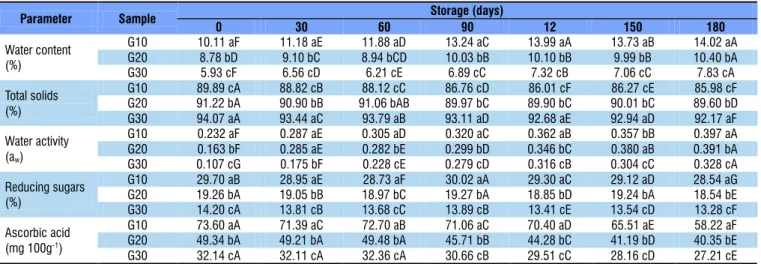
Table 1 shows the mean values of water content, total solids, water activity (aw), reducing sugars and ascorbic acids
of ‘umbu-cajá’ pulp powders during the storage at ambient conditions. The water content tended to increase over the storage period, indicating that the utilized package allowed water diffusion from the environment to the studied powders. This phenomenon is in agreement with Juliano et al. (2014), who reported reduction of water content in ‘camu-camu’ pulp powder along 150 days of storage at 25 ºC.
The absorption of water by the samples may also have been favored by the ambient conditions (Hymavathi & Khader, 2005), which promoted relatively high values of temperature and relative air humidity of 26.4 °C and 80.8%, respectively. At the end of the storage, as the concentrations of additive increased in the ‘umbu-cajá’ powders, the recorded water contents decreased.
The total solids were inversely correlated with the water contents, significantly decreasing always when the water content increased in the ‘umbu-cajá’ powders (Table 1). These results indicate that, as the storage period increased, the nutritional characteristics of the evaluated powders decreased, because proteins, carbohydrates and minerals are diluted with increments of water. Similar observations were reported by Alexandre et al. (2014) in ‘pitanga’ pulp powder packed in flexible packages and stored at ambient conditions for 60 days. At the end of the storage period, the sample G30, formulated with 30% of gum arabic, showed solid contents higher than 90% due to the lower initial water content and lower water absorption rates along the storage.
in the same period (Table 1), a behavior frequently reported in stored fruit powders, such as ‘mandacaru’ (Oliveira et al., 2015a) and passion fruit (Costa et al., 2013). Increments in aw in stored powders result from the transfer of water vapor through the package or by leaves in the heat-sealing area, making bioavailable the aqueous solvent in the free status, which can be used in chemical reactions. At the end of the storage, there was statistical difference between all samples with aw values lower than 0.60 in all evaluated powders, which would not affect the microbiological stability.
There was a tendency of significant decrease in the reducing sugars in all samples, with reduction levels between 3 and 7% (Table 1), which is in agreement with Costa et al. (2013) and Lisbôa et al. (2012), who also reported reduction of reducing sugars in stored passion fruit and prickly pear pulp powders. This phenomenon can be related to the dilution of the sugars due to the increase in the water content of the samples during the storage or to the degradation of reducing sugars when they react with free amino acids, through the Maillard reaction (Liu et al., 2010). At the end of the storage period, there was statistical difference in all samples and the powder produced with ‘umbu-cajá’ pulp formulated with 10% of gum arabic showed the highest content of reducing sugars, because the greater the addition of additive, the higher the dilution of the sugars from the fruit.
The contents of ascorbic acid were significantly reduced in all powder samples (Table 1), which can also be related to the absorption of water during the storage, because the increase in the water content of food along the storage can accelerate the oxidation of the ascorbic acid, since higher water contents lead to greater molecular mobility (Juliano et al., 2014).
In addition, it should be considered that the degradation of this component in processed agricultural products may be due to reactions caused by the action of ascorbate oxidase enzyme (Santos et al., 2013) and “autoxidation”, i.e., the process of ascorbic acid oxidation by the oxygen present in the package
in which the powders are stored (Granato et al., 2010), with synthesis of diketogulonic acid. Furthermore, at the end of the storage, the samples containing lower concentrations of additive showed the highest contents of ascorbic acid, due to the lower dilution of this constituent caused by the addition of gum arabic. In a study on the stability of ‘mandacaru’ pulp powder packed in laminated packages and stored for 50 days, Oliveira et al. (2015a) reported degradation of ascorbic acid along the storage, corroborating the results of the ‘umbu-cajá’ powders.
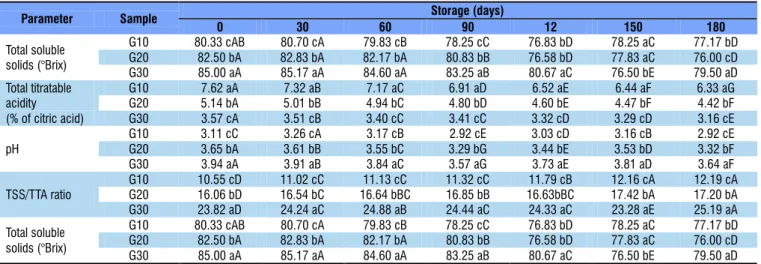
Table 2 shows the mean values of total soluble solids (TSS), total titratable acidity (TTA), pH and TSS/TTA ratio of ‘umbu-cajá’ pulp powders during the storage period at ambient conditions. The TSS reduced along the storage and, at the end of the period, reached values statistically different from the initial ones, in all evaluated samples. These reductions may be due to the increase in water content along the storage, altering the proportion of solids in the total mass (Loureiro et al., 2013), especially by the dilution of organic acids and soluble sugars, besides reactions of oxidation of components in solution, such as ascorbic acid, organic acids and reactions of non-enzymatic darkening, which culminate in the decrease of reducing sugars. In a similar study, Costa et al. (2013) also observed reduction in the TSS values of passion fruit at the end of 360 days of storage at ambient conditions.
The TTA significantly decreased in all samples along the storage period, which may be related to the dilution of organic acids promoted by the absorption of water by the powders along the storage or the oxidation of these compounds. In addition, there were more accentuated decreases of TTA in the powder produced with the pulp formulated using 10% of gum arabic, followed by the samples G20 and G30, respectively, suggesting that the addition of additives promoted certain protection against the oxidation of organic compounds. Lisbôa et al. (2012) observed this behavior for prickly pear powder packed in laminated packages and stored at temperatures of 25 and 40 ºC for 100 days.
Table 1. Mean results of water content, total solids, water activity, reducing sugars and ascorbic acid of ‘umbu-cajá’ pulp powders produced through lyophilization during the storage period at ambient conditions
Parameter Sample Storage (days)
0 30 60 90 12 150 180
Water content (%)
G10 10.11 aF 11.18 aE 11.88 aD 13.24 aC 13.99 aA 13.73 aB 14.02 aA G20 8.78 bD 9.10 bC 8.94 bCD 10.03 bB 10.10 bB 9.99 bB 10.40 bA
G30 5.93 cF 6.56 cD 6.21 cE 6.89 cC 7.32 cB 7.06 cC 7.83 cA
Total solids (%)
G10 89.89 cA 88.82 cB 88.12 cC 86.76 cD 86.01 cF 86.27 cE 85.98 cF G20 91.22 bA 90.90 bB 91.06 bAB 89.97 bC 89.90 bC 90.01 bC 89.60 bD G30 94.07 aA 93.44 aC 93.79 aB 93.11 aD 92.68 aE 92.94 aD 92.17 aF
Water activity (aw)
G10 0.232 aF 0.287 aE 0.305 aD 0.320 aC 0.362 aB 0.357 bB 0.397 aA G20 0.163 bF 0.285 aE 0.282 bE 0.299 bD 0.346 bC 0.380 aB 0.391 bA G30 0.107 cG 0.175 bF 0.228 cE 0.279 cD 0.316 cB 0.304 cC 0.328 cA
Reducing sugars (%)
G10 29.70 aB 28.95 aE 28.73 aF 30.02 aA 29.30 aC 29.12 aD 28.54 aG G20 19.26 bA 19.05 bB 18.97 bC 19.27 bA 18.85 bD 19.24 bA 18.54 bE G30 14.20 cA 13.81 cB 13.68 cC 13.89 cB 13.41 cE 13.54 cD 13.28 cF
Ascorbic acid (mg 100g-1)
G10 73.60 aA 71.39 aC 72.70 aB 71.06 aC 70.40 aD 65.51 aE 58.22 aF G20 49.34 bA 49.21 bA 49.48 bA 45.71 bB 44.28 bC 41.19 bD 40.35 bE G30 32.14 cA 32.11 cA 32.36 cA 30.66 cB 29.51 cC 28.16 cD 27.21 cE
Water content: OM = 9.68%; CV = 0.84%; LSD for columns = 0.1617; LSD for rows = 0.2061 Total solids: OM = 90.32%; CV = 0.09%; LSD for columns = 0.1617; LSD for rows = 0.2061 Water activity: OM = 0.292; CV = 0.76%; LSD for columns = 0.0044; LSD for rows = 0.0056 Reducing sugars: OM = 20.64%; CV = 0.15%; LSD for columns = 0.0625; LSD for rows = 0.0797 Ascorbic acid: OM = 48.31 OM 100g-1; CV = 0.28%; LSD for columns = 0.2724; LSD for rows = 0.3472
At the end of the storage, the ‘umbu-cajá’ powders showed TTA values between 2.81 and 10.29%, which were higher than those recorded in other fruit powders, at the end of the storage period (Loureiro et al., 2013; Alexandre et al., 2014; Juliano et al., 2014), because ‘umbu-cajá’ is a fruit with intense acidic taste.
The powders with addition of additive showed significantly low pH until 90 days of storage with later increment at the times of 120 and 150 days. At the end of the storage, pH decreased and remained statistically inferior to the value recorded at the beginning. For these samples, there was no correlation of these values with TTA, a phenomenon also reported by Loureiro et al. (2013), studying the stability of ‘buriti’ powder stored for 90 days in polyethylene and laminated packages, which showed reduction of pH and TTA.
For all evaluated samples, the pH values were lower than 4.0 at all times of storage. This observation is technologically interesting because the stored products were able to maintain the acid characteristic of the fruit of origin. At the end of the storage period, the pH of the ‘umbu-cajá’ powders varied from 2.92 to 3.64, which are close to the values reported by Alexandre et al. (2014) in ‘pitanga’ pulp powder (2.90) at the end of 60 days of storage.
There was significant tendency of increase in the TSS/TTA ratio in all samples, which is related to the sharper decreases recorded in TTA, compared with TSS, along the storage of ‘umbu-cajá’ powders. Loureiro et al. (2013) reported similar behavior for the TSS/TTA ratio in ‘buriti’ pulp powder stored at ambient conditions for 90 days. Comparing the values between initial and final times, the powder produced with 10% of gum arabic (G10) exhibited higher percentage of increase for this ratio, corresponding to ≈15%, followed by the samples G20 and G30, obtained with pulps formulated using 20 and 30% of gum arabic, with almost 7 and 6% of increase, respectively.
The increase in TSS/TTA ratio along the storage time allows to obtain powders with sensory characteristic of sweeter taste, since the sweet sensation is not linked only to the concentration of sugars, but also to the balance between solids in solution
Table 2. Mean results of total soluble solids (TSS), total titratable acidity (TTA), pH and TSS/TTA ratio of ‘umbu-cajá’ pulp powders produced through lyophilization during the storage period at ambient conditions
Parameter Sample Storage (days)
0 30 60 90 12 150 180
Total soluble solids (°Brix)
G10 80.33 cAB 80.70 cA 79.83 cB 78.25 cC 76.83 bD 78.25 aC 77.17 bD G20 82.50 bA 82.83 bA 82.17 bA 80.83 bB 76.58 bD 77.83 aC 76.00 cD G30 85.00 aA 85.17 aA 84.60 aA 83.25 aB 80.67 aC 76.50 bE 79.50 aD Total titratable
acidity (% of citric acid)
G10 7.62 aA 7.32 aB 7.17 aC 6.91 aD 6.52 aE 6.44 aF 6.33 aG
G20 5.14 bA 5.01 bB 4.94 bC 4.80 bD 4.60 bE 4.47 bF 4.42 bF
G30 3.57 cA 3.51 cB 3.40 cC 3.41 cC 3.32 cD 3.29 cD 3.16 cE
pH
G10 3.11 cC 3.26 cA 3.17 cB 2.92 cE 3.03 cD 3.16 cB 2.92 cE
G20 3.65 bA 3.61 bB 3.55 bC 3.29 bG 3.44 bE 3.53 bD 3.32 bF
G30 3.94 aA 3.91 aB 3.84 aC 3.57 aG 3.73 aE 3.81 aD 3.64 aF
TSS/TTA ratio
G10 10.55 cD 11.02 cC 11.13 cC 11.32 cC 11.79 cB 12.16 cA 12.19 cA G20 16.06 bD 16.54 bC 16.64 bBC 16.85 bB 16.63bBC 17.42 bA 17.20 bA G30 23.82 aD 24.24 aC 24.88 aB 24.44 aC 24.33 aC 23.28 aE 25.19 aA
Total soluble solids (°Brix)
G10 80.33 cAB 80.70 cA 79.83 cB 78.25 cC 76.83 bD 78.25 aC 77.17 bD G20 82.50 bA 82.83 bA 82.17 bA 80.83 bB 76.58 bD 77.83 aC 76.00 cD G30 85.00 aA 85.17 aA 84.60 aA 83.25 aB 80.67 aC 76.50 bE 79.50 aD
Total soluble solids: OM = 80.23 °Brix; CV = 0.41%; LSD for columns = 0.6579; LSD for rows = 0.8387 Total titratable acidity: OM = 5.02%; CV = 0.40%; LSD for columns = 0.0400; LSD for rows = 0.0510 pH: OM = 3.45; CV = 0.19%; LSD for columns = 0.0130; LSD for rows = 0.0165
TSS/TTA ratio: OM = 17.51; CV = 0.69%; LSD for columns = 0.2395; LSD for rows = 0.3053
G10, G20 and G30 – ‘Umbu-cajá’ powders with pulps formulated with 10, 20 and 30% of gum arabic, respectively; OM – Overall mean; CV – Coefficient of variation; LSD – Least significant deviation Means followed by the same letter, lowercase in the columns and uppercase in the rows, do not differ statistically by Tukey test at 0.05 probability level; Statistical analysis applied individually for each parameter evaluated
and acidity of the product (Santos et al., 2014). At 180 days of storage, the sample G30, produced with 30% of gum arabic, showed ratio higher than 25 at the end of the storage period, suggesting that this sample was sensorially sweeter; however, sensory tests are required to ratify such hypothesis, in order to diagnose the interaction between the product and the consumer.
Table 3 shows the mean values of the color parameters of ‘umbu-cajá’ pulp powders during the storage period at ambient conditions. The greater availability of reducing sugars and ascorbic acid, besides the higher contents of water and aw recorded in the sample G10, contributed to the higher level of darkening (≈8%) in this product, followed by the powders formulated using pulps with 20 and 30% (G20 and G30) of additive, which showed darkening percentages of about 4 and 3%, respectively. At the end of the storage, all powders, despite the significant reductions of luminosity (L*), were classified as clear, with values higher than 70. A behavior similar to that observed in the pulp powders of the present study were reported by Liu et al. (2010) and Juliano et al. (2014) in pulps of tomato and ‘camu-camu’ along 5 months and 150 days of storage, respectively, with significant reduction of L* during the evaluated period.
There were two different behaviors for the intensity of red (+a*), with significant tendency of increase in the sample produced with pulp formulated using 10% of additive (G10) and significant decrease in the powders with higher levels of gum arabic (G20 and G30). Similar result was reported by Oliveira et al. (2015a) in mandacaru pulp powder produced with maltodextrins with dextrose equivalents (DE) of 10 and 14 at the end of 50 days of storage at 25 ºC, and the powder with DE = 10 showed significant decrease of +a*, while the sample with DE = 14 showed increase in this coordinate.
dessert. On the other hand, the increases of the component +a*, in some samples, may be due to the probable protecting effect that high values of gum arabic cause on fruit powders (Oliveira et al., 2015a).
All evaluated samples showed significant reductions in the intensity of yellow (+b*) and, at the end of the storage period, the values were statistically lower than those at the beginning. The reduction in the yellow color of the ‘umbu-cajá’ powders may be related to reactions of oxidation of carotenoids (Granato et al., 2010), favored by certain permeability of the package to the oxygen from the environment. This type of degradation, which results in alterations of color, is common when the product is subjected to a long storage time and was evidenced by Hymavathi & Khader (2005) in mango pulp powder stored for 6 months.
Due to the partial permeability of the package to the oxygen, observed through the increase in water content, there were probable degradations of carotenoids that culminated in reduction of the values of +b* and these oxidative reactions were probably favored by the relatively high temperature of storage (≈26.5 °C). In addition, the presence of metal ions naturally present in the ‘umbu-cajá’ powder may have acted as catalyst of the oxidative processes (Saron et al., 2007).
The powder sample formulated with 10% of additive (G10) showed tendency of significant reduction in the hue angle (h*), mainly related to the increase in the values of +a* along the storage, with decreases of ≈4%, which means that the perception of color of these powders became distant from the yellow region (h* = 90°) and become closer, although slightly, to the red region (h* = 0°). Costa et al. (2013) studied the stability of yellow passion fruit powder stored for 360 days at 25 ºC and observed reduction of the component h* during the storage, with decrease of ≈2.4%.
Table 3. Mean results of luminosity, intensity of red, intensity of yellow, hue angle and chrome of the ‘umbu-cajá’ pulp powders produced through lyophilization during the storage period at ambient conditions
Parameter Sample Storage (days)
0 30 60 90 12 150 180
Luminosity (L*)
G10 76.36 cA 76.31 cA 75.60 cB 74.84 cC 73.63 cE 74.48 cD 70.46 cF G20 78.23 bB 78.39 bA 78.09 bC 76.66 bD 74.71 bG 75.11 bE 75.02 bF G30 80.14 aA 80.13 aA 80.20 aA 79.36 aB 78.49 aC 77.46 aE 77.89 aD
Intensity of red (+a*)
G10 7.03 aD 6.81 aE 7.57 aB 6.81 aE 7.03 aD 7.40 aC 8.38 aA
G20 6.28 bA 6.03 bB 5.75 bD 5.94 bC 5.25 bF 5.13 bG 5.31 bE
G30 4.68 cA 4.38 cB 4.38 cB 4.22 cC 4.06 cD 3.97 cE 4.00 cE
Intensity of yellow (+b*)
G10 32.06 aA 32.08 aA 31.50 aC 31.71 aB 30.57 aE 31.11 aD 29.53 aF G20 30.13 bA 28.35 bC 29.25 bB 27.52 bD 26.83 bE 26.56 bF 25.82 bG G30 25.31 cA 24.00 cB 23.74 cC 23.22 cD 23.07 cE 23.73 cC 22.94 cF
Hue angle (h*)
G10 77.63 cC 78.01 bA 76.49 cF 77.88 bB 77.06 cD 76.61 cE 74.16 cG G20 78.22 bD 77.99 bE 78.88 bB 77.81 bF 78.93 bB 79.08 bA 78.37 bC G30 79.52 aD 79.67 aC 79.55 aD 79.69 aC 80.02 aB 80.49 aA 80.11 aB
Chroma (C*)
G10 32.82 aA 32.80 aA 32.40 aB 32.43 aB 31.37 aD 31.98 aC 30.69 aE G20 30.78 bA 28.98 bC 29.81 bB 28.15 bD 27.34 bE 27.05 bF 26.36 bG G30 25.74 cA 24.40 cB 24.14 cC 23.60 cE 23.43 cF 24.06 cD 23.28 cG
Luminosity (L*)
G10 76.36 cA 76.31 cA 75.60 cB 74.84 cC 73.63 cE 74.48 cD 70.46 cF G20 78.23 bB 78.39 bA 78.09 bC 76.66 bD 74.71 bG 75.11 bE 75.02 bF G30 80.14 aA 80.13 aA 80.20 aA 79.36 aB 78.49 aC 77.46 aE 77.89 aD
Luminosity: OM = 76.74; CV = 0.04%; LSD for columns = 0.0672; LSD for rows = 0.0856 Intensity of red: OM = 5.73; CV = 0.35%; LSD for columns = 0.0399; LSD for rows = 0.0509 Intensity of yellow: OM = 27.57; CV = 0.10%; LSD for columns = 0.0526; LSD for rows = 0.0671 Hue angle: OM = 78.39; CV = 0.06%; LSD for columns = 0.0879; LSD for rows = 0.1121 Chroma: OM = 28.17; CV = 0.09%; LSD for columns = 0.0509; LSD for rows = 0.0649
G10, G20 and G30 – ‘Umbu-cajá’ powders with pulps formulated with 10, 20 and 30% of gum arabic, respectively; OM – Overall mean; CV – Coefficient of variation; LSD – Least significant deviation Means followed by the same letter, lowercase in the columns and uppercase in the rows, do not differ statistically by Tukey test at 0.05 probability level; Statistical analysis applied individually for each parameter evaluated
Despite the oscillations along the storage period of the powders produced with pulps formulated using the highest concentrations of gum arabic (G20 and G30), the parameter h* tended to stabilize in these samples, with the data of this coordinate, at any storage time, close to the initial values.
The chroma (C*) showed significant tendency of decrease, reaching reduction levels of ≈6 to 14%, which indicates a reduction in the color intensity of the ‘umbu-cajá’ powders, which may be harmful from the economic point of view, because the products with higher values of the component C* are “vivid”, i.e., they show a more vibrant color and, as a consequence, become more attractive for purchase (Oliveira et al., 2015b).
At the end of the storage period, the powder produced with 10% of gum arabic (G10) showed the highest values of C*, indicating that this sample exhibited the most intense color and it would be preferred over the others if it were available in the market, because its color saturation is closer to that of the fruit of origin. Liu et al. (2010) reported similar behavior in tomato powder stored for 5 months, with reduction of the coordinate C* along the storage.
Conclusions
1. The physical, chemical and physico-chemical characteristics of the ‘umbu-cajá’ powders formulated with different concentrations of gum arabic were significantly altered along the storage period of 180 days at ambient conditions.
2. The water content and water activity of all samples increased; however, the values did not exceed the limit of microbiological safety.
darkening of the powders with reduction in the color intensity, compromising the visual quality of the products.
Literature Cited
Alexandre, H. V.; Figueirêdo, R. M. F. de; Queiroz, A. J. de M.; Oliveira, E. N. A. de. Armazenamento de pitanga em pó. Comunicata Scientiae, v.5, p.83-91, 2014.
AOAC - Association of Official Analytical Chemists. Official methods of analysis. 14.ed, Arlington: AOAC, 1997. 1041p.
Benassi, M. T.; Antunes, A. J. A. Comparison of meta-phosphoric and oxalic acids as extractant solutions for determination of vitamin C in selected vegetables. Arquivos de Biologia e Tecnologia, v.31, p.507-513, 1998.
Costa, J. N. da; Figueirêdo, R. W.; Sousa, P. H. M. de; Gonzaga, M. L. da C.; Constant, P. B. L.; Soares, D. J. Study of the stability of
passion fruit (Passiflora edullis f. flavicarpa) powder from organic
farming. Semina: Ciências Agrárias, v.34, p.705-716, 2013. http:// dx.doi.org/10.5433/1679-0359.2013v34n2p705
Granato, D.; Masson, M. L.; Freitas, R. J. S. Stability studies and shelf life estimation of a soy-based dessert. Ciência e Tecnologia de Alimentos, v.30, p.797-807, 2010. http://dx.doi.org/10.1590/S0101-20612010000300036
Hymavathi, T. V.; Khader, V. Carotene, ascorbic acid and sugar content of vacuum dehydrated ripe mango powders stored in flexible packaging material. Journal of Food Composition and Analysis, v.18, p.181-192, 2005. http://dx.doi.org/10.1016/j.jfca.2004.03.028 IAL - Instituto Adolfo Lutz. Normas analíticas, métodos químicos e
físicos para análises de alimentos. 4.ed. São Paulo: IAL, 2008. 1020p. Juliano, F. F.; Silva, P. P. M.; Casemiro, R. C.; Costa, M. H.; Spoto, M.
H. F. Polpa de camu-camu liofilizada e armazenada em diferentes embalagens. Revista Brasileira de Tecnologia Agroindustrial, v.8, p.1374-1384, 2014. http://dx.doi.org/10.3895/S1981-36862014000200007
Lisbôa, C. G. C.; Figueirêdo, R. M. F. de; Queiroz, A. J. de M. Armazenamento de figo-da-índia em pó. Revista Brasileira de Engenharia Agrícola e Ambiental, v.16, p.216-221, 2012. http:// dx.doi.org/10.1590/S1415-43662012000200013
Liu, F.; Cao, X.; Wang, H.; Liao, X. Changes of tomato powder qualities during storage. Powder Technology, v.204, p.159-166, 2010. http:// dx.doi.org/10.1016/j.powtec.2010.08.002
Loureiro, M. N.; Figueirêdo, R. M. F. de; Queiroz, A. J. de M.; Oliveira, E. N. A. de. Armazenamento de buriti em pó: Efeito da embalagem nas características físicas e químicas. Bioscience Journal, v.29, p.1092-1100, 2013.
Oliveira, A. S.; Figueirêdo, R. M. F. de; Queiroz, A. J. de M.;
Brito, J. G. Estabilidade da polpa do Cereus jamacaru em pó
durante o armazenamento. Revista Brasileira de Engenharia Agrícola e Ambiental, v.19, p.147-153, 2015a. http://dx.doi. org/10.1590/1807-1929/agriambi.v19n2p147-153
Oliveira, E. N. A. de; Santos, D. C.; Gomes, J. P.; Rocha, A. P. T.; Silva, W. P. da. Physicochemical stability of diet umbu-caja jams stored at ambient conditions. Journal of Food Processing and Preservation, v.39, p.70-79, 2015b. http://dx.doi.org/10.1111/ jfpp.12209
Santos, D. C.; Moreira, A. S.; Oliveira, E. N. A. de; Santos, Y. M. G. dos. Elaboração de bebida tipo néctar de graviola adoçada com
mel de Apis mellifera. Revista Caatinga, v.27, p.216-225, 2014.
Santos, D. C.; Oliveira, E. N. A. de; Martins, J. N.; Celestino, S. S. R. Preparados sólidos para refrescos sabor laranja: Estabilidade do ácido ascórbico e acidez total titulável. Higiene Alimentar, v.27, p.119-123, 2013.