N, P or K doses on the dry matter and
crude protein yield in maize and sorghum for silage
1Júnior Melo Damian2, Clovis Orlando Da Ros2,
Rodrigo Ferreira da Silva2, Ivanir José Coldebella2, Diego Henrique Simon3
INTRODUCTION
Ensiling methods aim to maintain the quality and nutritional value of fresh forage (Moraes et al. 2013). Accordingly, the production of silage for animal feed concentrates on the use of maize and sorghum as raw materials, mainly due to their high yield, fermentation characteristics and high energy values (Canizares et al. 2014, Carvalho et al. 2016).
ABSTRACT
RESUMO
The United States of America stand out as the largest producer of maize and sorghum for both grain and silage production (USDA 2016). In the 2014 crop season, the maize production for silage was estimated at 128 million tons, in addition to 4 million tons for sorghum (USDA 2016). In Brazil, the maize production for silage was approximately 13 million tons, being no greater than 3 million tons for sorghum, in 2006 (SIDRA/IBGE 2012).
1. Manuscript received in Aug./2016 and accepted for publication in Mar./2017 (http://dx.doi.org/10.1590/1983-40632016v4742722). 2. Universidade Federal de Santa Maria, Departamento de Ciências Agronômicas e Ambientais, Frederico Westphalen, RS, Brazil.
E-mails: [email protected], [email protected], [email protected], [email protected]. Maize and sorghum are the main raw materials in the
production of silage for animal feed, with mineral fertilization being worthy of note when the goal is to increase gains in the amount and quality of the forage. This study aimed at evaluating the contribution of N, P or K doses to the dry matter and crude protein yield in maize and sorghum grown for silage. The experiments were carried out in a randomized block design, with four replications, during five successive crops of maize (three summer seasons) and sorghum (two off-season). Five doses of N (0 kg ha-1, 50 kg ha-1, 100 kg ha-1, 150 kg ha-1 and 200 kg ha-1), five doses of P
2O5 (0 kg ha -1, 40 kg ha-1, 80 kg ha-1, 120 kg ha-1 and 160 kg ha-1) and five doses of K2O (0 kg ha-1, 30 kg ha-1, 60 kg ha-1, 90 kg ha-1 and 120 kg ha-1) were applied to each crop in the same experimental area. The N doses contributed to an increase in the crude protein yield in the five successive crops of maize and sorghum, together with an increase in dry matter and/or protein concentration. Crude protein increased 59.5-312.9 % for both crops. The soils used for the succession cropping system of maize and sorghum for silage had “very high” levels of P and K. Therefore, the P fertilization had no effect on the dry matter or crude protein yield in the first year of cultivation, similarly to the K fertilization during the five successive crop seasons.
KEYWORDS: Zea mays; Sorghumbicolor; mineral fertilization.
Doses de N, P ou K na produtividade de massa seca e proteína bruta de milho e sorgo para silagem
Milho e sorgo são as principais matérias primas na produção de silagem para consumo animal, merecendo destaque a adubação mineral, quando o objetivo for incrementar os ganhos em quantidade e qualidade forrageira. Objetivou-se avaliar a contribuição de doses de N, P ou K na produtividade de massa seca e proteína bruta de milho e sorgo para silagem. Os experimentos foram conduzidos em delineamento de blocos casualizados, com quatro repetições, durante cinco cultivos sucessivos de milho (três safras de verão) e sorgo (duas safrinhas). Foram utilizadas cinco doses de N (0 kg ha-1, 50 kg ha-1, 100 kg ha-1, 150 kg ha-1 e 200 kg ha-1), cinco doses de P
2O5 (0 kg ha -1, 40 kg ha-1, 80 kg ha-1, 120 kg ha-1 e 160 kg ha-1) e cinco doses de K
2O (0 kg ha-1, 30 kg ha-1, 60 kg ha-1, 90 kg ha-1 e 120 kg ha-1), aplicadas em cada cultivo, na mesma área experimental. As doses de N contribuíram para o aumento da produtividade de proteína bruta nos cinco cultivos sucessivos de milho e sorgo, associado ao aumento de massa seca e/ou da concentração de proteína. O incremento de proteína bruta foi de 59,5-312,9 % para as duas culturas. Os solos utilizados no sistema de sucessão de milho e sorgo para silagem apresentaram níveis “muito altos” de P e K. Portanto, a adubação com P não teve efeito sobre a produção de matéria seca ou proteína bruta no primeiro ano de cultivo, assim como ocorreu para a adubação com K durante as cinco safras sucessivas.
Maize and sorghum crops used as fodder for silage production show a high productive potential with the use of appropriate technology. Under Brazilian soil and climate conditions, studies show a production of 23,145 kg ha-1 of dry matter for
sorghum and 37,287 kg ha-1 for maize (Oliveira et
al. 2010, Silva et al. 2005a). However, in spite of
existing specific fertilization recommendations for
the silage production in these crops, which demand large amounts of nutrients (CQFS-RS/SC 2004), in many areas these recommendations are not adopted or are based on recommendations for grain production. In such situations, the nutritional demand is not met, compromising yield.
Studies show that maize for silage production export 56 % more N, 74 % more P and 384 % more K, when compared to the export of grains only (Ueno et al. 2013). In addition to the inadequate management of nutrient supply at the time of fertilization (Castoldi et al. 2011), unfavourable climate conditions (Guareschi et al. 2010, Wijewardana et al. 2015) also contribute to the low yield of forages destined for silage production.
Nitrogen fertilization is necessary in a production system of maize and sorghum for silage, as soil organic matter is not always able to satisfy the needs for N by plants. N determines a productive potential for dry matter and crude protein, besides improving silage quality by increasing
N concentrations in leaves and grains (Księżak
et al. 2012, Szulc et al. 2013). The silage quality contributes to increases in digestibility and voluntary intake by animals, and is achieved by the adequate management of N fertilization (Costa et al. 2006).
Phosphorus fertilization in soils with a high capacity for P adsorption is the principal way of increasing the availability of this nutrient to plants (Dovale & Fritsche-Neto 2013), especially when the soils are clayey and have high levels of iron oxide. In areas of successive forage cultivation for silage, the reduction of P availability in the soil may be increased, along with the capacity for adsorption by soil colloids and exportation in the forage dry matter.
Roy & Khandaker (2010) highlighted significant
responses to doses of P in the increase of crude protein in sorghum silage, and Tiritan et al. (2010) pointed out that increases are higher in soils that have low levels of the nutrient.
The high rate of K export by the biomass of forages used for silage is the main factor in
reducing the availability of the nutrient in the soil, and gradually reduces yield in areas of successive cultivation (Ueno et al. 2013). K is an element that has
a direct influence on almost all the bio-physiological
processes of the plant (Otto et al. 2010). In areas destined to silage production, K is usually found in low concentrations in the soil due to the high rate of export, often limiting increases in yield. In a system of forage produced for silage over six years, with maize or sorghum in the summer and ryegrass or black oats in the winter (total of 12 crops), Silva et al. (2010) found a reduction in the initial levels of K (0-10 cm layer) from 235 mg dm-3 to 66 mg dm-3, at
the end of the sixth year, with the use of 40 kg ha-1
of K2O per crop.
Fertilization is a factor that determines yield in forages, but may vary depending on the soil and climate conditions of each region. This involves adjusting nutrient doses for each region, considering the type of soil, in order to meet the plants demands and supply the amounts exported, especially in the successive cultivation of forages produced for silage. Thus, this study aimed at evaluating the contribution of N, P or K doses to dry matter and crude protein yield, in an area of successive cultivation of maize and sorghum for silage.
MATERIAL AND METHODS
The study was conducted over three years, with three maize crops (harvested in the summer) and
two sorghum crops (off-season), in the experimental
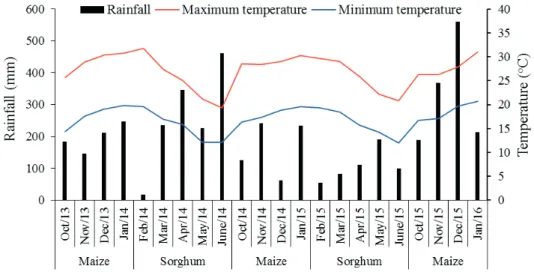
area of the Universidade Federal de Santa Maria (27º23’23.75”S, 53º25’41.18”W and altitude of 484 m), in Frederico Westphalen, Rio Grande do Sul State, Brazil. The climate of the region is type Cfa, subtropical humid with hot summers and maximum temperature equal to or higher than 22 ºC, minimum temperature from -3 ºC to 18 ºC, and average annual rainfall of 1,900-2,200 mm (Alvares et al. 2013). Figure 1 details the rainfall and maximum and minimum temperatures during the experiment (October 2013 to January 2016).
The experimental area had been managed under
a no-tillage system for over five years, with soybean
[Glycine max (L.) Merr.] and maize (Zea mays L.) cultivated in the summer and black oats (Avena strigosa Schreb) as a cover crop during the winter.
the following attributes determined before setting up the experiment (0-10 cm layer): 630 g kg-1 of clay;
13.4 mg dm-3 of P; 309.5 mg dm-3 of K, extracted
by Mehlich-1; 4.7 cmolc dm-3 of Ca; 2.5 cmol
c dm
-3
of Mg, extracted with 1.0 mol L-1 of a KCl solution;
10.0 mg dm-3 of S, extracted with a calcium phosphate
solution; 11.2 mg dm-3 of Cu; 3.3 mg dm-3 of Zn,
extracted with 0.1 mol L-1 of HCl; 12.4 cmol
c dm
-3
of potential CEC; 62.9 % of base saturation; 1.9 % of Al saturation; 28.2 g kg-1 of organic matter; pH in
water of 5.5; and SMP index of 5.8.
The study was divided into three experiments conducted in a randomized block design with four replications, in plots of 4 m x 3 m, with a total area of 12 m² per plot. Each experiment comprised doses of one nutrient applied to each crop, totaling five treatments in each experiment. Urea, triple superphosphate and potassium chloride were used in the three experiments as sources of N, P and K, respectively, spread over the surface and not incorporated to the soil.
Experiment I consisted of five topdressing N
doses (0 kg ha-1, 50 kg ha-1, 100 kg ha-1, 150 kg ha-1
and 200 kg ha-1) applied when the two crops showed
four expanded leaves. Immediately after sowing, 20 kg ha-1 of N, 120 kg ha-1 of P
2O5 and 90 kg ha -1 of
K2O were applied to each plot.
Experiment II consisted of five P2O5 doses (0 kg ha-1, 40 kg ha-1, 80 kg ha-1, 120 kg ha-1 and
160 kg ha-1) applied immediately after sowing,
together with 20 kg ha-1 of N and 90 kg ha-1 of
K2O in each plot. When the two crops had four
expanded leaves, 150 kg ha-1 of N was applied as
topdressing.
In the experiment III, five K2O doses (0 kg ha-1,
30 kg ha-1, 60 kg ha-1, 90 kg ha-1 and 120 kg ha-1)
were applied immediately after sowing, together with 20 kg ha-1 of N and 120 kg ha-1 of P
2O5 in each
plot. When the two crops had four expanded leaves, 150 kg ha-1 of N were applied as topdressing.
For the three years under evaluation, the maize crop was sown in October, using a no-tillage seeder, with spacing of 0.45 cm. The Dow AgroSciences 2A120Hx hybrid was used in the 2013/2014 and 2014/2015 seasons, while the Morgan Sementes 30A77Hx hybrid was used in the 2015/2016 season. An average of 3.8 plants
were used per linear meter, for an average final
population of 70,000 plants ha-1, 75,000 plants ha-1
and 78,000 plants ha-1 in the 2013/2014, 2014/2015
and 2015/2016 seasons, respectively. The sorghum was sown in February of the two years under evaluation, at the same spacing and employing the same seeder used for maize. The AG 2501 hybrid from Agroceres was used in 2014 and the Sunchales NR forage sorghum from Wolf Seeds in 2015. On average, 8.0 plants were used per
linear meter, with an average final population for
the respective seasons of 140,000 plants ha-1 and
120,000 plants ha-1. The sorghum crop was sown
at 30 days after removing the maize plants from the experimental area, simulating areas of forage production for silage. In winter, the area remained fallow, with no cultivation of forage crops.
Whole plants were collected to determine dry matter, at the farinaceous to hard grain stage recommended for ensiling. Eight maize plants and 2.0 linear meters of sorghum were collected from the working area of each plot, 15 cm from the ground. The plants were ground in a forage grinder and oven dried at 65 ºC to constant weight. The data were transformed and expressed as dry matter production (kg ha-1), which in maize was calculated based on the
number of collected plants and the final population,
and in sorghum based on the collection area (0.90 m2).
Sub-samples were later ground in a Wiley mill with a 1.0 mm screen. N concentrations in the dry and
ground material were quantified as described by
Silva & Queiroz (2002) and multiplied by a factor of 6.25, to be expressed as crude protein concentration. Based on the crude protein concentration and on the respective dry matter production, the crude protein yield (kg ha-1) was calculated.
The results were submitted to analysis of variance for each crop and the mean values of the treatments were adjusted by polynomial regression
analysis at 5 % (p ≤ 0.05), using the SAS 8.0 software.
Based on the regression equations, the maximum increase, when compared to a dose of zero N, P or K,
was calculated for each variable analyzed. The dose
of maximum technical efficiency was estimated with
the formula: x+ = -Δ
1/2Δ2, where Δ1 and Δ2 are values
estimated by the polynomial regression equation, corresponding to x and x2, respectively (Stork et al.
2006).
RESULTS AND DISCUSSION
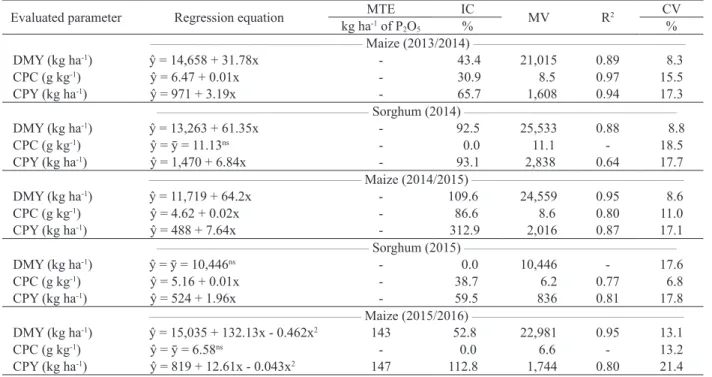
The dry matter yield in the maize and sorghum for silage indicated significant responses to the topdressing N doses applied in four of the five successive crops under study (Table 1). Increases for dry matter were seen up to the maximum dose of nitrogen fertilization (200 kg ha-1 of N) in the
two maize crops (2013/2014 and 2014/2015) and in one sorghum crop (2014), and up to the dose of
maximum technical efficiency with 143 kg ha-1 of
N in the last maize crop (2015/2016). In these four crops, increases in dry matter were between 43.4 % and 109.6 %, if compared to the dose of zero N, and the maximum dry matter yield varied between 21,015 kg ha-1 and 25,533 kg ha-1. These yields are
similar to those obtained by Oliveira et al. (2010), in maize and sorghum for silage.
ns Non-significant (p < 0.05).
Evaluated parameter Regression equation MTE IC MV R2 CV
kg ha-1 of P2O5 % %
______________________________________________________ Maize (2013/2014) ______________________________________________________
DMY (kg ha-1) ŷ = 14,658 + 31.78x - 43.4 21,015 0.89 8.3
CPC (g kg-1) ŷ = 6.47 + 0.01x - 30.9 8.5 0.97 15.5
CPY (kg ha-1) ŷ = 971 + 3.19x - 65.7 1,608 0.94 17.3
______________________________________________________ Sorghum (2014) ______________________________________________________
DMY (kg ha-1) ŷ = 13,263 + 61.35x - 92.5 25,533 0.88 8.8
CPC (g kg-1) ŷ = ȳ = 11.13ns - 0.0 11.1 - 18.5
CPY (kg ha-1) ŷ = 1,470 + 6.84x - 93.1 2,838 0.64 17.7
______________________________________________________ Maize (2014/2015) ______________________________________________________
DMY (kg ha-1) ŷ = 11,719 + 64.2x - 109.6 24,559 0.95 8.6
CPC (g kg-1) ŷ = 4.62 + 0.02x - 86.6 8.6 0.80 11.0
CPY (kg ha-1) ŷ = 488 + 7.64x - 312.9 2,016 0.87 17.1
______________________________________________________ Sorghum (2015) ______________________________________________________
DMY (kg ha-1) ŷ = ȳ = 10,446ns - 0.0 10,446 - 17.6
CPC (g kg-1) ŷ = 5.16 + 0.01x - 38.7 6.2 0.77 6.8
CPY (kg ha-1) ŷ = 524 + 1.96x - 59.5 836 0.81 17.8
______________________________________________________ Maize (2015/2016) ______________________________________________________
DMY (kg ha-1) ŷ = 15,035 + 132.13x - 0.462x2 143 52.8 22,981 0.95 13.1
CPC (g kg-1) ŷ = ȳ = 6.58ns - 0.0 6.6 - 13.2
CPY (kg ha-1) ŷ = 819 + 12.61x - 0.043x2 147 112.8 1,744 0.80 21.4
The response to the nitrogen fertilization on dry matter yield in the forages may be related to the organic matter content of the soil. It can be seen that, when starting the experiment, the organic matter content of the soil in the 0-10 cm layer (28.2 g kg-1)
was close to the lowest level (≤ 25.0 g kg-1), increasing
the response to nitrogen fertilization (CQFS-RS/SC, 2004). In addition, the successive cultivation of grasses in the same area favoured the N extraction through the mineralization of soil organic matter, as legumes were not included in the system of forage production (Castoldi et al. 2011). In addition to these factors, the crop residues from maize and sorghum remaining after the plants were removed (15 cm of stem and roots) may have immobilized part of the N, due to the high carbon/nitrogen ratio (Silva et al. 2009).
The lack of response to the N doses in the sorghum crop of 2015 may be related to the hybrid having a lower productive potential for dry matter, in relation to that used in the previous year (Table 1).
The difference in dry matter production between the
two years of cultivation was 15,087 kg ha-1. Normally,
the dry matter yield in sorghum was higher than that obtained in 2015 (Oliveira et al. 2010, Franco 2011). The occurrence of drought between March and April, with periods of 21 and 12 days with no rainfall in
the respective months, may also have affected the
initial growth of the sorghum plants, despite the
high resistance of sorghum to drought (Księżak et
al. 2012).
The values for dry matter obtained in maize and sorghum crops with no water restriction indicate a high productive potential under the conditions of the experiment. These dry matter values were greater than those found by Silva et al. (2015b), with adequate soil water availability, and by Moraes et al. (2013), with maize and sorghum hybrids used for forage, grain and dual purpose production. Furthermore, the dry matter yield of the crops may reach even higher levels, since there was a response up to the maximum N dose applied. Silva et al. (2015a) estimated a maize yield at 37,287 kg ha-1
with the use of 890 kg ha-1 of N. The high demand
for this nutrient, especially in grasses, is due to its C4 photosynthesis and high biomass growth capacity (Amin 2011). This demonstrates a high response to nitrogen fertilization and the need to adjust the dose
to obtain a maximum economic efficiency in the
production of silage from these two crops.
The crude protein yield significantly increased
with N doses in all maize and sorghum crops (Table 1). The responses to the N doses were linear, except for the maize silage in the last year of evaluation (2015/2016), which was quadratic. For maize crops with a linear response to the N doses, the maximum crude protein yield obtained at the maximum dose of N (200 kg ha-1) ranged
from 1,608 kg ha-1 (2013/2014) to 2,016 kg ha-1
(2014/2015), with increases of 65.7 % and 312.9 %, in relation to the dose of zero N, respectively. In the 2015/2016 harvest, the maximum crude protein yield for maize (1,744 kg ha-1) was obtained with a dose of
147 kg ha-1 of N, which is similar to the maximum
technical efficiency dose for the dry matter yield in
the same year. In the sorghum crop, 2,838 kg ha-1
and 836 kg ha-1 of crude protein were obtained in
2013 and 2014, respectively, with the maximum N dose representing increases of 93.1 % and 59.5 %, in relation to the dose of zero N.
The response of crude protein yield to the N doses, irrespective of the year of evaluation, is associated with the increase in dry matter and
crude protein concentration (Table 1). A significant
linear response can be seen in the crude protein
concentration for N doses in three of the five crops,
with increments between 30.9 % and 86.6 %, what reinforces the importance of nitrogen fertilization. As nutrient uptake increases, the protein synthesis in the plants tends to increase (Amin 2011), with increases in the crude protein yield per cultivated area, together with a higher protein concentration
in the dry matter (Księżak et al. 2012) and grains
(Szulc et al. 2013).
The maximum crude protein concentration achieved with the N doses varied from 6.6 % to 8.6 % in the maize silage, and from 6.2 % to 11.1 % in sorghum (Table 1). In only two crops the crude protein concentration was below the minimum of 7.0 %, considered the limit for positive nitrogen balance in the animal rumen (Costa et al. 2006). It is noteworthy that adequate crude protein concentrations in the maize silage were only obtained with nitrogen fertilization, which results in higher digestibility and voluntary intake by animals (Costa et al. 2006).
When comparing the two crops, sorghum usually presents a higher crude protein concentration, in relation to maize (Table 1), as was previously
et al. 2013). Considering the dry matter yield and nutritional quality, Von Pinho et al. (2007) pointed out that replacing sorghum silage with maize is not viable. It is also worthnoting the higher tolerance of sorghum to drought and low fertility soils, when compared to maize (Stone et al. 1996). However, a silage production system with successive cultivation of maize and sorghum is an alternative that may increase the silage production in the same area, using two crops that show a high response to nitrogen fertilization.
The maximum N dose used in the experiment (200 kg ha-1 N) was based on a recommendation by
the CQFS-RS/SC (2004) for maize, with an expected dry matter yield of 18,500 kg ha-1. It was found that,
in the four crops with no water deficit, the average
yield was 23,522 kg ha-1 of dry matter, higher than
predicted (Table 1). Under the conditions of the
experiment, there was probably a greater efficiency
in the use of N, as the conditions of humidity and temperature were suitable for N fertilization. Another possible explanation for this higher than expected yield may be that the CQFS-RS/SC (2004) recommendation overestimates the need for nitrogen fertilization in these crops.
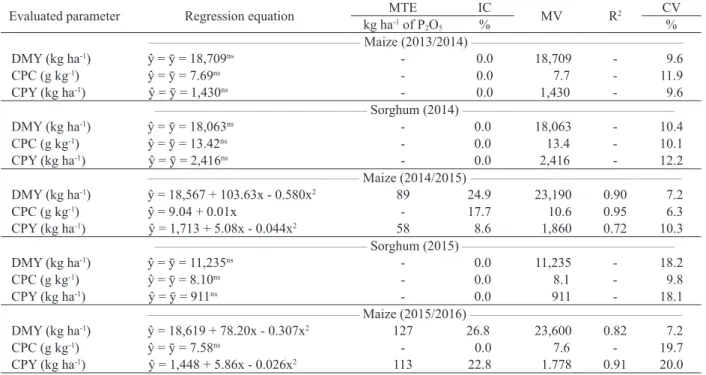
Phosphorus fertilization contributed to an increase in the dry matter and crude protein yield only after the third successive crop of maize and
sorghum (Table 2). The lack of significance for the P doses in the first two crops may be associated with the
adequate levels of this nutrient in the soil, which were
classified as “very high” (13.4 mg dm-3 of P) at the
beginning of the experiment (CQFS-RS/SC 2004). The response to phosphorus fertilization from the third crop shows that the soil P stocks can be depleted rapidly during the course of cultivation, given the high rate of nutrient export by the removal of forage plant biomass in the silage production (Oliveira et al. 2010). This suggests that phosphorus fertilization should be prioritized in areas of silage production, similarly to nitrogen fertilization, since year-on-year fertilization probably increased the nutrient absorption and use efficiency by plants (Dovale & Fritsche-Neto 2013).
In addition to the increasing dry matter yield, the P doses contributed with a 17.7 % increase in the crude protein concentration in maize, for the 2014/2015 harvest (Table 2). This result is similar to that by Roy & Khandaker (2010), who found
a significant effect of P doses on sorghum crude
ns Non-significant (p < 0.05).
Evaluated parameter Regression equation MTE IC MV R2 CV
kg ha-1 of P2O5 % %
______________________________________________________ Maize (2013/2014) ______________________________________________________
DMY (kg ha-1) ŷ = ȳ = 18,709ns - 0.0 18,709 - 9.6
CPC (g kg-1) ŷ = ȳ = 7.69ns - 0.0 7.7 - 11.9
CPY (kg ha-1) ŷ = ȳ = 1,430ns - 0.0 1,430 - 9.6
______________________________________________________ Sorghum (2014) ______________________________________________________
DMY (kg ha-1) ŷ = ȳ = 18,063ns - 0.0 18,063 - 10.4
CPC (g kg-1) ŷ = ȳ = 13.42ns - 0.0 13.4 - 10.1
CPY (kg ha-1) ŷ = ȳ = 2,416ns - 0.0 2,416 - 12.2
______________________________________________________ Maize (2014/2015) ______________________________________________________
DMY (kg ha-1) ŷ = 18,567 + 103.63x - 0.580x2 89 24.9 23,190 0.90 7.2
CPC (g kg-1) ŷ = 9.04 + 0.01x - 17.7 10.6 0.95 6.3
CPY (kg ha-1) ŷ = 1,713 + 5.08x - 0.044x2 58 8.6 1,860 0.72 10.3
______________________________________________________ Sorghum (2015) ______________________________________________________
DMY (kg ha-1) ŷ = ȳ = 11,235ns - 0.0 11,235 - 18.2
CPC (g kg-1) ŷ = ȳ = 8.10ns - 0.0 8.1 - 9.8
CPY (kg ha-1) ŷ = ȳ = 911ns - 0.0 911 - 18.1
______________________________________________________ Maize (2015/2016) ______________________________________________________
DMY (kg ha-1) ŷ = 18,619 + 78.20x - 0.307x2 127 26.8 23,600 0.82 7.2
CPC (g kg-1) ŷ = ȳ = 7.58ns - 0.0 7.6 - 19.7
CPY (kg ha-1) ŷ = 1,448 + 5.86x - 0.026x2 113 22.8 1.778 0.91 20.0
protein, suggesting that, in the long term, phosphorus
fertilization may influence the crude protein yield in
soils with “very high” levels. Normally, the response of silage dry matter yield to phosphorus fertilization occurs when P levels are less than critical (Tiritan et al. 2010). However, even with an adequate soil content, phosphorus fertilization is necessary to maintain the silage production in areas of successive forage cultivation (CQFS-RS/SC 2004).
The responses to phosphorus fertilization on the production of maize for silage were quadratic,
with maximum technical efficiency at 89 kg ha-1 and
127 kg ha-1 of P
2O5 for dry matter, and 58 kg ha -1 and
113 kg ha-1 of P
2O5 for crude protein, in the 2014/2015
and 2015/2016 harvests, respectively (Table 2). It can be seen that, in these two harvests, the maximum dry matter and crude protein yield of silage were similar,
but, in the final crop of maize, it was necessary to
apply a greater amount of P than in the previous crop, to allow an equivalent silage production. This reinforces the premise of a reduction in the initial stock of available P in the soil, and indicates that, in the following crops, an even greater dose of the nutrient may be necessary to maintain the same yield. This is supported by the recommendation
of the CQFS-RS/SC (2004), which indicates up to 170 kg ha-1 of P
2O5 for an expected production based
on the average maximum dry matter yield obtained
in the five sorghum and maize crops (18,959 kg ha-1).
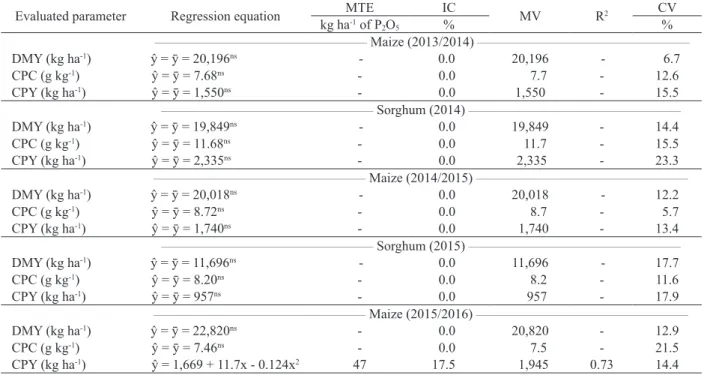
The K doses showed no significance for the dry
matter yield and crude protein concentration in the
five maize and sorghum crops evaluated in succession
(Table 3). There was only a response of the K doses
on the crude protein yield in the final maize crop, but
with an increase of only 16.5 %, in relation to the dose
of zero K. Similarly to P, this lack of significance for
K doses may be associated with the “very high” levels of this nutrient at the beginning of the experiment (309.5 mg dm-3 of K), as per CQFS-RS/SC (2004).
These levels were 5.2 times higher than the critical level, and possibly enough to maintain the dry matter
yield for five successive maize and sorghum crops.
The data show that, in soils with “very high” levels of K, fertilization can be suspended for a certain length
of time without affecting the forage production. This
interval should be monitored, based on an analysis of the soil, as recommended by the CQFS-RS/SC (2004).
In six years of study with a system of successive forage cultivation for silage, with maize or
ns Non-significant (p < 0.05).
Evaluated parameter Regression equation MTE IC MV R2 CV
kg ha-1 of P2O5 % %
______________________________________________________ Maize (2013/2014) ______________________________________________________
DMY (kg ha-1) ŷ = ȳ = 20,196ns - 0.0 20,196 - 6.7
CPC (g kg-1) ŷ = ȳ = 7.68ns - 0.0 7.7 - 12.6
CPY (kg ha-1) ŷ = ȳ = 1,550ns - 0.0 1,550 - 15.5
______________________________________________________ Sorghum (2014) ______________________________________________________
DMY (kg ha-1) ŷ = ȳ = 19,849ns - 0.0 19,849 - 14.4
CPC (g kg-1) ŷ = ȳ = 11.68ns - 0.0 11.7 - 15.5
CPY (kg ha-1) ŷ = ȳ = 2,335ns - 0.0 2,335 - 23.3
______________________________________________________ Maize (2014/2015) ______________________________________________________
DMY (kg ha-1) ŷ = ȳ = 20,018ns - 0.0 20,018 - 12.2
CPC (g kg-1) ŷ = ȳ = 8.72ns - 0.0 8.7 - 5.7
CPY (kg ha-1) ŷ = ȳ = 1,740ns - 0.0 1,740 - 13.4
______________________________________________________ Sorghum (2015) ______________________________________________________
DMY (kg ha-1) ŷ = ȳ = 11,696ns - 0.0 11,696 - 17.7
CPC (g kg-1) ŷ = ȳ = 8.20ns - 0.0 8.2 - 11.6
CPY (kg ha-1) ŷ = ȳ = 957ns - 0.0 957 - 17.9
______________________________________________________ Maize (2015/2016) ______________________________________________________
DMY (kg ha-1) ŷ = ȳ = 22,820ns - 0.0 20,820 - 12.9
CPC (g kg-1) ŷ = ȳ = 7.46ns - 0.0 7.5 - 21.5
CPY (kg ha-1) ŷ = 1,669 + 11.7x - 0.124x2 47 17.5 1,945 0.73 14.4
sorghum in the summer and ryegrass or black oats in the winter, Silva et al. (2010) found a reduction in the initial levels of K, in the 0-10 cm layer. K decreased from 235 mg dm-3 to 66 mg dm-3 and 100 mg dm-3 at
the end of the sixth year, with the use of 40 kg ha-1
and 155 kg ha-1 of K
2O per crop, by means of mineral
and organic fertilization, respectively. The authors pointed out that, in the absence or with small doses of K, the nutrient was depleted along the entire soil
profile, probably due to the high export rate, via the
silage biomass.
The response to potassium fertilization occurs in areas where the nutrient content is below the critical level (Galvão et al. 2015), except when levels, despite being low in the surface layer, are average at a depth of more than 20 cm (Rabêlo et al. 2013). However, in areas of successive forage cultivation for silage, it is necessary to add large doses of the nutrient to maintain high yields, due to the high rate of K export (Ueno et al. 2013).
The three maize and two sorghum crops
were not sufficient to induce large responses with
phosphorus and potassium fertilization. Sorghum, due to its greater genetic variability and depending
on the cultivar, may be more efficient in metabolizing
P and K, in relation to maize (Han et al. 2011). Moreover, when compared to maize, sorghum may be more or less responsive to variations in P and K doses (Morrill et al. 2012, Uribe & Ticianeli 2014). However, under the conditions of this study, with “very high” levels of P and K in the soil, a larger
number of harvests would be required to confirm any differentiated response to P and K fertilization
between the two crops.
The maintenance of dry matter and crude protein yield in the first two successive crops (maize and sorghum), even without addition of
P, and in five successive crops without the use of K fertilization, is an important finding for future
fertilization recommendations for these forages. In the crops that responded to the P fertilization, the
maximum technical efficiency doses were between
58 kg ha-1 and 127 kg ha-1 of P
2O5, values lower
than the maintenance fertilization suggested by the CQFS-RS/SC (2004), for the average productive
levels of the five forage crops obtained in the present
study. With respect to N fertilization, the response up to the maximum dose of N applied (200 kg ha-1)
demonstrates the need to use higher doses of fertilizer, when planning new studies with this nutrient.
CONCLUSIONS
1. Nitrogen doses increased the crude protein yield
by 59.5-312.9 %, in the five successive maize and
sorghum crops;
2. In soils with “very high” levels of P and K, the successive maize and sorghum cultivation for silage does not require fertilization with these
nutrients, in the first years of cultivation.
REFERENCES
ALVARES, C. A. et al. Köppen’s climate classification
map for Brazil. Meteorologische Zeitschrift, v. 22, n. 6, p. 711-728, 2013.
AMIN, M. E. H. Effect of different nitrogen sources on
growth, yield and quality of fodder maize (Zea mays L.).
Journal of the Saudi Society of Agricultural Sciences, v. 10, n. 1, p. 17-23, 2011.
CANIZARES, G. L. et al. Ingestive behavior of dairy goats fed increasing levels of sugarcane in replacement of corn silage. Revista Brasileira de Zootecnia, v. 43, n. 12, p. 648-653, 2014.
CARVALHO, W. G. et al. Silage quality of corn and sorghum added with forage peanuts. Revista Caatinga, v. 29, n. 2, p. 465-472, 2016.
CASTOLDI, G. et al. Sistemas de cultivo e uso de diferentes adubos na produtividade de silagem e grãos de milho. Acta Scientiarum Agronomy, v. 33, n. 1, p. 139-146, 2011.
COMISSÃO DE QUÍMICA E FERTILIDADE DE SOLO (CQFS-RS/SC). Manual de adubação e calagem para os Estados do Rio Grande do Sul e Santa Catarina. 10. ed. Porto Alegre: Sociedade Brasileira de Ciência do Solo, 2004.
COSTA, K. A. P. et al. Efeitos quantitativo e qualitativo do nitrogênio e do potássio no desenvolvimento da Brachiaria brizantha cv. MG-5. Revista Eletrônica da Faculdade de Montes Belos, v. 1, n. 1, p. 56-70, 2006.
DOVALE, J. C.; FRITSCHE-NETO, R. F. Genetic control
of traits associated with phosphorus use efficiency in maize
by REML/BLUP. Revista Ciência Agronômica, v. 44, n. 3, p. 554-563, 2013.
E M P R E S A B R A S I L E I R A D E P E S Q U I S A AGROPECUÁRIA (Embrapa). Centro Nacional de Pesquisa de Solos. Sistema brasileiro de classificação de
solos. 3. ed. Rio de Janeiro: Embrapa, 2013.
(Mestrado em Produção Vegetal) - Universidade Estadual de Montes Claros, Janaúba, 2011.
GALVÃO, J. R. et al. Adubação potássica em híbridos de sorgo forrageiro cultivados em sistemas de manejo do solo na Amazônia oriental. Revista Caatinga, v. 28, n. 4, p. 70-79, 2015.
GUARESCHI, R. F. et al. Produtividade de silagem de híbridos de milho e sorgo sem nitrogênio de cobertura em safra de verão. Pesquisa Agropecuária Tropical, v. 40, n. 4, p. 541-546, 2010.
HAN, L. P. et al. Accumulation and partitioning of
nitrogen, phosphorus and potassium in different varieties
of sweet sorghum. Field Crops Research, v. 120, n. 1, p. 230-240, 2011.
KSIĘŻAK, J. et al. Evaluation of productivity of maize and sorghum to be used for energy purposes as influenced
by nitrogen fertilization. Zemdirbyste-Agriculture, v. 99, n. 4, p. 363-370, 2012.
MORAES, S. D. et al. Produção e composição química de híbridos de sorgo e de milho para silagem. Revista
Brasileira de Saúde e Produção Animal, v. 14, n. 4,
p. 624-634, 2013.
MORRILL, W. B. B. et al. Produtividade e nutrientes minerais de milheto forrageiro e sorgo sudão adubado com soro de leite. Revista Brasileira de Engenharia Agrícola e Ambiental, v. 16, n. 2, p. 182-188, 2012.
OLIVEIRA, L. B. et al. Produtividade, composição química e características agronômicas de diferentes forrageiras. Revista Brasileira de Zootecnia, v. 39, n. 12, p. 2604-2610, 2010.
OTTO, R.; VITTI, G. C.; LUZ, P. H. C. Manejo da adubação potássica na cultura da cana-de-açúcar. Revista Brasileira de Ciência do Solo, v. 34, n. 4, p. 1137-1145, 2010.
RABÊLO, F. H. S. et al. Características agronômicas e bromatológicas do milho submetido a adubações com potássio na produtividade de silagem. Revista Ciência Agronômica, v. 44, n. 4, p. 635-643, 2013.
ROY, P. R. S.; KHANDAKER, Z. H. Effect of phosphorus
fertilizer on yield and nutritional value of sorghum (Sorghum bicolor) fodder at three cuttings. Bangladesh Journal of Animal Science, v. 39, n. 1-2, p. 106-115, 2010.
SILVA, F. A. et al. Milho para ensilagem cultivado nos sistemas de plantio direto e convencional sob efeito de veranico. Semina: Ciências Agrárias, v. 36, n. 1, p. 327-340, 2015b.
SILVA, J. C. P. M. et al. Esterco de gado leiteiro associado
à adubação mineral e sua influência na fertilidade de um
latossolo sob plantio direto. Revista Brasileira de Ciência do Solo, v. 34, n. 2, p. 453-463, 2010.
SILVA, J. D.; QUEIROZ, A. C. Análise de alimentos: métodos químicos e biológicos. 3. ed. Viçosa: Universidade Federal de Viçosa, 2002.
SILVA, M. R. et al. Estimativas da necessidade de nitrogênio para produção de grãos e silagem de milho.
Revista Caatinga, v. 28, n. 3, p. 12-24, 2015a.
SILVA, P. C. G. et al. Fitomassa e relação C/N em consórcios de sorgo e milho com espécies de cobertura.
Pesquisa Agropecuária Brasileira, v. 44, n. 11, p. 1504-1512, 2009.
SISTEMA IBGE DE RECUPERAÇÃO AUTOMÁTICA (SIDRA/IBGE). Censo agropecuário 2006. 2012.
Available at: <http://www.sidra.ibge.gov.br/bda/pesquisas/
ca/default.asp?o=2&i=P>. Access on: May 22, 2016.
STONE, L. R. et al. Response of corn, grain sorghum,
and sunflower to irrigation in the High Plains of Kansas. Agriculture Water Management, v. 30, n. 3, p. 251-259, 1996.
STORK, L. et al. Experimentação vegetal. 2. ed. Santa Maria: Ed. da UFSM, 2006.
SZULC, P. et al. Response of two cultivar types of maize (Zea mays L.) expressed in protein content and its yield to varied soil resources of n and mg and a form of nitrogen fertilizer. Polish Journal of Environmental Studies, v. 22, n. 6, p. 1845-1853, 2013.
TIRITAN, C. S. et al. Produtividade de massa seca de milho em função da adubação fosfatada mineral e organomineral.
Colloquium Agrariae, v. 6, n. 1, p. 1-7, 2010.
UENO, R. K. et al. Exportação de macronutrientes do solo em área cultivada com milho para alimentação de
bovinos confinados. Semina: Ciências Agrárias, v. 34,
n. 6, p. 3001-3018, 2013.
UNITED STATES DEPARTMENT OF AGRICULTURE (USDA). Crop production. 2016. Available at: <http://
www.usda.gov/wps/portal/usda/usdahome>. Access on: May 22, 2016.
URIBE, R. A. M.; TICIANELI, L. C. S. Influência do
estande na produtividade de sorgo sacarino. Diálogos & Ciência, v. 14, n. 34, p. 10-12, 2014.
VON PINHO, R. G. et al. Produtividade e qualidade da silagem de milho e sorgo em função da época de semeadura. Bragantia, v. 66, n. 2, p. 235-245, 2007.