An EDSL for
Modeling Kidney
Exchange Programs
João Paulo Rocha Viana
Dissertação de Mestrado apresentada à
Faculdade de Ciências da Universidade do Porto em
Ciencia de Computadores
2019
An E D S L for M od eli ng K idn ey E xc ha ng e P rograms João P aulo Ro cha V ianaMSc
FCUP ANO 2.º CICLOAn EDSL for Modeling
Kidney Exchange
Programs
João Paulo Rocha Viana
Mestrado em Ciência de Computadores
Departamento de Ciencia de Computadores 2019Orientador
Prof. Pedro Vasconcelos, FCUP
Coorientador
Todas as correções determinadas pelo júri, e só essas, foram efetuadas.
O Presidente do Júri,
Kidney exchange programs have grown from localized, single-site experiences to multi-center, orga-nized and regulated frameworks that are reaching international cooperation. These programs created opportunities for patients suffering from kidney failure to have better chances of finding a compatible organ. As the increase of scale demands more sophisticated approaches, mathematical models for the problem and its numerous variants have motivated the development of software and tools that of-fer real-word solutions to finding optimal exchange schemes, and also to further research by reducing the time taken to implement specific models and allowing more time for experimenting and testing.
In this dissertation we present PyKPD, a domain-specific language embedded in Python for man-aging, testing and optimizing kidney exchange program instances. It implements different exchange modalities, offers methods to load data on a pool of donors and patients, generates the mathemati-cal constructs of the model, and provides abstraction when specifying the criteria that will delineate the space of optimal exchanges. The usefulness of the language is validated by expressing several distinct examples of criteria in a simple, idiomatic way, in which pure Python code is mixed without blurring the semantics of the domain.
Os programas de doac¸ ˜ao renal cruzada partiram de pequenas experi ˆencias e evoluiram para esque-mas regulados, por vezes envolvendo v ´arios centros de transplantac¸ ˜ao e que comec¸am a atingir a cooperac¸ ˜ao internacional. Estes programas criaram oportunidades para que pacientes que est ˜ao a sofrer de falha renal tenham maior probabilidade de encontrar um org ˜ao compat´ıvel. Com o au-mento da exig ˆencia de abordagens sofisticadas `as quest ˜oes log´ısticas intr´ınsecas, os avanc¸os em modelac¸ ˜ao matem ´atica e a incorparac¸ ˜ao de diversas modalidades de troca motivaram o desenvolvi-mento de software e de ferramentas que se traduzem em soluc¸ ˜oes realistas na procura de esquemas ´otimos de trocas de rins, e tamb ´em o de potenciar mais investigac¸ ˜ao ao reduzir o tempo que imple-mentar experi ˆencias espec´ıficas leva, deixando mais tempo tamb ´em para experimentac¸ ˜ao e teste de hip ´oteses.
Esta dissertac¸ ˜ao prop ˜oe uma linguagem espec´ıfica de dom´ınio embebida em Python, denomi-nada PyKPD, cujo prop ´osito ´e permitir a gest ˜ao, teste e otimizac¸ ˜ao de inst ˆancias de programas de doac¸ ˜ao renal cruzada. S ˜ao implementadas diferentes modalidades de forma concisa e s ˜ao disponi-bilizados m ´etodos para construir uma base de dados relativa aos pacientes e dadores registados no programa, gerar os objetos matem ´aticos relativos ao modelo, e ainda permitir um n´ıvel de abstrac¸ ˜ao no momento de definir crit ´erios que delineiam a busca pelas trocas consideradas ´otimas. As van-tagens do uso da linguagem s ˜ao validadas pela apresentac¸ ˜ao de v ´arios exemplos de crit ´erios de forma simples e idiom ´atica, onde c ´odigo mais caracter´ıstico do Python ´e introduzido sem confundir a sem ˆantica ao n´ıvel do dom´ınio.
I would like to thank my supervisors Pedro Vasconcelos and Jo ˜ao Pedro Pedroso for all the help and support throughout these years. You have never given up on me and I am infinitely grateful for that.
Gostaria de agradecer aos meus pais, `a minha irm ˜a e cunhado Semyon, por serem um apoio incondicional neste meu caminho. E muito por voc ˆes que vale a pena finalmente encerrar este´ cap´ıtulo.
To Tiago Campos, my partner and companion, thank you for this incredible year and for staying by my side through all the moments of hardship in such a devoted way. Your love, support, care and attitude inspire me to be better in every way and I could not be more excited for the new and loving memories to come after this chapter.
To my family of friends who have been fundamental in this path. In no specific order, I want to thank Ana Tarrinho, Rehana Jassat (and her family), Carina Fernandes, Marina Meira, Fab´ıola Fernandes, Jos ´e Belo, Rita Vint ´em, Pedro Pereira, Sara Jesus, my goddaughter Alice, Juliana Braga, Joana Santos, Rui da Silva, Victor Hugo Ramos, Jo ˜ao Agostinho, Cl ´audia Abreu, Nilufar Neyestani, In ˆes Soares, Filipe Pereira, Sara Pereira, Maria Jos ´e Costa, S´ılvia Ramos, Marisa Reis, Daniel Carvalho, Joaquim Martins, Tiago Azevedo, Joaquin Pereira, Luis Gabriel Pereira and Teresa Forte for all the love you gave me in this hard, long process. I would thank you and more individually if I could, for you have showed me support in very special, simple and unique ways. I believe you know why in particular.
To Ricardo Bessa, thank you for giving me the opportunity to work at INESC TEC, where I was able to be in contact with a research environment that enabled me to get important help on finishing this dissertation.
To researchers Ana Viana, Xenia Klimentova and Nicolau Santos from INESC TEC, thank you for your precious help and insights.
I thank all my friends and colleagues at INESC TEC who, in our everyday interaction encouraged me, cared about my progress and helped me with the content and format of this dissertation.
Contents
1 Introduction 1
1.1 Kidney Exchange Programs . . . 1
1.2 Objectives of this dissertation . . . 2
1.3 Outline of the dissertation . . . 2
2 Background 5 2.1 Kidney Paired Donation . . . 5
2.1.1 History and development . . . 5
2.1.2 Conditions for Kidney Exchange . . . 7
2.1.3 Modalities of Living Donor Exchanges . . . 8
2.1.4 Market clearing: Models for Kidney Exchange . . . 11
2.1.5 Related tools and software . . . 17
2.2 Domain-Specific Languages . . . 19
2.2.1 Designing and implementing a DSL . . . 20
2.2.2 The embedded case . . . 21
2.2.3 Python as a host language . . . 22
3 EDSL for Kidney Paired Donation 27 3.1 Architecture overview . . . 27
3.2 Implementation details . . . 28
3.2.1 Entities module . . . 28
3.2.2 Exceptions module . . . 29
3.2.3 Pool Manager . . . 30
3.2.4 Compatibility Graph module . . . 31
3.2.5 Model Manager . . . 33
3.2.6 Main PyKPD module . . . 34
4 Examples and operational features 37 4.1 A first example . . . 37
4.2 Other examples of criteria application . . . 40
5 Conclusions and Future Work 45 5.1 Discussion of the presented work . . . 45
5.2 Future Work . . . 45
ii FCUP
An EDSL for Modeling Kidney Exchange Programs
B Software installation 49
List of Figures
2.1 Timeline for the implementation of National KEP in Europe. . . 7
2.2 A 2-way exchange. . . 9
2.3 A 3-way exchange. . . 9
2.4 A n-way exchange. . . 10
2.5 Altruistic donor chains. . . 11
(a) Domino-Paired Donation (DPD). . . 11
(b) Non-simultaneous Extended Altruistic Donation (NEAD). . . 11
2.6 An example of a chain where the first and last pairs involved are compatible. . . 12
2.7 Kidney Exchange example graph. . . 13
2.8 The interface of the Kidney Exchange Data Analysis Toolkit. . . 19
2.9 Visualization examples in KPDGUI. . . 19
(a) Small KEP instance and its compatibility graph. . . 19
(b) Larger KEP instance after running optimization. The top solution is now repre-sented in the graph. . . 19
2.10 Parameter interface of KPDGUI. . . 20
(a) General parameters for the optimization. . . 20
(b) Allowing further specification of the optimization. . . 20
2.11 Example of for loops in Python. . . 23
2.12 Example of functions being passed on as arguments to other functions. In this case, the built-in function map receives a function that squares its input as parameter and applies it to all elements in a list. . . 24
3.1 PyKPD Architecture overview.. . . 28
3.2 Class definition headings for various KEP concepts. . . 29
3.3 Custom exceptions for PyKPD. . . 30
3.4 Main elements of the Pool Manager class. . . 31
3.5 The CompGraph class with some of its methods and private helper functions. . . 32
3.6 The ModuleManager class main components. . . 35
List of Tables
2.1 Average number of cycles and chains sampled from the Dutch national kidney
ex-change program. . . 16
2.2 List of DSLs and their domain. Source: [Hud98] . . . 20
2.3 Examples of EDSLs implemented in Python. . . 22
Chapter 1
Introduction
1.1
Kidney Exchange Programs
Patients whose renal function is severely diminished from damaged kidneys have to resort to dialysis or a kidney transplant. Globally, around 3.8 million people suffer from End Stage Renal Disease (ESRD)[ERC], when the kidneys cannot perform their normal function on their own. While dialysis is an exhausting therapy that may require several sessions per week, it may be the only option for those whose kidney condition has worsen beyond eligibility for a transplant.
Renal transplant is the most performed transplant in the world, but still the demand for organs is far too high. Some patients wait several years for an available, compatible kidney while others, having been considered fit for the procedure, end up waiting excessive time and also become too ill to be transplanted.
This method for improving kidney functionality and people’s life quality began in the form of de-ceased organ donation. It eventually evolved to allow for living kidney donation, where a person with two healthy kidneys is willing to donate one of them. In most cases, there is an emotional relationship between the donor and the intended recipient of the organ, and it is said the donation is directed. But due to blood type and tissue incompatibilities, it is not always possible to perform the transplant. Patients suffering from ESRD still had no option but to keep waiting for an available, compatible kidney.
Around forty years ago [Rap86], a new framework for kidney donation arose from the observance of such situations of incompatibility. It would be possible for two pairs of incompatible donors and patients to exchange kidneys when the donor from the first pair is compatible with patient of the second pair, and vice-versa. A simple but initially very controversial setting that is today known as kidney paired donation or kidney exchange. At the risk of taking the emotional aspect of donation and leading an otherwise willing donor to withdraw such intention, there was a potential gain in kidney transplants that could save more lives. Patients were not buying organs (such practice is illegal in most countries) but would engage in barter, where the goods to be traded were kidneys.
Barter is the trading of goods or services where no monetary compensation is involved, as in the case of kidney exchange. The success of the practice led to the formation of organized programs at the local, regional, national and eventually at the international level. These programs can be seen as barter markets, where the agents are incompatible pairs of patients and donors who are seeking to meet their needs with the best available and suiting item, a kidney. Finding the exchange scheme that brings the highest level of satisfaction for the majority of the agents is known as market
2 FCUP
An EDSL for Modeling Kidney Exchange Programs
clearing. Barter is one of the oldest forms of trade and is still common nowadays. Especially with the development of the Internet and the World Wide Web, we can find a multitude of platforms that enable barter exchanges. Examples of goods and services in barter platforms are accommodation [Cou; Hom], books [Swa] or clothing [Reh].
As these markets grow in size and complexity, the job of handling all the agents’ demands be-comes arduous. Computerized systems offer the possibility of centralizing information, mediation and optimization of the output of market operation. Kidney exchange is no exception.
Some programs now involve hundreds of pairs, and since organ donation is strongly regulated, in order to guarantee fairness and equality conditions, it is important to develop a framework where every patient might see that needs are met in an equitable way. In that sense, a lot of research stemmed from the kidney exchange experience, and new mathematical models for optimizing market clearing have arisen. Real-world needs for program management and optimal exchange exploration led to the development of tools directed at the problem in question.
1.2
Objectives of this dissertation
Our proposal is to develop a domain-specific language embedded in Python (a general-purpose language) for handling kidney exchange instances. The challenge is dual: knowledge on language design must be paired with sufficient understanding of the domain in order to produce a tool that is useful enough for a domain expert without too much programming experience to recognize, analyze and even develop their own applications in the language. Our main goal was to leverage the Python architecture to implement a series of definitions and methods that, while not escaping the limits of the host language, will be integrated in a way where it actually gains from having general-purpose features available. The discussion of the details of the implementation attests the adequacy of host language and the examples shown in this work show how the proposed language and Python interact and make for very readable, domain-friendly code. We expect that our solution helps making the management, simulation and testing of optimization schemes and kidney exchange programs easier, both in research and real-world perspectives.
1.3
Outline of the dissertation
The rest of this dissertation is organized in the following manner:
• Chapter 2 - Background: gives the reader insight in the field of Kidney Paired Donation,
pre-senting its progress in recent history, modalities in use, and the mathematical formulations underlying the computational approaches to find virtually optimal exchanges in the population available for transplantation. The chapter also includes information about domain-specific lan-guages: the motivation for their use, examples of developed languages and the advantages on embedding their implementation in a general-purpose language.
• Chapter 3 - EDSL for Kidney Paired Donation: In this chapter we detail our proposed
em-bedded domain-specific language (EDSL), discussing some of the implementation details and explaining some of the usage conventions.
• Chapter 4 - Examples and operational features: An illustration of how to use the language
schemes as validation of the language’s abstraction capabilities.
• Chapter 5 - Conclusions and Future Work: A summary of the dissertation, where the final
remarks are presented. The difficulties, challenges and opportunities for future development derived from the work are also discussed.
Chapter 2
Background
In this chapter, we present the literature pertaining the subjects underlying this dissertation. Im-plementing a domain-specific language implies owning a reasonably good knowledge base on the specific domain we are trying to model, and so it is important to know what are the main concepts, historical context and technical aspects of the problem at hand. Also, it is important to have a good understanding of the context of software and language development, in order to provide the im-plementation with good enough abstractions (in the domain) and good managing tools (for output production). The first section of this chapter introduces the relatively young but already very broad subject of Kidney Paired Donation, while the second provides context on domain-specific languages, their different modalities and forms of implementation.
2.1
Kidney Paired Donation
2.1.1 History and development
The idea of kidney swap between unrelated pairs of donor/patients was first suggested by Rapaport in 1986 [Rap86], as a strategy to help patients with willing related donors get a kidney from another pair with whom they were reciprocally compatible (initially for patient/donor blood types A-B and B-A). This idea came to fruition for the first time in South Korea, in the year 1991, when the first kidney exchange between two incompatible but cross compatible pairs was performed successfully. A few other exchanges took place in the following years (by 1995, Korea was also experimenting with simultaneous paired donations involving 3 to 4 incompatible pairs). It was not until the end of the decade, in 1999, that the first ever kidney paired exchange took place in European soil, more specifically in Switzerland [Thi+01]. The year after, the US was also having its first ever kidney exchange [ATM04].
Organized Kidney Exchange Programs
The success of the first kidney exchanges led to the development of organized programs to enroll more and more incompatible pairs with hopes of increasing the likelihood of finding a compatible organ. The bigger the pool, the greater the possibility of finding a matching donor for a patient in need and also the greater the possibility of finding a better match, while reducing waiting times for transplantation and improving the survival rates of those suffering from kidney failure.
6 FCUP
An EDSL for Modeling Kidney Exchange Programs
The first programs started at a local level, mostly on a single center. Again, in South Korea, in 1995, the first organized KEP program was established at Yonsei University College of Medicine in Seoul [Huh+08]. In Europe, Romania had in 2001 two kidney exchange programs that performed 56 kidney exchanges over the course of 5 years, reporting similar graft survival rates to direct, emo-tionally related living donor transplants [Luc07]. India began performing KPD in the year of 2000, although only 34 transplants had been carried out in the first 9 years, being that, until 2005, the pro-gram operated only in one state [Mod+10]. Australia had also a first experience with KEP propro-grams using a regional registry, resulting in nine kidney transplants in a year [FWC09].
With time, several countries developed KEP programs on a national level. In fact, while local, single center instances demonstrated the potential and viability of such programs, they are inherently characterized by smaller pools of incompatible pairs, and so the likeliness of finding a mutually com-patible pair remained impaired. Smaller pools can also have little impact on patients who are harder to match (due to blood type or human leukocyte antigen composition, as we shall address later). By creating a framework for national operation, countries allowed the creation of greater pools, leading to more and better transplants, but also brought other challenges, on the logistical and technical levels. South Korea was again the pioneer in developing a nationwide kidney exchange registry, in 2001 [Mie+13]. The Dutch Kidney Exchange Program was the first European national program to be established, in 2004. Since then, a multitude of national kidney exchange registries have risen, each with their own specifications and logistical challenges. An example is the UK Living Kidney Sharing Scheme (UKLKSS, formed in 2006, having its first exchange performed in 2007) [UK ]. Around the world, other KEP programs formed such as Canada’s Living Donor Paired Exchange (LDPE, which started as a three-province program in 2009 and was extended to the entire country in 2010) [Can] and the Australian Paired Kidney Exchange Program (AKX, established nationwide in 2010).
In the United States, although there is still no unified national program, there are several programs across the country. Some are very local, geographically concentrated, while others span across multiple transplant centers and have performed matching runs on a national level. The three main programs operating are the National Kidney Registry, the Alliance for Paired Donation and the UNOS Kidney Paired Donation Pilot Program. Each of them are composed by substantial pools that overlap in some cases. So although there is no central registry for paired donation, the existing programs and specialized centers, combined, reach national coverage [Ell14].
On the international level, there is interesting emerging cooperation to be mentioned. In Europe, a considerable group of nations have already kicked off their national KPD program (see Figure 2.1). The experiences at the country level are leading to new considerations on the need and viability for a larger, transnational programs. An initiative called the European Network for Collaboration on Kidney Exchange Programs (ENCKEP), funded by the Cooperation on Science and Technology Association (COST) [Eur] furthers investigation and cooperation between the various KEP programs in order to assess what are the best practices in paired donation, the underlying difficulties and opportunities for growth arising from each country’s particular circumstances. The goal is to promote the imple-mentation of KEP in countries which still do not have one, and bring existing ones to build common platforms and protocols for joint operation, while accumulating and harmonizing knowledge on how to improve the performance of the programs. It is important to note the COST geographical reach extends that of the European Union to include other European countries and even some nations out-side of the continent [Bir+19a]. Nowadays, experiences with international cooperation and programs include instances such as Austria and the Czech Republic, who have joined their national pools; the
2004 Netherlands 2006 Italy 2007 United Kingdom 2009 Spain 2010 Portugal 2011 Czech Republic 2013 Austria 2014 Belgium | France 2015 Poland
Figure 2.1: Timeline for the implementation of National KEP in Europe.
UK welcoming pairs and altruistic donors from Ireland; France and Switzerland signed a cooperation protocol, although no transnational transplants occurred as a result yet; Scandiatransplant started the process of joining Denmark, Norway and Sweden in a common KEP [Bir+19a]. Also, in the present time, Australia and New Zealand have united in a common paired exchange program [ANZ].
Kidney Exchange Program in Portugal
In Portugal, the National Kidney Exchange Program, Programa Nacional de Doac¸ ˜ao Renal Cruzada [PND], started in 2010. However, no exchanges were performed until 2013 [12; 13]. The program is maintained by Instituto Portugu ˆes do Sangue e da Transplantac¸ ˜ao, who reports, since 2015, four 3-way exchanges, (one in 2015, another in 2017 and two in 2018) across different transplant centers [IPS]. In [Bir+17], there is also mention of three 2-way exchanges and one 3-way exchange until the end of 2016, with a total of 50 registered pairs. In total, out of the 8 transplant centers in the country, 5 are participating in the program, as well as 3 histocompatibility and immunogenetics laboratories. Since the summer of 2018, Portugal has been in cooperation with Italy and Spain, in which after running the match search in each national pool, the three countries perform a joint matching run to try and find matches for the remaining pairs in their respective registry [Bir+19b].
2.1.2 Conditions for Kidney Exchange
Kidney exchange (in fact, any kind of donation) can only happen if certain conditions are met. These conditions determine the compatibility between a donor and a patient and are mainly related to blood type and tissue compatibility. By performing clinical tests, a donor and a patient are considered incompatible if the patient carries antibodies to any particular antigen in the donor’s system. Antigens are molecules that trigger immunological responses in the body, activating the antibodies that attack them. In that case, insisting in performing transplantation would result in the patient’s body rejecting the new organ, leading to even greater complications.
Blood type compatibilty (ABO)
Pertaining to blood type, the standard form of assessing compatibility is using the ABO system. Human blood can be categorized under four types: O, A, B and AB. These indicate the presence or absence of antigens A and B, which means that type O blood has none of those antigens and AB refers to a person carrying both antigens in their blood. If an organism does not possess a certain antigen, it will develop antibodies against it. If a donor has an antigen that the patient does not have, chances are that the organ will be rejected by the patient’s body. For this reason, type O donors are
8 FCUP
An EDSL for Modeling Kidney Exchange Programs
theoretically able to donate to any blood type, while AB-type donors can donate only to other AB-type patients. Donors with type A or B can only donate to the same blood type or to patients with AB blood type. [Ame19]
Human Leukocyte Antigen (HLA) compatibility
Another important form of testing for compatibility is by the presence of specific antigens. Human Leukocyte Antigens are proteins present at the surface of white blood cells and other human tissues. These antigens are generally grouped into a small number of categories (HLA-A, HLA-B, HLA-DR, HLA-DQ are the most common). To check for compatibility between a patient and a donor, a test known as a crossmatch is performed. In it, a sample of serum taken from both subjects is mixed to test for the presence of antibodies in one organism against the antigens present in the other. If that is the case, there is said to be a positive crossmatch and those two people are rendered incompatible [Uni98].
Depending on the composition of their tissues, a person can be more or less sensitive to trans-plantation. If they have antibodies against a large number of antigens, they will be harder to match than a patient who has less antibodies. The percentage of donors against whom they will most likely be crossmatch positive is given by the percentage of panel reactive antibodies (PRA), and it is used to classify the sensitivity to another person’s blood. Generally, if the PRA is below 20%, we say that the patient has a low level of sensitization. If it is over 80%, they are said to be highly sensitized [Uni98].
Confirming compatibility
Matching runs define the best possible exchange scheme. Especially with larger pools, most of the times, compatibility is established via computational tests. Having information about the patient and the donor’s blood type and HLA antigen and antibody composition, it is possible to perform a virtual crossmatch, which might not always correspond to true compatibility. For instance, the patient might have been subject to a blood transfusion, which might temper with their constitution. In order to assure that there is still a high chance of transplant success, a final test is run before the procedure. A sample of the donor’s blood and the patient’s plasma are combined for a final check. In case there is no agglutination (no antigens are joined with their antibodies, creating larger masses in the mix), then the pair is considered to be truly compatible. [Cho07]
2.1.3 Modalities of Living Donor Exchanges
We now present different schemes for kidney exchange that have developed over time, as experi-ences and circumstantial needs pushed for new frameworks and resulted in more opportunities for patients to receive a kidney.
Note that, in each of the example figures, a dashed line means incompatibility, while a full line signals compatibility. A dashed arrow means that the transplant occurs in the presented scheme.
D1 P1
D2 P2
Figure 2.2: A 2-way exchange. Donor D1gives a kidney to patient P2and donor D2donates to patient P1.
D1 P1
D2 P2
D3 P3
Figure 2.3: A 3-way exchange.
2-way exchange
This is the simplest form of exchange between pairs of incompatible patients and donors (Figure 2.2). In this setting, the donor of one pairs donates his or her kidney to the patient of the other pair and vice versa. Concerns about any of the participants dropping out before the two transplants are performed lead to the requirement that the exchange be made simultaneously.
3-way exchange
More than 2 pairs can be involved in an exchange. In order to alleviate the need for reciprocal compatibility, an extra pair can be introduced, which does not have to be mutually compatible with the first two pairs. In the example seen in Figure 2.3, donor D1 is compatible with patient P2, donor D2
is compatible with P3, and donor D3 is compatible with patient P1, forming a cycle, or closed chain,
in which compatibility does not need to be mutual between all pairs. Ideally though, this would be the case, as if, for instance, one of the pairs is unable to participate in the exchange (due to, for instance, incompatibility problems arising from last minute clinical tests), there is still a chance for a 2-way exchange. These types of 3-way cycles have been referred to as effective 2-way exchanges [MO12].
n-way exchange
This concept is a generalization of 3-way exchanges to allow for an arbitrarily long cycle (Figure 2.4). In practice, for most cases, exchanges do not exceed the 3 or 4 kidney paired donations, although there have been reports of longer cycles (for instance, of 6 and 7 transplants in the Czech Republic [Bir+19a]). There are a few reasons that justify keeping cycles relatively short: first, since exchanges are required to happen at the same time, there are obvious logistical constraints, in terms of the number of operating rooms, surgeons, nurses and other medical staff, which multiply with each transplant; second, having long cycles, especially those without embedded shorter cycles, represents a risk in the sense that it is more likely that someone along the chain will drop out or that, as mentioned
10 FCUP
An EDSL for Modeling Kidney Exchange Programs
D1 P1
D2 P2
...
Dn Pn
Figure 2.4: A n-way exchange.
before, new clinical tests render any one of the transplants to be unfeasible, or even if a patient becomes too ill for receiving a transplant.
Non-directed (altruistic) donation
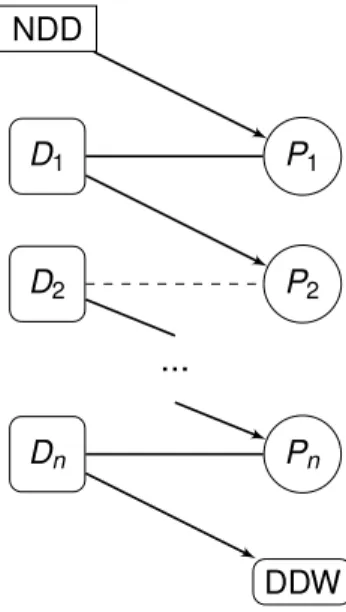
A different scenario from all of the listed above involves non-directed donors (NDD), also known as altruistic, good samaritan or unspecified donors, who are willing to donate a kidney to a patient in need, not being associated to any one in particular. Through them, a chain of transplants is initiated, and different variants have been used. One of the variants is the Domino-Paired Donation (DPD, Figure 2.5a), where the altruistic donor, instead of donating to the deceased donor waitlist (DDW), initiates that chain by donating to a patient in the KEP pool. The associated incompatible donor gives their kidney to another patient, and the process goes on until eventually a number of patients receives a kidney and the donor paired with the last patient donates to the deceased donor waitlist. The other variant involves what is known as bridge donation: donors who may later initiate themselves a chain, even though they are associated with a patient. The procedure initiates with an altruistic donor, the chained donations are performed until the patient in the last served pair gets their kidney. Their associated donor, the bridge donor, is available to initiate a chain later in time. This is known as a non-simultaneous extended altruistic donation (NEAD, Figure 2.5b).
Chains have the advantage that, because it is not a closed circuit, donor withdrawal is less harmful than in a cycle. In particular, the rule of simultaneity can be relaxed. This is a natural aspect of NEAD, considering that one chain leads to a future one, and that one is the cause of a new chain, thanks to bridge donors. That is why NEAD is also known as Never-Ending Altruistic Donor chain. In 2018, a piece of news reported that a chain initiated in this fashion led to more than 100 donations, and counting [Coo18]. Nowadays, around two thirds of all the transplants performed via the Kidney Paired Donation Program in Canada are the result of chains initiated by good samaritans [Bac].
Inclusion of compatible pairs
An alternative to using incompatible donor/patient pairs or unspecified donors is admitting pairs in the pool that are compatible [Gen+07]). The idea behind this is that compatible pairs may bring donors which are in higher demand, while the patient in the compatible pair also has the chance of finding a kidney of better quality (for instance, with stronger compatibility, or a younger donor, a healthier
NDD D1 P1 D2 P2 ... Dn Pn DDW (a) Domino-Paired Donation (DPD). NDD D1 P1 D2 P2 ... Dn Pn Dn+1 Pn+1 Dn+2 Pn+2 ... Dn+k Pn+k br idge donor br idge donor
(b) Non-simultaneous Extended Altruistic Donation (NEAD).
Figure 2.5: Altruistic donor chains.
kidney). By increasing the number of kidneys in the pool, there is a higher chance of forming new cycles or chains, while also allowing for better quality exchanges.
2.1.4 Market clearing: Models for Kidney Exchange
In the context of kidney paired donation programs, market clearing means finding an optimal ex-change scheme that maximizes the gain at the collective level, where a typical goal is to provide the greatest number of transplants to patients in need of them. With the establishment of centralized kidney exchange programs, and the growing size of pools of incompatible donor/patient pairs waiting for a match, more and more research has been dedicated to finding strategies, especially computa-tional, that allow to explore the space of possible exchanges. These approaches use optimization like Integer Programming (IP) to find an optimal exchange or exchanges to be considered. Since there are several different aspects and technicalities involved, a more formal definition of a model for kidney exchanges will help to grasp the nature and the complexity of the task at hand. This subsec-tion provides the theoretical framework by listing the necessary definisubsec-tions, notasubsec-tions and algorithms that were the base of the proposed implementation, which are aligned with the formalization given in [Glo14].
Definition 2.1.1. A pool N = NP ∪ NU consists of pairs of incompatible donor and patients (NP) and
altruistic donors (NU) waiting to be matched in a kidney exchange program.
Virtual compatibility (typically, ABO compatibility and HLA crossmatch testing) can be represented using a directed graph, in which that compatibility is made explicit.
Definition 2.1.2. A kidney exchange pool can be represented as a directed graph G = (V , A), where
V is the set of either incompatible donor/patient pairs or altruistic donors and A represents the arcs that signal compatibility between each agent, i.e., for vertices i, j ∈ V , if (i, j) ∈ A, donor in pair i can give the kidney to patient in pair j.
12 FCUP
An EDSL for Modeling Kidney Exchange Programs
NDD D1 P1 D2 P2 ... Dn Pn DDW
Figure 2.6: An example of a chain where the first and last pairs involved are compatible.
When two vertices are connected in both directions, those two pairs’ correspondent donors and patients can exchange kidneys. Altruistic donors, because they have no associated patient, have no incoming arcs. In the simplest setting, there would be a 2-way exchange between two vertices connected directly. There may be an indirect connection between two vertices, through a path, which can be defined as follows.
Definition 2.1.3. A sequence hn1, n2, ... , nki is a path if {n1, n2, ... , nk} ⊆ N and for every 1 < i ≤ k ,
(ni−1, ni) ∈ A.
This simple definition allows for establishing what cycles and chains of kidney donations are in this representation.
Definition 2.1.4. A chain of length k is a path hn0, n1, n2, ... , nki where n0 ∈ NU and, for 1 ≤ i ≤ k ,
ni ∈ NP.
Definition 2.1.5. A cycle of length k is a path hn1, n2, ... , nki where for each 1 ≤ i ≤ k , ni ∈ NP and
(nk, n1) ∈ A.
The length of a chain or a cycle defines on the number of transplants they imply, and that is why a chain of length k has k + 1 nodes and a cycle of length k has k nodes.
As discussed previously, due to practical questions, cycles and chains are usually limited in length. Hence, it is natural to define the following set:
Definition 2.1.6. In a graph for a kidney exchange pool G, the set of all cycles with length at most
k ∈ N and chains with length at most k0 ∈ N is defined as:
C(k , k0) = {c: c is a cycle of length at most k or a chain of length at most k’ in G }
The goal, as stated previously, is to find an optimal scenario where the greatest improvement, or satisfaction, is attained for the agents in the market. In the case of kidney exchange, that can be done through a combination of cycles and chains. The next concepts follows naturally.
Definition 2.1.7. An exchange M is a set of cycles and chains {c1, c2, ... , cn} such that, for every
n1
n2 n3
n4
n5 n6
Figure 2.7: Kidney Exchange example graph.
Definition 2.1.8. For a given kidney exchange graph G, the set of all subsets M ⊆ C(k , k0) such that M is an exchange is denoted by M.
Having defined the kidney exchange graph and the set of implicit cycles and chains, the optimal solution to the kidney exchange problem is a subset of all possible exchanges. Depending on the nat-ural number k limiting the size of chained donations, we are looking for a subset of M of exchanges that clear the market according to selected criteria.
A feature such as the number of transplants can be generalized as a concept of ranking ex-changes, and it is used to define those which maximize or minimize a particular criteria implied by that feature.
Definition 2.1.9. For a given exchange set M, a criterion is a function f : M → R.
With f , we can clear a problem using one particular criteria. However, we may wish to find the exchanges that optimize multiple criteria, called the hierarchical multi-criteria clearing problem.
Definition 2.1.10. For a given exchange set M and set of criteria I = {f1, f2, ... , fn}, the hierarchical
multi-criteria clearing problem is to find the subset M∗⊆ M with exchanges M∗such that, for each i =
1, ... , n, M∗ ∈ Miand each Miis recursively defined as Mi := {M ∈ Mi−1 : fi(M) ≥ fi(M0), ∀M0 ∈ Mi−1}
with M0= M.
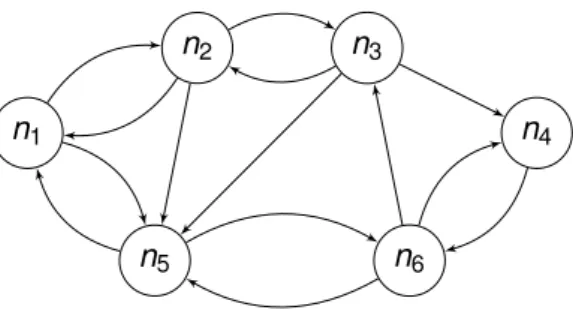
Figure 2.7 illustrates an example of graph for a kidney exchange pool. If we set k = 3, it is possible to identify five 2-way exchanges: c1 = hn1, n2i, c2 = hn2, n3i, c3 = hn1, n5i, c4 = hn4, n6i,
c5 = hn5, n6i and three 3-way cycles: c6 = hn1, n2, n5i, c7 = hn3, n4, n6i and c8 = hn3, n5, n6i. If,
however, we let k = 4, than we can identify more cycles, namely two 4-way cycles c9= hn1, n2, n3, n5i
and c10 = hn2, n5, n6, n3i. All of these cycles belong to the exchange set M, as do their disjoint
combinations. For example, the set M1 = {c1, c7} is a possible exchange, as is M2 = {c4, c6}.
When considering the number of transplants, an exchange like M3 = {c4, c9} would be considered
optimal, as it serves the most patients in the pool (in this case, all pairs get and donate a kidney). By relaxing (i.e., increasing) the parameter k of the maximum length of all cycles and chains, a single cycle c11 = hn1, n2, n3, n4, n5, n6i would clear the market entirely. Nonetheless, in a real setting, it is
usually preferable to keep cycles as short as possible (due to already discussed considerations like logistics or the possibility of failure or dropout in longer cycles), so an exchange like M4= {c2, c3, c4}
would probably be preferred, as it is composed only by 2-way exchanges and thus only implies two simultaneous transplants, i.e., four simultaneous operations.
The next subsection builds on these formulations to present strategies that enable the search for optimal exchanges.
14 FCUP
An EDSL for Modeling Kidney Exchange Programs
Integer Programming Formulations
The problem of finding the optimal set of kidney exchanges can be described using optimization programs such as Integer Programs (IP). Although there are different formulations for the problem, we present the one that was used as basis for our implementation. It is the so called cycle formulation, where the objective function consists of a linear combination of all possible cycles found in the pool.
Cycle formulation
The cycle formulation was introduced by [ABS07] and is based on the cycles of the pool, where each one corresponds to a binary decision variable x such that, for every c ∈ C(k , k0):
xc=
1 if c is included in the exchange set 0 otherwise
The program is defined as follows:
Maximize z(x ) = X c∈C(k ,k0) wcxc (2.1.4.1) Subject to X c∈C(k ,k0):n∈c xc ≤ 1 ∀n ∈ N (2.1.4.2) xc ∈ {0, 1} ∀c ∈ C(k , k0) (2.1.4.3)
In this formulation, 2.1.4.1 sets the objective function as a linear combination of variables xc
weighted by their correspondent coefficients, or weights, wc (which are usually set as the length |c|
of the cycle/chain, but kept as general as possible to serve for other criteria of optimization). The set of constraints 2.1.4.2 ensure that the same pair is not present more than once in the exchange set (i.e., each pair can only appear in one selected cycle). Conditions in 2.1.4.3 set the variables as binary. Although the problem is described as a maximization program, it can easily be converted to a minimization program if we multiply each of the coefficients of the variables by -1.
This formulation is concise but can become computationally heavy. The number of cycles grows exponentially as the number of nodes increases, as well as when we increase the length of allowed cycles and chains
The next subsection presents a formulation to model problems that require multiple criteria to be considered, keeping in line with the already defined multi-criteria hierarchical clearing problem.
Multi-criteria Formulation
Some of the already established National Kidney Exchange Programs set multiple criteria that im-plicitly define the best possible exchanges. In order to achieve this, we recursively solve the problem regarding the first criteria, then propagate the optimal value of the objective function to the problem defined by the following criteria in the form of an additional constraint, and so on until the final criteria produces the optimal exchange set. Formally, we can describe this as iterating through a set of single objective problems using the cycle formulation as basis, with m being the number of applied criteria:
Maximize zi(x ) = X c∈C(k ,k0) wc(i)xc i = 1, ... , m (2.1.4.4) Subject to X c∈C(k ,k0):n∈c xc ≤ 1 ∀n ∈ N (2.1.4.5) zj(x ) ≥ zj∗ j = 1, ... , i − 1 (2.1.4.6) xc ∈ {0, 1} ∀c ∈ C(k , k0) (2.1.4.7)
This approach is referred to as ”hierarchical programming”. As can be noted, this formulation is very similar to the cycle formulation. In 2.1.4.4, the weights are now indexed by i to refer to the problem under which they are assigned, and this definition is identical to 2.1.4.1. When i = 1, constraints 2.1.4.6 are not active. 2.1.4.5, again, limits each pair or unspecified donor to appear only once in the exchange (as in 2.1.4.2) and 2.1.4.7 constrain each variable xc to be binary, as does
2.1.4.3. When i is greater than 1, 2.1.4.6 become active constraints in the corresponding problem. They ensure that each problem takes into account the optimal value (represented by zj∗) found by all the previous objective functions. This is analogous to the condition that defines each of the exchange sets Mi in Definition 2.1.10. In that same definition, we can think of each of the criterion functions as
corresponding to each of these problems defined sequentially.
Generalizing iterative formulations
The idea of recursively finding optimal values that are propagated to following programs is not exclu-sive of the presence of distinct criteria. For example, in [Mon+19], a comparative study of matching algorithms regarding waiting times describes a process that is related to one specific criteria (that is, maximizing the number of patients that have been waiting the longest) which can be solved by an iterative formulation which is, formally, similar to the one used for multi-criteria clearing problems. Considering waiting times, we first maximize the number of patients that have waited the longest observed waiting time in the pool, than maximize the number of patients waiting for the second great-est observed waiting time, and so on until we reach of exchanges where the number of long-waiting patients is optimal. This same search can be applied to other attributes of the pool such as patients’ age, time in dialysis or a sequence of blood types.
Generalizing this routine we have, for a given set of values t1, t2, ... , tn a sequence of problems
that are solved by maximizing the number of exchanges where each value is observed. In practice, we can think of this approach as a version of the multi-criteria problem by considering that maximizing each of the listed values can correspond to a single, independent criteria. The objective function and associated constraints are the same as the ones previously presented.
Complexity of the problem and other formulations
As commented on the cycle formulation’s subsection, increasing the number of nodes, or pairs/un-specified donors, as well as the limit on the length of cycles and chains can result in an exponential growth of the size of the graph and the number of cycles and chains, which in turn creates an ex-change set that is intractable to enumerate. In [ABS07], the authors present statistics on instances of kidney exchange pools generated from real data from the United Network for Organ Sharing (UNOS)
16 FCUP
An EDSL for Modeling Kidney Exchange Programs
Nodes Arcs Cycles ≤ 4 Chains ≤ 4 Chains ≤ 6
10 50 0 1.0e+1 5.4e+1
20 192 8.00 e+1 2.21e+2 1.34e+2 50 1087 2.04e+2 9.87e+3 2.51e+5 100 4443 5.07e+3 1.84e+5 2.44e+7 200 16412 1.00e+5 2.23e+6 1.34e+9 500 99501 8.58e+6 1.02e+8 5.83e+11
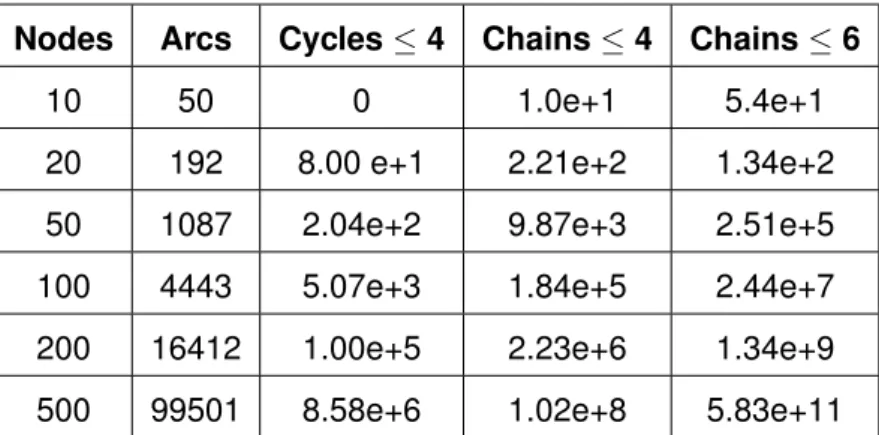
Table 2.1: Average number of cycles and chains sampled from the Dutch national kidney exchange program. Source: [Glo14].1
[Uni19], which show that, for a pool of 500 patients, an average of less than half a million cycles of length 2 and 3 are to be expected. The scale rises to a million when the number of patients doubles. Considering that each cycle corresponds to a variable in our programs, a great computational effort is expected in order to retrieve optimal exchanges. Increasing the length limit of the chains and cy-cles involved to 4 is enough to grasp the exponential progress of the number of variables, with mean values of close to 9 million for cycles and in the hundred million for chains for a pool of 500 patients (see Table 2.1). [ABS07] and [Glo14] present proof that, for a limit length of 3 and above, inspecting the existence of a perfect cycle cover for a kidney exchange graph is a problem that is NP-complete. These unavoidable issues render a simple formulation unfeasible for large instances, whether by the time it takes to enumerate the solutions or by the memory outage caused by generating them (for large enough instances, simply listing all possible cycles can exhaust available memory). The demand for more effective numerical approaches to kidney exchange arose naturally. While other simple formulations (like the edge formulation, based on the arcs of the exchange graph instead of the cycles, described in [ATM04]) suffered from the same problem as the cycle formulation (in this case, it is the number of constraints that grows exponentially, not the number of variables), the application of more elaborate strategies helped scale these programs to be able to deal with increasingly greater pools.
One of the strategies is the so called branch-and-price method [ABS07; Glo14; KAV14; Dic+16], which involves starting with a subset of the cycles calculated for the original kidney exchange graph and using the linear program (LP) relaxation (i.e., relaxing the integrality restriction on the variables) of the program to get (possibly) fractional upper bounds on the solution of the IP version. Whenever specific conditions (attributing a price, or cost to the cycles) show that adding new variables help improve the optimal value, we proceed with the increment. As long as the retrieved optimal value is fractional, the branching strategy restricts one or more variables back to integral values and repeat this process.
By using a smaller set of variables, we keep the problem simpler and quick to solve. This makes sense since, for example, in the cycle formulation, the objective function consists of a linear combina-tion of all variables that correspond to cycles in the graph, but the exchanges are usually composed of very small subsets of all cycles. Column generation algorithms (which correspond to adding variables to the program) inspect the cost of those additions and its impact on the optimal value. Linear dual-ity conditions are used to check the improvement of the incremented program in finding the optimal
value of the original, complete problem.
Another strategy consists in new integer programs which are compact. A compact formulation means that the number of variables or constraints of a problem grow but are bounded by a polyno-mial, which keeps the programs from exhausting computational resources as quickly. In [Con+13], the authors propose two new formulations, the edge assignment formulation and extended edge for-mulation, and while the classical formulations (edge and cycle) present linear relaxations with tighter upper bounds on the optimal values, results from the article suggest that these compact formulations are more capable of handling larger instances, when considering a greater limit on the cycle and chain lengths or when the graphs have higher density. There is a trade-off between finding a tight bound, reaching optimality faster and being capable of computationally handle the problem. An im-portant contribution was the proposal of adaptations of the programs to handle other variants of the problem, such as the inclusion of altruistic donors or compatible pairs.
Authors in [Dic+16] proposed three new formulations, two of which are compact: the position-indexed edge formulation and the position-position-indexed chain-edge formulation. While the former handles cycles only but maintains the tightness of the linear relaxation, the latter is capable of handling chains but still produces an exponential number of variables, namely the ones pertaining to cycles, and so the program is still sensible to the limit imposed on length. In order to tackle this issue, the authors present an implementation combining this program with the branch-and-price strategy. A final formulation, which is a combination of the first two, is also compact.
2.1.5 Related tools and software
The application of kidney exchange, whether in its incipient years or in the context of defined lo-cal and national programs, has mutually influenced the extensive research that aimed to discuss its moral complexities, their implications such as criteria that translates to better outcomes, while also improving implementation at the technical level. Also many, if not all of the established KEPs use computational tools in order to decide which are the best possible exchanges. In this subsection to provide a few examples of tools developed that enable research validation and also refer some so-lutions that implement kidney exchange schemes or allow to customize search runs, while providing some form of visualization.
Data models and simulators
As discussed previously, a lot of investigation is dedicated to improving the performance of market clearing algorithms. As a result, it is a common and necessary practice to present benchmarking tests that assert the claims made about new implementations. Credibility is added when the data used is, at least, sampled from real records. An example is Table 2.1, where the length of cycles and chains are averaged from multiple samples of pools based on real data from the Dutch program. But this is not always possible. Even in those cases, there is the idea of producing data that is based on a reasonably realistic model of a certain population. This way, it is possible to generate multiple instances of data with the goal of providing average performance indicators.
The data generated in [ABS07], presented in the previous sections, follows a processed described in [Sai+06], which aims to assess the effectiveness of kidney paired donation programs by means of simulations based on real data. The authors present statistics derived from that data that allows the generation of new instances of incompatible donor/patient pairs.
18 FCUP
An EDSL for Modeling Kidney Exchange Programs
These simulations can be made parametric and formalized into specific tools. In [San+17], a simulator for both pool generation and optimization is presented. It is a system comprised of several modules that tackle each of the parts of the process of generating new data. It is highly customizable, allowing the user to choose general parameters such as different exchange modalities (include only incompatible pairs or allow the inclusion of compatible pairs and multiple donors, for instance), but also to input the characteristics of the participants of the pool, such as distribution of blood type and age or even the level of PRA. A dedicated PRA estimation module estimates PRA based on the input profile and uses it to form incompatibilities between generated couples. Finally, a pool generation module puts this all together to instantiate a virtual group of donors and patients in a KEP pool. Additional modules help manage the pool’s changes over time (one of the main goals of the simulator is to study the behavior of different policies and exchange schemes as pairs are matched or become unsuitable for transplantation and eventually leave the pool) and perform the optimization itself.
Software for exploring and optimizing KEP instances
Although most of the software used in real kidney exchange programs is not public, we were still able to find some examples of applications that allow the input of a KEP pool and, to a certain degree of parameterization, enable optimization subject to desired constraints. In this subsection we present two examples.
The first one, found in [MO12], is an application dedicated to finding the optimal exchanges for the national UK kidney exchange program. In fact, the authors present two pieces of software: one, the Kidney Exchange Allocator, that implements the problem with the hierarchical criteria as defined by the National Health Service Blood and Transplant and a second one, the Kidney Exchange Data Analysis Toolkit, that enables the exploration of the impact of the same criteria. It allows the user to simultaneously test the impact of different combinations of criteria, in a simple but intuitive interface. Data describing the pool of registered pairs must be input in a JSON format and for each run there are options to define the limit on cycle and chain lengths independently, as well as the desired constraints, ordered to a preferred hierarchy. These tools come in the form of a web application, adding that the former also is available in a web API version. A screenshot of the data analysis toolkit is found in Figure 2.8.
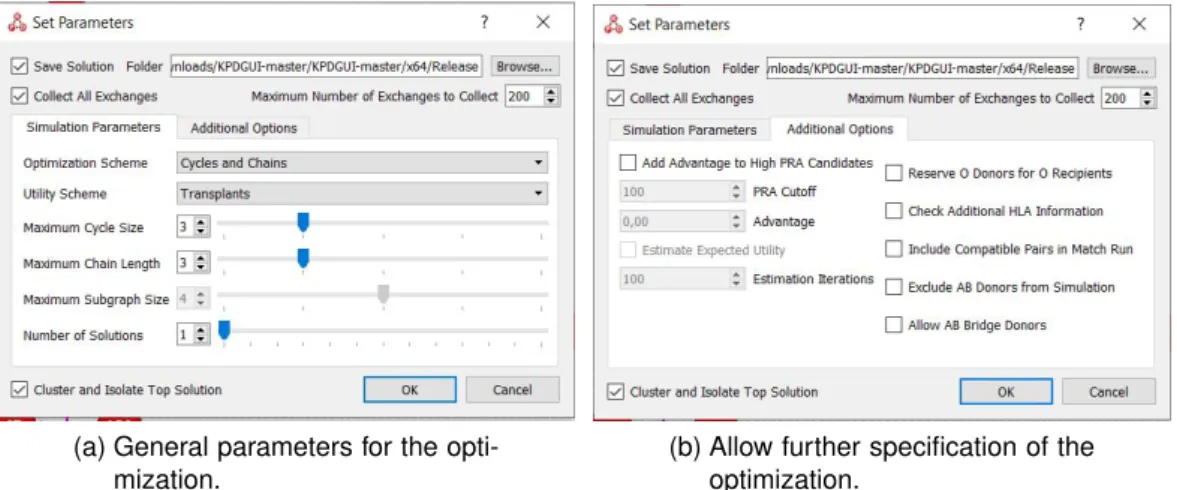
The other example is a software for KEP management, optimization and visualization, called KPDGUI [Bra+19], and it is the most complete system that we found that was free to use. It allows the user to create a new pool entirely or upload a preexisting database of patients and donors, and then to edit that same pool either by changing the existing data or by adding or removing pairs and altruistic donors. Upon loading the information, a visualization of the pool and its virtual compatibility graph is instantly presented (see Figure 2.9a). Exploring the software, it is noted that the software is prepared to deal with different modalities for kidney exchange, like the inclusion of non-directed donors or the association of multiple donors to one patient. The “matching runs” are also very customizable, as the software allows to tune various parameters like prioritization of high PRA candidates, inclusion of compatible pairs, dedicate blood type O donors for blood type O patients, to name a few (see Figure 2.10a). Also, for more general parameters, the user can set the length limit for cycles and chains and set the number of exchanges returned; different optimization schemes are also included where, for instance, we can impose the existence of fallbacks in cycles and chains (possibility of smaller exchanges in case of failure, from 3-way exchange to a 2-way exchange, as an example).
Figure 2.8: The interface of the Kidney Exchange Data Analysis Toolkit.
(a) Small KEP instance and its com-patibility graph.
(b) Larger KEP instance after run-ning optimization. The top so-lution is now represented in the graph.
Figure 2.9: Visualization examples in KPDGUI.
The software also lets the user choose different utility schemes, an option that also influences the objective of the optimization, by setting the goal on a number of goals like number of transplants, mid and long-term survival rates, and difficult transplants (see Figure 2.10b). Finally, after the matching is made, the graph’s look changes in order to display which exchanges are part of the optimal setting (Figure 2.9b).
2.2
Domain-Specific Languages
A Domain-Specific Language (DSL) is a term describing any programming language designed to express, model and solve problems in a specialized domain. This set of problems, which motivate the development of a number of applications and for which that language constitutes the basis, is referred to as the domain. They contrast with General-Purpose Languages (GPL), whose domain is not specific and are capable of tackling many different domains using generic syntax and semantics.
20 FCUP
An EDSL for Modeling Kidney Exchange Programs
(a) General parameters for the opti-mization.
(b) Allow further specification of the optimization.
Figure 2.10: Parameter interface of KPDGUI.
Programming Language Domain
pic, postscript 2D graphics TEX, LATEX document layout
Open GL high-level 3D graphics Mathematica, Maple symbolic computation
Emacs Lisp text editing
Prolog logic
Lex and Yacc program lexing and parsing
Table 2.2: List of DSLs and their domain. Source: [Hud98]
In fact, there are currently many examples of programming languages that can be considered domain-specific. Paul Hudak presented a simple table with some examples of programming lan-guages and the domains they were designed for (see Table 2.2). Some of the listed items may be referring to systems with their own programming language within them.
2.2.1 Designing and implementing a DSL
There are two main categories of DSLs [Fow10]:
External DSL a domain-specific language that is created in separate to other host languages. It
can be used by other languages, but usually has its own syntax and constructs. Some exter-nal DSLs are standalone products. For example, Mathematica [Mat] is a program for symbolic computation with its own programming language (the Wolfram Language) that can link to other, more general purpose languages. While these languages have the advantage of allowing syn-tax which is very close to the notations used by domain experts and can provide more adequate error reporting, also allowing for optimizations at the domain level, they require a great amount of effort to implement, since all of the components of the language would most likely have to be implemented for the language (like a dedicated lexer, parser, a compiler or interpreter). Moreover, language extensions would also be harder to achieve [MHS05].
Internal (or Embedded) DSL (or domain-specific embedded language) a domain-specific language
that is built by using the features and constructs offered by a general-purpose language. In other words, internal DSLs are built using the constructs and abstractions of an existing general-purpose language. Main advantages are that they are easier to implement, as a lot of the fundamental mechanisms like the processor already exist; a lot of language features from the host language can already be good enough for domain-level abstraction; code is easier to extend and reuse. On the other hand, we are limited to the host language’s syntax, which can distract the domain expert from the domain notation; error reporting can be ineffective if not customizable; and optimizations at the domain level may be harder to achieve [MHS05]. A good example of an external DSL is AMPL [AMP; FGK03], a language designed for optimiza-tion. It has its own syntax constructs, designed to bring the programmer closer to the domain. Since optimization relies on mathematical models, AMPL expressions are very close to what could be con-sidered mathematical equations. It allows to describe optimization models like linear programs, and then has a data mechanism to fill the model with specific information. The language connects the model to a solver that will retrieve optimal solutions and several other related output.
In general, when creating a domain-specific language, we might have to deal with all the building blocks, more or less complex, of giving good domain abstraction to a domain expert. In fact, just like any software, programming languages are exposed to updates and optimization in a possibly endless process. It depends on the community support a programming language has, its popular-ity, how useful it is in the software development landscape, and just how much work and effort it takes to maintain such a language. Ultimately, the context of the domain itself (how relevant are domain-specific notations, how important are domain-specific optimizations or how necessary are good analysis constructs like error reporting) will influence the choice of the style of implementation to use.
2.2.2 The embedded case
As mentioned in the introduction, the goal of this dissertation was to develop a prototype of a domain-specific embedded language for modeling kidney exchange programs. In this section, we will address this approach in a more detailed fashion.
Like stated above, internal DSLs, also known as embedded domain-specific languages (EDSL) is an implementation technique which takes advantage of a host language, thus avoiding cumbersome work associated with implementing a completely new programming language. For instance, since we are working within the syntactical and semantical limits of an already designed language, compiling or interpreting issues will not be something to tackle with right away [VKV00]. EDSLs rely on their host language’s features to become more and more expressive, in the sense that by capturing an increasingly better picture of the semantics of the domain in question, the language itself becomes more useful. Thus, when designing an EDSL, we are interested not so much in the syntactical details of its design (since, like we said, the “playground” for syntax is as limited as is the host language itself and, to some degree, the user, if still not familiarized, will have to learn at some level how to communicate with that host language, which can constitute a disadvantage in some cases), but rather in the semantics of what we are building. When reasoning about a EDSL, we must never forget who the intended future user is: a domain expert, to whom an application should be very quickly readable). An EDSL should provide very readable code at the domain level; because of this, it is often the case
22 FCUP
An EDSL for Modeling Kidney Exchange Programs
Name Domain
Django [Dja] High-level web design Numpy [Num] Scientific computing
Pandas [Pan] Fast multidimensional data processing PyFX [Lej06] real-time graphics effects PyGPU [Lej06] high-speed image processing
Table 2.3: Examples of EDSLs implemented in Python.
that they have a high-level programming language look and feel.
2.2.3 Python as a host language
Python [Pyt] is a general-purpose, high-level, multi-paradigm, substantially modular programming lan-guage that was conceived and initially implemented by Guido Van Rossum at the end of the 1980s. Like other programming languages, it has grown and matured into a fully fledged system used in a wide range of areas and suffering continuous updates and increments, currently going on version 3.7.3. Python has become one of the most popular and used programming languages around the world [TIO], and is growing, among other reasons, with the help of a large and supporting community. It was described as “batteries included” due to an extensive standard library, increasing the useful-ness and variability of application domains of this truly general-purpose language. Python is also known for its high level of abstraction, using language constructs that center the programmer around the concept of the problem at hand, freeing them from the more low-level aspects of a computer system, like memory and process management.
A common form of interacting, developing and testing Python code is through an interactive en-vironment, the Python interpreter. An advantage is that it is possible to execute single lines of code individually and inspect the result of their execution.
As a host language, Python is well suited for embedding our proposed implementation. The rest of this section lists and comments some of these features and characteristics, which are either suitable for the implementation itself or, looking from the DSL point of view, serve as useful constructs to aid in building new applications in the domain or even to extend it to some degree. Table 2.3 presents some examples of internal DSLs that were implemented in Python.
Syntax and code readability
Python prioritizes code readability and it is, indeed, one of its distinct features. Code written in Python, especially when aligned with good programming practices, is clear and concise, allowing for a good logical structure. The syntax is also a facilitating aspect of the language design: for example, its use of whitespace and indentation impose a particular structure such that even a less organized developer can maintain a minimal degree of readability. Flow control statements like the for loop or conditional execution (if statements) are very straightforward (see Figure 2.11 and also notice how indentation helps with code readability).
for pair in kpd.pool:
if pair.patient['Age'] > 40 :
print(pair.patient['Name'])
Figure 2.11: Example of for loops in Python.
A high-level programming language
Python’s high-level constructs make that language particularly advantageous for implementing an in-ternal DSL: the host language is already powerful in the abstraction sense, so the work of keeping the new programming language focused on the domain is substantially facilitated. To that effect, Python has useful features such as built-in types (data structures like lists and dictionaries); compact but ex-pressive constructs (such as list comprehensions and if-then-else expressions); its fundamental class system, allowing the definition of generic objects with associated methods and attributes, modeling domain level concepts; operator overloading, where we can add meaning to operations involving user-defined class instances and use Python’s own syntax to express such operations; lambda ex-pressions which are anonymous functions defined locally and allow simple function definition with single expressions; the decorator mechanism, which wraps functions with additional information, be-havior and context (for example, at the domain level) and the property function which is another mechanism for setting and getting attributes from objects while performing computation that, for ex-ample, performs domain-level verification.
DSLs, whatever their form of implementation, are naturally also high-level languages, so it is in our interest to have available abstractions that will build on this domain-specific language.
Multi-paradigm design
Python offers different programming paradigm features that help bring about complex programs and integrate several approaches to problem solving and software design:
• Imperative: Python’s execution has side effects and produces changes on the machine’s state. Variable assignment and structure manipulation depend on the state of memory at the time of execution.
• Procedural: Statements are executed line per line, jumping to function calls and constructor methods when needed.
• Functional: Python’s standard library carries methods and includes modules such as itertools and functools, which implement various concepts characteristic of functional programming lan-guages, like mapping over a collections of items, using list comprehensions or currying func-tions. Also, functions are first class citizens, which means they can be passed to other functions and referenced as other primitive types. This is specially useful for delaying computation (a form of lazy strategy where a function is passed but is not intended to be applied immediately). An example of a function being used as an argument to another function is given in Figure 2.12 (in this example, although the output is shown as a list, it is in fact a map object, where the function to be applied is stored and applied only to the values of the list when the result of that application is requested).
• Object-oriented (OOP): One Python’s most recognized asset is its OOP constructs. They form the basis of the language since everything in it is an object. As mentioned earlier, Python also