A Practical Guide to Integrated Project Planning and
Evaluation
Ulrich Schiefer
Reinald Döbel
Budapest
2001
Please quote as:
Schiefer, Ulrich; Döbel, Reinald (2001) MAPA – Project. A
Practical Guide to Integrated Project Planning and
Evaluation. OSI-IEP Publications, Budapest 132 p.
Institute for Educational Policy
OPEN SOCIETY INSTITUTE
MAPA-PROJECT
A Practical Guide to
Integrated Project Planning
and Evaluation
By Ulrich Schiefer
and Reinald Döbel
With contribution
from Lucinia Bal
MAPA stands for Método Aplicado de Planeamento e Avaliação (Method for Applied Planning and Assessment). It was developed by Ulrich Schiefer and António Batista. Leonor Gandra, Carla Batista and Marina P. Temudo contributed to the first manual devel-oped for the Portuguese Co-operation Institute, ICP.
© Ulrich Schiefer
MAPA is a protected trademark.
This version was adapted for the Instiute for Educational Policy by Ulrich Schiefer and Reinald Döbel. We encourage its free use and distribution by all workshop participants.
For translation into other languages, please contact:
[email protected] or dobel@uni_muenster.de or [email protected]
ISBN: 963 7316 96 5
Institute for Educational Policy
OPEN SOCIETY INSTITUTE
MAPA-PROJECT
A Practical Guide to
Integrated Project Planning
and Evaluation
By Ulrich Schiefer
and Reinald Döbel
With contribution
from Lucinia Bal
Acknowledgements
The authors wish to express their thanks to the staff of the Institute for Educational Policy, which is part of the Open Society Institute-Budapest, and provides support for the Soros foundations network.
We are also grateful to the workshop participants from the national foundations and spin-off organisations of many countries, who have contributed many valuable suggestions to this handbook.
A special thank you to Lucinia Bal who accompanied the introduction of the MAPA process to the Soros founda-tions network from the beginning and who has made important contribufounda-tions to this handbook. Her strategic vision, clarity of purpose and patience have been a constant source of encouragement.
We are grateful to Marlene Laeubli, from the Swiss Federal Office of Public Health, and to Benoit Girardin, from the Swiss Agency for Development and Co-operation, for the review of this handbook. Their suggestions are the start-ing point for the development of the second edition of the handbook, currently under preparation.
Ulrich Schiefer Reinald Döbel
Table of Contents
Table of Contents . . . 7
PART I: What Is MAPA?. . . 11
Introduction. . . 11
Purpose of the Handbook. . . 11
History of the Handbook . . . 11
Structure of the Handbook . . . 11
Integrated Participatory Project Planning and Evaluation in Perspective. . . 12
Players and Perspectives . . . 13
Participation. . . 14
Limitations of the participatory method . . . 15
Strategic Planning and Project Planning . . . 16
The MAPA-PROJECT and PROJECT CYCLE MANAGEMENT (PCM) . . . 17
A MAPA-PROJECT Overview . . . 21
Planning. . . 21
Evaluation . . . 22
Fast-track Planning . . . 24
Fast-track Evaluation. . . 24
PART II: MAPA "STEP BY STEP" . . . 25
NORMAL PLANNING. . . 26
Preparation of Planning Workshop I . . . 26
Preconditions . . . 26 Guiding Questions . . . 26 Concrete Steps . . . 26 Results. . . 28 Planning Workshop I . . . 29 Preconditions . . . 29 Guiding Questions . . . 29 Concrete Steps . . . 30 Results. . . 32
Preparation of Planning Workshop II. . . 33
Preconditions . . . 33 Guiding Questions . . . 33 Concrete Steps . . . 33 Results. . . 33 Planning Workshop II . . . 34 Preconditions . . . 34 Guiding Questions . . . 34 Concrete Steps . . . 34 Results. . . 35 Subtitle
Finalisation of the Planning Phase . . . 36 Preconditions . . . 36 Guiding Questions . . . 36 Concrete Steps . . . 36 Results. . . 36 EVALUATION . . . 37
Procedures of the Evaluation . . . 38
The difference between a "normal evaluation" and an "evaluation with re-planning" . . . 38
Normal Evaluation. . . 39
Preparation of Evaluation Meeting I. . . 39
Preconditions . . . 39 Guiding Questions . . . 39 Concrete Steps . . . 39 Results. . . 40 Evaluation Meeting I . . . 41 Preconditions . . . 41 Guiding Questions . . . 41 Concrete Steps . . . 41 Results. . . 42
Preparation of Evaluation Meeting II . . . 43
Preconditions . . . 43 Guiding Questions . . . 43 Concrete Steps . . . 43 Results. . . 43 Evaluation Meeting II . . . 44 Preconditions . . . 44 Guiding Questions . . . 44 Concrete Steps . . . 44 Results. . . 44
Finalisation of the Evaluation Phase. . . 45
Preconditions . . . 45
Guiding Questions . . . 45
Concrete Steps . . . 45
Results. . . 45
Evaluation with Re-planning . . . 46
Preparation of Evaluation and Re-Planning Meeting I . . . 47
Preconditions . . . 47
Guiding Questions . . . 47
Concrete Steps . . . 47
Results. . . 48
Evaluation cum Re-Planning Workshop I . . . 49
Preconditions . . . 49
Guiding Questions . . . 49
Concrete Steps . . . 49
Results. . . 50
Preparation of Evaluation cum Re-Planning Workshop II . . . 51
Preconditions . . . 51
Concrete Steps . . . 51
Results. . . 51
Evaluation cum Re-Planning Workshop II. . . 52
Preconditions . . . 52
Guiding Questions . . . 52
Concrete Steps . . . 52
Results. . . 53
Finalisation of Evaluation and Re-Planning . . . 54
Preconditions . . . 54
Guiding Questions . . . 54
Concrete Steps . . . 54
Results. . . 54
Fast-Track Planning . . . 55
Preparation of a Fast-Track Planning Workshop . . . 56
Preconditions . . . 56
Guiding Questions . . . 56
Concrete Steps . . . 56
Results. . . 56
The Fast-Track Planning Workshop . . . 57
Preconditions . . . 57 Guiding Questions . . . 57 Concrete Steps . . . 57 Results. . . 58 Finalisation. . . 59 Preconditions . . . 59 Guiding Questions . . . 59 Concrete Steps . . . 59 Results. . . 59 Fast-Track Evaluation . . . 60
Preparation of the Fast-Track Evaluation Meeting . . . 60
Preconditions . . . 60
Guiding Questions . . . 60
Concrete Steps . . . 60
Results. . . 60
The Fast-Track Evaluation Meeting. . . 61
Preconditions . . . 61 Guiding Questions . . . 61 Concrete Steps . . . 61 Results. . . 61 Finalisation. . . 62 Preconditions . . . 62 Guiding Questions . . . 62 Concrete Steps . . . 62 Results. . . 62 Table of Contents
PART III: APPENDICES . . . 63
List of APPENDICES . . . 63
APPENDIX 1: Checklist for the Preparation of Workshops . . . 64
APPENDIX 2: Facilitation . . . 66
APPENDIX 3: Visualisation . . . 68
APPENDIX 4: Problem Diagnosis: Problem "Clouds" . . . 70
APPENDIX 5: Defining Goals and Objectives . . . 73
APPENDIX 5a: Problem "Trees" and Objective "Trees" . . . 74
APPENDIX 5b: The Eisenhower Model . . . 77
APPENDIX 6: The Logical Framework (Logframe) Method . . . 78
APPENDIX 7: The Project Implementation Plan . . . 82
APPENDIX 7a: Monitoring of Activities . . . 84
APPENDIX 7b: The Gantt Schedule for the Preparation of a Planning Workshop . . . 85
APPENDIX 7c: The Gantt Schedule for the Preparation of an Evaluation Meeting . . . 88
APPENDIX 8: The "Mopping Up" Exercise . . . 91
APPENDIX 9: The "Kill the Project!" Exercise . . . 92
APPENDIX 10: Risk Analysis. . . 93
APPENDIX 11: Stakeholder Analysis . . . 94
APPENDIX 12: Target Group Analysis . . . 95
APPENDIX 13: Partner Analysis. . . 96
APPENDIX 14: Analysis of the Institutional Framework . . . 98
APPENDIX 15: Gender Analysis . . . 100
APPENDIX 16: Viability Studies. . . 103
APPENDIX 17: The Monitoring and Evaluation System . . . 104
APPENDIX 18: The Impact Evaluation Matrix . . . 106
APPENDIX 19: Format for a Project Document . . . 115
APPENDIX 20: Format for an Evaluation Report. . . 116
APPENDIX 21: Staff Profiles . . . 118
APPENDIX 22: Terms of Reference (TOR) . . . 119
Bibliography . . . 120
What Is MAPA?
Introduction
Purpose of the Handbook
This handbook is intended as an aide-mémoire and guide for workshop participants who have gathered experience in facilitation and in the MAPA-PROJECT process. It is intended as a book for use, not as a book for reading. The use of this handbook is explained in the third section of this introduction, Structure of the Handbook.
Experience has shown that proficiency in the participatory methodology used in the training workshops is a pre-condition for the success of the MAPA-PROJECT method described in this handbook, and we therefore start with a
Disclaimer:
Whoever tries to use the methods described in this handbook without having attended the training workshops is responsible for any undesirable results this may produce. This, of course, does not mean that those who have attended workshops are not also responsible for the results...
We think, however, that experienced facilitators who also have some knowledge of planning and evaluation procedures, and the logframe method in particular, can use this handbook as a resource for a particular sequence of the MAPA-PROJECT process (see the MAPA-MAPA-PROJECT Overview) and for any of the particular methods employed. In this case, we highly recommend that they read Part I of this handbook (this introduction, Integrated Participatory Project Planning and
Evaluation in Perspective, and the MAPA-PROJECT Overview) before experimenting with any of the specific techniques.
History of the Handbook
MAPA was originally developed in order to introduce a unified planning and evaluation method for the diverse insti-tutions involved in Portuguese development cooperation. The authors are social scientists with different disciplinary backgrounds and varied professional experience. Beyond its original purpose, the method is now widely used in government and civil society institutions in Portugal. This additional experience has led to a further refinement and adaptation of the method. It has also shown that the MAPA process enables institutions with different organisational cultures and ways of working to cooperate and coordinate their efforts towards achieving a common goal.
Structure of the Handbook
For ease of use, the book has been divided into three parts: PART I (this part), which gives an overview of the book and the complete MAPA-PROJECT process; PART II, which acts as a step-by-step guide through the particular pro-cedures of project planning and evaluation; and PART III, which contains all the specific techniques used in the "stan-dard" and "fast-track" workshops for planning and evaluation, as well as the recommended formats for project and evaluation documents. Compiling all the techniques and document formats in Part III leaves the sequence of steps uncluttered by repetitive technical details and allows the user of the handbook to easily access the specific techniques whenever necessary.
Integrated Participatory Project Planning
and Evaluation in Perspective
The user of this book should be aware from the start that this is not a comprehensive guide for all purposes: inte-grated participatory project planning and evaluation are but one aspect of all the various modern attempts to intro-duce change into social systems and institutions. All these attempts require some kind of intervention that is usual-ly guided by a strategic vision. This vision provides the bigger picture, of which the individual project and the organ-isations running the project are particular parts. The overall picture also comprises other organorgan-isations, other pro-jects, other target groups, and other social groups, and it works in much larger timeframes than a project can: while planned social change may be calculated in terms of decades, projects are usually firmly lodged within the budget-ing constraints of a one to three-year timeframe.
Nonetheless, some of the techniques used for project planning (such as visualisation, facilitation, and some of the diagnostic tools) can also be used for strategic planning and organisational change, provided the "bigger pic-ture" aims at more openness, trust, and co-operation. In other words, they work if both democracy and efficiency (rather than the concentration of power and control) are part of the strategic vision. We will come back to this point later. The reader will probably agree that the strictly controlled hierarchies of many governments that aim to control rather than to govern the populations of the respective countries will find it difficult to accept even the idea of partic-ipatory project planning. If they do so because of the demonstrated value of the method with respect to project effi-ciency, they may find it difficult to integrate such a project into their normal administrative routines. Yet, it has hap-pened that this attempt triggered further demand for changing some of these routines because they were beginning to feel inefficient themselves. Thus, the introduction of participatory project planning can induce a demand for par-ticipatory strategic planning and even for organisational change. MAPA can offer solutions for both of these demands, but these solutions are the object of separate training courses and their respective handbooks.
The Organization The Institutional
Landscape
The Project
The Target Group
Players and Perspectives
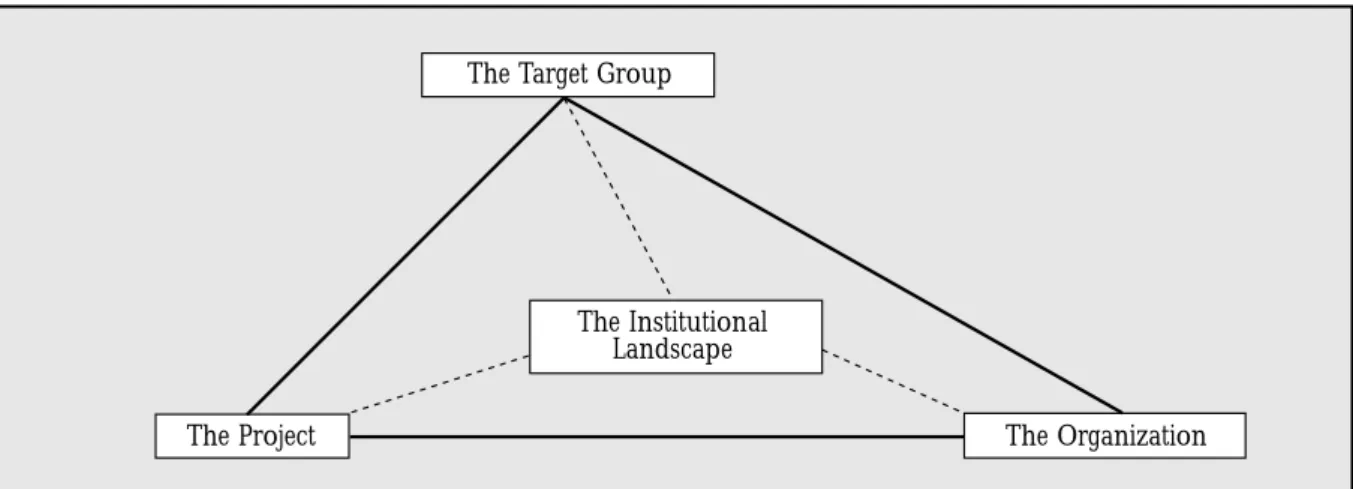
Any project can be and is looked at from the perspectives of the different players: the perspective of the project itself, the perspective of the organisation that runs the project, the perspective of the target group (of which there may be more than one), and the perspective of all the other organisations that are affected by or have some influence over the project in one way or another. These four perspectives can be represented by a three-dimensional geometric fig-ure, a tetragon. Using this image makes one aware that this "whole" (comprising the project, the organisation, the target group, and the organisational landscape) looks different when viewed from each of its four "corners."
Fig. 1: The MAPA “Crystal”
The participatory MAPA-PROJECT process allows for the integration of all these different views, to some extent, in both the planning and evaluation phases of a project. Integrating these views allows for a more comprehensive per-spective, and provides one that is also more realistic because views from a perspective other than that of the pro-ject's can be accommodated from the very beginning. Having a perspective not taken into account usually means that a player has been overlooked, a player who may later put unforeseen obstacles in the project's way in an attempt to push forward interests previously not taken into account.
The project itself is situated within an organisation and looks at "the world" with the aim of enlisting resources in
order to achieve a clearly stated goal. The resources come not only from within the organisation but also from other parts of the outside world, from other organisations, as well as from the target group itself. All the project's activi-ties use these resources in order to achieve measurable results in one particular segment of the outside world. The most relevant aspect of this segment is called the target group. To the extent that the project provides a particu-lar service, the target group is comprised of the people who should benefit directly from this service. They are the
users of the project.
On the other hand, those people or organisations with whom the project has to deal with in order to get funding are the project's clients. It is important to be clear about this distinction: the interests of the one who gives the money can be quite different from the interests of those who should benefit directly from the services. The project needs to satisfy both interests without confounding them.
To some extent, the project also needs to take into account the interests of other players and organisations with whom some form of collaboration is necessary in order to satisfy the two primary sets of interests (the target group's and client's), including organisations that provide resources or contractual services, social groups interacting with the tar-get group and affected by any change in the tartar-get group, and organisations and institutions active in the same field or competing with the project for the same financial or other resources. This reveals the importance of analysing the
organisational landscape and how the project, its organisation, and the target groups are seen from the differ-Integrated Participatory Project Planning and Evaluation in Perspective
ent perspectives present within the organisational landscape. This landscape is composed of different organisations, institutions, and social groups, each of which has its own particular perspective. MAPA-PROJECT takes these perspec-tives into account during the planning workshops and evaluation meetings by inviting representaperspec-tives of particularly important organisations to the workshops, by conducting specific studies when needed, and by using the participants' knowledge about these perspectives and interests. In this way it is possible to locate potential partners and potential opponents, with the intent of turning their possibly contradictory views into a valuable resource for the project.
The organisation looks at the project as one of its regular or extraordinary activities. Thus, the project is integrated into a bigger framework. This applies both to the goals of the project and to the resources committed to the project. At the same time, the organisation needs to leave enough manoeuvring room for the project to function according to the participatory mechanisms upon which MAPA-PROJECT is based. In concrete terms, this means that the organisation's responsibility is transferred to the project manager once the expected results have been defined and the budget for their achievement has been approved. The details of allocating these resources to specific activities within the framework of a project implementation plan are then the sole responsibility of the project's manager. For details, see the section on the 'logframe' and the 'project implementation plan' in Part III (See Appendix 6: Logical Framework and Appendix 7: The Project Implementation Plan).
The target group is comprised of the 'users' of the project's services. To some extent, all social intervention pro-jects provide services (we are not dealing with investment propro-jects in this handbook). Past experience with other ser-vices will have influenced the target group's expectations, as will rumours about this and other intended projects. Social intervention projects usually expect some kind of input from the target group, and the expectations of the tar-get group will influence their willingness to provide these inputs. The participatory methods of MAPA-PROJECT are designed to provide a platform for negotiation between the target group's expectations, the initial project idea, and the interests of the other players mentioned above. If all players agree to this process and follow it through togeth-er, the final project plans, including the goals, will reflect the consensus reached through this process of negotiation. This increases the chances that all participants will honour their commitments as detailed in the logframe and the project implementation plan.
Participation
As already mentioned, the main reason for putting MAPA-PROJECT firmly on the foundation of a participatory methodology is the possibility of achieving a negotiated agreement between all parties concerned. In this way, dif-ferent (and often conflicting) viewpoints can be integrated into a plan that displays greater logical coherence; by mak-ing possible disagreements transparent, they become resources for a negotiated agreement that incorporates them all. Thus, there will be less friction between the different groups once implementation of the project starts. Along with greater logical coherence, this also entails a more rational use of available resources, leading to greater overall pro-ductivity. For the providers of funds, this means "more bang for the buck.".
Because all the relevant stakeholders are present whenever decisions are taken, the process itself is transparent. This transparency increases trust in the decisions reached in this manner, both internally and externally. Internally, the trust created by the participation of all relevant stakeholders in the decision-making process increases their motiva-tion to carry out the agreed-on commitments. As these commitments are all fixed in writing, the possibilities for non-compliance are reduced because a participant's non-non-compliance will at least become public. This becomes particu-larly important if the project is undertaken in a society that has a history of strictly hierarchical ways of organising things: such social and/or organisational contexts are usually characterised by a distrust of "intrinsic" motivation and therefore tend to emphasise strict methods of control. Externally, in an international climate that shows a tendency towards transparency and participation, the use of transparent and participatory methods for planning and evalua-tion increases the credibility of a project (and of the organisaevalua-tion that runs it) when it is submitted for funding.
In addition to logical coherence, transparency, and trust, MAPA-PROJECT provides a standardised format and a coherent language of project management, a language that is internationally understood by project planners, evalu-ators, and funding organisations. Therefore, both the intentions of the project and its results can be more easily com-municated within the international network of organisations and individuals professionally engaged in social change projects. With such improved communication, successful experiences can be more easily shared for the benefit of other projects, both between professionals as well as between professionals and non-professionals belonging to tar-get groups. Participation in MAPA-PROJECT process equips people with a "communication interface" that allows for the collaboration and co-operation of very different partners in the same project, including small NGOs and large foundations, private businesses and government departments, non-professionals and experts. Often, representatives of these different groups also belong to different cultures, and the MAPA-PROJECT is designed to facilitate cross-cul-tural communication and collaboration.
Of course, all this only works to the advantage of the participants if participation, transparency, and trust are what all the participants and stakeholders want. It is important to stress this point because there are many social situa-tions and contexts where this is not the case. It is therefore also necessary to discuss the limitation of the process.
Limitations of the participatory method
The most important limitation has already been mentioned: if important stakeholders do not themselves want to par-ticipate or to admit the participation of others, then the MAPA-PROJECT, or any other participatory method for that matter, cannot be used. It is irrelevant whether this reluctance to participate is caused by the fear of transparency, the fear of loss of personal advantages, the fear of the unreliability of others, the insistence on privileged positions of wealth and power, or any other destructive attitude. Whenever important stakeholders cling to any of these or sim-ilar positions, it is impossible to use participatory methods. Participation can only mean voluntary participation, and it cannot be enforced.
Therefore, it is equally difficult to use MAPA-PROJECT, or similar methods, in social contexts that rely heavily on top-down decision-making, on command structures. An army represents an extreme case of such an organisation, but, more generally, strongly hierarchical organisations find it difficult to leave enough manoeuvring room for par-ticipatory processes. They may agree to send a representative to a MAPA-PROJECT meeting, but then "forget" to entrust him or her with enough responsibility to make binding commitments in the name of the organisation. If this occurs during the second planning workshop (see "Overview"), during which final decisions about the project's goals and project implementation plan are taken, the workshop may fail to achieve its purpose.
Other limitations to the use of MAPA-PROJECT and participatory processes in general are as follows:
❖ In highly volatile and risky environments, these processes are difficult to organise in the first place, and any deci-sions made through such processes may become outdated quickly due to rapid changes in the environment. In such environments, hierarchical forms of organisation may be more appropriate.
❖ In "low trust societies", those in which homo hominis lupus est, people are not willing to disclose what their real problems, feelings, and judgements are because all "public" statements are subject to tactical instrumental consid-erations. In such a situation, any consensus reached through a seemingly participatory process may not repre-sent the true picture, and the decisions reached may therefore not be realistic.
❖ A similar situation can arise in groups or societies where people have a tendency towards "false consensus" (i.e., where people will almost invariably say "yes", even if they mean "no").
❖ Another possibility is that people are afraid or reluctant to make commitments. The reason could be, for exam-ple, that any commitment would restrict the participant's freedom to freely dispose of resources. This is a situ-ation that is characteristic of "dissipative" economic structures , in which the flow of external funding is dispro-portionately higher than existing productive capacities.
❖ A limitation of the use of MAPA can also be created by group dynamics, when it develops in the direction of allow-ing the dominaiton of a set of ideas, or of individuals. The facilitation and visualisation techniques atempt to avoid this trap.
❖ The participatory processes need representation of all interested parties, while the group dynamics is rarely good with more than twenty participants. Alternative meetings with clusters of stakeholders are recommended in case groups are likely to be too large.
❖ More generally, participatory processes do not lead to binding commitments if the logic of appropriating resources for private use interferes with the intervention logic of the project (for an explanation of this term see the section on "logframe" in part III). In this case, the project will build a façade of seemingly logical activities that in reality serve another purpose, which is to allow people to participate in the sharing of the flow of resources.
❖ Finally, such facades are likely to be built whenever a second, "parallel" hierarchy exists side by side with the offi-cial one. One example is a government bureaucracy penetrated by members of a political party or secret soci-ety. This party or society's own hierarchical structure will secretly make all the real decisions, irrespective of any official decisions, perhaps even adapting official decisions to their secret ones.
Strategic Planning and Project Planning
Project Planning concerns efforts to achieve limited goals with limited resources in a limited period of time. This is the arena for the MAPA-PROJECT.
Strategic Planning concerns long term goals that cannot be planned in the same manner as projects. In a pragmat-ic sense, human, material, and financial resources cannot be calculated accurately over longer periods of time. And in a more fundamental sense, strategic planning requires a long-term vision that is flexible enough to accommodate tactical changes, changes that do not compromise the long-term goal embedded in the vision. This is the arena for MAPA - STRATEGIC PLANNING.
Thus, a "project" is a tactical manoeuvre within a long-term strategy. While it must fit into the bigger picture, it can be planned with much more precision because of its clear limits. These limits concern the definition of the goal, the time frame given to achieve this goal, and the resources and activities employed to reach that goal.
Any larger organisation, institution, or even social group usually has an explicit or implicit strategic vision, whether it has been planned or not. Organisations, institutions, and social groups also have internal "cultures," and charac-teristic methods of pursuing goals and of reacting to events in the outside world. These methods are the arena for MAPA - ORGANIZATIONAL DEVELOPMENT.
Thus, projects must be compatible with both the strategic planning and the culture of an organisation. This has sev-eral aspects:
❖ The goals of the projects must fit into the larger strategic goals of the organisation.
❖ The methods of the project must be compatible with the methods usually employed by that organisation (remem-ber the incompatibility between hierarchical and participatory approaches).
❖ Similarly, the organisational culture and the management model of the project and the organisation must be com-patible.
❖ The target group(s) of the organisation and of the project should at least be headed in the same direction: you can-not run a project for landless people within an organisation serving the interests of large landowners.
❖ The organisation's strategy and the project's goals need to address the same interests, needs, and problems. ❖ The partner organisations of the project should not be in conflict with the partner organisations of the host
While there are no hard and fast rules about what is congruent and what is not, the application of common sense in the preparatory phase of a project will usually clarify if and how a certain project idea fits into an organisation. Alternatively, the inventors of a good project idea can (and should) carefully consider to which organisation or insti-tution they want to attach the project.
MAPA-PROJECT and PROJECT CYCLE MANAGEMENT (PCM)
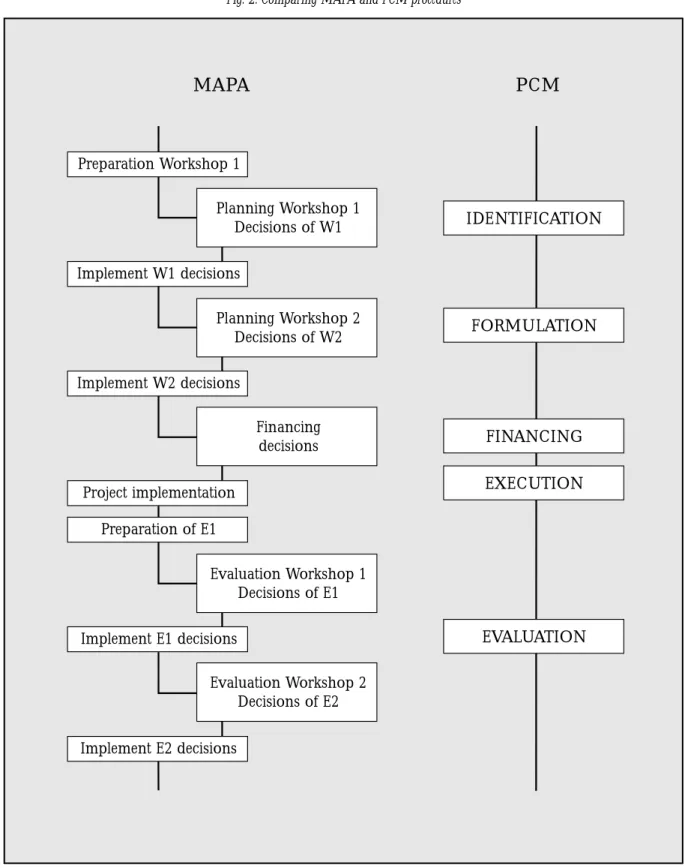
There are three main differences between the widely spread "project cycle management" and MAPA-PROJECT (fig. 2):
1) MAPA-PROJECT specifies which decisions are taken when, and it includes a method of reaching decisions based on consensus between stakeholders, providing the advantages described previously.
2) MAPA-PROJECT specifies a sequence of two workshops with definite aims, both for planning and evaluation, while PCM leaves the number of workshops open. In other words, MAPA-PROJECT is more strictly opera-tionalised than PCM (the details of this operationalisation are the subject of part III of this handbook).
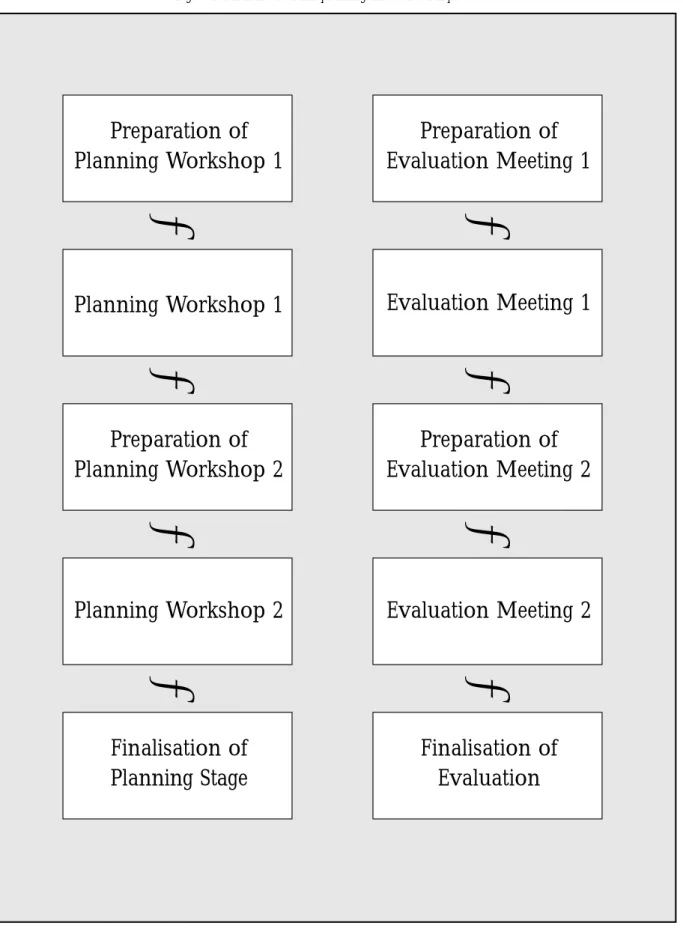
3) Perhaps the most important advantage of the MAPA-PROJECT system is the strict parallelism of the two Evaluation Meetings with the two Planning Workshops (see fig. 3 and the section "Overview"). This allows the use of MAPA-PROJECT evaluation as an exercise in re-planning the project. In this manner the advantages of increased transparency, consistency, and accountability can be built into projects that were originally conceived using a less stringent model.
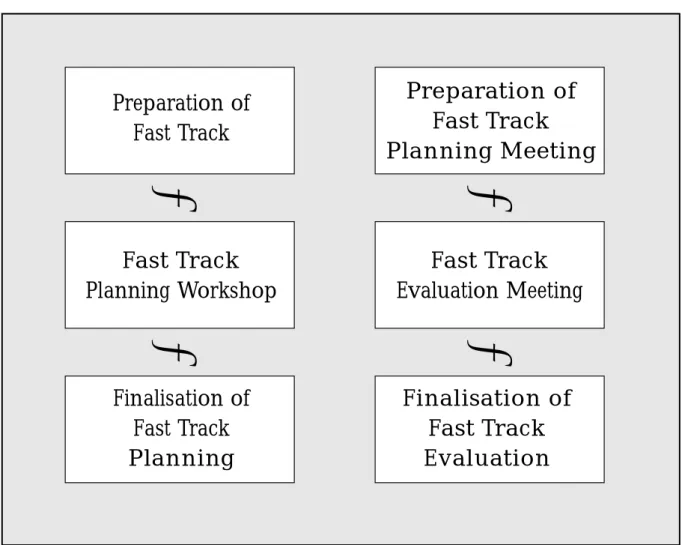
For small and routine projects, even the "normal" two-workshop sequence of MAPA-PROJECT may be too clumsy. For such cases, there is a "fast-track" process in which all requirements can be met in the course of just one work-shop (fig. 4). This is not intended as an excuse for sloppy work or for cutting short time and money; an organisa-tion using the MAPA-PROJECT process should define strict criteria concerning the size and complexity of projects for which the "fast-track" option is appropriate.
There is one particular application of the "fast-track" process that needs to be mentioned here: its use as an instru-ment for making decisions about project proposals that are submitted to the organisation for funding. A "fast-track" evaluation of the application document allows for testing of the internal consistency of the project plan and its ade-quacy for the environment for which it is planned.
The following diagram shows how the "planning" stage of the PCM process is further divided into two workshops, with a phase for collecting information and conducting studies in between them:
Fig. 2. Comparing MAPA and PCM procedures
The "evaluation" phase of the project is similarly divided into two workshops, with a phase for collecting and analysing information in between them.
Preparation Workshop 1
Planning Workshop 1
Decisions of W1
Implement W1 decisions
Implement W2 decisions
Project implementation
Preparation of E1
Implement E1 decisions
Implement E2 decisions
Planning Workshop 2
Decisions of W2
Financing
decisions
Evaluation Workshop 1
Decisions of E1
Evaluation Workshop 2
Decisions of E2
IDENTIFICATION
FORMULATION
FINANCING
EXECUTION
EVALUATION
MAPA
PCM
The next diagram shows the parallelism between the planning and the evaluation stages, which allows for the use of a MAPA-PROJECT evaluation as a re-planning exercise:
Fig. 3: Parallelism of MAPA planning and evaluation procedures
Integrated Participatory Project Planning and Evaluation in Perspective
Preparation of
Evaluation Meeting 1
Preparation of
Planning Workshop 1
Planning Workshop 1
Preparation of
Evaluation Meeting 2
Preparation of
Planning Workshop 2
Evaluation Meeting 2
Planning Workshop 2
Finalisation of
Evaluation
Finalisation of
Planning Stage
Evaluation Meeting 1
➮
➮
➮
➮
➮
➮
➮
➮
Fig. 4: The Parallel Steps for MAPA Fast Track Planning and Evaluation
Preparation of
Fast Track
Planning Meeting
Preparation of
Fast Track
Fast Track
Planning Workshop
Finalisation of
Fast Track
Planning
➮
➮
➮
➮
Finalisation of
Fast Track
Evaluation
Fast Track
Evaluation Meeting
MAPA-PROJECT Overview
This chapter gives a brief description of the meaning and purpose of the different phases of the MAPA-PROJECT process. It is an overview, and the operational details follow in part II. The overview follows the division into a plan-ning and an evaluation stage, both in the "normal" process of two workshops for each phase and in the "fast-track" process (with only one participatory and facilitated workshop for each phase).
The most important point for all types of workshops is that the participation of the representatives of all relevant stakeholder groups is ensured. This goes beyond mere discussion: at some stage there is always the necessity to make binding decisions. At this point, the workshop participants must be empowered by their respective organisations and/or groups (constituen-cies) to make such binding decisions (commitments concerning the use of people, materials, equipment, time, and money).
A second important point for all types of workshops is the recommended use of a team of two facilitators. Years of experience in the context of organisations in the field of development have clearly demonstrated the advantage of having two facilitators rather than only one: a single facilitator simply cannot keep track of all the details of the group processes and, at the same time, keep the discussion focussed along the lines of the previously agreed agenda. Therefore, it is essential that the two facil-itators compare their perceptions in the breaks between sessions and take turns in facilitating. Their perceptions thus gain in objectivity and their activity is less influenced by the emotional and cognitive strain that group processes invariably produce.
It should also be obvious that the less the facilitators are directly involved in the project under discussion, the more efficiently they will work. The more they are "outsiders," the more impartial they can be towards the expression of (sometimes diverging) inter-ests in the processes of discussion and negotiation that are the essence of the MAPA-PROJECT workshops. This will not only increase the trust of all participants in the results of the workshop (i.e. the project plan), it will also enhance the credibility of this plan in the eyes of outside organisations, such as a funding organisation. For the same reason it is often advisable to conduct the workshop on "neutral grounds" (i.e., in a location different from that of the organisation which will be running the project).
One last word about the facilitators at this point: while the participants of the workshops do not need to know the MAPA-PROJECT method in any detail, the facilitators must be so familiar with it that they can respond to the par-ticular case and people present with the flexibility characteristic of the MAPA-PROJECT. However, flexibility does not mean arbitrary adaptation of the method. Once the decision for a MAPA-PROJECT has been taken (and this should be taken well in advance of the workshop and fully cognisant of the implications of this decision), the process must be followed through completely in order to achieve the desired results. Thus, the facilitators bear full responsibility for adherence to the MAPA-PROJECT process by following the appropriate steps, while the organisation continues to carry the responsibility to act according to the results of the participatory negotiation process so followed.
Planning
The planning process moves from the diagnosis of a particular situation (conducting a needs assessment, for exam-ple) to clarifying goals for a project, and finally to the identification of the concrete activities that are expected to lead to the achievement of these goals.
The planning process does not start with Planning Workshop I. It starts when a preliminary project idea appears as an appro-priate response to a situation, and when there is a person who can promote this idea in the institutional context of the situation.
Any kind of project can grow from this idea, provided the "promoter" has enough resources at his or her disposal. Once this person decides to follow the MAPA-PROJECT process, however, events follow a prescribed sequence of logical steps. The first of these steps is to collect and process the existing information (such as existing needs assessments), to iden-tify the relevant stakeholders, and to invite them to Planning Workshop I, sending them the relevant information well in advance. During this workshop (which lasts from two to three days), the preliminary diagnosis is expanded and
the preliminary project idea is detailed and put into the formats of a preliminary logframe and a preliminary project implementation plan. The participation of stakeholders in this workshop may eventually reveal that the initial diag-nosis of the situation rested on too little information, and also that not all relevant stakeholders are present.
The information gaps identified during the first workshop will be filled during the interim before the second workshop, which usually lasts at least two weeks. How the information will be gathered during this time and who else should take part in the second workshop is decided at the end of the first workshop. These decisions are transformed into a Gantt schedule for the preparation of Planning Workshop II, which follows a similar format as the project implementation plan.
This Gantt schedule details which studies (impact analysis, risk assessment, target group analysis, organisational analysis, financial assessment, environmental analysis, gender analysis, etc.) need to be undertaken by whom and who else needs to be contacted in addition to those present at the first workshop. The implementation of this schedule is the responsibility of a specific "project group" for the preparation of Planning Workshop II. Sometimes it is necessary to appoint specific working groups (which may also include or contract external consultants) to conduct particular studies and process the information for Planning Workshop II.
All the information gathered in the meantime must be distributed to all participants of Planning Workshop II, during which the project plan is finalised. This requires that care be taken to distribute the information well ahead of Planning Workshop II and to invite not just the representatives of all relevant stakeholders, but the real decision-makers. Alternatively, it must be ensured that the representatives are invested with the necessary decision-making authority by their organisations.
The participants of Planning Workshop II together arrive at a consensual decision about the project's goals, activities, and budget. This includes decisions about how the achievement of the project's goals can be objectively determined (the objectively verifiable indicators and the kinds of documents that will contain the needed information). Some of these may be routine documents of the project or other organisations; some may require specific data collection. The idea is to avoid a mistake that many projects have made in the past: that of collecting and documenting information, 90 per cent of which is not needed, while producing only 10 per cent of the information that is really needed to eval-uate the success of a project. In sum, Planning Workshop II decides on a valid monitoring and evaluation system.
Thus, at the end of Planning Workshop II, it is clear what the project should achieve, how it should be achieved, and how this achievement can be measured. It is also clear what contribution is expected from each of the relevant stake-holders, and these commitments have been documented in the logframe and the project implementation plan.
How this result is achieved in detail is set out in the planning section of part III of the handbook.
Evaluation
A project evaluation is meant to investigate the effects and consequences of project activities against well-defined criteria: for instance, to determine to what extent a project has reached its explicitly formulated goals. Evaluation should be understood less as a "passing of a judgement" and more as a learning exercise. Determining the cause(s) for less than 100 percent achieve-ment can enable an organisation or a project to avoid these mistakes in the future. If the evaluation is a midterm review, this learning can be integrated into the same project. If the evaluation is a final evaluation, it can benefit follow-up projects.
To run a MAPA-PROJECT evaluation does not require that a project has been planned according to this particular sequence and logic. It only requires that the organisation and the project agree to being evaluated according to this logic and with the participation of the relevant stakeholders.
Once this agreement is reached, any non-MAPA project can use an evaluation in order to be transformed into a prop-erly planned MAPA project by re-planning. In this case, Evaluation Meeting II also becomes a planning workshop, at the end of which a logframe and a project implementation plan will have been agreed upon. The sequence is then slightly different from a normal evaluation, which we will describe first.
For a normal MAPA evaluation, it is not important whether we are dealing with a mid-term review, a final evalua-tion, or even an ex-post (impact) evaluation. All of them require a sequence of two workshops of two to three days each with an interim period of at least two weeks to collect additional information and conduct any additional stud-ies needed. This sequence is strictly parallel to the sequence of the two planning workshops described above (see also the diagram in Fig. 3).
The MAPA-PROJECT procedure for evaluation then guarantees three types of consensus: ❖ consensus on the method (participatory stakeholder evaluation)
❖ consensus on the indicators employed to measure the project's success ❖ consensus on the degree of achievement reached by the project.
The evaluation goes faster if it only follows the internal logic of the project as planned. It is then reduced to a sim-ple checking of existing indicators, provided these have been properly defined and agreed on previously, as in the standard MAPA-PROJECT procedure. In this case, Evaluation Meeting I may conclude that the existing information is sufficient to allow all relevant stakeholders to come to a consensual agreement on the degree of achievement shown by the indicators. If all participants agree that 1) the indicators defined during the planning stage cover all the rele-vant aspects of the project and 2) all the relerele-vant information has been produced by the project, Evaluation Meeting I may achieve the aim of determining the degree of achievement of results and project purpose by interpreting exist-ing information accordexist-ing to previously agreed procedures. The advantage of the MAPA-PROJECT still lies in gettexist-ing all stakeholders to participate in this interpretation. In this way, the interpretation of success is a shared and transpar-ent one, which therefore has more validity than a purely expert evaluation by an outside evaluator.
It is always advantageous to have an external evaluator, though. All internal evaluation suffers from the blind spots that involvement into particular routines always brings about. An external evaluator always brings a fresh and independent perception and judgement to the project, which can only enhance the learning effect intended by an evaluation.
Experience has shown, however, that it is better not to restrict the evaluation to the internal project logic in the man-ner just mentioned. Additional insights are always gained if the evaluation tries to look beyond the project's bound-aries or "behind" the project. One always sees more if one tries to rethink the project from the start by seeing it as a response to a particular constellation of problems in its environment. In this way, an evaluation can be more than a simple check on the project's efficiency; it can also give a fresh view on the project's adequacy. Instead of only attempting to see if the project is still on track, the evaluation can attempt to find out if that track is still the right one.
During Evaluation Meeting I of a MAPA-PROJECT evaluation, the participating stakeholders agree on a list of indi-cators according to which the project can be evaluated. If the evaluation is run according to the second mode described in the previous paragraph (by looking "behind" the project), this list of indicators is generated through a participatory group exercise. Therefore, this list may be different from the list of indicators that were established in the project document arrived at during Planning Workshop II.
For the same reason, the interim period for data collection remains necessary, even if the project's employees have been careful about collecting and documenting the information as specified in the original plan.
It should be mentioned that an external evaluator may also bring his or her own list of indicators, and these may conform to a list of standardised indicators used by particular international funding organisations. These can simply be integrated into the overall list of indicators arrived at during Evaluation Meeting I. Existing lists of "standard" indi-cators (for education, for example) originating from international organisation may also be of use. But it is always better to rethink the "intervention logic" (for a detailed explanation see the section on "logframe" in part III, Appendix 6) of the project and derive the indicators directly from there.
All the information collected in the interim period must be distributed to all participants of Evaluation Meeting II well
in advance, allowing participants time to study these materials before the workshop is convened. During Evaluation MAPA-PROJECT Overview
Meeting II, this information is analysed by all stakeholders, who can now reach an agreement on the degree of goal achievement based on the objectively verifiable indicators agreed on earlier.
If the evaluation concerns a project not originally planned according to the MAPA-PROJECT method, the last part of the second workshop is also used to fill in a logframe and a project implementation plan in the same manner as in a regular planning workshop. On the basis of the general diagnosis and the indicators already agreed upon, this is not difficult to achieve. What is needed is a revision of existing goals and activities in order to incorporate addi-tional insights gained during the evaluation. However, this can only be achieved if, as in Planning Workshop II, all the relevant decision makers are participating in Evaluation Meeting II.
To sum up, an evaluation should not be understood as an outsider's (hostile) assessment of the project's faults, but rather as a learning opportunity that allows for the following:
❖ Increasing the capacity for managing the project itself
❖ Correcting mistakes that may have been made during all stages of the project ❖ Increasing the technical capability of the partners
❖ Increasing the technical capability of all the institutions involved in the planning, implementation, and evaluation of the project ❖ Avoiding the repetition of mistakes other projects have already run into
❖ Stimulating sectorial, trans-sectorial and transnational learning
❖ Increasing the capacity to detect, manage, and minimise the risks of the project
❖ Redefining the objectives of the project when external changes have occurred or when this would increase the project's adequacy.
Fast-track Planning
Projects below a certain size and level of complexity, especially routine projects, do not justify the costs of the full MAPA-PROJECT sequence, with its two workshops of several days each. For these cases, the MAPA-PROJECT pro-vides a shortcut through fast-track planning (and evaluation). To avoid sloppy planning, however, an organisation should be careful to establish clear criteria for the kind of project that is eligible for fast-track planning.
Unlike the normal planning process, all relevant information must be made available to all participants of the fast-track planning workshop. As in Planning Workshop II, the participants must be in a position to make binding deci-sions on behalf of the stakeholders they represent. Once these conditions have been met, the participants of a fast-track planning workshop can run a full-scale participatory stakeholder diagnosis, definitely determine the project's goals, and decide on a binding logframe and project implementation plan.
In the case of routine projects, the whole process may be rather quick, since there will already be both a logframe and a project implementation plan from previous cycles of the routine project. These only need to be updated in light of any changes in the environment that may have occurred in the meantime.
Fast-track Evaluation
Projects that qualify for fast-track planning may also qualify for fast-track evaluation. Fast-track evaluation may also be decided upon for other projects in order to provide a quick check on internal assessment.
As in the fast-track planning workshop, all relevant information must be distributed to all participants prior to the actual workshop. It is also important to get all relevant decision-makers to participate in the workshop, as its outcome is a final decision on the degree of achievement of a project. Decision-makers who have not had a chance to participate may later oppose the results of a fast-track evaluation. If, on the other hand, all relevant decision makers are present, a fast-track Evaluation Meeting may even come up with a preliminary evaluation report that will later be detailed by a project group.
MAPA "STEP BY STEP"
MAPA unites freedom of invention with an orderly sequence, leading to clearly structured results. To achieve the transformation of participatory decision-making into tangible results, the suggested sequence should always be fol-lowed. Therefore, this part of the handbook is intended as a guide through all the individual steps, in enough detail to enable any trained facilitator to guide participants through the process and to enable any decision-maker to organ-ise the sequence of workshops and the production of the necessary documents.
The sequence always begins with preparing the workshop, clarifying what happens during the workshop, and setting out what has to be done after the workshop, either in preparation of the second workshop or to "finalise" the sequence.
For each of these well-defined segments, we clarify what "preconditions" must be met before it can be undertaken, what "guiding questions" must be answered in the process, which individual "concrete steps" must be taken, and, finally, what "results" will be achieved by this. A number of the "concrete steps" occur in more than one workshop or preparatory period and are therefore described in more detail in one or another of the appendices. The same applies to the document formats of some of the "results."
Part III of the book may therefore be considered the "toolbox", while this part of the book gives detailed instructions on how and why particular tools should be used in a particular order, providing the sequence of movements you must make with those tools in hand in order to achieve the results you want.
One of the results should always be the ability to answer the "guiding questions" in the respective sections. You will find that whenever there is a sequence of two workshops, some of the questions appear in both the first and the sec-ond workshop. This means that the first workshop tries to come up with preliminary answers, while the secsec-ond workshop will have to find the definite answers. To do this usually requires additional information and expertise, or the participation of additional stakeholders and decision-makers. Which additions are needed, however, is always something for which the first workshop has to find a definite answer.
While we have tried to phrase the "guiding questions" in the most encompassing way we could think of, we cannot claim that other questions may not be relevant for particular cases. Just remember, these are "guiding" questions that define the minimum area to be covered. They may guide you to other questions in other areas that must also be answered for the particular project to which you try to apply the MAPA principles and methods.
NORMAL PLANNING
Preparation of Planning Workshop I
P r e c o n d i t i o n s
To begin with, only three preconditions must be met:
1) There must be a preliminary project idea.
2) A decision-maker within the organisation must decide to use the MAPA-PROJECT method for project planning and evaluation.
3) This decision-maker must control a budget that allows him to finance the MAPA planning process.
G u i d i n g Q u e s t i o n s
❖ Who will be responsible for the planning of the project? ❖ Who will assist in the planning of the project?
❖ What is the problem the project will try to solve? Or, Which is the area of intervention for the project?
❖ Which information about this problem / intervention area is available? ❖ Who are the likely target groups?
❖ Who are the potential partners?
❖ Who are, therefore, the relevant stakeholders to be invited as participants for Planning Workshop I?
❖ Who can facilitate the planning process? - This question takes into account that it is not advisable to hire different (teams of) facilitators for Planning Workshop I and Planning Workshop II. Just in case it is not obvious: knowing the problems and at least some of the participants and their communication styles makes facilitation easier for Planning Workshop II because the facilitators can concentrate on what is new and particularly relevant at this stage of the process, rather than having to familiarise themselves with the overall situation and with all the participants. ❖ What are the logistics for Planning Workshop I? (Location, materials, equipment, travel arrangements,
accom-modation)
C o n c r e t e S t e p s
1) Appointment of a "project promoter"
The "project promoter" is the person responsible for the planning process. Proper project planning is a complex process that itself needs to be managed. This is the task of the project promoter. He or she may also be the source of the original project idea and/or the manager of the project itself, but this is by no means necessary. The direc-tor of an organisation may have a brilliant project idea but no time to follow it up, and he may be able to del-egate the organisation of the planning process to one of his assistants, who also may have too many other tasks to be able to manage the project itself. Alternatively, the originator of an idea may know the ideal candidate for the position of project manager, who is also in a position to manage the planning process.
What is important at this point in time is to clearly designate the person responsible for the planning process and to make sure that this person has enough resources to manage the planning process. By "resources" we mean time, money, and the necessary support for questions of logistics and information gathering. For more complex projects, it may therefore also be necessary to appoint/designate a "planning team".
2) Appointment of a "planning team" (if necessary)
This team will help the project promoter gather all available information about the intended area of intervention, identify and contact possible stakeholders (target groups, partners, and opponents), and organise the logistics of the planning process. The team may be chosen together with the project promoter or by the project promoter, depending on the decision processes within the organisation. It may also include people from partner organisations. 3) Collection of information by the project promoter (and the planning team)
Initial project ideas are often based more on hunches, on "intuitive insights", than on an objective analysis of a situation. At this stage of the planning, however, it is necessary to give this initial idea a more objective position by collecting existing information about the problem or the area of intervention that the project is intended to address. Analysing existing documents should make it possible to define the idea more clearly and to see how it relates to social groups, organisations, and institutions in the area of intervention. In more abstract forms of plan-ning, this may appear sufficient to develop precise justifications for the project. In MAPA-PROJECT, it leads to the (preliminary) identification of stakeholders, who will then be invited to participate in the further planning. Therefore, the analysis of documents should be complemented by a more direct study of the target group(s), the
possible partners, and the expertise (i.e. "living knowledge") about the area of intervention, including but not
restrict-ed to acknowlrestrict-edgrestrict-ed experts. The reviewrestrict-ed documents retain an important place however: the project promot-er (and the planning team) are expected to synthesise this information into a document which will be distrib-uted well in advance to all participants of Planning Workshop I.
Some examples of such available information are as follows:
❖ official statistics (population, health, education, environment, economic conditions, etc.) ❖ published studies by relevant institutions
❖ books and journal articles. 4) Analysis of the target group
The project promoter (and the planning team) should at this stage conduct a target group analysis (for details see appendix 13). However preliminary this may be due to limited resources, it is essential for the identification of the participants of Planning Workshop I. Without direct input from the target group, no project can claim to be participatory, be it MAPA or not MAPA. And without documented participatory elements, it has become diffi-cult to scout for the funding of social intervention projects (whether in the area of education, health, agridiffi-culture, the environment, minority rights, or any other) because participation, along with sustainability, are at the top of the priority lists of virtually all national and international funding organisations.
5) Identification of possible partner organisations
Few, if any, projects stay within the borders of a single organisation: they can only be implemented in collabo-ration with one or more institutional partners. Since such collabocollabo-ration cannot be planned by one partner alone while still expecting the other partners' compliance with this plan, such partners should be involved in the plan-ning of the project as early as possible. During the preparatory phase of Planplan-ning Workshop I, they are identi-fied, contacted, and invited to participate (for details of the analysis of partners see appendix 14).
6) (Preliminary) analysis of the organisational landscape
Any social intervention project is but one player in a "landscape" of social groups, organisations, and institutions (for details of the analysis of the organisational landscape see appendix 15). Some of these can be viewed as partners, supporters, or, at least, sympathetic observers. Others may become obstacles or enemies if they per-ceive the project as an infringement on their terrain or interests. It is advisable to identify the latter in particu-lar rather early. Including them in the planning process, by inviting them to participate in Planning Workshop I or at least by asking for their expertise, may make them feel less threatened and occasionally even turn them into supporters.
7) Identification of experts needed for the planning process
On the basis of the preliminary analysis of existing information, it is almost always possible to immediately iden-tify knowledge gaps and areas of expertise that will be needed for good and realistic planning. It is often advis-able to include such experts in Planning Workshop I. At this stage it is necessary to prepare terms of reference for their participation, even before identifying particular individuals.
8) Identification of the participants for Planning Workshop I
Completing steps four through seven will give the project promoter (and the planning team) a reasonably detailed list of all the stakeholders of the project (target group(s), possible partner organisations, possible opponents, etc.) and of the kind of experts needed. From this list the project promoter (and the planning team) draw the actual participants, depending on their importance and availability. It may sound easy, but securing a variety of peo-ple's participation in one event (getting all the relevant people into the same room at the same date under the guid-ance of a competent team of facilitators) requires considerable attention, flexibility, and communication skills. 9) Contracting the facilitators
As mentioned before, it is advisable to contract a team of two facilitators who are proficient in the MAPA-PRO-JECT method and who are willing (and committed) to accompany the whole of the planning process (i.e. Planning Workshop I and Planning Workshop II). The facilitators should always be as neutral towards all stake-holders as possible, and they do not necessarily need to identify with the project idea either. In order to facilitate the participants' own thinking and communication in the planning process, they should be as non-partisan as possible (i.e., it is preferable that they be hired from outside the organisation intending to run the project). 10) Logistic preparation of and invitation to Planning Workshop I
(see also appendix 1: Checklist for the preparation of workshops)
Once the date has been set, possibly through negotiation with the relevant participants, the logistics for the work-shop need to be tackled. This includes not only the identification of a proper location and the preparation of necessary materials (preliminary documents, paper, pens, etc.) and equipment (flipcharts, camera for documen-tation, etc.), but also the invitation of participants, their confirmation of participation, their travel arrangements (including visas, if necessary), and their accommodation. Two points need particular attention:
10 a) The event should be held on as "neutral" ground as possible so that participants do not feel that the choice of location was designed to influence the outcome. Also, the room must be big enough and have at least one blank wall that can be used for attaching the cards. Finally, a good arrangement for coffee and meal breaks as close to the main workshop room as possible is advisable. This gives participants a chance for informal communication during breaks and avoids completely breaking up group cohesion while travelling to another location for meals.
10b) All participants should be provided with a synthesis of the information reviewed by the project promoter (and the managing team) well in advance to give them a chance to familiarise themselves with this information and to reflect on their own opinions about this information and the direction the project should take.
11) A "project planning reporter" should be appointed. This person is responsible for documenting the process of Planning Workshop I, for gathering all the information and provisional plans produced during the workshop, and for collating all these data into a provisional project document for distribution to all participants.
R e s u l t s
❖ All preliminary documents (terms of reference for experts, document containing a synthesis of existing informa-tion) are available.
❖ All participants have been invited, have confirmed their participation, and have received all preliminary documents. ❖ The facilitators have been contracted.
❖ The logistical preparation of Planning Workshop I has been completed (time and location have been set, room, materials and equipment have been prepared, travel arrangements have been made, and accommodation has been booked).
Planning Workshop I
P r e c o n d i t i o n s1) All the results of the previous phase have been achieved. 2) The financing has not been cut in the interim period.
3) The participants have studied the documents sent to them, have come, and are still willing to participate in and contribute to Planning Workshop I.
This may seem trivial, but in particular, possible opponents (whom the project promoter invited in order to get them "on board") may have decided to come in order to sabotage the project rather than to assist its planning. But nothing is lost yet: remember that for MAPA all perspectives, even contradictory ones, are regarded as an asset. While intending saboteurs may make Planning Workshop I more difficult to facilitate, they will hardly be able to sabotage it completely, and their views will ultimately be part of the overall pool of ideas that the plan-ning process has taken into account.
A more serious handicap to the success of Planning Workshop I is the absence of one or more of the relevant stakeholders who earlier confirmed their participation, particularly representatives of the target group. The process can still go on, however; while the results of Planning Workshop I will be more tentative, missing views can be included during the preparation of Planning Workshop II and during Planning Workshop II itself.
4) One person has been designated to be responsible for documenting the process and the results of Planning Workshop I. This is very important because of the visual techniques used facilitate a rather complete documen-tation of all ideas during the workshop. These ideas represent the most important resource for the following stages of the planning process.
G u i d i n g Q u e s t i o n s
The Guiding Questions for Planning Workshop I fall in two groups:
1) Questions concerning the project and its intended effects. These questions will find only a preliminary answer dur-ing the workshop and will have to be asked again durdur-ing Planndur-ing Workshop II, after additional studies have been undertaken and additional relevant stakeholders have been contacted. On this basis, Planning Workshop II will have to come up with definite answers to these questions. However, Planning Workshop II will not ask any fundamen-tally new questions.
2) Questions relating to the preparation of Planning Workshop II (such as the additional information needed, the additional partners, target groups, and experts to be contacted, etc.). If the overall planning process is to proceed smoothly, these questions must be answered definitively during the course of Planning Workshop I.
1) Questions about the project in general:
❖ What are the problems that the project will address?
❖ What are the goals that the project will try to achieve or contribute to? ❖ How can the achievement of these goals be measured?
❖ How and from where can the information about these measurements be obtained? ❖ How (through which activities) will the problems be addressed / the goals be achieved? ❖ What kinds of human and other resources will be needed for these activities?
❖ Who will fund the project?
❖ Who are the target groups of the project?
❖ Who are the relevant players in the institutional landscape? ❖ Who are the partner organisations for the project?
❖ Who will be responsible for which activities?
❖ Are there alternative ways of reaching the project's goals? (Are the suggested activities the most efficient ones?)