Finale:
Contextualising Participation in a Transition Society
David Cairns* & Airi-Alina AllasteIntroduction: the practice of youth politics
This special issue of Studies of Transition States and Societies closes with a concluding discussion that aims to contextualise some of the key fi ndings from the preceding articles. To do so, we use comparative level evidence drawn from other regions included in the MYPLACE consortium, identifyng contrasts and commonalities in how youth politics is practiced across diff erent European regions. The basic approach is one of assessing the extent to which patterns of participation in Estonia diverge from activism elsewhere, thus locating Estonian youth within a broader analytical framework. In this sense, we are taking advantage of the regional diversity of the MYPLACE project design to better understand the meaning of the contemporary practice of youth politics in Estonia.
Crucially, the research consortium included not only societies within close geographical proximity to Estonia, most obviously Latvia and Russia, but also national contexts with whom we might anticipate greater diverenges in the practice of youth poltitics. This includes other post-socialist societies (Hungary, Slovakia and Georgia), Nordic countries (Finland and Denmark), three Mediterranean nations (Spain, Portugal and Greece), the United Kingdom, Germany and the European Union’s newest Member State, Croatia. From looking at these varied situtions, we can move towards a better understanding of how young people practice politics in contemporary Europe and gain a better idea of where Estonian youth fi t into the current activism schema, using the example of digital activism. And this word ‘practice’ is chosen quite deliberately for its ambiguity, connoting both the act of engaging in a specifi c political undertaking and the idea that this engagement is in some way a preparation for subsequent political activism later in life.
The dominant perspective within studies of political activism appears to be one regarding mobilisation as a reaction to exceptional and perhaps unpredicted contemporary events. This includes circumstances that have become excessively oppresssive or even personally injurous, with additional emphasis on the novel means through which political ideas are transmitted today. For example, Castells’ (2012) book on social movement activism cites the signfi cance of repressive governments in inspiring the Arab Spring, as well as the effi cacy of digital activism in forming a response. And this initial spark is an important part of a greater chain of events that can also inspire activism across borders (della Porta & Mattoni, 2014). However, this is not the whole story, since more quotidian aspects of participation must also be accounted for.
We need to not only consider the immediate stimulus for action in terms of current events but also take into account political legacy and the means through which this inheritance is passed on societally and inter-generally, including familial transmission of activism predispositions. This focus also extends to what has been termed ‘sub-politics’ or ‘sub-activism’ (e.g., Holzer & Sorensen, 2001; Bakardjieva, 2009); a theme introduced in the contribution to this special issue on the Pirate Party / Estonian Internet Society. While this case study represents an example of virtual activism, balance is maintained between diff erent means of engaging in activism through focusing on the example of Youth Councils in Estonia. From this point of view, we are able to appreciate the fact that while new and potentially innovative forms of practicing politics have emerged, more traditional means have also retained their relevance.
Citizenship and participation
Another important theme is that of the relationship between citizenship and participation. This is a topic that, while latent within the MYPLACE surveys and qualitative fi eldwork, is more explicitly addressed in the Estonian context. The article targeting the topic in this edition also reminds us that there has been long-standing interest in youth politics and civic engagement at European Policy level, including recognition of the idea of Active Citizenship. And through an analysis of quantitative data, we are able to better appreciate the patterns of activism that emerge in locales that contrast in terms of socio-demographic profi le.
One of the most interesting fi ndings has been to discover the infl uence of factors such as age, family background and education level, with young people who have the strongest social and economic inheritances tending to be the most participative. Also revealed in this context is the tension created by Europe being increasingly characterised by hostile conditions for young people in terms of their labour market participation; for example, in elevated levels of unemployment and job precariousness (Cairns et al., 2016). At the same time, there remains an expectation that they will meaningfully engage in the political and civic spheres; an optimistic hope given this widespread position of economic disadvantage.
Discussion of this issue within this journal can help inform policy debates in this fi eld, reminding us that one of the basic objectives of the MYPLACE study was to inform European policy on youth participation and civic engagement at a broad level, in addition to looking at more exceptional examples of radical politics.
Negotiating the past across Europe
Understanding the role of the past in contemporary activism was another key objective of the MYPLACE project. The article on this theme in this issue focused on some of the key issues in the transmission of political memories among Estonian youth. This included exploration of how recent examples of youth mobilization are infl uenced by past events and the defence of the symbols that embody the values of this past; most prominently, the example of the ‘Bronze Soldier’ incident in Tallinn in 2007. That the Estonian past, in this case events associated with the Second World War, continues to be remembered in the present by young people several generations removed is an interesting fi nding in itself, confi rming that the legacy of the wartime years remains strong. This process of linking past with present is explained by the existence of diff erent sites of memory transmission; for example, schools, museums and the family home, as well as symbolic values having become embedded within discursive narratives associated with particular ethnic or national groups.
Looking at the broader fi eld of evidence collected by the MYPLACE research teams across Europe, we can identify similar processes and shared national discursive themes, including remembrance of events associated with the Second World War that are of special local signifi cance. The closest example, in geographical terms, to the Estonian situation can be observed in the evidence gathered in the Latvian context; work which included cooperation with the Museum of the Occupation of Latvia on coping with the legacy of the holocaust. As the material presented in the Latvian national report on the transmission of political values demonstrates, the defeat of Nazism by the USSR is deeply respected but complicated by the loss of independence following the Soviet ‘occupation’ in 1940. In this case, the term ‘occupation’ is problematised due to the fact that the presence of Soviet forces is not universally perceived as an invasion by a hostile foreign power, with a substantial Russian minority feeling otherwise. However one interesting fi nding emerging from focus groups conducted with Latvian youth was the diffi culty of fi nding cases wherein there was knowledge and understanding of the causes of WWII. What was on show were ways of commemorating the past and
marking particular dates in the calendar with these commemorations and national holidays (Saleniece et al., 2013, p. 29). This position suggests that the connection between historical events and acts of remembrance may be more imaginative than we might anticipate, with the current day ‘struggle’ for recognition also being a result of the desire to preserve the sanctity of certain dates in the calendar, in this case 25 March and 9 May, rather a celebration of the veterans.
The Latvian analysis also emphasises the importance of maintaining the existence of a national narrative of statehood during the war-time and Soviet periods, indicative of the fact that negotiating the past is a practice engaged in by ‘majority’ populations as well as national, linguistic or ethnic minority groups. Soviet and post-Soviet historical legacy also looms large in Estonia, Georgia, Hungary and Slovakia. While these contexts share a common experience of going through national independence processes, memory transmission practices are not uniform across national contexts or even within the various fi eld sites covered by the MYPLACE project; for example, between perceptions of ‘victimhood’ and ‘accusation’ in the Hungarian analysis (Popov and Deák, 2012). These splits are refl ected in the choice of events to be remembered and the meanings attached to them, embodied in the exhibitions hosted by the chillingly named ‘house of terror’ museum, detailing the struggles of the fascist and communist periods. Furthermore, competing valuations of history become embedded into the political agendas of political left and right. What this means is that history becomes grist for the mill of identity politics at national and European levels: creating a positive national self-image and an example of central European historical experience worthy of recognition on the international stage (Popov and Deák, 2012, p. 13). The Russian case study meanwhile provides an additional perspective, focusing on issues such as the alleged ‘falsifi cation’ of historical discourses, including contested interpretations of the ‘Great Patriotic War’ (Fomina et al., 2012).
These issues are obviously not present in the same formulations outside the various Eastern European contexts included in the MYPLACE project. Instead we fi nd young people faced with a complex legacy of totalitarianism (e.g., in Greece and Portugal), national and regional independence movements (e.g., Spain/Catalonia), and other structural factors such as post-industrialization in the UK that produce markedly diff erent political identity eff ects. One refl ection that can be made of these more recent examples of memory transmission is that near contemporary historical events, perhaps not surprisingly, tend to be remembered more accurately and less divisively. For example, the Portuguese revolution of 25 April 1974 is generally accepted as a positive event, and while diff erent interpretations of the political paths taken in its aftermath may be present, the event itself provides an unambiguously positive identity resource irrespective of personal political preferences (Cairns et al., 2012). What this implies is that the more recent the event, the less likelihood there is of divergent, or disingenuous, interpretations becoming established.
This is particularly apparent where there is consensus regarding the ‘positive’ interpretation of a historical legacy, such as is arguably the case in regard to the Portuguese revolution, meaning limited potential for contested remembrance. Added to this refl ection is the realisation that some young people have actually lived through ‘history’ as it happened, giving them actual as opposed to inherited or received memories of this past. This is true of some of our older respondents in respect to the transition from communism to free market economies, and all of those in the Spanish, Greek and Portuguese research contexts, who have lived through some of the worst aspects of the global fi nancial crisis, austerity and the demands of external debt repayment programmes (Calvo et al., 2012; Cairns et al., 2014).
These latter remarks imply that just as there is a pressing need to negotiate with the past in becoming political, many young people face the problem of coping with the present and anticipating the future. Whether or not the immediate weight of this task will replace the burden of dealing with political challenges related to complicated histories is uncertain, but it does make this activity feel somewhat secondary in importance.
Cross-national online participation
In looking at the issue of contemporary political participation, much research attention has been devoted to ascertaining the extent to which conventional forms of participation have decreased in popularity while involvement in online participation is thought to have correspondingly increased (e.g., Castells, 2012). This participation turnaround appears to be especially evident in Estonia, and is refl ected in the results emerging from our research. But the question remains as to the extent to which the growing popularity of participation in social media in Estonia is exceptional or similar to what is happening elsewhere in Europe.
To help answer this question, results from the MYPLACE quantitative survey provide insight into respondents’ estimated weekly usage of social media (and other digital technology such as text messages), making reference to the duration of communicating with their friends about politics on a four-point scale (‘No time at all’, ‘Less than 1 hour’, ‘1 hour to 2 hours’ and ‘More than 2 hours’). Using data published in the MYPLACE work package 4 report (Busse et al., 2014, pp. 260-261), we have been able to locate ‘Estonia’ within the context of the 13 country (28 region) project outcomes (Table 1), covering two socio-demographically contrasting locations in each country (four in Germany); one being a characteristically affl uent area and the other a less prosperous neighbourhood (see Zurabishvili et al., 2013).
As Table 1 reveals, the UK is the clear ‘winner’ in regard to social media usage within the MYPLACE survey, with both of its research sites occupying the top two positions on this breakdown. However, in third place we fi nd one of the two Estonian sites, the Narva area, with the second Estonian location, Tartu, occupying a more middling position. What these results suggest is that the Estonian respondents are generally more active in regard to social media and other digital forms of communication compared to their counterparts elsewhere in the regions covered by the MYPLACE consortium, providing some support for the idea that youth politics has moved online.
While these results, emerging from the context of a dedicated survey on youth political activism, might lead us to believe that social media is important to participation, outcomes emerging from other questions included make us to question the effi cacy of digital platforms. In other words, does the fact that politics is being discussed online mean this is an eff ective means of mobilising?
Table 1: Use of social media by location for ‘more than 2 hours’ per week — all MYPLACE regions (%)
Location % Location %
Nuneaton (UK) 61 Lieksa & Nurmes (Finland) 32
Coventry (UK) 58 Ozd (Hungary) 31
Narva area (Estonia) 41 New Philadelphia (Greece) 30 Telavi (Georgia) 41 Odense Centre (Denmark) 28 Sant Cugat (Spain) 39 Rimavska Sobota (Slovakia) 27
Vyborg (Russia) 39 Sopron (Hungary) 27
Kupchino (Russia) 38 Argyroupouli (Greece) 26 Kutaisi (Georgia) 36 Agenskalns (Latvia) 24 Lumiar (Portugal) 36 Barreiro (Portugal) 23 Pescenica (Croatia) 35 Kuopio (Finland) 22 Bremerhaven (Germany west) 35 Trnava (Slovakia) 21 Tartu (Estonia) 34 Jena (Germany east) 20 Vic (Spain) 32 Rostock (Germany east) 19 Odense East (Denmark) 32 Forstate & Jaunbuve (Latvia) 12
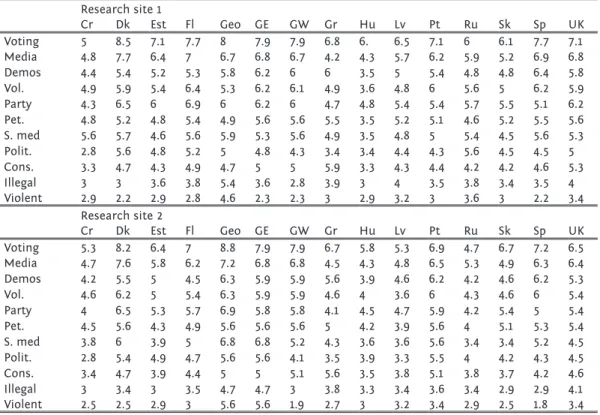
Table 2 provides an overview of results emanating from a question block on the perceived effi cacy of diff erent forms of political participation, assessing these activities on a scale between zero and ten. These results unambiguously show that ‘Voting in elections’ is regarded as the most effi cacious form of political participation, with illegal and violent protest actions the least useful and all other items of middling importance, including social media. And as is explained in the previous article analysing everyday forms of new participation, these social media practices are often not recognised as a form political participation among Estonian Youth. Looking at the broader picture, the overall mean on the effi cacy of social media for political activism was 4.85 (n=16,370, sd=2.83), with responses varying between a high in Georgia (Telavi) of 6.8, to a low of 3.4 in Slovakia (Rimavska Sobota). Putting this issue into context alongside other forms of activism, social media still fares relatively well in terms of its perceived effi cacy, although substantially less well regarded than voting in elections, and is not considered as effi cacious in Estonia compared to other regions included in the MYPLACE study.
Summary
Refl ecting upon these results, and specifi c nature of the Estonian research context, and of being a transition society, we can observe both common ground with the other regions in the MYPLACE project in regard to youth participation issues, for example, the legacy of the Second World War and the Soviet era, along with more specifi c elaboration on issues such as digital activism and youth citizenship. In regard to what is exceptional about the Estonian respondents, we can see that while they may be more engaged with digital platforms when it comes to discussing politics, their levels
Table 2: Political effi cacy of activism in all MYPLACE regions (means)
Research site 1 Cr Dk Est Fl Geo GE GW Gr Hu Lv Pt Ru Sk Sp UK Voting 5 8.5 7.1 7.7 8 7.9 7.9 6.8 6. 6.5 7.1 6 6.1 7.7 7.1 Media 4.8 7.7 6.4 7 6.7 6.8 6.7 4.2 4.3 5.7 6.2 5.9 5.2 6.9 6.8 Demos 4.4 5.4 5.2 5.3 5.8 6.2 6 6 3.5 5 5.4 4.8 4.8 6.4 5.8 Vol. 4.9 5.9 5.4 6.4 5.3 6.2 6.1 4.9 3.6 4.8 6 5.6 5 6.2 5.9 Party 4.3 6.5 6 6.9 6 6.2 6 4.7 4.8 5.4 5.4 5.7 5.5 5.1 6.2 Pet. 4.8 5.2 4.8 5.4 4.9 5.6 5.6 5.5 3.5 5.2 5.1 4.6 5.2 5.5 5.6 S. med 5.6 5.7 4.6 5.6 5.9 5.3 5.6 4.9 3.5 4.8 5 5.4 4.5 5.6 5.3 Polit. 2.8 5.6 4.8 5.2 5 4.8 4.3 3.4 3.4 4.4 4.3 5.6 4.5 4.5 5 Cons. 3.3 4.7 4.3 4.9 4.7 5 5 5.9 3.3 4.3 4.4 4.2 4.2 4.6 5.3 Illegal 3 3 3.6 3.8 5.4 3.6 2.8 3.9 3 4 3.5 3.8 3.4 3.5 4 Violent 2.9 2.2 2.9 2.8 4.6 2.3 2.3 3 2.9 3.2 3 3.6 3 2.2 3.4 Research site 2 Cr Dk Est Fl Geo GE GW Gr Hu Lv Pt Ru Sk Sp UK Voting 5.3 8.2 6.4 7 8.8 7.9 7.9 6.7 5.8 5.3 6.9 4.7 6.7 7.2 6.5 Media 4.7 7.6 5.8 6.2 7.2 6.8 6.8 4.5 4.3 4.8 6.5 5.3 4.9 6.3 6.4 Demos 4.2 5.5 5 4.5 6.3 5.9 5.9 5.6 3.9 4.6 6.2 4.2 4.6 6.2 5.3 Vol. 4.6 6.2 5 5.4 6.3 5.9 5.9 4.6 4 3.6 6 4.3 4.6 6 5.4 Party 4 6.5 5.3 5.7 6.9 5.8 5.8 4.1 4.5 4.7 5.9 4.2 5.4 5 5.4 Pet. 4.5 5.6 4.3 4.9 5.6 5.6 5.6 5 4.2 3.9 5.6 4 5.1 5.3 5.4 S. med 3.8 6 3.9 5 6.8 6.8 5.2 4.3 3.6 3.6 5.6 3.4 3.4 5.2 4.5 Polit. 2.8 5.4 4.9 4.7 5.6 5.6 4.1 3.5 3.9 3.3 5.5 4 4.2 4.3 4.5 Cons. 3.4 4.7 3.9 4.4 5 5 5.1 5.6 3.5 3.8 5.1 3.8 3.7 4.2 4.6 Illegal 3 3.4 3 3.5 4.7 4.7 3 3.8 3.3 3.4 3.6 3.4 2.9 2.9 4.1 Violent 2.5 2.5 2.9 3 5.6 5.6 1.9 2.7 3 3.2 3.4 2.9 2.5 1.8 3.4
of perceived effi cacy of such media are not particularly outstanding compared to their counterparts in other European regions. And as stated before in Estonia, the term ‘activism’ itself has negative connotations due to its associations with Soviet era state-mandated socialist activity, and that makes ‘activism’ unattractive in a success-oriented society stressing individualistic values. It might be considered a phenomenon of a transition society that participation is not as important as in Western societies, and that youth engage more easily in social participation if its ‘political’ connotation is somehow hidden.
This leaves us to ask what our work can contribute to our understanding of the issue in hand. Certainly, in looking for an answer to the broader question of what ‘explains’ youth activism, our Estonian research provides some insights. For example, we can see that a certain duality of thinking is required in order to make sense of an apparent contradiction in youth political biographies. There may be more varied means of practicing politics, yet there is also a shared belief that more traditional modes of participation such as voting in elections are the best means of making oneself heard. But it could be speculated that a quotidian level of regular participation in social media engages young people in an unintentional political activity; something that can be seen as ‘gateway activism’, which will lead a new generation of people towards more overt participation. Therefore, it may be the case that political legacies and more novel forms of activism are inter-twined, meaning that we need to acknowledge old and new means of becoming political. Alternatively, perhaps some political practices are better served by one means as opposed to the other: for instance, one may use a digital platform as a means of becoming civically engaged but this is not a realistic means of thinking about who to elect for the next government.
What our material seems to be telling us is that we should not abandon consideration of formal or traditional means of practicing politics because of the emergence of new, perhaps more informal, ways of participating. On the contrary, we should take into account the full range of possibilities in relation to youth activism. In this sense, the future is more likely to be characterised by greater diversity in youth politics rather than epochal shifts in how diff erent generations voice their societial concerns. For this reason, we can see that through observing activism in a transition society, we also record how activism is in transition, with the reformation of youth politics determined by a complex but not necessarily competing mix of historical legacies and contemporary possibilities.
References
Allaste, A.-A., Nugin, R., Pirk, R., & Taru, M. (2013). MYPLACE WP5: Interpreting Participation. Interviews (Deliverable 5.3: Country-Based Reports on Interview Findings: Estonia). Brussels: European Commission. Bakardjieva, M. (2009). Subactivism: Lifeworld and Politics in the Age of the Internet. The Information Society,
25(2), 91-104.
Busse, B., Hashem-Wangler, A., & Tholen, J. (2013). MYPLACE WP5: Interpreting Participation. Interviews (Deliverable 5.3: Country-Based Reports on Interview Findings: Bremen, Gemany). Brussels: European Commission.
Cairns, D., Alves, N. A., Alexandre, A., & Carvalho, T. (2012). MYPLACE WP2: Interpreting the Past. The
Construction and Transmission of Historical Memory (Deliverable 2.1: Country-Based Reports on Historical Discourse Production as Manifested in Sites of Memory: Portugal). Brussels: European Commission.
Cairns, D., Alves, N. A., Alexandre, A., & Correia, A. (2016). Youth Unemployment and Job Precariousness: Political
Participation in the Austerity Era. Basingstoke: Palgrave Macmillan.
Cairns, D., Growiec, K., & Alves, N. A. (2014). Another missing middle? The marginalised majority of tertiary educated youth in Portugal during the economic crisis. Journal of Youth Studies, 17(8), 1046-1060. Calvo, K. (2013). Fighting for a voice: The Spanish 15-M/Indignados Movement in Spain. In L. Cox & C. F.
Fominaya (Eds.), Understanding European Movements: New Social Movements, Global Justice Struggles,
Anti-Austerity Protest (pp. 236-253). London: Routledge.
Castells, M. (2012). Networks of Outrage and Hope: Social Movements in the Internet Age. Oxford: Polity Press. della Porta, D., & Mattoni, A. (2014). Spreading protest: Social Movements in Times of Crisis. Colchester: ECPR
Press.
Fomina, A., Krivonos, D., & Safonova, M. (2012). MYPLACE WP2: Interpreting the Past. The Construction and
Transmission of Historical Memory (Deliverable 2.1: Country-Based Reports on Historical Discourse Production as Manifested in Sites of Memory: Russia). Brussels: European Commission.
Holzer, B, & Sørensen, M. (2001). Subpolitics and Subpoliticians (Arbeitspapier 4 des SFB 536 Refl exive Modernisierung, Mü nchen, July 2001).
Nugin, R. (2016). Negotiating the Past: Some Issues of Transmission of Memories among Estonian Young People. Studies of Transition States and Societies, 8(2), 11-28.
Popov, A., & Deák, D. (2012). MYPLACE WP2: Interpreting the Past. The Construction and Transmission of Historical
Memory (Deliverable 2.1: Country-Based Reports on Historical Discourse Production as Manifested in
Sites of Memory: Hungary). Brussels: European Commission.
Saleniece, I., Stasulane, A., & Dura, D. (2013). MYPLACE WP2: Interpreting the Past. The Construction and
Transmission of Historical Memory (Deliverable 2.1: Country-Based Reports on Historical Discourse
Production as Manifested in Sites of Memory: Latvia). Brussels: European Commission.
Taru, M. (2016). Patterns and Types of Youth Activism in Two Contrasting Locations in Estonia. Studies of
Transition States and Societies, 8(2), 29-49.
Tiidenberg, K., & Allaste, A.-A. (2016). Perceptions of Participation and the Share Button. Studies of Transition
States and Societies, 8(2), 50-61.
Vihma, P. (2016). Internet, Activism and Politics. The Repertoires and Rhetoric of Estonian Internet Activists.
Studies of Transition States and Societies, 8(2), 62-78.
Zurabishvili, T., Khoshtaria, T. Turmanidze, K., & Barrowman, B. (2013). Chapter 8: Eff ective Political Action. In M. Ellison & G. Pollock (Eds.), MYPLACE: Memory, Youth, Political Legacy and Civic Engagement (Deliverable 4:6 Europe-Wide Thematic Report) (pp. 178-206). Brussels: European Commission.
David Cairns, PhD, is Senior Researcher at the Centre for Research and Studies in Sociology,
ISCTE-University Institute of Lisbon, Portugal. His main research interests are in the fi elds of youth, geographical mobility, education and political participation. His published work includes articles in International Migration, British Journal of Sociology of Education, Journal of Youth Studies, Young and Journal of the Royal Anthropological Institute, and fi ve books, including recent works on youth mobility and youth unemployment.
Airi-Alina Allaste, PhD, is Professor of Sociology in Tallinn University, Estonia and adjunct professor in
Åbo Akademi, Finland. Her research, publications and teaching concentrates on youth studies. She has been the national coordinator and working package leader for various international projects including MYPLACE and has recently edited fi ve books including ‘In Search of…’ New Methodological Approaches to
Appendix: Interviewees’ socio-demographic profi les overall and by fi eld site12
Demographic profi le Total Tartu
County Ida-Viru County Gender Male 37 (62%) 16 (55%) 21 (68%) Female 23 (38%) 13 (45%) 10 (32%) Age 16-20 15 (25%) 11 (40%) 6 (19%) 21-23 22 (37%) 9 (31%) 11 (36%) 24-25 23 (38%) 9 (31%) 14 (45%) Employment status In full-time employment 17 (28%) 3 (10%) 14 (45%) In part-time employment 3 (5%) 2 (7%) 1 (3%) Unemployed 3 (5%) 1 (3%) 2 (7%) In full-time education 23 (38%) 13 (45%) 10 (32%) In part-time education 0 (0%) 0 (0%) 0 (0%) Working and in full-time education 8 (13%) 5 (17%) 3 (10%) Working and in part-time education 2 (3%) 1 (3%) 1 (3%)
Not known2 4 (7%) 4 (14%) 0 (0%) Nationality Estonian 34 (57%) 28 (97%) 6 (20%) Russian 24 (40%) 0 (0%) 24 (77%) Ukrainian 2 (3%) 1 (3%) 1 (3%) Citizenship Estonian citizenship 47 (78%) 27 (93%) 20 (65%) Russian citizenship 5 (8%) 0 (0%) 5 (16%) Without citizenship 6 (10%) 0 (0%) 6 (19%) Other 1 (2%) 1 (3%) 0 (0%) Not known 1 (2%) 1 (3%) 0 (0%) Education Master degree 2 (3%) 0 (0%) 2 (6%) Bachelor’s degree 12 (20%) 5 (17%) 7 (23%) General secondary education 17 (28%) 12 (41%) 5 (16%) Vocational education after secondary education 11 (18%) 3 (10%) 8 (26%) Vocational education after basic education 1 (2%) 0 (0%) 1 (3%) Basic education 16 (27%) 9 (31%) 7 (23%) Less than basic education 1 (2%) 0 (0%) 1 (3%) Family
status
Single 46 (77%) 25 (86%) 21 (67%)
Married or living with partner 10 (17%) 2 (7%) 8 (26%)
Not known 4 (7%) 2 (7%) 2 (7%)
Residential status
Live at home with parent(s) 26 (43%) 14 (48%) 12 (39%) Live at home with other relatives, e.g., grandparents 4 (7%) 2 (7%) 2 (6%) Live independently alone 4 (7%) 0 (0%) 4 (13%) Live independently with own partner/ children 11 (18 %) 4 (14%) 7 (23%) Live independently with friends 7 (12%) 5 (17%) 2 (6%)
Not known 8 (13%) 4 (14%) 4 (13%)
Source: authors’ compilaton
1 ‘Not Known’ categories (hereinafter) implies to missing answers and errors in the completion of socio-demographic data sheets.
2 ‘Not Known’ categories (hereinafter) implies to missing answers and errors in the completion of socio-demographic data sheets.