PUBLIC OPINION: BIBLIOMETRIC ANALYSIS FOR THE SYSTEMATIZATION OF
TRENDS
A. E. F. A. SILVA*, J. W. PRADO, V. C. ALCÂNTARA, D. F. TONELLI, J. R. PEREIRA Universidade Federal de Lavras
[email protected]* Received 08/08/2018 -‐ Accepted 26/09/2018 DOI: 10.15628/holos.2018.6905 ABSTRACT
This paper sought to identify trends in the research of “public opinion”, allowing for an analysis of the field in a systematized manner. We carried out a bibliometric study of 2,536 articles selected from the Web of Science. We aimed to characterize the research front and intellectual base of the field. In relation to the research front, we noted an increase in publications between 1945 and 2016; we identified Robert Shapiro and Lawrence Jacobs as the most productive authors; among the most referenced articles were those by Gamson and Modigliani (1989) and Page and Shapiro (1983). We also identified that the majority of articles are: by North American authors; were published in the journals Public Opinion Quarterly and Sotsiologicheskie Issledovaniya;
are indexed in the categories of Government & Law and Political Science and represented by the keywords public opinion, attitudes, support, policy, the United States and politics. With regard to the intellectual base in the journal co-‐citation network, the Public Opinion Quarterly, American Political Science Review and American Journal of Political Science stood out. In the author co-‐citation network the most prominent authors were Page and Zaller. In the analysis of the references co-‐citation, the most frequent texts in the network were by Zaller (1992) and Page and Shapiro (1992). We concluded that scientific output on public opinion is on the increase, with a dynamic expansion of the research front and intellectual base.
KEYWORDS: Public Opinion; Scientific Literature; Bibliometrics; CiteSpace.
OPINIÃO PÚBLICA: UMA ANÁLISE BIBLIOMÉTRICA PARA SISTEMATIZAÇÃO DE
TENDÊNCIAS
RESUMO
Este trabalho buscou identificar as tendências de pesquisa sobre “opinião pública”, permitindo analisar o campo de forma sistematizada. Realizamos um estudo bibliométrico com 2.536 artigos selecionados na Web of Science. Buscamos caracterizar a frente de pesquisa e a base intelectual do campo. Em relação à frente de pesquisa, observamos um aumento nas publicações entre 1945 e 2016; identificamos Robert Shapiro e Lawrence Jacobs como os autores mais produtivos; entre os artigos mais referenciados foram aqueles de Gamson e Modigliani (1989) e Page e Shapiro (1983). Identificamos também que a maioria dos artigos: é de autores norte-‐americanos; foi publicada nos periódicos Public Opinion Quarterly e Sotsiologicheskie
Issledovaniya; está indexada nas categorias Government & Law e Political Science e representada pelas palavras-‐ chave public opinion, attitudes, support, policy, united-‐ states e politics. Quanto à base intelectual na journal co-‐ citation network, foram destaques os periódicos Public Opinion Quarterly, American Political Science Review e American Journal of Political Science. Já a author co-‐ citation network possui como mais proeminentes os autores Page e Zaller. Na análise das references co-‐ citation, os textos mais frequentes na rede foram de Zaller (1992) e Page and Shapiro (1992). Concluímos que a produção científica sobre opinião pública está em ascensão, com ampliação dinâmica da frente de pesquisa e da base intelectual.
PALAVRAS-‐CHAVE: Opinião Pública; Literatura Científica; Bibliometrics; CiteSpace.
1 INTRODUCTION
The concept of public opinion has provoked controversy (Bourdieu, 1980; Mateus, 2008). There are even those who claim that public opinion does not exist (Bourdieu, 1980). The controversy is due to the fact that “[...] the centrality of public opinion in social and political thinking renders it a fundamental symbolic value for societies. It effectively served as the basis for revolutions, democratic movements or to support totalitarian regimes” (Mateus, 2008, p. 59). It is still common to encounter the assertion that “[...] there can be no democracy without the democratic formation of public opinion” (Guimarães & Amorim, 2013, p. 53). From this perspective, public opinion is fundamental in shaping political will, as Jürgen Habermas, and before him, Jean-‐Jacques Rousseau both argued – despite the limitations of both propositions (Guimarães & Amorim, 2013).
The literature on public opinion in the 20th century makes expressive reference to the works: Public Opinion, by Walter Lippmann, 1922, and Kritik der Öffentlichen Meinung (translated as On Public Opinion), by Ferdinand Tönnies, also in 1922. Non-‐systematic evidence shows that there has been discussion on the theme by authors from different strands and epistemologies, as well as from different areas of knowledge and with various research themes. In the light of this, it becomes important to discover the trends in academic production involving the concepts of “public opinion”.
We sought to answer this question through a bibliometric analysis, which aims to organize scientific output trends and comprehend how a certain area of knowledge has been developing (Prado et al., 2016). Investigations such as these also propose an analysis of the dynamics associated with the formation, maintenance and decline of some scientific communities (Hagstrom, 1965) or scientific fields (Bourdieu, 1994). As such, the goal of this paper was to systematize trends in the field of “public opinion” surveys. To this end, we used Web of Science as base for the gathering of bibliographical material.
Following this introduction, there are another four sections: (i) brief theoretical presentation of the debates on public opinion; (ii) presentation of methodological research procedures; (iii) results and discussion and, finally, (iv) conclusions.
2 ORIGINS OF THE EXPRESSION “PUBLIC OPINION”
It is worth noting that due to the bibliometric analysis character of the article, this segment of text aims to merely identify some elements of the field.
To begin our reflection of the studies that deal with public opinion, we need to remember that although modern historical definitions of the expression “public opinion” date back to the 18th century and start of the 19th century, they are still related to the two isolated terms that form the expression – “opinion” and “public” – which have older origins (Borges, 2014; Mateus, 2008). It is important to note that the terms are initially in antithetic domains, since the former alludes to the individual, subjective and unstable world, while the latter refers to something objective, universal and common to various subjects (Borges, 2014; Mateus, 2008). The referral
to the terms separately in order to understand the concept is emphasized by Price (2008, p. 11): “The concept of public opinion emerged during the Enlightenment, but the separate concepts of the public and opinion have much older histories, each with a range of meanings that continue to inform their use to the present day”.
The origin of each term is in the political-‐philosophical thinking of Classical Antiquity. For Plato, opinion (doxa) was something ephemeral, unstable, based on popular belief, becoming something of less value in his estimation. In opposition was episteme with immutable ideas (Borges, 2014). A similar concept held sway among the Romans. Another meaning related to the term ‘opinion’ was proposed by John Locke – that of moral judgment, which is associated with social control, since it is through it that individuals are judged, attributing them with credit and reputation, or not (Borges, 2014).
The term ‘public’, according to Borges (2014), had a Roman definition that distinguished it in relation to the private, with a separation between private and common matters (also as per Hannah Arendt and Jürgen Habermas). These definitions underwent changes over the course of history. In the Middle Ages, for example, public was associated with the apparatus that was in the domain of the public (Habermas, 2003).
Through the junction of these terms (to a certain extent, antagonistic), between the end of the 18th century and the beginning of the 19th century, we had the emergence of the expression public opinion, in contexts involving attempts to implant and legitimize democratic models (Habermas, 2003). According to Borges (2014), public opinion was initially conceived as the “court” that legitimizes and monitors the exercise of political power (Habermas, 2003; Borges, 2014), in expressing the voice of the “enlightened public” (Borges 2014, p. 92). It consolidates itself as an offshoot of the Illuminist philosophies and revolutions at the start of modern times, securing its place in a context of a liberal economy and society dominated by the bourgeois, as an abstract authority that mediates between government and those governed. This debate was central in the work The Structural Transformation of the Public Sphere de Habermas and also in The Human Condition de Arendt.
It was, therefore, a concept rooted in critical publicity and important in overthrowing the Old Regime and the emergence of a new authority to which the governing leaders were accountable – the public. The process of elevating the public to a social category was slow and it is considered to have begun in the era of feudalism, after which, in the course of history, it was subject to the influence of events such as the development of capitalism, the creation of cities, new means of communication, the emergence of the press and the Protestant Reformation movement. All this contributed to the onset of a reading public who gathered in cafes and halls in European countries to inform themselves and converse about art, politics, religion, science and business – that is, the public illuminist sphere of the 18th century (Habermas, 2003). In these spaces, the conversations emerged from critical judgment.
However, according to Mateus (2008), the bourgeois operationalization of the expression is merely one among other possibilities, given that in other times and contexts, similar terms were used to designate comparable objectives. Since the 17th century, in England, precursors of “public opinion” such as “the sense of the people”, “the common voice”, “the general cry of the people” and “the public spirit” were used (Borges, 2014; Price, 2008; Habermas, 2003).
3 RESEARCH METHODOLOGY
Bibliometric studies are used, for example, to identify the trends and growth of knowledge in a certain area over time; evaluate the productivity of individual authors, organizations and countries; identify the journals that publish most on a given theme; identify reference authors for specific subjects, among many other possibilities (Prado et al., 2016). Therefore, this approach entails a broad perspective on trends and patterns through networks of co-‐citations (Chen, 2006; Prado et al., 2016, Costa et al., 2017).
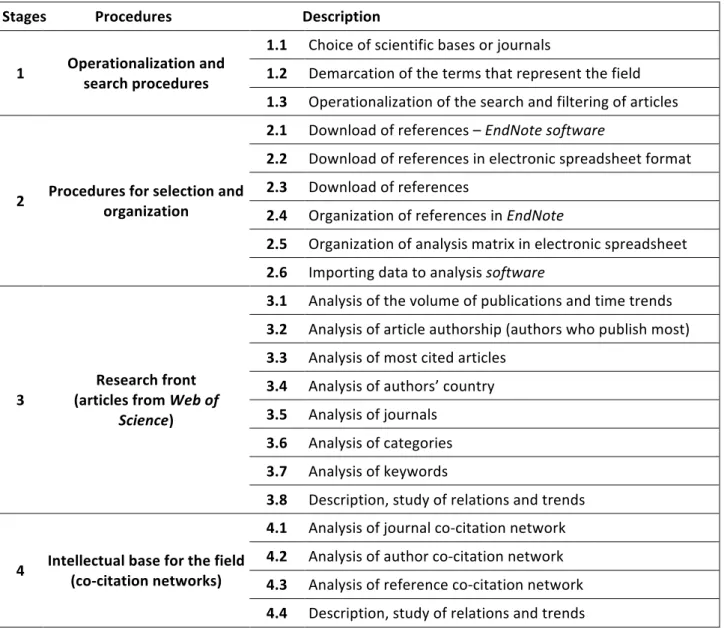
With the aim of ensuring precision and transparency in the collection and analysis of information we chose to adopt the framework of biometric analysis produced by Prado et al. (2016). The instrument establishes stages to be followed by the researcher in planning the study, data mining, selection, organization and analysis of the material that will constitute the corpus of the research (Figure 1).
Stages Procedures Description 1 Operationalization and search procedures
1.1 Choice of scientific bases or journals
1.2 Demarcation of the terms that represent the field 1.3 Operationalization of the search and filtering of articles
2 Procedures for selection and organization
2.1 Download of references – EndNote software
2.2 Download of references in electronic spreadsheet format 2.3 Download of references
2.4 Organization of references in EndNote
2.5 Organization of analysis matrix in electronic spreadsheet 2.6 Importing data to analysis software
3 (articles from Web of Research front
Science)
3.1 Analysis of the volume of publications and time trends 3.2 Analysis of article authorship (authors who publish most) 3.3 Analysis of most cited articles
3.4 Analysis of authors’ country 3.5 Analysis of journals
3.6 Analysis of categories 3.7 Analysis of keywords
3.8 Description, study of relations and trends
4 Intellectual base for the field
(co-‐citation networks)
4.1 Analysis of journal co-‐citation network 4.2 Analysis of author co-‐citation network 4.3 Analysis of reference co-‐citation network 4.4 Description, study of relations and trends
Figure 1 -‐ Organization framework of bibliometric analysis. Source: Adapted from Prado et al. (2016).
According to the framework of bibliometric analysis presented, the first procedure for the operationalization of research was the choice of Web of Science by Thomson Reuters (Principal Collection of the Web of Science), since it is among the most complete and reliable sources for organizing scientific production in accordance with rigid standards of selection, being used by different scholars as a reference (Pinto, Serra, & Ferreira, 2014). In the search, we used the expression “public opinion” or “public opinions” in brackets in the “title” field, that is, the term had to be in the title of the article – whereby the article would follow the central theme in its content. We only considered documents in the form of scientific article and in all the years available in the database –1945 to 2016. Moreover, no specific area was demarcated. At the end of the filtering, we found 2,536 articles.
Next, the other steps detailed in Figure 1 were followed. It is worth highlighting that by using specific software, bibliometric studies allow the researcher to deal with a large volume of information, which would be difficult implementing other analysis procedures (Pinto et al., 2014). To organize the references, we used EndNote (Free EndNote Trial). Nevertheless, in this article, we mainly used CiteSpace software for network presentations (Chen, 2006). In the analysis, we adopted the procedures described by Chen (2004, 2006) regarding the use of CiteSpace to view intellectual turning points (Chen, 2004) and understand emerging trends and transient patterns (Chen, 2004) in a general manner.
Important characteristics of CiteSpace use refer to the concepts of research front and intellectual base. Research front is the “emerging thematic trends and surges of new topics” (Chen, 2006, p. 362) and the intellectual base is represented in CiteSpace by the co-‐citation networks. CiteSpace also allows for the presentation of clusters as the figure illustrates. Chen (2006) demonstrates that through citations and co-‐citations we can discover the research trends on public opinion, the research front and the intellectual base of the field. In this way, the researcher may view the existing relations in his/her research field.
In addition, to extend the analysis we used the software for citation analysis VOSviewer 1.6.7 (Van Eck & Waltman, 2010) and CitNetExplorer 1.0.0 (Van Eck & Waltman, 2014). Through them, it was constructed networks of co-‐citation (bibliometric maps) to better visualize the research field on public opinion. With its specificities, CitNetExplorer is a tool for analyzing and visualizing citation networks of scientific publications.
[...] CitNetExplorer offers sophisticated functionality for drilling down into a citation network, for instance allowing users to start at the level of a full network consisting of several millions of publications and to then gradually drill down into this network until a small subnetwork has been reached including no more than, say, 100 publications, all dealing with a specific topic of interest. (Van Eck & Waltman, 2014, p. 02).
According to Van Eck and Waltman (2014), CitNetExplorer can assist in the study about the development of a research field or describe the literature on specific topics. The authors point out that it is an analysis of direct citation networks, so, it differs from CiteSpace (Chen, 2006) that operates with co-‐citations networks. Considering the specificities, we used more than one software to expand the analysis and visualizations of the networks, and, then, increase the capacity to identify the tendencies of research on public opinion.
4 RESULTS AND DISCUSSION
4.1 Research front (sample of articles from Web of Science)
Considering the period from 1945 to 2016, we found an initial phase with few publications: two articles were published in 1945, one in 1946 and another two in 1947. A progressive and continuous growth in publications with focus on the term “public opinion” only began in 1956, as shown in Figure 2. In the Figure, we also include a graph in which the total of years was divided into 4 intervals of 17 years each – other analyses are shown later considering these timeframes. Despite some oscillations from one year to another, with increases followed by reductions and new increases, the overall trend was of growth, particularly from 2011 onwards. We noted that at the end of the 1990s there was a slight tendency towards fewer articles, going from 67 in 1998 to 45 in 1999, 42 in 2000 and 35 in 2001 – with growth returning in 2002 (43 articles) and 2003 (48 articles). We noticed that 2015 was the year with the most articles, totaling 175. In 2016 (research was carried out on September 19, 2016) 114 articles have already been published, exceeding the total number of articles published in 2014 and 2013.
Figure 2 -‐ Evolution and trend of publications per year (1945-‐2016).
The increase in the number of articles opens space for the diversity of areas, interests and correlated research themes, stressing the plurality of sense attributed to “public opinion”, as mentioned by Figueiredo and Cervellini (1995) when addressing the concepts of the term. These are the first indications that the research front of publications on public opinion is quite diversified in theoretical and methodological terms. Nevertheless, the fact the theme is of interest to various areas is not new, having been strengthened by articles that deal with elections (Campbell, 1960; Mueller, 1973), the effects of public opinion on public policies (Page & Shapiro, 1983; Burstein, 2003) and mass media (Lippmann, 1922; Zaller, 1992). The first two articles found in this search address the issue of the statistical and mathematical measurement of public opinion – text Mann (1945) is indexed in the category of Statistics & Probability and Mathematics, in Web of Science, and Hyman (1945) is indexed in Psychology.
In the researched samples, the pioneering works were On a problem of estimation occurring in public opinion polls, by Mann (1945), published in the journal Annals of Mathematical Statistics, and Community background in public opinion research, by Hyman (1945), published in the Journal of Abnormal and Social Psychology. Both are from 1945 (the first
2 1 2 4 13 10 13 11 9 6 10 11 9 10 15 10 6 12 22 15 11 21 15 34 22 30 41 25 34 24 41 39 35 27 49 37 43 35 52 56 55 43 54 32 50 67 45 42 35 43 48 62 56 64 64 59 84 54 119 120 86 103 175 0 20 40 60 80 100 120 140 160 180 1945 1946 1947 1956 1957 1958 1959 1960 1961 1962 1963 1964 1965 1966 1967 1968 1969 1970 1971 1972 1973 1974 1975 1976 1977 1978 1979 1980 1981 1982 1983 1984 1985 1986 1987 1988 1989 1990 1991 1992 1993 1994 1995 1996 1997 1998 1999 2000 2001 2002 2003 2004 2005 2006 2007 2008 2009 2010 2011 2012 2013 2014 2015 71 319 773 1373 1945-‐1962 1963-‐1980 1981-‐1998 1999-‐2016
year available for searching Web of Science). Mann (1945) discusses properties of voter number estimation, considering a survey performed in the molds of simple random or stratified sampling. Also along the lines of quantitative studies on public opinion, Hyman (1945) identifies advances and shortfalls in the field of research on public opinion at that time.
Even with the growth observed in Figure 2, we find that for Bornmann and Mutz (2015), there is a growth of science that is from 8% to 9% in the second half of the 20th century. We chose to calculate the rate through an autoregressive process of order p=1 (Morettin & Toloi, 2006). In this process, we compared the annual volume of publications against a linear tendency, to verify the growth rate presented by the theme over the studied period. For this case, the growth rate found was 8.64%. If compared with Bornmann and Mutz’s paper (2015), it shows that the studied field is within the growth rate of science. Therefore, despite the verified growth, this growth is not higher than the growth rate of science as a whole.
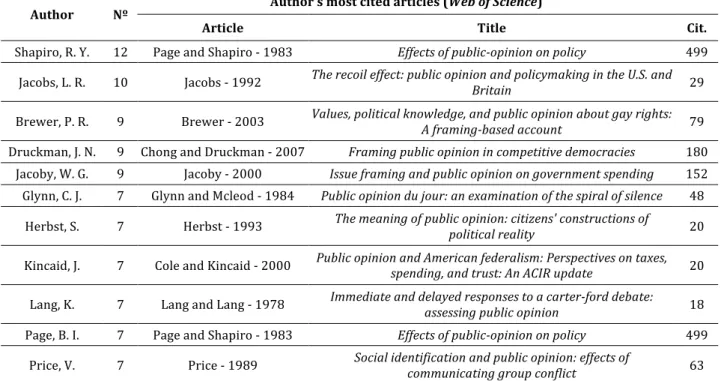
Next, we sought to identify, among the 2,536 sample articles (citing articles), which authors had published the most, especially the existence of authors who have published more than one article from those selected in the sample – these authors are important to demarcate the research front of the field. As such, Table 1 highlights the authors who have published seven or more articles, regardless of the authorship order, also presenting the article most cited in Web of Science (WoS)for each of the authors and the journal in which it was published. The Nº column denotes the total of articles published per author, and the number of citations is also indicated under Cit., including the most cited article. It is worth noting that the 11 authors shown in Table 1 have articles they co-‐authored amongst themselves. In this sense, the sum of their publications is 86 articles.
Table 1 -‐ Most prolific authors and their respective most cited articles (Web of Science)
Author Nº Author’s most cited articles (Web of Science)
Article Title Cit.
Shapiro, R. Y. 12 Page and Shapiro -‐ 1983 Effects of public-‐opinion on policy 499 Jacobs, L. R. 10 Jacobs -‐ 1992 The recoil effect: public opinion and policymaking in the U.S. and Britain 29 Brewer, P. R. 9 Brewer -‐ 2003 Values, political knowledge, and public opinion about gay rights: A framing-‐based account 79 Druckman, J. N. 9 Chong and Druckman -‐ 2007 Framing public opinion in competitive democracies 180
Jacoby, W. G. 9 Jacoby -‐ 2000 Issue framing and public opinion on government spending 152 Glynn, C. J. 7 Glynn and Mcleod -‐ 1984 Public opinion du jour: an examination of the spiral of silence 48
Herbst, S. 7 Herbst -‐ 1993 The meaning of public opinion: citizens' constructions of political reality 20 Kincaid, J. 7 Cole and Kincaid -‐ 2000 Public opinion and American federalism: Perspectives on taxes, spending, and trust: An ACIR update 20 Lang, K. 7 Lang and Lang -‐ 1978 Immediate and delayed responses to a carter-‐ford debate: assessing public opinion 18 Page, B. I. 7 Page and Shapiro -‐ 1983 Effects of public-‐opinion on policy 499
Price, V. 7 Price -‐ 1989 Social identification and public opinion: effects of communicating group conflict 63 Note: The table shows the authors who have published seven or more articles. “Most cited article” refers to the author’s most cited article, either authored or co-‐authored, in the WoS. “Cit.” refers to the sum of the article’s citations in the WoS database.
Given a sample of 2,536 articles, the result suggests a fragmentation in the scenario of authors being published on this issue, that is, there are many researchers interested in the theme and reflecting on it, albeit without a central author in the field’s research front. However, it is worth mentioning that the authors shown could have other articles and texts on the theme not considered because they are not indexed in Web of Science – Main Collection.
Even without authors who comprise a divergent volume of publications, we can highlight, from Table 1, the authors Robert Y. Shapiro (12 articles) and Lawrence R. Jacobs (10 articles), who have co-‐authored articles. Shapiro is a professor and researcher linked to the Department of Political Science at Columbia University. He is a specialist in American Politics, working on the themes of: interests of public opinion, policy formulation, political leadership, and means of communication and application of statistical methods. He is also co-‐author and co-‐editor of several books and articles published on these themes, such as the Oxford Handbook of American Public Opinion and the Media (edited with Lawrence R. Jacobs, Oxford University Press 2011). It should be stressed that Shapiro has been published on this subject for many years, as author and co-‐author, with articles spanning from 1983 (Page & Shapiro, 1983) to 2011 (Shapiro, 2011) and 2013 (Newport et al., 2013). Jacobs also has many years of experience in researching the theme, with special mention for his work in the 1980s (Jacobs & Shapiro, 1989) and after 2010 (Jacobs & Mettle, 2011).
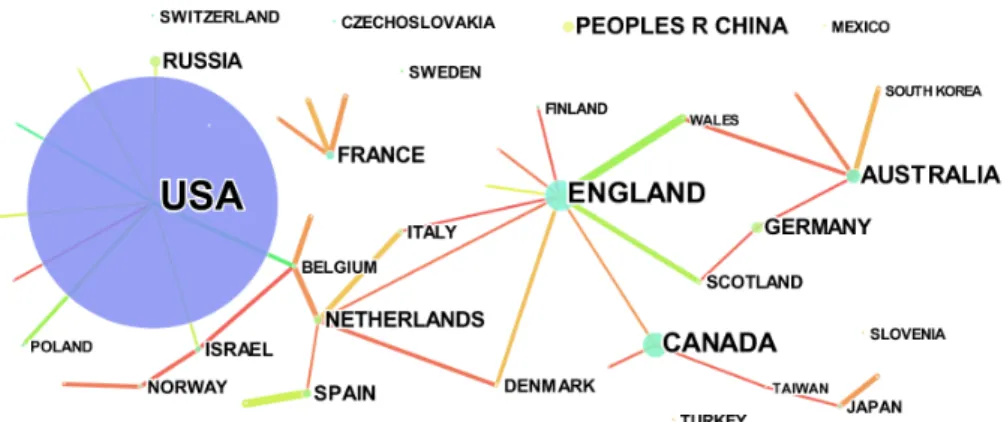
In the above list of authors that have published the most, it is important to stress that they are all linked to North American institutions. Of the ten institutions of learning that most publish, all are North American, with special mention for University of California, University of Michigan, University of North Carolina, University of Wisconsin, Columbia University and Florida State University. In the light of this, we also sought to analyze the countries with the highest number of publications (this analysis only considers the country of the first author). As shown in Figure 3, the United States is far ahead in terms of the number of publications.
Figure 3 -‐ Network of co-‐authors’ countries (country of first author).
Although other countries have published on the theme, such as England (116 articles), Canada (92 articles), Australia (59 articles), China (44 articles), Germany (42 articles), Russia (4 articles), Holland (36 articles), France (35 articles) and Spain (32 articles), the number of North American articles is far superior to the other countries (914 articles), which is illustrated by the size of the blue sphere in Figure 3. This result corroborates the assertion by Figueiredo and
Cervellini (1995) on the prominence of North American research on the theme of public opinion, especially in its study and measurement. Therefore, results prove the predominance of the United States on the public opinion research front.
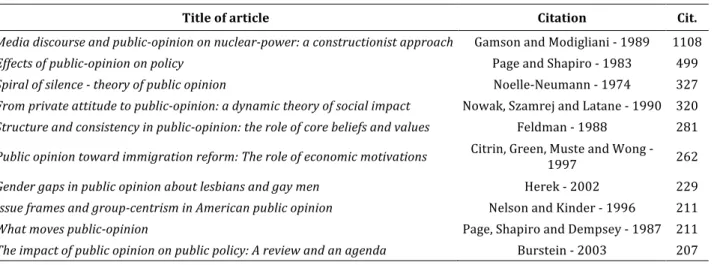
From the United States (the country with the highest number of articles), the most cited works were by the authors, Gamson, Page and Nowak, with their respective articles: Gamson and Modigliani (1989), with 1,108 citations; Page and Shapiro (1983), with 499 citations; and Nowak, Szamrej and Latane (1990), with 320 citations. As per the analysis that will be described later, these articles appear among the 10 most cited from the sample (citations in Web of Science). Also in relation to the United States, the first article found in the search was published in 1947: Public opinion measurement as an instrument in public health practice (Calver & Wingo, 1947), in the American Journal of Public Health and the Nations’ Health.
Continuing the analyses of the articles from the sample, in Table 2, we highlight the 10 most cited articles (number of citations informed through Web of Science). Apart from the title of the articles, Table 2 shows the authors (Citation), the journal in which the article was published and the number of citations (Cit.).
Among the results, it is worth noting that 4 of the 10 most cited articles are from the 1980s and focus on themes such as the effects of public opinion (Page & Shapiro, 1983; Page et al., 1987), media and public opinion (Gamson & Modigliani, 1989) and the relation between beliefs, values and public opinion (Feldman, 1988). The oldest article is the Spiral of silence: theory of public opinion, by Noelle-‐Neumann (1974), published in the Journal of Communication. In it, the German political scientist puts forward an often cited theory on public opinion and mass communication, in which he argues that people are afraid of isolation (of being excluded) and therefore prefer not to express their opinions when they are contrary to the majority’s (particularly on controversial themes).
Table 2 -‐ The 10 most cited articles (1945-‐2016) from the sample of 2,536 articles (citations in Web of Science)
Title of article Citation Cit.
Media discourse and public-‐opinion on nuclear-‐power: a constructionist approach Gamson and Modigliani -‐ 1989 1108
Effects of public-‐opinion on policy Page and Shapiro -‐ 1983 499
Spiral of silence -‐ theory of public opinion Noelle-‐Neumann -‐ 1974 327
From private attitude to public-‐opinion: a dynamic theory of social impact Nowak, Szamrej and Latane -‐ 1990 320
Structure and consistency in public-‐opinion: the role of core beliefs and values Feldman -‐ 1988 281
Public opinion toward immigration reform: The role of economic motivations Citrin, Green, Muste and Wong -‐ 1997 262
Gender gaps in public opinion about lesbians and gay men Herek -‐ 2002 229
Issue frames and group-‐centrism in American public opinion Nelson and Kinder -‐ 1996 211
What moves public-‐opinion Page, Shapiro and Dempsey -‐ 1987 211
The impact of public opinion on public policy: A review and an agenda Burstein -‐ 2003 207
The most cited article by far is Media discourse and public-‐opinion on nuclear-‐power: a constructionist approach, by Gamson and Modigliani (1989) published in the American Journal of Sociology. This article studies the relation between media and public opinion through an analysis of the discourse on nuclear energy over more than three decades. The intention is to understand
the formation of public opinion on nuclear energy (Gamson & Modigliani, 1989). Regarding the journals in which the 10 articles were published, we noted that the majority came from areas related to political science; the themes are also linked to these areas – it is the case of those that deal with influence of public opinion on political decisions (Burstein, 2003; Page & Shapiro, 1983), on the relation between media and public opinion, the impacts of public opinion, the relation of public opinion to beliefs and values, as well as looking at themes such as immigration and homosexuality, among others. Therefore, we reiterate that our analysis of the research front showed the existence of a plurality of themes, approaches and empirical research on public opinion, with a strong presence of themes related to the area of political science. In addition, on the research front, the article by Gamson and Modigliani (1989), on media and public opinion in the case of nuclear energy, stands out.
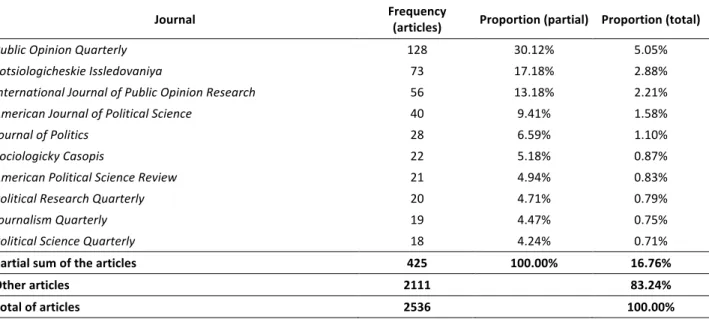
Next, we list the most frequent journals in the 2,536 published articles from the sample. This assessment was aimed at identifying any journal that was notable for the publication of articles on public opinion. In the list, we found a very high number of journals – more than 960 – demonstrating that the publications are disperse, being distributed between different journals, focused on wide-‐ranging areas (including political science, communication, economics, history, environmental sciences, health sciences, technology, engineering, literature, international relations, public policy, demography, public administration, business and others). Considering the journals from Table 3, the following published more than 30 articles: Public Opinion Quarterly (128 articles), Sotsiologicheskie Issledovaniya (73 articles), International Journal of Public Opinion Research (56 articles) and American Journal of Political Science (40 articles).
Table 3 -‐ Journals that published the most articles from the sample (1945-‐2016)
Journal Frequency (articles) Proportion (partial) Proportion (total)
Public Opinion Quarterly 128 30.12% 5.05%
Sotsiologicheskie Issledovaniya 73 17.18% 2.88%
International Journal of Public Opinion Research 56 13.18% 2.21%
American Journal of Political Science 40 9.41% 1.58%
Journal of Politics 28 6.59% 1.10%
Sociologicky Casopis 22 5.18% 0.87%
American Political Science Review 21 4.94% 0.83%
Political Research Quarterly 20 4.71% 0.79%
Journalism Quarterly 19 4.47% 0.75%
Political Science Quarterly 18 4.24% 0.71%
Partial sum of the articles 425 100.00% 16.76%
Other articles 2111 83.24%
Total of articles 2536 100.00%
Table 3 shows that the first 10 journals represent just 16.76% of publications, showing that the articles from the sample came from a very large number of journals. Nevertheless, the journals with the highest number of articles demonstrate a relative concentration of research on public opinion in areas linked to political sciences (American Journal of Political Science, Journal of Politics, American Political Science Review and Political Research Quarterly), or are journals
specialized in public opinion, such as Public Opinion Quarterly and the International Journal of Public Opinion Research. As such, these are the characteristics of the research front in terms of journals.
In terms of the sheer number of articles, the Public Opinion Quarterly stands out. It has a high impact factor, was created in 1937 and is part of the Oxford University publications. The journal’s publications deal with theoretical contributions to communication research, public opinion analysis and the investigation of methodological questions (Public Opinion Quarterly, 2016). In this journal, the most cited article was Gender gaps in public opinion about lesbians and gay men by Herek (2002), with 229 citations, and the oldest article was Public-‐opinion and national-‐security policy by Almond (1956). Herek (2002) analyzed the disparity in attitudes among heterosexuals in relation to homosexuals. The results showed that heterosexual men had less favorable attitudes towards homosexuals in terms of gender issues. The author’s research fits the orientation of opinion surveys. Almond’s research (1956) concerned public opinion and national security.
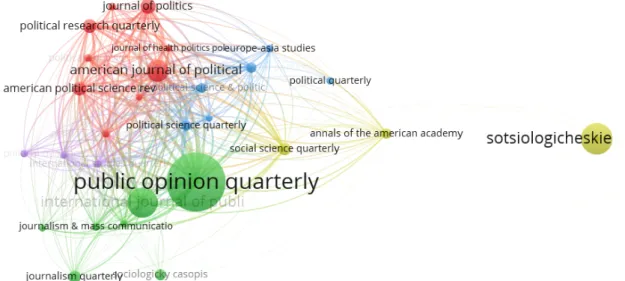
Through the analysis of Bibliographic Couplin in the VOSviewer, we identified 5 clusters in the journals where the articles of the sample were published (Figure 4).
Figure 4 -‐ Analysis of bibliographic couplin (cut of at least 10 articles).
Cluster 1 (red) consists of 9 journals. In this cluster, journals with more articles in the sample are: American Journal of Political, American Political Science and Journal of Political Science. Most of the journals in this cluster are focused on discussions about the field of political science. Cluster 2 (green) consists of 7 journals. This cluster is more focused on publications in the areas of journalism and media with journals such as Journalism and Mass Communication Quartely, Communication Research and Journalism Quartely. The journal with more articles in this cluster is Public Opinion Quarterly -‐ it is the journal with the largest number of articles in the sample.
Cluster 3 (blue) consists of 6 journals, among them, Europe-‐Asian Studies, Political Quartely, European Union Politcs and Political Science Quartely. In general, they are journals from the political science field. Cluster 4 (yellow) consists of 4 journals: Annals of the American
Academy of Political and Social Science, Russian Political and Law, Social, Science Quartely and Sotsiologicheskie Issledovaniya -‐ the last one is the second journal in number of articles in the sample. Finally, cluster 5 (purple) consists of 3 journals: International Studies Quartely, Journal of Conflict Resolution and Western Political Quartely.
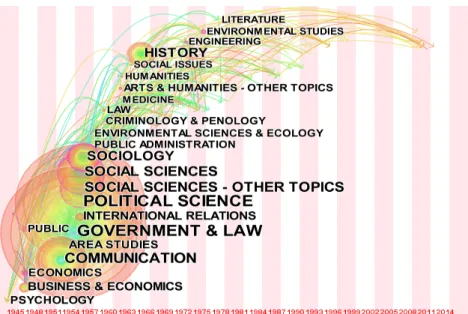
In Figure 5, we show the distribution of articles by categories in Web of Science (only areas of frequency equal to or greater than 44 appear in the figure). Indexation by categories shows that the theme of public opinion is multidisciplinary, even though it is mostly associated with Government and Law (844 articles), followed by studies in the areas of Political Science (780) and Communication (353). It is noteworthy that apart from the areas of knowledge cited, there are publications in various other areas of the sciences, such as medicine, art, cultural studies, international relations, education, environmental sciences, statistics, mathematics, business, demography, geography and ethics.
Figure 5 -‐ Co-‐occurring subject (Web of Science Category).
The co-‐occurring subject above is presented in the time zone format (Chen, 2006), showing, apart from frequency of articles (marked by the size of the circles), the trend for field expansion (marking the positions in which the first article from each area was published). It demonstrates that the research front has expanded and today forms a multidisciplinary field (exact and earth sciences; human sciences; agrarian science engineering and applied social sciences), as Figueiredo and Cervellini (1995) also point out.
In general, we noticed that the texts already presented also stand out in this aspect, such as the article by Page and Shapiro (1983), which is indexed both in the Government & Law category, and also in Political Science. The article (Communication) by Gamson and Modigliani (1989), the most cited from our sample, also appears, as well as the classic article by Noelle-‐ Neumann (1974). It is worth mentioning that the articles indexed in the category of History are little cited – the most cited article in this category was referenced only 32 times. Next, we will analyze the keywords used (co-‐occurring keywords), shown in Figure 6.
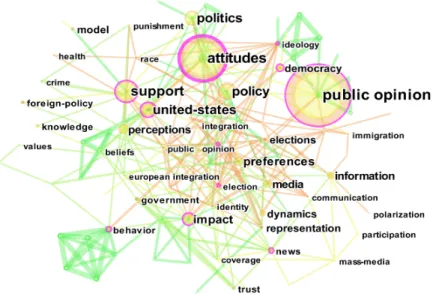
Figure 6 -‐ Co-‐occurring keywords (Years per slice = 10).
The most frequent keyword was public opinion, used 333 times (which was expected given the field demarcation). After it came attitudes (235), support (126), policy (118), among others, as per Figure 6 and Table 4. The highlighted words comprise the subject areas of the research front and, therefore, indicate focuses and trends in public opinion research (in the network those with frequency of at least 20 times were highlighted). Table 4 shows the frequency of keywords and the most cited article that used the respective keyword. We noted that the words and articles again demonstrate the plurality of the field and the multiplicity of research carried out from different study perspectives.
Table 4 -‐ Top 10 co-‐occurring key-‐words
Key-‐word Freq. Most cited article that used the respective keyword
Author Article
public opinion 333 Firestone and Kempton -‐ 2007 Public opinion about large offshore wind power: underlying factors
attitudes 235 Citrin, Green, Muste and Wong -‐ 1997 Public opinion toward immigration reform: the role of economic motivations support 126 Hooghe and Marks -‐ 2005 Calculation, community and cues public opinion on European integration
policy 118 Jacoby -‐ 2000 Issue framing and public opinion on government spending
United-‐States 103 Burstein -‐ 2003 The impact of public opinion on public policy: a review and an agenda politics 96 Citrin, Green, Muste and
Wong -‐ 1997 Public opinion toward immigration reform: the role of economic motivations
impact 73 Chong and Druckman -‐ 2007 Framing public opinion in competitive democracies preferences 72 Jacoby -‐ 2000 Issue framing and public opinion on government spending
perceptions 62 Brulle, Carmichael and Jenkins -‐ 2012 Shifting public opinion on climate change: an empirical assessment of factors influencing concern over climate change in the U.S., 2002–2010
In the selection of the articles published, besides the natural predominance of the term ‘public opinion’ (333 times) – the theme of this paper – we observed a network of words that could be connected to more frequent categories of the articles. Information, news and media, for example, are strongly related to the area of Communication. And policy, election, representation, democracy and politics are common terms in Political Science studies, as well as Government and Law. Attitude is one of the most used expressions among the keywords (235 times) and may be linked to studies from different areas and categories. Perhaps it is used so much due to its relation to the term opinion, taken to mean a personal attitude involving choices (Borges, 2014; Mateus, 2008). Other keywords indicate conceptual studies on public opinion, its impacts (measurement) or “public opinion survey”, such as support, knowledge, model, dynamics, behavior, impact and perception. Other keywords suggest more specific empirical research contexts, such as war, immigration and foreign policy. It is worth noting that the term United States is the fifth most used keyword, linked to the fact that it is the country with the highest number of studies on public opinion, has a tradition of carrying out surveys in this area and is where the authors publish the most.
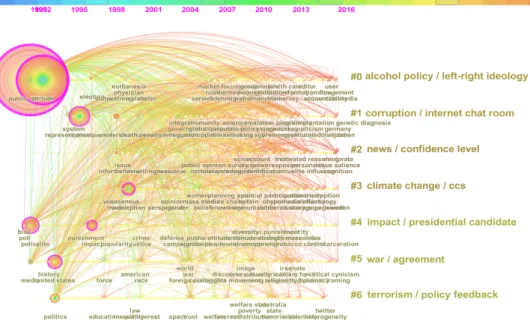
Another analysis performed in the CiteSpace software from the keywords network was through the function of grouping words in clusters. Clusters reveal underlying groups and make it possible to find categories that directly support analysis (Chen, Ibekwe-‐SanJuan & Hou, 2010). Clusters (Figure 7) were formed by the keywords network, using a selection and comparison algorithm. For tagging automatic cluster, we chose to select the tags directly from the index terms of articles cited in each cluster. In order to characterize the nature of clusters, we used two algorithms for classification, log-‐likelihood tests (LLR) and mutual information tests (MI) (Dunning, 1993; Chen, 2012). According to Chen, Ibekwe-‐SanJuan, Hou (2010, p. 2) “the traditional co-‐ citation analysis typically focuses on cited members of clusters as a primary source of evidence for interpretation. Focusing on citers can improve our understanding of the nature of a research front and its intellectual base”. Thus, as shown in Figure 7, there are 7 co-‐citation clusters in the network and these clusters are labeled by index terms from their own citers.
Figure 7 -‐ Cluster analysis in the network of co-‐occurring keywords. The best consensus-‐conforming ranking methods: 1) index terms by LLR = log-‐likelihood tests; 2) index terms by MI = mutual information tests.