493
General trends in world biogeographic literature: A preliminary bibliometric analysis
Juan J. Morrone
1& José C. Guerrero
2Scientific publications represent a quantitative measure
for the basic research activity in a given field. Bibliometric
studies have been published in recent years focusing on the
performance of particular areas, with varied temporal and
geographical foci (e.g., Garg & Pahdi 2002; Zhu et al. 2004;
Ferner & Aronson 2005; Zorzetto et al. 2006). Two recent
studies (Riddle & Haffner 2004; Posadas & Donato 2007) have
General trends in world biogeographic literature:
A preliminary bibliometric analysis
1Museo de Zoología “Alfonso L. Herrera”, Departamento de Biología Evolutiva, Facultad de Ciencias, Universidad Nacional Autónoma de México
(UNAM), Apdo. postal 70-399, 04510 Mexico, D.F., Mexico. [email protected].
2Departamento de Biología Animal, Facultad de Ciencias, Universidad de Málaga (UMA), 29071 Málaga, Spain. [email protected].
ABSTRACT.General trends in world biogeographic literature: A preliminary bibliometric analysis. Records with the search string biogeograph* were collected from the Science Citation Index (SCI). A total of 3456 records were downloaded for the 1945-2006 period from titles of articles and reviews, and 10,543 records were downloaded for 1991-2006, taking into consideration also abstracts and keywords. Temporal trends of publications, geographical and institutional distribution of the research output, authorship, and core journals were evaluated. There were as many as 122 countries carrying out biogeographic research; in the most recent period, USA is the top producing country, followed by the United Kingdom, Australia, France, Germany, Spain, and Canada. There were 17,493 authors contributing to the field. During 1991-2006 there were 4098 organizations with authors involved in biogeographic research; institutions with higher number of papers are the Natural History Museum (United Kingdom), the University of California, Berkeley (USA), the Museum National d’Histoire Naturelle (France), the Universidad Nacional Autónoma de México (Mexico), the American Museum of Natural History (USA) and the Russian Academy of Sciences (Russia). Research articles are spread over a variety of journals, with the Journal of Biogeography, Molecular Phylogenetics and Evolution, Molecular Ecology, and Biological Journal of the Linnean Society being the core journals. From 28,759 keywords retrieved those with the highest frequency were evolution, phylogeny, diversity, mitochondrial DNA, pattern(s), systematics, and population(s). We conclude that publications on biogeography have increased substantially during the last years, especially since 1998. The preferred journal for biogeographic papers is the Journal of Biogeography. Most frequent keywords seem to indicate that biogeography fits well within both evolutionary biology and ecology, with molecular biology and phylogenetics being important factors that drive their current development.
KEYWORDS. Biogeography; publications; journals; scientometrics; Science Citation Index.
RESUMEN.Tendencias generales en la literatura biogeografica mundial: un análisis bibliométrico preliminar. Se recolectaron registros con la palabra biogeograph* a partir del Science Citation Index (SCI). Se obtuvo un total de 3456 registros para el periodo 1945-2006, a partir de títulos de artículos y revisiones; y 10,543 registros para 1991-2006, tomando en cuenta también resúmenes y palabras clave. Se evaluaron las tendencias temporales y geográficas de las publicaciones, además de la distribución institucional de la investigación en el área, autoría y revistas principales. Durante 1945-2006 se publicaron 3456 artículos de biogeografía; cuando la búsqueda para 1991-2006 se expandió para buscar el tema en palabras claves y resúmenes, se recuperaron 10,543 registros. Hubo 122 países desarrollando investigación en biogeografía; en el periodo más reciente, los Estados Unidos de América fueron el país principal, seguidos del Reino Unido, Australia, Francia, Alemania, España y Canadá. 17,493 autores contribuyeron a la biogeografía. Durante 1991-2006 hubo 4098 instituciones con autores desarrollando investigación en el área; las que poseen un número mayor de artículos fueron el Natural History Museum (Reino Unido), la University of California, Berkeley (Estados Unidos de América), el Museum National d’Histoire Naturelle (Francia), la Universidad Nacional Autónoma de México (México), el American Museum of Natural History (Estados Unidos de América) y la Academia Rusa de Ciencias (Rusia). Los artículos de investigación se hayan repartidos en una variedad de revistas, siendo las principales el Journal of Biogeography, Molecular Phylogenetics and Evolution, Molecular Ecology y Biological Journal of the Linnean Society. A partir de 28,759 palabras claves, aquellas con mayor frecuencia fueron evolución, filogenia, diversidad, DNA mitocondrial, patrón (patrones), sistemática y población(es). Concluimos que las publicaciones en biogeografía se han incrementado sustancialmente durante los últimos años, en especial a partir de 1998. La revista preferida para artículos biogeográficos es el Journal of Biogeography. Las palabras claves más frecuentes indican que la biogeografía cabe adecuadamente tanto en la biología evolutiva como en la ecología, siendo la biología molecular y la sistemática filogenética los factores que conducen su desarrollo actual. PALABRAS CLAVE. Biogeografía; bibliometría; publicaciones; revistas; cientimetría; Science Citation Index.
given us some insights into the evolution and dynamics of
biogeography. We think that a worldwide analysis focused on
biogeographical articles published in scientific journals may
help elucidate how the field is structured.
494
Morrone et al.
and institutional distribution of research output, authorship,
and core journals.
METHODS
Data for the analysis were collected from the Science
Citation Index (SCI), a comprehensive data base covering
scientific journals, published by Thomson Scientific,
Philadelphia, USA. We downloaded two data sets, both
restricting our search to articles and reviews, and omitting
letters, book reviews, and other minor contributions. The first
one consisted of 3456 records from 1945-2006 using the search
string biogeograph* in their titles, which was used to estimate
the general trend in the annual growth of publications. The
second data set, consisting of 10,543 records, was compiled
for 1991-2006, period for which keywords and abstracts are
also available for the articles contained in SCI. It was used to
analyse the geographical and institutional distribution of
research output, authorship, and journals during the most
recent period. In addition to Science Citation Index, we used
software Endnote (Thomson ISI ResearchSoft 1998-2003) for
information extraction and processing.
RESULTS
Temporal trends of publications on biogeography.
During
1945-2006 a total of 3456 publications on biogeography was
published (Fig. 1), representing an average of 56 publications
per year. The growth seems relatively smooth, however, more
than half (53.50%) of these publications has been published
during the last nine years (1998-2006), with the highest number
(246, 7.1181%) in 2006. When the search for the 1991-2006
allowed to look for the subject additionally in keywords and
abstracts, a total of 10,543 of records was retrieved, which
show a clearer trend to increase in the last years (Fig. 2).
Considering that the complete data base for 1945-2006 includes
37,739,815 records, 3456 represents a 0.009% of publications
in biogeography, whereas for the second search (1991-2006),
for the 18,500,729 records available, 10,453 represents a 0.056%
of biogeographic articles.
Geographical distribution of research output.
During
1945-2006 there have been as many as 122 countries carrying out
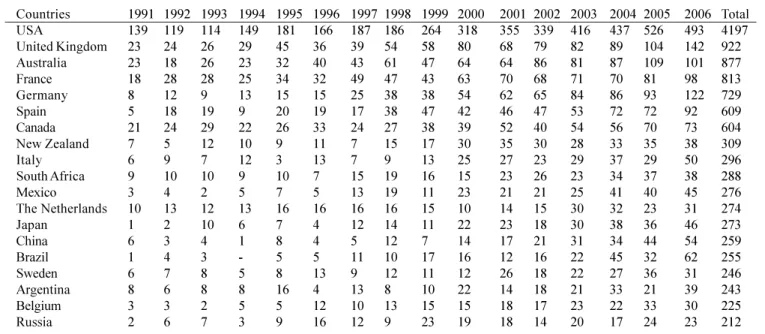
biogeographic research. In the most recent period (Table I),
USA is the top producing country, followed by the United
Kingdom, Australia, France, Germany, Spain, and Canada.
Anglo-speaking countries are the three first ones, although
Fig. 1. Number of publications (1946-2006) with biogeograph* in their titles.
495
General trends in world biogeographic literature: A preliminary bibliometric analysis
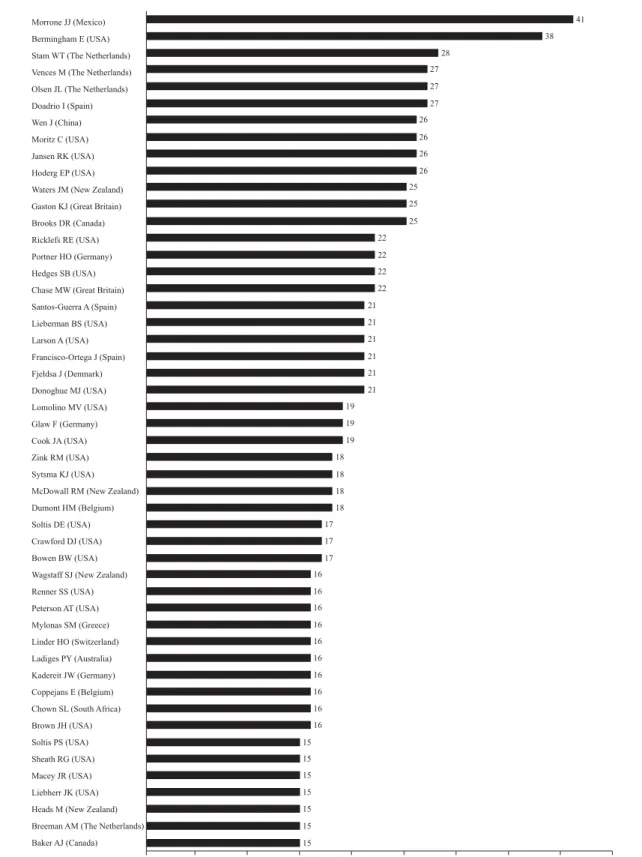
Fig. 3. Most productive authors in biogeography (1991-2006), with indication of the country where they currently work. Only those having 15 or more papers are figured.
France, Germany, Spain, Italy, Mexico, The Netherlands, Japan,
China, Brazil, Sweden, Argentina, Belgium and Russia are
situated among the countries publishing more papers in
biogeography.
496
Morrone et al.
Table I. Country distribution of authorships in biogeography (1991-2006). Only countries whose share is more than 2% are represented.
Countries
USA
United Kingdom
Australia
France
Germany
Spain
Canada
New Zealand
Italy
South Africa
Mexico
The Netherlands
Japan
China
Brazil
Sweden
Argentina
Belgium
Russia
1991
139
23
23
18
8
5
21
7
6
9
3
10
1
6
1
6
8
3
2
1992
119
24
18
28
12
18
24
5
9
10
4
13
2
3
4
7
6
3
6
1993
114
26
26
28
9
19
29
12
7
10
2
12
10
4
3
8
8
2
7
1994
149
29
23
25
13
9
22
10
12
9
5
13
6
1
-5
8
5
3
1995
181
45
32
34
15
20
26
9
3
10
7
16
7
8
5
8
16
5
9
1996
166
36
40
32
15
19
33
11
13
7
5
16
4
4
5
13
4
12
16
1997
187
39
43
49
25
17
24
7
7
15
13
16
12
5
11
9
13
10
12
1998
186
54
61
47
38
38
27
15
9
19
19
16
14
12
10
12
8
13
9
1999
264
58
47
43
38
47
38
17
13
16
11
15
11
7
17
11
10
15
23
2000
318
80
64
63
54
42
39
30
25
15
23
10
22
14
16
12
22
15
19
2001
355
68
64
70
62
46
52
35
27
23
21
14
23
17
12
26
14
18
18
2002
339
79
86
68
65
47
40
30
23
26
21
15
18
21
16
18
18
17
14
2003
416
82
81
71
84
53
54
28
29
23
25
30
30
31
22
22
21
23
20
2004
437
89
87
70
86
72
56
33
37
34
41
32
38
34
45
27
33
22
17
2005
526
104
109
81
93
72
70
35
29
37
40
23
36
44
32
36
21
33
24
2006
493
142
101
98
122
92
73
38
50
38
45
31
46
54
62
31
39
30
23
Total
4197
922
877
813
729
609
604
309
296
288
276
274
273
259
255
246
243
225
212
Institutional distribution.
During 1991-2006 there were
4098 organizations with authors involved in biogeographic
research (Fig. 4). Institutions with higher number of papers
are the Natural History Museum (United Kingdom), the
University of California, Berkeley (USA), the Museum National
d’Histoire Naturelle (France), the Universidad Nacional
Autónoma de México (Mexico), the American Museum of
Natural History (USA) and the Russian Academy of Sciences
(Russia).
Journals.
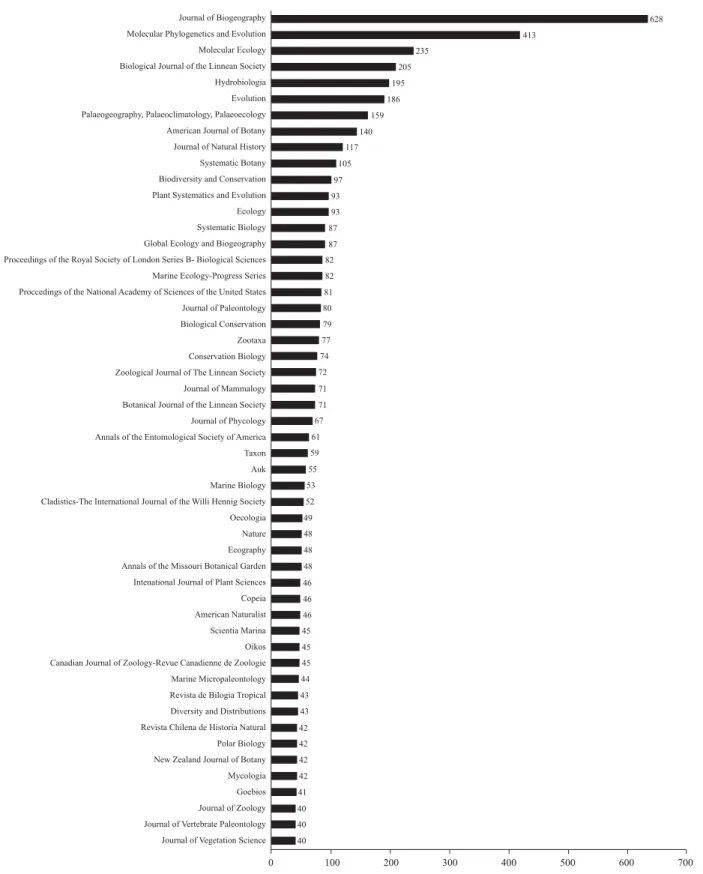
Research articles in biogeography are spread
over a variety of journals (Fig. 5). The core journals, e.g. those
497
General trends in world biogeographic literature: A preliminary bibliometric analysis
Fig. 5. Journals publishing research on biogeography (1991-2006). Only those having 40 or more papers are figured.
that have published more than 100 papers in the field, are the
Journal of Biogeography (628 papers),
Molecular
Phylogenetics and Evolution (413), Molecular Ecology (235),
Biological Journal of the Linnean Society (205),
Hydrobiologia (195), Evolution (186), Palaeogeography,
Palaeoclimatology, Palaeoecology (159), American Journal
of Botany (140), Journal of Natural History (117), and
Systematic Botany (105).
498
Morrone et al.
articles from 1991-2006 (Fig. 6). Those with the highest frequency
were: evolution (1683), phylogeny (1095), diversity (885),
mitochondrial DNA (856), pattern(s) (818), systematics (672), and
population(s) (633). Most frequent taxa included birds (322),
mammals (225), and plants (175). Most frequent geographic areas
were Australia (264), New Zealand (216), and Africa (170).
DISCUSSION
The analysis shows that publications on biogeography
have increased substantially during the last years, especially
since 1998. USA is the major producer, with 39% of the
publications in the period 1991-2006, followed by United
499
General trends in world biogeographic literature: A preliminary bibliometric analysis
Kingdom, Australia, France, Germany, Spain, and Canada.
Institutions with the highest numbers of publications on
biogeography are situated in United Kingdom, USA, France,
Mexico and Russia. As noted by Posadas & Donato (2007),
the relevance of Latin American authors and institutions is
worth mentioning, given the limited economic resources
available to them, when compared with the USA or European
countries.
Core journals where biogeographic papers have been
published include the Journal of Biogeography, Molecular
Phylogenetics and Evolution, Molecular Ecology, Biological
Journal of the Linnean Society, Hydrobiologia, Evolution,
and
Palaeogeography, Palaeoclimatology, Palaeoecology.
Analysis of the papers published in these journals, as done
by Posadas & Donato (2007) for the Journal of Biogeography
in 2005-2006, may give more specific aspects of the dynamics
and evolution of the field.
Keywords are useful bibliometric indicators, that may help
establish in which direction a discipline is growing. The most
frequently found keywords seem to indicate that biogeography
fits well within both evolutionary biology and ecology.
Molecular biology and phylogenetics represent important
factors that drive the current development of biogeography,
which is also evident by the fact that Molecular Phylogenetics
and Evolution and Molecular Ecology are among the three
core journals.
If papers from other databases which are not covered by
the SCI were included, the figures might change significantly.
Particularly, a bias toward journals printed in English in SCI
may be a handicap for a worldwide analysis, because many
papers published in other languages are not taken into
consideration. On the other hand, books and book chapters,
not covered by SCI, may constitute an additional source of
valuable information. Our conclusions are therefore subject
to these limitations.
Acknowledgments. We thank Malte Ebach, Ana L. Márquez, Layla Michán, Jesús Olivero, and Raimundo Real for helpful comments on the manuscript.
REFERENCES
Ferner, R. E. & J. K. Aronson. 2005. National differences in publishing papers on adverse drug reactions. British Journal of Clinical
Pharmacology 59: 108–111.
Garg, K. C. & P. Pahdi. 2002. Scientometrics of laser research in India during 1970–1984. Scientometrics 55: 215–241.
Posadas, P. & M. Donato. 2007. Everything you always wanted to know about historical biogeography, but were afraid to ask: A preliminary overview based on papers published in Journal of Biogeography 2005–2006. Biogeografía 2: 26–31.
Riddle, B. R. & D. J. Hafner. 2004. The past and future roles of phylogeography in historical biogeography. In: Frontiers of biogeography: New directions in the geography of nature (ed. by M. V. Lomolino & L. R. Heaney), Sinauer Associates Inc., Sunderland, Massachusetts, pp. 93–110.
Thomson ISI Researchsoft. 1998–2003. Endnote version 7.0.0. Zhu, X.; Q. Wu; Y. Z. Zheng & X. Ma. 2004. Highly cited papers and
the evaluation of a research university: A case study: Peking University 1974–2003. Scientometrics 60: 237–247.
Zorzettto, R.; D. Razzouk; M. T. B. Dubugras; J. Gerolin; N. Schor; J. A. Ghimaraes & J. J. Mari. 2006. The scientific production in health and biological sciences of the top 20 Brazilian universities.
Brazilian Journal of Medical and Biological Research 39:
1513–1520.