Father Involvement: Construction of a Theoretical Model
Based on a Literature Review
Ligia de Santis
1, *Elizabeth Joan Barham
11
Universidade Federal de São Carlos, São Carlos, SP, Brazil
Abstract
An ample body of scientifi c evidence exists, documenting the importance of the father-child relationship. The objective of this study was to develop a theoretical model of father involvement, organized according to the principles of Structural Equation Modeling, which require specifi cation of the variables associated with the central construct, based on empirical data. In 2015, a systematic search was conducted in the databases APA PsycNET, Bireme, PEPSIC, Web of Science and IndexPsi Periódicos, using the descriptors “involvement” and “father”, crossed with “measure”, “scale”, “tool” or “instrument”, in both the English and Portuguese languages. There were no restrictions on the year of publication. In total, 39 complete texts were located, that included data on father involvement. The information in these texts was grouped into three categories: (a) dimensions of father involvement, (b) factors affecting father involvement and (c) impacts of father involvement on other variables. The model presented synthesizes the results of these studies, representing an advance in theory development in this area. This model increases the visibility of conceptual issues about father involvement and its correlates, and, following empirical testing, may contribute to the improvement of intervention programs for fathers.
Keywords: Father involvement, theoretical model, development, wellbeing.
Envolvimento Paterno: Construção de um Modelo Teórico
Baseado em uma Revisão da Literatura
Resumo
Um corpo amplo de evidências científi cas já existente documenta a importância da relação pai-fi lho. O objetivo deste estudo foi desenvolver um modelo teórico de envolvimento paterno, organizado de acordo com princípios de Análise de Equações Estruturais, que requerem especifi car as variáveis associadas ao construto central, com base em dados empíricos. Em 2015, foi realizada uma busca sistemática nas bases de dados eletrônicas APA PsycNET, Bireme, PEPSIC, Web of Science e IndexPsi Periódicos, usando os descritores “envolvimento” e “paterno”, cruzados com “avaliação” ou “instrumento”, nos idiomas inglês e português. Não foram impostas restrições em relação ao ano de publicação. Foram encontrados 39 textos completos que incluíam dados empíricos sobre o envolvimento paterno. As informações encontradas foram agrupadas em três categorias: (a) dimensões do envolvimento paterno, (b) fatores que afetam o envolvimento paterno e (c) impactos deste envolvimento sobre outras variáveis. O modelo apresentado sintetiza os resultados dos estudos e representa um avanço no desenvolvimento teórico na
área. Este modelo aumenta a visibilidade de questões conceituais sobre o envolvimento paterno e seus correlatos, e, depois da sua testagem empírica, poderá contribuir para o aprimoramento de programas de intervenção para pais.
Palavras-chave: Envolvimento paterno, modelo teórico, desenvolvimento, bem-estar.
Envolvimiento Paterno: Construcción de un Modelo Teórico
Basado en una Revisión de la Literatura
Resumen
Un cuerpo de evidencia científi ca ya existente documenta la importancia de la relación padre-hijo. El objetivo de este estudio fue desarrollar un modelo teórico de envolvimiento paterno, organizados de acuerdo con los principios de la Análisis de Ecuaciones Estructurales, que requieren especifi car las variables asociadas con el constructo central, basada en datos empíricos. En 2015, se realizó una búsqueda sistemática en las bases de datos electrónicas APA PsycNET, Bireme, PEPSIC, Web of Science
e IndexPsi Periódicos, utilizando los descriptores “envolvimento” y “paterno”, cruzados con “avaliação” o “instrumento”, en Inglés y Portugués. No hubo restricciones en el año de publicación. Se encontraron 39 textos completos que incluían datos empíricos sobre el envolvimiento paterno. Estos resultados se agruparon en tres categorías: (a) las dimensiones del envolvimiento paterno, (b) factores que afectan el envolvimiento paterno y (c) el impacto de este envolvimiento en otras variables. El modelo sintetiza los resultados de los estúdios y representa un avance en el desarrollo teórico del área. Este modelo aumenta la visibilidad de las cuestiones conceptuales sobre el envolvimiento paterno y sus correlatos, y, después de su comprobación empírica, puede contribuir a la mejora de los programas de intervención para los padres.
Palabras clave: Envolvimiento paterno, modelo teórico, desarrollo, bienestar.
Researchers’ interest in studying father involvement is increasing, especially in recent decades (Volker, 2014). When initial studies on this question appeared in the academic literature, researchers focused on the effects of fathers’ physical presence versus absence in the family environment (Cia, 2009), comparing indicators of child development in both situations. Starting in the 1990s, in addition to the focus on face to face interactions between fathers and their children, two further concepts were introduced: (a) acces-sibility, which captures the extent to which the father is both physically and psychologically available to his child, and (b) responsibility, which involves tasks that the father performs, to guarantee his child’s care and welfare, such as taking the child to the doctor or maintaining relationships with paid caregivers (Lamb, 1997; Pleck, 2010). Currently, father involvement is understood as a multidimensional construct, covering a range of skills and encompassing
affective, cognitive and ethical dimensions of the father-child relationship, and which involves observable behavioral components that can be either direct (father-child interactions) or indirect such as fi nancial support, or psychological support to the mother (Pleck, 2007).
Although there is a considerable body of literature on the concept of father involvement, there is not yet a theoretical model of father in-volvement, indicating the relationship between this construct and other variables (Pleck, 2007; 2010). According to Pasquali (2010), the ab-sence of an empirically-tested theoretical model makes it diffi cult to build effective tools to guide professional practice and to improve the quality of research in a given area.
(Byrne, 2010). Using this approach, initially the researcher examines empirical studies on the subject, to obtain evidence about the dimensions of the phenomenon of interest and relations be-tween this phenomenon and other variables. Next, the researcher proposes a model that in-dicates probable links among these variables (Byrne, 2010; Kline, 2011). Thus, the objective of the present study was to construct an initial theoretical model of father involvement that in-tegrates results of empirical studies, indicating: (a) the dimensions of father involvement, (b) factors that may affect father involvement, and (c) the possible impacts of father involvement on other constructs (outcomes).
Method
A literature search was conducted from Feb-ruary to March, 2015, using the following data-bases: APA PsycNET, Bireme, PEPSIC, Web of Science (using the portal de periódicos CAPES) and IndexPsi Periódicos. The descriptors used, in Portuguese, were: “envolvimento” and “ pa-terno” and “avaliação” or “instrumento”. In English, the descriptors used were: “father” and “involvement” and “measure” or “instrument” or “scale” or “tool”, with the aim of fi nding stud-ies with empirical evidence on the subject. No limit was imposed on the date of publication. Only articles for which the full text could be ac-quired were considered for analysis, as articles must pass through a peer review process, to be published, and the full article contains important information that is unavailable in abstracts. In addition, the empirical information reported in these articles had to contribute to identifying: (a) the dimensions of father involvement, (b) factors that affect father involvement, or (c) impacts of father involvement on other variables. Two re-searchers analyzed the articles and reached a consensus (Anfara, Brown, & Mangione, 2002) about the articles that met these criteria.
Of the 95 articles initially encountered, 41 were excluded because the full text was not available. During the analysis process, a further 15 articles were excluded, because they did not contain empirical results that were relevant to
the objectives of this study, resulting in a fi nal total of 39 articles for analysis.
Results
Dimensions of Father Involvement
To construct a unifi ed theory of father in-volvement, it is important to examine how dif-ferent researchers understand and operational-ize this concept. In seven articles that focused on the creation or evaluation of psychometric instruments to measure father involvement, the authors examined empirical data to confi rm or reject their expectations concerning this con-struct (see Table 1).
Wysocki and Gavin (2004), together with other authors, highlighted the importance of evaluating both the quantity and the quality of father involvement (Finley & Schwartz, 2004; Gomez & Leal, 2007). For example, Finley and Schwartz (2004), and Gomez and Leal (2007) analyzed the emotional quality of the father-child relationship, as experienced by the father.
In addition, father involvement includes “direct” activities, involving face-to-face inter-actions with the child, and “indirect” activities, encompassing tasks or interactions with others, in the interests of the child. With respect to direct involvement, Escribano et al. (2013) highlighted fathering practices related to child discipline and supervision. Finley and Schwartz (2004) also in-vestigated direct fathering, focusing on actions related to the child’s homework. In addition, they investigated indirect involvements, exam-ining fi nancial support provided to the family. In three of the studies (Dick, 2004; Halme et al., 2010; Ly & Goldberg, 2014), father involvement was operationalized based on concepts proposed by Lamb (1997): interaction (direct involve-ments), accessibility and responsibility (indirect involvements).
investigated fathers’ emotional involvement. Finally, Dick (2004) verifi ed fathers’ social functions (fathers’ contributions to their child’s social adaptation, involving moral, gender, and
fi nancial issues).
Factors Affecting Father Involvement
In 15 of the studies on father involvement, the researchers reported evidence on factors that appear to infl uence the father-child relationship. These factors are varied (see Table 2), including aspects of the father’s general living conditions, together with indicators of the father’s and the mother’s characteristics and abilities.
Factors Related to the Fathers. Many in-vestigators have examined characteristics of the fathers that affect the father-child relationship. Broger and Zeni (2011), for example, found that fathers who lived with their children were more strongly engaged parents, compared to those who did not reside with their children (Grzybowski & Wagner, 2010). Although divorced fathers have a lower level of involvement, Warpechowski and Mosmann (2012) reported that these fathers had a positive view of their parenting role, and desired a greater participation in the lives of their children.
The father’s age (Broger & Zeni, 2011) and educational level (Grzybowski & Wagner, 2010; Silva & Aiello, 2009) are also correlated with
Table 1
Description of the Studies Grouped in the Category “Dimensions of Father Involvement”.
Reference Country Participants Child’s age
Dimensions of father involvement that were evaluated
Wysocki & Gavin (2004) USA
224 couples (father and mother) – child with a chronic disease
2 - 18
years Quantity of father involvement
Finley & Schwartz
(2004) USA 2353 men and women R*
Measure 1: Quality of father’s affective involvement
Measure 2: Emotional, social, and spiritual involvement; Financial, ethical responsible, and protective involvement; Guidance
in-volvement
Gomez & Leal (2007) Portugal
105 fathers and 107 mothers, during
pregnancy
G** Prenatal attachment
Escribano, Aniorte, &
Orgilés (2013) Spain 423 children
8 - 12 years
Parental Involvement; Positive Parenting; Inconsistent Discipline; Poor Supervision
Dick (2004) USA 311 men R*
Positive Engagement; Positive Emotional Responsiveness; Negative Engagement; Moral Father Role; Good Provider Role; Gender Role Model; Androgynous Role Model; Accessible Father; Responsible
Father
Halme, Tarkka, Paavilainen, Nummi, &
Åstedt-Kurki (2010)
Finland 1084 fathers 3 - 6 years
Shared activity of father and child; Enjoy-ment of engageEnjoy-ment; Potential engageEnjoy-ment; Daily confrontations related to engagement.
Ly & Goldberg (2014) USA
101 fathers of children with
atypical development
2 - 17 years
Avoidance; Involvement with child’s thera-peutic activities
Table 2
Description of the Studies Grouped in the Category “Factors that may Affect Father Involvement”.
Reference Country Participants Child’s age Factors affecting father involvement
Silva & Aiello (2009) Brazil 13 fathers, each with a mentally disabled child
2 - 4
years Father: educational level
Brandão & Figueiredo
(2012) Portugal 105 fathers
0 - 1 month
Father: practical involvement at the time of the child’s birth
Cia & Barham (2006) Brazil 58 fathers 10 - 14 years
Father: number of hours and work period (work shift)
Warpechowski &
Mosmann (2012) Brazil 3 divorced fathers
3 - 16
years Father: marital status
Broger & Zeni (2011) USA 54 fathers of chronically ill children
Up to 21 years
Father: marital status, age, and educational level
Grzybowski &
Wagner (2010) Brazil
234 fathers and mothers, following separation or
divorce
6 - 12 years
Father: cohabiting with the child, educational level, type of occupation Father-mother relationship: quality of the marital relationship
Habib & Lancaster
(2010) Australia
78 fathers – expecting
fi rst child G∗
Father: father’s emotional involvement during the gestation
period
Van Ee, Sleijpen, Kleber, & Jongmans
(2013)
Netherlands 80 fathers with posttraumatic stress
18 - 42
months Father: mental health
Cauce, Conger, King,
& Widaman (2011) USA
450 children of two-parent Mexican-origin families 5
th grade Father: adherence to cultural norms
Shapiro, Krysik, &
Pennar (2011) USA
197 mothers whose families were at risk for
child abuse
3 months Father: capacity to deal with fi nancial tasks
Waller & Bitler
(2008) USA
3103 unmarried, expecting
fathers and mothers Newborn Father: abortion intention
Murray, Rosengard, Weitzen, Raker, &
Phipps (2012)
USA
300 pregnant, teenage mothers (12-19 years old)
G∗
Father: support given to the mother during pregnancy, practical involvement at time
of birth
Mothers: sociodemographic characteristics
Falceto, Fernandes, Baratojo, & Giugliani
(2008)
Brazil 153 families 4 months
Mother: if she has paid work Father-mother relationship: quality of the marital relationship
Ehrenberg, Gearing-Small, Hunter, & Small
(2001)
Canada 58 dual-earner couples
Up to 9 years
Father-mother relationship: shared parenting
Formoso, Gonzales, Barrera, & Dumka
(2007)
USA 115 Mexican American two-parent families
11 - 14 years
Father-mother relationship: quality of the marital relationship;
parenting alliance
father involvement; the greater the father’s age and educational level, the greater his parenting involvement. Moreover, the greater the father’s ability to provide for his family (refl ected in family income and car ownership), the higher the level of father involvement (Shapiro et al., 2011). The father’s mental health also affects his parenting involvement. Van Ee et al. (2013) demonstrated the negative infl uence of posttraumatic stress on the quality of the father-child relationship.
In addition to the home front situation and the father’s sociodemographic profi le, research-ers have also investigated the infl uence of the father’s paid job on his parenting involvement. Type of occupation (Grzybowski & Wagner, 2010), number of hours spent working and the timing of work hours (work shift; Cia & Barham, 2006) all affect father involvement; a greater number of hours at home during the child’s non-school, waking hours is associated with greater parenting involvement.
Other researchers have studied the earliest indicators of parenting behaviors as predictors of involvement levels, later on. The same as moth-ers, a father’s involvement with his child starts during pregnancy (Piccinini, Silva, Gonçalves, Lopes, & Tudge, 2004). Intentions to terminate a pregnancy, among unmarried fathers and moth-ers, are related to a reduced probability that the father will help to meet expenses associated with the pregnancy, for example (Waller & Bitler, 2008). On the other hand, the more intense the father’s emotional involvement during the gesta-tion period (Habib & Lancaster, 2010) the great-er: (a) the support he gives to the mother (Murray et al., 2012), (b) his practical involvement at the time of his child’s birth (Brandão & Figueiredo, 2012; Murray et al., 2012), and (c) the likelihood that the father will engage in parenting activities at the beginning of his child’s life.
Finally, Cauce et al. (2011) examined the infl uence of cultural norms on the father-child relationship. When children evaluated their fa-ther’s involvement, fathers who adhered to cul-tural norms regarding their family responsibili-ties were evaluated more positively.
Factors Related to the Mothers. Murray et al. (2012) observed that the mother’s
sociode-mographic characteristics (such as race, age, and country of birth) affect the probability that the father will register the birth of their child, which is a critical step for fathers to establish a long-term involvement with their child. Maternal em-ployment is also important. Falceto et al. (2008) noted that when mothers did not have a paid job, there was a lower probability of the fathers being involved with their child, than when the mothers were economically active.
Factors Related to the Relationship Be-tween the Child’s Father and Mother. Falceto et al. (2008), Formoso et al. (2007), and Grzy-bowski and Wagner (2010) found that poor quality marital relationships are associated with low fathering involvement. On the other hand, a constructive alliance between the father and the mother positively infl uenced the quality of the father-child relationsh ip (Formoso et al., 2007). In addition, the ability of the couple to engage in shared parenting (through cooperation and mu-tual support) was also positively related to father involvement (Ehrenberg et al., 2001).
Outcomes of Father Involvement
In addition to the evidence on factors that may affect father involvement, in 19 papers, the authors presented results that point to develop-mental outcomes for the children, their moth-ers, their fathers or for the family as a whole, that may be affected by father involvement (see Table 3). For each family member, the evidence points to multiple impacts on the person’s life.
Table 3
Description of the Studies Grouped in the Category “Outcomes of Father Involvement”.
Reference Country Participants Child’s
age Outcomes of Father Involvement
Ramchandani et al. (2013)
United
Kingdom 192 families 1 year Child: externalizing behaviors
Cia, Barham, &
Fontaine (2010) Brazil
20 teachers, 99 children (whose fathers participated in an intervention
program)
8 years (average)
Child: externalizing and internalizing behaviors
Cia & Barham
(2009) Brazil
97 couples (father and mother)
and 20 teachers
6 - 9 years
Child: hyperactivity, externalizing and internalizing behaviors
Bronte-Tinkew, Moore, Capps, &
Zaff (2006)
USA 7242 children (teenagers)
Up to 18
years Child: externalizing behaviors
Freeze, Burke, & Vorster (2014)
South Africa
80 male
children 14 - 18 years Child: externalizing behaviors
Cia, Barham, &
Fontaine (2012) Brazil
97 couples (father
and mother) 6 - 9 years
Child: academic achievement, self-concept
Falco, Esposito, Venuti, & Bornstein (2008)
Italy 19 children 35.3 months (average)
Child: emergence of symbolic behavior
Salonna et al.
(2012) Slovakia 1863 children
16.8years
(average) Child: overall health
Uji, Sakamoto, Adachi, & Kitamura (2014)
Japan 1320 adults R*
Child: depression, anxiety, symptoms of stress-related health problems, social functioning, psychological
wellbeing
Formoso et al.
(2007) USA
115 Mexican American two-parent
families
11 - 14 years Child: mental health (depression), externalizing behaviors
Cerniglia, Cimino, & Ballarotto (2014)
Italy 77 families 23 - 26
months
Child: quality of the father-child relationship during meals, when
the father fed the child
Tessier et al.
(2009) Colombia 338 families 1 year
Child: locomotor, social, speech, hearing and motor coordination
development
Family: environmental stimulation, social openness, and positivity of the
mother-child interactions
Séjourné, Beaumé, Vaslot, & Chabrol (2012)
France 51 couples (father and mother)
0 - 4
months Mother: postpartum depression
Fagan & Lee
(2010) USA
100 teenage mothers
0 - 3
involvement) showed more unfavorable results on measures of depression, anxiety, physical symptoms, social functioning and psychological wellbeing.
In addition to these impacts on children’s psychological wellbeing, children whose fathers had lower levels of involvement tended to have weaker academic achievement levels and a poor-er self-concept (Cia et al., 2012). On the positive side, Falco et al. (2008) observed that fathers’ positive involvement favored the emergence of symbolic behavior among children with Down syndrome. Other positive consequences of more frequent father involvement include greater overall health of the children (Salonna et al., 2012). In this sense, fathers with a higher quality father-child relationship reported fewer diffi cul-ties in feeding their two-year old child (Cerniglia et al., 2014). In a more comprehensive study, Tessier et al. (2009) found that when father in-volvement was high, it had a positive effect on the development of male children in the follow-ing areas: locomotor, social, speech, hearfollow-ing and motor coordination.
Outcomes of Father Involvement for the Mothers. Researchers found that the more lim-ited the father’s initial involvement, or the lower
the mother’s satisfaction with this involvement, the more intense the symptoms of maternal post-partum depression (Fagan, & Lee, 2010; Sé-journé, Beaumé, et al., 2012; SéSé-journé, Vaslot, et al., 2012) and the greater the sense of mater-nal loneliness (Shapiro et al., 2011). In addition, Alexander et al. (2010), found that the father’s support signifi cantly infl uenced the mother’s intention and subsequent involvement in breast-feeding.
Outcomes of Father Involvement for the Fathers. In the current literature review, Bonner et al. (2007) conducted the only study on the effects of father involvement on the fathers, themselves. These researchers studied fathers whose children had cancer. Fathers with a greater level of involvement reported greater psychological distress and higher levels of depression. There were no studies about outcomes of parenting involvement for fathers of children with typical development.
Outcomes of Father Involvement for the Family Environment. Tessier et al. (2009) found that families with more involved fathers were assessed as providing more stimulating environments, were more open to other people (such as the extended family and neighbors),
Reference Country Participants Child’s
age Outcomes of Father Involvement
Séjourné, Vaslot, Beaumé, Goutaudier, & Chabrol (2012)
France 119 couples (father and mother)
0 - 2
months Mother: postpartum depression
Alexander, O’Riordan, & Furman (2010)
USA 176 low-income,
preg-nant couples G**
Mother: intention and involvement in breastfeeding
Shapiro et al.
(2011) USA
197 mothers whose families were at risk for
child abuse
3 months
Mother: sense of loneliness Family: prenatal care, cases of domestic violence, family income
Bonner, Hardy, Willard, & Hutchinson (2007)
USA
23 fathers (primary caregivers of a child with a chronic illness)
9.5 years (average)
Father: psychological distress, depression
Frascarolo, Zaouche-Gaudron,
& Favez (2005)
Switzerland 13 fathers (fi rst child)
0 - 18
months Family: family alliance
and had more positive mother-child interactions. Frascarolo et al. (2005) reported stronger family alliances when the father was more participative. In a third study, Shapiro et al. (2011) found associations between positive father involvement and: (a) better prenatal care during pregnancy, (b) fewer cases of domestic physical violence, and (c) higher family income.
Discussion
This literature review indicates that re-searchers have expanded the concept of father involvement and have gathered empirical evi-dence supporting the relationship between a va-riety of conditions that may affect father involve-ment, as well as a range of potential outcomes. Investigators have shown that differences in fa-ther involvement may be related to antecedent conditions such as age, education, marital status, and health conditions of the fathers and mothers, and to the quality of the relationship between the two parents. In addition, there are signifi cant developmental outcomes associated with father involvement, mostly for their children, but also for the mothers and for the fathers themselves. Taken together, this empirical evidence can be used to construct an initial theoretical model of father involvement.
The results of this literature review generally confi rm the results reported by Gomes, Bossardi, Cruz, Crepaldi and Vieira (2014), who compared information about different instruments that are being used to assess father involvement. Based on an analysis of 15 scientifi c papers, these au-thors emphasized the importance of Lamb’s (1997) tripartite concept of fathering (interac-tion, accessibility and responsibility), which provided a conceptual framework for most of the measures they encountered. However, some instruments were also constructed to evaluate more specifi c dimensions of the father-child re-lationship, such as emotional (or affective) in-volvement, parenting practices (discipline and educational involvement), and father-child com-munication. Gomes et al. discussed the impor-tance of assessing these dimensions to capture both the quality and quantity of the father’s
en-gagement. In the articles reviewed in the current study, additional dimensions were described, in-cluding the cognitive and social dimensions of fathering, and indirect fathering involvements. In addition to further expanding our understand-ing of father involvement, we also examined in-formation about factors that may either affect or be affected by father involvement.
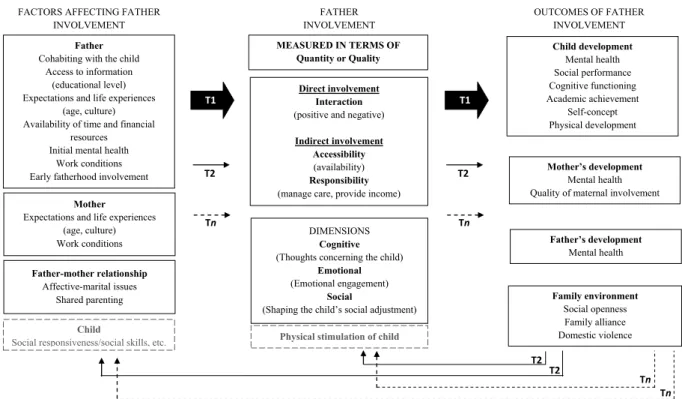
The information found in a systematic lit-erature review depends on the descriptors that are used. For example, in this review, none of the researchers assessed father involvement in terms of the extent to which the father physi-cally stimulated his child. According to Manfroi, Macarini and Vieira (2011), the most frequent type of father-child interaction is active play (a physical dimension of paternal involvement), which is important for child development. In addition, characteristics of the children (such as their social skills) were not investigated in any of the studies that comprised this review, although other authors have shown that child-related fac-tors such as social responsiveness can modify father involvement (Mehall, Spinrad, Eisenberg & Gaertner, 2009; Volker, 2014).The absence of this information may be linked to the descrip-tors used in this study, as some authors may have used more general descriptors (such as “child development”), or have used other descriptors (such as “father engagement”). Thus, in order to present a more complete theoretical model (see Figure 1), these two additional concepts were in-cluded (in boxes with broken perimeter lines), together with the concepts described in the re-sults of this study.
Figure 1. Theoretical model of father involvement. Conditions at Time 1 (T1) affect father involvement, which, in turn,
modi-fi es outcomes for each family member. These outcomes spur adjustments to fathering conditions or involvements, at Time 2 (T2), and so on, over time (Tn).
T2 T2
T1 T1
Child development
Mental health Social performance Cognitive functioning Academic achievement
Self-concept Physical development FACTORS AFFECTING FATHER
INVOLVEMENT
T2 Physical stimulation of child
Child
Social responsiveness/social skills, etc.
Tn
Father-mother relationship
Affective-marital issues Shared parenting
Mother
Expectations and life experiences (age, culture) Work conditions
Father
Cohabiting with the child Access to information
(educational level) Expectations and life experiences
(age, culture) Availability of time and financial
resources Initial mental health
Work conditions Early fatherhood involvement
Family environment
Social openness Family alliance Domestic violence Father’s development
Mental health
Mother’s development
Mental health Quality of maternal involvement
DIMENSIONS
Cognitive
(Thoughts concerning the child)
Emotional
(Emotional engagement)
Social
(Shaping the child’s social adjustment)
Direct involvement Interaction
(positive and negative)
Indirect involvement Accessibility
(availability)
Responsibility
(manage care, provide income)
MEASURED IN TERMS OF Quantity or Quality
Tn
T2
OUTCOMES OF FATHER INVOLVEMENT FATHER
INVOLVEMENT
Tn Tn
Volker, 2014). In terms of outcomes associated with differences in the quality of the father-child relationship, the evidence suggests that father involvement is associated with developmental outcomes for all family members. Child devel-opment outcomes were the most commonly re-ported, which is consistent with the fi ndings of other authors who have investigated factors af-fecting child development (Cabrera et al., 2007; Lamb, 2010; Volker, 2014).
Based on our analysis and synthesis of the empirical evidence on father involvement, we propose a theoretical model that specifi es the relationship between father involvement and other variables, helping to identify important correlates that can contribute to future work on this topic. Information about the impacts of the father-child relationship on children, moth-ers, and fathers point to the potential benefi ts of intervention programs to help fathers be more constructively involved parents. However, this model now needs to be empirically tested, us-ing a structural equation modelus-ing approach. In addition, experimental, intervention studies are needed to determine whether there are causal
relationships between the antecedent conditions specifi ed in the model and the quality of father involvement, and if increases in father involve-ment lead to improved outcomes. In closing, the use of an evidence-based, comprehensive, theo-retical model of father involvement can make a signifi cant contribution to increasing the effec-tiveness of interventions to improve the quality of father-child relationships.
References
*Alexander, A., O’Riordan, M. A., & Furman, L. (2010). Do breastfeeding intentions of pregnant inner-city teens and adult women differ.
Breast-feeding Medicine, 5(6), 289-296. doi:10.1089/
bfm.2009.0083
Anfara, V. A., Brown, K. M., & Mangione, T. L. (2002). Qualitative analysis on stage: Making the research process more public.
Educational Researcher, 31, 28-38.
doi:10.3102/0013189X031007028
Jour-nal of Pediatric Psychology, 32(7), 851-856. doi:10.1093/jpepsy/jsm011
*Brandão, S., & Figueiredo, B. (2012). Fathers’ emo-tional involvement with the neonate: Impact of the umbilical cord cutting experience.
Jour-nal of Advanced Nursing, 68(12), 2730-2739.
doi:10.1111/j.1365-2648.2012.05978.x
*Broger, B., & Zeni, M. B. (2011). Fathers’ coping mechanisms related to parenting a chronically Ill child: Implications for advanced practice nurses.
Journal of Pediatric Health Care, 25(2),
96-104. doi:10.1016/j.pedhc.2009.09.004
*Bronte-Tinkew, J., Moore, K. A., Capps, R. C., & Zaff, J. (2006). The infl uence of father involve-ment on youth risk behaviors among adoles-cents: A comparison of native-born and im-migrant families. Social Science Research, 35, 181-209. doi:10.1016/j.ssresearch.2004.08.002
Byrne, B. M. (2010). Structural Equation Modeling with AMOS. Basic concepts, applications, and
programmimng (2nd ed.). New York: Routledge,
Taylor & Francis Group.
Cabrera, N. J., Shannon, J. D., & Tamis-Lemonda, C. (2007). Father’s infl uence on their children’s cog-nitive and emotional development: From toddlers to pre-K. Applied Development Science, 11(4), 208-213. doi:10.1080/10888690701762100
*Cauce, A. M., Conger, R. D., Cruz, R. A., King, K. M., & Widaman, K. F. (2011). Cultural infl uenc-es on positive father involvement in two-parent Mexican-origin families. Journal of Family
Psy-chology, 25(5), 731-740. doi:10.1037/a0025128
*Cerniglia, L., Cimino, S., & Ballarotto, G. (2014). Mother-child and father-child interaction with their 24-month-old children during feed-ing, considering paternal involvement and the child’s temperament in a community sample.
Infant Mental Health Journal, 35(5), 473-481.
doi:10.1002/imhj.21466
Cia, F. (2009). Um programa para aprimorar o en-volvimento paterno: Impactos no
desenvolvim-ento do fi lho [A program to improve paternal
involvement: Impacts on child development] (Doctoral thesis, Postgraduate Program in Spe-cial Education, Federal University of São Car-los, São CarCar-los, SP, Brazil).
*Cia, F., & Barham, E. J. (2006). Infl uências das condições de trabalho do pai sobre o relaciona-mento pai-fi lho [Infl uences of the father’s work conditions on the father-child relationship].
Psico-USF, 11(2), 257-264.
doi:10.1590/S1413-82712006000200014
*Cia, F., & Barham, E. J. (2009). O envolvimento pa-terno e o desenvolvimento social de crianças ini-ciando as atividades escolares [Father involve-ment and the social developinvolve-ment of children in the school-entry transition stage]. Psicologia
em Estudo, 14(1), 67-74.
doi:10.1590/S1413-73722009000100009
*Cia, F., Barham, E. J., & Fontaine, A. M. G. V. (2010). Impactos de uma intervenção com pais: O desempenho acadêmico e comportamento das crianças na escola [Impacts of a parent in-tervention program: Their children’s academic achievement and classroom behavior].
Psi-cologia: Refl exão e Crítica, 23(3), 533-543.
doi:10.1590/S0102-79722010000300014
*Cia, F., Barham, E. J., & Fontaine, A. M. G. V. (2012). Desempenho acadêmico e autoconceito de esco-lares: Contribuições do envolvimento paterno [Children’s academic performance and self-con-cept: Contributions of father involvement].
Es-tudos de Psicologia (Campinas), 29(4),461-470.
doi:10.1590/S0103-166X2012000400001
*Dick, G. L. (2004). The Fatherhood Scale.
Re-search on Social Work Practice, 14(2), 80-92.
doi:10.1177/1049731503257863
*Ehrenberg, M. F., Gearing-Small, M., Hunter, M. A., & Small, B. J. (2001). Childcare task divi-sion and shared parenting attitudes in dual-earner families with young children. Family
Relations, 50(2), 143-153.
doi:10.1111/j.1741-3729.2001.00143.x
*Escribano, S., Aniorte, J., & Orgilés, M. (2013). Fac-tor structure and psychometric properties of the Spanish version of the Alabama Parenting Ques-tionnaire (APQ) for children. Psicothema, 25(3), 324-329.doi:10.7334/psicothema2012.315
*Fagan, J., & Lee, Y. (2010). Perceptions and satis-faction with father involvement and adolescent mothers’ postpartum depressive symptoms.
Journal on Youth and Adolescence, 39,
1109-1121. doi:10.1007/s10964-009-9444-6
*Falceto, O. G., Fernandes, C. L., Baratojo, C., & Giugliani, E. R. J. (2008). Factors associated with father involvement in infant care. Revista
Saúde Pública, 42(6), 1-6.
doi:10.1590/S0034-89102008000600009
*Falco, S. de, Esposito, G., Venuti, P., & Bornstein, M. H. (2008). Fathers’ play with their Down’s syndrome children. Journal of Intellectual
Dis-ability Research, 52(6), 490-502. doi:10.1111/
j.1365-2788.2008.01052.x
Scales: Retrospective measures for adoles-cent and adult children. Educational and
Psy-chological Measurement, 64(1), 143-164.
doi:10.1177/0013164403258453
*Formoso, D., Gonzales, N. A., Barrera, M., Jr., & Dumka, L. E. (2007). Interparental relations, maternal employment, and fathering in Mex-ican-American families. Journal of Marriage
and the Family, 69, 26-39.
doi:10.1111/j.1741-3737.2006.00341.x
*Frascarolo, F., Zaouche-Gaudron, C., & Favez, N. (2005). Variations in fathers’ discourse on fa-therhood and in family alliances during infancy.
European Journal of Psychology of Education,
20(2), 185-199. doi:10.1007/BF03173507
*Freeze, M. K., Burke, A., & Vorster, A. C. (2014). The role of parental style in conduct disorders: A comparison between adolescent boys with and without conduct disorders. Journal of Child &
Adolescent Mental Health, 26(1), 63-73. doi:10.
2989/17280583.2013.865627
Gomes, L. B., Bossardi, C. N., Cruz, R. M., Crepaldi, M. A., & Vieira, M. L. (2014). Propriedades psi-cométricas de instrumentos de avaliação do en-volvimento paterno: Revisão de literatura [The psychometric properties of instruments for eval-uating father involvement: A literature review].
Avaliação Psicológica, 13(1), 19-27. Retrieved
from http://pepsic.bvsalud.org/pdf/avp/v13n1/ v13n1a04.pdf
*Gomez, R., & Leal, I. (2007). Vinculação parental durante a gravidez: Versão portuguesa da forma materna e paterna da Antenatal Emotional Attachment Scale [Parental attachment during pregnancy: The Portuguese maternal and paternal versions of the Antenatal Emotional Attachment Scale]. Psicologia, Saúde & Doenças, 8(2), 153-165. Retrieved from http://www.scielo.mec.pt/ pdf/psd/v8n2/v8n2a01.pdf
*Grzybowski, L. S., & Wagner, A. (2010). O envolvi-mento parental após a separação/divórcio [Pater-nal involvement following separation or divorce].
Psicologia: Refl exão e Crítica, 23(2), 289-298. doi:10.1590/S0102-79722010000200011
*Habib, C., & Lancaster, S. (2010). Changes in identity and paternal-foetal attachment across a fi rst pregnancy. Journal of
Reproduc-tive and Infant Psychology, 28(2), 128-142.
doi:10.1080/02646830903298723
*Halme, N., Tarkka, M. T., Paavilainen, E., Num-mi, T., & Åstedt-Kurki, P. (2010). The design and development of the father-child instrument
(FCI) for assessing the characteristics of fathers’ availability and engagement with their preschool children. American Journal of Men’s Health,
4(2), 145-156. doi:10.1177/1557988309331825
Kline, R. B. (2011). Principles and Practice of
Struc-tural Equation Modeling (3rd ed.). New York:
The Guilford Press.
Lamb, M. E. (1997). Father and child development: An introductory overview and guide. In M. E. Lamb (Ed.), The Role of the Father in Child
De-velopment (pp. 1-18). New York: John Wiley &
Sons.
Lamb, M. E. (2010). How do fathers infl uence chil-dren’s development? Let me count the ways. In M. E. Lamb (Ed.), The Role of the Father in Child Development (2nd ed., pp. 1-26). Hoboken, NJ: John Wiley & Sons.
*Ly, A. R., & Goldberg, W. A. (2014). A new mea-sure for fathers of children with developmental challenges. Journal of Intellectual Disability Re-search, 58(5), 471-484. doi:10.1111/jir.12044
Manfroi, E. C., Macarini, S. M., & Vieira, M. L. (2011). Comportamento parental e o papel do pai no desenvolvimento infantil [Parental behavior and the role of the father in child development].
Revista Brasileira Crescimento e
Desenvolvi-mento Humano, 21(1), 59-69. Retrieved from
http://pepsic.bvsalud.org/scielo.php?script=sci_ arttext&pid=S0104-12822011000100007
Mehall, K. G., Spinrad, T. L., Eisenberg, N., & Gaertner, B. M. (2009). Examining the rela-tions of infant temperament and couples’ marital satisfaction to mother and father involvement: A longitudinal study. Fathering, 7(1), 23-48. doi:10.3149/fth.0701.23
Murray, A. L., Rosengard, C., Weitzen, S., Raker, C. A., & Phipps, M. G. (2012). Demographic and relationship predictors of paternity establish-ment for infants born to adolescent mothers.
Pediatric and Adolescent Gynecology, 25,
322-327. doi:10.1016/j.jpag.2012.05.015
Pasquali, L. (2010). Instrumentação psicológica:
Fundamentos e práticas [Psychological
in-strumentation: Principles and practices]. Porto Alegre, RS: Artmed.
Pleck, J. H. (2007). Why could father involvement benefi t children? Theoretical perspectives.
Ap-plied Development Science, 11(4), 196-202. doi:
10.1080/10888690701762068
Pleck, J. H. (2010). Paternal involvement: Revised conceptualization and theoretical linkages with child outcomes. In M. E. Lamb (Ed.), The Role of the Father in Child Development (2nd ed., pp. 28-58). Hoboken, NJ: John Wiley & Sons.
*Ramchandani, P. G., Domoney, J., Sethna, V., Psy-chogiou, L., Vlachos, H., & Murray, L. (2013). Do early father-infant interactions predict the on-set of externalizing behaviors in young children? Findings from a longitudinal cohort study.
Jour-nal of Child Psychology and Psychiatry, 54(1),
56-64. doi:10.1111/j.1469-7610.2012.02583.x
*Salonna, F., Geckova, A. M., Zezula, I., Sleskova, M., Groothoff, J. W., Reijneveld, S. A., & van Dijk, J. P. (2012). Does social support medi-ate or modermedi-ate socioeconomic differences in self-rated health among adolescents?
Interna-tional Journal of Public Health, 57, 609-617.
doi:10.1007/s00038-011-0300-6
*Séjourné, N., Beaumé, M., Vaslot, V., & Chabrol, H. (2012). Effect of paternity leave on mater-nal postpartum depression. Gynécologie Obsté-trique & Fertilité, 40, 360-364. doi:10.1016/j. gyobfe.2011.08.033
*Séjourné, N., Vaslot, V., Beaumé, M., Goutaudier, N., & Chabrol, H. (2012). The impact of pater-nity leave and paternal involvement in childcare on maternal postpartum depression. Journal of
Reproductive and Infant Psychology, 30(2),
135-144. doi:10.1080/02646838.2012.693155
*Shapiro, A. F., Krysik, J., & Pennar, A. L. (2011). Who are the fathers in healthy families in Arizona? An examination of father data in at-risk families. American Journal of
Orthopsy-chiatry, 81(3), 327-336. doi:
10.1111/j.1939-0025.2011.01101.x
*Silva, N. C. B., & Aiello, A. R. L. (2009). Análise descritiva do pai da criança com defi ciência mental [Descriptive analysis of fathering a mentally disabled child]. Estudos de Psicolo-gia (Campinas), 26(4), 493-503. doi:10.1590/ S0103-166X2009000400010
*Tessier, R., Charpak, N., Giron, M., Cristo, M., Cal-ume, Z. F., & Ruiz-Peláez, J. G. (2009). Kan-goroo mother care, home environment and father involvement in the fi rst year of life: A random-ized controlled study. Acta Pædiatrica, 98, 1444-1450. doi:10.1111/j.1651-2227.2009.01370.x
*Uji, M., Sakamoto, A., Adachi, K., & Kitamura, T. (2014). The impact of authoritative, authoritari-an, and permissive parenting styles on children’s later mental health in Japan: Focusing on parent and child gender. Journal of Child and Family
Studies, 23, 293-302.
doi:10.1007/s10826-013-9740-3
*Van Ee, E., Sleijpen, M., Kleber, R. J., & Jongmans, M. J. (2013). Father-involvement in a refugee sample: Relations between posttraumatic stress and caregiving. Family Process, 52, 723-735. doi:10.1111/famp.12045
Volker, J. (2014). Paternal involvement: A review of the factors infl uencing father involvement and outcomes. TCNJ Journal of Student
Scholar-ship, 16, 1-8. Retrieved from http://joss.pages.
tcnj.edu/fi les/2014/04/2014-Volker.pdf
*Waller, M. R., & Bitler, M. P. (2008). The link be-tween couples’ pregnancy intentions and behav-ior: Does it matter who is asked? Perspectives
on Sexual and Reproductive Health, 40(4),
194-201. doi:10.1363/4019408
*Warpechowski, A., & Mosmann, C. (2012). A ex-periência da paternidade frente à separação con-jugal: Sentimentos e percepções [The experi-ence of fatherhood followingmarital separation: Thoughts and feelings]. Temas em Psicologia, 20(1), 247-260. Retrieved from http://pepsic. bvsalud.org/pdf/tp/v20n1/v20n1a18.pdf
*Wysocki, T., & Gavin, L. (2004). Psychometric properties of a new measure of fathers’ involve-ment in the manageinvolve-ment of a pediatric chronic diseases. Journal of Pediatric Psychology,
29(3), 231-241. doi:10.1093/jpepsy/jsh024
Recebido: 21/09/2015 1ª revisão: 14/04/2016 Aceite fi nal: 05/05/2016
__________________________________________________________________________________________