Paula Inês Cosme Teixeira
Licenciada em Ciências de Engenharia do Ambiente
Assessing sustainability on a degrowth perspective
Dissertação para obtenção do Grau de Mestre em Engenharia do Ambiente,
perfil de Gestão e Sistemas Ambientais
Orientador: Prof. Doutor Rui Ferreira dos Santos,
Professor Associado, FCT/UNL
Júri: Presidente: Prof. Doutora Maria Paula Baptista da Costa Antunes Arguente: Prof. Doutor Nuno Miguel Ribeiro Videira Costa Vogal: Prof. Doutor Rui Jorge Ferreira dos Santos
Assessing sustainability on a degrowth perspective
Copyright © Paula Inês Cosme Teixeira
Faculdade de Ciências e Tecnologia
Universidade Nova de Lisboa
2012
v
Acknowledgments
This dissertation represents an important step towards a transition phase in my life and there are several people to whom I have to say thank you for all the help and support given.
On top of all, I want to thank my mother, Isabel. There are no words to describe how your love and support was important to me through all my life and during this particularly hard period. You made all of this possible, and I have to thank you for that. I also want to thank my sister Ana for always being there for me and for being so supportive, and to my brother-in-law, João, for his help too. A very special thank you to my grandparents, Maria José and José, who also made my education possible and always strived to give me the best support they could.
A special word to all my close friends for your patience when I was more upset or simply without time to pay you more attention, and also for all your help!
The last thank you in this section, however one of the most important ones, goes to Filipe. Thank you for your endless support and for the strength you gave me, without you this would have been much harder to accomplish.
Now in the academic field, I have to thank all my university teachers, you were the ones who guided me through this path and all of you gave a special contribution to my knowledge. A very special thank you to Rui Santos, the teacher who guided me through this dissertation and gave me all the help that I could ask for, it was a pleasure to work with you.
vii
Agradecimentos
Esta dissertação representa um passo importante para uma fase de transição na minha vida e há várias pessoas às quais tenho de dizer obrigada por todo a ajuda e apoio dado.
Acima de tudo, queria agradecer à minha mãe, Isabel. Não há palavras para descrever como o teu amor e apoio foram importantes para mim durante toda a minha vida e durante este período particularmente difícil. Fizeste com que tudo isto fosse possível, e tenho que te agradecer por isso. Quero também agradecer à minha irmã Ana por estar sempre presente para mim e me dar tanto apoio, assim como ao meu cunhado, João, também pela sua ajuda. Um agradecimento muito especial também para os meus avós, Maria José e José, que também possibilitaram a minha educação e sempre lutaram para me dar o melhor apoio que puderam.
Uma palavra especial para todos os meus amigos mais próximos pela vossa paciência quando estava mais chateada ou simplesmente sem tempo para vos dar mais atenção, e também por toda a vossa ajuda!
O último agradecimento nesta secção, porém um dos mais importantes, vai para o Filipe. Obrigada pelo teu apoio inesgotável e por toda a força que me deste, sem ti este trabalho teria sido muito mais difícil de concretizar.
Agora no campo académico, tenho de agradecer a todos os meus professores universitários, foram vocês que me guiaram ao longo deste caminho e todos deram uma contribuição especial para o meu conhecimento. Um agradecimento muito especial para Rui Santos, o professor que me guiou na elaboração desta dissertação e deu-me toda a ajuda que eu poderia pedir, foi um prazer trabalhar consigo.
ix
Abstract
It is not new that humanity has limits to its economic expansion. However, what to do if we already surpassed the ecological limits of the environmental systems? It is a great challenge to solve the environmental problems without compromising the social dimension. Degrowth is a strive for
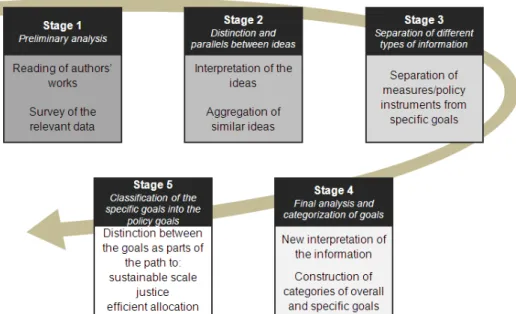
down-scaling society’s throughput in a fair and sustainable way.
The essential questions answered in this work were: what is the sustainable degrowth perspective and what does it entail? Are the existent sustainability assessment metrics able to capture the degrowth-related concerns?
These questions were addressed first by doing a literature-based research and a posterior treatment and comparison of the results. The origin of the degrowth movement was delineated and afterwards the most updated publications gave the basis to understand in what way policy-making can be crucial to achieve degrowth goals.
After knowing what were the policy goals, they were contrasted with existing sustainability assessment indicators, being them aggregated measures and sets of indicators. The economic aggregated metrics analysed were: Gross Domestic Product (GDP), Index of Sustainable Economic Welfare (ISEW) and Genuine Progress Indicator (GPI), Adjusted Net Savings (ANS) and Genuine Savings (GS), Ecological Domestic Product (EDP) and Environmentally Sustainable National Income (eSNI). The biophysical and social aggregated measures analysed were: Environmental Performance Index (EPI), Living Planet Index (LPI), Human Appropriation of Net Primary Production (HANPP), Ecological Footprint (EF), Environmental Sustainability Index (ESI), Well-being Assessment Index (WI), Happy Planet Index (HPI), Human Development Index (HDI), Sustainable Society Index (SSI), Environmental Vulnerability Index (EVI), and Canadian Index of Well-being (CIW). The sets of indicators analysed were: Core Set of Indicators of the European Environment Agency (CSI-EEA), European Union Set of Sustainable Development Indicators (EU-SDIs), Japan For Sustainability Indicators (JFI), Millennium Development Goals Indicators (MDGI) and System of Indicators of Sustainable Development for Portugal (SIDS-Portugal).
The main results achieved were that neither existing aggregated metrics nor sets of indicators were able to capture all degrowth-related concerns. In spite of that fact, there are some metrics that can be very useful to assess some policy goals. Also, the goals that are less addressed open doors to new studies and new creation of metrics. It is discussed that the metrics that showed more connection points to degrowth goals were the more complete sets of indicators, since they are able to capture the different dimensions of sustainability assessment.
xi
Resumo
Não é novidade que a expansão económica da humanidade tem limites. No entanto, o que fazer se já tivermos ultrapassado os limites ecológicos dos sistemas ambientais? É um grande desafio resolver os problemas ambientais sem comprometer a dimensão social. O decrescimento é uma iniciativa para diminuir a escala do fluxo de actividade da sociedade, de uma forma justa e sustentável.
As questões essenciais a que este trabalho deu uma resposta foram: qual é a perspectiva do decrescimento sustentável e o que é que envolve? Serão as métricas de avaliação de sustentabilidade capazes de apreender as preocupações relativas ao decrescimento?
Estas questões foram abordadas primeiramente fazendo uma pesquisa de literatura e um posterior tratamento e comparação de resultados. A origem do movimento do decrescimento foi traçada e depois, as publicações mais actualizadas serviram de base para perceber de que forma a construção de políticas pode ser crucial para atingir os objectivos do decrescimento.
Após saber quais os objectivos do decrescimento, estes foram contrastados com os indicadores de avaliação de sustentabilidade existentes, sendo estes medidas agregadas e grupos de indicadores. As medidas económicas agregadas analisadas foram: Produto Interno Bruto, Índice de Bem-estar Económico Sustentável e Indicador Genuíno de Progresso, Poupanças Líquidas Ajustadas e Poupanças Genuínas, Produto Interno Ecológico e o Rendimento Nacional Ambientalmente Sustentável. As medidas biofísicas e sociais agregadas analisadas foram: Índice de Desempenho Ambiental, Índice Planeta Vivo, Apropriação Humana da Produção Primária Líquida, Pegada Ecológica, Índice de Sustentabilidade Ambiental, Índice de Avaliação do Bem-estar, Índice Planeta Feliz, Índice de Desenvolvimento Humano, Índice da Sociedade Sustentável, Índice da Vulnerabilidade Ambiental e o Índice Canadiano de Bem-estar. Os grupos de indicadores analisados foram: Indicadores-chave da Agência Europeia do Ambiente, Indicadores de Desenvolvimento Sustentável da União Europeia, Indicadores da Organização Japão para a Sustentabilidade, Indicadores dos Objectivos de Desenvolvimento do Milénio e o Sistema de Indicadores de Desenvolvimento Sustentável de Portugal.
Os resultados principais atingidos foram que nem as métricas agregadas existentes nem os grupos de indicadores são capazes de capturar todas as preocupações ligadas ao decrescimento. Apesar desse facto, existem algumas métricas que podem ser muito úteis para avaliar alguns objectivos de políticas. Da mesma forma, os objectivos que estão menos abordados abrem portas para novos estudos e para a criação de novas métricas. É discutido que as métricas que mostram mais pontos de conexão com os objectivos do decrescimento, são os grupos de indicadores mais completos, visto que são capazes de apreender as diferentes dimensões da avaliação de sustentabilidade.
xiii
Index of subjects
Chapter 1. Introduction ... 1
1.1. Context of the research theme ... 1
1.2. Personal motivation ... 2
1.3. Purpose and objectives ... 3
1.4. Framework of the dissertation ... 3
Chapter 2. From limits to growth to sustainable degrowth ... 5
2.1. Limits to growth ... 5
2.2. The evolution of the sustainability concept ... 6
2.3. Economic growth versus sustainable development ... 8
2.4. Sustainable degrowth hypothesis ... 11
2.4.1. Emergence of the idea ... 11
2.4.2. The divergence of opinions around degrowth ... 13
2.5. Transition to a Steady-State Economy (SSE) ... 20
Chapter 3. Importance of the degrowth viewpoint in today’s and tomorrow’s society ... 23
3.1. Economic crisis as an opportunity ... 23
3.2. New demands in terms of policy-making and sustainability assessment ... 24
3.2.1. Sustainability goals for policy-making ... 24
3.2.2. Important principles for policy-making ... 27
3.2.3. Specific policy goals in a sustainable degrowth perspective... 29
3.2.4. Degrowth policy goals versus sustainability goals for policy-making ... 40
Chapter 4. Sustainability assessment indicators and the degrowth concept ... 43
4.1. The importance of measuring and how can the existing indicators be used to assess degrowth ... 43
4.2. Existing economic aggregated metrics ... 44
4.2.1. Gross Domestic Product (GDP) ... 44
4.2.2. Index of Sustainable Economic Welfare/Genuine Progress Indicator (ISEW/GPI) ... 46
xiv
4.2.4. System of Environmental-Economic Accounting (SEEA) – Green National Product or Environmentally Adjusted Net Domestic Product or Ecological Domestic Product (GNP or
eaNDP or EDP) ... 50
4.2.5. Environmentally Sustainable National Income (eSNI; former SNI) ... 51
4.3. Existing biophysical and social aggregated metrics ... 51
4.3.1. Environmental Performance Index (EPI) ... 51
4.3.2. Living Planet Index (LPI) ... 52
4.3.3. Human Appropriation of Net Primary Production (HANPP) ... 53
4.3.4. Ecological Footprint (EF) ... 54
4.3.5. Environmental Sustainability Index (ESI) ... 55
4.3.6. Well-being Assessment Index (WI) ... 56
4.3.7. Happy Planet Index (HPI) ... 56
4.3.8. UN Human Development Index (HDI) ... 57
4.3.9. Sustainable Society Index (SSI) ... 58
4.3.10. Environmental Vulnerability Index (EVI) ... 59
4.3.11. Canadian Index of Well-being (CIW) ... 59
4.4. Existing sets of indicators for assessing sustainable development ... 60
4.4.1. Core set of Indicators – European Environmental Agency (CSI-EEA) ... 60
4.4.2. European Union set of Sustainable Development Indicators (EU-SDIs) ... 61
4.4.3. Japan for Sustainability Indicators (JSI) ... 62
4.4.4. Millennium Development Goals Indicators (MDGI) ... 62
4.4.5. System of indicators of sustainable development for Portugal (SIDS-Portugal) ... 63
4.5. Recent proposes of new metrics ... 63
Chapter 5. What to measure about sustainable degrowth? ... 65
5.1. What the existing indicators do and do not measure ... 65
5.2. Analysis of the economic aggregated metrics ... 66
5.3. Analysis of the biophysical and social aggregated metrics ... 68
5.4. Analysis of the sets of indicators ... 73
xv
Chapter 6. Conclusions and future developments ... 77
6.1. Synthesis of the work ... 77
6.2. Future developments ... 79
References ... 81
Annexes ... 89
Annex I – Analysed policy goals from sustainable degrowth-related literature ... 90
Annex II – Components of the metrics analysed ... 95
xvii
Index of figures
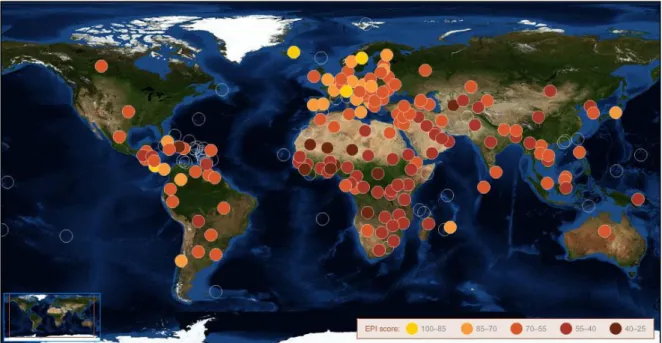
Figure 2.1 Representation of the balancing needed for reaching a steady-state world economy (source: Kerschner, 2010). ... 21 Figure 3.1 Adopted methodology for the analysis of degrowth-related literature in this work. ... 30 Figure 4.1 Income versus happiness growth in the USA, between 1945 and 2005 (source: Victor, 2008). ... 46 Figure 4.2 ISEW/GPI versus GDP results for Netherlands, Germany, Australia and USA, between 1950 and 1997 (source: http://www.foe.co.uk). ... 48 Figure 4.3 EPI scores for 2010 (source: http://epi.yale.edu/). ... 52 Figure 4.4 LPI values for the time period between 1970 and 2007 (source: WWF, 2010). ... 53 Figure 4.5 Global ecological creditor and debtor countries in 2007, based on the EF of consumption of each country versus globally available biocapacity (source: Ewing et al., 2010). ... 54 Figure 4.6 Worldwide ESI values for 2005 (source: Esty et al., 2005)... 55 Figure 4.7 World HPI values for 2005 presented in a colour scale (source: Abdallah et al., 2009). 56 Figure 4.8 HDI values for 1970 in comparison to the values of 2010 (source: UNDP, 2010a). ... 57 Figure 4.9 Worldwide values for SSI in 2010 (adapted from van de Kerk and Manuel, 2010). ... 58 Figure 4.10 Comparison between GDP and CIW trends (and of its components) from 1994 to 2008 (source: Michalos et al., 2011). ... 60 Figure 4.11 The three-level pyramid structure of EU-SIDs (source: EC, 2011). ... 61
Figure 4.12 Conceptual framework on which is based O’Neill’s work (source: O’Neill, 2011). ... 64
Figure 4.13 O’Neill’s potential set of indicators to measure degrowth transition to a SSE (source:
xix
Index of tables
Table 2.1 Review of contributions for degrowth research – group A. ... 16
Table 2.2 Review of contributions for degrowth research – group B. ... 17
Table 2.3 Review of contributions for degrowth research – group B (continuation). ... 18
Table 2.4 Review of contributions for degrowth research – group C. ... 19
Table 2.5 Review of contributions for degrowth research – group D. ... 20
Table 3.1 Review of the main goals and their connection to specific ones through degrowth-related literature analysis. ... 31
Table 3.2 Mentioned measures/policy instruments in the publications reviewed for Goal 1. ... 32
Table 3.3 Mentioned measures/policy instruments in the publications reviewed for Goal 2. ... 33
Table 3.4 Mentioned measures/policy instruments in the publications reviewed for Goal 3. ... 34
Table 3.5 Mentioned measures/policy instruments in the publications reviewed for Goal 4. ... 35
Table 3.6 Mentioned measures/policy instruments in the publications reviewed for Goal 5. ... 36
Table 3.7 Mentioned measures/policy instruments in the publications reviewed for Goal 6. ... 37
Table 3.8 Mentioned measures/policy instruments in the publications reviewed for Goal 7. ... 39
Table 3.9 Comparison between degrowth policy goals and their general aim towards sustainability. ... 40
Table 3.10 Comparison between degrowth policy goals and their general aim towards sustainability (continuation). ... 41
Table 4.1. Comparison between the components of ISEW and GPI (based on information from Talberth et al., 2006 and Beça and Santos, 2010)... 47
Table 5.1 Comparison between degrowth policy goals and economic aggregated metrics. ... 67
Table 5.2 Comparison between degrowth policy goals and biophysical and social aggregated metrics (EPI, LPI, HANPP, EF and EVI). ... 69
Table 5.3 Comparison between degrowth policy goals and biophysical and social aggregated metrics (EPI, LPI, HANPP, EF and EVI - continuation). ... 70
Table 5.4 Comparison between degrowth policy goals and biophysical and social aggregated metrics (ESI, HPI, HDI, SSI, WI and CIW). ... 71
Table 5.5 Comparison between degrowth policy goals and biophysical and social aggregated metrics (ESI, HPI, HDI, SSI, WI and CIW - continuation). ... 72
xx
Table 5.7 Comparison between degrowth policy goals and the system of indicators proposed by
O’Neill (2011)... 75 Table 5.8 Comparison between degrowth policy goals and the system of indicators proposed by
xxi
List of Abbreviations and Acronyms
ANS Adjusted Net Savings
APA Agência Portuguesa do Ambiente (Portuguese Environmental Agency) CIW Canadian Index of Well-being
CSI-EEA Core Set of Indicators of the European Environment Agency EC European Commission
EDP Ecological Domestic Product EEA European Environmental Agency EEA European Environment Agency EF Ecological Footprint
EPI Environmental Performance Index ESI Environmental Sustainability Index
eSNI Environmentally Sustainable National Income
EU European Union
EU SDIs European Union set of Sustainable Development Indicators EU SDS European Union Sustainable Development Strategy Eurostat Statistical office of the European Union
EVI Environmental Vulnerability Index GDP Gross Domestic Product
GPI Genuine Progress Indicator
GS Genuine Savings
HANPP Human Appropriation of Net Primary Production HDI Human Development Index
HPI Happy Planet Index
IMF International Monetary Fund
ISEW Index of Sustainable Economic Welfare JFS Japan For Sustainability
xxii MDGI Millennium Development Goals Indicators NDP Net Domestic Product
NI National Income
NNI Net National Income NPP Net Primary Product
OECD Organisation for Economic Co-operation and Development
SIDS-PT Sistema de Indicadores de Desenvolvimento Sustentável de Portugal (System of Indicators of Sustainable Development for Portugal)
SNA System of National Accounts SSE Steady-state economy SSI Sustainable Society Index UN United Nations
UNDP United Nations Development Program UNEP United Nations Environmental Program
WB The World Bank
WCED World Commission on Environment and Development WI Well-being Index
Introduction
1
Chapter 1. Introduction
1.1. Context of the research theme
The world is far behind from being managed in a sustainable way. Although the gap between social, economic and environmental concerns is getting increasingly smaller, when a serious problem with the economic system bursts, the other two issues are usually neglected in favour of the strive for more economic growth. The most echoed words in the last few years were probably
‘economic crisis’ since that affected almost everyone directly and in a relatively short period of time
– and it still does. Particularly in recession periods, environmental problems are often seen almost
as ‘luxuries’ that we can address in the case we have spare time and funds. However, the environmental crisis which we are experiencing is not disconnected from the rest of our lives, and so it cannot be put into a shelf for later trouble while we only deal with the turmoil that surrounds global economy. In fact, instead of being afraid of a change in our lifestyles due to crossing a period where people have less money to spend, we should see that as an opportunity for going back to being used to a less materialistic lifestyle.
An economic crisis is very useful for us to understand what our real priorities are. And this does not necessarily mean that we choose our next step more carefully since we are limited with the budget. Many people choose it more wisely as they fear what is going to happen next, since in these unstable times we never know. Our current panorama is filled with fast changes, what helps to
show us that today’s reality might not be the mirror to tomorrow’s reality. But why do we subject
ourselves to this way of unstable living? Some things must change and as fast as possible.
Environmental problems might not have been very problematic in the distant past but they are increasingly becoming great threats in many ways. Climate change is a very serious issue that is not being taken care of as it should be by now, after all the failed attempts to get to a global agreement. All the complex interactions between human-related activities and the environment are opening doors to climate instability, biodiversity loss and the overall depletion of crucial natural resources for our survival. Apart from all the ethical issues that arise due to our greed on consuming and destroying all that we can, severe threats to our survival start being noticed with the imminent food and water crisis. These problems along with natural catastrophes lead to massive deaths, more hunger and more wars. Environmental-related issues might very soon turn into global security issues. And as in a period of economic crisis, here too the poorest will suffer first and in a more sever way. In the end, the puzzle to solve is always the same: how can we improve the
visibility of “long-term” problems when they are invisible to almost everyone until the day they burst?
Introduction
2
striving for the enjoyment of life, decoupling it from the current overconsumption patterns. All of these goals are a part of what sustainable degrowth means.
The scale of the economy turned bigger than we can afford within earth’s ecological limits, and so
to degrowth is evermore the only chance to achieve a sustainable way of development, since the decoupling between economic growth and environmental damages is definitely not happening. This means that any kind of strive for a ‘green growth’ is very unlikely to be successful in solving the environmental and social problems.
Although economic degrowth is already occurring with the world economy, it is not occurring in a sustainable way as intended. This shows that degrowth pursuance can have severe consequences, unless it is turned into a manageable opportunity for change. It is important to stress that a necessary sustainable degrowth of the scale of human influence is ultimately to improve our life quality without putting in jeopardy the health of the environment.
All of this should make sense when one realises that a finite world can only support a limited economic system. Nonetheless, it seems that for many this still does not make any sort of sense, as the endeavour for ‘the more, the better’ continues to persist. Ultimately, what it does seem in
fact is that we do not have a clue of “how big can the economy possibly be before it overwhelms
and destroys the ecosystem in the short run” but apparently we have globally decided “to do an experiment to answer that question empirically” (Daly in Jackson, 2009, p.xii).
In spite of some authors consider the sustainable degrowth movement as a sort of ‘wake-up call’, it
can also be interpreted as a more defined concept that already has many policy concerns behind it. Policy-making is a strategic area for research since it turns ideas into possible solutions. Nonetheless, and as obvious as it may sound, it is worth to reinforce the idea that it is crucial to know where we are heading, what are the policy goals. Sustainability was since the beginning the fight for a global state of welfare that does not compromise the future generation’s possibility of
welfare. Even if the sustainable degrowth movement is trying to show a different meaning of sustainable development, in fact there is nothing wrong with this goal. The progressively more utopic idea is that we are going to achieve it with a never-ending growing economy.
1.2. Personal motivation
Introduction
3
1.3. Purpose and objectives
This work was done to answer to two essential questions, which are:
1) What is the sustainable degrowth perspective and what does it entail?
2) Are the existent sustainability assessment metrics able to capture the degrowth-related concerns?
These research questions are aimed to be answered by:
Analysing the historical roots of the concept and other development-related concepts that originated the debate about sustainable degrowth.
Discussing the divergence of opinions around degrowth in terms of the concept, where does it fit in today’s society, how can we approach it and whether if it is an important view in an economic crisis scenario.
Understanding how the existing economic, biophysical and social metrics allow the translation of degrowth-related concerns into our lives or the monitoring of a society that is moving towards a degrowth path.
1.4. Framework of the dissertation
On Chapter 2, it is explored the problematic of economic system’s growth within the environmental system, providing the theoretical background for the rest of the work. The path between old and new concerns is constructed, starting with the discussion of how the unbounded way of economic growth is problematic due to the environmental boundaries. Afterwards it is analysed the passage to the appearance of sustainability and sustainable development concepts, which are then contrasted with the economic growth pursuance. The emergence of the sustainable degrowth concept is inserted into the context of the previous analysed issues. For that it is presented not only
the idea’s origins but also the divergence in its conceptualization, as well as the main areas that are subjects of research in the scientific community. Finally, it is presented the idea of a Steady-State Economy as the following path after the economic system scale has been shrunken to fit
Earth’s capacity.
Introduction
4
Chapter 4 is dedicated to find ways to analyse degrowth goals, by the means of the previously examined policies. In this chapter, it is discussed the importance of measuring the path towards the goals and there are presented some existing metrics for assessing economic development and sustainability. These metrics are separated in aggregated measures and sets of indicators. A brief theoretical background is done for all of them, as well as the gathering of the main published benefits and criticisms and the discussion of their potential importance for assessing degrowth goals.
After the analysis of the existing metrics, Chapter 5 assembles the results of the contrast done
between every metric’s components and each one of degrowth specific goals considered in this
work. This analysis allowed understanding the extent to which these goals can be assessed by existing indicators, as well as which are the closest ones to achieving what is intended.
Chapter 6 assembles the main ideas and concludes the work, as well as presents the future
developments that have been considered to be pertinent for the development of degrowth’s field of
From limits to growth to sustainable degrowth
5
Chapter 2. From limits to growth to sustainable degrowth
2.1. Limits to growth
It is not new that humanity is entirely dependent on natural resources and that we might experience a limit to our unbridled way of growing. As soon as 1798, Thomas R. Malthus started to direct his work towards this issue. When he wrote the book An Essay on the Principle of Population (Malthus, 1798), Malthus already knew that it seemed impossible to chase an infinite goal of growth and he started to reflect about “whether man shall henceforth start forwards with accelerated velocity towards illimitable, and hitherto unconceived improvement; or be condemned to a perpetual oscillation between happiness and misery, and after every effort remain still at an immeasurable distance from the wished-for goal” (Malthus, 1798, p.3). In other words, with this economic growth path we will always be wavering between a period of economic crisis and a period of relatively increased wealth, without having a very logical goal for growing.
While Malthus concerns were pointed towards the lack of food supply, in 1865 W. Stanley Jevons was discussing the problematic of coal supply for the future as it was the great driving force of the economy, just as oil is today (Victor, 2008). In his book, The Coal Question (Jevons, 1865), Jevons expressed his concerns about the future of the British economy as the most prosperous economy of the world at the time, due to the possible shortage of cheap coal that was coming from their own mines (Victor, 2008).
Almost a century after, these worries were far from being forgotten. In 1963, Harold J. Barnett and Chandler Morse published a study called Scarcity and Growth (Barnett & Morse, 1963), which reviewed the inflated-adjusted prices and costs of natural resources traded in the United States in a period of approximately 87 years (1970-1957) (Victor, 2008). With this study, they concluded that economic growth was not threatened by the scarcity of the resources assessed, nor it was a threat in the future. This study influenced the way economists thought at the time and opened the door for the debate. That discussion lead to the publication of the books Scarcity and Growth Reconsidered (V. K. Smith, 1979), a compilation of papers showing various viewpoints on the subject and, more recently, Scarcity and Growth Revisited (Simpson et al., 2005). In the last review of this subject, the authors analyse the evolution of the concerns of the first book and go further into the ‘new’
concerns with not only the natural resources assessed but also with the potential threats to ecological services and other goods not included at the time.
However, it was in 1972 with the publication of Limits to Growth (D. H. Meadows et al., 1972) - the first report of the Club of Rome1 - that this problematic was put into focus at a global level. With this report, a group of experts wanted people to become aware of the fact that our planet has limitations in terms of natural resources and in terms of the capacity to absorb emissions from our processes
1
From limits to growth to sustainable degrowth
6
of transformation of land and materials. With the help of a computer model named “World3”, they
constructed scenarios for the following years, having in consideration population growth and economic expansion. The conclusion achieved was that this human-related expansion would gradually force us to spend more and more money on fighting earth’s limits or covering the
damages we made (D. H. Meadows et al., 2004). With this constant growth that humanity pursues, the money we spent would get to a point where economic growth would be impossible to withstand. Moreover, the material and energy sources are becoming much more expensive to explore, the
sinks (air, water and land) are already surpassing their limits and the ecosystems’ services are
deteriorating (Victor, 2008).
This would eventually lead to a decline in population what, without any planning, would occur along with health issues, great inequalities, ecological collapse and social conflicts. This point is referred as the point of overshoot and there are mentioned three causes for reaching it: a growth phase, followed by getting to a limit which is foreseen that, if crossed, the system may not be able to continue stable and finally, the phase of crossing that limit due to misperceptions and the struggle to maintain the system inside its limits (D. H. Meadows et al., 2004).
These types of studies are still being done, and the sequels of the first Limits to Growth continue to be published in order to update readers with further results of the research in every ten years, approximately – Beyond the Limits (D. H. Meadows et al., 1992); The Limits to Growth: The 30-Year update (D. H. Meadows et al., 2004). The most recent approach to this book, although not by the same authors, was the publication of the book The Limits to Growth Revisited (Bardi, 2011) that occurred last year.
2.2. The evolution of the sustainability concept
The term sustainability appeared with the increasing concerns with the environmental degradation and with the limits our development is starting to experience. Along the years, it became more and more important to give prominence to the balance between social, economic and environmental issues.
Historically speaking, there are six lines of thought that appeared mainly after 1950 and lead to the creation of the concept (Kidd, 1992). According to Kidd (1992) the most important root is the ecology field discussion about how the human development-related activities would conduct to sever consequences. This debate revolved around the concept of carrying capacity, the capacity that a certain ecosystem has to support an indefinitely quantity of species, letting seasonal and random alterations occur without environmental degradation and without retreating that capacity in the future (Hardin, 1977; Kidd, 1992). When that maximum is exceeded, we call it overpopulation and the number of individuals will tend to return to that maximum or below it, by the means of several happenings (Kidd, 1992).
From limits to growth to sustainable degrowth
7
great preoccupation was about the quality of the environment and social pressure started to take place in response to population’s frustration with the capitalist movement (Kidd, 1992). These concerns were particularly common to the Western Europe countries and Japan, which led to the organization of the first international conference on environmental issues, the Conference on the Human Environment, which took place in Stockholm in 1972 (Kidd, 1992; Paul, 2008). This conference focused the discussions on the conflicts between the priorities that we should give to environment versus economic issues and also generated the United Nations Environmental Program (UNEP), with the mission of leading humanity to improve the life quality without threatening future generations (Paul, 2008).
A third root is referent to the awareness of the global scale of environmental problems. One of the first authors to refer this was George P. Marsh in 1864 (Marsh, 1864), who wrote that the scale of human influence was no more local but global (Kidd, 1992). However, the first author to focus that the present generations have the moral responsibility to allow that the future ones have, in fact, a future, was probably Nathanial Shaler in 1905 (Shaler, 1905; Kidd, 1992).
Another root is the criticism of technological progress. The historical origin of this movement belongs probably to Henry David Thoreau, an American author who fervently criticized development, as it can be seen in his book named Walden (Thoreau, 1957). Nevertheless, it was
only between the 1960’s and 1970’s that negative consequences of broad technology exportation to developing countries were highlighted as, frequently, the projects were not designed to avoid ecological implications on their implementation (Kidd, 1992). In contrast, technological progress in developing countries was argued, by some authors (e.g. (Schumacher, 1973), as being an important question when done in a moderate, ecological responsible way and also if adaptable to their economic and social panorama (Kidd, 1992).
The movement against economic growth or in defence of a slower growth is also a root of the sustainability concept, as the main discussion is around whether wealth is supposed to be the main goal for human development or not (Kidd, 1992). Nonetheless, this root will be further explored on a next sub-chapter.
Finally, the last root is considered by Kidd (1992) to be the ‘ecodevelopment’ emergence. This term was created by Ignacy Sachs in 1977 as he aimed to take the development concept to a next level, where social and economic issues would be managed in an ecological responsible way, in order to protect the future for upcoming generations. On the year after, UNEP used the word ‘sustainability’
for the first time in the United Nations (UN) context having the ecodevelopment concept in mind. Sachs also influenced many other authors, for instance, Robert Riddell, that published in 1981 his own approach on the so-called ecodevelopment (Riddell, 1981), arguing that we should fight poverty and hunger, seek for international equity and for political and administrative honesty while also balancing the number of people with resource availability, among other things.
From limits to growth to sustainable degrowth
8
(WCED, 1987a). This report was the outcome of the 1972 Conference on the Human Environment results. This concept translates the same ideas that evolved along the past centuries by defining it as a development that assures “the needs of the present without compromising the ability of future
generations to meet their own needs” (WCED, 1987b).
In 1992, Rio de Janeiro welcomed the UN Conference on Environment and Development, also known as Rio Earth Summit. This was a major event on the ‘sustainability’ scene, producing as results the Rio Declaration, Agenda 21 and the Commission on Sustainable Development, and thus giving a key importance to sustainable development of world’s nations and launching the concept to a truly international level (Paul, 2008).
The following milestone in the concept’s evolution was probably the agreement of the Millennium Development Goals in the 2000 Millennium Summit. These goals helped to mark what were some of the humanitarian, economic and environmental priorities needed to get fixed by 2015. These goals were reconfirmed and complemented in 2002 in the World Summit on Sustainable Development, held in Johannesburg. The last time these were revised was in 2010 at the UN Summit on the Millennium Development Goals, held in New York.
It is interesting to note that this concept is broadly accepted and still largely used in every sector nowadays. It is believed that this acceptance has occurred because the concept was agreed and published and has resisted to a single interpretation along the years (Dietz & Neumayer, 2007).
2.3. Economic growth versus sustainable development
The economic growth discourse is based on the premise that the more the better, i.e. the optimal growth rate is the maximum possible rate (Spangenberg, 2010). The parallelism between the type of development that we are pursuing and the one that it is in fact taken as sustainable may sound contradictory in many ways. However, it is usual to talk about economic growth and sustainable development in the same sentence, even though with barely any reference of how to intercept the concepts. There is a clear negligence when it comes to present numbers, to define limits or the so-called extremes for population growth or exploitation of resources, to connect the need to fight climate change and the depletion of natural resources with the future of economic growth (Bartlett, 2006; Spangenberg, 2010).
In this context, it is argued that it will not be possible to pursue a sustainable economic growth due to the contradiction of the concepts. Bartlett (2006) analysed the Brundtland report and argued that
the term ‘sustainable growth’ is an oxymoron. In his work, he concludes that pursuing this type of
growth points towards a limitless increase of the economy, i.e. tending to infinite, what it is impossible to accompany with our finite earth.
From limits to growth to sustainable degrowth
9
policies that would help the redistribution of GDP are pointed out as deterrents of economic growth. Moreover, welfare and poverty are essentially functions of relative income, what lead this author to the conclusion that economic growth is, in fact, unable to increase the relative income of everyone in the world what seems to be the goal of the policies.
Focusing on the environmental part of sustainability, Hueting (2010) presents several reasons for the improbable combination of growth production/consumption and the improvement/maintenance of environmental quality. The author argues that this combination would mean having available technology which was clean enough, that did not require the depletion of renewable natural resources and simultaneously found a way to substitute non-renewable ones, that did not have impacts on the soil and did not limit its ecological uses and finally, this will all be worthless if this technology is not cheaper than the current available ones. In these conditions, economic growth would be occurring within its ecological limits, and so it would occur what can be called as ‘absolute
decoupling’, between economic output and material throughput. The decoupling can be relative or absolute, being the first one the decline of environmental impacts relatively to GDP growth, whereas the second one is the absolute decline of those impacts (Jackson, 2009). The relative decoupling is not very interesting since it does not guarantee that impacts are really decreasing. The absolute decoupling is not possible to achieve with present technology, however it is vital to pursue it with or without the endeavour for economic growth (Jackson, 2009).
There are also other reasons pointed out by Hueting (2010) that sustain the contradiction of these two principles. Among them we can find that production growth is affected by the increase of prices due to the internalization of environmental costs. We can also find that in the calculation of National Income (NI), the environmental burden is directly related to population size, and if on the one hand
we say that we have to decrease world’s population to pursue a sustainable way of development,
on the other hand we have the fact that if population diminishes, production will also be lower and so it will be economic growth. Following these ideas is also Bartlett (2006), who defends that future programs for development should plan ahead a scenario of zero, or even negative for a period, growth of population and also of the rates of resources consumption, if they want to be called sustainable. The author argues that it will be everyday more difficult to progress to sustainability conditions if population continues to grow to feed economic growth.
As reasoned by Daly (2006), economic growth is in fact becoming “uneconomic”, meaning that
From limits to growth to sustainable degrowth
10
environmental systems and economic growth. According to the Second Law of Thermodynamics, entropy always increases in an isolated system, i.e. the level of “randomization of the structure or capacity of matter or energy to be useful to us” (Daly & Farley, 2011, p.32) continuously increases, while the quantity of matter and energy stays equal. With this, one can claim that throughput is a one-way flow, and despite materials can be recycled, energy cannot be recycled without spending more energy (Daly & Farley, 2011). This makes no sense to do since it would always bring more costs, and the economy cannot survive without recycling its outputs, since we are not able to use waste as raw material as it was a perfect circular system where nothing is lost. When the economy does not respect this recycling, when it uses inputs in an unmeasured way, the costs start to rise faster than benefits.
Bearing this in mind, it can be observed that, at today’s rate, it seems that we want macroeconomy to grow into an infinite, unreachable point, what also is in concordance with Bartlett’s viewpoint.
Nonetheless, in reality, macroeconomy has trespassed its limits and has created opportunity costs of natural capital and ecological services, which are often more beneficial than the production outputs that were their cause (although we cannot know that accurately since with GDP we only measure benefits and not costs – see Chapter 4).
In this context, it can be easy to understand the need to limit this “uneconomic” growth in wealthy
countries in order to give poorer countries to pursue their still possible economic growth, an ideology that emphasis development and growth as a global goal instead. Daly (2006) does an interesting parallelism with the microeconomics line of thoughts. This author poses the question that if in microeconomics one accepts that optimization is to only pursue growth until marginal cost is equal to marginal benefit, why there is no translation of this to macroeconomics, why there are no plans of a stopping point when it comes to economic growth of a country.
All of these viewpoints are focused on an economic growth as we know it today, i.e. without limits and with higher consumption of goods and services to ‘feed the machine’, whether they bring good, neutral or bad consequences for the environment and for social welfare. The question inherent to this discussion is whether we want to destroy our natural resources now or later. As Bartlett (2006, p.26) puts forward:
“Smart growth is better than dumb growth, but smart growth destroys the environment; and dumb growth destroys the environment. The difference is that smart growth destroys the environment
with good taste. So it’s a little like buying a ticket on the TITANIC. If you’re smart you go first class. If you’re dumb you go steerage. But either way,the result is about the same”.
From limits to growth to sustainable degrowth
11
In his work, the author proposes a change in the macroeconomic system in order to differentiate sectors in which we need to grow, the ones that have to stop growing and the ones that have to experience a decline in their growth, for having already grown too much. The sectors that should grow are pointed out as health, education, culture and activities that push forward energy and resource conservation. The sectors that should have limitations to growth are consumption and investments highly intensive in terms of resource exploitation and also infrastructures with high rates of energy consumption. The sectors that should decline are related to the use of carbon-intensive fuels.
Harris divides our economic model transition in two periods. The first one (roughly between 2010-2050) contemplates an unavoidable period of economic growth, which he foresees as increases in the sectors that should actually grow, what should put the rich North on the way of a transition to a low-carbon, service-oriented economy and the poor South into an ascending growth path with investments within a carbon-free and energy efficient focus. The second period (after 2050) is seen as a possible beginning of a stable economy (see sub-chapter 2.5), where economic growth is naturally not an important pressure anymore.
It is interesting to connect this last viewpoint with the sustainable degrowth view, that will be put on more detail on the next sub-chapter. Even though Harris does not talk specifically about the degrowth hypothesis, his proposal reaches many points argued by degrowth defenders. Harris talks about the possible solution scenarios for surpassing the economic crisis that the failure of the present economic model has put the world into, while degrowth is a movement that has basically the same ideas but has the objective of launching the debate around economic growth and around of how should be the future of sustainable development.
2.4. Sustainable degrowth hypothesis
2.4.1. Emergence of the idea
After a research in humanity’s development problematic, one can reach the conclusion that the
solution for our problems is yet to come. We are already experiencing limits to our development as natural resources are becoming scarcer and our economic model is failing. We can now discuss that the sustainable development concept defended so fervently in the two past decades may be a contradictory theory and its goals will not be a reality if we do not change some of our old paradigms.
In this context, the scientific community started to talk about an alternative suggestion to save our existence, and that is the sustainable degrowth hypothesis. Although there is not an agreement on the sustainable degrowth definition yet, some authors consider it as an emerging paradigm that will go beyond the ‘sustainable development’ paradigm that appeared in the 1980s (Martínez-Alier et al., 2010); others go further and consider it as a “political slogan” (Latouche, 2010) or as a “multi
From limits to growth to sustainable degrowth
12
There have been many efforts in defining this ‘new’ word, finding its different contexts and also tracking the historical roots of the movement. Even though this movement has gained strength relatively recently, its nomenclature can be due to Nicholas Georgescu-Roegen, the father of ecological economics or “bioeconomics”, as the author defined it in 1977 (Gowdy & Mesner, 1998). This author was a pioneer in the criticism of economic growth defended by most mainstream economists, claiming that we should only use services that came from renewable resources instead of using flows from depletable ones (Kerschner, 2010). Moreover, he defended that a declining state was necessary and possible and also that we should focus on the “enjoyment of life”, a central concept in the degrowth movement (Kerschner, 2010; Martínez-Alier et al., 2010). The word ‘degrowth’ appeared due to the translation of the French word décroissance. In turn, the French term appeared in the scientific community with the publication of the book Demain la décroissance in 1979, a compilation of translated works of Georgescu-Roegen done by Ivo Rens and Jacques Grinevald (Georgescu-Roegen, 1995). At this point, the key ideas behind this term were that, on the one hand, degrowth was inevitable due to the limits of nature and, on the other hand, human knowledge (technological progress) should be used to control degrowth rather than be used to incentive growth, that will only lead to rising unemployment, to more inequality between rich and poor countries and ultimately to an “irremediable disaster” (Georgescu-Roegen, 1995; Fournier, 2008).
The degrowth movement has gained strength in France mostly because of the journals that spread the word about it, namely Casseurs de pub, Silence, the Ecologist (French edition) and la Décroissance (Baykan, 2007). Some publications helped to launch this discussion in the political arena and some people that believed in this movement formed the Degrowth party (Parti pour la Décroissance). This party has the objective of increasing the debates on this issue and playing its part in the opposition, not exactly to seize power, whereas they also defend that this has to be a bottom-up process to avoid authoritarian regimes (Baykan, 2007). This is seen as a new political frame that will contest the conventional line of thoughts in political and social terms, while it may rejuvenate the environmental issues in this context (Baykan, 2007).
It is important to notice that, on a current basis, the décroissance movement is highly connected with politics whereas the term sustainable degrowth is mostly explored by ecological economics (Martínez-Alier et al., 2010). This might give degrowth different meanings and goals but the main ideas remain the same.
In spite of these differences, the first time this issue was brought to a broader, worldwide discussion was at the “First International Conference on Economic De-growth for Ecological Sustainability and Social Equity”, held in Paris between 18th and 19th April of 20082. The conference produced a Declaration that gathers the main conclusions that were reached during the various panels and workshops: the increase of economic growth is not reducing poverty as expected, result of the uneven exchange in trade and financial markets; economic growth is connected with more
2
From limits to growth to sustainable degrowth
13
consumption/production and, therefore, with a greater use of land, materials and energy; a better efficiency does not imply a decrease in extraction of natural resources, production of waste or emissions; there are limits to the scale of global production/consumption and to the scale of national economies after whose there will be environmental and social costs and there are evidences that show that global economy (especially the industrialised North) has already surpassed those limits; the richer countries use more than their reasonable portion of natural resources, what causes a negative impact to poorer countries; we have to find ways to balance the global economic activity with the natural boundaries and redistribute the wealth to avoid negative social impacts and an uncontrolled economic recession or collapse (Research & Degrowth, 2010). The second reunion of the scientific community with activists and other participants took place in Barcelona between 26th and 29thMarch of 2010 at the “Second Conference on Economic Degrowth for Ecological Sustainability and Social Equity”3. The results of this conference were also put on paper in a Declaration. In short, the matters debated on the conference were the following: structuration of proposals to work towards a degrowth society that will pursue ecological sustainability and societal equity; discussions about issues that are commonly put aside in the mainstream conversations about sustainable development, for instance currencies and financial institutions, working hours and resource consumption; construction of new proposals for putting in practice the theory about degrowth (Research & Degrowth, 2011).
These gatherings had the goal to inform and launch this subject to a more comprehensive group of people, so that it could be discussed not only by a small niche of the scientific community but also by other researchers and the public in general. Since then, the number of publications about degrowth has been boosting, as well as the debate about the meaning of degrowth, its consequences and the measures/policies that may be connected to the movement is also gaining ground.
2.4.2. The divergence of opinions around degrowth
The most recent publications on degrowth are still quite divergent in terms of the word definition, partly maybe because some degrowth defenders find irrelevant to have a precise definition when one thinks of the purposes of the movement itself. There are also different types of approaches, as some authors focus only on theoretical aspects of degrowth (especially in terms of criticizing our development model – e.g. (Martínez-Alier, 2009; Martínez-Alier et al., 2010; Latouche, 2010) and others focus also on measures and policies that are important for the future (Schneider et al., 2010; Harris, 2010; Kallis, 2011). Nevertheless, there are several authors that have tried to define the word on their publications.
According to Kallis (2011), in ecological economics the sustainable degrowth perspective means “a socially sustainable and equitable reduction (and eventually stabilisation) of society's throughput”.
3
From limits to growth to sustainable degrowth
14
In contrast, for van den Bergh (2011) there are several definitions and interpretations of degrowth, which can be assembled in five main categories:
GDP degrowth: This concept offers an economic perspective as it presupposes that it is necessary a reduction in GDP or a negative GDP growth. This could only be achieved with a steep change in the environmental policies, putting degrowth as a measure and then hoping that it can be the solution to the environmental problems. Thus, the author does not consider this approach as a very efficient measure since it has a very hypothetical basis.
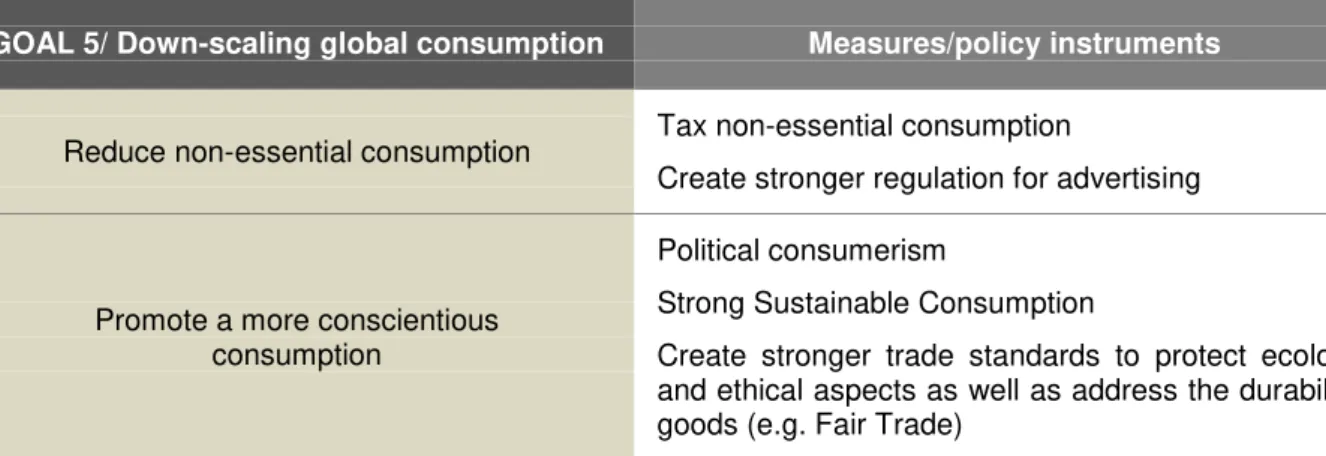
Consumption degrowth: Here it is the overconsumption that it is pointed out as the cause for the excessive resource use and pollution. The solution here would be the reduction of consumption but this is proving to be a very vague and imprecise method as it raises the question of how to apply it and how to measure its effectiveness. Would people get used to buy fewer things if they have the economic power to buy them? Would it be a voluntary system or would it be necessary to create measures to achieve that reduction? Both hypotheses have many problems. On one hand, people could be informed to be aware of the problems that overconsumption raises and then we would hope that people started to consume less (voluntary simplicity). On the other hand, the governments could tax consumption or restrict it equally, but that would raise many social and political questions as people could feel that their liberty was being violated.
This approach may also be prejudicial to the environment as it may lead to a rebound effect which is a possible consequence of the consumption reduction. If people with a certain income start to reduce their consumption of certain goods that are harmful for the environment, they will be saving money. In turn, that extra money will be available to be used for other types of consumption that in the end will have the same result, an outcome that turns degrowth efforts into nothing.
Nonetheless, recent studies (Lorek & Fuchs, 2011) alert for the fact that reducing consumption is going to be a reality whether people want it or not, it is not an option anymore. They also argue that it is not possible to go into a sustainable degrowth path without pursuing what they call of strong sustainable consumption or, in other words, an approach that presupposes a reduction in global consumption accompanied by other measures that promote human well-being through not only material goods. Despite all the difficulties that this might bring about, the authors defend that it would rather be sooner than later that these kinds of measure should be put forward by the governments, as they believe that it is very improbable to achieve this with voluntary simplicity alone.
From limits to growth to sustainable degrowth
15
The author considers this option as the most accurate one as the reduction of working hours is a fairly clear measure, it would not leave room for too much disagreement. He also argues that it could be the most efficient measure as it would aim to both production and consumption although he also discusses that it would not be ideal in terms of reducing environmental pressures connected to consumption.
Radical degrowth: According to this author, a radical change in our economic and social systems is the main line of thought among degrowth defenders. This option presupposes major changes in our economic and social structures, implying values, individual preferences, markets and even the role of money in society.
This degrowth approach encompasses the first two definitions but it is much broader as it goes
as far as a change in people’s minds, lifestyles and the whole economic structure as we know it. This leads the author to have reservations about it, as he claims that it is a very unclear point of view with no specific measures. He considers specially blurred the view of the path that connects the small groups of people that defend or will defend degrowth to the society as a whole, as this presupposes a global change for being effective.
Apart from all the uncertainty and lack of a throughout analysis, van den Bergh also argues that this is a very risky strategy. Moreover, it does not assure us any environmental improvements as it is based on a hope that they will appear as long as we fight the causes. In contrast, the author proposes that a less risky and slower change would allow producers, consumers and investors adapt to it, avoiding economic instability and social chaos. This viewpoint is shared with Harris (2010), who also claims that the change must be slow and in two distinct periods, as explained on the previous sub-chapter.
Physical degrowth: This interpretation is seen as a new approach for the same concept that
has begun to be discussed in the 1970’s when Limits to Growth (D. H. Meadows et al., 1972) and Nicholas Georgescu-Roegen writings were published. The focus is on the direct reduction of resource use and polluting emissions. The aim is to construct a sustainable economy with less harmful actions against the environment and therefore it is connected to Herman Daly’s
Steady-State Economy hypothesis.
Even so, the author argues that to bring something new it should give more focus on policy review and on the social and political acceptance and viability. He also points out that it can easily confused with GDP degrowth if not well defined.
Kallis (2011) disagrees with the categorization of degrowth ideas, calling it as an “umbrella keyword” that provides a context for the linkage of policies and civil movements and has not the
main objective of being a precise concept.
From limits to growth to sustainable degrowth
16
degrowth research were presented on an issue of the Journal of Cleaner Production4 in April 2010 and were summarized by Schneider et al. (2010). In tables 2.1 to 2.5, it will be presented a more recent version of the contributions to this research, which includes not only the ones from that issue but also from other relevant publications. The individual contributions are assembled in groups (from A to D) in order to organize the main issues that are debated academically.
Table 2.1 Review of contributions for degrowth research – group A.
4
This issue is available online at: http://www.sciencedirect.com/science/journal/09596526/18/6.
Main group issues
Exposure of economic growth as an imperative to the market society and the avoidance of alternatives
Radical institutional changes as pre-conditions of degrowth
Author References Individual contributions
Annuka Berg & Janne I. Hukkinen
(Berg & Hukkinen,
2011)
Narrative policy analysis of interviews with member of the Finish Committee on sustainable consumption and production
Conclusions on the opinion of many business and ministry representatives in terms of criticism to the current growth dependent economic system
Emphasis on the need for robust institutional support for degrowth
Valérie Fournier (Fournier, 2008)
Context of degrowth in the environmental politics - democracy, citizenship and alternatives to consumerism society.
Criticism of growth-based economy versus growing concerns of environmental degradation
Giorgos Kallis, Joan Martínez-Alier & Richard
Norgaard
(Kallis et al., 2009)
Study on the roots of crisis in an ecological economics perspective and criticism to the growth-based economy
Argue that this moment of crisis is the opportunity to create na alternative, smaller economy that is compatible with both human and the ecosystem's needs
Kent A. Klitgaard
& Lisi Krall (Klitgaard & Krall, 2011)
Indicate the lack of studies in terms of the dynamics of the economy (slow growth periods even without biophysical constraints)
Discussion about the strive for growth to solve social problems, contrasted with the need for degrowth and then a SSE
Clément Levallois (Levallois, 2010) Divergences between Georgescu-growth’ team views on the future of economic growth - degrowth Roegen and the ‘limits to versus sustainable growth
From limits to growth to sustainable degrowth
17
Table 2.2 Review of contributions for degrowth research – group B. Main group issues
Sustainability of current growth patterns
Different perspectives on what degrowth might mean, whether and under what conditions is desirable
Author References Individual contributions
Blake Alcott (Alcott, 2010; Alcott, 2011)
Analysis of the environmental impacts equation (I = f(P,A,T))5 to understand where to act
It is more effective to act on the right-side of the equation, but policies to control population and consumption are likely to have rebound effects
Limit resource depletion and pollution through caps, instead of rationing resource use
Analysis of the problematic of unemployment and suggests that degrowth policies should consider the humanitarian right to work (job guarantee)
Simone d’Alessandro, Tommaso Luzzati
& Mario Morroni
(D’Alessandro et al., 2010)
Model that shows implications of investing in renewable energy technologies to escape from the scarcity and problems of fossil fuels
Sustainability can only be obtained with low GDP rates, investment in alternative energy sources and limiting consumption growth
Baris Gencer
Baykan (Baykan, 2007) View on the evolution of the degrowth political movement in France
Iris Borowy (Borowy, 2011)
Analysis of the Cuba crisis in the 1990's as an experiment of degrowth
Balance of the positive aspects of degrowth with the negative aspects of the crisis
Roefie Hueting (Hueting, 2010)
Current growth is wrongly formulated
Environmental sustainability can only be obtained with a decrease in production
Dematerialised, renewable-energy based economy more likely to lower production and consumption
Giorgos Kallis (Kallis, 2011)
Criticism to the categorization of degrowth aspects done by J. van den Bergh and presentation of degrowth as an umbrella concept
Degrowth as an inevitable happening
Suggestion of policies for turning degrowth socially sustainable
Christian
Kerschner (Kerschner, 2010)
Links degrowth to the SSE (complementary concepts)
Economic degrowth in the North to allow the economic growth in the South
Points out population degrowth as a controversial measure in terms of liberty (against authoritarian, state-imposed population control policies)
5