Universidade de Lisboa
Faculdade de Medicina Dentária
Effect of Chlorhexidine Loading on the Flexural Strength of
Acrylic Reline Resins After Thermal Ageing
Inês Costa Rijo
Dissertação
Mestrado Integrado em Medicina Dentária
Universidade de Lisboa
Faculdade de Medicina Dentária
Effect of Chlorhexidine Loading on the Flexural Strength of
Acrylic Reline Resins After Thermal Ageing
Inês Costa Rijo
Dissertação orientada pela Professora Doutora Cristina
Bettencourt Neves e coorientada pelo Professor Doutor Jaime
Portugal
Mestrado Integrado em Medicina Dentária
Table of Contents
Table of Contents
Agradecimentos ii Resumo iii Abstract vii 1. Introduction 1 2. Objectives 43. Materials and Methods 5
4. Results 11
5. Discussion 14
6. Conclusion 18
7. References 19
Appendices
Appendix 1 - List of Tables
27 27
Appendix 2 - List of Figures 28
Appendix 3 - List of Abbreviations 29
Agradecimentos
Agradecimentos
Para a realização desta dissertação foi essencial a participação de um conjunto de pessoas, às quais devo um enorme agradecimento.
À Professora Doutora Cristina Neves, Professora Auxiliar da unidade curricular de Prostodontia Removível da Faculdade de Medicina Dentária da Universidade de Lisboa, quero agradecer pela paciência, pela disponibilidade permanente, pelo conhecimento transmitido e pela orientação sempre atenta e rigorosa.
Ao Professor Doutor Jaime Portugal, Professor Associado e Regente da disciplina de Biomateriais da Faculdade de Medicina Dentária da Universidade de Lisboa, gostaria de agradecer pelo apoio quer na realização da tese quer no trabalho de investigação, pelo seu conhecimento disponibilizado na área de estatística e pela sua disponibilidade.
À Dra. Joana Costa, pela enorme compreensão, pelo tempo despendido, pela ajuda tremenda e pela simpatia e preocupação constantes.
À Professora Doutora Sofia Oliveira, Professora Associada, regente da unidade curricular de Odontogeriatria e docente da disciplina de Biomateriais Dentários, pela ajuda valiosa oferecida para o trabalho laboratorial.
À Professora Doutora Filipa Chasqueira, Professora Auxiliar Convidada da disciplina de Biomateriais da Faculdade de Medicina Dentária da Universidade de Lisboa, pelo apoio fornecido durante a investigação laboratorial.
Ao meu parceiro de laboratório Daniel Pedro com quem foi um enorme prazer partilhar este projeto. Quero agradecer-lhe pela companhia, ajuda a todas as horas, pela amizade e motivação.
Aos funcionários e docentes da Faculdade de Medicina Dentária da Universidade de Lisboa que me prestaram ajuda sempre que necessária.
Por fim, a toda a minha família e amigos que tanto me ajudaram e incentivaram ao longo deste ano e que, de uma maneira ou outra, tiveram uma influência positiva neste percurso.
Resumo
Resumo
A reabsorção do rebordo alveolar associada à perda dentária é um fenómeno fisiológico crónico e progressivo de remodelação óssea. Por essa razão, indivíduos que possuam próteses dentárias removíveis vão sendo submetidos a uma progressiva perda de estabilidade e retenção da prótese e, consequentemente, um crescente desconforto. Como forma de corrigir esta desadaptação, recorrem-se a rebasamentos, utilizando, para tal, resinas acrílicas auto-polimerizáveis cuja polimerização poderá ser classificada como direta ou indireta, consoante o ambiente onde ocorre, na cavidade oral ou em laboratório, respetivamente.
A estomatite protética é uma patologia inflamatória que afeta, com frequência, indivíduos reabilitados com próteses dentárias removíveis. Esta patologia demonstra uma etiologia multifatorial, necessitando do sinergismo de um conjunto de fatores, tais como, o trauma associado a uma prótese instável e desadaptada, a idade elevada do indivíduo, uma fraca higienização oral e da prótese, xerostomia, ausência de descanso noturno da prótese e a presença de uma doença crónica ou comprometimento imunitário. Para além destes fatores etiológicos, é muito relevante a ação da espécie
Candida, especialmente, o patógeno Candida albicans, que facilmente adere e prolifera
nos tecidos da cavidade oral e nas resinas acrílicas, gerando biofilmes heterogéneos e complexos.
O tratamento da estomatite protética envolve, por um lado, a adaptação da prótese removível, a confeção de uma nova prótese dentária ou a limpeza da prótese removível pré-existente e, por outro, a terapia farmacológica, sendo que os fármacos antifúngicos disponibilizados poderão ser administrados de forma tópica ou sistémica. A terapia antifúngica revela algumas desvantagens, nomeadamente, a necessidade da cooperação do paciente e o rápido desvanecimento do fármaco do local alvo. Para além destas desvantagens, quando administrados de forma sistémica, os fármacos antifúngicos alcançam o local de infeção em concentrações muito baixas, acrescendo daí um risco de existirem reações secundárias adversas.
A baixa eficácia do tratamento convencional da estomatite protética impulsionou o surgimento de novas medidas. A incorporação dos agentes terapêuticos anteriormente referidos em materiais de rebasamento ou da base da prótese tem sido uma alternativa estudada. O propósito da criação destes dispositivos transportadores de fármacos é o de
Effect of Chlorhexidine Loading on the Flexural Strength of Acrylic Reline Resins After Thermal Ageing
libertar no local de infeção, em doses adequadas e contínuas, o agente terapêutico, sem necessitar do envolvimento do paciente.
A Clorexidina (CHX) é um fármaco antisético com ação antibacteriana, antifúngica e anti-biofilme de elevada substantividade. O facto de ser capaz de suprimir a adesão da Candida albicans às células da mucosa oral e às superfícies das resinas torna este fármaco um bom candidato para o tratamento da estomatite protética. Adicionalmente, estudos microbiológicos comprovaram uma eficácia superior comparativamente a outros agentes antifúngicos como o fluconazol e a nistatina.
Este fármaco, quando incorporado em resinas acrílicas apresenta uma taxa de eluição durante um período de vinte e oito dias, sendo que esta libertação é mais elevada nos primeiros dois a sete dias após o que se torna mais baixa e estável até ao fim do referido intervalo de tempo.
Alguns autores investigaram também, a ação que a incorporação de CHX tem em diversas propriedades mecânicas de resinas de rebasamento. Destes estudos foi possível concluir que incorporar CHX no valor de 10% da massa do pó das resinas de rebasamento Kooliner e Probase Cold tem efeitos nocivos na resistência à flexão destas, tal como na concentração de 7,5% na resina Probase Cold.
Tendo como referência as proporções de CHX previamente estudadas, o objetivo deste estudo foi avaliar a influência da incorporação que diferentes concentrações de CHX têm sobre a resistência à flexão das resinas Kooliner, Ufi Gel Hard e Probase Cold, após estas terem sido sujeitas a um processo de envelhecimento térmico que simula o ambiente da cavidade oral.
Foram preparados espécimes (64x10x3,3 mm), de cada uma das resinas, recorrendo a moldes retangulares de aço inoxidável. Para todas as resinas foi executado um grupo controlo com uma concentração de CHX de 0% da massa do pó do material, sendo que para a resina Kooliner foram realizados espécimes experimentais com 1%, 2,5%, 5% e 7,5% de CHX, para a resina Ufi Gel Hard 1%, 2,5%, 5%, 7,5% e 10% de CHX e para a resina Probase Cold 1%, 2,5% e 5%. Cada grupo era composto por oito espécimes, tendo sido realizados um total de cento e dezoito espécimes.
Todos os espécimes foram sujeitos a um processo de termociclagem que os submeteu a 1000 ciclos de banhos térmicos de 5ºC e 55ºC, o que equivale a um envelhecimento térmico na cavidade oral de um mês. Seguidamente, foi levado a cabo um teste de resistência à flexão de três pontos.
Resumo
A análise estatística envolveu uma análise descritiva dos valores de resistência à flexão, tendo sido determinados os valores de média, desvio padrão, mediana e amplitude interquartil.
Após análise com recurso ao software SPSS Statistics (SPSS Inc., Chicago, IL, USA), verificou-se que os valores não apresentavam uma distribuição normal para as variáveis em estudo (através de testes Shapiro-Wilk) e, por essa razão, os resultados foram submetidos a testes não-paramétricos de acordo com o método de Kruskal-Wallis, seguindo-se comparações múltiplas utilizando testes Mann-Whitney, com correcções de Bonferroni, para determinar se existiam diferenças específicas significativas entre grupos de concentrações de CHX. Um valor de significância de 5% foi a referência em todos os testes estatísticos realizados.
Os resultados da influência da CHX nos valores de resistência à flexão das resinas acrílicas foram divergentes. Para as resinas Kooliner e Ufi Gel Hard não se verificaram diferenças estatisticamente significativas para os diferentes grupos de CHX (p> 0,05). Por sua vez, os espécimes do grupo de CHX 5% da resina Probase Cold demonstraram um valor de resistência à flexão inferior comparativamente ao grupo controlo (p= 0,033), sendo que as restantes comparações entre grupos não mostraram diferenças estatisticamente significativas (p> 0,05).
Uma possível explicação para os resultados similares obtidos pelas duas resinas acrílicas diretas, Kooliner e Ufi Gel Hard, pode encontrar-se nas suas semelhanças químicas. No entanto, as diferenças estruturais e químicas da resina acrílica indireta Probase Cold, comparativamente às restantes, e o seu método de polimerização diferente, em condições de alta temperatura e pressão, podem explicar a razão pela qual a CHX influenciou de modo diferente o grupo 5% CHX desta resina. No grupo 5% CHX do Probase Cold, a presença de partículas de CHX pode ter provocado distúrbios nas cadeias poliméricas da resina acrílica, já que a incorporação de fármacos aumenta a distância intermolecular entre os monómeros das cadeias, registando-se ainda, um aumento de monómero residual o que, consequentemente acarreta com uma menor resistência à flexão.
Os resultados obtidos vão de encontro com os de outros autores que, de modo semelhante, estudaram a incorporação de CHX nas três resinas de rebasamento. A proporção de 10% de CHX na resina Ufi Gel Hard não se revelou nociva para a resistência à flexão contrariamente à conclusão previamente obtida por outro autor
Effect of Chlorhexidine Loading on the Flexural Strength of Acrylic Reline Resins After Thermal Ageing
embora este tenha utilizado um procedimento de envelhecimento térmico equivalente a três meses.
Concluindo, após envelhecimento térmico equivalente a um mês, as proporções de CHX 1%, 2,5%, 5% e 7,5% na resina Kooliner e as proporções de CHX 1%, 2,5%, 5%, 7,5% e 10% na resina Ufi Gel Hard não reveleram alterar as propriedades de resistência à flexão dos materiais. No entanto, a proporção de CHX 5% na resina Probase Cold mostrou ter uma resistência à flexão diminuída quando comparada com o grupo controlo. Por essa razão, as proporções de CHX que não modificam os valores de resistência à flexão da resina Probase Cold são 1% e 2,5%.
Os resultados obtidos neste estudo são, no entanto, limitados sendo que são necessários mais estudos que investiguem outras propriedades, quer mecânicas quer físicas das resinas acrílicas incorporadas com CHX. É, também, importante desenvolver estudos que realizem protocolos de envelhecimento, não só térmico, mas também químico das resinas. Por fim, será essencial que se concretizem mais estudos de microbiologia e biocompatibilidade.
Palavras-chave: estomatite protética; resinas acrílicas de rebasamento; resistência à flexão; incorporação de fármacos; clorexidina.
Abstract
Abstract
Objectives: The aim of this study was to evaluate the influence of the concentration of chlorhexidine (CHX) on the flexural strength of three reline acrylic resins, Kooliner, Ufi Gel Hard and Probase Cold, after undergoing a thermal ageing process.
Methods: Distinct proportions of CHX were selected for loading each reline resin. Kooliner had four groups (1%, 2.5%, 5%, 7.5% CHX), Ufi Gel Hard had five groups (1%, 2.5%, 5%, 7.5%, 10% CHX) and Probase Cold had three groups (1%, 2.5%, 5% CHX). Every material had also a control group (0% CHX). Specimens with 64x10x3.3mm were submitted to a thermocycling procedure consisting of 1000 cycles of thermal fluctuations between 5ºC and 55ºC. Afterwards they were tested for flexural strength values using a three point bending device. Results were submitted to nonparametric tests according to the Kruskal-Wallis method, followed by multiple comparisons using Mann-Whitney tests with Bonferroni corrections, being considered the 5% level of significance (α=0.05).
Results: Regarding Kooliner and Ufi Gel Hard specimens, there were no statistical significant differences on flexural strength values among different CHX groups (p>0.05). Results for Probase Cold specimens showed that 5% CHX group had a lower flexural strength value compared to the control group (p= 0.033).
Conclusions: The proportions of 1%, 2.5%, 5% and 7.5% CHX for Kooliner, 1%, 2.5%, 5%, 7.5% and 10% CHX for Ufi Gel Hard and 1% and 2.5% CHX for Probase Cold do not affect the flexural strength values of the acrylic resins after a thermal ageing process equivalent to one month in the oral cavity.
Keywords: denture stomatitis; acrylic reline resins; flexural strength; drug loading; chlorhexidine.
Introduction
1. Introduction
Residual ridge resorption, after tooth loss, is a chronic and progressive phenomenon of bone remodeling which causes, in individuals wearing removable prosthesis, a diminished denture stability, loss of retention and reduced comfort (Atwood and Coy 1971; Budtz-Jorgensen 1999).
To overcome this physiological phenomena a reline procedure is used since it will enhance the fit of pre-existing denture to the hard and soft tissues (Chow et al. 1999; Chopde et al. 2012). The materials of choice are usually auto-polymerizing acrylic reline resins, either direct acrylic resins that are cured at the chairside in the dental clinic or indirect acrylic resins which are cured at the laboratory (Neppelenbroek
et al. 2003; Neves 2012). Auto-polymerizing acrylics turn the reline procedure into a
relatively simple, useful and inexpensive treatment (Rawls 2003).
If left untreated a poor fit denture can cause mucosal trauma in denture wearers. This trauma associated with other factors such as the increased age of the user and the increased age of the dentures, a poor denture and oral hygiene, dietary factors, xerostomia, absence of overnight removal, a chronic disease or a compromised immune system can lead to a denture induced stomatitis (Chow et al. 1999; Koray et al. 2005; Lyon et al. 2006; Urban et al. 2006; Vanden et al. 2008; Gendreau et al. 2010; Chopde
et al. 2012).
The main pathogen related to denture stomatitis is Candida albicans due to its ability to adhere and proliferate through tissues of the oral cavity and acrylic resins, and to produce a complex and heterogeneous bacterial biofilm (Waters et al. 1997; Akpan et
al. 2002; Salerno et al. 2011).
Candida-associated denture stomatitis is the most frequent form of oral
candidiasis and has a preferential localization on the palatal mucosa. Its clinical appearance can be a discrete area of pinpoint inflammation related to de ducts of the palatal mucous glands or an intense erythematous area of the mucosa covered by the denture (Scully et al. 1994; Chow et al. 1999; Salerno et al. 2011). Even though this oral disease is usually asymptomatic it should be treated as it may conduct to more extensive infections and bone resorption. (Wilson et al. 1998; Salerno et al. 2011).
Treatment of this disorder is usually based on cleansing, relining or even replacement of the denture together with the prescription of antifungal drugs (Cross et
Effect of Chlorhexidine Loading on the Flexural Strength of Acrylic Reline Resins After Thermal Ageing
Applying an antifungal agent topically can be highly inefficient due to the rapid drug clearance from the site of infection. Moreover, it is very difficult to obtain a rigid patient compliance and, when drugs are given systemically, only a small concentration of the drug tends to reach the target location and there is a risk of undesired side effects (Chow et al. 1999; Amin et al. 2009; Salim et al. 2012a; Salim et al. 2013a). Besides that, even when hygiene solutions are used for denture cleansing, Candida strains tend to subsist (Bissel et al. 1992; Nikawa et al. 2003; Cross et al. 2004; Boscato et al. 2009).
The feasibility of introducing antimicrobial and antifungal agents in acrylic resins or soft liners acting as drug carriers for the treatment of denture induced stomatitis has been investigated by several researchers (Bueno et al. 2013; Salim et al. 2013a,b; Bertolini et al. 2014; Garner et al. 2015; Malakhov et al. 2016;Wen et al. 2016; Sánchez-aliaga et al. 2016; Neppelenbroek et al. 2018). These drug delivery systems have advantages such as continuous drug release at the infection site maintaining therapeutic levels, minimal risk of systemic toxicity, absence of patient compliance and, when incorporated in reline materials, simultaneous treatment of ill-fitting dentures and Candida-related infection (Chow et al. 1999; Amin et al. 2009; Salim et al. 2013).
However, despite the advantages of loading drugs into acrylic resins there can be some influence on the mechanical and physical properties of the material (Schneid 1992; Urban et al. 2006; Cunha et al. 2008; Casemiro et al. 2008; Urban et al. 2009; Regis et al. 2010; Paleari et al. 2010; Salim et al. 2012; Acosta-Torres et al. 2012; Rodriguez et al. 2012; Sánchez-aliaga et al. 2016).
Chlorhexidine is a widely used antiseptic drug with remarkable antifungal, antibacterial and anti-biofilm abilities and a high substantivity (Salim et al. 2012; Bueno
et al. 2013). It has the capability to suppress the adherence of Candida albicans to cells
or acrylic surfaces and for this reason can inhibit Candida-related infections (MacNeill
et al. 1997; Suci et al. 2002; Pusareti et al. 2009; da Silva et al. 2011; Bertolini et al. 2014; Iqbal et al. 2016; Shino et al. 2016).
When loaded into acrylic resins, CHX has shown higher effectiveness in microbiological tests compared to other agents such as fluconazole and nystatin (Amin
et al. 2009; Ryalat et al. 2011; Salim et al. 2013a, b). Also, releasing rates with CHX
loaded acrylic resins showed interesting results since demonstrated a pattern of higher CHX release at the first two to seven days, that decrease and became steadier for a
Introduction
period of time that ended after twenty eight days (Wilson and Wilson 1993; Cao et al. 2010; Ryalat et al. 2011; Salim et al. 2012, 2013; Marcelino 2015).
Many microbiological studies found that the concentration of 10% of CHX is probably the most effective against Candida albicans (Amin et al. 2009; Ryalat et al. 2011; Salim et al. 2012a, 2013b). However, preliminary results from Costa (2017) established that the minimal concentration of CHX (w/w) would be 2.5% for the reline acrylic resin Kooliner and 5% for Ufi Gel Hard and Probase Cold, since those proportions reveal proper antifungal activity against Candida albicans.
The flexural strength of a material is a mechanical property that can be described as the strength needed to fracture an object that is under forces applied in between its end-points, which are fixed. The flexural properties of a removable prosthesis are tested when mastication or impact forces are applied (Anusavice 2003; Paleari et al. 2010).
Sousa (2014) found that 10% CHX negatively influenced flexural strength of Kooliner and Probase Cold and Martins (2015) showed that 7.5% CHX group had lower flexural strength values than the control.
Previous studies of loading CHX into acrylic reline resins (Sousa 2014; Martins 2015) were promising because established concentrations of CHX that had antifungal activity with no influence on the properties of the resins. However, these studies point to a short period after polymerization occurred. Oral biomaterials in function are submitted to biodegradation processes that can change their physical and biomechanical properties which lead to the importance of mimic the conditions of the oral cavity through ageing processes.
Objectives
2. Objectives
The objective of this study was to evaluate the influence of the concentration of CHX on the flexural strength of three different reline acrylic resins, after undergoing a thermal ageing process, according to the following hypotheses:
H01: Loading Kooliner with different concentrations of CHX does not affect the
flexural strength values of the reline acrylic resin.
H11: Loading Kooliner with different concentrations of CHX affects the flexural
strength values of the reline acrylic resin.
H02: Loading Ufi Gel Hard with different concentrations of CHX does not affect
the flexural strength values of the reline acrylic resin.
H12: Loading Ufi Gel Hard with different concentrations of CHX affects the
flexural strength values of the reline acrylic resin.
H03: Loading Probase Cold with different concentrations of CHX does not
affect the flexural strength values of the reline acrylic resin.
H13: Loading Probase Cold with different concentrations of CHX affects the
Materials and Methods
3. Materials and methods
In the present study three auto-polymerizing acrylic resins were used (Table 3.1), presented in the powder-liquid form.
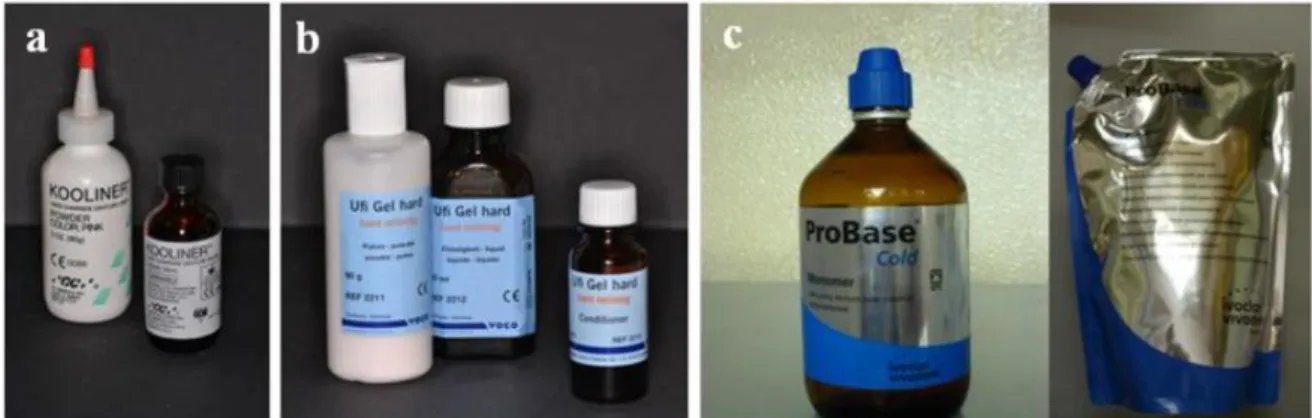
Two of them are direct reline resins, Kooliner (GC America Inc, Alsip, Illinois, USA) and Ufi Gel Hard (Voco GmbH, Cuxhaven, Germany) (Figure 3.1 a,b) composed by pre-polymerized poly(ethyl methacrylate) particles and the third is an indirect reline resin, Probase Cold (Ivoclar Vivadent AG, Liechenstein) (Figure 3.1 c), formed by pre-polymerized polymethylmetacrylate particles (Arima et al. 1995).
Table 3.1-Materials under evaluation in the study.
Product Manufacturer Batch number
P/L ratio (g/mL)
Composition Curing cycle
Kooliner GC America Inc., Alsip, Illinois, USA 1007201(P) 1008101(L) 1.4/1 P: PEMA L: IBMA 10 minutes 37ºC Ufi Gel Hard Voco GmbH, Cuxhaven, Germany 1128441(P) 1134070(L) 1.77/1 P: PEMA L: HDMA 7 minutes 37ºC Probase Cold Ivoclar Vivadent AG, Liechtenstein L49853(P) L43809(L) 1.5/1 P: PMMA L: MMA 15 minutes 40ºC 2-4 bar
P- Powder, L - Liquid, PEMA - polyethyl methacrylate, IBMA – isobutyl methacrylate, HDMA – 1,6 - hexanediol dimethacrylate, PMMA - polymethyl methacrylate, MMA - methyl methacrylate.
Figure 3.1 - Materials under evaluation in the study; a) Kooliner; b) Ufi Gel Hard; c) Probase Cold.
Effect of Chlorhexidine Loading on the Flexural Strength of Acrylic Reline Resins After Thermal Ageing
Preparation of the specimens
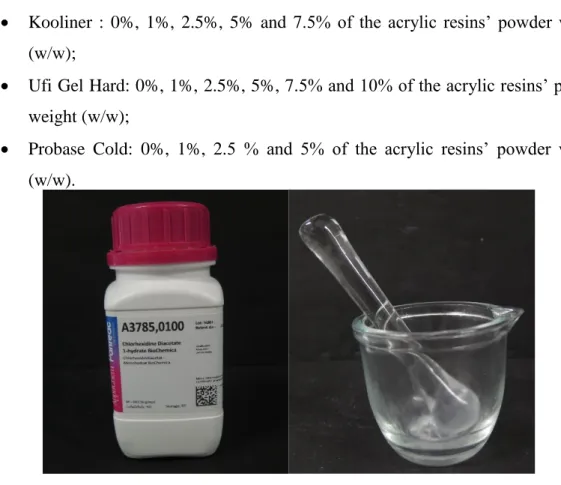
The acrylic resins were manipulated according to the manufacturer’s instructions (Table 3.1). The liquid was measured using a pipette and the powder was weighed using a precision scale (Mettler Toledo). Afterwards all specimens were loaded with chlorhexidine diacetate monohydrate (Panreac Applichem, Darmstadt, Germany) using a mortar and pestle for homogenization (Figure 3.2), according to the proportions previously established:
Kooliner : 0%, 1%, 2.5%, 5% and 7.5% of the acrylic resins’ powder weight (w/w);
Ufi Gel Hard: 0%, 1%, 2.5%, 5%, 7.5% and 10% of the acrylic resins’ powder weight (w/w);
Probase Cold: 0%, 1%, 2.5 % and 5% of the acrylic resins’ powder weight (w/w).
Eight specimens of each group (n=8) were prepared, making a total of one hundred eighteen specimens. Control was represented as the 0% CHX group (Table 3.2).
The specimens of each material were prepared from rectangular shaped stainless steel molds as ISO 20795-1 recommends (ISO 20795-1: 2013), having each specimen approximately 64×10×3.3 mm (Figure 3.3).
a
b
Figure 3.2 – Chlorhexidine diacetate monohydrate; a) Package; b) Incorporation and homogenization.
Materials and Methods
For the preparation of each specimen, the stainless steel mold was placed on a glass plate covered by a polyester sheet. The materials were prepared and placed into the mold. A new polyester sheet and glass plate were positioned on top of the mold (Figure 3.3).
D
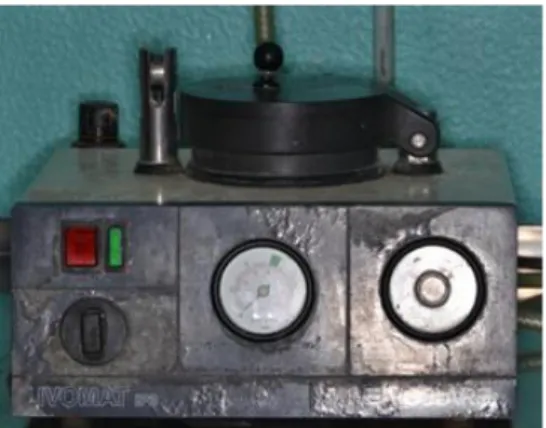
uring the polymerization of the direct reline resins, the specimens were kept under compression at 37±2ºC for the time stablished by the manufacturer (Table 3.1), in order to simulate the intraoral curing cycle of the materials. On the other hand, polymerization of the indirect reline resin was carried out in a pressure device (Ivomat, Ivoclar Vivadent, Liechenstein) (Figure 3.4) at recommended time, temperature and pressure (Table 3.1).
Figure 3.4 – Ivomat pressure device.
Figure 3.3 – Preparation of the specimens; a) Homogeneous mixture of liquid and powder formulations is placed in the stainless steel mold; b)
Effect of Chlorhexidine Loading on the Flexural Strength of Acrylic Reline Resins After Thermal Ageing
After polymerization, the samples were removed from the molds and the edges of each sample were polished with a 600-grit silicon carbide paper (Carbimet Paper Discs, Buehler Ltd., Lake Bluff, IL), on a polisher with constant refrigeration (Figure
3.5).
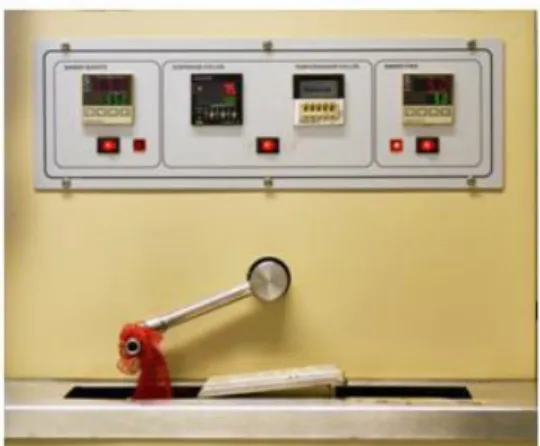
All specimens were submitted to thermal ageing process, being exposed to 1000 cycles of thermal fluctuations between 5ºC and 55ºC (20 seconds each bath), with 5 seconds of dwell time, in a specific machine (Refri 200-E, Aralab, Cascais, Portugal) (Figure 3.6).
Figure 3.6 – Thermocycling machine Refri 200-E, Aralab
Figure 3.5 - Preparation of the specimens. After polymerization and removal of the specimen from the molds; a) Irregularities were removed; b) Examples of
Materials and Methods
Flexural Strength Test
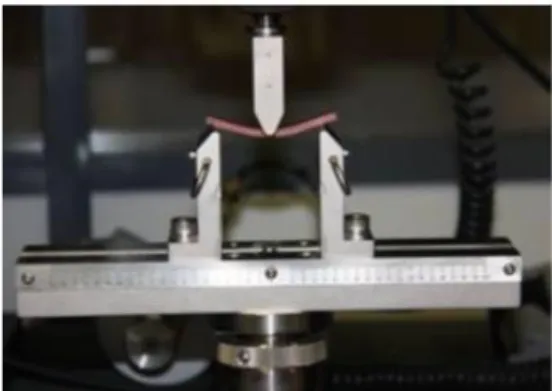
A servo-hydraulic universal testing machine (Instron Model 4502) was used to perform flexural strength tests using a three point bending device (Figure 3.7). Firstly, the width and thickness were measured in each specimen with a digital micrometer of 0.01mm precision (Mitutoyo Digimatic, MFG. Co., Ltd Tokyo, Japan). Then their averages were introduced in the software just before testing.
A crosshead speed of 5mm per minute was selected and the distance between supports was 50mm, as described elsewhere (ISO 20795-1: 2013).
Load was applied until failure and the fracture load was recorded in Newtons (N). The flexural strength was expressed in megapascal (MPa) and calculated using the formula:
Where FS is the flexural strength, W is the maximum load before fracture (N), l is the distance between supports (50mm), b is the specimen’s width (mm) and d is the specimen’s thickness (mm).
Figure 3.7 - Specimen submitted to 3 point loading flexural strength test in a universal machine.
Effect of Chlorhexidine Loading on the Flexural Strength of Acrylic Reline Resins After Thermal Ageing
Statistical Analysis
Descriptive statistics of flexural strength values were carried out being determined the mean, median, standard deviation and interquartile range per group.
Since data did not follow a normal distribution for the studied variables (verified by Shapiro-Wilk normality tests), the results were submitted to the nonparametric tests according to the Kruskal-Wallis method, followed by multiple comparisons using Mann-Whitney tests with Bonferroni corrections to determine whether there were specific significant differences among materials and groups.
In all statistical tests, it was considered the 5% level of significance (α=0.05). Data were statistically analyzed using SPSS Statistics 20 (SPSS Inc., Chicago, IL, USA).
Results
4. Results
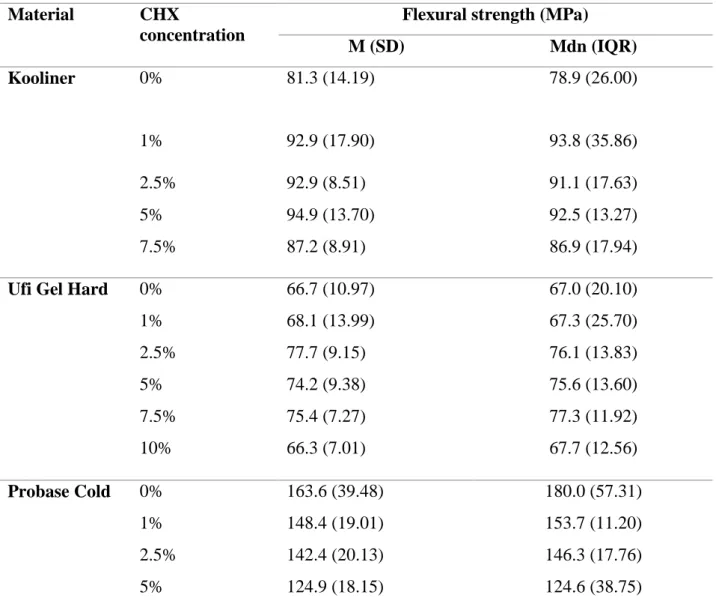
The descriptive analysis is summarized on Table 4.1. including mean, standard deviation, median and interquartile range values of flexural strength per each group.
Table 4.1- Descriptive analysis for each material.
Material CHX
concentration
Flexural strength (MPa)
M (SD) Mdn (IQR) Kooliner 0% 81.3 (14.19) 78.9 (26.00) 1% 92.9 (17.90) 93.8 (35.86) 2.5% 92.9 (8.51) 91.1 (17.63) 5% 94.9 (13.70) 92.5 (13.27) 7.5% 87.2 (8.91) 86.9 (17.94) Ufi Gel Hard 0% 66.7 (10.97) 67.0 (20.10)
1% 68.1 (13.99) 67.3 (25.70) 2.5% 77.7 (9.15) 76.1 (13.83) 5% 74.2 (9.38) 75.6 (13.60) 7.5% 75.4 (7.27) 77.3 (11.92) 10% 66.3 (7.01) 67.7 (12.56) Probase Cold 0% 163.6 (39.48) 180.0 (57.31) 1% 148.4 (19.01) 153.7 (11.20) 2.5% 142.4 (20.13) 146.3 (17.76) 5% 124.9 (18.15) 124.6 (38.75)
M= mean; SD= standard deviation; Mdn= median; IQR= Interquartile range; n=8 for each group.
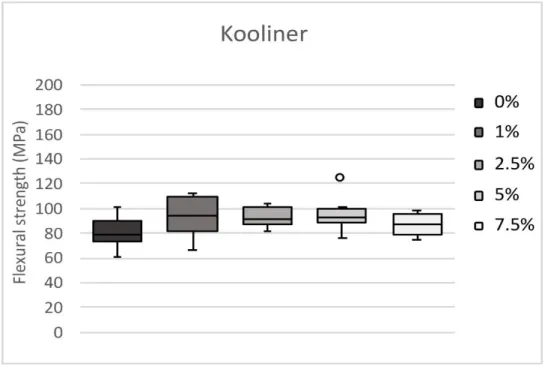
Kooliner specimens (Figure 4.1.) showed no differences of flexural strength among groups of different CHX concentrations loaded in the resin (p>0.05).
Effect of Chlorhexidine Loading on the Flexural Strength of Acrylic Reline Resins After Thermal Ageing
Also, groups of Ufi Gel Hard (Figure 4.2.) showed no statistical significant differences on flexural strength values (p>0.05).
Figure 4.1. – Mean, standard deviation, median and interquartile range of flexural strength values (MPa) for different groups of CHX of Kooliner.
Figure 4.2. – Mean, standard deviation, median and interquartile range of flexural strengthvalues (MPa) for different groups of CHX of Ufi Gel
Results
Considering Probase Cold (Figure 4.3.), 5% CHX group had lower flexural strength values compared to the 0% CHX (control) group (p= 0.033). The remaining comparisons between groups did not evidence statistical significant differences on flexural strength values (p>0.05).
Figure 4.3. – Mean, standard deviation, median and interquartile range of flexural strength values (MPa) for different groups of CHX of Probase
Cold. Groups assigned with the same letter (a/b) show no significant statistical differences between them.
Discussion
5. Discussion
The purpose of this study was to verify if there was an influence on the flexural strength of three types of reline resins loaded with various concentrations of CHX. Flexural strength was the strength property selected since it is one of the most significant features when assessing dental polymers and it’s a helpful property for predicting the clinical performance of the denture when subjected to mastication forces (Anusavice 2003; Casemiro et al. 2008; Al-Haddad et al. 2014).
The three reline resins were chosen for their differences in chemical composition and structural arrangement. Kooliner has the monomer isobutylmethacrylate and forms a simple non-crosslinking net when polymerization is complete. Ufi Gel Hard has the monomer 1,6-hexanodioldimethacrylate and forms a more complex crosslinking net. Probase Cold, a resin that polymerizes on the laboratoty, has methylmethacrylate as the monomer, forming a net with a reduced percentage of uncured monomer (Arima et al. 1995; Arima et al. 1996).
Other objective of the present study was to submit the specimens to a thermocycling ageing procedure. This was done in order to simulate the temperature fluctuations occurring in the oral cavity whenever there is ingestion of food and drinks at different temperatures (Palmer et al. 1992). It is important to evaluate the impact of thermal ageing on the acrylic resins because it is known that these variations of temperature can produce mechanical stresses and, consequentially, induce crack propagation and diminish the mechanical properties of acrylic based materials (Neppelenbroek et al. 2006; Neves 2012). In the present study, the thermocycling method consisted of 1000 cycles of thermal fluctuations between 5ºC and 55ºC, which corresponds to 6 weeks of intraoral temperature variation (Gale and Darvell. 1999). This particular period of time was selected due to the fact that previous studies, focused on the releasing rates of CHX loaded in acrylic resins (Wilson and Wilson 1993; Cao et al. 2010; Ryalat et al. 2011), showed that most of the CHX incorporated is released from the carrier devices in the first twenty eight days, approximately one month, and after this time the antifungal dentures become gradually less efficient, which implies that reline procedures with reline resins loaded with CHX shouldn’t extend longer than this period of time.
Effect of Chlorhexidine Loading on the Flexural Strength of Acrylic Reline Resins After Thermal Ageing
The CHX concentrations selected were based on previous mechanical studies (Sousa 2014; Martins 2015), focused on 0%,1%, 2.5%,5%, 7.5% and 10% groups of CHX loaded on the same three acrylic reline resins of the present study.
Sousa (2014) referred that loading 10% CHX could negatively influence flexural strength of Kooliner and Probase Cold, so they were excluded for the present study. However, the proportion of Ufi Gel Hard 10% CHX was included in the study because, according to the study from Sousa (2014), the specimens of Ufi Gel Hard 10% CHX didn’t evidence lower flexural strength values when compared to the control group (0% CHX). On the other hand, Martins (2015) found a negative impact on the flexural strength of Probase Cold when 7.5% CHX was loaded on the resin specimens. So, it was settled in the present study to include groups of Probase Cold only till 5% CHX.
In the present study, the influence of different CHX concentrations on the flexural strength diverged between reline resins. Concerning Kooliner and Ufi Gel Hard groups there were no statistical significant differences between specimens with different CHX loading. The fact that both Ufi Gel Hard and Kooliner groups weren’t affected by the CHX loading might be explained by their similar chemical constitution, being both composed of pre-polymerized poly(ethyl methacrylate) particles (Arima et al. 1995).
The results are similar to those obtained by Martins (2015) because specimens of Kooliner and Ufi Gel Hard incorporated with CHX in the concentration of 1%, 2.5%, 5% and 7.5%, even after being subjected to thermal ageing, didn’t evidence a negative impact on their flexural strength. On the other hand, results for Ufi Gel Hard 10% CHX do not corroborate those found by Sousa (2014) since the author concluded that after thermal ageing equivalent to three months, groups of Ufi Gel Hard with 10% CHX had a reduction of flexural strength. Therefore, it can be stipulated that doing a reline procedure with Ufi Gel incorporated with 10% CHX for a period of time longer than one month can influence negatively its flexural strength.
At this time it may be concluded that the first and second hypothesis cannot be rejected since no statistical significant differences between specimens with different CHX loading were found.
The third null hypothesis may, however, be rejected since Probase Cold 5% CHX group had significant lower flexural strength compared to the control. A diminished flexural strength can result in a greater incidence of fracture when the acrylic is subjected to occlusal stress (Cunha et al. 2008). Even so, in this particular
Discussion
situation, the 5% CHX group still had a flexural strength that was clinical accepted by the ISO 1567 standard (65 MPa) (Paleari et al. 2010; Acosta-Torres et al. 2012).
Probase Cold was the only resin that demonstrated significant variances between groups with different CHX concentrations. This acrylic resin has a different chemical composition, since it is composed of pre-polymerized polymethylmetacrylate particles, and has different structural arrangement compared to the other resins studied. Moreover, unlike Kooliner and Ufi Gel Hard, its curing cycle is accomplished under high temperature and pressure. These reasons might explain the negative influence of CHX on Probase Cold specimens’ flexural strength. The result obtained for Probase Cold 5% CHX group is in accordance with many other studies (Addy et al. 1981; Casemiro et al. 2008; Cunha et al. 2008; Regis et al. 2010; Paleari et al. 2010; Acosta-Torres et al. 2012; Rodriguez et al. 2012; Sousa 2014; Martins 2015) that revealed a reduction on flexural strength values of resins after being combined with antimicrobial agents, although only Sousa (2014) implemented a thermal ageing procedure. Some authors have also described an inverse proportional relation between the concentration of the antimicrobial introduced and the flexural strength values, meaning that higher amounts of drug loaded in the acrylic resins are translated in lower flexural strength values of the materials (Addy et al. 1981; Regis et al. 2010; Paleari et al. 2010).
According to Addy (1981), the physical presence of the CHX particles in the resin matrix may disturb the physical form of polymers (Addy et al. 1981). In fact, Rodrigues (2012) explained the decrease of flexural strength of the denture base acrylic resin by the possible increase of intermolecular distance between monomers of the polymer chains after the incorporation of the antimicrobial monomer 2-Tert-Butylaminoethyl Methacrylate (Rodriguez et al. 2012). Paleari (2010) associated the diminished flexural strength of the denture base acrylic resin loaded with 2-Tert-Butylaminoethyl methacrylate to the presence of a higher amount of residual monomer and a lower conversion degree of the acrylic resin (Paleari et al. 2010).
Therefore, the reduction of the flexural strength of Probase Cold 5% CHX group could be substantiated by the increase of intermolecular distance of monomers in the polymer chains and the increase of residual monomer.
Recent preliminary results from a microbiological study by Costa (2017) established that the most effective concentration of CHX (w/w) against Candida
Effect of Chlorhexidine Loading on the Flexural Strength of Acrylic Reline Resins After Thermal Ageing
Considering the results achieved by this study and by Costa (2017), it can be concluded that the proportions of 2.5% CHX for Kooliner and 5% CHX for Ufi Gel Hard are valid because, besides being effective against Candida albicans, there is also no influence on the acrylic resins flexural properties. On the other hand, introducing a concentration of 5% CHX in Probase Cold may not be advisable on future investigations because, although microbiologically effective, the present study verified a negative impact on the flexural strength values of this specific group.
With this study it was possible to achieve important conclusions regarding the concentrations of CHX possible to incorporate in reline resins without influencing their flexural strength after these have been submitted to thermal ageing of one month period. However, the results found are limited being important to investigate other mechanical and physical features of the acrylic resins loaded with CHX after not only thermal but also chemical ageing. It’s also essential to associate more microbiological and biocompatibility tests
Conclusion
6. Conclusions
The first null hypothesis may be accepted since there were no variations on flexural strength values between all groups of Kooliner;
The second null hypothesis may, as well, be accepted because there wasn’t evidence of alterations on flexural strength values for different Ufi Gel Hard groups.
The third null hypothesis, concerning Probase Cold groups, may, however, be rejected due to the lower flexural strength values from group 5% CHX compared to control.
Therefore, it can be established that the concentrations of 1%, 2.5%, 5% and 7.5% CHX for Kooliner, 1%, 2.5%, 5%, 7.5% and 10% CHX for Ufi Gel Hard and 1% and 2.5% CHX for Probase Cold do not affect the flexural strength values of the acrylic resins after a thermal ageing equivalent to one month of oral environment.
References
7. References
Acosta-Torres LS, Mendieta I, Nuñez-Anita RE, Cajero-Juárez M, Castaño VM. Cytocompatible antifungal acrylic resin containing silver nanoparticles for dentures. Int J Nanomedicine. 2012; 7:4777–86.
Addy M, Handley R. The effects of the incorporation of chlorhexidine acetate on some physical properties of polymerized and plasticized acrylics. J Oral Rehabil. 1981; 8:155–63.
Akpan A, Morgan R. Oral candidiasis. Postgr Med J. 2002; 78:455–9.
Al-Haddad A, Vahid Roudsari R, Satterthwaite JD. Fracture toughness of heat cured denture base acrylic resin modified with Chlorhexidine and Fluconazole as bioactive compounds. J Dent. 2014;42:180–4.
Amin WM, Al-Ali MH, Salim N, Al-Tarawneh SK. A new form of intraoral delivery of antifungal drugs for the treatment of denture-induced oral candidosis. Eur J Dent. 2009;3:257–66.
Arima T, Murata H, Hamada T. Properties of highly cross-linked autopolymerizing reline acrylic resins. J Prosthet Dent. 1995;73:55–9.
Atwood DS CW. Clinical, cephalometric and densitometric study of reduction of the residual ridges. J Prosthet Dent. 1971;26:280–95.
Barreiros M. Effect of Chlorhexidine Incorporation on the Surface Properties of Acrylic Reline Resins. Dissertação de Mestrado Integrado em Medicina Dentária. Faculdade de Medicina Dentária da Universidade de Lisboa. 2015.
Bertolini MM, Portela MB, Curvelo JAR, Soares RMA, Lourenço EJV, Telles DM. Resins-based denture soft lining materials modified by chlorhexidine salt incorporation: An in vitro analysis of antifungal activity, drug release and hardness. Dent Mater. 2014;30:793–8.
Bissell V, Felix D WD. Comparative trial of fluconazole and amphotericin in the management of denture stomatitis. Oral Surg Oral Med Oral Pathol. 1992;76:35–9.
Effect of Chlorhexidine Loading on the Flexural Strength of Acrylic Reline Resins After Thermal Ageing
Boscato N, Radavelli A, Faccio D, Loguercio AD. Biofilm formation of candida albicans on the surface of a soft denture-lining material. Gerodontology. 2009;26:210– 3.
Budtz-Jorgensen E. Prosthodontics for the elderly: diagnosis and treatment. 1st edition. United States: Quintessence Publishing Co, Inc.; 1999.
Bueno MG, Urban VM, Barbério GS, da Silva WJ, Porto VC, Pinto L. Effect of antimicrobial agents incorporated into resilient denture relines on the Candida albicans biofilm. Oral Dis. 2015;21:57–65.
Cao Z, Sun X, Yeh CK, Sun Y. Rechargeable infection-responsive antifungal denture materials. J Dent Res. 2010;89:1517–21.
Casemiro LA, Martins CHG, Pires-De-Souza FDCP, Panzeri H. Antimicrobial and mechanical properties of acrylic resins with incorporated silver-zinc zeolite - Part I. Gerodontology. 2008;25:187–94.
Chopde N, Pharande A, Khade MN, Khadtare YR, Shah SS, Apratim A. In vitro antifungal activity of two tissue conditioners combined with nystatin, miconazole and fluconazole against Candida albicans. J Contemp Dent Pract. 2012;13:695–8.
Chow CK, Matear DW, Lawrence HP. Efficacy of antifungal agents in tissue conditioners in treating candidiasis. Gerodontology. 1999;16:110–8.
Cross LJ, Williams DW, Sweeney CP, Jackson MS, Lewis MAO, Bagg J. Evaluation of the recurrence of denture stomatitis and Candida colonization in a small group of patients who received itraconazole. Oral Surg Oral Med Oral Pathol Oral Radiol Endod. 2004;97:351–8.
Cunha TR, Regis RR, Bonatti MR, de Souza RF. Influence of incorporation of fluoroalkyl methacrylates on roughness and flexural strength of a denture base acrylic resin. J Appl Oral Sci. 2009;17:103–7.
References
Da Silva PMB, Acosta EJTR, de Rezende Pinto L, Graeff M, Spolidorio DMP, Almeida RS, et al. Microscopical analysis of Candida albicans biofilms on heat- polymerised acrylic resin after chlorhexidine gluconate and sodium hypochlorite treatments. Mycoses. 2011;54:712–7.
Gale MS DB. Thermal cycling procedures for laboratory testing of dental restorations. J Dent. 1999;27:89–99.
Garner SJ, Nobbs AH, McNally LM, Barbour ME. An antifungal coating for dental silicones composed of chlorhexidine nanoparticles. J Dent. 2015;43:362–72.
Gendreau L, Loewy ZG. Epidemiology and Etiology of Denture Stomatitis. J Prosthodont. 2011;20:251–60.
H. R. Dental polymers. In: Phillips´Science of Dental Materials. 11th ed. St. Louis, Missouri: Elsevier Science Ltd. 2003:143–69.
Iqbal Z, Zafar MS. Role of antifungal medicaments added to tissue conditioners: A systematic review. J Prosthodont Res. 2016;60:231–9.
Jo JK, El-Fiqi A, Lee JH, Kim DA, Kim HW, Lee HH. Rechargeable microbial anti-adhesive polymethyl methacrylate incorporating silver sulfadiazine-loaded mesoporous silica nanocarriers. Dent Mater. 2017;33:361–72.
KJ A. Flexural (Bending) strength. In: Phillips’ Science of Dental Materials. 11th ed. St. Louis Missouri: Elsevier Science Ltd. 2003:78.
Koray M, Ak G KE. Fluconazole and/or hexetidine for management of oral candidiasis associated with denture-induced stomatitis. Oral Dis. 2005;11:309–13.
Lee JH, El-Fiqi A, Jo JK, Kim DA, Kim SC, Jun SK. Development of long-term antimicrobial poly(methyl methacrylate) by incorporating mesoporous silica nanocarriers. Dent Mater. 2016;32:1564–74.
Lyon JP, da Costa SC, Totti VMG, Munhoz MFV, de Resende MA. Predisposing conditions for Candida spp. carriage in the oral cavity of denture wearers and individuals with natural teeth. Can J Microbiol. 2006;52:462–7.
Effect of Chlorhexidine Loading on the Flexural Strength of Acrylic Reline Resins After Thermal Ageing
MacNeill S, Rindler E, Walker A, Brown AR CC. Effects of tetracycline hydrochloride and chlorhexidine gluconate on Candida albicans. An in vitro study. J Clin Periodontol. 1997;24:753–60.
Malakhov A, Wen J, Zhang B, Wang H, Geng H, Chen X, et al. Rechargeable anticandidal denture material with sustained release in saliva. Oral Dis. 2016;22:391–8.
Marcelino N. Effect of Chlorhexidine Incorporation on Acrylic Reline Resins – Release Studies. Dissertação de Mestrado Integrado em Medicina Dentária. Faculdade de Medicina Dentária da Universidade de Lisboa. 2015.
Martins S. Effect of Chlorhexidine Incorporation on the Mechanical Properties of Acrylic Reline Resins. Dissertação de Mestrado Integrado em Medicina Dentária. Faculdade de Medicina Dentária da Universidade de Lisboa. 2015.
McCourtie J, McFarlane TW SL. A comparison of the effects of chlorhexidine gluconate, amphotericin B and nystatin on the adherence of Candida species to denture acrylic. J Antimicrob Chemother. 1986;17:575–83.
Monteiro DR, Silva S, Negri M, Gorup LF, de Camargo ER, Oliveira R. Antifungal activity of silver nanoparticles in combination with nystatin and chlorhexidine digluconate against Candida albicans and Candida glabrata biofilms. Mycoses. 2013;56:672–80.
Neppelenbroek KH, Pavarina AC PS, DM, Sgavioli Massucato EM, Spolidorio LC VC. Effectiveness of microwave disinfection of complete dentures on the treatment of Candida-related denture stomatitis. J Oral Rehabil. 2008;35:836–46.
Neppelenbroek KH, Pavarina AC, Spolidorio DM, Vergani CE, Mima EG MA. Effectiveness of microwave sterilization on three hard chairside reline resins. Int J Prosthodont. 2003;16:616–20.
Neppelenbroek KH, Lima JFM, Hotta J, Galitesi LL, Almeida ALPF, Urban VM. Effect of Incorporation of Antifungal Agents on the Ultimate Tensile Strength of Temporary Soft Denture Liners. J Prosthodont. 2018;27:177–81.
References
Neppelenbroek KH, Pavarina AC, Gomes MN, Machado AL, Vergani CE. Bond strength of hard chairside reline resins to a rapid polymerizing denture base resin. J Appl Oral Sci. 2006;14:436-42
Neves Bettencourt C. Insights on the Biodegradation of Acrylic Reline Resins Insights on the Biodegradation of Acrylic Reline Resins. Tese de Doutoramento em Medicina Dentária especialidade de Reabilitação Oral. Faculdade de Medicina Dentária da Universidade de Lisboa. 2012
Nikawa H, Jin C, Makihira S, Egusa H, Hamada T, Kumagai H. Biofilm formation of Candida albicans on the surfaces of deteriorated soft denture lining materials caused by denture cleansers in vitro. J Oral Rehabil. 2003;30:243–50.
Paleari AG, Marra J, Pero AC, Rodriguez LS, Ruvolo-Filho A, Compagnoni MA. Effect of incorporation of 2-tert-butylaminoethyl methacrylate on flexural strength of a denture base acrylic resin. J Appl Oral Sci. 2011;19:195–9.
Palmer DS, Barco MT, Billy EJ. Temperature extremes produced orally by hot and cold liquids. J Prosthet Dent. 1992;67:325–7.
Pusateri CR, Monaco EA, Edgerton M. Sensitivity of Candida albicans biofilm cells grown on denture acrylic to antifungal proteins and chlorhexidine. Arch Oral Biol. 2009;54:588–94.
Radnai M, Whiley R, Friel T, Wright PS. Effect of antifungal gels incorporated into a tissue conditioning material on the growth of Candida albicans. Gerodontology. 2010;27:292–6.
Redding S, Bhatt B, Rawls HR, Siegel G, Scott K, Lopez-Ribot J. Inhibition of Candida albicans biofilm formation on denture material. Oral Surgery, Oral Med Oral Pathol Oral Radiol Endodontology. 2009;107:669–72.
Rodriguez LS, Paleari AG, Giro G, de Oliveira Junior NM, Pero AC, Compagnoni MA. Chemical characterization and flexural strength of a denture base acrylic resin with monomer 2-tert-butylaminoethyl methacrylate. J Prosthodont. 2013;22:292-7.
Effect of Chlorhexidine Loading on the Flexural Strength of Acrylic Reline Resins After Thermal Ageing
Ryalat S, Darwish R, Amin W. New form of administering chlorhexidine for treatment of denture-induced stomatitis. Ther Clin Risk Manag. 2011;7:219–25.
Salerno C, Pascale M, Contaldo M, Esposito V, Busciolano M, Milillo L. Candida-associated denture stomatitis. Med Oral Patol Oral Cir Bucal. 2011;16: 39-43.
Salim N, Moore C, Silikas N, Satterthwaite J, Rautemaa R. Candidacidal effect of fluconazole and chlorhexidine released from acrylic polymer. J Antimicrob Chemother. 2013;68:587–92.
Salim N, Silikas N, Satterthwaite JD, Moore C, Ramage G, Rautemaa R. Chlorhexidine-impregnated PEM/THFM polymer exhibits superior activity to fluconazole-impregnated polymer against Candida albicans biofilm formation. Int J Antimicrob Agents. 2013;41:193–6.
Salim N, Moore C, Silikas N, Satterthwaite JD, Rautemaa R. Fungicidal amounts of antifungals are released from impregnated denture lining material for up to 28 days. J Dent. 2012;40:506–12.
Salim N, Satterthwaite JD, Rautemaa R, Silikas N. Impregnation with antimicrobials challenge bonding properties and water sorption behaviour of an acrylic liner. J Dent. 2012;40:693–9.
Salim N, Satterthwaite J, Rautemaa R, Silikas N. Impregnation with antimicrobials has an impact on degree of conversion and colour stability of acrylic liner. Dent Mater J. 2012;31:1008–13.
Sánchez-aliaga A, Viviane C, Pellissari G, Augusto C, Arrais G, Michél MD. Peel bond strength of soft lining materials with antifungal to a denture base acrylic resin. Dental Materials Journal. 2016; 35: 194–203.
Schneid TR. An in vitro analysis of a sustained release system for the treatment of denture stomatitis. Special Care in Dentistry.1992; 12: 245-50.
Scully C, El-Kabir M SL. Candida and oral candidosis: a review. Crit Rev Oral Biol Med. 1994; 5:125– 57.
References
Shino B, Peedikayil FC, Jaiprakash SR, Ahmed Bijapur G, Kottayi S, Jose D. Comparison of Antimicrobial Activity of Chlorhexidine, Coconut Oil, Probiotics, and Ketoconazole on Candida albicans Isolated in Children with Early Childhood Caries: An in Vitro Study. Scientifica. 2016; 2016: 1-5.
Sousa C. Effect of Chlorhexidine Incorporation on the Properties of Acrylic Reline Resins. Dissertação de Mestrado Integrado em Medicina Dentária. Faculdade de Medicina Dentária da Universidade de Lisboa. 2014.
Suci PA, Tyler BJ. Action of chlorhexidine digluconate against yeast and filamentous forms in an early-stage Candida albicans biofilm. Antimicrob Agents Chemother. 2002;46:3522–31.
Uludamar A, Gökhan Özyeşil A, Ozkan YK. Clinical and microbiological efficacy of three different treatment methods in the management of denture stomatitis. Gerodontology. 2011;28:104–10.
Urban VM, Machado AL, Oliveira R V, Vergani CE, Pavarina AC, Cass QB. Residual monomer of reline acrylic resins. Effect of water-bath and microwave post-polymerization treatments. Dent Mater. 2007;23:363–8.
Urban VM, De Souza RF, Galvao Arrais CA, Borsato KT, Vaz LG. Effect of the association of nystatin with a tissue conditioner on its ultimate tensile strength. J Prosthodont. 2006;15:295–9.
Urban VM, Seó RS, Giannini M, Arrais CAG. Superficial distribution and identification of antifungal/antimicrobial agents on a modified tissue conditioner by sem-eds microanalysis: A preliminary study. J Prosthodont. 2009;18:603–10.
Vanden Abbeele A, De Meel H, Ahariz M, Perraudin JP, Beyer I, Courtois P. Denture contamination by yeasts in the elderly. Gerodontology. 2008;25:222–8.
Waters MG, Williams DW, Jagger RG LM. Adherence of Candida albicans to experimental denture soft lining materials. J Prosthet Dent. 1997;77:306–12.
Effect of Chlorhexidine Loading on the Flexural Strength of Acrylic Reline Resins After Thermal Ageing
Wilson J. The aetiology, diagnosis and management of denture stomatitis. Br Dent J. 1998;185:380–84.
Wilson SJ, Wilson HJ. The release of chlorhexidine from modified dental acrylic resin. J Oral Rehabil. 1993;20:311–19.
Appendices
Appendices
Appendix 1 – List of tables
Table 3.1-Materials under evaluation in the study. (Page 5) Table 4.1- Descriptive analysis for each material. (Page 11)
Effect of Chlorhexidine Loading on the Flexural Strength of Acrylic Reline Resins After Thermal Ageing
Appendix 2 – List of figures
Figure 3.1 - Materials under evaluation in the study; a) Kooliner; b) Ufi Gel Hard; c) Probase Cold. (Page 5)
Figure 3.2 – Chlorhexidine diacetate monohydrate; a) Package; b) Incorporation and homogenization. (Page 6)
Figure 3.3 – Preparation of the specimens; a) Homogeneous mixture of liquid and powder formulations is placed in the stainless steel mold; b) Pre-polymerized specimen and mold between polyester sheets and glass plates. (Page 7)
Figure 3.4 – Ivomat pressure device. (Page 7)
Figure 3.5 - Preparation of the specimens. After polymerization and removal of the specimen from the molds; a) Irregularities were removed; b) Examples of polymerized Kooliner specimens. (Page 8)
Figure 3.6 – Thermocycling machine Refri 200-E, Aralab. (Page 8)
Figure 3.7 - Specimen submitted to 3 point loading flexural strength test in a universal machine. (Page 9)
Figure 4.1 – Mean, standard deviation, median and interquartile range of flexural strength values (MPa) for different groups of Kooliner. (Page 12)
Figure 4.2 – Mean, standard deviation, median and interquartile range of flexural strength values (MPa) for different groups of Ufi Gel Hard. (Page 12)
Figure 4.3 – Mean, standard deviation, median and interquartile range of flexural strength values (MPa) for different groups of Probase Cold. (Page 13)
References
Appendix 3 – List of abbreviations
CHX - Chlorhexidine diacetate monohydrate FS – Flexural Strength
HDMA – 1,6 - hexanediol dimethacrylate IBMA – isobutyl methacrylate
ISO – International Organization for Standardization MMA - methyl methacrylate
MPa - Megapascal
PEMA - polyethyl methacrylate PMMA - polymethyl methacrylate
Effect of Thermocycling Ageing on the Mechanical Properties of Reline Resins Incorporated with Chlorhexidine
Appendix 4 – Flexural Strength values
Material Proportion Specimen Load at Yield [KN] Width [mm] Thickness [mm] Flexural Strength [Mpa]
Probase Cold 0% 1 0.2341 10.19 3.41 148.1766374 2 0.123 10.13 3.24 86.74948577 3 0.2627 10.17 3.08 204.220319 4 0.2517 10.24 3.14 186.9757251 5 0.276 10.27 3.23 193.1945439 6 0.2544 10.37 3.18 181.9471989 7 0.2712 10.3 3.33 178.0841455 8 0.1867 10.22 3.25 129.714332 1% 1 0.2022 10.09 3.09 157.4107143 2 0.2109 10.21 3.15 156.1316659 3 0.214 10.28 3.19 153.4265629 4 0.1545 10.23 3.3 104.0126673 5 0.2 10.14 3.21 143.5632361 6 0.2145 10.15 3.22 152.8659552 7 0.2176 10.15 3.11 166.2391594 8 0.2164 10.17 3.22 153.9167284 2,5% 1 0.1894 10.26 3.11 143.1439836 2 0.1249 10.17 3.08 97.09599484 3 0.2085 10.16 3.23 147.526001 4 0.1934 10.09 3.09 150.5600007 5 0.2136 10.09 3.12 163.1030782 6 0.2244 10.25 3.48 135.5819147 7 0.2255 10.15 3.26 156.7857426 8 0.228 10.19 3.4 145.1657266 5% 1 0.1516 10.35 3.25 104.0048023 2 0.1592 10.29 3.13 118.4405122 3 0.1976 10.11 3.15 147.7324637 4 0.2071 10.3 3.2 147.2665731 5 0.1557 10.93 3.2 104.3349368 6 0.1574 10.73 3.16 110.1772946 7 0.1828 10.26 3.13 136.3959324 8 0.1937 10.14 3.31 130.766633
Appendices
Material Proportion Specimen Load at Yield [KN] Width [mm] Thickness [mm] Flexural Strength [Mpa] Kooliner 0% 1 0.0964 10.34 3.4 60.48670464 2 0.1223 10.34 3.34 79.51961121 3 0.1351 10.28 3.35 87.82818008 4 0.109 10.5 3.38 68.1498747 5 0.1171 10.19 3.38 75.441545 6 0.1386 10.18 3.17 101.6150865 7 0.1331 10.26 3.14 98.68080007 8 0.124 10.64 3.34 78.35169335 1% 1 0.0989 9.96 3.21 72.27500856 2 0.1262 10.16 3.33 84.01144281 3 0.1272 10.68 3.68 65.96012723 4 0.1607 10.02 3.28 111.8051301 5 0.1562 10.31 3.41 97.7180675 6 0.1618 10.36 3.28 108.8760454 7 0.1477 10.04 3.13 112.6209978 8 0.1292 10.21 3.25 89.85273748 2,5% 1 0.1443 10.18 3.25 100.6498413 2 0.132 10.55 3.38 82.13898547 3 0.14 10.5 3.46 83.53102342 4 0.1552 10.01 3.36 103.0007408 5 0.145 10.01 3.48 89.70914143 6 0.1286 10.19 3.2 92.43322191 7 0.1248 10.26 3.21 88.53569955 8 0.1612 10.41 3.35 103.4870381 5% 1 0.1448 10.18 3.28 99.15950722 2 0.1237 10.01 3.28 86.14879321 3 0.1557 10.08 3.07 122.9171814 4 0.1102 10.09 3.28 76.13844525 5 0.1462 10.13 3.28 100.6123987 6 0.1283 10.12 3.26 89.46892252 7 0.1415 10.3 3.3 94.61338896 8 0.1374 10.09 3.36 90.46451831 7.5% 1 0.1182 9.92 3.22 86.18969113 2 0.1166 10.25 3.28 79.30275243 3 0.1474 10.11 3.34 98.01999086 4 0.1383 10.11 3.24 97.73323347 5 0.1171 10.56 3.08 87.67036351 6 0.1156 10.8 3.19 78.88855041 7 0.1307 10.32 3.17 94.52324644 8 0.1143 10.45 3.3 75.32919451
Effect of Thermocycling Ageing on the Mechanical Properties of Reline Resins Incorporated with Chlorhexidine
Material Proportion Specimen Load at Yield [KN] Width [mm] Thickness [mm] Flexural Strength [Mpa]
Ufi Gel Hard 0% 1 0.0895 10.19 3.12 67.67074016 2 0.0915 9.99 3.26 64.63707111 3 0.0710 10.19 3.18 51.6762735 4 0.1074 10.05 3.11 82.86644444 5 0.1003 10.18 3.18 73.0735453 6 0.0751 10.16 3.28 51.52995996 7 0.1020 9.94 3.19 75.6299276 8 0.0913 9.97 3.22 66.24073447 1% 1 0.0988 10.54 3.53 56.41936402 2 0.1248 10.11 3.59 71.83495036 3 0.1093 9.92 3.63 62.71284499 4 0.1443 10.13 3.62 81.52691486 5 0.1241 10.03 3.34 83.18388089 6 0.1394 10.28 3.49 83.49876818 7 0.0949 10.19 3.44 59.02505585 8 0.0597 10 3.1 46.59209157 2,5% 1 0.1431 10.21 3.49 86.30268375 2 0.1567 10.66 3.77 77.56938617 3 0.1322 10.26 3.6 74.56591582 4 0.1496 10.1 3.49 91.20541614 5 0.1129 10.41 3.6 62.76239015 6 0.1031 10.21 3.26 71.26216074 7 0.1223 10.07 3.29 84.15238984 8 0.1078 9.92 3.32 73.94216879 5% 1 0.1148 10.26 3.53 67.34515858 2 0.1397 10.08 3.48 85.82990849 3 0.1047 10.25 3.2 74.81421494 4 0.1404 10.27 3.51 83.22306278 5 0.0941 10.13 3.52 56.22845034 6 0.1122 10.08 3.27 78.07249938 7 0.1097 9.94 3.29 76.4697571 8 0.1019 9.96 3.28 71.3228061
Appendices Ufi Gel Hard 7.5% 1 0.1217 10.23 3.31 81.43671005 2 0.1359 9.93 3.61 78.76206024 3 0.1126 9.99 3.34 75.7776673 4 0.1105 10.12 3.6 63.18849729 5 0.1119 10.14 3.47 68.73761279 6 0.0999 10.02 3.25 70.79332459 7 0.1115 9.85 3.25 80.37725648 8 0.1154 10.26 3.16 84.478374 10% 1 0.1163 10.08 3.59 67.14157874 2 0.0916 10.5 3.37 57.61129483 3 0.1050 10.09 3.38 68.31656092 4 0.1073 10.26 3.32 71.16024869 5 0.0805 10.39 3.28 54.01245392 6 0.0933 10.11 3.23 66.34171693 7 0.1024 10.18 3.21 73.2155581 8 0.0957 10.07 3.13 72.75369507