UNIVERSIDADE DE LISBOA FACULDADE DE MEDICINA DENTÁRIA
Effect of thermal treatments on optical properties
of bis-acryl resins
Daniela Filipa Vala Lourenço
Dissertação orientada pelo
Professor Doutor Jaime Pereira Fontes de Almeida Portugal
Mestrado Integrado em Medicina Dentária
“Persistence is the shortest path to success!”
3
ACKNOWLEDGEMENTS
Ao Prof. Doutor Jaime Portugal, por toda a disponibilidade que demonstrou, pela orientação, paciência e dedicação. Com a sua ajuda, este trabalho tornou-se mais fácil e interessante.
A todos os responsáveis e colaboradores do laboratório da GIBBO, pela ajuda e cedência dos equipamentos necessários à realização desta dissertação, e ao Prof. Doutor Pires Lopes, pela cedência do espaço e equipamentos do laboratório de Biomateriais.
À VOCO e à 3M, pela disponibilização dos materiais necessários para a realização deste protocolo experimental.
Aos meus pais, pelo apoio em momentos mais difíceis, deste e de todos os percursos. Ao meu irmão, Bernardo, por estar sempre pronto a ajudar em tudo o que estivesse ao seu alcance.
Aos meus primos, Catarina e Tiago, por me animarem mesmo sem se aperceberem e estarem sempre disponíveis para mim. Ao Matias, que ainda é pequenino, mas que me traz vida e cor todos os dias com a inocência própria de uma criança.
A toda a minha família, pelo apoio e carinho em todas as horas.
Ao André, por me ouvir em todas as horas difíceis e nunca me deixar desistir. Por acreditar em mim mesmo quando eu mesma não o fiz. Por me marcar para sempre e mesmo que a vida nos separe.
À família que encontrei e que escolhi quando cheguei a Lisboa perdida e com medo, André, Dayana, Filipe, Karina, Luís, Margarida, Maria, Mónica Lourenço, Mónica Moreira e Sara, obrigada por me fazerem sentir sempre em casa. Sem vocês, estes 5 anos não teriam sido tão bons. Obrigada por me ouvirem sempre nos momentos bons e maus, sempre com a opinião mais sincera possível, por nunca se esquecerem de mim e estarem sempre de braços abertos e sorriso no rosto. A vida é melhor convosco.
A todas as pessoas que me continuam a receber com um sorriso mesmo com a ausência que a vida proporciona.
5
ABSTRACT
Aim: The purpose of this study was to evaluate the effect of various thermal
treatments on the chromatic stability of two bis-acrylic resins, after 24h and 7d.
Materials and Methods: Ten experimental groups (n=10) were set according to
the several possible combinations between the bis-acrylic resin (Protemp 4, P4; Structur 3, S3) and post-polymerization thermal treatment (without any post-polymerization treatment, nt; post-polymerization in a water bath at 60°C for 5 minutes, wb5; microwave at 750W for 1 minute, mw1; water bath at 60°C for 1 minute, wb1; conventional hairdryer for 1 minute, hd1). Thirty minutes after the polymerization, the baseline color values were measured, and all the specimens were immersed in the staining solution (coffee). After 24h and 7d new measurements were taken and ∆E calculated. A ∆E higher than 3.7 was considered clinically unacceptable. After confirming the normality and homogeneity of the data with Shapiro-Wilk and Levene’s testes (p>0.05), the ΔE data were submitted to a 2-way ANOVA, followed by 1-way ANOVA and Tukey post-hoc tests for each material (α=0.05).
Results: The ΔE ranged between 5.9 and 13.0, at 24h, and between 9.1 and 24.7,
after 7d. The ∆E was statistically (p<0.001) influenced by both bis-acrylic resin and post-polymerization heat treatment, at 24h and 7d. A statistically significant (p<0.001) interaction was observed between the two factors. At 24h, regarding S3 specimens, all post-polymerization treatments showed a statistically (p<0.05) higher ∆E than the nt group, but for the P4 specimens, the mw1 and wb5 groups showed similar (p>0.05) ∆E than nt group. At 7d, no differences were found between S3 groups. In the P4 specimens, the wb5 showed a lower ∆E than nt, and only the wb1 and the hd1 obtained a ∆E higher than nt.
Conclusion: Both, bis-acrylic resin and post-polymerization treatments, influence
the ∆E, at 24h and 7d.
Key-words: bis-acrylic resin; colour, stability; post-polymerization treatments;
7
RESUMO
Introdução: Restaurações provisórias são um passo essencial no plano de tratamento em prótese fixa. Os seus principais objetivos são proteger tanto o complexo polpa-dentina como o periodonto e estabilizar e restaurar a função e a estética do dente durante a reabilitação, desde a preparação até a cimentação da restauração final. Além disso, são também usados com ferramenta de diagnóstico para avaliar a eficácia estética, funcional e terapêutica do plano de tratamento, desempenhando um papel essencial no seu prognóstico. Considerando estes objetivos, as restaurações devem obedecer a certos requisitos estéticos, mecânicos e biológicos, como uma boa adaptação marginal, retenção e resistência adequadas, baixa condutividade térmica, sem causar irritação pulpar ou do tecido gengival, estabilidade cromática e permitir uma fácil higiene, pois podem ser utilizados durante longos períodos de tempo. Assim, os materiais que os constituem devem ser biocompatíveis, fáceis de manusear e não-tóxicos, determinando o seu sucesso ou insucesso. Atualmente, existem dois grandes grupos de materiais, tendo em conta a composição química, para a confeção destas restaurações temporárias. Resinas de polimetilmetacrilato e resinas compostas bis-acrílicas. Existem também resinas de dimetacrilato de uretano fotopolimerizáveis. As resinas de polimetilmetacrilato têm um bom acabamento marginal, bom polimento e alta resistência. Mas têm uma elevada contração de polimerização, induzem a irritação pulpar associada ao monómero livre, têm um odor forte e têm uma reação de polimerização exotérmica. Como a mistura é realizada manualmente, essas propriedades físicas podem eventualmente ser influenciadas, inadvertidamente, por diferenças na proporção de monómero e pó recomendada pelo fabricante.
Mais recentemente, as resinas compostas, nomeadamente a resina composta bis-acrílica, ganhou alguma popularidade e mais estudos foram feitos. Esta resina tem uma fácil manipulação, o tempo clínico necessário para a fabricação de uma coroa temporária é reduzido, bom ajuste marginal e facilidade de reparação. Como vantagem em relação às resinas de polimetilmetacrilato, apresenta baixa contração de polimerização e reduzida exotermia da reação de presa. No entanto, tem algumas desvantagens, como a dificuldade em polir e a controversa estabilidade de cor.
8
O facto de não haver estudos suficientes para comprovar a estabilidade cromática da resina composta bis-acrílica pode resultar num problema estético. Alterações de cor percetíveis podem comprometer a aceitabilidade do tratamento provisório, o que pode levar à insatisfação do paciente e a um custo económico e tempo extra para a sua substituição.
A estabilidade cromática pode ser afetada por 2 tipos de fatores: 1. pigmentação intrínseca, como descoloração do próprio material, grau de conversão, alteração da matriz da resina ou interface matriz/carga e através dos diferentes procedimentos de polimento do material, levando a diferentes rugosidades da superfície; 2. pigmentação extrínseca, que inclui manchas por adsorção ou absorção de corantes resultantes da contaminação da dieta, hábitos do paciente, nicotina e algumas bebidas. Alguns autores estudaram formas de aumentar a estabilidade cromática desses materiais por meio de tratamentos pós-polimerização, com microondas ou banho de água quente, por exemplo, para aumentar o grau de conversão do material. Assim, aumentar a resistência mecânica, dureza superficial, capacidade de polimento, redução de poros e proporcionar maior estabilidade cromática. A diferença cromática (ΔE) é determinada comparando as respetivas coordenadas obtidas em dois momentos, inicial e final, pela seguinte equação ΔE * = [(L * final - L * inicial) 2 + (a * final - a * inicial) 2+ (b * final - b * inicial) 2] 1/2 (Sakaguchi R & Powers JM, 2012). Neste estudo uma ΔE>3,7 foi considerada como clinicamente percetível.
Objetivos: o objetivo deste estudo foi avaliar o efeito de vários tratamentos de
pós-polimerização de duas resinas bis-acrílicas imersas em café durante 24 horas e 7 dias, de acordo com as seguintes hipóteses nulas: 1) não existem diferenças nas propriedades óticas entre os dois materiais; 2) a estabilidade cromática é influenciada pelos tratamentos de pós-polimerização.
Materiais e Métodos: foram preparados 100 espécimes cilíndricos com 12mm
de diâmetro e 2 ± 0,15mm de espessura, cinquenta com Protemp 4, cor A3 (Lote: 628352, Ref.70201132621 data de validade: 2018-05, 3M ESPE, Seefeld, Alemanha) e cinquenta com Structur 3, cor A3, (Lote: 1807226, Ref. 2505, data de validade: 2020-02, VOCO, Cuxhaven, Alemanha). Imediatamente após o tempo polimerização, indicado pelo fabricante, os espécimes de cada material foram submetidos a um dos tratamentos térmicos estudados: sem tratamento, nt; microondas (Samsung, GW73B, South Korea) com a potência de 750W durante 1 minuto, mw1; banho-maria (J.P. Selecta, Precisterm,
9
Spain) a 60ºC durante 1 minuto, wb1, ou 5 minutos, wb5; e secador de cabelo convencional (Philips, SalonDry Control Hairdryer, HP 8182/23, Netherlands) de 1800W a 20cm provocando uma temperatura de 60ºC, hd1. Os espécimes foram limpos, secos e mantidos num meio seco a 22°C durante 30 minutos antes da medição inicial da cor com o espectrofotómetro VITA Easyshade® (Vident Brea, CA, EUA). A cor foi analisada de acordo com o espaço de cor CIE L* a* b. As medições foram feitas sobre um fundo cinzento neutro, sempre numa câmara escura. De seguida, foram colocados numa solução de 10mL, em que se diluiu 2g de café em 120mL de água, a uma temperatura de 37ºC. Após 24 horas, os espécimes foram escovados e foi efetuada uma nova medição. Os espécimes foram, então, novamente imersos na solução de café e nos 6 dias seguintes, até se atingir uma semana. A solução foi todos os dias renovada. A diferença cromática (ΔE) foi, quer para as 24 quer para os 7 dias, calculada através da equação ΔE*= [(ΔL*)2 + (Δa*)2+ (Δb*)2]1/2. Os valores ΔL*, Δa* e Δb* foram calculados através da equação ΔL= L final – L inicial, consoante a coordenada da cor em questão. Os dados foram analisados estatisticamente com o software SPSS (IBM SPSS Statistics 20; SPSS Inc). Após confirmar a normalidade e homogeneidade dos dados com os testes de
Shapiro-Wilk e Levene (p>0,05), os dados de ΔE foram submetidos a uma ANOVA de duas
dimensões (α=0,05). Finalmente, foi feito um ANOVA de uma dimensão (α=0,05) foi feito para cada material. Quando diferenças significativas entre os grupos foram verificadas, os dados foram analisados pelo teste post-hoc Tukey. Para todos os testes, foi fixada uma significância estatística de 5% (α=0,05).
Resultados: os valores da ΔE variaram entre 5,9 e 13,0, após 24 horas, e entre 9,1
e 24,7, após 7 dias. A ∆E foi influenciada estatisticamente (p<0,001) tanto pela resina bis-acrílica como pelo tratamento térmico pós-polimerização, às 24 horas e 7 dias. Foi observada uma interação estatisticamente significativa (p<0,001) entre estes dois fatores. Às 24 horas, em relação às amostras S3, todos os tratamentos de pós-polimerização apresentaram valores de ∆E estatisticamente superiores (p<0,05) ao grupo nt, mas para os espécimes P4, os grupos mw1 e wb5 apresentaram valores de ∆E estatisticamente semelhantes (p>0,05) ao grupo nt. Aos 7 dias, não foram encontradas diferenças (p=0,098) entre os grupos S3. Nos espécimes de P4, o wb5 apresentou valores de ∆E menores que nt, e apenas wb1 e hd1 obtiveram uma ∆E maior que nt.
Conclusões: existiram diferenças entre a estabilidade cromática dos materiais
10
cromática foi influenciada também pelo tipo de tratamento de pós-polimerização, ou a falta deste. Apenas os espécimes do grupo mw5, microondas 5 minutos, conseguiram obter uma ∆E estatisticamente inferior ao controlo. Todos os espécimes apresentaram uma alteração de cor considerada clinicamente inaceitável após um período de 24 horas de imersão em café.
Palavras-chave: bis-acrílico; estabilidade cromática; tratamento de
I TABLE OF CONTENTS ABSTRACT ... 3 TABLE OF CONTENTS ... I INTRODUCTION ... III OBJECTIVES ... VIII MATERIALS AND METHODS... IX 1. Specimens preparation ... IX 2. Post-polymerization treatment ... XI 3. Initial colour measurement - T0 ... XV 4. Colour measurement after 24 hours - T1 ... XVI 5. Colour measurement after 7 days - T7 ... XVII 6. Analysis of the colour difference ... XVII 7. Statistical analysis ... XVII RESULTS... XVIII DISCUSSION ... XXI CONCLUSIONS ... XXV REFERENCES ... XXVI
III
INTRODUCTION
Temporary crown and bridge materials are essential for treatment procedures with fixed prosthodontic (Haselton DR et al., 2004). The main goals are to protect both the pulp-dentin complex and the periodontium, to stabilize and restore function and esthetics on the tooth in rehabilitation, from the preparation to the cementation of the final restoration (Burns, DR et al., 2003; Bayindir F et al., 2012; Mei, ML.; 2015). In addition, they are also used as a diagnostic tool to evaluate the aesthetic, functional and therapeutic efficacy of a treatment plan, playing an essential role in its prognosis (Gujjari AK et al., 2013; Sham AS et al., 2004;).
Considering these goals, restorations must comply with certain aesthetic, mechanical and biological requirements (Haselton DR et al., 2004; Rutkunas V et al., 2010) such as good marginal adaptation, adequate retention and resistance, low thermal conductivity, without causing pulp or gingival tissue irritation, chromatic stability and ease of hygiene, once they can be used between several days to half a year or more. Therefore, the materials that embody them should be biocompatible, easy to handle and non-toxic, having a key role in their success or failure (Burns, DR et al., 2003; Patras et
al., 2012).
Currently, there are two major groups of materials according to the chemical composition available for the preparation of these temporary restorations (Haselton DR
et al., 2004; Givens EJ et al., 2008; Gujjari AK et al., 2013). Methacrylate resins that are
available in a powder / liquid, hand mixed formulation such as polymethyl methacrylate (PMMA) resin, polyethyl methacrylate resin or polyvinyl methacrylate resin; and composite-based materials that have a paste / paste formulation, mainly automixed, such as bis-acryl composite resin. There are also photopolymerized urethane dimethacrylate resins. (Michalakis et al., 2006; Patras et al., 2012; Prasad et al., 2014).
Methacrylate resins have a good marginal finish, good polishing and high strength. Nonetheless, their polymerization contraction is high, they induce pulpal irritation associated with free monomer, they have a strong odor and their polymerization reaction is exothermic. As the blending is performed manually, these physical properties may eventually be influenced inadvertently by differences in the monomer and powder ratio recommended by the manufacturer.
IV
Recently, this composite-based, namely the bis-acryl composite resin, has gained some popularity and more studies have been done regarding this resin, which composition consists of two or more types of materials (Young HM et al., 2001; Balkenhol M et al., 2007; Strassler HE et al., 2007; Givens EJ et al., 2008; Patras M et al., 2012).
Usually in its constitution has three structural components:
1. Organic matrix: A plastic resin material that forms a continuous phase and binds the charge particles. Commonly, it is a dimethacrylate such as Bis-GMA or UDMA that crosslinks upon polymerization and provides strength to the material (Carneiro, JT. 2017). These monomers have a high molecular weight and are very viscous at room temperature, making it difficult to incorporate filler into the resin matrix. Therefore, it is necessary to associate lower molecular weight diluent co-monomers such as TEGDMA (triethylene glycol dimethacrylate) and EDMA (ethylene glycol dimethacrylate) (Carneiro, JT. 2017); 2. Inorganic filler particles: reinforcing particles and / or fibers dispersed in the matrix. They are usually glass, quartz and / or silica particles and a bonding agent that promotes adhesion between the filler particles and the organic resin matrix, such as silane (Carneiro, JT. 2017).
3. Silane: a bifunctional molecule capable of binding both the inorganic filler and the matrix polymer. These charge particles increase hardness, mechanical resistance to fracture and abrasion (Carneiro, JT. 2017).
This resin can be easily handled, has a good marginal fit, is easy to repair and the clinical time required for the manufacture of a temporary crown with this material is lower. In advantage to Methacrylate resins, a lower polymerization contraction as well as a lower exothermic reaction (Patras et al., 2012, Carneiro, JT. 2017). However, it has some drawbacks such as being difficult to polish (Sen D et al., 2002; Rutkunas V et al., 2010; Turgut et al., 2013) and its controversial colour stability (Yannikakis SA et al., 1998; Haselton DR et al., 2004; Guler AU et al., 2005a; Haselton DR et al., 2005; Givens EJ et al., 2008; Rutkunas V et al., 2010; Gupta G & Gupta T, 2011; Bayindir F et al., 2012; Gujjari AK et al., 2013; Turgut et al., 2013.)
The fact that there are insufficient studies to prove the chromatic stability of bis-acryl composite resin may result in an aesthetic problem. Perceptible colour changes may compromise the acceptability of the provisional treatment, which may lead to patient
V
dissatisfaction, consequentially costing more money and time to substitute the temporary crown (Guler AU et al. 2005; Gupta G & Gupta T, 2011).
Chromatic stability can be affected by 2 types of factors: 1. intrinsic, such as discoloration of the material itself, degree of conversion, alteration of the resin matrix or the interface matrix / load and related to different polishing procedures of the material leading to different roughness of the surface; 2. Extrinsic inclusions, for instance, that include spotting by adsorption or absorption of dyes resulting from contamination from exogenous sources from the patients diet and habits such as smoking and certain beverages (Szesz, AL et al, 2011); (Turgut et al., 2013). Water accumulation and photo-oxidation have been reported to be responsible for internal colour change. Water plays an important role in the chemical degradation processes such as oxidation and hydrolysis and the subsequent change of the optical properties of the restorative materials (Bayindir F et al., 2012). Studies have demonstrated that water absorption in composite materials can be affected by filler content, degree of cross-linking of resin molecules, and the amount of air inclusion or unreacted monomers. Automixing of bis-acryl methacrylate instead of hand-spatulation reduces the amount of air entrapment, but it is unclear how colour stability is affected. Automixing of bis-acryl methacrylate instead of hand-spatulation reduces the amount of air entrapment, but it is unclear how colour stability is affected (Sham AS et al., 2004).
The pigment agent is usually derived from food products and oral hygiene and its effect is dependent upon the time of contact with the restoration. (Yannikakis et al., 1998; Haselton DR et al., 2005; Gujjari AK et al., 2013). According to the literature, red wine (Rutkunas V et al., 2010; Gupta G & Gupta T, 2011), coffee, tea and coca cola (Gupta G & Gupta T, 2011; Bayindir F et al. 2012; Gujjari AK et al., 2013) have been identified as foods that are associated with more significant colour changes.
Some authors have studied ways of increasing the chromatic stability of these materials through post-polymerization treatments, with microwaves or hot water baths for example, to increase the degree of conversion of the material. Thus, increasing mechanical strength, surface hardness, polishing ability as well as better pore reduction and greater chromatic stability.
To evaluate the colour stability of a material, in-vitro artificial aging techniques can be used (Sham AS et al., 2004; Haselton DR et al., 2005).
VI
Colour assessment can be achieved in two ways: qualitatively by visual (subjective) comparison or quantitatively by electronic (objective) measurement equipment (Jarad et al., 2007).
Based on the parameters of the system CIELab (1971) (Commission International de l'Eclairage, L = Luminosity, a = chroma along the red-green axis, b = chroma along the azure axis), data obtained from colorimeters or spectrophotometers allow a mathematical comparison (Seghi et al., 1990). The CIELab colour space is a numerical area where the colour of an object can be expressed and referenced by Cartesian coordinates L * a * b *. L * is vertical coordinate and a * and b * are horizontal coordinates. This is the most widely used system for instrumental colour measurement (Stevenson et al., 2010). In another system, called CIELCh the colors with the same colour space of the CIELab system are described, but through cylindrical coordinates. L * expresses the brightness of the sample between black (0) and white (100). C * is measure of the saturation of a chroma and represents the distance of the neutral axis. Finally, h * is the hue measure and is represented by an angle between 0 ° and 360 ° (VITA Easyshade Manual). Colour notation in the CIELCh * system offers an advantage over the CIELab * system because it is easier to relate to the systems used initially, namely the Munsell system, which gave rise to the traditional colour scales used by dental professionals. The communication between these professionals is traditionally done with reference to hue, chroma and value. The conversion of the values from CIELab * to CIELCh * is purely mathematical, being translated by the formulas: C * = (a2 + b2) 1/2 and h * = tang-1 (b / a). The values of L * are the same in both systems.
The chromatic difference (ΔE) is determined by comparing the respective coordinates obtained in two moments, initial and final, by the following equation ΔE * = [(L * final - L * initial)2 + (a * final - a * initial )2+ (b * final - b * initial)2] 1/2 (Sakaguchi R & Powers JM, 2012). L * represents the value while a * and b * represent the hue. Positive values of a * indicate the prevalence of red tint, while negative values indicate a prevalence of green tint. Positive values of b * indicate a tendency for yellow hue while negative values indicate a more bluish hue (Givens EJ et al., 2008).
Although there is no consensus among authors, values of ΔE <1 are considered as not perceptible by the human eye, values of ΔE between 1 and 3.3 are perceptible by people with training (ex: dentists / dental technicians / dental assistants) but clinically
VII
acceptable and values of ΔE> 3.3 are perceptible by untrained people (eg patients) and therefore clinically unacceptable (Vichi et al., 2004, 2011).
VIII
OBJECTIVES
The aim of this study was to investigate the effects of post-polymerization treatments on the optical properties of two bis-acrylic resins, at 24 hours and 7 days, according to the following hypotheses:
H0: There are no differences between the optical properties of the studied materials.
H1: There are differences between the optical properties of the studied materials.
H0: Chromatic stability is not influenced by the post-polymerization treatment. H1: Chromatic stability is influenced by the post-polymerization treatment.
IX
MATERIALS AND METHODS
1. Specimens preparation
The influence of three post-polymerization methods on the colour stability using two commercial bis-acrylic resins after 24 hours and 7 days in a staining solution (coffee) was studied. One hundred (N=100) cylindrical specimens of bis-acrylic with a diamenter of 12 mm diameter and a thickness of 2 ± 0.15 mm thickness were prepared, fifty using Protemp 4, shade A3 (Lote: 628352, Ref.70201132621 expiring date: 2018-05, 3M ESPE, Seefeld, Alemanha) and fifty using Structur 3, shade A3, (Lot:1807226, Ref. 2505, expiring date: 2020-02, VOCO, Cuxhaven, Germany) (Figure 1) (Table 1).
Material Abbreviation Batch
No./Manufacturer Composition* Structur 3 S3 1807226/VOCO GmbH, Cuxhaven, Germany Catalyst
(Urethanedimethacrylate, Bis GMA, benzoyl peroxyde); Base (Urethanedimethacrylate) Protemp 4 P4 628352/3M ESPE, St. Paul Minnesota, USA Catalyst (2,2’-[(1-methylethylidene) bis (4,1-phenyleneoxy)] bisethydiacetate,
benzyl-phenyl-barbituric acid, silane treated silica, Tert-butyl
3,5,5-trimethylperoxyhexanoate); Base
(Dimethacrylate (bisema6), silane treated amorphous sílica, reaction products of
1,6-diisocyanatohexane with 2-[(2-metacryloyl)ethyl]6-hydroxyhexanoate
and 2-hydroxyethyl methacrylate (desma), silane treated silica)
*According to the information provided by the manufacturer. Table 1: Characteristics of the bis-acrylic resin used.
X
Figure 1: Bis-acrylic resins (Structur 3 and Protemp 4)
A sheet of acetate was placed on a glass slab and on this was a rubber ring with an internal cavity with 12 mm of diameter and 2 mm high, which served as a mold. Bis-acrylic resin was inserted into the mold in a single increment, keeping the tip of the dispenser always immersed in the material and making a slow and continuous movement around the mold to minimize the incorporation of air bubbles. After filling the mold with the bis-acrylic resin, a second sheet of acetate and another glass slab were placed thereon. Constant digital pressure was applied for 10 seconds for the flow of excess material to ensure the production of discs with a uniform thickness of 2 mm and smooth and parallel surfaces. After 5 minutes (Structur 3) and 4 minutes (Protemp 4), where the entire system was held stationary to ensure complete polymerization of the material and avoid any distortion, the glass slabs and acetate sheets were removed, the specimens were removed from the mold and carefully inspected on both sides in backlight (figure 2).
XI
Figure 2: Specimen representative of the sample.
All discs that showed pores or irregularities were discarded and replaced. The specimens were finished by removing the excess material with a spatula and then cleaned with a cotton ball soaked in alcohol. The cotton ball was rugged on both surfaces to remove the surface layer of material which could exhibit polymerization inhibited by possible contact with oxygen according to the instructions of the respective manufacturers.
2. Post-polymerization treatment
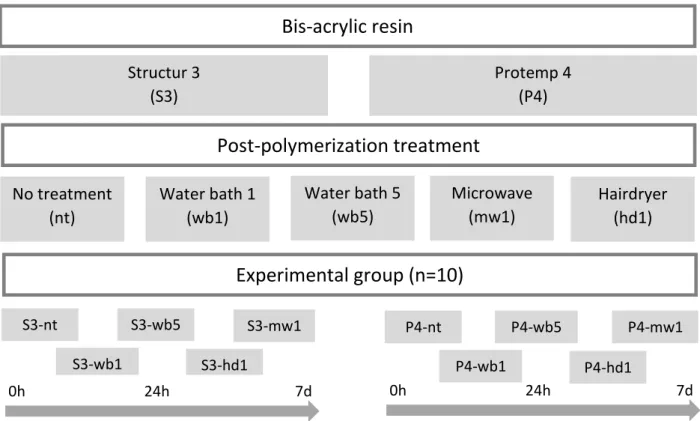
Ten experimental groups were formed according to the various possible combinations between the bis-acrylic resin [Protemp 4 (P4) and Structur 3 (S3)] and the post-polymerization method used (n = 10). All procedures will be performed in a standardized manner by the same operator
XII
Immediately after fabrication, specimens were submitted to post-polymerization treatment according to the experimental group:
a) No treatment (nt): specimens without any post-polymerization treatment and following the manufacturer's instructions;
Figure 3: No treatment group
b) Water bath (J.P. Selecta, Precisterm, Spain) post-polymerization (wb5): specimens subjected to post-polymerization in a water bath at 60 ° C for 5 minutes; 0h 24h 7d
Bis-acrylic resin
Structur 3 (S3) Protemp 4 (P4)Post-polymerization treatment
No treatment (nt) Water bath 1 (wb1) Microwave (mw1) Hairdryer (hd1)Experimental group (n=10)
S3-nt S3-wb5 S3-mw1 S3-wb1 S3-hd1 P4-nt P4-wb5 P4-mw1 P4-wb1 P4-hd1 Water bath 5 (wb5) 0h 24h 7dXIII
c) Water bath polymerization (wb1): specimens subjected to post-polymerization in a water bath at 60 ° C for 1 minute;
Figure 4: Water bath post-polymerization group
d) Microwave polymerization (mw1): Specimens subjected to post-polymerization in a microwave at 750w for 1 minute;
XIV
e) hairdryer polymerization (hd1): specimens subjected to post-polymerization with a conventional hairdryer of 1800w, at 60ºC and 20 cm;
Figure 6: hairdryer post-polymerization group
Table 2: Representative table of thermal treatments.
Material Post-polymerization treatment Group's name
Structur 3
Without any post-polymerization treatment;
Post-polymerization in a water bath at 60 ° C for 5 minutes;
Post-polymerization in a microwave at 750w for 1 minute;
Post-polymerization in a water bath at 60 ° C for 1 minute;
Post-polymerization with a conventional hairdryer;
S3-nt S3-wb5 S3-mw1 S3-wb1 S3-hd1 Protemp 4
Without any post-polymerization treatment;
Post-polymerization in a water bath at 60 ° C for 5 minutes;
Post-polymerization in a microwave at 750w for 1 minute;
Post-polymerization in a water bath at 60 ° C for 1 minute;
Post-polymerization with a conventional hairdryer;
P4-nt
P4-wb5
P4-mw1
P4-wb1
XV
3. Initial colour measurement - T0
The specimens were washed, dried and kept on a dry medium at ambient temperature of 22°C for 30 minutes before starting the initial colour measurement with the VITA Easyshade® contact spectrophotometer (Vident Brea, CA, USA).
The colour was analyzed according to the CIE colour space L * a * b. The measurements were made on a neutral gray background in a darkroom, and the parameters L *, a * and b * were collected. Each measurement was performed three times at the center of the specimen for reproducible results. The three results were recorded, and the mean of the results was calculated, which was used as the initial colour of the specimen in question. Prior to the measurement of each experimental group, the spectrophotometer was calibrated according to the manufacturer's instructions.
Figure 7: A) Easyshade® VITA; B) Measuring the specimen
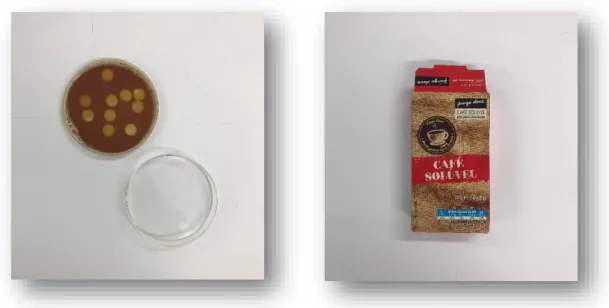
Then, the specimens were placed in reservoirs, properly identified, with 10 mL of coffee solution (Café solúvel, Pingo Doce) and kept in an oven at 37ºC for 24 hours. This solution was prepared with a dilution of 2 g of coffee in 120 ml of water.
XVI
Figure 8: A) Reservoir for each Group B) Reservoir with the solution of aging and an experimental group C) Aging solution
4. Colour measurement after 24 hours - T1
After 24 hours of immersion in the coffee solution, the specimens were washed with water and brushed with a tooth brush for 10 seconds on each surface. They were dried with absorbent paper and kept on dry medium at room temperature for 30 minutes, before proceeding to the colour T1 measurement, according to the procedure described above. The specimens were then immersed in a new coffee solution, with the same dilution as previously used, and kept at 37 ° C for 6 days.
XVII
5. Colour measurement after 7 days - T7
During this 6-day period, the coffee solution was renewed once a day and the specimens were brushed with a tooth brush for 10 seconds on each face.
After the total immersion period, which represents an aging of 7 days from its manufacture, the specimens were washed with water and brushed with a tooth brush for 10 seconds, on each surface. They were dried with absorbent paper and kept on dry media for 30 minutes at 22 ° C before the T7 colour was measured according to the procedure described for the initial measurement.
6. Analysis of the colour difference
The chromatic difference (ΔE) was calculated for the 24 hours and the 7 days by the equation ΔE * = [(ΔL *) 2 + (Δa *) 2+ (Δb *) 2] 1/2. The values ΔL *, Δa * and Δb *
were calculated through the initial ΔL = L final - L equation, depending on the coordinate of the colour in question. ∆E higher than 3.7 was considered clinically unacceptable.
7. Statistical analysis
Data were analyzed statistically with SPSS software (IBM SPSS Statistics 20; SPSS Inc). After confirming the normality and homogeneity of the data with Shapiro-Wilk and Levene’s testes (p>0.005), the ΔE data calculated for each aging period were submitted to a 2-way ANOVA (α = 0.05). Followed by a one-way ANOVA test for each material. When significant differences between the groups were verified, the data were analyzed through a Tukey post-hoc test (α=0.05).
XVIII
RESULTS
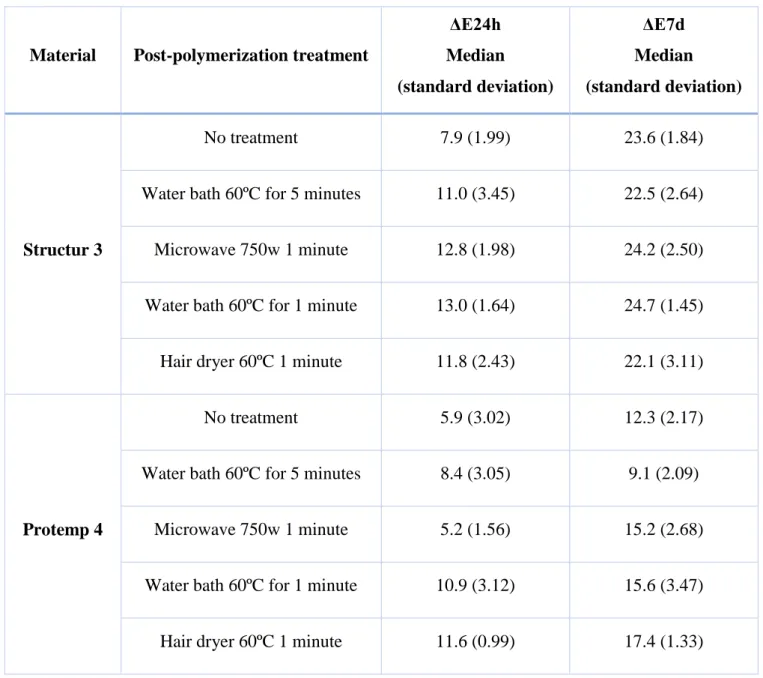
The descriptive statistics of the samples are presented in table 3, according to the median values of ΔE24h and ΔE7d, with their respective standard deviation.
The ΔE ranged between 5.9 (P4-nt) and 13.0 (S3-wb1), at 24h, and between 9.1 (P4-wb5) and 24.7 (S3-wb1), after 7d.
Table 3: Mean and standard deviation of the ΔE values for Protemp 4 and Structur 3 after 24 hours and after 7 days of artificial aging in coffee.
Material Post-polymerization treatment
ΔE24h Median (standard deviation) ΔE7d Median (standard deviation) Structur 3 No treatment 7.9 (1.99) 23.6 (1.84)
Water bath 60ºC for 5 minutes 11.0 (3.45) 22.5 (2.64)
Microwave 750w 1 minute 12.8 (1.98) 24.2 (2.50)
Water bath 60ºC for 1 minute 13.0 (1.64) 24.7 (1.45)
Hair dryer 60ºC 1 minute 11.8 (2.43) 22.1 (3.11)
Protemp 4
No treatment 5.9 (3.02) 12.3 (2.17)
Water bath 60ºC for 5 minutes 8.4 (3.05) 9.1 (2.09)
Microwave 750w 1 minute 5.2 (1.56) 15.2 (2.68)
Water bath 60ºC for 1 minute 10.9 (3.12) 15.6 (3.47)
XIX
The ∆E was statistically (p<0.001) influenced by both bis-acrylic resin and post-polymerization heat treatment, at 24h and 7d. A statistically significant (p<0.001) interaction was observed between the two factors.
At 24h, S3 specimens showed higher ∆E values than the P4 specimens.
Regarding S3 specimens, all post-polymerization treatments showed a statistically (p<0.05) higher ∆E than the nt group. All post-polymerization groups showed similar ΔE (p>0.05) (figure 10).
In the P4 specimens, the mw1 and wb5 groups showed similar (p>0.05) ∆E than nt group. Only the wb1 and the hd1 obtained a ∆E higher than nt (p<0.05). The mw1 group showed a statistically (p <0.05) lower ΔE than the other post-polymerization groups (figure 10).
Figure 10: Mean and standard deviation of the ΔE values for Protemp 4 and Structur 3 after 24 hours.
Bars with equal letters are statistically similar (p≥0.05).
At 7d, as well as at 24h, S3 specimens showed higher ∆E values than P4 specimens. 0 2 4 6 8 10 12 14 16 S3 P4 Me an ∆ E (E rro r b ar = SD) Bis-acrylic resin
Influence of post-polymerization treatment
24 hours
nt hd1 mw1 wb1 wb5 a b b b b a,b b,c a c,d dXX
At 7d, no differences (p=0.098) were found between S3 groups (figure 11). In the P4 specimens, the wb5 showed a lower ∆E than nt, and only the wb1 and the hd1 obtained a ∆E higher than nt. The mw1 showed similar (p>0.05) ∆E than nt group (figure 11).
Figure 11: Mean and standard deviation of the ΔE values for Protemp 4 and Structur 3 after 7 days
Despite the observed differences, all experimental groups presented a ΔE> 3.3, considered clinically unacceptable, at 24h and 7d.
0 5 10 15 20 25 30 S3 P4 Me an ∆ E (E rro r b ar = SD) Bis-acrylic resin
Influence of post-polymerization treatment
7 days
nt hd1 mw1 wb1 wb5 a a a a a a b b,c c cXXI
DISCUSSION
In this study, coffee was used as staining solution since is a common drink in the Portuguese diet. According to some studies, this drink is capable of a higher and shorter in time staining in materials (Rutkunas V et al., 2010; Gupta G & Gupta T, 2011; Bayindir F et al., 2012; Gujjari AK et al., 2013). Colour changes due to coffee can be explained by a mechanism of surface adsorption and absorption of coloring particles (Gupta G & Gupta T, 2011; Bayindir F et al., 2012). The less polar dyes and the water-soluble polyphenols in the dyes appear to have penetrated deeply into these materials possibly because these are compatible with the polymer matrix (Bayindir F et al., 2012; Sham AS
et al., 2004). On the other hand, it has been reported that the coloring ability of the coffee
is also due to its smaller molecular size which can be deposited in the pores of the bis-acrylic resin (Sham AS et al., 2004; Gujjari AK et al., 2013). These pores may have been formed due to polymerization shrinkage between the matrix fillers. Brushing performed prior the colour measurement only removes partially particles that are adsorbed to the surface but does not remove the absorbed dye.
The specimens were immersed in the aging solution for 7 days and colour changes were measure at 24 hours and 7 days. The coffee manufacturer purports that the average time for consumption of 1 cup of a drink is 15 minutes. Among coffee drinkers, the average consumption of coffee is 3.2 cups per day. Therefore, the 24 hours’ storage time simulated consumption of the drink over 1 month and the measurement after 7 days, a period of approximately one year (Guler AU et al., 2005a).
Colour changes can be evaluated and measured with various instruments. Since these instruments eliminate the subjective interpretation of visual colour comparison, spectrophotometers and colorimeters have been used to measure colour change in dental materials (Szesz, AL et al, 2011). Colour measurements were performed with a spectrophotometer and expressed in CIE (Commission Internationale de l’Eclairage) L*a*b* colour system once because it is well suited for determination of small colour differences.
The CIE-Lab colour system is a uniform colour scale that covers all the colours visible to the human eye and is hence suitable for perceptual studies of colour differences in dental materials (Roque, JS., 2015). Using the CIE L*a*b* colour system, different thresholds of colour change (∆E) values that produce visually perceptible differences have been reported in several studies. This system provides exactness to the results
XXII
obtained, following numerous studies, which describe the agreement of the results obtained with the human visual perception (Szesz, AL et al, 2011). The main advantage of using this system is that it allows a summary value, ΔE, to be calculated and used as a tolerance for colour matching (Givens, EJ et al, 2008). In this study, the results were obtained through comparisons between colour differences denominated ΔE (Roque, JS., 2015). The value of ΔE represents the numerical distance between the coordinates L * a * b * and the relative colour changes an observer can report for materials. Thus, ΔE is more significant than the individual values L *, a * and b *. In the CIE colour system, L * is defined as the value, or lightness / darkness of the specific colour, while a * and b * specify the actual hue or colour. Positive a values indicates predominance of red hue, while negative values indicate predominance of green. Positive values b indicates a tendency for yellow, while negative values show a bluish tone. (Givens, EJ et al, 2008). Some studies emphasize that L * represents luminosity, and the human eye perceives this characteristic of a lighter colour, since the number of cells (rods) responsible for black and white vision is much larger than that of responsible cells by coloured vision (cones). Thus, any loss of brightness is critical to colour stability and clinical success (Szesz, AL
et al, 2011).
The first null hypothesis, "there are no differences between the optical properties of the studied materials” was rejected.
The differences in the composition of the two bis-acrylic materials under test may be the justification for the differences observed at both 24h and 7 days.
The second null hypothesis, " chromatic stability is not influenced by the post-polymerization treatment.” was also rejected.
Post-polymerization treatments aim to increase the degree of conversion and reduce surface pores of materials. Thus, to reduce both the intrinsic and extrinsic factors of discolouration through simple and practical procedures (Jorge, JH, 2007; Bonatti, MR,
et al, 2009).
However, the untreated group of Structur at 24 hours showed better results. While at 7 days, there are no differences between all groups. However, with Protemp 4 at 24h, the microwave 1 minute and control groups showed the same results of ΔE. Other groups showed worse ΔE. At 7 days the water-bath group 5 minutes presented the best results, with significant differences for all the other groups.
XXIII
It has been suggested that the colour change is related, in a first phase, to the extrinsic factors such as the type of pigment and the type of polishing of the restoration material (Turgut et al., 2013). As these resinous materials undergo water absorption, intrinsic factors are the main factors responsible for their colour stability (Sham AS et al., 2004; Rutkunas V et al., 2010). According to some studies, when the degree of conversion is low there may be a chemical discolouration due to the oxidation of the polymer matrix or the oxidation of unreacted double bonds in the residual monomers and the subsequent formation of degradation products from water diffusion (Yannikakis SA et al., 1998).
Therefore, at 24 hours the post-polymerization treatments may have led to an increase in surface pores, and then to a lower chromatic stability. Despite this, wb 5 may have increased the degree of conversion of Protemp 4, thereby causing the intrinsic pigmentation to be reduced.
Johnston and Kao studied the evaluation of the appearance by visual observation and clinical colorimetry and stated that the average colour difference between teeth classified as "match" in the oral environment was ΔE = 3.7. A ΔE value equal to or less than 3.7 is considered visually imperceptible and clinically acceptable. In all groups, with or without post-polymerization treatment, and in the 2 materials, ΔE was> 3.7, therefore, clinically unacceptable (Roque, JS., 2015).
The problem found in all in vitro studies is the correlation of properties measured in the laboratory with those measured under clinical conditions. In the intraoral environment, restorations are subject to several types of aggressors that may contribute to colour change, which were not simulated in this investigation. According to the literature, biofilm formation correlated positively with surface free energy, surface roughness and hydrophobicity (Rutkunas V et al., 2010; Bayindir F et al., 2012).
On the other hand, in the oral environment, a prosthetic restoration is submitted to several influences and conditions: saliva with various proteins and enzymes, a great variety of foods and beverages, temperature extremes caused by food and beverages, smoking, poor oral hygiene habits, functional and parafunctional load. These factors could lead to a higher colour change (Rutkunas V et al., 2010).
In this study, surfaces of the specimens were flat, while clinically, provisional restorations would have an irregular shape with convex and concave surfaces. Therefore, pigments can remain in these irregularities (Gujjari AK et al., 2013).
XXIV
The specimens were immersed in test solutions that were static, unlike the oral cavity, where the solutions are in a dynamic state (Gujjari AK et al., 2013). The solution used in this study did not constitute all the substances to which the provisional materials may be exposed, although it has been used in similar researches and represents a common environment for the oral environment. Together, all these factors contribute to colour changes. Therefore, a more comprehensive strategy should be developed in order to study influences of the oral environment on the colour stability of provisional prosthetic materials.
XXV
CONCLUSIONS
All specimens showed visibly detectable colour change and were considered clinically unacceptable after a 24-hour immersion in coffee.
There were differences between the chromatic stability of the studied materials, at 24h and 7d.
Chromatic stability was influenced by the type of post-polymerization treatment type. Only the treatment in water-bath 5 minutes, at 7 days and in Protemp 4, allowed a ΔE lower than the control.
XXVI
REFERENCES
Bayindir F, Kürklü D, Yanikoğlu ND. The effect of staining solutions on the colour stability of provisional prosthodontic materials. J Dent. 2012 Dec (2012): e41-e46.
Bonatti, M. R., Cunha, T. R., Regis, R. R., Silva‐Lovato, C. H., Paranhos, H. F. O., & De Souza, R. F. (2009). The Effect of Polymerization Cycles on Color Stability of Microwave‐Processed Denture Base Resin. Journal of Prosthodontics, 18(5), 432-437. Burns, D. R., Beck, D. A., & Nelson, S. K. (2003). A review of selected dental literature on contemporary provisional fixed prosthodontic treatment: report of the Committee on Research in Fixed Prosthodontics of the Academy of Fixed Prosthodontics. Journal of Prosthetic Dentistry, 90(5), 474-497.
Carneiro, J. T. (2017). Adesão do bis-acrílico e contaminação.
Doray, P. G., Li, D., & Powers, J. M. (2001). Color stability of provisional restorative materials after accelerated aging. Journal of Prosthodontics, 10(4), 212-216.
Givens, E. J., Neiva, G., Yaman, P., & Dennison, J. B. (2008). Marginal adaptation and color stability of four provisional materials. Journal of Prosthodontics, 17(2), 97-101.
Gujjari, A. K., Bhatnagar, V. M., & Basavaraju, R. M. (2013). Color stability and flexural strength of poly (methyl methacrylate) and bis-acrylic composite based provisional crown and bridge auto-polymerizing resins exposed to beverages and food dye: an in vitro study. Indian Journal of Dental Research, 24(2), 172.
Guler, A. U., Yilmaz, F., Kulunk, T., Guler, E., & Kurt, S. (2005). Effects of different drinks on stainability of resin composite provisional restorative materials. Journal of Prosthetic Dentistry, 94(2), 118-124.
Gupta, G., & Gupta, T. (2011). Evaluation of the effect of various beverages and food material on the color stability of provisional materials–An in vitro study. Journal of conservative dentistry: JCD, 14(3), 287.
Haselton, D. R., Diaz‐Arnold, A. M., & Dawson, D. V. (2004). Effect of storage solution on surface roughness of provisional crown and fixed partial denture materials. Journal of Prosthodontics, 13(4), 227-232.
XXVII
Jorge, J. H., Giampaolo, E. T., Vergani, C. E., Machado, A. L., Pavarina, A. C., & Carlos, I. Z. (2007). Biocompatibility of denture base acrylic resins evaluated in culture of L929 cells. Effect of polymerisation cycle and post‐polymerisation treatments. Gerodontology, 24(1), 52-57.
Mei, M. L., So, S. Y., Li, H., & Chu, C. H. (2015). Effect of Heat Treatment on the Physical Properties of Provisional Crowns during Polymerization: An in Vitro Study. Materials, 8(4), 1766-1777.
Patras, M., Naka, O., Doukoudakis, S., & Pissiotis, A. (2012). Management of provisional restorations' deficiencies: a literature review. Journal of Esthetic and Restorative Dentistry, 24(1), 26-38.
Roque, J. C. D. S. (2015). Propriedades óticas de sistemas cerâmicos de alta resistência: estudo laboratorial.
Rutkunas, V., Sabaliauskas, V., & Mizutani, H. (2010). Effects of different food colorants and polishing techniques on color stability of provisional prosthetic materials. Dental materials journal, 29(2), 167-176.
Sham, A. S., Chu, F. C., Chai, J., & Chow, T. W. (2004). Color stability of provisional prosthodontic materials. Journal of Prosthetic Dentistry, 91(5), 447-452.
Szesz, A. L., Pupo, Y. M., Martins, G. C., Gomes, J. C., & Gomes, O. M. M. (2011). Influência de diferentes bebidas na estabilidade de cor da resina composta. Odontologia Clínico-Científica (Online), 10(4), 323-328.
Turgut, S., Bagis, B., Ayaz, E. A., Ulusoy, K. U., Altintas, S. H., Korkmaz, F. M., & Bagis, N. (2013). Discoloration of provisional restorations after oral rinses. International journal of medical sciences, 10(11), 1503.
Yannikakis, S. A., Zissis, A. J., Polyzois, G. L., & Caroni, C. (1998). Color stability of provisional resin restorative materials. Journal of Prosthetic Dentistry, 80(5), 533-539.