
Effect of castor cake and elephant grass composting on edaphic fauna
Efeito da torta de mamona e do capim-elefante compostagem sobre a fauna edáfica
Rafael Nogueira ScorizaI* Miriam de Oliveira BianchiI
Maria Elizabeth Fernandes CorreiaII Marco Antonio de Almeida LealII ISSN 1678-4596
ABSTRACT
Elephant grass and castor cake when combined can make a promising organic fertilizer. However, castor cake contains potentially toxic chemicals, such as ricin and ricinine. To test potential effects of these chemicals, compost piles of elephant grass (Pennisetum purpureum Schum.) with castor cake were prepared with different C:N ratios (T1 = 40, T2 = 30, T3 = 20; T4 = 30 [control, elephant grass + crotalaria]) to evaluate colonization by edaphic fauna and any suppressive effects of castor cake. Soil organisms were collected with Berlese-Tullgren funnels. There were temporal differences between the treatments, and the epigeous fauna was mainly represented by members of the Acari and Entomobryomorpha. Elapsed time is the major factor in determining the composition of the epigeous fauna community associated with composting, indicating that castor cake has no suppressive effect.
Key words: organic compound, plant residues, soil fauna.
RESUMO
O composto inteiramente vegetal, a partir da mistura de capim elefante e torta-de-mamona, apresenta-se promissor como adubo orgânico. No entanto, há preocupações quando se consideram os compostos químicos potencialmente tóxicos contidos na torta-de-mamona, como a ricina e ricinina. Assim, foram montadas pilhas de compostagem com diferentes relações C:N (T1 = 40; T2 = 30; T3 = 20; T4 = 30 (tratamento controle composto por Capim elefante + crotalária )) com o objetivo de avaliar, ao longo do tempo, a colonização da fauna edáfica e se a torta-de-mamona causa algum efeito supressor. A avaliação foi realizada com funis de Berlese-Tullgren. Houve diferenças pontuais entre os tratamentos, sendo a fauna epígea representada principalmente pelos grupos Acari e Entomobryomorpha. Verificou-se que o tempo é o principal fator na determinação da comunidade de fauna epígea associada à compostagem, indicando
que o uso da torta-de-mamona não tem efeito supressor sobre a fauna edáfica ao longo do processo de compostagem.
Palavras-chave: fauna do solo, composto orgânico, resíduos vegetais.
INTRODUCTION
In organic systems, substrate and input
demands can be satisfied with composted materials, which are readily available, inexpensive, and rich
in nutrients (LEAL et al., 2007). Elephant grass and castor cake have these characteristics. Elephant grass (Pennisetum purpureum Schum.) is a tropical
forage plant that is rich in nutrients, with potential
for biomass production (PEREIRA et al., 2000). The cake produced from castor (Ricinus communis L.),
which is widespread in Brazil, has a high nitrogen and protein content and undergoes rapid mineralization in
the soil, it is therefore extensively used in agricultural
as an organic fertilizer (FERNANDES et al., 2011;
SANTOS et al., 2012).
Composting depends on the proliferation of several saprophagic invertebrates and microorganisms (SAmpERo & DomiNguEz, 2008), which fragment the plant material and increase
the bioavailability of many elements (mENTA, 2012;
MORAIS et al., 2013). The diversity and activity
of these organisms are influenced by chemical and
physical characteristics of the plant material, and they
Iprograma de pós-graduação em Agronomia, Ciência do Solo, universidade Federal Rural do Rio de Janeiro (uFRRJ), BR 465, Km 7,
23890-000, Seropédica, RJ, Brasil. E-mail: [email protected]. *Corresponding author. IIEmbrapa Agrobiologia, Seropédica, RJ, Brasil.
help to determine its decomposition rate (gATiBoNi et al., 2009; JiANg et al., 2014).
However, a consistent concern regarding the
use of different plant species as inputs is the possibility of negative effects on the organisms involved in
decomposition. A study in Brazil has demonstrated that the ricin and ricinine in castor cake are efficient
in controlling populations of phytonematodes
(DiNARDo-miRANDA & FRACASSo, 2010). During the composting process, different inputs may interfere with the associated faunal community. Different combinations of inputs can enhance or reduce
the community, and measurements of soil organism populations are therefore good indicators of the input
quality (KuNDE et al., 2013). Thus, the objectives of this study were (a) to assess the edaphic fauna community in plant compost piles with different C:N ratios, and (b) to investigate whether castor cake had a suppressive effect on the colonization of this substrate.
MATERIALS AND METHODS
The experiment was conducted at Embrapa Agrobiologia, Seropédica, Rio de Janeiro. The raw materials used were 90-day-old aerial parts of crotalaria
(Crotalaria juncea L.), 120-day-old sprouted elephant
grass, and castor cake (Azevedo® brand). All materials were shredded into 3-cm lengths with a mechanical chopper. The ratio of each raw material was calculated using pearson’s Square. Compost piles with different C:N ratios were assembled: T1 (C:N = 40, Elephant grass + 11.5 % castor cake); T2 (C:N = 30, Elephant grass + 18.4% castor cake); T3 (C:N = 20, Elephant grass + 32.9% castor cake); T4 (C:N = 30, Elephant grass + crotalaria [control]). Each pile was assembled on a plastic tarp in a pasture and measured 1.5m wide, 2.0m long, and 1.2m high. piles were turned on days
14, 30, and 60. The average temperature of the piles
decreased with time composting, from 48°C (30 days)
to 30ºC (90 days).
Soil organisms were collected 30, 60, and 90
days after composting began and before turning, using a
Berlese-Tullgren funnel. Following the method outlined by AQuiNo et al. (2006), the composted material was
placed into a 1.33-dm-3 metallic cylinder, with a 2-mm
mesh across its base, and heated from above (15cm) by an incandescent bulb of 40W for 7 days. Organisms
were moved away from the heat and fell down into the collector bottle, which contained 1% formaldehyde. Four replicates were randomly collected in each pile,
from the surface to a depth of 10cm.
invertebrates were counted and identified to major taxonomic group, according to the
descriptions provided by DiNDAL (1990). The following metrics were estimated: density (number
of individuals·dm-3), total richness (number of groups identified in each treatment), average richness (number of groups identified in each replication), and
Pielou’s evenness index (distribution of the number
of individuals among the taxonomic groups), which
is used to evaluate the biodiversity of a community
(oDum & BARRETT, 2011).
The homogeneity of error variances was evaluated with Cochran test, and normality was checked with the Lilliefors test, using Saeg 9.1 software. Data with non-parametric distributions were transformed
(square root (x+1)). An analysis of variance (ANOVA)
was conducted on parametric data with the Bonferroni correction (α = 0.05), using Sisvar 5.3 software. Non-parametric distributions were analyzed with the Kruskal-Wallis test (P = 0.05), using Saeg 9.1 software. A Principal Component Analysis, namely density or abundance of edaphic fauna, composting time, C:N
ratio, and composting treatment were conducted with Canoco 4.5 software (LEpS & SmiLAuER, 2003).
RESULTS AND DISCUSSION
The main groups of edaphic fauna in the
compost piles, in decreasing order of density, were
Acari, Entomobryomorpha, Coleoptera, Diplura, and Formicidae (Table 1). The high numbers of mesofauna
in Acari and Entomobryomorpha may reflect their great
importance in decomposition and the maintenance of
soil fertility (oDum & BARRETT, 2011). These fauna
groups have ecological functional characteristics that are directly related to the conditions offered by the compost piles. Many springtail species interfere
directly and indirectly with decomposition because
they eat the available organic material and still
associate themselves with microorganisms and fungi (zEppELiNi FiLHo & BELLiNi, 2004).
Mites are usually very abundant in the environment
and are particularly associated with decomposing
or already decomposed materials like fallen leaves,
humus, rotting wood, and debris. members of Coleoptera have a wide range of trophic functions,
but most of them are phytophagous, fungivorous,
or detritivorous. Formicidae have different habits,
and they feed on other animals or on plant matter, including sap, nectar, and similar substances.
Diplura are often found in humid places and under rotting wood (RuppERT et al., 2005).
Temporal differences were found between
treatments at 30 and 60 days after composting began.
higher than in T1. Conversely, on day 60, the total
organism density in the control (T4) was higher than
in T2, and the Entomobryomorpha group in T4 was
higher than in T1 and T2 (Table 2). These results indicated that the amount of castor cake used did not have an effect on the composition and diversity of
Table 1 - main groups of edaphic fauna collected at day 30, 60, and 90 of composting with different treatments. aDifferent lowercase letters indicate a significant difference at p = 0.05 (Kruskal-Wallis test). ADifferent uppercase letters indicate a significant difference at p = 0.05 (ANoVA with Bonferroni correction). *ANoVA was calculated with transformed data. 1Entomobryomorpha. T1 (C:N = 40, Elephant grass + 11.5% castor cake); T2 (C:N = 30, Elephant grass + 18.4% castor cake); T3 (C:N = 20, Elephant grass + 32.9% castor cake); T4 (C:N = 30, Elephant grass + crotalaria [control]).
Acari Coleoptera Diplura Entomo1 Formicidae Total
Treatment
---Number of individuals dm-3--- Richness average Pielou’s index ---Day
30---T1 796.5A 11.5a 10.4A 96.2A 0.2a 916.1A 4.5B 0.23
T2 635.7A 8.7a 21.1A 241,7A 2.8a 935,0A 8.0A 0.34
T3 199.5A 9.6a 7.0A 16.8A 3.6a 242.0A 6.8AB 0.32
T4 38.8A 4.9a 5.8A 5.1A 1.9a 59.0A 6.5AB 0.55
---Day
60---T1 746.1a 17.9A 0.4a 20.9B* 2.4a 801.4ab 5.3a 0.14
T2 22.4a 3.6A 1.5a 11.5B* 0.0a 41.8b 5.0a 0.59
T3 172.9a 5.7A 1.5a 84.2AB* 6.8a 276.1ab 6.5a 0.36
T4 402.9a 5.1A 2.1a 340.9A* 0.2a 768.5a 5.0a 0.37
---Day
90---T1 1455.4A 12.8A 0.0a 3.8A 6.6A 1488.2A 6.0A 0.06
T2 853.6A 16.6A 4.3a 5.7A 10.5A 894.1A 6.3A 0.10
T3 430.4A 16.2A 0.6a 39.2A 9.6A 511.6A 7.8A 0.25
T4 1247.8A 6.8A 1.3a 15.8A 5.1A 1373.8A 7.8A 0.16
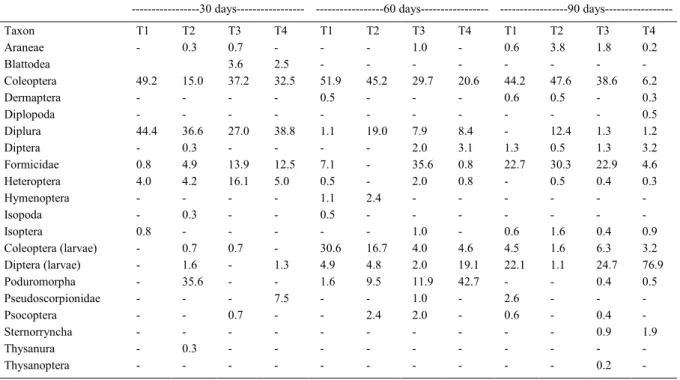
Table 2 - Relative proportion of other fauna groups (excluding Acari and Entomobryomorpha) collected in compost piles with different treatments on three collection dates. T1 (C:N = 40, Elephant grass + 11.5% castor cake); T2 (C:N = 30, Elephant grass + 18.4% castor cake); T3 (C:N = 20, Elephant grass + 32.9% castor cake); T4 (C:N = 30, Elephant grass + crotalaria [control]).
---30 days--- ---60 days--- ---90
days---Taxon T1 T2 T3 T4 T1 T2 T3 T4 T1 T2 T3 T4
Araneae - 0.3 0.7 - - - 1.0 - 0.6 3.8 1.8 0.2
Blattodea 3.6 2.5 - - -
-Coleoptera 49.2 15.0 37.2 32.5 51.9 45.2 29.7 20.6 44.2 47.6 38.6 6.2
Dermaptera - - - - 0.5 - - - 0.6 0.5 - 0.3
Diplopoda - - - 0.5
Diplura 44.4 36.6 27.0 38.8 1.1 19.0 7.9 8.4 - 12.4 1.3 1.2
Diptera - 0.3 - - - - 2.0 3.1 1.3 0.5 1.3 3.2
Formicidae 0.8 4.9 13.9 12.5 7.1 - 35.6 0.8 22.7 30.3 22.9 4.6
Heteroptera 4.0 4.2 16.1 5.0 0.5 - 2.0 0.8 - 0.5 0.4 0.3
Hymenoptera - - - - 1.1 2.4 - - -
-Isopoda - 0.3 - - 0.5 - - -
-Isoptera 0.8 - - - 1.0 - 0.6 1.6 0.4 0.9
Coleoptera (larvae) - 0.7 0.7 - 30.6 16.7 4.0 4.6 4.5 1.6 6.3 3.2
Diptera (larvae) - 1.6 - 1.3 4.9 4.8 2.0 19.1 22.1 1.1 24.7 76.9
Poduromorpha - 35.6 - - 1.6 9.5 11.9 42.7 - - 0.4 0.5
Pseudoscorpionidae - - - 7.5 - - 1.0 - 2.6 - -
-Psocoptera - - 0.7 - - 2.4 2.0 - 0.6 - 0.4
-Sternorryncha - - - 0.9 1.9
Thysanura - 0.3 - - -
-the associated fauna, because -the treatment (T3) with
the highest proportion of this material did not differ from the control. In addition, the lack of difference
between parameters at 90 days indicates a small and
temporary effect of the treatments on the soil fauna.
overall, treatment T1 (with the lowest castor cake content) exhibited the lowest pielou’s index value (Table 1). This index, which ranges from 0 to 1, was used to compare taxonomic diversity between treatments and can indicate whether a particular group is dominant (oDum & BARRETT, 2011). For this treatment, the dominant group was Acari, which represented over 85% of the density at each collection time (Figure 1). There was no
observable relationship between the amount of
castor cake used (and its possible toxic effects) and
colonization by Acari.
The Acari represented over 50% of individuals in all other treatments at every sampling time. Compost piles supply resources that are
ephemeral, unevenly distributed, and rich in energy;
they sustain communities of detritivore
micro-arthropods like mites, where many species experience
frequent population peaks in response to fresh inputs
(TAYLoR et al., 2010). Springtails, which are also detritivores, have a similarly rapid response with population peak (gATiBoNi et al., 2009).
The relative compositions of the
less-abundant taxa (Figure 1) are shown in 2. members of Blattodea and Thysanura were only found in the first collection, while Diplopoda, Sternorrhyncha,
and Thysanoptera appeared only in the last collection.
Coleoptera and Diptera, including their larvae,
generally increased over time, as did predatory
taxa in Araneae, Dermaptera, Formicidae, and isotera. Diplura, Heteroptera, and poduromorpha showed a relative decrease over time. These results
clearly demonstrated the coexistence and autogenic succession of groups and functions as the physical
environment changed and reflected competitive interactions produced within the community itself (oDum & BARRETT, 2011).
Among these groups, according to
BRuSSAARD (1998) and mENTA (2012), mites,
springtails, isopods, and millipedes, in addition to a diversity of insect larvae, are considered the most important transformers of plant and animal materials, directly or indirectly facilitating microbial decomposition. Additional groups (Hymenoptera,
isopoda, pseudoscorpionida, and psocoptera) were present sporadically and may not be associated with the composting process; their presence might reflect their relationships with other organisms and/or preferred temperature and moisture conditions within
the compost piles.
Composting time was the main component that influenced the composition of the associated fauna, as shown in figure 2. other authors had already noted the association of time with colonization
patterns of epigeous fauna. According to TAYLOR et
al. (2010) and FuJii & TAKEDA (2012), the biomass
and abundance of different groups of soil fauna can drastically change both temporally and spatially.
Figure 2 also shows weaker relationships between groups and treatments. psocoptera, pseudoscorpionidae, and Blattodea were most associated with treatment T3, while other groups, Figure 1 - proportion of Acari and Entomobryomorpha groups
collected on three different dates from compost piles
with different treatments. T1 (C:N = 40, Elephant grass + 11.5% castor cake); T2 (C:N = 30, Elephant grass + 18.4% castor cake); T3 (C:N = 20, Elephant grass + 32.9% castor cake); T4 (C:N = 30, Elephant
including Diplura and Entomobryomorpha, were associated with treatment T2. in fact, it is possible that
group richness and individual abundance are related to the quality of the plant material being decomposed
(RESENDE et al., 2013; JiANg et al., 2014). However,
input quantity may not determine the abundance, biomass, taxonomic richness, or composition of the
associated fauna community (ASHFoRD et al. 2013).
CONCLUSION
Compost piles of elephant grass and
castor cake were primarily colonized by Acari,
Entomobryomorpha, Coleoptera, Diplura,
and Formicidae, which act as pioneers in soil
communities and have a high capacity for
colonization and reproduction. Different amounts of castor cake, which modified the C:N ratio, did not appear to influence fauna community composition. Composting duration was the most important
factor in determining community composition and
diversity, allowing succession and competition. Castor cake, when used as a raw material in
association with other energy sources for the production of organic fertilizer, did not suppress the
activity of the organisms that promote composting.
REFERENCES
AQuiNo, A.m. et al. Amostragem da mesofauna edáfica utilizando funis de Berlese-Tullgren modificado. Seropédica: Embrapa Agrobiologia, 2006. Circular Técnica n17.
ASHFoRD, o.S et al. Litter manipulation and the soil arthropod community in a lowland tropical rainforest. Soil Biology & Biochemistry, v.62, p.5-12, 2013. Available from: <http://www.
sciencedirect.com/science/article/pii/S0038071713000850>.
Accessed: Sept. 17, 2013. doi: 10.1016/j.soilbio.2013.03.001.
BRuSSAARD, L. Soil fauna, guilds, functional groups and
ecosystem processes. Applied Soil Ecology, v.9, p.123-135,
1998. Available from: <http://www.sciencedirect.com/science/
article/pii/S0929139398000663>. Accessed: Sept. 17, 2013.
doi: 10.1016/j.soilbio.2013.03.001.
DiNARDo-miRANDA, L.L.; FRACASSo, J.V. Efeito da torta de mamona sobre populações de nematoides fitoparasitos e a
produtividade da cana-de-açúcar. Nematologia Brasileira, v.34, n.1, p.68-71, 2010. Available from: <http://docentes.esalq.usp.br/sbn/ nbonline/ol%20341/68-71%20co.pdf>. Accessed: Sept. 17, 2013.
Figure 2 - ordination diagram of major components, using the abundance of edaphic fauna groups, type of
treatment (T1, T2, T3, and T4 [control]), carbon to nitrogen ratio (C:N), and composting time
(time). T1 (C:N = 40, Elephant grass + 11.5% castor cake); T2 (C:N = 30, Elephant grass + 18.4% castor cake); T3 (C:N = 20, Elephant grass + 32.9% castor cake); T4 (C:N = 30, Elephant grass +
DiNDAL, D.L. Soil biology guide. New York: Wiley, 1990. 1349p.
FERNANDES, L.B. et al. influência da torta de mamona nas
características químicas do solo. Revista Verde, v.6, n.3,
p.156-159, 2011. Available from: <http://www.gvaa.com.br/revista/ index.php/RVADS/article/view/785>. Accessed: Sept. 17, 2013.
FuJii, S.; TAKEDA, H. Succession of collembolan communities
during decomposition of leaf and root litter: effects of litter type and position. Soil Biology & Biochemistry, v.54, p.77-85,
2012. Available from: <http://www.sciencedirect.com/science/
article/pii/S0038071712001605>. Accessed: Sept. 17, 2013.
doi: 10.1016/j.soilbio.2012.04.021.
gATiBoNi, L.C. et al. modificações na fauna edáfica durante a
decomposição da palhada de centeio e aveia preta, em sistema de plantio direto. Biotemas, v.22, n.2, p.45-53, 2009. Available from:
<https://150.162.1.115/index.php/biotemas/article/view/19795>.
Accessed: Sept. 17, 2013. doi: 10.5007/2175-7925.2009v22n2p45.
JiANg, Y. et al. impact of soil mesofauna on the decomposition of two main species litters in a pinus koraiensis mixed broad-leaved
forest of the Changbai Mountains. Acta Ecologica Sinica, v.54,
p.110-115, 2014. Available from: <http://www.sciencedirect.com/
science/article/pii/S1872203214000122>. Accessed: Mar. 13,
2015. doi: 10.1016/j.chnaes.2013.06.005.
KuNDE, R.J. et al. Avaliação da mesofauna edáfica (ácaros e
colêmbolos) no processo de vermicompostagem. Cadernos de Agroecologia, v.8, n.2, p.1-4, 2013. Available from: <http://
www.aba-agroecologia.org.br/revistas/index.php/cad/article/ view/13880>. Accessed: Jul. 26, 2014.
LEAL, m.A.A. et al. utilização de compostos orgânicos como
substratos na produção de mudas de hortaliças. Horticultura Brasileira, v.25, n.3, p.392-395, 2007. Available from:
<http://www.scielo.br/scielo.php?script=sci_arttext&pid =S0102-05362007000300014>. Accessed: Sept. 17, 2013. doi:
10.1590/S0102-05362007000300014.
LEpS, J.; SmiLAuER, p. Multivariate analysis of ecological data using Canoco. Cambridge: Cambridge university, 2003. 283p.
MENTA, C. Soil fauna diversity – function, soil degradation,
biological indices, soil restoration. in: LAmEED, g.A. (Ed.).
Biodiversity conservation and utilization in a diverse world.
Rijeka: inTech, 2012. Chapt.3, p.59-94.
moRAiS, J.W. et al. mesofauna. in: _____. O ecossistema solo: componentes, relações ecológicas e efeitos na produção
vegetal. Lavras: uFLA, 2013. p.183-200.
oDum, E.p.; BARRETT, g.W. Fundamentos de ecologia. São Paulo: Cengage Learning, 2011. 612p.
PEREIRA, A.V. et al. Variação da qualidade de folhas em cultivares de capim-elefante (Pennisetum purpureum) e híbridos de capim-elefante x milheto (P. purpureum × P. glaucum), em função da idade da planta. Ciência Agrotecnica, v.24, n.2, p.490-499, 2000.
RESENDE, A.S. et al. Artrópodes do solo durante o processo de decomposição da matéria orgânica. Agronomía Colombiana,
v.31, n.1, p.89-94, 2013. Available from: <http://www.scielo. org.co/scielo.php?script=sci_arttext&pid=S0120996520130001 00011&lng=en&nrm=iso&tlng=pt>. Accessed: Sept. 17, 2013.
RuppERT, E.E. et al. Zoologia dos invertebrados: uma abordagem funcional-evolutiva. 7.ed. São Paulo: Rocca, 2005. 1145p.
SAmpERo, L.; DomiNguEz, J. Stable isotope natural
abundances (d 13C and d 15N) of the earthworm Eisenia fetida
and other soil fauna living in two different vermicomposting
environments. Applied Soil Ecology, v.38, p.91-99, 2008.
Available from: <http://www.sciencedirect.com/science/article/
pii/S0929139307001333>. Accessed: Sept. 17, 2013. doi:
10.1016/j.apsoil.2007.10.008.
SANToS, S.S. et al. produção de cebola orgânica em função
do uso de cobertura morta e torta de mamona. Horticultura brasileira, v.30, n.3, p.549-552 2012. Available from: <http://
www.scielo.br/scielo.php?script=sci_arttext&pid=S0102-05362012000300032&lng=pt&nrm=iso&tlng=pt>. Accessed:
Sept. 17, 2013. doi: 10.10.1590/S0102-05362012000300032.
TAYLOR, A.R. Impact of microarthropod biomass on the composition of the soil fauna community and ecosystem processes. European Journal of Soil Biology, v.46, p.80-86,
2010. Available from: <http://www.sciencedirect.com/science/
article/pii/S1164556309001058>. Accessed: Sept. 17, 2013. doi:
10.1016/j.ejsobi.2009.11.003.

![Figure 2 - ordination diagram of major components, using the abundance of edaphic fauna groups, type of treatment (T1, T2, T3, and T4 [control]), carbon to nitrogen ratio (C:N), and composting time (time)](https://thumb-eu.123doks.com/thumbv2/123dok_br/15947482.680146/5.892.153.792.126.620/figure-ordination-diagram-components-abundance-treatment-nitrogen-composting.webp)
