2016 | Lavras | Editora UFLA | www.editora.ufla.br | www.scielo.br/cagro http://dx.doi.org/10.1590/1413-70542016405001316
Co-inoculation with diazotrophic bacteria in soybeans
associated to urea topdressing
Co-inoculação com bactérias diazotróficas em soja associada a aplicação de ureia em cobertura
Glauber Monçon Fipke1*, Gerusa Massuquini Conceição2, Luiz Fernando Teleken Grando2, Rodrigo Luiz Ludwig2, Ubirajara Russi Nunes2, Thomas Newton Martin2
1Universidade Federal de Santa Maria/UFSM, Departamento de Fitotecnia, Santa Maria, RS, Brasil 2Universidade Federal de Santa Maria/UFSM, Santa Maria, RS, Brasil
*Corresponding author: [email protected] Received in January 11, 2016 and approved in July 27, 2016
ABSTRACT
Increased grain yield can be obtained via an interaction between plants and growth-promoting microorganisms. The Bradyrhizobium spp. are capable of fixing atmospheric nitrogen in soybeans [Glycine max (L.) Merril], and Azospirillum spp. induce the synthesis of phytohormones. The aim of this study was to evaluate inoculation with Bradyrhizobium and co-inoculation with Bradyrhizobium + Azospirillum brasilense in soybeans in combination with the application a topdressing of 0, 75 or 150 kg of N ha-1 of urea during the reproductive stage. Three soybean cultivars (BMX Ativa, TEC 6029 and BMX Potência), were tested in field experiments in Santa Maria, RS, Brazil, during two agricultural years (2013/2014 and 2014/2015) and two sowing times. Morphological, nodulation and yield components were evaluated. Co-inoculation increased the grain yield by 240 kg ha-1 compared with conventional inoculation. When co-inoculated, cultivars BMX Ativa, TEC 6029 and BMX Potência showed increased grain yields of 6, 4 and 12%, respectively. The application of 150 kg ha-1 of N as a topdressing increased the grain yield by 300 kg ha-1 in the co-inoculated cultivars TEC 6029 and BMX Potência, but without a financial return. When inoculated only with Bradyrhizobium, the cultivars did not respond positively to the application of urea.
Index terms: Azospirillum spp.; Bradyrhizobium spp.; Glicine max (L.) Merr.; nitrogen.
RESUMO
O incremento na produtividade de grãos pode ser obtido pela interação entre plantas e microrganismos promotores do crescimento vegetal. Bactérias do gênero Bradyrhizobium spp. são capazes de realizar a fixação do nitrogênio em soja [Glycine max (L.) Merril], enquanto as do gênero Azospirillum spp. induzem a síntese de hormônios vegetais. O objetivo do presente trabalho foi avaliar a inoculação com Bradyrhizobium e co-inoculação com Bradyrhizobium + Azospirillum brasilense em sementes de soja associado a aplicação de 0, 75 e 150 kg de N ha-1 de ureia aplicada em cobertura no estádio reprodutivo. Três cultivares de soja (BMX Ativa, TEC 6029 e BMX Potência) foram utilizadas nos experimentos em Santa Maria, RS, Brasil, durante dois anos agrícolas (2013/2014 e 2014/2015) e duas épocas de cultivo. Foram avaliadas as características morfológicas, de nodulação e componentes da produtividade. A co-inoculação proporcionou incremento de 240 kg de grãos ha-1 em relação a inoculação convencional. Quando co-inoculadas, as cultivares BMX Ativa, TEC 6029 e BMX Potência acresceram a produtividade de grãos em 6, 4 e 12% respectivamente. A aplicação de 150 kg de N ha-1 acresceu a produtividade em 300 kg de grãos ha-1, com a co-inoculação das cultivares TEC 6029 e BMX Potência, porém, sem retorno econômico. Os cultivares testados quando inoculados somente com Bradyrhizobium não responderam positivamente à aplicação de ureia.
Termos para indexação:Azospirillum spp.; Bradyrhizobium spp.; Glycine max (L.) Merr.; nitrogênio.
INTRODUCTION
Inoculation of soybeans with Bradyrhizobium
genus (conventional inoculation) is one of the determining factors for achieving high yields because of biological
nitrogen fixation (BNF), which is a sustainable source of the nutrient. Typically, the populations of rhizobia naturally present in the soil are low or inefficient for adequate BNF; thus, inoculation is necessary (Santos et al., 2013, Atieno et al., 2012, Deaker et al., 2004). In Brazil,
this is a widespread cultural practice that is indicated in the technical recommendation guides of the country’s
regions, and it contributes to an increase in crop production (Hungria; Nogueira; Araújo, 2015).
Many studies have assessed the plant-microorganism interaction and have shown the potential for the use of plant
and indirect stimulation. Direct stimulation mechanisms are BNF in the Fabaceae and Poaceae, the synthesis of plant hormones such as auxin and gibberellins, and the solubilization of minerals such as phosphates. Indirect
stimulation mechanisms are the production of antagonists
to pests, antibiotics, and siderophores and the induction of systemic resistance (Bashan; Bashan, 2010, Verma et al.,
2010).
Azospirillum is an associative PGPR that has shown the capacity for BNF and the synthesis of plant hormones in the Poaceae (Hungria; Nogueira; Araújo,
2013). The association of Azospirillum brasilense bacteria with rhizobia has shown promising results in the Fabaceae family, such as beans and soybeans (Dardanelli et al., 2008, Benintende et al., 2010). Generally, mixed inoculation or co-inoculation improves seed germination, plant growth, root branching and nodulation (Juge et al.,
2012) and suggestions have been made that the presence of Azospirillum helps plants to overcome environmental
stresses (Chibeba et al., 2015).
Despite positive results obtained with inoculated seeds, some strategies to meet the nutritional needs of the plant are still the subject of speculation, such as the application of a nitrogen (N) fertilizer topdressing (Petter et al., 2012). During the growth and development of soybean crops, there are some critical periods related to N stemming from BNF. Among these are the reproductive stages R3 [early pod formation (Fehr et al., 1971)] and R5 (early grain filling), which require high levels of
photosynthate and may result in nodule senescence.
Assuming that the supply of N in the soil is low, the
demand could be supplied via the application of nitrogen
fertilizer (Gan et al., 2003).
The aim of this study was to evaluate inoculation with
Bradyrhizobium and co-inoculation with Bradyrhizobium
+ Azospirillum brasilense in soybeans associated with the
application of a topdressing of 0, 75 or 150 kg of N ha-1
as urea during the reproductive stage.
MATERIAL AND METHODS
Four experiments were conducted in the experimental area of the Department of Plant Science of Santa Maria Federal University, located in the Central Area of the Rio Grande do Sul state in Brazil at 29º43’05’’S and 53º43’59’’W at an altitude of 116 m. The soil in this area is classified as Argissolo Vermelho Distrófico típico
(Embrapa, 2013) (a sandy clay loam Acrisol in the FAO classification). Soil samples were collected at a depth of 0-20 cm for chemical characterization and the results were
as follows: pH (water, 1:1) = 5.1; organic matter (%, m/v) = 2.2; clay (g kg-1) = 230; phosphorus, P-Mehlich (mg dm-3)
= 17.2; potassium (mg dm-3) = 84.0; H + Al (cmol cdm
-3) =
7.9; cation-exchange capacity (CEC) (pH 7, cmolcdm -3) =
14.7; bases saturation (%) = 47.8. The climate of the area according to the Köppen classification, is type Cfa (Peel; Finlayson; Mcmahon, 2007); a humid subtropical climate, with the mean temperature in the warmest month of 24.8 °C and 14.1 °C in the coldest month (Heldwein; Buriol; Streck, 2009). The data are shown in Figure 1 (Inmet, 2005).
Three months before the experiment, the
populations of microorganisms naturally present at the
experimental site were determined by sampling the soil. The samples were collected, stored on a sterile swab in a tube and sent to a laboratory at Neoprospecta Microbiome Technologies (Florianópolis, SC). A bacterial diversity analysis was performed, estimated
by the number of genetic sequences found. The Illumina Misec® DNA sequencing system was used. A total of
1382 traces of bacterial diversity were determined, and 1.69 x 10² traces of Bradyrhizobium spp. were
estimated, but no indication of Azospirillum brasilense
was found.
During the two years of testing, wheat was sown during the winter and provided a layer of 4 Mg stubble
ha-1. Forty days prior to sowing, 1.5 L glyphosate (360
g L-1 active ingredient, a. i.) ha-1 was applied. Two days
prior to sowing, phytosanitary treatment of the seeds was conducted with 0.002 L pyraclostrobin (25 g L-1
a. i.) + thiophanate methyl (225 g L-1 a. i.) and fipronil
(250 g L-1 a. i.) kg-1 of seed. The seeds were allocated
into paper packets and stored in a dry place with constant humidity at 25 °C soon after treatment with fungicides and insecticides. Seed inoculation and co-inoculation were performed two hours prior to sowing. Sowing and base fertilization were conducted mechanically on October 15 and November 18 in the 2013/14 season and October 28 and December 15 in the 2014/15 season. The
sowing density was 13 viable seeds per linear meter with
a row spacing of 0.45 m, which provided approximately 289,000 plants ha-1. Mineral base fertilizers were mixed
and placed in the planting furrow at a dose of 150 kg
ha-1 triple superphosphate (TSP, 46% P
2O5) + 150 kg ha -1
potassium chloride (KCl, 60% K2O).
Micronutrients such as cobalt and molybdenum, which are generally provided via seed treatment, were
not applied in this way because the salinity could interfere
commercial product containing Co (1.7%) and Mo (17%) was performed during vegetative stage V4 (four nodes and three fully developed trifoliate leaves). Pesticides
were applied whenever there was an incidence of pests
(weeds, insects or diseases), using products recommended
for soybean crops.
The experimental design was a randomized block arranged in a factorial design (3x2x3), with four replications. Soybean cultivars were allocated as the first factor, two types of inoculation as the second factor, and three amounts of N fertilizer topdressing as the third factor. The experimental unit was 7 m x 2.25 m, for a total of 15.75 m2. The BMX Ativa RR (Brasmax)
cultivar had a determinate growth type and relative
maturity group (RMG) equal to 5.6, the TEC 6029 IPRO [Cooperativa Central Gaúcha Ltda. (CCGL)] cultivar had an indeterminate growth type and RMG equal to 5.7, and the BMX Potência RR (Brasmax) cultivar had an indeterminate growth type and RMG equal to 6.7. The
conventional inoculation contained bacteria of the genus
Bradyrhizobium, B. japonicum strain CPAC 15 (SEMIA 5079) and B. diazoefficiens (Delamuta et al., 2013) strain CPAC 7 (SEMIA 5080) at 7x10⁹ colony-forming units
(CFU) mL-1 of a commercial product at a dose of 0.002
L kg-1 seeds. The co-inoculation contained the same
strains as the conventional inoculation plus Azospirillum brasilense strains Ab-V5 and Ab-V6 at 2x10⁸ CFU mL-1
at the same total dose of 0.002 L kg-1 of seeds. Urea (45%
of N) was used as the N fertilizer topdressing, and was manually applied at 0 kg N (without supplementation), 75 kg N ha-1 (37.5 kg in V4 + 37.5 kg in R2), or 150 kg
N (75 kg in V4 + 75 kg in R2).
Four plants were sampled to assess the number of nodules per plant (NNP, plant-1) and dry matter (DMP,
g plant-1) during stage V5 (five nodes and four fully
developed trifoliate leaves), and four more plants were sampled for a similar evaluation during stage R3. All
nodules present on the taproot and secondary roots larger
than 2 mm diameter were counted. Five plants were
sampled for assessing plant growth and yield during stage
R8 (full ripening of 95% pods). The number of pods per plant (NPP, plant -1) was counted, and pods of one, two and
three seeds were selected to estimate the number of seeds
per pod (NSPo, pod-1). The harvested area comprised 5 m
within three central rows (6.75 m2), and the two external
rows and 1 m of the ends of the rows were the borders. The plants were threshed and cleaned for the measurement and
correction of the seed moisture (base 13%), the estimated grain yield (GY, Mg ha-1), and the thousand seed weight
(TSW, g).
Figure 1: Mean temperatures (ºC) and accumulated precipitation (mm) during the experimental period in 2013/14
The data were verified and met the mathematical model assumptions. A subsequent analysis of variance (F-test) was conducted, and when a significant difference was confirmed, a mean comparison test was applied [Scott-Knott (α≤0.05)] using the Sisvar® statistical software
(Ferreira, 2011).
RESULTS AND DISCUSSION
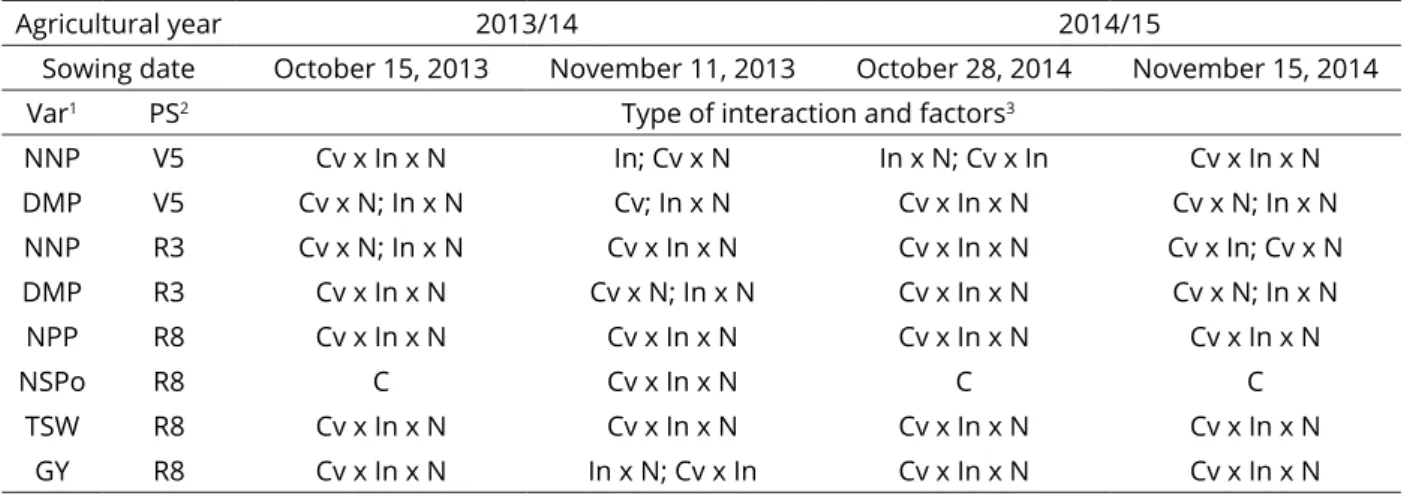
The analysis of variance indicated that triple,
double and main effect interactions were present and were
significant for each measured variable (Table 1). For the sowing on October 15, 2013, the data for cultivar TEC 6029 were not reported because of problems with the germination of the seed lot, so this cultivar was discarded.
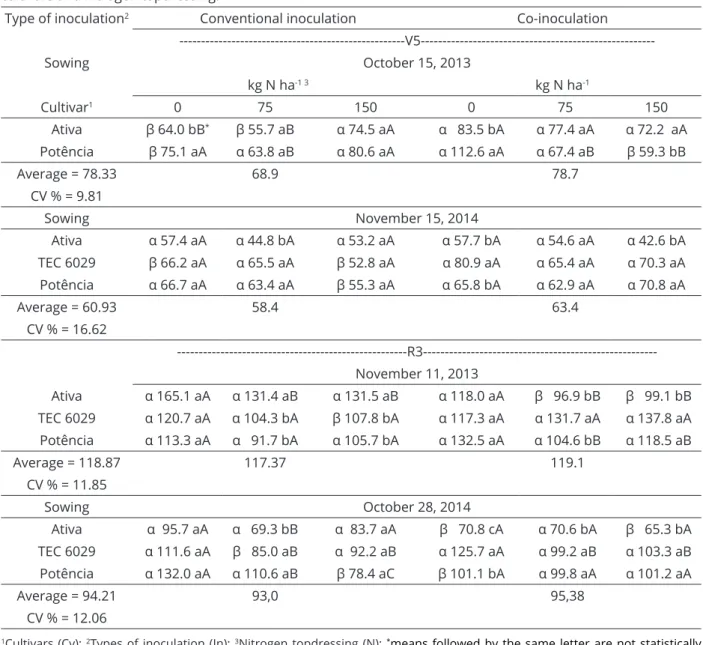
The number of nodules per plant was significantly
affected by the inoculum type in the two sample stages
tested. In V5, nodulation was not significantly different
between the two inoculum types for most treatment
combinations, but co-inoculation provided occasional significant increases, such as the best performance when
nitrogen was not supplied (Table 2).
To ensure satisfactory nodulation, at least 1x10⁴
colony-forming units (CFU) seed-1 of rhizobia should be
provided, and a proportional increase in the number and mass of nodules, yield and N content in the grain occurs when this dose it increased to 1x10⁷ (Albareda et al.,
2009). To achieve this level, inoculants at concentrations of approximately 108-109 CFU per gram or mL (peat
or liquid) of product is required (Hartley et al., 2005).
According to the current legislation in Brazil, the bacterial load in an inoculum should be 1x10⁹ CFU per gram or mL of product for Bradyrhizobium and 1x10⁸ CFU per gram
or mL of product for Azospirillum brasilense (Hungria, Nogueira and Araújo, 2015). Both inoculants that were used in the experimental inocula exceeded the required standard: seven-fold higher for the first inoculum and
two-fold higher for the second.
Mixed inoculation has been indicated to promote
the earlier occurrence of nodulation and an increase in
the root system (Chibeba et al., 2015; Benintende et al., 2010). In the present study, the rapid formation of nodules in the vegetative stages of the soybean crop (V5) was demonstrated, reaching means of 5-10 more nodules
plant-1 compared to treatment with Bradyrhizobium alone.
Cassán et al. (2009) observed a similar phenomenon in co-inoculated plants, confirming that the two bacterial genera are capable of excreting indole-3-acetic acid (IAA), gibberellic acid and zeatin in sufficient concentrations to
cause morphological and physiological changes in young tissues.
The N fertilizer topdressing did not affect nodulation, suggesting that mineral N is not harmful during later stages of the growing season. In experiments with diazotrophic bacteria, it is usual that one of the control treatments has added N, usually as high doses of urea immediately after sowing and during flowering, which causes a lower number and mass of nodules (Campos; Gnatta, 2006; Hungria; Campo; Mendes, 2003). According
Table 1: Summary of analysis of variance for the variables in each periods evaluated.
Agricultural year 2013/14 2014/15
Sowing date October 15, 2013 November 11, 2013 October 28, 2014 November 15, 2014
Var1 PS2 Type of interaction and factors3
NNP V5 Cv x In x N In; Cv x N In x N; Cv x In Cv x In x N DMP V5 Cv x N; In x N Cv; In x N Cv x In x N Cv x N; In x N
NNP R3 Cv x N; In x N Cv x In x N Cv x In x N Cv x In; Cv x N DMP R3 Cv x In x N Cv x N; In x N Cv x In x N Cv x N; In x N
NPP R8 Cv x In x N Cv x In x N Cv x In x N Cv x In x N
NSPo R8 C Cv x In x N C C
TSW R8 Cv x In x N Cv x In x N Cv x In x N Cv x In x N GY R8 Cv x In x N In x N; Cv x In Cv x In x N Cv x In x N
1Variables: number of nodules per plant (NNP, plant-1); dry matter plants (DMP, g plant-1), number of pods per plant (NPP,
plant-1); number of seeds per pod (NSPo, pod-1), thousand seed weight (TGW, g), and grain yield (GY, Mg ha-1); 2phenological
to Bottomley and Myrold (2007), some mineral forms of N in the soil such as nitrate (NO3
-) and ammonium
(NH4+) can inhibit nodule formation and degrade already
formed nodules, affecting BNF. In this study, N application during the vegetative stage V4 did not affect symbiosis by reducing the number of nodules per plant in V5. Aratani et al. (2008) have shown that nitrogen fertilization did
not harm nodulation nor interfere with nodule dry matter.
Nodulation in R3 showed anomalous behavior,
complicating the interpretation of the results (Table 2). The
addition of urea (75 or 150 kg of N ha-1) tended to decrease
the number of nodules. The highest mean number of nodules
that occurred in the treatment without urea is noteworthy, and indicated that mineral N provided during the reproductive stage was detrimental to nodulation. Nodulation should be better exploited because a trend of breeding cultivars
Table 2: Number of nodules per plant (NNP, plant-1) observed in V5 and R3 depending on the type of inoculation,
cultivars and nitrogen topdressing.
Type of inoculation2 Conventional inoculation Co-inoculation
---V5---Sowing October 15, 2013
kg N ha-1 3 kg N ha-1
Cultivar1 0 75 150 0 75 150
Ativa β 64.0 bB* β 55.7 aB α 74.5 aA α 83.5 bA α 77.4 aA α 72.2 aA
Potência β 75.1 aA α 63.8 aB α 80.6 aA α 112.6 aA α 67.4 aB β 59.3 bB
Average = 78.33 68.9 78.7
CV % = 9.81
Sowing November 15, 2014
Ativa α 57.4 aA α 44.8 bA α 53.2 aA α 57.7 bA α 54.6 aA α 42.6 bA
TEC 6029 β 66.2 aA α 65.5 aA β 52.8 aA α 80.9 aA α 65.4 aA α 70.3 aA
Potência α 66.7 aA α 63.4 aA β 55.3 aA α 65.8 bA α 62.9 aA α 70.8 aA
Average = 60.93 58.4 63.4
CV % = 16.62
---R3---November 11, 2013
Ativa α 165.1 aA α 131.4 aB α 131.5 aB α 118.0 aA β 96.9 bB β 99.1 bB
TEC 6029 α 120.7 aA α 104.3 bA β 107.8 bA α 117.3 aA α 131.7 aA α 137.8 aA
Potência α 113.3 aA α 91.7 bA α 105.7 bA α 132.5 aA α 104.6 bB α 118.5 aB
Average = 118.87 117.37 119.1
CV % = 11.85
Sowing October 28, 2014
Ativa α 95.7 aA α 69.3 bB α 83.7 aA β 70.8 cA α 70.6 bA β 65.3 bA
TEC 6029 α 111.6 aA β 85.0 aB α 92.2 aB α 125.7 aA α 99.2 aB α 103.3 aB
Potência α 132.0 aA α 110.6 aB β 78.4 aC β 101.1 bA α 99.8 aA α 101.2 aA
Average = 94.21 93,0 95,38
CV % = 12.06
that produce grain with higher protein content exists. To accomplish this, plants should be selected for maximum BNF (Santos et al., 2013). A higher nodule number of is an indication of efficient symbiosis. Over 40% of the grain
yield is correlated with the nodulation component of soybean
cultivars (Brandalero; Peixoto; Ralisch, 2009), emphasizing
the importance of effective inoculation.
The importance of shoot dry matter has been reported
by Souza et al. (2008), who have observed a significant
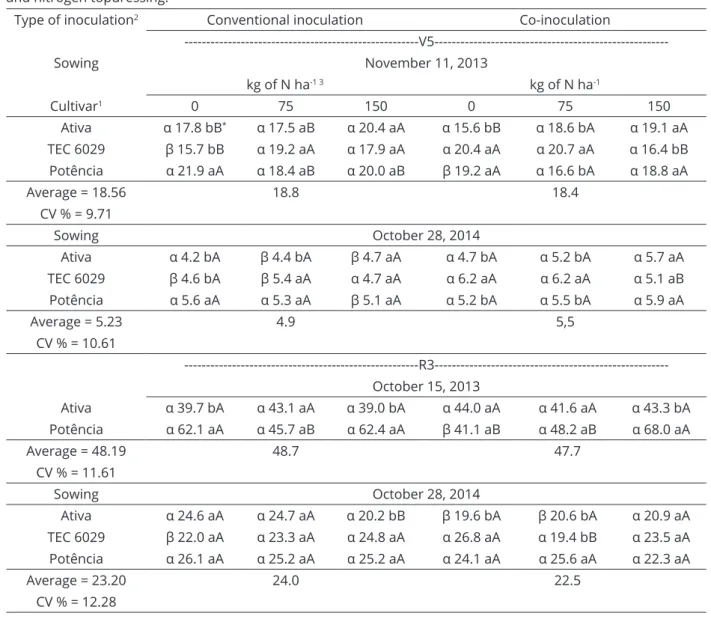
correlation between dry matter and total N accumulated in shoots as well as ureide N. The plant dry matter sampled in V5 showed little or no effects from the application of urea (Table 3). Plants sowed on October 28, 2014 had dry matter means lower than those observed for the previous sowing, probably due to the establishment of a better plant stand,
which meant that the plants had fewer side branches and
therefore less dry matter. Dry matter in R3 was also lower on average, reinforcing the previous results (Table 3).
Table 3: Dry matter plant (DMP, g plant-1) observed in V5 and R3 depending on the type of inoculation, cultivars
and nitrogen topdressing.
Type of inoculation2 Conventional inoculation Co-inoculation
---V5---Sowing November 11, 2013
kg of N ha-1 3 kg of N ha-1
Cultivar1 0 75 150 0 75 150
Ativa α 17.8 bB* α 17.5 aB α 20.4 aA α 15.6 bB α 18.6 bA α 19.1 aA
TEC 6029 β 15.7 bB α 19.2 aA α 17.9 aA α 20.4 aA α 20.7 aA α 16.4 bB
Potência α 21.9 aA α 18.4 aB α 20.0 aB β 19.2 aA α 16.6 bA α 18.8 aA
Average = 18.56 18.8 18.4
CV % = 9.71
Sowing October 28, 2014
Ativa α 4.2 bA β 4.4 bA β 4.7 aA α 4.7 bA α 5.2 bA α 5.7 aA
TEC 6029 β 4.6 bA β 5.4 aA α 4.7 aA α 6.2 aA α 6.2 aA α 5.1 aB
Potência α 5.6 aA α 5.3 aA β 5.1 aA α 5.2 bA α 5.5 bA α 5.9 aA
Average = 5.23 4.9 5,5
CV % = 10.61
---R3---October 15, 2013
Ativa α 39.7 bA α 43.1 aA α 39.0 bA α 44.0 aA α 41.6 aA α 43.3 bA
Potência α 62.1 aA α 45.7 aB α 62.4 aA β 41.1 aB α 48.2 aB α 68.0 aA
Average = 48.19 48.7 47.7
CV % = 11.61
Sowing October 28, 2014
Ativa α 24.6 aA α 24.7 aA α 20.2 bB β 19.6 bA β 20.6 bA α 20.9 aA
TEC 6029 β 22.0 aA α 23.3 aA α 24.8 aA α 26.8 aA α 19.4 bB α 23.5 aA
Potência α 26.1 aA α 25.2 aA α 25.2 aA α 24.1 aA α 25.6 aA α 22.3 aA
Average = 23.20 24.0 22.5
CV % = 12.28
Co-inoculated plants sowed on October 28, 2014 and sampled in V5 showed the highest average dry matter. The results of Groppa, Zawoznik and Tomaro (1998) corroborate this observation, indicating the increased
production of total dry matter compared to conventional
inoculation. Root dry matter can greatly contribute to the increase in the total dry matter of plants. Juge et al. (2012) showed significant differences in the total plant mass,
but the shoot dry matter was not different. High root dry
matter coincides with a high rate of BNF that encourages
further root proliferation and the subsequent use of water
and nutrients, so sugar production is not limited.
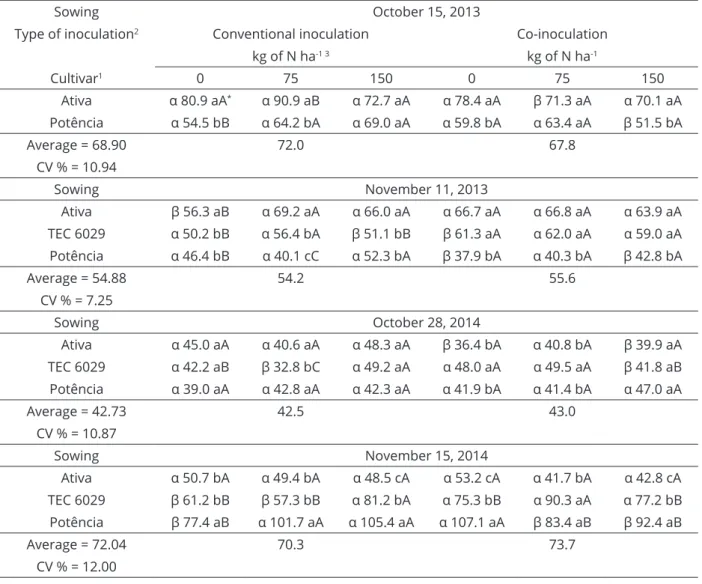
The highest average number of pods (72 pods
plant-1) was observed for the sowing of November
15, 2014. (Table 4). The number of pods has a strong correlation with the yield (Dalchiavon; Carvalho, 2012), when favorable conditions for grain filling occur. These results did not occur in the treatments with higher yields, which can be explained by the evaluation methodology
that considers even pods containing only a single seed.
Table 4: Number of pods per plant (NPP, plant-1) observed in R8 depending on the type of inoculation, cultivars
and nitrogen topdressing.
Sowing October 15, 2013
Type of inoculation2 Conventional inoculation Co-inoculation
kg of N ha-1 3 kg of N ha-1
Cultivar1 0 75 150 0 75 150
Ativa α 80.9 aA* α 90.9 aB α 72.7 aA α 78.4 aA β 71.3 aA α 70.1 aA
Potência α 54.5 bB α 64.2 bA α 69.0 aA α 59.8 bA α 63.4 aA β 51.5 bA
Average = 68.90 72.0 67.8
CV % = 10.94
Sowing November 11, 2013
Ativa β 56.3 aB α 69.2 aA α 66.0 aA α 66.7 aA α 66.8 aA α 63.9 aA
TEC 6029 α 50.2 bB α 56.4 bA β 51.1 bB β 61.3 aA α 62.0 aA α 59.0 aA
Potência α 46.4 bB α 40.1 cC α 52.3 bA β 37.9 bA α 40.3 bA β 42.8 bA
Average = 54.88 54.2 55.6
CV % = 7.25
Sowing October 28, 2014
Ativa α 45.0 aA α 40.6 aA α 48.3 aA β 36.4 bA α 40.8 bA β 39.9 aA
TEC 6029 α 42.2 aB β 32.8 bC α 49.2 aA α 48.0 aA α 49.5 aA β 41.8 aB
Potência α 39.0 aA α 42.8 aA α 42.3 aA α 41.9 bA α 41.4 bA α 47.0 aA
Average = 42.73 42.5 43.0
CV % = 10.87
Sowing November 15, 2014
Ativa α 50.7 bA α 49.4 bA α 48.5 cA α 53.2 cA α 41.7 bA α 42.8 cA
TEC 6029 β 61.2 bB β 57.3 bB α 81.2 bA α 75.3 bB α 90.3 aA α 77.2 bB
Potência β 77.4 aB α 101.7 aA α 105.4 aA α 107.1 aA β 83.4 aB β 92.4 aB
Average = 72.04 70.3 73.7
CV % = 12.00
The cultivar BMX Potência presented the highest average number of seeds per pod, (Table 5). This yield component had the least variability, even in different tillage situations, which can be attributed to breeding
for soybeans with an average of two seeds per pod
(Mundstock; Thomas, 2005). For the experiments in this study, the overall average ranged from 2.15 to 2.36 seeds per pod, and differed with the sowing time.
Along with the number of seeds per pod, seed mass is also a characteristic for each cultivar, but the number can
change depending on the environmental conditions and tillage
(Silva et al., 2011b). Co-inoculation achieved the best average for all tested cultivars, and the cultivar with the heaviest seeds was TEC 6029. The thousand seed weight was lower for the sowing on November 15, 2014, which was 142.2 g on average, while the average of the other three experiments was 167 g (Table 6). As mentioned earlier, the average of pods per plant was also highest for plants sown on this date, and this may have affected the seed filling, reducing the mass.
Effective BNF increases the seed mass, and this
was demonstrated by the foliar application of cobalt and molybdenum compared to uninoculated plants that were not supplemented with the micronutrients
(Silva et al., 2011a). Molybdenum is a cofactor of nitrate reductase, which increases its activity, enabling
the incorporation of nitrogen by the plant (Toledo et
al., 2010).
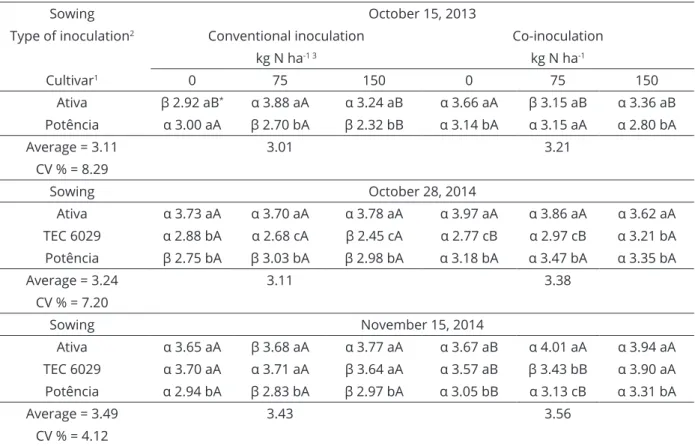
Co-inoculated plants achieved equal or superior yields compared to conventional inoculation in most
of the observations, regardless of nitrogen topdressing. The average increase in the grain yield was 240 kg ha-1
compared to conventional inoculation (Figure 2). The cultivars BMX Ativa, TEC 6029 and BMX Potência, showed yield increases of 6, 4 and 12%, respectively,
when co-inoculated. The practice of co-inoculation
with PGPR has increased yield. This has been shown with co-inoculation with Bacillus (Atieno et al., 2012)
and A. brasilense (Hungria; Nogueira; Araújo, 2013).
Table 5: Number of seeds per pod (NSPo, pod-1) observed in R8 depending on the cultivar.
Sowing October 15, 2013 October 28, 2014 December 15, 2014 Cultivar average
Cultivars
Ativa 2.05b* 2.11b 2.33b 2.16
TEC 6029 --- 2.06b 2.28c 2.17
Potência 2.39a 2.28a 2.48a 2.38
Overall average 2.22 2.15 2.36
CV % 2.51 4.25 2.60
*means followed by the same letter in the column do not differ statistically from each other by the Scott-Knott test
(α≤0.05).
Table 6: Thousand seed weight (TSW, g) observed in R8 depending on the type of inoculation, cultivars and nitrogen topdressing.
Sowing October 15, 2013
Type of inoculation2 Conventional inoculation Co-inoculation
kg of N ha-1 3 kg of N ha-1
Cultivar1 0 75 150 0 75 150
Ativa α 172 aC* α 190 aA α 178 aB α 176 aB α 189 aA β 150 bC
Potência α 157 bA α 157 bA α 153 bA α 152 bA α 154 bA α 155 aA
Average = 165.72 167.8 162.7
CV % = 2.04
Sowing 18/11/2013
Ativa β 148 cB α 158 cA β 156 cA α 161 bB α 153 cC α 175 aA
TEC 6029 α 180 aA α 183 aA α 180 aA β 171 aA β 168 bA β 168 bA
Potência β 168 bA α 171 bA α 170 bA α 175 aA α 176 aA α 166 bB
Average = 168.76 168.2 168.1
CV % = 2.62
Sowing 28/10/2014
Ativa β 153 bB α 176 bA α 171 bA α 179 bA α 167 bB α 163 bB
TEC 6029 α 188 aA α 195 aA β 184 aA α 190 aA α 196 aA α 199 aA
Potência α 136 cA α 130 cA α 140 cA α 139 cA α 137 cA α 140 cA
Average = 166.29 163.7 167.8
CV % = 4.04
Sowing 15/12/2014
Ativa α 136 bA α 133 bA α 133 bA α 135 bA α 135 bA α 135 bA
TEC 6029 α 169 aA β 170 aA α 166 aA α 170 aA α 176 aA α 171 aA
Potência β 113 cB α 123 cA β 113 cB α 128 cA α 122 cB α 121 cB
Average = 142.20 139.6 143.7
CV % = 2.85
1Cultivars (Cv); 2Types of inoculation (In); 3Nitrogen topdressing (N); *means followed by the same letter are not statistically different from each other by the Scott-Knott test (α≤0.05). Lowercase letters are observed in the column (“Cv” within each level of the “In x N”), uppercase letters are observed in the row (“N” within each level of the “Cv x In”), Greek letters are observed among the same combination of cells (“In” within each level of the “Cv x N”).
Table 6: Continued.
Co-inoculated treatments combined with N fertilizer topdressing showed two types of responses, both in favor of the higher dose of fertilizer, but sometimes without statistical significance. (Table 7). The 150 kg N ha-1 treatment stood
out mainly during the wettest season for cultivars with an
indeterminate growth type. A nonsignificant response to the urea topdressing prevailed in the dry season, which decreased yield. In contrast, conventional inoculation showed no response to N fertilizer topdressing, even
with higher water availability conditions. This suggests that co-inoculation produces interactions between the
microorganisms, maximizing the utilization of N available
for absorption in the mineral form.
The economic feasibility of the use of 150 kg N ha-1 in co-inoculated seeds equates to approximately
333.33 kg urea ha-1. The average increase was 300 kg
grain ha-1 for indeterminate cultivars. Therefore, such a
practice would become economically viable only when
the fertilizer is cheaper than usual and transportation, storage and the cost of the application of fertilizer should
also be considered.
An analysis of the results obtained for the other
variables related to the yield implies that the application
of nitrogen fertilizer is unnecessary. On average for all cultivars tested, the vegetative stages V4-V5 precedes a large crop “draining” stage followed by flowering (R1). Similarly, the formation of pods begins in the R2-R3 stage and grain filling (R5) immediately follows. Split nitrogen
topdressing applied during those so-called “critical” periods for the crop did not corresponded to a yield
increase. This result agrees with the results of Aratani et al. (2008) and Mendes et al. (2008), who tested nitrogen
topdressing in soybeans independent of the application
time, both in the vegetative and in reproductive stages,
which did not increase yield compared to a treatment without nitrogen application.
Table 7: Grains yield (GY, Mg ha-1) observed in R8 depending on the type of inoculation, cultivars and nitrogen
topdressing.
Sowing October 15, 2013
Type of inoculation2 Conventional inoculation Co-inoculation
kg N ha-1 3 kg N ha-1
Cultivar1 0 75 150 0 75 150
Ativa β 2.92 aB* α 3.88 aA α 3.24 aB α 3.66 aA β 3.15 aB α 3.36 aB
Potência α 3.00 aA β 2.70 bA β 2.32 bB α 3.14 bA α 3.15 aA α 2.80 bA
Average = 3.11 3.01 3.21
CV % = 8.29
Sowing October 28, 2014
Ativa α 3.73 aA α 3.70 aA α 3.78 aA α 3.97 aA α 3.86 aA α 3.62 aA
TEC 6029 α 2.88 bA α 2.68 cA β 2.45 cA α 2.77 cB α 2.97 cB α 3.21 bA
Potência β 2.75 bA β 3.03 bA β 2.98 bA α 3.18 bA α 3.47 bA α 3.35 bA
Average = 3.24 3.11 3.38
CV % = 7.20
Sowing November 15, 2014
Ativa α 3.65 aA β 3.68 aA α 3.77 aA α 3.67 aB α 4.01 aA α 3.94 aA
TEC 6029 α 3.70 aA α 3.71 aA β 3.64 aA α 3.57 aB β 3.43 bB α 3.90 aA
Potência α 2.94 bA β 2.83 bA β 2.97 bA α 3.05 bB α 3.13 cB α 3.31 bA
Average = 3.49 3.43 3.56
CV % = 4.12
The cultivar BMX Ativa RR had the highest
average yield among the tested cultivars. Its behavior was little affected by the type of inoculation or nitrogen
application, indicating that cultivars with a determinate
growth type have greater yield stability.
CONCLUSIONS
Co-inoculation (Bradyrhizobium spp + Azospirillum
spp.) increased yield compared to inoculation with
Bradyrhizobium spp. alone, exemplified by increases of 6, 4 and 12%, respectively in Ativa, TEC 6029 and BMX Potência. The application of a urea topdressing (150 kg of N ha-1) in the two indeterminate cultivars increased yield,
but without a financial return. The cultivars tested, when inoculated conventionally, did not respond positively to
urea application. Most of the observed variables showed no
increase with supplied urea, which is therefore unnecessary.
ACKNOWLEDGMENTS
To the National Council for Scientific and Technological Development (CNPq), for the Productivity Grant, Scientific Initiation Scholarship and Total Biotecnologia Ltda.
REFERENCES
ALBAREDA, M. et al. Soybean inoculation: Dose, N fertilizer supplementation and rhizobia persistence in soil. Field Crop Research. 113(3):353-356, 2009.
ARATANI, R. G. et al. Adubação nitrogenada em soja na
implantação do sistema plantio direto. Bioscience Journal. 24(3):31-38, 2008.
ATIENO, M. et al. Efficiency of different formulations of
Bradyrhizobium japonicum and effect of co-inoculation of Bacillus subtilis with two strains of Bradyrhizobium japonicum.
World Journal of Microbiology and Biotechnology. 28(7):2541-2550, 2012.
BASHAN, Y.; BASHAN, L. E de. How the plant growth-promoting
bacterium Azospirillum promotes plant growth - A critical assessment. Advances in Agronomy. 108(2):77-136, 2010.
BENINTENDE, S. W. et al. Comparación entre coinoculación
com Bradyrhizobium japonicum y Azospirillum brasilense
e inoculación simple con Bradyrhizobium japonicum en la
nodulación, crecimiento y acumulación de N en el cultivo de soja. Agriscientia. 27(2):71-77, 2010.
BOTTOMLEY, P. J.; MYROLD, D. D. Biological N inputs.
In: PAUL, E. A. (Ed.). Soil microbiology, ecology and
biochemistry. 3. ed. Oxford: Academic Press, 2007.
p.365-388.
BRANDALERO, E. M.; PEIXOTO, C. P.; RALISCH, R. Nodulação de cultivares de soja e seus efeitos no rendimento de grãos.
Semina: Ciências Agrárias. 30(3):581-588, 2009.
CAMPOS, B. C.; GNATTA, V. Inoculantes e fertilizantes foliares na soja em área de populações estabelecidas de Bradyrhizobium sob sistema plantio direto. Revista Brasileira de Ciência do Solo. 30(1):69-76, 2006.
CASSÁN, F. et al. Azospirillum brasilense Az39 and Bradyrhizobium japonicum E109, inoculated singly or in combination, promote seed germination and early seedling growth in corn (Zea mays L.) and soybean (Glycine max L.). European Journal of Soil Biology. 45(1):28-35, 2009.
CHIBEBA, A. M. et al. Co-inoculation of soybean with Bradyrhizobium and Azospirillum promotes early nodulation. American Journal of Plant Sciences. 6(10):1641-1649, 2015.
DALCHIAVON, F. C.; CARVALHO, M. P. Correlação linear e
espacial dos componentes de produção e produtividade
da soja. Semina: Ciências Agrárias. 33(2):541-552, 2012.
DARDANELLI, M. S. et al. Effect of Azospirillum brasilense coinoculated with Rhizobium on Phaseolus vulgaris
flavonoids and nod factor production under salt stress.
Soil Biology & Biochemistry. 40(11):2713-2721, 2008.
DELAMUTA, J. R. M. et al. Polyphasic evidence supporting
the reclassification of Bradyrhizobium japonicum group Ia strains as Bradyrhizobium diazoefficiens sp. nov.
International Journal of Systematic and Evolutionary Microbiology. 63(9):3342-3351, 2013.
DEAKER, R. et al. Legume seed inoculation technology - A review. Soil Biology & Biochemistry. 36(1):1275-1288, 2004.
EMPRESA BRASILEIRA DE PESQUISA AGROPECUÁRIA-EMBRAPA.
Sistema Brasileiro de Classificação de Solos. 3. ed.
Brasília, DF: EMBRAPA, 2013. 353p.
FEHR, W. R. C. et al. Stage of development descriptions for soybean, Glycine max (L.) Merrill. Crop Science. 11(1):929-931, 1971.
FERREIRA, D. F. Sisvar: A computer statistical analysis system.
Ciência e Agrotecnologia. 35(6):1039-1042, 2011.
GAN, Y. et al. Effect of fertilizer top-dressing at various reproductive stages on growth N2 fixation and yield of
GROPPA, M. D.; ZAWOZNIK, M. S.; TOMARO, M. L. Effect of
co-inoculation with Bradyrhizobium japonicum and Azospirillum brasilense on soybean plants. European Journal of Soil Biology. 34(2):75-80, 1998.
HARTLEY, E. J. et al. Age of peat-based lupin and chickpea inoculants in relating to quality and efficacy. Australian Journal of Experimental Agriculture. 45(3):183-188, 2005.
HAYAT, L. et al. Soil beneficial bacteria and their role in plant
growth promotion: A review. Annals of Microbiology. 60(4):579-598, 2010.
HELDWEIN, A. B.; BURIOL, A. G.; STRECK, N. A. O clima de Santa
Maria. Ciência & Ambiente. 38(1):43-58, 2009.
HUNGRIA, M.; CAMPO, R. J.; MENDES, I. C. Benefits of
inoculation of the common bean (Phaseolus vulgaris) crop with efficient and competitive Rhizobium tropici strains. Biology and Fertility of Soils. 39(2):88-93, 2003.
HUNGRIA, M.; NOGUEIRA, M. A.; ARAÚJO, R. S. Soybean seed
co-Inoculation with Bradyrhizobium spp. and Azospirillum brasilense: A new biotechnological tool to improve yield and sustainability. American Journal of Plant Sciences.
6(6):811-817, 2015.
HUNGRIA, M.; NOGUEIRA, M. A.; ARAÚJO, R. S. Co-inoculation of soybeans and common beans with rhizobia and Azospirilla:
Strategies to improve sustainability. Biology and Fertility of Soils. 49(7):791-801, 2013.
INSTITUTO NACIONAL DE METEOROLOGIA-INMET.
Automatic meteorological stations data (National Meteorology Institute). Brasília, Distrito Federal,
2015. Available in: <http://www.inmet.gov.br/portal/
index.php?r=bdmep%2Fbdmep>. Access in: August 03, 2016.
JUGE, C. et al. Growth and biochemical responses of soybean to double and triple microbial associations with
Bradyrhizobium, Azospirillum and arbuscular mycorrhizae.
Applied Soil Ecology. 61(1):147-157, 2012.
MENDES, I. C. et al. Adubação nitrogenada suplementar tardia em soja cultivada em latossolos do cerrado. Pesquisa Agropecuária Brasileira. 43(8):1053-1060, 2008.
MUNDSTOCK, C. M.; THOMAS, A. L. Soja:Fatores que afetam o crescimento e o rendimento dos grãos. Departamento de plantas de Lavoura da Universidade do Rio Grande do Sul, UFRGS. Porto Alegre, 2005. 31p.
PEEL, M. C.; FINLAYSON, B. L.; MCMAHON, T. A. Updated world map of the Köppen-Geiger climate classification. Hydrology and Earth System Science. 11(5):1633-1644, 2007.
PETTER, F. A. et al. Respostas de cultivares de soja à adubação
nitrogenada tardia em solos de cerrado. Revista Caatinga. 25(1):67-72, 2012.
SANTOS, M. A. et al. Mapping of QTLs associated with biological nitrogen fixation traits in soybean. Hereditas. 150(2-3):17-25, 2013.
SILVA, A. F. et al. Doses de inoculante e nitrogênio na
semeadura da soja em área de primeiro cultivo. Bioscience Journal. 27(3):404-412, 2011a.
SILVA, A. F. et al. Inoculação com Bradyrhizobium e formas
de aplicação de cobalto e molibdênio na cultura da soja.
Agrarian. 4(12):98-104, 2011b.
SOUZA, R. A. et al. Conjunto mínimo de parâmetros para avaliação da microbiota do solo e da fixação biológica do nitrogênio pela soja. Pesquisa Agropecuária Brasileira. 43(1):83-91, 2008.
VERMA, J. P. et al. Impact of plant growth promotion
rizhobacteria on crop production. International Journal of Agricultural Research. 5(11):954-983, 2010.