Genotypic value in hybrid progenies of
Panicum maximum
Jacq.
Valor genotípico de progênies híbridas de Panicum maximum Jacq. Thiago Gomes dos Santos Braz1 Janaina Azevedo Martuscello2 Liana Jank3
Dilermando Miranda da Fonseca4 Marcos Deon Vilela Resende5 Anderson Barbosa Evaristo6 ISSNe 1678-4596
INTRODUCTION
Forage species with high yield and good nutritional quality have a great importance in the sustainability of the animal production system. In this regard, release of improved cultivars, e.g.,
Panicum maximum Jacq., emerges as the main form of diversifying Brazilian pastures (JANK et al., 2011). According to JANK et al. (2008), this is the most productive seed-propagated forage species of the Brazilian market and can adapt to several types of soil and climate. Panicum maximum occupies more than 20 1Instituto de Ciências Agrárias, Universidade Federal de Minas Gerais (UFMG), 39404-547, Montes Claros, MG, Brasil. E-mail: [email protected]. Corresponding author.
2Departamento de Zootecnia, Universidade Federal de São João del-Rei (UFSJ), São João del-Rei, MG, Brasil. 3Laboratório de Citogenética, Embrapa Gado de Corte, Campo Grande, MS, Brasil.
4Departamento de Zootecnia, Universidade Federal de Viçosa (UFV), Viçosa, MG, Brasil.
5Universidade Federal de Viçosa (UFV), Viçosa, MG, Brasil. Embrapa Florestas, Colombo, PR, Brasil. 6Universidade Estadual do Tocantins (UNITINS), Palmas, TO, Brasil.
ABSTRACT: Genetic breeding of forage plants has increasingly contributed to the release of more productive plants. In this regard, evaluating the genotypic value is essential when aiming to rank genotypes based on the mean free of environmental factors. Therefore, this study aimed to predict the genotypic value of agronomic and nutritive value characters of three progenies of Panicum maximum. Hybrids were evaluated in a clonal test in an incomplete-randomized design with three treatments (progenies 1, 2, and 3) and two replications (clones). Six harvests were performed at 25cm from the ground level throughout one year. Progeny 2 provided better results for total and leaf dry mass yield, regrowth, and height, and lower incidence of leaf spot. Progenies 1 and 3 had a better response for qualitative characters such as higher crude protein and digestibility and lower lignin and fiber content. Hybrid progenies of P. maximum have forage characters of interest for breeding, and when using ‘Mombaça’ grass as parents, the progeny stands out for leaf production and resistance to leaf spot and for ‘Tanzania’ grass as parent has resulted in better forage quality.
Key words: Bipolaris maydis, chemical composition, leaf biomass, ‘Mombaça’, ‘Tanzania’.
RESUMO: O lançamento de forrageiras resultantes de programas de melhoramento genético tem sido importante fonte de liberação de novas forrageiras mais adaptadas e competitivas. Nessas situações, a avaliação do valor genético é essencial quando se objetiva ranquear os genótipos com base no valor genotípico, isento dos efeitos ambientais. O objetivo com este trabalho foi estimar e avaliar o valor genotípico de características agronômicas e de valor nutritivo de três progênies de P. maximum, resultantes do cruzamento entre duas progenitoras sexuais e as cultivares ‘Mombaça’ e ‘Tanzânia’. O experimento foi implantado em teste clonal no delineamento em blocos incompletos com três tratamentos (progênies 1, 2 e 3) com duas repetições (clones). Os híbridos foram manejados por meio de cortes na altura de 25cm do nível do solo por um ano, realizando seis cortes. A progênie 2 proporcionou melhores resultados para produção de folhas, rebrota, altura de planta e baixa incidência de mancha foliar causada por Bipolaris maydis. As progênies 1 e 3 apresentaram, em média, melhores resultados para características qualitativas como proteína bruta e digestibilidade e menor teor de lignina. As progênies híbridas de P. maximum apresentam características forrageiras de interesse para o melhoramento, sendo que a utilização do capim-mombaça como parental proporciona maior produção de folhas e resistência à mancha foliar, ao passo que o capim-tanzânia como parental proporciona melhoria da qualidade da forragem.
Palavras-chave: Bipolaris maydis, composição bromatológica, biomassa de folhas, ‘Mombaça’, ‘Tanzânia’.
million hectares in the country (VALLE et al., 2009),
which confirms its importance as a tropical forage.
According to JANK et al. (1997), breeding of P. maximum has the objective of selecting apomictic genotypes for release either from the variability introduced or generated by crosses and
thus contribute to pasture diversification in Brazil.
Characters targeted in the breeding program are high forage and leaf production, less marked seasonality, high seed production, good nutritional value, and resistance to pests and diseases.
Despite the importance of crosses, release of hybrid cultivars is still recent in Brazil. In this scenario, introduction of germplasm and phenotypic selection of more adapted accessions is still relevant to obtaining new cultivars. These techniques limit the potential for obtaining superior genotypes, especially when aiming to combine the characters of potential parents.
Of the main cultivars of P. maximum
available in the market are the ‘Mombaça’ and ‘Tanzania’, which are widespread among producers and have greater potential to be used as progenitors in crosses. Both cultivars have been largely studied about management; however, there is a gap in the knowledge about their potential as parents for the characters of interest to breeding.
Prediction and selection based on the genotypic value in perennial species as forages is recommended, mostly because through it, we can
find individuals genetically superior. According to RESENDE et al. (1996), the field evaluation of
genetic materials has two goals, which are to infer about the genetic or genotypic values, and to rank them based on these values. Also, according to these authors, there should be less interest in the phenotypic mean and greater importance on predicted mean, when they are planted again in commercial crops and free of effects of location, blocks, plots, and random environmental effects.
Based on these premises, our study aimed to predict and compare the genotypic value of agronomic and qualitative characters of three progenies of Panicum maximum resulting from the cross between two sexual progenitors and cultivars ‘Mombaça’ and ‘Tanzania’.
MATERIALS AND METHODS
The experiment was conducted at Embrapa Gado de Corte, located in Campo Grande-MS, Brazil (20°27’ latitude and 54°57’ longitude). According to
the Köppen classification, the climate of the region is
a rainy savannah type, Aw subtype, characterized by
irregular annual distribution of rains and well-defined
occurrence of a dry period during the cold months and a rainy season period the summer. Climatic data were collected during the experimental period in a meteorological station 500 meters distant from the experiment. During the 14 months of experiment conduction, the precipitation accumulated 2178mm and minimum, average and maximum temperatures of 23.9, 34.3 and 14.4ºC, respectively.
We evaluated three full-sib progenies of P. maximum. The individuals were obtained by crossing four progenitors: sexual mother plants S10 and S12 and the apomictic cultivars ‘Mombaça’ and ‘Tanzania’, which were pollen donors. Progeny 1 resulted from the cross between sexual plant S10 and ‘Tanzania’ grass; progeny 2 from the cross between the S10 sexual plant and ‘Mombaça’ grass; and progeny 3 from the cross between sexual parent S12 and ‘Tanzania’ grass. Seeds were obtained by polycross blocks (one mother plant seeded into a plot with 25m² of the apomictic progenitor), germinated in a greenhouse,
and later transplanted into the field.
After the establishment phase, 114 hybrids were obtained in progeny 1; 167 hybrids in progeny 2; and 45 hybrids in progeny 3. The 326 individuals were cloned by tussock division and planted in a clonal test. An incomplete-block design with three treatments (progenies 1, 2, and 3) and two replications was adopted, totaling 33 plots, in which each plot was composed of three rows with nine plants of each progeny. The spacing adopted between plants within the row and between rows was 1m, and the experimental unit consisted of one tussock from the respective hybrid. Two lines with ‘Mombaça’ grass plants 1m spaced were used as experimental border.
Before planting the experiment, conventional soil-preparation method was used in the experimental area. The soil collected from the 0-20cm layer was analyzed chemically and presented the following characteristics: pH in water (1:2.5 ratio) = 5.10; P-Mehlich−1 = 2.61mg dm-3; K+ = 17.70mg
dm-3; Ca²+ = 6.56cmol
c dm
-3; Mg²+ = 1.62cmol c
dm-3; Al3+ = 0.11cmol
c dm
-3; H + Al = 3.01cmol c
dm-3, base saturation = 57.17%; Al saturation =
2.70%; and organic matter = 3.24dag kg-1. Based on
these results, 120kg ha-1 P
2O5were applied as single
superphosphate, and 40kg ha-1 K
2O as potassium
chloride. During the experiment, 100kg ha-1 N, 100kg
ha-1 K
2O, and 100kg ha -1 P
2O5 were applied annually
The hybrids were managed by cutting at 25cm above the soil level on 01/26/2010, 03/08/2010, 10/05/2010, 11/18/2010, 12/29/2010, and 02/03/2011. At each harvest, the forage was collected, weighed, and sampled. Samples were separated in morphological components leaf, stem + sheath, and dead forage. Each component was dried in a closed oven at 65ºC until a constant weight was reached. Next, the dry mass and its relative participation in the morphological composition of the samples were determined.
The following agronomic characters were evaluated: total dry mass yield (TDM - g plant-1),
percentage of leaf (%L), leaf dry mass yield (LDM - g/plant), stem + sheath dry mass yield (SDM - g/ plant), plant height (PH - cm), regrowth (REG), and incidence of leaf spots caused by the fungus
Bipolaris maydis (BM).
Height was determined on the day before the harvest, by measuring the distance from the soil to the leaf horizon. Regrowth assessments were performed seven days after harvest. This value integrates two other characters: regrowth density and speed. Density was evaluated by assigning scores of 1 to 5, in which 1 corresponds to regrowth of 0 to 20% of tillers, and 5 to regrowth of 80 to 100% of tillers. Speed; however, was determined by assigning scores of -1 (slow), 0 (medium), and 1 (high). The sum of these two variables generates the plant regrowth, which can vary from 0 to 6.
Incidence of leaf spots caused by Bipolaris maydis was evaluated using the subjective assessment by assigning scores of 1 to 5, in which 1 corresponds to 0 to 20% incidence, and 5 to 80 to 100% incidence. This assessment was also performed on the day before the plants were harvested.
The following characters associated to nutritional value were evaluated: crude protein (CP),
neutral detergent fiber (NDF), acid detergent fiber (ADF),
and lignin (LIG) contents and the in vitro organic matter digestibility (IVOMD). Those characters were estimated
in the samples of leaves by the near infrared reflectance
spectroscopy (NIRS), according to procedures described
in MERTENS et al. (1987). Reflectance data of the
samples in the wavelength of 1,100 to 2,500nm were measured with the spectrophotometer (Model NR5000: NIRS systems, Inc., USA). The CP, NDF, ADF, LIG, and IVOMD values were obtained by calibration equations developed by conventional methods (EUCLIDES & MEDEIROS, 2003).
The genotypic value was estimated by using the mixed linear model:
y = Xf + Zi + Wp + Tb + Qa + Pc + ε
where y is the data vector; f is the vector of progeny effects added to the overall mean (assumed
as fixed); i is the vector of individual genotypic effects (assumed as random); p is the vector of plot effects (assumed as random); b is the vector of block effects (assumed as random); a is the vector of permanent environmental effects (random), c is the vector of harvest effects (random); and ε is the vector of errors or residuals (random). Uppercase letters (X, Z, W, T, Q, and P) represent the incidence matrices for the mentioned effects.
After estimation of the genotypic values for each hybrid as a function of the replications and of the six evaluations, the average of all individuals of the progeny were obtained and compared by the
t-test, adopting 5% as the critical level of probability. All analyses were performed using the software Sistema Estatístico e Seleção Genética Computadorizada via Modelos Lineares Mistos, Selegen – REML/BLUP (RESENDE, 2007).
RESULTS AND DISCUSSION
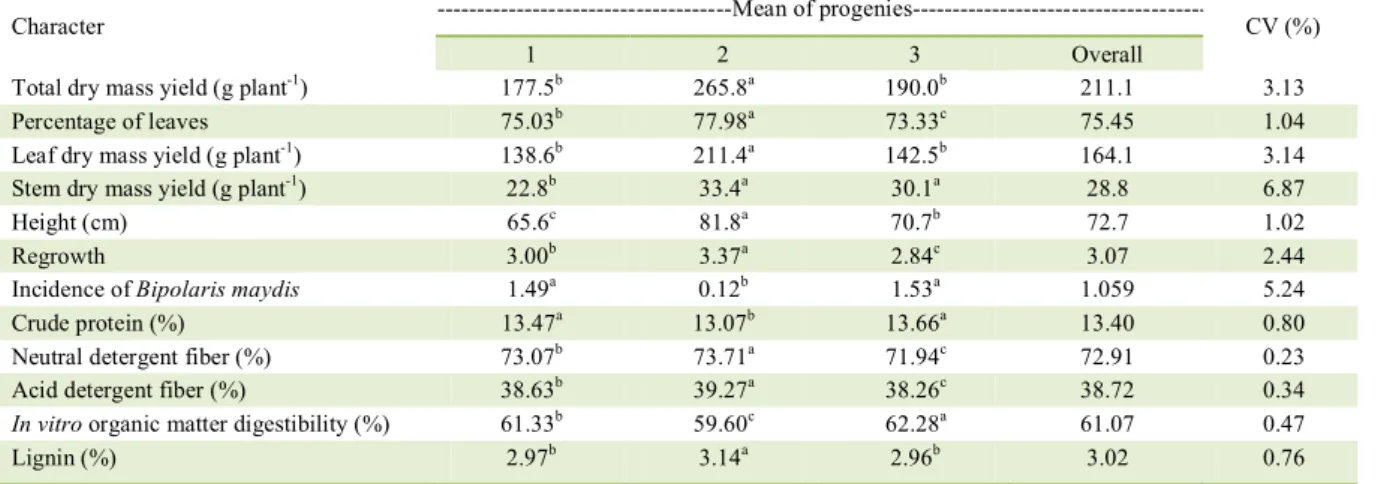
Agronomic characters of all progenies obtained from the crosses between sexual accessions S10 and S12 and apomictic cultivars Mombaça and Tanzania were statistically different (Table 1). Progeny 2 hybrids presented greater total dry mass yield (TDM = 265.8g plant-1) and higher percentage
of leaf blade (%L = 77.98%) on the average of the harvests (Table 1). Between progenies 1 and 3, no
significant differences were observed for TDM, but
it differs statistically for %L. Yield results agree with those reported in other experiments with P. maximum, e.g., MARTUSCELLO et al. (2009) obtained an average forage TDM of 239.86g plant-1
during the rainy season in hybrids of P. maximum
full-sib progenies. RESENDE et al. (2004) observed accumulated production of 9.84t ha−1.year−1 TDM and 8.06t ha−1 year−1 LDM in full-sib progenies of P. maximum. In the present study, progenies 1, 2, and 3 presented an estimated annual production of 10.62, 15.90, and 11.4t ha−1 TDM, respectively.
performance with the cross between S10 and T74 plants, which indicates superiority of the S10 plant as regards forage production. Also, according to these authors, the hybrids with worst performance were those from the S12 × T110 cross. Trend of progenies originating from the most productive parents obtaining greater TDM and LDM in the P. maximum species is related to the considerable level of heritability reported for these parameters (RESENDE et al., 2004; BRAZ et al., 2013).
Considering the remarkable stem elongation in ‘Mombaça’ plants (SANTOS et al., 1999), higher SDM values were expected from progeny 2, which in fact occurred, compared with progeny 1. However, despite having a greater SDM, progeny 2 did not
show a significant difference for this parameter in
relation to progeny 3 (Table 1). In this context, greater SDM production for hybrids from progeny 2 and 3 is explained by the larger TDM production (Table 1). Accumulation of stem is undesirable in the breeding of forage plants considering their lowest digestibility in the rumen compared with leaves. Thus, forages that tend to elongate and accumulate stems throughout the seasons should not be prioritized; in this case, those having greater leaf dry mass production are more valued.
The percentage of leaves (77.98%), TDM (265.8g plant-1) and LDM (211.4g plant-1) yield was
higher in plants of progeny 2. This result indicates the superiority of this progeny, since leaf production is indispensable to selection of superior forages, as this is the botanical component of greatest digestibility,
which will directly influence the performance of
animals (HACKER et al., 1998; JANK et al., 2005). Progeny 2 hybrids were taller (Table 1) than the others, which can also be explained by the cross with ‘Mombaça’ grass, as this plant also has a medium height, under free growth, of up to 1.7, whereas ‘Tanzania’ grass grows to around 1.2m (JANK et al., 2010).
Plant height can be adopted as a selection criteria, mainly when one aims to select shorter plants to be used in production systems for small ruminants. Thus, the hybrids originating from progeny 1 would be the most indicated for this purpose. Among the progenies evaluated in this study, the largest forage production was also reported in progenies whose hybrids had a greater average height (Table 1). Thus, hybrids from progeny 2 stood out for being high plants, with greater TDM yield, and greater stem dry mass yield (Table 1). CARGNELUTTI FILHO et al.
(2004) observed a positive and significant correlation
between plant height and total and stem mass.
Hybrids from progeny 2 also have the greatest regrowth capacity (3.37), followed by the progeny 1 and 2, which also differ statistically from each other (Table 1). Because it is a perennial species, the regrowth capacity of P. maximum should be taken into account as it is directly related to the persistency of the forage plant after defoliation.
Progeny 2 showed lower incidence of
Bipolaris maydis (BM) in relation to the others (Table 1). This progeny is probably less susceptible
Table 1 - Mean genotypic values and coefficient of variation (CV) of agronomic and nutritional characters in hybrid Panicum maximum progenies.
Character ---Mean of progenies--- CV (%)
1 2 3 Overall
Total dry mass yield (g plant-1) 177.5b 265.8a 190.0b 211.1 3.13
Percentage of leaves 75.03b 77.98a 73.33c 75.45 1.04
Leaf dry mass yield (g plant-1) 138.6b 211.4a 142.5b 164.1 3.14
Stem dry mass yield (g plant-1) 22.8b 33.4a 30.1a 28.8 6.87
Height (cm) 65.6c 81.8a 70.7b 72.7 1.02
Regrowth 3.00b 3.37a 2.84c 3.07 2.44
Incidence of Bipolaris maydis 1.49a 0.12b 1.53a 1.059 5.24
Crude protein (%) 13.47a 13.07b 13.66a 13.40 0.80
Neutral detergent fiber (%) 73.07b 73.71a 71.94c 72.91 0.23
Acid detergent fiber (%) 38.63b 39.27a 38.26c 38.72 0.34
In vitro organic matter digestibility (%) 61.33b 59.60c 62.28a 61.07 0.47
Lignin (%) 2.97b 3.14a 2.96b 3.02 0.76
to colonization and/or development of this fungus, providing greater tolerance to this disease. A possible explanation is the heritage of genes of resistance of the male parent (‘Mombaça’) in progeny 2. SANTOS et al. (2015) reported high severity of the leaf spot disease in progenitor ‘Tanzania’, the male parent of progenies 1 and 3, when compared with ‘Mombaça’. AMORIM et al. (2001) also reported similar results, demonstrating that cultivar ‘Tanzania’ was more susceptible when compared with cultivar ‘Mombaça’. Several phytopathogenic fungi have been reported to infect P. maximum all over the world (LENNÉ, 1990). In Brazil, many diseases have been reported in experimental and commercial areas, some of which have caused serious damage, as is the case of the leaf spot. Thus, the development of resistant-cultivars to
the pathogen would certainly bring benefits to
pasture-based production systems. In this regard, progeny 2 plants and their parents have the potential for breeding programs aiming the resistance to leaf spot.
Differences were also observed between the evaluated progenies for nutritional characters (Table 1). A higher crude protein (CP) content was observed for the hybrids from progenies 1 and 3: 13.47 and 13.66%, respectively. Forages of the species
P. maximum stand out for their high CP contents compared with other tropical forages. GERDES et al. (2000) evaluated the quality of ‘Tanzania’ grass and reported average values of 14.33 and 7.58 for leaves and stems, respectively. BRANCIO et al. (2003) reported CP values of 14 and 12% for ‘Mombaça’ and ‘Tanzania’ grasses, respectively. These data are in line with those observed in this study. Moreover, the values observed for all progenies are above the minimum required for adequate rumen fermentation (MINSON, 1984).
For the characters lignin and neutral
detergent fiber (NDF), forage plants should be
selected in descending order, since high values are negatively correlated with digestibility and forage intake. RODRIGUES & VIEIRA (2006) showed that lignin affects the dry matter digestibility, especially of the NDF fraction, by limiting the digestion of the plant cell wall; in this case, there is a direct impact on the concentration of digestible energy of plants, which compromises animal production. Progeny 2 showed higher NDF values (73.71%), followed by progenies 1 (73.07%) and 3 (71.94%). Differences observed between the NDF contents in the evaluated progenies were little expressive. Nevertheless, the observed NDF values agree with those reported in other studies with P. maximum
(BRÂNCIO et al., 2002). Progeny 3 showed the
highest IVOMD values, followed by progenies 1 and 2, respectively. The average values of the three progenies for IVOMD agree with the literature data for some cultivars of P. maximum already released in the market (BRÂNCIO et al., 2002) and for some hybrids. The highest IVOMD values were reported in the same progenies that had lower NDF, ADF and lignin values.
In forage breeding programs, the evaluation of characters related to the nutritional value is of essential as they present a positive correlation between forage quality and animal performance (HACKER et al., 1998; JANK et al., 2011). Even so,
we emphasize that management has a great influence
in the nutritional value of forages.
Cultivar ‘Tanzania’ is probably a carrier of genes that provide better nutritional value in leaves than cultivar ‘Mombaça’. Progenies 1 and 3, whose male progenitor was cultivar ‘Tanzania’, showed better results in all nutritional parameters. Comparing progenies 1 and 2 that have the same female progenitor S10, we evidenced that the use of ‘Tanzania’ grass as a male parent provided an improvement in the nutritional value of hybrids. BRÂNCIO et al. (2002) and EUCLIDES et al. (1999) also reported superiority in the nutritional value of cultivar ‘Tanzania’ when compared with other P. maximum cultivars.
CONCLUSION
The three P. maximum hybrid progenies performed well for forage characters in both productivity and nutritional aspects. Progeny 2 (S10 × ‘Mombaça’ grass) stands out for its dry mass and leaf productivity, in addition to low incidence of leaf spot caused by Bipolaris maydis when compared with progenies 1 (S10 × ‘Tanzania’) and 3 (S12 × ‘Tanzania’). Progenies derived from progenitor ‘Tanzania’ grass have better nutritional value, in average.
AKNOWLEDGEMENTS
We would like to thank Embrapa Beef Cattle and Unipasto (Association for the promotion of research in forage
breeding) for financial support and for Conselho Nacional de Desenvolvimento Científico e Tecnológico (CNPq) for the
scholarship of the third author on technological development and innovative extension productivity.
REFERENCES
AMORIM, T.R. et al. Avaliação de genótipos de Panicum maximum
Proceedings... Bonito, Brasil: Embrapa Gado de Corte, 2011. v.3.p.254-257. CD-ROM.
BRÂNCIO, P.A. et al. Avaliação de três cultivares de Panicum maximum Jacq. sob pastejo. Composição química e digestibilidade da forragem. Revista Brasileira de Zootecnia, v.31, n.4, p.1605-1613, 2002. Available from: <http://www.scielo.br/scielo. php?script=sci_arttext&pid=S1516-35982002000700002>. Accessed: May 04, 2015. doi: 10.1590/S1516-35982002000700002.
BRAZ, T.G.S. et al. Genetic parameters of agronomic characters in Panicum maximum hybrids. Revista Brasileira de Zootecnia, v.42, n.4, p.231-237, 2013. Available from: <http://www.scielo. br/scielo.php?pid=S1516-35982013000400001&script=sci_ arttext&tlng=pt>. Accessed: May 05, 2015. doi: 10.1590/S1516-35982013000400001.
CARGNELUTTI FILHO, A. et al. Análise de repetibilidade de caracteres forrageiros de genótipos de Panicum maximum, avaliados com e sem restrição solar. Ciência Rural, v.34, n.3, p.723-729, 2004. Available from: <http://www.scielo. br/scielo.php?pid=S0103-84782004000300011&script=sci_ arttext>. Accessed: May 05, 2015. doi: 10.1590/S0103-84782004000300011.
EUCLIDES, V.P.B.; MEDEIROS, S.R. Valor nutritivo das principais gramíneas cultivadas no Brasil. Campo Grande: Embrapa Gado de Corte, 2003. 433p.
EUCLIDES, V.P.B. et al. Consumo voluntário de forragem de três cultivares de Panicum maximum sob pastejo. Revista Brasileira de Zootecnia, v.28, n.6, p.1177-1185, 1999. Available from: <http://www.scielo.br/pdf/rbz/v28n6/a02v28n6.pdf>. Accessed: May 06, 2015.
GERDES, L. Avaliação de características de valor nutritivo das gramíneas forrageiras ‘Marandu’, ‘Setária’ e ‘Tanzânia’ nas estações do ano. Revista Brasileira de Zootecnia, v.29, n.6, p.955-963, 2000. Available from: <http://www.scielo. br/scielo.php?pid=S1516-35982000000400003&script=sci_ abstract&tlng=pt>. Accessed: May 05, 2015.
HACKER, J. et al. Breeding tropical and subtropical grasses. In:_____. Grass for dairy cattle. Wallingford: CABI, 1998. p.49-71.
JANK, L. et al. Catálogo de caracterização e avaliação de germoplasma de Panicum maximum: descrição morfológica e
comportamento agronômico. Campo Grande: Embrapa Gado de Corte, 1997. 53p. (Documentos, n.68).
JANK, L. et al. Panicum maximum Jacq. In: FONSECA, D.M.; MARTUSCELLO, J.A. Plantas forrageiras. Viçosa, MG: UFV, 2010. Cap.5, p.166-196.
JANK, L. et al. Melhoramento genético de Panicum maximum. In: RESENDE, R.M.S. et al. (Eds.). Melhoramento de forrageiras tropicais. Campo Grande: Embrapa Gado de Corte, 2008. v.1, p.55-87.
JANK, L. et al. Breeding tropical forages. Crop Breeding and Applied Biotechnology, v.11, n.1, p.27-34, 2011. Available from:
<http://www.scielo.br/scielo.php?pid=S1984-70332011000500005&script=sci_arttext>. Accessed: May 06, 2015. doi: 10.1590/S1984-70332011000500005.
JANK, L. et al. New grasses and legumes; Advances and perspectives for the tropical zones of Latin America. In: _____. Grasslands: developments, opportunities and perspectives. Rome: FAO, 2005. p.55-79.
MARTUSCELLO, J.A. et al. Among and within family selection and combined half-sib family selection in Panicum maximum Jacq. Revista Brasileira de Zootecnia, v.38, n.10, p.1870-1877, 2009. Available from: <http://www.scielo.br/scielo.php?pid=S1516-35982009001000003&script=sci_arttext&tlng=es>. Accessed: May 2015. doi: 10.1590/S1516-35982009001000003.
MERTENS, D. Predicting intake and digestibility using mathematical models of ruminal function. Journal of Animal Science, v.64, n.5, p.1548-1558, 1987. Available from: <https://dl.sciencesocieties.org/ publications/jas/abstracts/64/5/JAN0640051548>. Accessed: May 02, 2015. doi: 10.2134/jas1987.6451548x.
MINSON, D. Digestibility and voluntary intake by sheep of five Digitaria species. Animal Production Science, v.24, n.127, p.494-500, 1984. Available from: <http://www.publish.csiro.au/paper/ EA9840494>. Accessed: May 20, 2015. doi: 10.1071/EA9840494.
RESENDE, M.D.V. SELEGEN-REML/BLUP: sistema estatístico e seleção genética computadorizada via modelos lineares mistos. Colombo: Embrapa Florestas, 2007. 359 p.
RESENDE, M.D.V. et al. Estimação de componentes de variância e predição de valores genéticos pelo modelo da máxima verossimilhança restrita (REML) e melhor predição linear não viciada (BLUB) em Pinus. Boletim de Pesquisa Florestal, n.32/33, p.18-45, 1996. Available from: <http://www.alice. cnptia.embrapa.br/bitstream/doc/282154/1/mresende1.pdf>. Accessed: May 20, 2015.
RESENDE, R.M.S. et al. Biometrical analysis and selection of tetraploid progenies of Panicum maximum using mixed model methods. Pesquisa Agropecuária Brasileira, v.39, n.4, p.335-341, 2004. Available from: <http://www.scielo.br/scielo.php?pid=S0100-204X2004000400006&script=sci_arttext>. Accessed: May 02, 2015. doi: 10.1590/S0100-204X2004000400006.
SANTOS, É.C.M. et al. Evaluation of Panicum maximum Jacq. genotypes to bell smut and leaf spot. Summa Phytopathologica, v.41, n.1, p.35-41, 2015. Available from: <http://www.scielo.br/ scielo.php?pid=S0100-54052015000100035&script=sci_arttext>. Accessed: May 30, 2015. doi: 10.1590/0100-5405/1900.
SANTOS, P.M. et al. Efeito da freqüência de pastejo e da época do ano sobre a produção e a qualidade em Panicum maximum
cvs. ‘Tanzânia’ e ‘Mombaça’. Revista Brasileira de Zootecnia, v.28, n.2, p.244-249, 1999. Available from: <http://www.scielo.br/ scielo.php?script=sci_arttext&pid=S1516-35981999000200004>. Accessed: July 05, 2015.