Original Article
Artigo Original
Fernanda Prada Machado1
Ruth Ramalho Ruivo Palladino1
Maria Claudia Cunha1
Descritores
Fonoaudiologia Transtorno autístico Questionários Comunicação Linguagem Keywords
Speech, Language and Hearing Sciences Autistic disorder Questionnaires Communication Language
Correspondence address:
Fernanda Prada Machado
Graduate Program in Speech Language Pathology and Audiology,
Rua Monte Alegre, 499, São Paulo (SP), Brazil, CEP: 05014-000.
E-mail: [email protected]
Received: 07/11/2013
Accepted: 03/13/2014
Study carried out at the Pontifícia Universidade Católica of São Paulo – PUC-SP – São Paulo (SP), Brazil. (1) Pontifícia Universidade Católica de São Paulo – PUC-SP – São Paulo (SP), Brazil.
Financial support: Coordination for the Improvement of Higher Education Personnel (CAPES).
Conlict of interests: nothing to declare.
Adaptation of the Child Development Clinical Risk
Indicators instrument to retrospective parent report
Adaptação do instrumento Indicadores Clínicos de
Risco para o Desenvolvimento Infantil para questionário
retrospectivo para pais
ABSTRACT
Purpose: To adapt the Child Development Clinical Risk Indicators (IRDI) instrument to retrospective report for parents of children from 3 to 7 years old and administer it in two groups. Methods: Participated on the study 72 subjects — parents of children aged from 2 years and 11 months to 7 years and 7 months — divided into two groups: Research Group and Control Group. The proposed modiication to parent report transformed the 31 indicators (afirmations) into retrospective self-administered questions to parents, with responses in Likert scale. The IRDI-questionnaire was administered in the two groups. Results: The IRDI-questionnaire showed to be easy and quick to administer (average 15 minutes) and with low cost. The analysis of the questions obtained a good internal consistency value. The comparison between the groups by the parents’ answers to the 31 questions showed difference in 16 questions. Conclusion: The items of the IRDI-questionnaire concern the main Autism Spectrum Disorders risk signs pointed out in literature. The parents’ answers showed differences between the studied groups.
RESUMO
Objetivo: Adaptar o instrumento Indicadores Clínicos de Risco para o Desenvolvimento Infantil (IRDI) para questionário retrospectivo para pais de crianças de 3 a 7 anos e aplicá-lo em dois grupos de sujeitos.
INTRODUCTION
The infantile autism has been studied by various areas of knowledge since its irst description in 1943 by Léo Kanner. Since then, its deinition has undergone several modiications and, currently, the great variability in clinical signs shown by this group of individuals made the use of the term “autism spec-trum disorders” (ASD) more appropriate(1).
It is known that language dificulties are an important dimen-sion of this clinical condition, next to impairments in social interaction and behavior(1-4).
In general, the clinical signs of ASD can be observed in very young children, since the signs involve changes in skills that are typically developed in the irst 2 years of life(5-8).
In this context, some variability in the concerns expressed by parents occurs; however, complaints about the delay in the development of oral language are among the most common and consensual ones(4,9,10).
Family concerns in relation to the language development of these children is one of the reasons why the speech language pathologist is, in many cases, the irst professional sought by the family, even before the diagnosis of the ASD has been advised or investigated. Thus, the relevance of speech language pathology and audiology in identifying possible risk for ASD is evident.
The signiicant results of intensive therapeutic interven-tions with very young children have encouraged this move-ment, which led to the need for use of diagnostic, assessmove-ment, and identiication tools as a starting point for a differentiated prognosis(5,11-13).
Articulating the academic perspective of research and pro-cedures in Public Health, it is recommended to identify chil-dren who are at risk for an eventual diagnosis of ASD using effective and low-cost methods. The main strategy toward this purpose, according to several authors, would be the use of an instrument in the format of a retrospective question-naire for parents(14-16).
In Brazil, it is still very common for children to get to speech language pathology and audiology therapy at around 3–4 years of age, with recurrent complaints of delay in lan-guage development, often with suspected hearing loss, with-out any prior research or diagnosis for ASD having been performed(17).
In Brazil, the aim at the development of instruments for early detection of problems in child development, a multi-centered study (in the period of 2000–2008), with the support of the Ministry of Health, the São Paulo Research Foundation and the National Council for Scientiic and Technological Development, was carried out. From this study an instrument has emerged, which comprises the Clinical Risk Indicators for Child Development (Indicadores Clínicos de Risco para o Desenvolvimento Infantil, IRDI), consisting of 31 indicators
observable in the irst 18 months of the child’s life, whose use is indicated for pediatricians and other health profes-sionals(18). It is noteworthy that the IRDI is not a speciic
instrument for ASD, but for the problems in child develop-ment broadly.
This study aimed at articulating the important results of the research developed with IRDI in health to the interven-tions made by Brazilian speech-language pathologists, who often meet — as evidenced by the clinical experience — with children showing signs of risk for ASD and having dificulty in accessing free-of-charge clinical tools in Brazil.
In this sense, it seems promising to investigate the appli-cability of the IRDI instrument in the form of a questionnaire for parents, which is the theme of this research.
Such considerations support what is proposed by this study, namely to adapt the IRDI instrument into a retrospective ques-tionnaire for parents of children from 3 to 7 years of age and apply it, for the sake of comparison, in two groups of partici-pants (affected and not-affected by ASD).
METHODS
This study was approved by the ethics committee in research of the university in which it was developed (protocol no. 117/2011).
Casuistry
The sample was obtained by convenience, with consecutive selection. A total of 72 individuals took part in the research: 65 mothers and 7 parents of children aged from 2 years and 11 months to 7 years and 7 months.
The subjects were divided into Study Group (SG) and Control Group (CG), to preserve the validity analysis and the reliability of the instrument.
The SG consisted of 34 mothers (94.4%) and 2 fathers (5.6%) of children who were selected according to the inclu-sion criteria described next, being 29 of them males (80.6%) and 7 of them females (19.4%), who received autism ambu-latory care from the Institute of Psychiatry of the Hospital das Clínicas of the School of Medicine, Universidade de São Paulo (HC-FMUSP), and in private practices, aged between 35 and 91 months (2 years and 11 months and 7 years and 7 months).
Inclusion criteria were children with diagnosed ASD, according to the Diagnostic and Statistical Manual of Mental Disorders, Fourth Edition criteria(19) (American Psychiatric
Association, 1995), and the absence of genetic, metabolic, and/or neurological disorders diagnosis, with the “IRDI ques-tionnaire” answered by the parents, and the informed consent signed by them.
The CG consisted of 31 mothers (86.1%) and 5 fathers (13.9%) of children selected following the criteria described as follows: 23 male children (63.9%) and 13 female ones (36.1%), aged between 39 and 82 months (3 years and 3 months and 6 years and 10 months), with typical development and who attended the Public School of Early Childhood Education (EMEI) Curumim I, in Santana de Parnaíba.
diagnosis, with the “IRDI questionnaire” answered by the par-ents and the informed consent signed by them.
Material
IRDI questionnaire: adapted IRDI into a retrospective ques-tionnaire for parents with scaled answers.
Note: the IRDI instrument was validated in Brazil, consist-ing of 31 observable indicators in the irst 18 months of the child’s life. Its application is given by observation, followed by the recording of the results into three categories: present, absent, or not veriied indicators. The absence of at least two indicators indicates risk of development(14).
The adaptation of the IRDI instrument into the IRDI ques-tionnaire turned its 31 indicators (statements) into questions (ret-rospective ones), directed toward parents, in a self-report format. The adaptation procedure is described in the next section.
Procedure
Adaptation of the instrument
The IRDI questionnaire is introduced by considerations about the nature of the questions and instructions regarding its illing out.
Then, information regarding both the informant and the child is requested.
The 31 statements of the original instrument (IRDI) were transformed into retrospective questions, directed toward par-ents. For this, only the verbal tense (from present to simple past) was modiied, in order to preserve their original contents.
The answers, which in the original instrument were “absent,” “present,” and “unveriied,” in the new format (questionnaire) were placed on a Likert scale that quantiied the behaviors into ive categories: “never,” “rarely,” “sometimes,” “often,” and “always.” In addition to these categories, the option “do not remember” was also included, because it was a retrospec-tive questionnaire, and therefore, based solely on the memory of parents about the early development of their children. The Likert scale was the chosen one, consisting of categories that are linked in a continuum, so as not to unduly constrain the answers, in favor of the reliability of the instrument.
After the completion of this adaptation, it was given to two professionals, with extensive experience in administering the IRDI in its original format, to assess the IRDI questionnaire and suggest the necessary adjustments (which were not sig-niicant). Afterwards, the IRDI questionnaire was applied in both studied groups.
Administering the Clinical Risk Indicators for Child Development questionnaire in the Study Group
As part of the routine service of the Autism Clinic of the Institute of Psychiatry of the HC-USP, a team of researchers developed a protocol for multidisciplinary evaluations.
For the purposes of this study, patients who attended the service for routine psychiatric care were approached by the research team to check if they had interest in participating
in the multidisciplinary assessments. Once conirmed about the interest of the parents, a return would be scheduled for the evaluations, including those relating to this research.
On the scheduled date, the researcher would provide a brief explanation about the ethical issues contained in the informed consent and about the contents of IRDIquestionnaire, which was delivered to one of the parents (the one who vol-unteered so) so as to answer the questions. It is observed that the average time taken to ill out the questionnaire was 15 minutes.
Administering the Clinical Risk Indicators for Child Development questionnaire in the Control Group
After the paperwork needed for the authorization of the Education Department of the city of Santana de Parnaíba for carrying out of this research, the researcher attended the school, designated by the City Hall, in order to get in touch with the direction. It was agreed that the “IRDIquestionnaires” would be distributed by the researcher in PTA meetings, scheduled according to the school year’s calendar.
After the selection of the classrooms where the question-naires would be handed in (according to the age groups pre-viously established as inclusion criteria for the study), it was veriied with the direction of the EMEI if there were com-plaints regarding any students, as to their development both in general terms and speciically about language and/or behavior. Students with complaints of this nature from the school were excluded from the study.
On the date of the meeting with the parents, the researcher provided a brief explanation about the study and investi-gated, at the time the questionnaires were handed in, if the parents had any complaints as to the development of their children regarding their development in general terms, and in language and/or behavior, so as to exclude those with complaints.
An explanation about the contents of the IRDIquestionnaire, which was handed in to one of the parents (the one who would volunteer so) to be illed out by, was also performed. The aver-age illing out time was 15 minutes.
Statistical analysis
A descriptive analysis of the data using absolute and rela-tive frequencies, measures of central tendency (average and median), and dispersion (standard deviation (SD), minimum and maximum) was conducted. To assess the homogeneity between the groups (CG and SG), we used the association of the χ2 test and the comparison of the Student’s t-test averages.
In the internal consistency analysis of the IRDIquestionnaire, the Cronbach’s a was used. Statistical signiicance was taken on a signiicance level of 5% (p≤0.05).
RESULTS
Up next, the results of its application in the two studied groups (SG and CG) are presented.
The studied population comprised 72 children; 36 in each group. It is observed that there was a higher percentage of boys in both groups and that this distribution was homogeneous (p=0.114; Table 1). The average age of the children in the CG was 58.8 months (SD=9.2) and, for the children of the SG, it was 62.6 months (SD=15.0), presenting no difference between the groups (p=0.199). As to the parental educa-tional level, there was also no difference between the groups (p=0.690; Table 2).
Regarding the age at the time of the diagnosis and the time elapsed between diagnosis and the questionnaire’s application in the SG, it appears that the average age of diagnosis is approximately 3 years and 6 months, ranging between 2 years and 5 months and 4 years and 9 months. In relation to the time elapsed, the average was 20 months (1 year and 8 months), with a minimum time less than 1 month and a maximum of 3 years and 10 months. It is noteworthy that the IRDIquestionnaire was administered to some chil-dren concurrently with the diagnostic process; therefore, the minimum time spent between diagnosis and completion of the questionnaire was less than a month in these cases.
After checking the homogeneity between the groups, the analysis of the internal consistency of the 31 questions of the instrument by Cronbach’s α, which had a value of 0.89,
was performed; α value ≥0.6 was considered as
satisfac-tory for internal consistency. Thus, it can be stated that the IRDIquestionnaire presented good internal consistency(20).
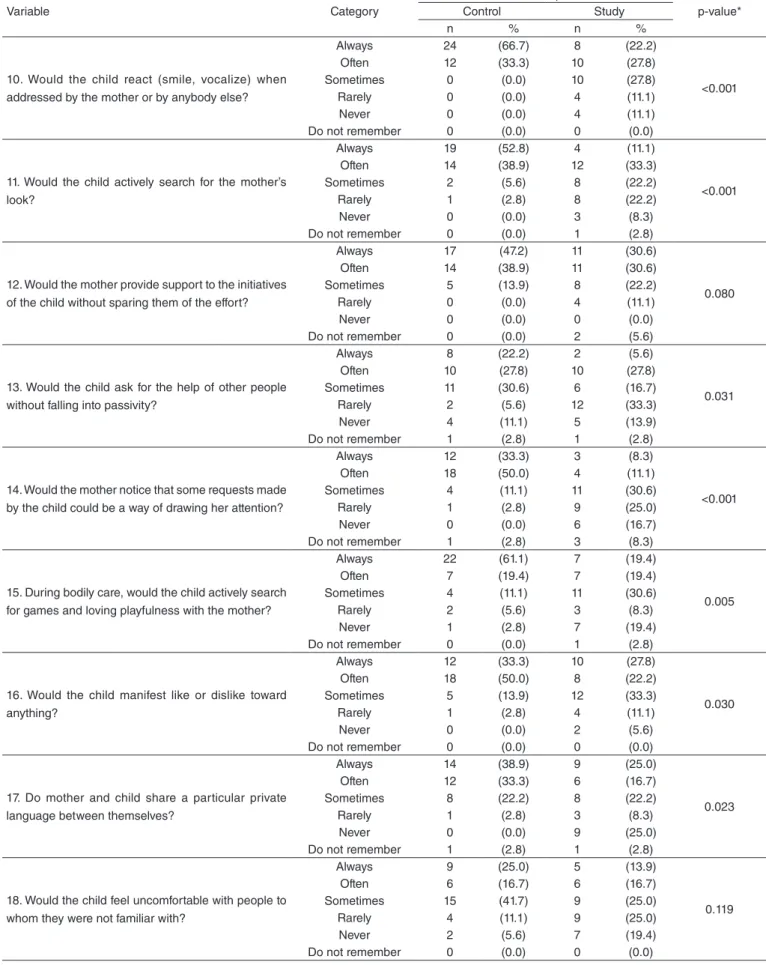
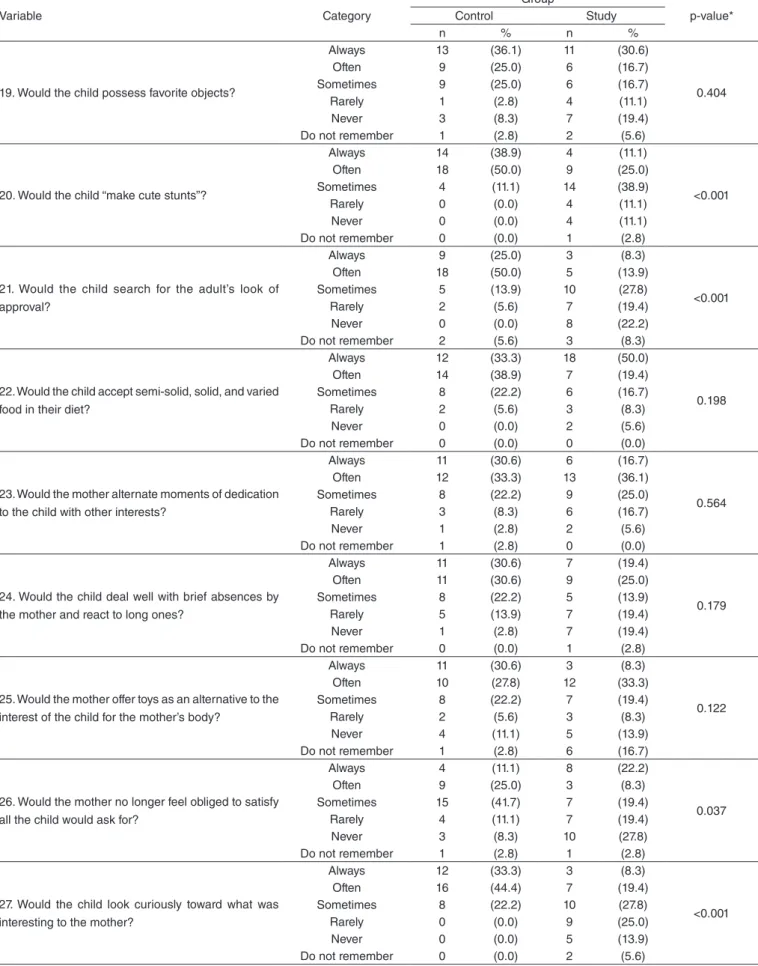
The comparison between the groups has shown differ-ences in 16 questions, which can be seen in Table 3.
A higher proportion of children in the CG whose parents answered “always” to the question of whether there was an exchange of glances between the child and the mother, when compared to the answers of parents of children with ASD (p=0.006). According to parents, the likelihood of the child “always,” when requesting their mother, wait for their mother’s response was higher in the CG in relation to the SG (p=0.002).
It was also found that the CG children were more likely to react (smile, vocalize) when the mother or other per-son addressed them when compared to children with ASD (p<0.001). Children in the CG had a higher proportion in the reaction of “actively search for their mother’s look” in relation to those with ASD (p<0.001). In the same way, the proportion of children who would “always” ask for help from someone else instead of remaining passive was higher in the CG (p=0.031).
In the CG, there is a higher proportion of children whose mothers “always” perceived that some requests from the child could be a way to draw their attention, when compared to the answers of parents of children with ASD (p<0.001).
The answers of the parents indicate that the probability of the child “always” actively seeking games and loving playfulness with their mother, during physical care pro-cedures, was higher in the CG when compared to that in the SG (p=0.005).
According to parents, children in the CG are more likely to “always” show like or dislike toward something when compared to those in the SG (p=0.030). It is observed that in the CG the probability of mothers and children sharing a particular and private language between themselves was higher than that in the SG (p=0.023). It is also observed that the CG children are more likely to “make cute stunts” when compared to those of the SG (p<0.001). Likewise, from the parents’ answers, it is noticeable that the CG children are more likely to get the look of approval from the adult when compare to those with ASD (p<0.001).
The parent responses indicate that 27.8% of the moth-ers of children with ASD “never” felt not obliged to ful-fill everything the child would ask for, whereas 8.3% of the mothers of children in the CG felt the same (p=0.037).
In the answers of the parents, it is still possible to see that the probability of the child looking with curiosity toward what interests the mother was higher in the CG (p<0.001). Therefore, in the comparison between the studied groups, through the IRDIquestionnaire, it was possible to distin-guish children with ASD from the ones presenting typical development, considering the 16 (of the 31) questions that were statistically significant.
Table 1. Number and percentual of children according to the study group, gender, and school education
Variable
Group
p-value* Control Study
n (%) n (%)
Gender
Male 23 (63.9) 29 (80.6) 0.114
Female 13 (36.1) 7 (19.4)
Parents’ school education
Incomplete grade school 3 (8.3) 6 (16.7) 0.690 Complete grade school 2 (5.6) 3 (8.3)
Incomplete high school 3 (8.3) 2 (5.6) Complete high school 11 (30.6) 13 (36.1) Incomplete higher education 5 (13.9) 4 (11.1) Complete higher education/
college degree
7 (19.4) 6 (16.7)
Incomplete graduate school 3 (8.3) 0 (0) Complete graduate school 2 (5.6) 2 (5.6) Informant
Mother 31 (86.1) 34 (94.4) 0.429
Father 5 (13.9) 2 (5.6)
Total 36 (100) 36 (100)
*χ2 test
Table 2. Description of age at the time of the diagnosis and time elapsed between the diagnosis and the administration of the questionnaire, only for the Study Group
Variable n Mean
(SD)
Median (Min–Max) Age at the time of the diagnosis 36 42.5 (7.5) 43.5 (29.0–57.0) Time elapsed between the diagnosis and
the administration of the questionnaire
36 20.3 (15.0) 20.0 (0–46.0)
Continues...
Table 3. Number and percentage of children according to group and questions of the Clinical Risk Indicators for Child Development questionnaire (1–31)
Variable Category
Group
p-value*
Control Study
n % n %
1. When the child would cry or scream, did the mother know what they wanted?
Always 9 (25.0) 13 (36.1)
0.072
Often 18 (50.0) 8 (22.2)
Sometimes 7 (19.4) 10 (27.8)
Rarely 0 (0.0) 4 (11.1)
Never 1 (2.8) 1 (2.8)
Do not remember 1 (2.8) 0 (0.0)
2. Would the mother speak to the child in a style directed particularly to them (“motherese”)?
Always 15 (41.7) 10 (27.8)
0.737
Often 9 (25.0) 12 (33.3)
Sometimes 8 (22.2) 8 (22.2)
Rarely 3 (8.3) 3 (8.3)
Never 1 (2.8) 2 (5.6)
Do not remember 0 (0.0) 1 (2.8)
3. Would the child react to the motherese?
Always 14 (38.9) 9 (25.0)
0.278
Often 9 (25.0) 6 (16.7)
Sometimes 8 (22.2) 8 (22.2)
Rarely 4 (11.1) 7 (19.4)
Never 1 (2.8) 4 (11.1)
Do not remember 0 (0.0) 2 (5.6)
4. Would the mother propose anything to the child and wait for their reaction?
Always 13 (36.1) 12 (33.3)
0.779
Often 14 (38.9) 15 (41.7)
Sometimes 7 (19.4) 6 (16.7)
Rarely 1 (2.8) 2 (5.6)
Never 0 (0.0) 1 (2.8)
Do not remember 1 (2.8) 0 (0.0)
5. Was there any exchange of looks (eye contact) between the child and the mother?
Always 25 (69.4) 16 (44.4)
0.006
Often 10 (27.8) 5 (13.9)
Sometimes 1 (2.8) 5 (13.9)
Rarely 0 (0.0) 8 (22.2)
Never 0 (0.0) 1 (2.8)
Do not remember 0 (0.0) 1 (2.8)
6. Would the child start to differ day from night?
Always 11 (30.6) 12 (33.3)
0.005
Often 12 (33.3) 4 (11.1)
Sometimes 9 (25.0) 4 (11.1)
Rarely 1 (2.8) 5 (13.9)
Never 0 (0.0) 8 (22.2)
Do not remember 3 (8.3) 3 (8.3)
7. Would the child use different signals in order to express their different needs?
Always 9 (25.0) 6 (16.7)
0.100
Often 14 (38.9) 8 (22.2)
Sometimes 10 (27.8) 10 (27.8)
Rarely 2 (5.6) 4 (11.1)
Never 0 (0.0) 6 (16.7)
Do not remember 1 (2.8) 2 (5.6)
8. Would the child request their mother and make a pause in order to wait for the mother’s response?
Always 12 (33.3) 5 (13.9)
0.002
Often 9 (25.0) 3 (8.3)
Sometimes 10 (27.8) 6 (16.7)
Rarely 2 (5.6) 12 (33.3)
Never 1 (2.8) 8 (22.2)
Do not remember 2 (5.6) 2 (5.6)
9. Would the mother address to the child using short sentences?
Always 17 (47.2) 15 (41.7)
0.368
Often 11 (30.6) 17 (47.2)
Sometimes 6 (16.7) 3 (8.3)
Rarely 0 (0.0) 1 (2.8)
Never 1 (2.8) 0 (0.0)
Table 3. Continuation
Continues...
Variable Category
Group
p-value*
Control Study
n % n %
10. Would the child react (smile, vocalize) when addressed by the mother or by anybody else?
Always 24 (66.7) 8 (22.2)
<0.001
Often 12 (33.3) 10 (27.8)
Sometimes 0 (0.0) 10 (27.8)
Rarely 0 (0.0) 4 (11.1)
Never 0 (0.0) 4 (11.1)
Do not remember 0 (0.0) 0 (0.0)
11. Would the child actively search for the mother’s look?
Always 19 (52.8) 4 (11.1)
<0.001
Often 14 (38.9) 12 (33.3)
Sometimes 2 (5.6) 8 (22.2)
Rarely 1 (2.8) 8 (22.2)
Never 0 (0.0) 3 (8.3)
Do not remember 0 (0.0) 1 (2.8)
12. Would the mother provide support to the initiatives of the child without sparing them of the effort?
Always 17 (47.2) 11 (30.6)
0.080
Often 14 (38.9) 11 (30.6)
Sometimes 5 (13.9) 8 (22.2)
Rarely 0 (0.0) 4 (11.1)
Never 0 (0.0) 0 (0.0)
Do not remember 0 (0.0) 2 (5.6)
13. Would the child ask for the help of other people without falling into passivity?
Always 8 (22.2) 2 (5.6)
0.031
Often 10 (27.8) 10 (27.8)
Sometimes 11 (30.6) 6 (16.7)
Rarely 2 (5.6) 12 (33.3)
Never 4 (11.1) 5 (13.9)
Do not remember 1 (2.8) 1 (2.8)
14. Would the mother notice that some requests made by the child could be a way of drawing her attention?
Always 12 (33.3) 3 (8.3)
<0.001
Often 18 (50.0) 4 (11.1)
Sometimes 4 (11.1) 11 (30.6)
Rarely 1 (2.8) 9 (25.0)
Never 0 (0.0) 6 (16.7)
Do not remember 1 (2.8) 3 (8.3)
15. During bodily care, would the child actively search for games and loving playfulness with the mother?
Always 22 (61.1) 7 (19.4)
0.005
Often 7 (19.4) 7 (19.4)
Sometimes 4 (11.1) 11 (30.6)
Rarely 2 (5.6) 3 (8.3)
Never 1 (2.8) 7 (19.4)
Do not remember 0 (0.0) 1 (2.8)
16. Would the child manifest like or dislike toward anything?
Always 12 (33.3) 10 (27.8)
0.030
Often 18 (50.0) 8 (22.2)
Sometimes 5 (13.9) 12 (33.3)
Rarely 1 (2.8) 4 (11.1)
Never 0 (0.0) 2 (5.6)
Do not remember 0 (0.0) 0 (0.0)
17. Do mother and child share a particular private language between themselves?
Always 14 (38.9) 9 (25.0)
0.023
Often 12 (33.3) 6 (16.7)
Sometimes 8 (22.2) 8 (22.2)
Rarely 1 (2.8) 3 (8.3)
Never 0 (0.0) 9 (25.0)
Do not remember 1 (2.8) 1 (2.8)
18. Would the child feel uncomfortable with people to whom they were not familiar with?
Always 9 (25.0) 5 (13.9)
0.119
Often 6 (16.7) 6 (16.7)
Sometimes 15 (41.7) 9 (25.0)
Rarely 4 (11.1) 9 (25.0)
Never 2 (5.6) 7 (19.4)
Table 3. Continuation
Continues...
Variable Category
Group
p-value*
Control Study
n % n %
19. Would the child possess favorite objects?
Always 13 (36.1) 11 (30.6)
0.404
Often 9 (25.0) 6 (16.7)
Sometimes 9 (25.0) 6 (16.7)
Rarely 1 (2.8) 4 (11.1)
Never 3 (8.3) 7 (19.4)
Do not remember 1 (2.8) 2 (5.6)
20. Would the child “make cute stunts”?
Always 14 (38.9) 4 (11.1)
<0.001
Often 18 (50.0) 9 (25.0)
Sometimes 4 (11.1) 14 (38.9)
Rarely 0 (0.0) 4 (11.1)
Never 0 (0.0) 4 (11.1)
Do not remember 0 (0.0) 1 (2.8)
21. Would the child search for the adult’s look of approval?
Always 9 (25.0) 3 (8.3)
<0.001
Often 18 (50.0) 5 (13.9)
Sometimes 5 (13.9) 10 (27.8)
Rarely 2 (5.6) 7 (19.4)
Never 0 (0.0) 8 (22.2)
Do not remember 2 (5.6) 3 (8.3)
22. Would the child accept semi-solid, solid, and varied food in their diet?
Always 12 (33.3) 18 (50.0)
0.198
Often 14 (38.9) 7 (19.4)
Sometimes 8 (22.2) 6 (16.7)
Rarely 2 (5.6) 3 (8.3)
Never 0 (0.0) 2 (5.6)
Do not remember 0 (0.0) 0 (0.0)
23. Would the mother alternate moments of dedication to the child with other interests?
Always 11 (30.6) 6 (16.7)
0.564
Often 12 (33.3) 13 (36.1)
Sometimes 8 (22.2) 9 (25.0)
Rarely 3 (8.3) 6 (16.7)
Never 1 (2.8) 2 (5.6)
Do not remember 1 (2.8) 0 (0.0)
24. Would the child deal well with brief absences by the mother and react to long ones?
Always 11 (30.6) 7 (19.4)
0.179
Often 11 (30.6) 9 (25.0)
Sometimes 8 (22.2) 5 (13.9)
Rarely 5 (13.9) 7 (19.4)
Never 1 (2.8) 7 (19.4)
Do not remember 0 (0.0) 1 (2.8)
25. Would the mother offer toys as an alternative to the interest of the child for the mother’s body?
Always 11 (30.6) 3 (8.3)
0.122
Often 10 (27.8) 12 (33.3)
Sometimes 8 (22.2) 7 (19.4)
Rarely 2 (5.6) 3 (8.3)
Never 4 (11.1) 5 (13.9)
Do not remember 1 (2.8) 6 (16.7)
26. Would the mother no longer feel obliged to satisfy all the child would ask for?
Always 4 (11.1) 8 (22.2)
0.037
Often 9 (25.0) 3 (8.3)
Sometimes 15 (41.7) 7 (19.4)
Rarely 4 (11.1) 7 (19.4)
Never 3 (8.3) 10 (27.8)
Do not remember 1 (2.8) 1 (2.8)
27. Would the child look curiously toward what was interesting to the mother?
Always 12 (33.3) 3 (8.3)
<0.001
Often 16 (44.4) 7 (19.4)
Sometimes 8 (22.2) 10 (27.8)
Rarely 0 (0.0) 9 (25.0)
Never 0 (0.0) 5 (13.9)
DISCUSSION
The importance of using screening and tracking tools for the early diagnosis of ASD is widely discussed in the litera-ture(11-16,18,20-22). However, these instruments should have some
basic features such as being easy to be applied, with simple questions and answers, being lowincost and being effective in the tracking which it is proposed to(14,19).
The use of the IRDIquestionnaire, in the sample stud-ied, showed itself to be adequate in relation to the under-standing of the questions and the pattern of answers given by the interviewees, as well as being quick and easy to be applied. The IRDI questionnaire showed good internal consistency. This result is consistent with other reliability studies of instruments used for the screening and diagnosis of ASD: Autism Screening Questionnaire, CARS-BR (the Brazilian version of the Childhood Autism Rating Scale) and Childhood Autism Rating Scale(20,23,24).
The results show that many of the questions whose answers had statistical signiicance include important signs of risk for ASD, such as the exchange of looks, shared attention, and social interaction.
The matter of exchange of glances or looks between the child and the mother addresses a sign of ASD widely studied in the literature(1,5,13,14,25). Besides the IRDIquestionnaire, some
other studies also deal with the subject of the gaze and shared attention in subsequent age groups.
In a study that examined the discriminative ability of the IRDl questionnaires among ASD, mental retardation, and nor-mality by administering the instrument to family videos of chil-dren who were later on diagnosed with autism, the author found compatible results when verifying that the average chance of an autistic baby to show like or dislike toward something is 1.82 times higher than that of a normal baby(21).
Another study of family movies of children who were later on diagnosed with autism found that the social proile of an autistic baby differs from that of a normal baby when consid-ering the average duration of glances addressed to the parents and the duration and frequency of social smiling(26).
The literature is vast and consensual when pointing out the deicits in social skills and in shared attention as strong early signs of ASD(16,27). Thus, the studies corroborate the results
obtained here by claiming that, in children with ASD, the lack of interest in social stimuli is characterized by reduced fre-quency of eye contact; these children having a preference for non-social stimuli, manifested by directing the gaze preferen-tially to objects and not to individuals, along with the lack of interest in sharing attention(16,27-29).
An important concept introduced by Laznik et al.(30)
regarding the three stages of the instinctive cycle is dis-cussed in Question 15 of the IRDIquestionnaire. According to the authors, the subjective constitution is given in three stages: the irst stage, called active, is the one in which the baby goes in search of the external object (oral) in order *χ2 test
Table 3. Continuation
Variable Category
Group
p-value*
Control Study
n % n %
28. Would the child like to play with objects used by the parents?
Always 14 (38.9) 3 (8.3)
0.002
Often 13 (36.1) 10 (27.8)
Sometimes 7 (19.4) 9 (25.0)
Rarely 0 (0.0) 8 (22.2)
Never 1 (2.8) 5 (13.9)
Do not remember 1 (2.8) 1 (2.8)
29. Would the mother request the child to name what they wanted, not settling for gestures alone?
Always 16 (44.4) 14 (38.9)
0.287
Often 9 (25.0) 16 (44.4)
Sometimes 7 (19.4) 2 (5.6)
Rarely 2 (5.6) 2 (5.6)
Never 2 (5.6) 1 (2.8)
Do not remember 0 (0.0) 1 (2.8)
30. Would the parents impose minor behavior rules to the child?
Always 18 (50.0) 12 (33.3)
0.302
Often 12 (33.3) 16 (44.4)
Sometimes 6 (16.7) 5 (13.9)
Rarely 0 (0.0) 1 (2.8)
Never Do not remember
0 0
(0.0) (0.0)
2 0
(5.6) (0.0)
31. Would the child differentiate their parents’ objects from their own?
Always 9 (25.0) 3 (8.3)
<0.001
Often 16 (44.4) 5 (13.9)
Sometimes 9 (25.0) 9 (25.0)
Rarely 0 (0.0) 11 (30.6)
Never 0 (0.0) 6 (16.7)
Do not remember 2 (5.6) 2 (5.6)
to seize it. The second stage, the relective and self-erotic one, is the one in which the child takes the object as a part of their own body (e.g., thumb/hand sucking). The third stage is the one in which the child is offered as the object of another sub-ject (e.g., when the baby stretches their foot toward the mother’s mouth and the two of them experience a shared pleasure in this game). According to the author, the autistic child does not reach the third stage of the cycle(30). Without denying the effect of the
organic factors involved in this clinical panorama, the failure in settling the third stage of the instinctive cycle suggests that the possibility of placing themselves in someone’s place, when the baby offers themselves as an object to others, does not occur in the case of autistic children(30).
The IRDIquestionnaire also contains some questions con-cerning the participation of the mother and her attitudes in rela-tion to their child’s behavior. The results of this study showed that two among these were noticeable after the statistical anal-ysis conducted. To that extent, worth noting is the peculiarity introduced by the research that has elaborated the IRDI, includ-ing the relationship between mother and baby to the center of observation, differently from what predominantly occurs when it comes to signs of risk for ASD, focusing their observation solely on the child(18,21,22).
The results obtained here differ from those of the multi-center study conducted with the IRDI, which showed a group of 15 indicators with the ability to predict the risk for child development, out of which only 5 would match those indicated in this study, according to the adopted criterion for statistical signiicance. This might be because the present study focused on children with ASD, unlike what happened with the research mentioned, which has focused its attention on the problems of child development more broadly.
In the same vein, it is noteworthy that the issues that have the “motherese” theme have not been highlighted in the sta-tistical analysis performed in this study. The studies in psy-cholinguistics of the prosody of mothers of children with autism show signiicant differences in the melodic curves analyzed — a fact that certainly served as base for the inclu-sion of items that address this aspect in the preparation of the IRDI(30). However, in a study conducted with the application
of the IRDl questionnaires to family videos, there were also no differences in the analysis of these items, which was attrib-uted, in the study, to the possibility that the ability to respond to the calling by others is not yet affected in the autistic group from 0 to 3 months of age(27).
From the indings presented, it appears that much of the content of the IRDIquestionnaire is consistently referenced in the literature, emphasizing signs of signiicant risk for ASD. Thus, it is suggested that this instrument may support future researches on the subject, particularly as to the early diagnosis of ASD.
This study has some limitations. The irst of them refers to the sample number, which must be increased in future researches to verify if the results agree with those obtained here.
It is noteworthy that other researches with the instrument are in progress, including one comparing it to another instru-ment considered to be of goldstandard for diagnosis.
CONCLUSION
This research started from the inding that the delay in language development is one of the most common concerns of parents of chil-dren with ASD, which is why the Speech-Language Pathologist is, in many cases, the irst professional sought by the family. Thus, the role of these professionals in identifying the potential risk for ASD and the importance of their conduct as to redirecting the patients toward relevant clinical care are evident.
Aiming to support and endorse such actions, this research presented a proposal for the adapting of the IRDI into a retro-spective questionnaire for parents (IRDIquestionnaire).
It was found that the questionnaire items covered the main early clinical signs reported in the literature. It was also notice-able that the answers by the parents have pointed out signii-cant differences between the SG and the CG.
The application of the IRDIquestionnaire also included an important recommendation as to identiication, tracking, and sorting tools: ease of application and low cost, enabling their use on a large scale.
Other studies with the IRDIquestionnaire are recommended, aiming at the understanding of its scope and limitations. Therefore, it is suggested that studies with the IRDIquestionnaire should continue, so that it can be effectively validated and used as a tool for tracking ASD.
*FPM and MCC were responsible for deining the design of the study; FPM performed the data collection and literature survey, which were analyzed and discussed together with MCC and RRRP.
REFERENCES
1. Volkmar FR, Pauls D. Autism. Lancet. 2003;362(9390):1133-41. 2. Thurm A, Lord C, Lee LC, Newschaffer C. Predictors of language
acquisition in preschool children with autism spectrum disorders. J Autism Dev Disord. 2007;37:1721-34.
3. Eigsti IM, Bennetto L, Dadlani MB. Beyond pragmatics: morphosyntactic development in autism. J Autism Dev Disord. 2007;37:1007-23.
4. Weismer SE, Lord C, Esler A. Early language patterns of toddlers on the autism spectrum compared to toddlers with developmental delay. J Autism Dev Disord. 2010;40:1259-73.
5. Matson JL, Wilkins J, Gonzalez M. Early identiication and diagnosis in autism spectrum disorders in young children and infants: how early is too early? Res Autism Spectr Disord. 2008;2:75-84.
6. Wetherby AM, Woods J, Allen L, Cleary J, Dickinson H, Lord C. Early indicators of autism spectrum disorders in the second year of life. J Autism Dev Disord. 2004;34(5):473-93.
7. Dewrang P, Sandberg AD. Parental retrospective assessment of development and behavior in Asperger syndrome during the irst 2 years of life. Res Autism Spectr Disord. 2010;4:461-73.
8. Horovitz M, Matson JL, Tuygin N, Beighley JS. The relationship between gender and age of irst concern in toddlers with autism spectrum disorders. Res Autism Spectr Disord. 2012;6:466-71.
9. Levy SE, Mandell DS, Schultz RT. Autism. Lancet. 2009; 374(9701):1627-38.
11. Matson JL, Beighley J, Turygin N. Autism diagnosis and screening: factors to consider in differential diagnosis. Res Autism Spectr Disord. 2012;6:19-24.
12. Itzchak EB, Zachor DA. Who beneits from early intervention in autism spectrum disorders? Res Autism Spectr Disord. 2011;5:345-50. 13. LoVullo SV, Matson JL. Development of a critical item algorithm for the
baby and infant screen for children with autism traits. Res Autism Spectr Disord. 2012;6(1):378-84.
14. Reznick JS, Baranek GT, Watson LR, Crais ER. A parent-report instrument for identifying one-year-olds at risk for eventual diagnosis of autism: the irst year inventory. J Autism Dev Disord. 2007;37:1691-710. 15. Rogers SJ, Hepburn S, Wehner E. Parent reports of sensory symptoms
in toddlers with autism and those with other developmental disorders. J Autism Dev Disord. 2003;33(6):631-42.
16. Clifford SM, Dissanayake C. The early development of joint attention in infants with autistic disorder using home video observations and parental interview. J Autism Dev Disord. 2008;38:791-805.
17. Sousa EC, Lima FT, Tamanaha AC, Perissinoto J, Azevedo MF, Chiari BM. A associação entre a suspeita inicial de perda auditiva e a ausência de comunicação verbal em crianças com transtornos do espectro autístico. Rev Soc Bras Fonoaudiol. 2009;14(4):487-90.
18. Kupfer MCM, Jerusalinsky AN, Bernardino LF, Wanderlet D, Rocha PSP, Molina SE, et al. Valor preditivo de indicadores clínicos de risco para o desenvolvimento infantil: um estudo a partir da teoria psicanalítica. Rev Latinoam Psicopatol Fundam. 2010;13(1):31-52.
19. American Psychiatric Association. Manual Diagnóstico e Estatístico de Transtornos Mentais – DSM-IV-TR – Texto Revisado. Porto Alegre: Artes Médicas; 2002.
20. Sato FP. Validação da versão em português de um questionário para avaliação de autismo infantil [dissertação]. São Paulo: Universidade de São Paulo; 2008.
21. Pesaro ME. Alcance e limites teórico-metodológicos da pesquisa multicêntrica de indicadores clínicos de risco para o desenvolvimento infantil [tese]. São Paulo: Universidade de São Paulo; 2010.
22. Lerner R. Indicadores clínicos de risco para o desenvolvimento infantil – IRDI: verificação da capacidade discriminativa entre autismo, retardo mental e normalidade [livre-docência]. São Paulo: Universidade de São Paulo; 2011.
23. Pereira A, Riesgo RS, Wagner MB. Autismo infantil: tradução e validação da Childhood Autism Rating Scale para uso no Brasil. J Pediatr (Rio J). 2008;84(6):487-94.
24. Shopler E, Reichler RJ, Devellis RF, Daly K. Toward objective classiication of childhood autism: Childhood Autism Rating Scale (CARS). J Autism Dev Disord. 1980;10:91-103.
25. Poon KK, Watson LR, Baranek GT, Poe MD. To what extent do joint attention, imitation, and object play behaviors in infancy predict later communication and intellectual functioning in ASD? J Autism Dev Disord. 2012;42(6):1064-74.
26. Brisson J, Serres J, Gattegno MP, Adrien JL. Étude des troubles précoces du contact social à partir de l’ánalyse des ilms familiaux chez des nourrissons de la naissance à 6 mois ultérieurement diagnostiqués autistes. Devenir. 2011;23(1):87-106.
27. Ward S, Gilmore L. The autistic behavioural indicators instrument (ABII): development and instrument utility in discriminating autistic disorder from speech and language impairment and typical development. Res Autism Spectr Disord. 2010;4:28-42.
28. Maestro S, Muratori F, Cesari A, Cavallaro M, Paziente A, Pecini E, et al. Course of autism signs in the irst year of life. Psychopathology. 2005;38:26-31.
29. Toth K, Munson J, Meltzoff AN, Dawson G. Early predictors of communication development in young children with autism spectrum disorder: joint attention, imitation, and toy play. J Autism Dev Disord. 2006;36:993-1005.