Correspondence: Elif Börekci, Bozok University, School of Medicine, Department of Internal Medicine Yozgat/Turkey, Email: [email protected]
Received: 30.July.2015, Accepted: 19. September.2015
Copyright © Journal of Microbiology and Infecious Diseases 2016, All rights reserved
Journal of Microbiology and Infectious Diseases / 2016; 6 (1): 38-39
JMID doi: 10.5799/ahinjs.02.2016.01.0213
L E T T E R TO E D I TO R
A Rare Cause of Gastrointestinal Bleeding: Crimean-Congo Haemorrhagic
Fever Disease
Elif Börekçi1, Mehmet Çelikbilek2, Tuğba Özdemir1, Çiğdem Kader3, Hasan Börekçi4
1 Department of Internal Medicine, Bozok University, School of Medicine, Yozgat, Turkey 2 Department of Gastroenterology, Bozok University, School of Medicine, Yozgat, Turkey
3 Department of Infectious Diseases and Clinical Microbiology , Bozok University, School of Medicine, Yozgat, Turkey 4 Department of General Surgery, Bozok University, School of Medicine, Yozgat, Turkey
Dear Editor,
Crimean-Congo Haemorrhagic Fever (CCHF) dis-ease is a viral haemorrhagic fever syndrome pres-ent in Turkey since 2002 [1]. CCHF is transmitted by ticks and can be fatal. Thrombocytopenia and coagulopathy can develop and, because of severe bleeding in the gastrointestinal tract, the prognosis is poor. After 3-7 days of incubation, fever, head-ache, fatigue, generalised muscle pain, nausea, vomiting, and skin and mucosal haemorrhages can occur [2]. J Microbiol Infect Dis 2016;6(1): 38-39
Key words: CCHF, endoscopy, gastrointestinal bleeding
An 83-year-old male patient was admitted to our emergency department because of weakness, fatigue, and generalised muscle pain 4 days in dura-tion. He was a retired worker living close to the pine area in Yozgat and he was not deal with animals. Upon physical examination, he was hypotensive
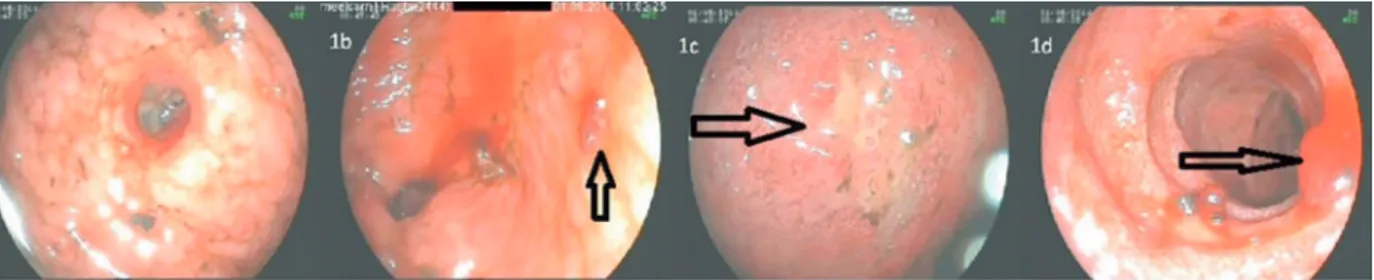
and tachycardic, and ecchymotic areas of haemor-rhage were widespread in both the lower and upper extremities and the body. His body temperature was 37.6°C. Laboratory indings were: leukocytes 2,710/ mm3, haemoglobin: 10.9 g/dL, platelets: 23,000/ mm3, creatine kinase 156 mg/dL, lactate dehydro-genase 569 IU/L, C-reactive protein 54 mg/L, acti-vated partial thromboplastin time 44.5 s, prothrom-bin time 10.4 s, and international normalised ratio= 0.8. Melena was present. Upper gastrointestinal endoscopy revealed supericial erosions with ooz-ing haemorrhages in the oesophagus, and multiple oozing bleeding ulcers up to 7-8 mm in diameter with adherent fresh blood clots in the stomach and duodenum (Figure 1). There was no history of con-tact with ticks, but living in the endemic area, and the current laboratory and clinical indings brought to mind of the CCHF disease in the differential di-agnosis. Our suspicion of CCHF was conirmed by polymerase chain reaction. Upon supportive care, the patient improved in about one week.
Figure 1: Upper gastrointestinal endoscopic images showing mucosal haemorrhages caused by CCHF. 1a: the corpus of the stomach, 1b: the antrum of the stomach, 1c: the duodenal bulb, 1 d: the second portion of the duodenum.
To protect healthcare workers from the risk of CCHF infection, any marked combination of clinical features-such as thrombocytopenia, fever, myalgia,
Borekci E, et al. CCHF and gastrointestinal bleeding 39
J Microbiol Infect Dis www.jmidonline.org Vol 6, No 1, March 2016
Declaration of Conlicting Interests: No con-lict of interest of any author exists.
Financial Disclosure: The authors declared no inancial support.
REFERENCES
1. Gönen I, Ermiş F. Crimean-Congo hemorrhagic fever present
-ing with gastrointestinal manifestations: two cases. Turk J Gastroenterol. 2014 ;25:120-121.