63
REV BRAS EPIDEMIOL SEP 2015; 18 SUPPL 1: 63-88
ABSTRACT: Introduction: It is known that a single prevention strategy is not enough to control multiple HIV epidemics around the world and in Brazil. However, it is not only necessary to recognize the importance of condoms as part of the policy of HIV/AIDS prevention but also discuss its limits. In this article, we aim to investigate the use of condoms in Brazil, draw critical relections, and understand how they can once again be highlighted in Brazil’s prevention strategy going forward. Methods: A narrative review of literature was conducted using keywords in PubMed. Reports from national surveys that guide the epidemiological and behavioral surveillance of the Brazilian Ministry of Health were also included. Results: A total of 40 articles and 3 reports were included in the review and 11 intervention studies to promote the condom use; the main indings were as follows: 1) Despite the increase in national studies on sexual behavior, little attention is given to the role of condom use; 2) There are few studies examining the factors associated with condom use among key populations such as men who have sex with men (MSM), female sex workers (FSW), drug users (DU), and transvestites and transexuals (TT), while substantial studies focus on adolescents and women; 3) Evidence suggests that a combination of interventions is more efective. Discussion: new prevention technologies must not lose sight of the critical importance of condoms, and eforts to reintroduce them should focus on the role of pleasure in addition to their potential to minimize the risk of HIV.
Keywords: Condoms. HIV. Acquired Immunodeiciency Syndrome. Disease Prevention. Prevalence. Brazil.
Revisiting the use of condoms in Brazil
Revisitando o uso do preservativo no Brasil
Inês DouradoI, Sarah MacCarthyII, Manasa ReddyII, Gabriela CalazansIII,IV, Soia GruskinII
IInstituto de Saúde Coletiva, Universidade Federal da Bahia – Salvador (BA), Brazil.
IIProgram on Global Health and Human Rights, University of Southern California – Los Angeles (CA), United States. IIISchool of Medical Sciences, Santa Casa de São Paulo – São Paulo (SP), Brazil.
IVSchool of Medicine, Universidade de São Paulo – São Paulo (SP) Brazil.
Corresponding author: Inês Dourado. Instituto de Saúde Coletiva, Universidade Federal da Bahia. Rua Basílio da Gama, s/n, Campus do Canela, CEP 40110-140, Salvador, BA, Brazil. E-mail: [email protected]
Conlict of interests: nothing to declare – Financial support: none.
64
INTRODUCTION
The male condom has played a key role in the ight against HIV/AIDS around the world and in Brazil1. Early in the epidemics, these used to be distributed at certain moments of the year such as Carnival and the “World Day Against AIDS” or through research projects. In 1994, the wide and systematic distribution started, in addition to the purchase of the most male condoms and lubricant gels by the Brazilian National Health System2,3, coordinated by the National STD/AIDS Program, currently Department of STD/AIDS/HIV and Viral Hepatitis (DDAHV) of the Ministry of Health.
Over the past 35 years, the ield of HIV prevention has undergone several transfor-mations. Today, it is argued that efective HIV prevention requires a combination of behavioral, biomedical, and structural intervention strategies. It is known that a single prevention strategy is not enough to control multiple HIV epidemics around the world and in Brazil. To the global extent, there are high expectations on the so-called “new prevention technologies” or “biomedical prevention technologies” (circumcision, micro-bicides, postexposure prophylaxis – PEP, and preexposure prophylaxis – PrEP), in addition to behavioral strategies (such as sero-positioning, sero-adaptation, and other forms of agreement between sexual partners)4-7.
At the same time, the country is experiencing an increasing HIV prevalence among young people, especially men who have sex with men (MSM)8; high prevalence of HIV
RESUMO: Introdução: No âmbito da atual política de prevenção do HIV/AIDS é necessário reconhecer a importância do preservativo masculino e discutir seus limites. Esse artigo objetivou investigar o uso do preservativo masculino no Brasil e elaborar relexões críticas sobre o papel do mesmo no novo contexto da prevenção do HIV/AIDS. Métodos: Revisão narrativa sobre o uso do preservativo masculino no Brasil em diferentes grupos populacionais e fatores associados ao uso, por meio de buscas realizadas entre março e abril de 2013, utilizando-se descritores em inglês categorizados na base PubMed. Incluíram-se também documentos provenientes de inquéritos nacionais que orientam a vigilância epidemiológica e comportamental do Ministério da Saúde. Resultados: Incluí-se 40 artigos e 3 relatórios para caracterizar a produção de conhecimentos e outros 11 estudos de intervenção para promoção do uso de preservativos. Observou-se que: 1) apesar do aumento de estudos nacionais, estes apresentam baixa regularidade; 2) há poucos estudos sobre fatores associados ao uso de preservativo entre os grupos nos quais a epidemia se concentra, como homens que fazem sexo com homens (HSH), trabalhadoras sexuais (TS), usuários de drogas (UD) e travestis e transexuais (TT), e concentração entre adolescentes e mulheres; 3) combinação de intervenções mostrou-se mais efetiva do que uma só. Discussão: A relexão e discussão do uso do preservativo no âmbito das novas tecnologias de prevenção devem não só enfatizar a importância do mesmo, mas também considerar o papel do prazer e do sexo nas intervenções combinadas, além do potencial de redução do risco de infecção por HIV.
65
REV BRAS EPIDEMIOL SEP 2015; 18 SUPPL 1: 63-88
is also noted in some population groups in vulnerable contexts (MSM, sex workers – SW, drug users – DU, and transvestites and transsexuals – TT)9-12, currently referred to as key populations13, in addition to downward trend in the consistent use of condoms14. It is, thus, necessary to recognize the importance of condoms as part of the HIV/AIDS prevention policy and to discuss its limits.
This article aimed to investigate the use of condoms in Brazil and to make critical relec-tions on their role in the new context of HIV/AIDS prevention.
METHODS
We conducted a literature review15,16 aiming at the use of condoms in Brazil as a strat-egy for HIV/AIDS prevention in different population groups, the factors associated with its use, and the actions taken to promote the use of male condoms. To draw up a more organized search of documents, guaranteeing sensitivity (including the largest number of documents) and specificity (excluding documents not related to the study purposes), we used descriptors in English previously defined and categorized in PubMed database (MeSH Terms) and keywords used by authors in publications identified in the explor-atory readings on the theme (Chart 1). Titles and abstracts were read when addressing condom use as the main outcome variable. Searches were carried out between March
Descriptor Pubmed Search Term
Brazil Brazil OR Brasil
condom use (male or female)
“Condoms/supply and distribution”[Mesh] OR “Condoms/trends”[Mesh] OR “Condoms/utilization”[Mesh] OR condom [tiab]
condom use (female)
“Condoms, Female/supply and distribution”[Mesh] OR “Condoms, Female/ trends”[Mesh] OR "Condoms, Female/utilization”[Mesh]
HIV/AIDS “HIV Infections”[Mesh] OR HIV OR aids OR Acquired Immunodeiciency Syndrome
Sex workers “sex worker” [MeSH] OR “sex worker” OR prostitute*
Drug users (“substance-related disorders”[MeSH Terms] OR “injection drug use”)
Men who have sex with men
(“men who have sex with men” OR “males who have sex with males” OR MSM OR homosexual* OR bisexuality OR homosexuality male)
Transgender individuals
(“transsexualism”[MeSH Terms] OR “transsexualism”[All Fields] OR “transgender”[All Fields])
Adolescents (“adolescent”[MeSH Terms] OR “adolescent”[All Fields] OR “youth”[All Fields] OR “young men” OR “young women”)
66
and April 2013, and articles with full-text available were kept in the sample, all of them published between 2000 and 2013.
We also included documents from national surveys that guide the epidemiological and behavioral surveillance of the DDAHV, and included condom use as one of the main out-comes, such as in the “Sexual Behavior and Perceptions of the Brazilian Population on HIV/AIDS” survey conducted in 1998 and 2005, in a representative sample of the popu-lation aged 16 – 65 years, by the Brazilian Center for Analysis and Planning (CEBRAP)17; and in on the knowledge, attitudes, and practices related to STD and AIDS (PCAP), house-hold survey undertaken in 2004 and 2008 among a representative sample of the population aged 15–64 years14,18,19, surveys among conscripts of the Brazilian Army8,20, and behavioral surveillance surveys among key populations9,12,21,22.
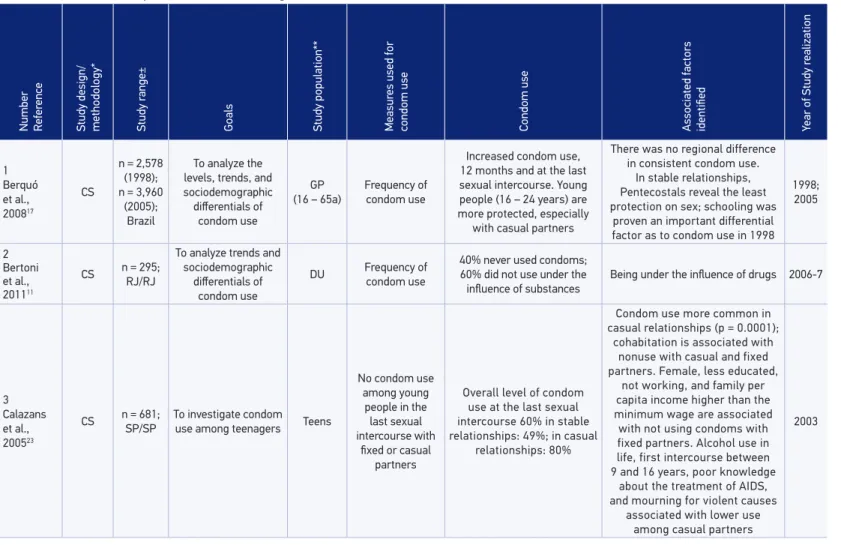
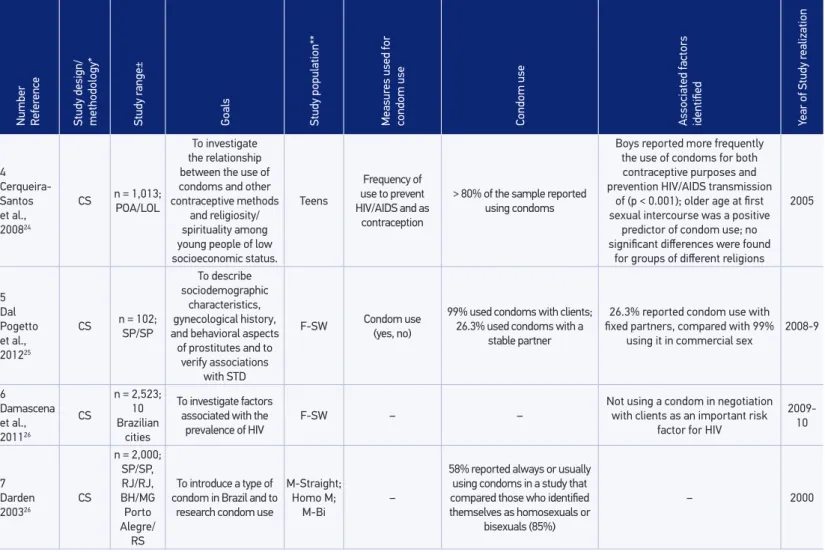
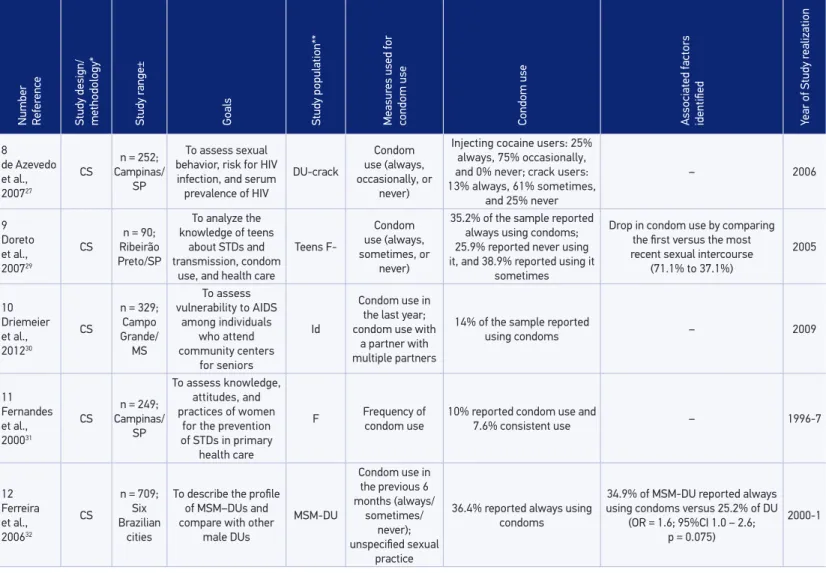
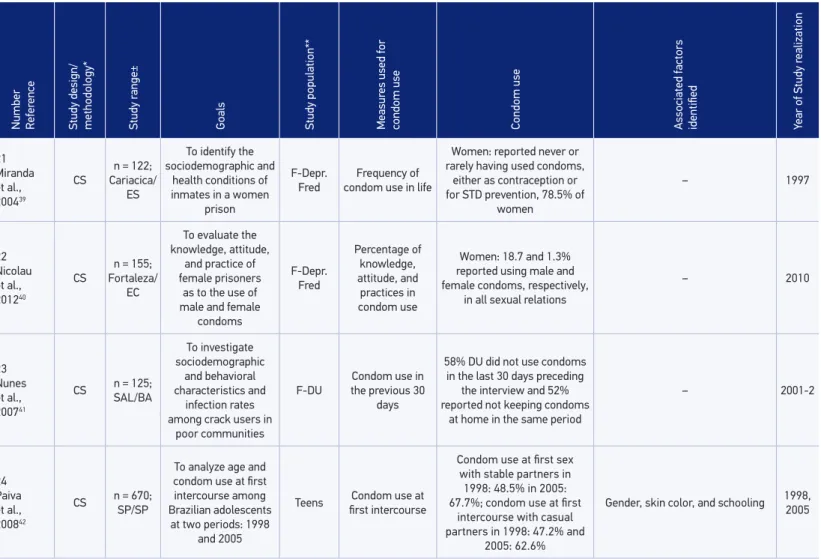
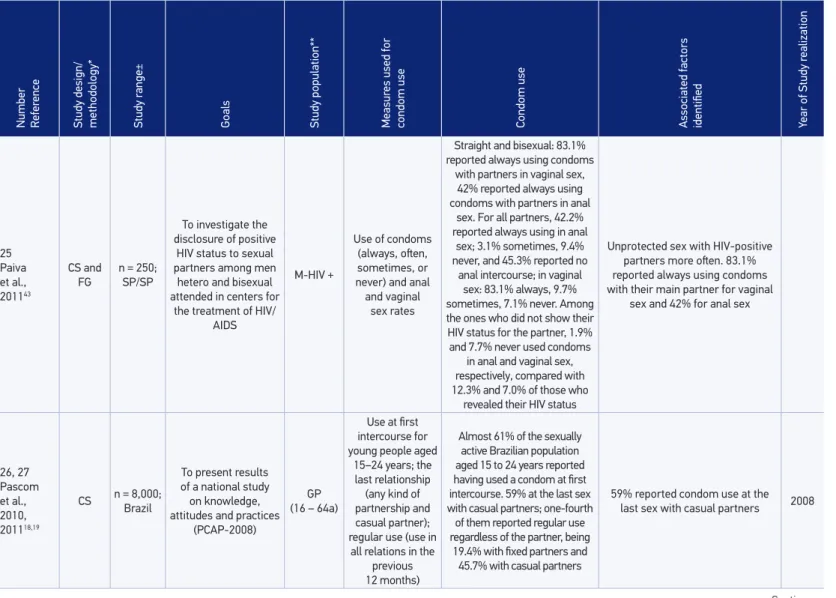
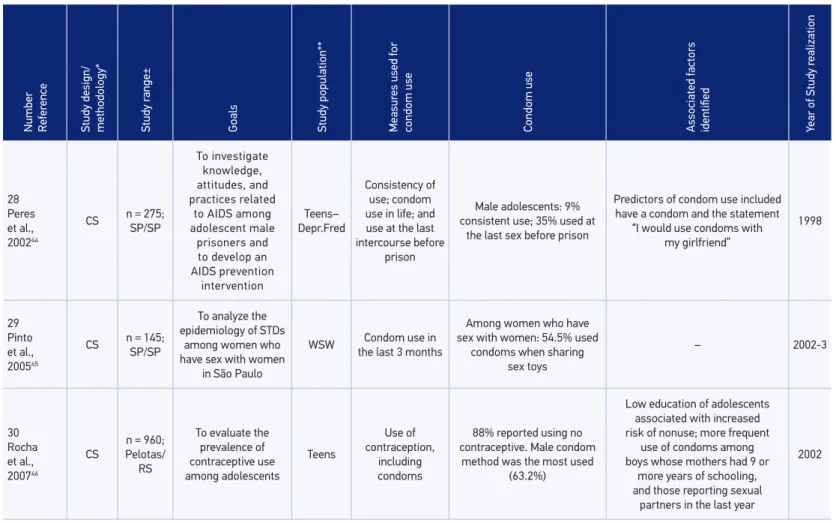
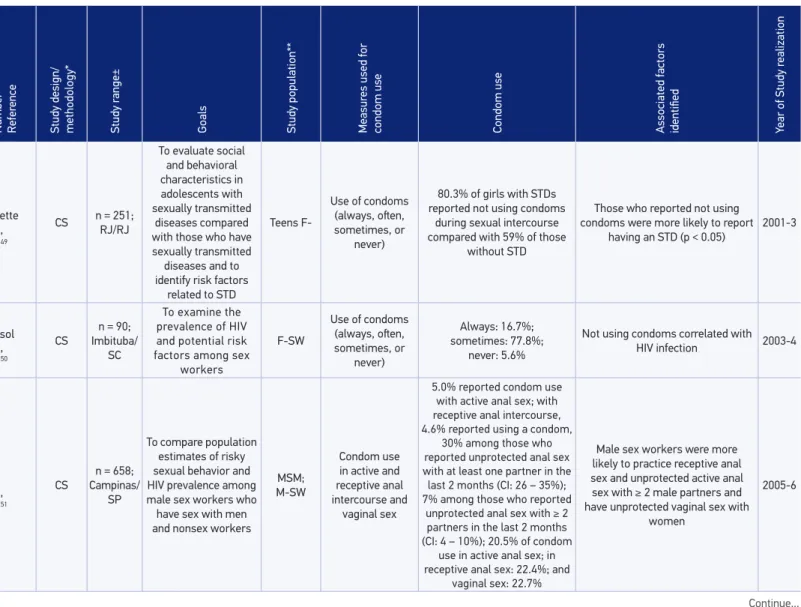
Information about the characteristics of the scientiic literature on the use of male con-doms was organized in Table 1. Factors associated with condom use were organized by population group and sexual practice in Table 2. Tables 3 and 4 summed up data on the efects of combined and single interventions to promote condom use. Exclusion criteria were:
1. studies that did not report the proportion of condom use (even if changes in attitudes and knowledge had been reported) and
2. if no intervention component had been performed in Brazil.
RESULTS
A total of 40 papers8,9,11,17-21,23-54 (Table 1) and 3 DDAHV reports were included in this article to describe the production of knowledge about the use of condoms in Brazil and associated factors. The reports were not included in Table 1, but condom use information from the PCAP report14, the national study of crack users12, and the RDS-TS study22 were described. Studies addressing the type of intervention to encourage condom use were also identiied: combined interventions- ive studies29,55-58 (Table 3) and only one intervention- eight studies53,57,59-64 (Table 4).
FEATURES OF THE PRODUCTION OF KNOWLEDGE ABOUT THE USE OF CONDOMS
A critical reading of the production of knowledge about condom use in Brazil over the past 13 years leads us to the following summarization:
67
Number Refer
ence
Study design/ methodology* Study r
ange±
Goals Study population** Measur
es used for
condom use Condom use Associated factors identiied Year of Study r
ealization
1
Berquó
et al.,
200817
CS
n = 2,578 (1998); n = 3,960
(2005);
Brazil
To analyze the levels, trends, and sociodemographic
diferentials of
condom use
GP
(16 – 65a)
Frequency of
condom use
Increased condom use,
12 months and at the last
sexual intercourse. Young
people (16 – 24 years) are
more protected, especially with casual partners
There was no regional difference
in consistent condom use. In stable relationships, Pentecostals reveal the least
protection on sex; schooling was proven an important differential factor as to condom use in 1998
1998; 2005
2
Bertoni et al.,
201111
CS n = 295;
RJ/RJ
To analyze trends and sociodemographic
diferentials of
condom use
DU Frequency of
condom use
40% never used condoms; 60% did not use under the
inluence of substances Being under the inluence of drugs 2006-7
3
Calazans et al.,
200523
CS n = 681;
SP/SP
To investigate condom use among teenagers Teens
No condom use among young
people in the last sexual intercourse with
ixed or casual
partners
Overall level of condom
use at the last sexual
intercourse 60% in stable relationships: 49%; in casual
relationships: 80%
Condom use more common in
casual relationships (p = 0.0001);
cohabitation is associated with
nonuse with casual and fixed
partners. Female, less educated,
not working, and family per
capita income higher than the minimum wage are associated with not using condoms with
fixed partners. Alcohol use in life, first intercourse between 9 and 16 years, poor knowledge
about the treatment of AIDS, and mourning for violent causes
associated with lower use among casual partners
2003 Table 1. Features of the production of knowledge related to male condom use in Brazil, 2000 – 2013.
Number Refer
ence
Study design/ methodology* Study r
ange±
Goals Study population** Measur
es used for
condom use Condom use Associated factors identiied Year of Study r
ealization
4
Cerqueira-Santos et al.,
200824
CS n = 1,013; POA/LOL
To investigate the relationship
between the use of
condoms and other contraceptive methods
and religiosity/ spirituality among
young people of low
socioeconomic status. Teens
Frequency of
use to prevent HIV/AIDS and as
contraception
> 80% of the sample reported
using condoms
Boys reported more frequently the use of condoms for both
contraceptive purposes and prevention HIV/AIDS transmission
of (p < 0.001); older age at irst
sexual intercourse was a positive
predictor of condom use; no signiicant diferences were found
for groups of diferent religions 2005
5
Dal Pogetto et al.,
201225
CS n = 102;
SP/SP
To describe sociodemographic
characteristics, gynecological history, and behavioral aspects
of prostitutes and to verify associations
with STD
F-SW Condom use
(yes, no)
99% used condoms with clients; 26.3% used condoms with a
stable partner
26.3% reported condom use with ixed partners, compared with 99%
using it in commercial sex
2008-9
6
Damascena et al.,
201126
CS
n = 2,523; 10
Brazilian cities
To investigate factors
associated with the
prevalence of HIV
F-SW – –
Not using a condom in negotiation
with clients as an important risk factor for HIV
2009-10
7 Darden
200326
CS
n = 2,000;
SP/SP, RJ/RJ, BH/MG Porto Alegre/ RS
To introduce a type of
condom in Brazil and to research condom use
M-Straight; Homo M;
M-Bi
–
58% reported always or usually
using condoms in a study that
compared those who identiied
themselves as homosexuals or
bisexuals (85%)
– 2000
Table 1. Continuation.
69
Number Refer
ence
Study design/ methodology* Study r
ange±
Goals Study population** Measur
es used for
condom use Condom use Associated factors identiied Year of Study r
ealization 8 de Azevedo et al., 200727 CS
n = 252;
Campinas/ SP
To assess sexual
behavior, risk for HIV infection, and serum prevalence of HIV
DU-crack
Condom use (always, occasionally, or
never)
Injecting cocaine users: 25% always, 75% occasionally, and 0% never; crack users: 13% always, 61% sometimes,
and 25% never
– 2006 9 Doreto et al., 200729 CS
n = 90;
Ribeirão Preto/SP
To analyze the
knowledge of teens
about STDs and transmission, condom
use, and health care
Teens
F-Condom use (always, sometimes, or
never)
35.2% of the sample reported always using condoms; 25.9% reported never using it, and 38.9% reported using it
sometimes
Drop in condom use by comparing
the irst versus the most
recent sexual intercourse
(71.1% to 37.1%)
2005 10 Driemeier et al., 201230 CS
n = 329;
Campo Grande/ MS
To assess vulnerability to AIDS
among individuals who attend community centers
for seniors
Id
Condom use in
the last year;
condom use with a partner with multiple partners
14% of the sample reported
using condoms – 2009
11 Fernandes et al.,
200031
CS
n = 249;
Campinas/ SP
To assess knowledge,
attitudes, and
practices of women for the prevention of STDs in primary
health care
F Frequency of
condom use
10% reported condom use and
7.6% consistent use – 1996-7
12
Ferreira et al.,
200632
CS
n = 709;
Six Brazilian
cities
To describe the proile of MSM–DUs and
compare with other male DUs
MSM-DU
Condom use in
the previous 6
months (always/ sometimes/
never); unspeciied sexual
practice
36.4% reported always using
condoms
34.9% of MSM-DU reported always using condoms versus 25.2% of DU
(OR = 1.6; 95%CI 1.0 – 2.6; p = 0.075)
2000-1
Table 1. Continuation.
Number Refer
ence
Study design/ methodology* Study r
ange±
Goals Study population** Measur
es used for
condom use Condom use Associated factors identiied Year of Study r
ealization
13
Fialho et al.,
200833
CS n = 300;
SALT/BA
To assess the
prevalence of STDs
and blood-borne infections among adolescents deprived of freedom Teens-Depr.Fred Condom use (always, sometimes, and never)
27% never used
Those who reported using condoms
were signiicantly less likely to report a previous STD (OR = 0.06,
95%CI 0.01 – 0.61; p < 0.01)
2004-5
14
Filipe et al.,
200534
CS n = 250;
SP/SP
To describe the
risk perception and behavior of HIV-+ve
men who had sex
with women before knowing they had HIV
M-HIV + Consistent
condom use
Condom with women before diagnosis: 22.6% among heterosexual men; 34.7%
among bisexual men
Consistent use reported by 23% of heterosexuals and 35% of bisexual
men (p < 0.05)
2001-2002 15 Greco et al., 200735
CS n = 1,025; BH/MG
To describe bisexual men’s behavior and sexual identity,
condom use,
frequency of sexual
intercourse, and
types of partners
and to determine inconsistent condom use rates according to
the partner’s sex
M-Bi
Inconsistent rate
of condom use
during active and receptive anal sex
35% of inconsistent condom use for active anal sex with a ixed male partner; around
60% reported condom use with stable partner; between 68 and 86% reported condom use with casual partners; 55% of inconsistent condom use in receptive anal sex with ixed
male partner
Active anal sex associated with
lower rates of inconsistent
condom use 1994-2005 16 Harrison et al., 199936 CHS
n = 753 followed up for 1.5 years; RJ/
RJ
To evaluate the
incidence of HIV in a cohort of adult MSM
MSM Rate of use in
receptive anal sex
59.6% and 43.6% among
serum positive and serum negative, respectively, who practiced unprotected
receptive anal sex
– 1995-7
Table 1. Continuation.
71
Number Refer
ence
Study design/ methodology* Study r
ange±
Goals Study population** Measur
es used for
condom use Condom use Associated factors identiied Year of Study r
ealization
17 Juarez & Le Grand,
200538
CS Recife/PE–;
To study condom use
among boys at irst
intercourse
M-Teens living in slums
Age at irst
intercourse and
factors associated
with not using condoms
– associated with condom use among Highest SSE was positively male adolescents – 18 Kerr et al., 20129 CS
n = 3,859; 10
Brazilian cities
Conducting national
survey of behavioral surveillance of HIV
among adult MSM in Brazil
MSM
Unspeciied type of sexual practice.
Condom use with all partners,
condom use with casual or
commercial partners in
the previous 6 months; and
condom use at the last sexual intercourse with a
man or woman
Proportion of protected sex with all partners ranged from
30.1% in Manaus to 55.3% in Santos; Proportion of
protected sex between casual
partners ranged from 50.0% in Curitiba to 77.7% in Campo
Grande – 2009 19 Lazzarotto et al., 200837 CS
n = 510;
Vale dos Sinos/RS
To evaluate the
knowledge about HIV/
AIDS in community groups
Elderly
Knowledge about condoms and
condom use
86.3% did not use condoms, but it is unclear if this was
because of sexual inactivity – 2005
20
Martins et al.,
200638
CS n = 1,594; SP/SP
To compare knowledge
about STD/AIDS and
to identify factors
associated with
adequate knowledge
and consistent use
of male condoms in teenagers from public
and private schools
Teens
Condom use (always, most
oten, occasionally, and never)
Consistent condom use was
60% in private schools and 57.1% in public schools
Consistent condom use associated with male gender and lower
socioeconomic status; consistent
use was higher in private schools
(p < 0.05)
–
Table 1. Continuation.
Number Refer
ence
Study design/ methodology* Study r
ange±
Goals Study population** Measur
es used for
condom use Condom use Associated factors identiied Year of Study r
ealization
21
Miranda et al.,
200439
CS
n = 122;
Cariacica/
ES
To identify the
sociodemographic and
health conditions of
inmates in a women prison
F-Depr. Fred
Frequency of condom use in life
Women: reported never or rarely having used condoms,
either as contraception or
for STD prevention, 78.5% of
women
– 1997
22
Nicolau et al.,
201240
CS
n = 155;
Fortaleza/
EC
To evaluate the
knowledge, attitude, and practice of female prisoners
as to the use of male and female
condoms
F-Depr. Fred
Percentage of knowledge,
attitude, and practices in condom use
Women: 18.7 and 1.3%
reported using male and
female condoms, respectively,
in all sexual relations
– 2010
23
Nunes et al.,
200741
CS n = 125;
SAL/BA
To investigate sociodemographic
and behavioral characteristics and
infection rates among crack users in
poor communities
F-DU
Condom use in
the previous 30
days
58% DU did not use condoms in the last 30 days preceding
the interview and 52% reported not keeping condoms
at home in the same period
– 2001-2
24
Paiva et al.,
200842
CS n = 670;
SP/SP
To analyze age and
condom use at irst
intercourse among Brazilian adolescents
at two periods: 1998 and 2005
Teens Condom use at
irst intercourse
Condom use at irst sex
with stable partners in
1998: 48.5% in 2005: 67.7%; condom use at irst
intercourse with casual
partners in 1998: 47.2% and 2005: 62.6%
Gender, skin color, and schooling 1998, 2005
Table 1. Continuation.
73
Number Refer
ence
Study design/ methodology* Study r
ange±
Goals Study population** Measur
es used for
condom use Condom use Associated factors identiied Year of Study r
ealization
25
Paiva et al.,
201143
CS and FG
n = 250;
SP/SP
To investigate the
disclosure of positive
HIV status to sexual partners among men hetero and bisexual
attended in centers for the treatment of HIV/
AIDS
M-HIV +
Use of condoms (always, oten,
sometimes, or
never) and anal
and vaginal sex rates
Straight and bisexual: 83.1%
reported always using condoms with partners in vaginal sex,
42% reported always using
condoms with partners in anal
sex. For all partners, 42.2%
reported always using in anal
sex; 3.1% sometimes, 9.4% never, and 45.3% reported no
anal intercourse; in vaginal sex: 83.1% always, 9.7% sometimes, 7.1% never. Among
the ones who did not show their
HIV status for the partner, 1.9% and 7.7% never used condoms
in anal and vaginal sex, respectively, compared with
12.3% and 7.0% of those who
revealed their HIV status
Unprotected sex with HIV-positive
partners more oten. 83.1%
reported always using condoms
with their main partner for vaginal sex and 42% for anal sex
26, 27
Pascom et al.,
2010, 201118,19
CS n = 8,000; Brazil
To present results
of a national study on knowledge,
attitudes and practices
(PCAP-2008)
GP
(16 – 64a)
Use at irst intercourse for
young people aged
15–24 years; the
last relationship
(any kind of
partnership and
casual partner);
regular use (use in all relations in the
previous
12 months)
Almost 61% of the sexually
active Brazilian population
aged 15 to 24 years reported having used a condom at irst intercourse. 59% at the last sex with casual partners; one-fourth
of them reported regular use regardless of the partner, being
19.4% with ixed partners and 45.7% with casual partners
59% reported condom use at the
last sex with casual partners 2008 Table 1. Continuation.
Number Refer
ence
Study design/ methodology* Study r
ange±
Goals Study population** Measur
es used for
condom use Condom use Associated factors identiied Year of Study r
ealization
28
Peres et al.,
200244
CS n = 275;
SP/SP
To investigate
knowledge,
attitudes, and practices related
to AIDS among adolescent male
prisoners and to develop an AIDS prevention
intervention
Teens–
Depr.Fred
Consistency of use; condom use in life; and
use at the last
intercourse before
prison
Male adolescents: 9% consistent use; 35% used at
the last sex before prison
Predictors of condom use included
have a condom and the statement “I would use condoms with
my girlfriend”
1998
29
Pinto et al.,
200545
CS n = 145;
SP/SP
To analyze the
epidemiology of STDs
among women who have sex with women
in São Paulo
WSW Condom use in
the last 3 months
Among women who have
sex with women: 54.5% used
condoms when sharing sex toys
– 2002-3
30
Rocha et al.,
200746
CS
n = 960;
Pelotas/ RS
To evaluate the
prevalence of
contraceptive use among adolescents
Teens
Use of
contraception, including condoms
88% reported using no
contraceptive. Male condom method was the most used
(63.2%)
Low education of adolescents
associated with increased
risk of nonuse; more frequent use of condoms among
boys whose mothers had 9 or
more years of schooling,
and those reporting sexual partners in the last year
2002
Table 1. Continuation.
75
Number Refer
ence
Study design/ methodology* Study r
ange±
Goals Study population** Measur
es used for
condom use Condom use Associated factors identiied Year of Study r
ealization
31
Rocha et al.,
201321
CS
n = 3,449; 10
Brazilian cities
To investigate factors
associated with unprotected sex among MSM
MSM
Factors associated with unprotected sex
47% of unprotected anal sex
story
Association between unprotected receptive
anal sex in the 6 months before
the study: living with a male
partner; using illicit drugs; having
stable partners or having stable
and casual trading partners; sex only with male partners; reporting that no or few friends encouraged condom use;
homosexual/gay/MSM
identity; and being considered at high or moderate risk
for HIV infection
2009-10
32
Silva et al.,
200247
IS
n = 25;
Campinas/ SP
To develop a STD/AIDS prevention program
among professional
soccer players
Teens
Consistent condom use with
casual partners compared with
ixed partners
73% of young athletes
consistently used condoms with casual partners
– 1998/
1999
33,34
Szwarcwald et al.,
2005, 20078,20
CS
1997– 2002: n = 30,970;
2007; n = 35,432;
Brazil
To assess sexual
behavior of young
Brazilian boys aged
17 – 20 years
Conscripts; (17 – 20
years)
Using condoms during sexual
intercourse
–
Decreased regular use of condoms in relations with ixed and casual
partners compared with the study
of 1999 – 2002
1997-2002 E 2007
Table 1. Continuation.
Number Refer
ence
Study design/ methodology* Study r
ange±
Goals Study population** Measur
es used for
condom use Condom use Associated factors identiied Year of Study r
ealization
35 Taquette
et al.,
200549
CS n = 251;
RJ/RJ
To evaluate social and behavioral characteristics in adolescents with sexually transmitted
diseases compared with those who have sexually transmitted
diseases and to
identify risk factors
related to STD
Teens
F-Use of condoms (always, oten,
sometimes, or
never)
80.3% of girls with STDs
reported not using condoms during sexual intercourse
compared with 59% of those
without STD
Those who reported not using
condoms were more likely to report having an STD (p < 0.05)
2001-3
36
Trevisol et al.,
200550
CS
n = 90;
Imbituba/ SC
To examine the
prevalence of HIV and potential risk factors among sex
workers
F-SW
Use of condoms (always, oten,
sometimes, or
never)
Always: 16.7%; sometimes: 77.8%;
never: 5.6%
Not using condoms correlated with
HIV infection 2003-4
37
Tun et al.,
200851
CS
n = 658;
Campinas/ SP
To compare population
estimates of risky
sexual behavior and HIV prevalence among
male sex workers who
have sex with men
and nonsex workers
MSM;
M-SW
Condom use in active and receptive anal intercourse and
vaginal sex
5.0% reported condom use with active anal sex; with receptive anal intercourse, 4.6% reported using a condom,
30% among those who reported unprotected anal sex with at least one partner in the last 2 months (CI: 26 – 35%); 7% among those who reported
unprotected anal sex with ≥ 2 partners in the last 2 months (CI: 4 – 10%); 20.5% of condom
use in active anal sex; in receptive anal sex: 22.4%; and
vaginal sex: 22.7%
Male sex workers were more likely to practice receptive anal
sex and unprotected active anal
sex with ≥ 2 male partners and
have unprotected vaginal sex with women
2005-6
Table 1. Continuation.
77
Number Refer
ence
Study design/ methodology* Study r
ange±
Goals Study population** Measur
es used for
condom use Condom use Associated factors identiied Year of Study r
ealization
38
Viana et al.,
200752
CS n = 600;
BH/MG
To assess the factors associated with safe sex
among sexually active public school students
Teens
Consistent condom use with casual and
ixed partner
51–54% reported always using condoms with regular or ixed
partners; 57–61% reported
always using condoms with casual partners
Being a male, attended by health
professionals in school activities, and mother’s education > 8 years was
positively associated with consistent
condom use with casual or ixed
partner. Secondary education (versus
fundamental) and older age were
inversely associated with consistent
condom use with casual and ixed
partners, respectively
2000
39
Villarinho et al.,
200253
CS and
equalizer
n = 279;
Santos/ SP
To describe the
vulnerability of sexual transmission of HIV/
AIDS among truck
drivers
M-Straight
truck
Consistency of
condom use by sex
and type of partner: ixed, frequent, or
casual
Condom use reported with key partners (6.0%) (regardless
of the type of intercourse). With regular partners: 56.6%
in vaginal sex, 45.0% in anal sex and 6.4% in oral sex; with casual partners: 67% in vaginal sex, 54% in anal sex and 46% in
oral sex
– 1998
Intervention assessment
40
Diaz et al.,
200528
CS
n = 763; RJ/RJ; n = 819; BH/MG; n = 714,
SAL/BA
To compare opinions and sexual practices among students in
schools with and without sex education
programs
Teens Current condom use
Between 41.0% and 57.0% of
sexually active adolescents reported condom use
Education on sexual physiology,
contraception, sexuality, and gender
roles. Adjusted OR of condom
use among sex education groups compared with controls:
RJ: OR = 1.07; 95%CI 0.64 – 1.77; BH: OR = 0.83; 95%CI 0.51 – 1.36; SSA: OR = 1.08; 95%CI 0.51 – 2.28
1997 Table 1. Continuation.
Fatores General
Population MSM
Sex
workers
Drug
users Teens Women Indians Seniors Conscripts
Associated with increased condom use
Male X X
Younger ages X X X
Higher education X
Multiple partners in the recent past X X X X
Single X X
With casual partners (vs. ixed or regular partners) X
Mother’s education > 8 years X
Having or buying condoms X X
Already took condoms for free X
Associated with decreased condom use
Married or in a stable relationship X X
Initiation of sexual activity before 14 years X X
Not informed about HIV/AIDS X
Negative attitudes toward condom X Not knowing someone with AIDS and not
engaging in gay NGOs X
Being MSM X
Contradictory results
Years of schooling X
Religion X
Socioeconomic status X
Other factors relevant to the groups, but no quantiication of the efect on condom use Incorrect beliefs about the use of condoms and
STDs X X
Condom use as contraceptive X
Gender relations X X
Situations of violence X
Table 2. Factors associated with condom use by diferent population groups.
79
Type Population Efect size Reference
Availability of condoms MSM Sexo anal desprotegido diminuiu 18% (p < 0,001) Sampaio et al., 200257
Sex education program in schools in and out of classrooms
Teens
Condom use with casual partners has doubled; use of other contraceptive methods in the last sexual intercourse increased by 68% (p = 0.033)
Andrade et al., 200959
Contraceptive use in the intervention vs. control group (OR): • The irst sexual relationship: 3.2% higher comparing men:
1.06 (CI 0.75 – 1.49); and women: 0.79 (CI 0.51 – 1.24) • In the most recent sexual intercourse: 2.7% higher, comparing men:
1.03 (CI 0.62 – 1.73); 1.14 and women (CI 0.59 – 2.18) • Condom use at the last sexual intercourse: OR among men:
1.00 (0.60 – 1.66); among women: 0.95 (0.56 – 1.59)
Magnani et al., 200160
Consistent use (always) of condom with casual or ixed partners at least 3% higher among those who received sex education,
but it was not statistically signiicant Viana et al., 2007
53
Workshops on the female
condom, STD/HIV Women
Condom use at the last sexual intercourse (male or female condom)
increased by 4% (p < 0.000) Barbosa et al., 200761
Sex education by peers Sex workers
Condom use in the previous week increased by 36% (p < 0.001) Benzaken et al., 200762
Condom use with all clients in the last four months increased by 1.4% (p = 0.287)
Condom use with all partners (customers or not) last week decreased by 1.6% (p = 0.808)
Kerrigan et al., 200863
Structured discussion on
condom use MSM Unprotected anal intercourse decreased (p = 0.029)
Colosio et al., 200764
MSM: men who have sex with men.
Type Population Efect size Reference
Group conversations about sex work, discrimination, human rights, and STD/HIV
in a social living space;
Workshops on sex education carried out by peers at the time of study and visits at 3, 6,
9, and 12 months of follow-up
Sex workers (women, (men and
transvestites)
Incidence of unprotected sex in the last week comparing the efect of interventions between:
• Women: 1.10 (0.90; 1.30); • Men: 0.15 (0.03; 0.68); • Transsexuals: 0.40 (0:05; 2.90)
Lippman et al., 201055
Sex education by peers
Talking about condom use
Teens
Odds ratio adjusted for sex education: • Rio: 1.07 (CI 0.64 – 1.77); • Belo Horizonte: 0.83 (CI 0.51 – 1.36);
• Salvador: 1.08 (CI 0.51 – 2.28)
Diaz et al., 200529
Sex education by peers
Structured discussion (workshops) about condom use and safe sex
Young adults (18–25 years)
Efect of workshops on safe sex was statistically signiicant for girls; ater the intervention, lower frequency of unprotected
sex with casual partners, with partners that they thought that were not monogamous and
anal sex with regular partners (p ≤ 0.05)
Antunes et al., 200256
MSM Unprotected anal sex decreased by 18%
(p < 0.001) Sampaio et al., 200257
DU 29% increase in condom use with vaginal sex
(p = 0.02) Pechansky et al., 200758
MSM: men who have sex with men; DU: drug users.
81
REV BRAS EPIDEMIOL SEP 2015; 18 SUPPL 1: 63-88
2. Studies on factors associated with condom use among population groups in which the epidemics is concentrated in Brazil, such as MSM, DU, and TT, date back to 2009.
3. There is a concentration of studies among adolescents.
4. Effective interventions to encourage the use of condoms indicated that, combination of interventions was more effective than the concentration in a specific practice; there is a need, however, for further studies to understand and produce evidence on how to effectively handle these interventions to increase the use and adherence to condom (Tables 3 and 4).
5. National surveys investigating the general population (CEBRAP and PCAP) were carried out in 1998, 2004, 2005, and 2008; conscripts surveys took place from 1997 – 2000, 2002, and the last one in 2007. Studies on speciic populations (MSM, SW, and DU) were a survey for each population between 2008 and 2009. In the last 4 years, there were virtually no studies on the use of condoms promoted and/or inanced by DDAHV.
WHAT IS KNOWN ABOUT THE USE OF CONDOMS AND ASSOCIATED FACTORS?
Condom use rates differ substantially between the national surveys. Those con-ducted by CEBRAP indicated: an increase of 19.1% (1998) to 33.1% (2005) in the proportion of the use in sex encounters with steady partners in the 12 months preced-ing the interview; lower condom use rate among individuals with higher education in contrast to the use rate among those with secondary education; association between sexual debut of those aged between 15 and 16 years and decreased use of condoms, especially among those who initiated sex before 14 years of age; and increased use of condoms in sexual debut among those aged 16 – 19 years, comparing with the data collected in 1998 and 200517.
Data from PCAP showed a downward trend in condom use at the last sexual inter-course in the 12 months before the survey comparing the years of the study (38.4% versus 36.8%), despite the fact that knowledge about the use of condoms has remained high in 2004 and 2008; higher proportions of use among young people; and an increased use among them at first intercourse, when comparing the different versions of PCAP (53.2% versus 60.9%)14.
These studies highlight a diverse set of factors associated with the use of condoms among diferent groups. With regard to the general population, data from PCAP indicated associa-tions between regular condom use (in all sexual relaassocia-tions in the 12 months before the survey) and: being a man; aged 15 – 24 years; having received condoms for free; and not living with a partner14,18,19. Importantly, studies show a greater diiculty in keeping condom use in the context of relationships considered stable by the parties involved23,65,66.
82
use with lower SES, Juarez et al.38 indicated that higher SES was positively associated with condom use among male adolescents. With regard to religion, Berquó et al.17 found greater adherence to condom use among Brazilians who reported no religion, while Viana et al.53 reported greater adherence, although not signiicantly higher, among Catholic students compared with students who identiied themselves as evangelicals or linked to other or no religion (Table 2).
When considering the groups in which the epidemics is concentrated, MSM use condoms more often when compared with heterosexuals14. Recently, monitoring and surveillance studies in key populations, with sampling technique directed by the par-ticipant [the respondent-driven sampling (RDS)], were used to obtain more detailed information about HIV/AIDS among MSM, with 47% of them reporting unprotected anal sex, and associations between unprotected receptive anal sex in the 6 months before the study and: living with a male partner; using illicit drugs; having stable partners or having stable and casual trading partners; having sex only with male partners; no or few friends encouraging condom use; homosexual/gay/MSM identity; and being con-sidered at high or moderate risk for HIV infection21.
In the report of FSW study with RDS, the proportion of regular use (in all sexual rela-tions) of condoms with steady partners in the practice of vaginal and anal sex was 21.4% and 29.4%, respectively. The use with clients in during vaginal and anal sex was 69.7% and 64%, respectively22.
Studies about SW are concentrated in women, and few identify factors associated with condom use. Most of them describe the proportion of use in different situa-tions or refer to not using condoms as a risk factor for HIV infection. The RDS study indicated nonuse of condoms when negotiating with clients as an important risk fac-tor for HIV25,26,51.
With respect to drug users, about 40% of them reported never using condoms, with an increase to 60% when under inluence of psychoactive substances11. But, there are no recent publications on injecting drug users (IDUs) — at least indexed studies. The most recent survey funded by the National Secretariat of Policies for Drugs (SENAD) of the Ministry of Justice among crack and/or similar drug users in 26 Brazilian capitals and the Federal District was conducted between 2011 and 2013. In this study, more than one-third (39.5%) of crack/similar drug users in Brazil reported not having used a condom in vaginal inter-courses in the previous month before the interview12.
83
REV BRAS EPIDEMIOL SEP 2015; 18 SUPPL 1: 63-88
lower educational levels; the increase in the composite risk behavior (average number of partners in the previous year, weighted by the proportion of nonuse of condoms in accordance with the type of relationships participants maintain); and the lower pro-portion of condom use among young MSM8.
KEY FINDINGS FROM INTERVENTION STUDIES: WHAT WORKS TO PROMOTE CONDOM USE?
We identiied proposals of intervention that have been proven efective to encourage condom use (Tables 3 and 4)29,53,55-58,60-64. These include a combination of interventions to improve the adherence to condoms and to support groups to discuss their use and negotia-tion. A combination of interventions was more efective than focusing on a speciic practice (Table 3). Participating in support groups that discuss strategies to promote the use of con-dom and mobilize the negotiation has been signalized as an important factor to increase the acceptability and conidence of women in bringing condom into their relationships. However, there is little evidence of how efective these interventions are to increase the adherence to condom.
DISCUSSION
Before presenting the main considerations on the literature reviewed, we emphasize that our intention was not to exhaust the production of knowledge about condom use in Brazil. There are also limitations, such as the time frame in the selection of articles, the selection criteria chosen, and the limited number of intervention studies found.
Examination of articles identiied here allows highlighting three key points about the use of condoms as part of HIV/AIDS prevention policy for the relection about and the improve-ment of HIV prevention in Brazil:
84
behavioral surveillance surveys among FSW, MSM and IDUs incorporate at least UNGASS indicators of use of male condoms in order to enable consistent monitoring of risky sexual behaviors in these populations and the effectiveness of prevention when adopting safer behaviors.”
2. In the same efort, it must be ensured that, from all studies conducted within the HIV/ AIDS prevention policy in Brazil, analyzes are carried out and published addressing factors associated with the use of condoms both in the general population and among the groups in which the epidemics is concentrated in Brazil.
3. The prevention policy based on the promotion of use of condoms should be based on a combination of interventions, including participation in support groups to discuss strategies to promote use and mobilize negotiation. However, the development of studies contributing to understand and produce evidence on how to effectively operate these interventions to increase the use and adherence to condom is very important. We set forth below some additional points for consideration of new perspectives in the national policy of HIV prevention and promotion of condom use.
Other points to think about the future of HIV/AIDS prevention in Brazil should take into account that the data showing reduction or eventual stabilization in the use of con-doms bring a variety of issues to the national prevention policy. Would it be possible to obtain a higher proportion of male condom use? The literature and the international media have been mentioning, since the late 1990s, the so-called “condom fatigue” or “prevention fatigue”70-72 and the lack of contact of the youngest with AIDS, the reduction of interven-tion programs, and changes in the way of inding partners (online networks) as explanatory causes of the increase of AIDS cases in cities and countries where the epidemics had previ-ously declined or stabilized.
85
REV BRAS EPIDEMIOL SEP 2015; 18 SUPPL 1: 63-88
The combination strategies of condom use motivation, that articulates reflections and the possibility of appropriation, by the subjects, of social conditions of prevention methods appears to be more effective. Thus, new approaches to recognize such social constraints associated with a measure of prevention that focuses on sexual practices should bring the issue of sex and pleasure to the scope of adherence to condoms, in the context of affective heterosexual or homosexual relationships, where the values assigned to trust, faithfulness, and love contrast with the risk of a disease being pre-vented, or in the context of heterosexual relationships in which there are expectations for reproduction, as highlighted in the study by Villela and Barbosa73 and by Everett et al.74; or in the context of homosexual relationships, in which attention is given to the contact with the partner’s sperm and fluids, as sign of acceptance and intimacy, as highlighted in the article by Terto Jr75. It is mandatory to recognize various affec-tive-normative explanations that imply barriers to the adoption of condoms as a regular method of prevention.
Regarding the diiculty in maintaining the use of condoms in the context of relation-ships considered stable by partners involved, some prevention strategies recently adopted, biomedical or behavioral, aim to overcome such challenge. That is the case with “ treatment as prevention”76, in which serodiscordant couples abandon condom use with a view to the protection conferred by antiretroviral treatment or even of sero-adaptation strategies77 that have been adopted by the international gay communities as an alternative to reduce the risk of infection. It all leads us to believe that one should consider the limitations of expanding the proportion of people who use condoms regularly. For some people and some relation-ship contexts, it is possible that other prevention strategies prove more appropriate and, thus, more efective.
ACKNOWLEDGEMENTS
86
1. Paiva V VG, França Junior I, Lopes F. Uso de preservativos: pesquisa nacional MS/IBOPE, Brasil 2003. Disponível em http://www.usp.br/nepaidsabia/images/ BIBLIOTECA/_MIGRAR/artigo_preservativo.pdf (Acessado em 20 de dezembro de 2013).
2. Brasil. Ministério da Saúde. Departamento de DST, AIDS e Hepatites Virais. Por que usar a camisinha. Disponível em http://www.aids.gov.br/pagina/por-que-usar (Acessado em 12 de dezembro de 2013). 3. Brasil. Ministério da Saúde. Departamento de DST, AIDS
e Hepatites Virais. Insumos de prevenção. Disponível em http://www.aids.gov.br/pagina/insumos-de-prevencao (Acessado em 12 de dezembro de 2013). 4. Padian NS, Buve A, Balkus J, Serwadda D, Cates W,
Jr. Biomedical interventions to prevent HIV infection: evidence, challenges, and way forward. Lancet 2008; 372(9638): 585-99.
5. El-Sadr WM, Serwadda DM, Sista N, Cohen MS. HIV prevention: great achievements, more challenges ahead. J Acquir Immune Deic Syndr 2013; 63 Suppl 2: S115-6. 6. Celum C, Baeten JM, Hughes JP, Barnabas R, Liu
A, Van Rooyen H, et al. Integrated strategies for combination HIV prevention: principles and examples for men who have sex with men in the Americas and heterosexual African populations. J Acquir Immune Deic Syndr 2013; 63 Suppl 2: S213-20.
7. Celum C, Hallett TB, Baeten JM. HIV-1 prevention with ART and PrEP: mathematical modeling insights into resistance, efectiveness, and public health impact. J Infect Dis 2013; 208(2): 189-91.
8. Szwarcwald CL, Andrade CL, Pascom AR, Fazito E, Pereira GF, Penha IT. HIV-related risky practices among Brazilian young men, 2007. Cad Saude Publica 2011; 27 Suppl 1: S19-26.
9. Kerr LR, Mota RS, Kendall C, Pinho AD, Mello MB, Guimaraes MD, et al. HIV among MSM in Brazil. AIDS 2012; 26: 000-00
10. Szwarcwald CL, de Souza Junior PR, Damacena GN, Junior AB, Kendall C. Analysis of data collected by RDS among sex workers in 10 Brazilian cities, 2009: estimation of the prevalence of HIV, variance, and design efect. J Acquir Immune Deic Syndr 2011; 57 Suppl 3: S129-35. 11. Bertoni N, Singer M, Silva CM, Clair S, Malta M, Bastos FI. Knowledge of AIDS and HIV transmission among drug users in Rio de Janeiro, Brazil. Harm Reduct J 2011; 8: 5. 12. Brasil. Ministério da Justiça. Peril dos usuários de crack e/ou similares no Brasil. Brasília: Secretaria Nacional de Políticas sobre Drogas; 2013
13. World Health Organization (WHO). Consolidated guidelines on HIV prevention, diagnosis, treatment
and care for key populations. Geneva: World Health Organization; 2014.
14. Brasil. Pesquisa de Conhecimentos, Atitudes e Práticas na População Brasileira de 15 a 64 anos, 2008. Brasília: Ministério da Saúde; 2011.
15. Cordeiro AM, Oliveira GMd, Rentería JM, Guimarães CA. Revisão sistemática: uma revisão narrativa. Rev Col Bras Cir 2007; 34: 428-31.
16. Rother E. Revisão sistemática X revisão narrativa. Acta Paulista de Enfermagem 2007; 20(2): 2. 17. Berquó E, Barbosa RM, Lima LP; Grupo de Estudos em
População, Sexualidade e AIDS. [Trends in condom use: Brazil 1998 and 2005]. Rev Saude Publica 2008; 42 Suppl 1: 34-44. 18. Pascom ARP, Ferraz DAS, Arruda MR, Brito I.
Conhecimento e práticas sexuais de risco associados ao HIV na população brasileira de 15 a 64 anos, 2008. Tempus Actas em Saúde Coletiva. 2010; 4(2): 101-12. 19. Pascom AR, Szwarcwald CL. Sex inequalities in HIV-related practices in the Brazilian population aged 15 to 64 years old, 2008. Cadernos de saude publica 2011; 27 Suppl 1: S27-35. 20. Szwarcwald CL, de Carvalho MF, Barbosa Junior A, Barreira D, Speranza FA, de Castilho EA. Temporal trends of HIV-related risk behavior among Brazilian military conscripts, 1997-2002. Clinics (Sao Paulo) 2005; 60(5): 367-74. 21. Rocha GM, Kerr LR, de Brito AM, Dourado I,
Guimaraes MD. Unprotected receptive anal intercourse among men who have sex with men in Brazil. AIDS and Behav 2013;17(4):1288-95.
22. Brasil. Ministério da Saúde. Secretaria de Vigilância em Saúde. Departamento de DST, AIDS e Hepatites virais. Taxas de prevalência de HIV e síilis e conhecimento, atitudes e práticas de risco relacionadas às infecções sexualmente transmissíveis no grupo das mulheres proissionais do sexo, no Brasil (RDS-PS)- Anexo VIII. Brasília: Ministério da Saúde; 2009.
23. Calazans G, Araujo TW, Venturi G, Franca Junior I. Factors associated with condom use among youth aged 15-24 years in Brazil in 2003. AIDS 2005; 19 Suppl 4: S42-50. 24. Cerqueira-Santos E, Koller S, Wilcox B. Condom use,
contraceptive methods, and religiosity among youths of low socioeconomic level. Span J Psychol 2008; 11(1): 94-102. 25. Dal Pogetto MR, Marcelino LD, Carvalhaes MA, Rall VL, Silva MG, Parada CM. Characteristics of a population of sex workers and their association with the presence of sexually transmitted diseases. Rev Esc Enfermagem USP 2012; 46(4): 877-83.
87
REV BRAS EPIDEMIOL SEP 2015; 18 SUPPL 1: 63-88 27. Darden C. Promoting condoms in Brazil to men who have
sex with men. Reprod Health Matters. 2006; 14(28): 63-7. 28. de Azevedo RC, Botega NJ, Guimaraes LA. Crack users, sexual behavior and risk of HIV infection. Rev Bras Psiquiatr 2007; 29(1): 26-30.
29. Diaz M, Mello MB, Sousa MH, Cabral F, Castro e Silva R, Campos M, et al. Outcomes of three diferent models for sex education and citizenship programs concerning knowledge, attitudes, and behavior of Brazilian adolescents. Cad Saude Publica 2005; 21(2): 589-97. 30. Doreto DT, Vieira EM. [Knowledge on sexually
transmitted diseases among low-income adolescents in Ribeirao Preto, Sao Paulo State, Brazil]. Cad Saude Publica 2007; 23(10): 2511-6.
31. Driemeier M, Andrade SM, Pontes ER, Paniago AM, Cunha RV. Vulnerability to AIDS among the elderly in an urban center in central Brazil. Clinics (Sao Paulo) 2012; 67(1): 19-25.
32. Fernandes AM, de Gaspari Antonio D, Bahamondes LG, Cupertino CV. [Knowledge, attitudes, and practices of Brazilian women treated in the primary health care system concerning sexually transmitted diseases]. Cad Saude Publica 2000; 16(## Suppl 1): 103-12. 33. Ferreira AD, Caiafa WT, Bastos FI, Mingoti SA. Proile
of male Brazilian injecting drug users who have sex with men. Cad Saude Publica 2006; 22(4): 849-60. 34. Fialho M, Messias M, Page-Shafer K, Farre L, Schmalb M,
Pedral-Sampaio D, et al. Prevalence and risk of blood-borne and sexually transmitted viral infections in incarcerated youth in Salvador, Brazil: opportunity and obligation for intervention. AIDS Behav. 2008; 12(4 Suppl): S17-24. 35. Filipe EM, Batistella E, Pine A, Santos NJ, Paiva V,
Segurado A, et al. Sexual orientation, use of drugs and risk perception among HIV-positive men in Sao Paulo, Brazil. Int J STD AIDS 2005; 16(1): 56-60. 36. Greco M, Silva AP, Merchan-Hamann E, Jeronymo ML,
Andrade JC, Greco DB. [Diferences in HIV-risk behavior of bisexual men in their relationships with men and women]. Rev Saude Publica 2007; 41 Suppl 2: 109-17. 37. Harrison LH, do Lago RF, Friedman RK, Rodrigues J,
Santos EM, de Melo MF, et al. Incident HIV infection in a high-risk, homosexual, male cohort in Rio de Janeiro, Brazil. J Acquir Immune Deic Syndr 1999; 21(5): 408-12. 38. Juarez F, LeGrand T. Factors inluencing boys’ age at irst intercourse and condom use in the Shantytowns of Recife, Brazil. Stud Fam Plann 2005; 36(1): 57-70. 39. Lazzarotto AR, Kramer AS, Hadrich M, Tonin M, Caputo P, Sprinz E. [The knowledge of the aged about HIV/AIDS: epidemiologic study in Vale do Rio dos Sinos, Rio Grande do Sul, Brazil]. Cien Saude Colet 2008; 13(6): 1833-40. 40. Martins LB, da Costa-Paiva LH, Osis MJ, de Sousa
MH, Pinto-Neto AM, Tadini V. [Factors associated
with condom use and knowledge about STD/AIDS among teenagers in public and private schools in Sao Paulo, Brazil]. Cad Saude Publica 2006; 22(2): 315-23. 41. Miranda AE, Mercon-de-Vargas PR, Viana MC. [Sexual and reproductive health of female inmates in Brazil]. Rev Saude Publica. 2004; 38(2): 255-60.
42. Nicolau AI, Ribeiro SG, Lessa PR, Monte AS, Bernardo EB, Pinheiro AK. [Knowledge, attitude and practices regarding condom use among women prisoners: the prevention of STD/HIV in the prison setting]. Rev Esc Enferm USP 2012; 46(3): 711-9.
43. Nunes CL, Andrade T, Galvao-Castro B, Bastos FI, Reingold A. Assessing risk behaviors and prevalence of sexually transmitted and blood-borne infections among female crack cocaine users in Salvador--Bahia, Brazil. Braz J Infect Dis 2007; 11(6): 561-6. 44. Paiva V, Calazans G, Venturi G, Dias R; Grupo de Estudos
em População, Sexualidade e AIDS. [Age and condom use at irst sexual intercourse of Brazilian adolescents]. Rev Saude Publica 2008; 42 Suppl 1: 45-53..
45. Paiva V, Segurado AC, Filipe EM. Self-disclosure of HIV diagnosis to sexual partners by heterosexual and bisexual men: a challenge for HIV/AIDS care and prevention. Cad Saude Publica 2011; 27(9): 1699-710.
46. Peres CA, Paiva V, Silveira Fd F, Peres RA, Hearst N. [AIDS prevention among incarcerated teenagers, Brazil]. Rev Saude Publica. 2002; 36(4 Suppl): 76-81. 47. Pinto VM, Tancredi MV, Tancredi Neto A, Buchalla CM. Sexually transmitted disease/HIV risk behaviour among women who have sex with women. AIDS 2005; 19 Suppl 4: S64-9.
48. Rocha CL, Horta BL, Pinheiro RT, Cruzeiro AL, Cruz S. Use of contraceptive methods by sexually active teenagers in Pelotas, Rio Grande do Sul State, Brazil. Cad Saude Publica 2007; 23(12): 2862-8.
49. Silva WA, Buchalla CM, Paiva V, Latorre Mdo R, Stall R, Hearst N. [Prevention of sexually transmitted diseases and AIDS among junior professional players]. Rev Saude Publica. 2002; 36(4 Suppl): 68-75. 50. Taquette SR, Andrade RB, Vilhena MM, Paula MC.
[Comparative study between female adolescents with and without sexually transmitted diseases]. Rev Assoc Med Bras 2005; 51(3): 148-52. E
51. Trevisol FS, Silva MV. HIV frequency among female sex workers in Imbituba, Santa Catarina, Brazil. Braz J Infect Dis 2005; 9(6): 500-5.
88
53. Viana FJ, Faundes A, de Mello MB, de Sousa MH. Factors associated with safe sex among public school students in Minas Gerais, Brazil. Cad Saude Publica 2007; 23(1): 43-51.
54. Villarinho L, Bezerra I, Lacerda R, Latorre Md Mdo R, Paiva V, Stall R, et al. [Vulnerability to HIV and AIDS of short route truck drivers, Brazil]. Rev Saude Publica 2002; 36(4 Suppl): 61-7.
55. Lippman SA, Donini A, Diaz J, Chinaglia M, Reingold A, Kerrigan D. Social-environmental factors and protective sexual behavior among sex workers: the Encontros intervention in Brazil. Am J Public Health 2010; 100 Suppl 1: S216-23.
56. Antunes MC, Peres CA, Paiva V, Stall R, Hearst N. [Diferences in AIDS prevention among young men and women of public schools in Brazil]. Rev Saude Publica. 2002; 36(4 Suppl): 88-95.
57. Sampaio M, Brites C, Stall R, Hudes ES, Hearst N. Reducing AIDS Risk Among Men Who Have Sex with Men in Salvador, Brazil. AIDS Behav 2002; 6(2): :173-81. 58. Pechansky F, Bassani DG, Diemen L, Kessler F, Leukefeld CG, Surratt HL, et al. Using thought mapping and structured stories to decrease HIV risk behaviors among cocaine injectors and crack smokers in the South of Brazil. Rev Bras Psiquiatr 2007; 29(3): 233-40. 59. Andrade HH, Mello MB, Sousa MH, Makuch MY, Bertoni N, Faundes A. Changes in sexual behavior following a sex education program in Brazilian public schools. Cad Saude Publica 2009; 25(5): 1168-76. 60. Magnani RJ, Gaikin L, de Aquino EM, Seiber EE,
Almeida MC, Lipovsek V. Impact of an integrated adolescent reproductive health program in Brazil. Stud Fam Plann 2001; 32(3): 230-43.
61. Barbosa RM, Kalckmann S, Berquo E, Stein Z. Notes on the female condom: experiences in Brazil. Int J STD AIDS. 2007; 18(4): 261-6.
62. Benzaken AS, Galban Garcia E, Sardinha JC, Pedrosa VL, Paiva V. [Community-based intervention to control STD/AIDS in the Amazon region, Brazil]. Rev Saude Publica 2007; 41 Suppl 2: 118-26.
63. Kerrigan D, Telles P, Torres H, Overs C, Castle C. Community development and HIV/STI-related vulnerability among female sex workers in Rio de Janeiro, Brazil. Health Educ Res 2008; 23(1): 137-45. 64. Colosio R, Fernandes MI, Bergamaschi DP, Scarcelli IR, Lopes IC, Hearst N. [HIV prevention using the operative group approach among men who have sex with men in Sao Paulo, Brazil]. Cad Saude Publica 2007; 23(4): 949-59. 65. Jimenez AL, Gotlieb SL, Hardy E, Zaneveld LJ. [Prevention of sexually transmitted diseases in women: association with socioeconomic and demographic variables]. Cad Saude Publica 2001; 17(1): 55-62.
66. Hearst N, Chen S. Condom promotion for AIDS prevention in the developing world: is it working? Studies in family planning. 2004; 35(1): 39-47. 67. Mello MB, Malta M, Pascom AR, Linhares Y. Revisão
sistemática de estudos com HSH, UDI e TS no Brasil:1998-2008. Brasília: Departamento Nacional de DST/AIDS. Ministério da Saúde; 2008.
68. Malta M, Magnanini MM, Mello MB, Pascom AR, Linhares Y, Bastos FI. HIV prevalence among female sex workers, drug users and men who have sex with men in Brazil: a systematic review and meta-analysis. BMC Public Health 2010; 10: 317.
69. United Nations Programme on HIV/AIDS (UNAIDS). Monitoring the Declaration of Commitment on HIV/ AIDS: guidelines on construction of core indicators; 2008 reporting. UNAIDS. Geneva.2008.
70. Adam BD, Husbands W, Murray J, Maxwell J. AIDS optimism, condom fatigue, or self-esteem? Explaining unsafe sex among gay and bisexual men. J Sex Res 2005; 42(3): 238-48.
71. Ostrow DG, Silverberg MJ, Cook RL, Chmiel JS, Johnson L, Li X, et al. Prospective study of attitudinal and relationship predictors of sexual risk in the multicenter AIDS cohort study. AIDS Behav 2008; 12(1): 127-38.
72. James SK. Condom Fatigue Or Prevention Fatigue? 2010. Disponível em http://ezinearticles.com/?Condom-Fatigue-Or-Prevention-Fatigue?&id=5196308 (Acessado em 12 de Janeiro de 2014).
73. Villela WV, Barbosa RM. Prevenção da transmissão heterossexual do HIV entre mulheres: é possível pensar estratégias sem considerar suas demandas reprodutivas? Rev Bras Epidemiol 2015; n.esp HIV: 131-42. 74. Everett SA, Warren CW, Santelli JS, Kann L, Collins
JL, Kolbe LJ. Use of birth control pills, condoms, and withdrawal among U.S. high school students. J Adolesc Health 2000; 27(2): 112-8.
75. Terto Jr. V. Diferentes prevenções geram diferentes escolhas? Relexões para a prevenção de HIV/AIDS em homens que fazem sexo com homens e outras populações vulneráveis. Rev Bras Epidemiol 2015; n.esp HIV: 156-68.
76. Dabis F. Test and treat all as soon as possible. Lancet Glob Health 2014; 2(1): e2-e3.
77. McConnell JJ, Bragg L, Shiboski S, Grant RM. Sexual seroadaptation: lessons for prevention and sex research from a cohort of HIV-positive men who have sex with men. PloS One 2010; 5(1): e8831.
Received on: 01/30/2014