RBCDH
DOI: http://dx.doi.org/10.5007/1980-0037.2012v14n2p174original article
CC Licence
Creative Commom
1. Universidade do Extremo Sul Catarinense. Laboratory of Physio-logy and Biochemistry of Exercise. Criciúma, SC. Brazil.
2. Universidade Federal do Rio Grande do Sul. Center for the Study of Oxidative Stress. Porto Alegre, RS. Brazil.
3. Universidade Federal de Santa Catarina. Center of Cardiology and Exercise Medicine. Florianópolis, SC. Brazil.
Received: 16 February 2011 Accepted: 21 October 2011
Impact of ironman triathlon on oxidative
stress parameters
Impacto do triatlon ironman sobre os parametros de
estresse oxidativo
Débora da Luz Schefer1
Cleber Aurino Pinho1
Mariana Leivas Müller Hof 2
Luciano Acordi da Silva 1
Magnus Benetti 3
José Claudio Fonseca Moreira 2
Ricardo Aurino Pinho 1
Abstract – Several studies have investigated the biochemical response changes that take place in Ironman triathletes, but there are few data on oxidative stress changes. he ob-jective of this study was to investigate oxidative stress parameters in triathletes ater an Ironman event. he sample consisted of eighteen male triathletes, with a mean age of 34.5 ± 2.15 years, weight 69.3 ± 1.9 kg, and height 1.71 ± 0.18 m. he Ironman triathlon consists of a 3.8-km swim, a 180-km bicycle ride, and a 42.2-km (marathon) run. Before the competition and immediately ater its conclusion, 10-mL blood samples were collected, centrifuged and frozen at -80ºC for subsequent analysis. Total antioxidant capacity, lipid peroxidation, protein carbonylation, and total thiol content were measured. he results showed a signiicant increase in all markers ater the event (p<0.05) in relation to the pre--event period, which conclusively shows that the Ironman triathlon induces signiicant changes oxidative stress markers in athletes and that antioxidant supplementation would be important to reverse these efects.
Key words: Oxidative stress; Physical exercise; Reactive oxygen species.
Ironman triathlon consists of a sports competition including three diferent sports in one single event (3.8 km swim, 180 km bike ride, and 42.2 km run), raced in this order and without a break, during which athletes exercise for a long period of time. hese competitions require high resistance and can lead to heat
stress and dehydration1,2, muscle injury3, oxidative stress, and inlammation4,5.
Among the biochemical and physiological changes afecting ironman
athletes, researchers have focused their attention on oxidative stress6,7. he
consumption of oxygen for aerobic production of adenosine triphosphate (ATP) may increase from 10 to 20 times during exercises compared with
resting levels8 and up to 100 times when referring to muscles9. his causes
a concomitant increase in the production of reactive oxygen species (ROS) and subsequent oxidative damage to cellular structure because of oxidation of membrane lipids, protein carbonylation, carbohydrate oxidation, and
damage to nucleic acids9. In addition, other phenomena may prompt the
production of ROS during long sports competitions, such as migration of
polymorphonuclear cells to the injured tissue and ischemic muscle response5.
According Cruzat et al.10, individuals who undergo intense and
prolonged exercise or exhaustive training, or even those with very high training frequency may exceed the capacity of endogenous antioxidant system and, consequently, cause severe muscle injuries, with subsequent inlammation and oxidative stress. herefore, high rates of oxidative stress may contribute to decreased performance, fatigue, muscle damage, and
muscle pain11,12. Although studies have described the process of
produc-tion of ROS during exercise13,14 and the biochemical changes in prolonged
exercises, there is need to broaden the current knowledge on the impact of this type of exercise on oxidative stress parameters, especially in terms of Ironman races, mainly because in this type of sports there are many diferent variables that can afect athletes’ performance, such as weather, athletes’ current health status, diet, level of training, and duration of race.
In endurance races, the athletes’ physical wear causes a signiicant energy demand and substantial change in the antioxidant defense
mecha-nisms and reduced cellular repair system5. As a result, some studies suggest
an increase in oxidative damage of biomolecules due to increased ROS generated mainly via the mitochondrial respiratory chain, incomplete
reduction of oxygen, as well as decrease in antioxidant defense system13,15.
he literature provides only assumptions that need further investiga-tion. hus, the objective of the present study was to investigate the impact of ironman triathlon on oxidative stress parameters.
METHODS
Sample
Ironman and oxidative stress Schefer et al.
as follows: participants could not be using any medications, antioxidants or dietary supplements, should be non-smokers, and could not have any symptoms of illness in the previous 48 hours, such as colds and fever. Of the individuals selected, only nineteen triathletes who completed the race in less than 11 hours were included in the study. Athletes’ characteristics are shown in Table 1. Participants signed a consent form. he study was approved by the local Research Ethics Committee. Athletes were allowed to eat and drink freely during the race.
Table 1. Athletes’ body mass (kg) and creatine kinase (U/L) before and after the Ironman race
Before the race After the race
Age (years) 32.4 (3.09)
Height (m) 1.71 (0.18)
Body mass (kg) 67.9 (3.4) 66.4 (1.8)
Creatine kinase(U/L) 161.8 (21.32) 2231.5 (239.7)*
Values are shown as mean±standard error of mean. The signiicant diference between the means (*) was p < 0.05.
Race
he race consists of 3.8 km swim, 180 km bike, and 42.2 km run. Environ-mental conditions varied from 20 to 25 ºC and 79-85% relative humidity.
Data collection
Upon arrival at the laboratory before the race, participants had their height and weight measured, and a 10-mL blood sample was collected from an antecubital vein. Up to 20 minutes ater the end of the race, another 10-mL blood sample was collected. Blood was collected using heparinized plastic tubes and centrifuged at 1500 rpm for 10 min at 4 °C. Aliquots of erythrocyte and plasma samples were stored at -80 °C for later biochemical analysis. A mobile laboratory was used during the sports event to ensure proper collection, identiication, and storage of samples.
Biochemical Tests
• Total Antioxidant Capacity
Athletes’ plasma antioxidant capacity was assessed using the TRAP
technique (Total Radical Trapping Antioxidant Potential, Lissi et al.16).
Twenty µl of plasma were added to 4 ml of peroxyl radical generating sys-tem (10 mM AAPH, 4 mM luminol, 100 mM glycine bufer, 8.6 pH) and plasma chemiluminescence was monitored and recorded for 50 minutes using the Wallac 1409 DSA Liquid Scintillation Counter (Wallac Oy, Turku, Finland). Two parameters were evaluated in this test: total antioxidant
reactivity (TAR), calculated according to Lissi et al.17, and reaction over
time, represented as the area under the curve (AUC) calculated using a sotware (GraphPad Sotware Inc., San Diego, CA, USA - version 5.00),
of oxidative damage in lipids. he amount of hydroperoxide was deter-mined by spectrophotometry at 550 nm and data were expressed as nmol/
mg protein as previously described by Hermes-Lima et al.19. Damage to
proteins was determined by the formation of carbonyl groups based on the reaction with dinitrophenylhydrazine. Carbonyl content was determined
by spectrophotometry at 370 nm using a coeicient of 22.000M-1. Data were
expressed as nmol/mg protein as previously described by Levine et al.20.
Total thiol content was determined in a reaction with 5,5’-dithiobis-(2-nitrobenzoic acid) or DTNB. he content was read spectrophotometrically
at 412 nm and expressed in nmol of DTNB/mg protein21.
• Protein Determination
he amount of protein in the lipid and protein oxidative damage tests
was determined according to the technique of Lowry et al.22.
Statistical treatment
All data are presented as mean and standard error of mean (SEM) and t-test was used to test diferences between pre-race and post-race. P-value < 0.05 was used to determine statistical signiicance using the Bonferroni post-hoc test. Normality was evaluated by means of the Smirnof-Kolmogorof test.
RESULTS
• Total Antioxidant Capacity
According to igures 1A and 1B, athletes had a lower plasma anti-oxidant capacity ater the race when compared with the values shown before the race. TAR value before the race was higher than the post-race value, 27.37±7.31 and 10.93±1.83 nM trolox indicating that the samples collected before the race have a higher antioxidant capacity than the samples collected ater the race. Before the race, the mean AUC was 194.02±22.94 mM trolox, while the post-race AUC was 279.56±17.32 mM trolox. AUC value is inversely proportional to the antioxidant capacity of the sample, so that the group with lower AUC is the one with higher antioxidant potential.
• Oxidative damages
Ironman and oxidative stress Schefer et al.
Figure 1. Athletes’ total plasma antioxidant potential before and after the Ironman race shown as TAR (A) and AUC (B). Data expressed as mean±standard error of mean; *signiicant statistical diference for t test; p = 0.0253 and p = 0.0178, respectively.
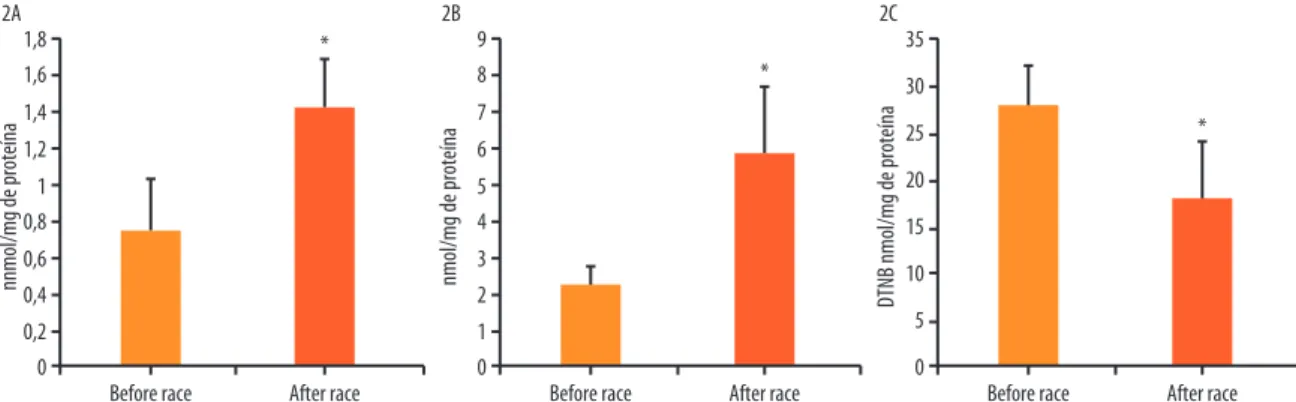
Figure 2. Athletes’ plasma oxidative damage before and after the Ironman race, represented by lipid peroxidation (A), protein carbonylation (B), and total thiols (C). Data expressed as mean±standard error of mean; *signiicant statistical diference for t test; p < 0.05.
DISCUSSION
he production of ROS represents a normal physiological process, how-ever, during strenuous exercise, there is an increase in the production of these species with a reduction of the defense system, leading to oxidative stress. Excessive production of these species and consequent oxidative damages have been associated with decreased performance, fatigue, muscle
damage, and “overtraining”23,24. Although strenuous exercise promotes
increased production of ROS and oxidative damage6,4, studies have shown
that endurance training increases the antioxidant defense system, as well
as muscle oxidative capacity24,25. However, these positive efects of
train-ing may not be suicient to reduce oxidative damage caused by intense exercise of long duration.
he increase we found in creatine kinase activity ater the Ironman race (Table 1) suggests the presence of muscle microlesions and a
pos-sible ultrastructural disruption of the sarcolemma26. Similar results were
observed in athletes who participated in one of the main ultraendurance
cycling races, the Tour de France27.
activity of xanthine oxidase triggered by hypoxia, increased activity of nicotinamide adenine dinucleotide phosphate (NADPH) oxidase in inlammatory processes, increased activity of phospholipase, as well as
auto-oxidation of heme proteins15.
Due to the possible increase in the production of ROS, our results show a decrease in the TRAP in plasma levels as seen in Figure 1. he TRAP is a method that quantiies the plasma antioxidant potential and its decrease ater the race suggests an increased production of ROS, which can lead to signiicant oxidative damage. he low levels of the TRAP found ater the Ironman race and the increased AUC shown in Figure 1A and 1B may be mainly associated with the oxidation of glutathione induced by exercises.
Pinho and colleagues25 suggest that increased oxidation is caused by
ex-cessive production of ROS ater intense exercise. Glutathione is one of the most important antioxidants in biological systems because it is a direct scavenger of free radicals, glutathione peroxidase substrate and it can also be involved in the reduction of other antioxidants such as vitamin E
and C11. hus, depletion of glutathione reduces the capacity of antioxidant
defense leading to oxidative stress.
he good level of itness based on the duration of the race (less than 12 hours), seems to be insuicient to prevent oxidative damage to lipids (Figure 2A) and proteins (Figure 2B and 2C), although high intensity
train-ing is able to increase plasma antioxidant defenses25. Studies conducted
by Child and colleagues28 show diferent results. Athletes participated in
a simulated half-marathon race and showed an increase in serum total antioxidant capacity; however, exercise induced increased concentrations
of malondialdehyde. Mastaloudis et al.29 found an increase in total
anti-oxidant capacity ater endurance races and they suggest that this response should be related to a higher release of antioxidants. It is possible that such diferences among the studies may be related to the characteristics of the exercise, the athletes’ itness, or even the methodology used to determine total antioxidant capacity.
Changes in oxidative damage after physical exercise are directly
related to the type, intensity, and duration of the exercise25. hus, it has
been reported that diferent exercises cause diferent levels of oxidative damage, although the results suggesting the inluence of exercise on the levels of oxidative stress remain controversial. Increased production of
ROS can oxidize membrane lipids causing lipid peroxidation29. During
lipid peroxidation, there may be losses of intermediaries resulting in short-chain hydrocarbons (ethane, pentane), aldehydes (such as malonaldehyde,
4-hydroxynonenal), epoxides, and other highly cytotoxic prodcuts9. As a
result of lipid peroxidation, membranes undergo changes in luidity and
permeability, resulting in a loss in homeostasis and cell death9, leading to
Ironman and oxidative stress Schefer et al.
Oxidation of amino acids causes formation of carbonyl groups and re-duction of total thiols, among other changes that alter the normal function
of proteins, being widely used as a marker of cell damage by ROS action9.
he results of our study show an increase in protein carbonylation (PC) and reduction in the amount of total thiols (TTs). Several mechanisms may contribute to this phenomenon, such as increased mitochondrial electron low, increased oxidation of purines, and imbalance in the
cal-cium concentrations29. herefore, the decrease in TTs can be explained
by high levels of ROS produced during the Ironman race, since TTs are
the irst line of defense against the ROS attack21. Some studies29,30 have
shown similar results for changes in the markers of oxidative stress ater prolonged exercise.
CONCLUSION
he results of the present study show clear evidence that long and highly intense races cause reduced antioxidant capacity and oxidative damage of athletes regardless of their performance during the race. Establishing a strategy of supplementation of antioxidants may help reduce these efects and improve the performance in long and exhaustive races.
REFERENCES
1. Smith LL, Anwar A, Fragen M, Rananto C, Johnson R, Holbert D. Cytokines and cell adhesion molecules associated with high-intensity eccentric exercise. Eur J Appl Physiol 2000;82(1-2):61-7.
2. Hew-Butler T, Collins M, Bosch A, Sharwood K, Wilson G, Armstrong M, at al. Maintenance of Plasma Volume and Serum Sodium Concentration Despite Body Weight Loss in Ironman Triathletes. Clin J Sport Med 2007;17(2):116-22.
3. Suzuki K, Peake J, Nosaka K, Okutsu M, Abbiss CR, Surriano R, et al. Changes in markers of muscle damage, inlammation and HSP70 ater an Ironman triathlon race. Eur J Appl Physiol 2006;98(6):525-34.
4. Knez WL, Jenkins DG, Coombes JS. Oxidative Stress in Half and Full Ironman Triathletes. Med Sci Sports Exerc 2007;39(2):283-8.
5. Pinho RA, Silva LA, Pinho CA, Schefer DL, Souza CT, Benetti M, et al. Oxida-tive stress and inlammatory parameters ater ironman race. Clin J Sport Med 2010;20(4):306-11.
6. Mastaloudis A, Morrow JD, Hopkins DW, Devaraj S, Traber MG. Antioxidant sup-plementation prevents exercise-induced lipid peroxidation, but not inlammation, in ultramarathon runners. Free Radic Biol Med 2004; 36(10):1329-41.
7. Neubauer O, König D, Kern N, Nics L, Wagner KH. No indications of persistent oxidative stress in response to an ironman triathlon. Med Sci Sports Exerc 2008; 40(12):2119-28.
8. Finaud J, Scislowski V, Lac G, Durand D, Vidalin H, Robert A. Antioxidant status and oxidative stress in professional rugby players: evolution throughout a season. Int J Sports Med 2006;27(2):87-93.
11. McBride JM, Kraemer WJ, Triplett-McBride T, Sebastianelli W. Efect of resistance exercise on free radical production. Med Sci Sports Exerc 1998;30(1):67-72.
12. Avery NG, Kaiser JL, Sharman ML, Scheett TP, Barnes DM, Gomez AL, at al. Ef-fects of vitamin E supplementation on recovery from repeated bouts of resistance exercise. J Strength Cond Res 2003;17(4):801-9.
13. Shalin K, Shabalina IG, Mattsson CM, Bakkman L, Fernström M, Rozhdestvens-kaya Z, at al. Ultraendurance exercise increases the production of reactive oxygen species in isolated mitochondria from human skeletal muscle. J Appl Physiol 2010;108(4):780-7.
14. Silva LA, Silveira PC, Pinho CA, Tuon T, Dal Pizzol F, Pinho RA. N-acetylcysteine supplementation and oxidative damage and inlammatory response ater eccentric exercise. J. Sport. Nutr. Exerc. Metab 2008;18(4):379-88.
15. Ji LL. Antioxidants and oxidative stress in exercise. Proc Soc Exp Biol Med 1999;222(3):283-92.
16. Lissi E, Pascual C, Del Castillo MD. Luminol luminiscence induced by AAPH thermolysis. Free Rad Res Comms 1992;17(5):299-311.
17. Lissi E, Salim-Hanna M, Pascual C, Del Castillo MD. Evaluation of total antioxi-dant potential (TRAP) and total antioxiantioxi-dant reactivity from luminol-enhanced chemiluminescence measurements. Free Rad Biol Med 1995;18(2):153-8.
18. Dresch MT, Kappel VD, Rossato S, Biegelmeier R, Hof MLM, Mayorga P, Zuanazzi M, at al. Optimization and validation of an alternative method to evaluate total reactive antioxidant potential. Anal Biochem 2009;385(1):107-14.
19. Hermes-Lima M, Willmore WG, Storey KB. Quantiication of lipid peroxidation in tissue extracts based on Fe(III)xylenol orange complex formation. Free Radic Biol Med 1995;19(3):271-80.
20. Levine RL, Garland D, Oliver, CN, Amici A, Climent I, Lenz AG, et al. Deter-mination of carbonyl content in oxidatively modiied proteins. Meth Enzymol 1990;186:464-78.
21. Aksenov MY, Markesbery WR. Changes in thiol content and expression of glu-tathione redox system genes in the hippocampus and cerebellum in Alzheimer’s disease. Neurosci Lett 2001;302(2-3):141-5.
22. Lowry OH, Rosebough NG, Farr AL, Randall RJ. Protein measurement with the folin phenol reagent. J Biol Chem 1951;193(1):265-75.
23. Carmeli E, Laviam G, Reznick AZ. he role of antioxidant nutrition inexercise and aging. In: Free Radicals in Exercise and Aging. Radák Z, ed. Champaign: Human Kinetics 2000; p. 73-106.
24. Silva LA, Pinho CA, Scarabelot KS, Fraga DB, Volpato AM, Boeck CR, at al. Physical exercise increases mitochondrial function and reduces oxidative damage in skeletal muscle. Eur J Appl Physiol 2009;105(6):861-7.
25. Pinho RA, Andrades ME, Oliveira MR, Pirola AC, Zago MS, Silveira PCL, at al. Imbalance in SOD/CAT activities in rats skeletal muscles submitted to treadmill training exercise. Cell Biol Int 2006; 30(10):848-53.
26. Silva LA, Rocha LGC, Schefer DL, Soares FS, Pinho CA, Polizelli AB, at al. Resposta de duas sessões de natação sobre parâmetros de estresse oxidativo em nadadores. Rev Bras Cineantropom Desempenho Hum 2009; 11(2):160-5.
Ironman and oxidative stress Schefer et al.
28. Child RB, Wilkinson DM, Fallowield JL, Donnelly AE. Elevated serum antioxidant capacity and plasma malondialdehyde concentration in response to a simulated half-marathon run. Med Sci Sports Exerc 1998; 30(11):1603-7.
29. Mastaloudis A, Leonard SW, Traber MG. Oxidative stress in athletes during extreme endurance exercise. Free Radic Biol Med 2001;31(7): 911-22.
30. Gomez-Cabrera MC, Martínez A, Santangelo G, Pallardó FV, Sastre J, Viña J. Oxidative stress in marathon runners: interest of antioxidant supplementation. Br J Nutr 2006;96(1)31-3.
Address for Correspondence
Laboratório de Fisiologia e Bioquímica do Exercício - UNESC Av. Universitária, 1105 – Bairro Universitário