259
Study of the bone mineral density in patients with systemic lupus erythematosus
Radiol Bras. 2008 Jul/Ago;41(4):259–262
Original Article • Artigo Original
Study of the bone mineral density in patients with
systemic lupus erythematosus before and after
glucocorticoid treatment*
Estudo da densidade mineral óssea em pacientes com lúpus eritematoso sistêmico antes e após uso de glicocorticóides
Fernanda do Amarante1, Simara Santos de Souza2, Volnei Borges3, Carlos Jader Feldman4
OBJECTIVE: To evaluate the bone mineral density variability in patients with systemic lupus erythematosus, before the beginning and at 30 and 60 days from the beginning of glucocorticoid therapy. MATERIALS AND METHODS: Fifteen premenopausal women with systemic lupus erythematosus were referred for bone densitometry before being submitted to glucocorticoid therapy. RESULTS: It was demonstrated that the bone mineral density in g/cm² in the lumbar spine presented a significant decrease in the span between the first analysis previously to the beginning of the glucocorticoid therapy and the third analysis after 60 days under therapy. On the other hand no significant difference was found in the femoral neck. CONCLUSION: The authors conclude that, at short term, rather than only at long term as previously reported by other authors, corticotherapy in patients with systemic lupus erythematosus results in a decrease in the bone mineral density in the lumbar spine.
Keywords: Bone densitometry; Premenopause; Systemic lupus erythematosus.
OBJETIVO: Avaliar a variabilidade da densidade mineral óssea em pacientes com lúpus eritematoso sistê-mico, antes do início e após 30 e 60 dias do início de glicocorticoterapia. MATERIAIS E MÉTODOS: Estudo efetuado em 15 mulheres em pré-menopausa com lúpus eritematoso sistêmico encaminhadas para realiza-ção de densitometria óssea e que fariam uso de corticosteróides logo após o exame. RESULTADOS: De-monstrou-se que a densidade mineral óssea, em g/cm², na coluna lombar reduziu-se significativamente entre a análise prévia ao uso e a análise em 60 dias de uso da medicação, mas no colo femoral não houve diferença significativa. CONCLUSÃO: Concluiu-se que o uso de corticoterapia em pacientes com lúpus eritematoso sistêmico, em curto prazo, reduz significativamente a densidade mineral óssea na coluna lombar, não so-mente em longo prazo como descrito anteriorso-mente por outros autores.
Unitermos: Densitometria óssea; Pré-menopausa; Lúpus eritematoso sistêmico.
Abstract
Resumo
* Study developed at the Unit of Bone Densitometry, SIDI – Medicina por Imagem, Porto Alegre, RS, and Faculdade de Tec-nologia em Radiologia – Fatipuc, Canoas, RS, Brazil. Support: FAURGS – Support Foundation of Universidade Federal do Rio Grande do Sul (UFRGS).
1. Master, Specialist in Clinical Densitometry, Professor at Fa-culdade de Tecnologia em Radiologia – Fatipuc, Canoas, RS, Brazil.
2. Professor for the Technical Course of Medical Radiology – IPUC, Canoas, RS, Brazil.
3. PhD, Professor at Universidade Federal do Rio Grande do Sul (UFRGS), Porto Alegre, RS, Brazil.
4. PhD, MD, Radiologist at SIDI – Medicina por Imagem, Porto Alegre, RS, Brazil.
Mailing address: Dr. Volnei Borges. Departamento de Enge-nharia Nuclear – UFRGS. Avenida Osvaldo Aranha, 99, 4º an-dar. Porto Alegre, RS, Brazil, 90046-900. E-mail: vorges@ ufrgs.br
Received July 6, 2007. Accepted after revision October 16, 2007.
hormone (GnRH) release or yet with the suppression of the hypophysis sensitivity to
this hormone(5). Additionally to these
mechanisms, it is already known that syn-thetic glucocorticoid can suppress adreno-corticotrophic hormone (ACTH) secretion, leading to an adrenal atrophy and conse-quential androgens decrease(6). The main mechanisms of glucocorticoid osteoporo-sis are: decrease in the bone matrix depo-sition by osteoblasts, increase in the bone resorption by osteoclasts, decrease in the intestinal resorption and increase in the urinary excretion of calcium(7,8).
The incidence of osteoporosis in pa-tients with systemic lupus erythematosus still remains unknown, but the wide utili-zation of corticotherapy may be responsible for the development of osteoporosis not
Amarante F, Souza SS, Borges V, Feldman CJ. Study of the bone mineral density in patients with systemic lupus erythe-matosus before and after glucocorticoid treatment. Radiol Bras. 2008;41(4):259–262.
mass and deterioration of bony micro-architecture with the consequential in-crease in risk for fractures(1).The disease is caused by an imbalance between osteoblas-tic bone formation and osteoclasosteoblas-tic bone resorption(2,3). Most frequently, osteoporo-sis affects postmenopausal women with relevant morbidity and mortality rates, but may also develop very early in patients with hypercortisolism like those affected by sys-temic lupus erythematosus.
Corticotherapy has been widely utilized because of anti-inflammatory and immuno-suppressive effects of the method in the management of several diseases such as
systemic lupus erythematosus (SLE)(4).
Hypogonadism in cases of hypercorti-solism has been associated with the sup-pressive effect of gonadotropin-releasing
0100-3984 © Colégio Brasileiro de Radiologia e Diagnóstico por Imagem INTRODUCTION
260
Amarante F et al.
Radiol Bras. 2008 Jul/Ago;41(4):259–262
only in patients with SLE but also in other diseases(4).
Current evidences indicate that, most of times, the catabolic effect of glucocorti-coids is due to the direct action of these steroids over the bone cells activity, besides the increase in the bone resorption(9). Os-teoporosis is the most frequently found iatrogenic complication associated with the chronic treatment with pharmacological doses of these steroids. The bone loss se-verity is related to factors such as dose and therapy duration. It is known that this bone loss is greater in the first six months of therapy and may persist in patients receiv-ing higher doses of glucocorticoids(10).
The present study was aimed at evalu-ating the variability of bone mineral den-sity in patients with SLE with medical in-dication for glucocorticoid therapy, before the beginning and at 30 and 60 days from the beginning of the therapy.
MATERIALS AND METHODS
The present case-control study has been developed in the Unit of Bone Densitom-etry at SIDI – Medicina por Imagem, Porto Alegre, RS, with the participation of Faculdade de Tecnologia em Radiologia – Fatipuc, Canoas, RS, Brazil.
Fifteen women under the age of 48, who were not undergoing treatment with hor-mones or other drugs, like calcium, that could influence the study results, and with previous diagnosis of SLE (at least three criteria for SLE classification, according to the American College of Radiology [ACR]) and who had agreed to participate in the study were evaluated. Only those women who would be submitted to corti-coid therapy right after the bone densito-metry, were invited to participate.
The patients answered a questionnaire about clinical data such as body weight, height, date of disease onset, previous frac-tures, life style (physical activities, alcohol-ism, tobacco smoking) and use of medica-tions.
Bone mineral density was measured by a specialized technologist in the lumbar spine and femoral head by means of dual energy x-ray absorptiometry in a DPX model densitometer (Lunar Radiation Cor-poration; Wisconsin, USA). Coefficients of
variation of the densitometric technique in the period of data collection were measured on the lumbar spine and proximal femur, respectively with the following results: 1.5% and 0.9%(11).
According to the diagnostic criteria pro-posed by Kanis(12) and Sampaio Netto et al.(13), the results can be divided into four groups:
– Normal: higher bone mineral density values than a lower-than-expected standard deviation for a young woman. Bone den-sity in the lumbar spine ≥ 1,05 g/cm², and
≥ 0,83 g/cm² in the femoral neck. – Decreased bone mass: bone mineral density values ranging between 1.0 and 2.5 lower-than-expected standard deviation for a young woman. Bone density in the lum-bar spine ranging between 1.05 and 0.88 g/ cm², and between 0.83 and 0.71 g/cm² in the femoral neck.
– Osteoporosis: bone mineral density values ≤ 2.5 lower-than-expected standard deviation for a young woman. Bone den-sity in the lumbar spine ≤ 0.88 g/cm², and
≤ 0.71g/cm² in the femoral neck
– Established osteoporosis: bone min-eral density values ≤ 2.5 lower-than-ex-pected standard deviation (SD) for a young woman, in the presence of one or more fractures(14).
The first bone densitometry study was performed before the beginning of the glu-cocorticoid therapy, and the second and third evaluations, after respectively 30 and 60 days under therapy.
The ANOVA test for repeated measure-ments was utilized for statistical analysis, with Bonferroni correction for multiple comparisons between mean values. The SPSS-10 statistical software was utilized and statistical significance level corre-sponded to p ≤ 0.05.
RESULTS
Fifteen premenopausal women previ-ously diagnosed with SLE and referred for bone densitometry were evaluated in the period between February-June 2007.
In the present study, median for age was 43 years (range, 32–48 years) and all the women were white.
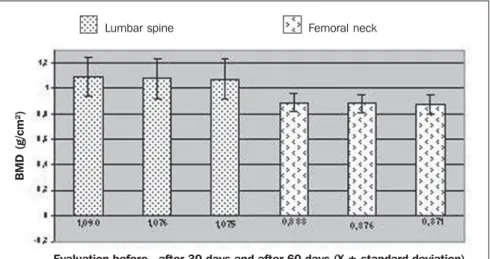
Previous or current history of tobacco smoking was reported by 13.3% of the patients. Nine patients (60%) were seden-tary, five (33.3%) presented a familial his-tory of osteoporosis, only three (20%) had a previous history of fracture, and four (26.7%) utilized oral calcium supplements. Graphic 1 demonstrates the bone min-eral density in g/cm² in both segments evaluated — the lumbar spine and femo-ral neck — at three different moments: before the beginning of the glucocorticoid therapy, and after 30 and 60 days under therapy. The patients received doses con-sidered as low (≤ 7.5 mg/day) during the evaluation. The mean value for the lumbar spine at the first evaluation was 1.090 ± 0.159 g/cm², at the second evaluation, af-ter 30 days, 1.076 ± 0.164 g/cm², and at the
Graphic 1. Bone mineral density of lumbar spine and femoral neck respectively before and after gluco-corticoid therapy.
Evaluation before , after 30 days and after 60 days (X ± standard deviation)
B
M
D
(
g
/c
m
²)
261
Study of the bone mineral density in patients with systemic lupus erythematosus
Radiol Bras. 2008 Jul/Ago;41(4):259–262
third evaluation, after 60 days, 1.075 ± 0.161 g/cm². No statistically significant difference was found in the comparison between mean values for bone mineral densities at the first versus second evalua-tion, and second versus third evaluation. However, in the comparison between mean values in the first and third evaluations, there was a statistically significant differ-ence (p = 0.023).
Also, mean values for bone mineral density of femoral neck are demonstrated on Graphic 1: at the first evaluation, 0.888 ± 0.075 g/cm², second, 0.876 ± 0.068 g/ cm², and third, 0.871 ± 0,070 g/cm². No sta-tistically significant difference was found in the comparison between evaluations.
Bone mineral densities are translated as t-scores according to the diagnostic guide-lines proposed by the World Health Orga-nization (WHO). Graphic 2 demonstrates the t-scores corresponding to the evalua-tions for the lumbar spine and femoral neck before the beginning of the glucocorticoid therapy, after 30 days and after 60 days under therapy. The first evaluation of the lumbar spine resulted in a t-score corre-sponding to –0.680 ± 1.1, the second evalu-ation, –0.820 ± 1.3, and the third evalua-tion, –1.030 ± 1.4, with no statistically sig-nificant difference. However, according to the WHO criteria, the first and second evaluations demonstrated normal levels of
bone mineral density, and the third evalu-ation demonstrated osteopenia (decreased bone mass). Mean t-scores for femoral neck are also demonstrated on Graphic 2: at the first evaluation, –0.760 ± 0.7, at the second, –0.860 ± 0.6, and at the third, –0.900 ± 0.6. No statistically significant difference was found in the comparison between these evaluations.
DISCUSSION
Osteoporosis is a disease that may de-velop in the presence of several conditions, and its pathogenesis may be associated with factors such as the presence of osteo-degenerative disorders like rheumatoid ar-thritis and SLE whose treatment involves drugs which affect the bone mass.
Some of these medications are the low-dose glucocorticoids. The harmful effect of these drugs on the bone mass seems to be observed early in the course of the therapy, although this is still not well determined(15). The glucocorticoids effects on the bone and pathogenesis in the induction of osteoporo-sis have been exhaustively reviewed and seem to be both direct and indirect, inhib-iting bone formation and increasing bone resorption(16).
In 2006, Natsui et al. demonstrated a significant loss of bone mineral density, particularly in the lumbar spine, after a
two-month high-dose glucocorticoid therapy, showing that the intensive use of this drug induces to a fast loss of trabecular bone mineral density (17).
Recently, a meta-analysis demonstrated an increased risk for fracture within three-six months after the beginning of high-dose corticosteroid therapy(18).
In the present study, patients undergo-ing low-dose glucocorticoid therapy pre-sented decreased bone mineral density in the lumbar spine (L1–L4) two months af-ter the beginning of the therapy, with a sta-tistically significant difference (p = 0.023) as compared with the previous bone min-eral density in the same patients. Previ-ously, studies also had demonstrated that glucocorticoid therapy for at least three months would induce bone mineral density decrease in men and postmenopausal women(19).
Also in cases of some respiratory disor-ders, such as asthma, corticosteroid therapy is frequently utilized and, probably, pre-sents the same effect on bone tissues which should be further researched.
Glucocorticoid-induced osteoporosis represents a relevant problem caused not only by high-dose therapies, and new stud-ies on their mechanisms of action have been developed. Although effective pre-ventive and management therapies for glu-cocorticoid-induced osteoporosis are well described, they have not been routinely adopted in the clinical practice(20).
Finally, the present study demonstrated the significant decrease in the bone mineral density in the lumbar spine of women in the age range between 32 and 48 years, with SLE under low-dose glucocorticoid therapy for 60 days, indicating that there is a significant variability as a result of the utilization of these drugs at short term.
REFERENCES
1. Keen RW, Kelly PJ. Genetic factors in osteoporo-sis. What are the implications for prevention and treatment? Drugs Aging. 1997;11:333–7.
2. Zaidi M, Alam AS, Shankar VS, et al. Cellular bi-ology of bone resorption. Biol Rev Camb Philos Soc. 1993;68:197–264.
3. Manolagas SC, Jilka RL. Bone marrow, cytokines, and bone remodeling. Emerging insights into the pathophysiology of osteoporosis. N Engl J Med. 1995;332:305–11.
4. Godinho F, Santos MJP, Silva JC. Osteoporose in-duzida pelos glicocorticóides: conhecimento e
Graphic 2. T-score for lumbar spine and femoral neck respectively before and after glucocorticoid therapy.
Lumbar spine Femoral neck
Evaluation before , after 30 days and after 60 days (X ± standard deviation)
T
-sc
o
262
Amarante F et al.
Radiol Bras. 2008 Jul/Ago;41(4):259–262
estratégias preventivas nos doentes com lúpus. Acta Reumatol Port. 2004;29:105–10.
5. Veldhuis JD, Lizarralde G, Iranmanesh A. Diver-gent effects of short term glucocorticoid excess on the gonadotropic and somatotropic axes in norml men. J Clin Endocrinol Metab. 1992;74: 96–102.
6. Doerr P, Pirke KM. Cortisol-induced suppression of plasma testosterone in normal adult males. J Clin Endocrinol Metab. 1976;43:622–9.
7. Weinstein RS, Jilka RL, Parfitt AM, et al. Inhibi-tion of osteoblastogenesis and promoInhibi-tion of apo-ptosis of osteoblasts and osteocytes by glucocorti-coids. Potential mechanisms of their deleterious effects on bone. J Clin Invest. 1988;102:274–82. 8. Sambrook P, Lane NE. Corticosteroid osteoporo-sis. Best Pract Res Clin Rheumatol. 2001;15: 401–13.
9. Lanna CMM, Montenegro Jr RM, Paula FJA. Fi-siopatologia da osteoporose induzida por glico-corticóide. Arq Bras Endocrinol Metab. 2003;47: 9–18.
10. Adachi JD. Corticosteroid-induced osteoporosis. Am J Med Sci. 1997;313:41–9.
11. Defavori CG, Sarriés GA. A correlação de méto-dos DEXA e CDEXA em absortimetria mineral óssea. Radiol Bras. 2007;40:183–7.
12. Kanis JA. Bone density measurements and os-teoporosis. J Intern Med. 1997;241:173–5. 13. Sampaio Netto O, Coutinho LOL, Souza DC.
Aná-lise da nova classificação de laudos de densito-metria óssea. Radiol Bras. 2007;40:23–5.
14. Szejnfeld VL, Atra E, Baracat EC, et al. Bone density in white Brazilian women: rapid loss as the time around the menopause. Calcif Tissue Int. 1995;56:186–91.
15. LoCascio V, Bonucci E, Imbimbo B, et al. Bone loss in response to long-term glucocorticoid therapy. Bone Miner. 1990;8:39–51.
16. Baylink DJ. Glucocorticoid-induced osteoporo-sis. N Engl J Med. 1983;309:306–8.
17. Natsui K, Tanaka K, Suda M, et al. High-dose glucocorticoid treatment induces rapid loss of trabecular bone mineral density and lean body mass. Osteoporos Int. 2006;17:105–8.
18. van Staa TP, Leufkens HG, Cooper C. The epide-miology of corticosteroid-induced osteoporosis: a meta-analysis. Osteporos Int. 2002;13:777–87.
19. McIlwain HH. Glucocorticoid-induced osteopo-rosis: pathogenesis, diagnosis, and management. Prev Med. 2003;36:243–9.