45
Description of a new species of the genus
Leporinus
Spix (Characiformes:
Anostomidae) from the rio Araguaia, Brazil, with comments on the
taxonomy and distribution of
L. parae
and
L. lacustris
Heraldo A. Britski and José L. O. Birindelli
A new species of the genus Leporinus is described from the rio Araguaia, in Mato Grosso and Goiás states, Brazil. The new species has the dental formula 4/3, a unique feature within the genus; all other species of Leporinus have dental formulae 3/3, 3/4 or 4/4. In addition, the new species can also be distinguished by the following combination of characters: 36 to 37 scales in the lateral line, 4/4.5 or 4/5 series of scales in the transversal line, 16 circumpeduncular scale series, anal fin surpassing base of lower caudal-fin rays and three blotches along the lateral line. The new species shares with L. parae and L. lacustris a rather deep body, terminal mouth, long anal fin, three small dark blotches on the lateral line, the latter two, particularly the last one, usually fading, and preference for lentic habitats. Comments on the taxonomy and distribution of the species L. parae andL. lacustris are provided.
Uma nova espécie do gênero Leporinus é descrita do rio Araguaia, nos estados do Mato Grosso e Goiás, Brasil. A característica mais notável da nova espécie é sua fórmula dental 4/3, única entre as espécies do gênero que possuem fórmula dental 3/3, 3/ 4 ou 4/4. A nova espécie também pode ser reconhecida pela combinação das seguintes características: 36 a 37 escamas na linha lateral, 4/4,5 ou 4/5 séries de escamas na linha transversal, 16 series de escamas circumpedunculares, nadadeira anal ultrapassando a base dos raios inferiores da nadadeira caudal e presença de três manchas escuras ao longo da linha lateral. A nova espécie compartilha com L. parae e L. lacustris corpo alto, boca terminal, nadadeira anal longa e escura, três manchas escuras na linha lateral pequenas, sendo as duas últimas, em especial a última, geralmente apagadas, e preferência por habitats lênticos. Além disso, são feitos comentários sobre a taxonomia e a distribuição de L. parae e L. lacustris.
Key words:Leporinus venerei, Tocantins, Anostomoidea, Ostariophysi.
Museu de Zoologia da Universidade de São Paulo, Caixa Postal 42494, 04299-970, São Paulo, SP, Brazil. [email protected]; [email protected]
Introduction
In 1995, Paulo Cesar Venere sent to Museu de Zoologia da Universidade de São Paulo (MZUSP) a collection of fishes made by himself in the rio Araguaia, eastern region of Mato Grosso, central Brazil, including different species of the ge-nusLeporinus. This collection included three specimens of an undescribed species with a unique number of teeth in the jaws; however, considering the small number of specimens available, this species was not described at that time. In the year of 2005, another lot of this new species was deposited at MZUSP, with three specimens collected in the same area by members of the Central Brazilian Expedition (CBE). Since the new species was rediscovered, we contacted Paulo Cesar Venere who recently collected a few more specimens. On the basis of this material now in hands the new species can now be appropriately described.
The first paper on Leporinus from the rio Tocantins basin (including the rio Araguaia drainage) comes from Valenciennes (1850) who, based on material collected by Castelnau, de-scribed L. pachyurus and mentioned L. obtusidens and L. maculatus. Other papers by Castelnau (1855), Borodin (1929), Garavello (1979), Santos et al. (1984), Santos & Jégu (1989), Britski (1997), Garavello & Britski (2003), and Santos et al. (2004), reported a total of 18 species of Leporinusfor the rio Tocantins basin, including two new species currently under description by Garavello & Santos (Garavello, pers. com.). This makes the rio Tocantins one of the richest in species of the genus Leporinus among all South American river basins.
Material and Methods
ex-eliminates the very confusing count of a half scale in this series. A half scale between the lateral line and the pelvic fin is only counted when the base of the pelvic-fin first ray faces the middle of the scale immediately in front of it. Meristic data of the holotype are indicated in the text by an asterisk. Insti-tutional abbreviations includes: ANSP, Academy of Natural Sciences of Philadelphia; MZUSP, Museu de Zoologia da Universidade de São Paulo and USNM, United States Nation Museum, Smithsonian Institute.
Results
Leporinus venerei, new species
Fig. 1
Holotype: MZUSP 93124 (113.3 mm SL), Mato Grosso, São Felix, Lake in Fazenda Entre-Rios (approx.11º35’S 50º40’W), 24 Oct 2006; P. C. Venere & C. E. de Melo.
Paratypes: MZUSP 93123 (8, 82.5-105.8 mm SL), collected with holotype. MZUSP 92027 (3, 103.1-114.3 mm SL), Goias, Aruanã, Fazenda Sobrado, pool at margin of road between Aruanã and Cocalinho (14º45’30"S 50º37’50"W), 25 Jul 2005; C. Chamon, L. Sousa, M. Melo & L. Souza. MZUSP 93125 (3, 92.2-106.4 mm SL), Mato Grosso, Araguaiana, Córrego and Cacimbas (borrow pits) at Fazenda do Italiano (approx. 15º43’S 51º51’W), 06 Jul 1995; P. C. Venere & C. E. Melo. MZUSP 93122 (6, 98.1-135.5 mm SL), Mato Grosso, Araguaiana, Ribeirão Dois de Agosto, tributary of rio Pindaíba, rio das Mortes drainage (approx. 15º15’S 51º45’W), 30 Jun 1992; P. C. Venere & C. E. Melo.
Diagnosis.Leporinus venerei is distinguished from its con-geners by having 4 teeth on the premaxilla and 3 teeth on the dentary yielding the dental formula 4/3 (vs. 3/3, 3/4 or 4/4 in all other species of Leporinus).Leporinus venerei is also diag-nosed by the following combination of non-unique charac-teristics: presence of 36-37 pored scales in the lateral line, 4 scales in transversal series from origin of dorsal fin to lateral line and 4.5 to 5 scales from lateral line to base of pelvic fin; 16 series of scales around caudal peduncle; three round dark blotches on lateral line, the first at vertical through dorsal fin, the second at vertical through adipose-fin origin and the third at base of caudal peduncle (the latter two blotches, particu-larly the last one, usually small or inconspicuous).
men 135.5 mm SL. Body rather elevated and compressed. Dorsal profile straight from anterodorsal portion of snout to posterior tip of supraoccipital; straight or very slightly con-vex from that point to fin origin; straight along dorsal-fin base; slightly convex or straight from dorsal-dorsal-fin base to adipose fin and slightly concave from adipose fin to caudal-fin origin. Ventral profile slightly convex from tip of lower jaw to pelvic-fin insertion, (convexity less pronounced below bran-chial region in some specimens); straight from pelvic-fin base to anal-fin origin; straight at anal-fin base and concave from anal fin to caudal fin. Greatest body depth at origin of dorsal fin. Head somewhat compressed; mouth terminal, anterior opening of mouth positioned at horizontal bisecting eye.
Premaxillary with four teeth diminishing in size laterally from the symphyseal tooth. Dentary with three teeth also de-creasing in size laterally. Teeth on both jaws of stair-step type.
Dorsal-fin rays ii+11* or iii+11; dorsal-fin origin slightly in front of vertical through pelvic-fin origin; dorsal-fin base extending through seven or eight scales. Pectoral-fin rays i+13, 14* or 15; pectoral fin extending to third or fourth scale anterior to pelvic-fin base. Pelvic-fin rays i+8; pelvic fin ex-tending to four or five scale posterior to fin base. Anal-fin rays ii-9 or iii+9*; anal fin clearly surpassing base of lower caudal-fin rays; distal margin of anal fin straight or slightly convex. Length of last anal fin ray 26 to 47% (mean 36%) length of first branched anal-fin ray. Caudal-fin rays i+17+i; caudal fin forked, upper lobe slightly more developed than lower lobe. Vertebrae 34 (n=4) to 35 (3).
Scales with few radii (5-7). Lateral line complete with 36 (5) to 37* (13) perforated scales; transversal series with 4 (21)
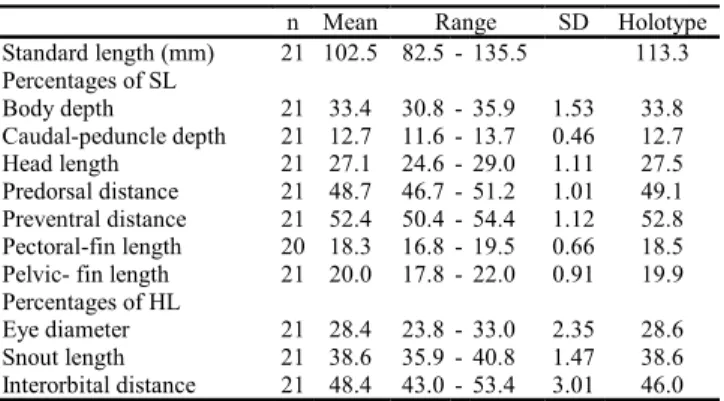
Table 1. Morphometric data of Leporinus venerei.
n Mean Range SD Holotype
Standard length (mm) 21 102.5 82.5 - 135.5 113.3
Percentages of SL
Body depth 21 33.4 30.8 - 35.9 1.53 33.8
Caudal-peduncle depth 21 12.7 11.6 - 13.7 0.46 12.7
Head length 21 27.1 24.6 - 29.0 1.11 27.5
Predorsal distance 21 48.7 46.7 - 51.2 1.01 49.1
Preventral distance 21 52.4 50.4 - 54.4 1.12 52.8
Pectoral-fin length 20 18.3 16.8 - 19.5 0.66 18.5
Pelvic- fin length 21 20.0 17.8 - 22.0 0.91 19.9
Percentages of HL
Eye diameter 21 28.4 23.8 - 33.0 2.35 28.6
Snout length 21 38.6 35.9 - 40.8 1.47 38.6
scales from dorsal-fin origin to lateral line and 4.5 (6) to 5* (15) scales from lateral line to pelvic-fin base; 9, 10* or 11 predorsal scales; 10 to 12* scales in median dorsal row
be-tween dorsal fin and adipose fin; 7* or 8 scales in median dorsal row between adipose fin and caudal fin; 14 to 18* prepelvic scales; 9, 10* or 11 scales in median ventral row
surfaces of head pale, without chromatophores, except the bright silver opercular series; sometimes with a black blotch on its ventral portion. Body gradually darker from lateral line dorsally. Three dark blotches on lateral line: first blotch at vertical through posterior half of dorsal-fin base; second at level of the fifth or sixth scale anterior to adipose fin base and third at base of caudal peduncle; only first blotch usually conspicuous; second and third blotches generally reduced in size, faded or, occasionally, completely absent. Brown chro-matophores bordering posterior edge of each scale giving a relatively gray reticulated aspect to body ground coloration. Some individuals with faint transverse bars on dorsum occa-sionally extended onto ventral portion of body. With excep-tion of anal and adipose, remaining fins nearly hyaline with few chromatophores along margins of rays; anal fin dark brown, sometimes with whitish areas along its posterior mar-gin; adipose fin usually whitish near base and dark brown distally.
Discussion
The number of teeth in species of the genus Leporinus as discussed by Britski (1997), is a very important feature for the species diagnoses. The species of Leporinus are character-ized by having three or four teeth on each premaxilla and dentary and, with the exception of the new species all of them can be placed into three artificial groups according to dental formula (i.e., species with 3/3, 3/4 or 4/4 dental formulae). We have been working exhaustively on Leporinus, examining hun-dreds of specimens of different species and we have found that variation in dental formula among co-specific individu-als is exceptional. In most cases, discrepant individuindividu-als were considered anomalous because their teeth were asymmetric (i.e., having either one more or one less tooth on only one side of upper or lower jaw); discrepancy involving both sides of jaws was found only in few examined specimens of L. taeniatus from the rio São Francisco basin. This consistency in number of teeth in species of Leporinus strengthens the reliance of this character in species diagnoses. In addition, we consider it important to provide a list of known species of Leporinus grouped by dental formula:
Dental formula 3/3: L aguapeiensis, L.amblyrhynchus, L.conirostris, L.crassilabris, L.desmotes, L.despaxi, L.elongatus, L.jatuncochi, L.macrocephalus, L.muyscorum, L.obtusidens, L.pachyurus, L.reinhardti, L.silvestri, L.trifasciatus, and L.wolfei.
Dental formula 3/4: L.amae, L.bahiensis, L.bistriatus, L.garmani, L.marcgravii, L.megalepis, L.melanopleura, L.microphthalmus, L.octofasciatus, L.octomaculatus, L.paranensis, L.reticulatus, L.sexstriatus, L.striatus, L.taeniatus, L.taeniofasciatus, L.tigrinus, andL.uatumaensis. Dental formula 4/4: L.acutidens, L.affinis, L.agassizi, L.alternus, L.arcus, L.aripuanensis, L.bimaculatus, L.boehlkei, L.brunneus, L.copelandii, L.cylindriformes, L.ecuadorensis, L.falcipinnis, L.fasciatus, L.friderici, L.gomesi, L.gossei, L.granti, L.holostictus, L.julii, L.klausewitzi, L.lacustris, L.lebaili, L.maculatus, L.melanosticus, L.moralesi, L.mormyrops, L.multifasciatus, L.nattereri, L.niceforoi, L.nigrotaeniatus, L.nijsseni, L.ortomaculatus, L.pachycheilus, L.parae, L.paralternus, L.pearsoni, L.pellegrinii, L.piau, L.pitingai, L.punctatus, L.spilopleura, L.steindachneri, L.steyemarki, L.subniger, L.thayeri, L.trimaculatus, L.vanzoi, and L.yophorus.
The following species have a doubtful number of teeth or the number of teeth is unknown: L. badueli, L. bleheri, L. jamesi,and L. latofasciatus.
We note that collectors must preserve specimens of Leporinus with mouth open, as they tend to close them very strongly when fixed in formaldehyde. Attempts at opening the mouth of fishes when so fixed usually lead to the break-age of the jaws, particularly the lower jaw, causing loss of the small lateral teeth and therefore making teeth counts unreliable. There is no consistent hypothesis about relationships within species of Leporinus, a genus with large number of species presenting a great degree of variation in mouth posi-tion, tooth morphology and arrangements. Attempts to split Leporinus into subgenera (for example Borodin, 1929) are not presently accepted. Nevertheless, it is necessary to make some comments on similarities between the new species, Leporinus parae Eigenmann, and L. lacustris Campos. The latter two species share with L. venerei a deep body, terminal mouth, anal fin long and dark, and the three blotches on the lateral line small, with the latter two, particularly the last one, usually fading.
Leporinus parae Eigenmann, 1907 was described from the lower Amazon basin in Para state, Brazil. Measurements and counts were taken from 73 of the 279 examined speci-mens of L. parae from different localities (see comparative material which includes type material). This species is diag-nosed by dental formula 4/4, 38 (n=22, including the type), 39 (52), 40 (9), and 41 (1) scales in the lateral line, 5/5 transversal series of scales, and 16 circumpeduncular series of scales (Fig. 1). These data are in agreement with the original descrip-tion (Eigenmann & Ogle, 1907: 8); but, one of these charac-ters differs from the text figure presented by those authors, as it shows a specimen with four series of scales between the lateral line and the dorsal fin. This should be interpreted as an inaccuracy of the drawer, since the type and all three cotypes have 5 scale series above the lateral line. Specimens of L. parae were found to occur throughout the Amazon and Orinoco basins (see comparative material, fig. 2). In some fish collections, specimens from the Orinoco were previously iden-tified as L. subniger Fowler, 1943, described from the Colom-bian Amazon. Leporinus subniger resembles L. parae in the terminal mouth, dental formula 4/4, and 16 series of scales in the caudal peduncle. Nevertheless, L. parae can be differen-tiated from L. subniger by the number of scales in the lateral line, 38 to 41 (vs. 36 to 38 in L. subniger), 5/5 scales in trans-versal line [vs. 4/4; although Fowler (1943) mentioned 5/5 scales in transversal line in L. subniger, our examination and that of Garavello (1979), confirmed that there are in fact 4/4 scales series in the transversal line in that species], three dark blotches sometimes fading [vs. three dark blotches always present and supplemented by several smaller blotches over body, see Fowler (1943: figs 10-12 for drawings), or Böhlke (1958: plate 6, fig. 2 for a photographed specimen)], and deep body and short head (vs. body relatively shallower and head relatively larger).
Leporinus lacustris Campos, 1945 was described from the
upper rio Paraná basin in São Paulo state, Brazil. Measure-ments and counts were taken from 109 of the 152 examined specimens of L. lacustris from the upper rio Paraná and rio Paraguay basins (see comparative material which includes type material, fig. 2). The species is diagnosed by having dental formula 4/4, 33 (n=4), 34 (69, including the type), or 35 (36) scales in the lateral line, 4/4 or 4/5 transversal series of scales, and 16 circumpeduncular series of scales (Fig. 1). When describingL. lacustris Campos (1945:155) did not comment on the number of teeth and reported 3.5 scales in transverse series above lateral line and 32 to 34 scales in the lateral line. By our counts, the types have 4 and 33 to 34 scales, respec-tively. In addition, L. lacustris has fewer vertebrae (33, n=6), when compared to L. venerei n.sp. (34 to 35, n=7) and L. parae (35 to 37, n=6).
It is also worth mentioning that to our knowledge these three species are the only in the genus that show preferences for lentic habitats.
Comparative material examined.Leporinus parae:Brazil (Ama-zon drainage): USNM 034613 (holotype: 74.6 mm SL), Pará, J. C. Brevoort. USNM 306340 (paratype: 62.8 mm SL), USNM 34575 (paratypes, 2: 71.8-123.0 mm SL), same data as holotype. ANSP 8222 (1: 73.7 mm SL), Pará, M. Sculte-Buckow. MZUSP 3717 (1: 205.0 mm SL), MZUSP 3732 (5: 91.4-106.0 mm SL), Lago Arari, Pará, Oct 1944, A. A. Campos. MZUSP 5022 (2: 92.0-100.3 mm SL), Cachoeira do Arari, Ilha de Marajó, Pará, 12 Jun 1966, Exp. Depto. Zool. MZUSP 6524 (9: 76.5-124.5 mm SL), Lago Manacapuru, Amazonas, 12-13 Dec 1967, H. A. Britski. MZUSP 31401 (1: 157.8 mm SL), rio Madeira, Calama, Rondônia, Oct 1980, M. Goulding. MZUSP 40850 (4: 78.2-103.0 mm SL), intermittent tributary of rio Bezerra, Arraias, Tocantins, 10 Jan 1989, J. C. Oliveira & W. J. M. Costa. MZUSP 40925 (2: 116.7-133.1 mm SL), Poço Gandaia, marginal lagoon of rio Paranã, Flores de Goiás, Goiás, 21 Jan 1989, J. C. Oliveira & W. J. M. Costa. MZUSP 48444 (2: 136.6-142.3 mm SL), Amazonas and Pará, E. Garbe. MZUSP 48445 (10: 56.7-123.5 mm SL), rio Arari, Cachoeira do Arari, Ilha de Marajó, Pará, Jul 1965, N. A. Menezes. MZUSP 48703 (1: 149.7 mm SL), Creek on the 11th km of road Tucuruí –
Masaguaral, 21 Apr 1983, R. Vari et al.Leporinus lacustris:Brazil (upper Paraná drainage): MZUSP 3458 (holotype: 113.1 mm SL), Pirassununga, São Paulo, 1943, O. Schubart. MZUSP 1449 (paratype: 86.6 mm SL), Olímpia, São Paulo, 1916, E. Garbe. MZUSP 3458a (paratypes: 90.0-105.0 mm SL), Olímpia, São Paulo, 1916, E. Garbe. MZUSP 1466 (1: 124.3 mm SL), rio Mogi-Guassu, Emas, São Paulo, 1907. MZUSP 3706 (1: 140.4 mm SL), rio Mogi-Guassu, Pirassununga, São Paulo, 1941, O. Schubart. MZUSP 42621 (1: 110.3 mm SL), Lagoa of rio Tietê, beneath Promissão dam, Promissão, São Paulo, 10 Nov 1978, H. A. Britski. MZUSP 43008 (1: 58.2 mm SL), rio Samambaia, tributary of rio Paraná, Taquaruçu, Mato Grosso do Sul (22o41’S 53o16’W), 27 Jun 1987, Nupelia.
MZUSP 43009 (2: 131.5-139.6 mm SL), rio Samambaia, tributary of rio Paraná, Taquaruçu, Mato Grosso do Sul (22o41’S 53o16’W),
27 Nov 1987, Nupelia. MZUSP 43024 (1: 104.3 mm SL), Reservatório de Itaipu, rio Paraná, Santa Helena, Paraná (24o51’S
54o21’W), 10 Nov 1985, Nupelia. MZUSP 43028 (2: 114.0-146.9
mm SL), Reservatório de Itaipu, near rio Tatuí, rio Paraná, Guairá, Paraná (24o08’S 54o20’W), 29 Ago 1989, Nupelia. MZUSP 43047
(1: 141.1 mm SL), rio Invinheima, tributary of rio Paraná, Taquaruçu, Mato Grosso do Sul (22o48’S 53o34’W), 27 Sep 1988, Nupelia.
MZUSP 43048 (1: 139.2 mm SL), rio Invinheima, tributary of rio Paraná, Taquaruçu, Mato Grosso do Sul (22o48’S 53o34’W), 28 Jul
1988, Nupelia. MZUSP 43058 (2: 69.0-72.0 mm SL), rio Iguatemi, tributary of rio Paraná, Mundo Novo, Mato Grosso do Sul (23o54’S
54o17’W), 23 Ago 1988, Nupelia. MZUSP 43059 (2: 112.4-124.5
mm SL), rio Iguatemi, tributary of rio Paraná, Mundo Novo, Mato Grosso do Sul (23o54’S 54o17’W), 23 Oct 1988, Nupelia. MZUSP
43067 (1: 196.8 mm SL), Lagoa do Guaraná, rio Samambaia, tribu-tary of rio Paraná, Taquaruçu, Mato Grosso do Sul (22o43’S
53o19’W), 25 Ago 1988, Nupelia. MZUSP 43068 (1: 134.5 mm
SL), Lagoa do Guaraná, rio Samambaia, tributary of rio Paraná, Taquaruçu, Mato Grosso do Sul (22o43’S 53o19’W), 26 Nov 1987,
Nupelia. MZUSP 43070 (1: 76.1 mm SL), Ilha Mutum, rio Paraná, Porto Rico, Paraná (22o45’S 53o17’W), 20 May 1989, Nupelia.
MZUSP 43072 (1: 167.0 mm SL), Lagoa Fechada, rio Samambaia, tributary of rio Paraná, Mato Grosso do Sul (22o41’S 53o13’W), 27
Ago 1988, Nupelia. MZUSP 43073 (1: 102.0 mm SL), Lagoa dos Patos, rio Invinheima, tributary of rio Paraná, Taquaruçu, Mato Grosso do Sul, 27 Jun 1988, Nupelia. MZUSP 43075 (1: 144.0 mm SL), rio Invinheima, Porto Tigre, tributary of rio Paraná, Naviraí, Paraná (23o00’S 53o40’W), 24 Ago 1989, Nupelia. MZUSP 43076
(1: 150.4 mm SL), rio Iguatemi, tributary of rio Paraná, Mundo Novo, Mato Grosso do Sul (23o55’S 54o13’W), 24 Ago 1989,
Nupelia. MZUSP 48410 (40: 106.0-155.0 mm SL), Ribeirão dos Porcos, tributary of rio Tietê, Mar de Espanha, Borborema, São Paulo, 12 Dec 1975, J. C. Garavello. MZUSP 48411 (2: 119.7-203.7 mm SL), tributary of rio Itaqueri, rio Piracicaba basin, 3 km from Águas de São Pedro, São Paulo, 25 Oct 1983, A. Copriva. MZUSP 48414 (1: 95.0 mm SL), rio Mogi Guaçu, Emas,
Miguelópolis, São Paulo, 6-7 Nov 1975, Cetesb. MZUSP 48740 (1: 114.3 mm SL), rio Mogi Guaçu, Emas, Pirassununga, São Paulo, 29 Jun 1962, Exc. Depto. Zool. Sec. Agric. MZUSP 53955 (2: 134.0-135.0 mm SL), Reservatório de Barra Bonita, rio Piracicaba, Santa Maria da Serra, São Paulo, 1994-1995, R. A. M. Silvano. MZUSP 63673 (1: 95.6 mm SL), rio Mogi-Guassu, Estação Ex-perimental, Pirassununga, São Paulo, May 1940, A. Aguirre. MZUSP 63685 (2: 95.5-106.2 mm SL), Olímpia, São Paulo, Nov 1916, E. Garbe. MZUSP 79327 (1: 104.8 mm SL), rio Tietê, Reservatório de Promissão, Promissão, São Paulo, Jan 2000, W. S. Smith. MZUSP 79347 (2: 119.7-133.8 mm SL), rio Tietê, Reservatório de Ibitinga, near rio Jacaré-Guaçu, Iacanga, São Paulo (21o52’12’’S 48o59’05’’W), Jul 2000, W. S. Smith. MZUSP 83388
(6: 115.8-125.7 mm SL), rio Tietê, dowstream of Reservatório da UHE Bariri, Bariri, São Paulo, 3 Nov 2003, A. Akama. Brazil (Para-guay drainage): MZUSP 25252 (2 : 98.3-107.1 mm SL), Lagoas at Fazenda Santo Antônio do Paraíso, Piquiri-Itiquira basin, Itiquira, Mato Grosso, 24-29 Oct 1978, J. C. Oliveira. MZUSP 28561 (1: 94.5 mm SL), rio Taquari, near the city, Coxim, Mato Grosso, Dec 1983, A. Carvalho Filho. MZUSP 36361 (1: 194.0 mm SL), Corixão Capão Grande, Nhecolândia, Corumbá, Mato Grosso, Sep 1985, G. M. Mourão et al. MZUSP 36421 (2: 101.0-150.9 mm SL), Baía do Cemitério, Fazenda Nhumirim, Nhecolândia, Corumbá, Mato Grosso do Sul, Ago 1985, G. M. Mourão & R. A. Mauro. MZUSP 36427 (2: 84.5-88.4 mm SL), Baía 39, Faz. Nhumirim, nhecolândia, Corumbá, Mato Grosso do Sul, May 1985, E. K. Bastos. MZUSP 36430 (1: 71.5 mm SL), Baía 74, Fazenda Nhumirim, Nhecolândia, Corumbá, Mato Grosso do Sul, Jul 1985, E. K. Bastos. MZUSP 36744 (10: 81.6-94.7 mm SL), Lagoas at Fazenda Santo Antônio do Paraíso, Piquiri-Itiquira basin, Itiquira, Mato Grosso, 19-20 Sep 1980, J. C. Oliveira et al. MZUSP 38164 (2: 86.3-118.2 mm SL), rio Cassange, road Transpantaneira, Poconé, Mato Grosso, 29 Jul 1978, F. A. Machado. MZUSP 44339 (1: 82.3 mm SL), Creek on road Barra do Bugres to Cáceres, Barra do Bugres, Mato Grosso, 11 Ago 1991, Exp. MZUSP/USNM/MCP. MZUSP 48303 (6: 55.5-84.0 mm SL), Fazenda Santo Antônio, Pantanal do Paiaguás, Mato Grosso do Sul, T. Liparelli. MZUSP 48356 (2: 60.0-80.5 mm SL), Fazenda Santo Antônio, Pantanal do Paiaguás, Mato Grosso do Sul, T. Liparelli. MZUSP 48413 (1: 134.5 mm SL), Ranchão da Lagoa, Santo Antônio de Leverger, Mato Grosso, 8 Mar 1977, Cepipam. MZUSP 48420 (1: 141.4 mm SL), Transpantaneira road, Poconé, Mato Grosso, 21-23 Feb 1977, Cepipam. MZUSP 48421 (2: 125.7-129.6 mm SL), rio Paraguay, Descalvados, Cáceres, Mato Grosso, 22-24 Jan 1977, Cepipam. MZUSP 58438 (4: 60.0-96.0 mm SL), Campo do Jofre, Poconé, Mato Grosso, Feb 1977, Cepipam. MZUSP 59669 (3: 105.0-112.0 mm SL), Brejo da Santa Sofia, Aquidauana, Mato Grosso do Sul (19o35’89’’S 56o20’47’’W),
90186 (1: 61.8 mm SL), Rio Sepotuba, Cáceres, Mato Grosso (15o47’33’’S 57o39’20’’W), 2 Mar 2002, H. A. Britski et al. MZUSP
90457 (1: 154.4 mm SL), rio Sepotuba, Cáceres, Mato Grosso (15o43’53’’S 57o39’53’’W), Mar 2002, H. A. Britski et al. Paraguay
(Paraguay drainage): MZUSP 54029 (1: 48.8 mm SL), río Paraguay, Puerto Voluntad, at Estancia Voluntad, Puerto Voluntad, Alto Para-guay, ParaPara-guay, 6 Jun 1997, M. T. Piza et al.Leporinus subniger:
Ecuador (upper Amazon drainage): ANSP 119928 (1), Quebrada of río Jivino, tributary of Napo, 08 Aug 1969, Hugghins.
Acknowledgments
The new species was discovered by Paulo Cesar Venere, to whom we are grateful for depositing material at MZUSP. We are also in debt to Carine Chamon, Leandro Sousa, Marcelo Melo and Lesley Souza, who collected additional material during the Central Brazil Expedition, founded by All Catfish Species Inventory (NSF DEB-0315963). We are also grateful to Flávio Lima, Mark Sabaj Pérez and two anonymous review-ers for suggestions to the manuscript; and to Mark Sabaj Peréz, John Lundberg, Richard Vari and David Santana for assistance during visit of JLOB to ANSP and USMN in Jan 2007. For loan of specimens we thank Mark Sabaj Peréz. The authors were funded by CNPq (HAB) and FAPESP (06/53737-7 - JLOB).
Literature Cited
Böhlke, J. 1958. Studies on fishes of the family Characidae. Nº 14. A report on several extensive recent collections from Ecuador. Proceedings of the Academy of Natural Sciences of Philadelphia, 110: 1-121.
Borodin, N. A. 1929. Notes on some species and subspecies of the genusLeporinus Spix. Memoirs of the Museum of Comparative Zoology at Havard College, 1 (3): 269-290.
Britski, H. A. 1997. Descrição de duas espécies novas de Leporinus dos rios Araguaia e Tocantins, e comentários sobre as demais espécies do gênero assinaladas na bacia (Ostariophysi, Characi-formes, Anostomidae). Comunicações do Museu de Ciências e Tecnologia da PUCRS, série Zoologia, 10: 27-43.
Britski, H. A & J. C. Garavello. 1978. Sobre Leporinus octofasciatus Steindachner da bacia do Paraná (Pisces, Anostomidae). Papeis Avulsos do Departamento de Zoologia, 31 (16): 235-250. Britski, H. A. & J. C. Garavello. 2005. Uma nova espécie de
Leporinus Agassiz, 1829, da bacia amazônica (Ostariophysi: Characiformes: Anostomidae). Comunicações do Museu de Ci-ências e Tecnologia da PUCRS, série Zoologia, 18 (2): 75-82. Campos, A. A. 1945. Contribuição ao estudo das espécies
brasilei-ras do gênero Leporinus. Papeis Avulsos do Departamento de Zoologia, 5 (16): 141-158.
Castelnau, F. 1855. Animaux nouveaux ou rares recueillis pendant l’expédition dans les parties centrales de l’amérique du Sud, de Rio de Janeiro à Lima et de Lima au Pará 2. Poissons. Introduction; I-XII; 1-112; 50 pls.
Eigenmann, C. H. & F. Ogle. 1907. An annotated list of characin fishes in the United States National Museum and the Museum of Indiana University, with descriptions of new species. Proceedings of the United States Natural Museum, 33: 1-36. Fowler, H. W. 1943. A collection of fresh-water fishes from
Colombia, obtained chiefly by Brother Nicéforo Maria. Proceedings of the Academy of Natural Sciences of Philadelphia, 95: 223-266.
Garavello, J. C. 1979. Revisão taxonômica do gênero Leporinus Spix, 1829 (Ostariophysi, Anostomidae). Unpublished Ph. D. Dissertation, Universidade de São Paulo, 451 pp.
Garavello, J. C. & H. A. Britski. 2003. Family Anostomidae. Pp. 71-84. In: Reis, R. E, S. O. Kullander & C. F. Ferraris Jr. (Eds.). Check List of the Freshwater Fishes of South and Central America. Porto Alegre, Edipucrs, 729p.
Santos, G. M. & M. Jégu. 1989. Inventário taxonômico e redescrição das espécies de Anostomideos (Characiformes, Anostomidae) do baixo Rio Tocantins, PA, Brasil. Acta Amazônica, 19: 159-213. Santos, G. M., M. Jégu & B. Merona. 1984. Catálogo de peixes comerciais do baixo Rio Tocantins. Eletronorte, Brasilia, 84 p. Santos, G. M., B. Merona, A. A. Juras & M. Jégu. 2004. Peixes do Baixo Rio Tocantins: 20 anos depois da Usina Hidroelétrica Tucurui. Eletronorte, Brasilia, 216 p.
Valenciennes, A. 1850. In: Cuvier & Valenciennes, 1850. Histoire Naturelle des Poissons, Paris et Strasbourg, 22: 532pp, pls. 634-650.