A fourth feature of the concept is that it permits a further subdivision of factors. Again for traffic deaths in the lifestyle category, the risks taken by individuals can be classed under impaired driving, carelessness, failure to wear seat belts, and speeding. In many ways the concept thus provides a road map which shows the most direct links between health problems, and their underlying causes, and the relative importance of var-ious contributing factors.
Finally, the health field concept provides a new pers-pective on health, a perspers-pective which frees creative minds for the recognition and exploration of hitherto neglected fields. The importance to their own health of the behavior and habits of individual Canadians is an example of the kind of conclusion that is obtainable by using the health field concept as an analytical tool.
One of the main problems in improving the health of Canadians is that the essential power to do so is widely dispersed among individual citizens, governments, health professions, and institutions. This fragmenta-tion of responsibility has sometimes led to imbalanced approaches, with each participant in the health field pursuing solutions only within his area of interest. Under the health field concept, the fragments are brought together into a unified whole which permits
everyone to see the importance of all factors, including those which are the responsibility of others.
This unified view of the health field may well turn out to be one of the concept's main contributions to progress in improving the level of health.
(Source: Reprinted from: Marc Lalonde. "A New Perspective on the Health of Canadians: a Working Document." Ottawa, Canada, Information Canada, 1975.)
Editorial Comment
The health field concept has been developed in Can-ada as a framework for analyzing health problems and as a method for adjusting health policies toward the achievement of health for all by the year 2000. The preceding article has been selected for publication because it represents one of the new and controversial approaches to the use of epidemiology in the solution of health problems and because the dissemination of these approaches constitutes one of the central objec-tives of the PAHO Epidemiological Bulletin.
WHO Collaborating Centers for Viral Diseases
The development of a network of collaborating cen-ters for reference and research on viruses began in 1947 with the establishment of a World Influenza Center in London by the Interim Commission of WHO to carry out worldwide surveillance of influenza. A second Cen-ter was soon created for the Americas (CenCen-ters for Dis-ease Control, CDC, Atlanta, Georgia, USA). At present, institutions from national influenza centers are linked with the two collaborating centers through WHO. The Centers in Atlanta have agreed to:
* obtain, fully characterize, and preserve representative strains from outbreaks in different parts of the world and distribute them to research and vaccine production labo-ratories;
* advise on the strains which should be included in influenza vaccines;
* arrange for the training of research workers in specialized techniques;
* collect and distribute, in coordination with PAHO and WHO, epidemiological information about the occurrence of influenza in different parts of the world; and
* provide reagent kits for the national influenza centers.
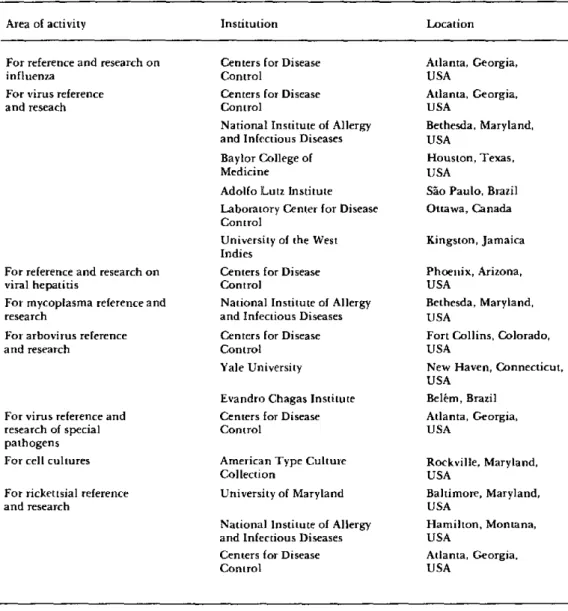
The problems raised by large poliomyelitis epidem-ics, together with the development of an inactivated poliovirus vaccine (IPV) in the early 1950s and the need to identify properly many strains of coxsackie and echoviruses isolated in that decade, led to a series of collaborative studies under the aegis of WHO and to the creation of a network of WHO reference centers in 1953. In 1958 this scheme was extended to all other viruses of public health importance. In 1973 the distinction between centers dealing with enteroviruses and respira-tory viruses was abolished since many of the centers were in fact working in both fields. Recent advances in certain fields such as hepatitis and special pathogens have led to the addition of new centers to cover these subjects. At present there are in the Region 18 collabo-rating centers in four countries: 14 in the United States, two in Brazil, and one each in Canada and Jamaica (Table 1). For practical reasons, a distinction has been maintained for influenza, viral hepatitis, mycoplasma, arboviruses, special pathogens, rickettsiae, and those centers which have a specific task rather than a wide range of reference activities.
Table 1. WHO collaborating centers for viral diseases in the Americas.
Area of activity Institution Location
For reference and research on Centers for Disease Atlanta, Georgia,
influenza Control USA
For virus reference Centers for Disease Atlanta, Georgia, and reseach Control USA
National Institute of Allergy Bethesda, Maryland, and Infectious Diseases USA
Baylor College of Houston, Texas, Medicine USA
Adolfo Lutz Institute Sao Paulo, Brazil Laboratory Center for Disease Ottawa, Canada Control
University of the West Kingston, Jamaica Indies
For reference and research on Centers for Disease Phoenix, Arizona, viral hepatitis Control USA
For mycoplasma reference and National Institute of Allergy Bethesda, Maryland, research and Infectious Diseases USA
For arbovirus reference Centers for Disease Fort Collins, Colorado, and research Control USA
Yale University New Haven, Connecticut, USA
Evandro Chagas Institute Belém, Brazil For virus reference and Centers for Disease Atlanta, Georgia, research of special Control USA
pathogens
For cell cultures American Type Culture Rockville, Maryland, Collection USA
For rickettsial reference University of Maryland Baltimore, Maryland,
and research USA
National Institute of Allergy Hamilton, Montana, and Infectious Diseases USA
Centers for Disease Atlanta, Georgia,
Control USA
The terms of reference of the viral diseases collaborat-ing centers are: to provide reference services (identifica-tion of rare strains); prepare and distribute to na(identifica-tional laboratories reference sera, antigens, and strains; take part in collaborative studies; cooperate with national laboratories and provide them with advice and train-ing; give on request advice to governments and
assist-ance in epidemics; collect epidemiological informa-tion; and carry out applied research.
(Source: Epidemiology Unit, Health Programs Development and Research Coordination, PAHO.)
\I5Id p~,
@rwo (
-~
4 . 6·<;PAN AMERICAN HEALTH ORGANIZATION Pan American Sanitary Bureau, Regional Office of the
WORLD HEALTH ORGANIZATION 525 Twenty-third Street, N.W.
Washington, D.C. 20037, U.S.A.
.
16