Comparative
Study of Safety and Efficacy of
IUD Insertions by Physicians and Nursing
Personnel in Brazil1
KAREN
J.LASSNER,
2 CHARLES
H. C.CHEN,~ LIA
A. J.KROPSCH,~
MARK
W.OBERLE,~ ISABEL
M. N.LOPES,~ & LEO MORRIS~
To assess whether trained nursing personnel could provide IUD services as safely and 4fecfively as physicians in Brazil, an experimental study was conducted at the main clinic of the Center for Research on Integrated Maternal and Child Care in Rio de Janeiro. From November 1984 through April 1986, a fatal of 1 711 women who requested IUD insertion at the clinic were randomly assigned to have a Copper-T 200 IUD inserted by one of the clinic’s 11 physicians or 13 nurses. All of the physicians and nursing staff members who provided fhese services had taken the Center’s standard clinical family planning training course.
Of 860 insertions attempted by the physicians and nurses, 1.3% and 3.3%, respectively, were unsuccessful. Statistically, this difference was very significant V < 0.01). Also, mainly because the cervix was small and undiluted, nulliparous women had a relatively high insertion failure rate of 8.0%‘ as compared to 1.5% for primiparas and 1 .O% for multiparas. The
overall rateof complications at insertion was 1.8%‘ these complications including diapkoresis, vomiting, syncope, cervical laceration, and one case of perforation of the uterus; no significant diflerence was found between the complication rates for insertions performed by physicians as compared to nurses. However, 9.0% of the study subjects reported severe pain during IUD inserfion, with significantly higher percentages reporting pain if the IUD was inserted by a physician, or if the subject was nulliparous, had preinsertion symptoms, or had a history of pelvic inflammatoy disease (PlD) or sexually transmitted disease (STD). It was also found that the nurses had a dramatically high insertion failure rate (11.6%) with nulliparous subjects, while the physicians‘ failure rate with suck subjects was a significantly lower 3.4%. No significant difference was found in the groups served by nurses and physicians with regard to posfinsertion complaints or termination of use within 12 months of insertion.
These findings suggest that future training, besides preparing nursing personnel in IUD
insertion, should emphasize preparation in taking the client’s medical kisto y and diagnosing ejcisting medical symptoms that could be associated with IUD insertion complications. In addifion, if a nulliparous woman requests an insertion, it should be performed by a physician or more experienced nursing staff member with close medical supervision. Because of high rates of reported pain at insertion, suck women, as well as those with medical symptoms associated with IUD insertion complications and those with a kistoy of PID or STD, should be considered candidates for extra care and counseling. Finally, because a kigk rate of removal was related to medical symptoms reported by users after insertion, women with postinserfion symptoms should be carefully evaluated and counseled about options for treatment or possible IUD removal.
‘Reprint requests and other correspondence should sultant in Rio de Janeiro, Brazil.
be addressed to Charles H. C. Chen, Mail Stop K- 3Demographer, Division of Reproductive Health 35, Centers for Disease Control and Prevention, (DRH), Center for Chronic Disease Prevention and Atlanta, GA 30333, USA. This article will also be Health Promotion (CCDPHP), Centers for Disease published in Spanish in the Boletin de la Oficina Control and Prevention (CDC), Atlanta, Georgia,
Sanitaria Panamericana, Vol. 119, 1995. U.S.A.
*Formerly with the Department of Information, Evaluation, and Research, Center for Research on Integrated Maternal and Child Care Kenfro de Pes-
quisas de Assistencia lntegrada a Mulher e a Crianfa-
CPAIMC). Currently an international health con-
4Formerly with CPAIMC.
5Medical epidemiologist, DRH, CCDPHP, CDC. 6Formerly a medical supervisor with CPAIMC. %ehavioral Epidemiology and Demographic Re-
D
ata indicate that only 1% of Brazil- ian married women 15-44 years of age use intrauterine devices (IUD) for contraception, even though overall con- traceptive use is high (66%) in compari- son to many other developing countries (l-3). Historically, several factors have contributed to low IUD use in Brazil. First, for many years the debate in Brazil over whether the IUD acted as an abortifacient deterred both potential providers and users of the device. Second, until re- cently IUDs were not manufactured in Brazil, and their importation required complex bureaucratic paperwork involv- ing the Ministry of Health. Third, Bra- zilian physicians had little knowledge of the method, since their medical educa- tion did not include training in IUD in- sertion and management. Last, the lack of a national family planning program made it difficult for most Brazilian women to learn about the method and gain access to the few IUDs available in the country.In the early 198Os, however, the situ- ation began to change. As copper IUDs became available, the IUD was recog- nized as a contraceptive that prevented fertilization rather than as an abortifa- cient. Domestic production of copper II-IDS also began on a small scale. Some med- ical schools began to include contracep- tion, including training about IUDs, in their curricula. The Ministry of Health launched the Women’s Integral Health Care Program
Programa de Assistencia In-
tegral u
Satide da Mulher),
which became the first national public health program in Brazil to offer family planning services, including the IUD. Still, one of the main problems in making IUD services avail- able to the general population in Brazil has been and remains a shortage of phy- sicians in primary health care settings- a problem commonly encountered in de- veloping countries.Over the past two decades, many de- veloping countries-including the Phil-
ippines and Turkey-have conducted
studies to test the feasibility of having health care workers other than physi- cians provide IUD services (4,5). The re- sults of these studies have generally in- dicated that trained nurses and other health care personnel can provide IUD services as safely and effectively as phy- sicians. Within this context, an evalua- tion of auxiliary nurse-midwife training programs in Turkey and the Philippines has shown that the trainees’ competency and proficiency in providing IUD serv- ices registered a definite improvement during the course of the training (4).
To determine whether trained nursing personnel could provide IUD services as safely as physicians in Brazil, an experi- mental study was conducted at the cen- tral clinic of the Center for Research on Integrated Maternal and Child Care (Cen-
tro de Pesquisas de Assistencia lntegrada a
Mzdher
e u Criunca-CCPAIMC) from No- vember 1984 through April 1986. CPAIMC was a nonprofit institution that provided primary health care and family planning services, including IUD insertion, to low- income families in Rio de Janeiro. The IUDs used in the study, imported with health ministry authorization, were do- nated by USAID intermediary donor agen- cies, which also provided CPAIMC with financial support to train health providers in IUD insertion and management.OBJECTIVES
Our study had two objectives. First, we tried to determine whether trained nursing personnel8 would perform IUD insertions as safely as physicians. To that end we compared insertion failures and complications at insertion for IUDs in-
*Nursing personnel in Brazil include university de- gree nurses; technical nurses with high school di- plomas and 11 years of education, of which the last 3 years consist of vocational nursing training; and auxiliary nurses with 8 years of education and 1.5 additional years of nursing training.
serted by nurses versus those inserted by physicians. Medical symptoms reported by the patients before and after IUD in- sertion by the two groups of providers were also compared. Second, we tried to assess the use-effectiveness of IUDs in- serted by the two types of providers, for which purpose the IUDs inserted by nurses and physicians were compared with regard to rates of continuation and of termination due to pregnancy, expul- sion, or removal.
METHODOLOGY
The study included all women who were eligible to receive the IUD and who voluntarily requested IUD insertion at the CPAIMC central clinic from November 1984 through April 1986. The criteria for ineligibility were CPAIMC’s standard contraindications to IUD insertion: sus- pected or confirmed pregnancy, uterine abnormality, abnormal cervical cytology, or pelvic infection (but not a history of pelvic inflammatory disease-PID). Women included in the study were ran- domly assigned to have an IUD inserted by one of 11 physicians or 13 nurses at the clinic. The device inserted was the Copper-T 200 IUD. Before the study, all physicians and nursing staff members who provided IUD services had participated in CPAIMC’s standard clinical family planning training course.
The training for nurses with university nursing degrees lasted for 6 weeks, in- cluding 2 weeks of theory and 4 weeks of practice. Training for technical nurses, and occasionally auxiliary nurses, usually lasted 8 weeks, including 2 weeks of the- ory and 6 weeks of practice. A minimum of 10 solo insertions was required during practice training. A small number of in- sertions included in the study were per- formed by nurse trainees from other in- stitutions. These latter received training that consisted of 1 week of theory and 3 weeks of practice, and that also re-
quired 10 solo insertions. During train- ing, all of the nurse trainees were su- pervised by CPAIMC family planning nurse practitioners.
A patient coming to the clinic for an IUD insertion was given a physical and gynecologic examination during her ini- tial visit. During this and subsequent vis- its, patients experiencing abnormal gy- necologic findings, as well as difficulties or complications with insertions per- formed by nursing personnel, were re- ferred to a consultant physician for treat- ment if necessary. In addition, a senior gynecologist was always present in the clinic to care for complicated cases re- ferred by the physicians.
Each patient’s basic sociodemographic data, reproductive history, medical con- ditions, insertion complications, com- plaints before and after insertion, and re- sults of insertion were recorded. Informed consents were not obtained from the sub- jects who participated in this study, be- cause we followed the existing standards of normal clinical procedure.
After the IUDs were inserted, all the participating women were asked to re- turn to the clinic for follow-up visits at 1, 6, and 12 months. However, every woman was also encouraged to return to the clinic if she experienced medical problems after the insertion. The nursing staff handled all follow-up visits to the clinic. Women with problems at follow- up who required medical care were re- ferred to a physician. At each follow-up visit, data were recorded on problems such as pregnancy, IUD expulsion, IUD re- moval, or patient complaints.
return to the clinic for their scheduled follow-up visit, were mailed up to four reminders. Follow-ups were discontin- ued for those who did not return after the four reminders. If the post office re- turned a reminder letter because the ad- dress was inadequate, no further follow- up was attempted.
RESULTS
Patient Characteristics
Before
Insertion
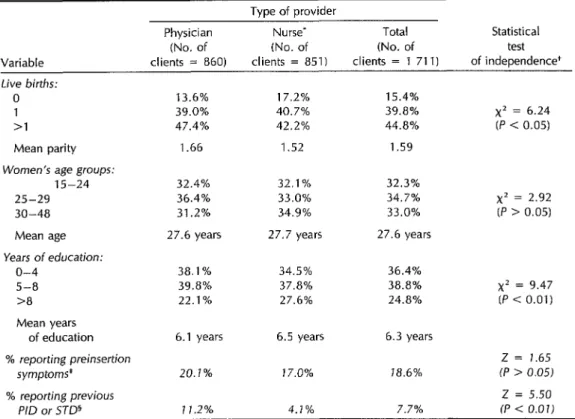
A total of 1 711 women were admitted for IUD insertion throughout the study period, with 860 and 851 insertions being attempted by the study physicians and nurses, respectively. In spite of the clients being randomly allocated by type of pro- vider, some sociodemographic character- istics and medical conditions of the two groups were significantly dissimilar. Table 1 shows the basic data involved, together with the results of X2 tests of independence for the types of providers and each variable.
Compared to the clients of nurses, the clients of physicians included a lower percentage of nulliparous women (13.6% vs 17.2%) and a higher percentage of women with a parity of two or more (47.4% vs 42.2%). Therefore, the clients of physicians had a higher mean parity than the clients of nurses (1.66 vs 1.52). This difference in parity distribution be- tween the clients of physicians and nurses was statistically significant (P < 0.05).
The age distributions of the clients of the two types of providers were slightly different; but the two groups had almost the same mean ages (27.6 versus 27.7 years), and the difference between them was not statistically significant (P > 0.05). Finally, the physicians’ clients had fewer years of schooling (an average of 6.1 years) than the nurses’ clients (an average of 6.5
years), and this difference was statisti- cally very significant (P < 0.01).
Some 20% of the physicians’ clients and 17% of the nurses’ clients reported prein- sertion symptoms such as intermenstrual bleeding, spotting, dysmenorrhea, or pelvic pain. The difference, however, was not statistically significant (P > 0.05). On the other hand, a much higher percent- age of physician clients than nurse clients (11.2% versus 4.1%) were found to have histories of pelvic inflammatory disease (PID) or sexually transmitted disease (STD). This difference was statistically very significant (P < 0.01).
One possible explanation for all these differences, despite the planned random- ization carried out, relates to differ- ences in the recorded rates of pelvic in- flammatory disease (PID) and sexually transmitted disease (STD) among the clients of nurses and physicians. If (as seems likely) the nurses were relatively poor at accurately detecting PID and STD, then they could have been more likely than the physicians to misdiagnose symptoms related to STD as PID,9 and so to exclude the misdiagnosed women from the study. Such phantom PID exclu- sions could have caused the nurses’ clients to have significantly lower average parity and significantly higher average education than the physicians’ clients, since groups with higher parity and lower education tend to have higher rates of STD.
Insertion
Failures, Complications,
and Pain
Table 2 shows the percentages of clients experiencing insertion failure, insertion complications, and severe pain at inser-
‘In 1987, when the study results were first available, the clinical records of 149 PID cases diagnosed by the nurses were reviewed by one of CPAIh4C’s most experienced nurse practitioners. This person could only confirm that about 34 were indeed PID cases.
Table 1. Characteristics of women requesting IUD insertion, by type of provider (CPAIMC, Brazil, 1984-l 986).
Tvoe of provider Physician
(No. of
Nurse’ (No. of
Total (No. of
Statistical test Variable clients- = 860) clients = 851) clients = 1 711) of independence+ Live births:
0
>I
Mean parity
Women’s age groups:
15-24 25-29 30-48 Mean age Years of education:
o-4 5-a 3
13.6% 17.2% 39.0% 40.7% 47.4% 42.2% 1.66 1.52 32.4%
36.4% 31.2% 27.6 years
38.1% 39.8% 22.1%
32.1% 33.0% 34.9% 27.7 years
34.5% 37.8% 27.6%
15.4% 39.8% 44.8% 1.59
x2 = 6.24
(P < 0.05)
32.3% 34.7% 33.0% 27.6 years
x2 = 2.92 (P > 0.05)
36.4% 38.8% 24.8%
x2 = 9.47 (P c 0.01) Mean years
of education 6.1 years 6.5 years 6.3 years
% reporting preinsertion Z = 1.65
symptoms* 20.1% 17.0% 18.6% (P > 0.05)
% reporting previous z = 5.50
P/D or STD5 11.2% 4.1% 7.7% (P < 0.01)
. In this and subsequent tables, the term “nurse” refers to all classlflcatlons of nursmg personnel in Brazil. univewty degree nurses, technical nurses (with high school diplomas), and auxiliary nurses (with
9
years of education) See text footnote 8. + The x2 stat&c was used to test the Independence between each vanable and the type of performer, while the Z score wasobtained to test the significance of rate differences between the two types of performers
* Symptoms reported by the client prior to Insertion (such as mtermenstrual spottmg, bleedmg, dysmenorrhea, or pelwc pain). 5 Those who reported one or more episodes of pelvic mflammatory disease or sexually transmitted disease prior to InsertIon.
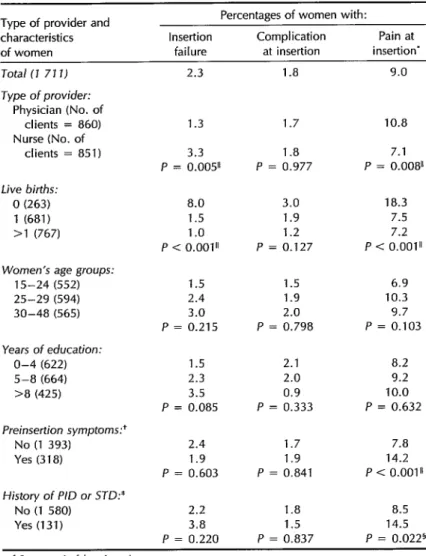
tion. These rates are also shown for the groups being served by nurses and by physicians, as well as for clients with var- ious sociodemographic characteristics and medical conditions. In all, out of 1 711 in- sertions attempted, 2.3% were unsuccessful.
Differences in rates of insertion failure by type of provider and client parity were statistically very significant. The rate of in- sertion failure was 1.3% for insertions at- tempted by physicians compared to 3.3% for those attempted by nurses. In addition, women with no previous live births (nul- liparas) had a relatively high insertion fail- ure rate of 8.0% (mainly because of the small, undilated cervix), while the two
groups with higher parity (one or more
than one previous live birth) had failure rates of 1.5% and l.O%, respectively.
Although the rate of insertion failure was somewhat higher for older age groups and more highly educated women, the differences observed were not statisti- cally significant. Likewise, reported preinsertion medical symptoms or a his- tory of PID or STD did not appear sig- nificantly related to insertion failure.
Table 2. Percentages of women with insertion failure, insertion complications, or pain at insertion by type of provider and characteristics of the women (CPAIMC, Brazil, 1984-l 986).
Tvae of ,. txovider and Percentages of women with:
characteristics of women
Insertion failure
Complication at insertion
Pain at insertion*
Total (7 77 7)
Type of provider:
Physician (No. of clients = 860) Nurse (No. of
clients = 851)
Live births:
0 (263) 1 (681) >l (767)
Women’s age groups:
15-24 (552) 25-29 (594) 30-48 (565)
Years of education:
O-4 (622) 5-8 (664) >8 (425)
Preinsertion symptoms:’
No (1 393) Yes (318)
History of P/D or SJD:*
No (1 580) Yes (131)
2.3 1.8 9.0
1.3 1.7 10.8 3.3 1.8 7.1
P = 0.005” P = 0.977 P = 0.008”
8.0 3.0 18.3 1.5 1.9 7.5 1 .o 1.2 7.2 P < 0.001” P = 0.127 P < 0.001”
1.5 1.5 6.9 2.4 1.9 10.3 3.0 2.0 9.7
P = 0.215 P = 0.798 P = 0.103 1.5 2.1 8.2 2.3 2.0 9.2 3.5 0.9 10.0
P = 0.085 P = 0.333 P = 0.632
2.4 1.7 7.8 1.9 1.9 14.2 P = 0.603 P = 0.841 P < 0.001”
2.2 1 .a 8.5 3.8 1.5 14.5 P = 0.220 P = 0.837 P = 0.0225 ’ Severe pain felt at insertion.
+ Intermenstrual spotting, bleeding, dysmenorrhea, or pelvic pam.
* Those who had had pelvic inflammatory disease or sexually transmitted disease before msertion.
5 Statistically significant, P < 0.05. 11 Statistically significant, P < 0.01.
laceration. There was also one case of perforation of the uterus. The complica- tion rates for insertions performed by physicians and nurses were low and about equal (1.7% and 1.8%, respectively). Ob- served differences in the complication rates of chents with different sociode- mographic characteristics and medical
conditions (age, parity, education, prein- sertion symptoms, and PID or STD his- tories) were not statistically significant.
The last column of Table 2 shows that 9.0% of the clients reported severe pain during insertion. A significantly higher percentage of those whose IUDs were in- serted by physicians as opposed to nurses
(10.8% versus 7.1%) reported such pain. Other statistically significant factors in- cluded nulliparity, the existence of prein- sertion symptoms, and a history of PID or STD. These latter findings suggest that the higher percentage of painful inser- tions experienced by the physicians’ clients (as compared to the nurses’ clients) may have occurred because higher percent- ages of the physicians’ clients were found to have preinsertion symptoms or a his- tory of PID/STD (see Table 1).
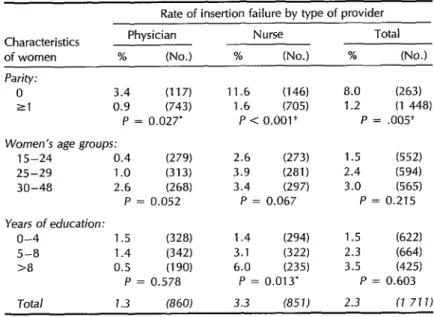
Since the rate of insertion failure was significantly related to both type of pro- vider and parity, the rate of insertion fail- ure by these two variables was cross- classified (Table 3). The physicians had an insertion failure rate of 3.4% for nul- liparous clients compared to 0.9% for clients with higher parity (one or more live births), a difference that was statis- tically significant (P < 0.05). In contrast, the nurses had a dramatically high failure rate of 11.6% for nulliparous clients, as compared to a failure rate of 1.6% for higher-parity clients; the difference be- tween these two latter rates was highly significant
(P -c 0.01).
The overall rate of insertion failure for women with one or more live births was 1.2%. This level of insertion failure is re- garded as quite high. Because the prev- alence of cesarean section in Brazil is also relatively high,*O it appears that this high level of insertion failure could be partly accounted for by inclusion of women in the parous category who delivered by ce- sarean section before there was any di- lation of the cervix.
‘OAccording to a nationwide contraceptive preva- lence survey conducted in 1986,31.6% of the most recent births in Brazil were delivered by cesarean section (2). However, lower socioeconomic groups had lower rates, while urban areas had higher rates than rural areas. The site of the study re- ported in this article was an urban Rio de Janeiro slum.
IUD Use-effectiveness
To evaluate the use-effectiveness of IUDs inserted by different providers, we used life-table techniques to analyze data for clients who had had their devices suc- cessfully inserted during the study pe- riod (November 1984 through April 1986). To ensure that all these clients were ob- served for at least one full year after ini- tial acceptance of the device, the cutoff date for the study was set at 30 June 1987. Partly because not all cases were actively followed up, 121 of the 1672 women with successfully inserted IUDs never re- turned to the clinic. Those who never returned (representing 7.2% of the over- all sample, 8.1% of the physicians’ clients, and 6.3% of the nurses’ clients) were ex- cluded from the analysis. Thus, a total of 1 551 cases were available for the life- table analysis.
In the life-table analysis, 46.0% of all the cases (47.2% of the physicians’ clients and 44.7% of the nurses’ clients) were censored at less than one year because they were lost to follow-up. However, 62.0% of all the cases who were lost to follow-up were observed for more than six months. Because the life-table analy- sis excluded the 7.2% of the women who never returned to the clinic after the ini- tial visit for IUD insertion but included the 46.0% of the women who were cen- sored at less than one year because they were lost to follow-up, the results of that analysis may not reflect the true levels of IUD use-effectiveness. Nevertheless, these data are valid for comparing the perfor- mance of IUDs being inserted by the phy- sicians and the nurses as long as the two groups did not differ greatly in terms of the rates of exclusion and the proportions lost to follow-up.
Table 3. Rate of IUD insertion failure, by type of provider and
demographic characteristics of clients. The numbers in parentheses refer to the number of clients. (CPAIMC, Brazil, 1984-l 986.)
Rate of insertion failure by type of provider Characteristics
of women
Physician Nurse Total % (No.) % (No.) % (No.)
Parity: 0
21
3.4 (117) 11.6 (146) 8.0 (263) 0.9 (743) 1.6 1705) 1.2 (1 448)
P = 0.027’ P < 0.001+ P = .005+ Women’s age groups:
15-24 0.4 (27% 25-29 1 .o (313) 30-48 2.6 (268)
P = 0.052
Years of education:
o-4 1.5 (328)
5-8 1.4 W-3 >8 0.5 (190)
P = 0.578
2.6 (273) 1.5 (552)
3.9 (281) 2.4 (594)
3.4 (297) 3.0 (565)
P = 0.067 P = 0.215
1.4 ww 1.5 (622)
3.1 (322) 2.3 (664)
6.0 (23% 3.5 (425)
P = 0.013’ P = 0.603 Total 1.3 (860)
* Statistically significant, P < 0.05. + Statistically significant, P < 0.01.
3.3 (85JJ 2.3 17 717)
totals of the monthly rates following IUD The table also shows the life-table gross insertion; they therefore reflect the data cumulative termination rates for reasons of censored at less than 12 months for the pregnancy, expulsion, and removal (for full known length of exposure. Differ- listed causes) by type of provider. No sig- ences in the continuation rates of the dot- nificant differences were observed be- tors’ and nurses’ clients were negligible. tween the termination rates (whether for
Table 4. Life-table cumulative rates of IUD continuation and termination at 12 months after insertion, by type of termination and type of provider. SE = standard error. (CPAIMC, Brazil, 1984-1986.)
Continuation and
Rate of termination by type of provider Physician Nurse Total tvoe of termination % (SE) % (SE) % (SE)
Continuation rate 74.4 (2.0) 75.2 (7.9) 74.9 (J.4)
Termination rate’ 25.6 (2.OJ 24.8 (7.9) 25.1 (1.4)
Pregnancy 1.4 (0.5) 1.0 (0.5) 1.2 (0.3) Expulsion 5.3 (0.9) 5.0 (0.8) 5.1 (0.6) Removal 21.6 (2.0) 20.8 (1.9) 21.1 (1.4)
Reasons for removal:’
Medical reasons a.7 (1.4) 6.2 (1.1) 7.4 (0.9) Planned pregnancy 6.3 (1 .a 5.8 (1.1) 6.1 (0.8) Other reasons 8.2 (1.4) 10.2 (1.5) 9.2 (1 .a * Notice that the total rate of termination is less than the sum of the three rates of reasons for
termination (pregnancy, expulsion, and removal) because these three rates were computed as gross rates without considering competing risks. Likewise, the three rates of reason5 for removal were computed as gross rates.
Table 5. Percentages of IUD users reporting complaints before and after IUD acceptance, by type of provider (CPAIMC, Brazil, 1984-l 986).
Before IUD
% having a complaint After IUD
Type of provider acceptance (1) acceptance (2) Difference (2 - 1) Physician (780) 20.5 46.3 25.8 Nurse (771) 17.1 42.2 25.1 Total (1 551) 18.8 44.3 25.5
pregnancy, expulsion, or removal) of clients served by the two types of providers.
IUD Side-effects
To detect side-effects associated with IUD use, we compared rates of com- plaints reported by women before IUD insertion at the initial visit with rates of complaints reported at the last follow-up visit, by type of provider (Table 5). Both the preinsertion and postinsertion com- plaints consisted mainly of abdominal pain, lumbago, and intermenstrual bleeding. There was no established pe- riod of retrospection for preinsertion complaint symptoms. The physicians re- ported a higher rate of clients with prein- sertion symptoms (20.5%) than did the nurses (17.1%). However, the increases in the complaint rates reported by the physicians and the nurses were compa- rable (25.8% and 25.1%, respectively).
DISCUSSION
Especially in a country short of phy- sicians, trained nursing personnel have an important role to play in primary health care settings. This study found that trained nurses, using the standard training and operating procedures at CPAIMC, pro- vided IUD services to family planning clients as safely and effectively as phy- sicians. Whether insertions were per- formed by physicians or nurses, the rate of complications at insertion was very low. The nurses had a higher rate of insertion
failure than the physicians, apparently because the nurses had a higher propor- tion of nulliparous clients and also be- cause they had a higher rate of insertion failure while working with nulliparous clients than did the physicians.
IUD use-effectiveness as well as side- effects appeared unrelated to whether the devices were inserted by physicians or nurses. Relative to other Brazilian studies using the same type of IUD, the use- effectiveness of the IUD observed in this study was characterized by very low pregnancy and expulsion rates, together with high rates of both removal and con- tinued use (5, 6). Relative to other studies conducted with the Copper-T 200 IUD elsewhere in the world (7), the contin- uation, pregnancy, and expulsion rates found in our study fall within the same range as the results of those studies. However, the removal rate found in our study was somewhat higher than the max-
histories of PID/STD seemed to experi- ence severe pain during IUD insertion, extra care and counseling should be con- sidered for these clients. Third, according to the norms of the Program for Maternal and Infant Health of the Ministry of Health, IUDs are not to be inserted in nulliparous women. l1 However, if a nul- liparous woman requests such an inser- tion, to minimize the risk of insertion fail- ure that insertion should be performed by a physician or by a more experienced nursing staff member with close medical supervision. Finally, because a high rate of removal was related to medical symp- toms reported by users after insertion, women with such symptoms should be carefully evaluated and counseled about options for treatment or possible IUD removal.
Acknowledgments. The authors wish to thank Teresa Cristina Soares Monteiro da Trindade and Glaucia Maria Bon for their assistance in coordinating data col- lection, entry, and processing in prepa- ration for an earlier version of this article; Dr. Eduardo Lavander, Dr. Sergio Nunes, and nurses Lucimar Ferreira Rodrigues and Ann Mary MTF Rosas for their co- operation throughout the study. as su- pervisors of the CPAIMC central clinic; Dr. Claudia Maria Lebre de Miranda for medical supervision of the study during its latter phase; nurses Concei@o Rocha Pinto and Cecilia Maria Bessa Rodrigues for their involvement in the planning and implementation of the study;. and most
“Since the CPAJhIC clinics are within the private sector, their norms of clinical procedure conform to those established by the Brazilian Obstetric and
Gynecology Association, according to which IUD insertion is provided for nulliparous women who request it.
importantly, all of the physicians, nurses, technical nurses, and auxiliary nurses who for two-and-a-half years faithfully com- pleted data collection forms as they cared for IUD clients.
We are also grateful to the Pathfinder Fund for the financial support that made this study possible, to Family Health In- ternational for the initial transfer of tech- nology that permitted the study to be implemented, and to the Division of Re- productive Health (DRH), Center for Chronic Disease Prevention and Health Education (CCDPHP), Centers for Dis- ease Control (CDC), for assistance with data processing and analysis.
REFERENCES
1.
2.
3.
4.
5.
6.
7.
Arruda JM, Rutenberg N, Morris L, Fer- raz EA. Pesquisa national sobre satide ma- terno-infantil e planejamento familiar, Brasil, 2986. Rio de Janeiro: Sociedade Civil Bem- estar Familiar do Brasil; 1988.
Wawer MJ, Lassner KJ, Hanff BBC. Con- traceptive prevalence in the slums of Rio de Janeiro. Stud Fam Harm 19&6;17(1):
44-52.
Ferraz EA, Ferreira IQ, Ruttenberg N. Pesquisa sobre salide familiar no Nordeste Bra- sil 1992. Rio de Janeiro, Brazil, and Co- lumbia, Maryland, USA: Sociedade Civil Bern-Estar Familiar do Brasil; October 1992. Akin A, Gray RH, Ramos R. Training aux-
iliary nurse-midwives to provide IUD
services in Turkey and the Philippines. Stud Fam Plann 1980;11(5):178-187. Eren N, Ramos R, Gray RH. Physicians vs. auxiliary nurse-midwives as providers of IUD services: a study in Turkey and the Philippines. Stud Fam Plann 1983; 14(2)x%-47.
Diaz J, Faundes A, Diaz MM, Pinotti JA. Comparative clinical trial of two models of copper IUDs in Campinas, the T-Cu 200 and the Multiload-Cu 250. J Bras Gi- necoI 1985;95(8):363-366.
Sivin I. The effectiveness of the Copper- T intrauterine device: a collaborative study in five countries. Stud Fam Nann 1973; 4(7):162-170.