https://doi.org/10.1590/0004-282X20170033
ARTICLE
Treatment of drooling with sublingual atropine
sulfate in children and adolescents with
cerebral palsy
Tratamento da sialorreia com sulfato de atropina via sublingual em crianças e
adolescentes com paralisia cerebral
Bruno L. Scofano Dias1, Alexandre R. Fernandes2, Heber de S Maia Filho2
Drooling is the involuntary loss of saliva and buccal content1,2
and it usually occurs in infants. Drooling is abnormal in children older than four years and it often persists in children with neu-rological disorders with neuromuscular incoordination of swal-lowing, and intelectual disabilities such as cerebral palsy (CP)1.
he prevalence of drooling in CP is not often studied1.
Some authors report a prevalence between 10% and 58%3,4,5,6 .
he drooling in CP children is not caused by hypersaliva -tion, but by oral motor dysfunc-tion, dysphagia and/or by an intraoral sensitivity disorder1,5,7,8. Drooling afects the lives of
CP children and their families, both clinically and socially.
Anterior drooling is the unintentional loss of saliva from the mouth. It may lead to psychosocial consequences for children and for their families such as social isolation, the constant need to remind the individual to swallow the saliva, as well as the need to clean up the excess saliva in the mouth, chin and other areas, and change and wash towels and clothes.
here are also physical consequences such as perioral infec -tions and damages to the dentition1,6,8. Posterior drooling
occurs whenever the saliva slips from the tongue to the phar-ynx. It poses a saliva aspiration risk, which may not be
diag-nosed before the development of signiicant lung injury1,6.
1Rede SARAH de Hospitais de Reabilitação; Rio de Janeiro RJ, Brasil. 2Universidade Federal Fluminense; Niterói RJ, Brasil.
Correspondence: Bruno L. Scofano Dias; Avenida Vice Presidente José Alencar, 1455 / bloco 5 / apartamento 104; 22775-033 Rio de Janeiro RJ, Brasil. E-mail: [email protected]
Conflict of interest: There is no conlict of interest to declare.
Received 12 August 2016; Received in inal form 23 November 2016; Accepted 20 December 2016.
ABSTRACT
Atropine sulfate blocks the muscarinic receptors in the salivary glands and leads to reduced saliva production. There are no published studies about its use in children with cerebral palsy. Objective: To report the effect of sublingual atropine sulfate to treat drooling in children with cerebral palsy by comparing the results of the Drooling Impact Scale in a non-controlled open clinical trial. Results: Twenty-ive children were assessed. The difference in the mean scores of the pre- and post-treatment scales reached statistical signiicance. There was a low frequency of side effects compared to studies with other anticholinergics. Conclusion: The use of sublingual atropine sulfate seems to be safe and there is a reduction in the Drooling Impact Scale score, which suggests eficacy in the treatment of drooling in children and adolescents with cerebral palsy. Our results should be replicated in randomized, placebo-controlled studies with larger numbers of participants.
Keywords: cerebral palsy; sialorrhea; child; drug therapy; atropine.
RESUMO
O sulfato de atropina bloqueia os receptores muscarínicos nas glândulas salivares reduzindo a produção de saliva. Não há estudos publicados relativos ao seu uso para tratamento da sialorreia em crianças com paralisia cerebral. Objetivo: Relatar o efeito do sulfato de atropina sublingual no tratamento da sialorreia em crianças com paralisia cerebral a partir da comparação dos resultados da Drooling Impact Scale em ensaio clínico aberto não controlado. Resultados: Vinte e cinco crianças foram avaliadas. A diferença das pontuações médias nas escalas pré-tratamento e pós-tratamento atingiu signiicância estatística. Houve baixa frequência de efeitos colaterais em relação a outros anticolinérgicos. Conclusão: O uso de sulfato de atropina sublingual parece ser seguro e está relacionado a uma redução na pontuação da Drooling Impact Scale, o que sugere eicácia no tratamento da sialorreia em crianças com paralisia cerebral. Nossos resultados devem ser replicados em estudos randomizados, placebo controlados, com maior número de participantes.
he drooling severity and impact may be assessed through objective or subjective methods9. he objective methods include
the measurement of the salivary low and the direct observa -tion of the loss of saliva; however, these are complicated and/or
invasive methods. Subjective scales are useful and appropriate
methods to measure changes in drooling, assessing the impact on families, caregivers and on the individuals themselves9,10.
Some drooling treatment modalities can be used in CP such astraining for sensory awareness and oral motor skills; oral, transdermal and sublingual anticholinergic drugs; appli-cation of botulinum toxin; and surgical management8,11,12,13.
Glycopyrrolate, benztropine, scopolamine and trihexyphe-nidyl are the most-used systemic anticholinergic drugs.
hey induce a signiicant reduction in saliva low and their efectiveness has been conirmed in several studies14,15,16,17,18,19.
On the other hand, they can lead to side efects such as vom -iting, diarrhea, irritability, mood changes and insomnia.
Although atropine sulfate was acknowledged as efec -tive many years ago, it never received wide acceptance in the treatment of chronic drooling. Its mechanism of action is by blocking the muscarinic receptors (M3) in the salivary glands, leading to reduced saliva production17. Some articles
have reported its use in the treatment of drug-induced drool-ing20,21,22 and in Parkinson’s disease patients23. he only article
referring to its use in treating drooling in children or adoles-cents reported the case of a successfully-treated 14-year-old boy with metachromatic leukodystrophy17. here is only one
prospective, randomized, placebo-controlled double-blind study that has investigated the use of sublingual atropine
sul-fate to treat drooling. he cohort comprised 22 adult subjects
with upper gastrointestinal tract cancer and the atropine had
no efect on those patients in comparison to the placebo24.
here is no published study assessing the use of atropine
sulfate to treat drooling in CP children.
he aim of the current study was to report the efect
of using sublingual atropine sulfate to treat drooling in CP children and adolescents by comparing the results of the Drooling Impact Scale (DIS). Our hypothesis was that there would be a reduction in the DIS score after the use of
atro-pine sulfate, as well as few side efects.
METHODS
Participants
All children and adolescents treated at a neurorehabilita-tion center in Rio de Janeiro (Brazil) were assessed for
eligi-bility. he inclusion criteria were: 1) CP diagnosis according to the International Executive Committee for the Deinition
of Cerebral Palsy25; 2) presence of drooling as deined by
Blasco2; 3) presence of clinical and/or social damage for the
children, followed or not by the feeling in the family of over-load caused by drooling; 4) ages between two and 17 years; 5) weight greater than or equal to 10 kg; and 6) normal
electrocardiogram. he following criteria were interpreted as losses: 1) presence of side efects; 2) irregular use of atropine
sulfate; 3) discontinuation in the use of atropine sulfate.
hirty-three patients met the inclusion criteria. Eight
individuals met the loss criteria, one due to irregular use of atropine sulfate, three due to discontinuation in the use of
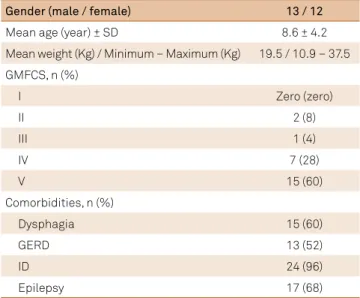
atropine sulfate, and four due to side efects. he inal sam -ple comprised 25 patients. Table 1 shows the participants’ sociodemographic and clinical characteristics.
Ethics
he current study was approved by the Research
Ethics Committee of the SARAH NetworkofRehabilitation
Hospitals (Certiicate of Submission for Ethics Assessment 48300015.0.0000.0022). he informed consent form was
signed by the patients and their caregivers.
Data collection
he data were collected by ive pediatricians (including the
author) of the neurorehabilitation center, who were trained to homogeneously perform the task and were also responsible
for prescribing the atropine sulfate. he following sociodemo -graphic and clinical variables were analyzed in addition to the
results of the DIS: age, gender, weight, and the Gross Motor Function Classiication System26. he following comorbidities
were taken into consideration: 1) dysphagia was deined as the presence of oral (diiculty in receiving food bolus, extraoral loss
of food, suction disorder, increased oral transit time, food resi-due) and/or pharyngeal phase symptoms (tachypnea and/or dyspnea, coughing and/or gagging, throat clearing, nasal regur-gitation during or immediately after feeding); 2)
gastroesopha-geal relux disease (GERD) deined as the presence of vomiting,
regurgitation, nausea, refusal of solid food, belching and hiccups during or immediately after feeding; and 3) intellectual disability
Table 1. Patient characteristics (n = 25).
Gender (male / female) 13 / 12
Mean age (year) ± SD 8.6 ± 4.2
Mean weight (Kg) / Minimum – Maximum (Kg) 19.5 / 10.9 – 37.5
GMFCS, n (%)
I Zero (zero)
II 2 (8)
III 1 (4)
IV 7 (28)
V 15 (60)
Comorbidities, n (%)
Dysphagia 15 (60)
GERD 13 (52)
ID 24 (96)
Epilepsy 17 (68)
as deined by the criteria of the Diagnostic and Statistical
Manual of Mental Disorders V27, and epilepsy as deined by the
criteria of the International League Against Epilepsy28.
The Drooling Impact Scale
he current study used a Portuguese translated, but not
validated in Brazil, version of the DIS (its use was permitted by the author of the original scale). Although not yet vali-dated, the version of the scale translated into Portuguese had already been used in clinical practice for several months in our hospital and, in our evaluation, the families easily
under-stood each question. he DIS has been speciically designed
to quantify and longitudinally assess the short/medium-term
beneits of interventions for drooling and changes in the
impact caused by drooling, on children with neurodevel-opmental disorders, including CP and intellectual
disabili-ties, and on their caregivers. he items comprising the scale
(described in the Table 2) are constructed as a 10-point scale.
he DIS can be answered by the caregiver or by the patient,
and it may be also annotated by the interviewer11.
Atropine sulfate
here are no speciic atropine sulfate formulations for
sublingual use; thus, ophthalmic drops of 0.5% were used.
he prescribed dose consisted of one sublingual drop admin -istered three times a day at six-hour intervals for patients weighing between 10 kg and 19 kg and two sublingual drops administered three times a day at six-hour intervals for patients with a weight equal to or greater than 20 kg.
hese doses were determined from the single article on the
use of atropine sulfate to treat drooling in an adolescent, in which there was a good tolerability level17.
here are no speciic studies on the bioavailability of 0.5% sublingual atropine sulfate drops. Rajpal et al. pub -lished a study in which a preparation of 2% atropine sulfate was formulated (a concentration four times greater than that
employed by us) and administered by sublingual injection,
not by drops, to adult individuals. All the volunteers showed
early symptoms of atropinization, such as dry mouth,
blur-ring vision, and thirst, 15 to 30 minutes after the injection29.
Study design and interventions
his was a non-controlled open clinical trial conducted
between July 2013 and June 2014. All patients who met the inclusion criteria were evaluated on the DIS before the
begin-ning of the treatment. he patients started using 0.5% sub
-lingual atropine sulfate and returned after 30 days of efec -tive use of the substance. Patients who met the loss criteria
were excluded from the study. he remaining patients were included in the inal sample and evaluated on the DIS again.
Statistical analysis
he SPSS software version 20 (IBM Corp.) was used for
statistical analysis. Descriptive statistics were used to lyze the sociodemographic and clinical variables. For the ana-lytical statistics, the Kolmogorov-Smirnov test and graphi-cal analyses were applied to the pre- and post-treatment DIS
samples and both showed normal distribution. he pre- and
post-treatment DIS scores were considered as continuous variables and the samples were considered as paired because the same sample was evaluated before and after the atropine
sulfate treatment. hus, the paired t-test was used in the fol
-lowing analyses: 1) comparison between the total pre- and
post-treatment DIS scores; 2) analysis of the total scores for each pre- and post-treatment DIS question; 3) comparison between the means of intervening variables in “Yes” (pres-ence) and “No” (abs(pres-ence) samples of each comorbidity in rela-tion to the pre-treatment DIS score (considered as a drooling
severity marker) and the diference between the mean pre- and
post-treatment DIS scores (considered as improvement the
level marker related to the use of atropine sulfate). he signii -cance level of 95% (p < 0.05) was adopted in all analyses.
RESULTS
Comparison between the total pre- and post-treatment DIS scores
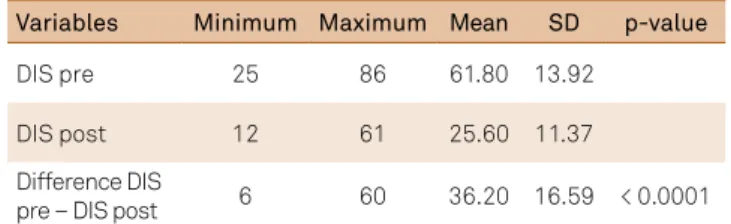
Table 3 shows the reduction in the mean pre- and
post-treatment DIS scores. he diference between these means reached statistical signiicance (p < 0.0001).
Table 2. Drooling impact scale items.
1- How frequently did your child dribble?
2- How severe was the drooling?
3- How many times a day did you have to change bibs or clothing due to drooling?
4- How offensive was the smell of the saliva on your child?
5- How much skin irritation has your child had due to drooling?
6- How frequently did your child's mouth need wiping? 7- How embarrassed did your child seem to be about his/her dribbling?
8- How much do you have to wipe or clean saliva from household items, e.g. toys, furniture, computers?
9- To what extent did your child's drooling affect his or her life? 10- To what extent did your child's drooling affect you and your family's life?
Table 3. Comparison between the total pre- and post-treatment DIS scores. n = 25.
Variables Minimum Maximum Mean SD p-value
DIS pre 25 86 61.80 13.92
DIS post 12 61 25.60 11.37
Difference DIS
pre – DIS post 6 60 36.20 16.59 < 0.0001
Analysis of the total scores of each pre- and post-treatment DIS question
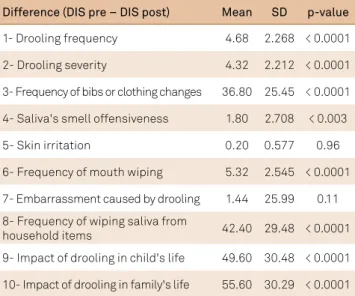
he analysis of the diference between the mean score of
each pre- and post-treatment DIS question is summarized
in Table 4. It shows a statistically signiicant reduction in
all questions (p < 0.0001 in questions 1, 2, 3, 6, 8, 9 and 10; p < 0.003 in question 4), except in questions 5 and 7.
Comparison between the means of intervening variables
In Table 5, the absence of GERD was correlated with
the greater diference between the mean scores in the pre- and post-treatment DIS. It reached statistical signiicance
(p < 0.024) and so did the absence of epilepsy (p < 0.02). In other words, the samples from patients without GERD and
epilepsy reached statistically signiicant improvement levels due to the use of atropine sulfate. he absence or presence of any of the comorbidities did not inluence the drooling sever
-ity since no statistically signiicant results were found sepa -rately in the mean pre-treatment DIS scores for any absence or presence of any of the studied comorbidities.
Side effects
Side efects were found in four out of the 33 patients who
started the study (12,1%) and their respective frequency
occurred as follows: fever and lush (1); irritability (1); lush and irritability (1); lush and angioedema (1).
DISCUSSION
To our knowledge, this is the irst study that reports the
use of sublingual atropine sulfate to treat drooling in CP chil-dren and adolescents.
he indication of any type of drooling treatment in CP
patients must take into account their social and family
con-texts. hus, one should indicate eicient and more speciic
methods that cause less overload to each patient/family.
he eicacy of some of the available treatment modalities
have been proven; however, they have features that hinder
the patients’ access to these techniques. he oral, transder -mal, or sublingual use of anticholinergic drugs has the
advan-tage of not requiring medical and nursing apparatus, speciic
equipment, sedation or anesthesia in order to be applied.
he atropine sulfate was chosen in the current study due to
its originality in the treatment of drooling in CP patients and to the easy access to the drug. However, one disadvantage is its
transient efect and, consequently, the need for its continuous use of three doses a day in order to maintain its efect.
Atropine sulfate use was associated with a statistically
signiicant reduction in the DIS score (p < 0.0001) in this
CP population. Other studies have demonstrated the
ben-eit of other anticholinergic drugs; however, the current study achieved a better safety proile (12.1% of the patients reported side efects). Mier et al.15 showed that
glycopyrro-late efectively controlled the CP patients’ drooling; however, 20% of the children had side efects severe enough to discon -tinue the use of the drug. Zeller et al.19 reached percentages of
response to oral glycopyrrolate with a peak of 56.7% in the 16th
week. hey found several side efects in 20.4% of the patients.
Mato Montero et al.16 found signiicant drooling reduction
(p < 0.005) in a transdermal scopolamine group in comparison to a placebo group, in which 13.3% of patients were excluded
from the study due to severe side efects. Camp-Bruno et al.14
found a signiicant drooling decrease in their benztropine
group in comparison to the placebo group, but severe
cho-linergic side efects required the discontinuation of the drug
Table 5. Comparison between the means of intervening variables.
Variable DIS pre
Difference DIS pre – DIS post Mean p-value Mean p-value
Dysphagia
Yes 59.47
0.649 32.33 0.158
No 66.75 42
GERD
Yes 58.85
0.279 29.15 0.024
No 65 43.83
ID
Yes 61.5
- 35.63 -
No 69 50
Epilepsy
Yes 59.47
0.23 35.63 0.02
No 66.75 47.13
DIS: drooling impact scale; DIS pre: pre-treatment; DIS post: post-treatment; GERD: gastroesophageal relux disease; ID: intellectual disability
Table 4. Analysis of the total scores of each pre- and post-treatment DIS question.
Difference (DIS pre – DIS post) Mean SD p-value
1- Drooling frequency 4.68 2.268 < 0.0001
2- Drooling severity 4.32 2.212 < 0.0001
3- Frequency of bibs or clothing changes 36.80 25.45 < 0.0001
4- Saliva's smell offensiveness 1.80 2.708 < 0.003
5- Skin irritation 0.20 0.577 0.96
6- Frequency of mouth wiping 5.32 2.545 < 0.0001
7- Embarrassment caused by drooling 1.44 25.99 0.11
8- Frequency of wiping saliva from
household items 42.40 29.48 < 0.0001
9- Impact of drooling in child's life 49.60 30.48 < 0.0001
10- Impact of drooling in family's life 55.60 30.29 < 0.0001
in 12% of the patients. Carranza-del Rio et al.18 concluded
that most of their dystonia CP patients (96%) reported some improvement in involuntary movements and/or drooling;
however, 69.3% of them showed side efects. Among the sev -eral anticholinergic drugs, sublingual atropine sulfate seems
to have a more local and lesser systemic efect. his feature may have contributed to a better safety proile.
he DIS questions assess ten diferent drooling-inluence
parameters in the lives of the children and their families.
he current study individually analyzed the efect of atropine sulfate on each parameter by analyzing the diference between
the means of each question in the pre- and post-treatment
DIS. his analysis showed statistically signiicant reduction in
all questions, except in questions 5 and 7. Question 5 relates to skin irritation, and its frequency was low among the patients in the sample. Question 7 concerns how embarrassed the patient feels due to drooling; this feeling was reduced by the presence of intellectual disability, which had a high incidence in the sample. Both situations led to low pre-treatment DIS scores in these questions and, consequently, to a statistically
signiicant reduction in the improvement potential.
he fact that only the samples from patients with no GERD and epilepsy achieved statistically signiicant improve -ment levels due to the use of atropine sulfate could be related to the clinical perception that the presence of GERD (which
stimulates the parasympathetic route and saliva production) and epilepsy (due to the need to use certain anticonvulsants) could increase drooling severity and reduce the therapeu-tic response to atropine. However, we did not come to the
same conclusion as we did not ind statistically signiicant
results in the mean pre-treatment DIS scores (drooling sever-ity marker) for any absence or presence sample of any of our studied comorbidities.
he use of sublingual atropine sulfate seems to be safe
and is related to a reduction in DIS scores, which suggests
eicacy in the treatment of drooling in CP children and ado -lescents. However, since it is a non-placebo-controlled open clinical trial, our results must be interpreted with parsimony and replicated in randomized, placebo-controlled studies with larger numbers of participants.
Acknowledgments
he authors thank Dr. Susan M. Reid for allowing us using
the Drooling Impact Scale, Dr. Fernanda Marinho de Lima, Dr. Fernanda Jordão Pinto Marques, Dr. Marta Cristina da Silva Teixeira, Dr. Rafael Rodrigues Barra for helping in the data collection and the children and their families for partici-pating in the study.
References
1. Reddihough D, Erasmus CE, Johnson H, Mckellar GM, Jongerius PH. Botulinum toxin assessment, intervention and aftercare for paediatric and adult drooling: international consensus statement. Eur J Neurol. 2010;17(Suppl 2):109-21. https://doi.org/10.1111/j.1468-1331.2010.03131.x
2. Blasco PA. Surgical management of drooling. Dev Med Child Neurol. 1992;34(4):368-9. https://doi.org/10.1111/j.1469-8749.1992.tb11444.x
3. Ekedahl C, Månsson I, Sandberg N. Swallowing dysfunction in the brain-damaged with drooling. Acta Otolaryngol. 1974;78(1-2):141-9. https://doi.org/10.3109/00016487409126339
4. Van De Heyning P, Marquet JF, Creten WL. Drooling in children with cerebral palsy. Acta Otorhinolaryngol Belg. 1980;34(6):691-705.
5. Tahmassebi JF, Curzon MEJ. The cause of drooling in children with cerebral palsy – hypersalivation or swallowing defect? Int J Paediatr Dent. 2003;13(2):106-11. https://doi.org/10.1046/j.1365-263X.2003.00439.x
6. Erasmus CE, van Hulst K, Rotteveel JJ, Willemsen MA, Jongerius PH. Clinical practice: swallowing problems in cerebral palsy. Eur J Pediatr. 2012;171(3):409-14. https://doi.org/10.1007/s00431-011-1570-y
7. Erasmus CE, Van Hulst K, Rotteveel LJ, Jongerius PH, Van Den Hoogen FJ, Roeleveld N et al. Drooling in cerebral palsy: hypersalivation or dysfunctional oral motor control? Dev Med Child Neurol. 2009;51(6):454-9. https://doi.org/10.1111/j.1469-8749.2008.03243.x
8. Senner JE, Logemann J, Zecker S, Gaebler-Spira D. Drooling, saliva production, and swallowing in cerebral palsy. Dev Med Child Neurol. 2004:46(12):801-6. https://doi.org/10.1111/j.1469-8749.2004.tb00444.x
9. Reid SM, Johnson HM, Reddihough DS. The Drooling Impact Scale: a measure of the impact of drooling in children with developmental disabilities. Dev Med Child Neurol. 2010;52(2):e23-8. https://doi.org/10.1111/j.1469-8749.2009.03519.x
10. Jongerius PH, Limbeek J, Rotteveel JJ. Assessment of salivary low rate: biologic-variation and measure error. Laryngoscope. 2004;114(10):1801-4. https://doi.org/10.1097/00005537-200410000-00023
11. Reddihough DS, Johnson H. Assessment and management of saliva control problems in children and adults with neurological impairment. J Dev Phys Disabil. 1999;11(1):17-24. https://doi.org/10.1023/A:1021804500520
12. Little SA, Kubba H, Hussain SS. An evidence-based approach to the child who drools saliva. Clin Otolaryngol. 2009;34(3):236-9. https://doi.org/10.1111/j.1749-4486.2009.01917.x
13. Hornibrook J, Cochrane N. Contemporary surgical management of severe sialorrhea in children. ISRN Pediatr. 2012;2012:364875. https://doi.org/10.5402/2012/364875
14. Camp-Bruno JA, Winsberg BG, Green-Parsons AR, Abrams JP. Eficacy of benztropine therapy for drooling. Dev Med Child Neurol. 1989;31(3):309-19. https://doi.org/10.1111/j.1469-8749.1989.tb04000.x
15. Mier RJ, Bachrach SJ, Lakin RC, Barker T, Childs J, Moran M. Treatment of sialorrhea with glycopyrrolate: a double-blind, dose-ranging study. Arch Pediatr Adolesc Med. 2000;154(12):1214-8. https://doi.org/10.1001/archpedi.154.12.1214
16. Mato Montero A, Limeres Posse J, Tomás Carmona I,
Fernández Feijoo J, Diz Dios P. Control of drooling using transdermal scopolamine skin patches: a case report. Med Oral Patol Oral Cir Bucal. 2008;13(1):E27-30.
17. Rapoport A. Sublingual atropine drops for the treatment of pediatric sialorrhea. J Pain Symptom Manage. 2010;40(5):783-8. https://doi.org/10.1016/j.jpainsymman.2010.02.007
19. Zeller RS, Davidson J, Lee HM, Cavanaugh PF. Safety and eficacy of glycopyrrolate oral solution for management of pathologic drooling in pediatric patients with cerebral palsy and other neurologic conditions. Ther Clin Risk Manag. 2012;8:25-32. https://doi.org/10.2147/TCRM.S27362
20. Freudenreich O. Drug-induced sialorrhea. Drugs Today (Barc). 2005;41(6):411-8. https://doi.org/10.1358/dot.2005.41.6.893628
21. Sockalingam S, Shammi C, Remington G. Clozapine-induced hypersalivation: a review of treatment strategies. Can J Psychiatry. 2007;52(6):377-84.
22. Mustafa FA, Khan A, Burke J, Cox M, Sherif S. Sublingual atropine for the treatment of severe and hyoscine-resistant clozapine-induced sialorrhea. Afr J Psychiatry (Johannesbg). 2013;16(4):242. https://doi.org/10.1177/070674370705200607
23. Hyson HC, Johnson AM, Jog MS. Sublingual atropine for sialorrhea secondary to parkinsonism: a pilot study. Mov Disord. 2002;17(6):1318-20. https://doi.org/10.1002/mds.10276
24. De Simone GG, Eisenchlas JH, Junin M, Pereyra F, Brizuela R. Atropine drops for drooling: a randomized controlled trial. Palliat Med. 2006;20(7):665-71. https://doi.org/10.1177/0269216306071702
25. Rosenbaum P, Paneth N, Leviton A, Goldstein M, Bax M,
Damiano D et al. A report: the deinition and classiication of cerebral palsy: April 2016. Dev Med Child Neurol. 2007;109(Suppl):8-14.
26. CanChild Center for Childhood Disability Research. Institute for Applied Health Sciences. GMFCS – E & R: Sistema de classiicação de função motora grossa: ampliado e revisto. Hamilton: CanChild Center for Childhood Disability Research; 2007 [cited 2015 Oct 17]. Available from: https:// www.canchild.ca/system/tenon/assets/attachments/000/000/075/ original/GMFCS-ER_Translation-Portuguese2.pdf
27. Cordioli VA, Kieling C, da Silva BTC, Passos IC, Barcellos MT. Deiciências intelectuais. In: Cordioli VA, Kieling C, Silva BTC, Passos IC, Barcellos MT, editores. Referência rápida aos critérios diagnósticos do DSM-5. Porto Alegre: Artmed; 2014. p. 17-23.
28. Fisher RS, Acevedo C, Arzimanoglou A, Bogacz A, Cross H, Elger CE et al. A practical clinical deinition of epilepsy. Epilepsia. 2014;55(4):475-82. https://doi.org/10.1111/epi.12550