Short communication
Simultaneous production of impurity-free water and magnetite from
steel pickling liquors by microwave-hydrothermal processing
V.S.T. Ciminelli
⁎
, A. Dias, H.C. Braga
Department of Metallurgical and Materials Engineering, Universidade Federal de Minus Gerais, Rua Espirito Santo 35/206, Belo Horizonte-MG, 30160-030, Brazil
Received 29 August 2005; received in revised form 29 December 2005; accepted 4 March 2006 Available online 27 June 2006
Abstract
Pickling plants produce large amounts of toxic and hazardous wastes containing heavy metals, thus creating an important environmental problem associated with steel production. This communication reports the use of the microwave-hydrothermal technology to remove metals from pickling liquors and also to produce electroceramics, which results in the simultaneous generation of impurity-free water and value-added materials. The results showed that the microwave-hydrothermal processing was efficient to produce magnetically soft ferrites, as well as to eliminate the heavy metal contamination from the spent liquor. © 2006 Elsevier B.V. All rights reserved.
Keywords:Stainless steel; Pickling liquors; Environment; Ferrites; Microwave; Hydrothermal
1. Introduction
The disposal of pickling solutions is still one of the major environmental concerns of the steel industry. The volume of waste material is considerably high: approx-imately 60% of rolled steel products, high-grade steel and stainless steels are pickled at least once and the quantity of iron dissolved during pickling accounts for up to 1.2 wt.% of the steel being pickled (Rituper, 1989). The standard practice for the treatment of this liquor is the neutralization and the consequent precipitation of metals, followed by discharge. However, this procedure is usually not sufficient for the purification of the resulting water to an extent that allows its discharge in the environment (Kanari et al., 2001). Also, the obtained products (used in the
treatment of water or as component for animal nutrition) may suffer some market restrictions due to eventual remobilization of the contaminants. After the 1990s, moved by environmental and economic issues, new approaches and methodologies were investigated for the treatment of pickling liquors. These include electrodialysis (Paquay et al., 2000), membrane distillation ( Tomas-zewska et al., 2001), selective precipitation (Dufour et al., 1997, 2001, 2002; Heras et al., 2004), anion exchange/ membrane electrowinning (Csicsovszki et al., 2005), and spray roasting (Kladnig, 2003). Some of these works led to the production of iron salts (chlorides and sulfates) as well as magnetic materials (ferrites). Spinel ferrites are ferrimagnetic materials with general formula AB2O4,
which are used as transformer cores in high-frequency power supplies. Among the vast literature dedicated to the study magnetic ferrites, few works have been dedicated to the production of ferrites from wastewaters, with the exception of those byDufour et al. (2002),López-Delgado
⁎ Corresponding author. Tel.: +55 31 3238 18 10; fax: +55 31 3238 1815.
et al. (1998), López-Delgado (1999) and Latorre et al. (1997), who investigated the production of ferrites from spent acid liquors. Nevertheless, the reported works focused on the production of electroceramics rather than the removal of metals from the aqueous phase to obtain impurity-free water.
The development of new routes for the treatment of solutions or synthesis of materials is driven by the continuing need for fast and energy-efficient techniques. For example, microwave-assisted routes are used in many areas of knowledge in new processes as well as substituting many conventional preparative methods (Adam, 2003). Microwave-based methods are generally much faster, cleaner, and more economical than the conventional practices. Also, new approaches and even unexpected results have increased the interest for the use of microwave energy in many processes involving chemical reactions (Adam, 2003; Jafarifar et al., 2005). Recently, the microwaves were introduced as an innova-tion in the conveninnova-tional/autoclave hydrothermal process to produce a wide range of materials for industrial applications. It appears to be a low-energy processing route (minor environmental impact) to clean wastewaters as well as to obtain crystalline and single-phase materials at mild temperatures and pressures with morphology control (Byrappa and Yoshimura, 2001; Palchik et al., 2000; Ku et al., 2002; Dias and Ciminelli, 2003; Liu et al., 2004). Also, an additional advantage of the microwave-hydrothermal process is that a hazardous industrial waste may be turned into a relatively cheap and accessible source of raw material to produce a more valuable product, such as electroceramics, in comparison to the traditional sulfate and chloride salts. Finally, and especially relevant, is the possibility to immobilize hazardous elements present in the effluent solution into the ceramics product. One unique process, or with few variations, can be used to treat pickling liquors from various sources, which is important to reduce capital and operating costs. In view of that, this communication aims to apply the microwave-hydrothermal technology to reduce the content of hazardous metals in spent pickling liquors to an acceptable level and also to produce high-value added materials for technological applications. This is a new approach, important from both environmental and economical points of view, once it combines the pollutants removal from the aqueous phase together with the concurrent production of valuable materials.
2. Experimental
Samples of chloride pickling liquors from local steel industries were analyzed by atomic absorption
spec-trometry (Perkin-Elmer Aanallyst 300), except for C1, determined by ion chromatography (Dionex LC20). The iron oxidation state was determined by titration with K2Cr2O7. For each synthesis, 50 mL of solution with
approximately 76% of original spent pickling liquor was prepared. Microwave-assisted hydrothermal experi-ments were performed using a Milestone MLS-1200 MEGA microwave digestion system (2.45 GHz). The system was programmed to work at 1000 W, for 5 min, up to the processing temperature (110 and 200 °C) and maintained at 400 W, for 5 and 60 min (autogenous pressure). The selected pH values were 6, 7.5, 9, 11 and 13 (adjusted with NaOH). The effect of the metals concentration was investigated by dilution of the original pickling liquor at 76%, 38% and 7.6% in a volume basis. After each synthesis, the resultant solution was centrifuged to separate the liquid phase from the solids. The liquid phase was chemically analyzed by induced coupled plasma spectrometry ICP-OES (TJA 61E). The precipitate was washed with hot water and centrifuged three times in order to remove all NaCl formed and dried overnight at 80 °C. Crystalline phases were determined by X-ray diffraction in a Philips PW1830 diffractometer with CuKα
radiation (40 kV, 30 mA) and graphite monochromator, from 10 to 100° 2θat a speed of 0.02° 2θ/s.
3. Results and discussion
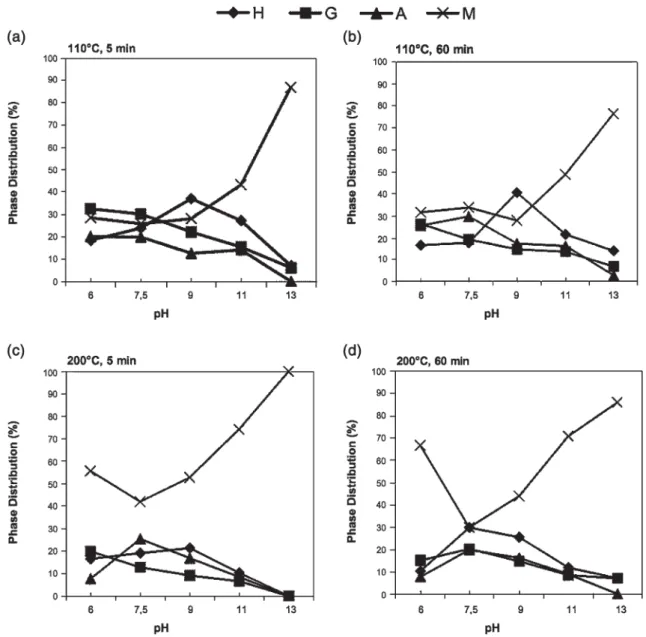
concentrations in the original liquor and after micro-wave-hydrothermal treatment at 110 °C, for 5 min (pH = 13) with respect to the levels established by the local environmental legislation for some hazardous elements. As it can be seen, the concentrations were drastically reduced under this processing condition, thus demonstrating the potential of the microwave-hydro-thermal technology for the treatment of industrial effluents to obtain impurity-free water. The focus on the aqueous phase represents a new approach, once the previous works emphasized mainly the solids produced. Now, the effects of the processing conditions on the resulting solid phases will be discussed.Fig. 3shows the results obtained at 110 and 200 °C, 5 and 60 min and pH 6, 7.5, 9, 11 and 13. The relative amount of the solid phase produced under a given experimental condition was estimated by comparing the relative area below the main X-ray diffraction peak of each phase. Magnetite (M) was found in amounts superior to 25% in all conditions; its relative quantity clearly increased with
the increase of processing temperature and pH values above 7.5. On the other hand, the content of goethite (G) clearly decreased with pH, while the amount of hematite (H) increased with up to a maximum at pH between 7.5 and 9, decreasing after this pH value. β-FeOOH (A) followed a similar trend, but the maximum was observed at pH 7.5 (no akaganeite was found at pH = 13). At 200 °C, magnetite appeared as the main phase in all pH conditions. For processing times of 5 min of processing and pH = 13, the only identified phase was magnetite, a well-known ferrous ferrite (Fe3O4). For pH values below 11, three other phases
were observed: goethite (α-FeOOH), akaganeite (β -FeOOH) and hematite (α-Fe2O3). At 110 °C, magnetite
is the main phase only for pH above 11, while hematite is the main phase at pH 9. For pH lower than 9, no clear
Fig. 1. Selected metals concentration as a function of solution pH after microwave-hydrothermal treatment at 110 °C, for 5 min.
Fig. 2. Ratio between selected metals concentration and the maximum permitted level (Class 3 effluent) for the original liquor and for the liquor treated at 110 °C, for 5 min (pH = 13).
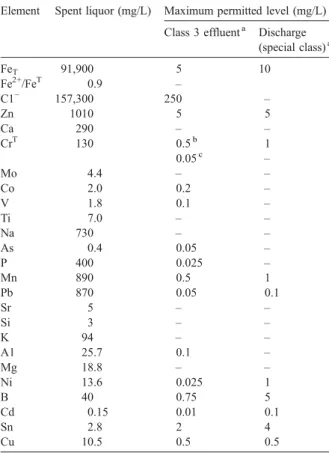
Table 1
Chemical analysis of the spent liquor (mg/L)
Element Spent liquor (mg/L) Maximum permitted level (mg/L) Class 3 effluenta Discharge
(special class)a
FeT 91,900 5 10
Fe2+/FeT 0.9
–
C1− 157,300 250
–
Zn 1010 5 5
Ca 290 – –
CrT 130 0.5b 1
0.05c –
Mo 4.4 – –
Co 2.0 0.2 –
V 1.8 0.1 –
Ti 7.0 – –
Na 730 – –
As 0.4 0.05 –
P 400 0.025 –
Mn 890 0.5 1
Pb 870 0.05 0.1
Sr 5 – –
Si 3 – –
K 94 – –
A1 25.7 0.1 –
Mg 18.8 – –
Ni 13.6 0.025 1
B 40 0.75 5
Cd 0.15 0.01 0.1
Sn 2.8 2 4
Cu 10.5 0.5 0.5
aThe least restrictive specification, water not appropriate for human
consumption (COPAM, 1987).
preferential phase could be identified. As a conclusion, if the target is the production of single-phase magnetite, strong alkaline conditions are required. Under mild alkaline conditions, a mixture of iron oxides is obtained. Recently,Wang et al. (1998)andDhage et al. (2002)
studied the preparation and the mechanism of formation of iron oxide phases by decomposition of ferric and ferrous salts in aqueous solutions using microwave radiation. The former verified that pH higher than 10 are necessary to produce stoichiometric magnetite, while pH below 7 favored the formation of α-Fe2O3. A
mixture of iron oxides was observed between these pH
values under microwave radiation. Similar to the present work,Dhage et al. (2002)showed that the color of the precipitates changed in the sequence light-yellow → orange→yellowish brown→blackish green→black. The X-ray diffraction patterns displayed essentially two phases: α-FeOOH and Fe3O4 with the transition
occurring at pH = 8. Differently of our results, β -FeOOH was not observed, probably due to the use of different microwave processing conditions. Microwave radiation appears to provide an efficient source of energy in driving the reaction to occur fast (5 min) and in temperatures as low as 110 °C. It is believed that the
electromagnetic fields into the microwave cavity can promote the migration of the ions, intensifying the diffusion and accelerating the overall reaction (Byrappa and Yoshimura, 2001; Adam, 2003).
Now, the features of the resulting impurity-free water and the solid phases will be compared. A strong correlation between the precipitation of Fe3O4 and the
reduction of the concentration of heavy metals in solution was observed. Magnetite presents a cubic structure that can accommodate a large number of ions in both octahedral and tetrahedral sites. This offers an opportunity to engineer specific magnetic interactions in the crystal lattice by substituting or incorporating various transition metal cations into the crystal structure, thereby altering the macroscopic magnetic properties. The processing condi-tions employed in the present work favored the precipitation of Fe3O4 in mild temperatures and short
period of times (5 min) with incorporation of metal cations into the structure. Thus, the result was the simultaneous cleaning of the aqueous phase from heavy metals as well as the production of an electroceramic. The magnetite obtained can be better described as a complex ferrite of composition [Fe,Zn,Mn,Ni,Cu,Cr,Cd, etc.]O·Fe2O3,
where the bivalent cations are located in both tetrahedral and octahedral sites. Finally, the effect of dilution of the original liquor in the crystalline phases obtained after microwave-hydrothermal processing was studied. As a general trend, the dilution of the original liquor from 76% to 38% reduced the amount ofβ-FeOOH produced, while the presence of goethite and hematite was still detected. At the highest dilution condition (7.6%), only the single-phase magnetite, with few contaminations, was verified. This result shows that the reduction of the pickling liquor concentration clearly favored the production of ferrous ferrite (Fe3O4). Ferrites with different composition can be
obtained through the intentional addition of selected chemicals to the original pickling liquors in a way that materials with tailor-made properties are produced.
4. Conclusions
The results showed that the microwave-hydrothermal processing is able to remove elements from pickling liquors, such as Fe, Pb, Mn, Cu, Co, Ni, Zn, Cr, Cd and Sn, mainly at pH higher than 9. Chemical analyses of the resulting impurity-free water indicate its suitability for discharge. Conversely, it was observed that in concen-trated liquors, single-phase magnetite (an important electroceramic material) was obtained at pH = 13 and processing conditions of 110 °C and 5 min. Lower pH values and temperatures led to the production of other iron oxides, such as goethite, β-FeOOH and hematite.
The relative amount of each phase was found to be strongly dependent on the experimental conditions, notably pH. Thus, the results pointed out to the possibility of the use of the microwave-hydrothermal technology to clean spent pickling liquors from hazardous elements and, at the same time, to obtain a more valuable product.
Acknowledgement
We acknowledge the financial support from MCT/ CNPq and the Millennium Institute: Water, a mineral approach.
References
Adam, D., 2003. Out of the kitchen. Nature 421, 571–572.
Byrappa, K., Yoshimura, M., 2001. Handbook of Hydrothermal Technology, 1st ed. Noyes Publications, William Andrew Publishing, New York.
COPAM, 1987. Deliberação Normativa n°10 de 16 de dezembro de 1986. Diário do Executivo-Minas Gerais, 10 de janeiro de 1987 (in Portuguese).
Csicsovszki, G., Kekesi, T., Torok, T.I., 2005. Selective recovery of Zn and Fe from spent pickling solutions by the combination of anion exchange and membrane electrowinning techniques. Hydrometal-lurgy 77, 19–28.
Dhage, S.R., Khollam, Y.B., Potdar, H.S., Deshpande, S.B., Bakare, P. P., Sainkar, S.R., Date, S.K., 2002. Effect of variation of molar ratio (pH) on the crystallization of iron oxide phases in microwave hydrothermal synthesis. Mater. Lett. 57, 457–462.
Dias, A., Ciminelli, V.S.T., 2003. Electroceramic materials of tailored phase and morphology by hydrothermal technology. Chem. Mater. 15, 1344–1352.
Dufour, J., Marrón, J.O., Negro, C., Latorre, R., Formoso, A., López-Mateos, F., 1997. Mechanism and kinetic control of the oxyprecipitation of sulphuric liquors from steel pickling. Chem. Eng. J. 68, 173–187.
Dufour, J., Negro, C., Heras, F., López-Mateos, F., 2001. Recovery of the metals from pickling liquors of stainless steel by precipitation methods. ISU Int. 41, 801–806.
Dufour, J., López, L., Negro, C., Latorre, R., Formoso, A., Lopez-Mateos, F., 2002. Mathematical model of magnetite synthesis by oxidation of sulfuric pickling liquors from steelmaking. Chem. Eng. Commun. 189, 285–297.
Heras, F., Dufour, J., Lopez-Delgado, A., Negro, C., Lopez-Mateos, F., 2004. Feasibility study of metals recycling from nitric–
hydro-fluoric waste pickle baths. Environ. Eng. Sci. 21, 583–590.
Jafarifar, D., Daryanavardi, N.R., Sheibani, S., 2005. Ultra fast microwave-assisted leaching for recovery of platinum from spent catalyst. Hydrometallurgy 78, 166–171.
Kanari, N., Evrard, O., Neveux, N., Ninane, L., 2001. Recycling ferrous sulfate via super-oxidant synthesis. J. Met. 32–33.
Kladnig, W.F., 2003. A review of steel pickling and acid regeneration: an environmental contribution. Int. J. Mater. Prod. Technol. 19, 550–561.
Latorre, R., Dufour, J., Garcia, J., Alcalá, E.M., Negro, C., López-Mateos, F., 1997. Synthesis of BaFe12O19by oxi-coprecipitation
from hydrochloric steel pickling liquors. J. Phys., IV France 7, 85–86.
Liu, J., Li, K., Wang, H., Zhu, M., Yan, H., 2004. Rapid formation of hydroxyapatite nanostructures by microwave irradiation. Chem. Phys. Lett. 396, 419–432.
López-Delgado, A., Vidales, J.L.M., Vila, E., López, F.A., 1998. Synthesis of mixed ferrite with spinel-type structure from a stainless steelmaking solid waste. J. Alloys Compd. 281, 312–317.
López-Delgado, A., Lopez, F.A., Vidales, J.L.M., Vila, E., 1999. Synthesis of nickel–chromium–zinc ferrite powders from stainless steel pickling liquors. J. Mater. Res. 14, 3427–3432.
Paquay, E., Clarinval, A.M., Delvaux, A., Derez, M., Hurwitz, H.D., 2000. Applications of electrodialysis or acid pickling wastewater treatment. Chem. Eng. J. 79, 197–201.
Palchik, O., Zhu, J., Gedanken, A., 2000. Microwave assisted prepara-tion of binary oxide nanoparticles. J. Mater. Chem. 10, 1251–1254.
Rituper, R., 1989. Economical regeneration of acid process solutions at surface-treatment by the KCH-RMR-Process. Metallurgy 43, 854–858.
Tomaszewska, M., Grypta, M., Morawski, A.W., 2001. Recovery of hydrochloric acid from metal pickling solutions by membrane distillation. Sep. Pure Technol. 22–23, 591–600.
Wang, G., Whittaker, G., Harrison, A., Song, L., 1998. Preparation and mechanism of acicular goethite–magnetite particles by