Industrial Crops and Products33 (2011) 369–373
Contents lists available atScienceDirect
Industrial Crops and Products
j o u r n a l h o m e p a g e :w w w . e l s e v i e r . c o m / l o c a t e / i n d c r o p
Hybrid chipboard panels based on sugarcane bagasse, urea formaldehyde
and melamine formaldehyde resin
Roberto Monteiro de Barros Filho
a, Lourival Marin Mendes
b, Kátia Monteiro Novack
c,
Leonardo Oliveira Aprelini
c, Vagner Roberto Botaro
d,∗aDesign School, and INAP Faculty, Rua Herval, 448 comp. 501, Serra, Belo Horizonte, MG, CEP 30240-010, Brazil
bUniversidade Federal de Lavras–UFLA - Department of Forestry Sciences, C.P 3037, Lavras, Minas Gerais, CEP 37200-000, Brazil
cUniversidade Federal de Ouro Preto–UFOP - ICEB - Universidade Federal de Ouro Preto Campus Universitário S/n, Morro Cruzeiro, Ouro Preto, MG 35400-000, Brazil dUniversidade Federal de São Carlos - UFSCar - Campus de Sorocaba, Rod. João Leme dos Santos, km 110, CP 3031 - Sorocaba, SP 18052-780, Brazil
a r t i c l e
i n f o
Article history:
Received 16 September 2010
Received in revised form 9 November 2010 Accepted 12 November 2010
Available online 14 December 2010
Keywords: Chipboard panels Bagasse Mechanical tests Urea formaldehyde Melamine formaldehyde
a b s t r a c t
The expansion of Brazilian agricultural production was very important in the last decade. A number of waste residues were produced showing an enormous potential for industrial crops and products. Sugar-cane bagasse is the most important one and it has been investigated for chipboard panel’s preparation. In this sense, this work aims to develop, characterize and compare chipboard panels made with sugarcane bagasse with urea formaldehyde (UF) and melamine formaldehyde (MF) resins. Panels were obtained with a mixture of sugarcane bagasse and particles, like pine or eucalyptus, with and without paraffin in the formulation. Nine different types of panels have been made, all with 9% in resin mix, under a press-ing cycle of 4.0 MPa cm2, and temperature of 160◦C. Under physical tests, the panels complied with the
American Standard CS 236-66 for trading chipboards of medium density and, in most cases the results obtained were lower than the ones raised in the literature. Under mechanical tests, that same standard was not complied with and, in most cases the results were close to or higher than those obtained in the literature.
© 2010 Elsevier B.V.
1. Introduction
Sugarcane is an important agricultural crop in the Brazil (Botaro, 1996). The cane stalk consists of inner pith that contains mostly sucrose. The external part is composed with lignocellulosic fibers. The process of sugarcane extracts the sucrose by crushing the entire stalk. Large quantities of bagasse containing both fibers and pith remain after sugar extraction (Xua et al., 2009). According toRowell and Keany (1991)disposal of this byproduct from the sugar indus-try is inefficient. Research work on the use of agro-industrial waste is needed because of the serious economic and environmental problems caused by the disposal of these resources. Transforming bagasse into high quality industrial panel products, such as bagasse particleboards (BPBs) or bagasse–polymer composites (Xua et al., 2009) provides an interesting solution for more effective bagasse utilization in accordance with a sustainable development.
According to Brundtland Report (1991)Brundtland (1991)and
Ljungberg (2007)the concept of sustainable development would be
∗Corresponding author. Present address: Universidade Federal de São Carlos (São Carlos Federal University) at Sorocaba’s city campus, Brazil. Tel.: +55 15 32291609; fax: +55 15 32291609.
E-mail address:[email protected](V.R. Botaro).
one that meets the needs of present generation without compro-mising the ability of future ones. Therefore, the search for models that fit this concept has shown that ideas previously antagonistic such as profit, social welfare and environmental preservation can be harmoniously associated.
The Fail to understand this concept conducted to erroneous pos-tures with great loss for both current as for future generations. Considering the need of sustainable development, various indus-trial sectors look for new technologies (Krook and Eklund, 2010). Analyzing the relevance of the wood panel industry in Brazil and its impact on the environment, it is important to propose some mea-sures that minimize the impact caused by this activity. In terms of raw materials, wood corresponds to more than 80% of final prod-ucts in panel industry. The wood comes normally from cultivated forests that have not been able to supply industry.
The correct use of waste depends on efficient systems for col-lection and separation (Krook and Eklund, 2010). It is easy to see that the search for alternatives for the replacement of wood by other materials, without losing the properties of the product, becomes crucial. The investigation for natural substitutes (not syn-thetic) derived from rejects, or waste recycling appears to be a good propose. The expansion of Brazilian agricultural production and therefore the higher amount of residues gives an idea of the potentiality to produce fiberboard panels. Some studies
concern-0926-6690© 2010 Elsevier B.V. doi:10.1016/j.indcrop.2010.11.007
Open access under the Elsevier OA license.
370 33 (2011) 369–373
ing production of panels without wood fibers have been carried out in Brazil. These studies suggest several alternatives from the production of panels with partial substitution, up to the total replacement of wood by agricultural waste. Natural fibers like sug-arcane bagasse, castor beans, rice husks, wheat and coffee residues are the most studied agricultural residues to produce fiberboards and composites. A number of investigations have pointed out in this way as, for example,Botaro (1996),Abdul Khalil et al. (2010),
Sobhani Aragh and Yas (2010),Satyanarayana et al. (2009),Xu et al. (2009),Guler et al. (2007)andI˜niguez-Covarrubias et al. (2001).
This study aimed to develop and to produce conventional chip-board panels using sugarcane bagasse by varying the composition of the mixture. The panels were obtained with or without paraffin, and with particles either ofPinnusspp. orEucalyptusspp. Complet-ing the study, trials were conducted aimComplet-ing to evaluate the physical and mechanical properties of the panels produced in accordance with current standards.
2. Materials and methods
2.1. Raw materials preparation
Industrial Sugarcane Bagasse (ISB) was kindly supplied by AGROPÉU Industry–Agro Industrial de Pompeu S.A., located in the motorway MG 060, km 82, in the town of Pompeu, Minas Gerais state (MG). Still’s Sugarcane Bagasse (SSB) was kindly supplied by Bocaina Agroindústria e Comércio de Cachac¸a Ltda., located in the BR 265, km 349, in Lavras town, Minas Gerais state (MG), both in Brazil. The pine and eucalyptus particles were provided by UEPAM - DCF - UFLA-MG. For gluing particles urea formaldehyde (UF) and melamine formaldehyde (MF) resins had been used.
The particles were dried under a moisture content of 3% and glued with a rotatable drum type glue applicator, through a spray-ing process. The mattress was formed by random deposition of particles.
2.2. Preparation of chipboards
The panels manufactured were of medium density and with 9% of resin content, pressed under a temperature of 160◦C, specific
pressure of 4.0 MPa for 8 min. Eight panels were manufactured, each of them with nominal dimensions of 48 cm×48 cm×1.5 cm.
Three replications for each panel composition have been done in order to improve the quality of results (Table 1).
After placing the panels in a climatic chamber at 20±2◦C and
relative humidity of 65±3%, the samples were prepared for static
bending tests (elasticity and rupture modules). Parallel compres-sion, internal bond, water absorption and swelling in thickness after 2 and 24 h of immersion in water and non-return rate in thickness were also analyzed. The tests were conducted based on procedures outlined in the ASTM D 1037 standard (ASTM, 1993).
The experiment was conducted under a completely randomized design with eight treatments and three replications. The effects covered in the model were tested with a significance level of 5%. The levels of treatments were compared using the Scheffé test.
2.2.1. Water absorption and swelling thickness
The samples were soaked in water for seven days. The rate of water absorption increased with immersion time of the samples, before stabilizing. The absorbed water (A) and swelling thickness (G) of the samples were calculated as percentages, according to the procedure of BS EN 317:1993. The amount of absorbed water was calculated using the following equation:
A(%)=
M1−M2M2
×100 (1)
whereM2 is the weight before the test andM1 is the measured weight (g).
The thickness swelling was calculated using the following equa-tion:
G(%)=
A1−A2A2
×100 (2)
whereA2 is the thickness before the test andA1 is the thickness (mm) after the test.
2.2.2. Internal bond test for fiberboards and wood adhesives (ASTM D1037)
Chipboard, fiberboard, and particleboard are engineered mate-rials made by gluing wood chips or wood particles together with an adhesive under high pressure. Increased use of these materials has resulted in the need for more stringent testing to determine their strength properties. One of these tests is the tensile strength perpendicular to surface test, also known as the internal bond strength test. This test is also commonly used as a fundamen-tal measure of the adhesive performance in wood composites and covers the determination of tensile strength properties of these boards or adhesive bonds in wood. In principle, the test involves bonding specimen blocks to the top and bottom sur-faces of the test specimen with a suitable adhesive. ASTM D1037, Standard Test Method for Evaluating Properties of Wood-Base Fiber and Particle Panel Materials, specifies that the upper load-ing fixture should be self-alignload-ing, and the specimen blocks should be 2-inch square by 1-inch in thickness and made from steel or aluminum alloy. The loading fixtures, which grip the spec-imen blocks, are attached to the test machine and tension is applied perpendicular to specimen surface until the specimen fails. Tensile strength is then calculated by dividing the maximum load at failure by the cross-sectional area of the test speci-men.
Table 1
Experimental chart.
Panel Particules Resin Waterproffing
Treatment Density Quantity Type Type Type
Bagasse (%) Wood (%)
T1 0.7 3 ISB (100) – UF –
T2 0.7 3 ISB (100) – MF –
T3 0.7 3 ISB (100) – UF Paraffin
T4 0.7 3 ISB (100) – MF Paraffin
T5 0.7 3 ISB (50) Pinnus (50) UF –
T6 0.7 3 ISB (50) Eucalyp. (50) UF –
T7 0.7 3 SSB (100) – UF –
33 (2011) 369–373 371
Table 2
Average values of water absorption in 2 and 24 h.
Treatments Water Absorption (%)
2 h 24 h
T1 16.81 146.93
T2 12.58 119.39
T3 13.39 98.76
T4 6.7 91.2
T5 88.46 201.68
T6 24.45 162.11
T7 64.87 188.49
T8 32.52 139.96
3. Results and discussion
3.1. Water absorption
In the average, the water absorption values for the panels produced with SSB were superior to those produced with ISB (Table 2). This fact can be explained by a higher quantity of sugar, a hydrophilic substance, in the SSB. The SSB process does not employ sequential washings after extraction of sugar. The mix of ISB with pine particles has shown a higher rate of absorption after 2 h, when compared to the panels produced with the mix of ISB with eucalyp-tus particles. This fact can be explained by the particles geometry. The pine particles are smaller than the eucalyptus ones and there-fore have a larger superficial area. This larger superficial area allows a higher absorption of water as it creates a bigger contact area and a lower availability of adhesive per particle as pointed out by
Iwakiri et al. (2005). The results also show for the panels produced with SSB, the water absorption values in 2 h are higher for those manufactured with urea formaldehyde. Panels produced with SSB panels/urea formaldehyde and with melamine formaldehyde have not shown any significant statistic differences amongst them.
It could be noted that the use of paraffin, a hydrophobic sub-stance, mixed with the resin in proportions of up to 1% by weight, statistically has not influenced the absorption of water after 2 h, both for the panels produced with urea formaldehyde or melamine formaldehyde.
On the average, the water absorption values of the panels pro-duced with SSB are superior to those propro-duced with ISB within a 24 h period (Table 2). It can be noted for the panels produced with ISB mixed with other substances, the water absorption after one day were higher when compared with the panels manufactured with ISB. The mixture of bagasses with pine particles revealed to absorb more water than the panels made with eucalyptus’ particles.
The results also show that for the panels produced with SSB, the water absorption values in 24 h are higher in the panels produced with urea formaldehyde. However, it could not be noted any sta-tistical difference in the values presented by panels with ISB and melamine formaldehyde resin, with or without paraffin. The same can be confirmed if compared panels produced with ISB and urea formaldehyde, with the ones produced with bagasse and melamine formaldehyde, as no statistical difference between the values have been noticed.
3.2. Swelling in thickness
On the average, the values of swelling in thickness after 2 h for the panels produced with SSB are superior to the ones produced with ISB (Table 3). Results also show that for the panels produced with SSB the values of swelling in thickness after 2 h are higher for those manufactured with urea formaldehyde. The swelling in thickness for the panels produced with ISB mixed to other parti-cles is higher than the swelling in thickness of the panels produced with only ISB. The mixture of the bagasse with pine particles also
Table 3
Average values of swelling in thickness in 2 and 24 h.
Treatments Swelling in thickness (%)
2 h 24 h
T1 15.59 36.2
T2 11.86 24.12
T3 7.03 21.44
T4 7.16 18.13
T5 26.5 33.24
T6 18.42 33.39
T7 24.71 31.58
T8 12.66 16.33
show higher values when compared to the panels from bagasse mixed with eucalyptus particles. It can be noticed that for panels produced with ISB and urea as a resin, the swelling in thickness after 2 h were higher for the panel manufactures without paraf-fin. However, when compared the panels produced with ISB and melamine formaldehyde resin, there have not been noticed any statistical differences in the use of paraffin.
It can also be noticed that all the values observed in this work for swelling in thickness in 2 h are higher than the values of the panels commercialized in China (IE 2 h = 5.41%) as pointed out by
Mendes (2008). They are also higher than the values found by
Mendes (2008)for chipboard panels with sugarcane bagasse and urea formaldehyde resin (AA 2 h = 5.33%).
Results presented inTable 3show that, the panels produced with SSB have higher values for swelling in thickness after 24 h when they are produced with urea formaldehyde. The swelling in thickness after 24 h for the panels produced with ISB mixed with other particles is higher than the absorption rate of the panels pro-duced with bagasse. However, when compared SSB with ISB there have not been observed any statistical differences in swelling in thickness after 24 h. The same occurred when comparing ISB with pine and with eucalyptus.
The panels produced with ISB/urea formaldehyde showed higher values of swelling in thickness after 24 h, when compared to those manufactures with melamine formaldehyde. And the ones produced without the addition of paraffin showed higher values of swelling in thickness after 24 h than the ones made with paraffin. The same did not occur if compared ISB/melamine formaldehyde, with and without paraffin.
3.3. Non-return rate
Results presented inTable 4show that for the panels produced SSB, the non-return rate is higher than those produced with urea formaldehyde. Considering the panels produced with ISB mixed with other particles, the results obtained are higher than the non-return rate for the panels produced with bagasse. However, when compared ISB with SSB, there have not found statistical differences for the swelling in thickness after 24 h. The same occurred when comparing ISB with pine and with eucalyptus.
Table 4
Average value of non- return rate in thickness.
Treatments Non-return rate in thickness (%)
T1 27.39
T2 17.52
T3 14.81
T4 12.83
T5 25.54
T6 27.77
T7 25.91
372 33 (2011) 369–373
Table 5
Average values of elasticity (MOE) and of rupture (MOR) modules.
Treatments Static flexion (MPa)
MOE MOR
T1 765.97 4.59
T2 937.68 4.72
T3 929.11 4.67
T4 1129.00 5.91
T5 710.85 3.42
T6 834.16 4.07
T7 757.80 3.66
T8 1053.28 5.53
For the panels made with ISB, the non-return rate is higher for those made with urea formaldehyde and, for this type of panel, those produced without the addition of paraffin presented higher values for the non-return rate if compared to the ones made with paraffin. The same did not occur if compared bagasse panels with melamine formaldehyde resin with and without paraffin.
3.4. Elasticity and rupture modules in static flexion
The results presented inTable 5show that, on the average, the elasticity modules of the panels produced with ISB are superior to the values of the panels produced with ISB mixed with other particles. On the other hand, chipboards produced with ISB or SSB have not shown statistical difference for the elasticity module.
It can also be verified that, for both panels produced with SSB or ISB, the elasticity module is higher in those produced with melamine formaldehyde.
It was also noticed that all the values obtained in this work for elasticity module are below the requirements of the North American Standard CS 236-66 (MOE = 2.403 MPa). They are also below the panel’s commercialized in China standard values (MOE = 1.308 MPa) (Mendes, 2008). However, they are higher than the values found byMendes (2008)for chipboard panels with sug-arcane bagasse and urea formaldehyde (MOE = 661 MPa).
The results presented inTable 5show that, on average, the rup-ture module of the panels produced with ISB is superior to the rupture module of the panels produced with bagasse mixed with other particles. However, when compared the ISB with the SSB, there was not significant statistical difference in the results.
It can also be noticed that for the panels produced with SSB, the rupture module is higher than those produced with melamine formaldehyde. Nevertheless, when compared ISB with urea formaldehyde and with melamine formaldehyde there had not been observed statistical differences in the rupture module. Also, there were not verified statistical differences in the rupture module between panels produced with bagasse mixed with pine with the ones mixed with eucalyptus.
It should also be noted that all the values obtained in this work for the rupture module are below the requirements of the North American standard CS 236-66 (MOR = 10.98 MPa). They are also below the values found byMendes (2008)for chipboard with sug-arcane bagasse and urea formaldehyde (MOR = 9.74 MPa).
The results presented inFig. 1demonstrate that both the panels produced with SSB, as those produced with ISB, show higher com-pression values when manufactured with melamine formaldehyde resin. There was not observed statistical differences amongst the panels, when changing the particle’s composition between ISB and SSB.
It should also be highlighted that all the values obtained in this work for parallel compression are below the panel’s values commercialized in China (CP = 13.14 MPa)Mendes (2008), but are higher than values obtained byMendes (2001)for chipboards with sugarcane and urea formaldehyde resin (CP = 2.98 MPa).
Fig. 1.Average values of parallel compression.
3.5. Internal bond
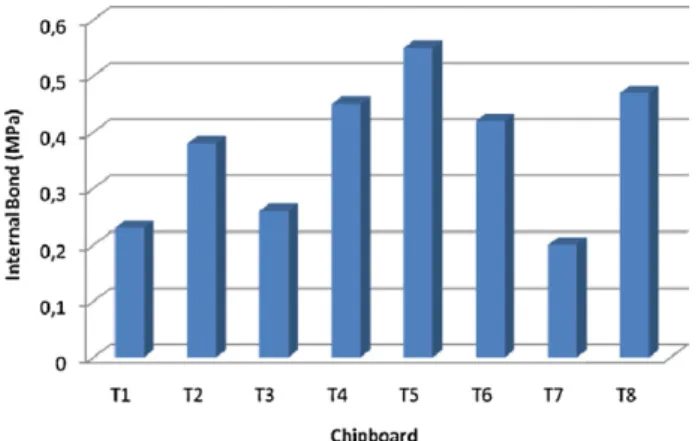
The results presented inFig. 2show that, on the average, the tension values in the internal bond tests for the panels produced with ISB mixed to other particles are higher than the tension in the panels produced with bagasse. The mixture bagasse with pine par-ticles show higher tension when compared to bagasse mixed with eucalyptus particles. The higher values of internal bond obtained when small particle was employed in the chipboard composition are directly attributed to a better compaction of the panels. Panels produced with ISB or SSB there have not shown any statistical dif-ference for the internal bond values showing that the presence of sugar does not affect this important parameter.
The results also show that, for both the panels produced with SSB as for the ones produced with ISB, the tension values in the internal bond test are higher for the ones produced with melamine formaldehyde.
It could also be noted that the values obtained in this work for internal bond are below the requirements of the North American standard CS 236-66 (LI = 0.48 MPa). They presented higher values than the panels commercialized in China (LI = 0.21 MPa)Mendes (2008), except for the panel T7 (LI = 0.20 MPa). However, they show, on average, higher values than those found by Mendes (2001)
for chipboards with sugarcane bagasse and urea formaldehyde (MOE = 0.28 MPa).
3.6. Scanning electron microscopy (SEM)
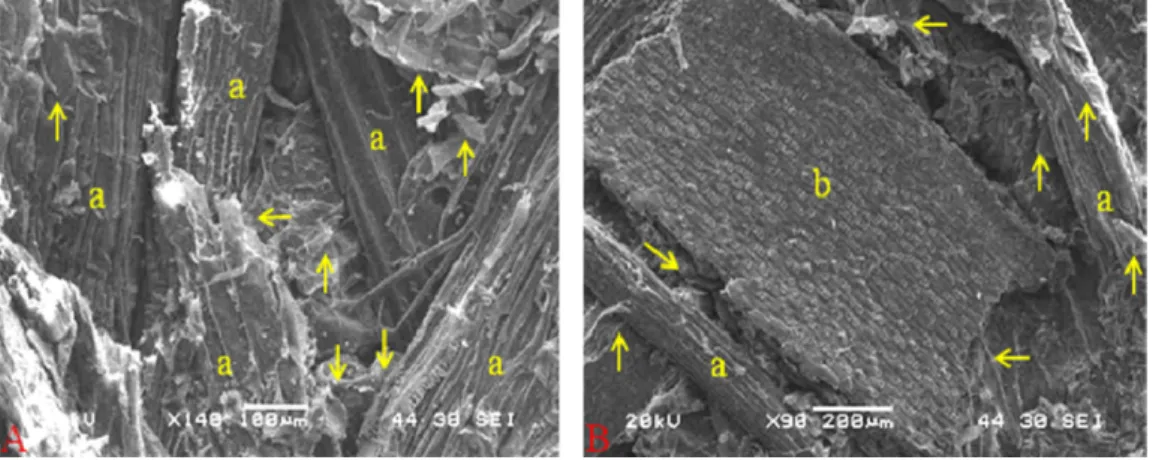
Fig. 3shows the superior face of panel T1 sugarcane bagasse fibers with different geometries indicated by the letters a and b, evolved by a urea formaldehyde polymeric film, indicated by
33 (2011) 369–373 373
Fig. 3.Photomicrography (SEM) of the superior face of the panel T1 enlarged 140×(A) and 90×(B).
arrows (images A and B). It can be noted from the micrographs a very heterogeneous distribution of the fiber into chipboard and the presence of very large fibers involved by the resin, as indicated (Fig. 3B, b). It can be also observed that the hollow structure of fibers collapsed under heat and pressure during the hot pressing. The lit-erature has pointed out that wood fiber collapsed to a much smaller degree than other fibers (Ye et al., 2007). The collapsed thin walled fiber depends on the degree of damage caused by hot pressing and could lead to more intimate contacts between fiber and matrix and therefore better inter fiber bonding and compacting. On the other hand, the collapse of the cell walls can cause more mechanical dam-age that can provoke a reduction of MOR and increase thickness swell in some cases (Ye et al., 2007).
4. Conclusions
This article reported on development and characterization of chipboard panels made with sugarcane bagasse with urea formaldehyde and melamine formaldehyde resins. Panels were also shaped by mixing sugarcane bagasse with particles, occasionally pine, occasionally with eucalyptus, with and without paraffin. The main results have showed that, on the average, the tension values in the internal bond tests for the panels produced with indus-trial bagasse mixed to other particles are higher than the tension in the panels produced with bagasse; and the mixture of bagasse with pine particles show higher tension when compared to bagasse mixed with eucalyptus particles.
References
Abdul Khalil, H.P.S., Nurul Fazita, M.R., Bhat, A.H., Jawaid, M., Nik Fuad, N.A., 2010. Development and material properties of new hybrid plywood from oil palm biomass. Mat. Design 31, 417–424.
Botaro, V.R., 1996. Deslignificac¸ão organosolve de bagac¸o de cana-de-ac¸úcar: fracionamento e benzilac¸ão das ligninas obtidas. PhD Thesis. São Carlos, USP.
Brundtland, G.H., 1991. Nosso futuro comum, Segunda Ed. Rio de Janeiro: Ed. Getúlio Vargas.
Guler, C., Copur, Y., Tascioglu, C., 2007. The manufacture of particle-boards using mixture of peanut hull (Arachis hypoqaea L.) and European Black pine (Pinus nigra Arnold) wood chips. Bioresource Technol. 99, 2893–2897.
I˜niguez-Covarrubias, G., Lange, S.E., Rowell, R.M., 2001. Utilization of byproducts from the tequila industry: part 1: agave bagasse as a raw material for animal feeding and fiberboard production. Bioresource Technol. 77 (1), 25–32. Iwakiri, S., Albuquerque, C.E.C, Mendes, L.M., Latorraca, J.V.F., 2005. Painéis de
Madeira Reconstituída. Ed. Curitiba-PR.
Krook, J., Eklund, M., 2010. Developing a monitoring method facilitating continual improvements in the sorting of waste at recycling centers. Waste Manage. 30, 32–40.
Ljungberg, L.Y., 2007. Materials selection and design for development of sustainable products. Mat. Design 28 (2), 466–479.
Mendes, L.M., 2001. Pinus spp. na produc¸ão de painéis de partículas orientadas. Curitiba, 2001. 156 p. Thesis (PhD in Forestry Engineering) – Ciências Agrárias. UFPR, Paraná-Brasil.
Mendes, R.F., 2008. Qualidade de painéis aglomerados produzidos na China uti-lizando bagac¸o de cana. In: XI EBRAMEM–in: Encontro Brasileiro em Madeiras e em Estruturas de Madeira. Londrina, Brasil 1, pp. 45–47.
Rowell, R.M., Keany, F.M., 1991. Fiberboards made from acetylated bagasse fiber. Wood Fiber 23 (1), 15–22.
Satyanarayana, K.G., Arizaga, G.G.C., Wypych, F., 2009. Biodegradable composites based on lignocellulosic fibers-An overview. Prog. Polym. Sci. 34 (9), 982– 1021.
Sobhani Aragh, B., Yas, M.H., 2010. Three-dimensional free vibration of functionally graded fiber orientation and volume fraction cylindrical panels. Mat. Design 31 (9), 4543–4552.
Xu, X., Yao, F., Wu, Q., Zhou, D., 2009. The influence of wax-sizing on dimension stability and mechanical properties of bagasse particleboard. Ind. Crops Prod. 1, 80–85.
Xua, X., Yaob, F., Wub, Q., Zhoua, D., 2009. The influence of wax-sizing on dimension stability and mechanical properties of bagasse particleboard. Ind. Crops Prod. 29, 80–85.